Christmas, Day 7: In the Beginning

LOOK: Incipit to the Gospel of John from the Book of Kells

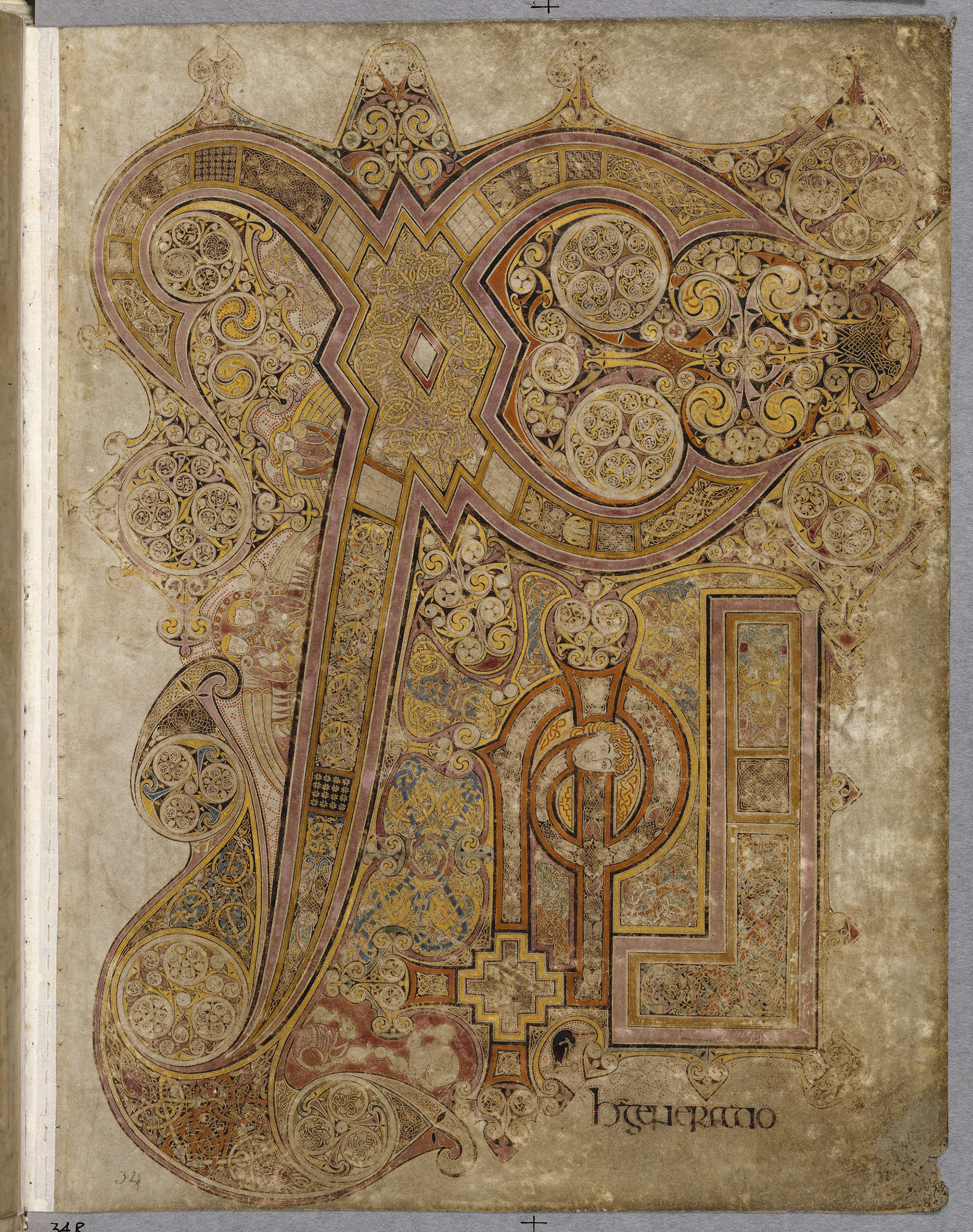
Incipit to the Gospel of John
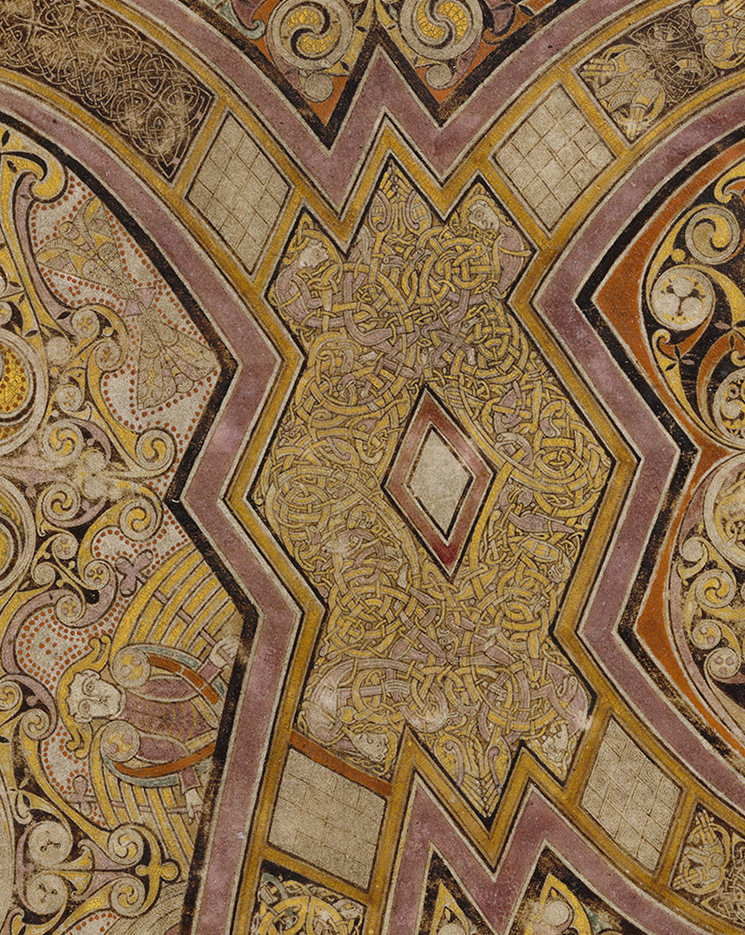
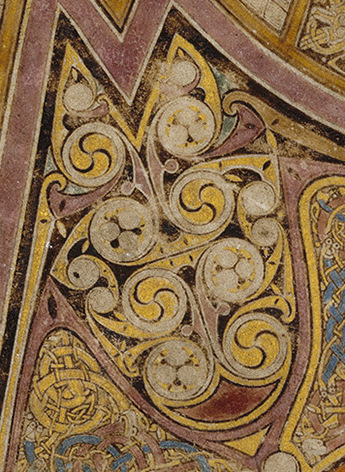
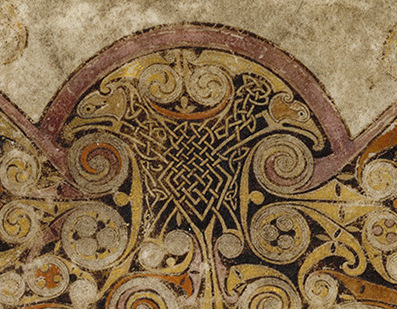
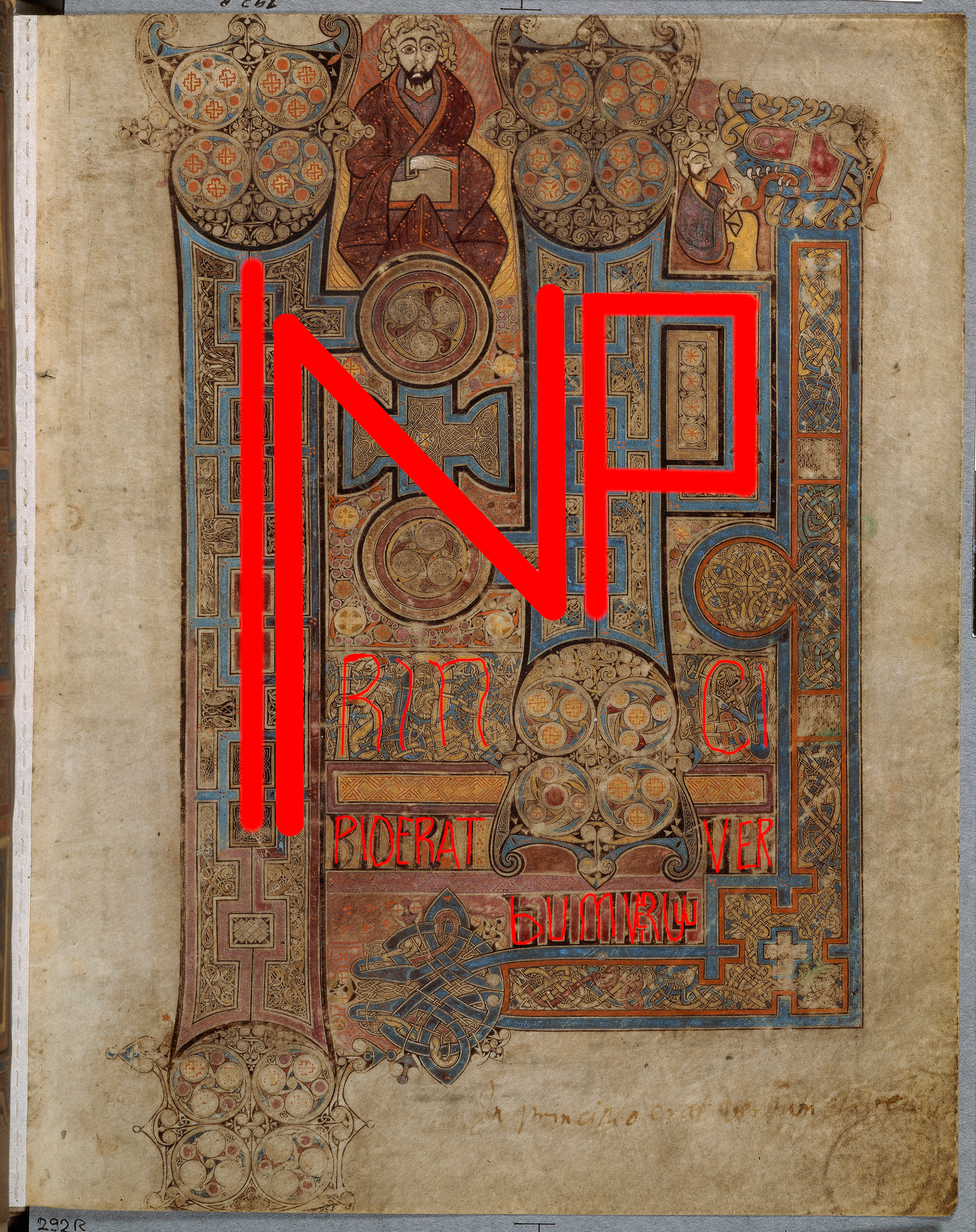
Incipit to the Gospel of John, Book of Kells, ca. 800. Trinity College Dublin MS 58, fol. 292r.

Made by Celtic monks in a Columban monastery around the year 800, the Book of Kells—an illuminated Gospel book named after the monastery of Kells in County Meath, Ireland, where it spent eight centuries—is one of the most beautiful manuscripts ever created. Pictured here is the lavishly decorated opening page of the Gospel of John, which bears the words “In p/rinci/pio erat ver/bum [et] ver[b]um” (“In the beginning was the Word, and the Word . . .”). The passage continues on the following page.

Bernard Meehan, the former head of research collections and keeper of manuscripts at Trinity College Dublin, describes the lettering on folio 292r:

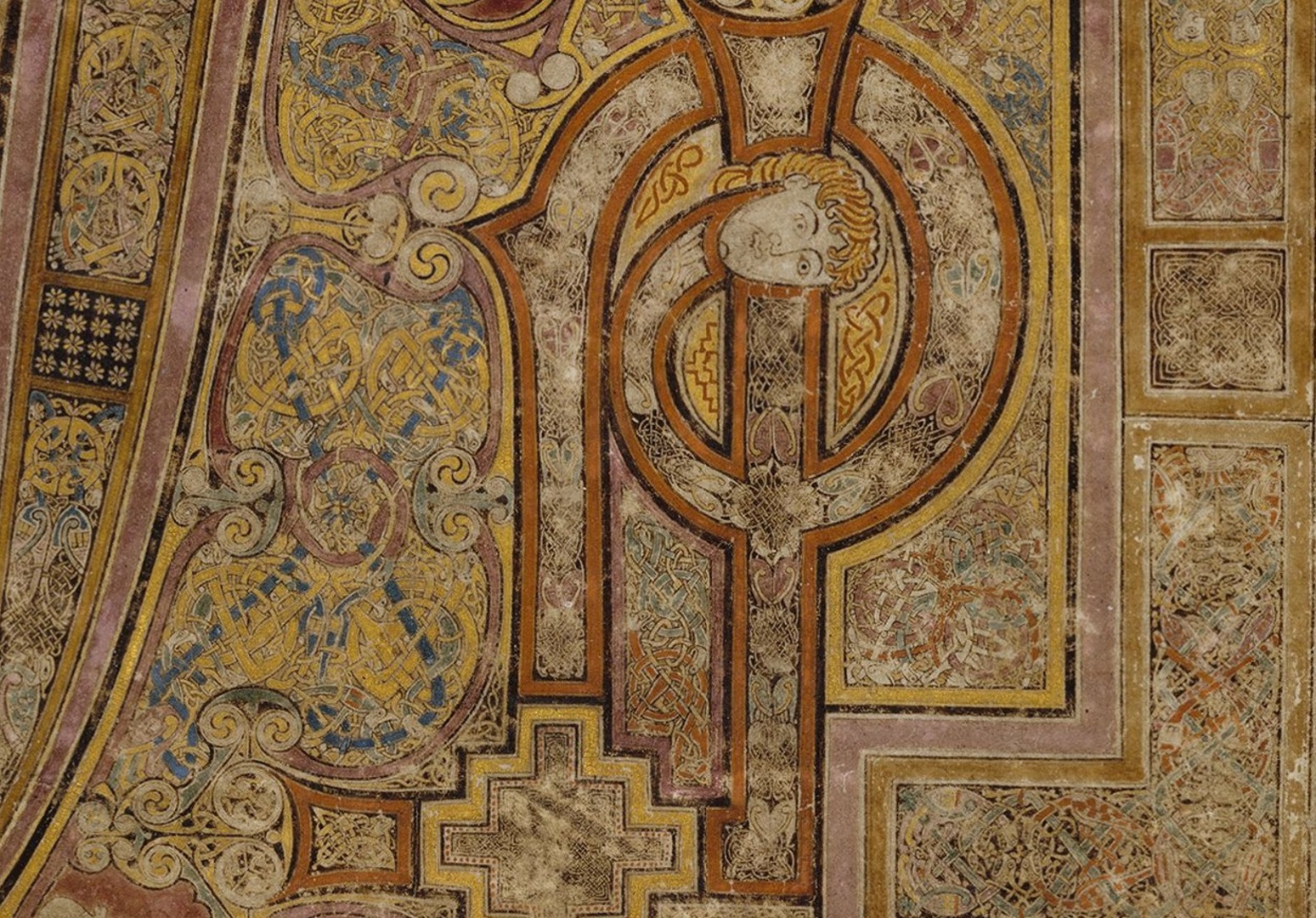
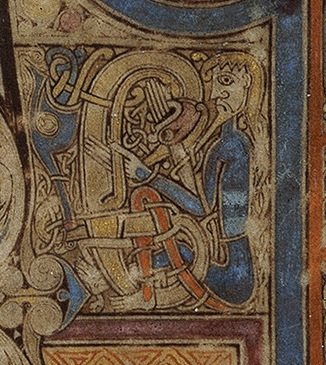
The letters IN P, filled with interlacing snakes, crosses and abstract ornament, dominate the composition. Snakes form the letters RIN and C, with C taking the form of a harp, played by the man who forms the letter I. The urge of the artist to decorate has taken precedence over legibility, to the extent that the letters ET and B are missing from the last line. [1]

Because some of the letters are difficult to discern, I’ve done my best to trace them in red in this graphic:
In the beginning (letters traced)

The text unfolds in four rows. The column on the left forms the I and doubles as the left stem of the N. The diagonal stroke of the N passes through the cross-shape, and its right stem is formed by another blue column, which also doubles as the stem of the P.

The following R, I, N, and C are beige and blue serpentine figures, tangled together, the latter shaped like a harp and being “played” by a seated man whose torso forms an I.
Book of Kells, fol. 292r (detail)

The remaining text is organized in two rows and is black. As Meehan mentioned, the artist-monk unintentionally omitted the ET and B in “et verbum.” And the final M is upside down, an artistic variation.

(Related post: “The Book of Kells,” a poem by Howard Nemerov)
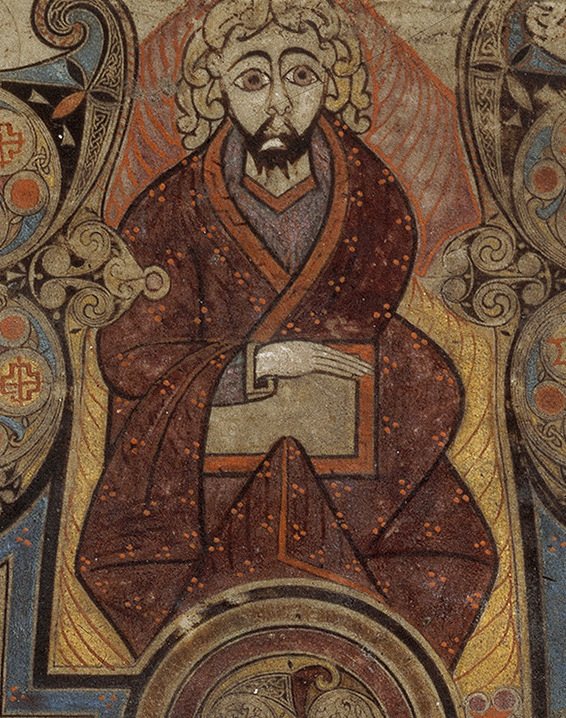
Book of Kells, fol. 292r (Christ)

Scholars disagree on who the curly-haired figure at the top is, holding a book: some suppose it’s John the Evangelist, the author of the fourth Gospel, while others think it’s Christ the Logos. I’m in the latter camp. Christ is often shown in art sitting on a throne holding a book, representing the gospel—as on folio 32v of this very manuscript. And a full-page portrait of John already appears on the opposite page, folio 291v; granted, the iconography is similar, but it would be an unusual choice to repeat a person in the same pose on a single page spread. Also, as art historian Heather Pulliam points out, the yellow and red striations that encompass the figure resemble flame—a “throne of light,” writes Françoise Henry—an attribute more befitting of the figure of Christ than of John. [2]

The identity of the smaller figure on the right who’s drinking from a red chalice is also debated. Again, it could be either John or Christ. According to an apocryphal legend that first appeared in the second-century Acts of John and that was popularized in the thirteenth-century Golden Legend, a pagan priest challenged John to drink a cup of poisoned wine to test whether his God was truly powerful enough to protect him. John blessed the cup, downed the wine, and suffered no harm. That’s why in art one of John’s attributes is a chalice with a serpent in it, representing the poison rising out and the triumph of Christian faith.
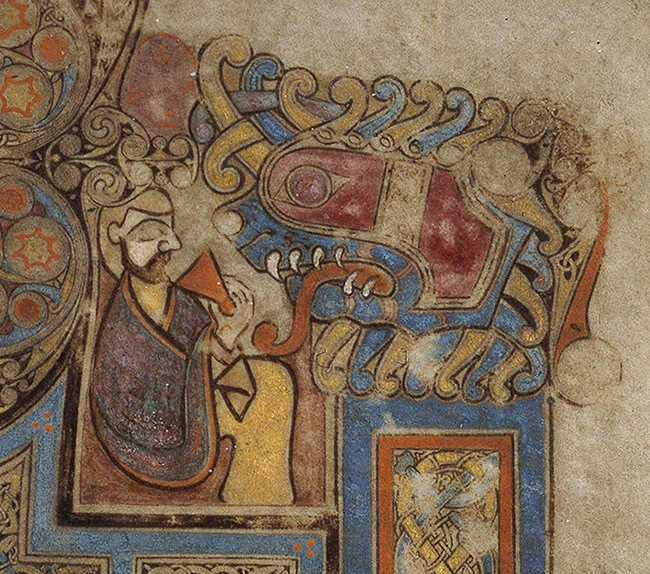
Book of Kells, fol. 292r (detail)

On the other hand, the drinking figure may be Christ drinking the cup of suffering (John 18:11). The monstrous head to the right supports either interpretation—it could be Satan tormenting Christ in Gethsemane, or in John’s case, the threat of death by poison, or the evil intent of the pagan priest who sought to discredit him.

Additional possibilities have also been posited. Małgorzata Krasnodębska-D’Aughton argues that the man is meant to be a generic Christian partaking of the Eucharist, [3] whereas Pulliam suggests that the cup represents not the blood of Christ but “the chalice of wisdom received from the breast of Christ.” [4] She cites Augustine’s first tractate on the Gospel of John:

Thence John, who said these things, received them, brothers, he who lay on the Lord’s breast, and from the breast of the Lord drank in what he might give us to drink. But he gave us words; you ought then to receive understanding from the source, from that which he drank who gave to you; so that you may lift up your eyes to the mountains from where shall come your aid, so that from there you may receive, as it were, the cup, that is, the word, given you to drink; and yet, since your help is from the Lord, who made heaven and earth, you may fill your breast, from the source. [5]

In Pulliam’s interpretation, the man imbibes the words of God—that is, scripture—providing a model for us to emulate.

Click here to digitally browse the Book of Kells in full.

Notes:

  1. Bernard Meehan, The Book of Kells: An Illustrated Introduction to the Manuscript in Trinity College Dublin (Thames & Hudson, 1994, 2008), 34.
  2. Heather Pulliam, Word and Image in the Book of Kells (Four Courts Press, 2006), 180–83; cf. Françoise Henry, The Book of Kells: Reproductions from the Manuscript in Trinity College, Dublin (Thames & Hudson, 1974).
  3. Małgorzata Krasnodębska-D’Aughton, “Decoration of the In principio initials in early Insular manuscripts: Christ as a visible image of the invisible God,” Word and Image: A Journal of Verbal/Visual Enquiry 18, no. 3 (Fall 2002): 117.
  4. Pulliam, Word and Image, 185.
  5. Augustine, In Joannis Evangelium 1.1, PL 35: 1382.

LISTEN: “The Word Was God” by Rosephanye Powell, 1996 | Performed by the University of Pretoria Camerata, dir. Michael Barrett, 2022

In the beginning was the Word, and the Word was with God, and the Word was God.

The same was in the beginning with God.

All things were made that have been made. Nothing was made he has not made.

While this choral anthem is not a Christmas song per se, it is a setting of John 1:1–3, the opening of the great prologue of the Incarnation. These first three verses are about Christ’s eternal being, his oneness with the Father, and his active role in creation. I can’t hear them without anticipating verse 14: “And the Word was made flesh, and dwelt among us . . .”

“The Word Was God” is by Dr. Rosephanye Powell (pronounced ro-SEH-fuh-nee) (born 1962), an African American composer, singer, professor, and researcher. One of her most popular and widely recorded works, it is full of rhythmic energy and drive. Read detailed notes by Powell here, where she explains her musical choices and their theological significance.
“The Book of Kells” by Howard Nemerov (poem)

Out of the living word
Come flower, serpent and bird.

All things that swim or fly
Or go upon the ground,
All shapes that breath can cry
Into the sinews of sound,
That growth can make abound
In the river of the eye
Till speech is three-ply
And the truth triply wound.

Out of the living word
Come flower, serpent and bird.

This poem is from The Next Room of the Dream (University of Chicago Press, 1962) and is compiled in The Collected Poems of Howard Nemerov (University of Chicago Press, 1977). Used by permission of the Estate of Howard Nemerov.

Howard Nemerov (1920–1991) was a major figure in midcentury American poetry, whose Collected Poems won the Pulitzer Prize, the National Book Award, and the Bollingen Prize. He served as US poet laureate from 1963 to 1964 and again from 1988 to 1990, and he also wrote fiction and essays. “Romantic, realist, comedian, satirist, relentless and indefatigable brooder upon the most ancient mysteries—Nemerov is not to be classified,” Joyce Carol Oates remarked in the New Republic. From an artistic family, Nemerov was the older brother of the photographer Diane Arbus.


The exuberantly decorated Book of Kells is widely agreed to be the most beautiful book ever made. The crown jewel of Celtic art, it is a manuscript copy of the Four Holy Gospels in Latin, with ten surviving full-page illuminations and many more marginal illuminations and decorated initials throughout the other 670 pages—the work of three artists and four scribes.

Most art historians believe the book was created on the Scottish island of Iona by a group of monks sometime around 800. Viking raids at that time forced the monks to flee to the monastery of Kells in Ireland; they were able to save the book, but it was left unfinished.

The most famous page from the Book of Kells is folio 34r, often referred to as the Christi autem or Chi-Rho page.

Chi-Rho page
The Chi-Rho page from the Book of Kells, ca. 800. Trinity College Dublin MS 58, fol. 34r.

The page illuminates the “second beginning” of the Gospel of Matthew, following the genealogy and opening the narrative of the life of Christ: Christi autem generatio (“Now the birth of Christ . . .”) (Matt. 1:18). The anonymous artist represents the Holy Name of Jesus with a monogram, enlarged and embellished, consisting of the Greek letters chi (Χ) (pronounced “kai”), rho (ρ), and iota (ι), the first three letters in the word Χριστός, Christos. H generatio (where h is shorthand for autem) is written in Latin in Insular majuscule script at the bottom right of the page.

The chi-rho monogram is accorded special dignity in Christian art. Here the chi takes up nearly the whole page, its arms and legs extending to the four corners, exuding a kinetic energy. It reaches, it leaps; it blossoms and enfolds. It is beautified with intricate interlaces, spirals, and lozenges, and it’s teeming with life! Creatures of the land, air, and sea dwell within and around—cats and mice (nibbling on a eucharistic wafer!), birds and moths, an otter and a fish, humans and angels. There are vines and flowers too, and the whirling gears of the cosmos—all of it spilling out of the precious name of Christ.

Peering out from the inner tip of the rho is a red-haired man. Might this represent Jesus? Scholars tend to think so.

Book of Kells detail (rho with head)

This illuminated page combines word (speech) and Word (Logos) with glorious liveliness. “The decoration of the text of Christ’s birth suggests the identification of Christ incarnate with Christ the Creator-Logos,” writes art historian Jennifer O’Reilly. “Christ as the divine Word is here revealed in a word, a single letter, concealed within the design. Similarly, commentators meditating on the name at this point in Matthew’s gospel, described his divinity as lying hidden in his creation, beneath his human flesh at his Incarnation and beneath the literal letter of the scriptural text.”

(Related posts: “What the Body Knows” by Jean Janzen, poem; “Standing Together in Prayer,” a commentary on Christ on the Mount of Olives from the Book of Kells)

In his ekphrastic poem “The Book of Kells,” Howard Nemerov subtly draws out this theology—Christ as the Creator of the universe in and by whom all things consist (Col. 1:17). Bearing a rhyme scheme of aa bcbccbbc aa, the poem opens and closes with the same couplet: “Out of the living word / Come flower, serpent and bird.” Again, the word “word” is multivalent, referring to the written word “Christ” that fills the Book of Kells page in the form of a stylized monogram, as well as to Christ the person, the living Word of God, the source of all life. It can also refer to the Bible, which is “living and active” (Heb. 4:12) and which reveals Christ.

Nemerov alludes to the Chi-Rho page’s knotwork, its geometric shapes, its zoomorphic interlaces, and its triskeles (triple spirals), glorying in the sacred beauty and abundance they signify, which some unnamed early medieval monk laboriously sketched and painted over the course of who knows how long, to honor the story of the birth of Jesus Christ.

The Book of Kells’ Chi-Rho page is a phenomenal work of art. The symbol of Christ is all-encompassing, and all of creation is united in harmony with it.

The 2009 animated fantasy drama The Secret of Kells, made by the Irish studio Cartoon Salon, features a wondrous animation of the Chi-Rho page at the end, bringing to life some of its many details:

Explore the full Book of Kells on the Digital Collections page of the Library of Trinity College Dublin.

“What the Body Knows” by Jean Janzen

Maybe it’s the ocean’s rhythmic tug
that helps me sleep, my body’s own
surge remembering its deepest pulse.

Think of those Celtic monks who
scaled the slippery rocks carrying
vellum and inks while the sea broke

and battered beneath them. High
in a crevice, a hidden stone hut
with cot and candle. The scribe

dips and swirls his quill to preserve
the story—Luke’s genealogy,
name after name, letters shaped

like birds in every color, a flight
of messengers released into history.
Each word unfurls the promise,

like Gabriel kneeling. The body
knows that wings, like waves,
can break through walls and enter,

that the secret of the story
is love, that even as we sleep,
its tides carry us in a wild safety.

The poem “What the Body Knows” by Jean Janzen is from her collection What the Body Knows (DreamSeeker Books / Cascadia Publishing House, 2015) and is used here by permission of the publisher.

The pages from the early ninth-century Book of Kells (IE TCD MS 58, fols. 200r, 200v, 201r, 201v, 202r) are sourced from the Digital Collections of the Library of Trinity College Dublin. They illuminate Luke 3:23–38 in the Latin Vulgate: Et ipse Iesus erat incipiens quasi annorum triginta ut putabatur filius Ioseph qui fuit Heli qui fuit Matthat qui fuit Levi . . . (“And Jesus himself began to be about thirty years of age, being, as was supposed, the son of Joseph, which was the son of Heli, which was the son of Matthat, which was the son of Levi . . .”) Click on the library link to zoom in and explore more, or on the individual images to view at full resolution.

Luke's genealogy (Book of Kells)

Celtic manuscript illumination of Christ in Gethsemane

I wrote today’s visual meditation for ArtWay, on one of the full-page miniatures in the ninth-century Book of Kells from Ireland: http://www.artway.eu/content.php?id=2063&lang=en&action=show.

Christ on the Mount of Olives (Book of Kells)
Christ on the Mount of Olives, from the Book of Kells (fol. 114v), early 9th century.

The framed lunette above Christ’s head contains a Latin inscription of Matthew 26:30: Et hymo dicto exierunt in montem Oliveti (“After a hymn had been said they left for Mount Olivet”). But the artist gives us a very atypical depiction of that scene, one that cross-references the Old Testament story of Israel’s battle against the Amalekites—in particular, the figures Aaron, Moses, and Hur. Click on the link above to learn more.

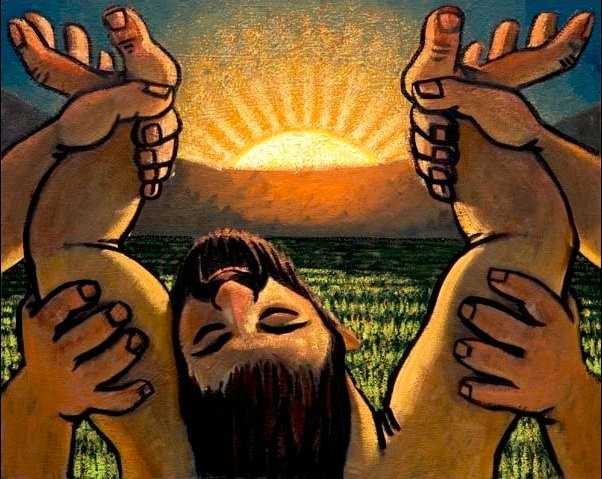
As I prepared commentary on the painting, meditating on its significance, I thought of Wayne Forte’s Community of Prayer—a beautiful image that, like the one from Kells, invokes an ancient battle story as a metaphor for bearing one another up in prayer.

Community of Prayer by Wayne Forte
Wayne Forte (American, 1950–), Community of Prayer, 2009. Oil and acrylic on canvas, 24 × 30 in.

(This is a subject Forte has turned to often. See on his website, for example, And the Battle Was Won; Arms of Prayer; Exodus 17:12 MedallionMoses [Sun Radiating]; Moses on a Rock; Moses with Staff; Moses, Aaron, and Hur; Succour; and Until the Sun Set.)