John Linnell (British, 1792–1882), Wheat, ca. 1860. Oil on canvas, 94.2 × 140.6 cm. National Gallery of Victoria, Australia.
Summer ends now; now, barbarous in beauty, the stooks arise
        Around; up above, what wind-walks! what lovely behaviour
        Of silk-sack clouds! has wilder, wilful-wavier
Meal-drift moulded ever and melted across skies?

I walk, I lift up, I lift up heart, eyes,
        Down all that glory in the heavens to glean our Saviour;
        And, eyes, heart, what looks, what lips yet gave you a
Rapturous love’s greeting of realer, of rounder replies?

And the azurous hung hills are his world-wielding shoulder
        Majestic—as a stallion stalwart, very-violet-sweet!—
These things, these things were here and but the beholder
        Wanting; which two when they once meet,
The heart rears wings bold and bolder
        And hurls for him, O half hurls earth for him off under his feet.
The beauty of Christ suffuses the landscape in “Hurrahing in Harvest” by Gerard Manley Hopkins, written September 1, 1877, while he was studying theology at St Bueno’s College in the Vale of Clwyd, Wales. A hurrah is a jubilant shout, an exclamation of joy, and in this poem the object of that joy is the kingdom of God manifest in a late summer day during the wheat harvest. Hopkins wrote to his friend and fellow poet Robert Bridges—the man who championed his work and is responsible for its being known at all—that “the Hurrahing Sonnet was the outcome of half an hour of extreme enthusiasm as I walked home alone one day from fishing in the Elwy.”
Stooks are bound sheaves of wheat, and Hopkins describes them as savage-looking (“barbarous in beauty”), perhaps suggesting their resemblance to an unkempt head of hair. In their wonderfully wild way, when propped up, they point to the clouds, which glide along moving aerial sidewalks—the wind (“wind-walks”). Through metaphor, Hopkins refers to the clouds as “silk-sack[s]” (they’re bulky yet smooth, substantial yet wispy) and not snowdrift but “meal-drift” (mounds of coarsely ground white grain). The clouds are willful and wavy; they mold together and melt into sky.
Hopkins lifts up his eyes and heart—language reflecting the Sursum corda of the liturgy—to behold the day’s glory. “Down” in line 6 can be read as an adverb or verb: Hopkins looks down across the valley, or he “downs” the scene, takes it all in. And seeing the freshly reaped fields, he “glean[s]” Christ. He likens the rapture he feels to receiving a kiss of greeting from a lover, real and round. Addressing his eyes and heart, he says that no adoring human gaze nor tender human lips have ever imparted such pleasure as Christ imparts through nature.
In the final stanza Hopkins perceives the hills as the majestic shoulders of Christ supporting the sky. He compares Christ to a stallion (wild, strong) and a violet (delicate, humble).
The image of a stallion returns in the second-to-last line, where he says his own heart “rears” (raises upright) wings, which enable him to launch himself upward, his legs pushing off the ground. It’s a leaping of the spirit, an ascent of the soul—an intimate meeting of self and Savior in the goodness of the cloudy-blue afternoon. The Divine is always here, he says, “and but the beholder / Wanting”; that is, lacking awareness.
Throughout the poem there’s a strong sense of propulsion, carried in part by all the alliteration: “barbarous in beauty,” “wind-walks,” “silk-sack,” “wilder, wilful-wavier,” “meal-drift moulded . . . melted . . . ,” “glory . . . glean,” “realer, rounder replies,” “hung hills,” “world-wielding,” “stallion stalwart,” “heart . . . hurls.”
Hopkins’s eyes have been oriented to perceive the spiritual in the material, and the result is ecstasy.
Gerard Manley Hopkins (1844–1889) was a preeminent English poet and a Jesuit priest, whose most famous works include “The Wreck of the Deutschland,” “Pied Beauty,” “God’s Grandeur,” and “The Windhover.” In 1866 he converted from Anglicanism to Roman Catholicism, a decision that estranged him from his family; then he entered the Jesuit novitiate in 1868 and was ordained to the priesthood in 1877. He spent the last five years of his life as a classics professor at University College Dublin, struggling with depression, during which time he wrote the “terrible sonnets,” so-called because of their expression of deep anguish and desolation. Very few of his poems were published during his lifetime, and widespread recognition didn’t come until nearly three decades after his death, in 1918, when his friend Robert Bridges edited the first collection of his poems. Hopkins was the most innovative poet of the Victorian era, his “sprung rhythm” creating new acoustic possibilities and anticipating the modernist movement.
Emily Dickinson (1830–1886) of Amherst, Massachusetts, is one of America’s most celebrated poets. There are hundreds of musical settings, from various genres, of her poems. Here are ten I really like.
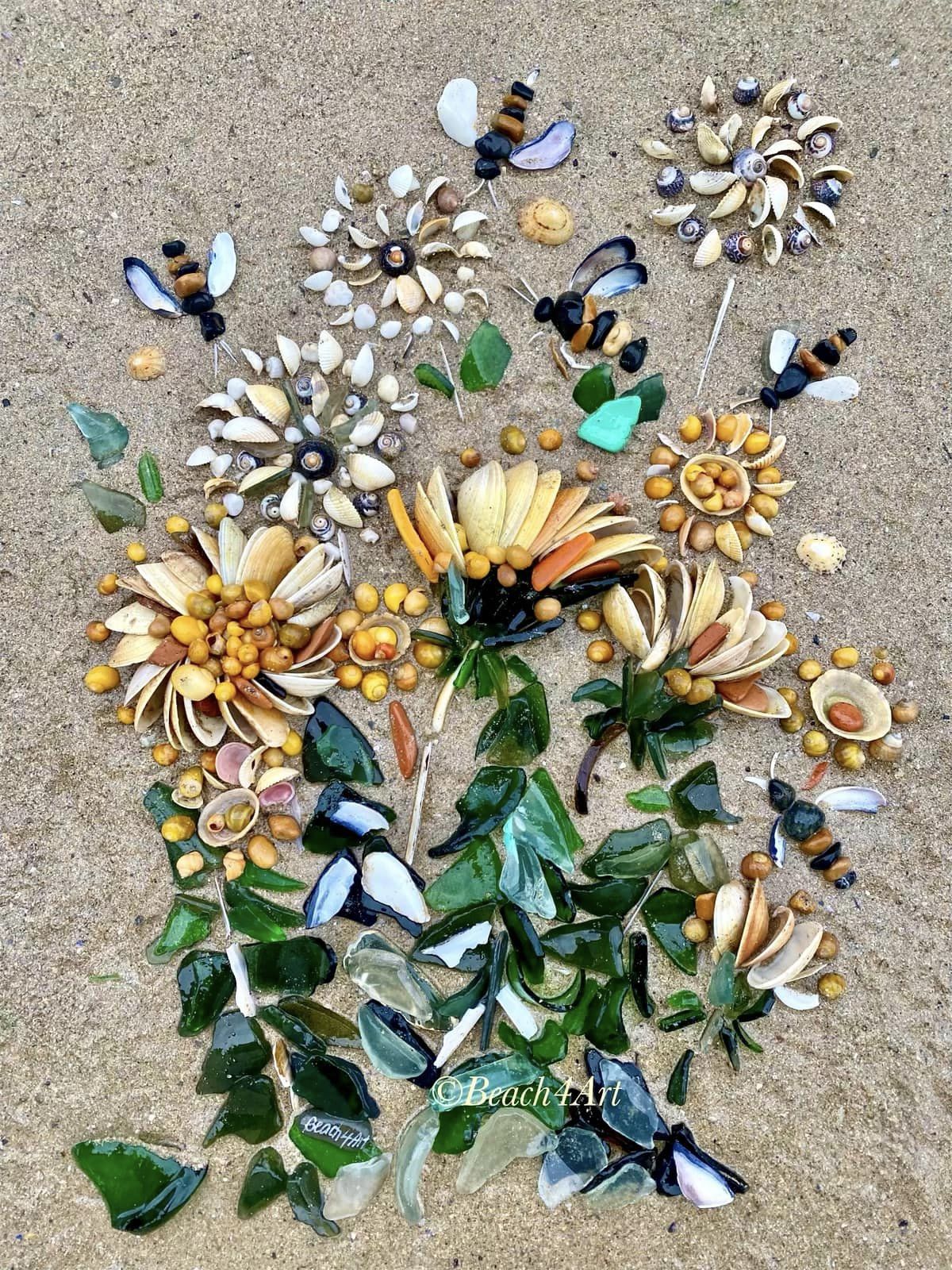
Created by Beach4Art, a family of four who assemble rocks and shells into images on the beaches of Devon, England
1. “I’m Nobody” by Emma Wallace: This is the first poem I ever read by Dickinson—in sixth grade. I was hooked, and I relished the assignment to memorize it and recite it to the class. The idea of being famous was apparently distasteful to Dickinson, and though she was a prolific writer of almost 1,800 poems, only ten were published during her lifetime, and those anonymously; some she sent in letters to friends, but most she kept private. She wrote this one in 1861, and it has contributed to her mystique. Singer-songwriter Emma Wallace turned it into a lovely, understated, minor-key waltz for The Thing with Feathers (2021), one of her several literary-themed albums.
I’m Nobody! Who are you? Are you – Nobody – too? Then there’s a pair of us! Don’t tell! they’d advertise* – you know!
How dreary – to be – Somebody! How public – like a Frog – To tell your name – the livelong June – To an admiring Bog!
* Dickinson often provided alternative words in the margins of her pages, which some editors have favored; “advertise” she marked as a possible substitute for “banish us.”
2.“I Shall Not Live in Vain” by Bard and Ceilidh (Mary Vanhoozer): Mary Vanhoozer’s debut album, Songs of Day and Night(2015), comprises original settings of classic poems by the likes of Emily Dickinson, Christina Rossetti, Henry Wadsworth Longfellow, and others. “Music has a unique ability to transform ordinary things into special things—the mundane into the extraordinary,” she writes. “This song cycle is all about exploring that further. Each song roughly represents an hour of the day. The CD begins at dawn and ends at dusk. As we travel through the day, we learn to perceive familiar objects and situations in a new light, infusing joy and a sense of mystery into the everyday experience.” For this track she is joined by her husband, Josh Rodriguez, on guitar. The text is a sort of purpose statement, committing to a life of love, kindness, and compassionate outreach.
If I can stop one Heart from breaking I shall not live in vain If I can ease one Life the Aching Or cool one Pain
Or help one fainting Robin Unto his Nest again I shall not live in vain.
3. “His Feet Are Shod with Gauze” by Emily Lau: The natural world, especially bees, was one of Dickinson’s favorite topics to write about. I think of her as a poet of summer. (Other great bee poems: “Bee! I’m expecting you!” and “Bees are Black, with Gilt Surcingles –.”) “His Feet are shod with Gauze –,” a panegyric, praises bees’ delicacy, might, and beauty. This musical setting is part of the suite Seven Dickinson Songs by composer and vocalist Emily Lau, which appears on her album Isle of Majesty (2019). Be sure to check out the other songs, including “I Can Wade Grief” and “I Never Saw a Moor,” in which Lau is joined by her chamber music ensemble, The Broken Consort.
His Feet are shod with Gauze – His Helmet, is of Gold, His Breast, a single Onyx With Chrysophras, inlaid –
His Labor is a Chant – His Idleness – a Tune – Oh, for a Bee’s experience Of Clovers, and of Noon!
4. “Some keep the Sabbath going to Church” by Michael McGuane: Dickinson was raised as a Congregationalist but never officially joined the church and by 1868 had stopped attending altogether. Her poems vary in tone toward Christianity, with some expressing devout sentiments and others irreverence. One thing that’s clear is that she often encountered God in nature. In this poem the fruit trees create a sanctuary for her and the birds serve as choir—an elevating, worshipful experience. Christians throughout history have spoken of how the “book of nature” complements the book of scripture, both revealing God’s truth. Here Dickinson acknowledges the same, emphasizing the goodness of creation, our enjoyment of which is sacred. On YouTube, the Americana musician Michael McGuane performs a guitar-picked, folk-rock tune he wrote for the poem.
Some keep the Sabbath going to Church – I keep it, staying at Home – With a Bobolink for a Chorister – And an Orchard, for a Dome –
Some keep the Sabbath in Surplice – I, just wear my Wings – And instead of tolling the Bell, for Church, Our little Sexton – sings.
God preaches, a noted Clergyman – And the sermon is never long, So instead of getting to Heaven, at last – I’m going, all along.
5. “Split the Lark” by Drum & Lace (Sofia degli Alessandri-Hultquist) and Ian Hultquist, feat. Ella Hunt: This pop music setting of “Split the Lark” was written by husband-and-wife composing duo Drum & Lace and Ian Hultquist for the Apple TV+ comedy-drama Dickinson (which I have mixed feelings about). It’s featured in season 2, episode 6, where it’s sung by Ella Hunt, the actress who plays Emily’s sister-in-law (and in the show, secret lover), Susan Huntington Gilbert Dickinson. Emily is attending an opera performance in Boston and imagines—in place of the soprano—Sue, singing her own words to her.
Split the Lark – and you’ll find the Music – Bulb after bulb, in Silver rolled – Scantily dealt to the Summer Morning Saved for your Ear, when Lutes be old –
Loose the Flood – you shall find it patent – Gush after Gush, reserved for you – Scarlet Experiment! Sceptic Thomas! Now, do you doubt that your Bird was true?
Containing echoes of William Wordsworth’s “We murder to dissect,” this poem derides empiricism as the sole method of arriving at truth. The addressee wants to better comprehend the lark’s song, to observe the internal apparatus that enables it to make such beautiful music. Go ahead, the speaker exasperatedly tells him: take up your scalpel and dissect the bird. You’ll unleash a flood of blood and guts (“bulb after bulb” could refer to globular anatomical structures—e.g., the aortic bulb, the jugular bulb—or organs, or to musical notes). But would such prying really bring you closer to knowing the lark? Your experiment will have only caused the song to stop. The poem references the apostle Thomas, who demanded physical proof of Christ’s resurrection (personally, I think he’s unfairly maligned for this; his probing does, in fact, lead him to a deeper level of knowledge).
Dickinson was very much a supporter of science, but she also recognized its limitations when it comes to explaining certain mysteries or trying to produce physical evidence of the invisible. On one level, this poem may describe Dickinson’s stance on poetry, which, once you start to pick it apart, can sometimes lose its magic. I’m all for poetic analysis, but there’s something to be said for simply letting the sounds and musicality of poetic verse wash over you without going at it with a scalpel.
6. “I Had No Time to Hate” by Gerda Blok-Wilson: Look what Dickinson can do with the cliché “Life is too short to be angry”! She had a dark wit, which you get a glimmer of here. The poem is structured in two stanzas, the first about hate, so we might expect the second to wax rhapsodic about the virtues of love. But instead we get a matter-of-fact admission that life is also too short to complete the work of love. However, because we must choose either hate or love, she chooses love—it’s for us to fill in why it’s the superior choice. I like the interplay of littleness and largeness, suggesting that even in small caring acts, there’s a substantiality and a sufficiency, no matter how imperfect our love may be. The following recording, from June 2021, is of the premiere performance of Gerda Blok-Wilson’s choral setting of “I had no time to Hate –” by the Vancouver Chamber Choir, directed by Kari Turunen.
I had no time to Hate – Because The Grave would hinder me – And Life was not so Ample I Could finish – Enmity –
Nor had I time to Love – But since Some Industry must be – The little Toil of Love – I thought Be large enough for Me –
7. “I felt a Funeral, in my Brain” by Andrew Bird, feat. Phoebe Bridgers: This is another Dickinson poem that made a strong impression on me when I read it in school—what a fabulous first line. Though some have interpreted the poem as Dickinson imagining her own funeral, I see the funeral as a metaphor—for, possibly, the loss of a cherished friendship, long-held belief, or hope or dream, any of which would take a heavy psychological toll, or for the temporary loss of sanity, a mental breakdown, due to some stressor. The mood is oppressive, and the speaker grows increasingly unraveled. The singer-songwriter, violinist, and whistler Andrew Bird set the poem to “a simple two-note melody,” he said, and, in collaboration with the Emily Dickinson Museum in Amherst, made a music video featuring Dickinson’s handwriting and footage of her lifelong home.
I felt a Funeral, in my Brain, And Mourners to and fro Kept treading – treading – till it seemed That Sense was breaking through –
And when they all were seated, A Service, like a Drum – Kept beating – beating – till I thought My mind was going numb –
And then I heard them lift a Box And creak across my Soul With those same Boots of Lead, again, Then Space – began to toll,
As all the Heavens were a Bell, And Being, but an Ear, And I, and Silence, some strange Race Wrecked, solitary, here –
And then a Plank in Reason, broke, And I dropped down, and down – And hit a World, at every plunge, And Finished knowing – then –
8. “Because I Could Not Stop for Death” by Susan McKeown: From the 2002 album Prophecy by Susan McKeown, a Grammy-winning musical artist from Ireland, this song takes as its lyrics one of Dickinson’s most famous poems, one that promotes a gentle, welcoming attitude toward death. It personifies Death as a kindly gentleman driving a carriage, transporting the speaker at a casual pace past the final traces of her mortal life and into eternity. (Note: Emma Wallace, from the first entry, also wrote a compelling setting!)
Because I could not stop for Death – He kindly stopped for me – The Carriage held but just Ourselves – And Immortality.
We slowly drove – He knew no haste And I had put away My labor and my leisure too, For His Civility –
We passed the School, where Children strove At Recess – in the Ring – We passed the Fields of Gazing Grain – We passed the Setting Sun –
Or rather – He passed Us – The Dews drew quivering and Chill – For only Gossamer, my Gown – My Tippet – only Tulle –
We paused before a House that seemed A Swelling of the Ground – The Roof was scarcely visible – The Cornice – in the Ground –
Since then – ’tis Centuries – and yet Feels shorter than the Day I first surmised the Horses’ Heads Were toward Eternity –
9. “Hope’s the Thing with Feathers” by Julie Lee: Another classic poem, this one about the warmth and persistence of hope. Julie Lee gives it an uplifting banjo tune.
“Hope” is the thing with feathers – That perches in the soul – And sings the tune without the words – And never stops – at all –
And sweetest – in the Gale – is heard – And sore must be the storm – That could abash the little Bird That kept so many warm –
I’ve heard it in the chillest land – And on the strangest Sea – Yet – never – in Extremity, It asked a crumb – of me.
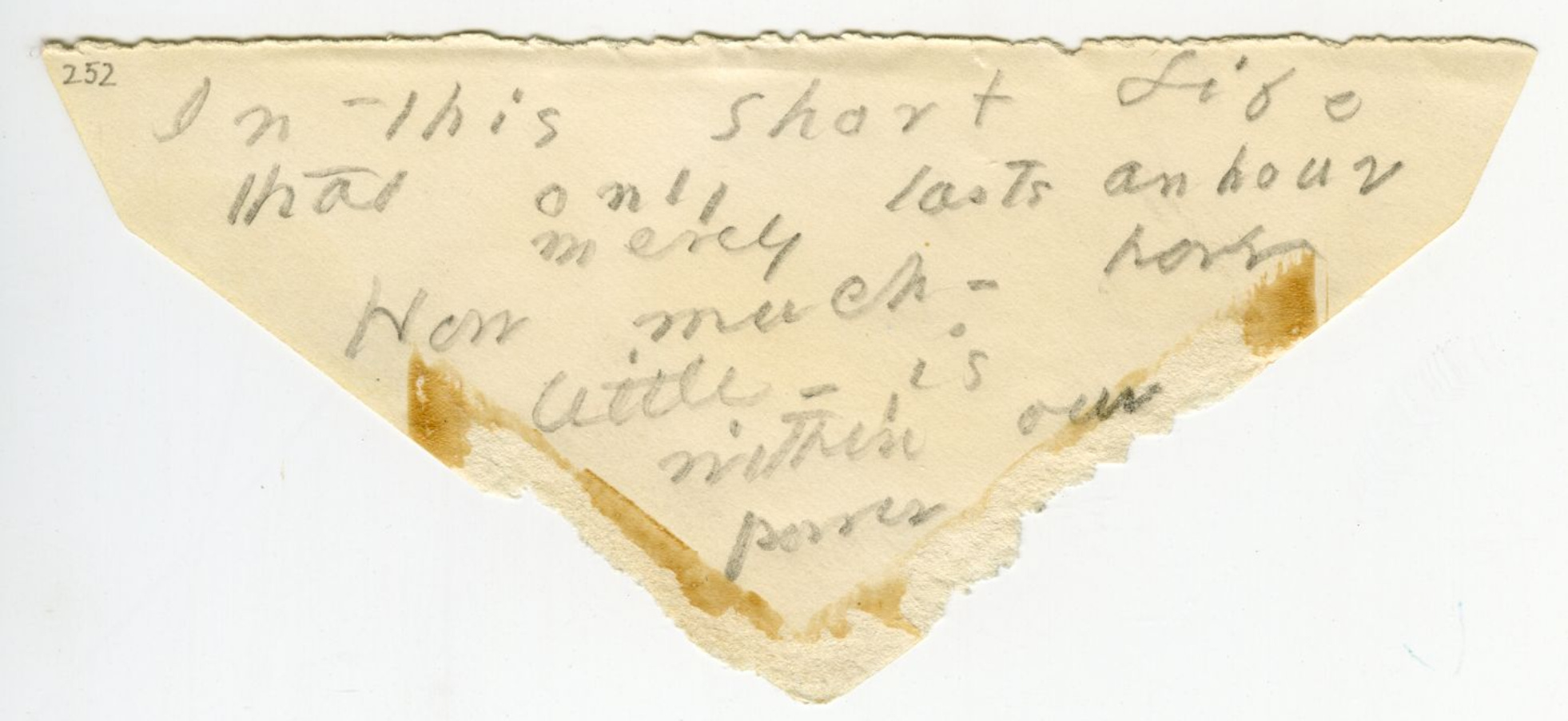
10. “In this short Life” by Scott Joiner: Dickinson wrote this compact poem of just two lines on an upcycled envelope flap, as she was wont to do, around 1873 and saved it. It expresses the paradox that we humans possess free will, a potent trait, and yet so many things are beyond our control. Composer Scott Joiner wrote a piece for voice and piano for this text, performed by Jessica Fishenfeld and Milena Gligić on the album Emily that released just this month (it features settings by Joiner of five poems by Dickinson and five by her near contemporary from across the pond, Emily Brontë). The tone is contemplative and resigned.
In this short Life that only lasts an hour How much – how little – is within our power
Envelope poem by Emily Dickinson, ca. 1873, from the Emily Dickinson Collection, Amherst College (Amherst Manuscript #252, Box 3, Folder 88)
Emilie Mediz-Pelikan (Austrian, 1861–1908), Blooming Chestnut Trees, 1900. Oil on canvas, 132 × 124 cm. Belvedere, Vienna.
Because I love
        The sun pours out its rays of living gold,
        Pours out its gold and silver on the sea.

Because I love
        The earth upon her astral spindle winds
        Her ecstasy-producing dance.

Because I love
        Clouds travel on the winds through wide skies,
        Skies wide and beautiful, blue and deep.

Because I love
        Wind blows white sails,
        The wind blows over flowers, the sweet wind blows.

Because I love
        The ferns grow green, and green the grass, and green
        The transparent sunlit trees.

Because I love
        Larks rise up from the grass
        And all the leaves are full of singing birds.

Because I love
        The summer air quivers with a thousand wings,
        Myriads of jewelled eyes burn in the light.

Because I love
        The iridescent shells upon the sand
        Take forms as fine and intricate as thought.

Because I love
        There is an invisible way across the sky,
        Birds travel by that way, the sun and moon
        And all the stars travel that path by night.

Because I love
        There is a river flowing all night long.

Because I love
        All night the river flows into my sleep,
        Ten thousand living things are sleeping in my arms,
        And sleeping wake, and flowing are at rest.
“Amo Ergo Sum” (Latin for “I Love, Therefore I Am”) by Kathleen Raine is from The Year One (London: Hamish Hamilton, 1952) and is compiled in The Collected Poems of Kathleen Raine (Ipswich: Golgonooza Press, 2000).
Kathleen Raine (1908–2003) was a British poet and William Blake scholar who fervently promoted spiritual values in an age marked by secular materialism. She was born in Ilford, Essex, and raised in a Methodist household (her father was a lay minister), converting to Catholicism in the 1940s, but, following her interests in Jungian psychology, Neoplatonism, and sacred symbols, she came to embrace the perennial philosophy, which views religious traditions as sharing a single metaphysical truth. With Keith Critchlow, Brian Keeble, and Philip Sherrard and the patronage of then Prince Charles of Wales, Raine founded the Temenos Academy of Integral Studies in 1990, a London charity that offers education in philosophy and the arts in “the light of the sacred traditions of East and West.” Raine authored more than thirty books, both poetry and prose, and her honors and awards include the CBE (Commander of the Order of the British Empire) and the Queen’s Gold Medal for Poetry.
Phil Greenwood (Welsh, 1943–), Blossom, 2003. Etching and aquatint, 67 × 59 cm. Edition of 150.
I have been out today in field and wood,
Listening to praises sweet and counsel good
Such as a little child had understood,
              That, in its tender youth,
Discerns the simple eloquence of truth.

The modest blossoms, crowding round my way,
Though they had nothing great or grand to say,
Gave out their fragrance to the wind all day;
              Because his loving breath,
With soft persistence, won them back from death.

And the right royal lily, putting on
Her robes, more rich than those of Solomon,
Opened her gorgeous missal in the sun,
              And thanked him soft and low,
Whose gracious, liberal hand had clothed her so.

When wearied, on the meadow-grass I sank,
So narrow was the rill from which I drank,
An infant might have stepped from bank to bank;
              And the tall rushes near,
Lapping together, hid its waters clear.

Yet to the ocean joyously it went,
And, rippling in the fulness of content,
Watered the pretty flowers that o’er it leant;
              For all the banks were spread
With delicate flowers that on its bounty fed.

The stately maize, a fair and goodly sight,
With serried spear-points bristling sharp and bright,
Shook out his yellow tresses, for delight,
              To all their tawny length,
Like Samson, glorying in his lusty strength.

And every little bird upon the tree,
Ruffling his plumage bright, for ecstasy,
Sang in the wild insanity of glee;
              And seemed, in the same lays,
Calling his mate and uttering songs of praise.

The golden grasshopper did chirp and sing;
The plain bee, busy with her housekeeping,
Kept humming cheerfully upon the wing,
              As if she understood
That, with contentment, labor was a good.

I saw each creature, in his own best place,
To the Creator lift a smiling face,
Praising continually his wondrous grace;
              As if the best of all
Life’s countless blessings was to live at all!

So with a book of sermons, plain and true,
Hid in my heart, where I might turn them through,
I went home softly, through the falling dew,
              Still listening, rapt and calm,
To Nature giving out her evening psalm.
This poem was originally published in Poems of Faith, Hope, and Love by Phoebe Cary (Hurd and Houghton, 1867) and is in the public domain.
Phoebe Cary (1824–1871) was an American poet whose verse focuses on themes of religion, nature, and feminism. She grew up on a farm near Cincinnati, Ohio, the sixth of nine children. She was particularly close with her older sister Alice, also a writer, with whom she copublished a volume of poetry in 1849 before going on to publish books of her own. Buoyed by the recognition they received from such luminaries as Edgar Allan Poe and John Greenleaf Whittier, in 1850 the two sisters moved to New York City together, where they contributed regularly to national periodicals and hosted a weekly Sunday evening salon attended by East Coast literati. Phoebe was active in the early days of the women’s rights movement, serving as an assistant editor for The Revolution, Susan B. Anthony’s suffrage newspaper. She died of hepatitis at age forty-six, just six months after Alice.
Paul Klee (Swiss, 1879–1940), Heitere Gebirgslandschaft (Joyful Mountain Landscape), 1929. Oil on board, 17 5/16 × 24 13/16 in. (43.9 × 63.1 cm). Yale University Art Gallery, New Haven, Connecticut.
By awesome deeds you answer us with righteousness,
O God of our salvation,
the hope of all the ends of the earth
and of the farthest seas;
the one who by his strength established the mountains,
being girded with might;
who stills the roaring of the seas,
the roaring of their waves,
the tumult of the peoples,
so that those who dwell at the ends of the earth are in awe at your signs.
You make the going out of the morning and the evening to shout for joy.
You visit the earth and water it;
you greatly enrich it;
the river of God is full of water;
you provide their grain,
for so you have prepared it.
You water its furrows abundantly,
settling its ridges,
softening it with showers,
and blessing its growth.
You crown the year with your bounty;
your wagon tracks overflow with abundance.
The pastures of the wilderness overflow,
the hills gird themselves with joy,
the meadows clothe themselves with flocks,
the valleys deck themselves with grain,
they shout and sing together for joy.
—Psalm 65:5–13
Psalm 65 is a such a magnificent praise song, and I especially love the expression in verse 12: “the hills gird themselves with joy” (ESV). Other translations have “the little hills rejoice on every side” (KJV), “the hillsides blossom with joy” (NLT), and “the hills [are set] to dancing” (MSG). The picture extends into the final verse, where, along with pastures, meadows, and valleys, the mountains “shout and sing” to their Creator. Last year when I saw Paul Klee’s Joyful Mountain Landscape at the Yale University Art Gallery, I instantly thought of this psalm—of how nature sings praises to God simply by being itself.
Human beings are called to join in creation’s joyful song.
SONG: “I Sing the Mighty Power of God” | Words by Isaac Watts, 1715 | Music (tune: ELLACOMBE) from Gesangbuch der Herzogl, Württemberg, 1784
I sing the mighty power of God
that made the mountains rise,
that spread the flowing seas abroad
and built the lofty skies.
I sing the wisdom that ordained
the sun to rule the day;
the moon shines full at his command,
and all the stars obey.
I sing the goodness of the Lord
that filled the earth with food;
he formed the creatures with his word
and then pronounced them good.
Lord, how thy wonders are displayed,
where’er I turn my eye,
if I survey the ground I tread
or gaze upon the sky.
There’s not a plant or flower below
but makes thy glories known,
and clouds arise and tempests blow
by order from thy throne;
while all that borrows life from thee
is ever in thy care,
and everywhere that man can be,
thou, God, art present there.
For a fairly traditional rendition of this classic hymn, here’s a three-part a cappella arrangement performed by the Ball Brothers in 2012:
If you prefer a more modern sound, check out the version by Ben Thomas on the 2015 album Bring Forth. Thomas wrote a new melody for the song and recorded it under the title “I Sing the Goodness” (using the language of verse 2 instead of 1).
The whole Bring Forth album is great, which takes as its basis thirteen hymn lyrics dating from the fourth through twentieth centuries—“all seeking to find the Divine in the everyday elements of our existence,” Thomas says. Thomas adapted and retuned the hymns and released them in three movements that echo the cycle of time: Dawn, Day, and Dusk. To guide you through your listening, there is a meditation and prayer for each movement published on his website.
Other favorites of mine from the album are “Creator God, Creating Still,” “Tell Me the Old, Old Story,” “Lord of All Being,” “Peace, Troubled Soul,” and “Bring Forth.”
This post belongs to the weekly series Artful Devotion. If you can’t view the music player in your email or RSS reader, try opening the post in your browser.
To view all the Revised Common Lectionary scripture readings for Proper 10, cycle A, click here.
Beneath the intricate network of noise
there’s a still more persistent tapestry
woven of whispers, murmurs and chants
It’s the heaving breath of the very earth
carrying along the prayer of all things:
trees, ants, stones, creeks and mountains alike
All giving silent thanks and remembrance
each moment, as a tug on a rosary bead
while we hurry past, heedless of the mysteries
And, yet, every secret wants to be told
every shy creature to approach and trust us
if we patiently listen, with all our senses.
“Breath” by Yahia Lababidi appears in Barely There: Short Poems (Wipf and Stock, 2013) and is used by permission of the publisher. Photograph by Don Komarechka, used with permission.
+++
Lately I’ve been delving into the writings of the Egyptian American poet, aphorist, and essayist Yahia Lababidi. I love his Barely There collection of poems on such topics as poetry / the poet, spiritual longing, virtue and vice, hope, surrender, the quiet beauty of nature, attention and gratitude, and pain as a gift. It’s such a wise and tender collection. His latest book, released last month, is Revolutions of the Heart: Literary, Cultural, and Spiritual.
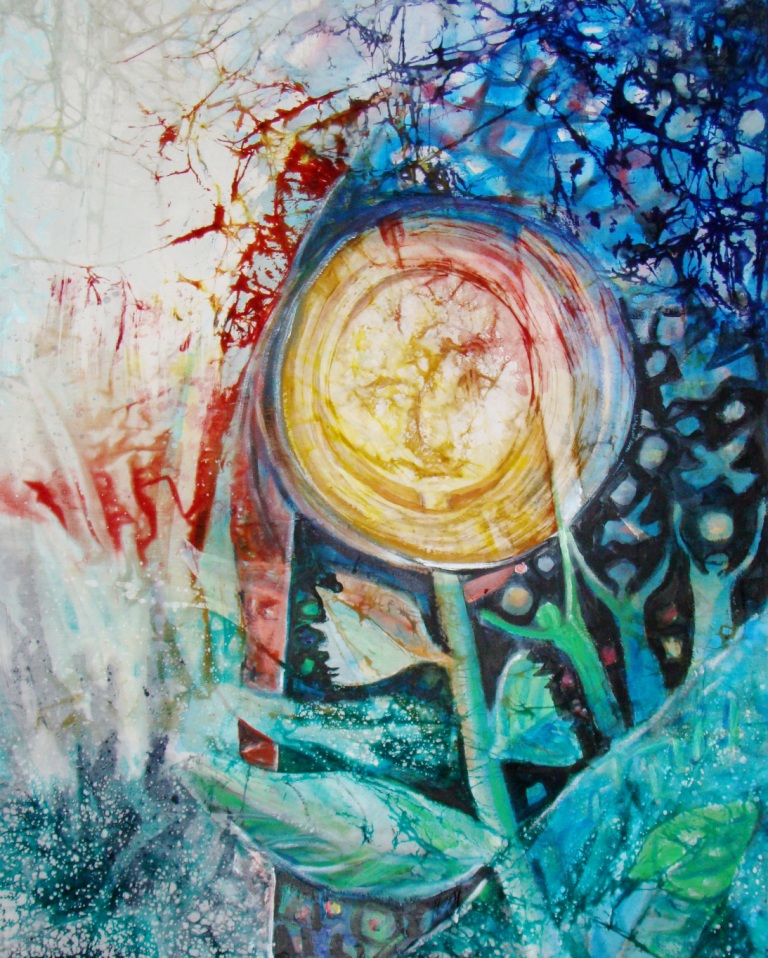
Untitled batik painting by Tony Nwachukwu (Nigerian, 1959–)
Praise the LORD!
Praise the LORD from the heavens;
praise him in the heights!
Praise him, all his angels;
praise him, all his hosts!
Praise him, sun and moon,
praise him, all you shining stars!
Praise him, you highest heavens,
and you waters above the heavens!
Let them praise the name of the LORD!
For he commanded and they were created.
And he established them forever and ever;
he gave a decree, and it shall not pass away.
Praise the LORD from the earth,
you great sea creatures and all deeps,
fire and hail, snow and mist,
stormy wind fulfilling his word!
Mountains and all hills,
fruit trees and all cedars!
Beasts and all livestock,
creeping things and flying birds!
Kings of the earth and all peoples,
princes and all rulers of the earth!
Young men and maidens together,
old men and children!
Let them praise the name of the LORD,
for his name alone is exalted;
his majesty is above earth and heaven.
He has raised up a horn for his people,
praise for all his saints,
for the people of Israel who are near to him.
Praise the LORD!
The above performance, by folk duo All Sons & Daughters (Leslie Jordan and David Leonard), was filmed in the small town of Assisi, Italy, where St. Francis penned his beautiful canticle of all creation, addressing the elements of nature as siblings—Sister Sun, Brother Moon, and so on. Almost seven hundred years later, British pastor William H. Draper paraphrased the poem (which was originally written in the Umbrian dialect) to create “All Creatures of Our God and King,” now a classic of Christian hymnody.
The constant noise in the background is, I believe, cicadas.
All creatures of our God and King,
lift up your voice and with us sing
alleluia, alleluia!
Thou burning sun with golden beam,
thou silver moon with softer gleam,
O praise him, O praise him,
alleluia, alleluia, alleluia!
Thou rushing wind that art so strong,
ye clouds that sail in heav’n along,
O praise him, alleluia!
Thou rising morn, in praise rejoice,
ye lights of evening, find a voice,
O praise him, O praise him,
alleluia, alleluia, alleluia!
Thou flowing water, pure and clear,
make music for thy Lord to hear,
alleluia, alleluia!
Thou fire so masterful and bright,
that givest man both warmth and light,
O praise him, O praise him,
alleluia, alleluia, alleluia!
And all ye men of tender heart,
forgiving others, take your part,
O sing ye, alleluia!
Ye who long pain and sorrow bear,
praise God and on him cast your care,
O praise him, O praise him,
alleluia, alleluia, alleluia!
Let all things their Creator bless,
and worship him in humbleness,
O praise him, alleluia!
Praise, praise the Father, praise the Son,
and praise the Spirit, three in one.
O praise him, O praise him,
alleluia, alleluia, alleluia!
This post belongs to the weekly series Artful Devotion. If you can’t view the music player in your email or RSS reader, try opening the post in your browser.
To view all the Revised Common Lectionary scripture readings for the Fifth Sunday of Easter, cycle C, click here.
Fumihiro Kato (Japanese, 1958–), Untitled (No. 29). Oil on canvas, 91 × 116.7 cm.
The heavens declare the glory of God,
and the sky above proclaims his handiwork.
Day to day pours out speech,
and night to night reveals knowledge.
There is no speech, nor are there words,
whose voice is not heard.
Their voice goes out through all the earth,
and their words to the end of the world.
In them he has set a tent for the sun,
which comes out like a bridegroom leaving his chamber,
and, like a strong man, runs its course with joy.
Its rising is from the end of the heavens,
and its circuit to the end of them,
and there is nothing hidden from its heat.
—Psalm 19:1–6 (ESV)
God’s glory is on tour in the skies,
God-craft on exhibit across the horizon.
Madame Day holds classes every morning,
Professor Night lectures each evening.
Their words aren’t heard,
their voices aren’t recorded,
But their silence fills the earth:
unspoken truth is everywhere.
God makes a huge dome
for the sun—a superdome!
The morning sun’s a new husband
leaping from his honeymoon bed,
The daybreaking sun an athlete
racing to the tape.
That’s how God’s Word vaults across the skies
from sunrise to sunset,
Melting ice, scorching deserts,
warming hearts to faith.
—Psalm 19:1–6 (The Message)
+++
SONG: “The Spacious Firmament” | Words by Joseph Addison, 18th century | Music by Herbert Sumsion, 20th century | Performed by the Ecclesium Choir, 2005
The spacious firmament on high,
With all the blue ethereal sky,
And spangled heavens, a shining frame,
Their great Original proclaim.
The unwearied sun from day to day
Does his Creator’s power display,
And publishes to every land
The work of an almighty hand.
Soon as the evening shades prevail,
The moon takes up the wondrous tale,
And nightly to the listening earth
Repeats the story of her birth:
Whilst all the stars that round her burn,
And all the planets in their turn,
Confirm the tidings, as they roll,
And spread the truth from pole to pole.
What though in solemn silence all
Move round the dark terrestrial ball?
What though no real voice nor sound
Amid their radiant orbs be found?
In reason’s ear they shall rejoice,
And utter forth a glorious voice,
Forever singing as they shine,
“The hand that made us is divine.”
Sumsion’s setting of Addison’s hymn text for SATB and organ is beautiful, but it’s too complex for congregational singing. For those of you who want to introduce this hymn to your church with a more singable melody, there are two precedents: you could use either LONDON by John Sheeles, composed around 1720 (listen here), or CREATION, taken from the chorus “The Heavens Are Telling” in Haydn’s 1798 oratorio The Creation (adapted, e.g., in The Hymnal 1982 #409).
This post belongs to the weekly series Artful Devotion. If you can’t view the music player in your email or RSS reader, try opening the post in your browser.
To view all the Revised Common Lectionary scripture readings for Proper 19, cycle B, click here.






 Art & Theology