Book Review: Accumulated Lessons in Displacement: Poems by Rachel E. Hicks

. . . each day a misery and a marvel, each person also.

—Rachel E. Hicks, from “Accumulated Lessons in Displacement”

A white American born in the foothills of the Himalayas to international school educators, Rachel E. Hicks is a second-generation third-culture kid (TCK) whose writing reflects decades of living as a global nomad, exploring themes of memory, connection, suffering, exile (both physical and spiritual), hospitality, and hope. She grew up in six countries—India, Pakistan, the United States, Jordan, the Democratic Republic of the Congo, and Hong Kong—and spent seven years as an adult in Chengdu, China, where she worked for the relief and development organization Food for the Hungry.

In 2013, she, her husband, and their two kids repatriated to the US, settling in Baltimore, where they live today. Hicks has lived in Baltimore longer than in any other city. But even with this rootedness, “the soil of each place in which I’ve lived still clings,” she says.
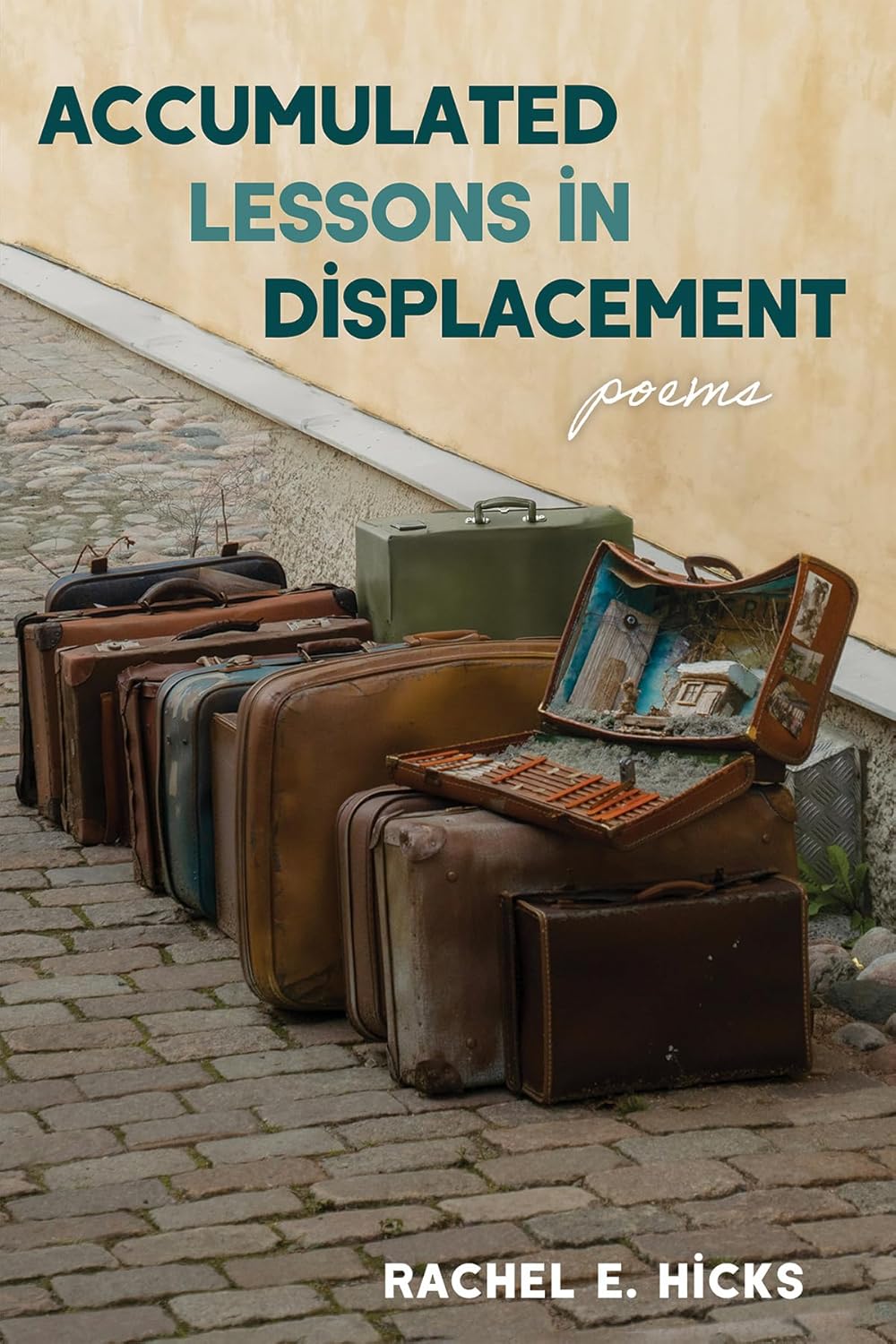
Accumulated Lessons in Displacement

In her debut poetry collection, Accumulated Lessons in Displacement (Wipf & Stock / Resource Publications, 2025), Hicks grapples with the experience of being a “perpetual pilgrim”—on her way to a particular place but also attuned to the significance of each moment along the way. “Pilgrims learn to walk a life of paradox: even though their hearts are set on their final destination, they walk through each day alive to its possibilities, people and lessons,” she wrote in a 2014 blog post.

What is “home”? How can we bear to leave home, whether forced to do so by war, famine, or natural disaster, or we choose to for opportunity or ministry? What do we do with feelings of alienation when we find ourselves in a culture not our own or in which we don’t fit well? How do we live cross-culturally? How do we make a home where we’re at? What are our responsibilities to place? Who is our neighbor?

“I believe that many—all?—of us live our lives with some sense of exile,” Hicks writes on her blog. “We experience it and are aware of it to varying degrees, but it’s there. So many of our quests, our longings, our purpose-seeking, and the stories we create and tell are about trying to find our way home. Home being that place—literal or figurative—in which we feel wholeness and true belonging.”

Accumulated Lessons is divided into two parts: “Bright Sadness, Bitter Joy” and “A Deeper Knowing.” The term “bright sadness”—a translation of the Greek word charmolypê—comes from the Eastern Orthodox tradition, and it describes the paradoxical state of mourning over sin while rejoicing in God’s grace. It can also describe the paradox of living a life of joy amid suffering.

I was trying to learn the word for joy

that settles awkwardly in grief’s nest, an oversized bird.
I didn’t want to scare it away.

So says the speaker in the book’s title poem, “Accumulated Lessons in Displacement.” Unfolding over eight sections, this persona poem draws on Hicks’s own experience of abrupt displacement from Kinshasa as a teenager, as well as the experiences of Bosnian refugee friends, and Syrian refugees she had only read about in the news.

It opens with a reflection on “home” in all its ordinariness—the yellow coffee cup, the dusty houseplant, the sunlit window seat—and laments that “no footpath exists leading back to these things,” which, the reader is led to presume, have been destroyed by armed conflict, or its residents blocked from returning by threat of death.

The poem contains several arresting images, like the green threads of a sweater on barbed wire tracing a path across miles. A boy who collects bullet casings to make a necklace for his sister. Charred diary pages dancing around a blown-out living room, “ma[king] a strange poem in my heart.”

Hicks wrestles with the savage violence humans are capable of:

It makes no sense that a soldier can press a button

and somewhere a baby ignites into flame.
And he goes home and brushes his teeth.

What we do to each other, to other created souls.
Always I carry this burden like a child on my hip.

Another powerful poem in the collection is “Visit to Sarajevo,” where Hicks describes visiting the Bosnian-Herzegovinan capital with her friend Dragan, who was forced to flee it as a young married adult with a child in the 1990s after the city was besieged by Serbian forces. Hicks had met Dragan and his family in 2000 through her husband, Jim, who worked alongside him at a refugee resettlement agency in Phoenix, Arizona, and the families became close. Meeting up years later in Dragan’s hometown, Dragan leads Hicks through the once-familiar streets “in a haze of pride, nostalgia, nightmare,” giving her a tour of sites both historically significant and deeply personal.

Hicks’s passport country too has its national traumas, one of which was precipitated by 9/11, when in 2001, terrorists flew planes into the World Trade Center in New York City, killing almost three thousand people. In “Disaster Chaplaincy Training,” she describes a course she took, taught by a Ground Zero worker, to become further equipped for her work in China, which was focused on disaster preparedness and response. In the course, she learned how to “loiter with intent” in zones of disaster, “acclimat[ing] to [suffering’s] pungency.” Make sure, said the instructor, to “let them see you cupping a small ball / of hope—toss it up, catch it.”

Nationwide crisis struck the US again when on April 12, 2015, a young Black man from Baltimore, Freddie Gray, died of a spinal cord injury while in police custody, allegedly due to police brutality—though none of the six involved officers was ultimately held responsible. Gray’s death led to civil unrest in Baltimore (which Hicks had recently made her home) and throughout the country, as citizens demanded recognition, in word and practice, that “Black lives matter.”

Hicks wrote “The Morning After Freddie Gray’s Funeral” while Baltimore was on lockdown. Fumbling for words, she tries to explain to her children what’s going on as she, too, tries to educate herself more deeply about the history of racism in America and the longstanding grievances of the Black community she lives in. In the poem, she harvests mint from her garden to brew a gallon of black mint tea to share with her neighbor—

             as what? An offering, apology?

A way to say I’m trying—learning
about all that fuels these fires still
smoldering this hushed morning?

The staining of the clear water as the tea steeps becomes a metaphor.

Accumulated Lessons in Displacement addresses global suffering, more localized suffering, as well as personal and family suffering.

One example of the latter has to do with Hicks’s daughter’s diagnosis, following an ankle sprain, with complex regional pain syndrome (CRPS), Ehlers-Danlos syndrome (EDS), and postural orthostatic tachycardia syndrome (POTS), chronic conditions that cause extreme nerve pain. “Bright Sadness” describes a return car ride from a fruitless medical visit, her daughter crying and gasping in agony in the back seat, when offhandedly, Hicks insists, “Turn your cries into opera!” This unexpected and ridiculous suggestion defuses, if for just a moment, the intense situation, resulting in “joy-laughing” amid plaintive contralto tones all the way home.

“Post-Miracle (I)” celebrates her daughter’s miraculous healing, holds the strange, tentative, empty-handed feeling of a fervent prayer request graciously granted. But then comes “Post-Miracle (II),” written when, after two months of her daughter being pain-free, the CRPS returned. Hicks wrestles with gratitude for the brief reprieve and anger at God’s “undoing” the miracle. She wonders about some of the healings Jesus performed in the Gospels, and whether they stuck.

“Post-Miracle (II)” is one of the few poems in the collection with end rhyme, each quatrain following an abba pattern. Perhaps the choice to work with a rhyme scheme for this particular subject represents, consciously or subconsciously, her attempt to make things rhyme again, to harmonize the reality of chronic pain with a good and loving God, to impose structure on the chaos.

Several of Hicks’s poems engage with biblical stories: the Suffering of Job, the Parable of the Prodigal Son, the Massacre of the Innocents, Zacchaeus encountering Jesus, the Walk to Emmaus. She performs poetic midrash, imaginatively interpreting and expanding the texts to connect with them on a deeper level.

Besides the biblical authors, some of her literary conversation partners in this collection are Frederick Buechner, Henri Nouwen, Simone Weil, Czesław Miłosz, Dostoevsky, G. K. Chesterton, Gregory of Nyssa, Paul Kingsnorth, and Karen Blixen.

Although there’s a heaviness to much of the material, it’s not overwhelming, as small graces are woven throughout: complimentary walnuts from a fruit shop owner on a winter Sunday; laughter over language barriers; refreshment from a water hose; the scent of turmeric and cardamom at a Punjab store in Baltimore, reminders of the poet’s birthplace; “the comfort of the priest’s thick thumb / upon my forehead, the signature of / Jesus,” on Ash Wednesday; dandelions and buttercups brushing ankles; a cairn at West Clear Creek; the monks at Great Lavra, Greece, making room for the dispossessed; bundles of sheep ascending limestone slopes at dawn in the Cotswolds; the delightful word cusp; her son’s euphoria upon gliding down a mountain on skis; the slow labor of opening a pomegranate and obtaining its ruby-red seeds for her daughter to eat.

The book is shot through with joy—a joy that coexists with suffering and that is sustained through faith.

“These are poems to live by—to help you stay human, love people, find joy in sorrow, pay attention to the world around you, open yourself to God, welcome mystery, and understand our times at a deeper level,” Hicks wrote in an email announcing the launch of the book. “You’ll journey all around the world and find it—in spite of its sorrow—full of beauty and worth loving.”

One of my favorite poems is “Just Before,” a perfect reading for the upcoming Advent season. It spans four cities of the world—places where people work, play, pray, and rest; places of economic disparity, of spiritual longing as well as mundane concerns—in each imagining the moment just before Jesus returns. In the midst of our threshing corn or lighting a lamp or settling a legal dispute or herding sheep, Jesus will come with a beauty that blossoms all the way out to the horizon, calling all nomads home.

“Just Before” by Rachel E. Hicks

When Jesus comes again
in all his glory, somewhere in
the Sichuan mountains tires will crackle
over corn spread out on the road—
easy threshing—while a small child
urinates in the gutter, absorbed
in watching the car shoot by.

As the first rent opens
a fingernail tear in the hazy sky,
a woman in the foothills above Rishikesh
will lay down her firewood burden
and light the clay Diwali lamp
in the chilling dusk,
circling her cupped hands in blessing.

In the pause before the clamor
of heaven’s trumpets,
the jurors’ waiting room in Baltimore’s
civic court will throb with the quiet
turning of pages, a buzzing phone
in the hand of a tired man, berating
himself for forgetting to bring coffee.

Just before we are aware of him,
Jesus will pause to survey the view;
two shepherd boys amidst boulders
in the Wadi Rum hills south of Amman
wipe sleep from their eyes and stand amazed
at the blood-red poppies at their feet
stretching to the eastern horizon.


Purchase Accumulated Lessons in Displacement here. (Update, 11/14/25: Wipf & Stock is offering a 50% discount through November 30, 2025; use code CONFSHIP at checkout. Media mail shipping is free.)

“Just Before” is reproduced with permission from Wipf and Stock Publishers, www.wipfandstock.com.

Book Review: Jesus through Medieval Eyes by Grace Hamman

As an English major in college, I was required to take a course on medieval literature. I had not been looking forward to it—Romantic and Victorian lit were more my thing. I worried that working through Old English and Middle English texts would be a slog. But boy were my expectations upended! I was enthralled by all the imaginative theology I encountered in verse, drama, and sermons, from the Dream of the Rood on down. I went to a public university, but the saturation in Christian thought is unavoidable for students of the history of English literature. After overcoming some hang-ups I had acquired from my fundamentalist Baptist upbringing, I found my faith opened up, strengthened, and inspired by my study of medieval writers. The same has held true in my studies of medieval art.

If you missed the opportunity to study the creative outputs of the Middle Ages in school but want to wade into those waters, you must follow the work of Dr. Grace Hamman, a medieval scholar from Denver who writes and teaches on the great works of that era through her newsletter, podcast, and more recently her first book, Jesus through Medieval Eyes: Beholding Christ with the Artists, Mystics, and Theologians of the Middle Ages (Zondervan, 2023). The book explores seven identities of Jesus—Judge, Lover, Knight, Word, Mother, Good Medieval Christian, and Wounded God—engaging art and literature that develop these tropes, some more familiar to us as moderns than others. Mechthild of Magdeburg, Julian of Norwich, Margery Kempe, Gregory the Great, Fra Angelico, Petrus Christus, Thomas Aquinas, Anselm of Canterbury, and Richard Rolle are among the folks we meet.

The church’s writings and images from the past, Hamman says, are a gift to us in the present that can help us see beyond our time- and culture-bound limitations. “In reading these exploring, adoring, faithful witnesses from the past, we can come to know Jesus—and ourselves—better,” she writes. “What we find strange or beautiful in these medieval witnesses can reveal our concerns, hidden biases, and even new truths. They also teach us new and profound ways to love him” (6).

She continues,

I began reading medieval texts because, to my joyful surprise, I learned that medieval Christians loved Jesus. They wrote about Jesus incessantly, compulsively, athirst with love, devotion, and creativity. They possessed vast Christian imaginations, often more expansive and interesting than many of the Christians who preceded or followed them. I discovered that writers of this period were far more comfortable than we today in thinking about Jesus metaphorically, highlighting particular and peculiar attributes, and crafting new stories about him. Their narrative freedom, delight in allegory and metaphor as paths to truth, and cultural difference offer us the gift of strange new insights—the gift of surprise. (10)

To receive that gift of surprise, Hamman advises, we must approach the texts with a spirit of openness—a willingness to sit with them quietly, attentively, and humbly before making judgments, acknowledging that our own views are not necessarily superior. Then we can welcome in the discernment process, weighing the validity of the picture at hand, determining whether we want to graft it into our understanding of Christ and his work.

I appreciate how Hamman regards the medieval era with neither nostalgia nor negativity. She’s not suggesting we simply embrace medieval theology wholesale, as if it represents some kind of golden age we ought to return to. No, we can and should be critical of certain aspects—but we should first come to these works with a genuine readiness to receive and to learn, not instantly writing them off because they come from a time or tradition we’re not a part of.

Some of the pictures of Jesus that Hamman addresses are

  • a barefoot knight who jousts with the devil and storms the gates of hell, wearing human nature as his armor
  • a mother who gestates, gives birth, and breastfeeds
  • a lover who “forms us in blooming beauty through his tender desire” (53)

In chapter 3, “The Lover,” Hamman includes a woodcut illustration of one of the couplets from the late medieval verse dialogue Christus und die minnende Seele (Christ and the Loving Soul), showing the soul making herself naked before Christ her bridegroom so that they can join in spiritual union. Each gives themselves to the other in vulnerability.

Christ as Lover
“Christus beraubt die Seele ihrer Kleider, so daß sie nackt ist” (Christ strips the soul of its garments so that it is naked), Germany, ca. 1460. Woodcut illustration from a broadsheet of Christus und die minnende Seele (Christ and the Loving Soul). Albertina Museum, Vienna, Inv. DG1930/197/3.

She also walks us through the anonymous fifteenth-century poem “Quia Amore Langueo,” which brings together the language of romance with imagery of the crucifixion; its Latin refrain, taken from Song of Songs 2:5, translates to “Because I swoon with love.”


It’s important to pay attention to the places in these ancient texts and images that cause discomfort or confusion, as they are often places that helpfully challenge our assumptions today of who God is or what Christianity should look like.

—Grace Hamman, Jesus through Medieval Eyes, pp. 53–54

Jesus through Medieval Eyes introduces the reader to several important medieval texts, including the Old English poem Christ III, concerned with the second coming of Christ; Piers Plowman by William Langland, an allegorical poem in which the narrator, Will, is on a quest for the true Christian life; and the enormously influential Meditationes Vitae Christi (Meditations on the Life of Christ) and its derivative The Mirror of the Blessed Life of Jesus Christ by Nicholas Love, who encourages us to exercise our “devout imagination” by envisioning the events of the Gospels. The latter includes charming, homey little narrative details, like Mary using her kerchief as a swaddle for the newborn Jesus, and after his forty-day fast in the desert, Jesus craving his mama’s home cooking.

I admire how Hamman takes art seriously as a theological medium, recognizing how historically, the church has expounded its theology not only through the written word but also through painting and other visual expressions. And so she integrates art images throughout the book, weaving them into her discussion. There are sixteen total, reproduced in black-and-white near the text that refers to them, for convenience, as well as in a color insert, where they can be enjoyed more fully. I wish more theologians and church historians would follow Hamman’s example of drawing on art as a resource for understanding the development of, and for inquiring into and articulating, religious ideas.

But what really sets Hamman apart from other medievalists, in my opinion, is the balance in tone she manages to achieve between academic, devotional, and personal. (It’s something I struggle to achieve as a writer.) She writes with authority but also with an intimacy that is inviting and refreshing. She lets us into her own background and experiences and feelings and is transparent about her enthusiasms and distastes. I feel like she’s a wise old friend conversing with me over a cup of tea. Whether it’s an audio commentary she’s published on her podcast, a Substack missive, or this book, I always come away from her content having learned something, been given something to reflect on or explore further, and been drawn closer to God. She’s a wonderful teacher!

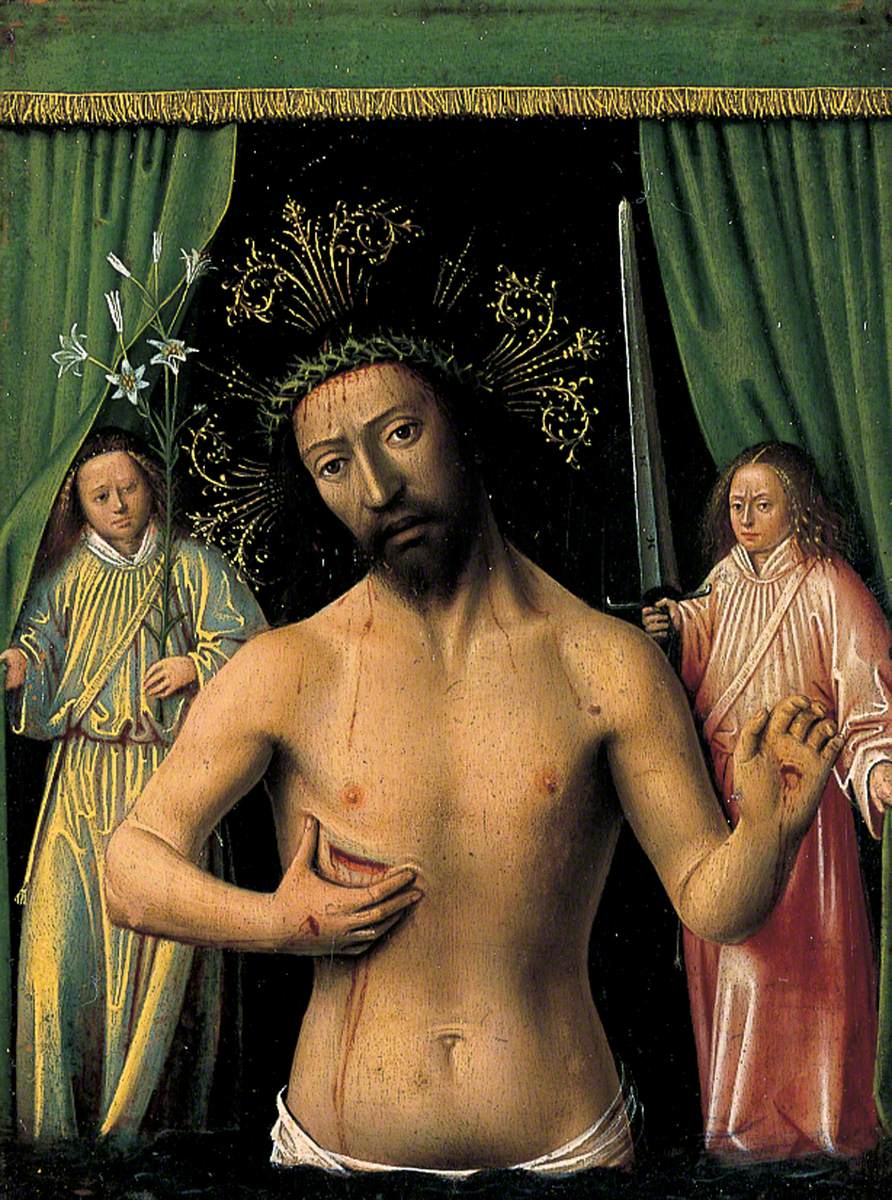
Christus, Petrus_Christ as the Man of Sorrows
Petrus Christus (Netherlandish, ca. 1410–ca. 1475), Christ as the Man of Sorrows, ca. 1450. Oil on panel, 11.2 × 8.5 cm. Birmingham Museum and Art Gallery, Birmingham, England.

In Jesus through Medieval Eyes, each chapter ends with a scripture, reflection questions, one or two suggested exercises, and a prayer—some sourced from medieval authors, others original.

Each chapter opens with a whimsical line drawing based on medieval manuscript marginalia, which often feature humorous scenarios, like a knight fighting a snail or a rabbit hunting a human! (Role reversals were a favorite form of play for medieval artists.) This design element further immerses the reader in that world. The cover too, its art taken from a French book of hours illuminated by Jean Colombe, gives a sense of the shine of medieval manuscripts with its gilt lettering and halos of the saints.

Hamman has revitalized my interest in medieval literature, in all its wild beauty and strangeness. You may have noticed her influence on my blog over the past few years I’ve been following her. I encourage you to follow her on Twitter @GraceHammanPhD and Instagram @oldbookswithgrace, subscribe to her Medievalish newsletter, and BUY HER BOOK! It would be great material for a Christian book club, and would also make a great gift.

You may also want to check out the recent interview Hamman sat for on The Habit Podcast, part of the Rabbit Room Podcast Network. It’s a terrific introduction to her work:

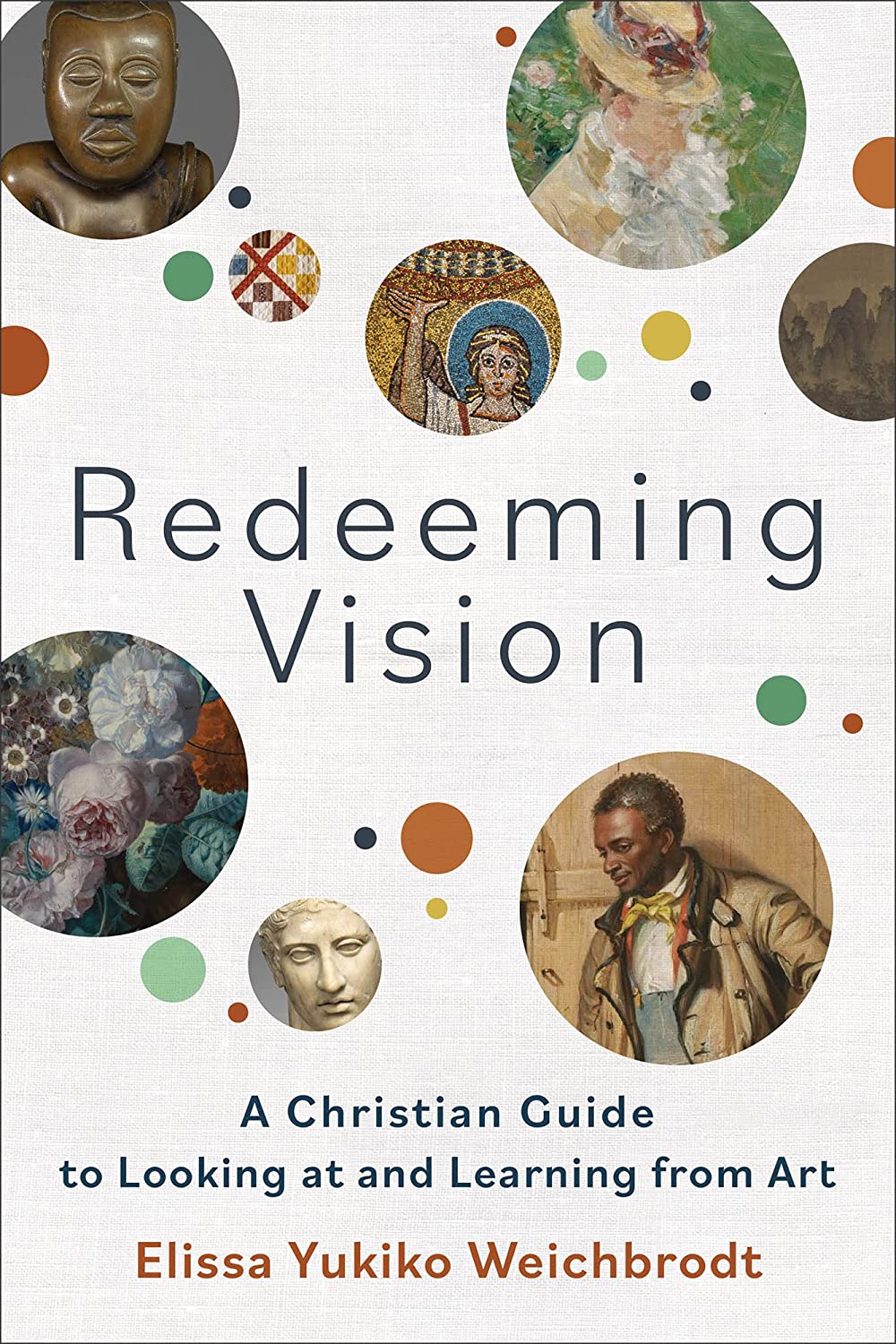
Book Review: Redeeming Vision: A Christian Guide to Looking at and Learning from Art by Elissa Yukiko Weichbrodt

Let’s say you’re visiting London. You buy a ticket to the Tate Modern, because hey, the tourist guides call it a must-see. You enter the enormous Turbine Hall and witness, across the five-hundred-foot downward concrete ramp that is the floor, a giant crack. No, it’s not a foundation problem. It’s a contemporary art installation by Doris Salcedo.* What in the world does this artwork have to offer? How do you engage meaningfully with it?

Dr. Elissa Yukiko Weichbrodt’s book Redeeming Vision: A Christian Guide to Looking at and Learning from Art (Baker Academic, 2023) equips Christians to look closely and well—with a posture of humility and generosity—at works from across the spectrum of art history, including ones like Salcedo’s Shibboleth that may initially evoke only puzzlement or an eye roll, and others that may at first glance seem run-of-the-mill and uninteresting (a marble head, a vase of flowers, an old family photograph). When we close ourselves off to art that doesn’t immediately touch us, we reject potential opportunities for transformation, transformation of how we see and how we love. Regardless of the personal faith commitments of its makers, Weichbrodt says, art can grow our love for both God and neighbor.

In order to love, we must first look. Weichbrodt gives examples of God’s looking in scripture to establish a “model of redemptive looking,” which “is utterly different from the objectifying gaze that is so common in our contemporary culture. Too often we look to consume, to surveil, to control, and to condemn. But as the beloved of God, we are called to mimic his gaze” (19). What if instead of letting personal judgments, stylistic, moral, or otherwise, dominate our approach to art, we were to adopt a primary posture of love?

When it comes to viewing art and visual culture, our faith doesn’t offer us a fence. It provides a path.

Elissa Yukiko Weichbrodt, Redeeming Vision, p. 10

Weichbrodt wants to move us beyond a facile thumbs-up or thumbs-down approach to looking at art, encouraging us to press in to unfamiliar (and too-familiar!) or even off-putting works with curiosity and openness, asking questions of them and allowing them to interrogate us as well. What stories, and whose stories, do the images tell and not tell?

She introduces the notion of “the archive,” the mental collection of images we have seen, which we subconsciously file into categories and access to help us interpret new images. Some examples of categories are “Mother,” “Poor,” “Black,” “Beautiful,” “Villain.” The problem is, our archives are inherently limited. For example,

Why do we have so many mental images of mothers in Africa living in poverty and so few mental images of successful, smiling African women who are business owners and community leaders? Why do we have so many images in our archive of good white mothers and so few of loving, strong, generous Latina mothers? A richly textured, robust, and varied archive is necessary if we are going to learn to see others—of all races, ethnicities, genders, and social classes—as God sees them. (62)

Expand your archive, Weichbrodt urges.

She demonstrates how archives work through a brilliant engagement with Dorothea Lange’s Migrant Mother (1936), an iconic photograph that I remember studying in a high school American history class but which Weichbrodt really opened up for me.

Weichbrodt is an associate professor of art and art history at Covenant College in Lookout Mountain, Georgia. Besides an intro-level Western art survey course, she also teaches courses such as “Race in American Art and Visual Culture,” “Women, Art, and Culture,” “Art and the Church,” “Grace in American Art,” “History and Theory of Photography,” “Global Modernisms,” and “Contemporary Art and Theory.” The facility with which she’s able to guide nonspecialists deeper into her subject is amply evidenced in this book, which is low-shelf academic, geared toward educated readers who may or may not have an art background.

Blue Room (Suzanne Valadon)
In chapter 9 of Redeeming Vision, on the mundane, Weichbrodt discusses how Suzanne Valadon’s Blue Room (1923) complicates a familiar art historical trope.

The most illuminating analyses in Redeeming Vision have to do with race, gender, and/or class; those are the topics where Weichbrodt’s primary research interests lie, and it’s where she really shines. She complexifies images that we might be inclined to take at face value, not think much about.

A highlight of the book is how Weichbrodt joins together fine art and contemporary visual culture more broadly, drawing Instagram selfies, memes, advertisements, news photos, propaganda posters, and such into conversation with paintings, sculptures, and other artworks that you’re likely to find in a museum. The tools she provides for performing visual analysis—chapter 1 unpacks that toolbox, giving us language (and a handy chart!) for describing an image’s visual qualities—can be applied just as well to a friend’s iPhone photo as to a multimillion-dollar oil painting that’s been the subject of multiple monographs.  

As would any art historian, Weichbrodt emphasizes the importance of understanding artworks within their historical contexts; “even if we can’t find all the answers, we should remember to ask questions about the image or object’s original audience and purpose” (62). But where she differs from some academics in the field is that she also acknowledges that our backgrounds—who we are, what we aspire to be, what experiences we carry with us, our cultural conditioning—are not irrelevant to the process of looking at art. She invites us to take stock of associations that come up for us in response to certain images, not to make them an authoritative lens but to prompt queries that bring us closer to truth. We need to recognize the limitations of how we see, but we need not get ourselves entirely out of the way when it comes to art, as if pure objectivity were even possible.

In Weichbrodt’s discussion of specific artworks, I appreciate the balance of attention between the work’s formal qualities, content, historical situatedness, and meaning. She also reminds us to consider a work’s physical context. In chapter 3, for example, she uses Caravaggio’s Deposition to discuss the differences between experiencing an artwork in situ (that is, in the place for which it was created; in this case, a chapel), in a museum, and online—and what questions to ask in each situation.

Caravaggio chapter opener

Chapters 4–10 each conclude with a “For Further Looking” page that lists artworks related to the theme of the chapter and offers guided questions. For example, in chapter 9, “Allowing for Complexity: Art of the Everyday,” the “For Further Looking” section includes the headings “Nineteenth-Century American Genre Painting” (How do these works reinforce certain gender roles or racial hierarchies?), “Genre Works by Black American Artists” (How do these works celebrate the normalcy of Black life and achievement?), and “The History of the Female Nude in Western Art” (How have artists borrowed, developed, and critiqued this trope?). I found these end-of-chapter sidebars to be incredibly helpful, quenching my desire for wider exploration and deeper reflection.

Some of the topics Weichbrodt covers in the book include:

God’s Transcendence. In chapter 5 she contrasts a medieval church mosaic, with its golden resplendence, placed above the head to an abstract expressionist painting by Kandinsky, an explosion of color and movement and indefinable forms—two very different ways, and over a millennium apart, to convey the same idea.

Portraiture. In chapter 7 she addresses the possibilities and pitfalls of the portrait genre. From a Spanish count-duke to a Kuba nyim (king) from Central Africa to the anguished Vincent van Gogh to a mourning Missouri father with his two daughters and nurse, Weichbrodt discusses the physical self, the symbolic self, the public self, the private self, and the relational self. She also comments on how the portraits we see of others on social media shape our self-perception and self-representation.

Landscape. In chapter 8 she considers humanity’s relationship to nature by looking at two mountain views: a Chinese ink on silk from the Northern Song Dynasty, influenced by the principles of Confucianism, and a painting of the American West made during the era of westward expansion.

Weichbrodt encourages us to think critically about the stories we tell through images. Take, for example, this before-and-after photograph of Hastiin To’Haali, a resident of the federally funded Carlisle Indian Industrial School (1879–1918) in Carlisle, Pennsylvania, which gutted me:

Choate, John_Tom Torlino
John Choate, “Tom Torlino—Navajo. As he entered the school in 1882. As he appeared three years later,” in Souvenir of the Carlisle Indian School (Carlisle, PA: J. N. Choate, 1902)

Founder Richard Henry Pratt hired the commercial photographer John Choate to document the residential school’s so-called success in “kill[ing] the Indian, . . . sav[ing] the man,” as Pratt put it, and these are two of the hundreds of photos he took of the students. What do we do when images lie?

One of my favorite chapters in the book is chapter 10, “Learning to Lament: The Art of History.” Here Weichbrodt discusses an ancient Assyrian stone relief carving of a soldier conducting captives across a river, a widely distributed revolutionary-era engraving of the Boston Massacre by Paul Revere, and From Here I Saw What Happened and I Cried by Carrie Mae Weems (1995).

“History is not simply a documentation of the past,” Weichbrodt writes. “It is the story we tell about past events. What do we include? What gets left out? Who has our empathy? Who can be vilified?” (215). She continues:

What stories do we weave about who we are and who we are not? Does our telling of history—and the images we use to support it—ignore brokenness in favor of self-congratulation? What are the images and objects that direct us to lament? We lament not to wallow in despair or guilt or recriminations but because we have the freedom to weep as children of God. Ours can be a productive grief. (232–33)

Hospitable, expansive, and full of insight, Redeeming Vision helps Christians identify the ways in which images form us and teaches us how to skillfully analyze them. Art viewing, Weichbrodt writes, is not necessarily a passive activity; it requires something of us and can be generative. “Our gaze,” she says, “can open up something new” (11), leading to doxology, confession, empathy, understanding, lament, shared delight, or love.

Visit the book’s website at https://www.redeemingvision.com/. You can order a copy from Amazon or Baker Publishing Group, and sign up to participate in the guided chapter-by-chapter reading community that Weichbrodt is leading from August 28 to November 17, 2023. Follow her on Instagram @elissabrodt.

* This artwork is no longer on display; the crack was filled in in 2008.


Note: On November 11, 2023, the Eliot Society in Annapolis, Maryland, is hosting a lecture by Elissa Yukiko Weichbrodt titled “Rupture as Invitation: Generosity and Contemporary Art,” and I’ll be moderating the Q&A. I hope you can come out! Register here. (Update: Listen to the talk.)

Elissa Yukiko Weichbrodt

Animal liberation and the kingdom of God: Streams in the Wasteland painting series by Josh Tiessen

“The wild animals honor me,
    the jackals and the owls,
because I provide water in the wilderness
    and streams in the wasteland . . .”

—Isaiah 43:20 (NIV)

This verse from the prophetic book of Isaiah supplies the title of artist Josh Tiessen’s Streams in the Wasteland series. Comprising seventeen paintings of wild animals inhabiting abandoned cities, it took six years to complete, from 2015 to 2021. In this body of work Tiessen weds a biblical imagination with his passion for wildlife conservation to promote ecological ethics, or what Christians call “creation care”—the biblical imperative to be benevolent stewards of the environment and all its creatures. He says he wants to represent “the majesty, particularity, and beauty of animals” (Streams in the Wasteland, p. 33)—to evoke wonder, love, and empathy, and a greater sense of responsibility.

“The whole creation has been groaning,” the apostle Paul writes in Romans 8, seeking to “be liberated from its bondage to decay and brought into the freedom and glory of the children of God.” Creation has been damaged in large part by humanity’s sin, which has caused deforestation, land degradation, ozone depletion, and species endangerment and extinction, among other harms. Instead of enjoying the full flourishing God intended, the natural world suffers.

Streams in the Wasteland engages with the question, What would the liberation of animals from the bondage to decay look like? Some of Tiessen’s creative visual responses:

  • An Indian temple elephant breaks free of its shackles, no more to be prodded and paraded for the people’s religious festivals.
  • Released from aquarium amusement parks where they were exploited for entertainment, a pod of orcas journeys down a canyon river into the ocean past their ancestors’ skeletal remains, which will one day rise.
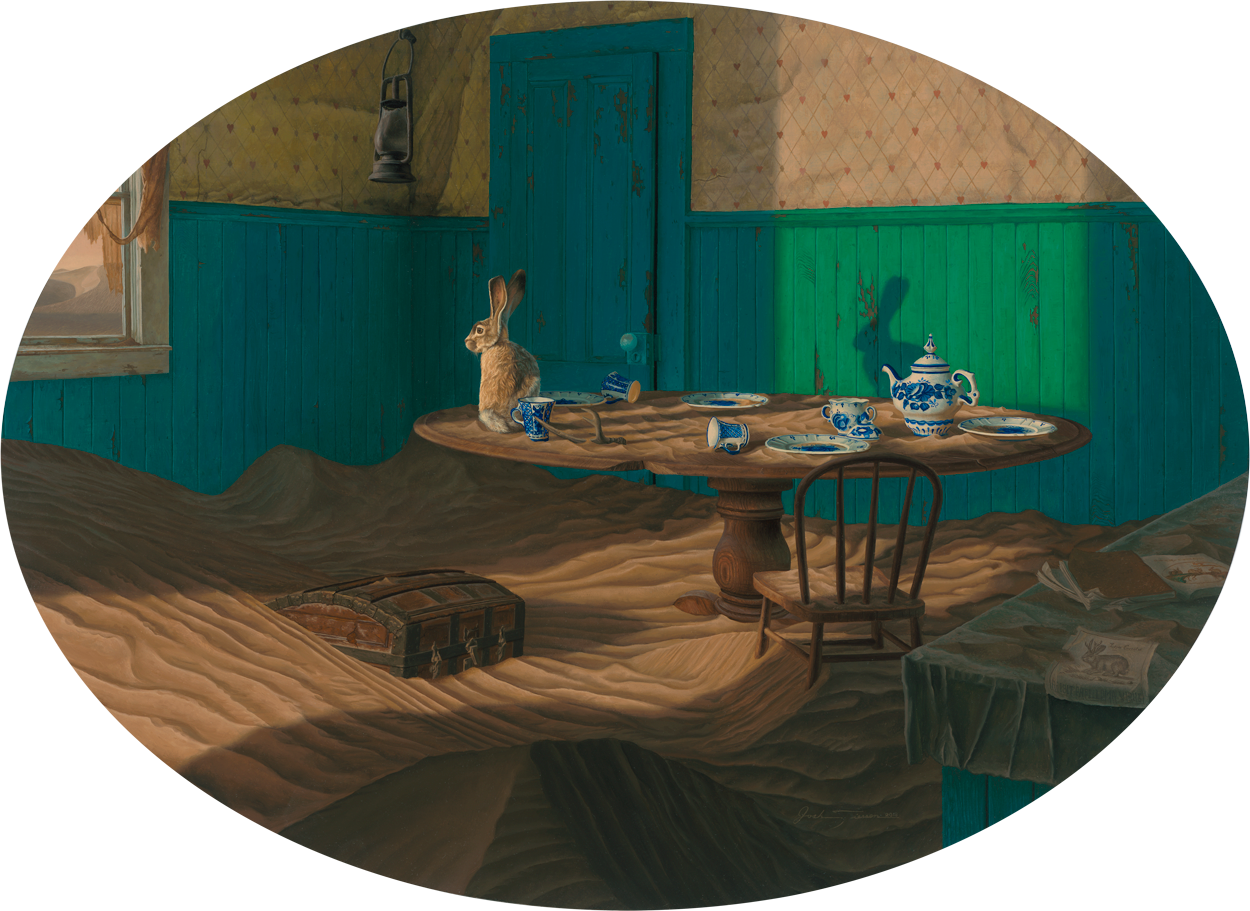
  • A jackalope—the mythical horned rabbit of North American folklore—sheds its antlers, a passing shadow of the old world. Rabbits with hornlike protrusions on or near their heads have actually been found in nature, the cancerous growths a result of a papillomavirus.
Tiessen, Josh_Liberation of the Jackalope
Josh Tiessen (Canadian, 1995–), Liberation of the Jackalope, 2018. Oil on braced Baltic birch, 21 × 29 in.

Tiessen calls his style “narrative hypersurrealism,” as he renders the animals with technical precision and great attention to naturalistic detail (hyperrealism) but places them in a postapocalyptic context, revealing strange beauty in the unexpected (surrealism). And in contrast to traditional wildlife art, Tiessen’s art tells a story. For Streams in the Wasteland, that story is one of reclamation and healing—but also one of warning for those who neglect God’s laws.

In preparation for this series, Tiessen wrote a research paper on zoological motifs in the book of Isaiah. He found that in several prophecies of judgment, God gives animals dominion over human civilization—an ironic reversal, the “weak” shaming the powerful.

Take Isaiah 13:19–22, for example:

Babylon, the jewel of kingdoms,
    the pride and glory of the Babylonians,
will be overthrown by God
    like Sodom and Gomorrah.
She will never be inhabited
    or lived in through all generations;
there no nomads will pitch their tents,
    there no shepherds will rest their flocks.
But desert creatures will lie there,
    jackals will fill her houses;
there the owls will dwell,
    and there the wild goats will leap about.
Hyenas will inhabit her strongholds,
    jackals her luxurious palaces.
Her time is at hand,
    and her days will not be prolonged.

In addition to Babylon, Isaiah indicts other unjust nations: in Cush the fruit of the vine “will all be left to the mountain birds of prey” (18:6), and in Edom “the desert owl and screech owl will possess it; the great owl and the raven will nest there” (34:11). Concerning the kingdom of Judah: moles and bats will take over idols of silver and gold (2:20), lambs will feed on the food of the rich (5:17), and Jerusalem will become void of human activity and instead be “the delight of donkeys, a pasture for flocks” (32:14). It’s not just nocturnal animals and scavengers that crop up, but also harmless ones like foals and sheep.

Returning to the opening quote of this article, we see that Isaiah describes an eschatological reality in which God’s abundant provision elicits thanksgiving and praise from the animal kingdom. But they are Israel’s foil: whereas the animals are sensible of God’s goodness, God’s people are not. “Yet you have not called on me, Jacob. . . . You have burdened me with your sins and wearied me with your offenses” (43:22, 24).
Tiessen understands such animals “as the Creator’s special agents worthy of intrinsic value and a role in history. I caught a glimpse of Isaiah’s larger vision for animals serving as co-workers with the Creator to confront humanity, calling from within the ruins of human moral decay” (Streams in the Wasteland, p. 22).

Therefore, in Streams in the Wasteland, a barn owl stakes its place on a plinth of a Gothic cathedral alongside sculptures of the saints, meerkats lounge on a chaise inside a Baroque manor, lar gibbons swing from the entryway of a university, and a pack of spotted hyenas wanders through Bodie, a California Gold Rush boomtown known for its sin, now a ghost town.

Tiessen, Josh_Occidental Babylon
Josh Tiessen (Canadian, 1995–), Occidental Babylon, 2017. Oil on braced Baltic birch, 52 × 75 in.

I’m very familiar with the Isaiah passages where creatures are presented as blessings of Edenic hope for the future, existing peaceably with humans (e.g., Isa. 11:6–9), but I had never really stopped to consider all the places where they are said to overtake what we deem human domains. Such passages are certainly more uncomfortable for us humans!

Though humans’ neglect or mistreatment of animals is not specifically what prompts God’s pledged use of animals to shame the rebellious nations, surely our disregard for the creation mandate in Genesis—to rule the earth with care and compassion—is a form of rebellion against God. And so Tiessen extends his reading of Isaiah to address that call in particular, which is echoed in other parts of scripture, such as Proverbs 12:10: “The righteous care for the needs of their animals.” By placing animals in human habitations, Tiessen compels us to remember our obligations to our nonhuman neighbors.

Perhaps my favorite painting from Tiessen’s series is Whale Hymn. The setting is the ruined shell of St. Dunstan-in-the-East, a twelfth-century church that once towered over the city of London but that was irreparably bombed during World War II. It has since been converted into a public garden. In his futuristic vision, Tiessen imagines it surrounded by floodwaters, a humpback whale swimming by. This giant of the deep sings its song to the Creator in the same place where generation after generation of Christians sang their praises until human violence rendered the building unusable.

Tiessen, Josh_Whale Hymn
Josh Tiessen (Canadian, 1995–), Whale Hymn, 2015. Oil on braced Baltic birch, 36 × 48 in.

Isaiah is not the only biblical source of inspiration for Tiessen. Ezekiel’s vision in the valley of dry bones inspired Can These Bones Live?, which shows a monarch butterfly gliding through the ribcage of a human skeleton, and its sequel, Rise Up—the only two paintings with human figures.

Tiessen was born in 1995 in Moscow to Canadian missionary parents. His Russian nanny, Lena Zhuk, taught him drawing basics, like perspective and shading, and, when he showed aptitude, bought him his first set of tempera paints, brushes, large heavy paper, and other materials. When he and his family moved back to Canada, Valerie Jones, a fellow church member and artist, noticed his talent and got him his first public art exhibition at age eleven. Then when Tiessen was fifteen, Canadian wildlife artist Robert Bateman took him on as a student and mentee. He graduated from high school at age sixteen and began exhibiting throughout North America while working on a bachelor’s of religious education in arts and biblical studies at Emmanuel Bible College in Kitchener, Ontario, which he earned in 2020. His professional memberships include Artists for Conservation, the Society of Animal Artists, and the International Guild of Realism.
He currently lives in Stoney Creek, Ontario.

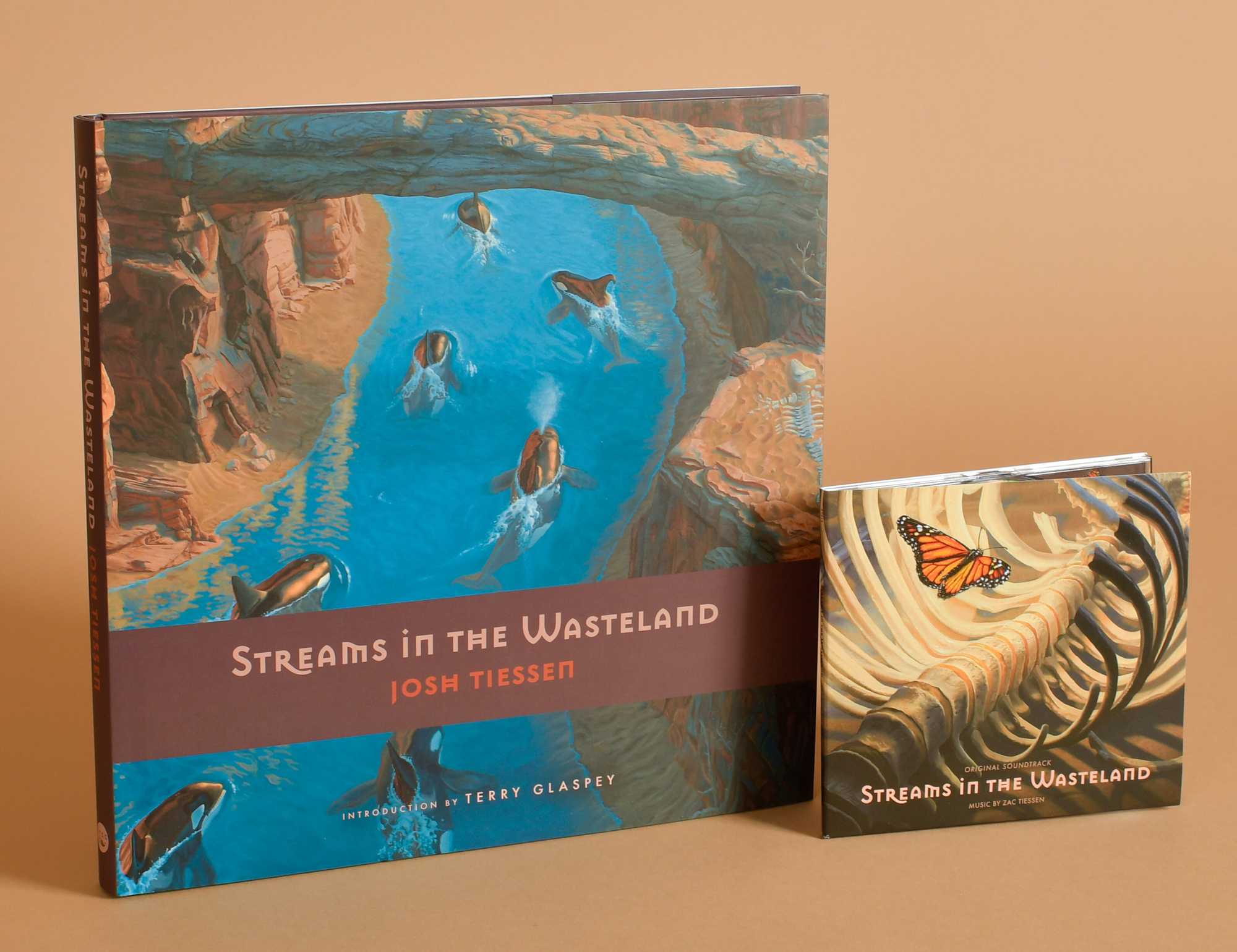
Tiessen has self-published a hardcover, glossy-paged, full-color book that collates all the works from Streams in the Wasteland, providing commentary on them (additional to that on his website), which includes engagement with scholarly interpretations of the Isaiah passages. Through sketches and more, he sheds light on his artistic process and also provides autobiographical information. The book comes with a CD of instrumental compositions by his brother Zac Tiessen that respond to each of the paintings—an atmospheric soundscape. It would make a great gift.

The culmination of the series is Agnus Dei, a triptych featuring all the animals in the individual paintings gathering around a horned altar where the Lamb of God lies slain. Tiessen drew inspiration from Jan van Eyck’s Adoration of the Mystic Lamb, Francisco de Zurbarán’s Agnus Dei, and the paintings of Caspar David Friedrich featuring abandoned abbeys, churches, and cemeteries in winter.

Instead of saints from the Homo sapiens species surrounding the Lamb in worship, Tiessen shows a giant panda, a double-wattled cassowary, a narwhal, and other animals paying homage to Christ. They, too, are drawn up into God’s awesome story of redemption. They, too, participate in the “new thing” God is doing.

“My painting is . . . a critique of the human-centric bias within Western art history,” Tiessen writes. “This is best seen in Renaissance paintings where animals seldom appear, and if they do, it is simply for allegorical purposes. By enlisting wild animals as protagonists with intrinsic value amidst the wasteland of human existence, I endeavor to revise Western art history through a zoological lens, liberating the Judeo-Christian worldview from its perversion at the hands of anthropocentric Greek philosophy.”

This final image shows animals liberated from the effects of the fall, honoring the One whose atoning death and resurrection reconciles all to God (Col. 1:19–20).

To see which of these paintings are available for purchase—either the originals or reproductions or notecards—visit https://www.joshtiessen.com/store.

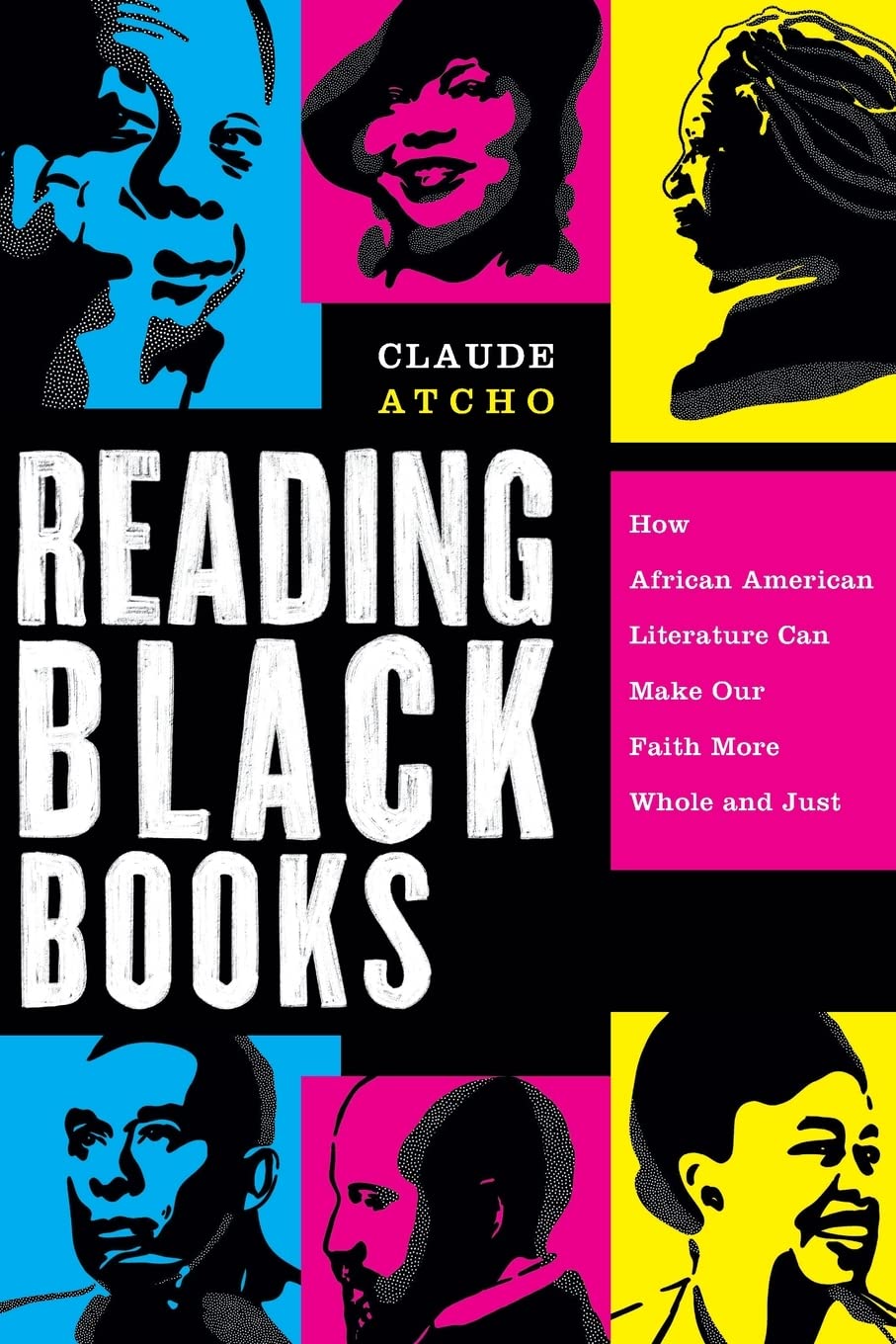
Book Review: Reading Black Books: How African American Literature Can Make Our Faith More Whole and Just by Claude Atcho

“One of the best ways to listen to Black voices is to attend to Black stories, specifically the enduring ones captured in classic African American literature,” writes pastor-theologian and former English professor Claude Atcho in the opening paragraph of Reading Black Books: How African American Literature Can Make Our Faith More Whole and Just.

Such great cover art and design by Octavia Ink!

Published last month by Brazos Press, the book consists of ten chapters, each one built around a theologically charged word or concept (such as “sin,” “image of God,” or “lament”) and a twentieth-century novel or poem(s) by a Black author that is then engaged through that lens. A potential danger with this approach is that the interpretations in either direction could be forced to fit into a box, but this turned out not to be the case at all. Reading Black Books is a two-way, mutually enriching exchange between theology and literature, one that is expansive rather than limiting and that takes each discipline seriously on its own terms.

Combining literary analysis and theological reflection, Atcho shows how “God’s truth addresses Black experience and how Black experience, as shown in the literature of our great writers, can prod readers from all backgrounds toward sharper theological thinking and more faithful living” (1). We are invited to inhabit the experiences of various characters and poetic voices and to be transformed as a result. As a middle-class white woman living in a Maryland suburb, I acknowledge that I move about the world with a very different set of experiences than those of people of color. With pastoral sensitivity but also directness, Atcho helps me enter into America’s racial narrative—and the narrative of the gospel!—from a different vantage point. This book is for Christians of any race who desire to be enlarged by story and to live more fully into the liberative arc of scripture.

Atcho provides enough context for each book—introducing us to characters, rehearsing relevant plot points, and highlighting specific scenes, often including quoted excerpts—that you don’t have to have read the work previously to benefit from his commentary. The book does contain spoilers, as all serious literary criticism almost inevitably will. But literature is way more than plot, and readers are encouraged to then engage with the primary texts in full on their own, equipped with frames for thinking about them and open to surprises.


I have attempted to come to this book about books as a guide who integrates my affections: my love for these stories, my love for what they say about Black experience in both trials and triumphs, and my love for Jesus and his kingdom.

Claude Atcho, p. 7

Chapter 1 examines the question “What does it mean to live as an image bearer when other image bearers try to limit your existence?” The protagonist of Ralph Ellison’s Invisible Man (not to be confused with H. G. Wells’s sci-fi novel The Invisible Man) is not physically invisible; rather, he is rendered invisible by others’ refusal to see him. Atcho discusses the need for white sight—our warped “inner eyes”—to be redeemed.

Chapter 2 explores how systemic sin exacerbates personal sin through the controversial character of Bigger Thomas in Richard Wright’s Native Son, a Black man from 1930s Chicago who kills two people (the first one accidentally). Is Bigger a victim or a perpetrator? The question is too simplistic. Bigger is both trapped by Sin and an agent of Sin, Atcho says. Atcho’s explication of Sin with a capital S and sin, little s, is sophisticated and illuminates for me broader discussions going on in contemporary culture. Sin is not just personally experienced and personally enacted; it is also a dominating force that’s been set loose in our world and that has become embedded in systems.

The focus of chapter 3 is James Baldwin’s semiautobiographical debut novel Go Tell It on the Mountain, “a critical generational portrait of the toxic Christian practice that emerges from belief in a loveless God” (40). Baldwin gestures toward true religion through negation—by presenting the character of Gabriel, the protagonist’s minister stepfather, as a promiscuous and abusive binge drinker with a lust for power.  

Chapter 4 visits “Christ Recrucified” and the nine-hundred-line “The Black Christ” (read the first stanza here) by Harlem Renaissance poet Countee Cullen, unpacking the picture they paint of a Jesus who suffers for, like, and with us. Published in the 1920s, both poems compare the crucified Christ to a lynched Black man.

In chapter 5 Zora Neale Hurston’s Moses, Man of the Mountain, a folkloric retelling of the book of Exodus, opens up a quest into the doctrine of salvation. Atcho discusses salvation from and to, which story and script forms us most (the old empire or the coming kingdom?), the significance of the promised land, and Christian social concern as a biblical imperative.

The deliverance of the exodus elides the false dichotomy of a truncated salvation. Hurston’s Moses points in the same direction—toward imagining a fully orbed salvation, as did our enslaved ancestors: revelation and liberation.

Is it our attention, then, to be fixed on the sin of slavery or our slavery to sin? Personal piety in the power of the Spirit or social change in Jesus’s name? Liberation or revelation? In the exodus, the Lord frees his people so that they might exist in freedom for him. It is liberation through revelation and atonement. God’s revelation (Exod. 9:4, 16, 29; 10:1–2; 11:7; 14:4), the necessity of atonement (13:13, 15), the urgency of liberation (2:23–25), and the subsequent call to holiness (31:13; Lev. 20:8) cannot be isolated. In the exodus, each motif exists in relation, forming the full melody of salvation. The song of salvation is not played in only one key. The contextual pressures of human experience can force us, understandably at times, to prize piety or liberation when truly salvation expands and contains both—and more. (84–85)

Nella Larsen’s Passing—which was adapted into an acclaimed film last year—is the subject of chapter 6, on racism. The novella delves into the psyches of two light-skinned Black women in 1920s Harlem, one of whom passes for white in all settings as a means of survival, and the other of whom does so only when convenient. Atcho talks about the need to combat colorism with affirmation (e.g., “Black is beautiful”), with denial, and through the flesh of Christ.

Chapter 7 spotlights Beloved, a gothic novel by Toni Morrison that combines the historical and the supernatural to tell the story of a devoted mother named Sethe who is seeking freedom from enslavement. At one point she escapes with her children, but when the authorities find them she kills her two-year-old daughter (who is unnamed in the novel and referred to as “Beloved,” the sole word on her tombstone) rather than relinquish her to a life of slavery. Sethe is ultimately able to get away to an Ohio farmhouse, which becomes haunted by Beloved’s ghost.

Atcho discusses the traumas of enslavement that continue to compound and haunt the body, mind, and soul even after one becomes “free”; the need for righteous rage; enfleshment and bodily liturgy; chattel slavery’s theft of the mother-child relationship; memory as a muscle that needs to be exercised transparently, communally, and redemptively; new creation and anticreation; and exorcism, rescue.

One of the most compelling characters in the novel is Sethe’s mother-in-law, Baby Suggs. A shepherdess of bodies and souls, she creates a new space in the woods near the farmhouse where she enacts weekly liturgies of healing. She directs her people, in Atcho’s words, “to move and be in the sacred humanity that they are and that has so viciously been attacked by those who enslaved and debased them” (117). A key passage in Beloved describes this communal gathering:

After situating herself on a huge flat-sided rock, Baby Suggs bowed her head and prayed silently. The company watched her from the trees. They knew she was ready when she put her stick down. Then she shouted, “Let the children come!” and they ran from the trees toward her.

“Let your mothers hear you laugh,” she told them, and the woods rang. The adults looked on and could not help smiling.

Then “Let the grown men come,” she shouted. They stepped out one by one from among the ringing trees.

“Let your wives and your children see you dance,” she told them, and groundlife shuddered under their feet.

Finally she called the women to her. “Cry,” she told them. “For the living and the dead. Just cry.” And without covering their eyes the women let loose.

It started that way: laughing children, dancing men, crying women and then it got mixed up. Women stopped crying and danced; men sat down and cried; children danced, women laughed, children cried until, exhausted and riven, all and each lay about the Clearing damp and gasping for breath. In the silence that followed, Baby Suggs, holy, offered up to them her great big heart. . . .

“Here,” she said, “in this here place, we flesh; flesh that weeps, laughs; flesh that dances on bare feet in grass. Love it. Love it hard. Yonder they do not love your flesh . . .”

Baby Suggs then goes on to list various parts of the body—eyes, skin, hands, mouth, neck, liver, heart—contrasting what “yonder” men do to those parts (gouge, flay, chop, beat, hang, expose and feed to hogs) with each part’s innate belovedness. Atcho’s comments on this passage—a passage that has stuck with me ever since I first read the novel some fifteen years ago—are among the best in the book.

Chapter 8 is on the theme of lament, and it considers that biblical practice in relation to the poem “A Litany of Atlanta” by W. E. B. Du Bois while also looking at the Psalms and the cross. “There is . . . power in lament that names injustice for what it is,” Atcho writes. “By naming it as such and placing it before God as counter to his moral will, lament teaches us to make no peace with injustice or oppression” (137). Bearing true witness against evil, the poem was written in response to the three-day reign of racial terror that white men unleashed on a Black community in Atlanta in September 1906, killing, maiming, and destroying homes and businesses. It opens, “O Silent God, Thou whose voice afar in mist and mystery hath left our ears an-hungered in these fearful days— / Hear us, good Lord!

Chapter 9 takes a look at another novel by Richard Wright, The Man Who Lived Underground, published for the first time last year, sixty-one years after the author’s death. (Publishers rejected it during Wright’s lifetime.) It follows Fred Daniels, a Black man who, after being picked up by police and relentlessly tortured, confesses to a double murder that he did not commit, then flees into the city’s sewer system. “The underground” confers on him a new knowledge of the world’s foundations of falsehood and injustice. At the end, he meets his demise.


To imagine a more just world, one must reckon with the world that is.

Claude Atcho, p. 145

Even though the novel promotes a worldview that is bleak and fatalistic, reading it can still be constructive, Atcho says; as Christians, we carry our hope to bleak texts. What would it look like to see this senseless world reconfigured into wholeness and justice? Atcho calls us to action, away from discrimination, violence, and power abuse and toward the pursuit of justice for all people on earth as it is in heaven.  

It’s fitting that the last chapter centers on hope, particularly as expressed through Margaret Walker’s poem “For My People.” Atcho describes the poem as “a living history, an ode, an exhortation, a lament, a prayer” that “embodies the fiery passion of a communal hope, a bond of persons and destiny” (160, 166). While the majority of the poem addresses Walker’s Black kin, at the end she expands “my people” to embrace all of humanity, “all the adams and eves.”

+++

Throughout Atcho’s book we see the legacies of racial oppression in America—how it manifests today. Though the most recent of the featured literary works is from 1989, they all speak into our current moment. I appreciate how Atcho defines terms that show up a lot in public discourse, such as liberation and justice, comparing cultural definitions with biblical ones. But he leads with story. While in the public square our tendency is often to arm ourselves with arguments to bolster our views and defend against attacks, story has a way of disarming us. Abstract concepts become incarnate in the lives of characters. Literature can teach us the discipline of listening and can develop our empathy and understanding. It may prompt us to assess our own prejudices or complicities and impel us to repentance and real change.

Reading Black Books demonstrates the power of great literature to form us spiritually, regardless of the faith commitments of its author. Atcho presumes no theological agenda on the part of the writers, but rather chooses to read these works theologically—which can unlock more nuanced interpretations or deepened meaning. Applying a theological framework, Atcho draws out themes from the works that cannot be addressed quite as well, I’d say, without theological language. He connects our collective human story to God’s story.

The back matter includes discussion questions for each chapter.

Though I had previously read and studied all four poems Atcho discusses, I’ve read only one of the seven novels—and this despite my having been an English major in college! This book makes me want to read more for sure. I’ve already stocked up my library accordingly. I’m grateful to Atcho for reactivating my interest in fiction and for extending it in the direction of these seminal African American novels.

You can buy Reading Black Books on Amazon (at the time of writing, Amazon is offering three for the price of two!), from Baker Publishing, or from your retailer of choice.

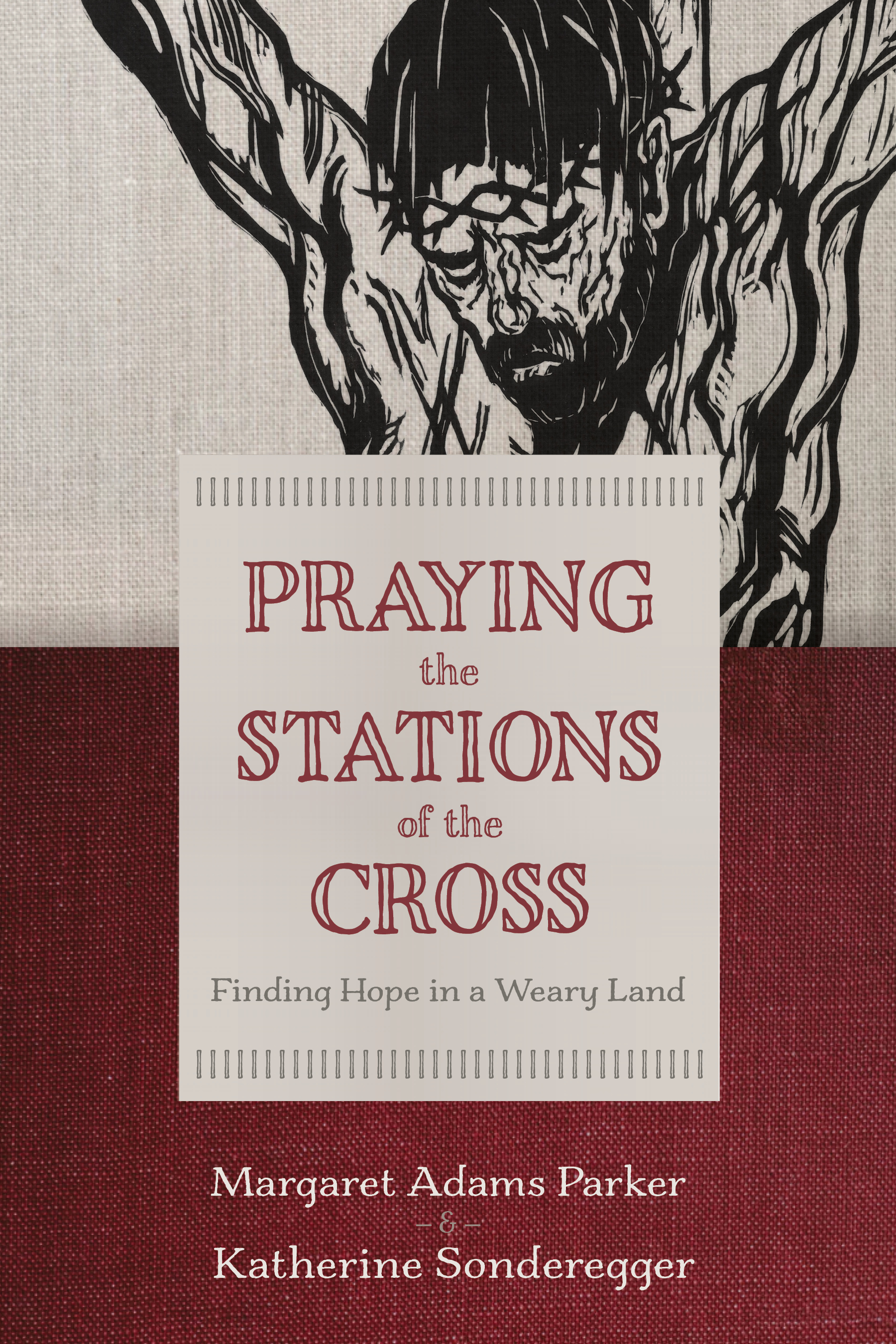
Book Review: Praying the Stations of the Cross by Margaret Adams Parker and Katherine Sonderegger

A collaboration between an artist and a preacher, Praying the Stations of the Cross: Finding Hope in a Weary Land by Margaret Adams Parker and Katherine Sonderegger (Eerdmans, 2019) is an ecumenical on-ramp to the ancient Lenten practice named in the title. A substantial introductory section provides a history of the Stations of the Cross, which are rooted in Holy Land pilgrimages, and selections from centuries’ worth of passion art, song, and other texts, showing the range of ways this old, old story has been engaged in various eras and locales. The core of the book is a service of scripture, prayer, image, and meditation, featuring original woodcuts by Parker alongside theological reflections by Sonderegger, who writes in a pastoral voice; together they draw us into the biblical narrative and its present-day implications, emphasizing how Christ’s mercy goes out and embraces all the sins and sorrows of the world. The final section provides resources for further study as well as an afterword by each of the authors, discussing their respective vocational callings and their approaches to this book project.

Praying the Stations of the Cross

Having grown up in a Baptist church, I don’t think I ever heard of the Stations of the Cross until college, and even then, it was just a vague head knowledge. My real entry point into the Stations—into a more experiential knowing of them—was through art, which I began studying more deeply about a decade ago and incorporating, in a loose way, into my spiritual practice. I came to realize that traditional images like the Ecce Homo and the Holy Face of Jesus and the Crucifixion and the Pietà, though often made to stand alone, are sometimes made as part of a fourteen-piece sequence that takes you all the way down the road to Calvary, from the praetorium to the tomb. And since the Middle Ages this sequence of images has had liturgies to go along with it.

The Stations of the Cross are about bearing witness, Parker writes, to the suffering death of Jesus Christ. They’re a way of being with a friend in his last moments (“How dreadful is the death that takes place alone, unwatched, unwept!”), and we do so in participation with fellow witnesses across time and place:

Countless pilgrims have walked and prayed the Stations of the Cross. We imagine that great cloud of witnesses, moving across centuries and cultures. We glimpse them in the winding streets of Jerusalem, in magnificent cathedrals of Europe, in dusty villages in South America. They are rich and poor, young and elderly, vigorous and dying, joyous and heartsick. They pray beside images resplendent in gold and rich color, in front of stark depictions in wood and unbaked clay, with Stations marked by numbers only. They speak and chant and pray in a myriad of languages. They weep. They stand silent. It is remarkable and moving to think of all of these worshipers—in ways so many and so varied—bearing witness to Jesus’s atoning work.

Today the practice of the Stations, for centuries primarily a devotion for Roman Catholics, has spread into the other liturgical denominations and even beyond. It takes many forms, visually and liturgically, from the sparest set of recitations to the most ornate combination of images, texts, and hymns. But to some Christians the practice can seem strange, bizarre, or even offensive, a kind of lugubrious piety with the puzzling addition of nonbiblical scenes. Why would the Stations dwell on this suffering, offering prayers that often seem to focus on Christ’s wounds? What is the spiritual and theological merit of the Stations? And how can a valid spiritual discipline include six (out of fourteen) scenes that are absent from the New Testament account of Christ’s passion? (7–8)

The authors go on to answer these questions, demystifying the Stations—drawing out their theological meaning, scriptural significance, and pastoral dimensions. They clarify the common misconception that the Stations are only about suffering, doubt, and darkness; actually, they are just as much about hope and redemption and resurrection. They are consolatory by nature.

Praying the Stations of the Cross book
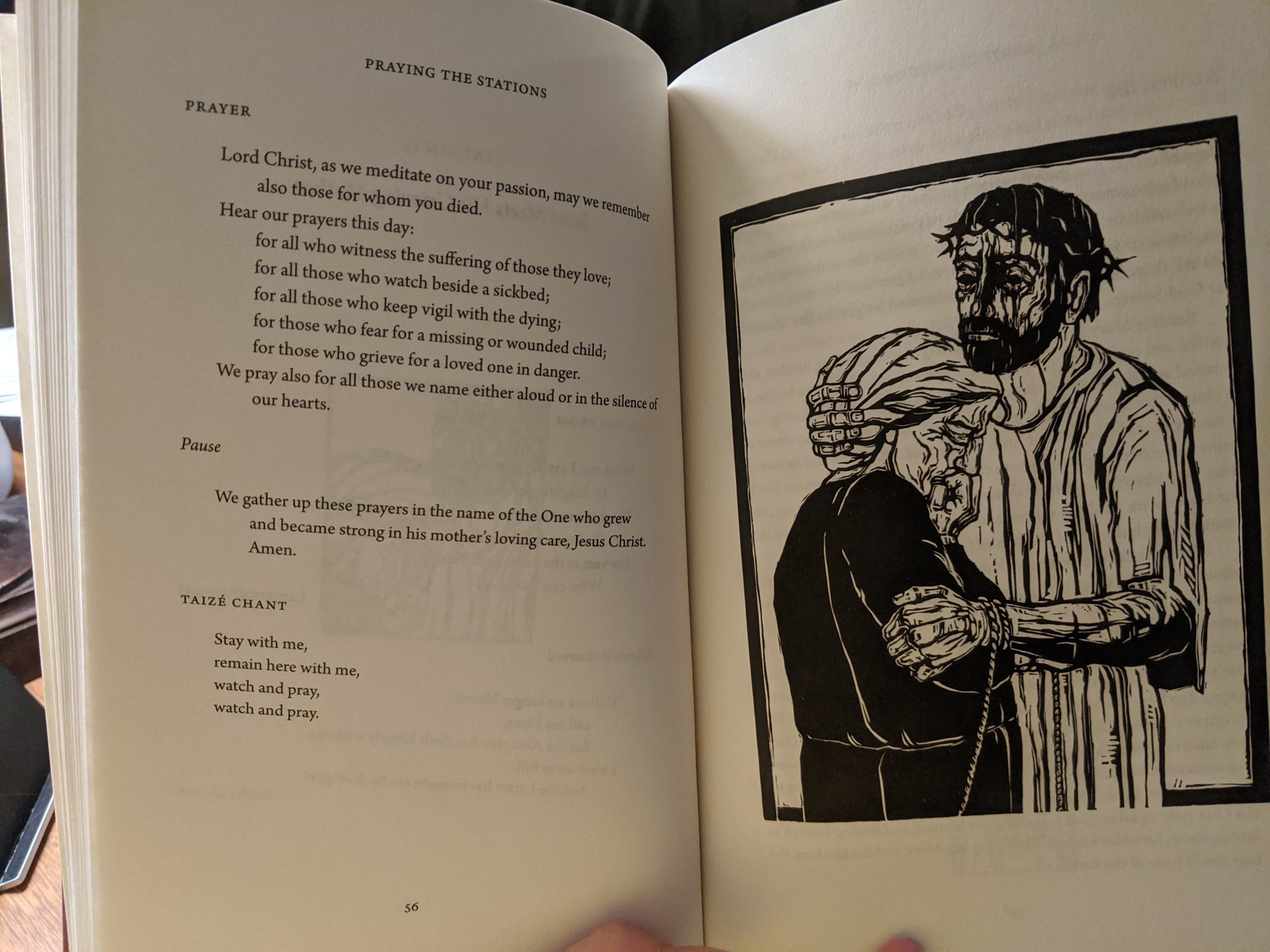
Excerpt from Station IV, “Jesus Meets His Grieving Mother”

Praying the Stations of the Cross book
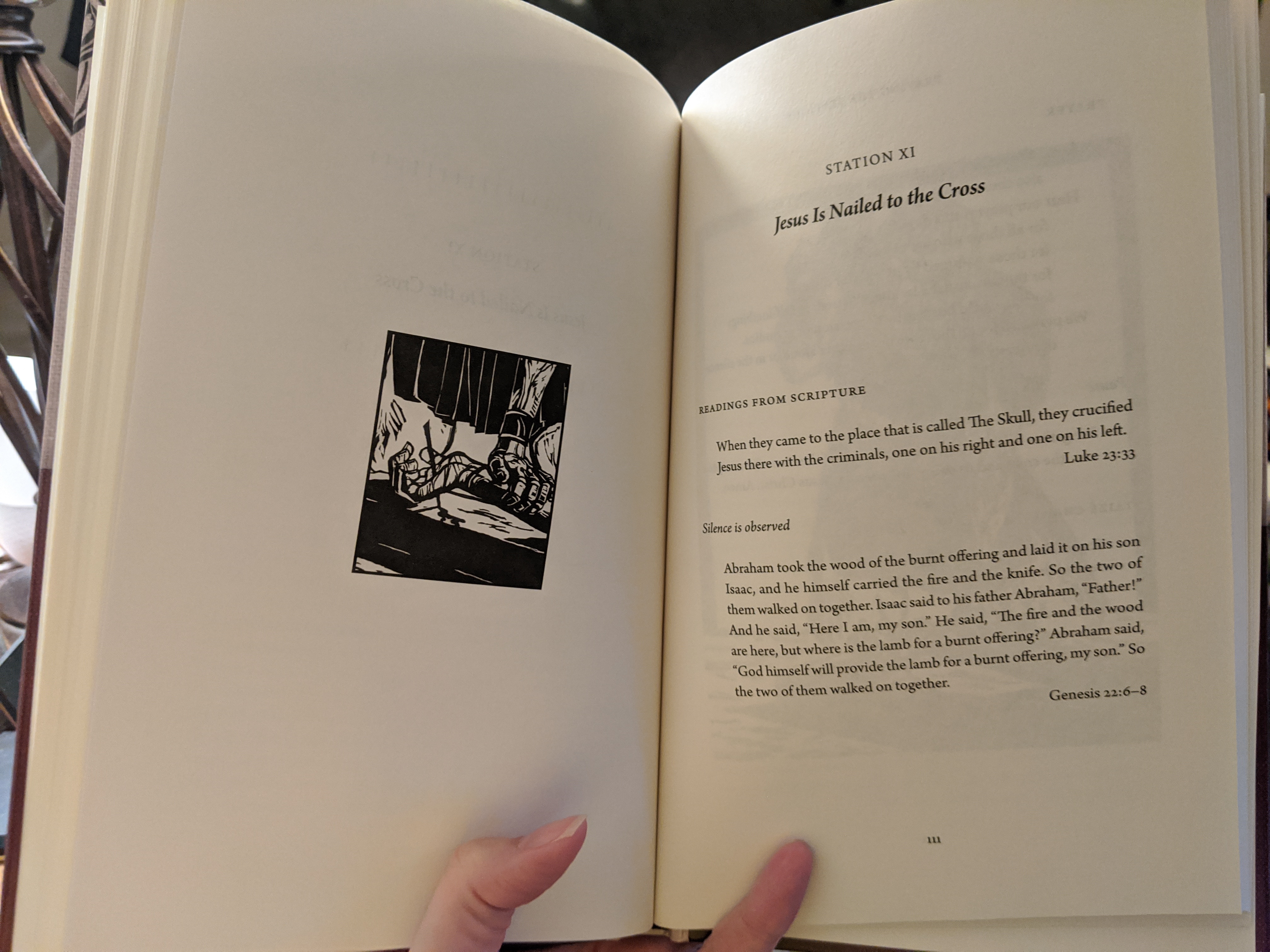
Excerpt from Station XI, “Jesus Is Nailed to the Cross”

Though centered on the person of Jesus and his journey to the cross, the Stations can also be a way of bearing witness to the suffering of those around us. Historically, they have sometimes taken this form, emphasizing that Christ stands beside all those who suffer. The prayers in Praying the Stations, written by Sonderegger, reflect this concern, interceding for those who bear heavy burdens; who are stricken by shame, guilt, or fear; who live in places of famine or disaster; and so on.

(Related post: “‘Where Sorrow and Pain Are No More’ by Margaret Adams Parker”)

One of the most powerful reflections in the book is on Station XIII, “Jesus Is Placed in the Arms of His Mother.” While acknowledging the uniqueness of Mary, Sonderegger also identifies her as every woman who is vulnerable through the suffering of those she loves. The image of Mary holding her dead son, therefore, can speak to the women of Ramah or Hiroshima, Auschwitz or the Jim Crow South, or any number of other mothers, wives, daughters, sisters who have lost loved ones to violence.

Praying the Stations isn’t merely a theoretical introduction to the Stations of the Cross; it’s practical, hands-on. The new worship service of the Stations that it offers gives readers the opportunity to see for themselves the powerful impact such a practice can have. The book would be suitable for individual or group use—I can envision it being used in small-group settings or corporate worship, or in private devotions.

As one who has never participated in a formal “Praying the Stations” liturgy—being from a denomination that does not readily avail itself of this rich devotional resource from the church’s past—I found the book incredibly helpful in understanding the purpose of the Stations and how a church community of any type could make use of them. The book is perfect for beginners (I’d especially recommend it to pastors and liturgists), while also being of value to those already familiar with the Stations, as it provides a fresh encounter, through word and image, with Jesus’s “Way of Sorrows.” The dual perspective of artist and preacher-theologian is a real asset. Clear, wise, and compassionate.

[Purchase from publisher] [Purchase on Amazon]

+++

I’ve featured artists’ interpretations of the Stations of the Cross several times on this blog and its predecessor, sometimes as part of a roundup, sometimes in full-fledged posts:

Book Review: A Lent Sourcebook

Published in 1990 by Liturgy Training Publications, A Lent Sourcebook: The Forty Days is an anthology of hymns, poems, prayers, homilies, and reflections gathered from ancient and modern sources on a variety of Lenten themes, interspersed with scripture passages. The thousand-plus entries were compiled and edited by J. Robert Baker, Evelyn Kaehler, and Peter Mazar, with additional compilation help from James P. Barron, OP; Thomas Cademartrie; Elizabeth Hoffman; Gabe Huck; Mary McGann, RSCJ; G. Michael Thompson; and Elizabeth-Anne Vanek. The introduction is by Peter Mazar.

A Lent Sourcebook

I really love the scope of the selections, which come from church fathers, mystics, novelists, poets, songwriters, activists, theologians, saints and martyrs, the Roman Missal and the Byzantine Rite. There’s Graham Greene, Flannery O’Connor, Elie Wiesel, John Donne, Gerard Manley Hopkins, E. E. Cummings, T. S. Eliot, Rainer Maria Rilke, Ambrose, Bonaventure, Dante, Negro spirituals and Shaker hymns and medieval carols, Jewish and Celtic blessings, Teresa of Avila, Julian of Norwich, Pierre Teilhard de Chardin, Dag Hammarskjöld, Thomas Merton, Dorothy Sayers, Simone Weil, C. S. Lewis, Dietrich Bonhoeffer, Daniel Berrigan, Oscar Romero, Desmond Tutu, Robert Farrar Capon, Walter Brueggemann, and many more.

These are some of the better-known names, but there are also names and texts that were new to me, some coming from obscure, out-of-print books or journal articles, and some of the selections that originated in Greek or Polish being translated afresh for this volume. There are a few African and Latin American voices represented, but most voices come from the West—a limitation that is understandable. Several compilation-style Lent devotionals I’ve used in the past feature only British and American writers, and this goes far beyond that, I’m glad to say. Just be aware that because A Lent Sourcebook is now three decades old, it doesn’t include any of the significant Christian voices that have emerged in more recent years.

Also be aware that this book was published by a Catholic institution, and the make-up of the compilation team was (from what I can tell) entirely Catholic, so that theology and tradition is heavily reflected. As a Protestant, that was not a barrier at all to me enjoying the book. There were a few selections that I take issue with on theological or practical grounds—but I never expect to agree with or to gravitate toward everything I read in an anthology! I appreciated learning more about the Catholic liturgies that surround Lent and some of the sources that inform or respond to them, as well as historical practices that developed in different locales. Eastern Orthodox liturgies are also featured, as are Protestant writings (including, in abundance, hymns!). There were several pleasant surprises for me.

I’ve read a handful of volumes from LTP’s Sourcebook series (which includes other liturgical seasons as well as topics like Baptism, Eucharist, Marriage, and so on), and they’re all great.

Because of the way I’m constituted, I tend to get more out of devotionals that integrate the arts rather than those that start off with a scripture passage followed by a lengthy prose reflection ending with a moral lesson or present-day application. I do appreciate discursive prose very much, but I like how this anthology also incorporates poetry, song, and fiction to stoke the imagination and showcase the beauty and multifacetedness of the gospel. Repentance, renewal, feasting and fasting, temptation, purity, divine love and mercy, prayer, silence, and eternity are among the themes addressed, and the biblical texts span from the Genesis narratives to the Pauline epistles.

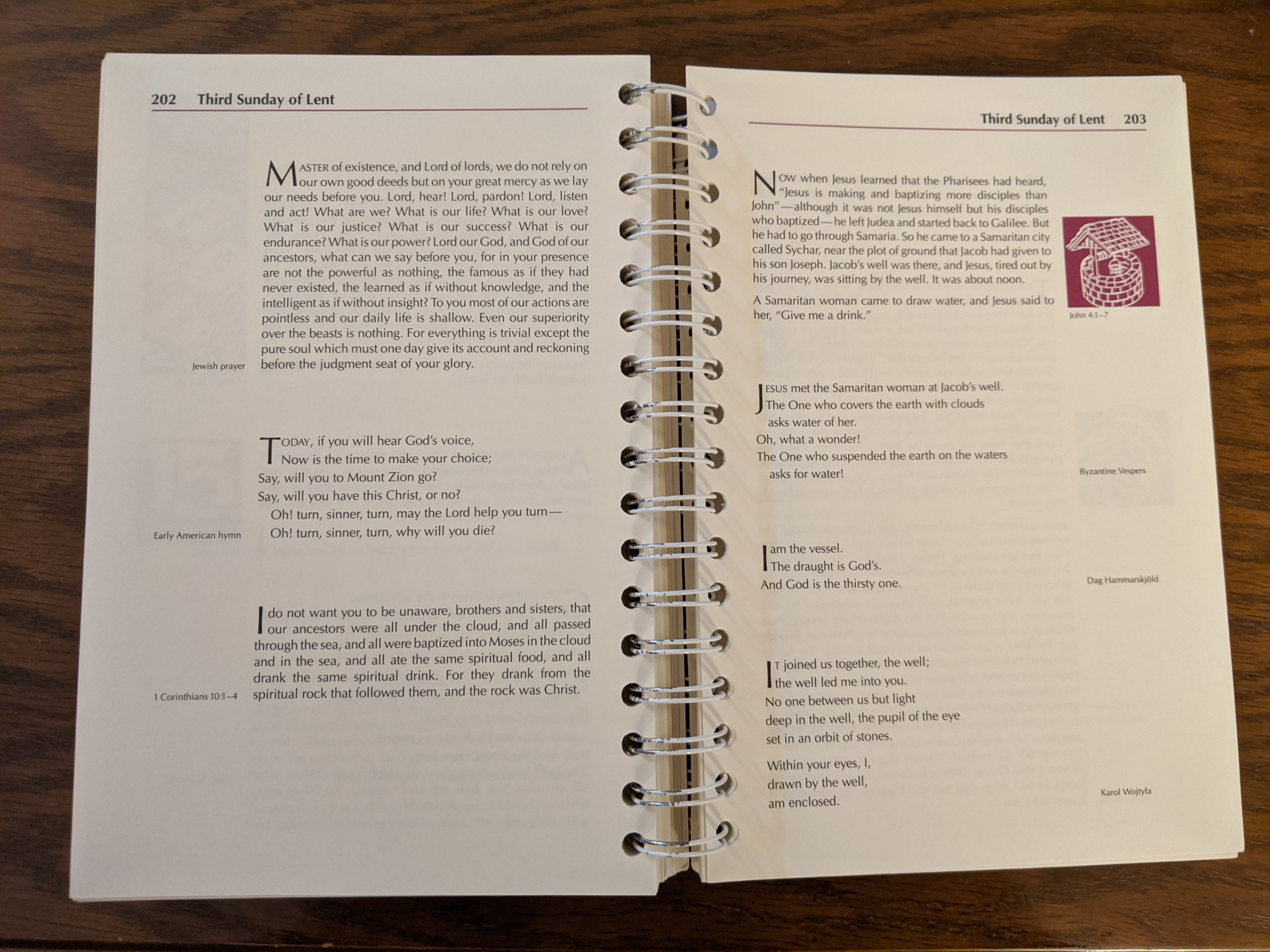
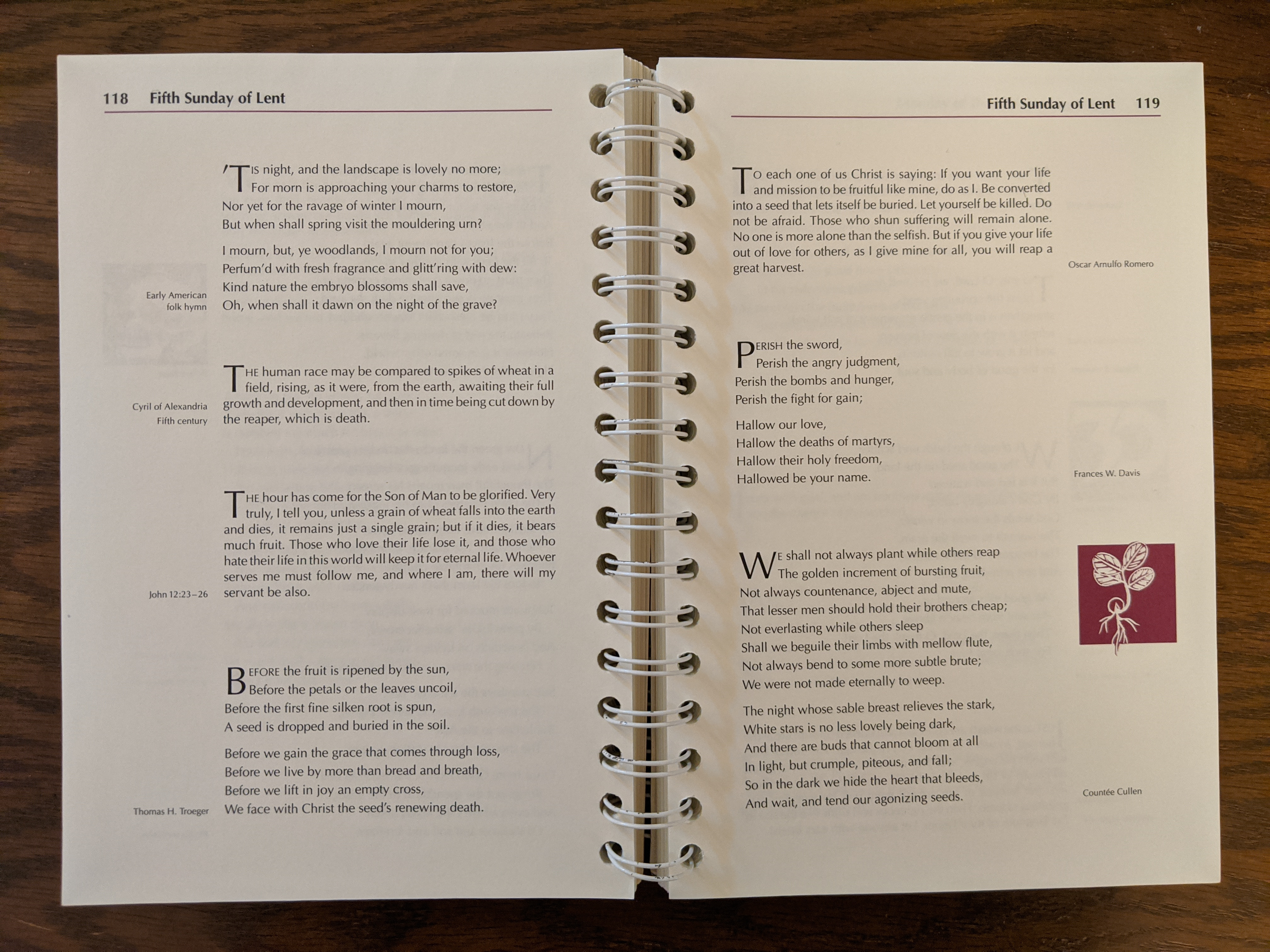
A Lent Sourcebook is available in two different formats: a single, 462-page, perfect-bound volume (ISBN 9780929650364), which appears to be the only option available on the publisher’s website, or two spiral-bound volumes (9780929650203, 9780929650357), which is what came to me through my local library’s interlibrary loan system. The entries are organized by week (Week of Ash Wednesday, First Week of Lent, . . . Sixth Week of Lent), and those “chapters” are broken down further by day (First Sunday of Lent, etc.), extending from Carnival to Holy Thursday. Basic attributions are given in the margins of each page, with fuller citations available in the back of the book. Also, each page spread contains a simple square (woodcut? linocut?) illustration, printed in magenta, by Suzanne M. Novak.

A Lent Sourcebook sample spread

A Lent Sourcebook sample spread

Below is a sampling of passages I encountered here for the first time.

PURCHASE A LENT SOURCEBOOK:

+++

An effigy of the Carnival is, in a great many places, “condemned to death” and executed (the method of execution varies—sometimes it is burnt, sometimes drowned, sometimes beheaded). The “putting to death of Carnival” is often accompanied by general tussles; nuts are thrown at the grotesque creature itself, or everyone pelts everyone else with flowers or vegetables. In other places (around Tübingen, for instance) the figure of the Carnival is condemned, decapitated and buried in a coffin in the cemetery after a mock ceremony. This is called “Carnival’s funeral.”

The other episode which is of the same sort is the driving out or killing of “Death” in various forms. The most widespread custom in Europe is this: Children make a guy from straw and branches and carry it out of the village saying: “We are carrying Death to the water,” or something of the sort; they then throw it into a lake or well, or else burn it. In Austria, all the audience fight round Death’s funeral pyre to get hold of a bit of the effigy. There we see the fertilizing power of Death—a power attaching to all the symbols of vegetation, and to the ashes of the wood burnt during all the various festivals of the regeneration of nature and the beginning of the New Year. As soon as Death has been driven out or killed, Spring is brought in.

—Mircea Eliade, Patterns in Comparative Religion (1963)

+++

Christianity is not reconciliation with death. It is the revelation of death, and it reveals death because it is the revelation of Life. Christ is this Life. And only if Christ is Life is death what Christianity proclaims it to be, namely the enemy to be destroyed and not a “mystery” to be explained. Religion and secularism, by explaining death, give it a “status,” a rationale, make it “normal.” Only Christianity proclaims it to be abnormal and, therefore, truly horrible.

—Alexander Schmemann, For the Life of the World (1973)

+++

I was entrusted with a sinless and living land,
but I sowed the ground with sin
and reaped with a sickle the ears of laziness;
in thick sheaves I garnered my actions,
but winnowed them not on the threshing-floor of repentance.
I beg of you, my God, the eternal farmer,
with the wind of your loving-kindness
winnow the chaff of my works,
and grant to my soul the harvest of forgiveness;
shut me in your heavenly storehouse, and save me!

—Byzantine Vespers, from The Lenten Triodion, translated by G. Michael Thompson

+++

Alas, dear Christ, the snake is here again.
Alas, it is here: terror has seized me, and fear.
Alas that I ate of the fruit of the tree of knowledge.
Alas that its envy led me to envy too.
I did not become like God; I was cast out of paradise.
Temper, sword, awhile, the heat of your flames
and let me go again about the garden,
entering with Christ, a thief from another tree.

—Gregory of Nazianzus, from Poemata Dogmatica (382 AD), translated from the Latin by Walter Mitchell and published in Early Christian Prayers, ed. Adalbert Hammon, OFM (1961)

(In this prayer the speaker likens himself to the thief who was executed on a “tree” beside Jesus on Calvary. I am “a thief from another tree,” Gregory confesses, having given in to temptation and stolen the fruit that was not mine. He apostrophizes the cherubim’s flaming sword that bars entry to Eden, begging it to cool down so that he might, by the merits of Christ, pass [back] into paradise, as did that penitent thief on Good Friday.)

+++

Even after several years with the reformed liturgy, it still comes as something of a shock to hear Lent described in the first Lenten preface as “this joyful season.” For those of us conditioned to imagine Lent as a grim, unpleasant time, the temptation will be either to shrug it off as poetic license or to associate it with a mother’s attempt to persuade a child to take its medicine.

But there is always C. S. Lewis. In his account of his youth and his journey of faith, Surprised by Joy (1955), Lewis gives us an inveigling definition of joy as “an unsatisfied desire which is itself more desirable than any satisfaction.” Here, perhaps, is something we can latch onto as we confront the notion of Lent as a “joyful season.”

Lent, in this perspective, is a time for eschewing pleasure in order to be surprised by joy, that unsatisfied desire more desirable than any satisfaction. Conversely, it is a time for recognizing the habit we have of seeking satisfactions that dull the deepest longing of the heart; the habit of having to have and not wanting to want. “The very notion of joy,” writes C. S. Lewis, “makes nonsense of our common distinction between having and wanting. There to have is to want and to want is to have.” Lent would then be a time for discovering what it is we really want, the heart’s desire, the restlessness which for Augustine is a symptom of our being made for something we can never possess. Paradoxically, knowing that longing brings joy.

—Mark Searle, “The Spirit of Lent,” in Assembly 8, no. 3 (1981), published by the University of Notre Dame Press

 +++

Each day may I remember the sources of the mercies thou hast bestowed on me gently and generously;
Each day may I be fuller in love to thyself.

Each thing I have received, from thee it came,
Each thing for which I hope, from thy love it will come,
Each thing I enjoy, it is of thy bounty,
Each thing I ask comes of thy disposing.

Holy God, loving Father, of the word everlasting,
Grant me to have of thee this living prayer:
Lighten my understanding, kindle my will, begin my doing,
Incite my love, strengthen my weakness, enfold my desire.

[. . .]

And grant thou to me, Father beloved,
From whom each thing that is freely flows,
That no tie over-strict, no tie over-dear
May be between myself and this world below.

—Celtic prayer compiled in the Carmina Gadelica, vol. 3, pp. 59–61, translated from the Gaelic by James Carmichael Watson (1940)

+++

“O Healing River” | Words by Fran Minkoff and music by Fred Hellerman, 1964

O healing river, send down your waters,
Send down your waters upon this land.
O healing river, send down your waters,
And wash the blood from off the sand.

This land is parching; this land is burning;
No seed is growing in the barren ground.
O healing river, send down your waters;
O healing river, send your waters down.

Let the seed of freedom awake and flourish;
Let the deep roots nourish; let the tall stalks rise.
O healing river, send down your waters,
O healing river, from out of the skies.

+++

“The Cast” by Sharon Olds (1985)

When the doctor cut off my son’s cast the
high scream of the saw filled the room
and the boy’s lap was covered with fluff like the
chaff of a new thing emerging, the
down in the hen-yard. . . . [Read the rest at poetryfoundation.org]

+++

Enter into the mystery of silence.

Your goal in life is not to hold your tongue but to love, to know yourself and to receive your God. You need to learn how to listen, how to retreat into the depths, how to rise above yourself.

Silence leads you to all this, so seek it lovingly and vigilantly. But beware of false silence: Yours should be neither taciturnity nor glumness, nor should it be systematic or inflexible, or torpid. Authentic silence is the gateway to peace, adoration and love.

Live your silence, don’t merely endure it.

—Pierre-Marie Delfieux, from the preface to A City Not Forsaken: Jerusalem Community Rule of Life (1985)


Book Review: The Annunciation: A Pilgrim’s Quest by Mark Byford

The Annunciation—Gabriel’s announcement to Mary that she will bear the Son of God—is one of the most depicted biblical subjects of all time. This narrative episode from Luke’s Gospel has long enthralled me, and I’ve been collecting artistic responses to it over the past several years, cogitating on how I might develop the materials into a book. Turns out, author Mark Byford has beaten me to the punch!

The Annunciation: A Pilgrim's Quest (book cover)

The Annunciation: A Pilgrim’s Quest (Winchester University Press, 2018) sets out to explore the history and spiritual meaning of the Annunciation through interviews with 150-plus clerics, theologians, church historians, artists, curators, art historians, and others, and through encounters with works of visual art, music, and poetry inspired by the story. It’s very cleverly structured as a pilgrimage, so the book’s organizing principle is roughly geographic, following Byford through England, France, the Low Countries, Spain, Italy, and the Holy Land as he encounters people, places, and artworks in those regions that shed light on the topic.

The scope and diversity of interviewees, from different denominations and even religions (Jews, Muslims, agnostics), is impressive, and the quotes he elicits and compiles here are a valuable trove. The roster includes big names like Rowan Williams and Archbishop Kallistos Ware, as well as others whose insights are just as rich. My fingers were very, very busy taking notes as I read!

Byford’s starting point is The Annunciation by François Lemoyne (pictured on the front cover), which he found himself unexpectedly captivated by upon seeing it at the National Gallery one day. It’s a relatively unknown work that pales in comparison to the other, world-renowned Annunciation paintings at the Gallery. When he saw that it was on loan from Winchester College, where it was installed in 1729, he grew all the more intrigued, as he is from Winchester. He wanted to find out why such a flamboyantly Catholic painting of Mary by a leading French artist came to reside in a public school in Protestant England in the eighteenth century, and why it has been removed from its original setting for display at the museum.

“I am not especially enchanted by its imagery or by its aesthetic value,” Byford admits (13)—but for whatever reason, it grasped him. I share Byford’s assessment of the painting as too cloying, florid, conventionally pious, and seeing it on the page does nothing for me. But I love how in this book, we get to see how differently different people see, because as Byford goes about his journey, he shows a reproduction of Lemoyne’s painting to each interviewee, recording their reactions. Whereas many people read the angel’s presence as domineering or oppressive, overpowering Mary’s will, and his finger as phallic, others read the encounter as a tender one, his finger illustrating his saying, “You will receive power from on high,” and indicating that it’s all about God, not her. Many expressed dislike toward the image because they say it shows Mary as weak and simpering instead of strong and courageous—“it’s disempowering” (82); “I want her to have the same force of character as the muscular angel” (85); she’s too insubstantial, “anemic,” even; “the blood and guts of the woman has been taken out of her” (173). Others were incredibly moved by the image, and commented on the “wonderful sense of movement” (100), the “spectacular light” (204), or Mary’s expression of joyful surrender. Theologian Ben Quash comments on the tattiness of the interior establishing a contrast between broken, worldly space and luminous, heavenly space—and the peeling plaster as a metaphor for revelation, a stripping back (208).

Besides bringing up the Lemoyne painting, Byford asked each interviewee some variation of the following:

  • Is the Annunciation literal (historical, factual) or metaphoric/symbolic?
  • How important is it for Christians to believe in the virgin conception?
  • Do you believe, as Bishop Philip Egan does, that the Annunciation is “the most important event in human history”?
  • Why is the feast of the Annunciation barely acknowledged today?
  • What is the spiritual meaning of the Annunciation?
  • Do you see a parallel between your story and Mary’s? (That is, have you ever felt a call from God that you would consider an “annunciation moment”?)
  • Is Mary a bridge or a barrier to interdenominational dialogue?
  • Do you venerate Mary?

One common point of discussion that results is the agency of Mary—or lack thereof—and on this point, the variant interpretations of feminists are interesting to note. Some feminists hate the story of the Annunciation because, in their reading, God forces Mary to bear a child against her will, enacting something akin to divine rape—and a few interviewees attempt to make this case. But other feminists find the story absolutely empowering for women, in that God comes into the world without the aid of a man, and with Mary’s full consent—a critical detail. Tina Beattie, for example, says, “It’s now a woman who has the voice of authority on behalf of creation” (157).

The word submission has negative connotations in today’s culture, and so can the idea of being an empty vessel, but this is so central to the Annunciation story, and I was glad to see the majority of Christians interviewed here uphold the virtuousness of submission and also recognize that it often connotes strength, and it is itself an act of the will. Like Mary, we can choose to say yes to what God calls us to. There are lots of ways of talking about submission to God, and I enjoyed hearing different wordings and perspectives on it.

Byford is the former deputy director general and head of BBC journalism, and his whole approach in this book is indeed journalistic. He marks his observances of the native environments, demeanors, and mannerisms of his interview subjects, and he presents their words unedited. He doesn’t editorialize, for the most part—that is, until the end, when, after interviewing his wife and (grown) children, he confronts his own views about the Annunciation, including how they have been influenced by the conversations he’s had over the course of the project.

[Below is a small sampling of the 205 images reproduced and discussed in the book.]

The majority of the book unfolds in England, but as previously mentioned, Byford also visits other countries, including places like Chartres Cathedral, which contains at least ten Annunciation scenes; Florence, with its many famous Annunciation paintings, including ones by Simone Martini and Lippo Memmi, Fra Angelico, Sandro Botticelli, and Leonardo da Vinci; and the catacombs and churches of Rome. He even makes it as far as Nazareth, where there are two different churches—one Greek Orthodox, the other Catholic—that claim to be the original site of the Annunciation. He interacts with other pilgrims there, collecting their thoughts.

The artistic merit of the image selections is variable. Byford did not choose all the world’s best representations to highlight—though there are many of those; he’s most interested in images that have deep personal meaning for the people who created them or who have beheld them, which means, in the case of one of the women priests he interviewed, a painting gifted to her by an elderly church parishioner (138), or in the author’s own case, an illustration from a 1950s storybook (4). Not all the artworks are reverent, though. Some, such as the Annunciation sculpture by Chris Ofili, and a painting of the same name by Mati Klarwein, used for a Santana album cover, are controversial for their blatant sexuality. Others were made for devotional or liturgical contexts but are controversial for other reasons, like David Wynne’s The Virgin Mary in Ely Cathedral in England, which many describe as hideous.

I appreciate the chapter on global (that is, non-European) depictions of the Annunciation, from the United States, Mexico, Cameroon, Nigeria, Kenya, Australia, Indonesia, and Japan. New to me are the paintings by Tom Thompson, who sets the scene in the bush area of the Southern Tablelands of New South Wales, on the veranda of a dilapidated Federation-style house (606–7). The wood carving the author purchased from a street vendor in Jakarta is also intriguing.

Besides speaking with professionals in the field of visual arts, Byford also interviews a filmmaker and, after sitting in on a performance of John Tavener’s Annunciation, a choral conductor and Tavener’s widow. Some of the conversations in this book resulted in the making of new art, such as fused glass (402), and a poem that beautifully imagines Mary’s internal process as she moves from fear to acceptance to delight (498). In addition, poems on the Annunciation, both traditional and contemporary, are scattered throughout, contributing to the drawing out of meaning of that long-ago encounter between Gabriel and Mary.

The Annunciation: A Pilgrim’s Quest is chock-full of goodness, and it caused me to reflect back on my own views about the Annunciation while considering the views of others. Some, like John Shelby Spong’s (126–29), really grated me! Some made me raise an eyebrow or shake my head. But many opened me up to a deeper reading of Luke 1 and the wider narrative, and the inclusion of people from a wide range of theological persuasions and backgrounds was key in that. I join Byford in lamenting the loss of the status and significance of the Annunciation in the church’s celebration, and I hope this book can serve as a catalyst to reignite interest.

I do think its hefty page count, 674 pages, will deter a lot of would-be readers, unfortunately. It is amply illustrated—and in full color!—but most of the images are thumbnail-size, so the heft is mainly text. To trim it down, I think he could have done away with the Madonna and Child artworks, the standalone Gabriel statues, and St. Luke painting the Virgin, focusing more strictly on Annunciation artworks, of which there is an abundant supply. And occasionally I felt that too much context was given on the history of certain churches and the backgrounds of interviewees. But my interest was sustained. I found myself looking forward to each new chapter, to see what new artworks and facets of the Annunciation would be revealed. The integration of historical and practical theology, art commentary, and personal story (the author’s and that of all those who participated in his project) is a hallmark of the book.

From a functionality standpoint, I wish there was an index—at the very least, of the names of interviewees. I also wish source citations were provided for the quotes not from interviews, as the author quotes church fathers, pastors, and others, giving only inexact references like “a professor quoted on a British Library blog” (317), or “Athanasius said . . .”; interviewees also make statements that I wish I could more easily follow up on, like “Emil Brunner, the Swiss theologian, said that if there was a virgin birth, it was a secondary miracle compared to the primary miracle of the birth of the Son of God” (484).

Biblical art curricula for small groups

As a dedicated church member and art enthusiast, I’m thrilled to see products popping up that are designed to lead church groups—Sunday school classes, outreach classes, midweek Bible-study classes—through masterworks of religious art, fostering visual literacy and an appreciation for the church’s rich cultural heritage. Last year, two of these were released: Imaging the Story: Rediscovering the Visual and Poetic Contours of Salvation by Karen Case-Green and Gill C. Sakakini and “Inspired to Follow: Art and the Bible Story” from London’s St. Martin-in-the-Fields. These come after the Through Artists’ Eyes series of Bible-study guides published in 2010 by Standard, which shares a similar intent.

While these are far from the only books/written materials available on the intersection of Christianity and the visual arts, they are among the very few that were created with group participation in mind, which means that discussion questions and/or activities are provided. (Of course, you can go through them as an individual, but a group approach would probably prove more fruitful.) Furthermore, they do not assume any previous knowledge of art history, making them suitable for your average churchgoer. All three reproduce the images in full color and, while not obviously sectarian, were written by Protestants.

Despite the common aim to use biblical art to inspire deeper engagement with scripture, each product takes a different approach. Here I’d like to offer some comparative reviews so that you can decide which curriculum, if any, is right for your small group. (Note: I read these on my own, not with a group, so I cannot offer feedback on the group experience.) I hope these inspire even more offerings in the same vein so that churches will have a wealth to draw from.

+++

Imaging the Story: Rediscovering the Visual and Poetic Contours of Salvation
Authors: Karen Case-Green and Gill C. Sakakini; foreword by W. David O. Taylor
Publisher: Cascade Books/Wipf & Stock (Eugene, Oregon)
Year: 2017
Product format: Paperback or Kindle
Number of sessions: 10

Imaging the Story

Each of the ten chapters of this book has four primary components: Read, Respond, Reflect, and Make. Like the other curricula, this one brings together scripture texts, visual art, and discussion questions—but unlike the others, it also integrates poetry, and, most notably, places emphasis on making. Projects include mosaic tiles, breviaries (using cards bound with ribbon), still lifes, and others that are even more open-ended, inviting the use of any media, including words. An appendix advises on how to mount an exhibition of the art produced during the course.

One of the authors, Gill, is herself a visual artist; the cover image is a painting of hers, titled Incarnation. Her coauthor, Karen, is a preacher, writer, and former lecturer in English literature. “Making something and then setting it free,” they write,

is to share in something of our Creator’s own respect for what he makes. If God allows his creation to be enjoyed—and interpreted—by others, then we too can set what we make free (be they poems, paintings, sculptures, children, sermons) for others to receive, or reject, as they will. This may seem a risk, but it is one our Creator took long ago! (12)

Because of this emphasis on making, and also because of the discussion of artistic vocation woven throughout, I would recommend this book to artists or “creative types.” The project instructions are clear enough that even those who aren’t accustomed to art making could complete them, and I appreciate the desire to get readers to exercise their own imaginations, but I think “noncreatives” would be resistant to this form of scripture exploration, and probably too self-conscious. It might work for those who already have the inclination to try, but I do not see it working for every small group.

I am not an artist, so I admit, I forwent the art projects, but even without that component, there is still a lot of rich substance in the book. I especially like how the authors guide the reader in looking at a variety of art images—a mixture of famous works throughout history, like Michelangelo’s Awakening Slave and Munch’s The Scream, and contemporary pieces from their circle of artist friends in the Grünewald Guild. Viewing art, they contend, can support the act of interpreting scripture:

One way to enliven biblical exegesis is to read a passage, take time to look at a painting or other artistic interpretation, then return to the text to see how the imaginative encounter has permitted fresh insights. This is a form of artistic midrash (mid, meaning to seek out, rash, meaning to inquire) that still has deep respect for the text. (126–27)

(Yes! This is precisely the approach I use in the Artful Devotion series.)

All the images in the book were chosen with intention and serve to bolster the story line of scripture. And to these are added insightful extracts from poems and theological prose, as well as questions to engage.

Also included throughout is a soft defense of the arts, including a corrective against the thinking that God calls only artists to care about art. Writing about the decoration of the Jewish tabernacle:

Note that everyone participates in the artistic venture—it is not for perceived creatives or for those who choose this activity over another. God invites all the Israelites, via Moses, to offer something in the way of materials in a very accessible manner. The list in Exodus 25:3–7 comprises precious as well as expensive items (“gold, silver, and bronze”) and also readily available ones (“goats’ hair, tanned rams’ skins, fine leather, acacia wood”). (134–35)

In other words, all of Israel was involved in supporting the arts, in ways both large and small.

Imaging the Story succeeds in stoking excitement for the gospel story through the arts, which the authors ably trace from Genesis to Revelation, pausing along the way with prompts for personal reflection and/or group discussion. For example, the questions in the chapter on Christ’s conception include:

  • What is Mary’s spiritual and mental state in Fra Filippo Lippi’s Annunciation?
  • What good news has God “announced” to you?
  • How easy do you find it to nurture a conception in the dark? How might you create a “photographic darkroom” or “nest” in which your own creativity can develop?
  • Why was it so important for Mary to find an Elizabeth?
  • Do you have an “Elizabeth” in your life? Would you like to pray for one?

My one grievance is that there are quite a few copyediting and proofreading mistakes, which became distracting, including typos, comma splices, and inconsistent heading and caption styles and name spellings.

+++

Inspired to Follow: Art and the Bible Story
Authors: Richard Carter, Jonathan Evens, Katherine Hedderly, James Johnston, Alastair McKay, and Chloë Reddaway
Publisher: St. Martin-in-the-Fields, in association with the National Gallery (London)
Year: 2017
Product format: Digital downloads (PDFs and PowerPoints)
Number of sessions: 22, divided into three terms

This discipleship course was developed by St. Martin-in-the-Fields, a historic Anglican church in the heart of London, in association with the National Gallery, conveniently located just across the street. Divided into twenty-two hour-long sessions, it uses paintings from the Gallery’s collections as a springboard into discussion of key elements of the Christian story and their personal implications. Two of the driving questions are “What does it mean to follow Jesus today?” and “How can I deepen my faith in God?”   Continue reading “Biblical art curricula for small groups”

Book Review: The Faithful Artist: A Vision for Evangelicalism and the Arts by Cameron J. Anderson

The Faithful Artist
296 pp. | 5 color plates, 38 halftones | Trim: 6 × 9 | Published 11/10/2016 | InterVarsity Press

“I write fully persuaded that art, in its most exalted form, can be used by God to transform women and men, to extend his common grace to the world and to lead the church to worship,” writes Cameron J. Anderson in the introduction to his book The Faithful Artist: A Vision for Evangelicalism and the Arts, the second in IVP Academic’s Studies in Theology and the Arts series. Based on the title, I wasn’t sure whether the book was meant for me, a nonartist, but I found that it speaks to the evangelical church at large, whose ambivalent and sometimes hostile attitude toward art is kindheartedly challenged by this insider to both worlds. How Christian artists can faithfully pursue their vocational calling in contemporary culture is a major concern of the book, but so is how Christians of any professional background can pursue art as worship.

Since 2009 Anderson has served as executive director of Christians in the Visual Arts (CIVA), a North American organization founded in 1979 with the mission of weaving serious art and serious faith into whole cloth. (It was recently announced that at the end of the year he will be retiring from this position, while continuing to be active in the organization.) Born and raised in the postwar evangelical subculture, Anderson encountered tall barriers to his vocational pursuit of the visual arts. First was his church’s utter disregard for art—their ignorance of art history and palpable disdain for modern art—which left him without a mentor. But just as formidable was the art world’s hostility to sincere, conservative religious belief.

In chapter 1, “A Double-Consciousness,” Anderson describes his dual identity as both an evangelical and an artist and the alienation he felt from both communities while attending art school in the 1970s. He says it seemed his only two options at the time were to either privatize his religious identity in the art world or produce sentimentalized art for the church—neither of which were tenable to him. Why the impasse? Part of it is due to competing stances: while evangelicalism embraces absolutes and is determined to safeguard tradition, modern art aggressively dismisses absolutes and is given to renouncing tradition. But an even bigger factor is the stereotypes each world perpetuates about the other: artists are narcissistic, profane, rebellious, elitist, while evangelicals are unsophisticated, superstitious, naive, irrelevant. Rather than seeking to interact with or understand each other, the art world and the church simply characterize each other as ridiculous.

Combating the assumption that modern art is completely devoid of any signs of faith, Anderson discusses Wassily Kandinsky, Barnett Newman, Mark Rothko, Andy Warhol, and other canonical artists who regularly probed spiritual reality (including, in some cases, the Christian story) in their work.

Stations of the Cross by Barnett Newman
Barnett Newman (American, 1905–1970), Stations of the Cross panoramic view (stations 3–13), 1965. Acrylic on canvases. National Gallery of Art, Washington, DC. Photo: Hillary Kelly.

In chapter 2, “The Body They May Kill,” Anderson explores the theological significance of our embodiment, challenging the assumption held by some Christians that the spirit is good and the body is evil. “A biblical understanding of the self,” Anderson writes, “must regard physical being as an essential component of true spirituality. . . . Corporeality is not the enemy of one’s spirit but rather the stage on which moral goodness and evil are both acted out and acted on” (69, 77). He looks at how the clothed and unclothed body has been treated in the visual arts over time and in popular culture. He also reflects on the ongoing discord between faculty and administrators at Christian colleges and universities over whether art students should be allowed to draw unclothed models (figure drawing is a fundamental building block of art education), and whether such works should be displayed on campus.

Chapter 3, “Secular Sirens,” highlights how “the biblical narrative accredits substantial virtue to our sensate being” (88)—our ability to see, hear, smell, touch, and taste. We know the world through our senses, and yet evangelicalism too often bypasses a role for them, save for music, in many cases fearing that the senses can enflame sexual desire. While acknowledging that an unrestrained indulgence of the senses can lead to vice, Anderson also warns that hard-and-fast resistance tempers our ability to enjoy God and his good creation. He insists on the need to hold ascetic discipline (the denial of one’s senses for some greater spiritual good) in concert with aesthetic delight (the stimulation of one’s senses through the arts).

In chapter 4, “Be Careful Little Eyes What You See,” Anderson discusses the place and meaning of religious images in biblical history onward into Protestant culture. He examines God’s commands to tear down idols against those to construct an image-filled tabernacle, a bronze serpent, and stone memorials, and Christ’s command to remember him through bread and wine.   Continue reading “Book Review: The Faithful Artist: A Vision for Evangelicalism and the Arts by Cameron J. Anderson”