Roundup: New VCS commentary, dichroic glass installation, the Lord’s Prayer in 11 languages, and more

With the feast of Pentecost coming up this Sunday, celebrating the gift of the Holy Spirit and the mission of the church, here are a few items of interest from around the web.

VISUAL COMMENTARIES: “The Risen Christ Appearing to the Disciples” by Victoria Emily Jones: This spring my latest exhibition for the Visual Commentary on Scripture was published, on Luke 24:36–49 and John 20:19–23, where Jesus appears to his frightened disciples after his resurrection, giving them peace, assurance, renewed purpose, and power. (In John’s telling of this episode, sometimes referred to as the Johannine Pentecost, Jesus breathes his Spirit onto them!) I selected and wrote about paintings by a medieval German artist, an Italian Renaissance artist, and a contemporary Indian artist that triangulate these parallel passages.
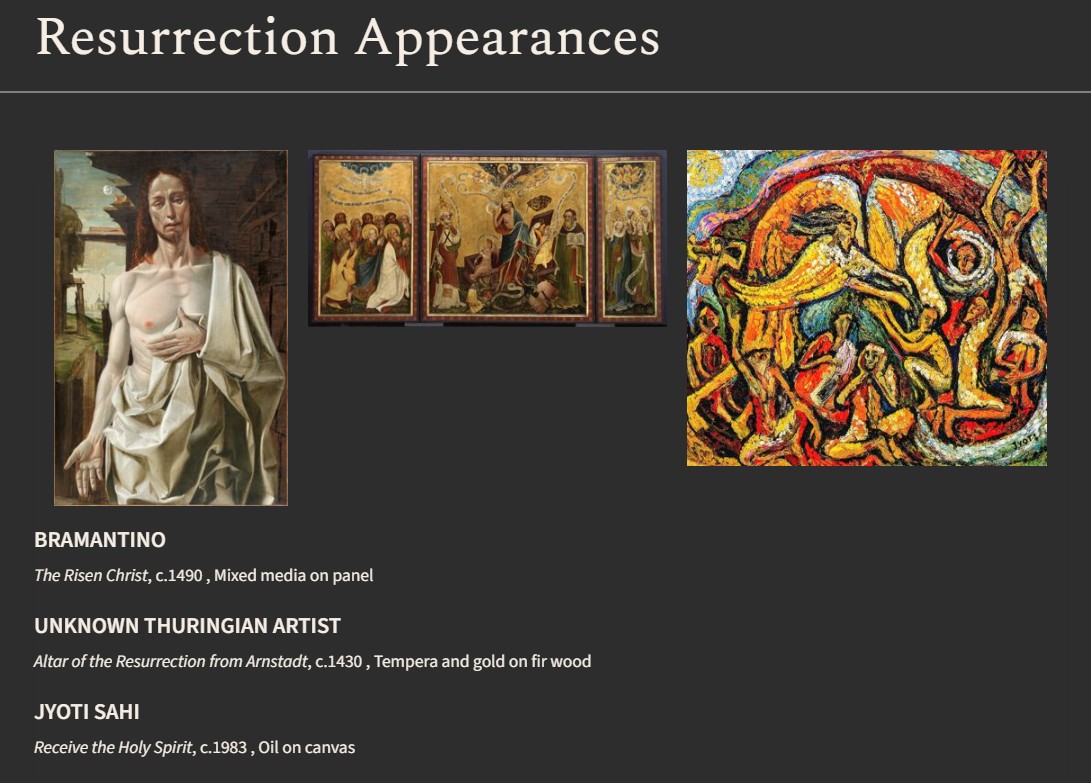
Resurrection Appearances screenshot

Two shortlisted artworks were David LaChapelle’s photograph Evidence of a Miraculous Event and a digital painting by Duncan Robertson.

>> Want to learn more about the Visual Commentary on Scripture [previously], an excellent free resource for pastors and other readers and teachers of the Bible? Check out the Exhibiting Faith podcast episode from April 30, where host David Trigg interviews VCS director Ben Quash about it.

+++

SONGS:

>> “O for a Thousand Tongues to Sing,” arr. Christopher M. Smith, performed by the MNU Heritage Choir: Smith arranged two stanzas of this Wesleyan hymn for the student choir he directs at MidAmerica Nazarene University in Olathe, Kansas. They perform the song inside the Bell Cultural Events Center, which has lines from the hymn inscribed on the walls.

>> “Citizen” by Philippa Hanna and Israel Houghton, performed with Moses Bliss

>> “For Your Gift of God the Spirit” by Margaret Clarkson (words) and Darwin Jordan (music), performed by musicians at Philpott Church in Hamilton, Ontario

+++

ARTICLE: “Vivid Spectrums of Color Radiate from Chris Wood’s Intricate Installations of Dichroic Glass” by Grace Ebert, Colossal: When I saw photos of this artwork by the Cambridgeshire-based light artist Chris Wood, with its prismatic colors and outward expansion, I thought of Pentecost—of the radiant gospel of Jesus Christ, from the launchpad of his resurrection and subsequent giving of his Spirit, going out to the world via and to various people groups, setting it ablaze. The artist says she was inspired by the logarithmic spiral of the nautilus shell. “We find in this a representation of how radiance can be embodied within us, as projected to those around us,” she says.
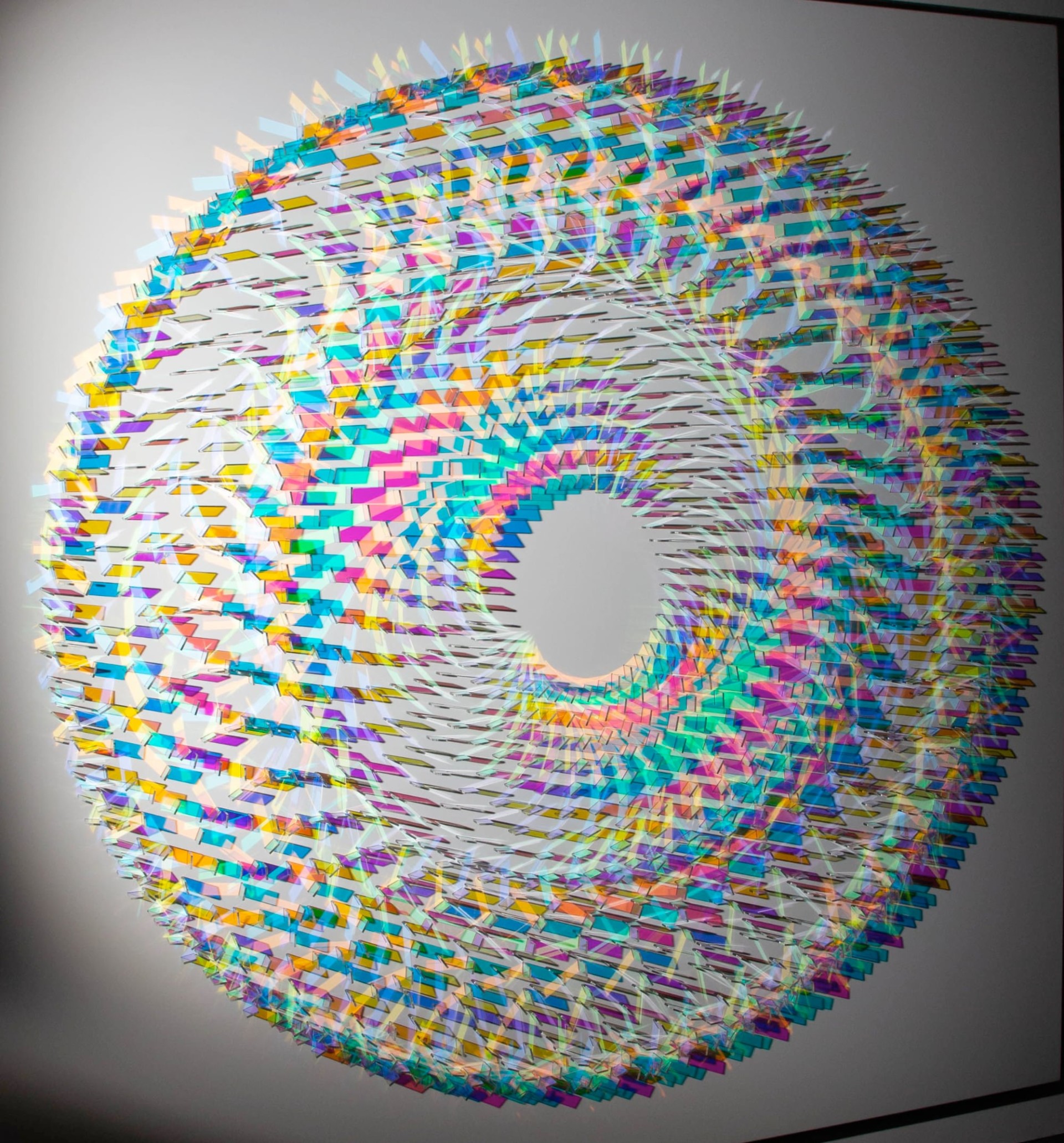

Wood, Chris_40 x 40
Chris Wood (British, 1954–), 40 × 40, 2022. Dichroic glass, diameter 160 cm. Commissioned by Clé de Peau Beauté.

Wood, Chris_40 x 40 (detail)

40 × 40 was commissioned in 2022 by the Japanese luxury skincare and makeup brand Clé de Peau Beauté for its fortieth anniversary. The work comprises forty spirals, each made up of forty pieces of dichronic glass, each forty millimeters long.  

“Dichroic is a material that is colorless, but it has an optical filter on it,” Wood explains. “So when light hits it, certain wavelengths, which are manifested as colors, reflect back, and the remaining wavelengths pass through, creating two colors. Those colors change depending on the angle and quality of the light and the viewpoint. It’s just the most eloquent description of the magic of light that I could find.”

+++

VIDEO: “The Lord’s Prayer: One Church, One Prayer”: ICF (International Christian Fellowship) Rotterdam-Noord, an intercultural church in the Netherlands, recently put together a video compilation of some of its members praying the Lord’s Prayer in their mother tongues; represented are English, Papiamentu, Dutch, Malayalam, Swahili, Arabic, Twi, Spanish, Tagalog, Chinese, and German.

Rotterdam is a diverse city, home to 170 different nationalities. In the neighborhoods ICF North serves, 70 percent of residents have a migrant background. Every Sunday the church, pastored by Fred Kappinga, offers an Arabic-Dutch service and an English-Dutch service, with translations into other languages when necessary and possible. They sing Christian worship songs from around the world and host guest preachers of various ethnicities.

Christ figure in Justin Dingwall’s Albus series

South African photographer Justin Dingwall (born 1983) seeks to depict beauty in difference. For his Albus series—Latin for “white” or “bright”—he worked with South African models and activists Thando Hopa and Sanele Junior Xaba, who have albinism. Albinism is a hereditary condition that affects melanin production, resulting in little to no pigmentation in the skin, hair, and eyes. It is more prevalent in sub-Saharan Africa than in the rest of the world, and people with the condition often face marginalization, discrimination, and even deadly violence.

In many ways Dingwall’s Albus series, which comprises several dozen photographs, is about metamorphosing perceptions about albinism, subverting the idea that it’s a curse; “by using butterflies my aim was to influence the viewer’s vision to be transformed, allowing them to view albinism in a new light—as something unique and beautiful,” he said. But the theme of transformation, of death and rebirth, as portrayed in some of the photos of Xaba, also connects with the narrative of Jesus’s passion, death, and resurrection, the model’s poses evoking traditional Christian imagery. (Not to mention how some of the photos of Hopa, not pictured here, intentionally reference Mother Mary.)

Rhapsody I, II, and III form a passion triptych of sorts, a sequence of three photos that show a male figure, clothed in a loincloth, falling into darkness—and yet, illuminated from above, he looks up toward the light.

Dingwall, Justin_Rhapshody triptych
Justin Dingwall, Rhapsody I, II, III, 2015

I’m reminded of Jesus speaking to his Father in Gethsemane, and at his crucifixion. Of all the art that shows him stumbling on his way to Calvary (“Jesus falls” makes up three of the fourteen stations of the cross). And especially of his slumped body being lowered from the cross. All the supporting characters, however, are absent, intensifying our focus on this lone Christ figure.

Justin Dingwall, Rhapsody I
Justin Dingwall, Rhapsody II
Justin Dingwall, Rhapsody III

Consider some of the compositional similarities between Dingwall’s three Rhapsody photographs and the following explicitly Christological artworks. (To view the full caption, click on the the image.)

Suggestive of burial, Embrace by Dingwall shows a man wrapped, cocoon-like, in white linen, lying against a black ground. His face, again, catches the light, and he appears to be at peace. He is resting in this silent, in-between time that precedes the emergence of new life.

Justin Dingwall, Embrace
Justin Dingwall, Embrace, 2015

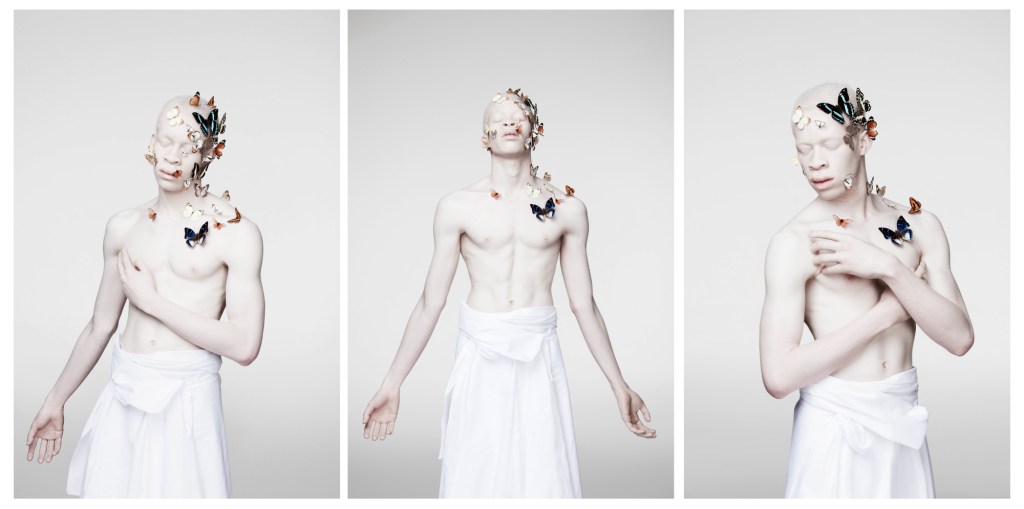
More explicitly inspired by Christian visual traditions is Dingwall’s Liberty triptych, which shows our Christ figure risen from death, glowing, and covered in butterflies, symbol of resurrection.

Justin Dingwall, Liberty (triptych)
Justin Dingwall, Liberty I, II, III, 2015

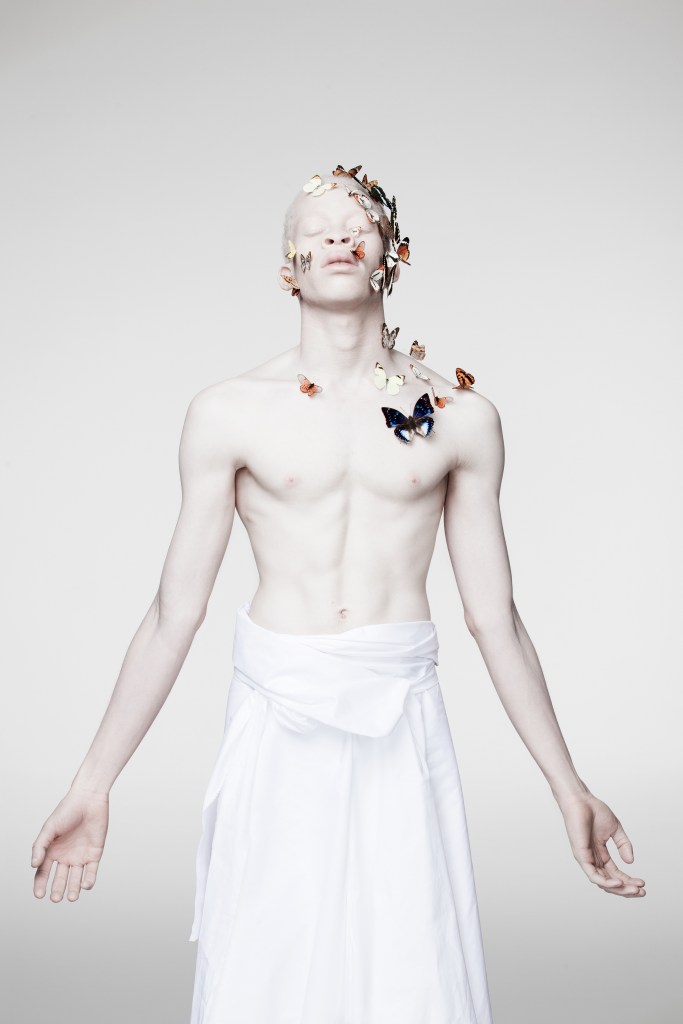
In Liberty II, the man extends his arms at a roughly forty-five-degree angle from his trunk, palms upward, in a beatific gesture. His eyes are closed as he bathes in light. Christ is often shown in this pose in art of the resurrection, emerging triumphant from his tomb and proudly revealing his transfigured wounds. Dingwall’s image, though, is quieter, more interior.

Justin Dingwall, Liberty II

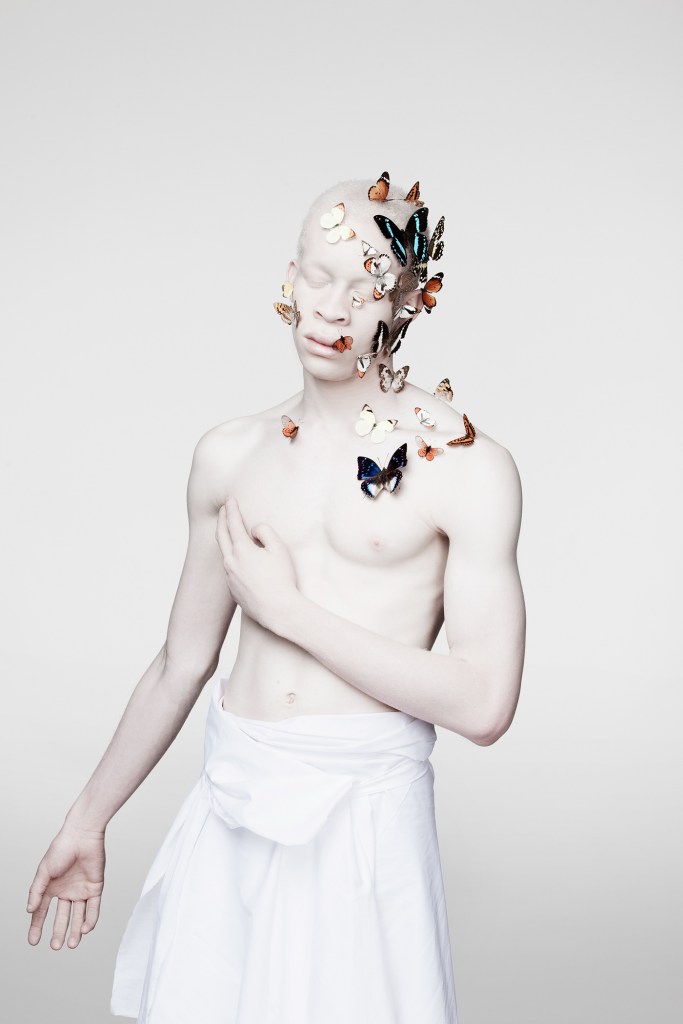
Liberty I is reminiscent of Jesus inviting Thomas to see and touch his wounds, and especially of Bramantino’s The Risen Christ (see tiled gallery below). People have long marveled at the incredible luminosity of Christ in the latter painting—how the light seems to come from within (the setting is nighttime, as the moon in the background indicates).

Justin Dingwall, Liberty I

So in many ways these photographs by Dingwall are continuous with Christian art history, but they are also open enough to be read in a multitude of other ways or applied to different contexts. Though the nature of Jesus’s resurrection and what it accomplished are, Christians believe, unique in history, stories of death and rebirth are universal, traversing all cultures and religious traditions.

View additional photos from the Albus series at https://www.justindingwall.com/albus.