Roundup: “God’s Love” playlist, embracing the ephemeral, and more

LENT SERIES: “Let go of unlove this Lent: Let’s practice love together—a new and improved Lenten reflection series starting March 5th” by Tamara Hill Murphy: I’ve been nurtured for years by Murphy’s gentle spiritual writing and curated beauty and wisdom, and I especially appreciate her annual Advent and Lent Daybook series. This Lent, she’ll be exploring four postures of cruciform love given to us in 1 Corinthians 13, providing daily scripture readings, prayers, and art, along with weekly practices. You can gain access for just $16. (She uses the Substack platform.)
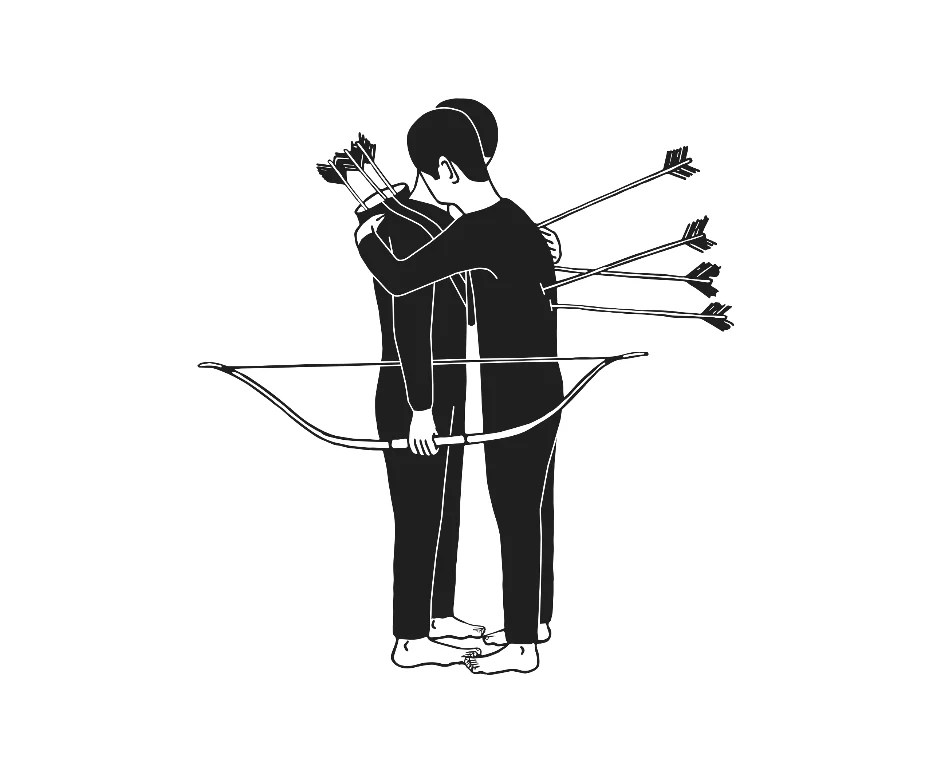
Erickson, Scott_Forgive Thy Other
Forgive Thy Other by Scott Erickson

I like how Murphy frames the season: “Lent is a significant time for us to seek a deeper understanding of God’s heart and recognize the gaps in our experiences of His love. Through its beautiful stories, prayers, and practices, Lent also invites us to reflect on our own expressions of love and unlove. The Book of Common Prayer encourages us to let go of our unloving ways so we can love what (and who) God loves. Let’s joyfully embrace this transformative season together, reflecting God’s love with compassion and understanding.”

+++

NEW PLAYLIST: God’s Love (Art & Theology): Related to Tamara Hill Murphy’s 2025 Lent Daybook theme: here’s a new playlist I put together of songs about the abounding, ever-present love of God the Father, Son, and Holy Spirit, a love that seeks, heals, and transforms.

The cover photo is of an early twentieth-century relief sculpture from the exterior of Holy Trinity Church in the town of St Andrews, Scotland, taken by Joy Marie Clarkson; it shows a pelican pecking her breast to feed her young with her own blood, a medieval symbol of Christ’s self-giving love.

There’s some overlap between this playlist and my dedicated Lent Playlist. I hope it uplifts you in the knowledge of the depths and riches of God’s love for you.

+++

SONGS:

>> “And Am I Born to Die?”: Lent opens with a call to “remember you are dust, and to dust you shall return.” A reflection on human mortality, this somber hymn was written by the great English Methodist hymnist Charles Wesley (1707–1788) and set to music—a shape-note tune—by Ananias Davisson (1780–1857), a Presbyterian elder from Virginia. In this video from January 2023, it’s performed by the Appalachian folk musician Nora Brown, with Stephanie Coleman on fiddle and James Shipp on harmonium.

And am I born to die?
To lay this body down?
And must my trembling spirit fly
Into a world unknown?

Awaked by trumpet sounds,
I from my grave shall rise,
And see the Judge, with glory crowned,
And see the flaming skies.

Soon as from earth I go,
What will become of me?
Eternal happiness or woe
Must then my portion be.

>> “Nunc tempus acceptabile” (Now Is the Accepted Time): Second Corinthians 5:20b–6:10 is traditionally read on Ash Wednesday, a passage that includes the adjuration, “Behold, now is the acceptable time; behold, now is the day of salvation!” (2 Cor. 6:2). There’s a beautiful tenth-century Latin chant hymn for Lent, from the Liber Hymnarius, that opens with this line. In 2013, the Chicago-based composer and conductor Paul M. French set it to music for SSA a cappella choir, its unison opening unfolding into an increasingly expressive three-part harmony. It’s performed here by the Notre Dame Magnificat Choir under the direction of Daniel Bayless.

Nunc tempus acceptabile 
Fulget datum divinitus,
Ut sanet orbem languidum
Medela parsimoniae.

Christi decoro lumine
Dies salutis emicat,
Dum corda culpis saucia
Reformat abstinentia.

Hanc mente nos et corpore,
Deus, tenere perfice,
Ut appetamus prospero
Perenne pascha transitu.

Te rerum universitas,
Clemens, adoret, Trinitas,
Et nos novi per veniam
Novum canamus canticum.

Amen.
Today is the accepted time.
Christ’s healing light, the gift divine,
shines forth to save the penitent,
to wake the world by means of Lent.

The light of Christ will show the way
that leads to God’s salvation day.
The rigor of this fasting mends
the hearts that hateful sinning rends.

Keep all our minds and bodies true
in sacrifice, O God, to you,
that we may join, when Lents have ceased,
the everlasting Paschal feast.

Let all creation join to raise,
most gracious Trinity, your praise.
And when your love has made us new,
may we sing new songs, Lord, to you.

Amen.

Translation © 2006 Kathleen Pluth

+++

LECTURE: “Embracing the Ephemeral: How Art Honors Creaturehood” by James K. A. Smith, Duke Divinity School, February 17, 2022: Mortality means something more than being a creature who will someday die, says philosopher James K. A. Smith; it is a way of being, not defined solely by its terminus. “To be created is to be ephemeral, fugitive, contingent. To be a creature is to be a mortal, subject to the vicissitudes of time.” Part of the Duke Initiatives in Theology and the Arts Distinguished Lecture Series, this talk about developing a Christian temporal awareness is based on chapter 4 of Smith’s then-forthcoming, award-winning book How to Inhabit Time (Brazos, 2022), titled “Embrace the Ephemeral: How to Love What You’ll Lose.”
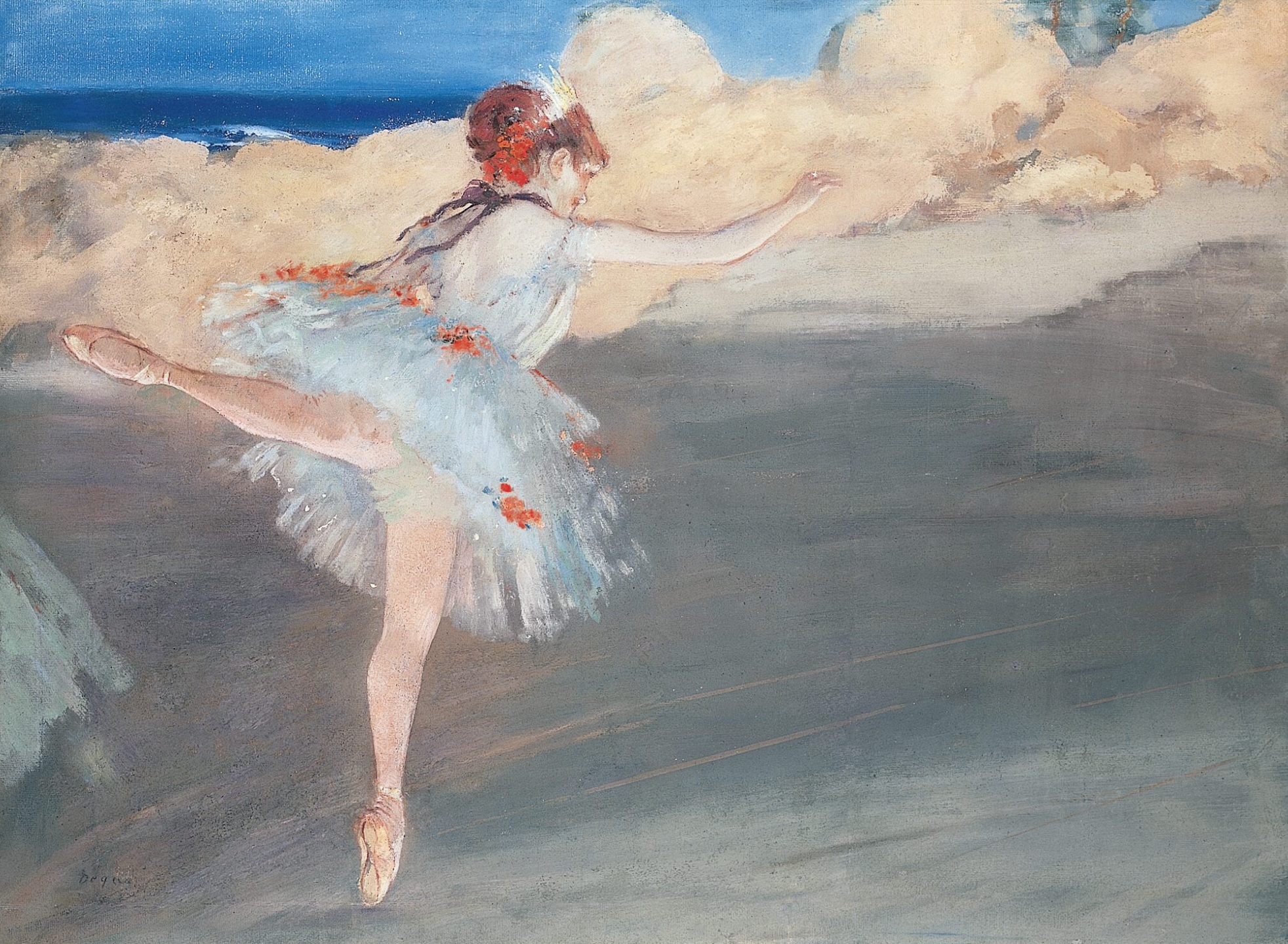
Degas, Edgar_The Star
Edgar Degas (French, 1834–1917), The Star: Dancer on Pointe, ca. 1878–80. Gouache and pastel on paper, mounted on board, 22 1/4 × 29 3/4 in. (56.5 × 75.6 cm). Norton Simon Museum, Pasadena, California.

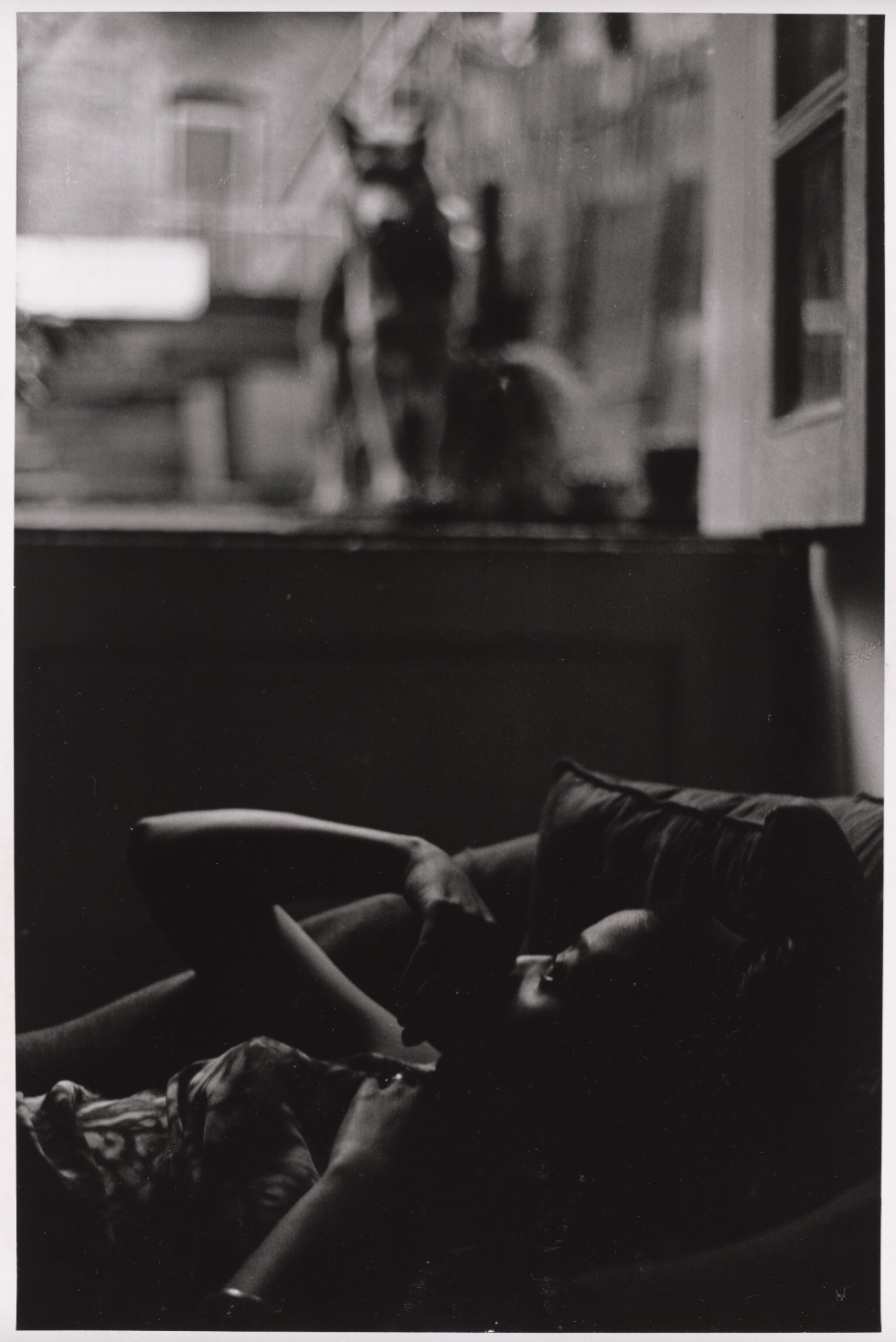
Randall, Herbert_Untitled (Lower East Side, NY)
Herbert Randall (American, 1936–), Untitled (Lower East Side, New York), 1960s. Gelatin silver print, 13 7/16 × 8 7/8 in. (34.2 × 22.5 cm). J. Paul Getty Museum, Los Angeles.

Some notes I took:

  • “We need not only memento mori, but also memento tempore—reminders of our temporality, not just our mortality.”
  • “Imagine embracing the ephemeral as a discipline of not only conceding our mortality as a condition but also receiving our mortality as a gift.”
  • “Our finitude is not a fruit of the fall, even if it is affected by the fall. Contingency is not a curse. . . . Aging is not a curse. Autumn is not a punishment. Not all that is fleeting should be counted as loss. The coming to be and passing away that characterize our mortal life are simply the rhythms of creaturehood.”
  • Resting in our mortality instead of resenting it
  • Theologian Peter Leithart says hebel means not “emptiness,” “vanity,” or “meaninglessness” but, literally, “mist” or “vapor.” The Teacher in Ecclesiastes uses that word repeatedly to describe human life: it’s vaporous, elusive, escapes our efforts to hold on to it, to manage it.
  • “The Fly” by William Oldys
  • Mono no aware, a Japanese aesthetic principle—what the thirteenth-century Japanese Buddhist nun Abutsu-ni referred to as “the ah-ness of things”
  • “It may be artists who help us best appreciate the fragile dynamism of creaturehood.”
  • Exhibition: Working Together: The Photographers of the Kamoinge Workshop. A collective of Black photographers founded in New York City in 1963. Their photographs don’t capture the ephemeral; they hallow it.
  • How to sift tragedy from good creaturely rhythms in which good things fade?
  • “To dwell faithfully mortally is to achieve a way of being in the world for which not all change is loss and not all loss is tragic, while at the same time naming and lamenting those losses that ought not to be. . . . To be faithfully mortal is a feat of receiving and letting go, celebrating and lamenting. Being mortal is the art of living with loss, knowing when to say thank you and knowing when to curse the darkness.”
  • “One Art” by Elizabeth Bishop: “The art of losing isn’t hard to master . . .”

A Q&A takes place from 39:00 onward. The first question, asked by theologian Jeremy Begbie, is the one I had, and it recurs with different phrasing at 58:17.

+++

POEM: “Ash Wednesday” by Anya Krugovoy Silver: I first encountered this poem in the excellent devotional Between Midnight and Dawn: A Literary Guide to Prayer for Lent, Holy Week, and Eastertide, and it has stuck with me ever since. (It was originally published in the equally excellent The Ninety-Third Name of God, Silver’s first poetry collection.)

Mortality is one of the main themes in Silver’s poetry, including the physicalities of being human, as reflected in “Ash Wednesday,” in which she, the speaker, muses on the shared Christian ritual of the imposition of ashes at the beginning of Lent. Silver, who died of breast cancer eight years after writing this poem, was used to practicing memento mori (“remember you must die”): her mastectomy scar and silicone breast prosthesis are constant reminders of the fact, she writes. She wants to touch the body of God, wants to wrap her fingers around some tangible promise of healing, but both remain elusive. Instead she resolves to embrace the finiteness of her present form, taking the burnt remains of those Hosanna palms from last year and wearing them with repentance and praise, knowing that what is sown in perishability will be raised in imperishability (1 Cor. 15:42).

I’m compelled by how Silver both laments her fragility and owns it. There’s a defiant quality to the tone, the ash-and-oil mixture that’s thumbed into her forehead in the shape of a cross evoking a football player applying eye black in front of a locker room mirror before the big game. Wearing the mark of Christ, she’s ready for the face-off between herself and death.
Roundup: Animal church service, “Life/Blood” installation, and more

Have you been delighted or inspired by the Art & Theology blog this year or its Instagram offshoot, @art_and_theology? If so, please consider donating to the work through a secure online form or PayPal, or by buying me a book from my Amazon wish list (my address is privately stored). Thank you to my five regular monthly supporters, and others who have blessed me with one-off donations of funds and books. These gifts not only provide important material assistance but also serve as an emotional boost, a validation that my work has value and is worth continuing.

My blog-related expenses this year have included a replacement of my old laptop, a conference registration and travel fees, a trip to New York, museum admissions, books, licensing fees for two images (I occasionally pay for images when good photos are not available online), and the yearly WordPress Premium fee to keep this site ad-free and mapped to a custom domain. Donations will go toward covering these, and if there is any left over, toward a new camera lens that will enable me to take wider shots, great for cathedrals and for larger artworks in tight quarters.


SPOTIFY PLAYLIST: October 2024 (Art & Theology): Every month I create a digital mixtape of Christian and Christian-adjacent music that deserves attention, consisting of old and brand-new recordings alike. Two hours of beautiful, soulful expressions of praise, prayer, and lament for your ears and heart.

+++

VIDEO: Animal Service at Ely Cathedral: On September 22, Ely Cathedral in England held its annual animal service, attended by some 450 animal lovers and their pets and service animals, mainly dogs. “Our annual Animal Service is an opportunity to give thanks for the animal companions with whom we share our lives and our planet, to bring them into our Cathedral, to ponder how best to care for animals and to ask God to bless them.” Marley the donkey, from the Donkey Sanctuary, led a procession up the nave. The liturgy was led by Canon James Garrard, and, in addition to several congregational hymns, including “All Creatures of Our God and King,” the cathedral’s children’s choir, the Ely Imps, sang “The Barnyard Song” by Rhonda Gowler Greene and “Look at the World” by John Rutter.

In addition to a special prayer of confession, act of commitment, and benediction, the service included this litany from the Book of Common Prayer:

God said, “Let the waters bring forth living creatures, and let birds fly across the sky.”

We thank you for the teeming life of the seas,
And the flight of the birds.
Help us to protect the environment
So that all life may flourish.
God of life: Hear our prayer.

God said, “Let the earth bring forth living creatures of every kind.”

We rejoice in the variety of animal life.
Grant us grace to treat all animals with respect and care;
To protect endangered species,
To preserve the variety of habitats,
And to honor the delicate balance of nature.
God of life: Hear our prayer.

Heavenly Father, you have filled the world with beauty.
Open our eyes to behold your gracious hand in all your works,
That, rejoicing in your whole creation,
We may learn to serve you with gladness,
For the sake of him through whom all things were made,
Jesus Christ our Lord.
God of life: Hear our prayer.

Two volunteer representatives from the charity Medical Detection Dogs were invited to share about the work of dogs who are trained to detect the odor of human disease.

Several churches worldwide hold animal services around this time of the year, the Feast of St. Francis (known for his love and care of animals) being on October 4. These are usually in addition to the regular Sunday morning worship service and are not eucharistic. UMC’s Discipleship Ministries provides a sample liturgy for “A Service for the Blessing of Animals.” Many such services are held outdoors, such as the one organized annually by Washington National Cathedral, which is taking place this Sunday, October 6, at 2 p.m.

+++

ART INSTALLATION VIDEOS + PHOTOS: In July I mentioned the Vessel art trail organized by Art + Christianity, which places contemporary artworks in rural churches along the Welsh-English border (see here). On commission from A+C, Mud and Thunder has taken some wonderful photos and video of the seven sites on the trail, including interview footage with the artists. What follows are videos for Life/Blood by Lou Baker, Grace Vessel by Jane Sheppard, and Centre by Steinunn Thórainsdóttir. (The remaining videos are on pieces by Lucy Glendinning, Andrew Bick, Barbara Beyer, and Robert George.)

The art trail continues through October 31. Visit https://artandchristianity.org/vessel to view in situ photographs, and see the following links for information on free creative workshops led by the participating artists: on making sculptures of found natural materials, working with clay as a meditative practice, social knitwork, and drawing.

+++

POEMS:

>> “There’s a Special Providence” by Seth Wieck, Texas Poetry Assignment: Seth Wieck [previously] is a writer from Amarillo, Texas. Published the week of the last US presidential inauguration, this poem muses on the impermanence of earthly empires, contrasting such with the steady, indifferent labor of birds, which continues on through administration changes and the passing of generations. The title and opening line are a clever rhyming twist on a line from the final act of Shakespeare’s Hamlet, “There’s a special providence in the fall of a sparrow.” For the poetic speaker, there’s a sense of comfort in God’s sovereignty and an orientation toward Christ’s lordship that puts election poll results, though not negligible, in proper perspective.

In a Substack post from February 2021, Wieck wrote, “I am no politician’s acolyte; they’re public servants, not saviors. I catch some heat in private conversation when I say that I couldn’t care less about national politics. That’s not a true statement, but the tense conversations in which I claim my ambivalence usually leave me no room for nuance. Those conversations demand my total wide-eyed attention to the firehouse of information being created by national elections. But as Mary Oliver said, ‘The beginning of devotion is attention.’ Forgive me if I am unwilling to develop devotion for those people whose only interest in my community is the exploitation of our devotion and resources.”

>> “Jesus Heals a Paralytic” by Ryan Keating, Reformed Journal: Ryan Keating is a pastor on the Mediterranean island of Cyprus (he preaches in Turkish and English), an academic writer and poet, and the owner of Exile Coffee and Wine. This poem retells the miracle from Mark 2:1–12 in the voice of the paralyzed man whom Jesus heals. Whereas many artists depict the episode with ropes used as a lowering mechanism, Keating says it’s much more likely, given the typically low ceilings of Middle Eastern homes, that the man would have been received by “a net of hands” raised up by the people in the room.

The poem repeats the word “temple” three times, remarking how the man was “suspended / in a temple by a temple / and landed on holy ground / as a temple . . .” The temple is the place where the crowd is gathered because Jesus is in it, and the four faith-filled friends who bring the paralyzed man there themselves constitute a temple, and the man too becomes a temple, a dwelling-place of God, after being made whole by Jesus. Drawing on Old Testament imagery of the garden of Eden and the exodus, the final stanza is one of restoration. The sea of people parts as the man steps outside into a garden, his friends buoyed by amazement.

+++

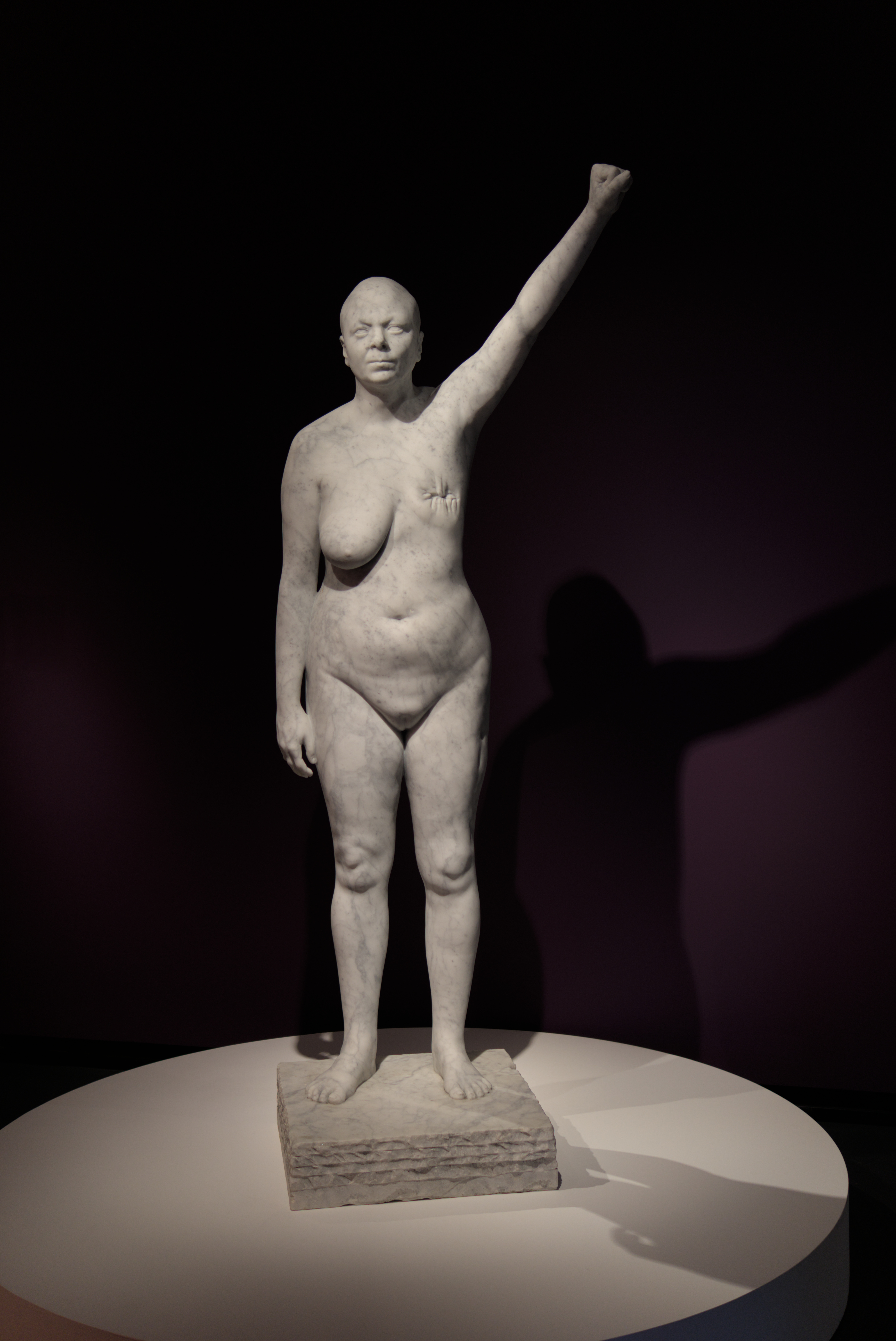
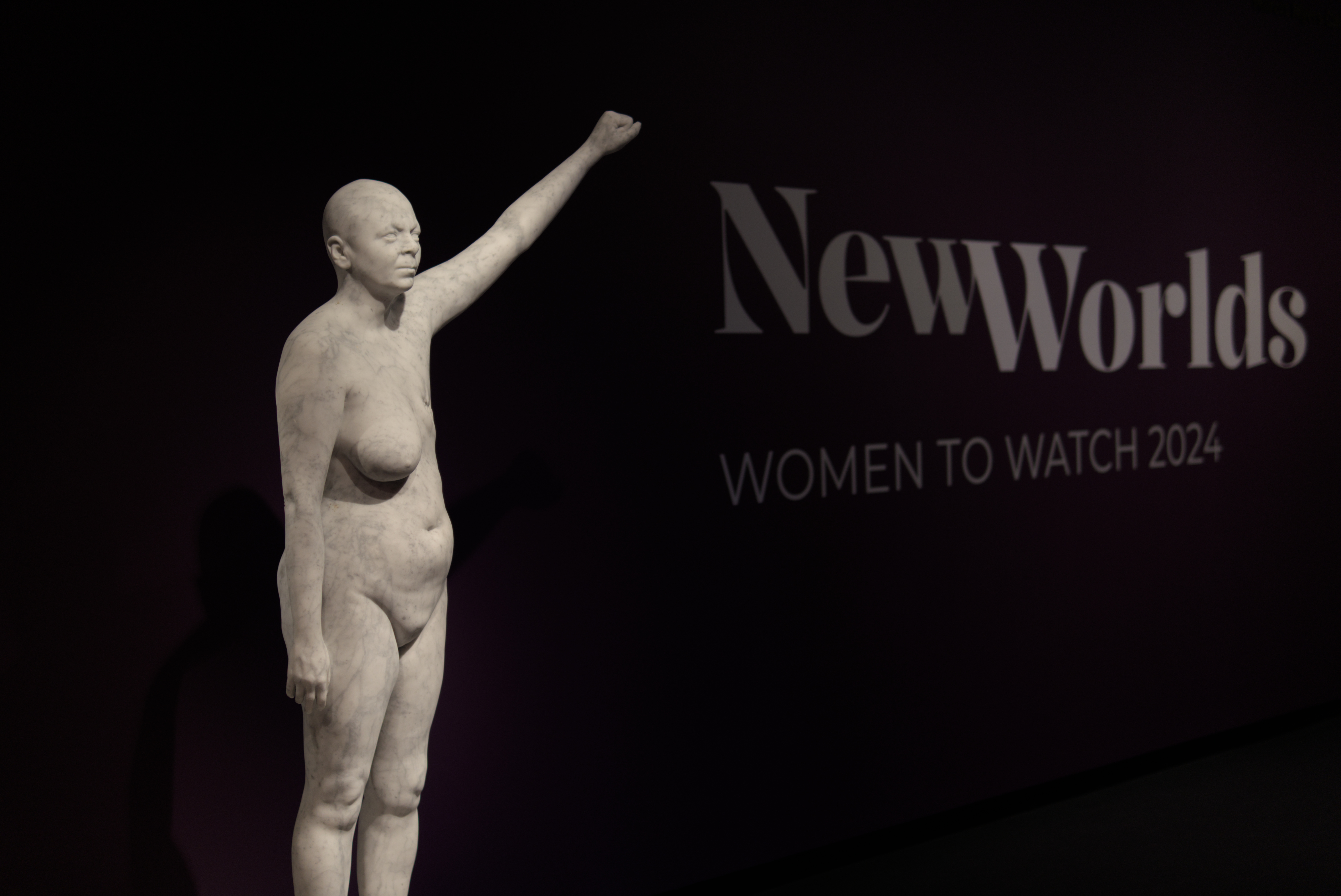
ARTWORK: Intra-Venus by Marina Vargas: October is Breast Cancer Awareness Month, so I wanted to share an artwork I encountered on the subject this summer at the New Worlds: Women to Watch 2024 exhibition at the National Museum of Women in the Arts. Intra-Venus is a nude self-portrait in marble by Spanish artist and breast cancer survivor Marina Vargas, frankly depicting her body after a mastectomy, chemotherapy, and radiation. Owning her scars and her baldness, she uses the language of classical sculpture to monumentalize a common female experience. (The chance of a woman in the US getting breast cancer in her lifetime is 1 in 8, and more than 100,000 US women undergo some form of mastectomy each year; global statistics are harder to come by.) Vargas lost the use of her left arm for a time during treatment, but here she shows herself with her left arm raised in triumph. The sculpture highlights the heroism of women who endure breast cancer and the dignity of their changed form.

Vargas, Marina_Intra-Venus
Marina Vargas (Spanish, 1980–), Intra-Venus, 2019–21. Carrara marble, 77 1/2 × 26 3/4 × 26 in. Photo: Victoria Emily Jones.

Vargas, Marina_Intra-Venus

Roundup: “Art and Religion Now” symposium, landscape of the body, and more

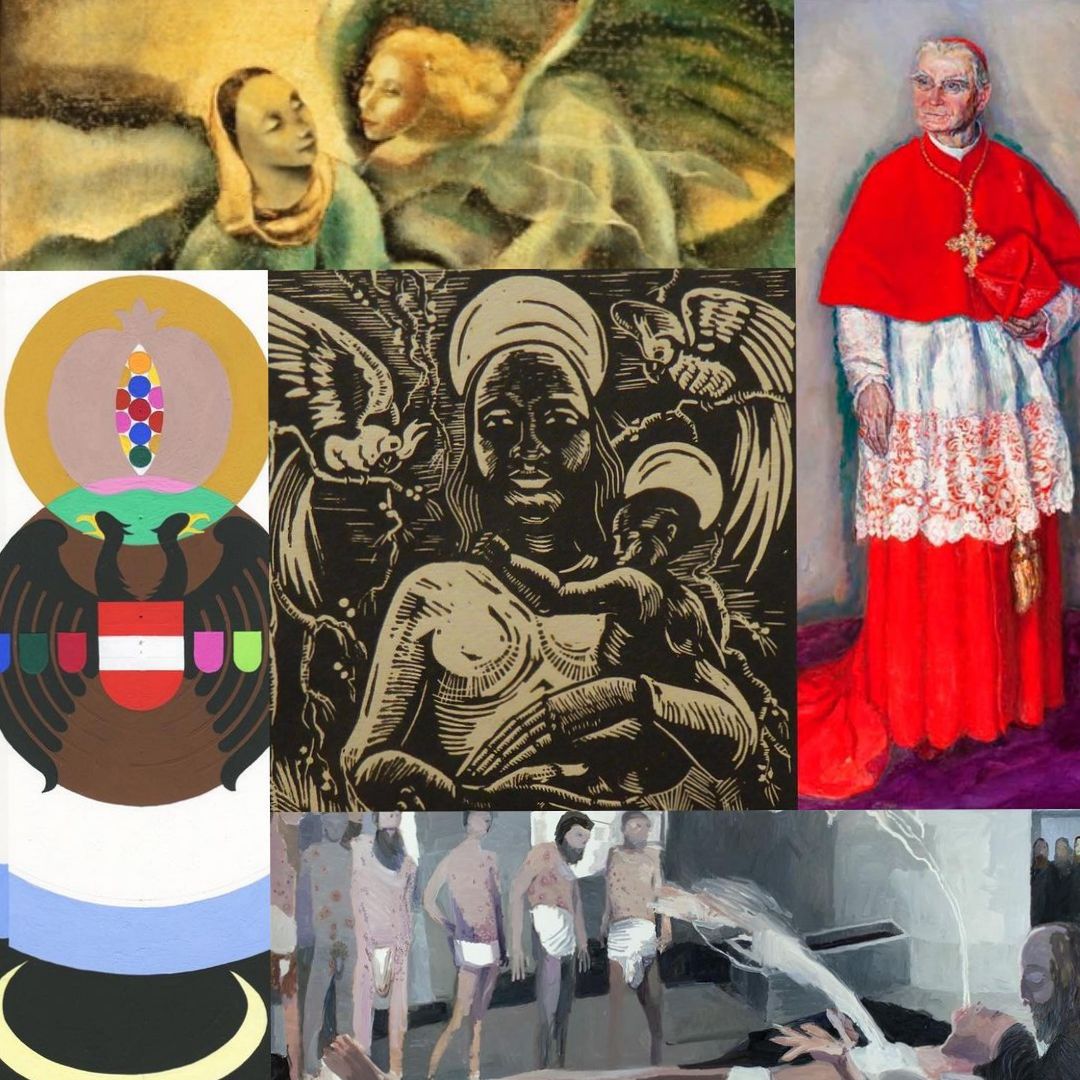
SYMPOSIUM: “Kunst en religie nu” (Art and Religion Now), October 20, 2023, 1:30–4:30 p.m., Museum Catharijneconvent, Utrecht, Netherlands: A week from Friday, attend a free afternoon of talks (in Dutch) on the topic of religion in modern and contemporary art. The speakers are Lieke Wijnia, who will present the results of her past two years of research on religious themes that crop up in modern and contemporary artworks in the Collectie Nederland (Netherlands Collection); Rozanne de Bruijne, on religion in art of the interwar period (1918–1940), the topic of a spring 2025 exhibition she’s curating; Wouter Prins from the Museum Krona, on the state of religious art in the post-Nietzsche era; and Joost de Wal on contemporary art in church spaces. Here’s the autotranslated description:

“The more modern the art, the smaller the presence of religion.” This frequently heard approach appears to be anything but justified. In fact, at the beginning of the twenty-first century, spirituality seems to be on the rise in the visual arts, resulting in a multitude of artistic interpretations. What does this say about the relationship between religion and art?

This symposium focuses on the multifaceted and sometimes unexpected presence of religion in visual art. For example, how does contemporary (religious) art relate to ongoing secularization on the one hand and to flourishing international religious communities on the other? What does the growing interest in spirituality mean for the arts? And what about the use of religious symbolism in visual art, both inside and outside the church? The speakers also shed light on how the wealth of (religious) stories and images can provide guidance in times of social uncertainty and uprooting.

Clockwise from top left: Annunciation by Mariette Lydis (1931); Portrait of Cardinal W.M. van Rossum by Jan Sluijters (1927); The Exorcism of Mary Magdalene by Helen Verhoeven (2020); Path and Puddle, panel 4, by Kasper Bosmans (2022); Black Madonna by Genia van der Grinten-Lücker (1934)

+++

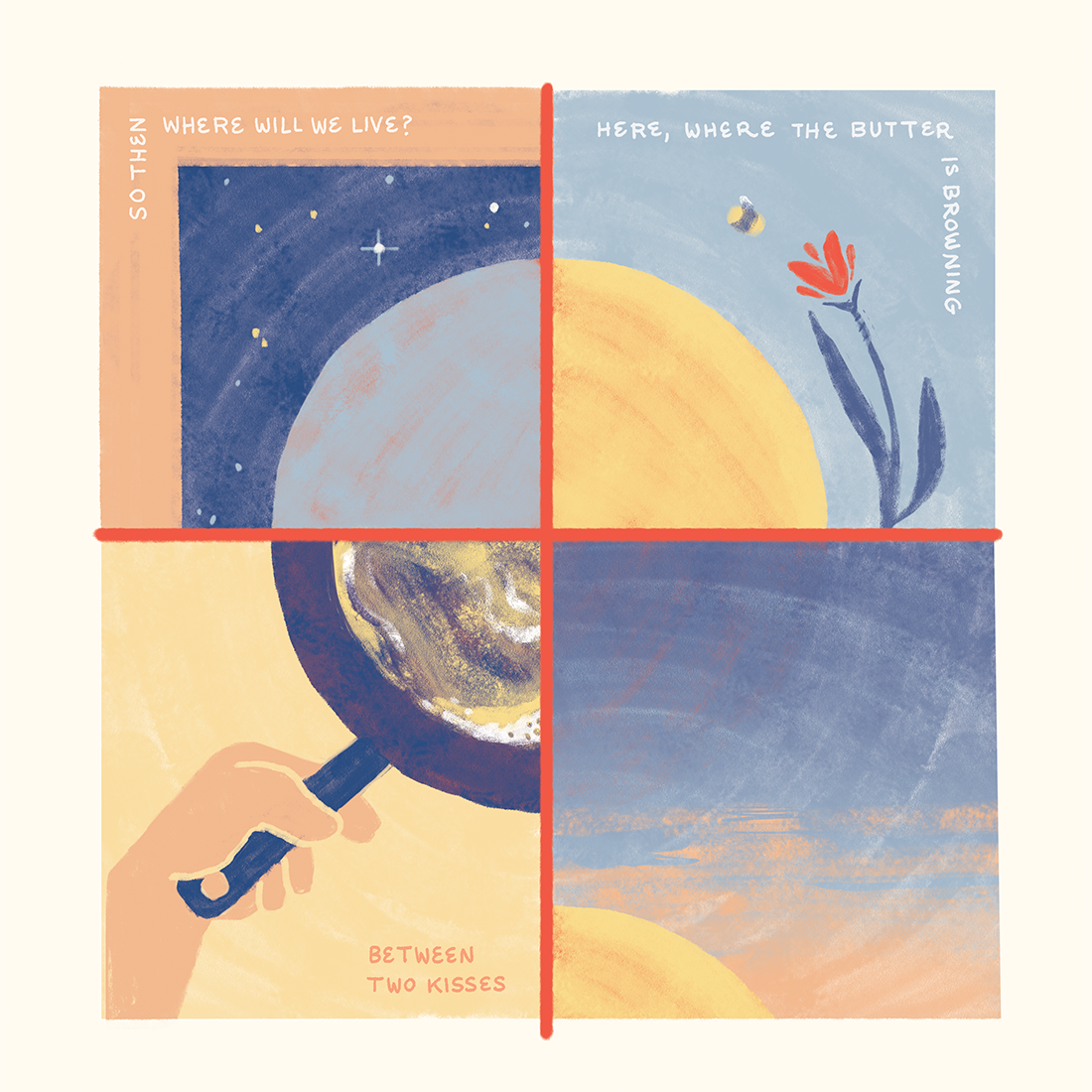
ONLINE WORKSHOP: “Deep Dive into Poetry Comics,” led by Madeleine Jubilee Saito, November 2, 9, 16, 30, 5–7 p.m. Pacific (8–10 p.m. Eastern): Madeleine Jubilee Saito [previously] is a cartoonist from Seattle who makes “poetry comics” about the environment and the sacred—and in four virtual sessions offered through Push/Pull, she’ll teach you how to make your own on topics of your choice!

Saito, Madeleine Jubilee_Love Poem
Madeleine Jubilee Saito, Love Poem, 2019

“In this online course, you’ll practice exercises to explore your own voice and interests in drawing and text, creating poetry comics in a variety of styles. You’ll learn about minicomics, how to do basic layout for printing, and how to print a quarter-page minicomic. We’ll end the course with a celebratory comics reading for friends and family on Zoom. Students need to either be comfortable drawing digitally (Procreate, Photoshop, etc.) or have access to a scanner. Students will be also need access to a printer or local print shop for the last phase of the course.”

If you don’t have time to commit to four classes, there’s a single one offered on October 27.

+++

NEW ALBUM: You Don’t Carry It Alone by Leila Way: Leila Way is a singer-songwriter from Austin, Texas, writing songs for the church. Her first full-length album, “You Don’t Carry It Alone is a collection of songs for hard times. Some of these are old hymns; some were written during a period of intense grief and loneliness, while others grew out of prayers for friends. The album was created to comfort those who mourn; to remind God’s people that He is always faithful, always present and at work, even when we can’t see what He’s up to.”

The album consists of four original songs, two original instrumentals, a cover of “Be Still, My Soul,” and new retunes of George Matheson’s “O Love That Wilt Not Let Me Go” (one of my favorite hymns) and James Montgomery’s “I cannot call affliction sweet.”

+++

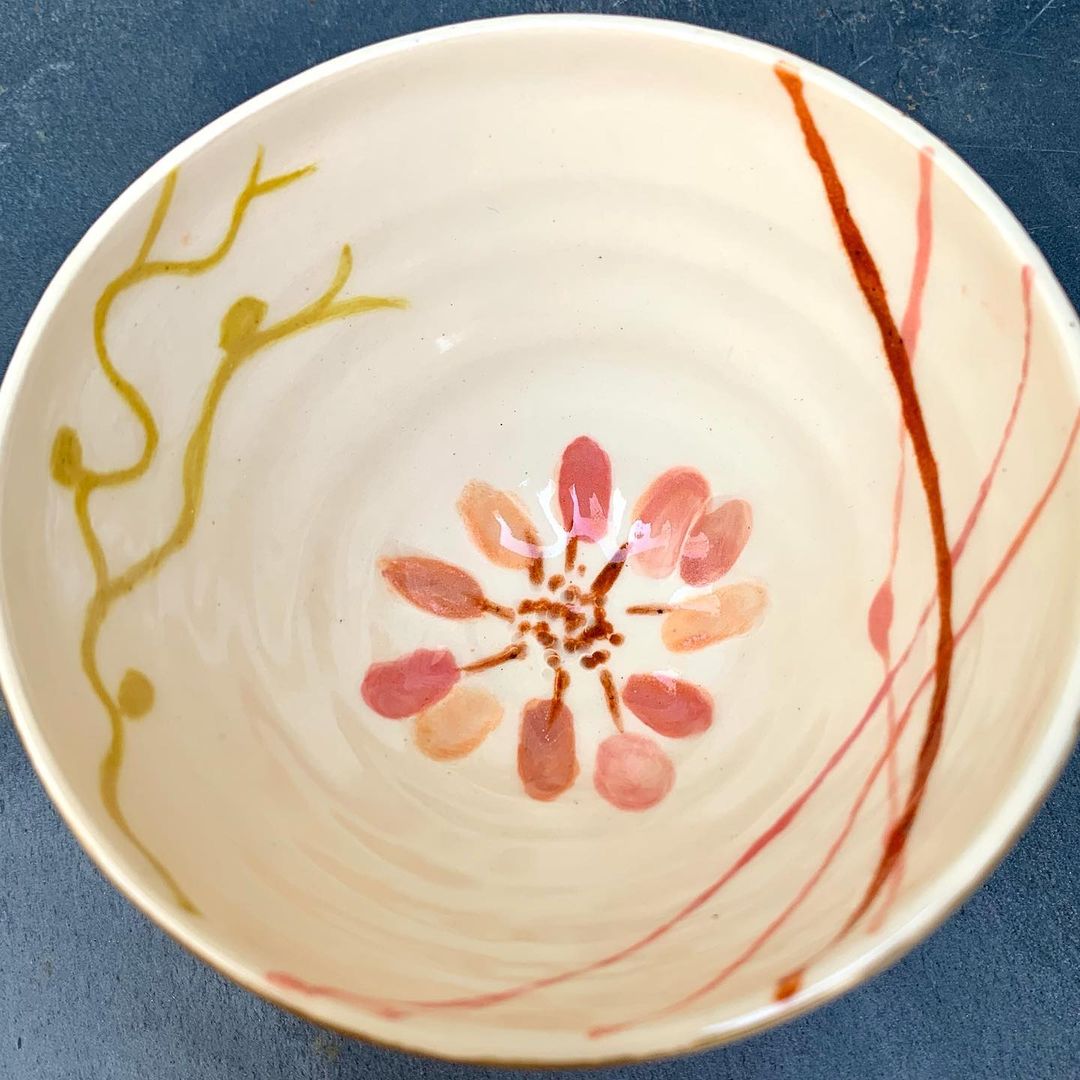
CERAMIC BOWLS: Nurture Collection by Jane Boutwell: I met artist Jane Boutwell at a Christians in the Visual Arts (CIVA) conference in 2021 after she presented this body of work that really moved me—a collection of ceramic bowls that take as their three design elements anatomical features of the female breast: lymph nodes (gold, river-like), mammary glands (pink and blooming), and musculature. She started the Nurture Collection after having one of her milk ducts surgically removed in 2019 for a biopsy (it turned out not to be cancer), as a meditation on the strength and inner beauty of this part of the body that is so often objectified or shamed. She recommends the bowls as a gift for a woman in your life who has had a tender year with regard to her breasts—cancer, nursing, etc.—to honor her journey.

Boutwell, Jane_Mammary bowl
Bowl from the Nurture Collection by Jane Boutwell, 2020

I share these now because October is Breast Cancer Awareness Month. Below is an eight-minute video explanation by the artist, followed by a short “making of” montage:

There are five Nurture bowls currently for sale in Boutwell’s online shop: Joan, Tracy, Colleen, Rita, and Wendy. Each is named after a woman she knows with breast cancer.

+++

PODCAST EPISODES:

>> “Landscape of the Body with David Taylor,” Makers & Mystics, September 13, 2023: Constructing a cogent theology of the body, theologian W. David O. Taylor discusses why it’s important that we honor and understand our bodies, and why having a right relationship to our bodies is imperative to the quest of art. Christians have often feared, distrusted, or despised the body; sin has meant that we’ve become alienated from our own bodies and the bodies of others, that we harm our bodies and others’, and that we often flee from our bodies, dissimulate. But Jesus wants us to be at home in our bodies, Taylor says—in worship, and in day-to-day life. He talks about Jesus as an icon of care-filled touch and the implications of that.

>> “On Being in a Body,” On Being with Krista Tippett, September 21, 2023: At the 2023 Aspen Ideas Festival, Krista Tippett interviewed Kate Bowler, author of Everything Happens for a Reason (and Other Lies I’ve Loved), a reflection on how she moved through learning at age thirty-five that she had Stage IV colon cancer. “From the new reality in our time of living with cancer as a chronic illness, to the telling of truths to our young as we face precarity in our collective body, this conversation is full of the vividly-whole humanity that Kate Bowler singularly embodies.” I heard Kate in person at Duke University a few years ago talking on a panel about suffering. She’s full of wisdom, wit, and raw tenderness and so, so endearing, and even though I’ve heard her story many times, every conversation with her brings up something new.  

+++

DANCE PERFORMANCE: Chroma, Grace, Takademe, and Revelations, performed by Alvin Ailey American Dance Theater: I’ve shared a video of Alvin Ailey’s Revelations here before. Well, this rebroadcast from 2015 includes that, plus performances of three other works by the prestigious Alvin Ailey American Dance Theater. I especially enjoyed Chroma, with music by Joby Talbot and choreography by Wayne McGregor—it’s the first twenty-six minutes of the video.

“Blessing for My Left Breast” by Anya Krugovoy Silver (poem)

Your skin slit round with a scalpel:
be brave.
Rise to the aluminum tray, the biopsy needle.
Go, nipple; go, milk ducts; go, veins.
Take with you my lymph nodes,
canaries of illness, blood cells’ puff balls.

Blessed be my chest wall for surrendering.

Now you will never shrink and wrinkle with age,
clove-studded orange, bittersweet.

Taken in your beauty, let the last hands
that hold you
be gentle.

This poem is from The Ninety-Third Name for God (Baton Rouge: Louisiana State University Press, 2010). Used by permission of the publisher.

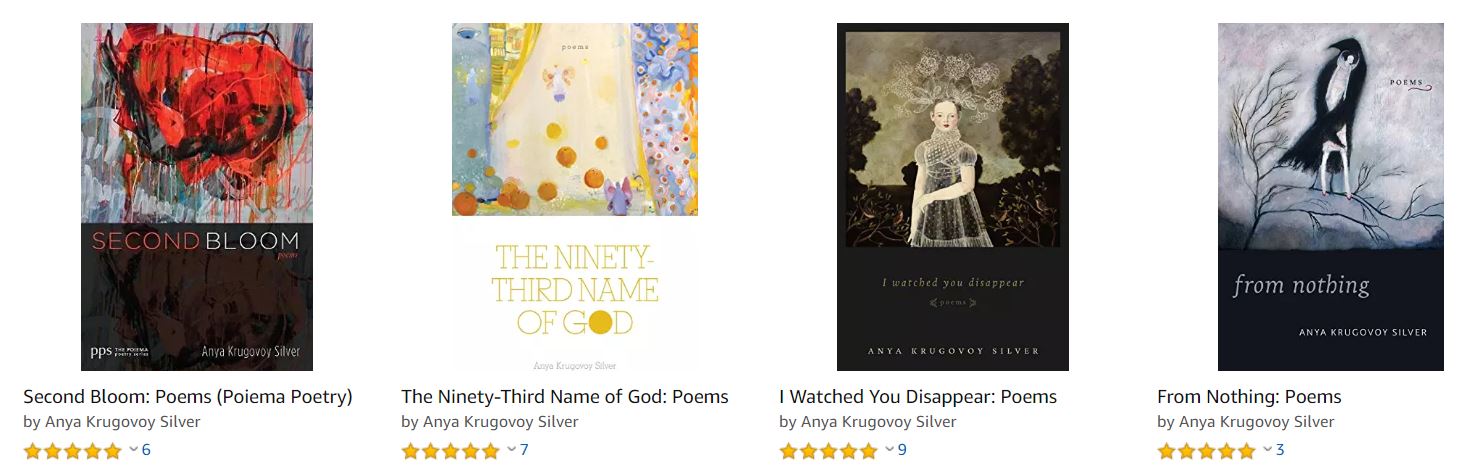
Anya Krugovoy Silver (1968–2018) was an American poet who authored five poetry collections: Saint Agnostica (posthumously published, 2021), Second Bloom (2017), From Nothing (2016), I Watched You Disappear (2014), and The Ninety-Third Name of God (2010). Diagnosed with inflammatory breast cancer in her thirties, she wrote often about life’s precariousness, the trauma of chronic and terminal illness, and holding on to joy and religious faith. She was named Georgia Author of the Year for Poetry in 2015 and was awarded a Guggenheim Fellowship in 2018. She taught at Mercer University until her death in 2018.

Roundup: Obits; breast cancer saint; exhibitions; gospel jam

ARTIST DEATHS:

This August saw the homegoing of two beloved Christian art-makers.

>> “Making meaning out of suffering and loss is one of poetry’s most fundamental aims,” wrote poet Anya Silver, who passed away from inflammatory breast cancer on August 6 at age forty-nine. Since her diagnosis in 2004, she published four volumes of poetry that wrap up faith with deep, honest questioning of God. Many of her poems contain imagery related to cancer and its treatment and describe with unswerving candor what it’s like to live under the threat of imminent death. When she received a Guggenheim Fellowship this year, the foundation described her work as “engag[ing] with the trauma of chronic and terminal illness, and with religious faith and mystery, storytelling, memory, and the risks and rewards of being human.” One of her best-known poems is “Psalm 137 for Noah,” written for her only child, whom she gave birth to during her illness.

“I have a tremendous amount of joy in my life, and my joy exists with pain,” Silver said in an interview with Georgia Public Radio in January. “I don’t see those two things as completely separate. All of life is woven together, and separating the strands is impossible.” Read her obituary in the New York Times, and a sweet tribute by Elizabeth Palmer in the Christian Century.

Anya Silver

Anya Silver books

>> A giant of contemporary French sacred art, Jean-Marie Pirot, known professionally as Arcabas, died August 23 at age ninety-one. He is best known for his paintings, which feature biblical characters and scenes, but he also worked in sculpture, engraving, tapestry, mosaic, and cabinetry, as well as in the theater making scenery and costumes. His magnum opus is the interior decoration of Saint-Hugues-de-Chartreuse in the Isère region of France, which comprises over a hundred works by the artist created over a span of thirty-five years.

There has been much published about Arcabas in French (e.g.) but unfortunately very little in English—though for starters, I recommend this ArtWay article. A YouTube search of his name yields several video interviews and feature news segments—again, in French. I’ve embedded a recent video homage below, which shows you inside Saint-Hugues as well as his designs for the stained-glass windows inside the Basilica of the Sacred Heart in Grenoble, a project he was working on when he died. I’d love to help bring out some of these books, or even a brand-new catalogue raisonné, in English, so if any of you have connections to Arcabas’s French publishers or people close to him, or have experience translating from French to English, let me know!

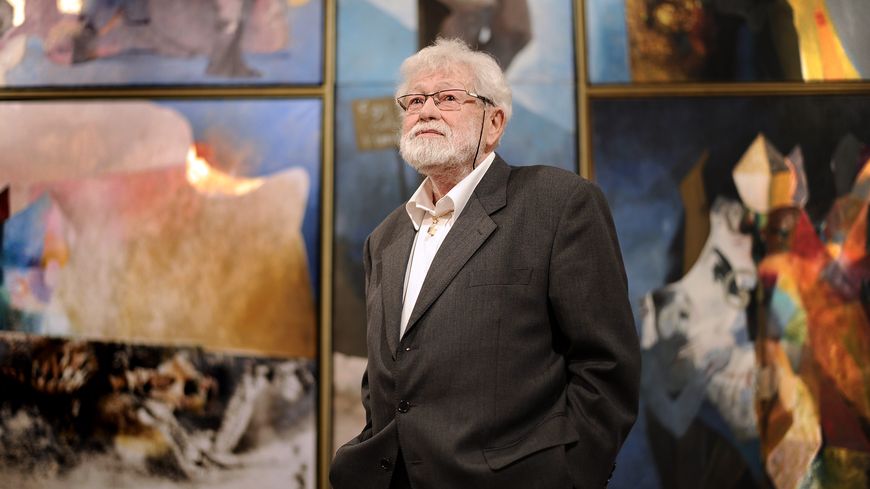
Arcabas

+++

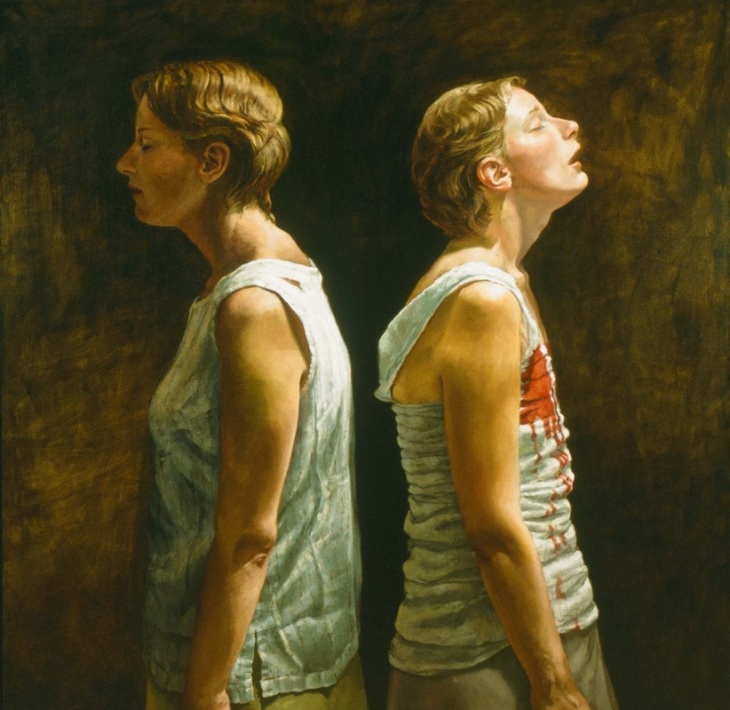
PAINTING: Saint Agatha’s Grief by Melissa Weinman: October is Breast Cancer Awareness Month, so what better time to get acquainted with Agatha of Sicily, patron saint of breast cancer patients. Agatha was a third-century Christian from a noble family whose martyrdom has been authenticated, although its details have not. According to legend, fifteen-year-old Agatha made a vow of virginity and rejected the amorous advances of the Roman prefect Quintianus. After consistently being spurned, Quintianus had her arrested for her faith (this was during the persecutions of Decius) and tortured. Among the tortures she underwent was the tearing off of her breasts with pincers. She died in prison, probably in the year 251.

St. Agatha's Grief by Melissa Weinman
Melissa Weinman (American), Saint Agatha’s Grief, 1996. Oil on canvas, 42 × 42 in.

In traditional portraiture, Agatha is shown holding her severed breasts on a platter (see, e.g., Francisco de Zurbarán). More recently, though, American artist Melissa Weinman painted a double portrait of Agatha as a modern-day woman in a white tank top enduring the tortuous experience of breast cancer. The two women stand back to back, the left figure having presumably just received the diagnosis, and the right figure bearing blood stains on the chest that indicate a mastectomy. There is an immediate sense of violation in the image, but also a sense that God’s glory is at work. While the one figure is cast in darkness, the other leans toward the light, suggesting hope and faith in the purposes of God, even in the groaning.

+++

RECENT EXHIBITION: “Creença”: This summer fifty artists from a variety of disciplines participated in a two-month residency at Konvent, a nineteenth-century convent (now an art center) in Cal Rosal, Catalonia, Spain. Organized by Void Projects, the residency culminated in a three-day pop-up exhibition from August 30 to September 2, titled “Creença” (Belief), which included not just visual art but live theater, talks, and music.

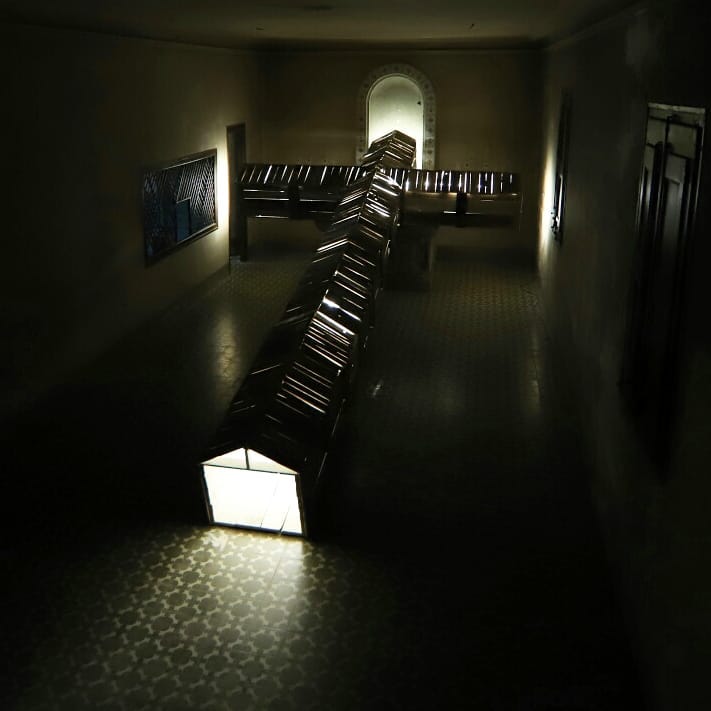
Jofre Oliveras and Stefan Krische installation
Site-specific installation by Jofre Oliveras and Stefan Krische, 2018, in Konvent, Cal Rosal, Catalonia, Spain.

+++

CURRENT EXHIBITION: “Wrestling the Angel: A Century of Artists Reckoning with Religion,” Bechtler Museum of Modern Art, Charlotte, North Carolina: Through October 28, the Bechtler is showing 219 pieces of religious-themed art spread out across its large fourth floor, including works by Dalí, Rouault, Chagall, Warhol, Manessier, Bearden, and other modern greats. I visited last weekend, and while I feel that the theme was treated too loosely and therefore the exhibition lacked the full impact it could have had, I thoroughly enjoyed individual portions, and I appreciate the Bechtler, and in particular curator Jen Edwards, for bringing together these diverse works that speak in some way to religion, spirituality, or morality.

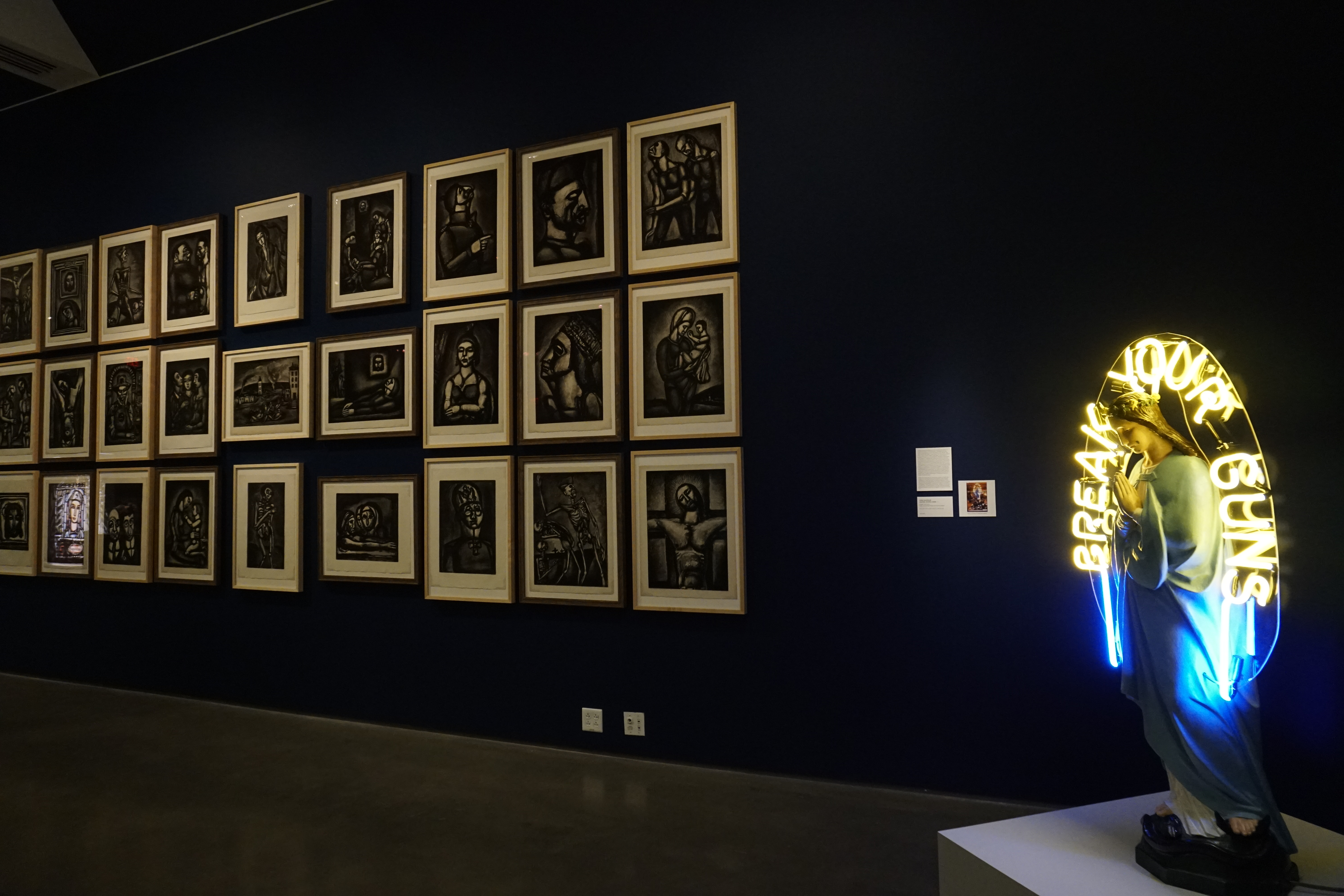
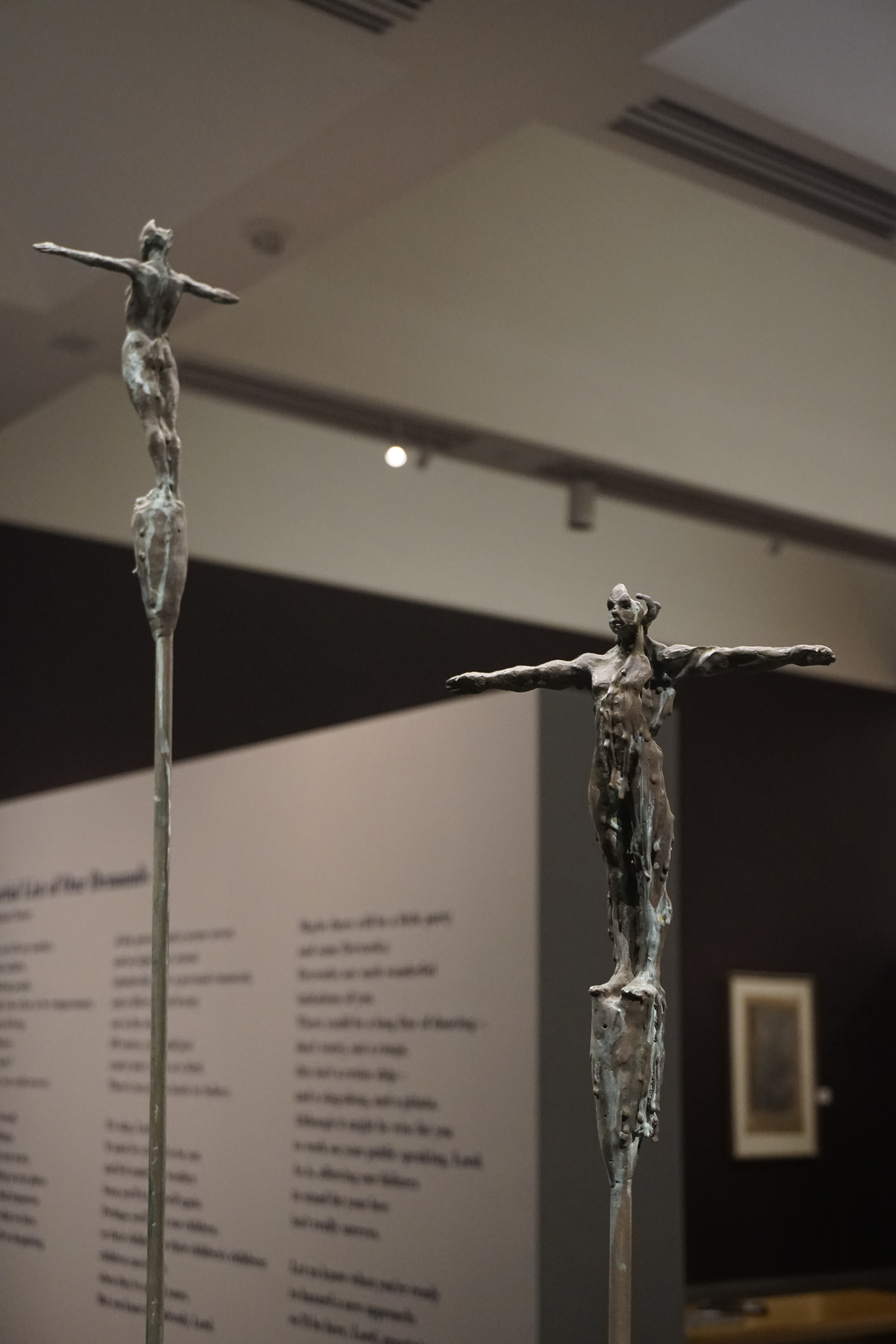
This was the first time I’ve seen Rouault’s entire Miserere (“Have Mercy”) series—all fifty-eight aquatints!—in one space, and it was stunning. Its display alongside Charlotte artist Gina Gilmour’s Break Your Guns and Stacy Lynn Waddell’s Untitled (Mike Brown’s Battle at Normandy) reinforces the theme of lament for violence and suffering inherent in all three. In the same room the set of small bronze crucifixes by Elizabeth Turk, which in their original gallery installation in 2002–03 contained lit candles in the hollows of the heads, invite further reflection on death, subtly connecting (through strategic placement) Christ’s crucifixion with the “crucifixions” of those slain in the past century through acts of war, gun violence, and police brutality.

Wrestling the Angel installation view
Installation view: “Wrestling the Angel,” Bechtler Museum of Modern Art, Charlotte, North Carolina, 2018. Left: Prints from Georges Rouault’s Miserere series, 1927. Right: Break Your Guns by Gina Gilmour, 1980. Photo: Victoria Emily Jones.

Poppyfields (detail) by Elizabeth Turk
Elizabeth R. Turk (American, 1961–), untitled bronzes from Poppyfields, 2002–03. Installation view: “Wrestling the Angel,” Bechtler Museum of Modern Art, Charlotte, North Carolina, 2018. Photo: Victoria Emily Jones.

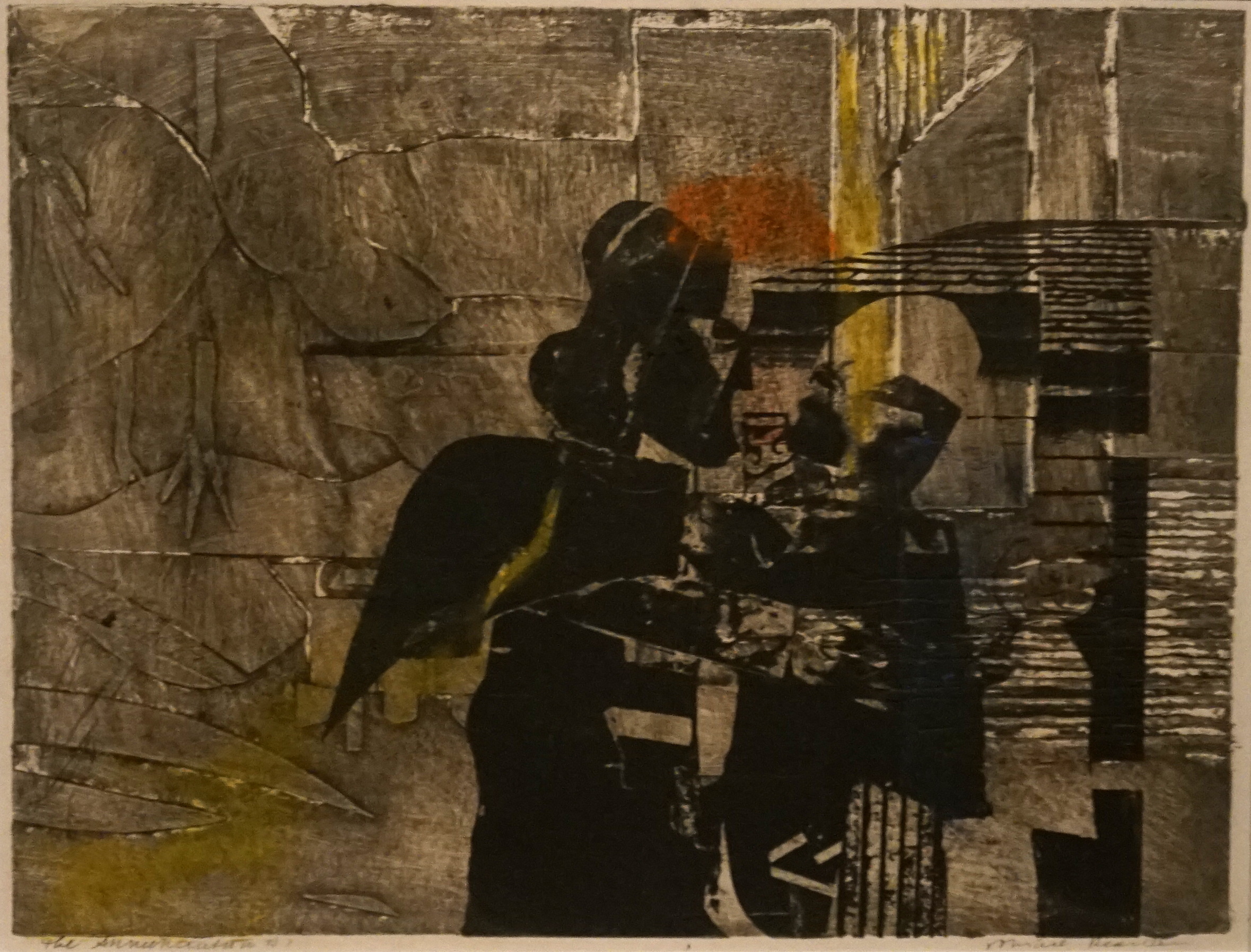
The Annunciation by Romare Bearden
Romare Bearden (American, 1911–1988), The Annunciation, ca. 1967. Collograph, 11 3/4 × 15 1/2 in. (29.6 × 39.4 cm). Courtesy of Jerald and Mary Melberg. Photo: Victoria Emily Jones.

For other reviews of this exhibition, see those by Andy Smith and Barbara Schreiber. And word to the wise: avoid the last day, because it’s a Carolina Panthers NFL home game, and the stadium is right across the street from the museum. (I wish I had thought to check the schedule before I made the cumbersome trek last Sunday!)

+++

JAM SESSION: I love this impromptu gospel music performance by Karen R. Harding (right), Steve Brock, and Sharon Walker. They sing “Give Up (And Let Jesus Take Over)” by Howard Goodman and “Can’t Nobody Do Me Like Jesus” by Andraé Crouch. [HT: Global Christian Worship]