Roundup: “Demons” (Dostoevsky) book club, quilting in prison, church installation by Kimsooja, and more

ONLINE COURSE: Studying the novel Demons by Fyodor Dostoevsky with Brian Zahnd, January 3–March 9, 2026: This ten-week online course led by Pastor Brian Zahnd (a Christian writer and preacher I admire) will explore Dostoevsky’s “darkest and most prophetic novel”: Demons (aka The Possessed or The Devils), a social and political satire, psychological drama, and large-scale tragedy inspired by the true story of a 1869 political murder in Russia. The course sounds intriguing to me, and I’m contemplating whether I can invest the time in a seven-hundred-page book—but I did buy a copy just in case! It’s the only one of the literary master’s four novels I haven’t read.
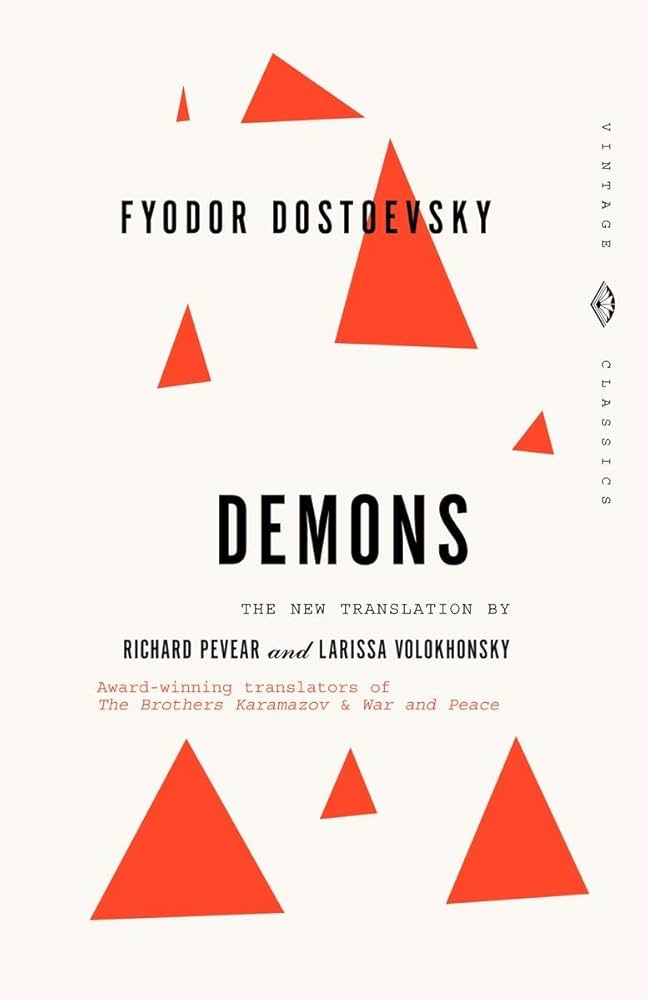
Demons (book cover)

“Dostoevsky’s Demons changed me,” Zahnd writes on Substack. “From it I learned the danger of giving oneself to an ism instead of to Christ. Isms are idols and they often become demonic. Admittedly Demons is a difficult novel, but it’s also prophetic and timely. . . . As you read Demons, expect to be horrified, but also expect to laugh—you are meant to. During the course we will be horrified and warned, but we will also laugh and learn together.”

The live Q&As will take place the first ten Mondays of 2026 at 5 p.m. CT (6 p.m. ET).

+++

SEMINAR (VIDEO): How to Watch a Movie (as a Christian)” with Chris Retts and Morgan Jefferson: On his Footnotes Substack, historian Jemar Tisby recently hosted a teach-in with two team members from the Los Angeles Film Studies Center, a nonprofit educational program designed to give undergraduate students at Christian colleges and universities meaningful experience in the film industry during a semester “abroad” in Los Angeles. Chris Retts is the director of the center, and Morgan Jefferson is an instructor.

Before discussing how to watch a movie, they discuss why Christians should watch movies in the first place, beyond the obvious (enjoyment):

  1. Because general revelation can happen anywhere, even at the movies (Rom. 1:20).
  2. Because movies generate empathy, which is central to the greatest commandment (Matt. 22:37–40).
  3. Because every movie has a theology, and media literacy makes it conscious and discernable (1 John 4:1).

They also discuss the four modes of meaning that filmmakers work with; cinematic language; and four steps for exegeting (“drawing out”) a film.

How does film relate to Dr. Tisby’s work at the intersection of faith, history, and justice? He has written for years about the dangers of white Christian nationalism. He says adherents of that ideology, or any, are not evaluating a list of propositions but are buying into a narrative; and “you can’t meet a narrative with logical reasoning,” he says. “You have to invite them into a counter-narrative—a more beautiful story.” Story is why he’s interested in film, as film is an engaging, and probably the most popular (in the US), storytelling medium. “Stories shape our sense of what’s true, what’s possible, and who belongs. That’s as true for political movements as it is for movies.”

For some of my movie recommendations, see my Top 20 Films of 2024 list and “Five Films about Finding Commmunity.”

+++

DOCUMENTARY SHORT: The Quilters (2024), dir. Jenifer McShane: This thirty-minute documentary on Netflix follows a group of men in a maximum-security prison in Missouri who design and sew custom quilts for children in foster care using donated fabrics and old machines. They care deeply about the quality of their work—they’re proud of what they make—and are emotional about the recipients, some of whom send thank-you cards. The film is about creating beauty and meaning within strict confines, not letting destructive choices from your past stymie you from making constructive ones in the present.

+++

TEMPORARY INSTALLATION: To Breathe—Mokum by Kimsooja, Oude Kerk (Old Church), Amsterdam, May 23–November 9, 2025: Sorry I didn’t get this out while the installation was still up (it wrapped on Sunday), but please do explore the photographic documentation. Kimsooja’s To Breathe—Mokum explores themes of migration, belonging, and the transient nature of home; the Yiddish word in its subtitle means “safe haven.” “At the work’s heart are Kimsooja’s iconic bottari—colorful textile bundles inspired by traditional Korean wrapping cloths,” designboom writes. “Spread across the [medieval] stone floor of the church, these bundles are filled with clothing donated by members of Amsterdam’s diverse communities. Each piece of clothing represents the lives and stories of the people who contribute to the city’s rich multicultural fabric. These textile bundles serve as symbols of both personal and collective journeys, embodying the arrival and departure of individuals who have shaped the identity of the city” over its 750 years.
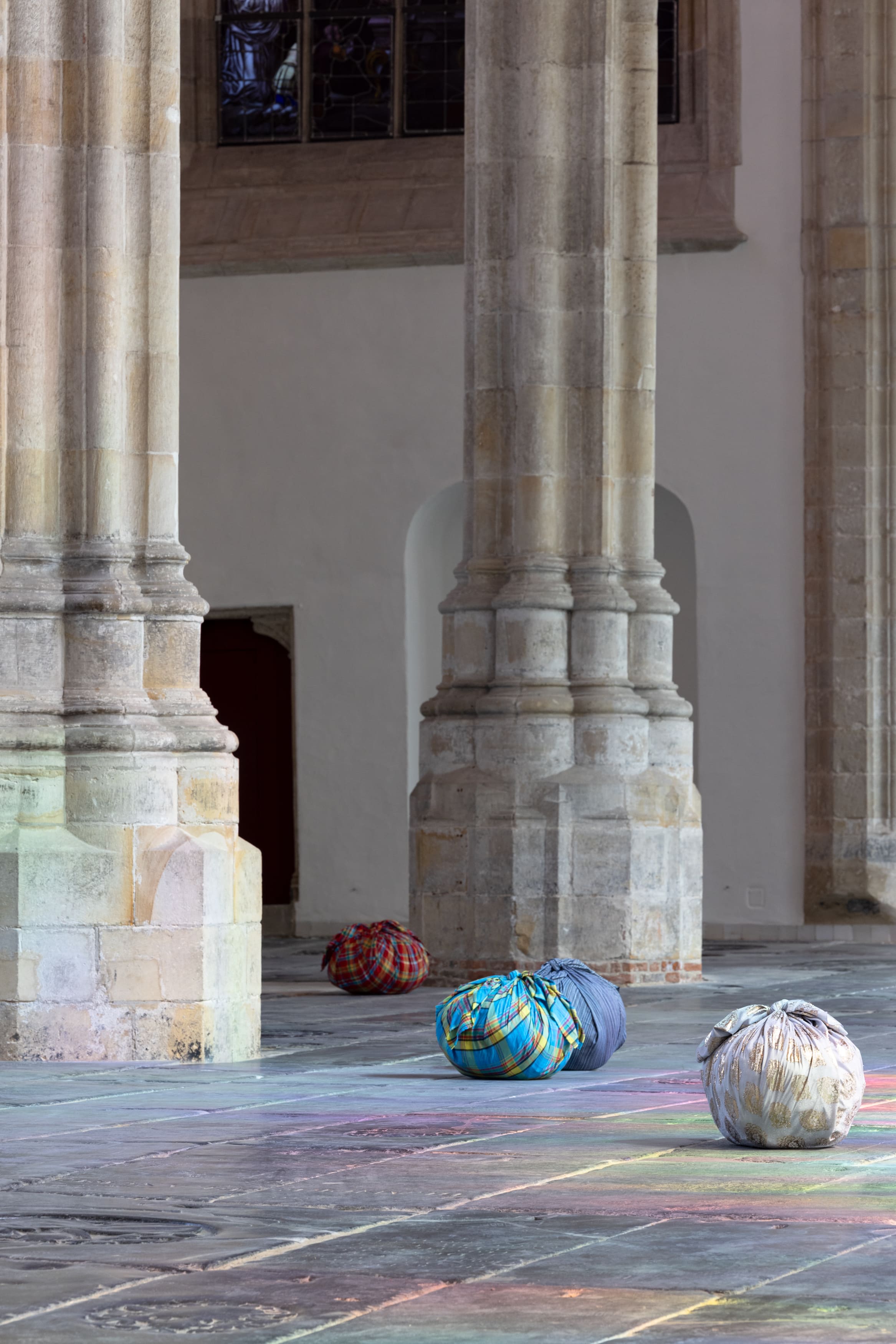
Kimsooja_To Breathe (Mokum)
Kimsooja (Korean, 1957–), To Breathe—Mokum (partial view), 2025. Site-specific installation at Oude Kerk, Amsterdam. Photo: Natascha Libbert.

+++

POEMS:

>> “On the Staten Island Ferry” by A. E. Stallings, Plough, July 1, 2025: Liberty is an American ideal—but for many in this country, an illusory one. Riding in New York Harbor with a boatload of commuters and tourists, Stallings lets settle what a young girl, pointing to the Statue of Liberty, exclaims.

(Related post: “One sonnet vs. shouted prose: Lady Liberty, Emma Lazarus, and Trump”)

>> “The Pillar of Cloud and Fire” by Anna A. Friedrich, Monafolkspeak (Substack), October 29, 2025: The poet reflects on her confusion as a child about this manifestation of God from the Old Testament, which leads her to surprising insights.
Roundup: One-word poems, “Go to Hell” musical setting, and more

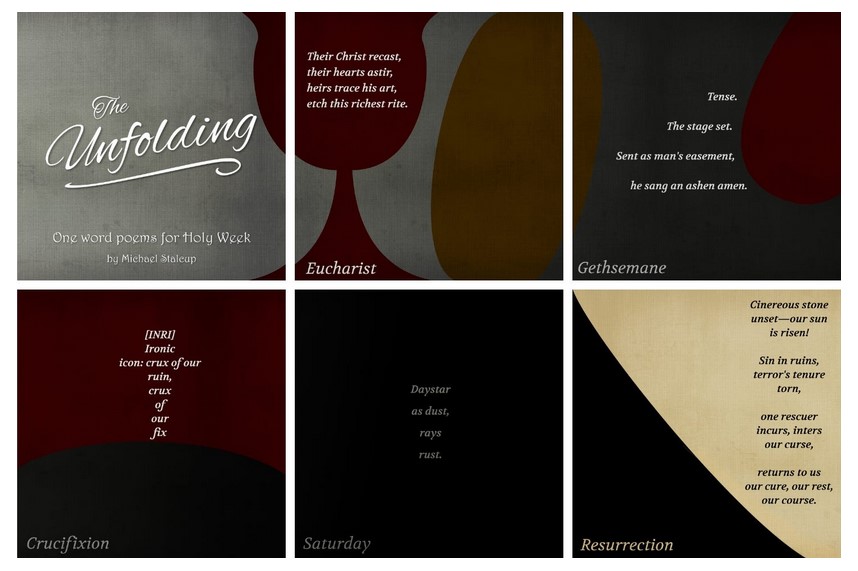
POEM SEQUENCE: “The Unfolding” by Michael Stalcup: Michael Stalcup has published a sequence of five short poems in Solum Journal that “tells the story of Jesus’ death and resurrection by unfolding five words that take us from Maundy Thursday through Easter Sunday,” he says. “I wrote these poems in a very unusual way, restricting myself to words that could be formed from the letters in each poem’s title. . . . This poetic form calls for creativity within intense limitations, which seems fitting for Holy Week—a time when Jesus crafted the most beautiful art this world has ever known within the constraints of his own suffering and death.” Stalcup has also presented them on Instagram (click on the image below).

The Unfolding by Michael Stalcup

+++

ARTICLE: “Don’t Rush Past Good Friday” by Brian Zahnd: Pastor and author Brian Zahnd cautions us not to shortchange the cross on the way to Easter, but rather to slow down and dwell there, beholding the crucified Christ.

+++

SONGS:

>> “Friday Morning” by Sydney Carter, performed by Timothy Renner: This Good Friday song by the English folk musician Sydney Bertram Carter (1915–2004) is difficult—one might even say blasphemous. That’s because it’s voiced from the perspective of the “bad” thief, who is spewing hatred and bitterness over his fate and blaming God for having created such a cruel world. But we’re aware of an irony in the refrain that the convicted man is not: “It’s God they ought to crucify / Instead of you and me, / I said to the carpenter / A-hanging on the tree.”

Read or listen to a reflection on “Friday Morning,” by Andrew Pratt, here.

>> “Go to Hell” by Nick Chambers: This song is a setting of a poem by Pádraig Ó Tuama from his collection Sorry for Your Troubles (Canterbury Press Norwich, 2013). The title is shocking, I know, but it’s derived from a line in the Apostles’ Creed, where we Christians profess that after Jesus died, he “descended into hell.” The singer-songwriter, Nick Chambers, writes in the YouTube video description: “In between Good Friday and Easter Sunday is possibly strangest day of the Christian year. On Holy Saturday, not only is Jesus, the God-Man, in the grave; traditions abound about his descent to the dead, his ‘harrowing of hell.’ What does it mean for the coming down of God-with-us not to end on earth but ‘under the earth,’ extending hope to the furthest regions of human pain and abandonment? Such a question deserves more poetry than explanation.”

“Go to hell” is a slang expression of scorn or rejection, to which Jesus was no stranger. As in the previous song, there’s an irony here, in telling Jesus to go to hell—because he did. Literally. Ó Tuama meditates on how Jesus shares in our vulnerabilities and yearnings and seeks to pull us out of the hells we’re in and redeem our stories.

Hear the poem read by the poet here, or at the end of the Stations of the Cross video below. “he is called to hell, this man / he is called to glory . . .”

+++

GUIDED MEDITATION: “Stations of the Cross, Good Friday, 2020” by Pádraig Ó Tuama: In 2020 the poet-theologian Pádraig Ó Tuama put together this twenty-minute video reflection for Good Friday structured around the Stations of the Cross, consisting of photos of art he’s taken and the praying of collects he’s written. (Several of the collects can be found in his book Daily Prayer with the Corrymeela Community from 2017.) The throughline is a set of stained-glass Stations by Sheila Corcoran at the Church of Our Lady Queen of Heaven at Dublin Airport; others are by Jong-Tae Choi, Gib Singleton, Sieger Köder, Richard P. Campbell, and Audrey Frank Anastasi.

Corcoran, Sheila_Veronica's Veil
Sheila Corcoran, Station 6: Veronica Wipes the Face of Jesus, ca. 1964. Stained glass, Church of Our Lady Queen of Heaven, Dublin Airport. Photo: Patrick Comerford.

Campbell, Richard_Stripped
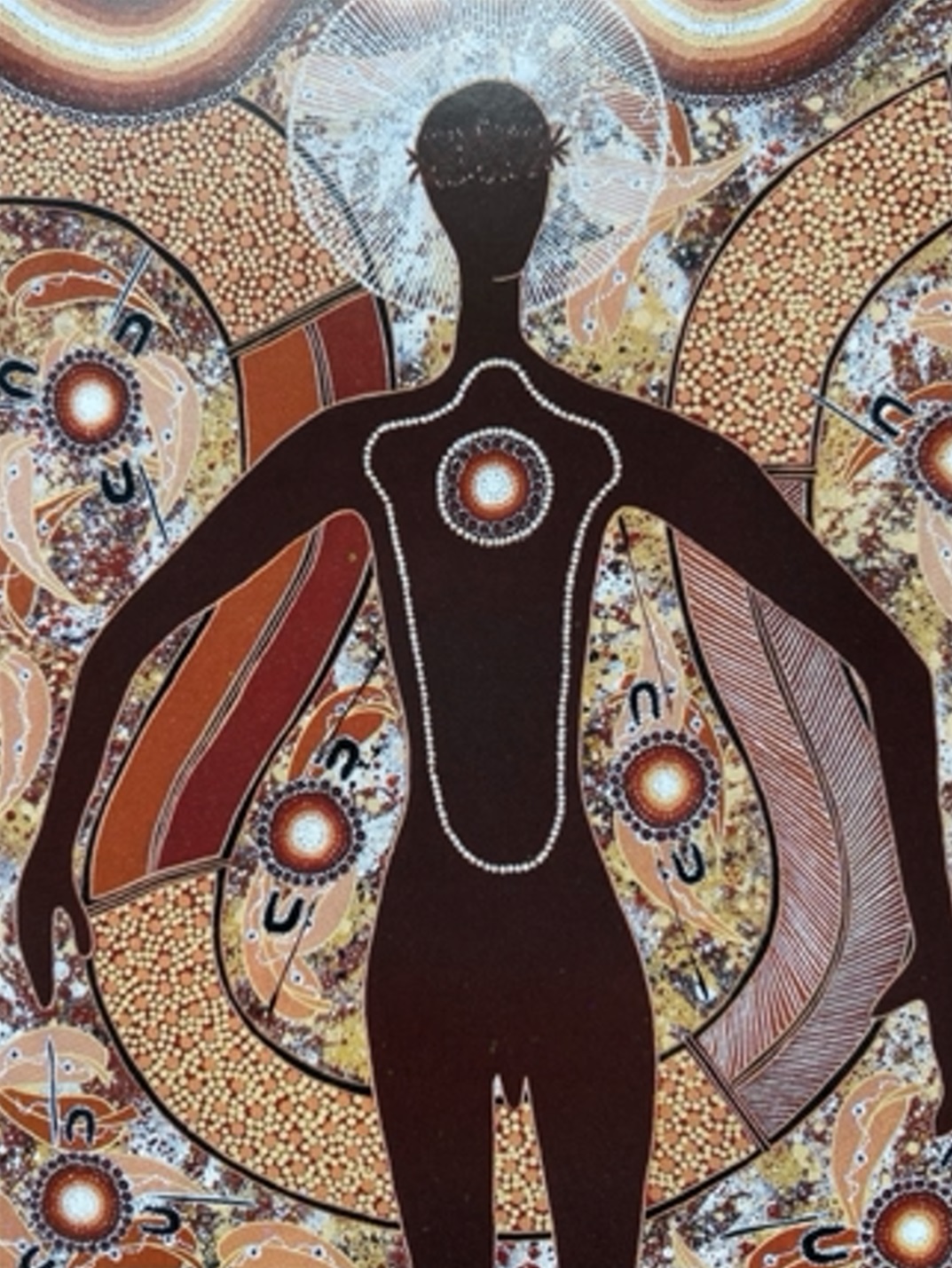
Richard P. Campbell (Dunghutti/Gumbaynggirr, 1958–), Station 10: Jesus is stripped of his garments, 2001. Reconciliation Church, La Perouse, Sydney, Australia.

But before stepping onto Jesus’s Via Dolorosa, Ó Tuama considers Judas, sharing a stained glass panel by Harry Clarke that illustrates a medieval legend about the Irish monastic saint Brendan the Navigator. According to the Navigatio Sancti Brendani Abbatis, on one of his voyages St. Brendan encountered Judas at sea, tied to an iceberg. He learned that an angel had taken pity on Judas in hell and given him a reprieve of one hour to cool himself from the flames of judgment. Ó Tuama then prays for those who, like Judas, are tormented by guilt and see no way out.

He closes with a reading of his poem “Go to Hell” (set to music in the previous roundup item).

+++

SONG: “For the Songless Hearts” by Jon Guerra: “There’s a lot of hubbub around Easter weekend in churches. And for good reason,” says singer-songwriter Jon Guerra. “But our hearts can’t always cooperate with the prescribed mood of the Easter season: ‘Celebrate! Be happy! Sing!’ Sometimes the last thing we are able to do is sing. Thankfully, Good Friday and Easter are not about mustering a mood. Good Friday and Easter are about remembering that there is One who meets us in our life and meets us in our death. He sings for us—and over us—when we can’t.”

That’s what “For the Songless Hearts” is about—a single released in 2017, and which Guerra sings with his wife, Valerie. In a Mockingbird blog post about it, Guerra admonishes, “Remember that before the tomb was empty, it was full. ‘When he was laid in the tomb, he laid right next to you.’” Jesus knew the depths of sorrow and the sting of death. We are not alone in such experiences.

Roundup: Historiated crosses, English ballad carol of the Crucifixion, and more

Holy Week begins Sunday. I will be publishing short daily devotional posts during that time and through the first eight days of Easter. Also: don’t forget about the Art & Theology Holy Week Playlist and Eastertide Playlist! I’ve made some new song additions since last year, mixed in to preserve the narrative flow.

+++

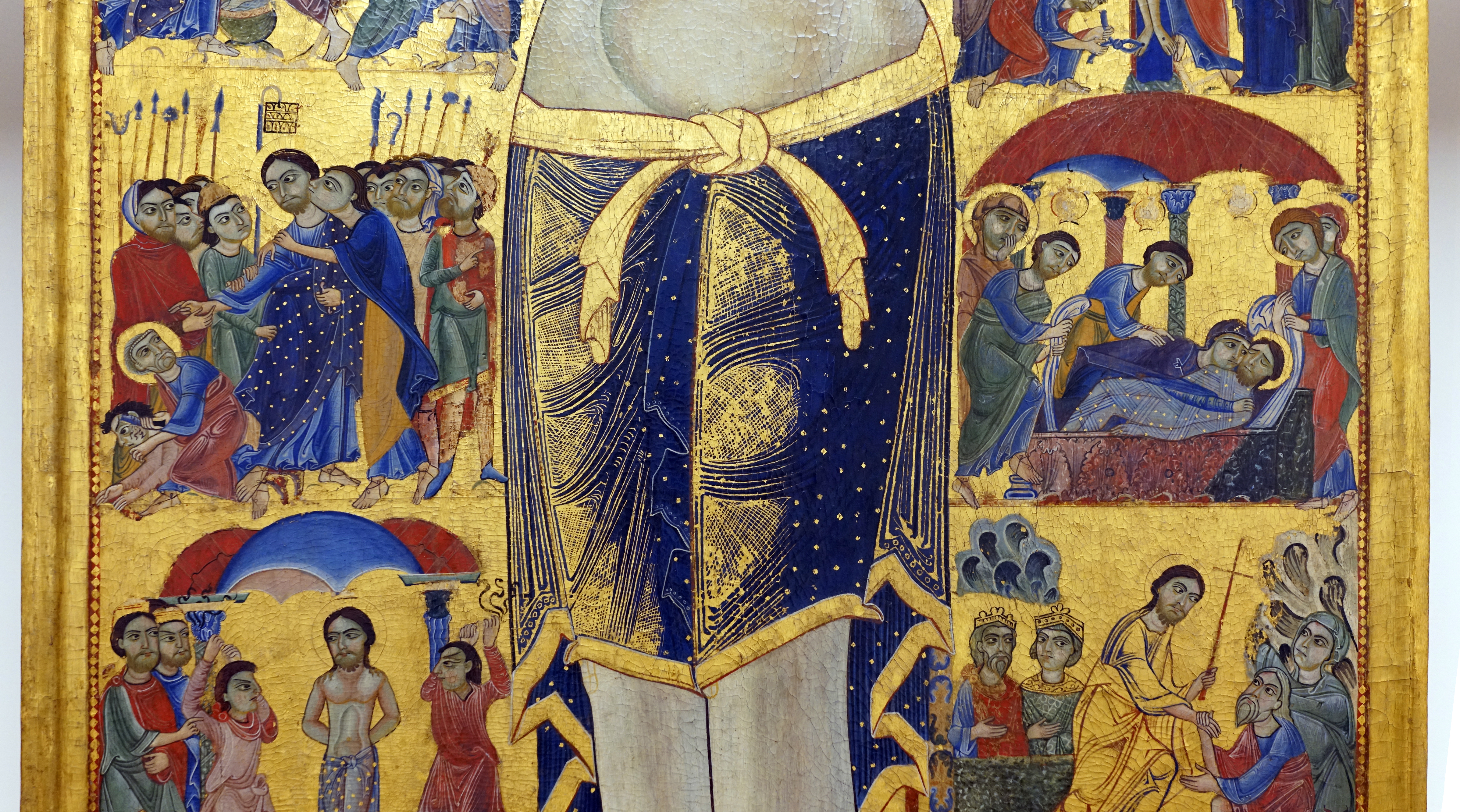
ART VIDEO: “The Crucifixion, c. 1200 (from Christus triumphans to Christus patiens)”: When I was a student in Florence for a semester, my first paper for my Italian history, art, and culture class traced the evolution of the painted wood-panel crucifix in late medieval Italy, from the Christus Triumphans (Triumphant Christ) type to Christus Patiens (Suffering Christ). I lived less than a five-minute walk from the Uffizi, which has in its collection a beautiful example of each—explored by Drs. Steven Zucker and Beth Harris in this short Smarthistory video. Longtime readers of the blog may recognize the latter, which I posted back in 2018.

Painted cross, Pisa (detail)
Painted cross (detail), Pisa, ca. 1180–1200. Tempera and gold leaf on wood, 277 × 231 cm. Galleria degli Uffizi, Florence, Inv. 432. [object record]

Zucker provides wonderful photos of both in high resolution on his Flickr page (start here and scroll right)—the full crosses and details of each apron scene—available for free noncommercial use under a Creative Commons license. And there are many other art historical images there as well!

+++

ONLINE EXPERIENCE: “Anamnesis: Journey through the Stations of the Cross”: This year visual artist Daniel Callis and the music and liturgy collective The Many collaborated on a self-guided set of online Stations of the Cross. There are fifteen total, which are being released one at a time every morning and evening from March 30 through April 5. Each station consists of an artwork, a prayer, a song, and a written meditation that help us enter into lament.

Callis, Dan_Grief Station 1
Daniel Callis (American, 1955–), Grief Station #1, Prognosis, 2022. Ink, oil, palm ash, fiber, clay, ash, fabric, 60 × 24 × 24 in. (total work). Photo courtesy of the artist.

The artworks are by Callis, and they’re from his Stations: Resurgam series, a body of work that was just exhibited this month at Green Art Gallery at Biola University in La Mirada, California. He began the series in January 2021 in response to the death of his son, Jeremy David Callis (1980–2020). It consists of fifteen mixed-media works on paper (his process involves printing, “wounding,” stitching, etc.) and fifteen raku-fired offering bowls that incorporate, from the cooling process, copies of letters, hospital documents, and drawings from Jeremy. “They are about pain and the absurd insistent pursuit of hope,” Callis says of the series. Resurgam is Latin for “I shall rise again.”

The songs are by The Many.

+++

BOOK EXCERPT from The Unvarnished Jesus: A Lenten Journey by Brian Zahnd: In this post from his blog, Pastor Brian Zahnd excerpts a passage from his book The Unvarnished Jesus (2019). “To interpret the meaning of the cross is more than a life’s work—in fact, it has and will remain the work of the church for millennia,” he writes. “The cross is the ever-unfolding revelation of who God is, and it cannot be summed up in a simple formula. This is the bane of tidy atonement theories that seek to reduce the cross to a single meaning. The cross is many things: It’s the pinnacle of God’s self-disclosure. It’s divine solidarity with all human suffering. It’s the shaming of the principalities and powers. It’s the point from which the satan is driven out of the world. It’s the death by which Christ conquers Death. It’s the abolition of war and violence. It’s the supreme demonstration of the love of God. It’s the re-founding of the world around an axis of love. It’s the enduring model of co-suffering love we are to follow. It’s the eternal moment in which the sin of the world is forgiven . . .” Read more.

+++

SONGS:

>> “The Leaves of Life”: “The Leaves of Life,” alternatively titled “The Seven Virgins,” is a traditional English ballad carol of Christ’s passion, first set down in the nineteenth century. It is narrated by (the apostle?) Thomas, who on a fateful Friday runs into the Virgin Mary and six of her companions, who are looking for Jesus. He directs them to the hill where Jesus is being crucified (“And sit in the gallery” may be a corruption of “The city of Calvary”). The women tearfully fly to the site, and Jesus tries to console his mother from the cross before breathing his last. The song ends with Thomas imbibing a strong scent of rose and fennel as he meditates on Christ’s love. [HT: Global Christian Worship]

Here the song is performed in the chapter house of Wells Cathedral in Somerset by William Parsons, founder of the British Pilgrimage Trust and author of Singing for Our Supper: Walking an English Songline from Kent to Cornwall, a book about the seven months he spent as a wandering minstrel. Parsons refers to it as a gypsy carol because Ralph Vaughan Williams collected one version of it from the Roma singer Esther Smith during his 1908–13 collecting trips that resulted in the publication, with Ella May Leather, of Twelve Traditional Carols from Herefordshire (1920).

>> “Were You There”: This African American spiritual is performed here by Pegasis, a vocal trio of sisters—Marvelis, Rissel, and Yaina Peguero Almonte—originally from the Dominican Republic but now living in Green Bay, Wisconsin. It’s as if they’re the three Marys singing their testimony! The song is on their 2016 album Peace Through Praise, which they released under the name The Peguero Sisters. Their harmonies are gorgeous.

+++

PODCAST EPISODE: “Malcolm Guite: Poems on the Passion”: In this special passion- and resurrection-themed Nomad devotional episode from 2018, Malcolm Guite reads and reflects on three of his poems, and David Benjamin Blower performs an original three-part song that he wrote in response and that has not been released elsewhere (see 4:30, 16:04, and 27:18).

Guite’s “Jesus dies on the cross,” part of his Stations of the Cross sonnet cycle, was inspired by a line from George Herbert’s poem “Prayer”: “God’s breath in man returning to his birth.” And his “Easter Dawn” [previously] is based in part on a sermon by the seventeenth-century Anglican bishop Lancelot Andrewes. Paraphrasing Andrewes, Guite says, “Jesus is the gardener of Mary [Magdalene]’s heart—her heart is all rent and brown and wintery, and with one word, he makes all green again.” Beautiful! For more on the theme of Jesus as gardener, see my 2016 blog post “She mistook him for the gardener.”