
NEW BOOK: Everything Could Be a Prayer: One Hundred Portraits of Saints and Mystics by Kreg Yingst: Released on October 15, this book features one hundred color block-print portraits by Kreg Yingst of folks in the family of God across time and place, along with one-page biographies. Get to know a wide range of Christian civil rights activists, scientists, environmentalists, social service workers, hymn-writers, artists, poets, evangelists, and monastics and the gospel impact they’ve made. The lineup is a mix of familiar and less familiar names, canonized saints and noncanonized. Examples include Brigid of Kildaire, Ignatius of Loyola, Satoko Kitahara, Dietrich Bonhoeffer, Mamie Till, Pandita Ramabai Dongre-Medhavi, and Black Elk. Click here to look inside.
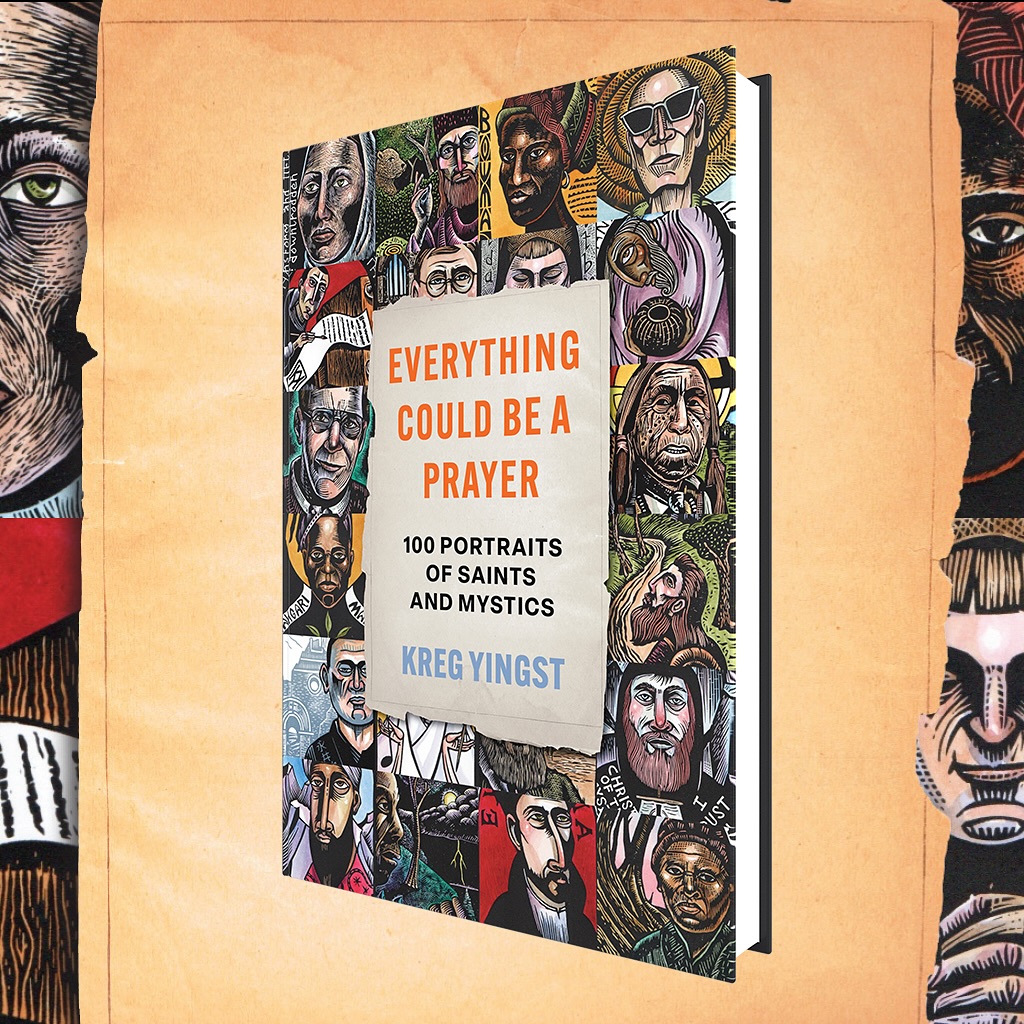
The title of the book is taken from a quote by Martin de Porres (1579–1639), a Dominican friar from Peru and the first Black saint of the Americas: “Everything, even sweeping, scraping vegetables, weeding a garden, and waiting on the sick, could be a prayer if it were offered to God.”
Related events:
- October 10–November 16, 2024: Art exhibition featuring the block prints from the book at The Gallery of Art, 36 W. Beach Dr., Panama City, Florida
- October 26, 2024, 1:00–3:00 p.m.: Book signing at Barnes & Noble, 1200 Airport Blvd., Pensacola, Florida
Through November 1, Yingst is offering 25% off all original woodcuts and linocuts that were used as illustrations for the book; view the discounted pieces in the “Mystics, Saints & Poets” section of his Etsy shop. These are not inkjet-printed photographs of original artworks (which is what some artists misleadingly call “prints”) but are themselves original limited-edition relief prints hand-pulled on an antique proof press from carved blocks; they are made with black oil-based ink and watercolor. If you want original art in your home or to gift a friend or family member for Christmas, Yingst’s work is a great and affordable option!
+++
SONGS:
November 1 is All Saints’ Day, a feast for commemorating the lives and witness of our siblings in the faith who have gone before us. Here are two songs for the occasion.
>> “I Sing a Song of the Saints of God,” performed by Wendell Kimbrough: This charming little children’s hymn was written by Lesbia Scott and was first published in her native England in Everyday Hymns for Little Children (1929). In the United States the song first appeared in the Episcopal Hymnal 1940 with a tune that John Henry Hopkins, a member of the hymnal committee, composed for it, capturing the childlike cadences of the text.
>> “When the Saints” by Sara Groves: This song from Groves’s album Tell Me What You Know (2007) draws encouragement from the faithfulness of God-followers throughout history, from Moses, Paul, and Silas to Harriet Tubman and Mother Teresa to the martyr Nate Saint and his sister Rachel Saint to rescuers of sex-trafficking victims. It is a call to hearers today to pick up their cross and follow Christ into places of hurt and injustice, pursuing liberation of body and soul for all. The refrain quotes the traditional Black gospel song “When the Saints Go Marching In.”
+++
ART EXHIBITION: Bruce Onobrakpeya: The Mask and the Cross, National Museum of African Art, Washington, DC, June 21, 2024–January 21, 2025: A father of African modernism, Bruce Onobrakpeya (b. 1932) [previously] is one of Nigeria’s most celebrated artists, and I was thrilled this month to visit his first solo show in the US, which, as it turns out, is centered on his Christian-themed linocut prints! (The artist is Anglican.) Onobrakpeya’s career spans over six decades, and this Smithsonian exhibition is not meant to be representative of the breadth of his oeuvre, which also includes painting and sculpture and various subject matters; rather, it presents two foundational bodies of work from the late sixties, both commissioned by the Catholic Church, that helped launch the artist’s long and esteemed career.
The exhibition displays rare artist’s proofs of the biblical illustrations Onobrakpeya made for Ki Ijoba Re De (May Your Kingdom Come) (1968), a Yoruba-language textbook for students in their fifth and sixth years of Catholic primary school (it was part of the Nigerian National Catechism), as well as a complete narrative series of prints titled Fourteen Stations of the Cross, produced in 1969. I blogged about the artist’s Stations cycle back in 2014, when I saw a different edition at the SMA African Art Museum in Tenafly, New Jersey; you can view better photos on the High’s website. For more on the work of Fr. Kevin Carroll, the Catholic missionary who commissioned Onobrakpeya to paint a church mural of the Stations that became the basis of these linocuts and who helped facilitate the May Your Kingdom Come publication, see here.
Curated by Lauren Tate Baeza, Bruce Onobrakpeya: The Mask and the Cross first opened last year at the High Museum of Art in Atlanta. This is Baeza’s first exhibition as curator of African art at the High, and I’m so pleased that when she dug through the High’s extensive archives, it was a set of Christian prints by a leading Nigerian artist that most compelled her, that she could imagine building a unique exhibition around and that she felt must be pulled out of storage for more people to see. Hear Baeza discuss the exhibition from 23:28 to 35:58 of the video “African Modernisms: A Legacy of Connection.”
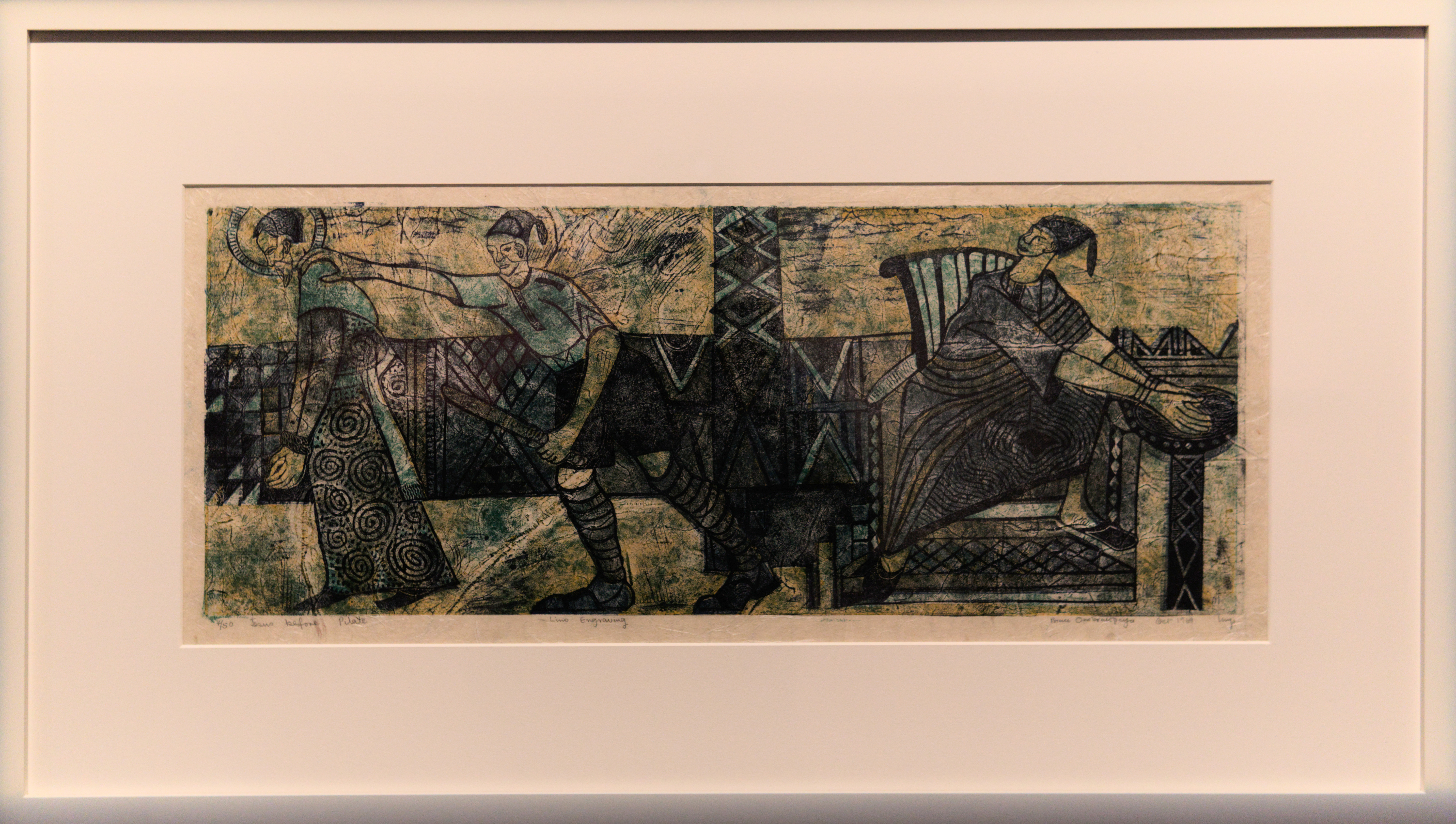
For his Stations of the Cross, Onobrakpeya “incorporat[ed] the rich patterns of Yoruba gelede and epa masks and stylized geometric patterns found in northern Nigerian architecture. Then he added generous adire motifs and his signature elongated figures and distortions of scale,” reads one of the gallery wall texts. He also embedded a critique of British colonial rule, portraying the Roman soldiers of Christ’s passion as British officers. (Nigeria had just attained independence from Great Britain earlier that decade, in 1960.) Pilate, though, is shown as a local Nigerian magistrate doing the bidding of the British government, highlighting a deeply felt tension in Nigeria’s then-recent political history.
I really appreciate the video components of the exhibition. One screen plays a compilation of clips from interviews Baeza conducted with the artist, and another displays a two-dimensional animation commissioned from Sadiki Souza specially for this exhibition, which brings to life Onobrakpeya’s fourteen Stations. Neither is available online, at least not that I can find.
+++
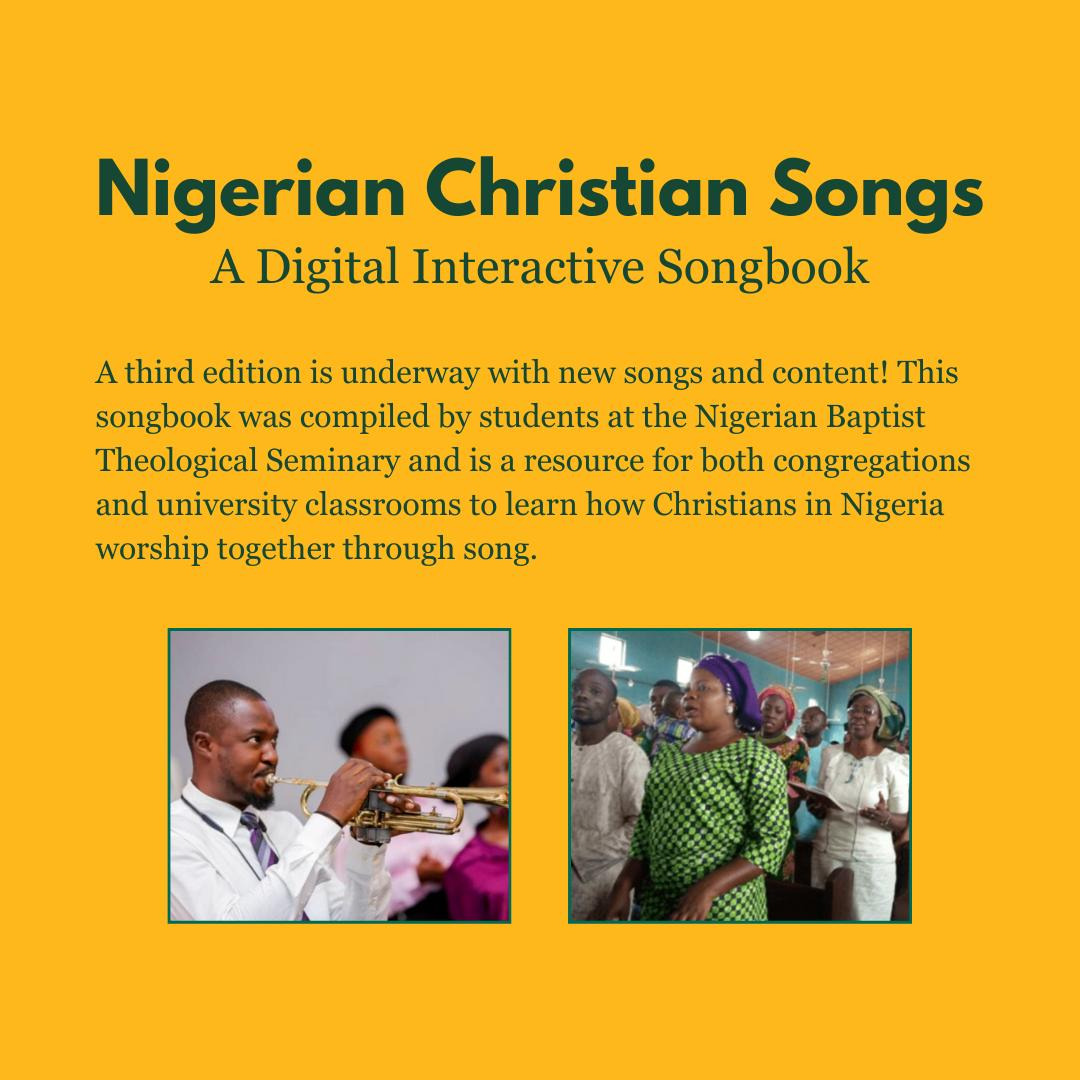
ZOOM EVENT: “Celebration of New Global Church Music Resources,” November 14, 9:00 a.m. CDT (12:00 p.m. ET): From Baylor University’s Dunn Center for Christian Music Studies: “We are excited to announce the launch of two website projects on November 14th! In collaboration with the Nigerian Baptist Theological Seminary, the third edition of the Nigerian Christian Songbook will be updated with new songs and content. In addition, a new project, the Global Church Music Bibliography, highlights underrepresented voices in church music scholarship. This is an interactive dashboard and map that features church music scholars writing about their own traditions outside of North America.” At the Zoom event on launch day, you will hear from various project participants. [HT: Global Christian Worship]
 Art & Theology