
11. The Ballad of Wallis Island, dir. James Griffiths. The award goes to Charles Heath (Tim Key) for being 2025’s most endearing onscreen character, and for eliciting the most laughs. Charles is a quirky, widowed lottery winner living on a remote island off the coast of Wales. As a superfan of McGwyer Mortimer, a folk duo who broke up over a decade ago, he hires the two musicians, Herb (Tom Basden) and Nell (Carey Mulligan), to reunite for the performance of a private concert at his home. Herb didn’t know Nell was coming, and her presence causes tension, as they used to be in a romantic relationship—from which Herb has never fully moved on—and now she’s married.
The Ballad of Wallis Island was written by the male costars, Key and Basden, longtime comedy collaborators, who based the script on a short film they released in 2007. It’s about growing apart in love and ambition; looking back with gratitude on what once was while also recognizing the inability to recover it, and embracing new possibilities.
Streaming on Prime Video.
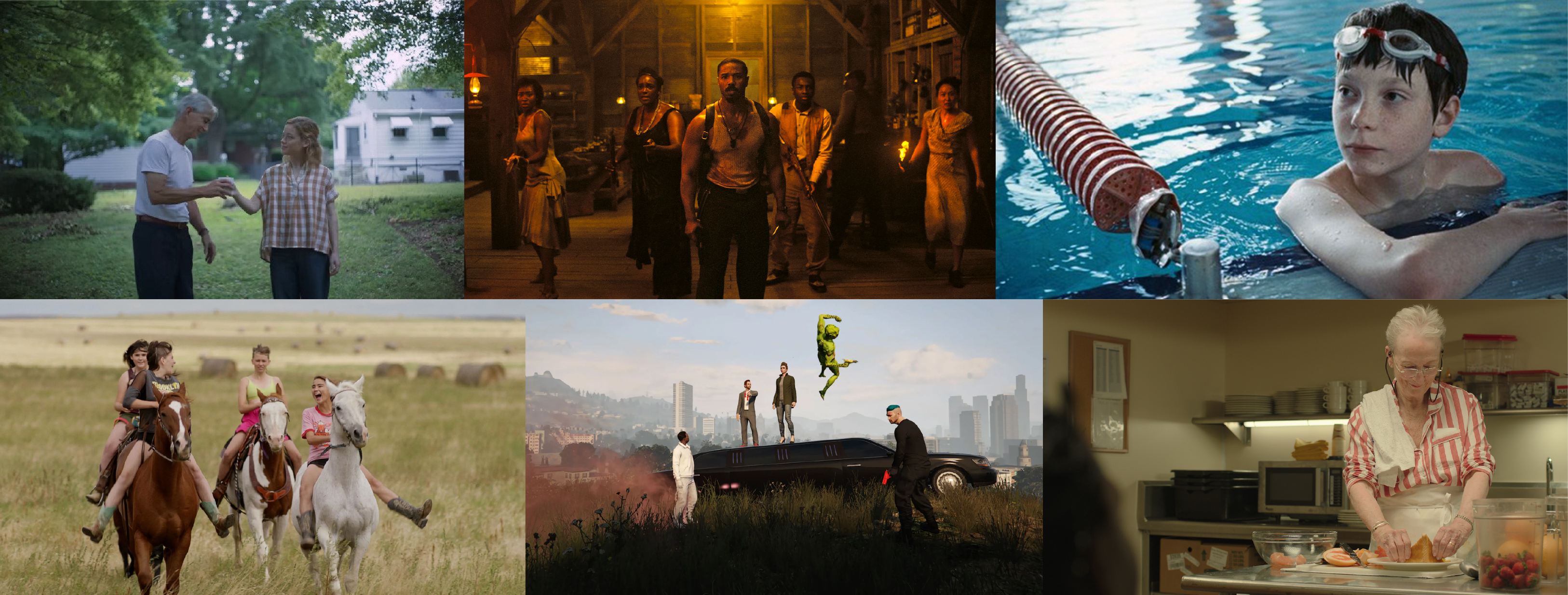
12. The Plague, dir. Charlie Polinger. A psychodrama with elements of body horror, The Plague is set at a middle school boys’ water polo summer camp in 2003. Ben (Everett Blunck) is kind and timid but also eager to fit in, so he cautiously befriends cool guy Jake (Kayo Martin). Jake and the other boys bully the socially awkward Eli (Kenny Rasmussen), who has a severe rash that they call “the plague” and that they claim spreads through contact. Ben feels sympathy for Eli and surreptitiously reaches out to him, at the risk of his own ostracization. The film explores the brutal peer group dynamics that male adolescents must navigate, especially as they seek to conform to cultural definitions of masculinity and normalcy. The performances by the three main child actors are excellent.
13. Familiar Touch, dir. Sarah Friedland. When the film opens, we’re inside Ruth’s (Kathleen Chalfant) kitchen; a former professional cook, she’s fixing a gourmet lunch for a date with a younger man (H. Jon Benjamin). But it turns out that man is not a boyfriend but her son; and the luggage he has prepared for her is not for some romantic getaway but for her new home in the “Memory Lane” wing of an assisted living facility. Familiar Touch is a humane (nonmiserabilist) portrayal of living with dementia, granting priority to Ruth’s perspective as she adjusts to her new living situation, facing fears and disorientation but also finding moments of comfort, connection, and joy. Writer-director Sarah Friedland said she wanted to tell a coming-of-old-age story, a transition as dramatic, she says, as that from teen to adult.
Streaming on MUBI.
14. A Little Prayer, dir. Angus MacLachlan. As I started watching this film, I thought how similar it feels to Junebug, one of my favorite movies—then I realized it’s by the same writer, who here also steps into the director’s chair. Shot and set in Winston-Salem, North Carolina, where MacLachlan has spent his whole life, A Little Prayer is, as reviewer Brian Tellarico sums up on Letterboxd, “a gentle dramedy about a decent man realizing he hasn’t raised a decent son.”
David (Will Pullen) and his wife Tammy (Jane Levy) live with David’s parents, Bill (David Strathairn) and Venida (Celia Weston). When Bill discovers that David is being unfaithful in his marriage, he confronts him. He is protective of his daughter-in-law. Bill and Tammy’s relationship is the central one of the film and is beautifully portrayed—the genuine affection they have for one another; they’re “kindred spirits,” as Tammy says. Bill finds it easier to talk with Tammy than with his own two children. (His flaky daughter is a sometime tenant in the house, whenever she’s fighting with her cocaine-dealing romantic partner.)
I also really like, in Bill and Venida’s characters, the portrayal of a seasoned marriage, especially as relates to parenting adult children. They want their kids to be strong, kind, fulfilled, principled—but they are continually disappointed in these hopes. The film shows them trying to accept the freedom their kids have to make their own choices, even when what they choose is short-sighted, dangerous, or immoral.
15. Souleymane’s Story, dir. Boris Lojkine. Souleymane (Abou Sangaré) is a Guinean immigrant to Paris, working illegally as a food delivery cyclist while in the process of seeking asylum. Set over two days, this social realist drama is empathetic and unsentimental in its look at the precarity of living in Europe without documents and the stress of navigating government bureaucracies to attain them. Other than the asylum interviewer, all the actors in the film are nonprofessionals. The lead was an auto mechanic when the casting director found him and is himself a Guinean seeking permanent residency in France. The story Souleymane tells at the end of the film is Sangaré’s real story of why and how he came to Paris.
Streaming on Kanopy.
16. Sinners, dir. Ryan Coogler. A southern gothic horror blockbuster, this is the most talked-about movie on my list, and the most ambitious. It’s October 1932, and twin brothers Smoke and Stack (both played by Michael B. Jordan) have just returned to their hometown of Clarksdale, Mississippi, after having worked with Al Capone in Chicago. They are opening a juke joint to carve out a space of freedom for their Black community, and they arrange for their cousin Sammie (Miles Caton), the blues-loving son of a disapproving preacher, to perform. But Sammie’s music—its ability to “pierce the veil between life and death, past and future”—attracts a group of white vampires led by the centuries-old Irishman Remmick (Jack O’Connell). He’s seeking converts to his community of “fellowship and love,” and when they don’t join willingly, he takes them by force.
Going in, I had assumed the film would be an allegory of the terror of white supremacy, but it is more layered than that, and I’m not sure I understand all the layers. It’s in one sense about how white people feed on Black culture in destructive ways. But Remmick is a complex villain, as he shares with the protagonists a history of being oppressed, and he seems to be motivated by his homesickness for Ireland; he mourns the loss of his culture and yearns to reconnect with his ancestors. If that’s Remmick’s objective, it’s unclear to me how his actions would achieve that. I’m also confused as to what Remmick is selling—a melting pot of world musics? a vast, cross-cultural ancestral community? harmonious coexistence?—but most interpret it as assimilation in the guise of “let’s all get along.” While the film’s treatment of racial and cultural identities, ancestral ties, and racism is complex, its treatment of religion is (sadly) simplistic, portraying Christianity only as a sinister colonizing force, a system that not only does not contain the resources for liberation but that is itself oppressive both for cultures, which it kills or dilutes, and for individuals, restricting the pursuit of bodily pleasures.
Still, I rate Sinners highly for its big swings, its entertainment value, its cinematic craftsmanship, the popular discourse it has sparked, its phenomenal music, and the best scene of the year—the one in which the juke joint fills with centuries’ worth of African and African American music and dance traditions (from Senegalese xalam playing to G-funk, Zaouli dancing to Alvin Ailey ballet), creating an energy that literally burns the house down.
Streaming on HBO.
17. Grand Theft Hamlet, dir. Sam Crane and Pinny Grylls. Cinema, theater, and gaming combine in this unique and riotous documentary shot entirely inside Grand Theft Auto Online, an online multiplayer action-adventure game in which players roam as criminals through a hyperviolent variation on Los Angeles. During the COVID-19 pandemic lockdown in January 2021, two professional but out-of-work actor friends from the UK, Sam Crane and Mark Oosterveen, found themselves increasingly spending time on GTA and decided, for a fun challenge and for community, to stage a complete production of Shakespeare’s Hamlet inside the video game. They posted notices for auditions (no experience required), recruited security (to deter shootings), assigned parts, scouted locations, chose costumes, ran rehearsals, then oversaw the performance of the full play in July 2022 before an audience of in-game avatars, excerpts of which are shown in the last fifteen minutes of the film.
What makes the film so charming is the incongruity of it all. Grand Theft Auto enables players to indulge all sorts of depravities through a fictional character—steal cars, pick up prostitutes, blow people up. While sure, there’s depravity in Hamlet too, I wouldn’t think that those who enjoy GTA would enjoy classic Elizabethan drama. One taps into our baseness, the other into our nobler sentiments. So it’s surprising that Crane and Oosterveen’s project gained traction. And so comical! But also beautiful, in how lonely, isolated people all over the world endeavored to make art together in this unlikely virtual space during quarantine.
Streaming on MUBI.
18. When Fall Is Coming, dir. François Ozon. Michelle (Hélène Vincent) lives in the Burgundian countryside, enjoying a quiet retired life, which includes the regular company of her longtime friend Marie-Claude (Josiane Balasko). Michelle has a good relationship with her preteen grandson Lucas (Garlan Erlos), but not with her daughter Valérie, Lucas’s mother (Ludivine Sagnier). When Valérie is hospitalized one day after eating poisonous mushrooms her mom unwittingly served for lunch, she cuts her off from Lucas. Meanwhile, Marie-Claude’s son Vincent (Pierre Lottin) has just gotten out of prison, and Michelle forms a motherly bond with him. He, in turn, becomes protective of Michelle and, seeing the pain she’s in being separated from Lucas, tries to mediate a reconciliation between mother and daughter—but his confrontation of Valérie causes a whole new set of troubles and turns this domestic drama into a character-driven mystery.
Streaming on Tubi and Prime Video.
19. East of Wall, dir. Kate Beecroft. Just east of Wall, South Dakota, the real-life Tabatha Zimiga works as a rancher, rescuing, training, and selling horses with her teenage daughter Porshia, a champion barrel racer. On her 1,200 acres, she also offers refuge to local teens who have fled abusive situations or whose parents can’t afford to take care of them, giving them a home and coaching them in competitive rodeo. Filmmaker Kate Beecroft met the Zimiga family (which also includes sons Chevy and Stetson) while looking for a story, and ended up living with them for three years in preparation for shooting the docufiction drama East of Wall, a female western. Other than professional actors Jennifer Ehle and Scoot McNairy, all the actors, including the two leads, play versions of themselves. The film centers on the mother-daughter pair, who are grieving the death of their husband and stepfather while also finding strength and solace in riding and in the community they’ve built.
20. Don’t Let’s Go the Dogs Tonight, dir. Embeth Davidtz. When casting the lead for her adaptation of a portion of Alexandra Fuller’s best-selling memoir, director Embeth Davidtz was looking for a grubby-faced wild child who could ride a horse and a motorbike and who had never acted before—and she found one in a small village in the South African bush in Lexi Venter, whose performance as eight-year-old Alexandra, aka “Bobo,” a white Rhodesian, is extraordinary. The movie depicts Bobo’s life on her family’s cattle farm during the final stages of the Bush War in the late 1970s, in which Black Rhodesians fought for independence from their white (British and British-descended) colonizers. Bobo is plucky and imperious and says outrageous things, some of which she’s heard from adults; family chaos, racial tensions, and national politics are narrated from her perspective, innocent (in the sense of simple, candid, ingenuous) and ignorant as it is. Davidtz plays Bobo’s mentally unstable mother, who drinks heavily to deal with her grief, not primarily over a collapsing way of life but over something more personally wrenching.
The title is a British idiom meaning “Let’s avoid ruin” or “Let’s not act in degrading ways,” an admonition spoken especially before parties—let’s not become like spoiled food thrown to the dogs. It originated with a poem by the English humorist A. P. Herbert, who writes, “Don’t let’s go to the dogs tonight, / For mother will be there.”
HONORABLE MENTIONS: Eephus (MUBI); Rental Family; The Baltimorons (AMC+); If I Had Legs I’d Kick You; Wake Up Dead Man (Netflix)
 Art & Theology