Roundup: The body as sacred offering; rest as resistance; “Amazing Grace”

I’m late in notifying you about my June 2025 playlist (a random compilation of faith-inspired songs I’ve been enjoying lately), but be sure to check it out on Spotify.

See also my Juneteenth Playlist, which I’ve added six new songs to since originally releasing it two years ago, including a cover of Roberta Slavitt’s protest song “Freedom Is a Constant Struggle,” “Black Gold” by Esperanza Spalding, and “The Block” by Carlos Simon, a short orchestral work based on a six-panel collage by Romare Bearden celebrating Harlem street life.
Romare Bearden, The Block
Romare Bearden (American, 1911–1988), The Block, 1971. Cut-and-pasted printed, colored, and metallic papers, photostats, graphite, ink marker, gouache, watercolor, and ink on Masonite, 4 × 18 ft. (121.9 × 548.6 cm). Metropolitan Museum of Art, New York. Photo: Victoria Emily Jones.

+++

PODCAST EPISODE: “The Body as Sacred Offering: Ballet and Embodied Faith” with Silas Farley, For the Life of the World, April 30, 2025: An excellent interview! “Silas Farley, former New York City Ballet dancer and current Dean of the Colburn School’s Trudl Zipper Dance Institute, explores the profound connections between classical ballet, Christian worship, and embodied spirituality. From his early exposure to liturgical dance in a charismatic Lutheran church to his career as a professional dancer and choreographer, Farley illuminates how the physicality of ballet can express deep spiritual truths and serve as an act of worship.”

I was especially compelled by Farley’s discussion of turnout, the rotation of the leg at the hips—foundational to ballet technique. It gives the body an “exalted carriage” and allows for “a more complete revelation of the body,” he says, because you see more of the leg’s musculature that way. This physical positioning, he says, reflects the correlative “spiritual turnout” that’s also happening in dance, and that Christians are called to in life—a posture of openness and giving. He cites the theological concept of incurvatus in se, coined by Augustine and further developed by Martin Luther, which refers to how sin curves one in on oneself instead of turning one outward toward God and others.

Farley also discusses how liturgical dance is like and unlike more performative modes of dance (“liturgical dance . . . is a kind of embodied prayer . . . a movement that goes up to God out of the body”); how discipline and freedom go together; the body as instrument, and how dancers cultivate a hyperawareness of their bodies; the two basic design elements of ballet, the plié and the tendu, and their significance; his formation, from ages fourteen to twenty-six, under the teaching of Rev. Dr. Tim Keller at Redeemer Presbyterian Church; the Four Loves ballet he choreographed on commission for the Houston Ballet, based on a C. S. Lewis book (see promo video below, and his and composer Kyle Werner’s recent in-depth discussion about it for the C. S. Lewis Foundation); Songs from the Spirit, a ballet commissioned from him by the Metropolitan Museum of Art (see next roundup item); Jewels by George Balanchine, a three-act ballet featuring three distinct neoclassical styles; “Hear the Dance” episodes of City Ballet the Podcast, which he hosts; and book recommendations for kids and adults.

+++

SITE-SPECIFIC BALLET: Songs from the Spirit, choreographed by Silas Farley: Commissioned by MetLiveArts [previously], Songs from the Spirit by Silas Farley is a three-part ballet for seven dancers that interprets old and new Christian spirituals, having grown out of an offertory Farley gave at Redeemer Presbyterian Church based on the song “Guide My Feet, Lord.” Staged in the museum’s Assyrian Sculpture Court, the Astor Chinese Garden Court, and the glass-covered Charles Engelhard Court of the American Wing, the ballet progresses from “Lamentation” to “Contemplation” to “Celebration.” Here’s a full recording of the March 8, 2019, premiere:

For the project, Farley solicited new “songs (and spoken word poetry) from the spirit” from men who were currently or formerly incarcerated at San Quentin State Prison in California, whose creative talent he learned about through the Ear Hustle podcast. Recordings of these contributions form about half the score, while the other half consists of traditional spirituals sung live by soprano Kelly Griffin and tenor Robert May. My favorite section is probably “Deep River” at 26:54, a duet danced by Farley and Taylor Stanley, picturing a soul’s “crossing over” to the other side, supported by an angelic or divine presence, or perhaps one who’s gone before.  

In his artistic statement, Farley says he wanted to invite viewers “to accompany us [dancers] on this journey: from darkness to light, bondage to freedom, exile to home.”

I am struck by how a contemporary work that is, in Farley’s words, so “unequivocally Christ-focused and Christ-exalting” was welcomed, even made financially possible, by a prestigious secular institution. I find apt Farley’s response when asked by Macie Bridge from the Yale Center for Faith & Culture about his consideration of his audiences (see previous roundup item):

All the people coming to the performance are hungry in different ways. Some are longing for beauty. Some are longing for a prophetic image of a better world. Some are longing to see something reflected back to them from their own lives. And I’m just trusting that as I offer the artwork as an act hospitality, and as I offer the artwork as an act of adoration and worship back to God, that in his own beautiful, winsome, totally personalized way, he’ll meet each of the audience members in the way they need to be met.

+++

ARTWORK: Dreaming with the Ancestors by Charlie Watts and Tricia Hersey [HT: Visual Commentary on Scripture]: Tricia Hersey is a poet, performance artist, spiritual director, and community organizer living in Atlanta, Georgia. She is the founder of The Nap Ministry, an organization that promotes rest as a form of resistance against capitalism (which fuels contemporary grind culture) and white supremacy, and the author of the New York Times best-selling Rest Is Resistance: A Manifesto (2022) and We Will Rest! The Art of Escape (2024). She pursued graduate research in Black liberation theology, womanism, somatics, and cultural trauma, earning a master of divinity degree from Candler School of Theology at Emory University.
Watts, Charlie_Dreaming with the Ancestors
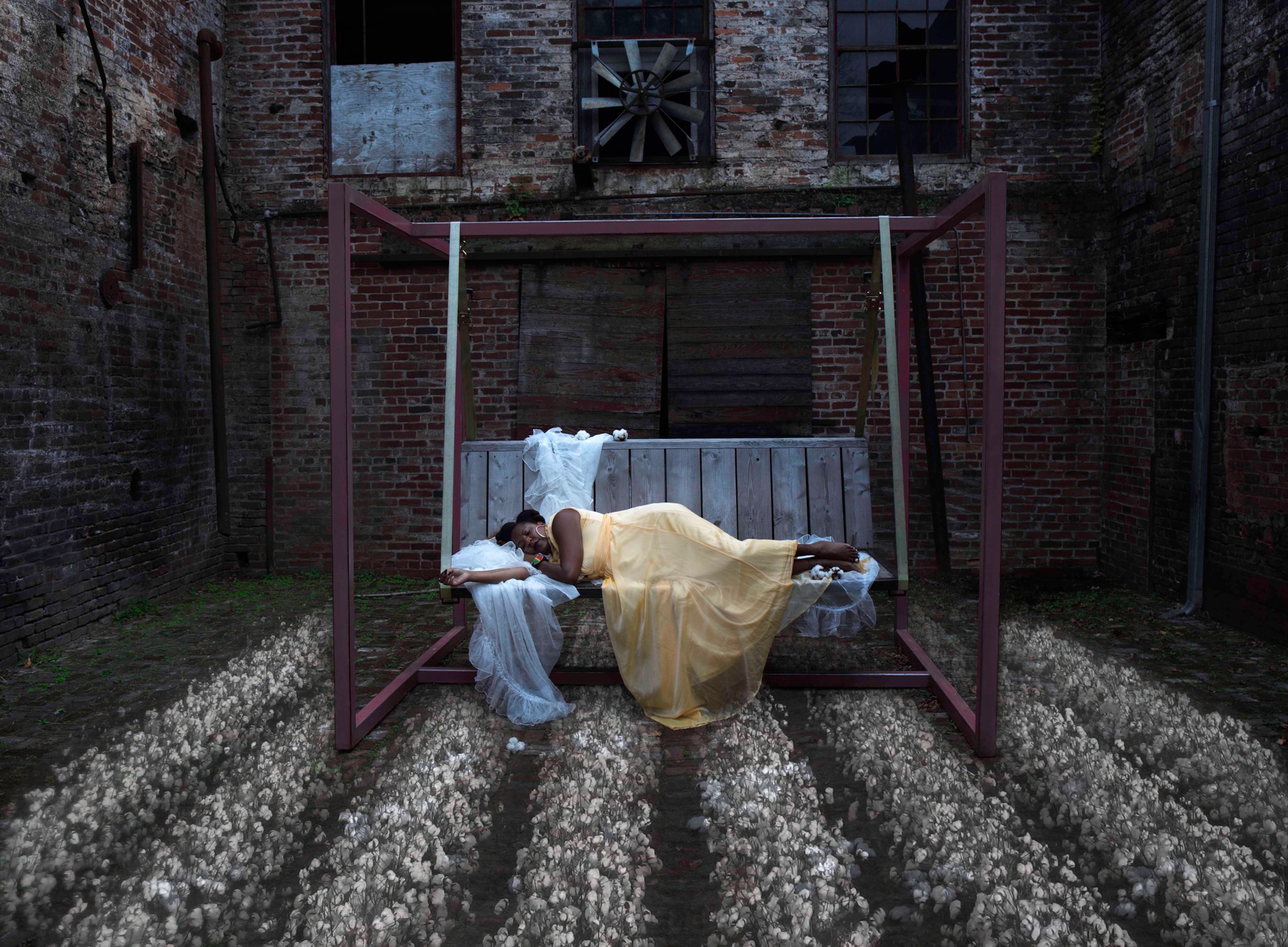
Charlie Watts and Tricia Hersey, Dreaming with the Ancestors, 2017. Archival digital print photograph, 76.2 × 101.6 cm.

The photograph Dreaming with the Ancestors, taken by Charlie Watts, portrays Hersey reclining on a wooden bench inside an open brick enclosure and above rows of cotton plants. Dressed in a soft yellow gown, she closes her eyes in rest, practicing what she calls “the art of escape”—from the incessant demand of productivity and overwork, from oppression of body and spirit, from noise that drowns out voices of wisdom.

In We Will Rest!, Hersey advises:

Every day, morning or night, or whenever you can steal away, find silence. Even if for only a few minutes. Look for quiet time, quiet breathing, quiet wind, quiet air. It is there. Even if it’s cultivated in your body by syncing with your own heart beating. Guilt and shame will be a formidable and likely opponent in your resistance. We expect guilt and shame to surface. Let them come. We rest through it. We commit to our subversive stunts of silence, truth, daydreaming, community care, naps, sleep, play, leisure, boundaries, and space. Be passionate about escape. (107)

+++

ALBUM: Grace Will Lead Me Home by Invisible Folk (2024) [HT: Jonathan Evens]: An Arts Council England grant awarded to singer-songwriter Jon Bickley in 2022 enabled him to conduct a research and songwriting project that culminated in the album Grace Will Lead Me Home, which engages with the hymn “Amazing Grace,” its author’s biography, and its legacy. Bickley partnered with the Cowper and Newton Museum in Olney and enlisted the collaboration of fellow folk musicians Angeline Morrison (The Sorrow Songs: Folk Songs of Black British Experience) and Cohen Braithwaite-Kilcoyne (creator of the “Black Singers and Folk Ballads” resource for secondary educators, and concertina player on Reg Meuross’s Stolen from God). Here’s the title track, written and sung by Morrison:

The album also includes a cover of Zoe Mulford’s “The President Sang Amazing Grace,” written in response to the racially motivated mass shooting at Mother Emanuel AME Church in Charleston, South Carolina, on June 17, 2015 (its ten-year anniversary is next Tuesday). In his eulogy at the funeral of one of the nine victims, Rev. Clementa Pinckney, President Barack Obama chose “the power of God’s grace” as his theme, and he closed by singing the first stanza of “Amazing Grace,” a moving gesture that Mulford’s song remembers.

Other songs on Grace Will Lead Me Home address John Newton’s love for his wife Polly, his impressment into naval service, and his friendship with William Cowper. There are also songs that grapple with the harm and suffering Newton inflicted on others through his involvement in the slave trade, and that wonder at his hymn’s being so mightily embraced not only by the Black church, many of whose members are descendants of enslaved Africans, but also by other traumatized communities, who insist amid all the wrongs and afflictions they’ve suffered that God is amazingly gracious.

It’s a myth that John Newton (1725–1807), who converted to Christianity in 1748 after surviving a turbulent sea voyage, immediately gave up his employment as a slave trader upon embracing Christ. In fact, he was soon after promoted from slave ship crew member to captain and sailed three more voyages to Africa as such, trafficking human beings for profit until 1754, when his ill health forced him to retire. But he continued to invest in slaving operations for another decade, until becoming a priest in the Church of England. It wasn’t until 1788, in the pamphlet Thoughts Upon the African Slave Trade, that he publicly denounced slavery and confessed his sin of having participated in that evil institution, and this was the start of his abolitionism.

+++

SONG: “Amazing Grace,” performed by the Good Shepherd Collective: This adaptation of “Amazing Grace” premiered at Good Shepherd New York’s digital worship service on June 1. Listen via the Instagram video below, or cued up on YouTube. The vocalists are, from right to left, Charles Jones on lead, Solomon Dorsey (also on bass), Jon Seale, Dee Wilson, and Aaron Wesley. James McAlister is on drums, Michael Gungor is on electric guitar, and Tyler Chester is on keys.
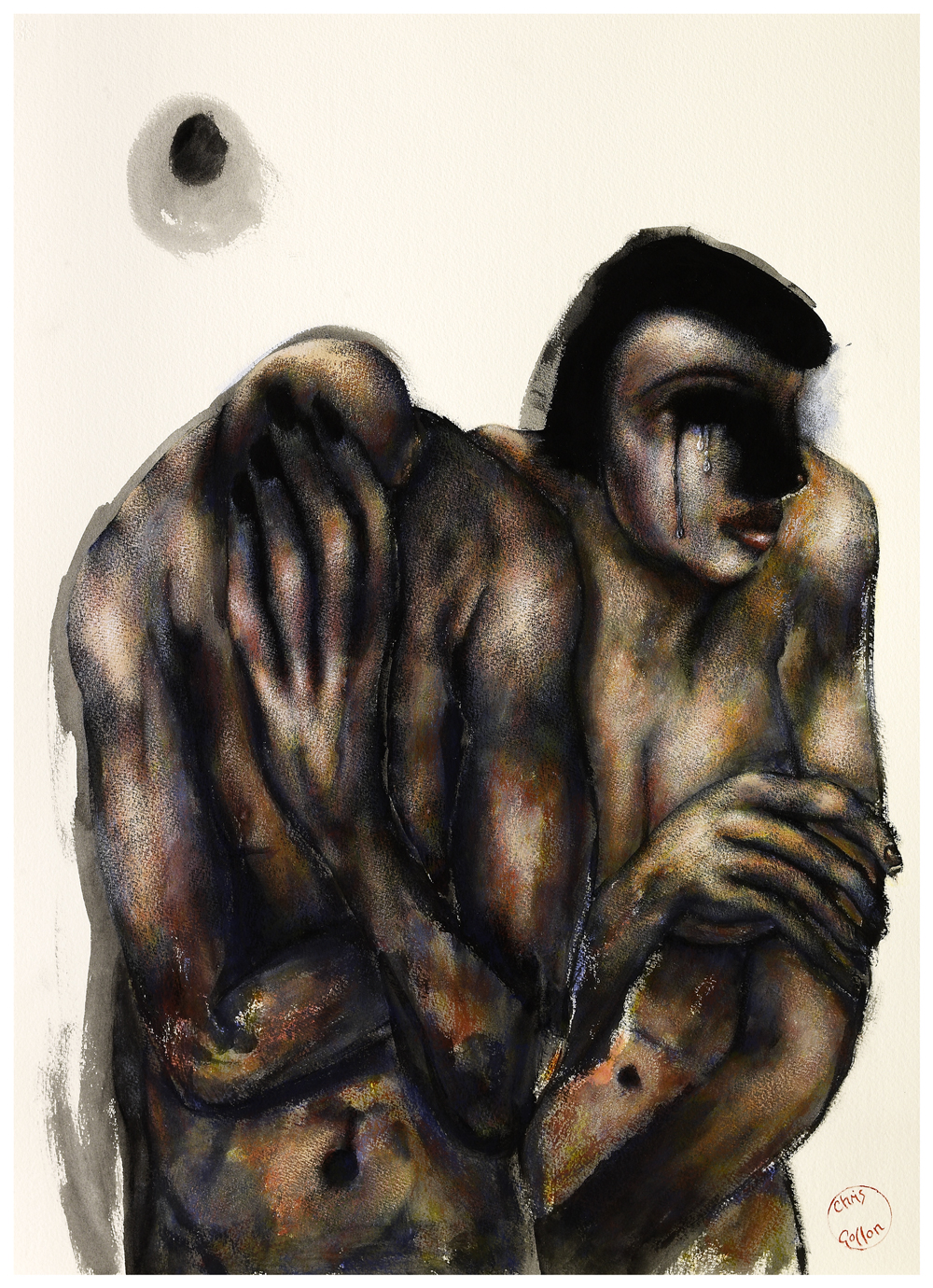
Fall of Man (Artful Devotion)

Gollon, Chris_Expulsion from Paradise
Chris Gollon (British, 1953–2017), Expulsion from Paradise, 2013. Acrylic on paper, 30 × 22 in. (76 × 56 cm).

So when the woman saw that the tree was good for food, and that it was a delight to the eyes, and that the tree was to be desired to make one wise, she took of its fruit and ate, and she also gave some to her husband who was with her, and he ate. Then the eyes of both were opened . . .

—Genesis 3:6–7

+++

SONG: “The Fall” by Gungor, on Ghosts Upon the Earth (2011)

The fall, the fall, oh God, the fall of man
The fruit is found in every eye and every hand
Nothing, there is nothing yet, in truest form
We walk like ghosts upon the earth; the ground, it groans

How long, how long will you wait?
How long, how long till you save us all, save us all?

Turn your face to me, turn your face to me

The light, the light, the morning light is gone
And all that’s left is fragile breath and failing lungs
The night, the night, the guiding night has come
Uniting lover with his bride, more precious than the dawn

How long, how long must we wait?

Turn your face to me, turn your face to me

Because of the music behind “Turn your face to me”—soft and smooth, consonant, calm not frantic like the rest—I read this refrain as being spoken by God. The humans lament their fall, asking how long they must wait for salvation, and God gently responds: it’s available now, just turn your face to me.

The idea of “ghosts upon the earth” is inspired by C. S. Lewis’s allegorical novel The Great Divorce, in which a group of travelers from a “grey town” are taken by bus to heaven, a land that proves to be far more solid, more real, than even the travelers’ own bodies. “Sometimes it seems like the most real thing is what we can see and experience with our senses around us—this life, the tangible,” Michael Gungor said. “Ideas like love, like God, these things sometimes feel more disconnected and ethereal, like that’s the ghostly realm. But what if that’s wrong and God and love is actually what is most real, and we are more like ghosts walking upon the earth, hoping to become more real?”

To watch a live performance of Gungor’s “The Fall” from 2012, click here.


This post belongs to the weekly series Artful Devotion. If you can’t view the music player in your email or RSS reader, try opening the post in your browser.

To view all the Revised Common Lectionary scripture readings for the First Sunday of Lent, cycle A, click here.

Advent Materials

Advent begins December 2, and Christian resource providers have already started releasing content for the season so that you can start adapting and programming it into your church services or family devotional practices, if desired. Here are three sets plus a Kickstarter campaign that caught my eye.

from SALT PROJECT

SALT Project Advent
Photo by SALT Project

SALT Project is a faith-based media company dedicated to creating beautiful visual content, especially video, for churches and other clients. Below are three of the five videos they’ve put together for Advent, which can be purchased and customized for church use. The videos feature a few products, like illustrated Advent calendar notecards (with daily tasks like “Deliver sweets to a neighbor” or “Write a thank-you letter to God”) and coloring pages and posters inspired by Mary’s Magnificat, available for download from SALT’s online shop.

I love their aesthetic! (These videos make me really excited for Advent.) I also appreciate how the devotional activities can be done either as an individual, a family, or a congregation. Click here to see a roundup of all five videos, and be sure to also check out Advent in Full Color, a devotional booklet that features poetry by Mary Oliver and Howard Thurman, daily practices, scripture texts, meditations on the season’s key theological themes, and coloring pages.

To subscribe to SALT’s weekly e-newsletter (which I highly recommend!), scroll to the bottom of this webpage; you can also follow them on Facebook @SALTyProject.

+++

from REFORMED WORSHIP

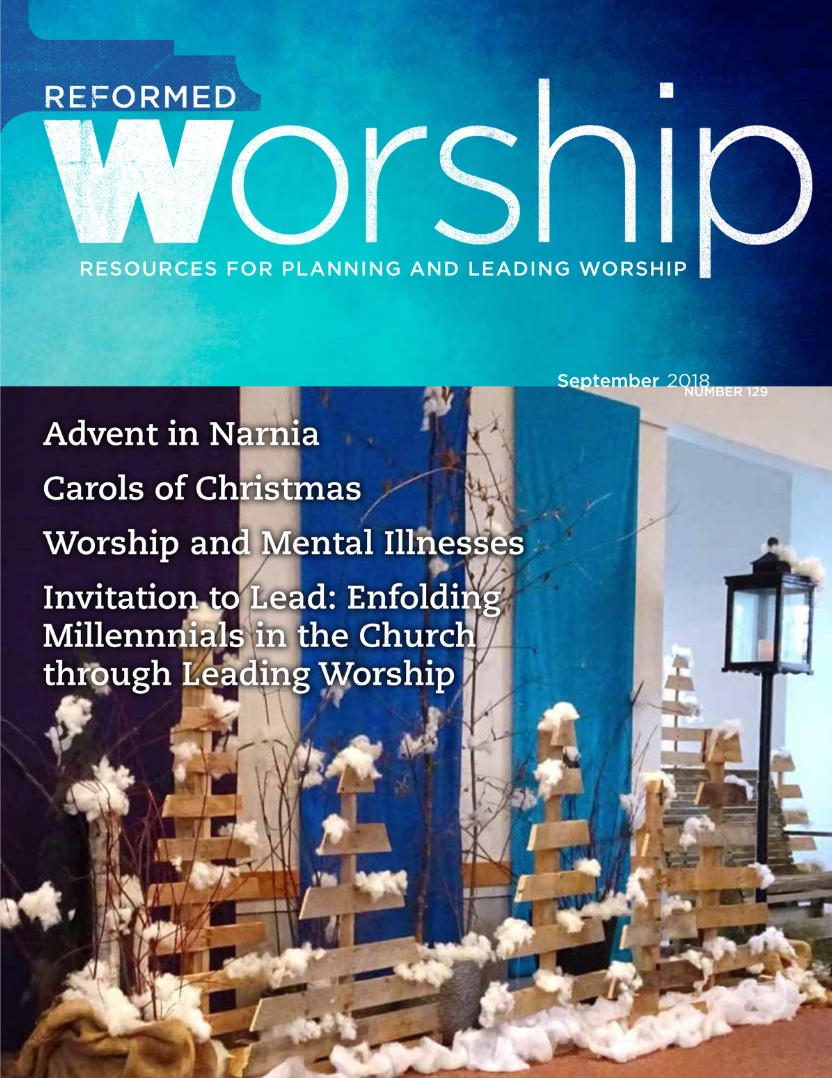
The cover story of the September 2018 issue of Reformed Worship magazine is “Advent in Narnia: An Invitation to Biblical Explorations Beyond the Wardrobe” by Cindy de Jong, which chronicles how seven different churches, including the author’s, used The Chronicles of Narnia last year to draw out some of the themes of Advent. In most cases this involved a six-week sermon series, or a service of lessons and carols, that integrated references to C. S. Lewis’s classic tale. At first I was skeptical of keying sermon series to a work of fiction, allegorical though it may be, but it turns out the worship service plans (reproduced in the article) were intelligently done, letting scripture drive and Narnia serve as a supplement to amplify God’s truth. One contributor even mentioned the need to be careful to not let Narnia be the focus; it can provide structural support but should not constitute the core of the sermon nor the worship service.

Reformed Worship cover

“The whole of Advent is this,” de Jong writes: “awaiting the birth of the Christ child in the same way we wait for the return of Christ’s kingdom. The whole of The Lion, the Witch, and the Wardrobe covers the same: waiting for Aslan and waiting for the triumph of Narnia.” Service plans, including songs, sermon titles and notes, Narnia references, and confessions, are included in the article with varying specificity. Though all drawing on the same text, there is a surprising diversity of approaches. Also included are ideas for how to decorate the sanctuary, how to engage children, and how to introduce the book and the sermon series to the congregation. Two additional books that are recommended are Advent in Narnia: Reflections for the Season by Heidi Haverkamp and The Lion’s World: A Journey into the Heart of Narnia by Rowan Williams.

Besides this eleven-page article, this month’s issue also includes an Advent reading for three voices by Joyce Borger, titled “What If . . . ?,” that reflects on the Flight to Egypt in light of today’s immigration debates, as well as an Advent worship service series that includes calls to worship, Advent readings, scripture texts, sermon themes and outlines, and song suggestions for five weeks’ worth of Sundays.

+++

from ADAM FARBIARZ via KICKSTARTER

Designed for daily use during December, One Night: An Advent Calendar is a large foldout storybook that reimagines Luke’s nativity narrative through the eyes of a shepherd. Printed on heavyweight paper wrapped around millboard, the product takes the form of a freestanding triptych with twenty-four numbered doors that open to reveal snippets of story. I’ve seen the mock-up, and it looks like a really quality endeavor, something for the whole family to enjoy (it’s pitched to adults but accessible to children). Help the creative team fund printing costs by contributing to their Kickstarter campaign in exchange for your own calendar in the mail by the end of November. Text and direction by Adam Farbiarz, illustrations by Rachael Clarke Hendel, hand lettering by Rachel Farbiarz, and design by Lizzie Stone.

One Night Advent calendar

One Night Advent calendar

+++

from THE HOMELY HOURS

These resources were published over the last few years, but I just found out about them this summer. Run by churchwomen from Christ the King Anglican Church in Dayton, Ohio, The Homely Hours is a website created out of a desire to encourage a deeper integration of the life of the church into the life of the home. It’s treated not so much as a blog (it’s not continually updated) as it is a repository, so search through the tabs and archives for creative ideas to celebrate the liturgical seasons in the domestic sphere.

Advent plans include Advent-wreath prayers, Jesus-tree ornaments, St. Nicholas Day treat bags, Advent Saints and Life of Mary coloring pages, a printable St. Lucy’s crown, poems, and more—all free. As a reminder that the observance of Advent with one’s family does not necessitate perfect planning or novelty or “lots of” (quite the contrary), see “If I handcraft artisan shoes for St. Nicholas Day but have not love . . .”

St. Nicholas treat bag
St. Nicholas Day treat bag by Bley Hack/The Homely Hours

Life of Mary coloring page
Life of Mary coloring page (detail) by Michelle Abernathy/The Homely Hours

Jonathan Anderson on the (in)visibility of theology in contemporary art criticism

Jonathan A. Anderson is an associate professor of art at Biola University, an interdenominational Christian university in southern California. In addition to being a practicing artist, he researches and writes on modern and contemporary art criticism, especially its relationship to theology. Along with William Dyrness, he has written the first book in InterVarsity Press’s new Studies in Theology and the Arts series: Modern Art and the Life of a Culture: The Religious Impulses of Modernism.

Below is a video of Anderson presenting a paper titled “The (In)visibility of Theology in Contemporary Art Criticism” at the 2012 conference Christian Scholarship in the Twenty-First Century: Prospects and Perils, sponsored by Biola University’s Center for Christian Thought. In it he examines the problematic absence of theologically informed criticism from contemporary art discourse and posits what is (and is not) needed to redress the problem. He very clearly articulates some of my frustrations with the contemporary art world, giving lots of examples and helpful breakdowns as well as advice for Christians writing about art.

On this blog I write primarily for nonscholars, as well as for the church, not the art world (though I’m thrilled if the art world wants to listen in!). So while I do very much approach art theologically, I know I’m not exactly the voice Anderson is looking for; furthermore, I cover a limited range of art here, restricting myself, for the most part, to Anderson’s first category of “religious” art, below.

Still, I share Anderson’s desire to see a new method of criticism develop, one that takes religious belief seriously instead of sweeping it under the rug. And I try, from my own little corner, to model said method—to “work productively in the rift.”

Here’s the presentation, followed by some highlights.

His starting point is October founder Rosalind Krauss’s pronouncement, in 1979, of an “absolute rift” between art and religion. He elaborates:

The textbooks of twentieth-century art history, theory, and criticism, as well as major museum collections, readily testify to the fact that the institutional art world regards Christianity as having made negligible contributions to the fine arts during the twentieth century, and unfortunately that’s a judgment I largely agree with. But the reverse is also true: for the most part, the church has little regard for the canon of twentieth-century art as having made contributions to the development and deepening of Christian thought. For most of the last century, the worlds of contemporary art theory and Christian theology developed into distinct cultural configurations that have been remarkably disengaged from each other, often to the point of mutual unintelligibility.

The twenty-first century has seen a return of religion to art, Anderson says, but it has been a return riddled with problems. His agenda here is to (1) articulate where the primary problem in the rift lies, (2) offer an argument for how we might think of the return of religion to the art discourse, and (3) suggest ways in which Christians can work productively in the rift.

[03:13] Where does the rift between art and religion lie?

[04:28] In his landmark book On the Strange Place of Religion in Contemporary Art, James Elkins says the rift exists not in the art itself but in the academic writing about art.

[05:43] Art Since 1900 identifies and articulates the four primary critical methods that have framed the modern and contemporary art discourse: psychoanalysis, social art history, formalism and structuralism, and poststructuralism and deconstruction. (“Theology” is not one of them.)

[18:48] Summarizing Elkins: “Religious content is unable to survive the suspicious interpretative operations of avant-garde theory and criticism, which relentlessly reads behind and beneath the subject matter and pictorial composition of an artwork.”   Continue reading “Jonathan Anderson on the (in)visibility of theology in contemporary art criticism”

The art of contemplative seeing (as modeled by Moses)

“Open my eyes, that I may behold wondrous things . . .”—Psalm 119:18

“My own eyes are not enough for me, I will see through those of others.”—C. S. Lewis

Images have revelatory power. God spoke through them in ancient times: a ladder (Jacob); sheaves of wheat (Joseph); a ripe grapevine (pharaoh’s cupbearer); birds eating cake (pharaoh’s baker); cattle eating cattle (pharaoh); a wheel inside a wheel (Ezekiel); dry bones reconstituting into living human beings (Ezekiel); a broken statue (Nebuchadnezzar); four beasts (Daniel); a sheet filled with animals (Peter); and fantastical creatures doing battle (John). Some of these images were received during sleep, while others were waking dreams—visions—and while verbal statements by God sometimes accompanied them, the images left definite impressions that plunged the seer into a deeper awareness of God’s nature and/or will.

Moses and the Burning Bush by Edward Knippers
Edward Knippers (American, 1946–), Moses and the Burning Bush, 2008. Oil on panel, 6 × 4 ft.

Another famous image through which God spoke was the burning bush on Mount Horeb, which interrupted Moses during his workday. Notice his double take:

Now Moses was keeping the flock of his father-in-law, Jethro, the priest of Midian, and he led his flock to the west side of the wilderness and came to Horeb, the mountain of God. And the angel of the Lord appeared to him in a flame of fire out of the midst of a bush. He looked, and behold, the bush was burning, yet it was not consumed. And Moses said, “I will turn aside to see this great sight, why the bush is not burned.” When the Lord saw that he turned aside to see, God called to him out of the bush, “Moses, Moses!” And he said, “Here I am.” (Exodus 3:1–4)

In Abiding: The Archbishop of Canterbury’s Lent Book 2013, Ben Quash notes that when Moses first sees the bush, he simply receives the visual data: bush on fire. But then as he starts to compute what he sees he realizes that hey, the flames are engulfing it, but it’s not being consumed; this is a “great sight” that deserves a closer look. So he turns aside from his intended path to dwell more consciously and deliberately with the strange bush. It is only then—when Moses has stood still long enough—that the voice of God addresses him. And he is utterly transformed by the encounter that follows, whereby he is called to liberate his people from slavery in Egypt and lead them in settling a new land.   Continue reading “The art of contemplative seeing (as modeled by Moses)”