
Advent, Day 6: Tears

LOOK: the heavens wept with me by Caitlin Connolly
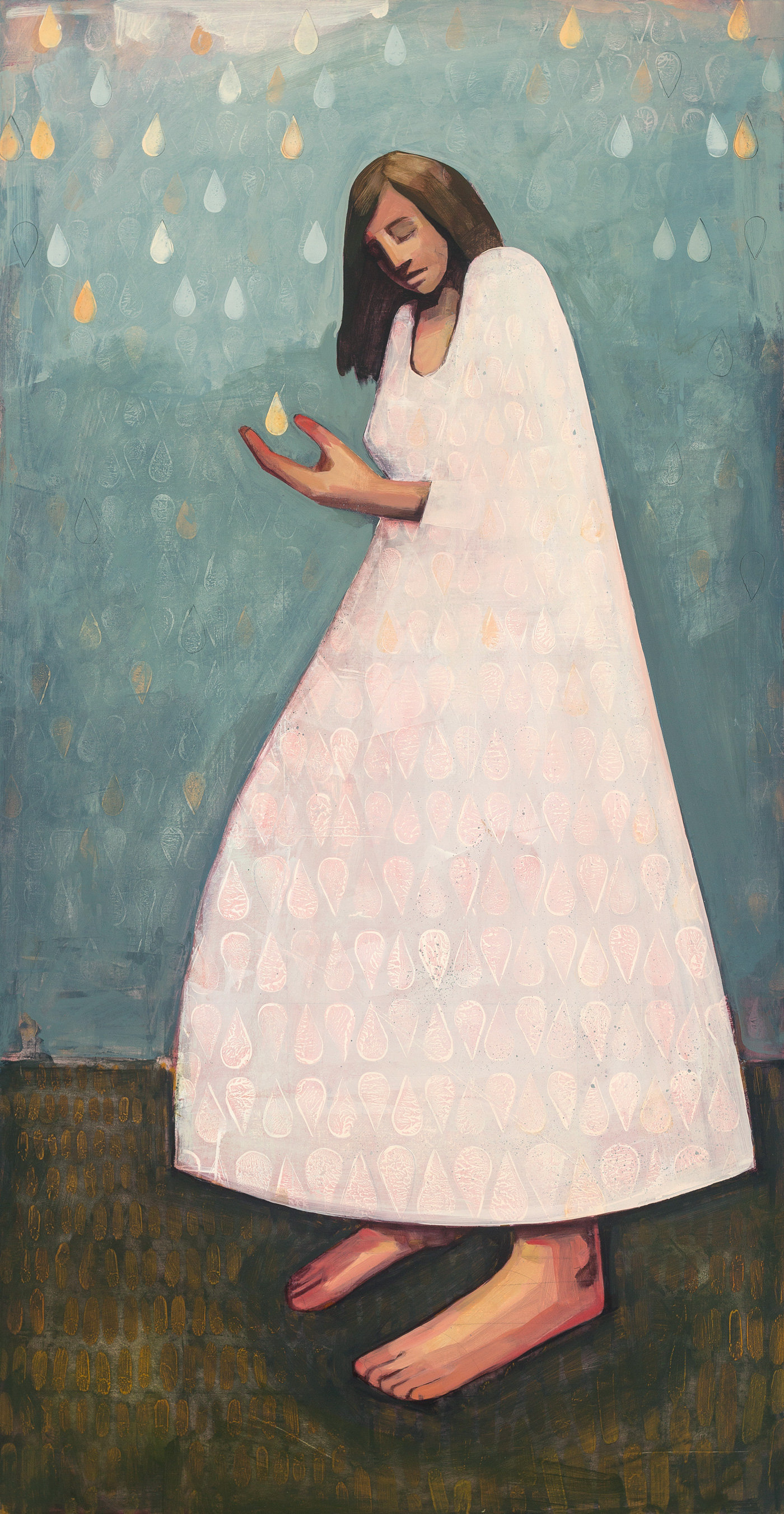
Connolly, Caitlin_the heavens wept with me
Caitlin Connolly (American, 1986–), the heavens wept with me, 2018. Oil on canvas.

LISTEN: “A Dream / On Another’s Sorrow” | Words by William Blake, from Songs of Innocence, 1789, adapt. | Music by David Benjamin Blower, on Innocence & Experience, 2022

Once a dream did weave a shade
O’er my Angel-guarded bed,
That an Emmet lost its way
Where on grass methought I lay.

Troubled, ’wildered, and forlorn,
Dark, benighted, travel-worn,
Over many a tangled spray,
All heart-broke I heard her say:

“O my children! do they cry?
Do they hear their father sigh?
Now they look abroad to see:
Now return and weep for me.”

Pitying, I dropped a tear;
But I saw a glow-worm near,
Who replied: “What wailing wight
Calls the watchman of the night?

“I am set to light the ground,
While the beetle goes his round:
Follow now the beetle’s hum;
Little wanderer, hie thee home.”

*

Can I see another’s woe,
And not be in sorrow too?
Can I see another’s grief,
And not seek for kind relief?

Can I see a falling tear,
And not feel my sorrow’s share?
Can a father see his child
Weep, nor be with sorrow filled?

Can a mother sit and hear
An infant groan, an infant fear?
No, no! never can it be!
Never, never can it be!

And can They who smile on all
Hear the wren with sorrows small,
Hear the small bird’s grief and care,
Hear the woes that infants bear,

And not sit beside the nest,
Pouring pity in their breast;
And not sit the cradle near,
Weeping tear on infant’s tear;

And not sit both night and day,
Wiping all our tears away?
O no! never can it be!
Never, never can it be!

They do give Their joy to all;
They become an infant small;
They become a one of woe;
They do feel the sorrow too.

Think not thou canst sigh a sigh,
And thy Maker is not by;
Think not thou canst weep a tear,
And thy Maker is not near.

The lyrics of this song comprise two poems from William Blake’s Songs of Innocence: “A Dream” and “On Another’s Sorrow.”

In “A Dream,” the poetic speaker dreams about a lost ant (an emmet) who is trying to find her way back to her children and husband. The speaker is moved by the ant’s distress and weeps for her. But then a glowworm (“the watchman of the night,” as he’s lit like a lantern) graciously intervenes, telling the ant to listen to the sound of the beetle walking and to follow that sound home while he lights the way.

“Told from a trusting, childlike perspective, the poem”—a fable—“suggests that those who ask for help will get it: the world is a naturally compassionate place, and guidance and protection are always at hand, even in difficult times.” (LitCharts)

Aren’t we all “little wanderers”? Many of us troubled, bewildered, lonely, and worn by our seeking and striving?

There is empathy for us not only from fellow travelers but also from the Divine.

“On Another’s Sorrow” is about how God lovingly enters into our woes through the Incarnation. He becomes a participant in the project of being human, experiencing firsthand the many trials, hurts, and vulnerabilities that come with the territory.  

In the first three stanzas, the speaker expresses how keenly he feels the sorrows of others. In the fourth stanza, he reflects on how God does the same—only God is perfectly present to all, weeping with those who weep, sighing with those who sigh. Having “become an infant small,” the Creator has demonstrated solidarity with his creation. It is a comfort to know that God is so intimately acquainted with the griefs that afflict us and is keen to companion us through them.

In his creative visioning, British singer-songwriter David Benjamin Blower brought together Blake’s “A Dream” and “On Another’s Sorrow” with a single, spare musical setting, linking the two poems with an instrumental interlude but keeping the same tune throughout. The first poem is about the feeling of weariness or lostness; the second, grief. Both have to do with compassion—we owe it to one another and often receive it from others, and it is always available to us in Christ, who is God brought near.

In “On Another’s Sorrow,” Blower changed the pronouns for God in the fourth and seventh stanzas from “He/His” to “They/Their,” since God is neither male nor female. He also omitted the final stanza in Blake’s original:

O! He gives to us His joy
That our grief He may destroy:
Till our grief is fled and gone,
He doth sit by us and moan.


This post is part of a daily Advent series from December 2 to 24, 2023 (with Christmas to follow through January 6, 2024). View all the posts here, and the accompanying Spotify playlist here.
Lent, Day 20

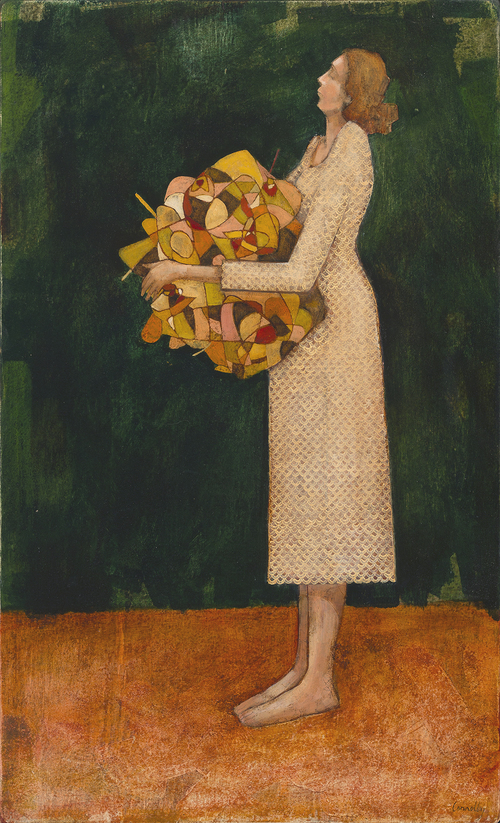
LOOK: Holding a Mystery by Caitlin Connolly

Connolly, Caitlin_Holding a Mystery
Caitlin Connolly (American, 1986–), Holding a Mystery, 2014. Oil on panel, 16 × 6 in.

Caitlin Connolly is an artist from Provo, Utah, whose paintings explore womanhood, sorrow, and faith. Her website, www.caitlinconnolly.com, contains an archive of original images dating back to 2013, many of which she sells as giclée prints from her online shop. She is featured in the first half of this episode of the BYUtv documentary series Artful.

The women in Connolly’s paintings are often shown holding something—the world, “holy things,” a book, a truth, a child, tears—or they might cup or cradle an absence that hurts. Here the figure carries a beautiful, tangled mass, a mystery, which is strangely both heavy and light. She doesn’t try to untangle it but simply hugs it close, resting.

LISTEN: “Lovely (Anselm of Canterbury)” by Nick Chambers, 2020 (to be released on an EP in 2022)

Lord my God, I don’t know how to start,
So I pray today that you would teach my heart
Where and how to find you, God, O where and how to search.
How can I know unless you show me first?

My God and my All, I’ve never seen you.
You created me, and you have made me new
And given me the good things in my hands and in my heart,
But still I don’t know who it is you are.

[Refrain] Let me seek you in all my desire,
Desire you in everything I seek.
Let it be by loving you I find you,
And when I finally find you, let it be lovely.

I come to you confessing gratefully.
It was in your image you created me
So that I may remember you and find the living course
On my way back to the loving source.

But that image is so worn and dim,
Darkened by the fault and by the smoke of sin,
That it can no longer do what you made it to do
Until it is refashioned and renewed.

[Refrain]

I’m not trying to ascend your heights;
My mind’s in no way capable of such a flight.
I do desire to know a little of your truth above
Which my heart already trusts and loves.

I seek to understand not so I can believe,
but I believe so I may understand.
And what is more, I do believe that unless I do believe,
I’ll never understand this mystery.

Originally from the Midwest, the Rev. Nick Chambers lives with his wife Katlyn and two sons in Atlanta, where he serves as the worship and formation pastor at Trinity Anglican Northside. His academic background is in philosophy and theology. “I love writing songs in, with, and for the church, and I’ve been doing it for years but only recently started seeking to share them beyond my local community,” he told me. He has contributed to two Porter’s Gate albums (Advent Songs and the forthcoming Climate Vigil Songs) and will be releasing his first solo EP later this year.

On Chambers’s YouTube channel you will find some of his original settings of psalms, prayers by Ephrem and Augustine and from the Book of Common Prayer, a poem by Pádraig Ó Tuama, and even a reworking of a Swedish hymn that he encountered through a few spoken lines from the Ingmar Bergman film Wild Strawberries!

“Lovely (Anselm of Canterbury)” is adapted from a prayer by the eleventh-century Burgundian-born monk, and later archbishop, named in the title. A doctor of the church, Anselm had a tremendous influence on the development of Christian theology and spirituality. The “combination of theological veracity and personal ardour is what most distinguishes Anselm’s writings from similar prayers, and makes him both traditional and revolutionary,” says Sister Benedicta Ward, a preeminent scholar and English translator of Anselm.

Anselm wrote the Proslogion (Lat. Proslogium, “Discourse”) in the 1070s while he was prior of the abbey of Notre Dame at Bec in Normandy. Chambers’s song is based on the passage that ends chapter 1:

Teach me to seek thee, and reveal thyself to me, when I seek thee, for I cannot seek thee, except thou teach me, nor find thee, except thou reveal thyself. Let me seek thee in longing, let me long for thee in seeking; let me find thee in love, and love thee in finding. Lord, I acknowledge and I thank thee that thou hast created me in this thine image, in order that I may be mindful of thee, may conceive of thee, and love thee; but that image has been so consumed and wasted away by vices, and obscured by the smoke of wrong‑doing, that it cannot achieve that for which it was made, except thou renew it, and create it anew. I do not endeavor, O Lord, to penetrate thy sublimity, for in no wise do I compare my understanding with that; but I long to understand in some degree thy truth, which my heart believes and loves. For I do not seek to understand that I may believe, but I believe in order to understand. For this also I believe—that unless I believed, I should not understand. (translated from the Latin by Sidney Norton Deane, 1903; emphasis mine)

In her 1973 translation of the Proslogion (pp. 243–44), Benedicta Ward sets this prayer in broken lines “in an attempt to convey the rhythm of Anselm’s complex rhymed prose, which is closer to our conception of poetry” and which aids a more meditative reading:

      Teach me to seek you,
   and as I seek you, show yourself to me,
   for I cannot seek you unless you show me how,
      and I will never find you
   unless you show yourself to me.
Let me seek you by desiring you,
   and desire you by seeking you;
   let me find you by loving you,
   and love you in finding you.

   I confess, Lord, with thanksgiving,
   that you have made me in your image,
so that I can remember you, think of you, and love you.
But that image is so worn and blotted out by faults,
   so darkened by the smoke of sin,
   that it cannot do that for which it was made,
   unless you renew and refashion it.
Lord, I am not trying to make my way to your height,
   for my understanding is in no way equal to that,
   but I do desire to understand a little of your truth
   which my heart already believes and loves.
I do not seek to understand so that I may believe,
   but I believe so that I may understand;
      and what is more,
I believe that unless I do believe I shall not understand.

I particularly love lines 8–9: “Let me find you by loving you, and love you in finding you.” Or, as Deane translates it, “Let me find thee in love and love thee in finding.” Chambers highlights these lines by making them, and the two that precede them, the refrain of his song: “Let me seek you in all my desire, / Desire you in everything I seek. / Let it be by loving you I find you, / And when I finally find you, let it be lovely.”

For Anselm, our desire for God must precede our understanding of God. We cannot know God except through love; those who pursue him without loving him will not find him. And it’s not as if our “finding” God ends the pursuit, as there is always more of God to discover. We catch small glimpses, and that’s invigorating. In this life we are never granted a full and complete vision of God but rather are always searching and often finding—and that search, undertaken with loving belief, is a delight.