ESSAY: “On ‘Laudes Creaturarum’ (‘All Creatures of Our God and King’): A Polyphony” by Kimberly Johnson

Blogger’s note: I’m fascinated by the history of hymns—all the creative hands they pass through (lyricists, translators, composers, harmonizers, arrangers, hymnal editors, church musicians, worship pastors, recording artists, etc.) to become what we use in our churches today. In this essay, poet, translator, and literary critic Kimberly Johnson traces in fragments the history of “All Creatures of Our God and King” [previously], interweaving that history with snippets of the authors’ biographies, musical analysis, personal confession, and observations from the time she spent in and around the hymn’s origin place of Assisi in the Umbria region of Italy.

Copyright credit: The essay “On ‘Laudes Creaturarum’ (‘All Creatures of Our God and King’): A Polyphony” by Kimberly Johnson is from Stars Shall Bend Their Voices: Poets’ Favorite Hymns and Spiritual Songs, edited by Jeffrey L. Johnson (Asheville, NC: Orison Books, 2018). It is reproduced here by permission of the publisher. I’ve added the photos for visual reference.

Laudes Creaturarum

Altissimu onnipotente bon signore
      tue so le laude la gloria e l’ onore e onne benedictione.
Ad te solo altissimo se konfano
      e nullu homo ene dignu te mentovare.
Laudatu si mi signore cum tucte le tue creature
      spetialmente messor lu frate sole
      lu quale iorno et allumini per loi.
E ellu è bellu e radiante cum grande splendore
      de te altissimu porta significatione.
Laudatu si mi signore per sora luna e le stelle
      in celu l’ ai formate et pretiose e belle.
Laudatu si mi signore per frate vento
      e per aere e nubilo e sereno et onne tempu
      per lu quale a le tue creature dai sustentamentu.
Laudatu si mi signore per sor aqua
      la quale è multo utile e humele e pretiosa e casta.
Laudatu si mi signore per per frate focu
      per lu quale n’ allumeni la nocte
      e ellu è bello e iucundo e robusto e forte.
Laudatu si mi signore per sora nostra matre terra
      la quale ne sustenta e governa
      e produce diversi fructi e coloriti fiore e erba.
Laudatu si mi signore per quilli ke perdonano per lo tue amore
      e sostengono infirmitate e tribulation
      beati quelli ke ‘l sosterranno in pace
      ke da te altissimu sirano incoronati.
Laudatu si mi signore per sora nostra morte corporale
      da la quale nullu homo vivente po skappare
      guai a quilli ke morranno in peccata mortale.
      Beati quelli ke troverà ne le tue sanctissime voluntati
      ke la morte secunda no ’l poterà far male.
Laudate e benedicete lu mi signore e rengratiate
      e servite a lui cum grande humilitate. Amen.

Francis of Assisi, c. 1225

Praises of the Creatures

Highest, omnipotent, good our Lord,
      yours are the praises, the glory, the honor, and all blessing.
To you alone, Most High, they are owed,
      and no mortal is worthy to mention you.
Be praised, my Lord, through all your creatures,
      especially through my Lord Brother Sun,
      who brings the day, and you shed light through him.
And he is beautiful and radiant in his grand splendor!
      Of you, Most High, he bears the likeness.
Be praised, my Lord, through Sister Moon and the stars;
      in heaven you formed them, bright and precious and beautiful.
Be praised, my Lord, through Brother Wind
      and through the air, cloudy and serene, and through all weathers
      by which you give your creatures sustenance.
Be praised, my Lord, through Sister Water,
      who is so useful and humble and precious and chaste.
Be praised, my Lord, through Brother Fire,
      through whom you illuminate the night;
      and he is lovely and playful and robust and strong.
Be praised, my Lord, through our Sister Mother Earth,
      who sustains and governs us
      and who brings forth varied fruits with vibrant flowers and herbs.
Be praised, my Lord, through those who give pardon for love of you,
      and bear infirmity and tribulation;
      blessed are those who persevere in peace,
      for they will be, by you Most High, endowed a crown.
Be praised, my Lord, through our sister, Death-of-the-Flesh,
      from whom no living mortal can escape.
      Woe to those who die in mortal sin!
      Blessed whom death finds abiding in your most sacred will,
      for the second death shall do them no harm.
Praise and bless my Lord, and render thanks to Him,
      and serve Him with great humility. Amen.

Translated from the Italian by Kimberly Johnson, 2018

All Creatures of Our God and King

All creatures of our God and King,
lift up your voice and with us sing:
Alleluia, alleluia!
O burning sun with golden beam,
and shining moon with silver gleam,
O praise Him, O praise Him,
Alleluia, alleluia, alleluia!

O rushing wind so wild and strong,
white clouds that sail in heaven along:
Alleluia, alleluia!
New rising dawn in praise rejoice;
you lights of evening find a voice,
O praise Him, O praise Him,
Alleluia, alleluia, alleluia!

Cool flowing water, pure and clear,
make music for your Lord to hear:
Alleluia, alleluia!
Fierce fire, so masterful and bright,
providing us with warmth and light,
O praise Him, O praise Him,
Alleluia, alleluia, alleluia!

Earth ever fertile, day by day,
bring forth your blessings on our way:
Alleluia, alleluia!
All flowers and fruits that in you grow,
let them his glory also show,
O praise Him, O praise Him,
Alleluia, alleluia, alleluia!

All you who are of tender heart,
forgiving others, take your part:
Alleluia, alleluia!
All you who pain and sorrow bear,
praise God and on him cast your care,
O praise Him, O praise Him,
Alleluia, alleluia, alleluia!

And thou most kind and gentle death,
waiting to hush our latest breath:
Alleluia, alleluia!
Thou leadest home the child of God,
and Christ our Lord the way hath trod.
O praise Him, O praise Him,
Alleluia, alleluia, alleluia!

Let all things their Creator bless,
and worship Him in humbleness:
Alleluia, alleluia!
Praise, praise the Father, praise the Son,
and praise the Spirit, Three in One!
O praise Him, O praise Him,
Alleluia, alleluia, alleluia!

Translated from the Italian by William Henry Draper, 1919
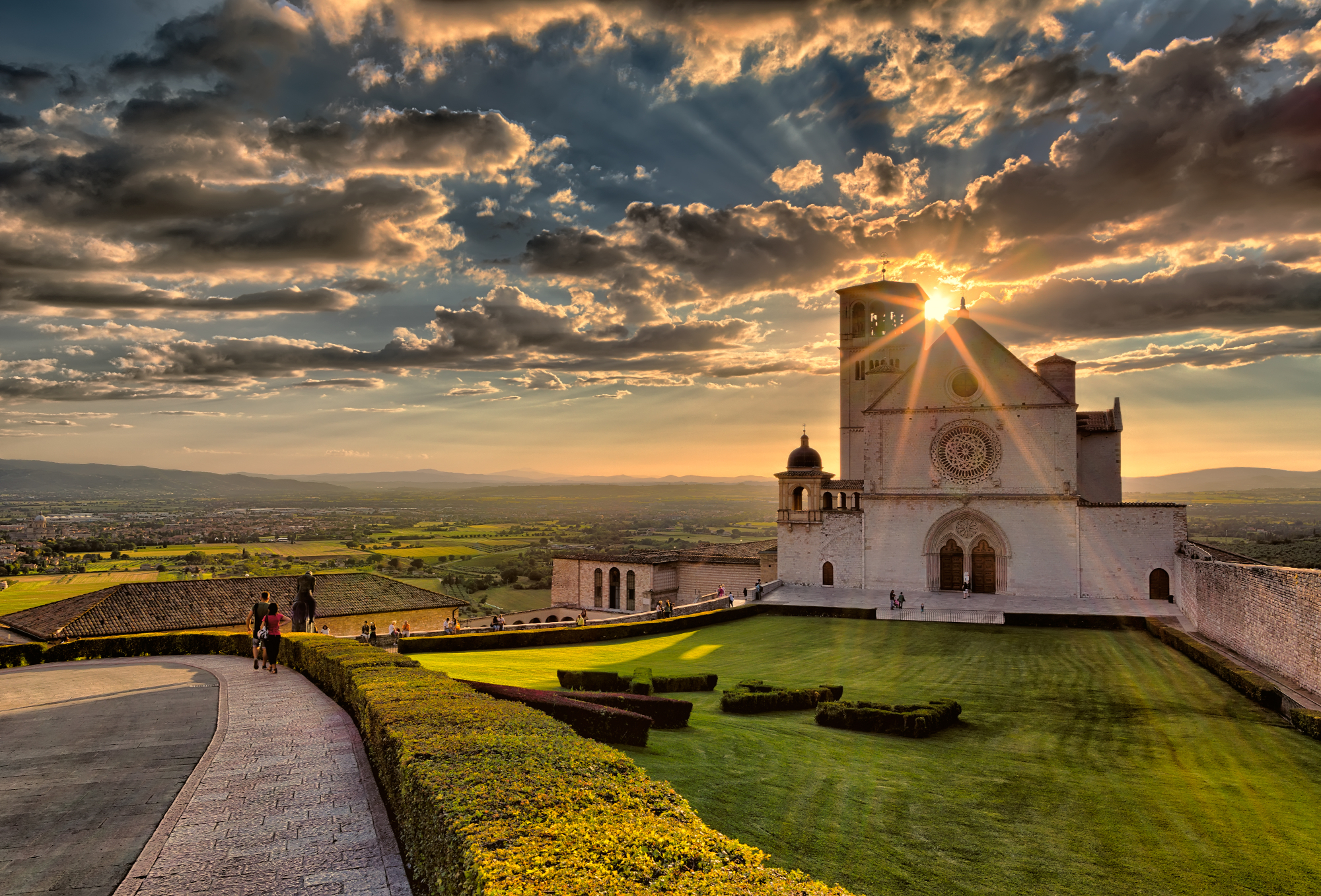
Basilica of St. Francis of Assisi
Basilica of St. Francis of Assisi, Assisi, Italy. Photo: Giorgio Art.

In Assisi, the sky vaults clouded and serene against the foothills.

*

Pietro, known as Francesco, devoted brother of his order, put quill to thirteenth-century parchment and began to praise. His inspiration was Psalm 148, whose Hebrew exhortations spur the sun and moon, the stars and highest heavens, tempests and mountains and wingèd birds to sing their Lord’s splendid name. Barchu and Hallelu.

*

In the trees that ring the great cathedral at Assisi, birds trill an antiphon in the innumerable dialects of their collected species.

*

“Laudatu si mi signore per sora nostra morte corporale,” Francis wrote in his backwater dialect, “da la quale nullu homo vivente po skappare.” Be praised, my Lord, through our sister, Death-of-the-Flesh, from whom no living mortal can escape.

*

William Henry Draper lost his first wife in childbirth. He lost his second wife in her youth. He lost three sons in World War I and a daughter in her childhood.

*

In Francesco’s hymn, the psalm’s call to worship forges familial bonds, each voice enfolded into the household: My Lord Brother Sun. Sister Moon and Sister Water, Brother Fire and Brother Wind.

*

Twice widowed, four times unfathered, William Henry Draper served as rector of the parish church in Leeds, where, in 1919, he translated a centuries-old poem by an Umbrian monk for a Whitsunday children’s concert.

*

On Whitsunday, the Assisi cathedral is afire with cloven tongues, pilgrims murmuring a babel of prayer.

*

Thou rushing wind that art so strong

*

At the wind of the day I walked the fortress wall on Assisi’s hilltop as the houselights came on below. “A mighty fortress is our God,” another word-dazzled monk would write three centuries after Francesco threw open the enclosures of monastic care to the lazar-house, the beggars, the birds.

*

At a piazza dinner in the hilltop town of Perugia, against which the young soldier Pietro called Francesco marched impenitent and won a year in prison for his pains, I overhear a tourist family at the next table. In New Jersey cadence, the mother suggests a next day’s trip to the basilica in Assisi. She sells it: “It’s where St. Francis is from.” Her son whines, “Who’s St. Francis?” The mother pauses. The pavement birds are belled into the evening sky. “He’s this really famous Franciscan monk.”

*

In the basilica, the nave vaults with sky, a gloaming blue clouded with verdant green. Gold stars fan out like finches. Like gilt notes on an ethereal staff.
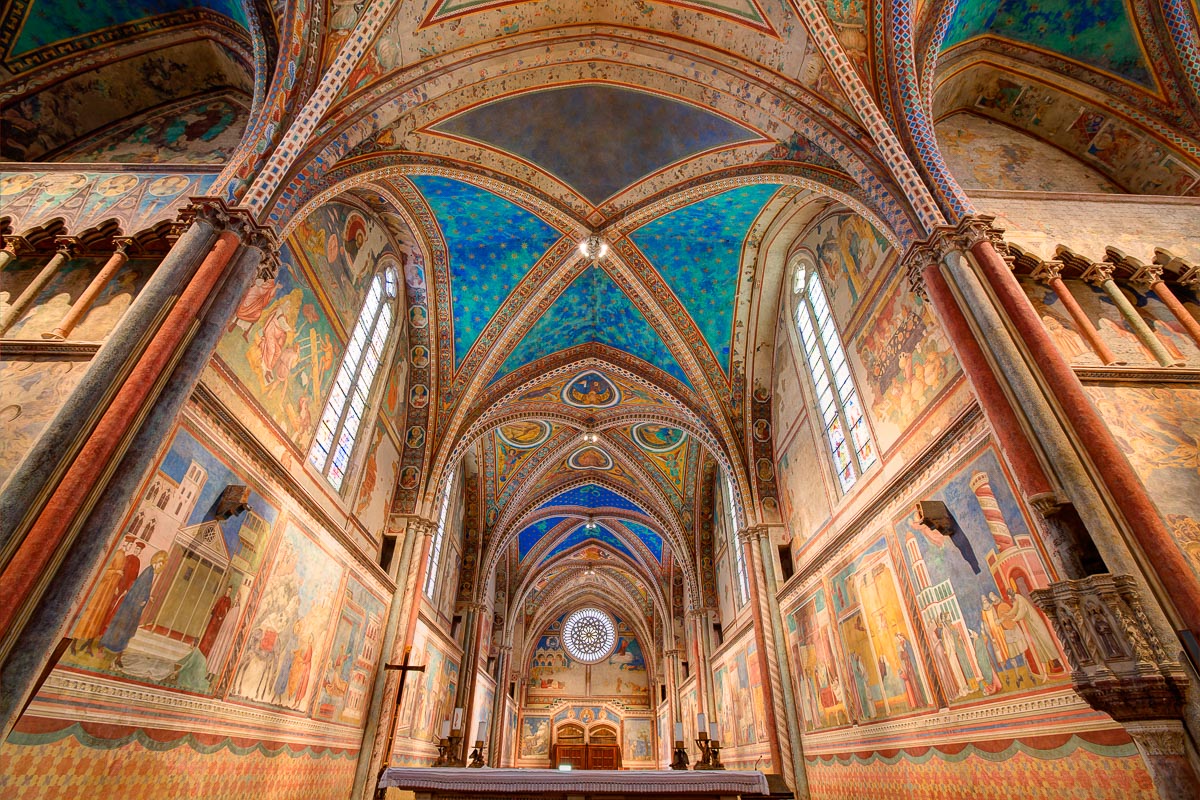
Basilica of St. Francis of Assisi
Basilica of St. Francis of Assisi, Assisi, Italy. Photo: Gustavo Kralj / Gaudium Press Images.

*

Ralph Vaughan Williams, son of a vicar, took up an old German tune, “Lasst uns Erfreuen” (“Let Us Rejoice”), harmonizing his Anglican to that melody’s spare Jesuit. And how hear we every man in our own tongue, wherein we were born?

*

It’s not the repeated alleluia. It’s not the catalogue of earthy beauty. It’s not the open-throated Ptolemaic chime. What undoes me is the single minor chord.

*

Undone. Unfathered. Lazar-house. Lost. Tempest. Prison. Babel. Evening. “Sora nostra morte corporale.”

*

The minor chord: unheard in the tune’s Teutonic plainchants, unheard before Vaughan Williams’s harmonies. It falls at the end of the penultimate line of each verse—in some versions of Draper’s English text, the minored syllable is Him, and in some it is Jah; either way, God takes the fall.

*

Vaughan Williams’s minor chord is the musical cognate of Francesco’s steadfast praise in and through the death of the flesh: a gut punch that refuses to be redeemed by the next line’s joy.

*

Confiteor: The next line’s return to D major requires a resolve that, many days, I don’t have.

*

In the Upper Church in Assisi, the fresco cycle attributed (probably wrongly) to Giotto includes San Francesco d’Assisi predica agli uccelli. There are doves, of course, in the saint’s congregation. There is a woodcock, I think. A robin. They will not fly until his sermon is finished. Until he follows the downpour with worms.
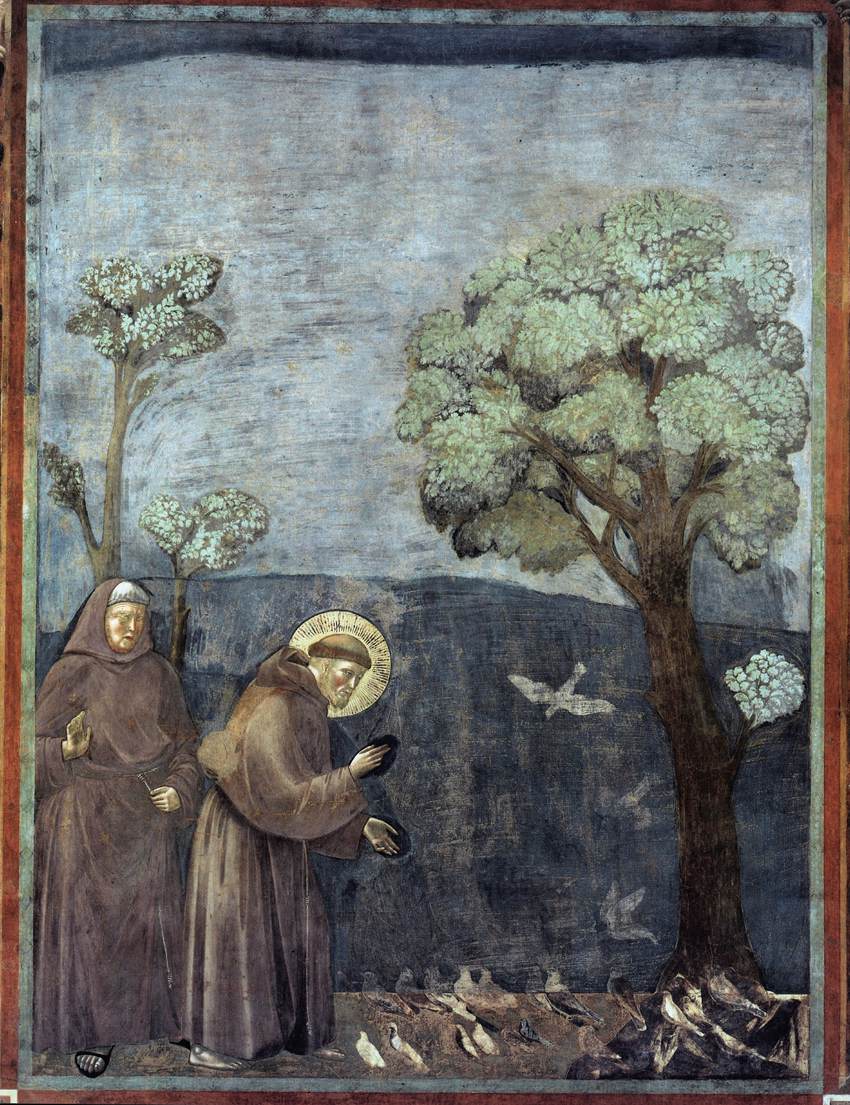
St. Francis Preaching to the Birds
“Sermon to the Birds,” from the Legends of Saint Francis cycle, attributed to Giotto, 1297–1300. Fresco, 270 × 200 cm. Upper Church, Basilica of St. Francis of Assisi, Assisi, Italy.

*

Nearby, another fresco shows Francis struck with stigmata; each wound an asterisk, a caveat. A flurry of wings above his head.
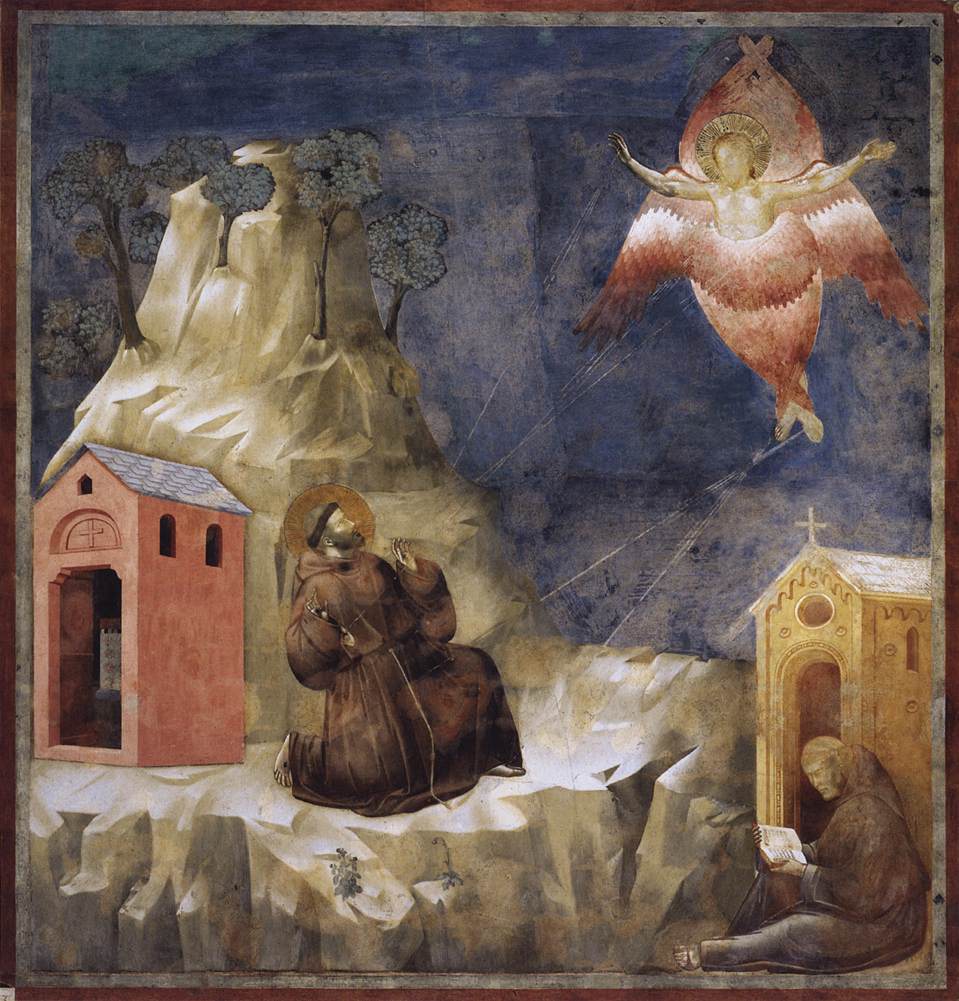
Stigmatization of St. Francis
“The Stigmatization of St. Francis,” from the Legends of Saint Francis cycle, attributed to Giotto, 1297–1300. Fresco, 270 × 230 cm. Upper Church, Basilica of St. Francis of Assisi, Assisi, Italy.

*

You lights of evening

*

At the altar in Assisi, my vespers are belled into the vault, where they flock and cloud.

*

Outside, rain. The birds tangle among the leaves, sustain their refractory antiphon. All with one accord in one place.

*

“perdonano per lo tue amore / infirmitate e tribulatione”

*

Pardon and love, weakness and wrack. Blame and whine, and worms and no escape. O praise Him.

*

A creaturely hymn for us creatures: Pietro called Francesco, faux Giotto, bereft William, Ralph, the variant birds, and myself. Each of us cloven by major and minor, each our own Pentecost.

Three poems about Vincent van Gogh

This spring I guest-wrote and narrated an episode of the Makers & Mystics podcast on the life, art, and spirituality of Vincent van Gogh.

Vincent van Gogh artist profile

The son of a Dutch Reformed pastor, Vincent was a lifelong seeker after God who sought through his work to convey the pervasion of the Divine in the everyday. Before he was an artist, he was a missionary to a destitute coal-mining village in Belgium. His ministry was so incarnational—he lived just like those he served—that the sending agency deemed him too undignified to be a minister of the gospel and cut off his support. Hurt by its hypocrisy, Vincent left the institutional church, but he never abandoned his faith. That faith did evolve, however. His so-called evangelical period gave way to a period of artistic discovery, which enabled him to revel even more deeply in the mystery of God and the ethics of Jesus—which he wrote about frequently in letters to his brother Theo.

Despite personal suffering and an acute awareness of the suffering of others, Vincent was very attuned to the beauty of this world and lived a life of wide embrace. He saw the image of God in people and in nature and honored that image through his paintings, of sunflowers, cypresses, olive groves, wheat fields, farmers and mothers and postmen, soldiers, doctors, café owners, and his own self. When he was institutionalized, he continued to paint, so long as his health allowed it, and some of his finest work comes from this period at Saint-Rémy, including The Starry Night. (“When all sounds cease, God’s voice is heard under the stars,” Vincent wrote.) While some interpret the agitated brushstrokes of his later paintings as evidence of internal turmoil and instability, might they not instead express his view of the universe as vibrant, wild, pulsating with life and energy? It is a myth, after all, that Vincent painted in fevered states.

As I was doing research for the podcast episode, I encountered many poets who have responded in verse to specific paintings of Vincent’s, or more generally to Vincent’s oeuvre, vocation, and legacy. I’ve selected three such poems from the latter category, each of which serves as a wonderful introduction to the man and his work—a distillation of his essence, even. I’m struck by how all three poets use religious language to describe Vincent’s paintings: hymns, psalms, prayers.

I’ve compiled the images referred to in the poems, plus a few other representative ones, in the tiled gallery below. To enlarge a photo and to view more info, click on its caption, visible by hovering your cursor over the bottom.

+++

“Dear Lover of Light” by Abigail Carroll

Dear Lover of Light,

There lived a priest
so in love with light
it drove him mad.
Paint was his thing.
When he could no longer
preach, he hopped a train
south, took up a brush,
turned zinc and lead
and chrome
into gaudy, wild-
petaled ambassadors
of the dawn. He slapped
stars as big as brooches
on the sky, danced
crows across bowing fields
of wheat, exalted a bowl
of onions, a bridge, a pipe,
a chair, a bed. Postmen
and prostitutes
were his friends—
so too were irises,
almond trees,
windmills,
clouds. Francis,
if you think of a painting
as a kind of song, he too
canticled the sun.

A Vincent enthusiast

This poem appears in A Gathering of Larks: Letters to Saint Francis from a Modern-Day Pilgrim (Eerdmans, 2017) and is reproduced here by permission of the publisher. All rights reserved.

“Dear Lover of Light” is from a collection of verse-style letters addressed to Saint Francis of Assisi, a thirteenth-century friar who was in love with Christ and with creation—he called animals, the natural elements, and celestial bodies “brothers” and “sisters,” as in his famous “Canticle of the Sun,” and is said to have preached to birds and tamed a wolf.

Abigail Carroll sees Francis as a kindred spirit to Vincent, who, she says, also “canticled the sun.” Vincent’s paintings are like songs of praise. Instead of words he used color—and yellow was his favorite (yellow ocher, cadmium yellow, zinc yellow, chrome yellow), representing for him life, energy, happiness, hope, and friendship.

“When he could no longer / preach” refers to Vincent’s being let go from his village preaching post by a religious board that deemed him too ineloquent and too radical. He moved to The Hague, where he befriended a pregnant sex worker named Sien and her daughter Maria, giving them shelter in his apartment and supporting them as best he could with his own meager funds. From there he went to Nuenen, where his compassion for the working poor manifested in the many earth-toned paintings of this period, including his first major work, The Potato Eaters, showing a family gathered around the dinner table, enjoying the fruit of their labors. After two years in Paris, Vincent needed a respite from the city noise, which led him to Arles in southern France, where he really started finding himself as an artist. He was enraptured by the way sunlight flooded the Provençal landscapes, making them radiant.

Carroll’s poetic descriptions of Vincent’s paintings—dancing crows, jewel-like stars, bowing wheat—capture his sense of all of creation being alive unto God, infused with the sacred. Vincent found great joy in observing what flowered around him, from the irises that grew outside the asylum where he committed himself to the almond tree he painted as a gift for his newborn nephew Vincent, whom his brother named after him. And Vincent saw sacred beauty not only in the natural world but also in everyday articles and objects, be they a pair of well-worn boots in the mudroom or the empty chair of his friend Paul Gauguin.

+++

“What Happened When He Looked” by Marilyn Chandler McEntyre

His miners are made of earth, his sowers so close
to the colors of the fields, only the broad hat, the sack,
the outflung arm keeps them from fading into wheat.

But sometimes, he found, the earth itself turns
to water. Mountains tumble like rapids, waves
curling, blue, roiling and leaping like
the Psalmist’s mountains clapping their hands.

And water turns to air. As life turns to breath.
The sky grows heavy with sun and draws
everything into its fierce embrace, urging
matter upward and homeward to where
the energies of earth begin.

And then there is fire. When they are alive enough
(or we), bushes burn. If you see it, you go
reeling home along a roadway you suddenly know
is temporary and might evaporate or begin
to pinwheel around a star, taking you with it
beyond deeper and deeper blue, into yellow that melts
to a core of thick, transparent white where love
burns day and night to fuel the fallen seed.

This poem appears in The Color of Light: Poems on Van Gogh’s Late Paintings (Eerdmans, 2007) and is reproduced here by permission of the publisher. All rights reserved.

This poem is structured around the four classical elements, understood as the material basis of the physical world: earth, water, air, and fire. Marilyn Chandler McEntyre notes how in Vincent’s paintings, these elements take on characteristics of one another: for example, in Olive Trees in a Mountainous Landscape, the hills surge and flow like water, and in The Sower of 1888, the air burns like fire.

In this latter painting, Vincent said he wished to use the yellow sun as a symbol of Christ’s presence, a sort of halo that covers everything it touches. (See also Letter 673: “I’d like to paint men or women with that je ne sais quoi of the eternal, of which the halo used to be the symbol, and which we try to achieve through the radiance itself, through the vibrancy of our colorations.”) The Sower shows the union between the temporal and eternal, two interpenetrating realms. “The sky . . . draws / everything into its deep embrace, urging / matter upward and homeward,” McEntyre writes.

Vincent saw, in the famous words of Elizabeth Barrett Browning, that “Earth’s crammed with heaven, / And every common bush afire with God.” A reference, of course, to the burning bush in Exodus 3:

Now Moses was keeping the flock of his father-in-law, Jethro, the priest of Midian, and he led his flock to the west side of the wilderness and came to Horeb, the mountain of God. And the angel of the LORD appeared to him in a flame of fire out of the midst of a bush. He looked, and behold, the bush was burning, yet it was not consumed. And Moses said, “I will turn aside to see this great sight, why the bush is not burned.” When the Lord saw that he turned aside to see, God called to him out of the bush, “Moses, Moses!” And he said, “Here I am.” Then he said, “Do not come near; take your sandals off your feet, for the place on which you are standing is holy ground.” (emphasis mine)

McEntyre titled this poem “What Happened When He Looked”—that is, what happened when Vincent, like Moses, looked with intent on the miraculous sights that go unnoticed by so many. What happened is, like Moses, he heard God speak. What happened is he experienced a mystical union with that “something on High—inconceivable, ‘awfully unnameable’— . . . which is higher than Nature.” Vincent’s art making was a reverent act of beholding and of bearing witness to that something.

The final line of McEntyre’s poem refers to Jesus’s parable of the fallen seed, which once it dies, springs forth life—a picture of the promise of resurrection. The sun, or white-hot love of God in Christ, is generative, the energy that raises us out of the dark and fuels our growth and flourishing. Vincent’s paintings radiate that love.

During his time as an assistant preacher under Rev. Thomas Slade-Jones in Isleworth, England, in summer 1876, Vincent wrote to Theo,

I am still far from being what I want to be, but with God’s help I shall succeed. I want to be bound to Christ with unbreakable bonds and to feel these bonds. To be sorrowful yet alway rejoicing. To live in and for Christ, to be one of the poor in His kingdom, steeped in the leaven, filled with His spirit, impelled by His Love, reposing in the Father [. . .]. To become one who finds repose in Him alone, who desires nothing but Him on earth, and who abides in the Love of God and Christ, in whom we are fervently bound to one another.

Though Vincent would later renounce orthodox Christianity, he retained his love for Christ and his sense of awe in the face of the Infinite active in the here and now.

+++

“Van Gogh” by Jeanne Murray Walker

     All right, I love him for the way
                      he painted Vermilion! Orange! jagged as
        shouts, and when no one bought them,
                      no one even heard him,
he shouted louder,
                      Sunflowers! Self-portrait!
     and years later, not one sold,
                      he cut off his own ear.

     Then he had to bring it back on canvas
                      hundreds of times,
        in the brass swelling
                      of the bell
that called him to dinner,
        in the complicated iris
                      at the end of the asylum path.
                            Think how stooping
at a fork in the road
                      he might have seen a stone-shaped ear,
       how the human heart,
                      once it knows what it needs,
will find it everywhere, how
       in the curve of his delicately padded cell
                      one starry night, he must have murmured
                            everything he had ever wanted to say
straight into the ear of God.

This poem appears in A Deed to the Light (University of Illinois Press, 2004) and is reproduced here by permission of the publisher. All rights reserved.

If McEntyre’s poem is about looking and provoking others to look, Jeanne Murray Walker’s is about wanting to be heard, and takes the ear as its central image. Vincent is, of course, notorious for the psychotic episode that culminated in him cutting off his left ear. (His self-portraits show the bandages on his right ear because he painted them while looking in a mirror.) Walker imagines him thereafter seeing ear-shapes everywhere in nature—delicate curves and hollows—manifestations of his longing to be listened to.

Vincent’s paintings are prayers, Walker suggests, that went straight into the ear of the One who hears, who holds all our joys and sadness in love. Others didn’t hear Vincent, but God did.

I will mention that it is a myth that Vincent never sold a painting during his lifetime. True, he sold few—his most significant sale was The Red Vineyard, purchased in January 1890 by Anna Boch while Vincent was convalescing at a psychiatric hospital—“but still,” writes Rainer Metzger in Van Gogh: The Complete Paintings, “the fact should not be overemphasized; after all, Vincent was so willing to give his paintings as presents that many would-be purchasers never needed to part with a penny” (566). And he sometimes made in-kind trades with his paintings.

It’s also false that Vincent died without ever having received recognition for his work. Actually, he was a rising star in the art world. The avant-garde circles in France and Belgium recognized his talent before his death. He was exhibited a few times and received a gushing review in January 1890. Several fellow artists spoke favorably of his work, and his brother Theo, an art dealer, was a tireless champion. It wasn’t easy getting established, and yes, there were many people along the way who didn’t see the value of what he was doing, but Vincent kept at it. He was still in his early career when he died on July 29, 1890, at age thirty-seven. After his death the audience for his work, and thus appreciation for it, grew exponentially, thanks in large part to his sister-in-law, Johanna van Gogh-Bonger, who edited, translated, and published all 652 letters from Vincent that she had in her possession, lent his paintings to various exhibitions, and promoted his work in other ways.

But on a personal level, Vincent was often overlooked, known as something of an eccentric, a crazy person, and was often teased and tormented. In fact, one theory about his death, originating in the 1950s and popularized by the Pulitzer Prize–winning biographers Steven Naifeh and Gregory White Smith in their 2011 book Van Gogh: The Life, is that he was shot by teenage bullies. (The Van Gogh Museum rejects this theory, declaring his death a definitive suicide.)

Vincent battled mental illness: during his lifetime he was diagnosed with a form of epilepsy that causes seizures, hallucinations, and manic depression. While he made friends in each city he lived in, his illness tended to cause rifts, sometimes permanent ones. On occasion he wrote to Theo how lonely he was.

So even when Vincent was starting to attain professional recognition for his art toward the end of his life, he still felt at times unwanted and misunderstood. “A great fire burns within me, but no one stops to warm themselves at it, and passers-by only see a wisp of smoke.” He wrote this line in June 1880, but it’s a sentiment that would resurface in his letters over the next ten years—the idea that people weren’t interested in the gifts he had to offer, whether relational or artistic.

Walker’s poem captures that mixture of confidence and doubt, self-assuredness and vulnerability, hardness and softness, and above all the dogged persistence that characterized Vincent. He “shouted” his soul onto canvas and into a world that in many quarters was plugging its ears. And he “murmured” it to the heavens, where it was received openly, caringly.

+++

To learn more about Vincent van Gogh, here are some recommended resources:

  • The aforementioned “Vincent van Gogh” podcast episode (Makers & Mystics Artist Profile Series no. 28) breaks down Vincent’s art and faith in under twenty minutes.
  • The world’s largest collection of van Gogh’s work is at the Van Gogh Museum in Amsterdam. The museum has an excellent website, which includes high-resolution photos of 200+ paintings and 500+ drawings, plus interactive “Stories” on such topics as “Nature and the Artist,” “Inspiration from Japan,” and “Brotherly Love: Vincent and Theo,” in which you click through bit by bit to view art, archival photos, and quotes connected together with short narration—very engaging! (Kudos to whoever designed the interface.) You can even take a seven-video virtual tour of the museum in 4K, seeing how all the galleries are laid out.
  • The freely accessible website Vincent van Gogh: The Letters contains scans, transcriptions, and translations of all van Gogh’s letters to his brother Theo, his artist friends Paul Gauguin and Émile Bernard, and many others. They are heavily footnoted and include sketches and other enclosures, and the website enables universal searches! I can’t afford the official six-volume, complete illustrated and annotated print edition from Thames & Hudson, but I do own a Penguin Classics edition, The Letters of Vincent van Gogh, a generous selection introduced and editorialized by Ronald de Leeuw and translated by Arnold Pomerans, which is mostly what I quote from in this article. An abridged book like this one might be a good place to start if you’re not able or willing to invest a ton of time poring over the full correspondence, some of which is dull or rambling.
  • Van Gogh’s paintings have been victim to some truly poor-quality reproductions circulating online. The full-color Van Gogh: The Complete Paintings (Taschen, 2012) was indispensable to me as I researched the artist, as it documents his full catalog of paintings (note: not drawings) with high-resolution photos that capture as accurately as possible the works’ colorative and textural richness. These are arranged by period and contextualized with essays.
  • The award-winning HENI Talks produced a seven-minute video titled “Van Gogh’s Olive Trees,” which is gorgeously shot and covers more than just the titular subject.
  • Movies? I really enjoyed the 1956 biopic Lust for Life starring Kirk Douglas—the characterization seems to me spot-on, and overall it does a great job with historical accuracy—and the oil-painted animated feature Loving Vincent from 2017 [previously]. I was not too keen on the recent At Eternity’s Gate starring Willem Dafoe.

Van Gogh books

There are many spiritual biographies of Vincent van Gogh, or books about the religious impulse behind his art:

At Eternity’s Gate, published by Eerdmans in 1998, was the first of its kind and is still probably my favorite; the author has advanced degrees in both religion and art history and does an excellent job arguing that Vincent’s spiritual life was essential to the unfolding of his artistic vision. Carol Berry’s Learning from Henri Nouwen and Vincent van Gogh, though, would probably be my top recommendation to those who just want to dip their toes in and engage Vincent’s story in a less academic, more personal, way, as Berry, an art educator with a background in Christian ministry, interweaves the lives of Vincent and Henri with personal memoir—an excellent gift book.

Creation’s Praise (Artful Devotion)

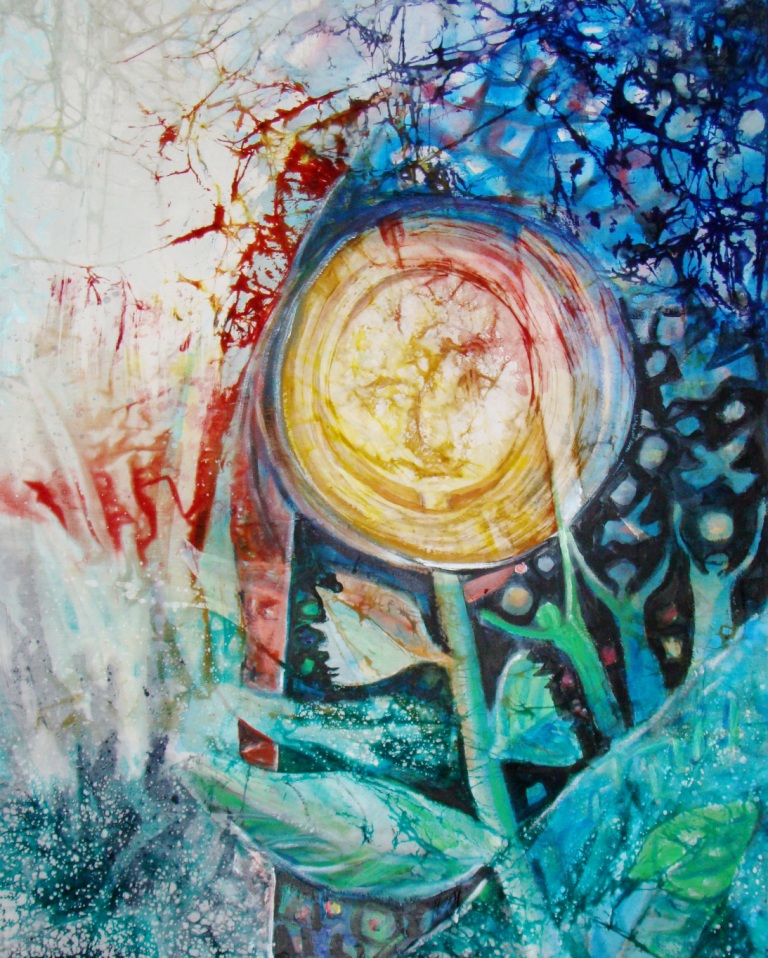
Nwachukwu, Tony_Untitled (Praise)
Untitled batik painting by Tony Nwachukwu (Nigerian, 1959–)

Praise the LORD!
Praise the LORD from the heavens;
praise him in the heights!
Praise him, all his angels;
praise him, all his hosts!

Praise him, sun and moon,
praise him, all you shining stars!
Praise him, you highest heavens,
and you waters above the heavens!

Let them praise the name of the LORD!
For he commanded and they were created.
And he established them forever and ever;
he gave a decree, and it shall not pass away.

Praise the LORD from the earth,
you great sea creatures and all deeps,
fire and hail, snow and mist,
stormy wind fulfilling his word!

Mountains and all hills,
fruit trees and all cedars!
Beasts and all livestock,
creeping things and flying birds!

Kings of the earth and all peoples,
princes and all rulers of the earth!
Young men and maidens together,
old men and children!

Let them praise the name of the LORD,
for his name alone is exalted;
his majesty is above earth and heaven.
He has raised up a horn for his people,
praise for all his saints,
for the people of Israel who are near to him.
Praise the LORD!

—Psalm 148

+++

SONG: “All Creatures of Our God and King” | Words by William Draper, early 20th century, based on “Canticle of the Sun” by Francis of Assisi, 1225 | Music by Friedrich Spee, 1623 (Tune: Lasst uns erfreuen) | Performed by All Sons & Daughters, 2016

The above performance, by folk duo All Sons & Daughters (Leslie Jordan and David Leonard), was filmed in the small town of Assisi, Italy, where St. Francis penned his beautiful canticle of all creation, addressing the elements of nature as siblings—Sister Sun, Brother Moon, and so on. Almost seven hundred years later, British pastor William H. Draper paraphrased the poem (which was originally written in the Umbrian dialect) to create “All Creatures of Our God and King,” now a classic of Christian hymnody.

The constant noise in the background is, I believe, cicadas.

To hear a traditional performance with full orchestra and choir, click here; for a recent choral arrangement by John Stoddart, see this performance by the Oakwood University Aeolians. The hymn has also been adapted into various other styles, such as bluegrass and jazz.

All creatures of our God and King,
lift up your voice and with us sing
alleluia, alleluia!
Thou burning sun with golden beam,
thou silver moon with softer gleam,
O praise him, O praise him,
alleluia, alleluia, alleluia!

Thou rushing wind that art so strong,
ye clouds that sail in heav’n along,
O praise him, alleluia!
Thou rising morn, in praise rejoice,
ye lights of evening, find a voice,
O praise him, O praise him,
alleluia, alleluia, alleluia!

Thou flowing water, pure and clear,
make music for thy Lord to hear,
alleluia, alleluia!
Thou fire so masterful and bright,
that givest man both warmth and light,
O praise him, O praise him,
alleluia, alleluia, alleluia!

And all ye men of tender heart,
forgiving others, take your part,
O sing ye, alleluia!
Ye who long pain and sorrow bear,
praise God and on him cast your care,
O praise him, O praise him,
alleluia, alleluia, alleluia!

Let all things their Creator bless,
and worship him in humbleness,
O praise him, alleluia!
Praise, praise the Father, praise the Son,
and praise the Spirit, three in one.
O praise him, O praise him,
alleluia, alleluia, alleluia!


This post belongs to the weekly series Artful Devotion. If you can’t view the music player in your email or RSS reader, try opening the post in your browser.

To view all the Revised Common Lectionary scripture readings for the Fifth Sunday of Easter, cycle C, click here.