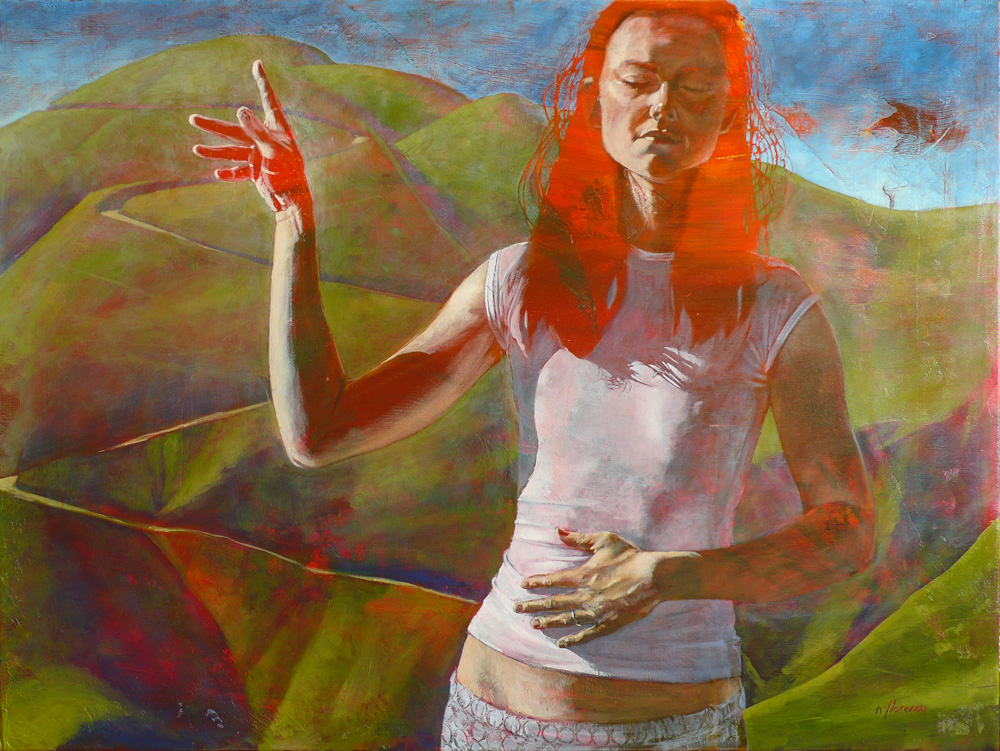
LOOK: Shine Forth Upon These Clouded Hills by Nathan Florence
Nathan Florence (American, 1972–), Shine Forth Upon These Clouded Hills. Oil on canvas, 30 × 40 in.
LISTEN: “Pave Every Road” by Caroline Cobb, on A Home and a Hunger: Songs of Kingdom Hope (2017)
Pave every road with repentance Bring the proud heart low Let the humble heart sing Break down all your walls, your defenses Swing wide your gates For the coming of the king
Lo, he has come to rebuild the ruins Lo, he has come, set them captives free I know he has come to bind up the broken It’s the year of his favor The year of Jubilee
People livin’ in the darkness Lift up your heads and see the sun I see a new day dawnin’ It brings good news for everyone
I see the sun risin’ I see the sun risin’ I see the sun risin’
One day we’ll all hear a trumpet He will return with reckoning I’ll follow my king into glory Who here is comin’ with me? Who here is comin’ with me? Who here is comin’ with me? Yeah!
I see the sun risin’ I see the sun risin’ I see the sun risin’
Get up, get ready Get up, get ready Get up, get ready For the king to come
>> “Peace on Earth” by U2: “Heaven on earth—we need it now. I’m sick of all this hanging around. Sick of the sorrow, sick of the pain . . .” U2’s “Peace on Earth” was inspired by the Omagh bombing in Northern Ireland on August 15, 1998. It first appeared on their 2000 album All That You Can’t Leave Behind, but I prefer the stripped-down acoustic version they recorded last year on Songs of Surrender.
The song wrestles with the tension between the angels’ proclamation of peace in Luke 2 and the course of history ever since, riddled, as before, with violence. “Hope and history won’t rhyme,” the lyrics lament—they’re just not matching up. “Peace on earth” feels naive; the words sometimes stick in our throats. The refrain addresses Christ: “Jesus, can you take the time / To throw a drowning man a line?” In its emotional honesty and its asks, it resembles a biblical psalm. (Bono has in fact spoken about how the Psalms have influenced his songwriting.)
When U2 performed “Peace on Earth” live at Sphere Las Vegas this February, Bono substituted the names of five Irish casualties of the Troubles listed in one of the verses with the names of four Palestinian and Israeli children who have been killed in the current Israel-Hamas War: Gal, Ayat, Hind, and Mila.
>> “There Will Be a Day (Isaiah 2)” by Caroline Cobb, arr. Joel Littlepage: I cued up my favorite song from last year’s Dawning Light service at Grace Mosaic church in Washington, DC (it’s at 32:50–37:29 of the video): “There Will Be a Day” by Caroline Cobb, based on Isaiah 2. The song is from Cobb’s album A Seed, a Sunrise: Advent to Christmas Songs (2020)—it’s my favorite of all her songs, and because of its emotional and summative power, I’ve set it as the concluding track of my Advent Playlist. Joel Littlepage, Grace Mosaic’s pastor of worship and formation and the director of the Daily Prayer Project, arranged it with gospel inflections for his church’s annual Advent carols service. He’s at the keyboard; his wife, Melissa Littlepage, is the vocal soloist (she’s also the choir director); and the saxophonist is Skip Pruitt.
ARTWORK: Home (land) Birth (place) by Beth Krensky:Beth Krensky is an artist, activist, and educator of Jewish heritage who describes herself as “a gatherer of things—objects, words, spirit—and a connector of fragments to make us whole.” Her website documents many compelling artistic projects she has undertaken over the past decade. One of them, Home (land) Birth (place), is a performance from 2016 with her academic colleague Amal Kawar, a professor of political science and the author of Daughters of Palestine: Leading Women of the Palestinian National Movement.
Beth Krensky (American, 1965–), Home (land) Birth (place), a performance with Amal Kawar, 2016, Great Salt Lake, Utah. Photo: Josh Blumental.
For this piece, Krensky sewed together a truce flag from baby clothes and other white linens and attached it to two olivewood poles onto which she burned quotes from Israeli and Palestinian mothers who have lost a child to Israeli-Palestinian violence. She and Kawar held the flag aloft in the desert outside their hometown of Salt Lake City as a call for peace. Read the artist’s statement at the link above, and view additional photos of the flag here.
+++
DEVOTIONAL POST: “Swords Will Be Turned into Plowshares,” Center for Christianity, Culture, and the Arts at Biola University: Every year Biola University’s CCCA publishes free daily Advent and Christmas devotions online that feature an artwork, a song, a poem, and a written reflection—the work of many contributors. You can access their 2024 Advent Project here.
Last year I was particularly taken with the peace-themed compilation offered on January 2, which includes a poem by Denise Levertov, a socially conscious, participatory art project led by Pedro Reyes (more on that in next roundup item), a Sweet Honey in the Rock rendition of an African American spiritual, and a wonderful reflection by Dr. Natasha Aleksiuk Duquette, a literature professor. Check it out.
+++
ARTICLE: “Mexican Artist Pedro Reyes Molds 1,527 Guns into Shovels Used to Plant Trees,”Colossal: Pedro Reyes is a Mexican artist, architect, and cultural agent who seeks to turn social problems into opportunities for tangible change through works that integrate elements of theater, psychology, and activism. (I learned about him through Biola’s Advent Project, above.) In 2008, in cooperation with city authorities, he led a campaign in Culiacán, Mexico, to collect firearms, giving donors vouchers for electronic appliances in exchange. The hundreds of guns he received were publicly crushed by a steamroller, melted, and remolded into shovels, which were then distributed to public schools and other institutions who committed to planting trees with them. This project was an effort to curb local gun violence and to cultivate the collective imagination toward life.
Pedro Reyes (Mexican, 1972–), Palas por Pistolas (Guns for Shovels), 2008Artist Pedro Reyes steamrolled 1,527 surrendered guns for his Palas por Pistolas project, transforming them into shovels for planting trees.
I’m interested in exploring more of Reyes’s work, as I love what he’s doing. In 2016, as a visiting lecturer in MIT’s Art, Culture, and Technology Program, he cotaught the course “The Reverse Engineering of Warfare: Challenging Techno-optimism and Reimagining the Defense Sector (an Opera for the End of Times).” A full-color illustrated survey of his projects, Pedro Reyes: Ad Usum / To Be Used, was published by Harvard University Press in 2017.
+++
INSTAGRAM SERIES: “Alternative Advent 2024” by Kezia M’Clelland: Through December 24, follow the Instagram account @alternative_advent for a progressively revealed photo essay of Advent promises told through journalistic images from 2024, sourced from various news organizations. I call attention to this project every year. The woman behind it, Kezia M’Clelland, has a master’s degree in violence, conflict, and development from SOAS University of London and helps equip churches and communities to support children and families in crisis situations.
“They will hunger no more and thirst no more; the sun will not strike them, nor any scorching heat, for the Lamb at the center of the throne will be their shepherd, and he will guide them to springs of the water of life, and God will wipe away every tear from their eyes.”
—Revelation 7:16–17
Then the angel showed me the river of the water of life, bright as crystal, flowing from the throne of God and of the Lamb through the middle of the street of the city. On either side of the river is the tree of life with its twelve kinds of fruit, producing its fruit each month, and the leaves of the tree are for the healing of the nations. Nothing accursed will be found there any more. But the throne of God and of the Lamb will be in it, and his servants will worship him; they will see his face, and his name will be on their foreheads. And there will be no more night; they need no light of lamp or sun, for the Lord God will be their light, and they will reign forever and ever.
And he said to me, “These words are trustworthy and true, for the Lord, the God of the spirits of the prophets, has sent his angel to show his servants what must soon take place.”
“See, I am coming soon! Blessed is the one who keeps the words of the prophecy of this book.”
—Revelation 22:1–7
LOOK: The Supper of the Lamb by Wayne Forte
Wayne Forte (Filipino American, 1950–), The Supper of the Lamb, 2004. Oil on canvas, 60 × 48 in.
In this eschatological painting by Wayne Forte, the slain and risen Lamb reopens Eden, welcoming us all to the feast. He holds a palm branch, symbol of the martyr’s victory, and stands atop a table set with bread, wine, and the fruits of the tree of life. A river issues forth, further underscoring that this is a place of refreshment.
In the foreground, the iron grillwork of the gate depicts key events from salvation history: the Fall and Expulsion, Noah’s Ark, the Sacrifice of Isaac, the Exodus, the Nativity, the Crucifixion, and the Resurrection. Originating in the early Christian era, the IHS monogram at the top denotes the first three letters of the Greek name of Jesus, ΙΗΣΟΥΣ: iota, eta, sigma. Later it came to be mistakenly (but appropriately!) interpreted as an acronym for the Latin Jesus Hominum Salvator, “Jesus, Savior of Humanity.”
LISTEN: “Behold, Behold” by Caroline Cobb, performed with Sean Carter on AHome and a Hunger: Songs of Kingdom Hope (2017)
I see a city coming down Like a bride in whitest gown Purely dressed I see the pilgrims coming home All creation finds shalom The promised rest The Lamb of God will be her light The sun will have no need to shine
Refrain: Behold, behold God makes his home with us He’ll take his throne, forever glorious Behold, behold God makes his home with us He’ll take his throne, forever glorious The curse will be undone O come, Lord Jesus, come
The Lord will banish every sin All that’s broken he will mend And make new And we will see him face to face As he wipes our tears away And death is through And all the ransomed and redeemed From every tongue and tribe will sing
[Refrain]
At last the darkness will surrender to the light But we, unveiled in glory, will forever shine At last the powers of hell will drown in lakes of fire But we will freely drink the crystal streams of life
Come, thirsty, taste and see Come, hungry, to the feast Come, weary, find your peace The Bride and Spirit sing Come! Come!
[Refrain]
Based on Revelation 21–22, “Behold, Behold” is the last song on Caroline Cobb’s album A Home and a Hunger, which traces kingdom hope from Genesis to Revelation, each song focusing on a different biblical book.
This post is part of a daily Advent series from December 2 to 24, 2023 (with Christmas to follow through January 6, 2024). View all the posts here, and the accompanying Spotify playlist here.
Celebrated fifty days after Easter, Pentecost is one of the great feasts of the Christian year. It commemorates the descent of the Holy Spirit on Jesus’s apostles when they were gathered in Jerusalem for the Feast of Weeks ten days after Jesus ascended to heaven, marking the birth of the church. Acts 2 describes the Spirit’s coming as accompanied by a “rushing mighty wind” and “tongues of fire”—quite the dramatic entry! The Spirit filled the apostles with the miraculous ability to preach in speech that was comprehensible to all the many Jewish pilgrims, from various language groups, who were gathered in the city, resulting in the conversion that day of three thousand to the Jesus Way.
I’ve compiled a Spotify playlist of one hundred-plus Pentecost songs that celebrate God’s Spirit poured out over the face of the earth, bringing life and power. The indie folk genre is heavily represented, but there’s also an Appalachian fiddle tune, a Renaissance motet, a Native American dance song, a Russian Orthodox kontakion, Sacred Harp hymns, modern classical, Pentecostal gospel, blues, jazz, pop, lo-fi, and more. I hope to capture something of the Spirit’s dynamism with these selections.
The Holy Spirit ministers in a handful of ways. He renews, purifies, transforms. He gifts and empowers. He guides and illumines and comforts. He dwells within, a constant friendly presence. He intercedes for us with wordless groans. He unites believers across lines of difference, making us one. He enables us to bear fruit—love, joy, peace, etc.—for God’s glory and the world’s good.
So many songs centered on the Holy Spirit have an individualistic focus and a gentle, subdued tone. The Spirit does of course minister to the individual, and can be gentle and soothing (Jesus refers to him as the Comforter, after all!), and we often invoke him in our weariness. But the Spirit is also wild and uncontainable. And the life he brings is not merely of an inward spiritual kind; his impact manifests itself in tangible deeds out in the community, as those whom he fills go forth to serve their neighbors after the example of Christ.
Urban Doxology’s “Spirit, Send Your Fire” is a good example of a Holy Spirit song with an outward, communal focus, and it’s full of anticipatory excitement:
In terms of energy, consider the vigor with which Bach ornaments the final line of the Gloria, “Cum Sancto Spiritu in gloria Dei Patris” ([You, Jesus Christ, alone are the Most High] with the Holy Ghost in the glory of God the Father), in his B minor Mass. And for wildness: the loud clashing of the piano chords in Daniel Glover’s “The Descent of the Holy Spirit”from Misteria, evoking a sense of the disorientation that must have been felt on that historic day when the Spirit came suddenly sweeping in and the apostles started speaking multiple languages at once. (Some observers thought they were drunk!)
“Let the Waters” is another high-octane Pentecost song—this one in a rock style—which Michael Gungor wrote in 2014 when he was part of the Liturgists. In 2020 he revisited it with the Good Shepherd Collective, adding as a tag the African American spiritual “Wade in the Water” [previously]. In this context the spiritual references both the Spirit’s tendency to disrupt and the ancient Jewish folk belief that an angel would periodically come down to stir the waters of a certain pool in Bethesda, activating its healing properties (see John 5:4). The GSC released this new arrangement later in 2020 under the title “Pentecost,” featuring on vocals Gungor, Liz Vice, and Charles Jones.
Let the waters cool ya Let the Spirit move ya Feel the fire on your lips and sing your hallelujah Sing your hallelujah
O my soul, sing hallelujah
Wade in the water Wade in the water, children Wade in the water God’s gonna trouble the water
Led by Betty Pamptopee of Isabella Reservation, Michigan, “Methodist Hymn” is the first verse of “O for a Thousand Tongues to Sing” in Ojibwe (but to the tune of “Alas, and Did My Savior Bleed”). Even though “tongues” in the song’s titular first line is probably referring not to languages but to the individual’s desire to maximize God’s praise—as in “Oh, that I had more tongues to praise you with!”—I love the implications for Pentecost, when the gospel went out in many tongues, the beginning of the “proclaim[ing] and spread[ing] through all the earth abroad / the honors of [Jesus’s] name.” I think there’s massive potential for a multilingual choral arrangement of this hymn. (I’m thinking, for example, of Laurel MacDonald’s “Qui habitat,” featured here.)
Several of the songs on the playlist highlight the Spirit’s creativity, such as verse 1 of “Come, Holy Spirit” (alt title: “Holy Spirit, Groaning”) by David Benjamin Blower. Genesis 1 says that in the beginning, the Spirit hovered over the waters of chaos—implying that he was active in creation. And he is still a creative force, bringing forth new life.
Hildegard of Bingen [previously], a twelfth-century nun and polymath from Germany, wrote several beautiful Latin antiphons to the Holy Spirit, both words and music, which together convey a sense of mystery and awe. One of them is “Spiritus sanctus vivificans,” from her Symphony of the Harmony of Celestial Revelations, sung here by soprano Anna Sandström:
Here are two English translations; I can’t decide which I like best, so I proffer them both:
Holy Spirit,
giving life to all life,
moving all creatures,
root of all things,
washing them clean,
wiping out their mistakes,
healing their wounds,
you are our true life,
luminous, wonderful,
awakening the heart
from its ancient sleep.

Trans. Stephen Mitchell
The Spirit of God
is a life that bestows life,
root of the world-tree
and wind in its boughs.

Scrubbing out sins,
she rubs oil into wounds.

She is glistening life
alluring all praise,
all-awakening,
all-resurrecting.

Trans. Barbara Newman
Most songs take the form of calling on the Spirit to descend once more with the breath or fire of revival, such as many of the old hymns: by Ambrose (retuned by Bradford Loomis and Beth Whitney), Rabanus Maurus, Bianco da Siena (retuned by Seth Thomas Crissman, and another version by Luke Brodine), Martin Luther (retuned by Paula Best and Tara Ward), Heinrich Held (retuned by Joshua Bennetch), Isaac Watts (retuned by Jon Green), Joseph Hart (retuned by Stephen Gordon), Charles Wesley (retuned by Jered McKenna), Benjamin Beddome, and Samuel Longfellow (retuned by Seth Thomas Crissman, and another version by Greg Yoder, both of The Soil and The Seed Project).
For example, we might ask the Spirit to increase our love for God and others. In Watts’s “Come, Holy Spirit, heav’nly dove,” we beseech him to come “with all Thy quick’ning pow’rs; come, shed abroad a Savior’s love, and that shall kindle ours.” Or elsewhere, similarly, to “light up our mortal frame” with love, “till others catch the living flame” (Ambrose). The Spirit also kindles belief and trust. “Revive our drooping faith,” prays Hart.
Further, the Spirit knits together diverse peoples into a brand-new family whose head is Christ. Fr. Peter Raymond Scholtes, a Catholic priest living on the south side of Chicago, penned the post–Vatican II hymn “One in the Spirit” (aka “They’ll Know We Are Christians by Our Love”) against the backdrop of the civil rights movement. It proclaims that Christians are united by their share in, as the apostle Paul puts it, “one body and one Spirit . . . one hope . . . one Lord, one faith, one baptism, one God and Father of all . . .” (Eph. 4:2–5), and prays “that all unity [across all humankind] will one day be restored.” It also emphasizes the importance of the church’s public witness through acts of love. As Jesus says in John 13:35, “By this everyone will know that you are my disciples, if you have love for one another.” Love is the primary fruit of the Spirit that Paul lists in Galatians 5:22–23. Here’s a jazz arrangement of the hymn performed by Ruth Naomi Floyd:
Unity is also the theme of one of four featured hymns from the Orthodox liturgy for Pentecost, the text of which translates to: “When the Most High descended and confused tongues [at the Tower of Babel], he scattered the people; but when he distributed the tongues of fire, he called all to unity. Therefore, with one voice, let us praise the most Holy Spirit.” Pentecost is often referred to as a reverse Babel.
There are several musical settings of scripture on the playlist, including:
“O Children of Zion” by Seth Thomas Crissman (The Soil and The Seed Project), a setting of Joel 2:23a, 28: “O children of Zion, be glad and rejoice in the LORD your God. . . . I will pour out my spirit on all flesh; your sons and your daughters shall prophesy, your old men shall dream dreams, and your young men shall see visions.”
“If Ye Love Me” by Thomas Tallis, a setting of John 14:15–17: Jesus says, “If you love me, you will keep my commandments. And I will ask the Father, and he will give you another Advocate [/Helper/Comforter; Gr. parakletos, Paraclete], to be with you forever. This is the Spirit of truth, whom the world cannot receive because it neither sees him nor knows him. You know him because he abides with you, and he will be in you.”
“The Spirit of Life” by Cody Curtis (Psallos), a setting of Romans 8:1–17, about living not according to the flesh but according to the Spirit, who is “life and peace” and who abides in us, enabling us to resist sin and bearing witness that we are children of God and therefore join heirs with Christ
“God Is Love” by Ri-An, a setting of 1 John 4:7–21, about how we abide in God, and God in us, through the Spirit, who is love
There are also a few songs that reference the story of Ezekiel in the valley of dry bones [previously], in which God brings his prophet to a desolate landscape littered with human bones. But then: “Thus says the Lord GOD to these bones: I will cause breath to enter you, and you shall live. . . . Come from the four winds, O breath, and breathe upon these slain, that they may live” (Ezek. 37:5, 9). And the bones reassembled, took on flesh, and became animated once again—a picture of the regenerative power of God’s Spirit. (The Hebrew word for “spirit” is ruach, which can also be translated “breath”; same with the Greek pneuma.) Here’s Caroline Cobb’s “Dry Bones”:
I hope the Art & Theology Pentecost Playlist helps you to more fully exult in the myriad workings of the Spirit, who came in a blaze some two thousand years ago and burns still, all over the globe, where Christ’s kingdom has taken root.



 Art & Theology