
Roundup: Slaviiq in Alaska, Shrine of the Three Kings in Cologne, and more

ARTICLE: “Witnessing the Divine: The Magi in Art and Literature” by Robin Jensen, Bible Review: In this 2001 article, art historian Robin Jensen traces the development of the tradition of the magi through early Christian art (catacomb frescoes, sarcophagi and funerary plaques, church mosaics) and literature.
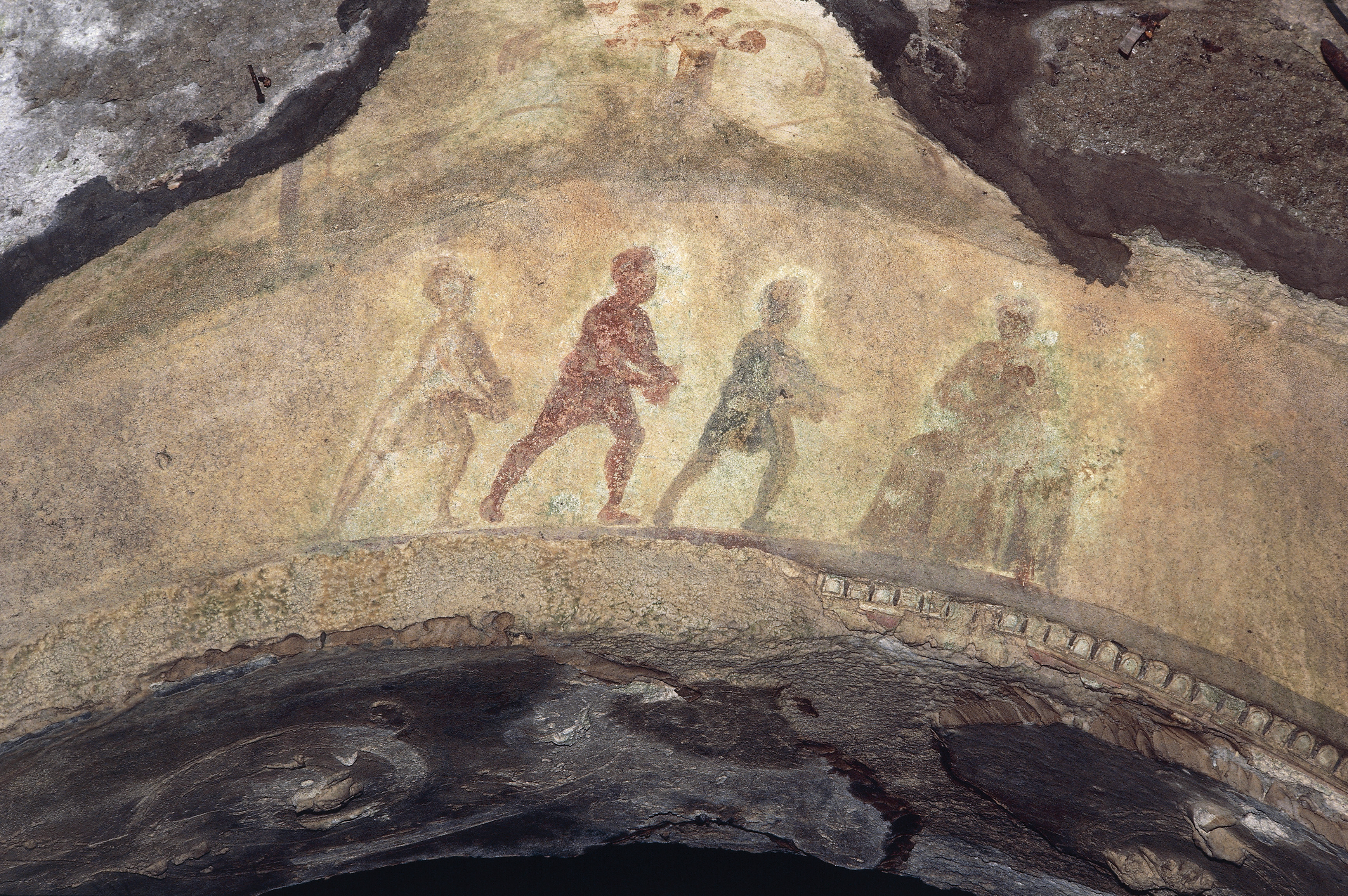
Adoration of the Magi (catacombs)
The Adoration of the Magi, 3rd century. Fresco, Capella Graeca, Catacomb of Priscilla, Rome. Photo: Vincenzo Pirozzi.

+++

SONGS:

>> Slaviiq (“Starring”) carols in St. Paul, Alaska: In the mid-eighteenth century, Russian Orthodoxy was the first Christian denomination to take root in Alaska; Siberian trappers arrived as part of the “fur rush,” and many ended up marrying local Native women, bringing their religion into their new and growing families. Now Orthodoxy is widely practiced in Unangan (Aleut), Alutiiq (Kodiak), Yup’ik, and Tlingit communities.

Adapted from a custom originating in the Carpathian Mountains, Slaviiq (also spelled Slaviq, Slaaviq Selaviq, or Slavii), meaning “Starring,” is a multiday Native Alaskan Orthodox Christmas celebration beginning on the Feast of the Nativity of Christ on January 7. It involves processions into homes with a large decorated pinwheel star, caroling in English, Slavonic, and Native languages, traditional foods, prayers, and blessings.

The following video is a five-minute clip from a Slaviiq celebration in 2022 on Saint Paul Island, one of the homes of the Unangan people. Community members Aquilina Lestenkof and George Pletnikoff Jr. sing a few songs while a youth spins the Christmas star.

To learn more about the Slaviiq tradition, see:

>> “Bright Star,” arranged for string quartet by Ellie Consta and performed by Her Ensemble: Published in 1968, the Christmas song “Bright Star” was a collaboration between poet Janice Lovoos and composer Margaret Bonds [previously]. Her Ensemble, a UK-based women’s orchestra founded by violinist Ellie Consta to perform and promote music by female composers, encountered the song in 2021 through Lara Downes’s solo piano arrangement and decided to arrange it for strings. “We wanted to keep it as close to the original as possible because it’s just so beautiful as it is,” they write, “but we did add a couple of very subtle harmonics in the background to add a little extra Christmas charm!”

It’s an instrumental performance, but here are Lovoos’s lyrics:

Bright star, glist’ning star, shining on that holy night,
guiding shepherds in their flight to Bethlehem;

Bright star, guiding star, leading to a blessed abode,
three wise men on camels rode to Bethlehem;

Bright star, glimm’ring star, floating in your cobalt sea,
won’t you light the way for me as you did them in Bethlehem;

Sweet star, holy star, won’t you shine as bright today,
bright as when the Christ child lay
in his manger in the hay in Bethlehem, in Bethlehem.

>> “Songs of Thankfulness and Praise,” performed by Josh Bales: The Episcopal priest and singer-songwriter Josh Bales introduces an Epiphany hymn from 1862 by Christopher Wordsworth, nephew of the Romantic poet William Wordsworth. Observed annually on January 6, Epiphany (meaning “manifestation”) celebrates three events in which Jesus’s identity was made manifest: the visit of the magi, Jesus’s baptism in the Jordan, and Jesus’s first miracle at the wedding at Cana. The Western Church focuses on the magi, the Eastern Church on the baptism. Read the lyrics at Hymnary.org. The tune, SALZBURG, was composed by Jakob Hintze in 1678.

+++

VIDEO: Nicholas of Verdun, Shrine of the Three Kings, Cologne Cathedral,” Smarthistory: I visited Cologne for the first time in fall 2025. I loved it. My only disappointment was that access to its cathedral’s most beautiful art object, the Shrine of the Three Kings, was obstructed, with the entire sanctuary and choir areas roped off, even though there was no Mass in session. I, a Protestant, was indifferent to the relics inside—the purported skulls of the magi—that have made Cologne an important pilgrimage destination since the Middle Ages. I merely wanted to see this extraordinary twelfth-century metalwork I had read about in art history books, the high point of Mosan art, from the renowned workshop of Nicholas of Verdun. If time had allowed, I could have paid for a tour that would have brought me a little closer but still at a distance. Instead, I had to resort to awkward viewing angles through metal bars.

However, a month after I returned home, Smarthistory uploaded a video that gives a closer look at the shrine, with lovely detail photographs by director Steven Zucker.  
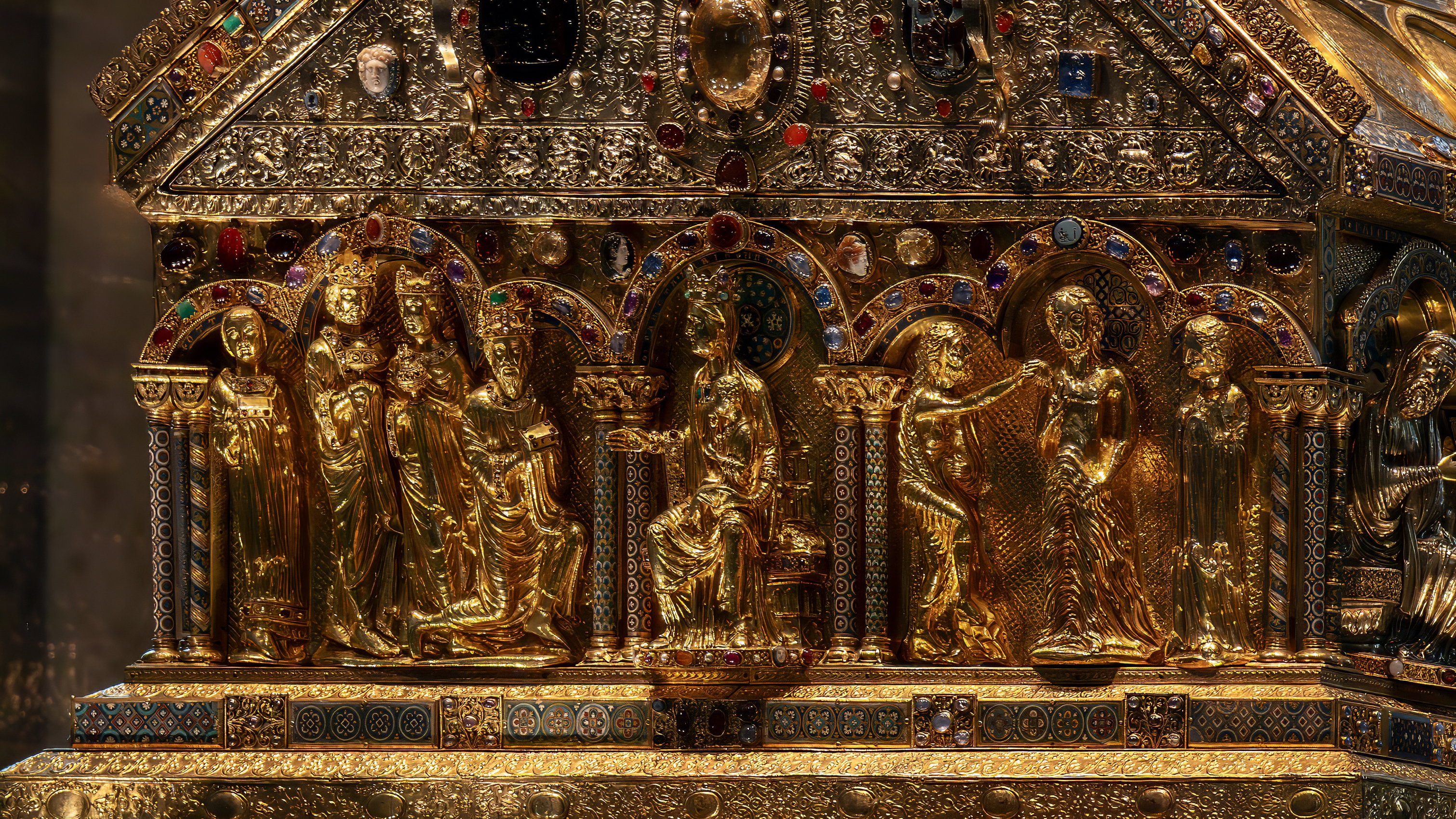
Adoration of the Magi and Baptism (Cologne)
Nicholas of Verdun and workshop, Shrine of the Three Kings (front view), ca. 1181–1220. Oak, gold, silver gilt, copper, enamel, jewels, 155 × 112 × 224 cm. Cologne Cathedral, Germany. Photo: Steven Zucker.

The short end that faces out toward worshippers portrays, in pure gold, the Adoration of the Kings, with the three traditional sovereigns accompanied by a fourth, the Holy Roman emperor Otto IV. (He had paid for the shrine’s production—following the magi’s example, he donated a materially precious gift in homage to Christ.) To the right of this scene is the Baptism of Christ.

The figures on the sides represent prophets, apostles, and evangelists.

Advent, Day 13: A star shall rise out of Jacob

LOOK: Virgin and Child with a Prophet catacomb fresco

Mary breastfeeding (Catacomb of Priscilla)
Virgin and Child with a Prophet, 3rd century. Fresco in the Catacomb of Priscilla on the Via Saleria, Rome. Photo: Scala / Art Resource. [view wider shot]

Deep in the Catacomb of Priscilla in Rome, one of the early Christian underground burial places (named after the donor of the land), is an arched ceiling fresco of a woman breastfeeding her child under an apple tree. Beside her a man points up to a star that’s resting over their heads among the fruit.

Dating to the third century, this image is the earliest known depiction of the Virgin Mary, and one of the oldest of Christ. The identity of the third figure is less sure, but it’s most likely the Gentile prophet Balaam, who, in the power of God’s Spirit, prophesied to King Balak of Moab that “a star shall come out of Jacob, and a scepter shall rise out of Israel” (Num. 24:17).

Although this prophecy had a more immediate fulfillment in King David, it has also been interpreted in a messianic sense since as early as Justin Martyr (ca. 100–165), who wrote, “And that he [Christ] should arise like a star from the seed of Abraham, Moses showed beforehand when he said, ‘A star shall arise from Jacob, and a leader from Israel’” (Dialogue with Trypho, chap. 106).

Irenaeus (ca. 130–200) wrote that the star the magi followed to seek out the newborn Christ was the one prophesied by Balaam (Against Heresies, bk. 3, chap. 9.2), and Origen (ca. 185–254) maintained that Numbers 24:17 was the Hebrew Bible verse the magi found that instigated their journey (Against Celsus, bk. 1, chap. 60).

Priscilla Catacomb arch
Arched ceiling detail from Gallery 3 of the Catacomb of Priscilla, Rome. The central image, in stucco, portrays a shepherd and two sheep, while at the far right, oriented in a different direction, is a fresco of the Virgin and Child. The artworks are damaged by age.

Other suggestions put forward as to the identity of the pointing figure in this catacomb fresco have been a magus; the Hebrew prophet Isaiah, who declared that “a virgin shall conceive” (Isa. 7:14) and enjoined his people to “arise, shine; for thy light is come, and the glory of the Lord is risen upon thee” (Isa. 60:1); and, from Hans-Ruedi Weber, John the Baptist, who “came as a witness to testify to the light, so that all might believe. . . . The true light, which enlightens everyone, was coming into the world” (John 1:6–9).

To explore more of the Catacomb of Priscilla, see the following Smarthistory video by Beth Harris and Steven Zucker. Today’s featured image is introduced at 3:35:

LISTEN: “There Shall a Star from Jacob Come Forth” (original title: “Es wird ein Stern aus Jacob aufgeh’n”), from Christus, Op. 97 | Original German text compiled by Christian Charles Josias von Bunsen, 1846, from Numbers 24:17 and the hymn “Wie schön leuchtet der Morgenstern” by Philipp Nicolai, 1599; English translation of lines 4–10 by Catherine Winkworth, 1863 | Music by Felix Mendelssohn, 1846–47, based on Nicolai’s hymn tune | Performed by the St. Olaf Choir, the St. Olaf Cantorei, the St. Olaf Chapel Choir, the Manitou Singers, Viking Chorus, and the St. Olaf Orchestra, dir. Robert Scholz, on Love Divine, Illumine Our Darkness: Christmas at St. Olaf, 2002

There shall a star from Jacob rise up,
And a sceptre from Israel come forth,
To dash in pieces princes and nations.

How brightly beams the morning star!
With sudden radiance from afar,
With light and comfort glowing!
Thy word, Jesus, inly feeds us,
Rightly leads us,
Life bestowing.
Praise, oh praise such love o’erflowing.

The musical work “Es wird ein Stern aus Jacob aufgeh’n” (There Shall a Star from Jacob Come Forth) is from an unfinished oratorio by Felix Mendelssohn (1809–1847), which the composer’s brother Paul gave the name Christus and published posthumously as Opus 97. The first performance took place in 1852.

The first three lines are taken from Numbers 24:17, while the latter portion is from the Lutheran hymn “Wie schön leuchtet der Morgenstern” (How Brightly Beams the Morning Star) by Philipp Nicolai, written in 1597 and first published in 1599 with the title “Ein geistlich Brautlied der gläubigen Seelen von Jesu Christo ihrem himmlischen Bräutigam, gestellet über den 45. Psalm des Propheten David” (A spiritual wedding song of the faithful soul about Jesus Christ, her heavenly groom, made over the 45th psalm of the Prophet David). The tune it was published with was adapted by Nicolai, it appears, from an older tune found in the Strasbourg Psalter of 1538—which is further adapted here by Mendelssohn.

In Mendelssohn’s piece, the first two lines about an emerging luminary from the lineage of Jacob are lovely and lofty, repeated in different and overlapping voices over the course of a minute-plus. But then the third line cuts in with emphatic force: “To dash in pieces princes and nations.” Its violence is jarring, very far from the peaceful sentiments we’re used to associating with this time of year! Even as it adds drama and interest to the composition, its militant language is unsettling.

But it does honor the larger context of Balaam’s prophecy:

So he [Balaam] uttered his oracle, saying,

“The oracle of Balaam son of Beor,
    the oracle of the man whose eye is clear,
the oracle of one who hears the words of God
    and knows the knowledge of the Most High,
who sees the vision of the Almighty,
    who falls down but with eyes uncovered:
I see him but not now;
    I behold him but not near—
a star shall come out of Jacob,
    and a scepter shall rise out of Israel;
it shall crush the foreheads of Moab
    and the heads of all the Shethites [a Moabite tribe].
Edom will become a possession,
    Seir [an alternative name for Edom] a possession of its enemies,
    while Israel does valiantly.
One out of Jacob shall rule
    and destroy the survivors of Ir [‘City’].”

(Num. 24:15–19)

The mercenary prophet Balaam had been hired by Balak, king of Moab, to curse Israel. See, the Israelites had escaped slavery in Egypt some forty years prior and were looking for land to settle. Having been refused passage through, they had just conquered Amorite country, which used to belong to Moab, and Balak feared Moab would be next.

Despite being a non-Israelite, Balaam heard words from Yahweh, Israel’s God. Balak recognized Balaam as an authority, as did others, and thought he might be persuaded for a fee to issue a prophecy in Moab’s favor. But Balaam told him he would speak only the words of Yahweh.

The passage above is the fourth and final oracle Balaam pronounced on this mission to Moab. In it he says that Moab and Edom would be conquered—a prophecy that came to pass with King David (2 Sam. 8:2–12; cf. Ps. 60:8).

Christians, as we have seen, often extract verses from longer Old Testament passages, prophetic or otherwise, and read into them messianic significance—pointers to Jesus Christ. Even the New Testament authors, and Jesus himself, did this. Did the Old Testament authors intend such meanings? Probably not in most places, not to the extent that premodern Christian interpreters suggested. (That’s not to say Jesus didn’t fulfill biblical prophecies. Quite the contrary!)

But many Christian biblical scholars acknowledge what’s been called the sensus plenior, or “fuller sense,” of scripture—a term popularized by Raymond E. Brown in his book The Sensus Plenior of Sacred Scripture (1955). Sensus plenior, Brown writes, is “that additional, deeper meaning, intended by God but not clearly intended by the human author, which is seen to exist in the words of a biblical text (or group of texts, or even a whole book) when they are studied in the light of further revelation or development in the understanding of revelation.”

Some people consider this kind of reading to be distortive. But others, including myself, consider it creative. Rabbinical literature often does the same thing: finds meaning in and beyond a scripture passage’s strict historical context that the original authors likely did not intend but that open up the text in new ways. Sensus plenior says that studying a book of the Bible only in its historical and immediate textual context and for what it would have meant to its original audience is limiting, incomplete. Of course, the opposite approach, which does run rampant in many Christian communities, is also problematic: divesting scripture passages of their contexts, reflexively backfilling all the Old Testament with “Jesus” at the expense of understanding the texts on their own terms.

I think the application of “To dash in pieces princes and nations” (a paraphrase from Balaam’s prophecy) to Jesus’s birth is confusing, as Jesus was nonviolent, rejecting conquest. Perhaps you could say that Christ’s rule would (rhetorically) dash Herod’s kingdom to pieces, as it challenged the modus operandi of empire. There’s a new caesar in town, a new king on the throne, and his law of love, his gospel of peace, trumps the laws and proclamations of all earthly rulers.

The last six lines of Mendelssohn’s song return to the sweet, gentle tones of the song’s opening, exulting in the radiant glory of Christ, the Morning Star (Rev. 22:16), who shines forth from the pages of God’s word.


This post is part of a daily Advent series from December 2 to 24, 2023 (with Christmas to follow through January 6, 2024). View all the posts here, and the accompanying Spotify playlist here