Roundup: The body as sacred offering; rest as resistance; “Amazing Grace”

I’m late in notifying you about my June 2025 playlist (a random compilation of faith-inspired songs I’ve been enjoying lately), but be sure to check it out on Spotify.

See also my Juneteenth Playlist, which I’ve added six new songs to since originally releasing it two years ago, including a cover of Roberta Slavitt’s protest song “Freedom Is a Constant Struggle,” “Black Gold” by Esperanza Spalding, and “The Block” by Carlos Simon, a short orchestral work based on a six-panel collage by Romare Bearden celebrating Harlem street life.
Romare Bearden, The Block
Romare Bearden (American, 1911–1988), The Block, 1971. Cut-and-pasted printed, colored, and metallic papers, photostats, graphite, ink marker, gouache, watercolor, and ink on Masonite, 4 × 18 ft. (121.9 × 548.6 cm). Metropolitan Museum of Art, New York. Photo: Victoria Emily Jones.

+++

PODCAST EPISODE: “The Body as Sacred Offering: Ballet and Embodied Faith” with Silas Farley, For the Life of the World, April 30, 2025: An excellent interview! “Silas Farley, former New York City Ballet dancer and current Dean of the Colburn School’s Trudl Zipper Dance Institute, explores the profound connections between classical ballet, Christian worship, and embodied spirituality. From his early exposure to liturgical dance in a charismatic Lutheran church to his career as a professional dancer and choreographer, Farley illuminates how the physicality of ballet can express deep spiritual truths and serve as an act of worship.”

I was especially compelled by Farley’s discussion of turnout, the rotation of the leg at the hips—foundational to ballet technique. It gives the body an “exalted carriage” and allows for “a more complete revelation of the body,” he says, because you see more of the leg’s musculature that way. This physical positioning, he says, reflects the correlative “spiritual turnout” that’s also happening in dance, and that Christians are called to in life—a posture of openness and giving. He cites the theological concept of incurvatus in se, coined by Augustine and further developed by Martin Luther, which refers to how sin curves one in on oneself instead of turning one outward toward God and others.

Farley also discusses how liturgical dance is like and unlike more performative modes of dance (“liturgical dance . . . is a kind of embodied prayer . . . a movement that goes up to God out of the body”); how discipline and freedom go together; the body as instrument, and how dancers cultivate a hyperawareness of their bodies; the two basic design elements of ballet, the plié and the tendu, and their significance; his formation, from ages fourteen to twenty-six, under the teaching of Rev. Dr. Tim Keller at Redeemer Presbyterian Church; the Four Loves ballet he choreographed on commission for the Houston Ballet, based on a C. S. Lewis book (see promo video below, and his and composer Kyle Werner’s recent in-depth discussion about it for the C. S. Lewis Foundation); Songs from the Spirit, a ballet commissioned from him by the Metropolitan Museum of Art (see next roundup item); Jewels by George Balanchine, a three-act ballet featuring three distinct neoclassical styles; “Hear the Dance” episodes of City Ballet the Podcast, which he hosts; and book recommendations for kids and adults.

+++

SITE-SPECIFIC BALLET: Songs from the Spirit, choreographed by Silas Farley: Commissioned by MetLiveArts [previously], Songs from the Spirit by Silas Farley is a three-part ballet for seven dancers that interprets old and new Christian spirituals, having grown out of an offertory Farley gave at Redeemer Presbyterian Church based on the song “Guide My Feet, Lord.” Staged in the museum’s Assyrian Sculpture Court, the Astor Chinese Garden Court, and the glass-covered Charles Engelhard Court of the American Wing, the ballet progresses from “Lamentation” to “Contemplation” to “Celebration.” Here’s a full recording of the March 8, 2019, premiere:

For the project, Farley solicited new “songs (and spoken word poetry) from the spirit” from men who were currently or formerly incarcerated at San Quentin State Prison in California, whose creative talent he learned about through the Ear Hustle podcast. Recordings of these contributions form about half the score, while the other half consists of traditional spirituals sung live by soprano Kelly Griffin and tenor Robert May. My favorite section is probably “Deep River” at 26:54, a duet danced by Farley and Taylor Stanley, picturing a soul’s “crossing over” to the other side, supported by an angelic or divine presence, or perhaps one who’s gone before.  

In his artistic statement, Farley says he wanted to invite viewers “to accompany us [dancers] on this journey: from darkness to light, bondage to freedom, exile to home.”

I am struck by how a contemporary work that is, in Farley’s words, so “unequivocally Christ-focused and Christ-exalting” was welcomed, even made financially possible, by a prestigious secular institution. I find apt Farley’s response when asked by Macie Bridge from the Yale Center for Faith & Culture about his consideration of his audiences (see previous roundup item):

All the people coming to the performance are hungry in different ways. Some are longing for beauty. Some are longing for a prophetic image of a better world. Some are longing to see something reflected back to them from their own lives. And I’m just trusting that as I offer the artwork as an act hospitality, and as I offer the artwork as an act of adoration and worship back to God, that in his own beautiful, winsome, totally personalized way, he’ll meet each of the audience members in the way they need to be met.

+++

ARTWORK: Dreaming with the Ancestors by Charlie Watts and Tricia Hersey [HT: Visual Commentary on Scripture]: Tricia Hersey is a poet, performance artist, spiritual director, and community organizer living in Atlanta, Georgia. She is the founder of The Nap Ministry, an organization that promotes rest as a form of resistance against capitalism (which fuels contemporary grind culture) and white supremacy, and the author of the New York Times best-selling Rest Is Resistance: A Manifesto (2022) and We Will Rest! The Art of Escape (2024). She pursued graduate research in Black liberation theology, womanism, somatics, and cultural trauma, earning a master of divinity degree from Candler School of Theology at Emory University.
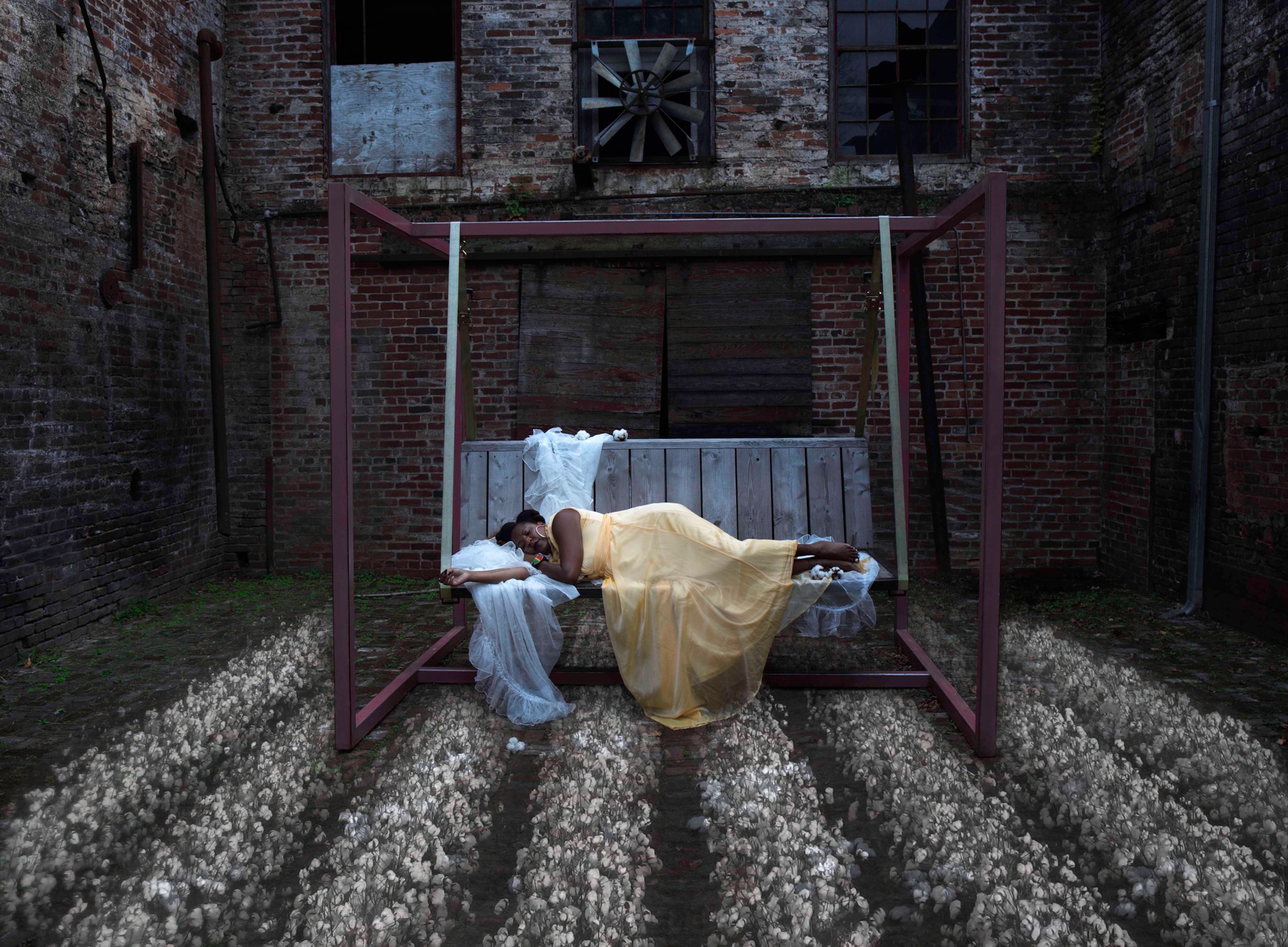
Watts, Charlie_Dreaming with the Ancestors
Charlie Watts and Tricia Hersey, Dreaming with the Ancestors, 2017. Archival digital print photograph, 76.2 × 101.6 cm.

The photograph Dreaming with the Ancestors, taken by Charlie Watts, portrays Hersey reclining on a wooden bench inside an open brick enclosure and above rows of cotton plants. Dressed in a soft yellow gown, she closes her eyes in rest, practicing what she calls “the art of escape”—from the incessant demand of productivity and overwork, from oppression of body and spirit, from noise that drowns out voices of wisdom.

In We Will Rest!, Hersey advises:

Every day, morning or night, or whenever you can steal away, find silence. Even if for only a few minutes. Look for quiet time, quiet breathing, quiet wind, quiet air. It is there. Even if it’s cultivated in your body by syncing with your own heart beating. Guilt and shame will be a formidable and likely opponent in your resistance. We expect guilt and shame to surface. Let them come. We rest through it. We commit to our subversive stunts of silence, truth, daydreaming, community care, naps, sleep, play, leisure, boundaries, and space. Be passionate about escape. (107)

+++

ALBUM: Grace Will Lead Me Home by Invisible Folk (2024) [HT: Jonathan Evens]: An Arts Council England grant awarded to singer-songwriter Jon Bickley in 2022 enabled him to conduct a research and songwriting project that culminated in the album Grace Will Lead Me Home, which engages with the hymn “Amazing Grace,” its author’s biography, and its legacy. Bickley partnered with the Cowper and Newton Museum in Olney and enlisted the collaboration of fellow folk musicians Angeline Morrison (The Sorrow Songs: Folk Songs of Black British Experience) and Cohen Braithwaite-Kilcoyne (creator of the “Black Singers and Folk Ballads” resource for secondary educators, and concertina player on Reg Meuross’s Stolen from God). Here’s the title track, written and sung by Morrison:

The album also includes a cover of Zoe Mulford’s “The President Sang Amazing Grace,” written in response to the racially motivated mass shooting at Mother Emanuel AME Church in Charleston, South Carolina, on June 17, 2015 (its ten-year anniversary is next Tuesday). In his eulogy at the funeral of one of the nine victims, Rev. Clementa Pinckney, President Barack Obama chose “the power of God’s grace” as his theme, and he closed by singing the first stanza of “Amazing Grace,” a moving gesture that Mulford’s song remembers.

Other songs on Grace Will Lead Me Home address John Newton’s love for his wife Polly, his impressment into naval service, and his friendship with William Cowper. There are also songs that grapple with the harm and suffering Newton inflicted on others through his involvement in the slave trade, and that wonder at his hymn’s being so mightily embraced not only by the Black church, many of whose members are descendants of enslaved Africans, but also by other traumatized communities, who insist amid all the wrongs and afflictions they’ve suffered that God is amazingly gracious.

It’s a myth that John Newton (1725–1807), who converted to Christianity in 1748 after surviving a turbulent sea voyage, immediately gave up his employment as a slave trader upon embracing Christ. In fact, he was soon after promoted from slave ship crew member to captain and sailed three more voyages to Africa as such, trafficking human beings for profit until 1754, when his ill health forced him to retire. But he continued to invest in slaving operations for another decade, until becoming a priest in the Church of England. It wasn’t until 1788, in the pamphlet Thoughts Upon the African Slave Trade, that he publicly denounced slavery and confessed his sin of having participated in that evil institution, and this was the start of his abolitionism.

+++

SONG: “Amazing Grace,” performed by the Good Shepherd Collective: This adaptation of “Amazing Grace” premiered at Good Shepherd New York’s digital worship service on June 1. Listen via the Instagram video below, or cued up on YouTube. The vocalists are, from right to left, Charles Jones on lead, Solomon Dorsey (also on bass), Jon Seale, Dee Wilson, and Aaron Wesley. James McAlister is on drums, Michael Gungor is on electric guitar, and Tyler Chester is on keys.
Roundup of religious art exhibitions

Religion is heavily present in every medieval and Renaissance art museum collection, and curators are constantly organizing exhibitions that highlight this fact. To a smaller extent, religion is also present in contemporary art, and my appreciation goes out to those institutions that have picked up on this and have chosen to mount shows with religion up front and center. Here’s a list of just some such exhibitions currently running that have crossed my radar. (Follow the links to view more images.)

+++

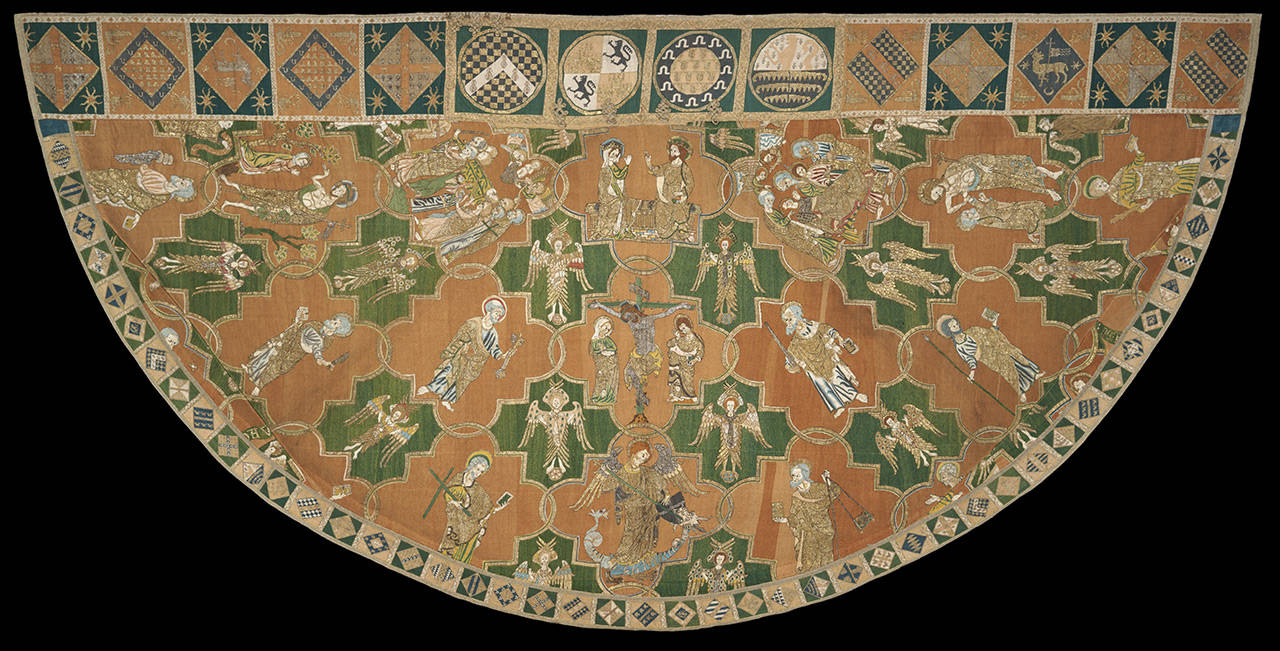
“Opus Anglicanum: Masterpieces of English Embroidery,” Victoria and Albert Museum, London, October 1, 2016–February 5, 2017: In medieval Europe, embroidered textiles were indispensable symbols of wealth and power. Owing to their quality, complexity, and magnificence, English embroideries (referred to as opus Anglicanum, “English work”) enjoyed international demand among kings, queens, popes, and cardinals, and here one hundred of them are brought together. Treasures include the Butler-Bowdon Cope, the Syon Cope, and the Tree of Jesse Cope—ceremonial cloaks made for use in church services and processions, featuring images from the lives of Christ, the Virgin, and the saints. (I love the interactive zoom function on these! To help you navigate the densely packed imagery, details of interest are tagged and can be clicked on to magnify and to reveal a textbox of information.) Hear contemporary embroiderer James Merry discuss some of the aspects of their technique and design that blow him away:

Syon Cope
The Syon Cope, 1310–20, England. Collection of the Victoria and Albert Museum, London.

+++

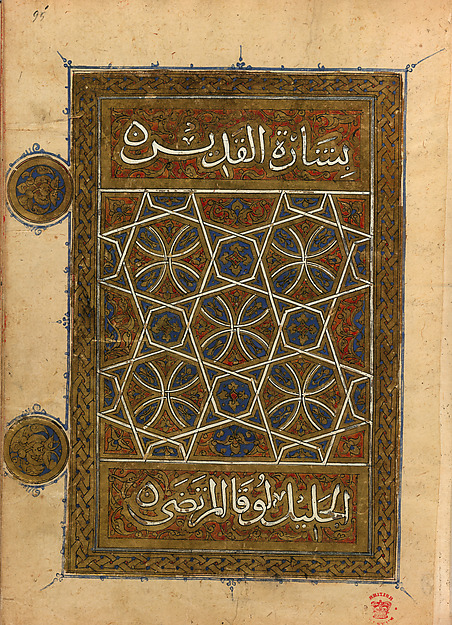
“Jerusalem 1000–1400: Every People Under Heaven,” Metropolitan Museum of Art, New York City, September 26, 2016–January 8, 2017: “This landmark exhibition demonstrates the key role that the Holy City played in shaping the art of the period from 1000 to 1400. In these centuries, Jerusalem was home to more cultures, religions, and languages than ever before. Through times of peace as well as war, Jerusalem remained a constant source of inspiration that resulted in art of great beauty and fascinating complexity. This exhibition is the first to unravel the various cultural traditions and aesthetic strands that enriched and enlivened the medieval city. It features some 200 works of art from 60 lenders worldwide.” I especially love the four Gospels in Arabic borrowed from the British Library, whose geometric illuminations bear an obvious Islamic influence.

Arabic Gospels
Folio from an Arabic Gospel-book, 1335, Jerusalem. Opaque watercolor, gold, and ink on paper, 10 5/8 × 7 7/8 in. (27 × 20 cm). Collection of the British Library (Add. MS 11856).

+++

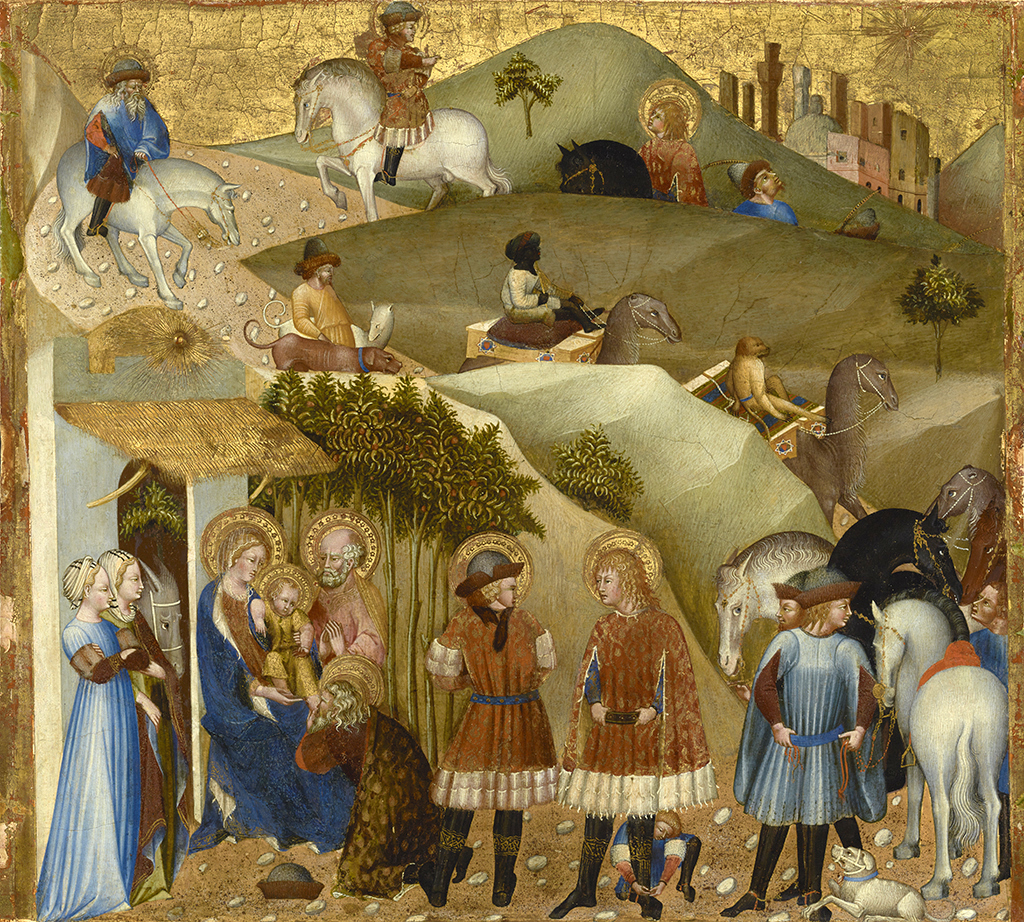
“The Shimmer of Gold: Giovanni di Paolo in Renaissance Siena,” Getty Center, Los Angeles, October 11, 2016–January 8, 2017: “Manuscript illuminator and panel painter Giovanni di Paolo was one of the most distinctive and imaginative artists working in Siena, Italy, during the Renaissance. This exhibition reunites several panels from one of his most important commissions—an altarpiece for the Branchini family chapel in the church of San Domenico in Siena—for the first time since its dispersal, and presents illuminated manuscripts and paintings by Giovanni and his close collaborators and contemporaries. Through recent technical findings, the exhibition reveals his creative use of gold and paint to achieve remarkable luminous effects in both media.”

Adoration of the Magi by Giovanni di Paolo
Giovanni di Paolo (Italian, ca. 1403–1482), The Adoration of the Magi, 1427. Tempera and gold leaf on panel. Kröller-Müller Museum, Otterlo, the Netherlands.

+++

“The Key” (organized by Caravan), Riverside Church, New York City, September 21–November 6, 2016: Founded by US Episcopal priest Paul-Gordon Chandler, Caravan develops initiatives that use art as a bridge for intercultural and interreligious dialogue. The organization’s 2016 exhibition is in the last leg of its Cairo-London-New York journey. It showcases the work of forty Middle Eastern and Western artists from different monotheistic faith backgrounds, each of whom was given a four-foot-tall fiberglass ankh to develop into a work of art. Known as the “Key of Life,” the ankh is an ancient hieroglyph originating in Egypt but spreading throughout Asia Minor; today it is used as a symbol of pluralism, tolerance, and harmony. I especially like the ones by Sergio Gomez, Arabella Dorman, Fatma Abdel Rahman, and Isaac Daniel.

The Key exhibition (Caravan)

+++

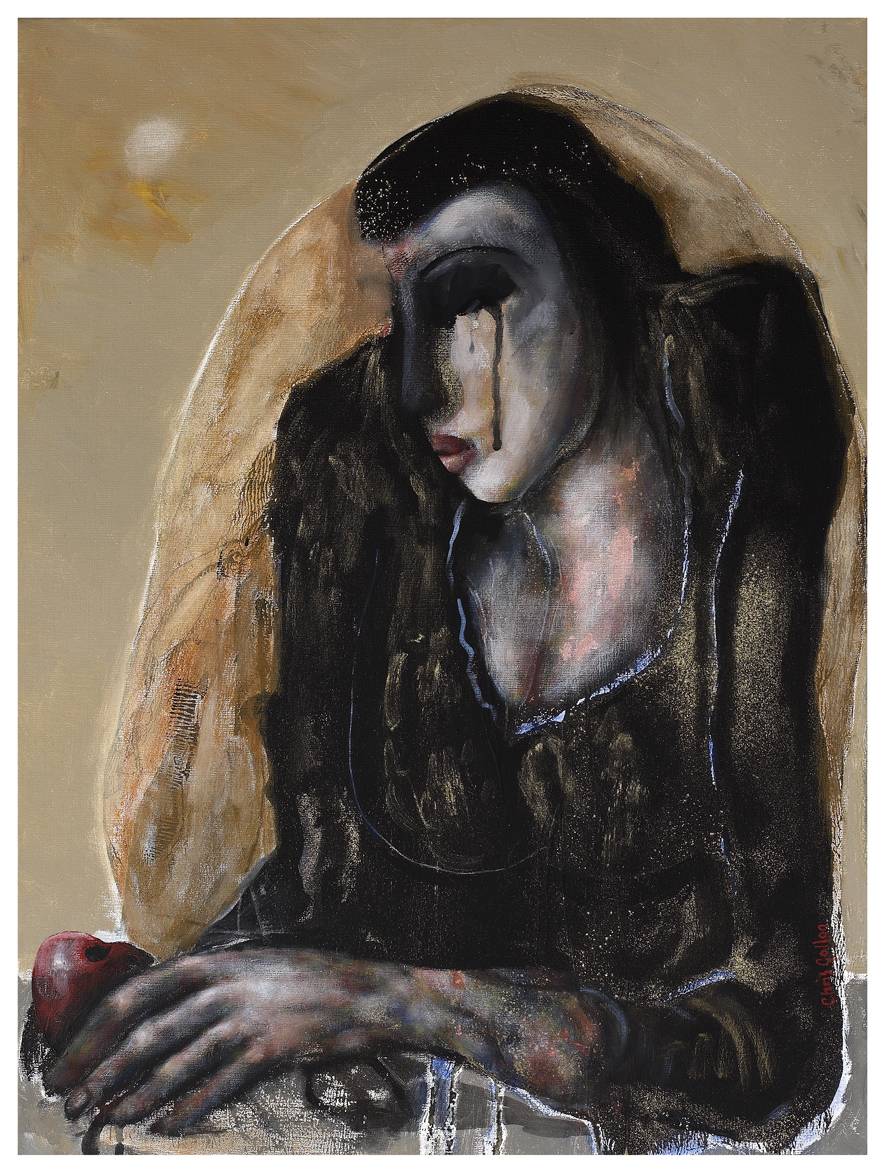
“Incarnation, Mary & Women from the Bible,” Romsey Abbey, Hampshire, England, October 12–November 6, 2016: Having already stopped at Guildford, Norwich, Chichester, Durham, and Hereford Cathedrals, Chris Gollon’s latest series of paintings on women of the Bible is now at Romsey Abbey. It includes the standards, like Eve, Rachel, Hannah, Delilah, Bathsheba, the two Marys (the Virgin, and Magdalene), and Salome, as well as some unnamed and even implied women, like Judas’s wife. It also includes some extrabiblical female saints, like Lucy, Cecilia, Julian of Norwich, and Ethelflaeda. I’m really attracted to the sad quality of many of Gollon’s women, and to the emphasis on hands (much like Eduardo Kingman!).

Contemplation of Eve by Chris Gollon
Chris Gollon (British, 1953–), The Contemplation of Eve, 2011. Acrylic on canvas, 24 × 18 in. (61 × 46 cm).

+++

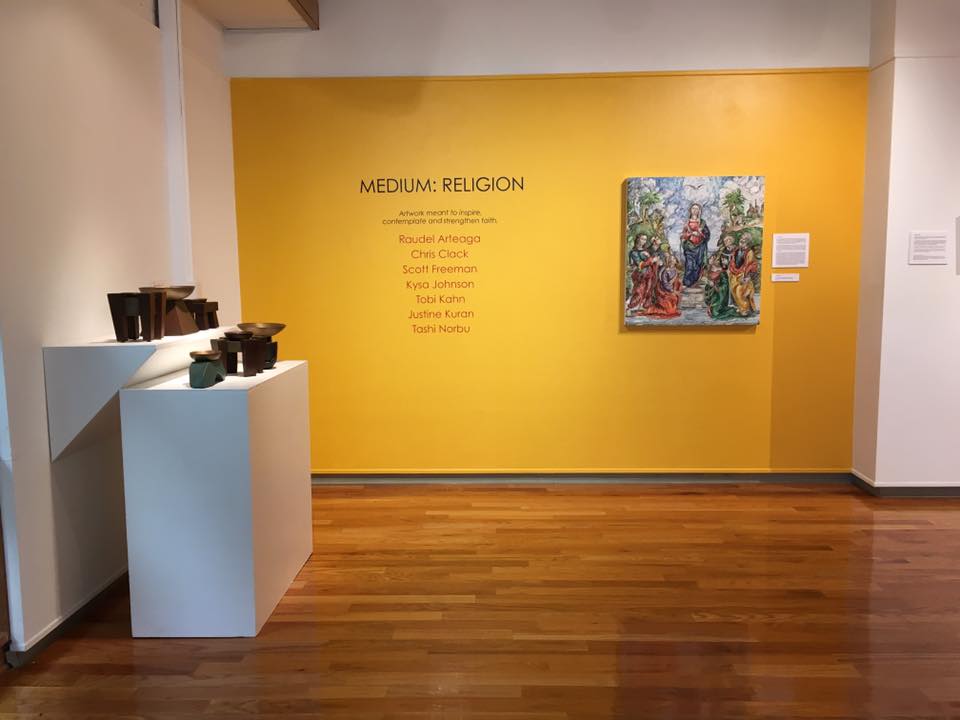
“Medium: Religion,” Gallery of Art and Design, University of Central Missouri, Warrensburg, Missouri, September 22–October 28, 2016: This exhibition—“meant to inspire, contemplate, and strengthen faith”—features seven contemporary artists whose work engages religion: Tobi Kahn, who creates Jewish ceremonial art like etrog containers, shalom bat chairs, and omer counters; Chris Clack, whose work explores the relationship between Christianity and science; Kysa Johnson, whose Immaculate Conception series links images of the Virgin with asexually reproducing yeast and bacteria; Justine Kuran, known for her quilled hamsas (palm-shaped amulets); Scott Freeman, whose The Wall Remaining laments the long-suffered disunity between Jews and Christians; Tashi Norbu, trained in the art of traditional Tibetan Buddhist thangka painting; and Raudel Arteaga, who deconstructs famous religious paintings into their geometric basics.

medium-religion-exhibition

+++

“Illuminations: Works by Vanessa German, Peter Oresick, and Christopher Ruane,” Carlow University Art Gallery, Pittsburgh, Pennsylvania, September 8–December 9, 2016: “‘Illuminations’ features the work of three local artists who evoke the traditions of icon painting or biblical parables to bring out focus on the overlooked and to cast light into the shadows of our present day,” says gallery director Sylvia Rhor. Works include responses to last year’s Charleston church shootings, literary figures painted in the style of Russian icons, and sacred stories updated through the use of photography and digital technology.

illuminations-exhibition-poster

Remembering Charleston

Friday, June 17, marks the one-year anniversary of the racially motivated mass shooting at Emanuel African Methodist Episcopal Church in Charleston, South Carolina, where nine members were killed by gunman Dylann Roof at a midweek service: Sharonda Coleman-Singleton, Cynthia Marie Graham Hurd, Susie Jackson, Ethel Lee Lance, Depayne Middleton-Doctor, Clementa C. Pinckney, Tywanza Sanders, Daniel Simmons, and Myra Thompson.

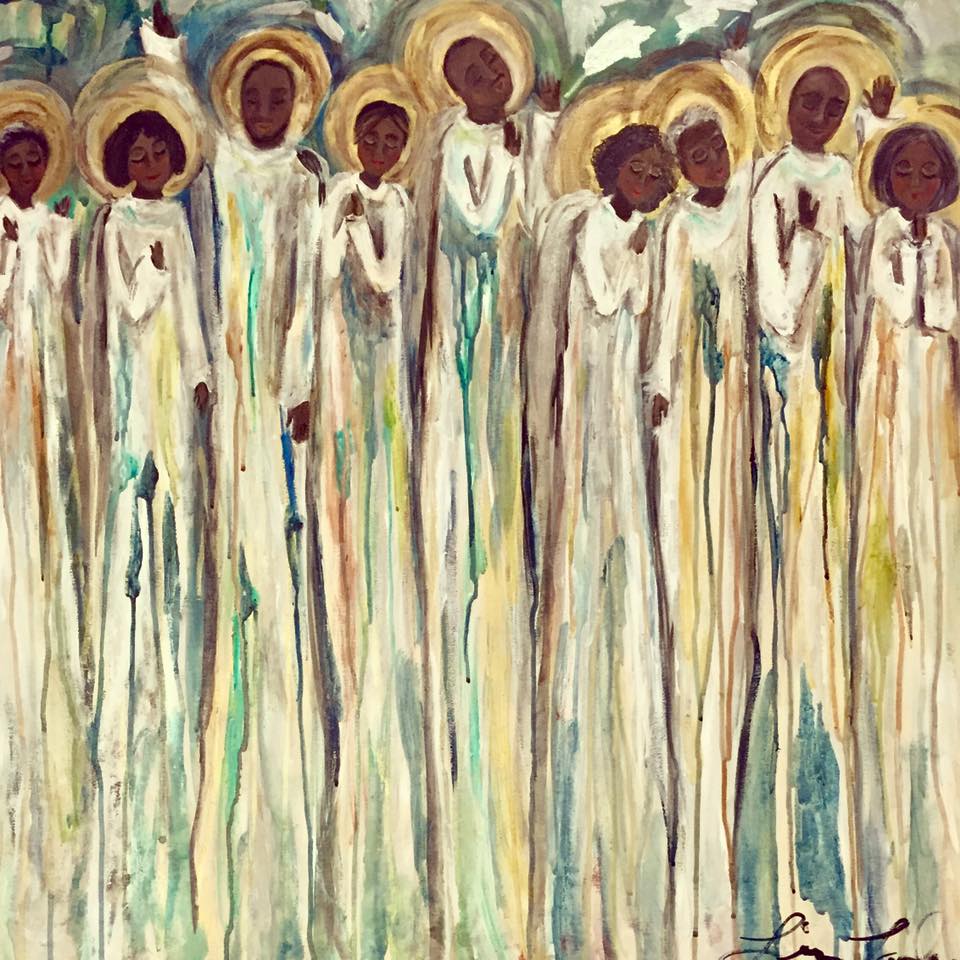
In response to the tragic event, Alabama artist Liz Landgren painted A Bridge Over Troubled Water, which shows the nine victims ascending, winged and haloed, from the troubled waters of this world.

A Bridge Over Troubled Water by Liz Landgren
Liz Landgren (American, 1974–), A Bridge Over Troubled Water, 2015. Acrylic on wood panel, 36 × 36 in.

Landgren says her visualization was inspired by Aretha Franklin’s 1971 cover of the Simon and Garfunkel song “Bridge Over Troubled Water”:

The original song premiered on November 30, 1969, on the CBS documentary feature Songs of America. Here, as in Landgren’s painting, it was connected with death, being played over footage from the funerals of John F. Kennedy, Robert Kennedy, and Martin Luther King Jr.

Paul Simon, who wrote the song, says his idea for it came from a line that Claude Jeter extemporized in the Swan Silvertones’ 1958 recording of the African American spiritual “Oh Mary Don’t You Weep”: “I’ll be your bridge over deep water if you trust in my name.” The speaker is Jesus; the context, his raising of Lazarus (see John 11:32–33). So whereas “Bridge Over Troubled Water” is often transmitted today as a message from one friend to another, its source material actually identifies that friend as Jesus, the one who lays himself down so that we can cross over pain without drowning in it.

Because of the religious significance of the song, Simon sought to give it a gospel feel. For this task he enlisted the help of Larry Knechtel, who arranged the song for piano (Simon had written it on guitar), styling it after church hymns. Knechtel’s piano playing is one of the song’s most distinguishing characteristics.

So back to Landgren’s painting. The waters of suffering roll off the figures’ garments, a heaviness they no longer bear, as they “sail on by” to be with their Lord. Saints on earth, they now pass into the extended communion of saints in heaven, leaving behind a world that’s roiling with violence and hate, anger and grief.

We lament the deaths of the Charleston Nine. We lament the laws that make it easier to kill. We lament the dividedness of our country. But we celebrate the witness of Sharonda, Cynthia, Susie, Ethel, Depayne, Clementa, Tywanza, Daniel, and Myra, whose Christian hospitality toward a white stranger cost them their lives.

The painting brings to my mind another song: “All God’s chillun [children] got wings . . . a robe . . . a crown . . . a song,” and when we get to heaven we’re gonna put them on.

Praise be to God, who raises us up—from death and from woe.