Roundup: Nativity art from Asia, the Christ Hymn in Thai, and more

ARTICLES:

>> “How Asian Artists Picture Jesus’ Birth from 1240 to Today” by Victoria Emily Jones, December 18, 2023, Christianity Today: My first CT article was published this week! I was asked to curate and introduce a sampling of Nativity art from across Asia. By representing Jesus as Japanese, Indonesian, or what have you, these artists convey a sense of God’s immanence, his “with-us–ness,” for their own communities—and for everyone else, the universality of Christ’s birth.

Turun, I Wayan_In Bethlehem
I Wayan Turun (Indonesian, 1935–1986), In Bethlehem, 1958. Acrylic on canvas, 46 × 64 cm. Collection of Stichting Zendingserfgoed (Missionary Heritage Foundation), Zuidland, Netherlands.

>> “The Story of Christ in Chinese Art: Scholars at Peking University Make a Christmas Portfolio for LIFE,” Life, December 22, 1941, pp. 40–49: In doing research for my Christianity Today article, I found this old article from Life magazine that features eight Chinese watercolors on silk from the collection of Dr. William Bacon Pettus (1880–1959), an American educator and president of the California College of Chinese Studies in Peking (Beijing) in the 1920s and ’30s, which were being exhibited at New York’s American Bible Society at the time. With the ordination of six Chinese bishops by Pope Pius XI in 1926, the Chinese Catholic Church was transitioning from a mission church to an indigenous local church, and Chinese-style religious art—much of it coming out of the art department of the new Catholic University of Peking (Beiping Furen Daxue)—was part of that localization. Productivity seems to have continued at Furen during the Japanese occupation, as this article attests. Many of the students and faculty were recent converts to Christianity, though the article reports that non-Christians also enrolled and taught in the art program.

Lu Hongnian_Nativity
Lu Hongnian (Lu Hung-nien) ( 陸鴻年) (Chinese, 1914–1989), The Birth of Jesus, ca. 1941. Chinese watercolor on silk.

Here is one of the paintings by Lu Hongnian, who sometime after this article was published, in part through his having engaged the New Testament as inspiration for his paintings, became a Christian and took the name John. It shows the Holy Family in a mountainside cave, Mary gazing adoringly at her newborn son as Joseph brings more straw to cushion him. Beside them, an angel holds up a lantern for light, while two shepherd children approach from the entrance, eager to meet their Savior.

+++

SONGS:

>> “Philippians 2:511” by HARK Music: This song takes a traditional Thai melody, arranged by Tirasip Kraitirangul, and puts it to a Thai translation of the famous Christ Hymn from Philippians 2. It’s performed by the HARK Duriya Tasana Singers (feat. Somchairak Sriket and Damrongsak Monprasit) and Dancers, filmed on location at Chaloem Kanchanaphisek Park in Bangkok. The song is from HARK’s Thai Hymns Album (2014), which can be downloaded for free at https://harkpublications.com/?product=thai-hymns-album-2. The two-stringed bowed instrument you see at 3:21 is a saw u.

The Duriya Tasana (“Curators of the Arts”) ensemble was formed in 2012 under the commission of the Thai-Psalms Project, an endeavor to create Thai traditional and classical music settings for the psalms of the Bible. Many of the members are affiliated with the Bunditpatanasilpa Institute of Fine Arts in Bangkok. Thanks to my friend Janet, whose sister is preparing a move to Thailand, for alerting me to this group!

>> “Jesus You Come” by Tenielle Neda, performed with Jon Guerra: This song by the Australian singer-songwriter Tenielle Neda [previously], which she sings with Jon Guerra, makes a nice complement to the Thai song above. The performance is from “Songs for Hope: A TGC Advent Concert” on December 6, 2020.

+++

MIDDLE ENGLISH LULLABY: “As I lay upon a night”: Medievalist Eleanor Parker introduces a charming Christmas lullaby from fourteenth-century England, a dialogue between Mary and the Christ child, and provides a modern English translation of its thirty-seven stanzas. In the Middle Ages, says Rosemary Woolf, the subject matter of lullabies was often a prophecy of the baby’s future—presumably a romantic promise of great and happy achievements. But here it is the child who relates the future to his mother, thus providing the material for his own lullaby.

+++

ART VIDEO: “Third Sunday of Advent: Ethiopian Art: Gospel Book” by James Romaine: Every December, my friend James Romaine, an art historian who teaches at Lander University, publishes four videos on his Seeing Art History YouTube channel related to the themes of the season, part of his annual Art for Advent series. This year he’s chosen to focus on Ethiopian art, covering illuminations from two different manuscripts, a diptych icon, and a rock-hewn church.

In this video Romaine discusses the formal qualities of two paintings from a sixteenth-century Ethiopian Gospel-book, the identity of the figures, and the liturgical context of the book, including the use of the red veil that’s attached at the top, which, Romaine says, “both protects and sanctifies the icon,” creating a sense of anticipation for the Orthodox believer who, in faith, lifts the veil to see what is revealed.

Christmas, Day 2: Listen, Friend!

LOOK: The Angel Brings Good News to the Shepherds by Luke Hua Xiaoxian

Annunciation to the Shepherds (Chinese)
Luke Hua Xiaoxian (華效先), The Angel Brings Good News to the Shepherds (天使向牧人傳佈嘉訊), 1948. Chinese watercolor on silk, mounted as hanging scroll, 47.5 × 53 cm (painting) / 123 × 65.5 cm (mounting). Collection of the Ricci Institute for Chinese-Western Cultural History at Boston College (formerly at the University of San Francisco).

LISTEN: “Pengyou, Ting!” | Words: Anonymous, ca. 1935 | Traditional Chinese melody, arr. Carolyn Jennings, 1994 | Performed by Calvin University’s Capella, dir. Pearl Shangkuan, 2021

Pengyou, ting zhe hao xin xi: Yesu jiangshi wei jiu ni
Benlai ta shi tian shang shen
Te lai wei jiu shi shang ren

Pengyou, ting zhe hao xin xi: Yesu jiangshi wei jiu ni
Yesu Judu, Yesu Jidu Jiangsh wei jiu wo, jiu ni!

English translation:

Listen, friend! Good news: Jesus came to earth for you!
Came from heaven where he was Lord!
Came to save, to save us all!

Listen, friend! Good news, hear this great good news!
Jesus Christ came to earth for you! For me, for you!

Easter, Day 8

I pray that, according to the riches of his glory, he may grant that you may be strengthened in your inner being with power through his Spirit, and that Christ may dwell in your hearts through faith, as you are being rooted and grounded in love. I pray that you may have the power to comprehend, with all the saints, what is the breadth and length and height and depth, and to know the love of Christ that surpasses knowledge, so that you may be filled with all the fullness of God.

—Ephesians 3:16–19

For once you were darkness, but now in the Lord you are light. Live as children of light—for the fruit of the light is found in all that is good and right and true. Try to find out what is pleasing to the Lord. Take no part in the unfruitful works of darkness . . .

“Sleeper, awake!
    Rise from the dead,
and Christ will shine on you.”

—Ephesians 5:8–11a, 14b

LOOK: Resurrection by Lu Lan

Lu Lan_Resurrection
Lu Lan (Chinese, 1972–), Resurrection, 1996. Tempera on cardboard, 50 × 50 cm.

LISTEN: “Easter Light” | Words by Angier Brock and music by Cecilia McDowall, 2016 | Performed by the Oxford Choir, on Oxford Choral Highlights 2017

In Easter light, the risen Christ is moving among us.
     How brightly the meadowlark sings its song of the season.
          Alleluia.
     How gently the Easter light lifts the face of the lily.
         Christ is risen.
With illumed heart and radiant faces,
     we too sing in that light.
          Christ is risen indeed. Alleluia. Alleluia.

Let Christ be rising now in our lives and in our prayers,
     as we open our hands to both friend and stranger.
Let Christ be rising now in our words and in our work
     as we strive to repair the earth
     and free all its creatures from danger.

Risen Christ of limitless love,
     Risen Christ of compassion and peace,
          Risen Christ of gracious surprising—
You move among us in Easter light.
Be now in us, rising.

I so love Angier Brock’s collaborations with Cecilia McDowall. I featured another of their choral anthems, “Advent Moon,” two Advents ago.

“Easter Light” is quieter and more reflective than most other Easter anthems. It muses on how, as the natural world awakens to the fullness of spring, our hearts are beckoned to come awake also. Christ rose from his grave in first-century Palestine and he rises in his followers, moving us to love, compassion, peace, generosity, and works of repair and liberation. This anthem is a blessing and a prayer—that we would be reanimated, reastonished, by the “risen Christ of gracious surprising”; that we would be Easter people, people of life and light, practicing resurrection.

The text above is as Brock wrote it. She gave McDowall the leeway to rearrange the order of lines, to repeat and layer words, and so on. Brock told me how pleased she is by how McDowall set the alleluias. “I think of them as ‘falling alleluias’ or ‘waterfalls of alleluias,’” she said.

In addition to being a sacred lyricist, Brock is also a poet. I asked her if she approaches differently the task of writing a poem that she knows will be set to music for church contexts versus writing a poem that does not have that objective. Here’s what she said:

For me, the biggest difference between writing a hymn or anthem text, as opposed to a freestanding poem, is that with the hymn or anthem, I know I will quite literally be putting words into other peoples’ mouths. And not just any words—words about faith, about the Holy, the Divine. Theology figures in—not my personal or private theology, but something larger. That adds a layer of—I’m not sure what the word is. Complexity? Responsibility? Gravitas? Something like one of those things, or some combination thereof.

The above recording is of a performance by the collegiate Oxford Choir, but for examples of church choirs singing “Easter Light” for Easter Day worship services, see the following timestamped video links:

+++

This concludes my *daily* posts in this format—but there are still another forty-two days of Easter, and I hope you’re continuing to celebrate! I’ll still be sharing content throughout the remainder of the season, just at a lesser frequency. In the meantime, I hope you’re enjoying the Art & Theology Eastertide Playlist, which includes today’s featured song.

If you would like to leave me a “tip” for the Lent-Easter posts or playlists, you can do so through PayPal. I appreciate your support, which gives me the freedom to step away from paid freelancing projects to devote time here, and to keep all the blog content free and available to everyone instead of moving to a Patreon model. If you don’t have a PayPal account but still wish to contribute to my work (as some of you have indicated to me), you could buy me a book from my Amazon wish list. Books feed my research and shape my spiritual development and can impact what I cover on the blog. Please note that wish list items do not equal endorsements.

I wish you all a very happy Eastertide! Thanks for journeying with me through Lent and Bright Week.

Roundup: Online literary retreat (Aug. 27), Yvonne Adhiambo Owuor interview, global Marian art, and more

ONLINE LITERARY RETREAT: “The Extraordinary Possibility of Ordinary Time: Retreat with Sarah Arthur,” August 27 (this Friday!), 1–3 p.m. ET: Hosted by Paraclete Press. “Come away for an afternoon of exploration, refreshment, and celebration of Ordinary Time. Sarah Arthur invites you to join her for a deep sip at the well of poetry and literature as devotional reading. Guest poets Luci Shaw and Scott Cairns will also take part in this mini-retreat for lovers of words and Spirit.” The $50 admission price includes a copy of Sarah’s book At the Still Point: A Literary Guide to Prayer in Ordinary Time. I attended her Lent retreat earlier this year and found it very meaningful. Sorry for the short notice.

+++

TRIBUTE: “My Benediction to the Beloved Storyteller Walter Wangerin Jr.” by Philip Yancey: Walter Wangerin Jr. died of cancer on August 5. He was a pastor; a storyteller; a National Book Award–winning author of novels, short stories, and spiritual essays, including The Book of the Dun Cow, The Book of Sorrows, and Ragman: And Other Cries of Faith; and a professor of literature, theology, and creative writing. His friend and fellow writer Philip Yancey has written this nice little tribute to him for Christianity Today.

+++

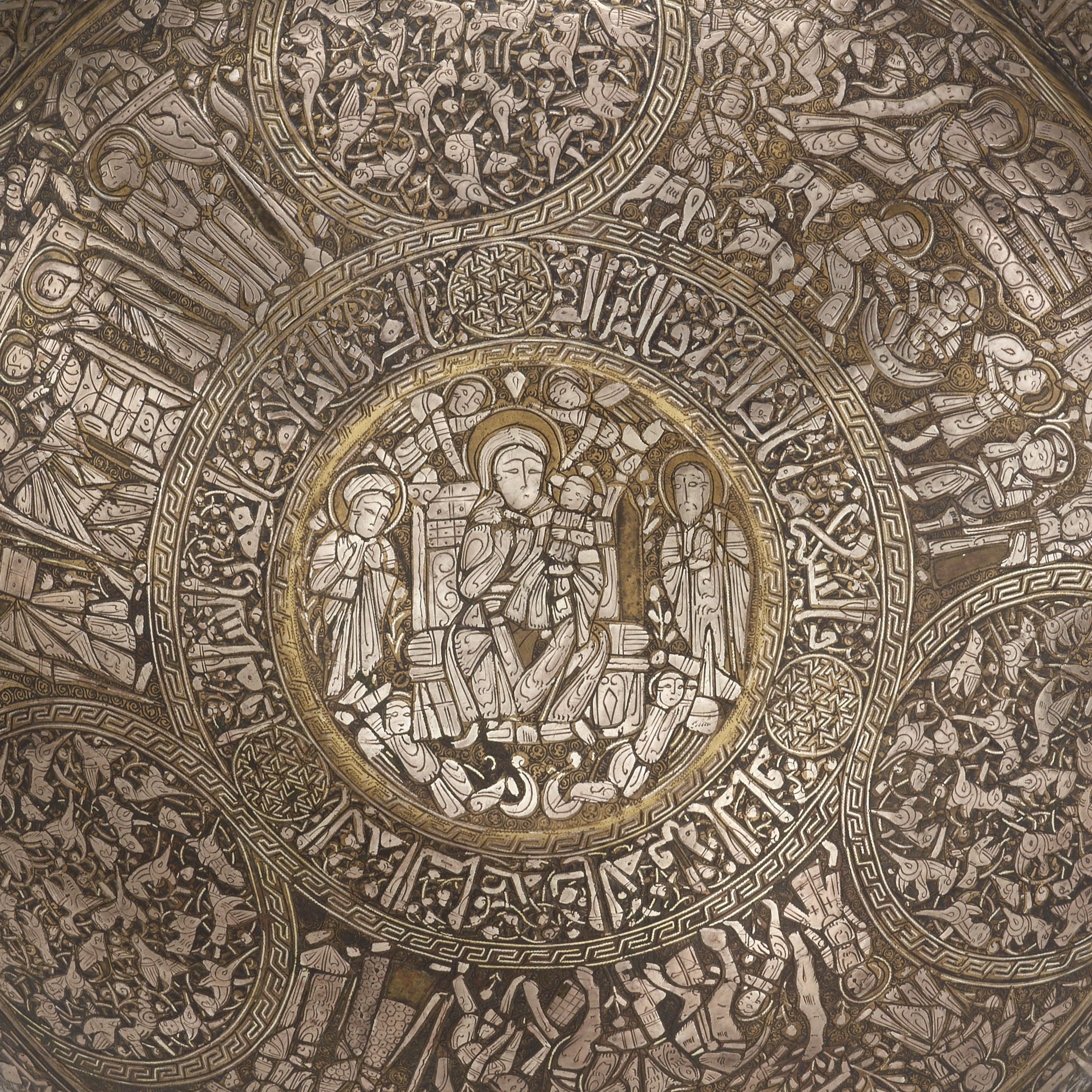
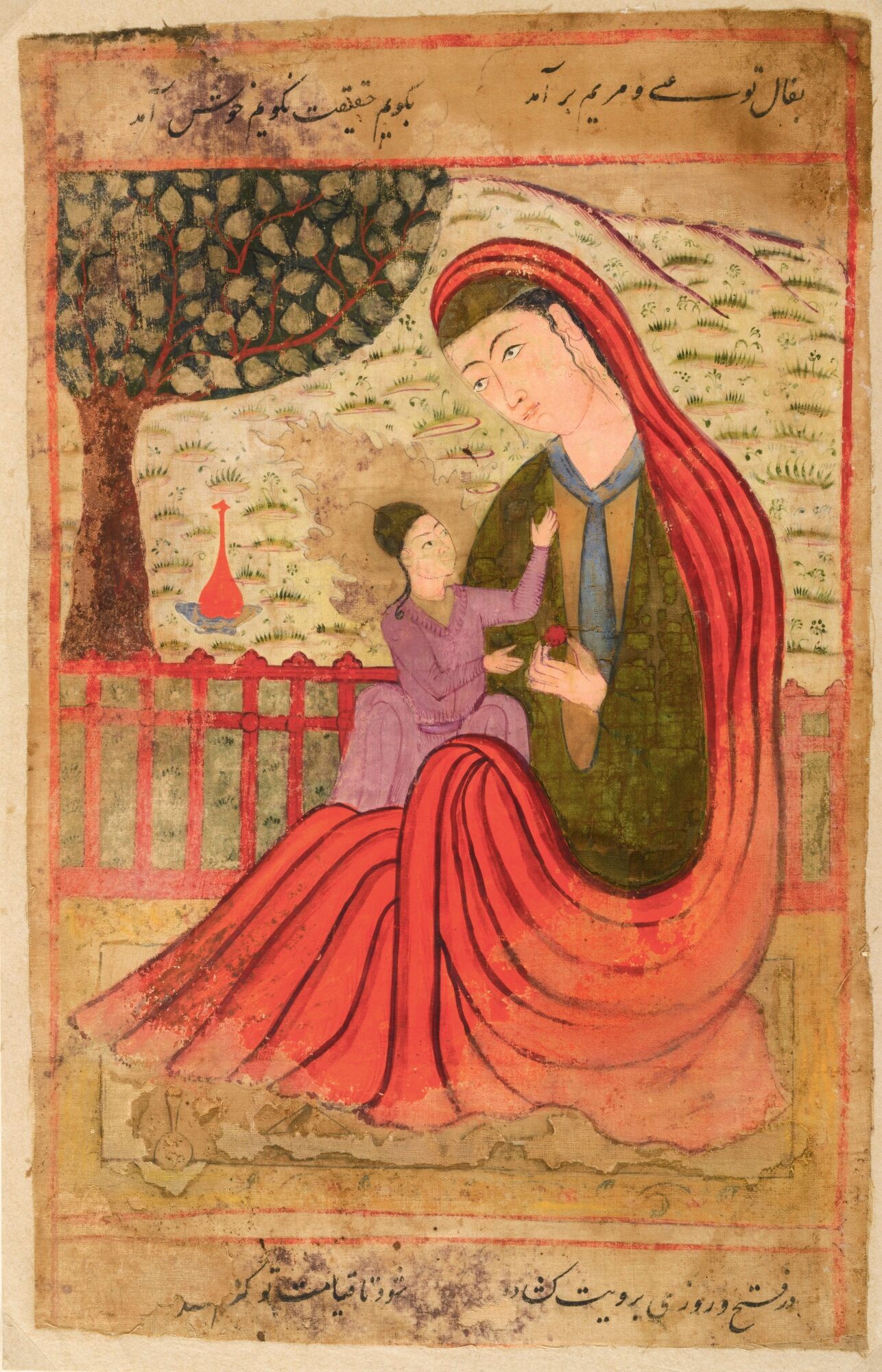
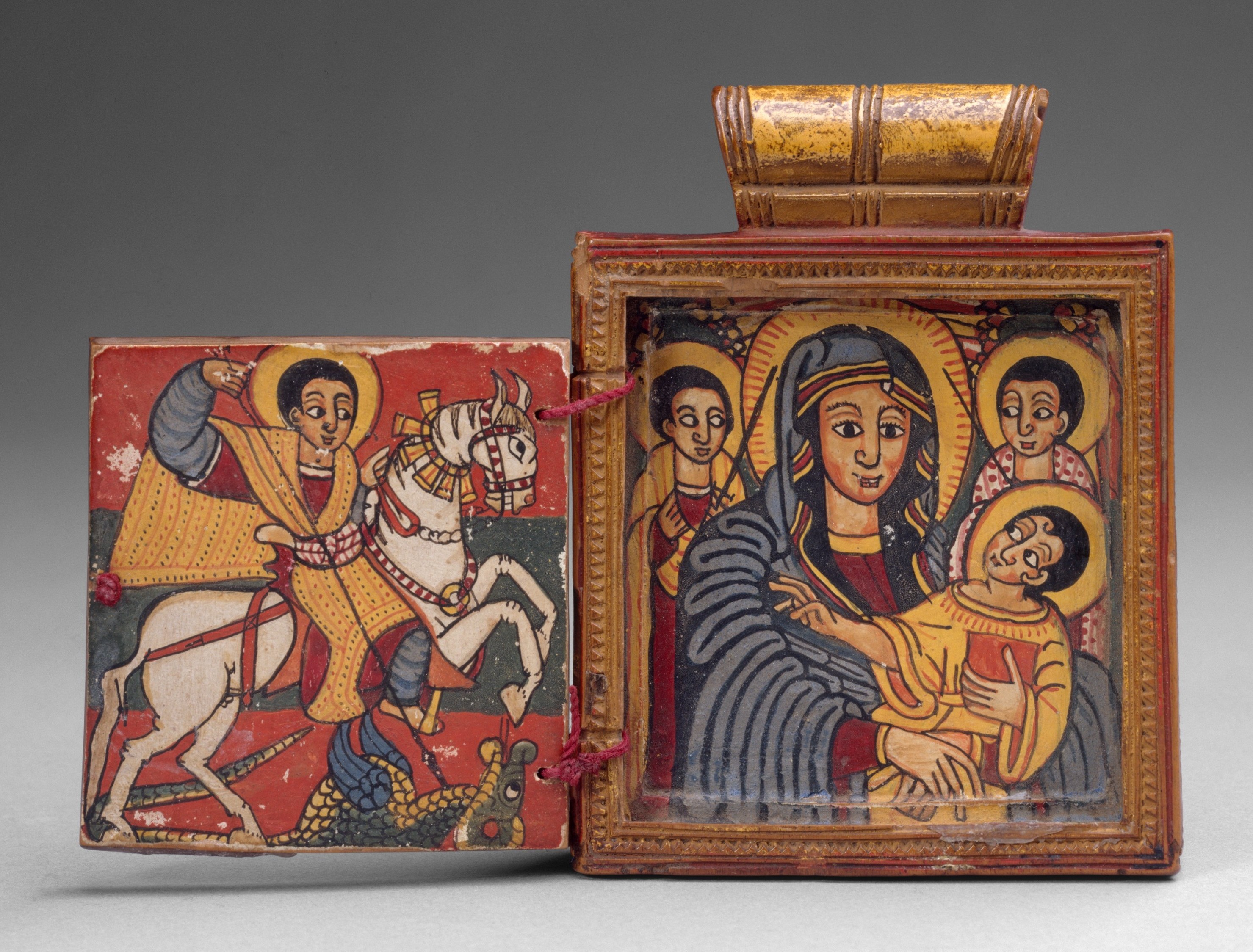
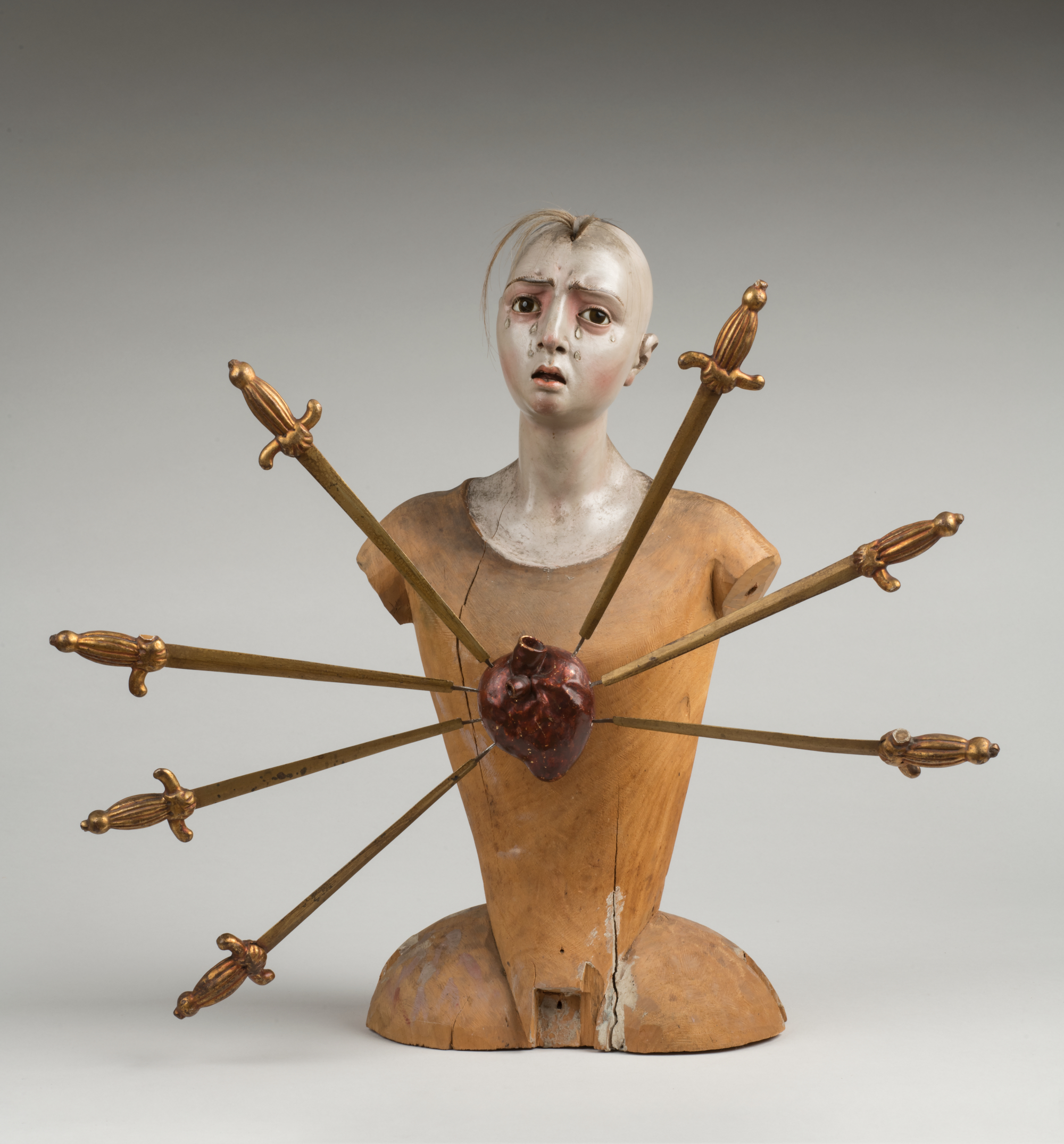
ONLINE EXHIBITION: A Global Icon: Mary in Context, created by the National Museum of Women in the Arts: Curated by Virginia Treanor, this digital resource was created as an expansion of the in-person exhibition Picturing Mary: Woman, Mother, Idea (see catalog), which ran from December 5, 2014, to April 12, 2015. Click through the pages to experience art images with descriptions, videos, and other content having to do with representations of Mary from across the world. The first video in the series is posted below, and here’s a playlist of all seven.

Christian canteen from Iraq
Canteen with Adoration of the Christ Child (detail), Syria or Northern Iraq, mid-13th century. Brass, silver inlay, 17 13/16 × 14 7/16 in. (45.2 × 36.7 cm). Freer Gallery of Art, Smithsonian Institution, Washington, DC. Click image to see full object.

Virgin and Child, from a Falnama (Book of Divination), Mughal India, ca. 1580. Gouache on cloth, 33.4 × 21.1 cm.

Dehua Madonna and Child
Madonna and Child, Dehua, China, 1690–1710. Porcelain, 15 × 3 1/2 × 3 in. (38.1 × 8.9 × 7.6 cm). Peabody Essex Museum, Salem, Massachusetts, inv. AE85957.

Ethiopian pendant icon
Double Diptych Icon Pendant, Ethiopia, early 18th century. Wood, tempera pigment, string, 3 3/4 × 6 × 5 1/2 in. (9.5 × 15.2 × 14 cm) (open, mounted). Metropolitan Museum of Art, New York.

Lady of Sorrows (Italy, 18th c)
Our Lady of the Seven Sorrows, Italy, 18th century. Polychromed wood, human hair, 17 3/4 × 17 3/4 × 9 3/4 in. Royal Museums of Art and History, Brussels, Inv. FB.514. Photo © RMAH, used with permission.

+++

INTERVIEW (+ upcoming virtual conversation): “A God Who Wails and Dances: A Conversation with Yvonne Adhiambo Owuor”: This interview by Erika Kloss, which appears in the current issue of Image journal (no. 109), is so. good. Kenyan writer Yvonne Adhiambo Owuor is the author of the novels Dust and The Dragonfly Sea and award-winning short stories such as “The Weight of Whispers,” as well as the executive director of the Zanzibar International Film Festival. Here she talks about fiction, faith, coffee, and calling colonialism to account. To engage further, you can register for the Image-sponsored online event “The Art of Fiction: A God Who Wails and Dances with Yvonne Adhiambo Owuor,” which takes place September 23 at 3 p.m. ET.

Here’s just a snippet from her conversation with Kloss, where she describes what she would say to those who want nothing to do with Christianity because of all the evil that has been done in its name:

Dare to rescue God as Emmanuel from the dense debris of hubris, and from the weight and stench of whited sepulchers. For it is true, an excess of ghouls have appropriated for themselves the meaning and potency of the revolutionary One who dares to pronounce to humanity, “Love your enemies . . . Do good to those who hate you.”

Why should young people let themselves be revulsed by a legion who never fully entered into the depths of the subversive, seductive, paradigm-dissolving, drinking-and-hanging-out-with-sinners, beautiful, and heroic man-God? Why wouldn’t young people set out to experience for themselves the grand and compelling epic of a creator God in love, who loses his children and the earth to a defiant and rebellious once-beloved prince of light, and who struggles long and hard to regain the humanity he had loved and lost? So passionate and desperate is the creator in this endeavor that he will enter into humanity to try to court and secure these cherished children, even at the risk of his own murder—and even that does not stop the love. A love stronger than death? Don’t we all write anthems, in one form or another, yearning for this?

Let the next generation of seekers . . . visit old worlds that contain the spirit of the faith, not just in the Middle East, but also northern Africa, northern Sudan, Egypt, and Ethiopia, all those rubbed-out places (that colonialists presumed to suggest they were ‘civilizing’) from which Christianity entered into and transformed Europe and the world. . . . An historical quest for meaning at sites of origins might inspire young people to look again at the call to adventure and transcendent idealism that is the Way.

+++

VIDEO SERIES: How to Read the Bible by BibleProject: “Reading the Bible wisely requires that we learn about the ancient literary styles used by the biblical authors. . . . While the Bible is one unified story, it cannot all be read in the same way. The How to Read the Bible series walks through each literary style found in the Bible to show how each uniquely contributes to the overall story of Scripture.”

Led by Dr. Tim Mackie and Jon Collins, BibleProject is a crowdfunded animation studio that creates videos, podcasts, and small-group curricula. From 2017 to 2020 they executed a series called How to Read the Bible, which is nineteen episodes total. In it they examine the three major literary styles that comprise the Bible: narrative (chronicles, biographies, parables), poetry (celebratory, reflective, erotic, politically resistant, apocalyptic), and prose discourse (laws, sermons, letters). Each style lives by its own rules and structure, and we get into trouble, for example, when we don’t properly understand how metaphor works, or when we don’t recognize that Paul’s epistles were situated in a particular historical context. Here’s one of the videos in the series, on design patterns in biblical narrative:

The Lost Lamb (Artful Devotion)

Good Shepherd (Chinese)
Chinese scroll painting of the Good Shepherd, 1966. Collection of the Church of the Good Shepherd, Ann Arbor, Michigan.

“What man of you, having a hundred sheep, if he has lost one of them, does not leave the ninety-nine in the open country, and go after the one that is lost, until he finds it? And when he has found it, he lays it on his shoulders, rejoicing. And when he comes home, he calls together his friends and his neighbors, saying to them, ‘Rejoice with me, for I have found my sheep that was lost.’”

—Luke 15:4–6

+++

SONG: “The Lost Lamb” by Abigail Washburn and Jingli Jurca | Performed by Abigail Washburn, on Song of the Traveling Daughter (2005)

Zai na yaoyuan de guxiang
Wo shiluo liao yi ge gulao de meng
Yi ge youshang de meng
Zai na yangyu wo de defang

Wo fenbian buliao muse he chenguang
Wo yanjuanliao chenmo he sixiang
Feng nanchui you zhuanxiang beifang
Jianghe ben hai, hai que bu zhang

Wo xin manliao choucheng
Yu lai you shi qing bu jiuchang
Fuzu tianbuman linghun de kewang
Zhihui dangbukai yongsheng de shuangjiang

Wo
Wo shi
Yi zhi
Mitu de gaoyang

Shei neng ying wo zouchu mimang
Nar you wo chongsheng de xiwang
Oh, muyangren ah
Ni zai hefang?

In that far distant land I call home
I lost the ancient dream
A sorrowful dream
In that place that raised me

I cannot discern the growing shadows of dusk
And the first faint rays of the morning sun
I’ve wearied in the silence and searching
Wind blows south and turns again north
River flows to the sea, yet the sea does not rise

My heart is filled with melancholy
The rains come, clear skies will follow soon
Even fortune and good blessings
Cannot quench the soul’s thirst
Wisdom cannot relieve us our eternal lot

I am a lost lamb

Who will lead me from this haze?
What will bring me hope again?
Oh shepherd
Where are you? [source]

+++

Before Abigail Washburn (previously featured here) became one of America’s most acclaimed folk musicians, she was a college student majoring in East Asian studies and Mandarin, traveling intermittently to China and ready to pursue a degree in international law at Beijing University. But before her planned departure, she heard at a party one night a recording of Doc Watson singing “Shady Grove,” and she instantly fell in love with American bluegrass music. She bought herself a banjo and traveled Appalachia, learning the instrument and developing a repertoire. Her skill and enthusiasm soon landed her at a recording studio in Nashville, the city where she now lives with her husband, Béla Fleck.

Although Washburn decided not to pursue a law career in Beijing, her love of Chinese language and culture has continued. In 2011 she embarked on a Silk Road Tour, where she collaborated with Chinese musicians at each stop along the way. That year also marks the founding of The Wu-Force, a self-described “kung fu-Appalachian avant-garde folk-rock” trio consisting of Washburn, guzheng (Chinese zither) virtuoso Wu Fei, and multi-instrumentalist Kai Welch. As her website says, “her efforts to share US music in China and Chinese music in the US exist within a hope that cultural understanding and the communal experience of beauty and sound rooted in tradition will lead the way to a richer existence.” Learn more by watching her 2012 TED talk, “Building US-China Relations . . . by Banjo,” or by listening to her (and Fleck’s) 2015 interview with Krista Tippett, “Truth, Beauty, Banjo.”

“The Lost Lamb” is one of several songs that Washburn co-wrote with her friend Jingli Jurca, a poet from Beijing. Washburn says it was inspired by one of the Chinese students she was teaching English to in Vermont in the early 2000s. He had come to the States to earn money to send back home, but four years later he received a letter from his wife saying that she and their daughter were going to start a new life without him. This mournful ballad gives expression to his feeling of exile, of rootlessness, of being far from home and unable to return to what was once a place of joy and connection.

The first time I heard this song, I was incredibly moved. Having no knowledge of Mandarin or the context of the song’s composition, I looked up a translation, finding that the lyrics have a beautiful resonance, whether intentional or not, with Jesus’s parable of the lost sheep, where he likens himself to a good shepherd who seeks out and restores those of his flock who have wandered off. I hear it as very psalmic, a grasping after God through pain. It’s hard to tell dusk from dawn, the speaker says. My soul thirsts. It ends, “Oh Shepherd, where are you?” Shepherd, who promises to lead us through dark valleys and bring us to still waters. The speaker is readily confessing that he’s lost; “come find me” is essentially what he pleads.

In the spirit of the biblical psalmists, the speaker appears to take God to task, questioning whether he will show up as he said he would. “Who will lead me from this haze? / What will bring me hope again?” It’s an earnest reaching, through tears and uncertainty, for something stable that he or she once knew.

Whether you want to interpret the song as lamenting a felt distance from one’s home country or culture or family or faith, it rings so true, so beautiful.

I’ve paired it with a visual artwork and scripture reading that fulfill its longing, showing a being found.


This post belongs to the weekly series Artful Devotion. If you can’t view the music player in your email or RSS reader, try opening the post in your browser.

To view all the Revised Common Lectionary scripture readings for Proper 19, cycle C, click here.