
LOOK: Journey to Bethlehem mosaic from the former Chora Church
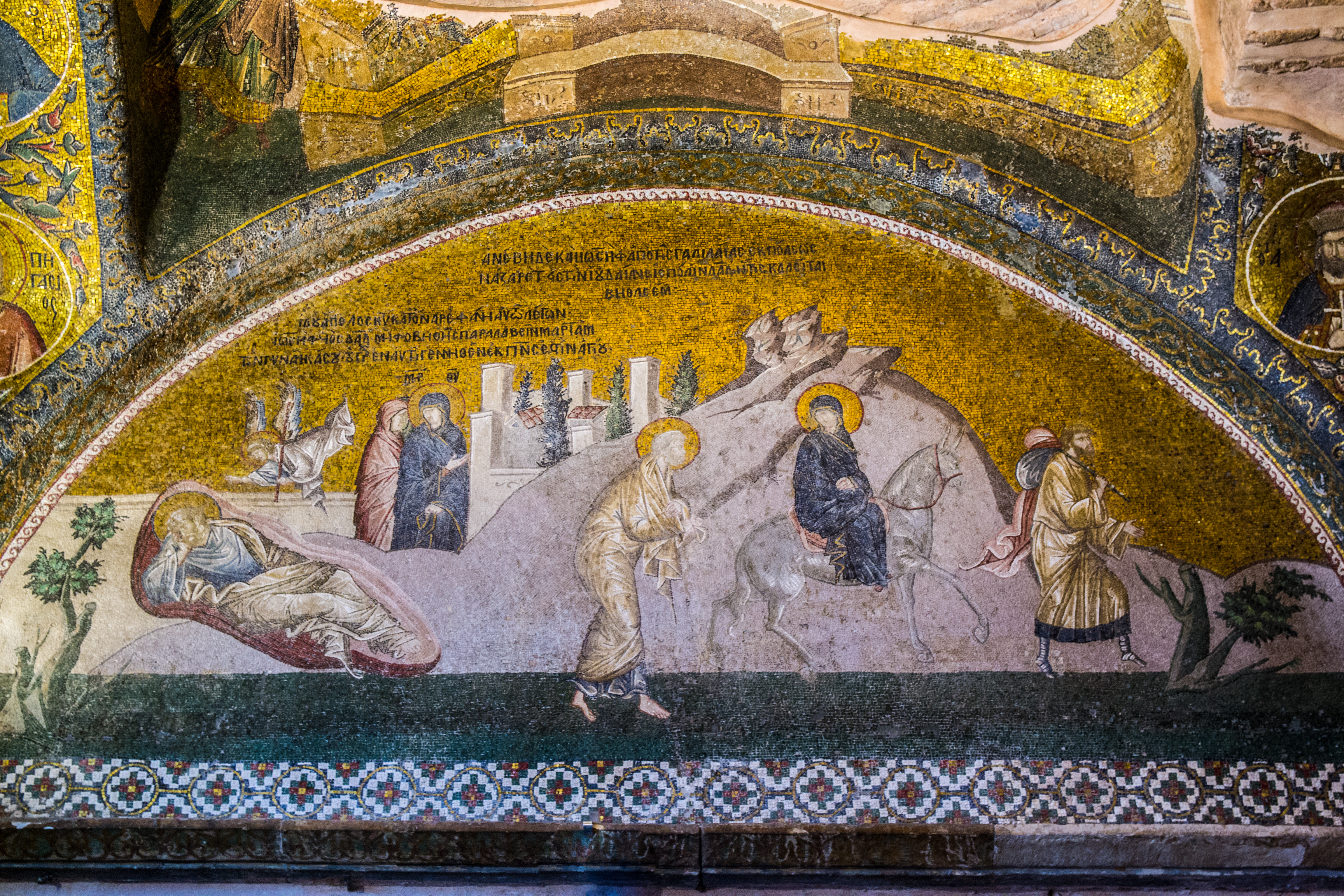
Among the finest artworks of the Palaeologan Renaissance, this Late Byzantine mosaic is in the lunette directly above the north door of a thirteenth-century church in Istanbul (formerly Constantinople), through which the clergy would have entered. It shows on the left an angel appearing to Joseph in a dream to corroborate Mary’s story of the miraculous conception of the son in her womb, and on the right the couple traveling to Bethlehem to register for the census, their donkey led by one of Joseph’s sons from a previous marriage (an apocryphal character from the Protoevangelium of James 17:1–2 and the Gospel of Pseudo-Matthew 13). I believe the scene in the middle background is the Visitation, in which Mary visits her older cousin Elizabeth in the hill country for support during her early months of pregnancy.
The building the mosaic was made for has changed possession and uses over the centuries. Originally a Byzantine church called the Church of the Holy Savior at Chora, it was converted to a mosque in 1511, over a half century after the Ottoman conquest of Constantinople. Because of the important cultural heritage it contains—namely, its Christian mosaics and frescoes—the secular Turkish Republic turned it into a museum in 1945 by court decree. In 2019 that decree was overturned, and the following year it was reconsecrated as a mosque.
It just reopened to the public May 6 of this year. Visitors are allowed daily, excluding Fridays, from 9 a.m. to 6 p.m. except during Muslim prayer times, which vary based on the sun but last for an hour in the early afternoon and an hour in the late afternoon. During prayer, the mosaics and frescoes in the “naos” (nave) are covered with curtains to honor the prohibition in the hadith against visual representations of human beings. But the images in the exonarthex, like the one shown here, remain uncovered at all times.

LISTEN: “Lift Up Your Heads” (original title: “Macht hoch die Tür”) | Original German words by Georg Weissel, 1623; translated into English by Catherine Winkworth, 1855 | Tune: TRURO, Anon., from Thomas Williams’s Psalmodia Evangelica, 1789 | Performed by Sufjan Stevens and friends on Silver & Gold, 2012
1. Lift up your heads, ye mighty gates!
Behold, the King of Glory waits;
The King of kings is drawing near,
The Savior of the world is here.
Life and salvation he doth bring,
Wherefore rejoice and gladly sing:
We praise thee, Father, now,
Creator, wise art thou!2. A Helper just he comes to thee,
His chariot is humility,
His kingly crown is holiness,
His scepter, pity in distress,
The end of all our woe he brings;
Wherefore the earth is glad and sings:
We praise thee, Savior, now,
Mighty in deed art thou!3. O blest the land, the city blest,
Where Christ the Ruler is confessed!
O happy hearts and happy homes
To whom this King in triumph comes!
The cloudless Sun of joy he is,
Who bringeth pure delight and bliss.
We praise thee, Spirit, now,
Our Comforter art thou!4. Fling wide the portals of your heart;
Make it a temple set apart
From earthly use for heaven’s employ,
Adorned with prayer and love and joy.
So shall your Sovereign enter in
And new and nobler life begin.
To thee, O God, be praise
For word and deed and grace!5. Redeemer, come! I open wide
My heart to thee; here, Lord, abide!
Let me thy inner presence feel,
Thy grace and love in me reveal;
Thy Holy Spirit guide us on
Until our glorious goal is won!
Eternal praise and fame
We offer to Thy name!
(Related post: https://artandtheology.org/2022/12/03/advent-day-7-lift-up-your-heads/)
Georg Weissel (1590–1635) was a German Lutheran minister and hymn writer. He wrote “Macht hoch die Tür” (Lift Up Your Heads) in 1623 for the dedication, during Advent, of the newly built Altroßgärter Kirche in Konigsberg, where he served as pastor until his death. The hymn is rooted in Psalm 24, especially verses 9–10:
Lift up your heads, O gates!
and be lifted up, O ancient doors,
that the King of glory may come in!
Who is this King of glory?
The LORD of hosts,
he is the King of glory. Selah
Likely written by King David on the occasion of the ark of the covenant’s coming to Jerusalem after being taken back from the Philistines (2 Sam. 6), this psalm directs its hearers to open wide the city gates to welcome in God’s presence, symbolized by this precious gold-plated chest. In his hymn, Weissel turns this directive into a metaphor, telling worshippers to open the gates of their hearts so that God can enter in and abide there.
Weissel’s hymn has an odd meter of 88.88.88.66—six lines of eight syllables, followed by two lines of six syllables. Many hymnals of the past century have modified the hymn’s structure to create four-line stanzas instead, each line of equal measure, nixing the shorter ending couplets and combining what remains.
On his 2012 Christmas album, Silver & Gold, Sufjan Stevens and a small vocal ensemble sing what in the original hymn is stanzas 1a and 3a. The group sings the four-part harmonies to a simple piano accompaniment for the first verse and a cappella the second.
For a contemporary arrangement that covers more lyrical ground, see Josh Bales’s 2018 recording of the hymn, from his album Come Away from Rush and Hurry:
I’ve paired this hymn with an artwork of the Journey to Bethlehem to show how “the King of kings is drawing near,” bringing life and salvation. Will you “fling wide the portals of your heart” to receive him?

 Art & Theology