PODCAST: Poetry for All, hosted by Joanne Diaz and Abram Van Engen:Poetry for All “is for those who already love poetry and for those who know very little about it. In this podcast, we read a poem, discuss it, see what makes it tick, learn how it works, grow from it, and then read it one more time.” I’ve consistently enjoyed this podcast since its launch in 2020, having learned about it through cohost Abram Van Engen [previously], an academic who often writes and speaks about poetry for general Christian audiences. Here are some of my favorite episodes of the ninety-seven that have been released to date:
Three haiku by Kobayashi Issa, translated from the Japanese by Robert Hass: The first: “The snow is melting / and the village is flooded / with children.” Learn the characteristics of what Joanne Diaz calls “the perfect poetic form.”
“spring song” by Lucille Clifton: One of my favorite poems by one of my favorite poets. “This joyful poem caps a sequence of sixteen poems called ‘some jesus,’ which walks through biblical characters (beginning with Adam and Eve) and ends on four poems for Holy Week and Easter. [Clifton] wrote other poems on the Bible as well, including ‘john’ and ‘my dream about the second coming,’ which reimagine a way into biblical characters to make their stories fresh.”
“Elegy for My Mother’s Mind” by Laura Van Prooyen: This episode is unique in that it has the poet herself on to read and discuss the poem, which in this case navigates the complexities of memory, loss, and familial relationships.
“View but This Tulip” by Hester Pulter: Ashamedly, I had never heard of this seventeenth-century female poet before listening to this episode, so I’m grateful to guest Wendy Wall, cocreator of the award-winning Pulter Project website, for introducing me to her! “In this episode we discuss [Pulter’s] work with emblems, her scientific chemistry experiment with flowers, and her wonderment (both worried and confident, doubtful and awestruck) about the resurrection of the body and its reunification with the soul after death.”
“From Blossoms” by Li-Young Lee: A much-anthologized poem ostensibly about eating summer peaches, but more deeply, it’s about joy. “One of the things that draws me to this poem,” says Van Engen, “is that joy is actually very hard to write about . . . without it sounding naive or sentimental or withdrawn or unaware.”
“Primary Care” by Rafael Campo: Dr. Rafael Campo is both a poet and a practicing physician. Here he uses blank verse to explore the experience of illness and suffering.
+++
POEMS:
>> “For V. the Bag Lady, Great in the Kingdom of Heaven,” “Damascus Road,” “The Sower,” and “Crosses” by Paul J. Pastor: The Rabbit Room received permission to reproduce four poems from Paul J. Pastor’s [previously] new poetry collection, The Locust Years, which “explores a world of mystery and sorrow, desolation and love. Rooted in the Pacific Northwest, these poems offer readers an invitation to walk along a path pebbled with profound joy and deep loss.” I’ll be sharing another on the blog next week, courtesy of Wiseblood Books.
>>“Undone”by Michael Stalcup: The rise of blogging in the aughts and its descendant, Substacking, in the last few years has meant that poets and other writers can share their work directly with their reading publics and give them insight into their creative process if they wish. On his Substack, the Thai American poet Michael Stalcup [previously] recently shared one of his new poems that’s based on the story of the woman caught in adultery in John 8:1–11. He explains how the poem’s form, a blend of the Petrarchan sonnet and the chiasmus, contributes to its meaning.
Nalini Jayasuriya (Sri Lankan, 1927–2014), Go, Sin No More, 2004. Mixed media on cloth, 23 × 19 in. Published in The Christian Story: Five Asian Artists Today, ed. Patricia C. Pongracz, Volker Küster, and John W. Cook (Museum of Biblical Art, 2007), p. 119.
Blessed be the paps which Thou hast sucked. —Luke 11:27
Suppose he had been Tabled at thy Teats, Thy hunger feels not what he eats: He’ll have his Teat ere long (a bloody one). The Mother then must suck the Son.
Scholar Kimberly Johnson [previously] unpacks these four lines about the body of Christ, who as an infant drank milk from his mother’s breast, and whose sacrificial death opened up his own breast whence flows the blood that nourishes us all. Johnson teases out the overlap of physical and spiritual in the poem, highlighting the maternal sharing of one’s own substance that links both couplets. At the eucharistic table, we are bidden to come and eat; or, in the stark metaphorical language of Crashaw, come and suck Christ’s bloody teat.
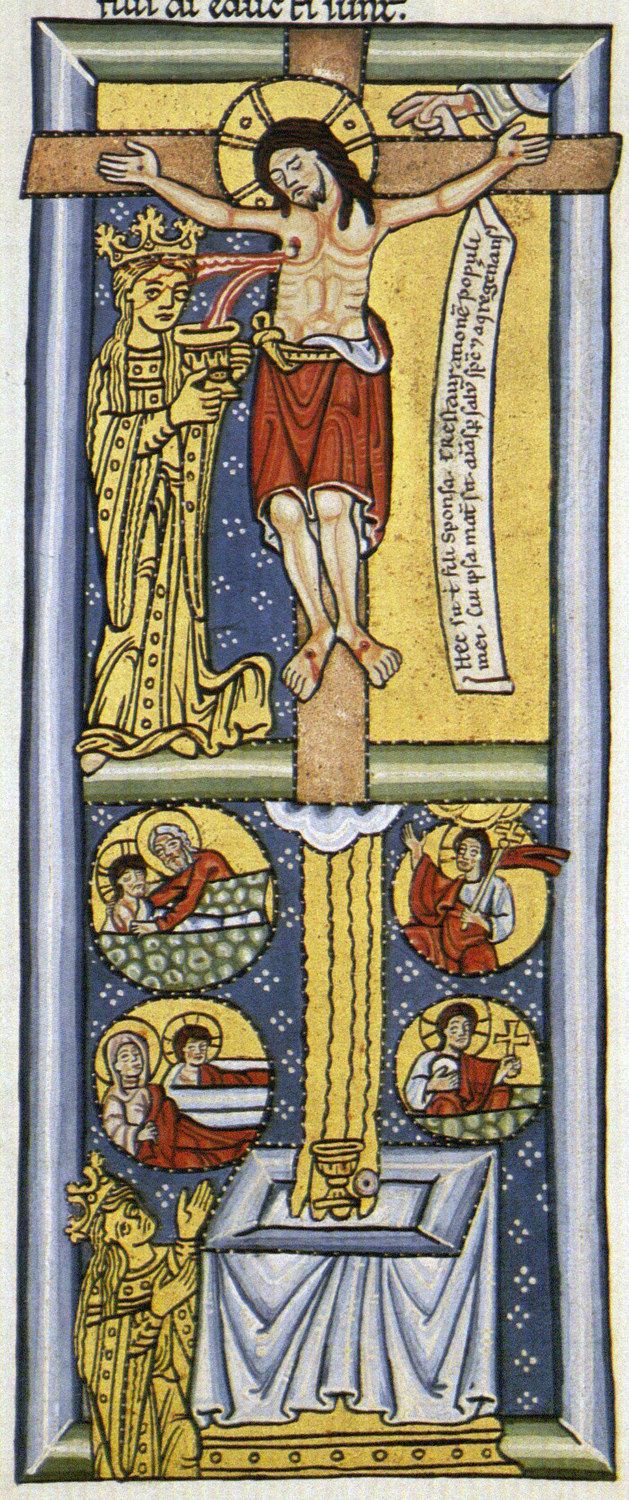
I plan to write an essay sometime about Christ as a nursing mother, as I’ve seen the image pop up in medieval writings and some visual art, including from Kongo and Ethiopia. In the meantime, here’s an illumination of the sixth vision in part 2 of Hildegard of Bingen’s Scivias (Know the Ways), painted under the supervision of Hildy herself. It shows the crucified Christ feeding Ecclesia (his bride, the church) with blood from his breast.
“The Crucifixion and the Eucharist,” from Scivias (Know the Ways) II.6, Rupertsberg Abbey, Germany, before 1179. Rupertsberg Codex, fol. 86r, Hildegard Abbey, Eibingen, Germany. The original manuscript from Hildegard’s lifetime was lost in 1945, but a faithful copy was made in 1927–33, which is the source of the color reproductions now available.
+++
ESSAY: “Only One Heart: The Poetry of Franz Wright as Emblem of God’s Grace” by Bonnie Rubrecht, Curator: “Are You / just a word? // Are we beheld, or am I all alone?” These three lines typify the poetry of Franz Wright (1953–2015), the Pulitzer Prize–winning author of Walking to Martha’s Vineyard, God’s Silence, and other collections. “Wright’s work is often described as confessional, colored by irony and humor. His irreverence, juxtaposed with honesty and humility, make his poetic voice unique in addressing God. Writers and poets often traffic in spiritual themes, but few modern poets echo the prophetic Old Testament tradition of crying out, approaching God with the concision and raw emotion that Wright does. He excels in voicing the concerns and ruminations of the human experience of suffering, while simultaneously shifting towards his own embodiment of grace.”
(This post is optimized for viewing in a web browser on a computer screen.)
Pelican in Her Piety, 1880–81. Mosaic, Palatine Chapel, Aachen, Germany.
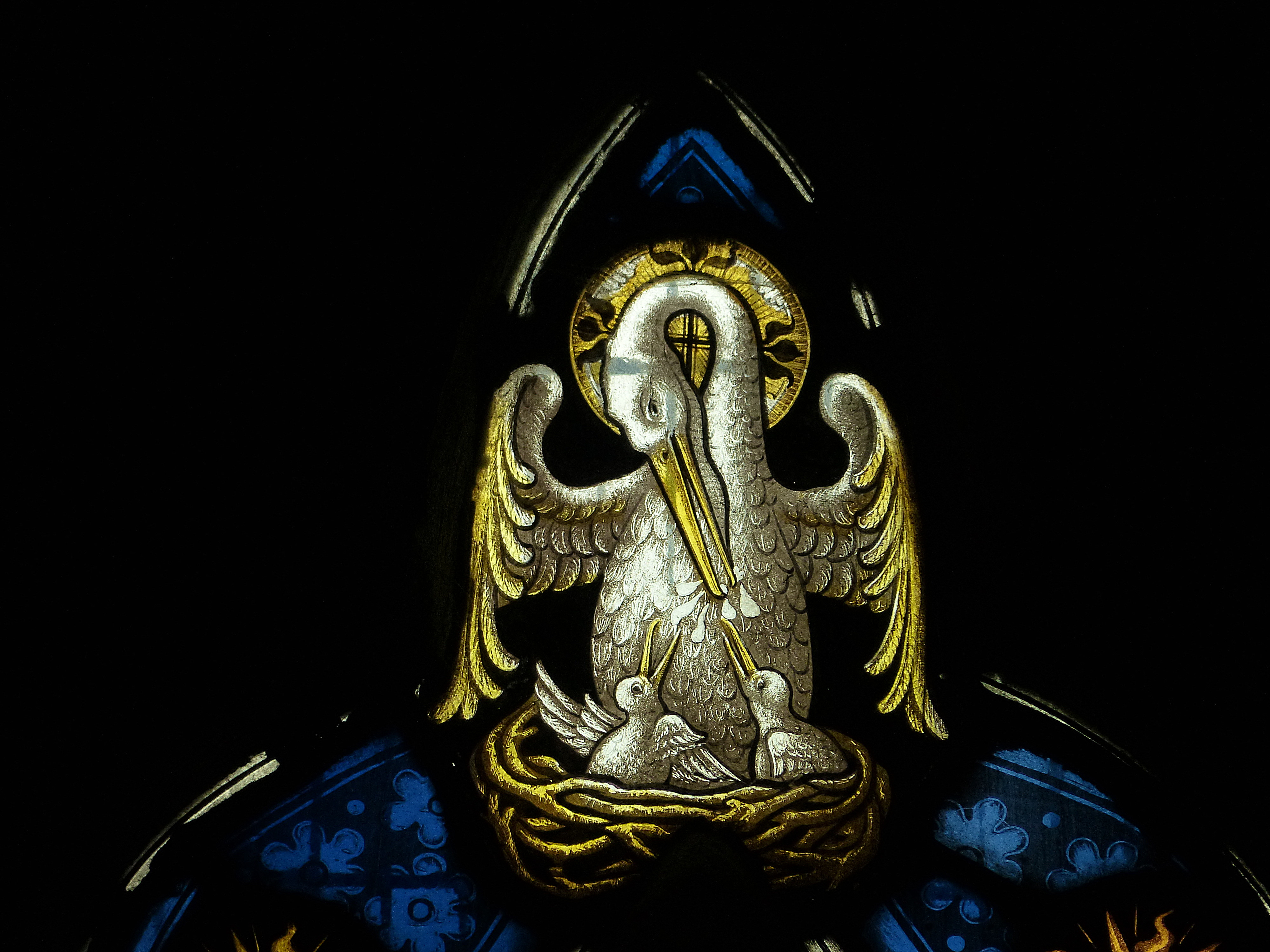
The pelican was one of the most popular animal symbols for Christ in the Middle Ages, appearing widely in art and literature. The association was first made in the Physiologus, a Late Antique Greek compilation of moralized animal lore written (probably around the year 200) in Alexandria and intended for Christian edification. Its anonymous author says the mother pelican is such “an exceeding lover of its young” that, to revive them from death, she pierces her breast with her beak and spills her blood over them.
The church sometimes refers to this allegorical bird as the vulning pelican (from the Latin vulnerō, “to wound”), or the Pelican in Her Piety.
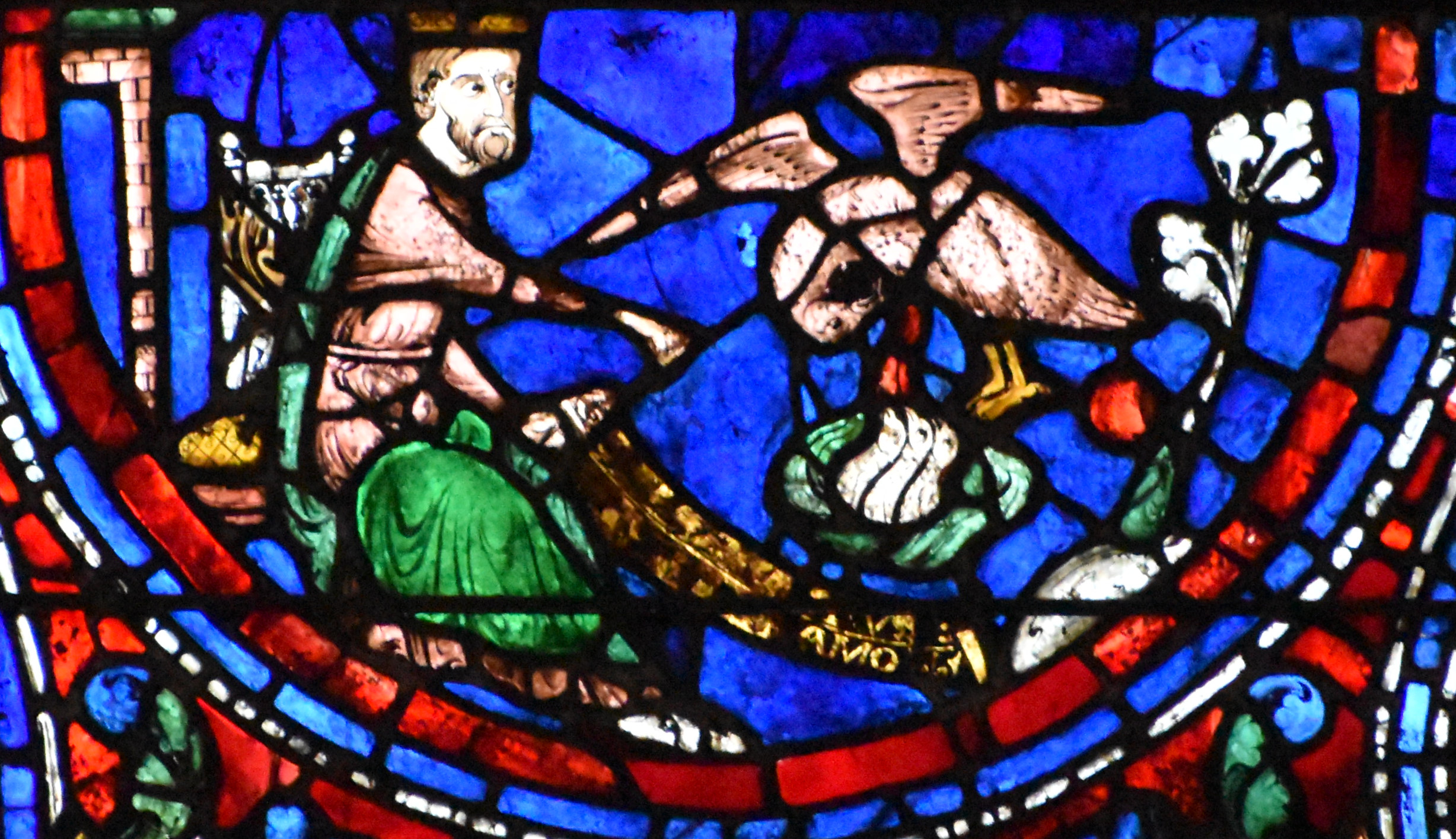
The Christological parallel is obvious: Jesus submitted to being pierced with nails and spear on the cross, his heart’s blood spilt, in order to give life to his children. But the Physiologus cites a more obscure biblical passage: “ὡμοιώθην πελεκᾶνι ἐρημικῷ” (Ps. 101:7a LXX). In the Latin Vulgate, that’s “Similis factus sum pelicano solitudinis,” and in English, “I am like a pelican of the wilderness” (Ps. 102:6a KJV). The Physiologus author puts these words of the psalmist, which express a sense of isolation, into the mouth of Christ, lonely in his messianic ministry and in his passion.
Detail from the 13th-century Redemption Window at Chartres Cathedral in France, showing a pelican (a figure of Christ) feeding her young with her own blood as King David looks on, holding a scroll with the inscription “Similis factus sum pellicamo,” from Psalm 102:6. Photo: Adrian Barlow. There are similar glass panels at Rouen and Le Mans.
Not all parts of the pelican legend recounted in the Physiologus map easily onto Christ’s love for his church. The chicks are dead because they kept striking their parents in the face, and their parents, striking back, killed them. The parents feel bad, and it’s after three days of mourning that mama bird breaks herself open to bring back her little ones.
In his commentary on Psalm 102, Augustine writes, “Let us not pass over what is said, or even read, of this bird, that is, the pelican.” Standing over her dead chicks, “the mother wounds herself deeply, and pours forth her blood over her young, bathed in which they recover life. This may be true, it may be false: yet if it be true, see how it agrees with him, who gave us life by his blood. It agrees with him in that the mother’s flesh recalls to life her young with her blood; it agrees well. For he calls himself a hen brooding over her young. If, then, it be so truly, this bird does closely resemble the flesh of Christ, by whose blood we have been called to life.”
Augustine then goes on to explain how the mother’s killing her young relates to God metaphorically killing our old self so that he can then raise us up to new life in Christ; he likens conversion to death and rebirth. Medieval theologians loved to stretch allegories to the extreme!
A more streamlined version of the pelican legend that got passed down omits the filicide, focusing simply on the bird’s animating sacrifice—on how her shed blood raises the dead to life. And after the Feast of Corpus Christi was established in 1311, a variant emerged that said the pelican feeds her young with her blood when no other food would satisfy, a picture that resonated with the increased attention on the Eucharist in the Latin West.
The Physiologus, which contains the earliest known appearance of the pelican legend, was translated from Greek into Latin sometime between the fourth and early sixth centuries, and from there into Ethiopic, Armenian, Syriac, and a multitude of European and Middle Eastern vernaculars. By the end of the twelfth century its legends were absorbed into the bestiary, a genre of popular nature-book in keeping with the encyclopedic taste of the High Middle Ages.
In Art
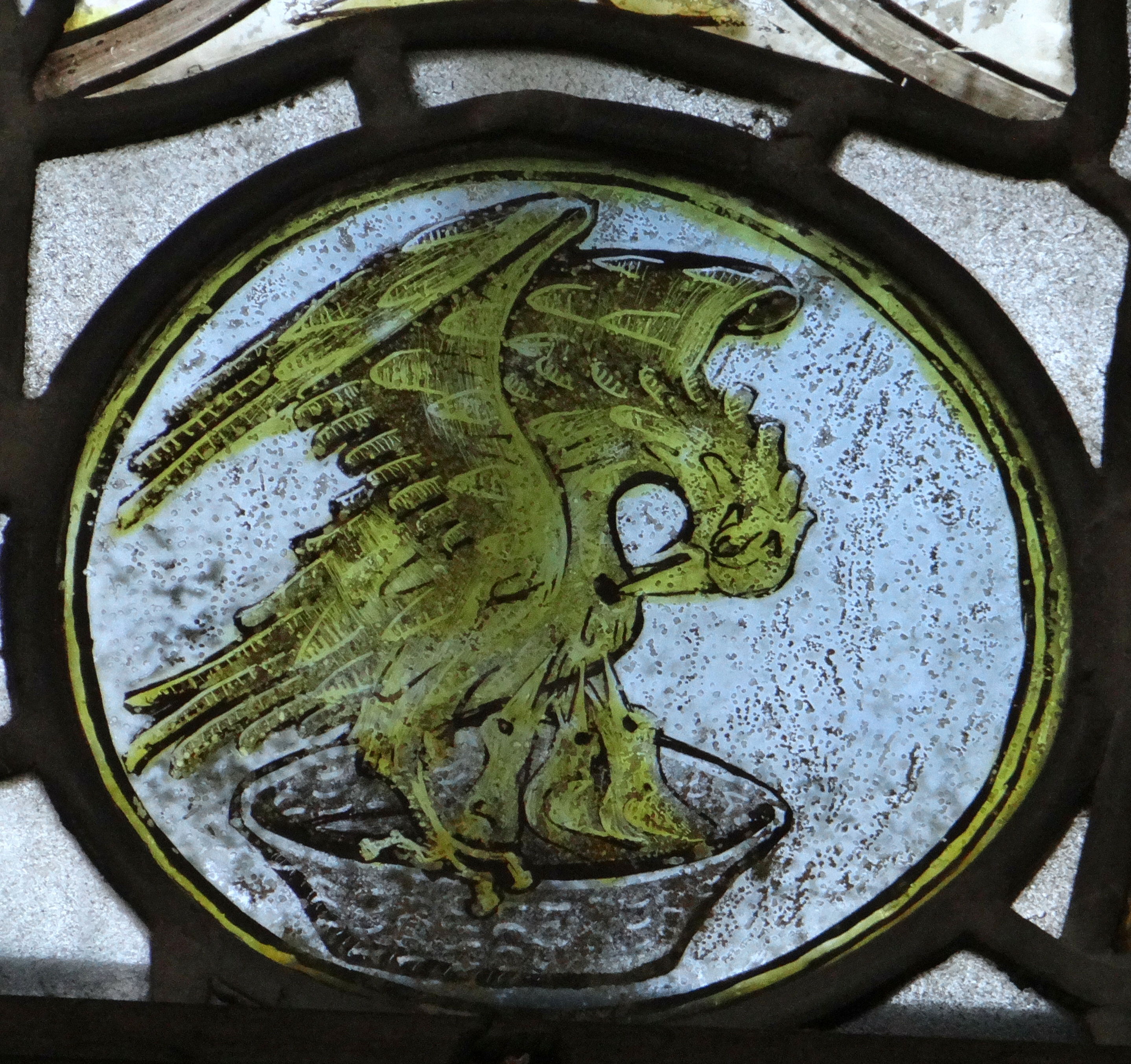
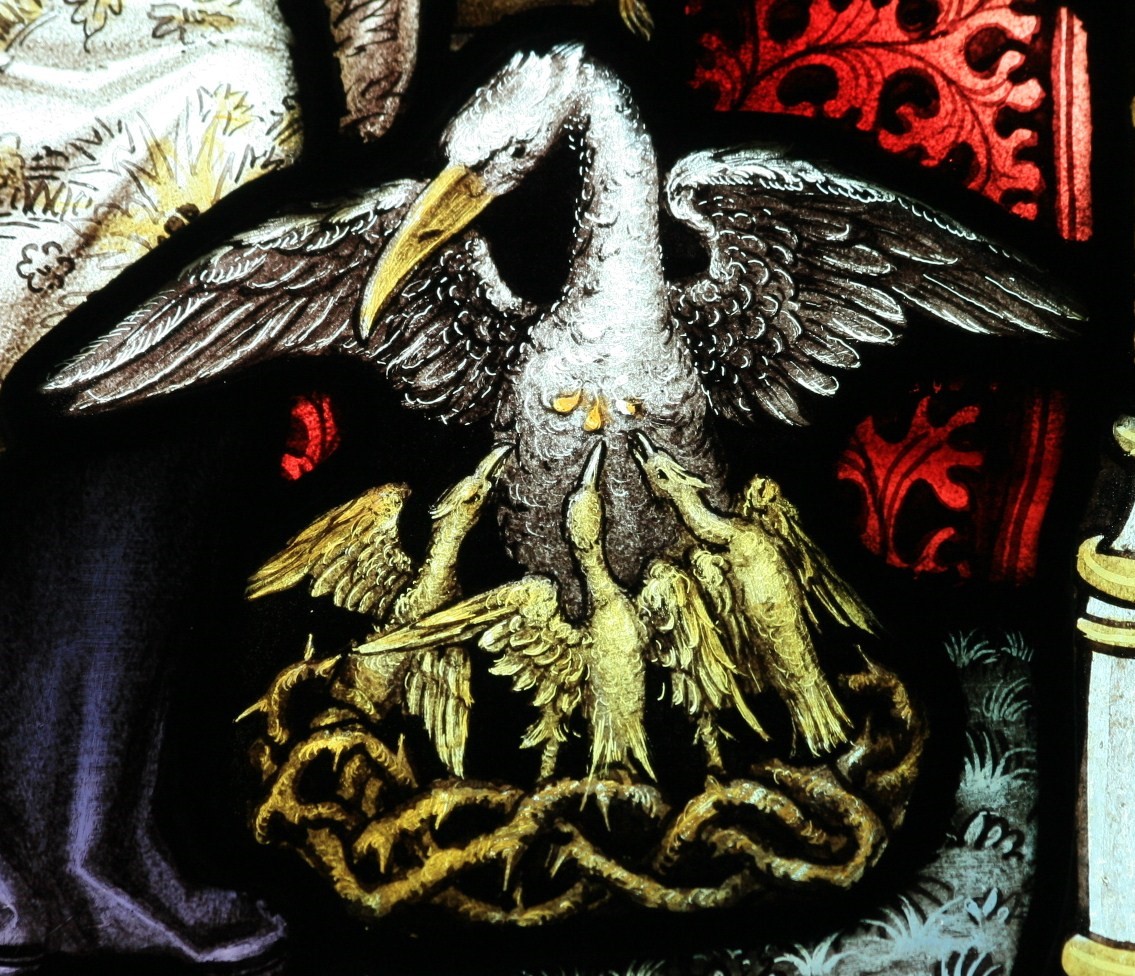
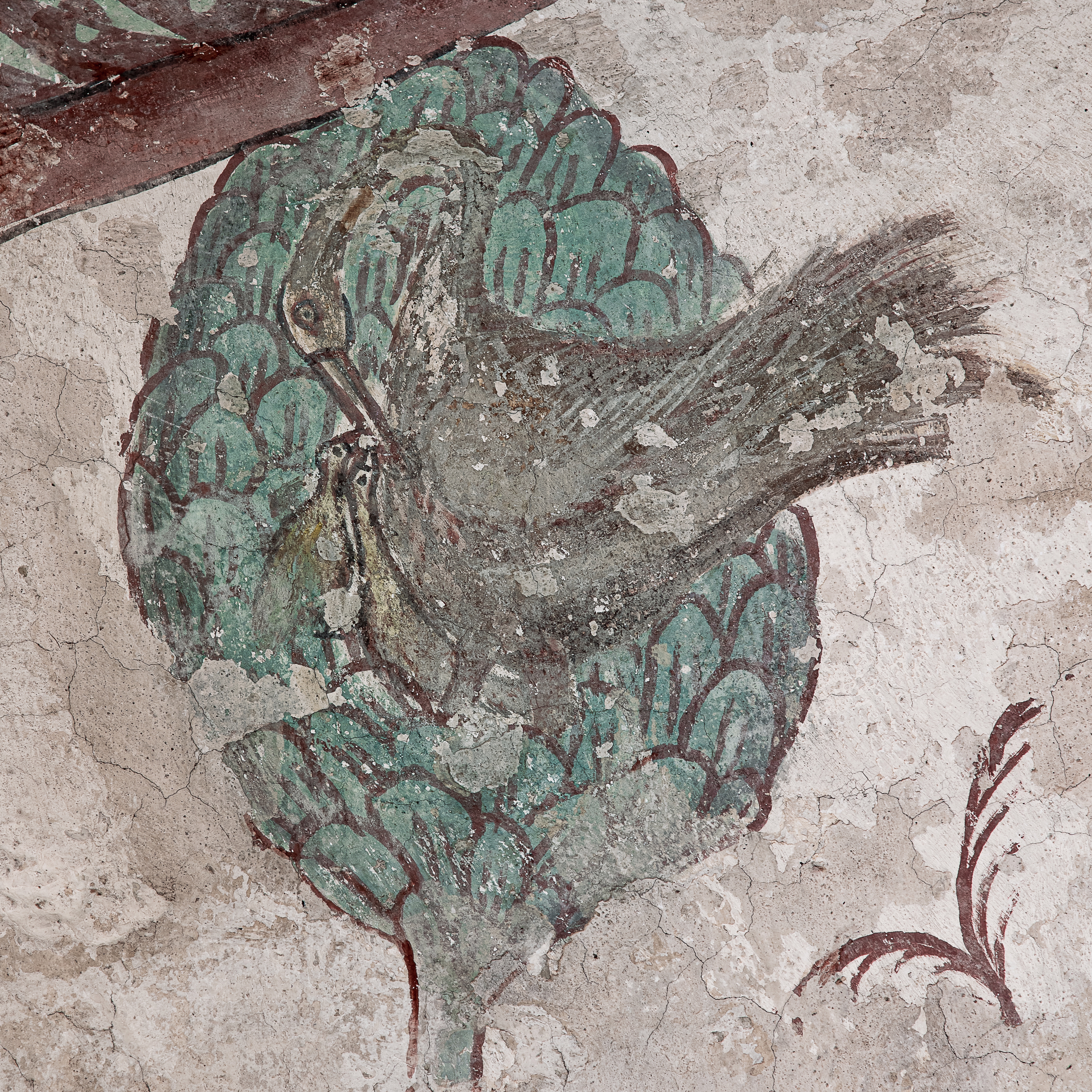
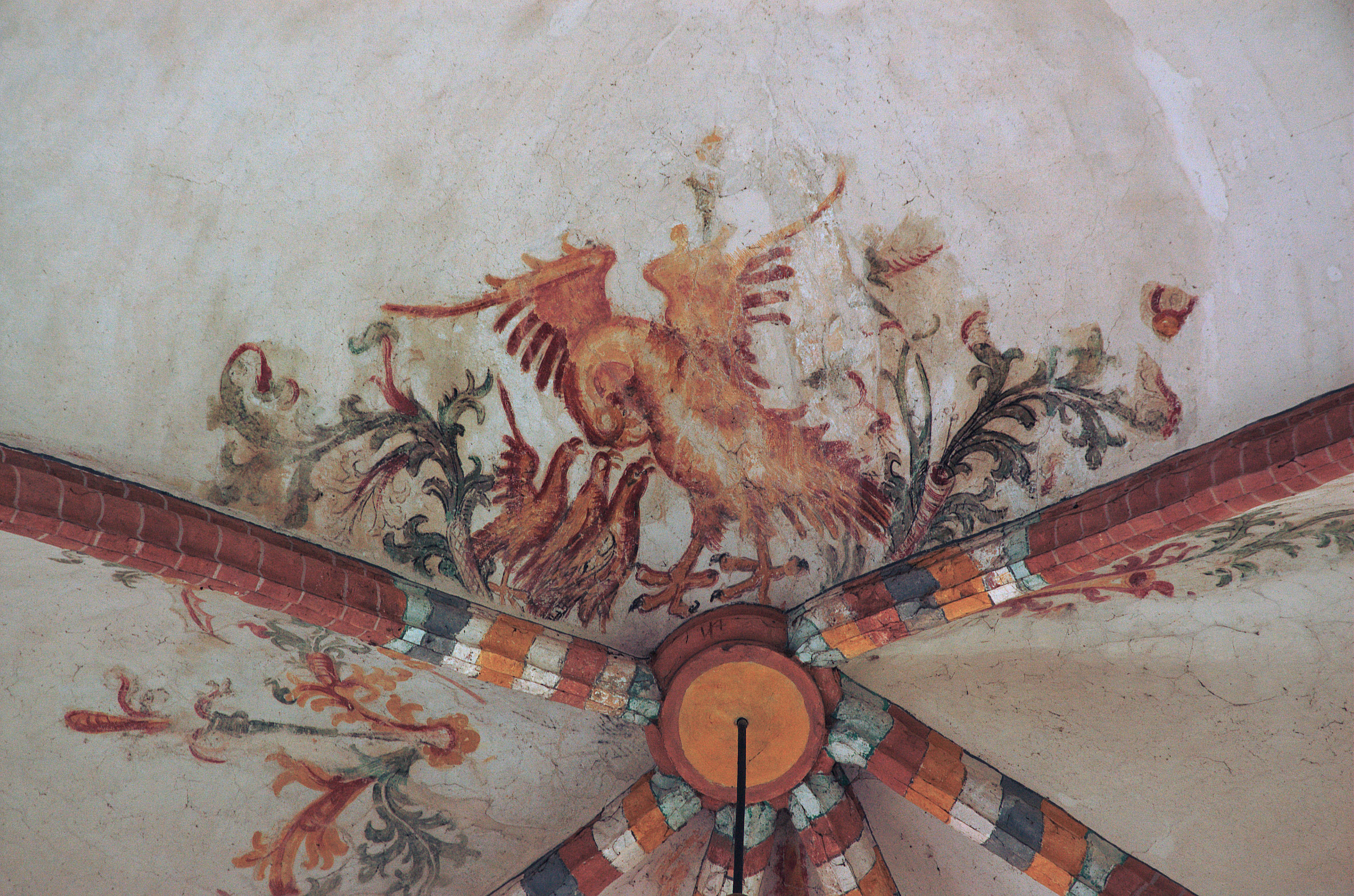
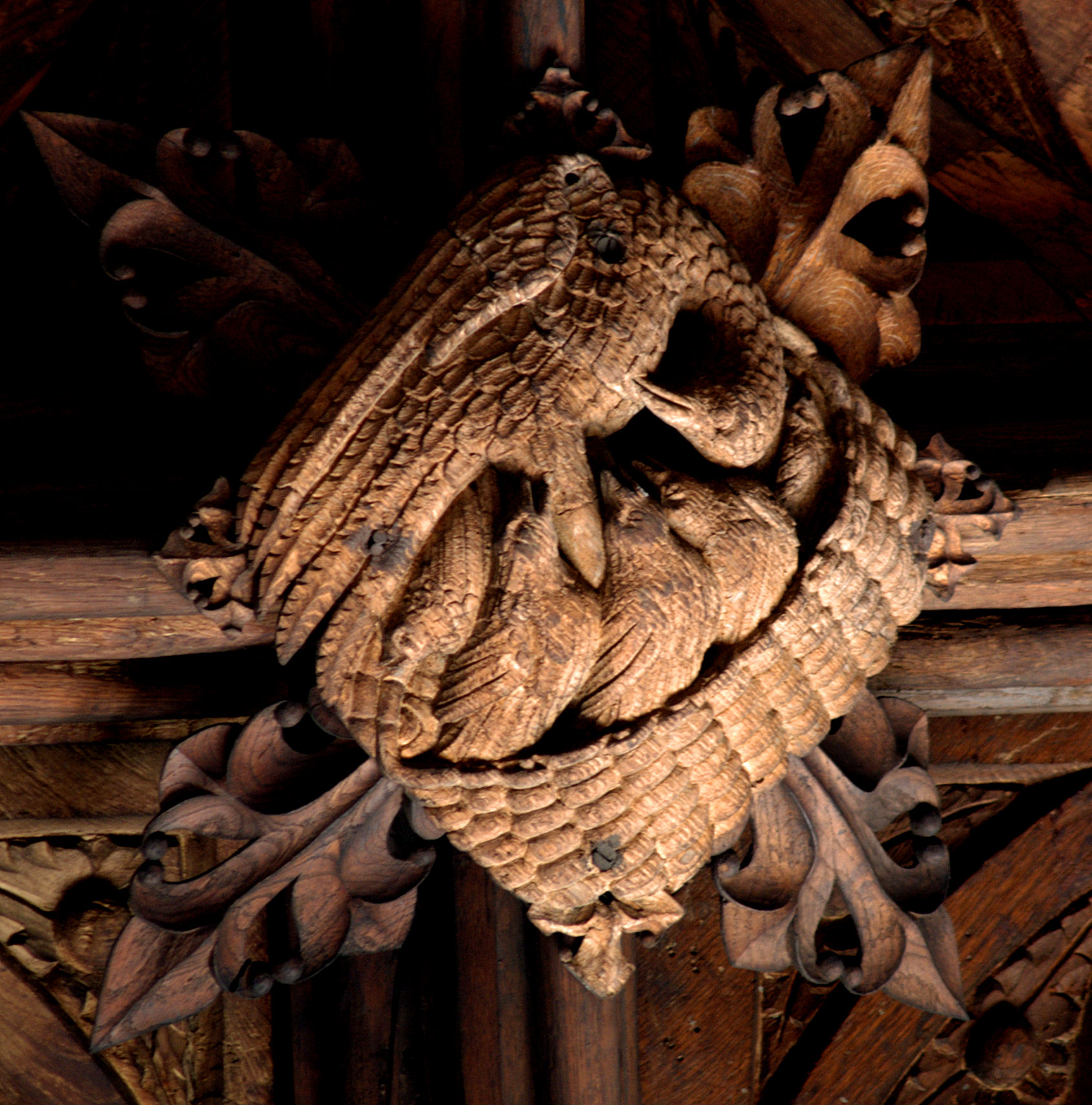
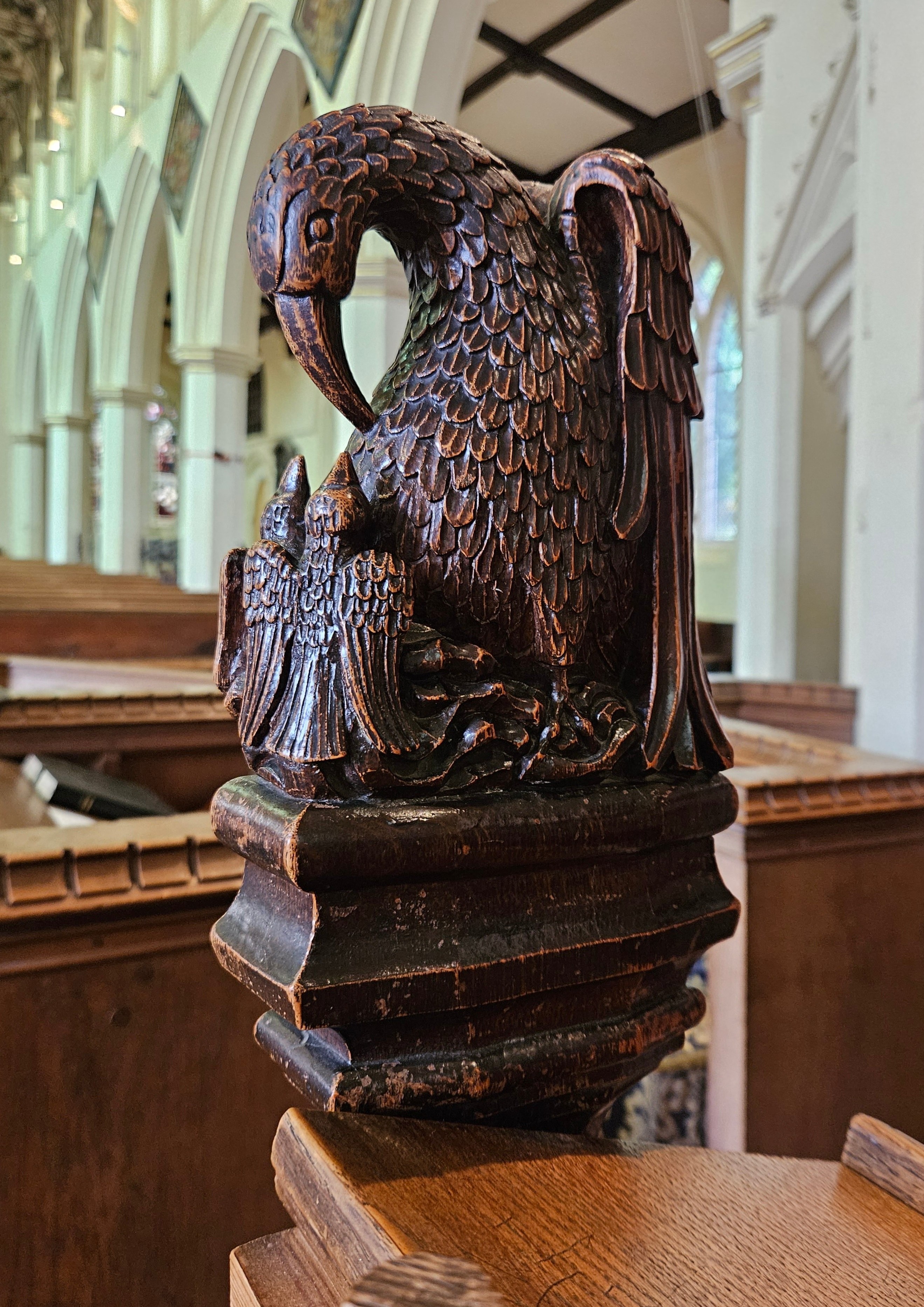
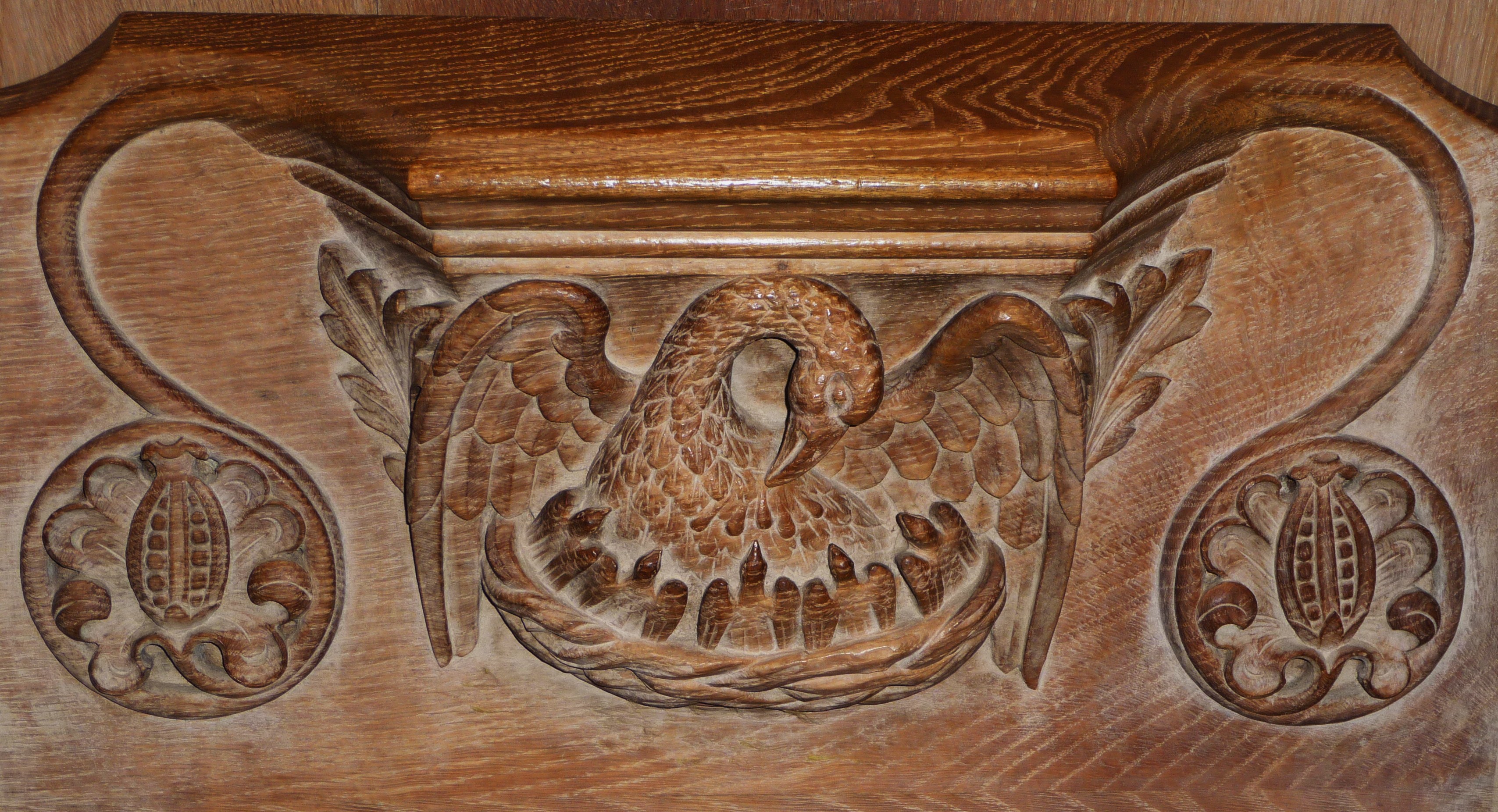
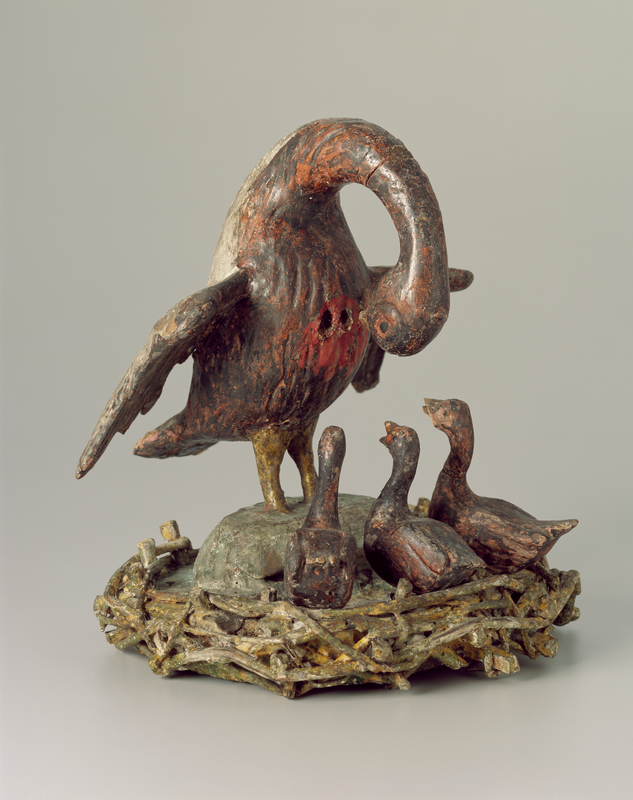
The vulning pelican has appeared in all kinds of visual media from late antiquity through the medieval and premodern eras and on into the twentieth and twenty-first centuries, including illuminated prayerbooks, missals, bestiaries (as in the tiled gallery below; hover to view captions, or click to enter carousel); panel paintings, frescoes; mosaics; stained glass windows; tapestries; lecterns, roof bosses, bench ends, misericords, corbels; and a range of liturgical objects and vestments.
From a miscellany containing an illustrated copy of Hugh of Fouilloy’s De avibus, Italy, late 13th or early 14th century. Biblioteca Statale di Cremona, MS 199, fol. 11v. https://bestiary.ca/beasts/beastgallery244.htm
From an illuminated copy of Der Naturen Bloeme (The Flower of Nature) by Jacob van Maerlant, Flanders, ca. 1350. The Hague, Koninklijke Bibliotheek, KA 16, fol. 96vb. https://manuscripts.kb.nl/show/images/KA+16/page/26
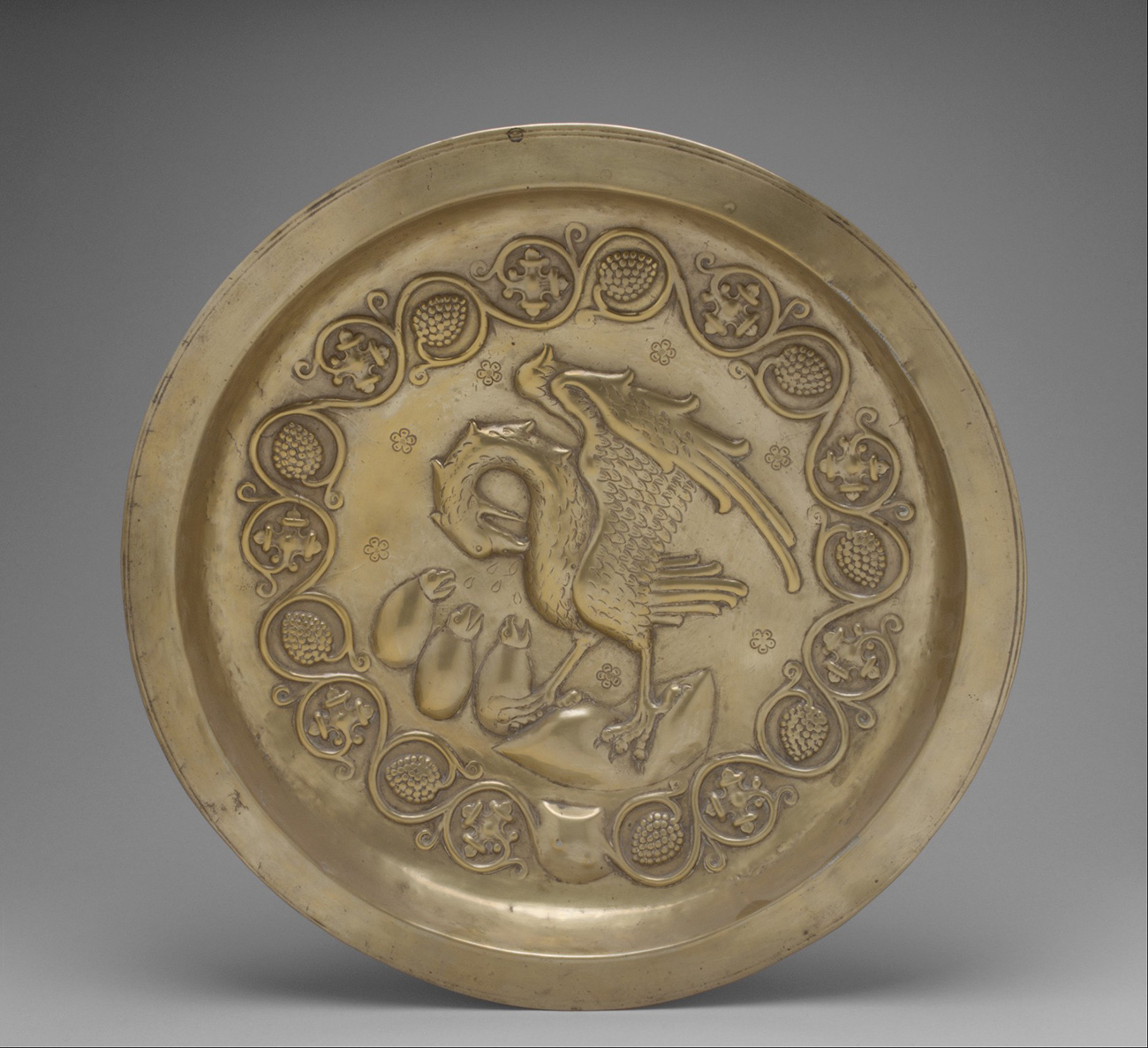
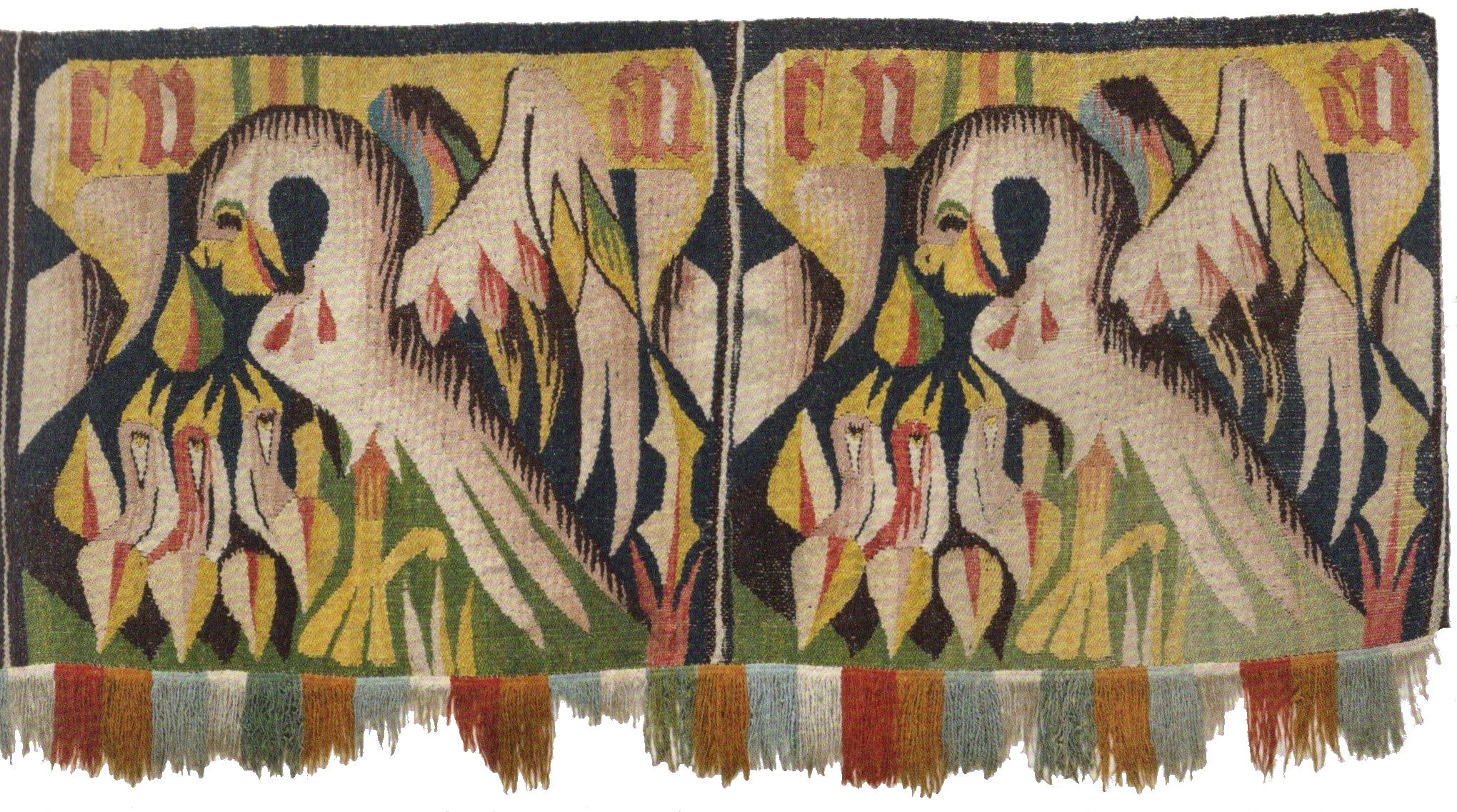
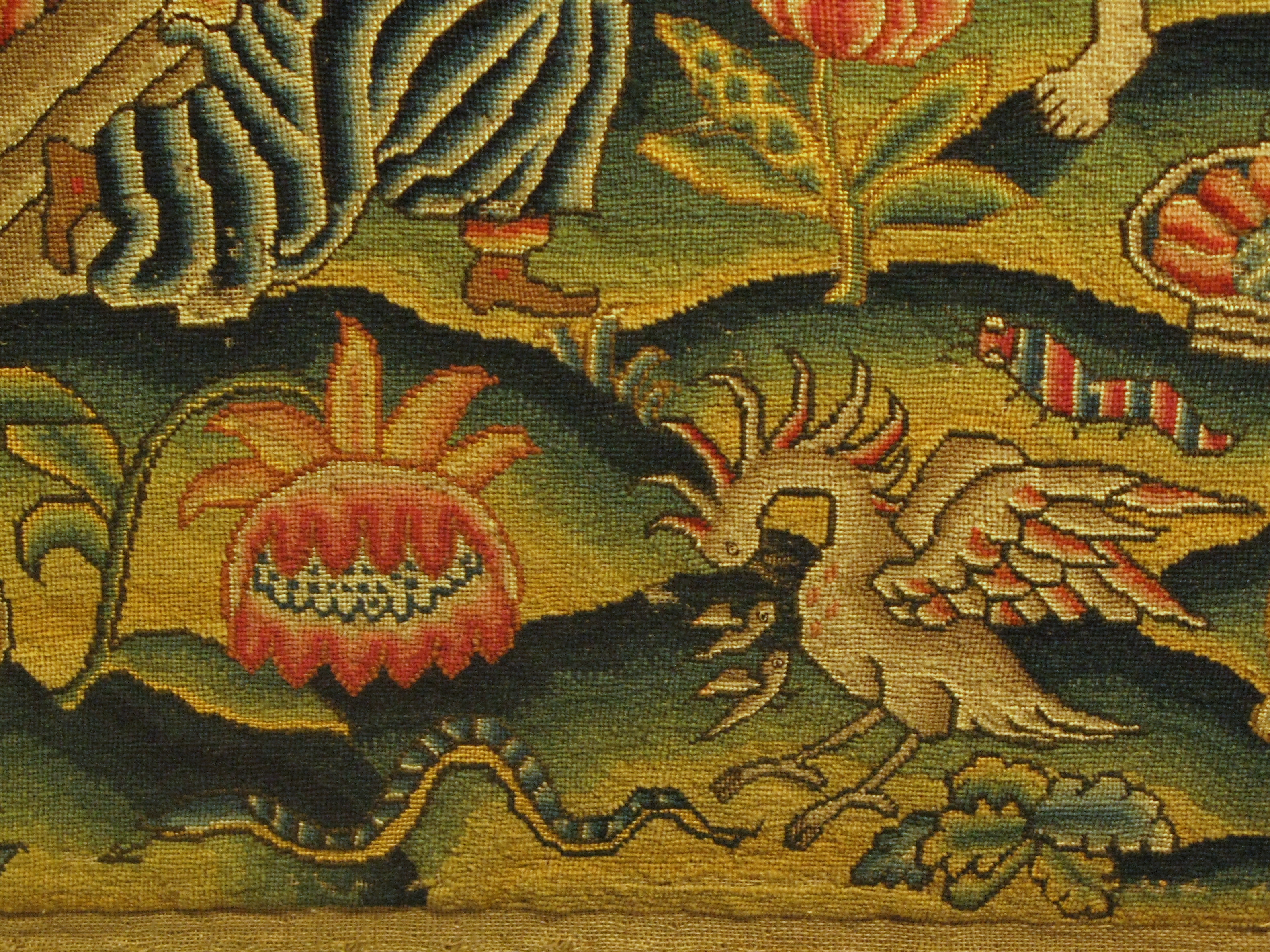
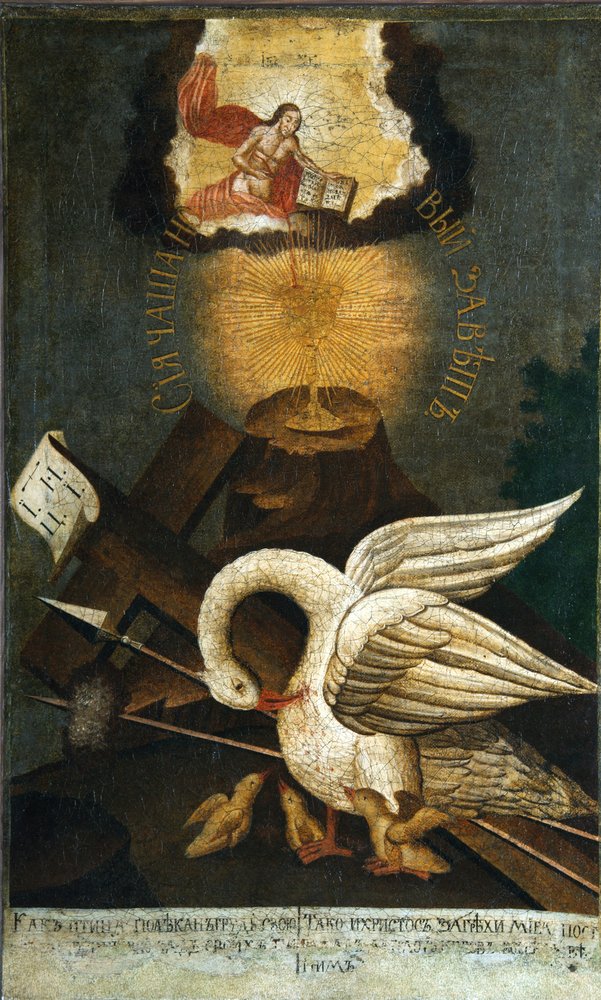
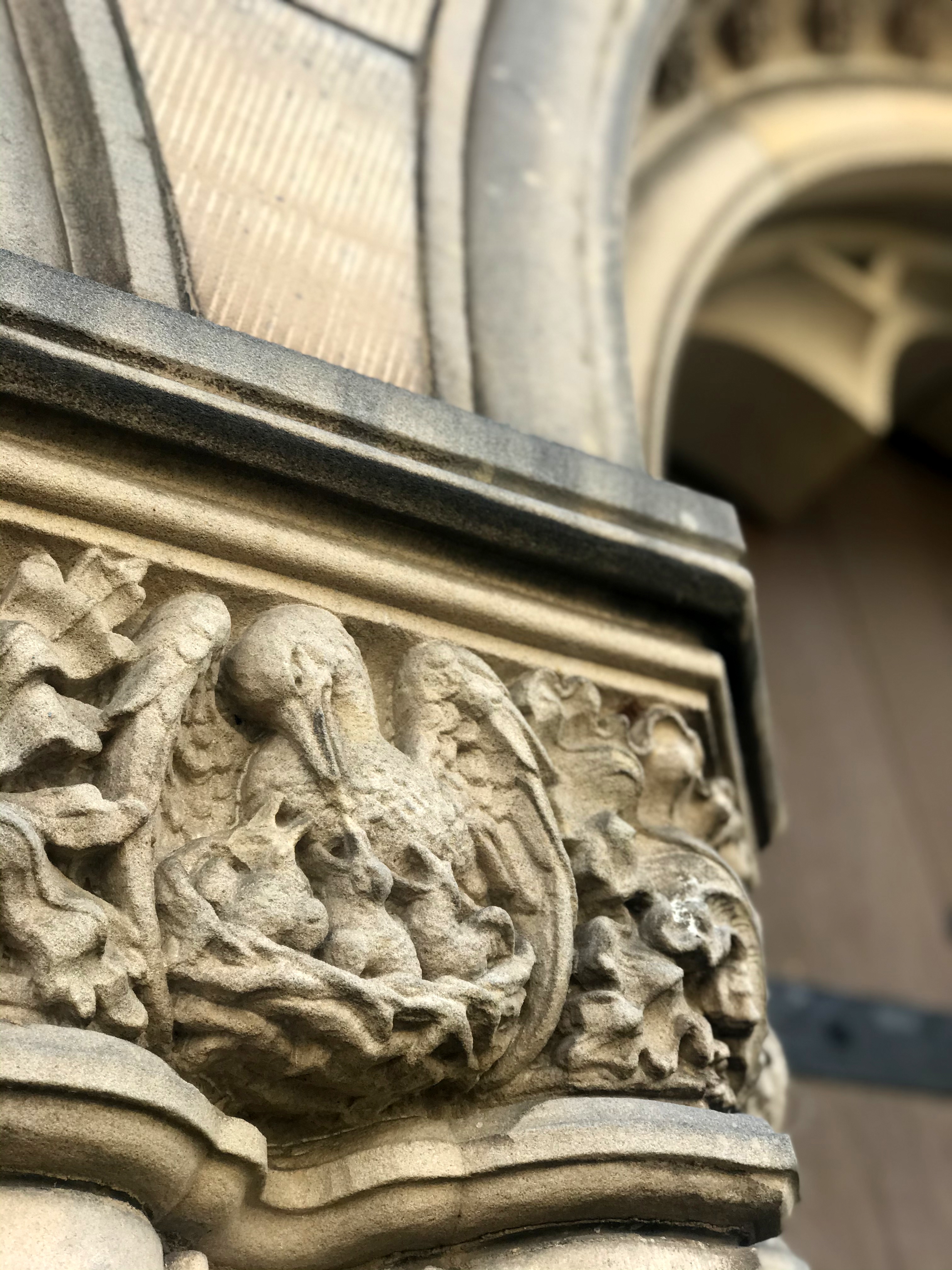
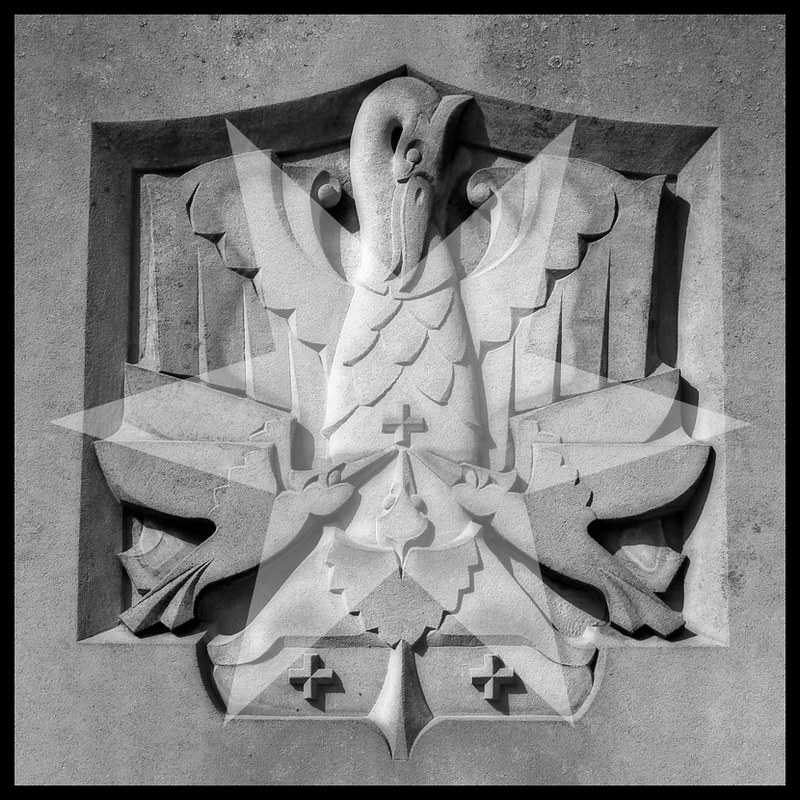
Pelican in Her Piety, 1331–32. Stained glass, Lady Chapel, St Michael and All Angels, Felton, Northumberland, England. Photo: Ann Chapman.Pelicanin Her Piety, 15th century. Stained glass, All Saints Church, Oaksey, England. Photo: Rex Harris.Pelican in Her Piety, All Saints Church, Bishop Burton, East Riding of Yorkshire, EnglandPelican in Her Piety, 1476. Fresco, Bollerup Church, Sweden. Photo: Stig Alenas.Painted choir vault, 15th century, Mariakerk (St. Mary’s Church), ‘t Zandt, Groningen, Netherlands. Photo: Ana Sudani.Oak wood roof boss, ca. 1470–80, St Mary the Virgin, Shrewsbury, Shropshire, England. Photo: Ana Sudani.Bench end by Henry Ringham, 19th century, St Margaret, Ipswich, Suffolk, England. Photo: Simon Knott.Carved oak misericord from Sheffield Cathedral, England, 1920Sculpture with Pelicans, Switzerland, 16th century. Painted linden and willow wood, 29.5 × 27 × 26 cm. Landesmuseum (Swiss National Museum), Zurich, LM-3972.Triptych with the Virgin and Child (detail), Cologne or Lower Rhine, ca. 1425–30. Tempera and gold leaf on oak wood. LVR-LandesMuseum Bonn, Germany. [view full triptych]Plate with the Pelican in Her Piety, Dinant or Malines, Netherlands, 15th century. Brass, diameter 19 7/8 in. Metropolitan Museum of Art, New York. It’s unknown whether this plate was used domestically or liturgically (i.e., for the Eucharist).Tapestry with a Pelican Feeding Her Young (detail), Germany (Lüne Abbey), ca. 1500. Linen and wool, 65 × 233 cm. Kloster Lüne Museum für sakrale Textilkunst, Lüneburg, Germany, Inv. LUEKO Ha 010.05. Source: Book of Beasts: The Bestiary in the Medieval World, cat. 41bCushion cover (detail), England, ca. 1640–70. Wool and silk embroidery on linen, 55.9 × 107.5 cm. Victoria and Albert Museum, London. The primary scenes are the Hospitality of Abraham and the Sacrifice of Isaac. [view full cushion]Pelican in Her Piety, Russia, early 19th centuryPelican in Her Piety, 1907–9. Relief carving from the exterior of Holy Trinity Church, St Andrews, Scotland. Photo: Joy Marie Clarkson.Pelican of Mercy, 1956. Stone relief carving, exterior of Blessed Sacrament Catholic Church, Sioux City, Iowa.
The bird doesn’t always look like an actual pelican, though. It could be that some of the artists had never seen one, although the Dalmatian pelican, which has the long bill and the expandable throat pouch that we most associate with the genus, had been widespread across Europe since ancient times. More likely, the imaginative rendering of the pelican in Christian art derives from the account of the bird in book 12 (“De animalibus”) of the widely influential compendium Etymologies by the Spanish archbishop Isidore of Seville, written around 623, which repeats the popular legend and adds that the pelican lives in Egypt. An exotic bird therefore required exotic treatment.
Neither does the behavior the Physiologus ascribes to pelicans have any basis in natural fact. It’s possible the legend arose from the observation that the pelican sometimes bends its beak into its chest, which may look like it’s piercing it, and that some pelicans have a reddish tinge on their breast plumage and/or a red tip on their beak. However, zoological accuracy was not the point; the point was to convey theological truth.
In The Bestiary of Christ, Louis Charbonneau-Lassay says the pelican first started appearing as a Christian symbol on clay oil lamps in ancient Carthage (present-day Tunisia), citing “L. Delattre, Carthage,Symboles eucharistiques, p. 91”—the French archaeologist Alfred Louis Delattre (1850–1932). But I’ve not been able to track down the cited text or find any such examples. If you can point me to photographs, please do!
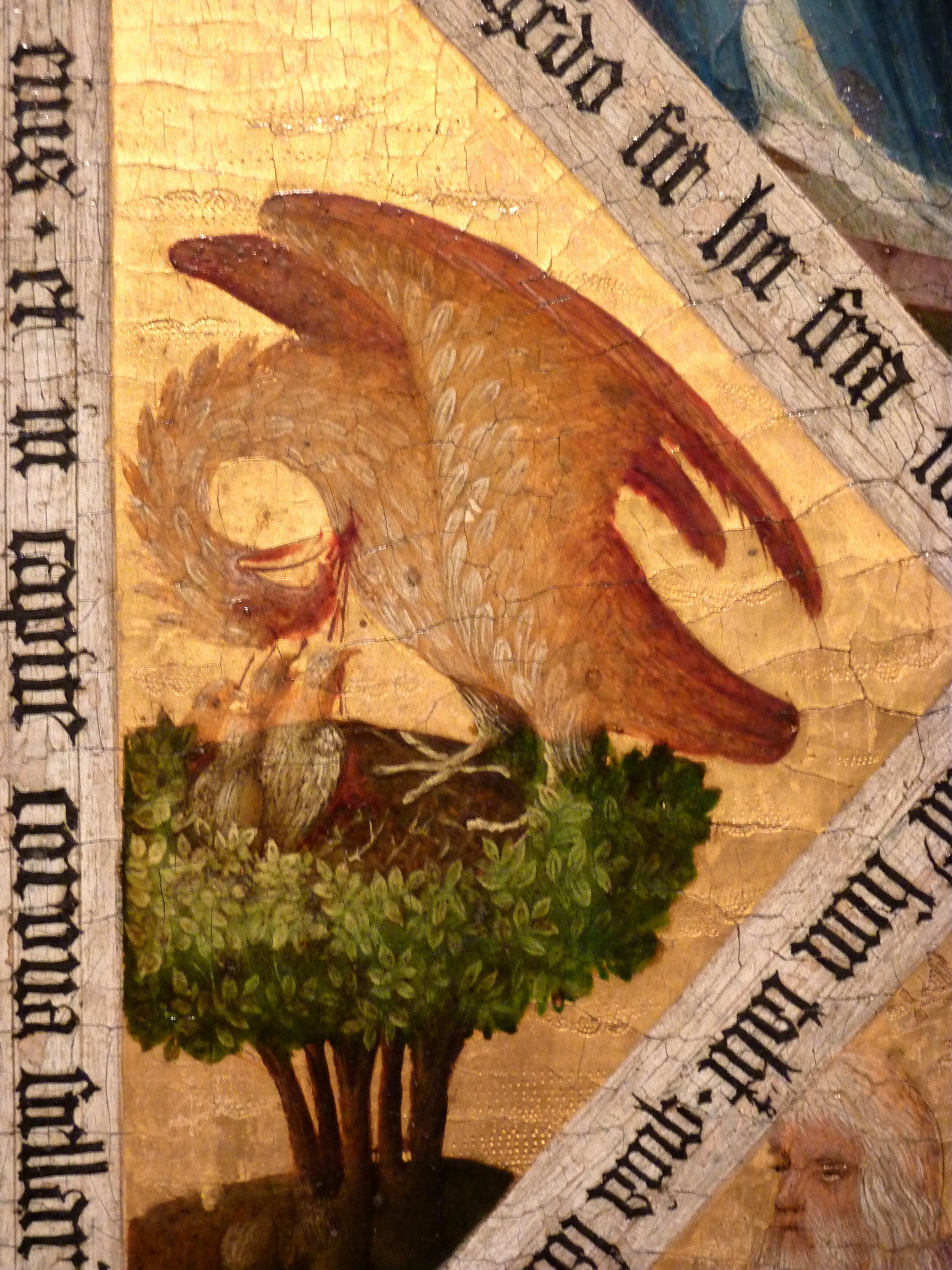
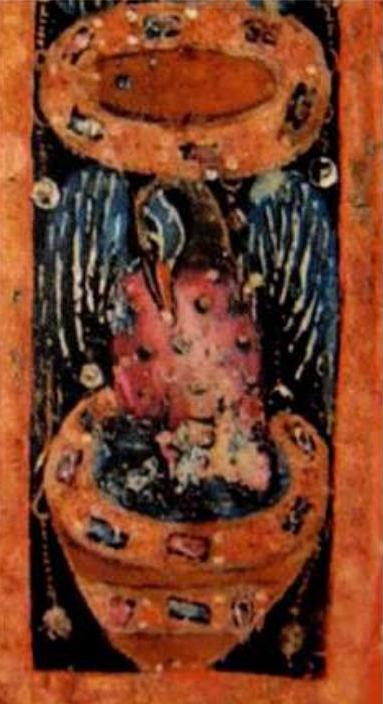
In the “Ējmiacin [Etchmiadzin] Codex” entry in The Eerdmans Encyclopedia of Early Christian Art and Archaeology, Paul Corbey Finney identifies the border illustrations in that Armenian Gospel book’s Baptism of Christ miniature from ca. 600 as depicting a pink-bodied pelican spreading its blue wings and pecking its breast while standing in a bejeweled chalice. The figure is repeated ten times.
Pelican detail from The Baptism of Christ in the Codex Etchmiadzin, an Armenian Gospel book. Yerevan, Mesrop Mashtots Institute of Ancient Manuscripts (Matenadaran), Cod. 2374, fol. 229v. The image is dated to ca. 600, but it was added to a 10th-century manuscript.
Finney mentions that a vulning pelican also appears in the Rabbula Gospels from sixth-century Syria. I think he’s referring to the bird at the top of the canon tables on folio 5a, which also shows the prophets Joel and Hosea and the Wedding at Cana. The iconography is far less obvious here.
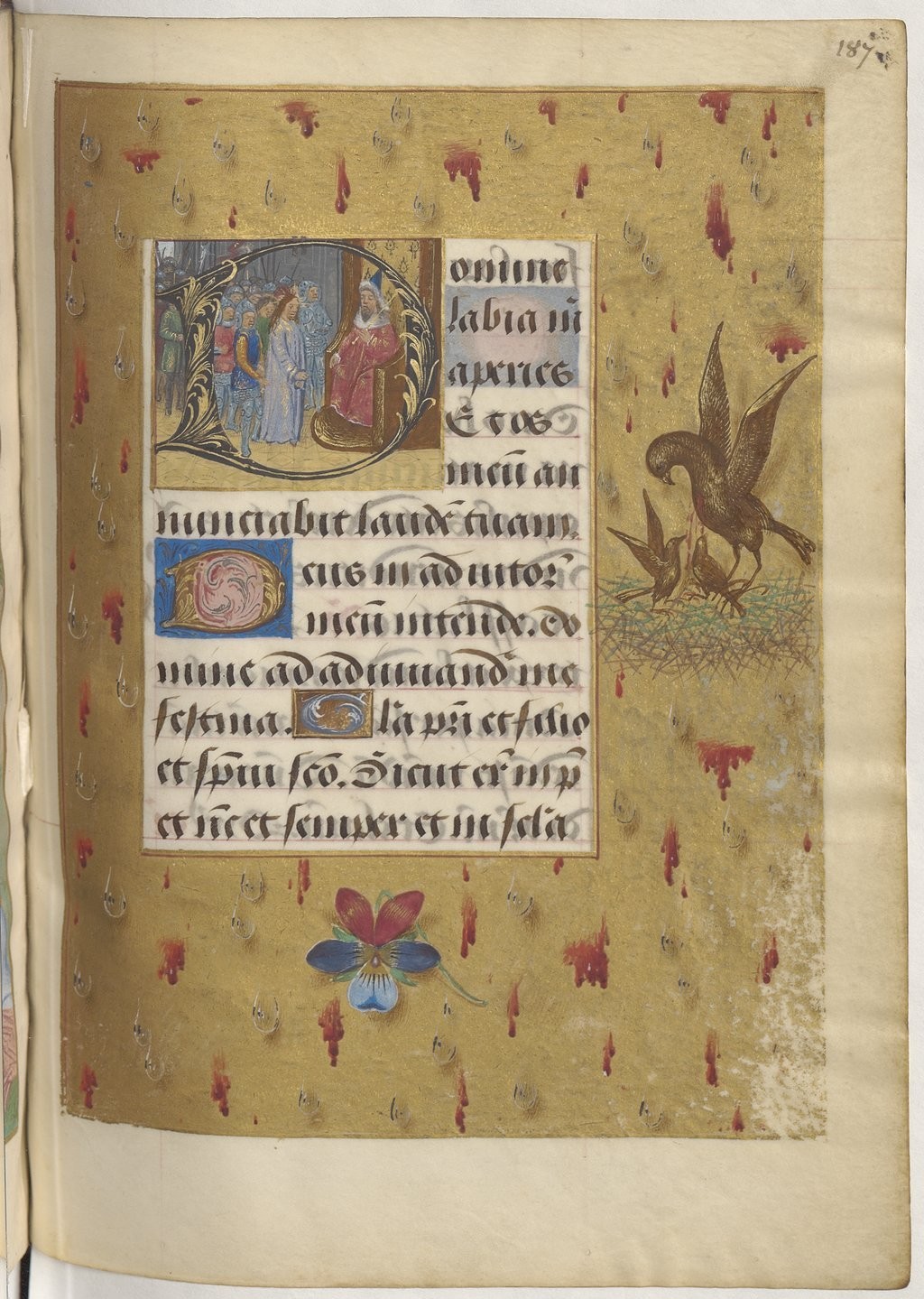
One illuminated manuscript page I love that makes use of the pelican symbol comes from the late Flemish Boussu Hours, a prayerbook made for Isabelle de Lalaing, probably after the death of her husband Pierre de Hennin, lord of Boussu.
Master of Antoine Rolin (Flemish, active 1490–1520), Le pélican, symbole du Christ (Pelican, symbol of Christ), from the Boussu Hours, Cambrai, France, ca. 1490–95. Paris, Bibliothèque de l’Arsenal, Ms 1185 réserve, fol. 187r.
Appearing opposite a full-page miniature of Christ in Gethsemane, folio 187r opens the Hours of the Passion prayer cycle:
V: Domine labia mea aperies. R: Et os meum annunciabit laudem tuam. V: Deus in adiutorium meum intende. R: Domine ad adiuvandum me festina. Gloria Patri, et Filio: et Spiritui sancto. Sicut erat in principio, et nunc, et semper: et in saecula saeculorum.
English translation:
V: O Lord, open my lips, R: And my mouth shall declare thy praise. V: Incline unto my aid, O God. R: O Lord, make haste to help me. Glory be to the Father, and to the Son, and to the Holy Ghost, as it was in the beginning, is now, and ever shall be: world without end.
The historiated initial “D” shows Christ before Pilate, and in the margin a pelican exudes her lifeblood into the mouths of her two chicks, a scene set against a gold background likewise dripping with blood—as well as sweat and tears. It’s “almost as if the gold margin were an expanded microcosm of the bird’s broken breast,” writes Katharine Davidson Bekker in her essay “Those Who Weep: Tears, Eyes, and Blood in the Boussu Hours.” Bekker further notes that “the pansy flower in the margin, the name of which references the French penser (‘to think’), . . . encourages the reader to think deeply about the images on the page.”
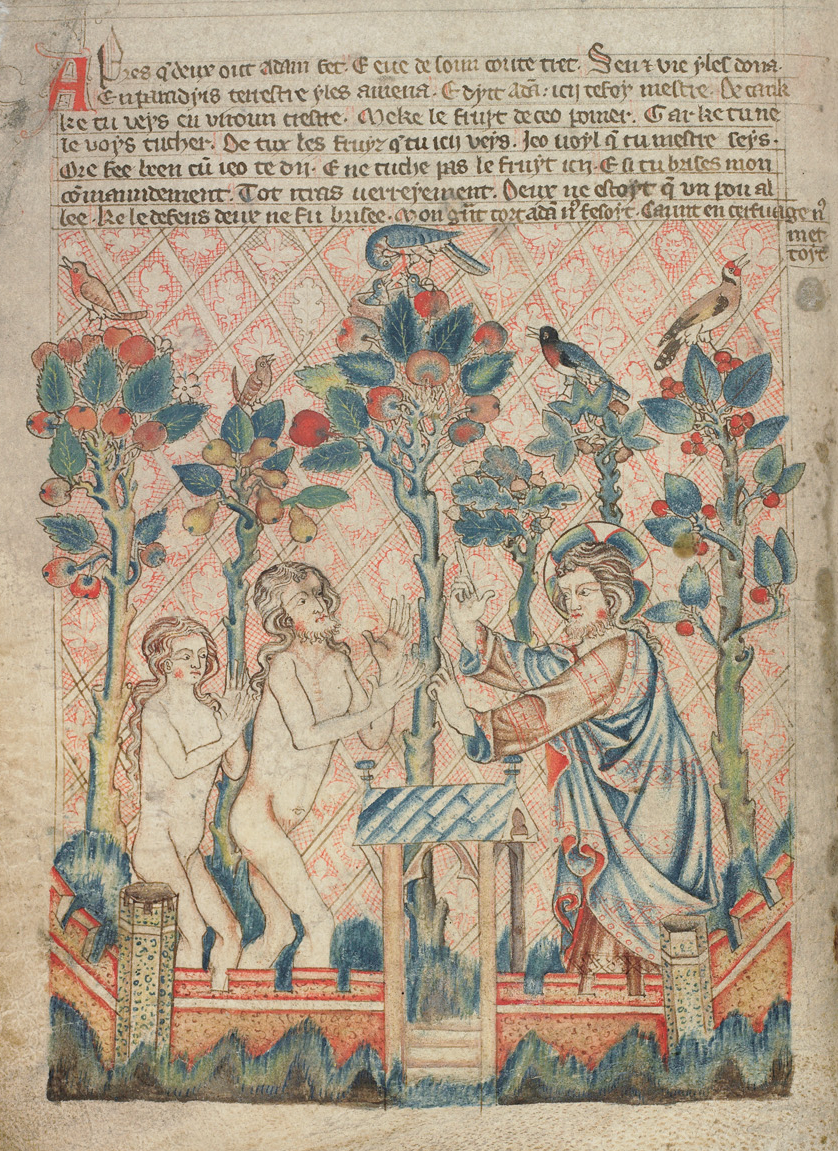
Another remarkable appearance of the pelican in medieval manuscript illumination is in the Holkham Bible Picture Book from fourteenth-century England—remarkable because it appears not in a passion cycle, as was typical, but in a creation cycle!
The Tree of Knowledge, from the Holkham Bible Picture Book, southeastern England, ca. 1327–35. British Library, Add MS 47682, fol. 3v.
In the garden of Eden, God the Creator, portrayed here as Christ, instructs Adam and Eve that they may freely eat of any tree except the tree of the knowledge of good and evil, which he points to with one hand and with the other wags his finger in a forbidding manner. Various birds perch atop the adjacent trees, but at the apex of this fateful one at the center is the vulning pelican, foreshadowing the sacrifice of Christ that will be required for humanity to reenter Paradise after the fall.
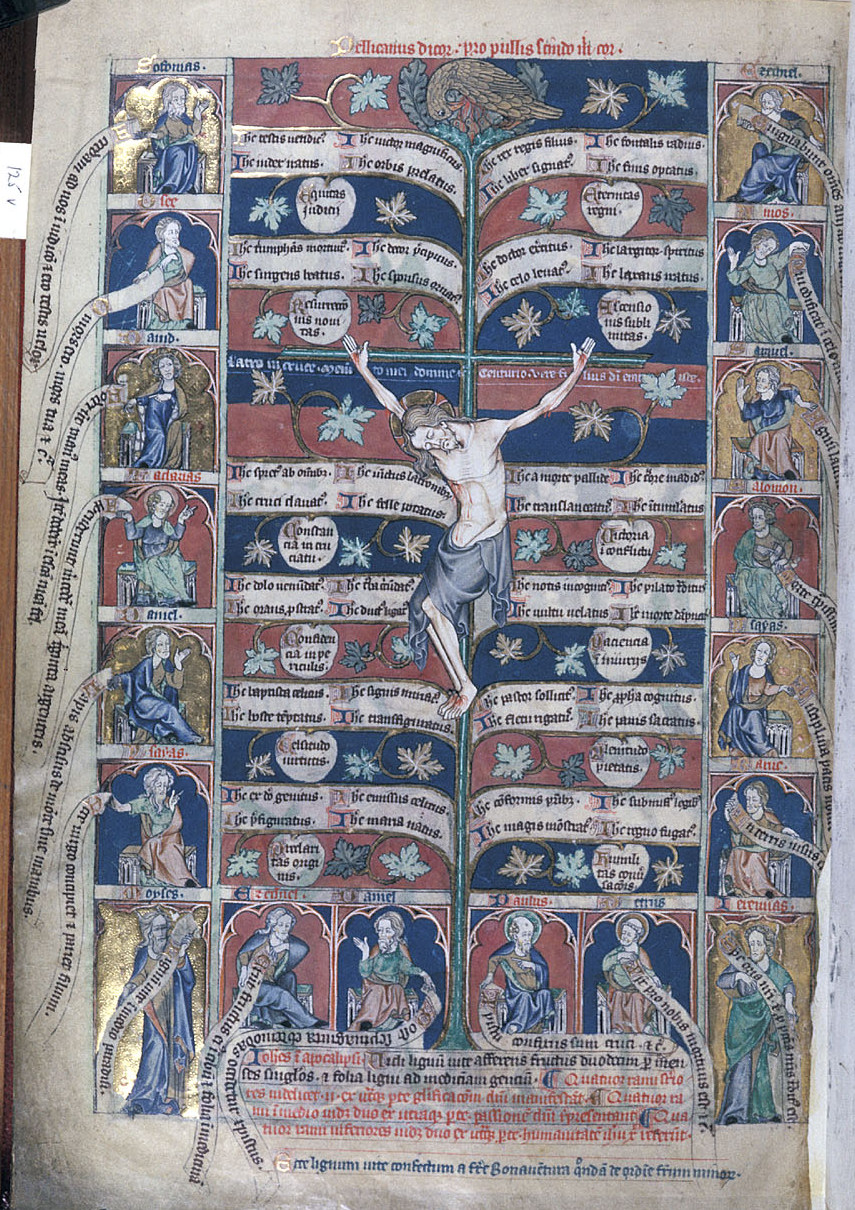
Compare this image to the diagrammatic one on folio 125v of the De Lisle Psalter, which was inspired by Bonaventure’s meditational treatise the Lignum vitae. It shows a pelican nesting atop the tree of life on which Christ is crucified, wounding herself to feed her offspring with her blood:
Tree of Life, from the De Lisle Psalter, England, 1310–39. London, British Library, Arundel MS 83, fol. 125v.
The Latin inscription above it in red reads, Pellicanus dicor, pro pullis scindo mihi cor (“I am called a pelican, because I tear open my heart for my chicks”). The twelve branches contain texts relating to Christ’s humanity, passion, and glorification, while the surrounding panels contain Old Testament witnesses.
The Crucifixion is the narrative context in which the vulning pelican most often appears in art, reinforcing the notion of Christ’s self-emptying sacrifice. It was especially popular in proto- and early Renaissance panel paintings from Italy—which the gallery below reflects, in addition to featuring a few other examples from France, Greece, and Armenia.
Fra Angelico, Christ on the Cross, the Virgin, Saint John the Evangelist, and Cardinal Torquemada (detail), ca. 1453–54. Harvard Art Museums / Fogg Museum, Cambridge, Massachusetts. Photo: Victoria Emily Jones [view full painting]
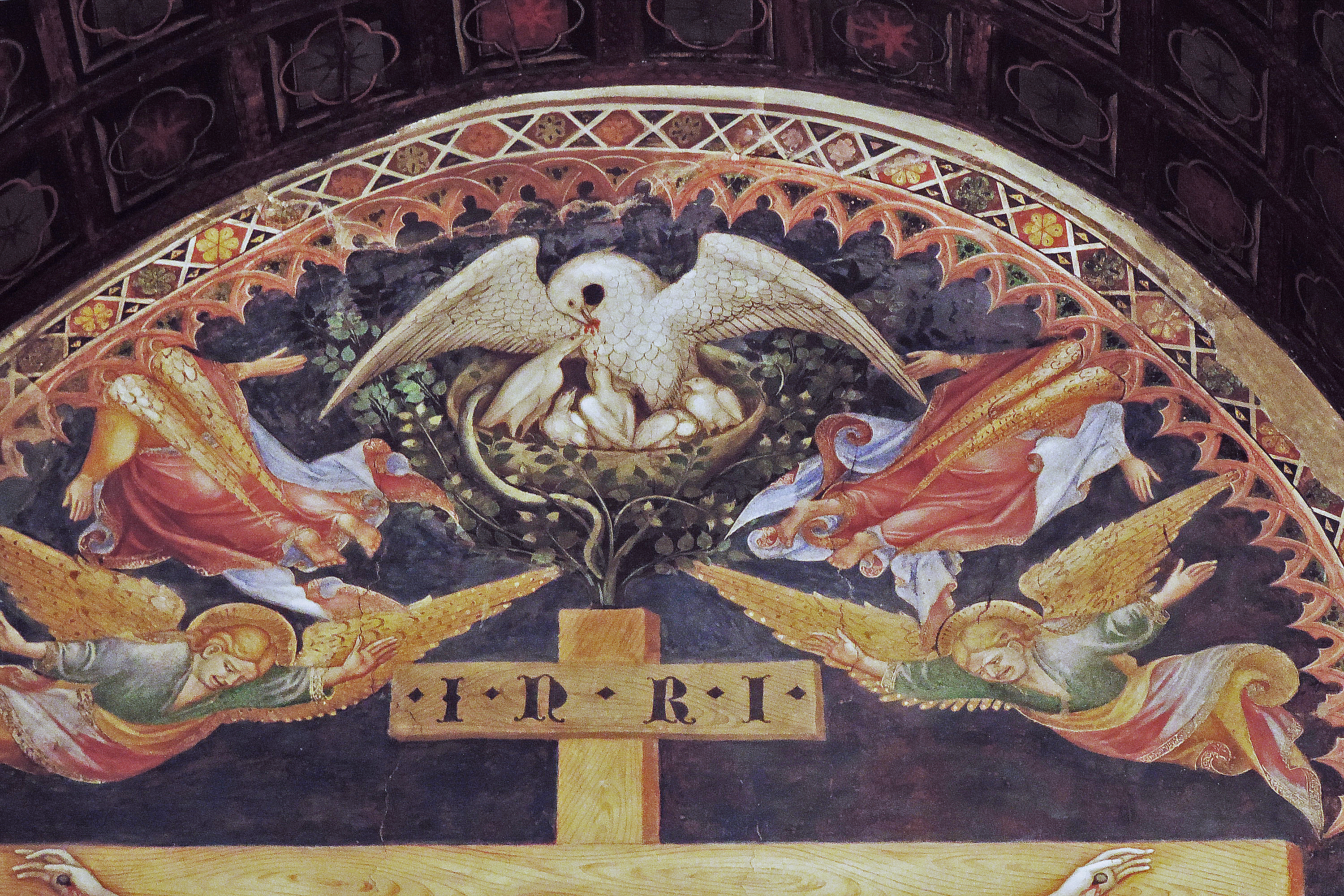
In the Simone di Filippo Benvenuti example above (third row, left), notice the little winged dragon fleeing the pelicans’ nest as the mother pelican undoes the harm he has inflicted. A similar detail can be found in the Crucifixion fresco from the altar wall of the Oratory of St. John the Baptist in Urbino, which shows a snake slithering away from the perishing chicks, who are brought back to life by their intervening mother:
Lorenzo Salimbeni (Italian, 1374–ca. 1418) and Jacopo Salimbeni (Italian, ca. 1370/80–after 1426), Crucifixion (detail), ca. 1416. Fresco, Oratorio di San Giovanni Battista (Oratory of St. John the Baptist), Urbino, Italy.
The snake motif references a version of the pelican legend found in De natura rerum (On the Nature of Things) by the Flemish Dominican friar Thomas of Cantimpré (ca. 1200–1272) and the slightly later De animalibus (On Animals) by the German Dominican friar Albertus Magnus (ca. 1200–1280). According to these two works, when the mother pelican leaves her nest to find food for her fledglings, she returns to find them dead from the bite of an ambushing snake. She then tears her own flesh to revive them with her blood, which is full of healing properties.
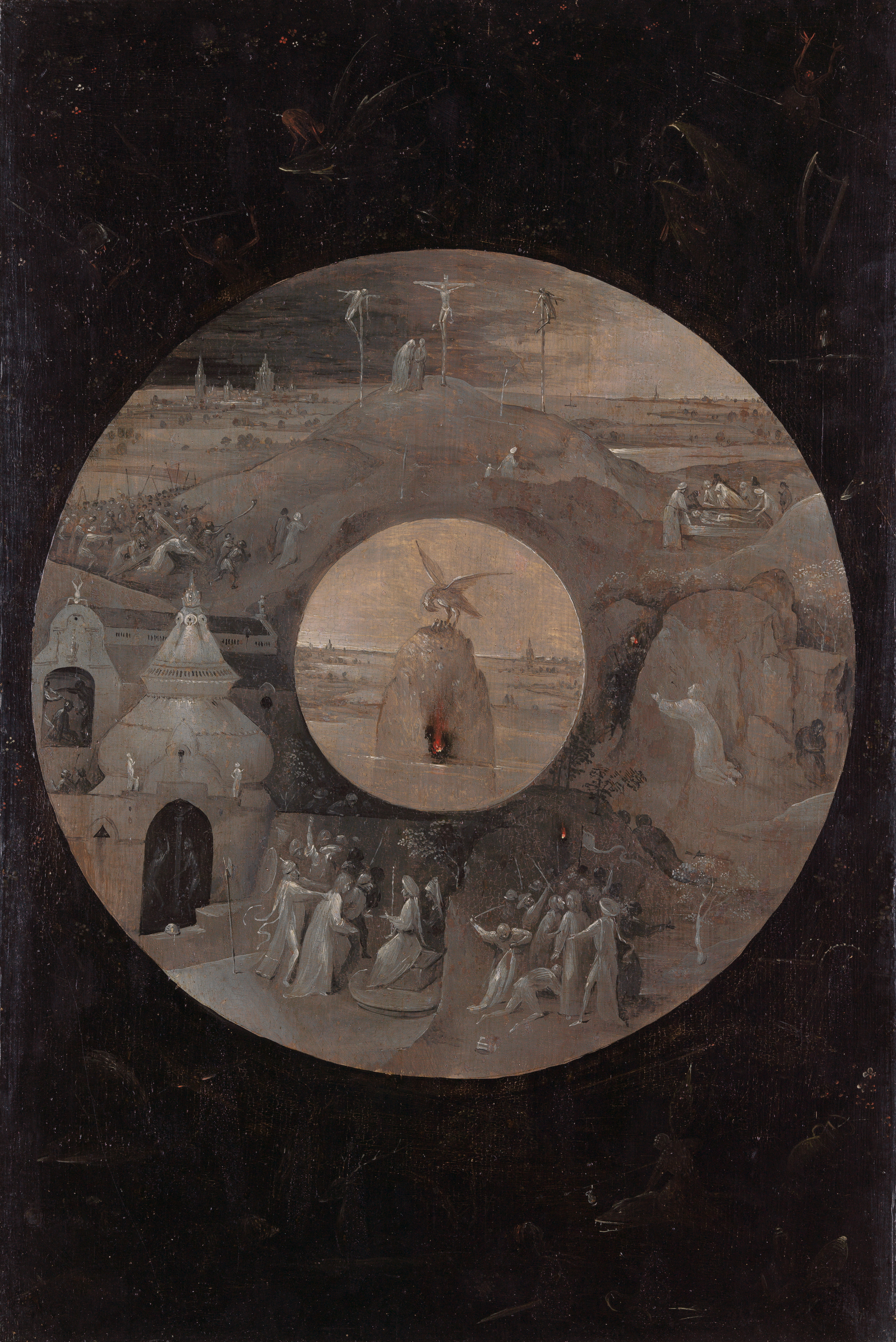
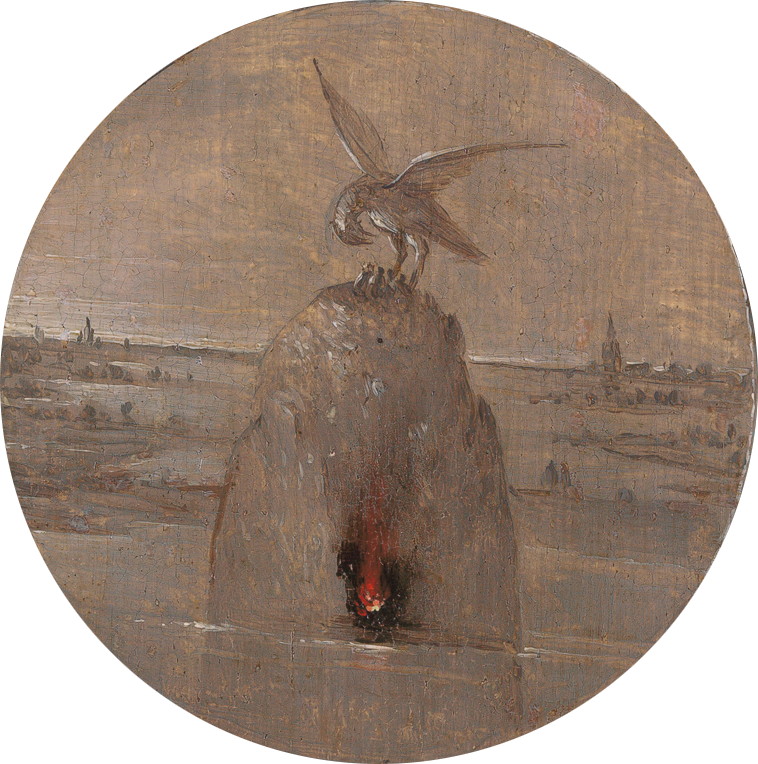
One of the most unique visual treatments of the vulning pelican that I found is a painting by the Dutch Renaissance artist Hieronymus Bosch. Rendered in grisaille (gray monochrome), his pelican appears in the center of a ring depicting scenes from the passion of Christ. It’s painted on the reverse of a panel that shows John the Evangelist in exile on Patmos, penning the book of Revelation.
Hieronymus Bosch (Netherlandish, ca. 1450–1516), Scenes from the Passion of Christ (reverse of John on Patmos), ca. 1500. Oil on panel in grisaille, 62.8 × 43.2 cm. Staatliche Museen zu Berlin, Gemäldegalerie.
Staged around mountain crags, the passion cycle begins on the right with Jesus praying in Gethsemane and continues clockwise with the Arrest of Christ, Christ before Pilate, the Flagellation, the Crowning with Thorns, the Carrying of the Cross, the Crucifixion, and the Entombment.
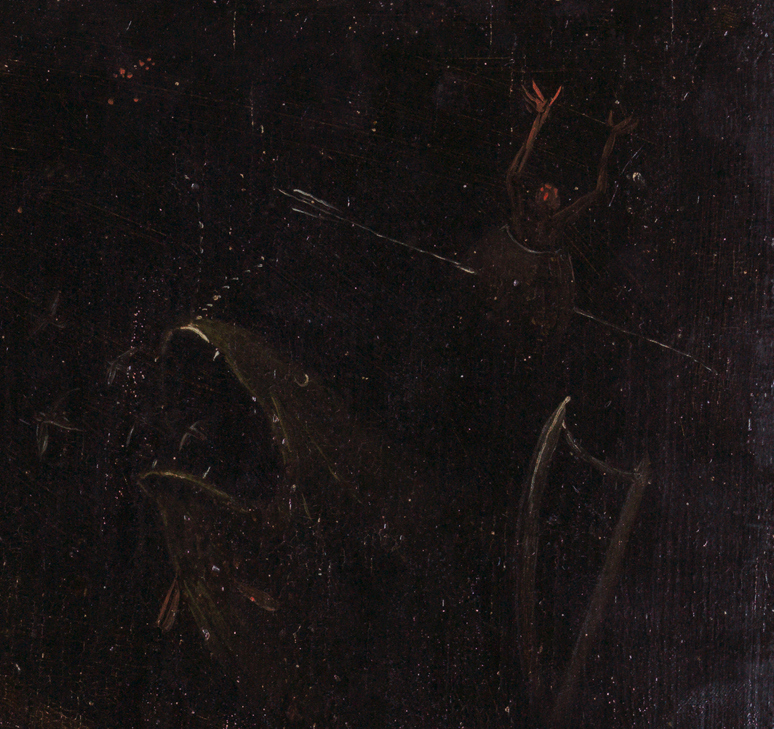
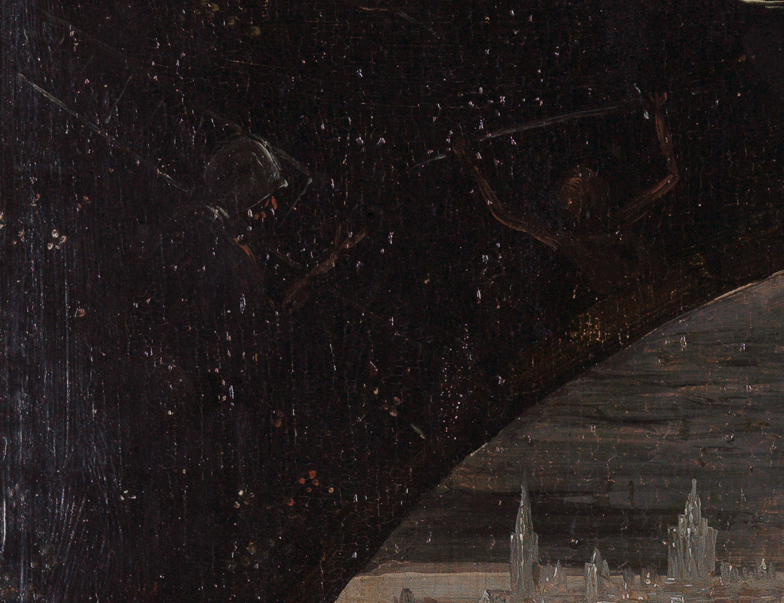
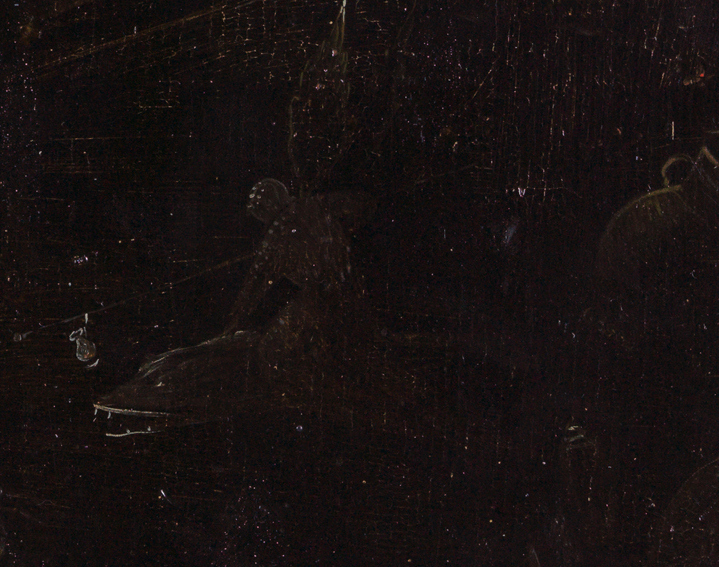
Outside this ring of scenes is a darkness populated by shadowy demons:
But the inner disc, the focal point of the composition, contains the promise of redemption. Emerging from the still waters of a vast postdiluvian landscape is a hillock with a hollow that houses a burning fire. On the summit, a large mother bird spreads her protective wings over her brood, inclining her head toward her chest—an iconography we recognize as the vulning pelican, symbolic of the deep, saving love God embodied on the cross.
As we view this painting, we progress from the outer darkness with its infernal powers, to the growing light actualized by the events of Maundy Thursday and Good Friday, and finally to the brilliant center with its red flame—which, other than two dim, flickering torches in Gethsemane, contains the sole bit of color in the whole painting. Images of the Sacred Heart of Jesus, which would gain prominence in the seventeenth century, feature a flame, representing Christ’s ardent love burning bright. And that’s what we have here.
Red is also the color of blood. I’m reminded of Robert Southwell’s poem “Christ’s Bloody Sweat,” which combines imagery of the pelican and the self-immolating but ultimately indestructible phoenix, marveling at “how bleedeth burning love.” (I’ll explore a few more poems about the pelican in the next section.)
As John writes in the wonderful prologue to his Gospel, “The light shines in the darkness, and the darkness did not overtake it” (John 1:5).
In Bosch’s painting, the Christbrand bursts, like the pelican’s split side. The flame of redemption is lit, like a lighthouse, calling us home into the love of God.
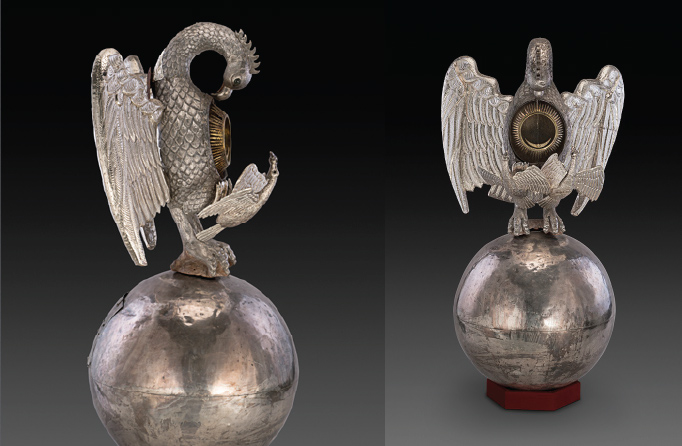
Another especially compelling art object that draws on the pelican legend is a silver-plated tabernacle monstrance from Portuguese Goa in southwestern India.
Tabernacle monstrance made in Goa, India, 17th century. Silver on wood, glass, 142 × 72 cm, globe 66 cm. Museum of Christian Art, Convent of Santa Monica, Old Goa, India.
In the Roman Catholic Church, a tabernacle is a container in which the consecrated hosts (small unleavened wafers of bread) of the Eucharist are stored as part of the “reserved sacrament” rite, and a monstrance is a vessel that displays the consecrated host on the altar and in procession. This object combines both into one—the spherical base serving as the tabernacle, with access gained through an opening at the back, and the bird’s breast bearing a transparent aperture surrounded by a golden sunburst halo, through which the host can be viewed. The body of Christ, broken for you.
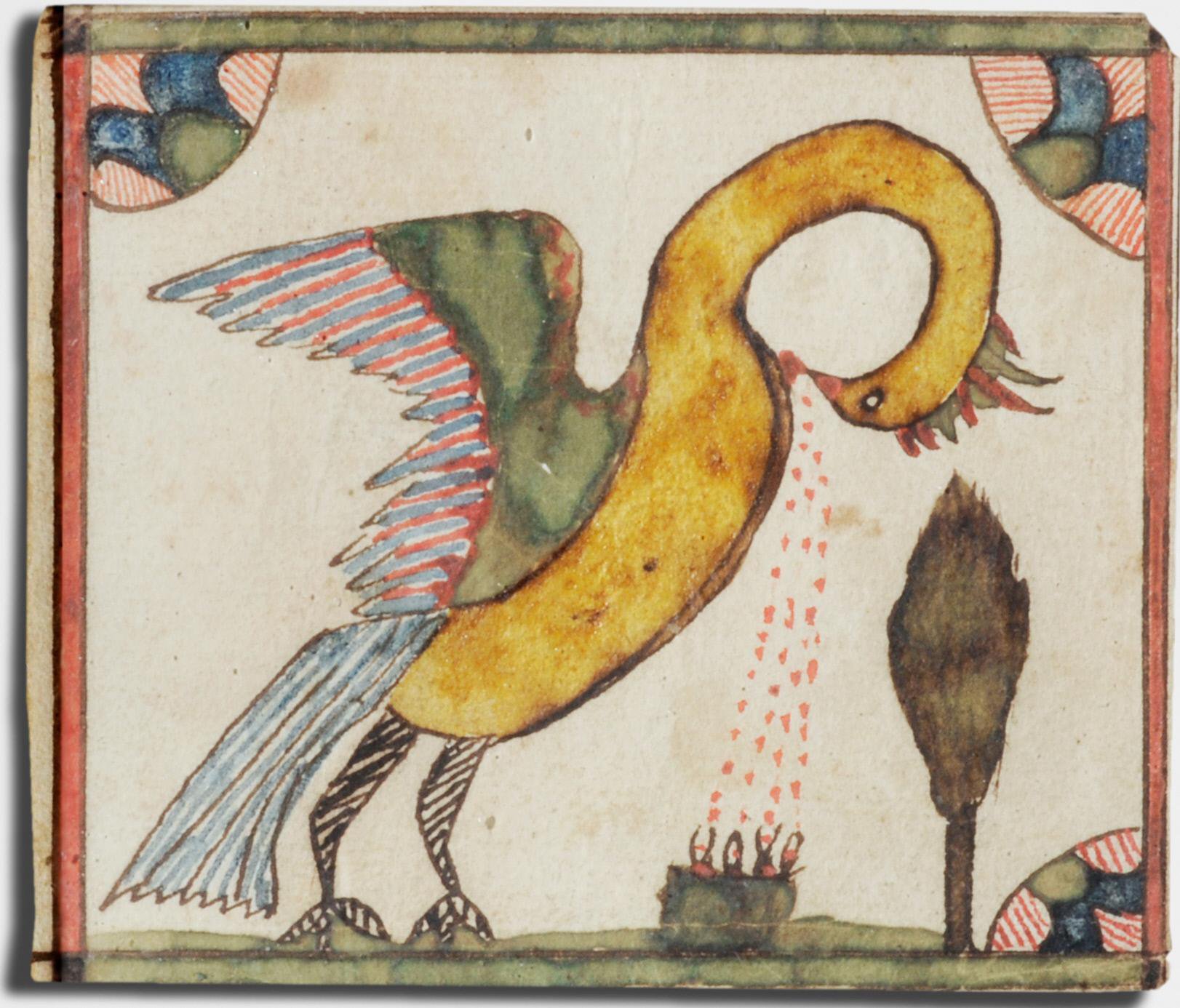
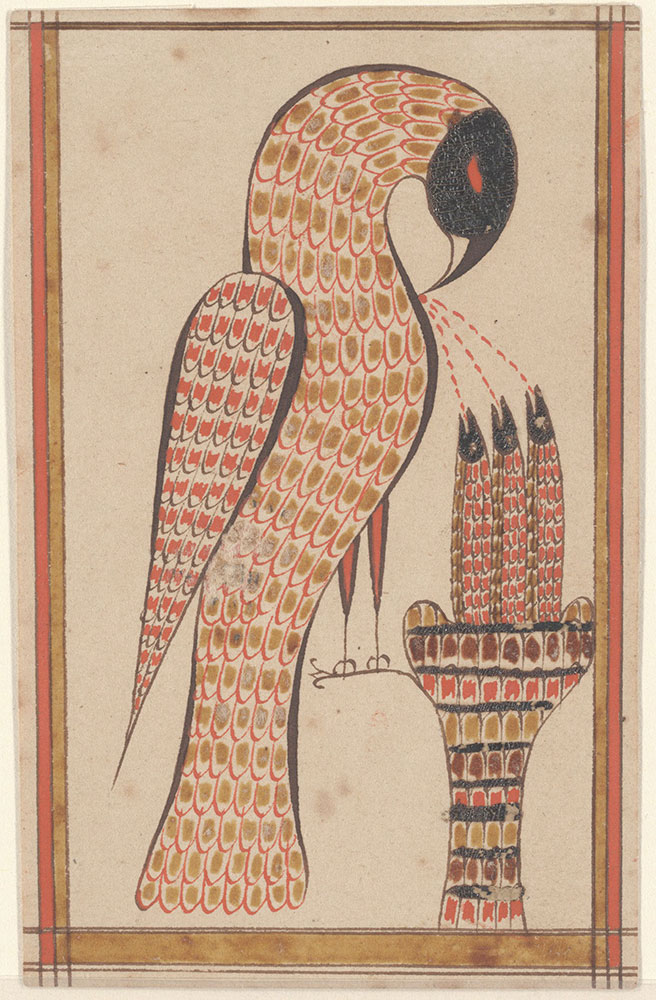
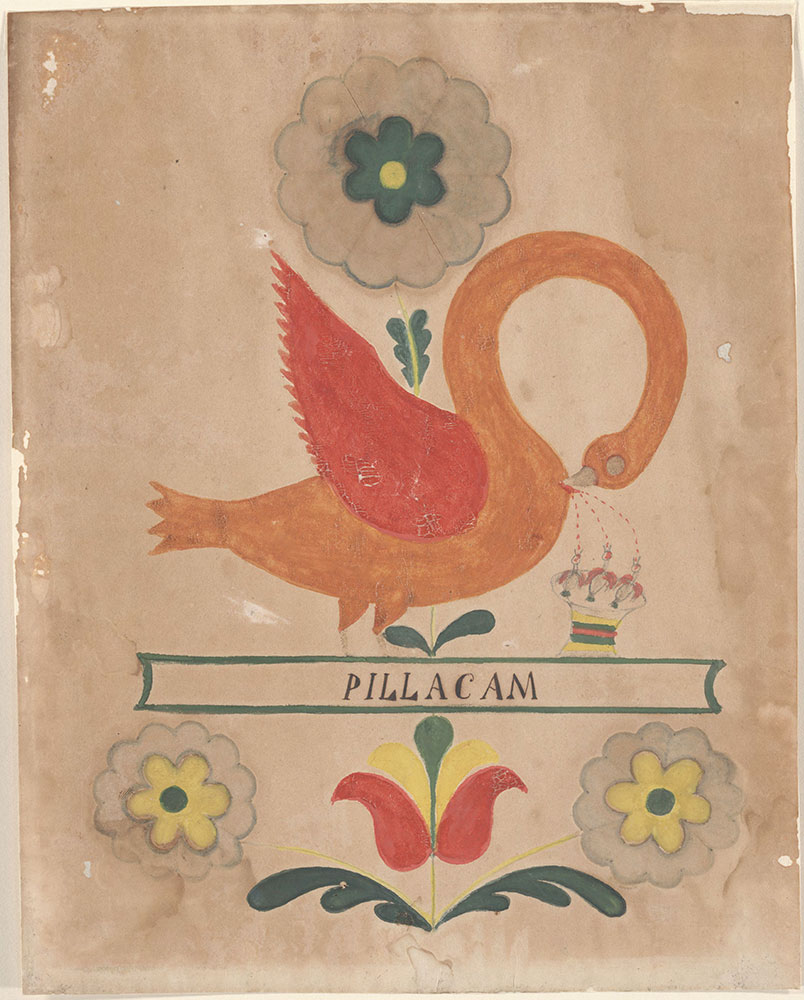
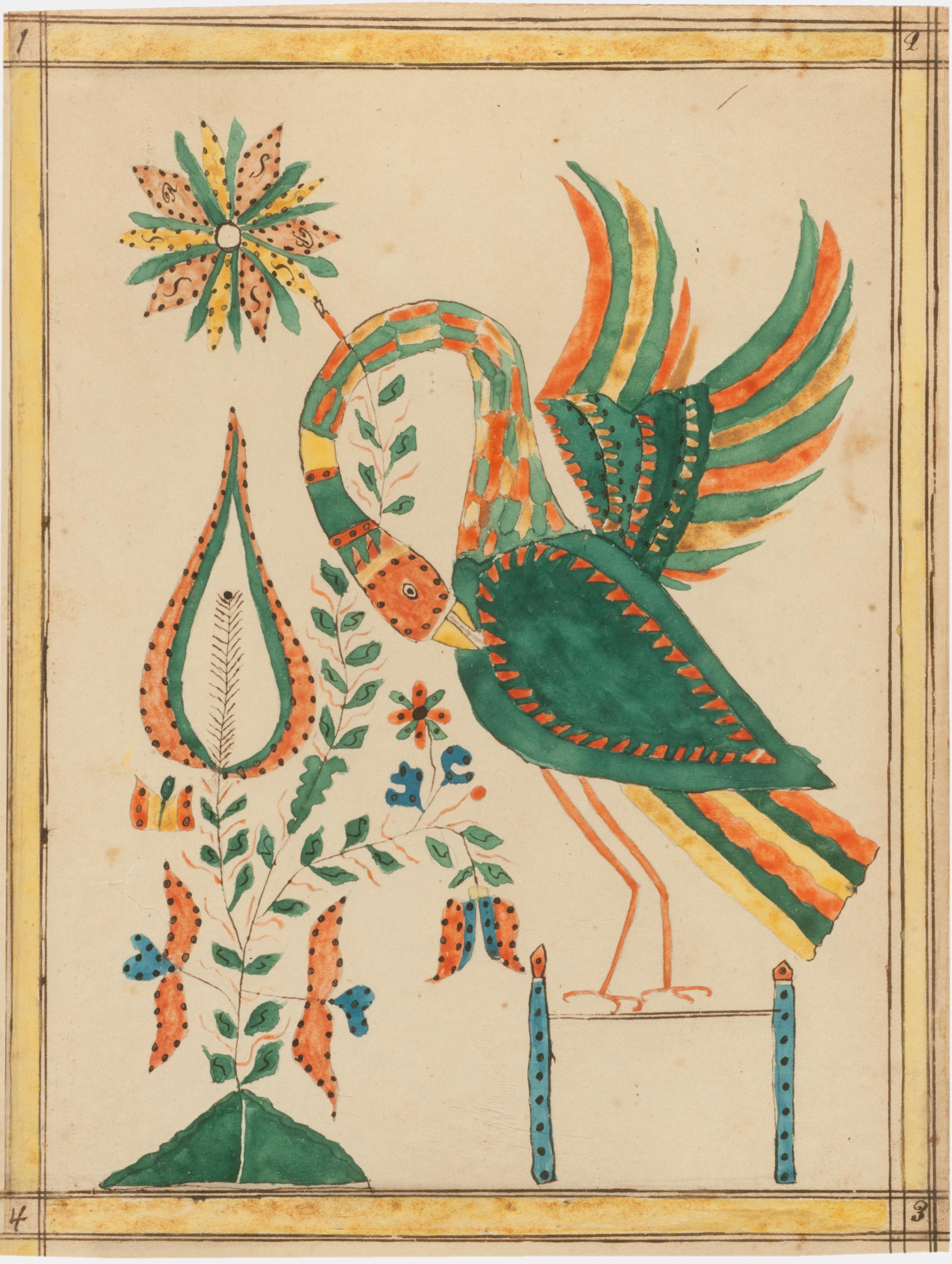
In researching this essay, I found that the pelican is a subject that recurs (so charmingly!) in the folk art of eighteenth- and nineteenth-century Pennsylvania Germans:
A Pelican in Its Piety, Bucks County or Montgomery County, Pennsylvania, ca. 1800. Watercolor and ink on laid paper, 8.9 × 8.3 cm. Promised gift of Joan and Victor Johnson to the Philadelphia Museum of Art.David Kulp (American, 1777–1834), Pelican in Its Piety, Bucks County, Pennsylvania, ca. 1810. Watercolor and ink on wove paper, 18.6 × 12.2 cm. Free Library of Philadelphia.Pelican, Pennsylvania, ca. 1850. Watercolor and ink on wove paper, 31.6 × 25.4 cm. Free Library of Philadelphia.A Pelican in Its Piety, Pennsylvania, ca. 1825. Watercolor and ink on wove paper, 24.1 × 19.1 cm. Promised gift of Joan and Victor Johnson to the Philadelphia Museum of Art.
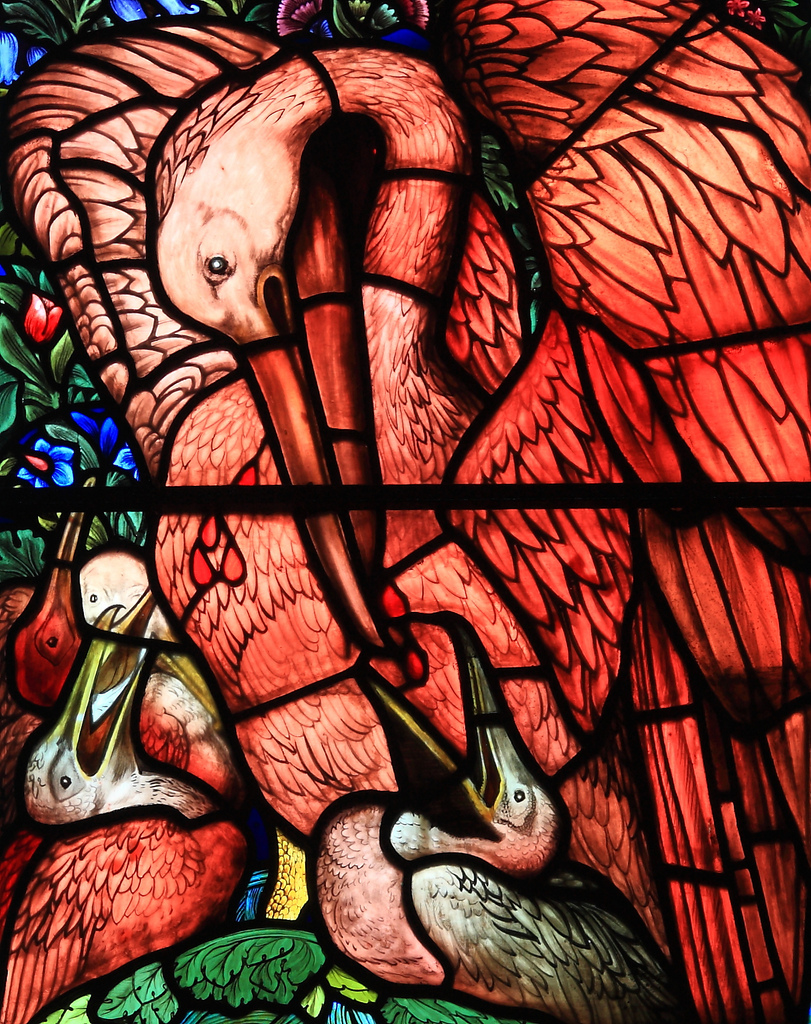
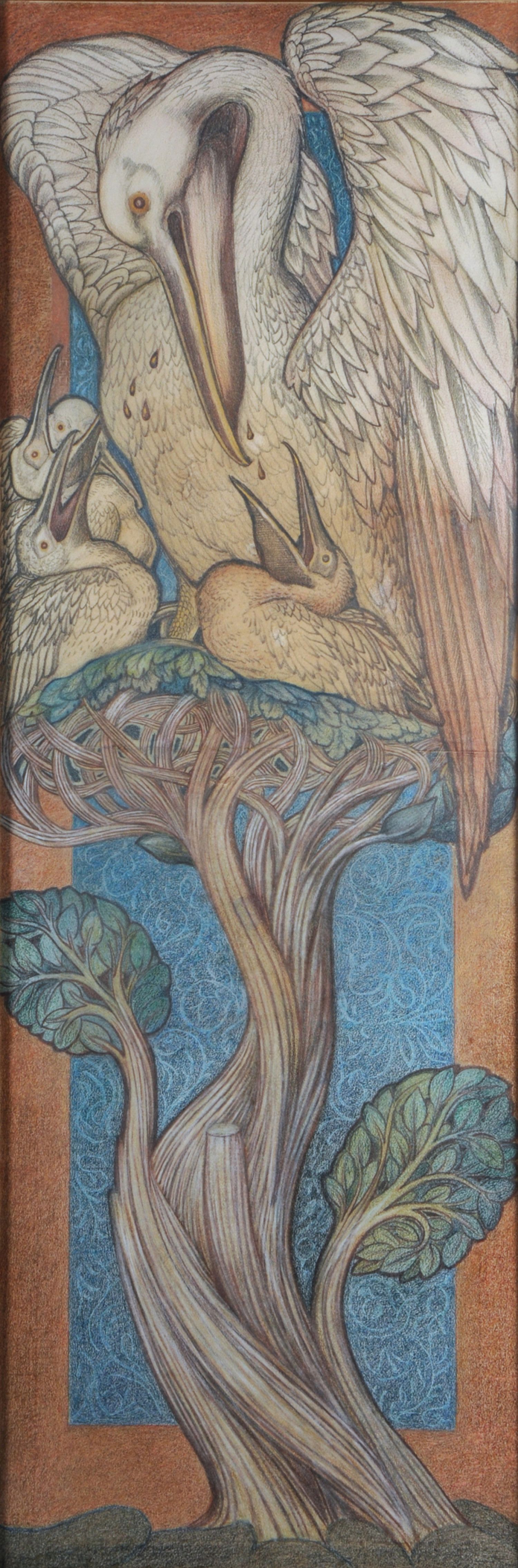
From the Victorian era, I’m especially fond of the stained glass pelican design by the Pre-Raphaelite artist Edward Burne-Jones, fabricated by Morris & Co. to serve as part of the East Window of St Martin’s Church, Brampton, in Cumbria. Burne-Jones drew his design in 1880, and after the window was completed the following year, he returned to the drawing out of personal fondness, embellishing it with colored chalks, and gold for the blood drops, thus developing it into a more substantial work.
Edward Burne-Jones (British, 1833–1898) and Morris & Co., Pelican on Nest (detail), 1880. East Window, St Martin, Brampton, Cumbria, England. Photo: Dave Webster. [view full window]Edward Burne-Jones (British, 1833–1898), Pelican in Her Piety, 1880–81. Pencil, colored chalk, and gold on paper, 172.7 × 57.3 cm. William Morris Gallery, London.
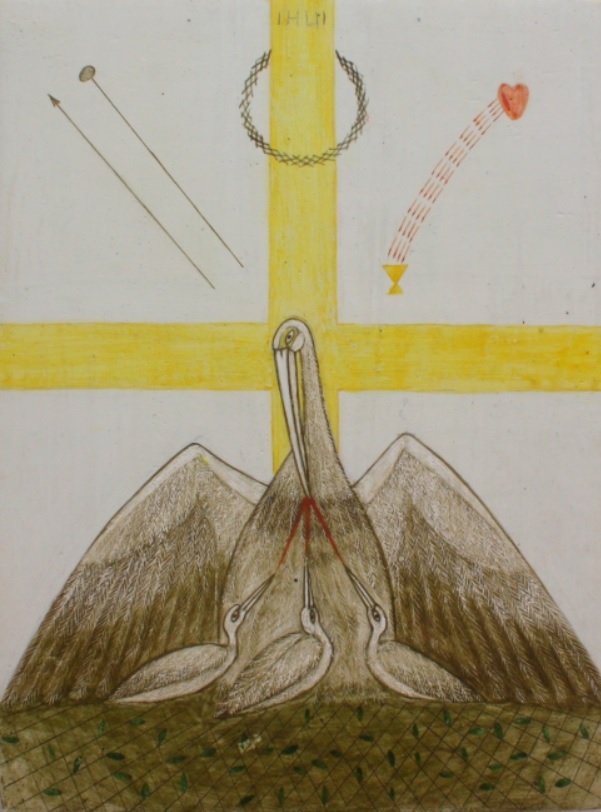
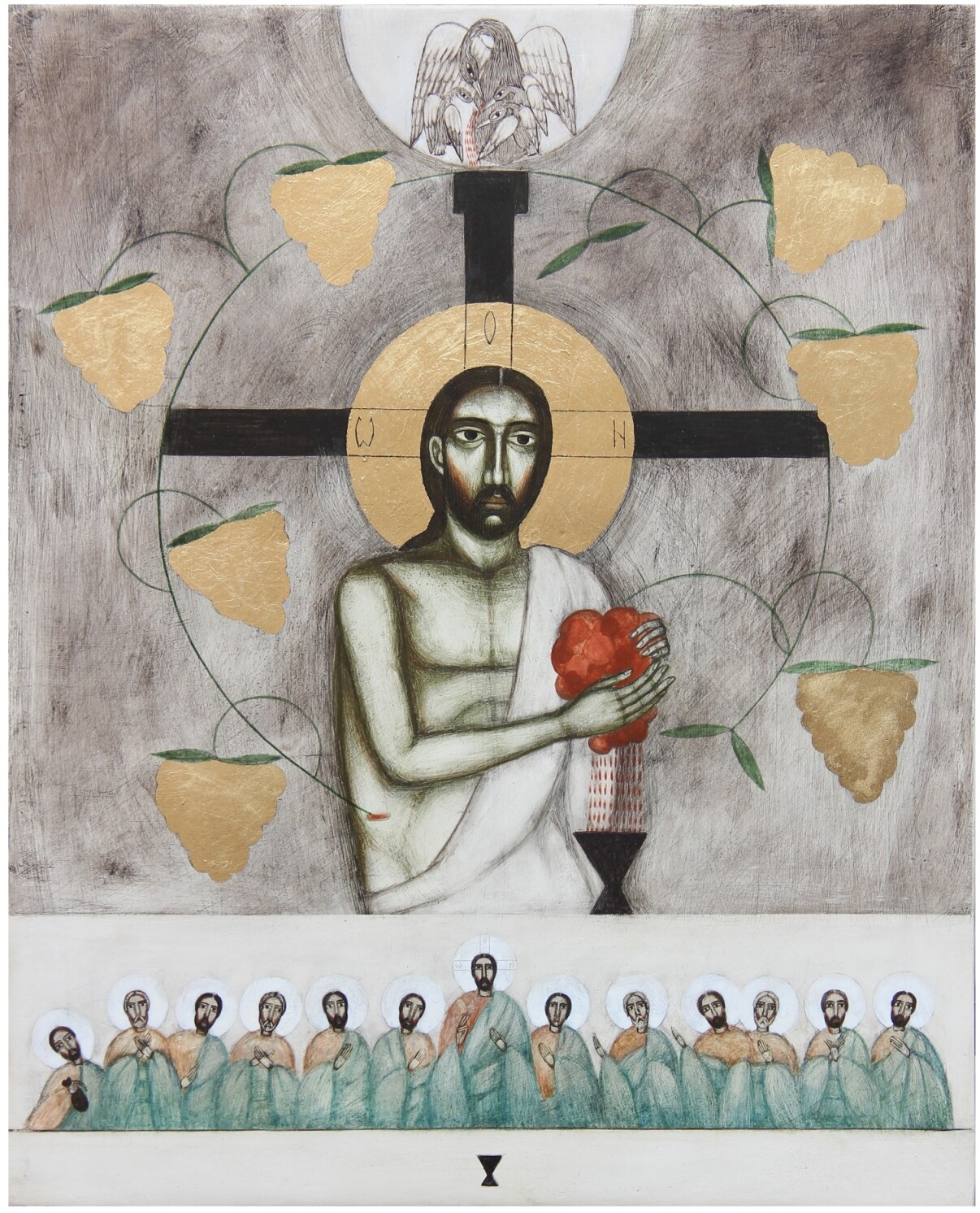
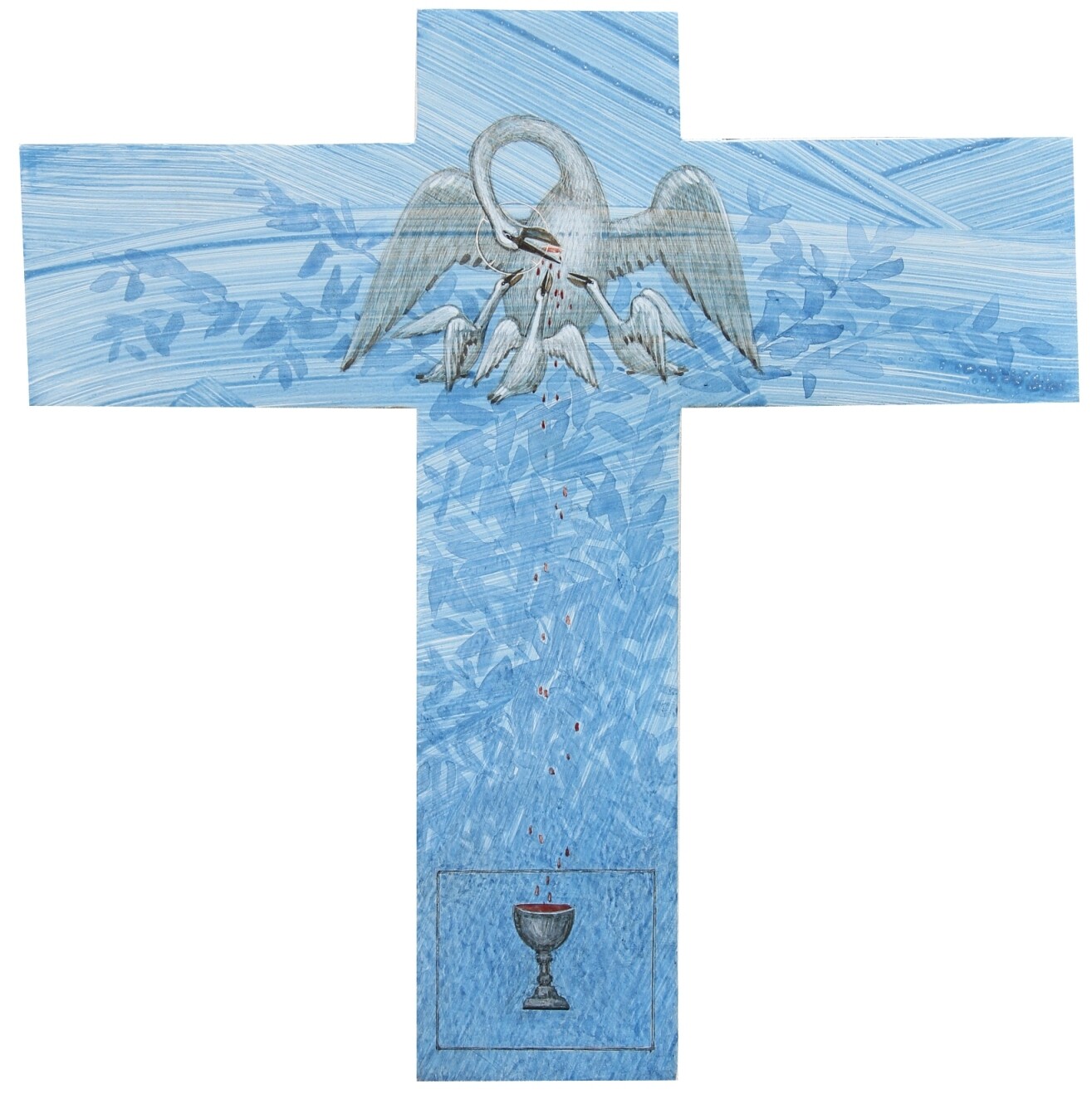
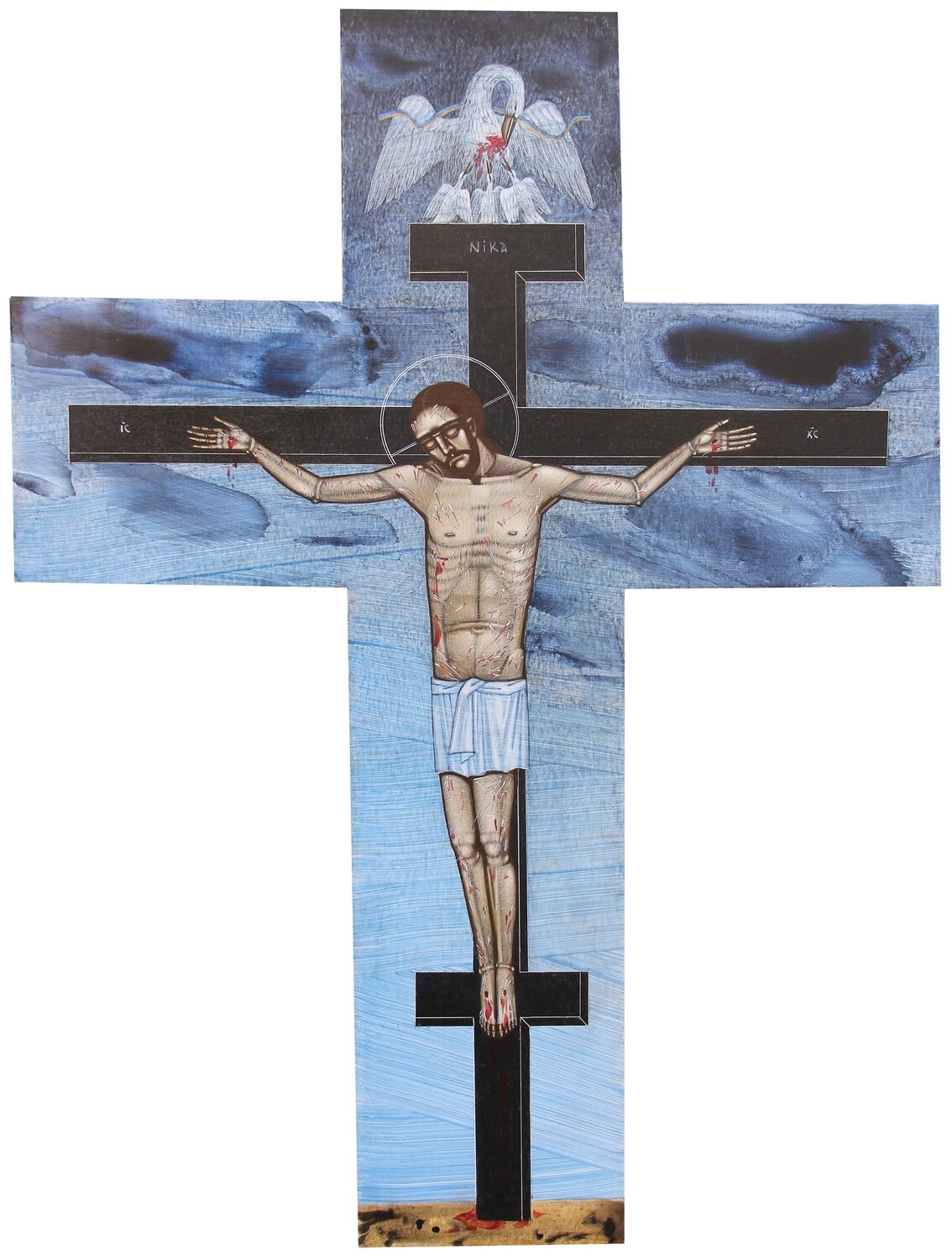
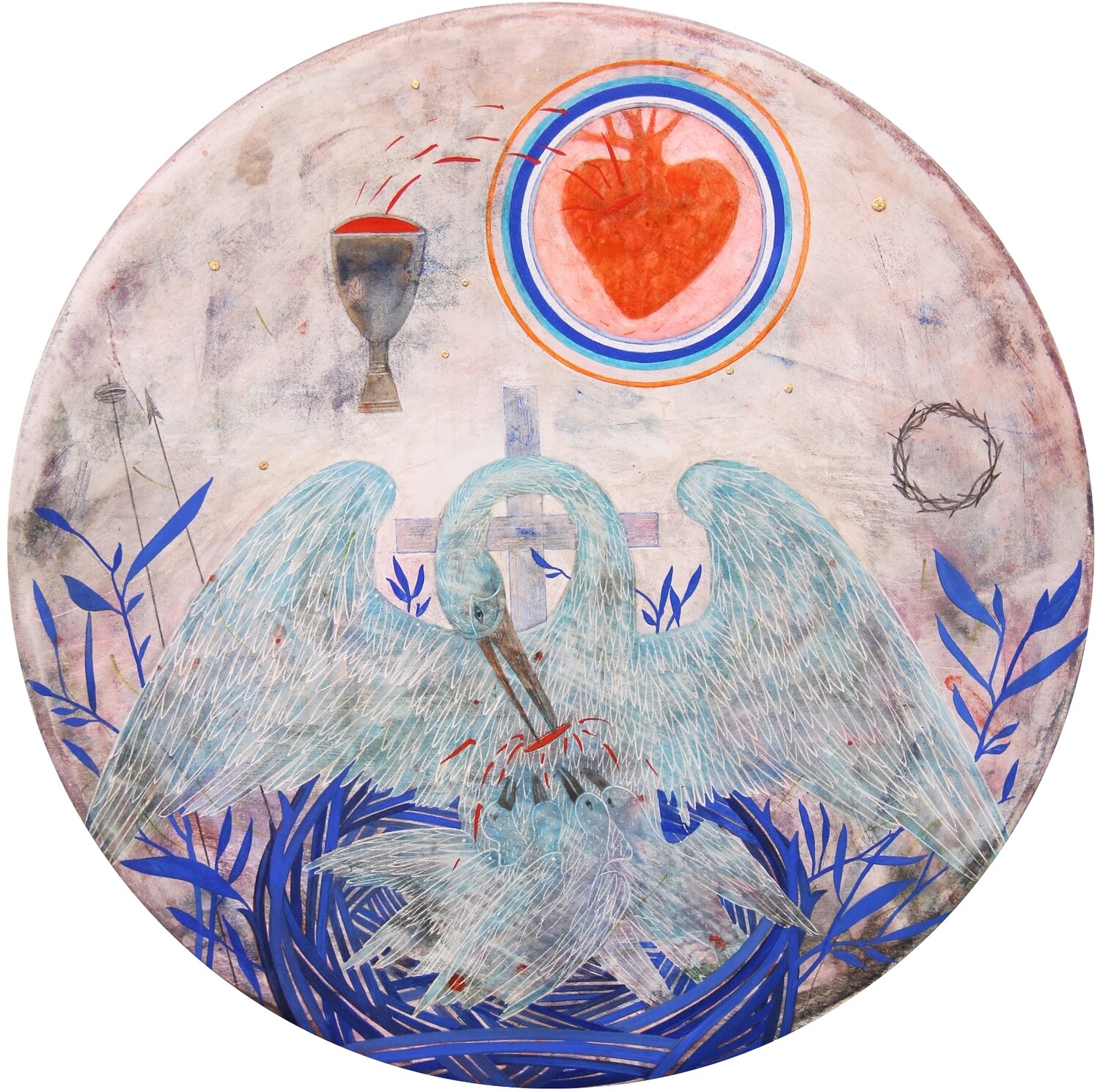
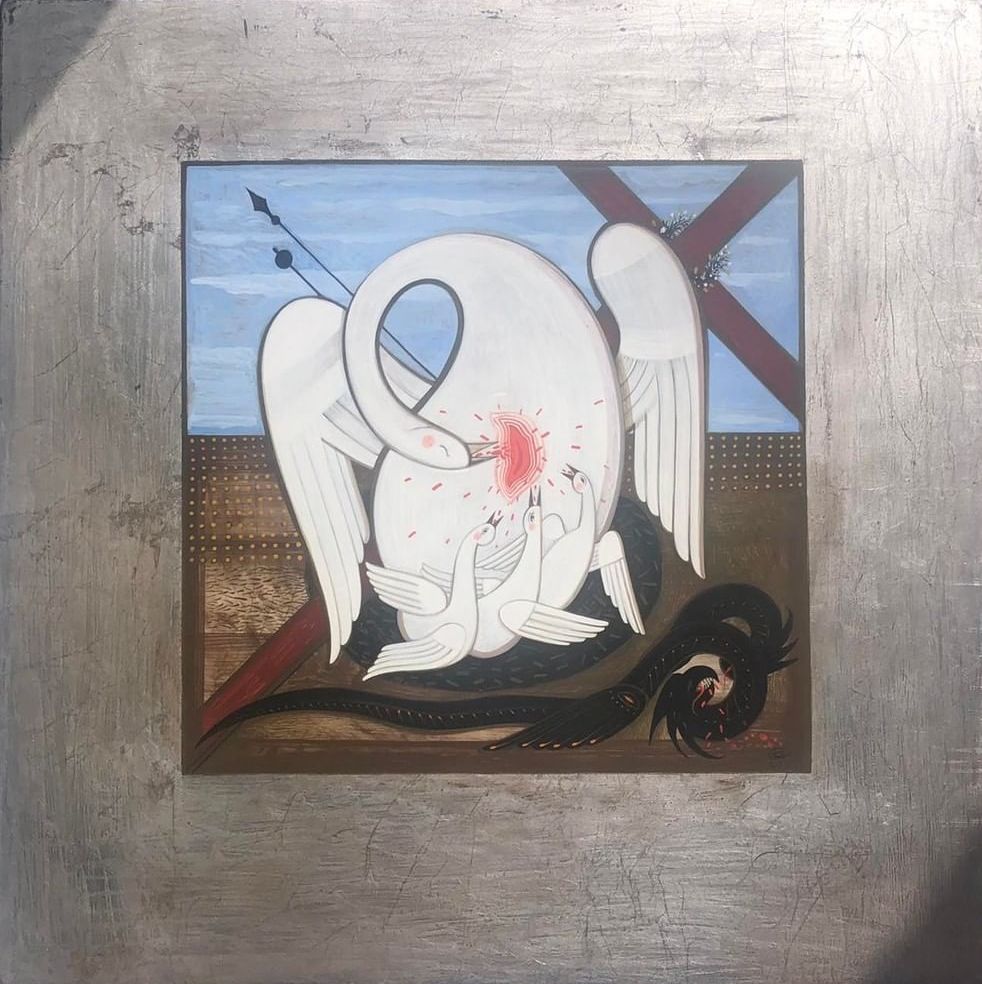
Contemporary artists have also turned to the subject of the vulning pelican, especially the Ukrainian Catholic women iconographers of Lviv:
Natalya Rusetska (Ukrainian, 1984–), Pelican, 2017. Egg tempera on gessoed wood, 19 × 15 cm.Natalya Rusetska (Ukrainian, 1984–), Jesus the Grapevine and the Last Supper, 2021. Egg tempera on gessoed wood, 30 × 24 cm.Kateryna Kuziv (Ukrainian, 1993–), Pelican, 2021. Egg tempera on gessoed wood, 30 × 30 cm.Kateryna Kuziv (Ukrainian, 1993–), Crucifixion, 2022. Egg tempera on gessoed wood, 65 × 49 cm.Ulyana Tomkevych (Ukrainian, 1981–), Pelican, 2021. Egg tempera on gessoed wood, diameter 30 cm.Olya Kravchenko (Ukrainian, 1985–), Sacrifice and Victory, 2022. Tempera and silver leaf on gessoed wood, 40 × 40 cm.
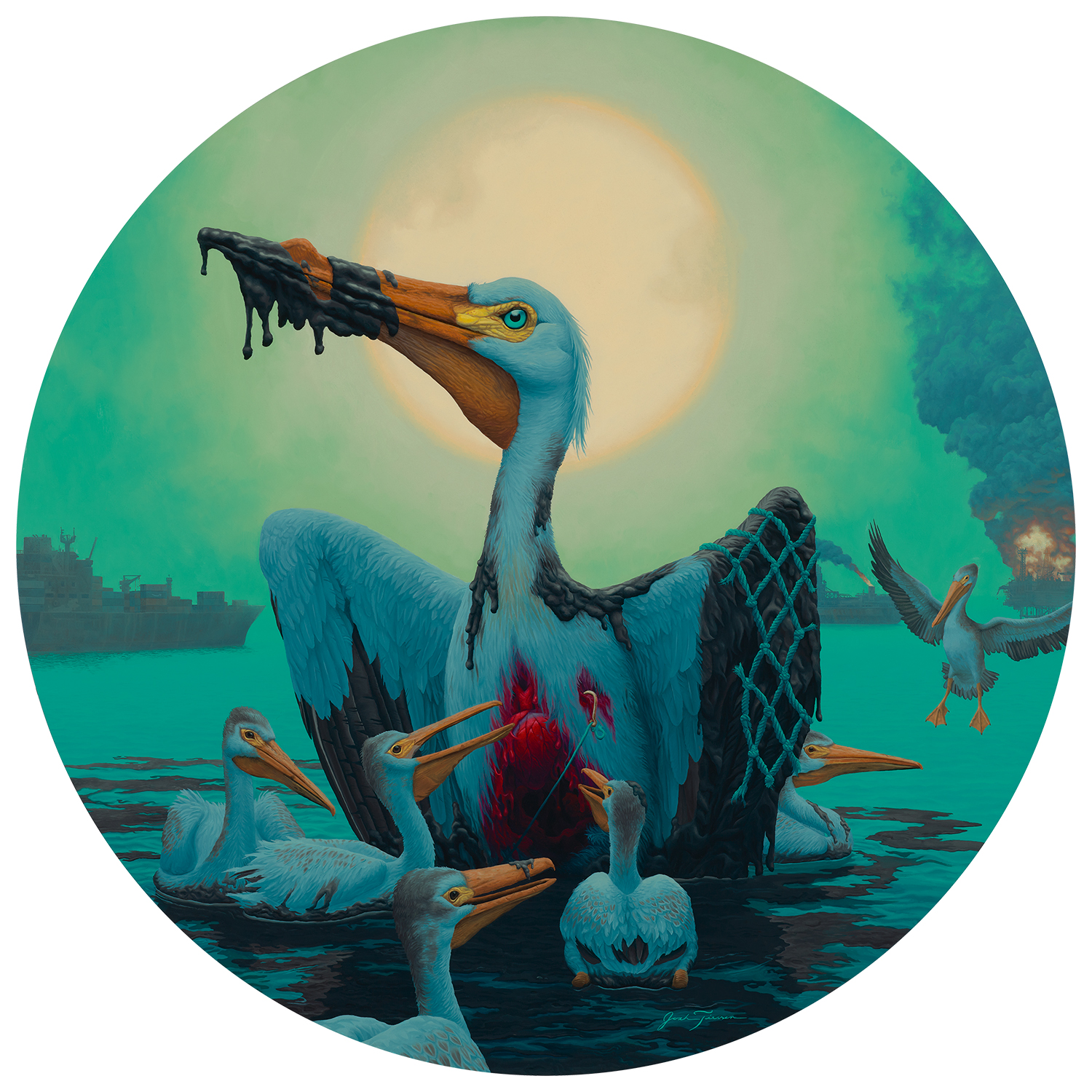
Addendum, 4/8/25: Shortly after publishing this, a reader reminded me of Josh Tiessen’s painting All Creatures Lament from his Vanitas and Viriditas series, which shows an American white pelican protecting her chicks in the face of another oil spill and the accumulation of fishing-related plastic waste. Tiessen, an artist of faith, directs the symbolism of the pelican toward a call for wildlife conservation. (I previously featured Tiessen’s work here.)
Josh Tiessen (Canadian, 1995–), All Creatures Lament, 2023. Oil on braced Baltic birch, diameter 26 inches.
In Poetry and Song
Probably the most universally famous poetic treatment of the pelican as an emblem of Christ is the eucharistic hymn “Adoro te devote” (Hidden God, Devoutly I Adore Thee). Written around 1260 by Thomas Aquinas, it is one of the most beautiful medieval poems in Latin. Aquinas did not originally write it for the liturgy, but it was added to the Roman Missal in 1570 and since then has been used in the Catholic Mass. The penultimate stanza reads:
Pie pelicane, Jesu Domine,
Me immundum munda tuo sanguine,
Cujus una stilla salvum facere
Totum mundum quit ab omni scelere.
Like what tender tales tell of the Pelican,
Bathe me, Jesus Lord, in what thy bosom ran—
Blood that but one drop of has the pow’r to win
All the world forgiveness of its world of sin.

Trans. Gerard Manley Hopkins
Here’s a great video of the hymn put out by the Fundación Canto Católico, set to a Benedictine plainsong melody from the thirteenth century, as has become standard. Our pelican passage appears at the 4:10 mark. The subtitles are in Spanish, but you can turn on CC for English.
(If, like me, you’re wondering what in the world the video’s images are from, an explanatory note in the YouTube comments section explains: they are from the Cuasimodo festival in Chile, celebrated the second Sunday of Easter. The festival has nothing to do with Victor Hugo’s famous hunchback but rather is about bringing Communion to the sick and elderly who were unable to leave their residences to participate in the sacrament during Holy Week. [The Spanish Cuasimodo comes from the Latin Quasimodo, from the incipit of the day’s introit based on 1 Peter 2:2: “Quasi modo géniti infántes . . . ,” or “As newborn babes . . .”] Traditionally for this task, priests were escorted by horsemen, who showed them the route and protected them from assaults.)
The vulning pelican also appears in the liturgy of the Eastern Orthodox Church, whose members sing at Matins on Good Friday evening, “Like a pelican wounding her breast, Thou, O Word, hast made Thy mortal children to live, for Thou hast shed upon them life-giving streams.”
Dante Alighieri, the great medieval Italian writer, calls Christ “nostro Pelicano” (our Pelican) in canto 25 of his Paradiso, the third book in his Divine Comedy trilogy of extended narrative poems.
The Christ-pelican appears, too, in English poetry from the late Middle Ages onward. One Middle English poem found in a prayerbook from ca. 1460 reads:
The pellicane his bloode dothe blede
Therwith his birdis for to fede.
It figureth that God with his bloode
Us fede hanging on the rode,
Whane he us brought oute of hell
In joy and blis with him to dwel,
And be oure fader and oure fode,
And we his childerne meke and good.

[Bodleian Library MS Douce 1, fol. 57r]
The pelican his blood doth bleed,
Therewith his birdies for to feed.
It figures God, who, with his blood,
Fed us hanging on the rood,
By which he brought us out of hell,
In joy and bliss with him to dwell,
To be our father and our food,
And we his children meek and good.
Our Pelican, by bleeding thus, Fulfill’d the law, and cured us.
Look here, and mark (her sickly birds to feed) How freely this kind Pelican doth bleed. See how (when other salves could not be found) To cure their sorrows, she herself doth wound; And when this holy emblem thou shalt see, Lift up thy soul to him, who died for thee.
For this our hieroglyphic would express That Pelican which, in the wilderness Of this vast world, was left (as all alone) Our miserable nature to bemoan; And in whose eyes the tears of pity stood, When he beheld his own unthankful brood His favors and his mercies then condemn, When with his wings he would have brooded them, And sought their endless peace to have confirm’d, Though to procure his ruin, they were arm’d.
To be their food, himself he freely gave; His heart was pierc’d, that he their souls might save, Because they disobey’d the sacred will, He did the law of righteousness fulfill; And to that end (though guiltless he had been) Was offered for our universal sin.
Let me, oh God! forever fix mine eyes Upon the merit of that sacrifice: Let me retain a due commemoration Of those dear mercies, and that bloody passion, Which here is meant; and by true faith, still feed Upon the drops this Pelican did bleed; Yea, let me firm unto thy law abide, And ever love that flock for which he died.
I already mentioned, in relation to Bosch’s pelican painting above, “Christ’s Bloody Sweat” by the English Catholic martyr Robert Southwell.
More recently, the Anglican priest Matt Simpkins, who performs music under the name Rev Simpkins, wrote a song titled “Pelican,” which he released on his album Big Sea (2020). Gritty and impassioned, here’s a live performance at Colchester Arts Centre:
Pelican feeds the hungry and needy I kneel before her My throat like an open grave
Food cannot fill me Water dilutes me Nothing contents me Pelican, pity me
She tears her breast, her children to refresh By her I am blessed, led to life from living death
Though death entreats me Her life flows sweetly Given so freely Given in flesh and blood
She tears her breast, her children to refresh By her I am blessed, led to life from living death
Pelican feeds me Loves me completely Though I’m unworthy She gives so graciously
She tears her breast, her children to refresh By her I am blessed, led to life from living death
She crowns the whole earth, the heavens and seas The Pelican tears her breast for me
She’s queen of what was and what is to be The Pelican tears her breast for me
She gives of herself in infinity The Pelican tears her breast for me
She’s compassion and love, she’s strength and glory The Pelican tears her breast for me
I love it when contemporary artists engage with historical Christological symbols, whether from the animal world or elsewhere, tapping into a creative wisdom the saints of ages past have bequeathed to us but that is too often dismissed in favor of literalism or wordy, intellectual articulations of doctrine.
I wholeheartedly support the endeavor of academic theology, but it must be remembered that for centuries, the church has developed her theology not just through discursive prose but also through liturgy, verse, and visual art. While many modern Christians may discount medieval allegories of Christ as naive, backward, too fanciful, or too obscure, I want to suggest that there’s value in learning (at least some of) them and even incorporating them into new material, to explore how they might come alive in new contexts.
By studying the pelican of ancient lore, for example, as it has been adapted in Christian art and literature, I’ve grown in my appreciation for the mother-love of God, who, to restore me to life and to nourish me—his child, his dependent—allowed his sacred flesh to be torn, so that I might know the power in the blood.
This essay took many hours to research and write and came to fruition only after several years spent collecting enough Pelican images to reach a critical mass. If you have the inclination and means to support more essays like this, I’d really appreciate a donation!
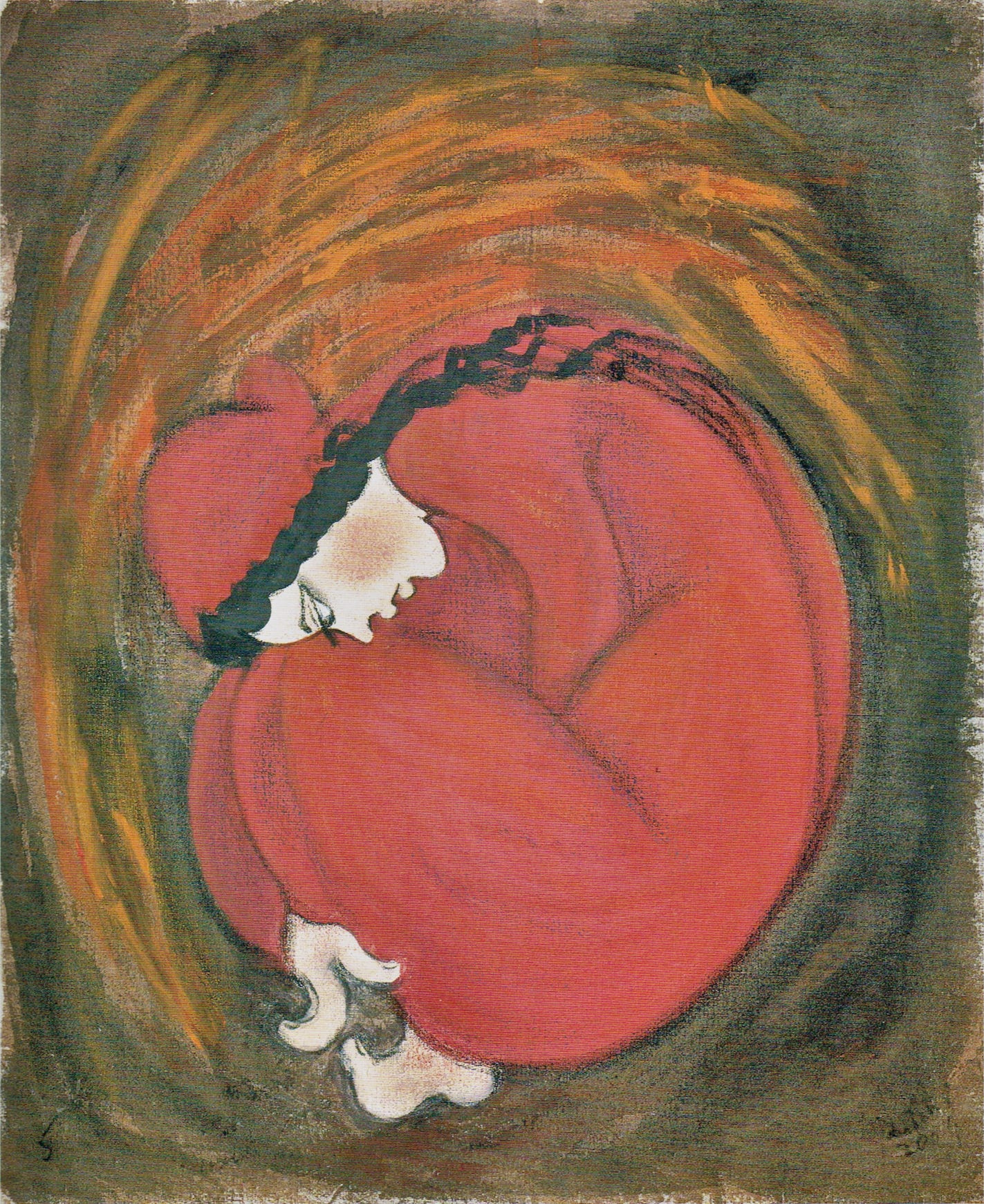
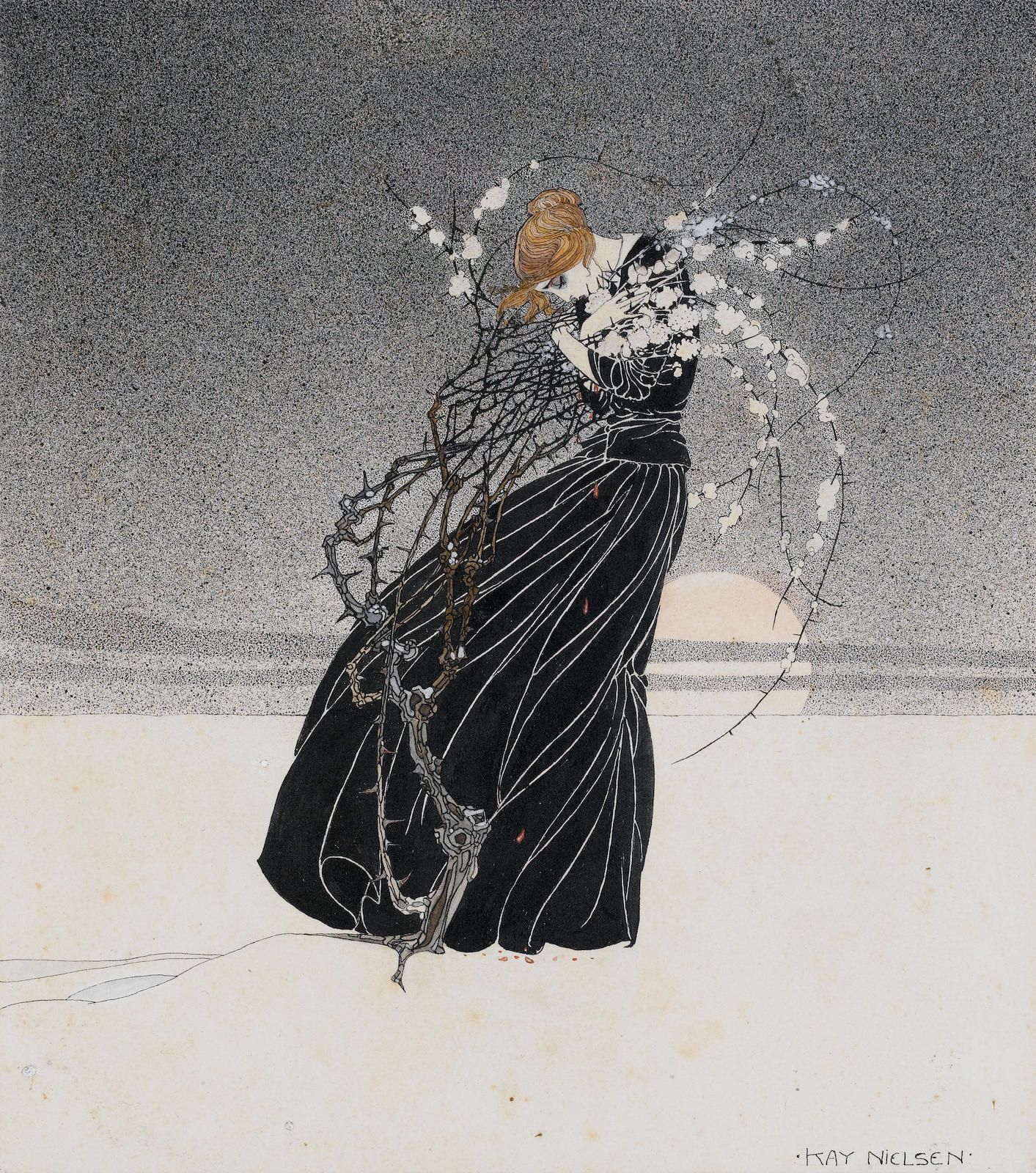
Kay Nielsen (Danish, 1886–1957), illustration for “The Story of a Mother,” ca. 1910. Pen and black ink and watercolor, heightened with bodycolor and gum arabic, 9 7/16 × 8 1/4 in. (24 × 21 cm).
When I saw this watercolor drawing of a woman embracing a thorny shrub till she drips blood come up in my Instagram feed, I immediately thought of Christ’s passion.
The caption reveals that it’s an illustration by Kay Nielsen for Hans Christian Andersen’s “The Story of a Mother,” a fairy tale written in 1848 and published around 1910 that shows the beauty and intensity of a mother’s love for her child.
The story is about a woman whose young son is gravely ill. One evening, old man Death enters her house and takes the child. Utterly distraught, she runs out after him, seeking to save the boy from Death’s clutches. As she crosses the snowy landscape in search of her son, she is stopped by various beings who request things of her in exchange for help. Night asks her for lullabies. The blackthorn bush asks for warmth. The lake asks for her eyes, clear as pearls, so “she wept till her eyes dropped down to the bottom of the lake.” An old woman who keeps Death’s greenhouse asks for her long black hair. (Oddly, she’s a redhead in Nielsen’s drawing!) Here is the exchange with the blackthorn bush, as translated from the Danish by Jean Hersholt:
At the crossroad grew a blackthorn bush, without leaf or flower, for it was wintertime and its branches were glazed with ice.
“Did you see Death go by with my little child?”
“Yes,” said the blackthorn bush. “But I shall not tell you which way he went unless you warm me against your heart. I am freezing to death. I am stiff with ice.”
She pressed the blackthorn bush against her heart to warm it, and the thorns stabbed so deep into her flesh that great drops of red blood flowed. So warm was the mother’s heart that the blackthorn bush blossomed and put forth green leaves on that dark winter’s night. And it told her the way to go.
The mother fulfills all the demands she encounters in her quest and finally meets Death, who explains that he merely carries out God’s will, which she ought not to disrupt. She ultimately resigns herself in humility to divine providence and lets the child go.
I’m not suggesting that this fairy tale is an allegory of God’s love. That wouldn’t quite make sense, as God is invoked at the end as a character in the story—and, à la the book of Job, as one who sometimes wills death (“The LORD gives and takes away,” Job 1:21).
But the mother’s love in the story is reflective, I find, of the fierce love of God, who is willing to go to any extreme to save his children from Death. He became incarnate and embraced the way of the cross. He took unto himself the crown of thorns, the nails, the humiliation. He sacrificed not just parts of himself but his whole self.
In Nielsen’s illustration, I see a picture of Christ our mother who willingly endured pain to rescue us, the warmth of whose love reverses the curse and brings life.
As an English major in college, I was required to take a course on medieval literature. I had not been looking forward to it—Romantic and Victorian lit were more my thing. I worried that working through Old English and Middle English texts would be a slog. But boy were my expectations upended! I was enthralled by all the imaginative theology I encountered in verse, drama, and sermons, from the Dream of the Rood on down. I went to a public university, but the saturation in Christian thought is unavoidable for students of the history of English literature. After overcoming some hang-ups I had acquired from my fundamentalist Baptist upbringing, I found my faith opened up, strengthened, and inspired by my study of medieval writers. The same has held true in my studies of medieval art.
If you missed the opportunity to study the creative outputs of the Middle Ages in school but want to wade into those waters, you must follow the work of Dr. Grace Hamman, a medieval scholar from Denver who writes and teaches on the great works of that era through her newsletter, podcast, and more recently her first book, Jesus through Medieval Eyes: Beholding Christ with the Artists, Mystics, and Theologians of the Middle Ages (Zondervan, 2023). The book explores seven identities of Jesus—Judge, Lover, Knight, Word, Mother, Good Medieval Christian, and Wounded God—engaging art and literature that develop these tropes, some more familiar to us as moderns than others. Mechthild of Magdeburg, Julian of Norwich, Margery Kempe, Gregory the Great, Fra Angelico, Petrus Christus, Thomas Aquinas, Anselm of Canterbury, and Richard Rolle are among the folks we meet.
The church’s writings and images from the past, Hamman says, are a gift to us in the present that can help us see beyond our time- and culture-bound limitations. “In reading these exploring, adoring, faithful witnesses from the past, we can come to know Jesus—and ourselves—better,” she writes. “What we find strange or beautiful in these medieval witnesses can reveal our concerns, hidden biases, and even new truths. They also teach us new and profound ways to love him” (6).
She continues,
I began reading medieval texts because, to my joyful surprise, I learned that medieval Christians loved Jesus. They wrote about Jesus incessantly, compulsively, athirst with love, devotion, and creativity. They possessed vast Christian imaginations, often more expansive and interesting than many of the Christians who preceded or followed them. I discovered that writers of this period were far more comfortable than we today in thinking about Jesus metaphorically, highlighting particular and peculiar attributes, and crafting new stories about him. Their narrative freedom, delight in allegory and metaphor as paths to truth, and cultural difference offer us the gift of strange new insights—the gift of surprise. (10)
To receive that gift of surprise, Hamman advises, we must approach the texts with a spirit of openness—a willingness to sit with them quietly, attentively, and humbly before making judgments, acknowledging that our own views are not necessarily superior. Then we can welcome in the discernment process, weighing the validity of the picture at hand, determining whether we want to graft it into our understanding of Christ and his work.
I appreciate how Hamman regards the medieval era with neither nostalgia nor negativity. She’s not suggesting we simply embrace medieval theology wholesale, as if it represents some kind of golden age we ought to return to. No, we can and should be critical of certain aspects—but we should first come to these works with a genuine readiness to receive and to learn, not instantly writing them off because they come from a time or tradition we’re not a part of.
Some of the pictures of Jesus that Hamman addresses are
a barefoot knight who jousts with the devil and storms the gates of hell, wearing human nature as his armor
a mother who gestates, gives birth, and breastfeeds
a lover who “forms us in blooming beauty through his tender desire” (53)
In chapter 3, “The Lover,” Hamman includes a woodcut illustration of one of the couplets from the late medieval verse dialogue Christus und die minnende Seele (Christ and the Loving Soul), showing the soul making herself naked before Christ her bridegroom so that they can join in spiritual union. Each gives themselves to the other in vulnerability.
“Christus beraubt die Seele ihrer Kleider, so daß sie nackt ist” (Christ strips the soul of its garments so that it is naked), Germany, ca. 1460. Woodcut illustration from a broadsheet of Christus und die minnende Seele (Christ and the Loving Soul). Albertina Museum, Vienna, Inv. DG1930/197/3.
She also walks us through the anonymous fifteenth-century poem “Quia Amore Langueo,” which brings together the language of romance with imagery of the crucifixion; its Latin refrain, taken from Song of Songs 2:5, translates to “Because I swoon with love.”
It’s important to pay attention to the places in these ancient texts and images that cause discomfort or confusion, as they are often places that helpfully challenge our assumptions today of who God is or what Christianity should look like.
—Grace Hamman, Jesus through Medieval Eyes, pp. 53–54
Jesus through Medieval Eyes introduces the reader to several important medieval texts, including the Old English poem Christ III, concerned with the second coming of Christ; Piers Plowman by William Langland, an allegorical poem in which the narrator, Will, is on a quest for the true Christian life; and the enormously influential Meditationes Vitae Christi (Meditations on the Life of Christ) and its derivative The Mirror of the Blessed Life of JesusChrist by Nicholas Love, who encourages us to exercise our “devout imagination” by envisioning the events of the Gospels. The latter includes charming, homey little narrative details, like Mary using her kerchief as a swaddle for the newborn Jesus, and after his forty-day fast in the desert, Jesus craving his mama’s home cooking.
I admire how Hamman takes art seriously as a theological medium, recognizing how historically, the church has expounded its theology not only through the written word but also through painting and other visual expressions. And so she integrates art images throughout the book, weaving them into her discussion. There are sixteen total, reproduced in black-and-white near the text that refers to them, for convenience, as well as in a color insert, where they can be enjoyed more fully. I wish more theologians and church historians would follow Hamman’s example of drawing on art as a resource for understanding the development of, and for inquiring into and articulating, religious ideas.
But what really sets Hamman apart from other medievalists, in my opinion, is the balance in tone she manages to achieve between academic, devotional, and personal. (It’s something I struggle to achieve as a writer.) She writes with authority but also with an intimacy that is inviting and refreshing. She lets us into her own background and experiences and feelings and is transparent about her enthusiasms and distastes. I feel like she’s a wise old friend conversing with me over a cup of tea. Whether it’s an audio commentary she’s published on her podcast, a Substack missive, or this book, I always come away from her content having learned something, been given something to reflect on or explore further, and been drawn closer to God. She’s a wonderful teacher!
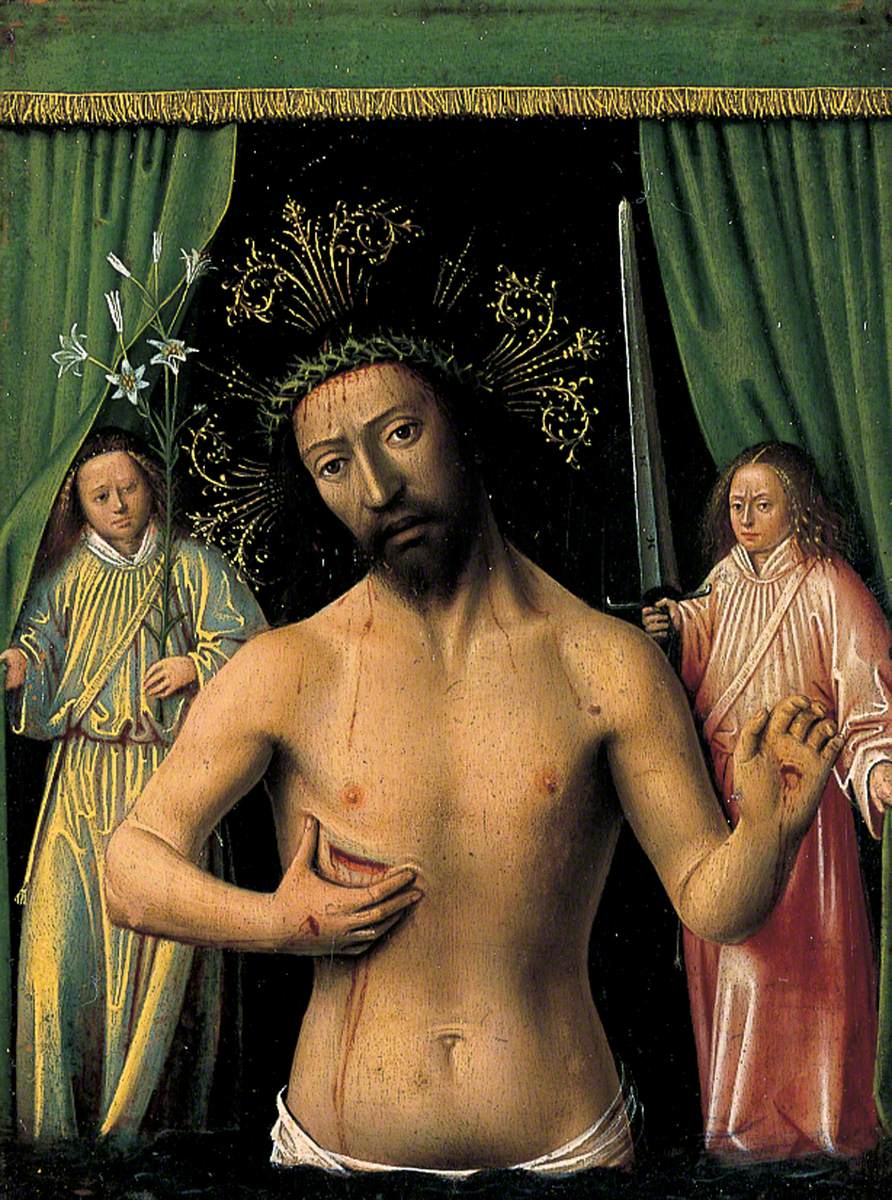
Petrus Christus (Netherlandish, ca. 1410–ca. 1475), Christ as the Man of Sorrows, ca. 1450. Oil on panel, 11.2 × 8.5 cm. Birmingham Museum and Art Gallery, Birmingham, England.
In Jesus through Medieval Eyes, each chapter ends with a scripture, reflection questions, one or two suggested exercises, and a prayer—some sourced from medieval authors, others original.
Each chapter opens with a whimsical line drawing based on medieval manuscript marginalia, which often feature humorous scenarios, like a knight fighting a snail or a rabbit hunting a human! (Role reversals were a favorite form of play for medieval artists.) This design element further immerses the reader in that world. The cover too, its art taken from a French book of hours illuminated by Jean Colombe, gives a sense of the shine of medieval manuscripts with its gilt lettering and halos of the saints.
Hamman has revitalized my interest in medieval literature, in all its wild beauty and strangeness. You may have noticed her influence on my blog over the past few years I’ve been following her. I encourage you to follow her on Twitter @GraceHammanPhD and Instagram @oldbookswithgrace, subscribe to her Medievalish newsletter, and BUY HER BOOK! It would be great material for a Christian book club, and would also make a great gift.
You may also want to check out the recent interview Hamman sat for on The Habit Podcast, part of the Rabbit Room Podcast Network. It’s a terrific introduction to her work:
SUMMER COURSES: Arts at Regent: Regent College in Vancouver is offering eight one- or two-week in-person courses on its arts track this summer, including “After Disenchantment” with Joy Marie Clarkson (reading list includes Charles Taylor, James K. A. Smith, Kazuo Ishiguro, etc.), “The Puritan Literary Imagination” (on Paradise Lost and Pilgrim’s Progress) with Johanna Harris, and “The Arts, Empathy, and Spiritual Formation” with Mary McCampbell. Several years ago I took a Regent summer course on worship and the arts and really enjoyed it!
+++
BIBLICAL COMMENTARY: “Ascension Sunday (Year A): Luke 24:44-53 and Acts 1:1-11” by SALT Project: This Sunday marks the risen Jesus’s departure after forty days of dwelling with the community of disciples. While SALT Project’s commentary doesn’t plumb all the meaning of the Ascension, I was struck by its pointing out of the significance of the Mount of Olives (in light of Zechariah’s prophecy and the “choreography” of Palm Sunday) and the resonances with Elijah’s ascent, particularly with Christ’s passing on his mantle to the church.
>> Music by Rowland Hugh Prichard, 1830: The hymn is often paired with the public-domain Welsh tune HYFRYDOL (which I know best from its association with “Jesus, What a Friend for Sinners”). It’s sung here by Ben Lashey and Chris Joyner:
>> Music by Rebecca Almazar and Brian Gurney, 2020: I really love this new tune that Almazar and Gurney wrote for the hymn while they were at New City Fellowship in Manassas, Virginia, which was released on the church’s EP A Liturgy. Gurney is now the director of contemporary worship at The Falls Church Anglican in Falls Church, Virginia. The song is not yet available on CCLI, but in the meantime, he has granted permission for license-free church use; here are the chords.
+++
CALL FOR ENTRIES: 2023 Sacred Art Competition and Exhibition: “Seeking the finest contemporary sacred art for an online juried exhibition hosted by the Catholic Art Institute, with a world-wide audience and the opportunity to sell work, be featured on the Catholic Art Institute website.” The top prize is $2,500. The deadline for submission is November 6, 2023. From what I can tell, participants need not be Catholic, but the artwork(s) should be suitable for devotional and/or liturgical use by Catholics.
In the fourteenth century, Hamman says, fathers generally loved their children but were less involved in the day-to-day tasks of caring for their physical and emotional needs, whereas mothers were deeply present. Julian wrote about how Christ gave birth to his children on the bed of the cross, how he nurses them from his side, and how he acutely hears and responds to their individual cries. This podcast episode is an excellent summation of a theological idea that may sound odd and unorthodox at first but that is in fact biblically derived, appearing throughout church history, and that grants us fuller insight into who Christ is.
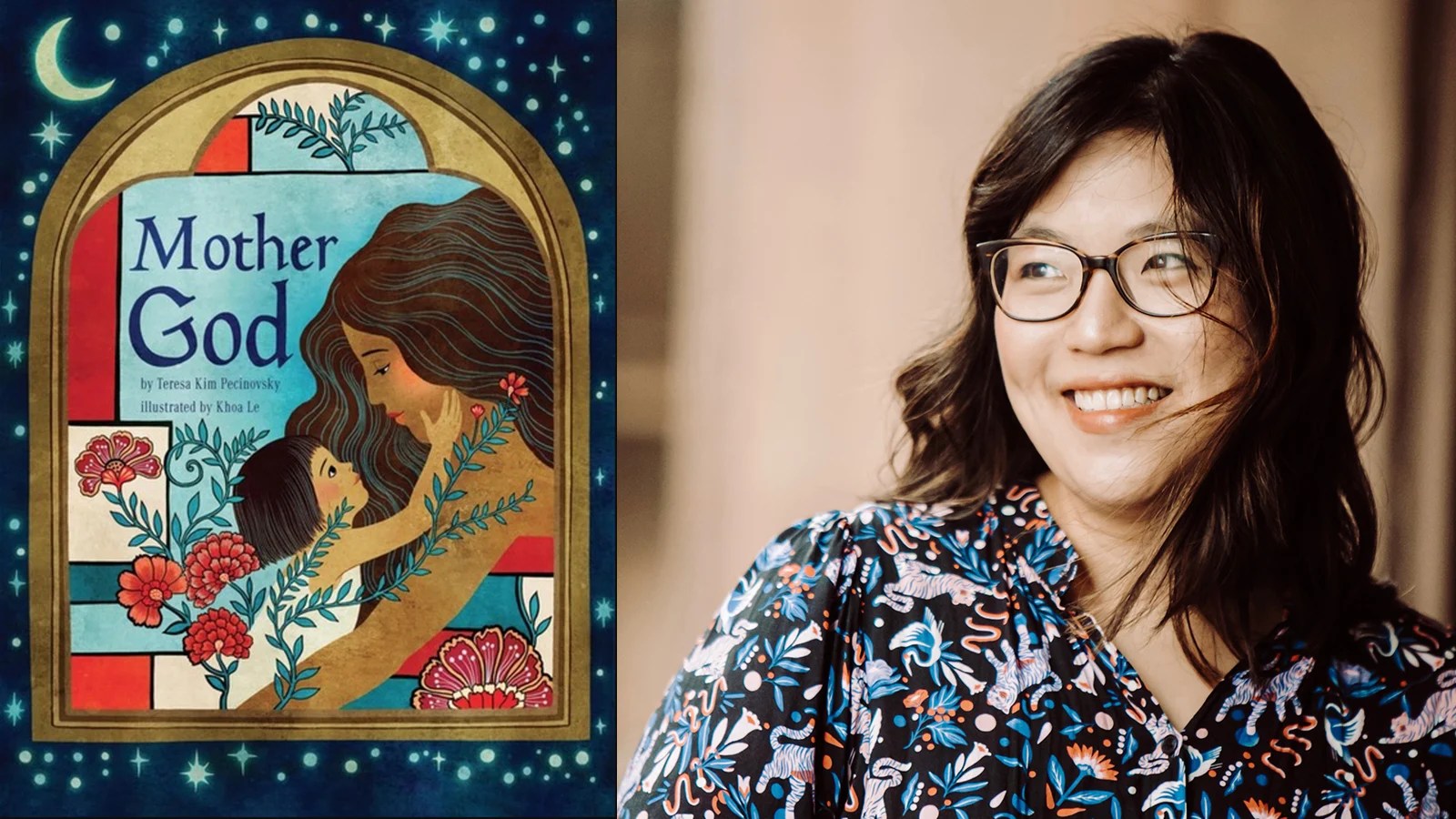
BOOK: Mother God by Teresa Kim Pecinovsky, illustrated by Khoa Le: Dovetailing with Hamman’s recent podcast episode is this beautifully unique children’s book that came out last year from Beaming Books. “With lyrical, rhyming text and exquisite illustrations, Mother God introduces readers to a dozen images of God inspired by feminine descriptions from Scripture. Children and adults alike will be in awe of the God who made them as they come to know her as a creative seamstress, generous baker, fierce mother bear, protective mother hen, strong woman in labor, nurturing nursing mother, wise grandmother, and comforting singer of lullabies. This gorgeous picture book welcomes children into a fuller, more diverse understanding of what it means to be made in the image of God.” Born in South Korea, raised in Iowa, and living in Texas, author Teresa Kim Pecinovsky (MDiv, MEd) (pictured below) is a hospice chaplain ordained in the Christian Church (Disciples of Christ) and a former elementary school teacher. Khoa Le is an artist from Vietnam.
Some traditionalists will no doubt have a visceral reaction against the cover and concept—“God reveals himself as Father, not Mother!” they’ll say, or “The Bible uses only masculine pronouns for God”—but it’s important to remember that God is nongendered, although God does contain both the masculine and the feminine (see, e.g., Gen. 1:27). “Father” is a metaphor, same as “mother.” God became incarnate as a male, Jesus, but as Hamman shows (see previous roundup item), Jesus also exhibited some qualities traditionally associated with women and mothers in particular, and therefore we can speak metaphorically of Christ as mother, as we can, too, of the First Person of the Trinity. Having an academic background in literature, I’m very comfortable with (and enthralled by!) metaphor, but I can understand, lamentably, how it trips some people up.
+++
ARTICLE: “Waking Ancient Seeds: Why the Middle Ages Matter” by Matthew J. Milliner, Comment, May 10, 2023: “For the medievals, Jesus is the Rosetta stone of cosmic meaning, with whom all things are aglow in the polyphonic resonance of truth, and without whom the world hurdles into centrifugal disconnection,” writes Matt Milliner, a theologically trained professor of art history at Wheaton College, an evangelical institution in Illinois. “It is our world that has been flattened, lacking the full-orbed splendour of medieval significance and depth.” In this article he contrasts the symbolism and sense of wonder and reverence of the Middle Ages with the deficits of the present, identifying several, sometimes unlikely places in which these “ancient seeds” are sprouting again.










 Art & Theology