
Roundup: Light in Nativity and Transfiguration icons, plus more art and song

LECTURE: “Light in Sacred Space: Light from the Cave” by Matthew J. Milliner and Alexei Lidov, December 19, 2019, Bridge Projects, Los Angeles: This double lecture about the role of light in Christian spirituality and theology was organized to coincide with the premiere of 10 Columns, an immersive light installation by Phillip K. Smith III that Bridge Projects commissioned for their inaugural exhibition.

While the Light & Space movement was born in Southern California in the 1960s, in many ways it participates in a much longer history of artists in dialogue with the phenomena of light. This presentation by two art historians, Matthew Milliner and Alexei Lidov, will begin with Milliner exploring the unexpected resonance of Phillip K. Smith III’s work with Byzantine and Gothic traditions. Lidov will then expand on these ideas with his scholarship in the Eastern Orthodox tradition and its long history of engaging light and mysticism. What kinds of insights might come when Light and Space artists, including Phillip K. Smith III, are put in conversation with ancient Orthodox Christian concepts of the nativity and uncreated light? [source]

Milliner speaks for the first forty minutes, discussing Nativity and Transfiguration icons and their correlatives in the West and making, as always, fascinating connections between art of the past and present. For example, he overlays Olafur Eliasson’s Ephemeral Afterimage Star (2008) on Rublev’s Transfiguration icon (19:19), and Ann Veronica Janssens’s Yellow Rose on an Adoration of the Magi illumination from a fifteenth-century book of hours at the Getty (26:32). He also introduced me to a fascinating medieval manuscript illumination from Germany (which he in turn learned about through Solrunn Nes) that combines the light of Bethlehem and Tabor—two Gospel scenes in one. Don’t miss the quote by Gregory of Nazianzus.
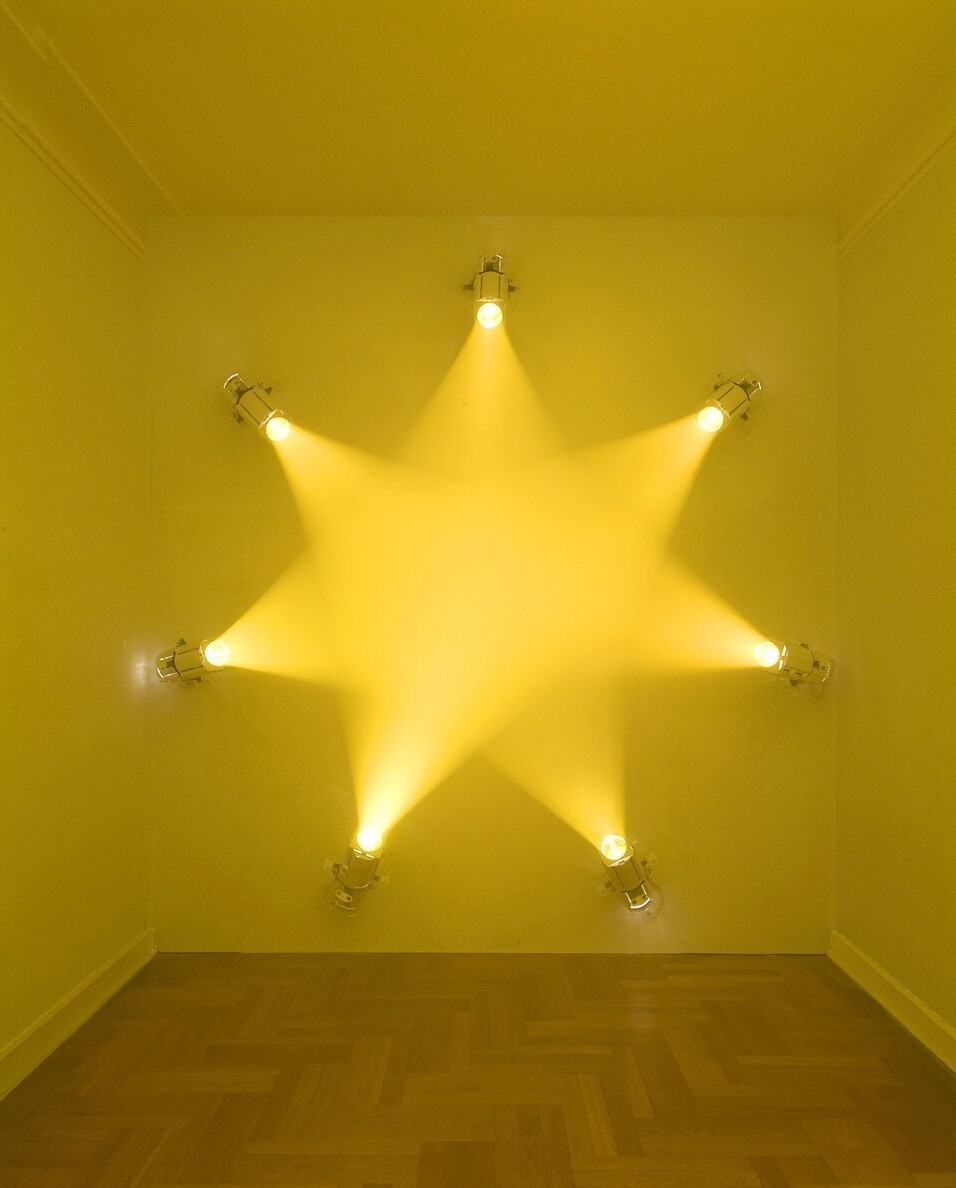
Janssens, Ann Veronica_Yellow Rose
Ann Veronica Janssens (Belgian, 1956–), Yellow Rose, 2007. Projectors, dichroic filters, and artificial mist, dimensions variable (min. 360 cm diameter, min. 250 cm depth). Museum Morsbroich, Leverkusen, Germany. Photo: Philippe De Gobert.

Nativity-Transfiguration (Ottonian MS)
The Nativity and the Transfiguration, from an Ottonian Gospel-book made in Cologne, 1025–50. Bamberg State Library, Msc.Bibl.94, fol. 155r.

Combining art history and theology (he has advanced degrees in both), Milliner’s talk is organized as follows:

  1. Thessaloniki | Gregory Palamas (d. 1337)
  2. Constantinople | Pseudo-Dionysius the Areopagite (d. ca. 500)
  3. Paris | Abbot Suger (d. 1151)
  4. Los Angeles | Phillip K. Smith III (b. 1972)

+++

ART VIDEOS:

>> “A 60-second introduction to ‘The Nativity at Night’”: One of my favorite Nativity paintings! By fifteenth-century Dutch artist Geertgen tot Sint Jans, a lay brother in the religious order of St. John. In this video from the National Gallery in London, a camera scans over the painting as an atmospheric soundscape plays and captions guide us in looking at the details.

Geertgen tot Sint Jins_The Nativity at Night
Geertgen tot Sint Jans (Dutch, ca. 1455/65–ca. 1485/95), The Nativity at Night, ca. 1490. Oil on oak, 34 × 25.3 cm. National Gallery, London.

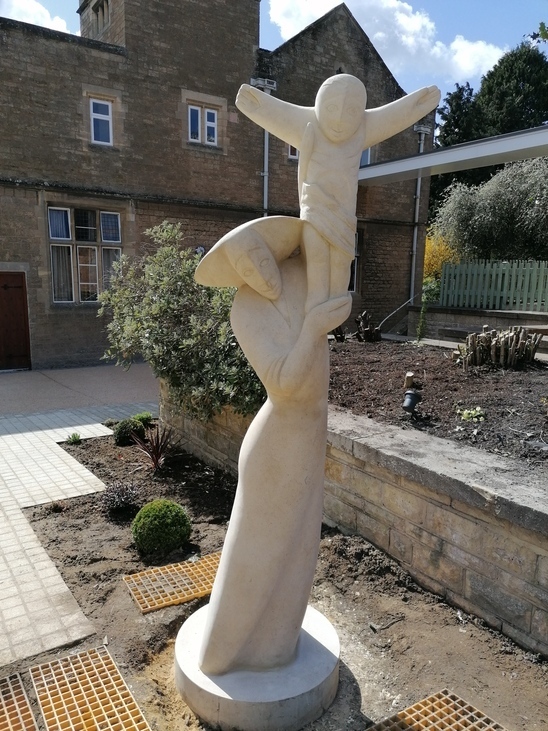
>> “Mother and Child Commission”: In this twelve-minute “making of” video, filmmaker Nick Clarke talks to artist Nicholas Mynheer over the first half of 2020, tracing his progress on the life-size Mother and Child sculpture that was commissioned by the Community of St Mary the Virgin, Wantage, an Anglican convent in Oxfordshire. I was struck by, from the looks of it, the physical demands of the sculpting process—the strength and endurance required to chip away daily at blocks of stone outside in winter, until they yield the shape you desire, then the logistics of attaching the blocks with steel, which weigh nearly a ton collectively, and disassembling, transporting, and reassembling them for installation. I was also interested to hear Mynheer discuss the expressive capabilities of English limestone—how you can convey emotional and sartorial subtleties, for example, through the precise angling of the chisel.
Mynheer, Nicholas_Mother and Child (Wantage)
Nicholas Mynheer (British, 1958–), Mother and Child, 2020–21. English limestone, height 230 cm.

Mother and Child was installed in the outdoor reception area of St Mary’s on April 12, 2021; you can watch a video of the installation here. “In very, apparently, simplified form, there is so much tenderness, energy, and something new,” says Sister Stella, the sister in charge, about the sculpture. “Jesus isn’t going to be held back. Her son’s going to go places.”

To learn more about Nicholas Mynheer, visit his website, https://www.mynheer-art.co.uk/. You can also read the artist profile I wrote on him for Transpositions in 2017.

+++

SONGS:

>> “Corazón Pesebre” (Heart Manger) by Rescate: A follower of the blog introduced me to this Christmas song from Argentina, and I dig it! Released as a single in 2017, it’s about turning our hearts into a manger to receive Christ. Read the Spanish lyrics in the YouTube video description.

The song is by the highly popular Argentinian Christian rock band Rescate, active from 1987 to 2020. Their lead singer and main songwriter, Ulises Eyherabide, died of cancer in July.

>> “Hallelujah, What a Savior!” (Christmas Version), performed by Providence Church, Austin, Texas: In 2012 Austin Stone Worship songwriters Aaron Ivey, Halim Suh, and Matt Carter rewrote the lyrics to Philip P. Bliss’s classic “Hallelujah, What a Savior!” to make them more Christmas-centered and added a new refrain; their version was released that year on A Day of Glory (Songs for Christmas). Here the song is performed by another Austin worship team—Jordan Hurst, Jaleesa McCreary, and Brian Douglas Phillips from Providence Church—for a virtual worship service on November 29, 2020. Instead of using the Austin Stone refrain, they quote Leonard Cohen’s “Hallelujah” between verses.
Christmas, Day 11

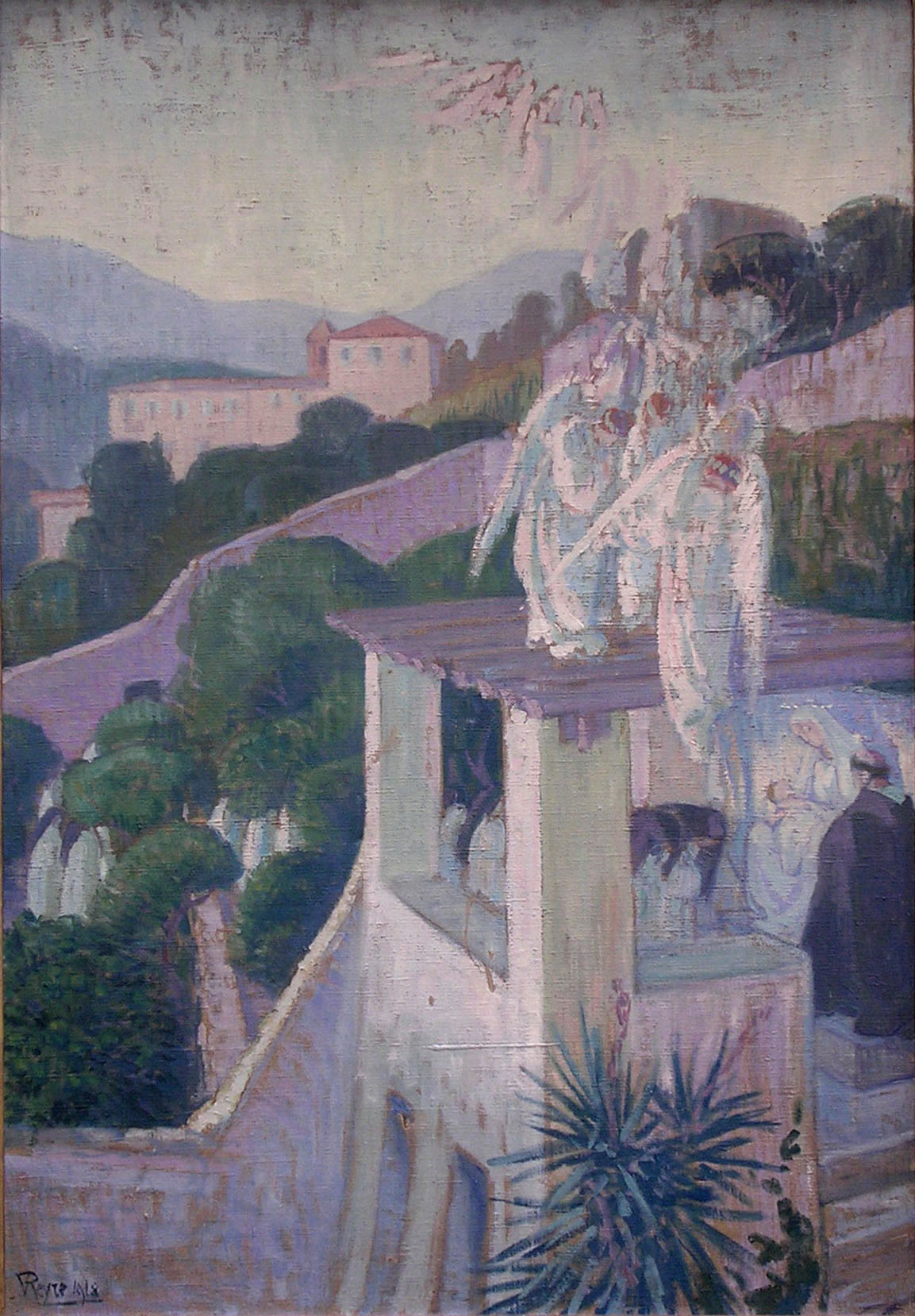
LOOK: Dominican Nativity by Valentine Reyre

Reyre, Valentine_Nativity
Valentine Reyre (French, 1889–1943), Nativité aux dominicaines (Dominican Nativity), 1918. Oil on canvas. Private collection. Photo: Michel Guérin.

Valentine Reyre was a French artist who participated in the revival of religious art in the first half of the twentieth century. She was the cofounder, with Maurice Storez and Henri Charlier, of L’Arche, a group of Catholic artists and architects active from 1919 to 1934. She also participated in the Ateliers d’art sacré, a movement that sought to reconcile tradition and modernity, art and craft, in the decoration of church interiors, especially those devastated by World War I. Members of the Ateliers—the most famous of which were Maurice Denis and George Desvallières—rejected academism on the one hand and the avant-garde (e.g., futurism, cubism) on the other, seeking a third way forward for religious art.

Reyre’s Dominican Nativity is set outside a Dominican convent in the hills of France. The focal point is the Virgin Mary and the infant Jesus, clothed in white and seated under a small, open, roofed structure. It’s deliberately ambiguous as to whether these figures are meant to be present in the flesh in this space or are a statue; in other words, is this the holy birth transplanted to another time and place, occurring as if for the first time, or is it the birth memorialized? Either way, a procession of nuns winds through the tree-studded landscape to offer their worship and devotion to Christ, their shaping mirrored by the ribbon of angels that unfurls from distant sky to the foregrounded rooftop. The adult male figure at the right is probably Saint Dominic, the medieval Castilian priest who founded the Dominican order, as he is tonsured and wears a habit.

I love the intersection of time and eternity in this image—heaven breaking into the everyday. A community of sisters bows in prayer and re-members Christ’s Nativity.

LISTEN: Hymns and Sacred Songs, FS 83: No. 1. Förunderligt at sige | Words by Nikolai F. S. Grundtvig, 1845 (reworked from “Mit hierte altid vanker” [“My Heart Always Wanders”] by Hans Adolph Brorson, 1732) | Music by Carl Nielsen, 1919 | Performed by the Svanholm Singers, dir. Sofia Söderberg Eberhard, on December, 2010

Forunderligt at sige,
Og sært at tænke paa,
At Kongen til Guds Rige
I Stalden fødes maa,
At Himlens Lys og Ære,
Det levende Guds Ord,
Skal huusvild blandt os være,
Som Armods Søn paa Jord!

Selv Spurven har sin Rede,
Kan bygge der og boe;
En Svale ei tør lede
Om Nattely og Ro;
De vilde Dyr i Hule
Har hver sin egen Vraa:
Skal sig min Frelser skjule
I fremmed Stald paa Straa?

Nei, kom! jeg vil oplukke
Mit Hjerte, Sjæl og Sind,
Ja, bede, synge, sukke:
Kom, Jesus, kom herind!
Det er ei fremmed Bolig,
Du den har dyrekiøbt!
Her skal du hvile rolig,
I Kiærligheden svøbt!

English translation by Jenny Rebecca Rytting, 2012:

How wonderful to sing of,
And strange to think at all,
The sovereign of God’s kingdom
Is born within a stall,
All heaven’s light and honour,
God’s living word, e’en he,
On earth shall homeless wander,
The son of poverty.

The sparrow, with her nesting,
Can build herself a home;
We find the swallow resting,
At night she needn’t roam.
The wild beasts abide in
The burrows where they stay.
Shall then my Saviour hide in
An unknown stall on hay?

No, come, I’ll open to thee
My heart, my soul, my mind.
I’ll pray and sing and sue thee,
“Come, Jesus, come inside!”
For here thou art no stranger;
This home thou dearly bought.
Rest now within this manger
In swaddling love has wrought.

Jenny Rebecca Rytting describes this Danish carol’s complex textual history, starting with its origins in an eighteenth-century carol by the Danish bishop and hymn-writer Hans Adolph Brorson. Brorson’s text has eleven verses; Nikolai F. S. Grundtvig cut it down to six in 1837, adapting these verses but following Brorson’s wording fairly closely. In 1845 Grundtvig made “extensive changes” to his initial reworking of the carol and published it in a booklet of his hymns. Much later, in 1939, the editors of Højskolesangbogen (The Folk High School Songbook) published Grundtvig’s text with only three verses (verses 1, 5, and 6 of his 1845 version). That’s the version that’s most often used today. Rytting has produced an English translation, posted above. For a translation of all six verses, albeit one that’s a bit clumsy, see here (scroll down to #50, “How wonderful to ponder”).

Carl Nielson, widely recognized as Denmark’s most prominent composer, wrote a musical setting for “Förunderligt at sige” in 1914 (in a letter to his wife at the time, he described it as “the most beautiful I have yet composed”), and it was first published in 1919. Cataloged as CNW 165, it is now considered the standard tune for the carol.

The text is inspired in part by Jesus’s words in Matthew 8:20: “Foxes have holes, and birds of the air have nests; but the Son of Man has nowhere to lay his head.” He was born in an out-of-town stable, lived as a stranger in Egypt, and spent years as an itinerant preacher, never staying for too long in any one place. The speaker invites the wandering Christ to take up permanent residence within her, as he has already bought her (Gal. 3:13; 1 Cor. 6:20). Her love, she says, will provide the swaddling, a cozy warmth.