He was oppressed, and he was afflicted, yet he did not open his mouth; like a lamb that is led to the slaughter and like a sheep that before its shearers is silent, so he did not open his mouth.
—Isaiah 53:7
As soon as it was morning, the chief priests held a consultation with the elders and scribes and the whole council. They bound Jesus, led him away, and handed him over to Pilate. Pilate asked him, “Are you the King of the Jews?” He answered him, “You say so.” Then the chief priests accused him of many things. Pilate asked him again, “Have you no answer? See how many charges they bring against you.” But Jesus made no further reply, so that Pilate was amazed.
—Mark 15:1–5
LOOK: Christ before the Judge by Cecil Collins
Cecil Collins (British, 1908–1989), Christ before the Judge, 1954–56. Oil on board, 47 1/2 × 35 1/2 in. (120 × 90 cm). Gardiner Chantry, Winchester Cathedral, England. Photo: Anne Baring.
I learned of this painting from the book The Image of Christ in Modern Art by Richard Harries. In the painting, Harries writes, Pilate is fierce, angular, aggressive, baring his teeth. “He represents the mechanism of law against Christ, now striated by the flagellation, and wearing a large crown of thorns. But Christ’s eyes are wide open, revealing a strong, serene and eternal order that remains untouched by the harshness.”
LISTEN: “Silencio,” movement 28 from La pasión según San Marcos (St. Mark’s Passion) by Osvaldo Golijov, 2000
The video below is the world premiere performance by the Orquesta La Pasión and the Schola Cantorum de Venezuela, conducted by María Guinand, on September 5, 2000, at the Beethovenhalle in Stuttgart, Germany. The “Silencio” movement is cued up for playback, but I recommend listening to the entire work!
Osvaldo Golijov(born 1960) is an Argentine composer born in La Plata to Ukrainian and Romanian Jewish parents. He left his native Argentina in 1983 to study for three years at the Rubin Academy of Music in Jerusalem, and then he settled in the United States. He lives in Massachusetts.
Golijov was one of four composers commissioned by the International Bach Academy of Stuttgart in 1996 to write a Passion oratorio to commemorate the 250th anniversary of J. S. Bach’s death in 2000. (I featured another, Tan Dun, in a recent roundup.) Golijov chose Mark’s Gospel as his basis, compiling the libretto from a Spanish translation of the Gospel and other Spanish-language sources, and for the music, drawing on a variety of Latin American styles and rhythms.
The “Silencio” movement of Golijov’s La pasión según San Marcos captures the moment at which Christ stands before Pontius Pilate, the governor of the Roman province of Judaea. He had already appeared before Caiaphas, the Jewish high priest; now he’s been handed over to another authority to stand trial yet again.
Much to everyone’s surprise, he does not defend himself against the charges of sedition, treason, and blasphemy—not because he was guilty, but because he knew it would do no good. He had already told the people who he was and what he was there to do—had demonstrated it with miracles—but most of those in power continued to disbelieve and resist him. And so he returns their accusations with a dignified silence. He has purposed to take his gospel all the way to the cross to further reveal the heart of God.
“Silencio” (Silence), which comes between “Amanecer: Ante Pilato” (Dawn: Before Pilate) and “Sentencia” (Sentence), consists of clapping and stomping in the mode of flamenco, the texture thickening to convey ratcheting tension. “Spanish flamenco suggests the influence of the colonizing power, akin to ancient Rome in the Holy Land,” Thomas May writes, “and is thus suitable for Jesus’ betrayal and sentencing by the authorities – but also for the fatalistic aura of his impending death.”
There are no vocals in this movement, and the only instruments are the cajón and body percussion. The chorus creates rhythms with their hands and feet, representing the chief priests and scribes and the gathered crowds who wait anxiously for a word from the accused, but who are more anxious still for a verdict.
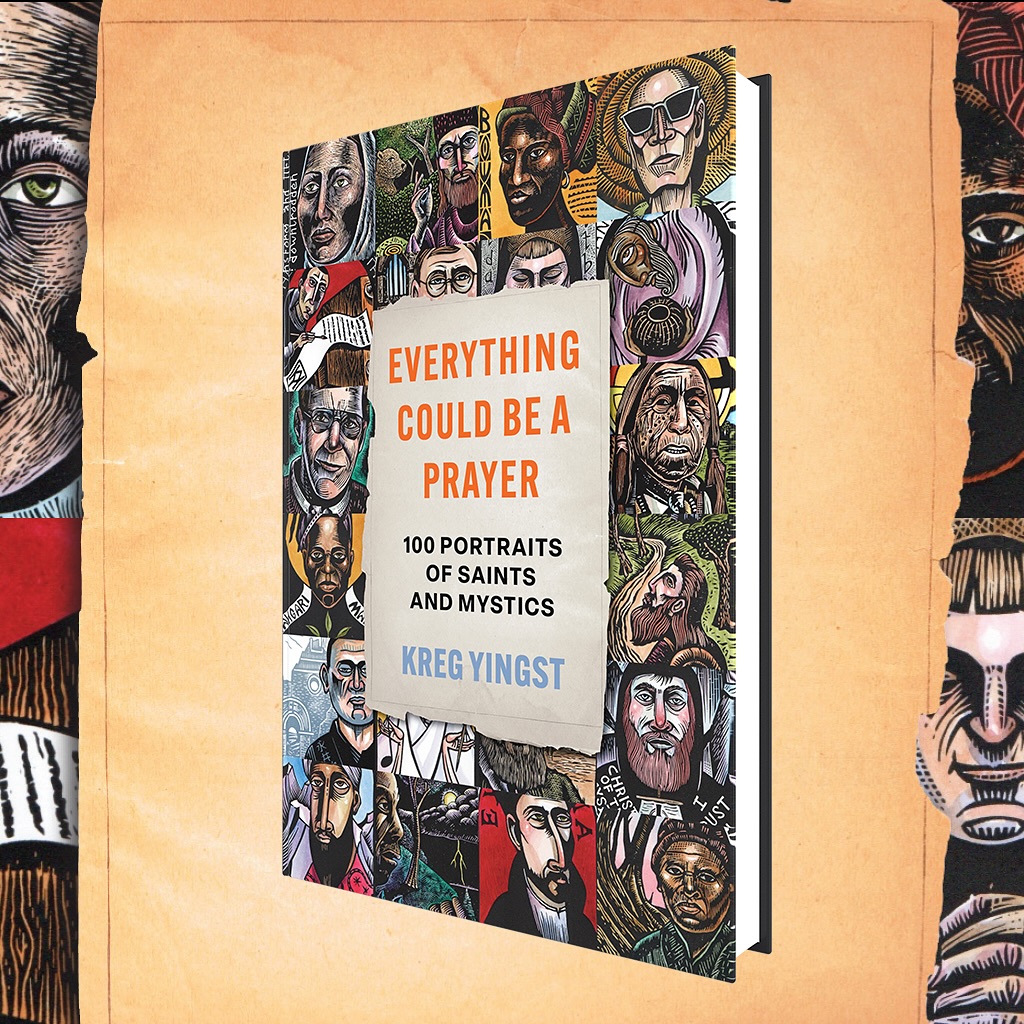
NEW BOOK: Everything Could Be a Prayer: One Hundred Portraits of Saints and Mystics by Kreg Yingst: Released on October 15, this book features one hundred color block-print portraits by Kreg Yingst of folks in the family of God across time and place, along with one-page biographies. Get to know a wide range of Christian civil rights activists, scientists, environmentalists, social service workers, hymn-writers, artists, poets, evangelists, and monastics and the gospel impact they’ve made. The lineup is a mix of familiar and less familiar names, canonized saints and noncanonized. Examples include Brigid of Kildaire, Ignatius of Loyola, Satoko Kitahara, Dietrich Bonhoeffer, Mamie Till, Pandita Ramabai Dongre-Medhavi, and Black Elk. Click here to look inside.
The title of the book is taken from a quote by Martin de Porres (1579–1639), a Dominican friar from Peru and the first Black saint of the Americas: “Everything, even sweeping, scraping vegetables, weeding a garden, and waiting on the sick, could be a prayer if it were offered to God.”
Related events:
October 10–November 16, 2024: Art exhibition featuring the block prints from the book at The Gallery of Art, 36 W. Beach Dr., Panama City, Florida
October 26, 2024, 1:00–3:00 p.m.: Book signing at Barnes & Noble, 1200 Airport Blvd., Pensacola, Florida
Through November 1, Yingst is offering 25% off all original woodcuts and linocuts that were used as illustrations for the book; view the discounted pieces in the “Mystics, Saints & Poets” section of his Etsy shop. These are not inkjet-printed photographs of original artworks (which is what some artists misleadingly call “prints”) but are themselves original limited-edition relief prints hand-pulled on an antique proof press from carved blocks; they are made with black oil-based ink and watercolor. If you want original art in your home or to gift a friend or family member for Christmas, Yingst’s work is a great and affordable option!
+++
SONGS:
November 1 is All Saints’ Day, a feast for commemorating the lives and witness of our siblings in the faith who have gone before us. Here are two songs for the occasion.
>> “I Sing a Song of the Saints of God,” performed by Wendell Kimbrough: This charming little children’s hymn was written by Lesbia Scott and was first published in her native England in Everyday Hymns for Little Children (1929). In the United States the song first appeared in the Episcopal Hymnal 1940 with a tune that John Henry Hopkins, a member of the hymnal committee, composed for it, capturing the childlike cadences of the text.
>> “When the Saints” by Sara Groves: This song from Groves’s album Tell Me What You Know (2007) draws encouragement from the faithfulness of God-followers throughout history, from Moses, Paul, and Silas to Harriet Tubman and Mother Teresa to the martyr Nate Saint and his sister Rachel Saint to rescuers of sex-trafficking victims. It is a call to hearers today to pick up their cross and follow Christ into places of hurt and injustice, pursuing liberation of body and soul for all. The refrain quotes the traditional Black gospel song “When the Saints Go Marching In.”
+++
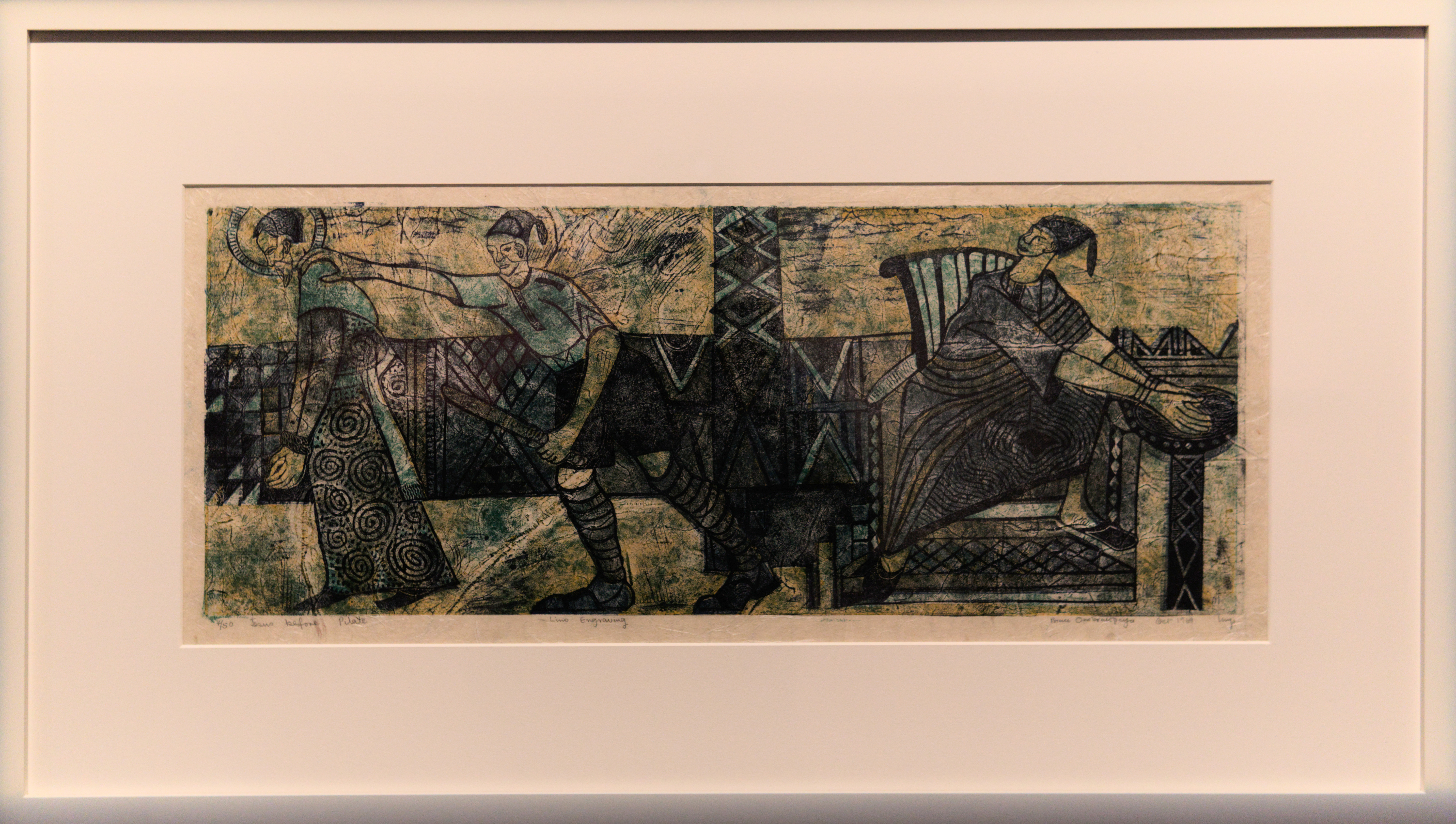
ART EXHIBITION: Bruce Onobrakpeya: The Mask and the Cross, National Museum of African Art, Washington, DC, June 21, 2024–January 21, 2025: A father of African modernism, Bruce Onobrakpeya (b. 1932) [previously] is one of Nigeria’s most celebrated artists, and I was thrilled this month to visit his first solo show in the US, which, as it turns out, is centered on his Christian-themed linocut prints! (The artist is Anglican.) Onobrakpeya’s career spans over six decades, and this Smithsonian exhibition is not meant to be representative of the breadth of his oeuvre, which also includes painting and sculpture and various subject matters; rather, it presents two foundational bodies of work from the late sixties, both commissioned by the Catholic Church, that helped launch the artist’s long and esteemed career.
The exhibition displays rare artist’s proofs of the biblical illustrations Onobrakpeya made for Ki Ijoba Re De (May Your Kingdom Come) (1968), a Yoruba-language textbook for students in their fifth and sixth years of Catholic primary school (it was part of the Nigerian National Catechism), as well as a complete narrative series of prints titled Fourteen Stations of the Cross, produced in 1969. I blogged about the artist’s Stations cycle back in 2014, when I saw a different edition at the SMA African Art Museum in Tenafly, New Jersey; you can view better photos on the High’s website. For more on the work of Fr. Kevin Carroll, the Catholic missionary who commissioned Onobrakpeya to paint a church mural of the Stations that became the basis of these linocuts and who helped facilitate the May Your Kingdom Come publication, see here.
Curated by Lauren Tate Baeza, Bruce Onobrakpeya: The Mask and the Cross first opened last year at the High Museum of Art in Atlanta. This is Baeza’s first exhibition as curator of African art at the High, and I’m so pleased that when she dug through the High’s extensive archives, it was a set of Christian prints by a leading Nigerian artist that most compelled her, that she could imagine building a unique exhibition around and that she felt must be pulled out of storage for more people to see. Hear Baeza discuss the exhibition from 23:28 to 35:58 of the video “African Modernisms: A Legacy of Connection.”
Bruce Onobrakpeya (Nigerian, 1932–), Station I: Pilate condemns Jesus to death, 1969. Linoleum block print on rice paper, 24 × 34 in. (61 × 86.4 cm). High Museum of Art, Atlanta, Georgia. Photo: Victoria Emily Jones.
For his Stations of the Cross, Onobrakpeya “incorporat[ed] the rich patterns of Yoruba gelede and epa masks and stylized geometric patterns found in northern Nigerian architecture. Then he added generous adire motifs and his signature elongated figures and distortions of scale,” reads one of the gallery wall texts. He also embedded a critique of British colonial rule, portraying the Roman soldiers of Christ’s passion as British officers. (Nigeria had just attained independence from Great Britain earlier that decade, in 1960.) Pilate, though, is shown as a local Nigerian magistrate doing the bidding of the British government, highlighting a deeply felt tension in Nigeria’s then-recent political history.
I really appreciate the video components of the exhibition. One screen plays a compilation of clips from interviews Baeza conducted with the artist, and another displays a two-dimensional animation commissioned from Sadiki Souza specially for this exhibition, which brings to life Onobrakpeya’s fourteen Stations. Neither is available online, at least not that I can find.
+++
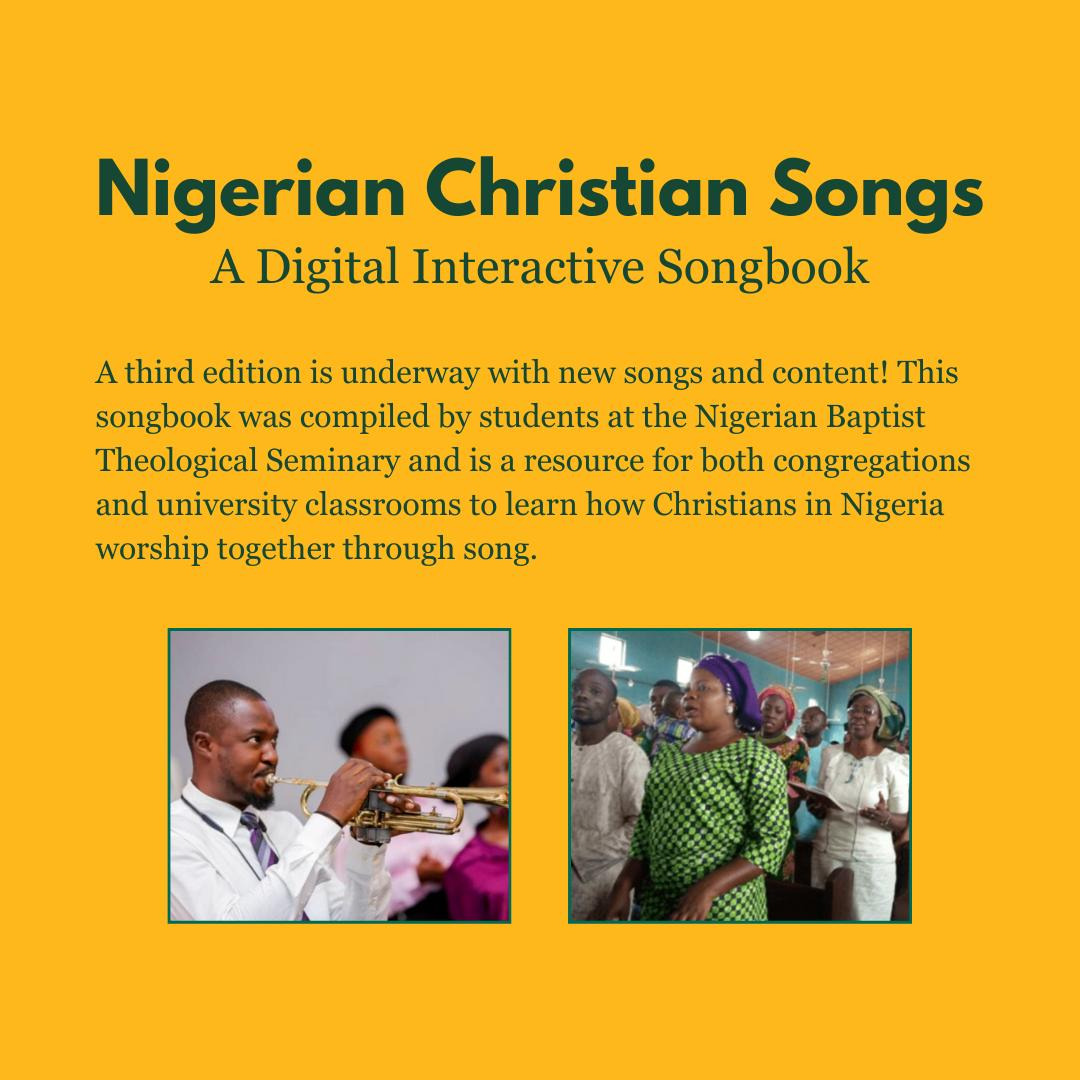
ZOOM EVENT: “Celebration of New Global Church Music Resources,” November 14, 9:00 a.m. CDT (12:00 p.m. ET): From Baylor University’s Dunn Center for Christian Music Studies: “We are excited to announce the launch of two website projects on November 14th! In collaboration with the Nigerian Baptist Theological Seminary, the third edition of the Nigerian Christian Songbook will be updated with new songs and content. In addition, a new project, the Global Church Music Bibliography, highlights underrepresented voices in church music scholarship. This is an interactive dashboard and map that features church music scholars writing about their own traditions outside of North America.” At the Zoom event on launch day, you will hear from various project participants. [HT: Global Christian Worship]
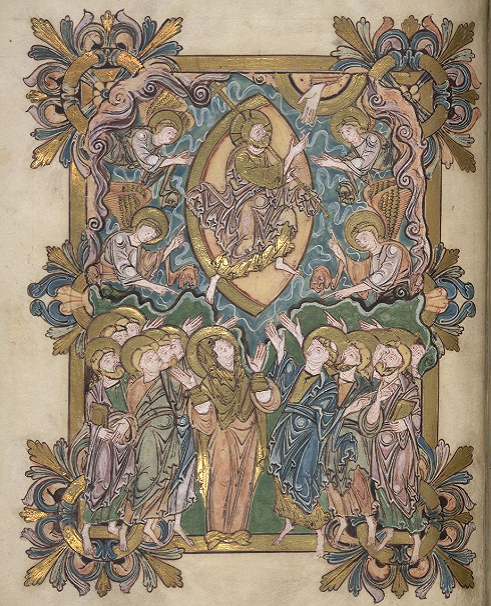
ANGLO-SAXON ASCENSION POEM: Excerpts from “Christ II” by Cynewulf, probably ninth century, translated from Old English by Eleanor Parker: Dr. Eleanor Parker lectures on medieval literature at Oxford University and runs the excellent blog A Clerk at Oxford, where she often shares her translations of Anglo-Saxon poetry, with commentary. The poem she shares here reflects on Christ’s ascension—the disciples’ grief, the angels’ joy. To me the most remarkable section is the one that, indirectly referencing a sermon of Gregory the Great, describes Christ “leaping” up to heaven, taking an active bound toward his homeland, a movement read in light of Song of Solomon 2:8: “Behold, he comes, leaping over the mountains, bounding over the hills.” This leap is one of six he took: from heaven (1) into Mary’s womb, (2) into a manger, (3) onto the cross, (4) into the tomb, (5) into hell, and finally, (6) back into heaven. “Prince’s play”! Parker pairs the poem with an exquisite, near-contemporary manuscript illumination, also from England; there’s also a lot of resonance between the poem and the Ascension image I published Tuesday by Bagong Kussudiardja, which shows a more balletic ascent.
The Ascension, from the Benedictional of St. Æthelwold (BL Additional MS. 49598), f. 64v, England, 963–984 CE. British Library, London.
+++
UNDERWATER DANCE:“AMA,” a short film by Julie Gautier: This wonderfully expressive silent film shows French free diver and underwater artist Julie Gautier dancing in a single breath for several minutes inside the world’s deepest swimming pool, Y-40 Deep Joy in Montegrotto Terme, Padua, Italy, to a minimalist piano piece. The final shot shows Gautier slowly rising to the water’s surface while releasing a giant air bubble, her pose evocative of the crucified Christ (and her upward movement an Ascension of sorts!). Titled “Ama” (Japanese for “sea woman,” the name given to Japan’s pearl divers), the film is “dedicated to all the women of the world,” Gautier says. The choreography is by Ophélie Longuet.
Gautier and her husband, Guillaume Néry, a free-diving champion, own the underwater filmmaking company Les Films Engloutis. Their most well-known project has been a music video featuring Beyoncé, codirected by Gautier and starring Néry.
+++
KICKSTARTER CAMPAIGN:Help Andy Squyres finance his next album: Andy Squyres is a super-talented singer-songwriter whose lyrics don’t stay in the shallows but, rather, dive into the depths of the faith experience. They are also supremely hope-filled. Below is a video of Squyres performing “Labor in Vain” at a house concert; the song is from his last album, Cherry Blossoms, which I reviewed here. Click on the boldface link above to hear Squyres discuss his new album project and to donate toward it.
+++
ICON PAINTING COMPETITION: The Interparliamentary Assembly of Orthodoxy (IAO) is hosting an international icon painting competition on the subject of Christ’s Resurrection. “Our purpose is to explore and bring to the foreground the numerous stylistic trends in existence today, enabling the visualization of a creative dialogue with tradition and, at the same time, the personal artistic expressions of artists who reframe tradition without, however, digressing from the doctrinal framework of Christian icon painting set by the 7th Ecumenical Council.” The submission window is closed—there are sixty-three great entries!—and now it’s time to cast your vote. Five winners will be selected to receive cash prizes, the topmost being €3,000, and other honors. Popular votes will be taken into account by the twelve jury members, among whom are esteemed iconographers George Kordis from Greece and Todor Mitrovic from Serbia.
Dimosthenis Avramidis (Greek, 1965–), Christ’s Descent into Hades, 2017. Egg tempera on wood, 91.5 × 61.5 cm.
+++
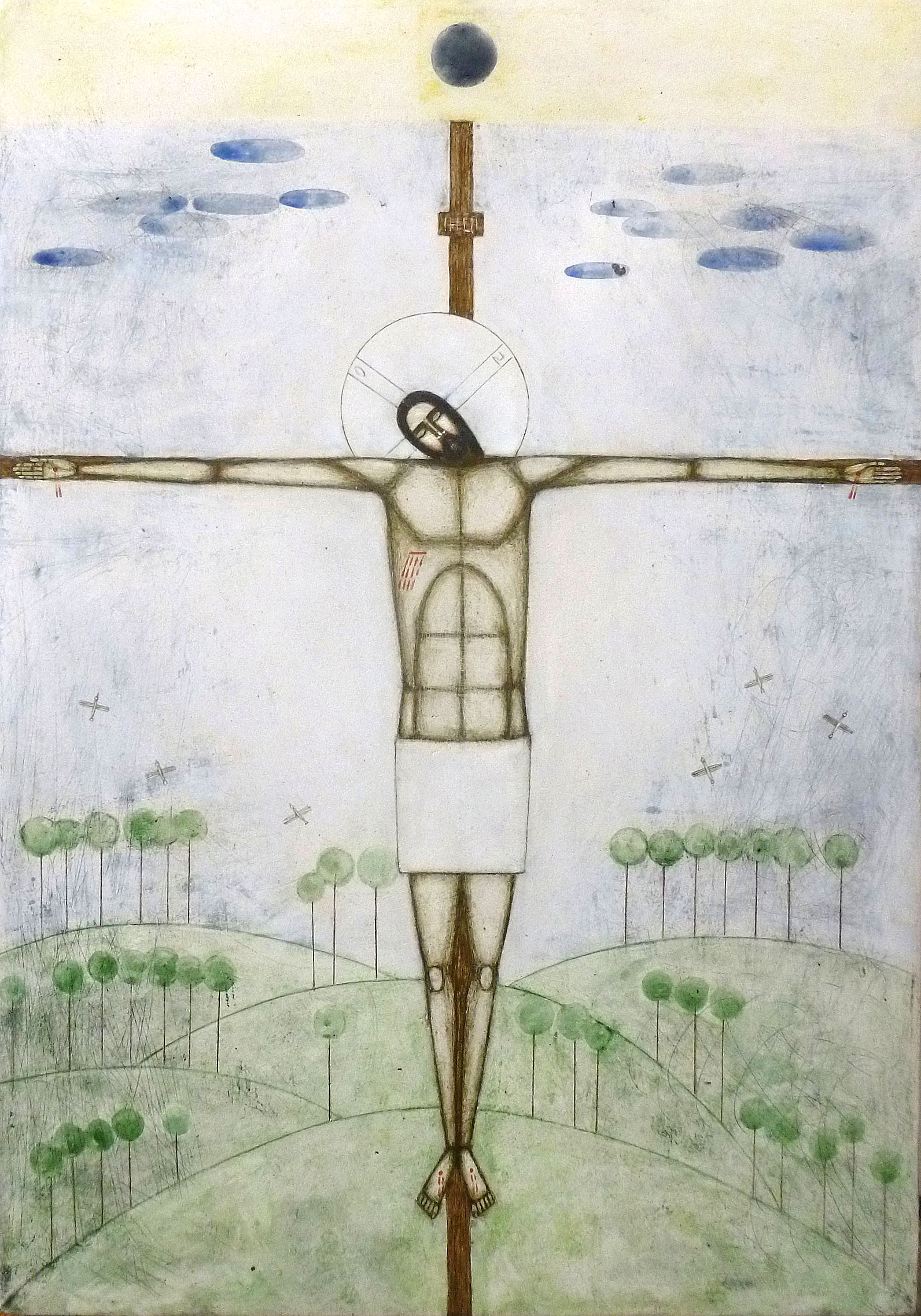
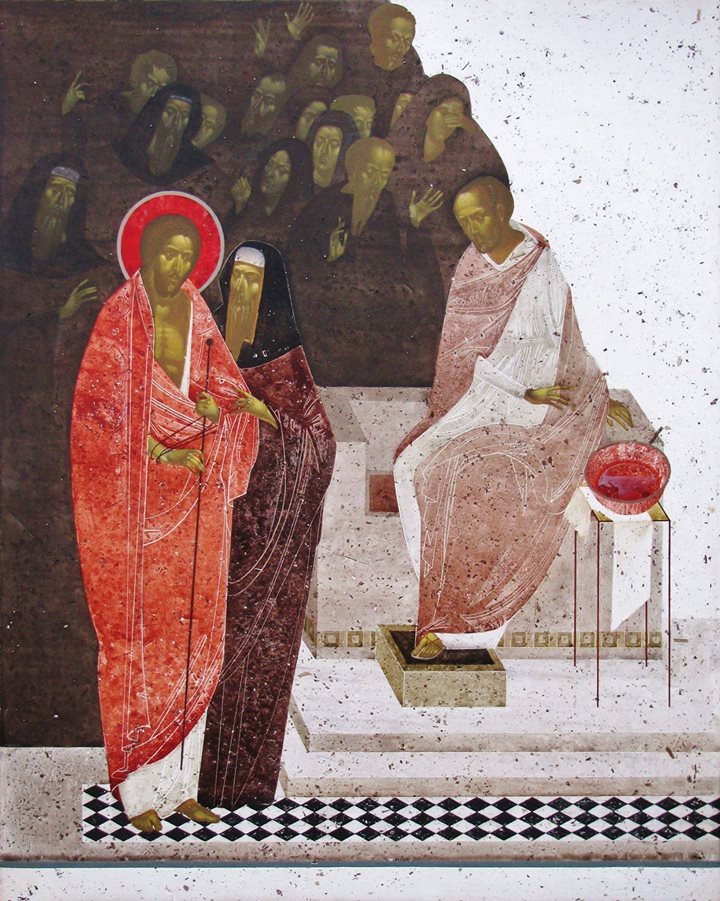
ESSAY: “On the Border of East and West: Searching for Icons in Lviv” by John A. Kohan: The latest issue of Image journal features a wonderful essay on the Lviv school of iconography (represented in entries #4, #10, and #20 of the above contest), a movement by young Ukrainian Greek Catholic artists to contemporize the Byzantine visual tradition. Written by John A. Kohan, an avid religious art collector and former Time bureau chief in Moscow (1988–1996), it discusses the political history of the city; the role of Metropolitan Andrey Sheptytsky (r. 1901–1944) in preserving and supporting art for future generations; the opening of the Iconart gallery in 2010 to nurture and promote the new style; the broad training these icon makers receive at the Lviv National Academy of Arts; and the uneven reception by others in the denomination (especially official church bodies), who tend to prefer their sacred art in the Radruzh School style or as contemporary Catholic kitsch. Kohan writes from his firsthand experiences meeting the artists and visiting their studios, churches, and exhibition spaces. The essay is available to subscribers only; click here to subscribe.
Natalya Rusetska (Ukrainian, 1984–), Crucifixion, 2017. Egg tempera on gessoed wood, 11 3/4 × 8 1/4 in.
Ivanka Demchuk (Ukrainian, 1990–), Christ before Pilate, 2017. Mixed media on gessoed wood, 19 3/4 × 15 3/4 in.
I’m enthralled by the contemporary icons being produced in Lviv—I saw a bunch from Kohan’s collection last summer, and I featured some in a Baptism of Christ roundup earlier this year. The best way to keep abreast of the output from the Lviv school is to follow Iconart on Facebook, and for an even wider breadth of innovative eastern European icons, follow Międzynarodowe Warsztaty Ikonopisów w Nowicy (International Iconography Workshop in Nowica, Poland).
+++
MET GALA + EXHIBITION: “Heavenly Bodies: Fashion and the Catholic Imagination,” May 10–October 8, 2018, Metropolitan Museum of Art, New York City: The largest exhibition ever mounted by the Met’s Costume Institute, “Heavenly Bodies” features both religious vestments from the Vatican and runway fashions by famous designers inspired by Catholicism. AFashionista reviewer who attended a preview reports on the integrated displays:
A reliquary arm of Saint Valentine is displayed alongside a breastplate and crown of thorns from Alexander McQueen’s Givenchy days; sacred music serves as the auditory backdrop for a Rodarte collection that features a dress inspired by Bernini’s famous sculpture Ecstasy of Saint Teresa. Rows of mannequins wearing Dolce & Gabbana, Moschino and Raf Simons show the ways that the silhouettes of the cassock and nun’s habit have been explored on the runway time and again. There are even vestments by the likes of Yves Saint Laurent and Riccardo Tisci that were expressly designed to dress statues of the Virgin Mary in chapels in Italy and France.
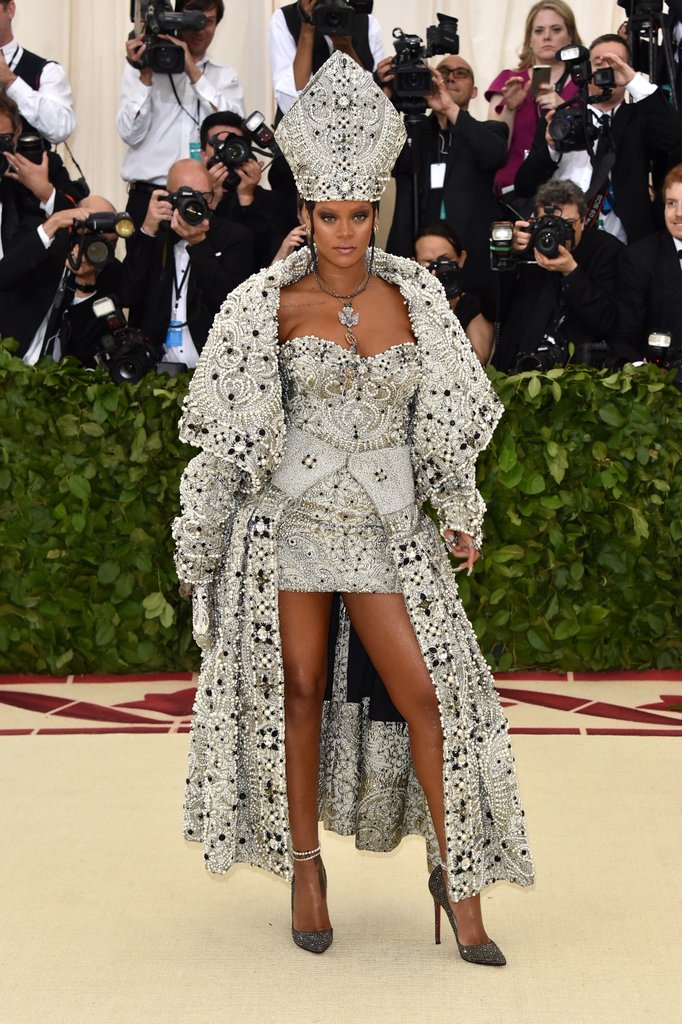
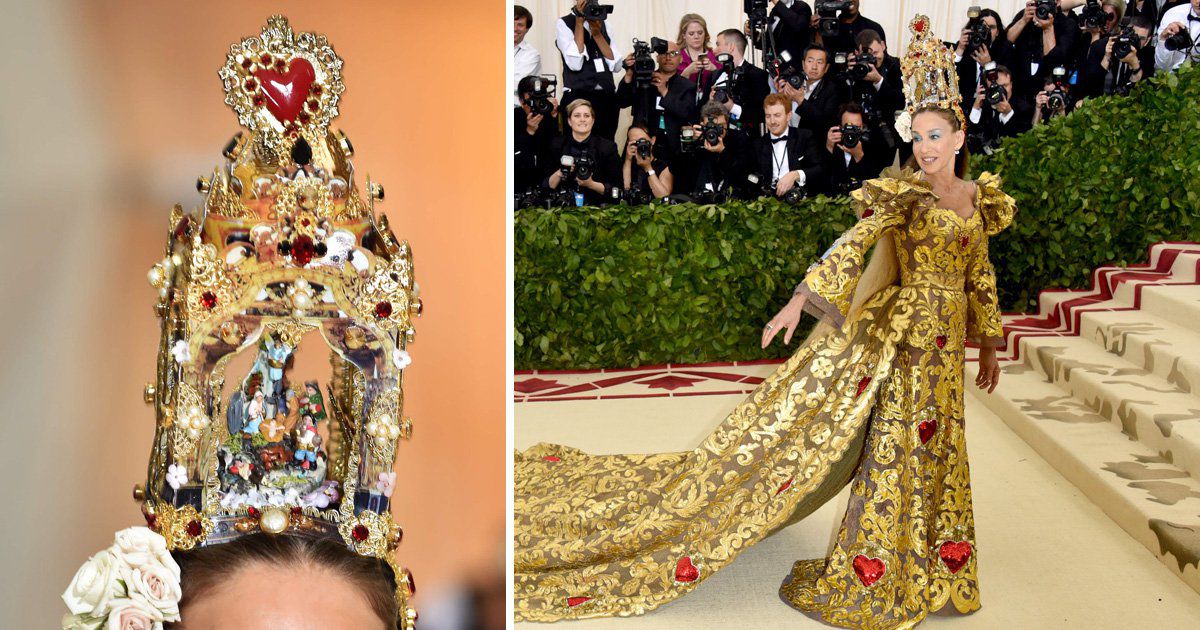
Each year since 1948, the opening of the Costume Institute’s spring exhibition has been celebrated with a huge fundraising gala attended by celebrities who dress to the theme; this year’s took place May 7. There were lots of crosses and haloes, but also some more particularized outfits. Ariana Grande’s gown was inspired by Michelangelo’s Last Judgment; Gigi Hadid’s, by stained glass. Selena Gomez carried a Coach handbag embroidered with Proverbs 31:30b: “A woman who fears the Lord is a woman who shall be praised.” The most brazenly dressed was Rihanna, who wore a gem-encrusted bishop’s miter (not a papal tiara, as has been commonly reported). Another standout headpiece was Sarah Jessica Parker’s, which featured a Neapolitan Nativity scene set inside a mini baldachin. (The making of elaborate presepi, or Christmas crèches, is a longstanding tradition in Naples, reaching its height during the eighteenth century.)
The white Margiela minidress, cape, and headpiece Rihanna wore to Monday’s Met gala were inspired by Catholic pontifical vestments. Photo: John Shearer/Getty.
Sarah Jessica Parker wore a regal gold, long-trained Dolce & Gabbana gown, but the pièce de résistance of her ensemble was the Nativity headpiece.
Lana Del Rey went as Our Lady of Sorrows, wearing an immaculate-heart chest plate pierced through with seven daggers; it was comical to hear religiously illiterate reporters trying to interpret the symbolism, saying things like the daggers are a “reminder to repent your sins or suffer damnation!” (Wrong. The swords symbolize the Virgin’s seven sorrows, beginning with Simeon’s prophecy.)



 Art & Theology