
Roundup: Multilingual Easter song, modern performance of medieval mystery play, and more

SONGS:

>> “He Is Lord (In Every People),” adapt. Gregory Kay: In this video from 2021, members of Spring Garden Church in Toronto take turns singing the popular twentieth-century worship song (of unknown authorship) “He Is Lord” in their native languages: English, Portuguese, Arabic, Korean, and Chinese. Greg Kay, one of the church’s copastors, added a fun refrain that highlights the global character of Christianity and the lordship of Christ over all creation, which everyone joins in on. Love this idea! [HT: Liturgy Fellowship]

>> Easter Medley performed by Infinity Song, feat. Victory Boyd: Infinity Song is a sibling band from New York City that was led for years by Victory Boyd, who is now focusing on her solo music career; its current members, represented in this video from 2021, are Abraham, Angel, Israel, and Thalia “Momo” Boyd. (Victory is singing lead.) The group combines the songs “In the Name of Jesus” by David Billingsley, “Jesus Is Alive” by Ron Kenoly [previously], and “Redeemer” by Nicole C. Mullen into an Easter medley at Fount Church in New York.

>> “Yessu Jee Utheya” (یسوع جی اُٹھیا) (Jesus Is Risen), performed by Tehmina Tariq: Tehmina Tariq is a prolific gospel singer from Islamabad, Pakistan. Here she performs a song in Urdu by Nadir Shamir Khan (words) and Michael Daniel (music). Press the “CC” button on the YouTube video player to follow along with the lyrics. For a more recent Easter song that Tariq recorded, see “Zinda Huwa Hai Masih” (The Messiah Is Risen). [HT: Global Christian Worship]

+++

MEDIEVAL MYSTERY PLAY: The Harrowing of Hell from the York cycle, produced by the YMPST (York Mystery Plays Supporters Trust): From the mid-fourteenth to mid-sixteenth century in England, during the feast of Corpus Christi in early summer, villagers used to enact stories from the Bible on moveable stages called pageant wagons, which would wheel through town making various stops for performance. Playing the roles of sacred personages were not professional actors but members of the trade guilds. Such plays were banned in Tudor times but since the mid-twentieth century have enjoyed a revival.

One of the few complete surviving English mystery play cycles, consisting of forty-eight individual verse dramas of about twenty minutes each, is the York Mystery Plays, named after the historic town where they originated. One of the plays, assigned to the town saddlers, is The Harrowing of Hell. The following video is a 2018 performance sponsored by the York Mystery Plays Supporters Trust, also available on DVD. You can follow along with the script at TEAMS Middle English Texts, though note that the players do adapt it lightly. Learn more at https://ympst.co.uk/.
York Mystery Play (Harrowing of Hell)
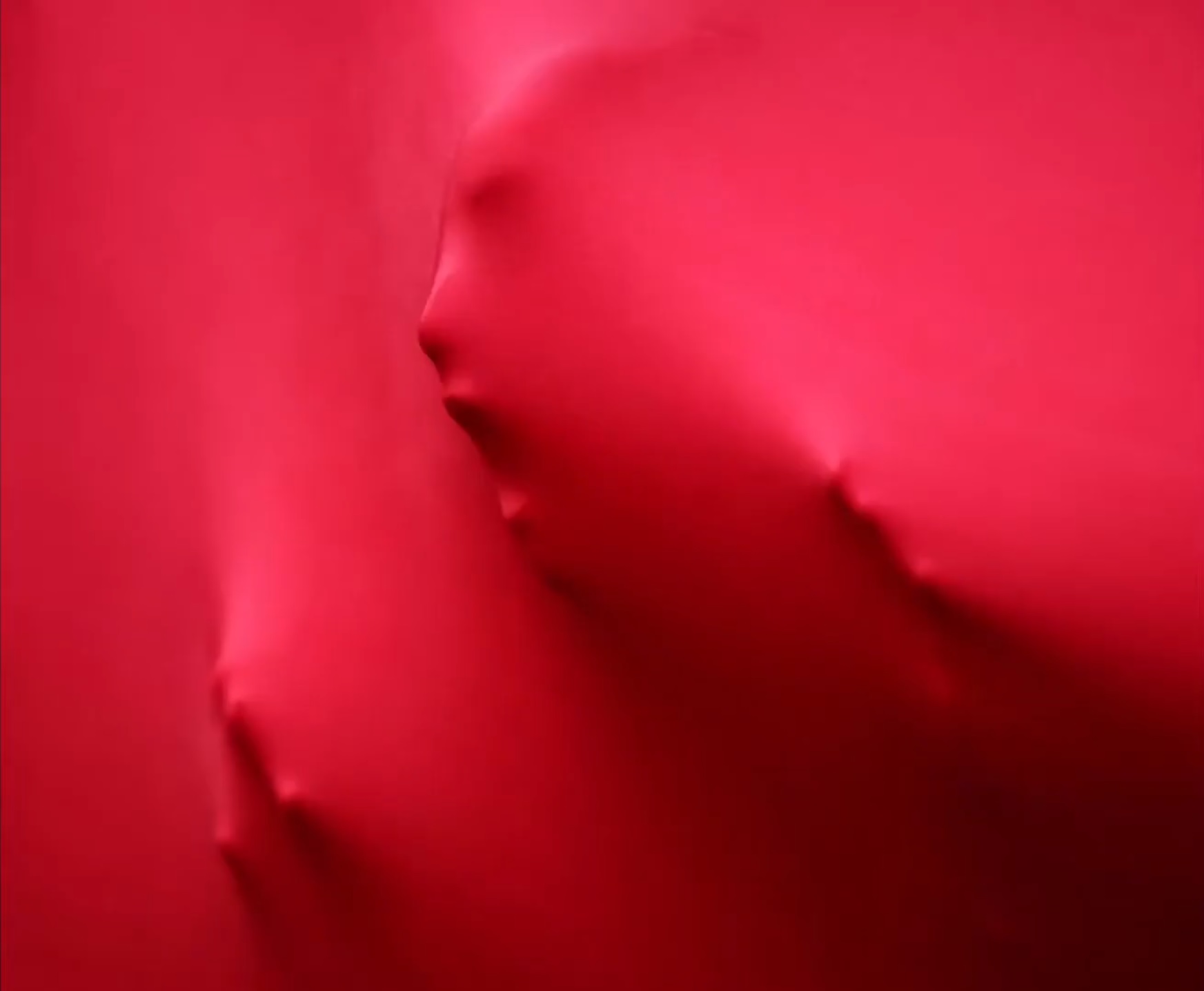
A soul writhes in Hades, awaiting rescue by Christ, in the 2018 YMPST wagon play performance of The Harrowing of Hell

For a preview of the language, here’s Adam’s speech toward the end, after Christ binds Satan and casts him into a fiery pit (I love the alliterative phrase “mickle is thy might”!):

A, Jesu Lorde, mekill is thi myght
That mekis thiselffe in this manere
Us for to helpe as thou has hight
Whanne both forfette, I and my feere.
Here have we levyd withouten light
Foure thousand and six hundreth yere;
Now se I be this solempne sight
Howe thy mercy hath made us clene.

Modern English translation:

Ah, Lord Jesus, mickle [great] is thy might
That makest thyself in this manner
To help us as thou hast said
When both of us offended thee, I and my companion [Eve].
Here have we lived without light
For four thousand six hundred years;
Now see I by this solemn sight
How thy mercy hath made us clean.

The YMPST performance incorporates modern elements in the music and costuming, including an electric guitar–driven rendition of the American gospel song “Ain’t No Grave” at the opening and closing.

+++

ART COMMENTARIES:

Below are discussions of two medieval English artworks of the Harrowing of Hell, one of my favorite religious subjects. In modern-day parlance, the word “hell” (an English translation of the Greek “Tartarus” or “Hades” or the Hebrew “Sheol”) typically connotes a place of eternal torment where the damned go, but in Christian theology it was long used more broadly to refer to the compartmentalized netherworld where both righteous and unrighteous souls go after death to await the general resurrection that will take place at Christ’s return.

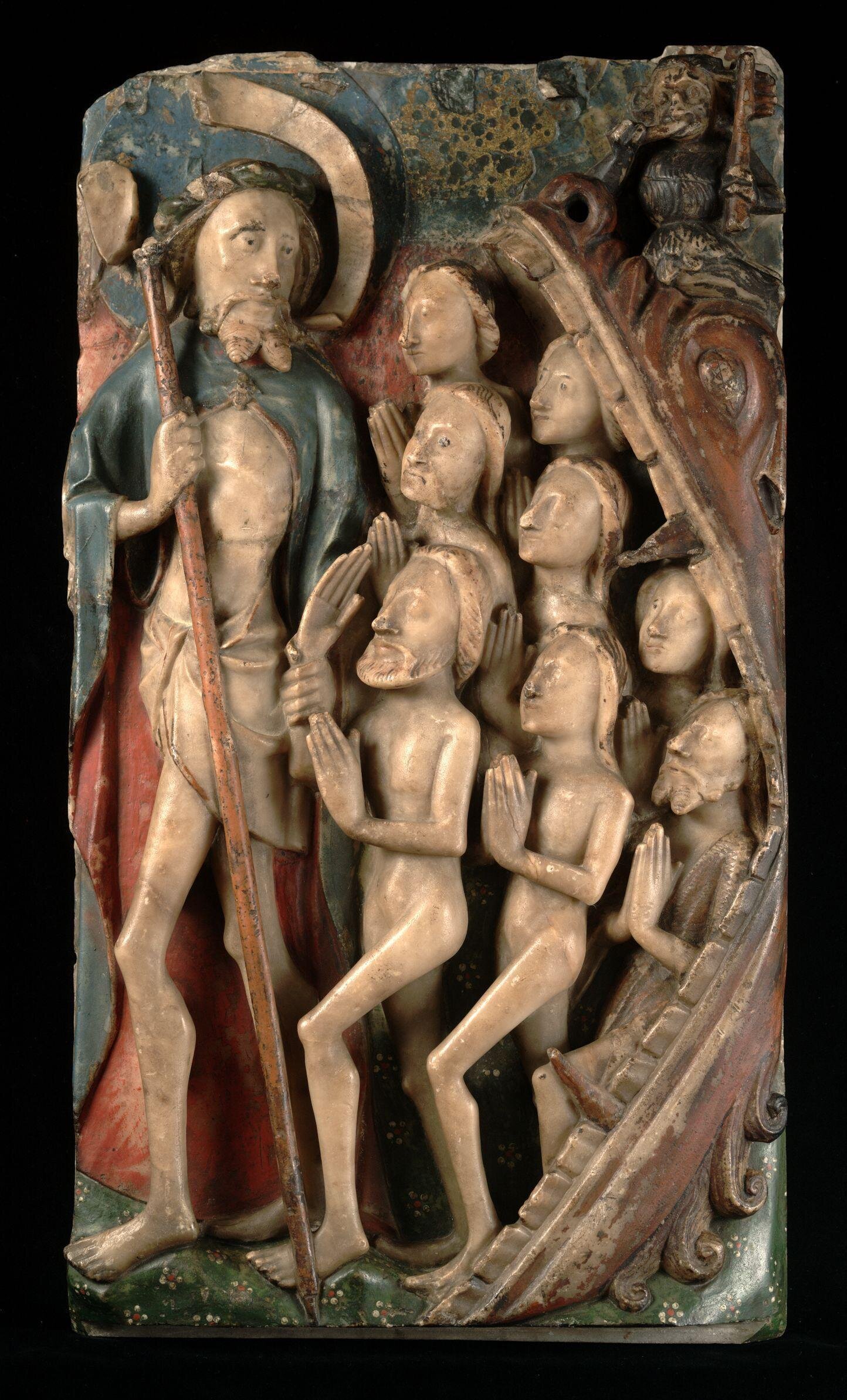
>> “The Harrowing of Hell” (Smarthistory video): Drs. Nancy Ross and Paul Binski discuss a fifteenth-century alabaster that’s in the collection of the Victoria and Albert Museum in London. What sticks out to me—the commentators mention it only briefly—is that Christ stands on a green, flowery lawn! The artist is probably alluding to the springtime, the new life, that Jesus’s resurrection ushered in: the redeemed exit the hellmouth, barefoot like their Lord, onto this lush grass. This detail reminds me a bit of Fra Angelico’s Noli me tangere fresco at San Marco in Florence.
Harrowing of Hell alabaster
The Harrowing of Hell, England, 15th century. Carved, painted, and gilt alabaster, 58 × 32 cm. Victoria and Albert Museum, London.

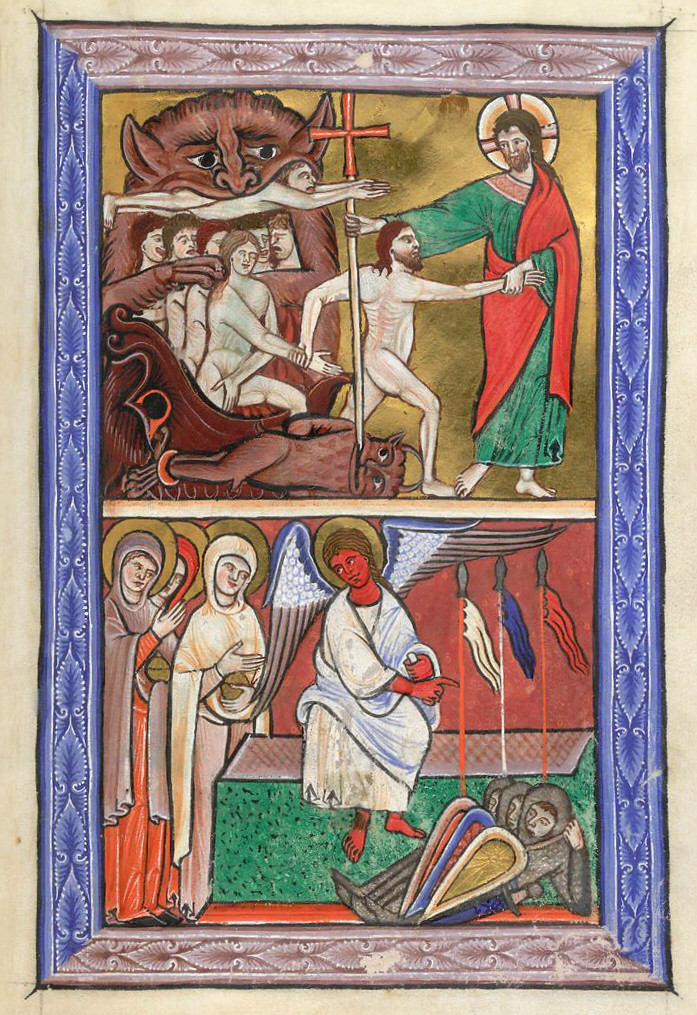
>> “Under the Earth” by Joanna Collicutt: The Visual Commentary on Scripture is a free online resource that provides material for teaching, preaching, researching, and reflecting on the Bible, art, and theology. For one of her three VCS-commissioned “visual commentaries” on Philippians 2:1–11, Rev. Dr. Joanna Collicut has selected an illumination of the Harrowing of Hell from a thirteenth-century psalter. The Christ Hymn that forms the meat of this passage celebrates Jesus’s descent and ascent, and in verse 10 it says that at his name, every knee will bow in heaven, on earth, and “under the earth.” This phrase had never stood out to me until now.
Resurrection (Arudel 157)
The Harrowing of Hell and The Holy Women at the Tomb, from an English psalter (BL Arundel 157, fol. 110), ca. 1220–40. Ink, tempera, and gold leaf on vellum, 29.5 × 20 cm. British Library, London.

Roundup: Nativity art from Asia, the Christ Hymn in Thai, and more

ARTICLES:

>> “How Asian Artists Picture Jesus’ Birth from 1240 to Today” by Victoria Emily Jones, December 18, 2023, Christianity Today: My first CT article was published this week! I was asked to curate and introduce a sampling of Nativity art from across Asia. By representing Jesus as Japanese, Indonesian, or what have you, these artists convey a sense of God’s immanence, his “with-us–ness,” for their own communities—and for everyone else, the universality of Christ’s birth.

Turun, I Wayan_In Bethlehem
I Wayan Turun (Indonesian, 1935–1986), In Bethlehem, 1958. Acrylic on canvas, 46 × 64 cm. Collection of Stichting Zendingserfgoed (Missionary Heritage Foundation), Zuidland, Netherlands.

>> “The Story of Christ in Chinese Art: Scholars at Peking University Make a Christmas Portfolio for LIFE,” Life, December 22, 1941, pp. 40–49: In doing research for my Christianity Today article, I found this old article from Life magazine that features eight Chinese watercolors on silk from the collection of Dr. William Bacon Pettus (1880–1959), an American educator and president of the California College of Chinese Studies in Peking (Beijing) in the 1920s and ’30s, which were being exhibited at New York’s American Bible Society at the time. With the ordination of six Chinese bishops by Pope Pius XI in 1926, the Chinese Catholic Church was transitioning from a mission church to an indigenous local church, and Chinese-style religious art—much of it coming out of the art department of the new Catholic University of Peking (Beiping Furen Daxue)—was part of that localization. Productivity seems to have continued at Furen during the Japanese occupation, as this article attests. Many of the students and faculty were recent converts to Christianity, though the article reports that non-Christians also enrolled and taught in the art program.

Lu Hongnian_Nativity
Lu Hongnian (Lu Hung-nien) ( 陸鴻年) (Chinese, 1914–1989), The Birth of Jesus, ca. 1941. Chinese watercolor on silk.

Here is one of the paintings by Lu Hongnian, who sometime after this article was published, in part through his having engaged the New Testament as inspiration for his paintings, became a Christian and took the name John. It shows the Holy Family in a mountainside cave, Mary gazing adoringly at her newborn son as Joseph brings more straw to cushion him. Beside them, an angel holds up a lantern for light, while two shepherd children approach from the entrance, eager to meet their Savior.

+++

SONGS:

>> “Philippians 2:511” by HARK Music: This song takes a traditional Thai melody, arranged by Tirasip Kraitirangul, and puts it to a Thai translation of the famous Christ Hymn from Philippians 2. It’s performed by the HARK Duriya Tasana Singers (feat. Somchairak Sriket and Damrongsak Monprasit) and Dancers, filmed on location at Chaloem Kanchanaphisek Park in Bangkok. The song is from HARK’s Thai Hymns Album (2014), which can be downloaded for free at https://harkpublications.com/?product=thai-hymns-album-2. The two-stringed bowed instrument you see at 3:21 is a saw u.

The Duriya Tasana (“Curators of the Arts”) ensemble was formed in 2012 under the commission of the Thai-Psalms Project, an endeavor to create Thai traditional and classical music settings for the psalms of the Bible. Many of the members are affiliated with the Bunditpatanasilpa Institute of Fine Arts in Bangkok. Thanks to my friend Janet, whose sister is preparing a move to Thailand, for alerting me to this group!

>> “Jesus You Come” by Tenielle Neda, performed with Jon Guerra: This song by the Australian singer-songwriter Tenielle Neda [previously], which she sings with Jon Guerra, makes a nice complement to the Thai song above. The performance is from “Songs for Hope: A TGC Advent Concert” on December 6, 2020.

+++

MIDDLE ENGLISH LULLABY: “As I lay upon a night”: Medievalist Eleanor Parker introduces a charming Christmas lullaby from fourteenth-century England, a dialogue between Mary and the Christ child, and provides a modern English translation of its thirty-seven stanzas. In the Middle Ages, says Rosemary Woolf, the subject matter of lullabies was often a prophecy of the baby’s future—presumably a romantic promise of great and happy achievements. But here it is the child who relates the future to his mother, thus providing the material for his own lullaby.

+++

ART VIDEO: “Third Sunday of Advent: Ethiopian Art: Gospel Book” by James Romaine: Every December, my friend James Romaine, an art historian who teaches at Lander University, publishes four videos on his Seeing Art History YouTube channel related to the themes of the season, part of his annual Art for Advent series. This year he’s chosen to focus on Ethiopian art, covering illuminations from two different manuscripts, a diptych icon, and a rock-hewn church.

In this video Romaine discusses the formal qualities of two paintings from a sixteenth-century Ethiopian Gospel-book, the identity of the figures, and the liturgical context of the book, including the use of the red veil that’s attached at the top, which, Romaine says, “both protects and sanctifies the icon,” creating a sense of anticipation for the Orthodox believer who, in faith, lifts the veil to see what is revealed.