Playlist: Christ the King

The final Sunday of the liturgical year—which this year is November 24—marks the Feast of Christ the King. This festival celebrates the reign of Jesus Christ over all of creation and every aspect of our lives.

“The belief in Christ as King finds its roots in the Christian understanding of Jesus as the Messiah, whose reign exists as both a present reality and a future hope,” writes Ashley Tumlin Wallace on her blog The Liturgical Home. “In the here and now, his reign manifests in the lives of believers who seek to live under his lordship. But the Feast of Christ the King also carries a sense of eschatological anticipation, signaling the ultimate culmination of time when the reign of Christ is fully realized.”

Unlike some who sit on earthly thrones, Christ is no tyrant; he’s a benevolent ruler who leads with love and perfect wisdom. He is high and lifted up, and yet he stoops down to us and attends to our cries. He’s so committed to our flourishing that he became one of us and sacrificed himself to save us from the Evil One and reconcile us to God. We owe him our praise, our deference, our all.

For Christ the King Sunday, I put together a Spotify playlist of songs that extol Christ as king of the cosmos and of our own hearts.

It includes traditional hymns like “All Hail the Power of Jesus’ Name” (below, sung by Paul Zach), “Come, Christians, Join to Sing,” “All Creatures of Our God and King,” “All People That on Earth Do Dwell,” “Praise to the Lord, the Almighty,” “O Worship the King,” “Crown Him with Many Crowns” . . .

In looking up hymns, I was delighted to find a new-to-me one from the nineteenth century by Josiah Conder called “The Lord Is King,” which Navy Jones set to a buoyant new tune:

There’s one song on the list whose text dates all the way back to the fifth century. Written in Latin by the Christian poet Sedulius, “Regnavit Dominus” (The Lord Is King) combines praises to the One who conquered death and feeds us with himself with the humble plea, “Kyrie eleison” (Lord, have mercy). Owen and Moley Ó Súilleabháin sing it to a twelfth-century melody:

The playlist also features several psalm settings, including two of Psalm 93, which opens,

The LORD is king; he is robed in majesty;
    the LORD is robed; he is girded with strength.
He has established the world; it shall never be moved;
    your throne is established from of old;
    you are from everlasting.

One is by Jacob Mwosuko, a member of the Abayudaya (People of Judah) Jewish community near Mbale in eastern Uganda. The text is in Luganda. Though Jews would read “LORD” as referring to God the Father, ever since the early church Christians have confessed Jesus not only as Lord (Master) but also as LORD (YHWH), consubstantial and co-eternal with the Father, sharing with him all rule, authority, power, and dominion.

Also from Africa, there’s the Resurrection-rooted salsa song “Jesus Reigns” by Joe Mettle of Ghana, which I learned while attending worship at a Nigerian friend’s church plant for African Christians in Maryland:

On a softer note, there’s the piano ballad “Wondrous Things” by Sandra McCracken, Patsy Clairmont, and JJ Heller of FAITHFUL, a collective of female Christian authors and artists formed in 2019. It lauds Jesus as king to the poor, the oppressed, and the brokenhearted. Heller and McCracken perform it with Sarah Macintosh in the following video:

This next one is more of a nostalgic pick for me: “Make My Heart Your Throne”:

Over two decades ago, when I was a young high schooler, I attended a Christian retreat. The worship leader for the weekend was a man named Carl Cartee, and I remember being struck by this original song of his that we all sang one night. Its words and melody imprinted on me, and all these years later I still find myself sometimes singing them in private as a prayer that Christ would be foremost in my affections and that I would cede control to him.

One of the keenest depictions of Christ’s kingship in scripture is in the book of Revelation, where his glory and triumph are on full display and he’s surrounded by worshipping throngs. Chapter 19, where the exiled John describes “the loud voice of a great multitude in heaven,” is the source text of the song “He Is Wonderful,” sung by Lowana Wallace with Lana Winterhalt and Josh Richert:

These three overlaid, harmonized vocal lines are so enthralling!

Wallace’s song is a simplified arrangement of “Revelation 19:1” by A. Jeffrey LaValley, who wrote it in 1984 for the gospel choir of New Jerusalem Baptist Church in Flint, Michigan, where he served as music director. You can listen to a more recent performance of “Revelation 19:1” on the album Jesus Is King (2019) by the Sunday Service Choir under the direction of Jason White, or in this Mav City Gospel Choir video from 2021, which features soloist Naomi Raine. The choir is directed by Jason McGee:

The build to such fullness of sound . . . wow! It really is evocative of the ample rejoicing in heaven around God’s throne that John the Revelator narrates—“like the sound of many waters and like the sound of mighty thunderpeals” (Rev. 19:6).

For a multilingual (English-Korean-Spanish) arrangement performed by students and staff at Fuller Theological Seminary in California, see here.

This is just a sampling of the eighty-plus songs on Art & Theology’s “Christ the King” playlist, exalting the One who lives and reigns supreme in the heavens and who will one day bring his kingdom to full fruition on earth.

Christ the King playlist cover

Cover art: John Piper (British, 1903–1992), Christ in Majesty, 1984, East Window, Chapel of St John Baptist without the Barrs, St John’s Hospital, Lichfield, Staffordshire, England

Easter, Day 3

But if we have died with Christ, we believe that we will also live with him. We know that Christ, being raised from the dead, will never die again; death no longer has dominion over him. The death he died, he died to sin, once for all; but the life he lives, he lives to God.

—Romans 6:8–10

LOOK: Egg mosaics by Oksana Mas

Mas, Oksana_Post-vs-Proto-Renaissance
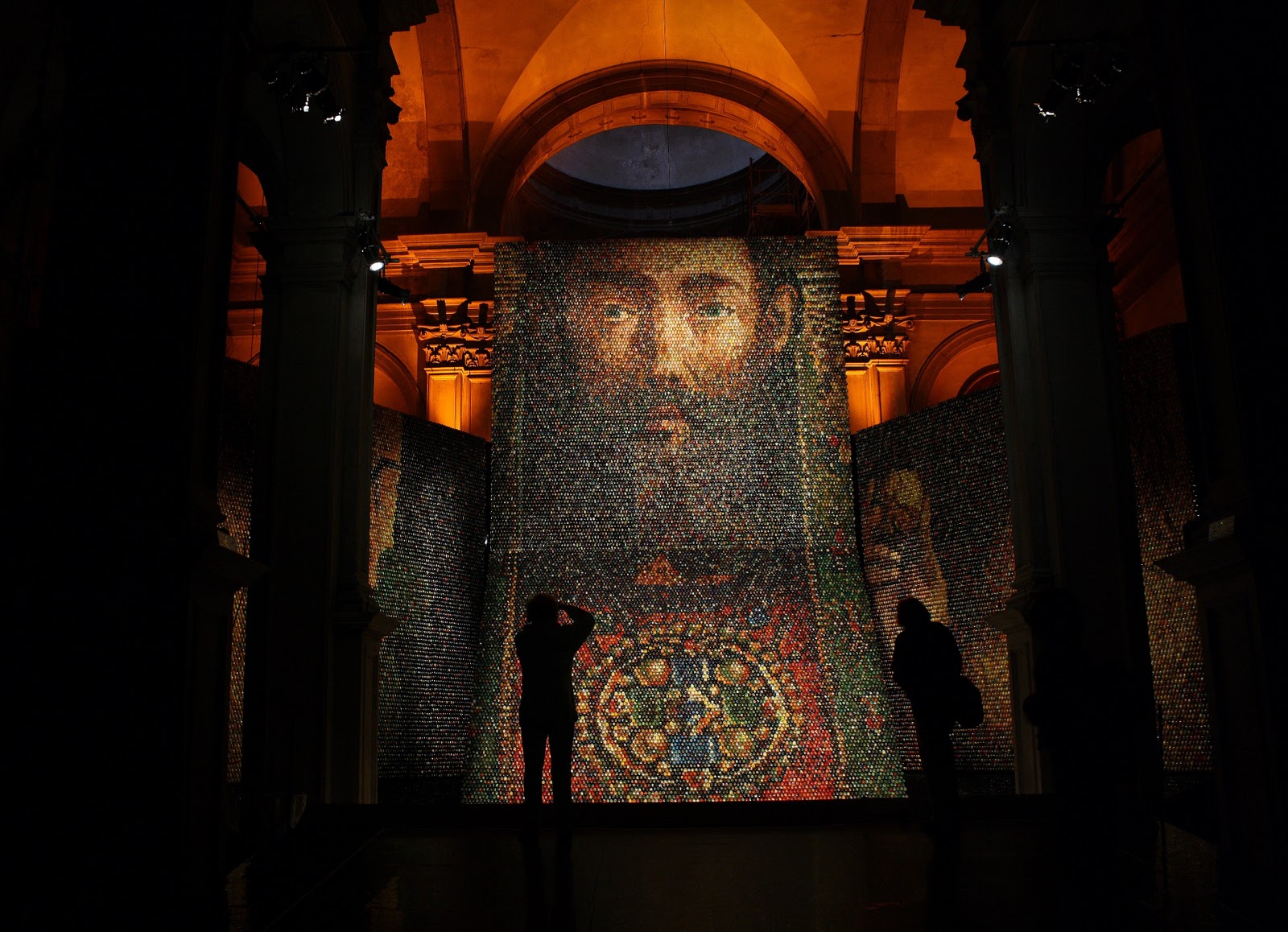
Oksana Mas (Ukrainian, 1969–), Post-vs-Proto-Renaissance, 2011. Hand-painted wooden eggs, installed in the Chiesa di San Fantin, Ukrainian Pavilion, 54th Venice Biennale, 2011.

Mas, Oksana_Post-vs-Proto-Renaissance
Mas, Oksana_Post-vs-Proto-Renaissance (detail)

Hand-painted wooden eggs are the primary material used by Ukrainian artist Oksana Mas in the past decade. She arranges them into colorful spheres or hemispheres or into monumental images, as she did for her Post-vs-Proto-Renaissance installation at the 54th Venice Biennale. This piece portrays segments of the van Eyck brothers’ Ghent Altarpiece [previously], whose two central scenes are (1) Christ (or God the Father, as some art historians argue) enthroned, and (2) the Adoration of the Mystic Lamb, based on John’s vision in the book of Revelation.

The Biennale installation—inside the church of San Fantin—was only a portion of the full piece, which is a massive 92 by 134 meters in total, comprising 3,640,000 eggs. It featured panels of the enthroned deity, the slain but risen Lamb, and details of Adam and Eve.

Mas is inspired by the Ukrainian folk custom of Easter egg decoration called pysanky. Traditionally, pysansky are raw eggs that are dyed using a wax-resist method, the designs inscribed in beeswax. But for her art, Mas starts with wooden eggs, and color is applied with a paintbrush. For Post-vs-Proto-Renaissance, she distributed plain wooden eggs to people from all walks of life and across forty-two countries, asking them to paint them and return them to her. Having received hundreds of thousands of painted egg contributions, she assembled them like tesserae, affixing them to boards that are then placed into an architectural framework so that, when viewed from a distance, they form recognizable figures from the Ghent Altarpiece. When you get up close, you can see the diverse patterns and other designs painted onto the individual eggs.

View more photos at My Modern Met.

In May 2012, a different iteration of this piece was installed in Sofiyivska Square in Kyiv, which Mas called the Altarpiece of Nations.

Mas, Oksana_Altarpiece of Nations (Kyiv)
Oksana Mas, Altarpiece of Nations, Kyiv, 2012. Crowned in a papal tiara, Christ is flanked by his mother Mary and John the Baptist, a traditional composition known as the Deesis.

As a traditional symbol of new life, eggs are often associated with Easter, and one could easily read Mas’s Ghent-inspired egg mosaics through that lens. In Venice, for example, you have Jesus in emblematic form as the sacrificial lamb, pouring out his blood at the altar, and then you have him exalted in majesty in his divine-human form, which together reference the death and resurrection narrative of the Gospels. Through that death and resurrection, we have been redeemed from the fall that’s alluded to in the wings—redeemed from sin and death, into life everlasting. It’s a very triumphal image, Mas’s. As is the liturgical artwork it’s based on, which shows all the redeemed in the new heavens and the new earth, gathered round “the Lamb at the center of the throne . . . [who] guide[s] them to springs of the water of life” (Rev. 7:17).

(Related post: “Egg Sketches by Autumn Brown”)

LISTEN: “Christus Resurgens,” Ireland, 12th century | Arr. Michael McGlynn, 2000 | Performed by Anúna on Cynara, 2000; compiled on The Best of Anúna, 2010

Christus resurgens ex mortuis, jam non moritur
Mors illi ultra non dominabitur
Quod enim vivit, vivit Deo

Alleluia (×4)

English translation:

Christ has arisen from the dead, and dies no more
Death will no longer have dominion over him
In that he lives, he lives unto God

Alleluia (×4)

“Christus resurgens” is an Easter chant in Latin that originated in medieval Ireland, its text taken from Romans 6:9–10. It is arranged here by Michael McGlynn and performed by the Irish vocal ensemble Anúna, which he founded in 1987. Much of Anúna’s repertoire comes from McGlynn’s arrangements, resettings, and reconstructions of early and medieval Irish music, as well as his original compositions.

This song is on the Art & Theology Eastertide Playlist.

Mas, Oksana_Post-vs-Proto-Renaissance
Photo: Steven Varni

The Tabernacle of Cherves (Limoges enamel, 13th century)

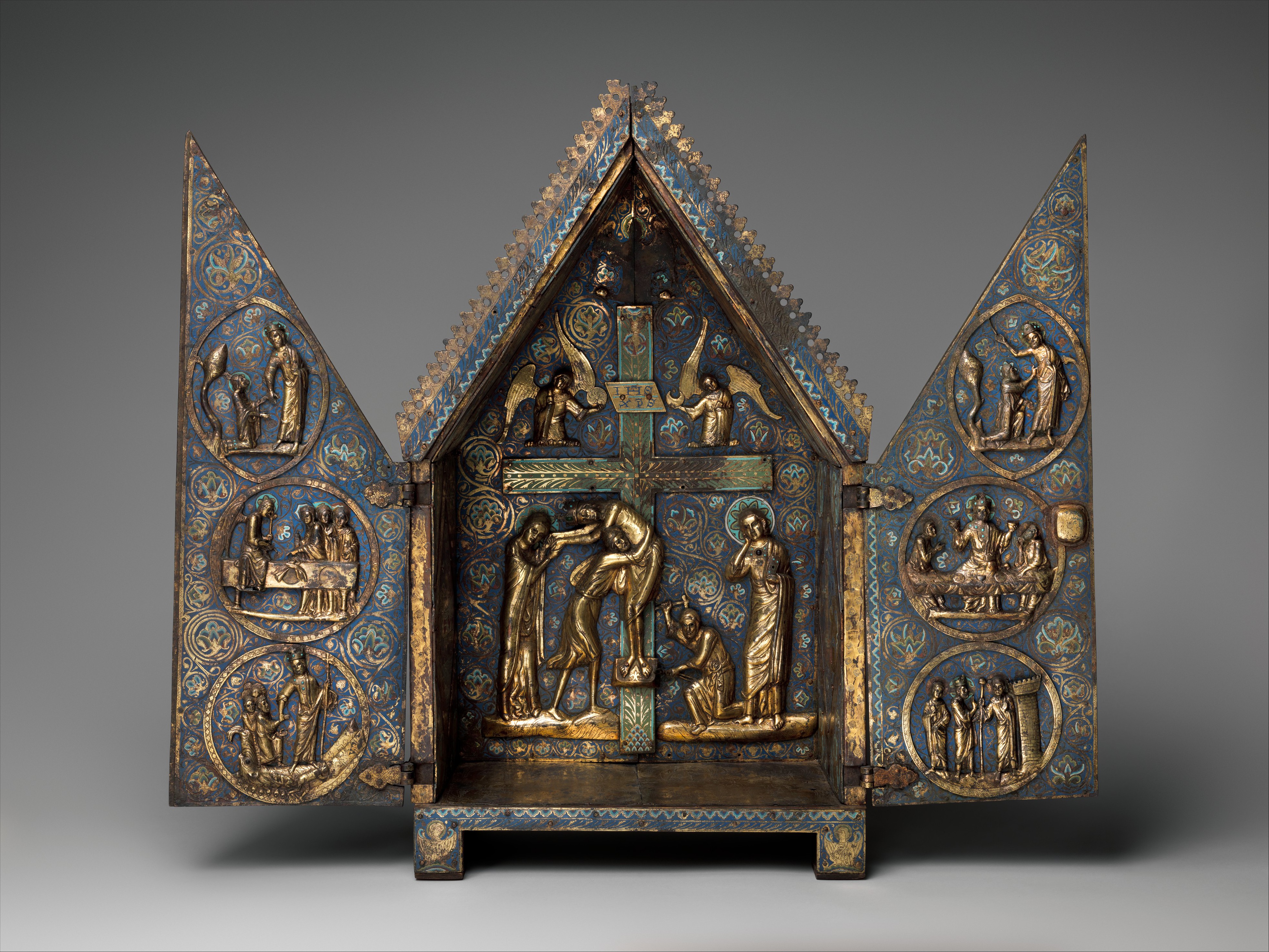
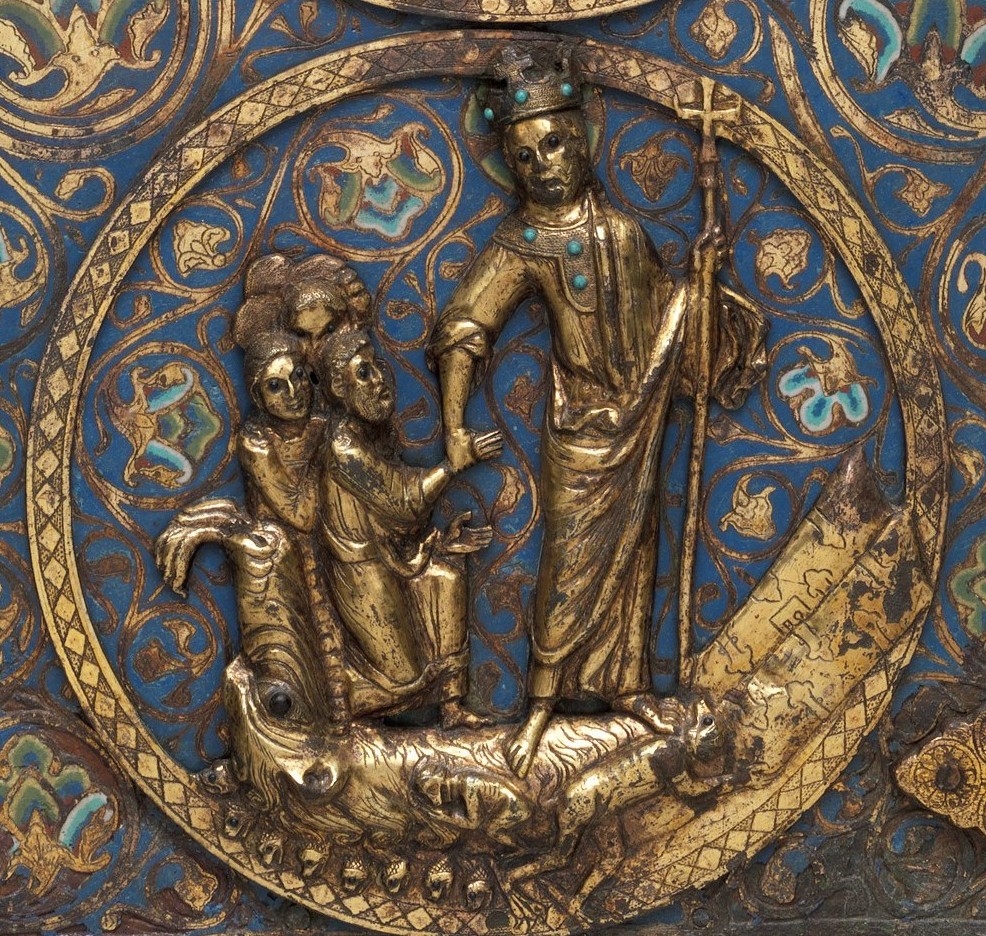
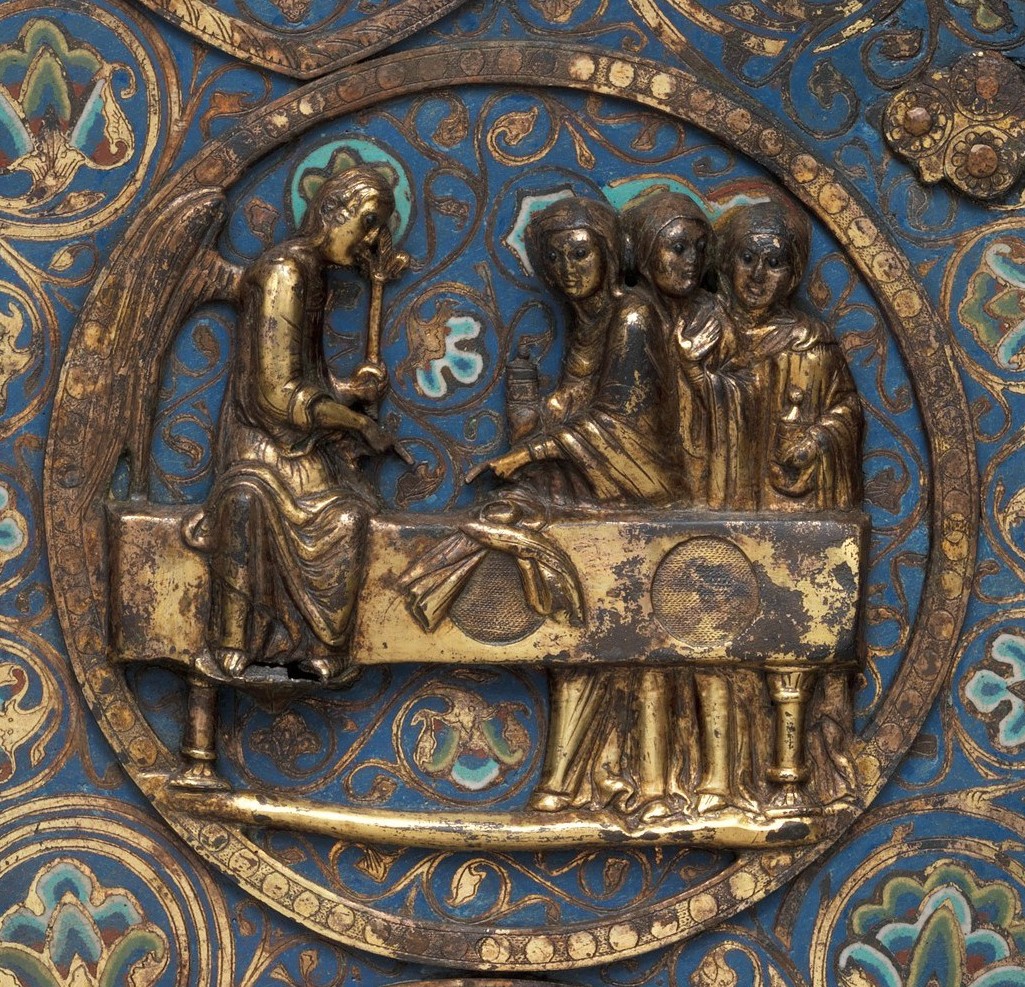
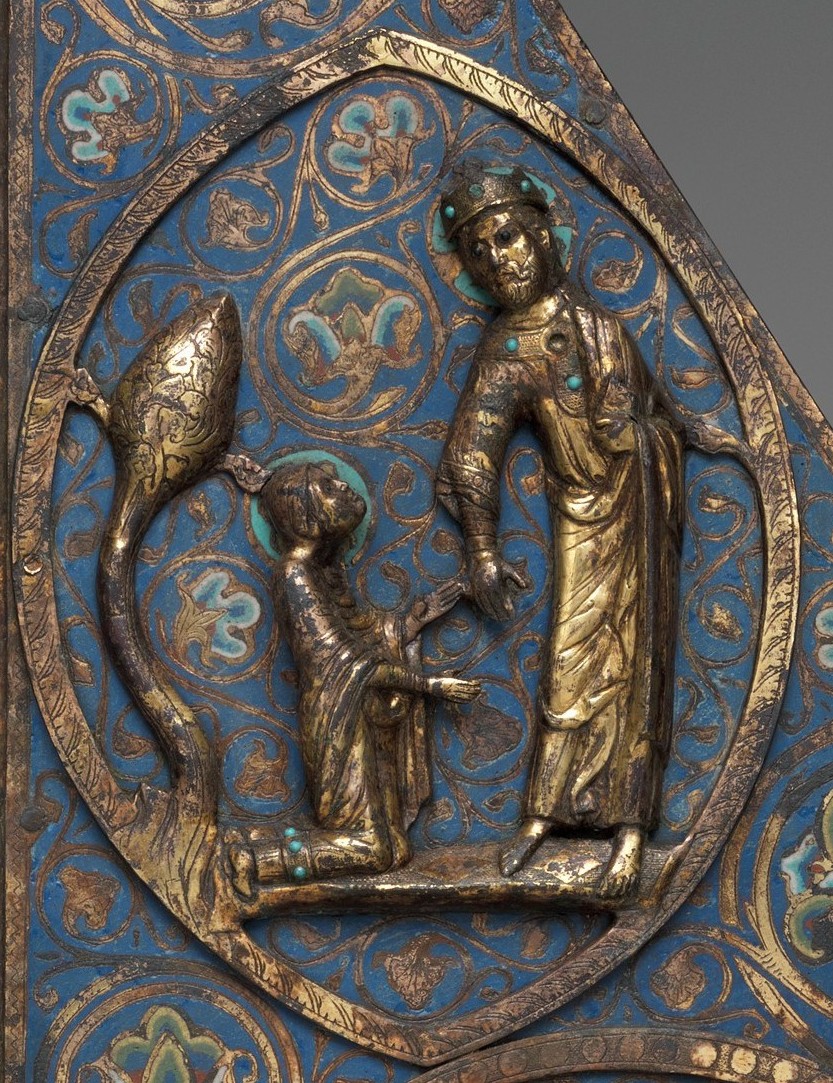
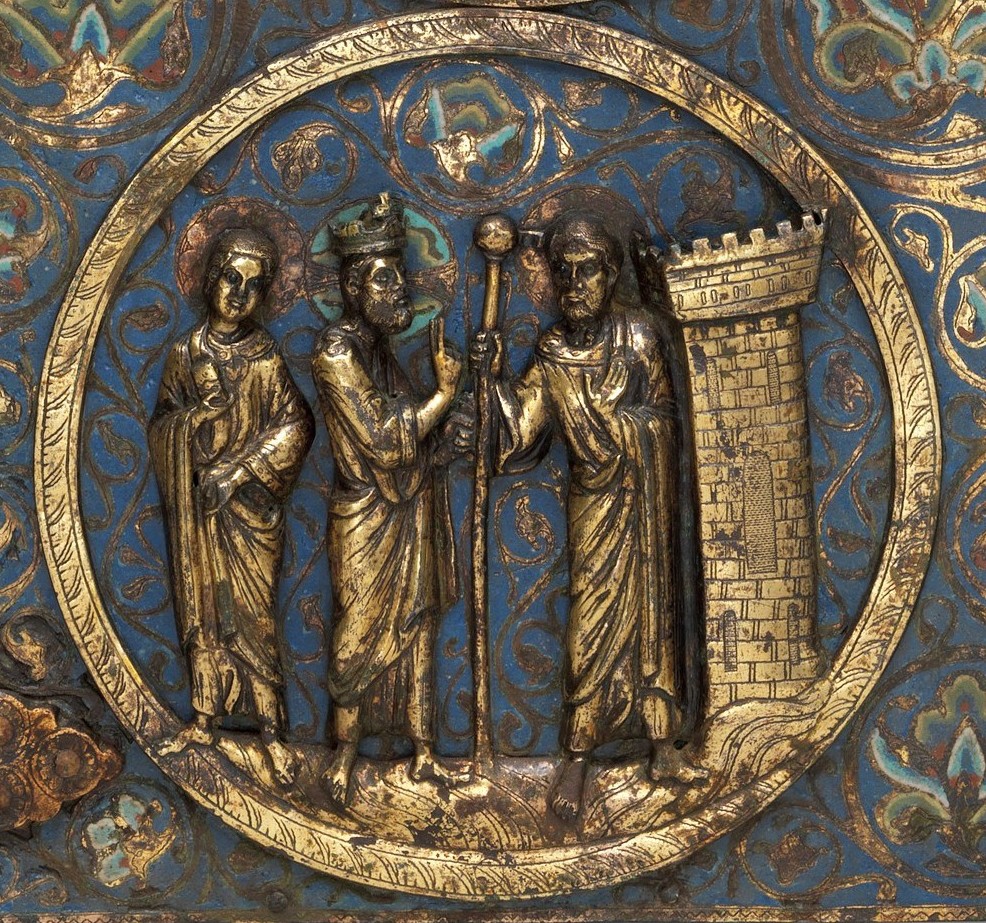
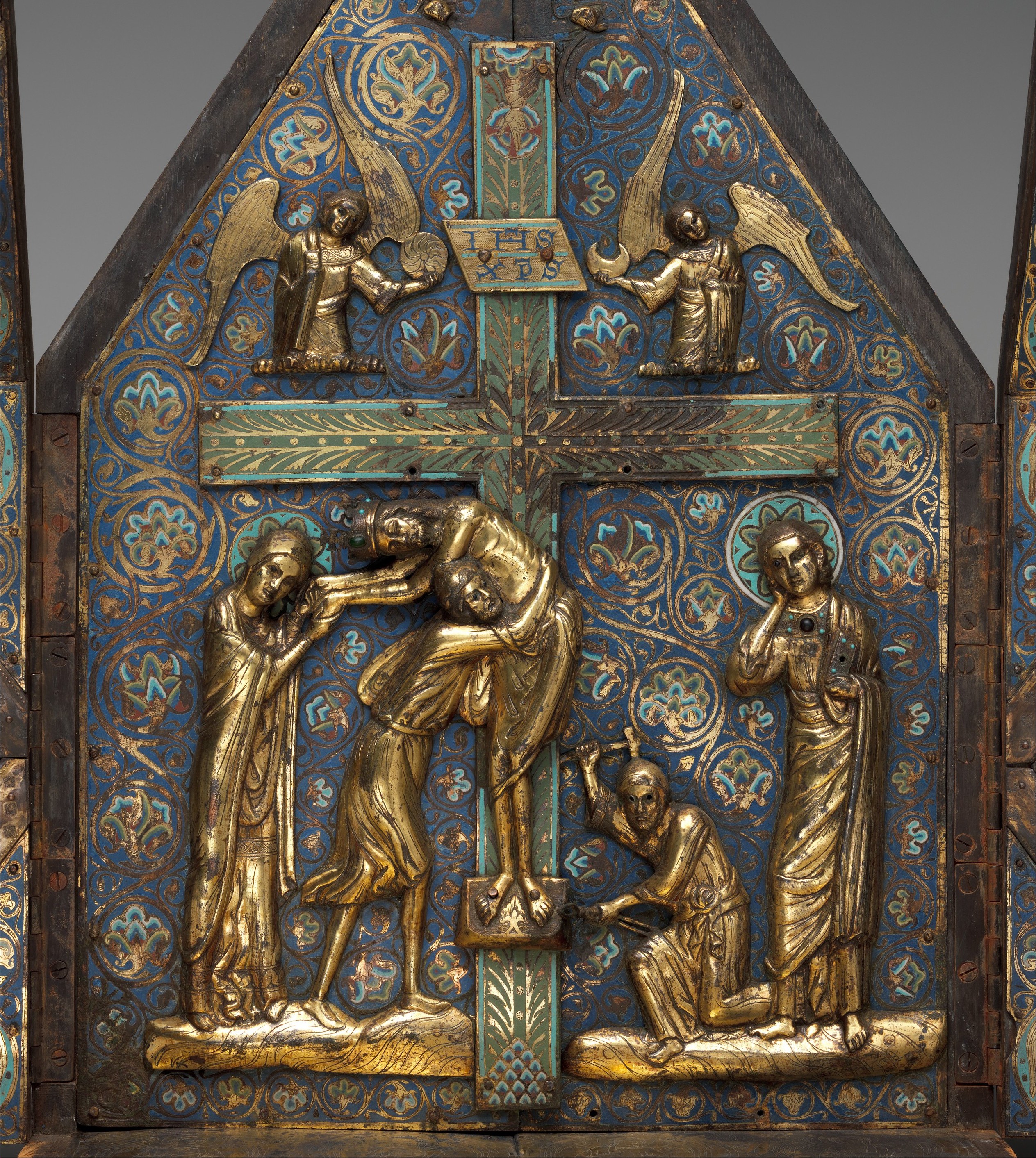
The Met Cloisters in New York City—the branch of the Metropolitan Museum of Art devoted to the art and architecture of medieval Europe—has some of the most beautiful Christian art objects I’ve seen. Here I’ll share just one of them: an elaborately decorated champlevé enamel tabernacle, that is, a cupboard where the vessels containing the “reserved Eucharist,” the already-blessed bread and wine, are kept. The primary scene represents the descent of Christ’s body from the cross, while the six medallion scenes on the interior doors (Christ’s appearance to Mary Magdalene, Thomas, and the Emmaus pilgrims; the holy women at the tomb; and the Harrowing of Hell) all have to do with the resurrection. To indicate his kingliness, Christ wears a crown. More on the iconography below.

Tabernacle of Cherves
Tabernacle of Cherves, Charente, France, ca. 1220–30. Champlevé enamel and copper, open: 33 × 37 3/4 × 10 3/4 in. (83.8 × 95.9 × 27.3 cm). Metropolitan Museum of Art, New York.

The enameled metalworks produced in twelfth- through fourteenth-century Limoges in southwestern France are renowned for their exquisite craftsmanship, which contemporary makers still marvel at. Some 7,500 such objects still survive in a variety of forms, including altar frontals, book covers, candlesticks, censers (incense burners), chrismatories (containers for chrism oil), coffers, croziers (bishop’s staffs), reliquaries (containers for relics), gemellions (handwashing basins), pyxides (small receptacles for the consecrated host), and more. The large concentration of churches and monasteries in France’s Limousin region created a large demand for decorated liturgical objects, which led to the rise of enamel workshops in the city of Limoges, located at the intersection of major trade routes. The technical and artistic mastery of these workshops’ products meant that soon orders were being placed by buyers in other regions and countries, and for a more diversified range of objects, not just those for church use.

The champlevé method of enameling, the predominant decorative technique associated with Limoges, first requires the gouging out of a prepared metal substrate (almost always copper) to create cells. Enamel powder, made from shards of colored glass, is carefully laid into these recessed cells and the object is fired, then cooled, then polished. Champlevé enamels often have appliqué figures attached to them. These are created from copper sheet that is raised from the back and then finished from the front using various specialized tools. For a detailed description of the creation process, which I find fascinating, see the essay “Techniques and Materials in Limoges Enamels” by Isabelle Biron, Pete Dandridge, and Mark T. Wypyski, in the 1996 Met exhibition catalog Enamels of Limoges, 1100–1350, available for free download from MetPublications.

The Cherves tabernacle, so named because it was discovered in the Cherves-Richemont commune near the site of a ruined priory, is one of only two enamel tabernacles that have survived from the Middle Ages. It consists of blue, turquoise, green, yellow, red, and white champlevé enamel; gilded copper figures shaped by the twin metalworking techniques of repoussé (hammering from the reverse side to create a design in low relief) and chasing (hammering on the front side, sinking the metal); and, on the inside gables, engraved copper plaques covered in gold leaf. Its wood support was fabricated after the object was excavated at Château-Chesnel, near Plumejeau, in 1896.

The following text, written by Barbara Drake Boehm, senior curator at the Met Cloisters, is reproduced from pages 299–302 of the book Enamels of Limoges, 1100–1350 by permission of the publisher. I’ve inserted one bracketed note, plus hyperlinks on references that may be unfamiliar to readers. All photos are courtesy of the museum and are linked to their source page.

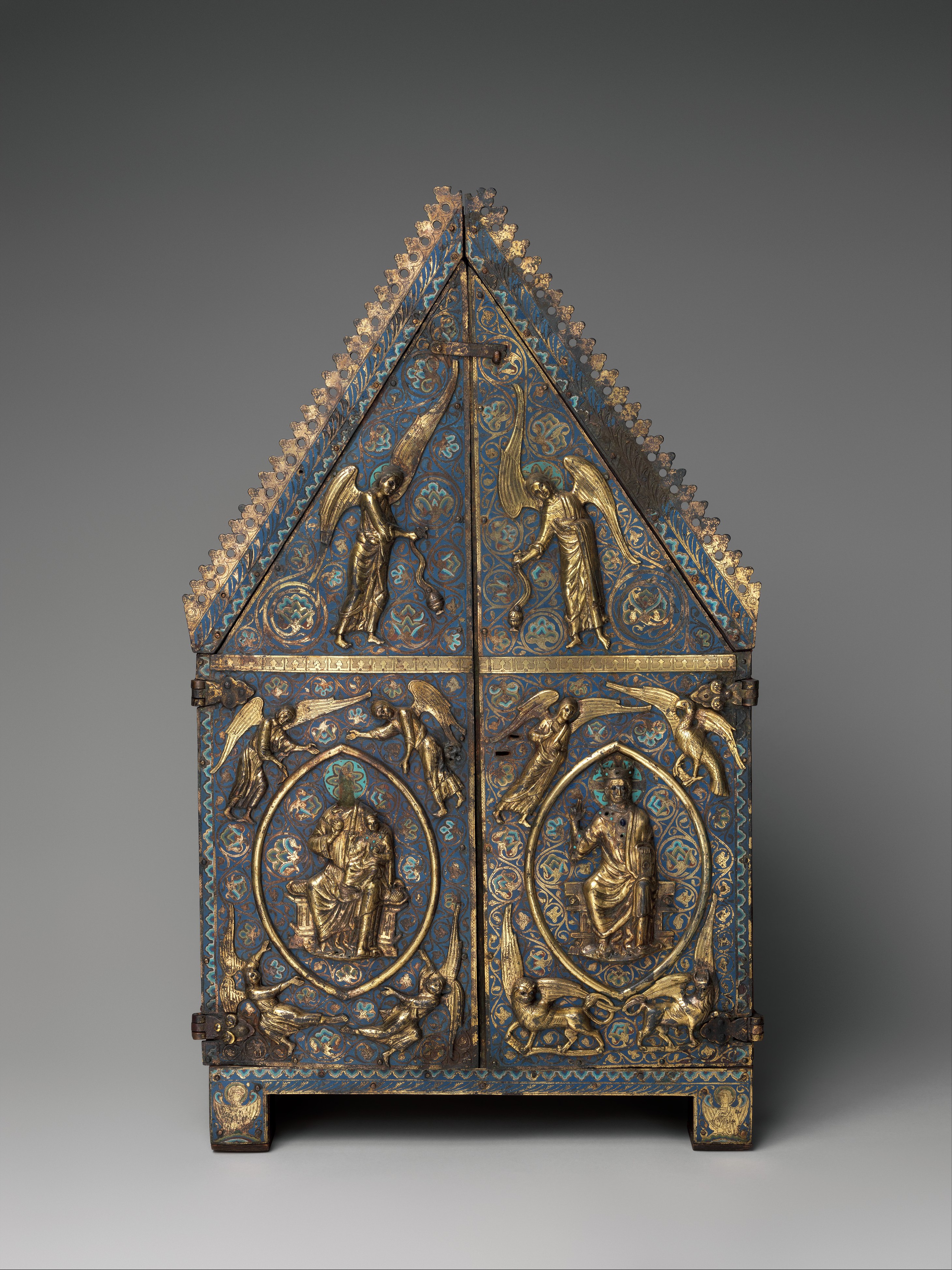
Tabernacle of Cherves (closed)
Closed view (the Virgin’s head is missing)

Standing on short legs, the tabernacle is in the form of a gabled cupboard with hinged doors. Gilded repoussé figures are applied to copper plates decorated with enameled foliate ornament. On the outside of the proper left door is the figure of Christ in Majesty, enthroned in a mandorla and surrounded by symbols of the evangelists. Opposite him on the proper right door is the Virgin with the Infant Jesus on her lap. She is framed within a mandorla and surrounded by four angels. Above them on the roof are two full-length angels, each holding a censer. Across the front runs a band of gilt copper inscribed with a decorative pattern derived from Kufic script, apparently based on the Arabic word yemen.

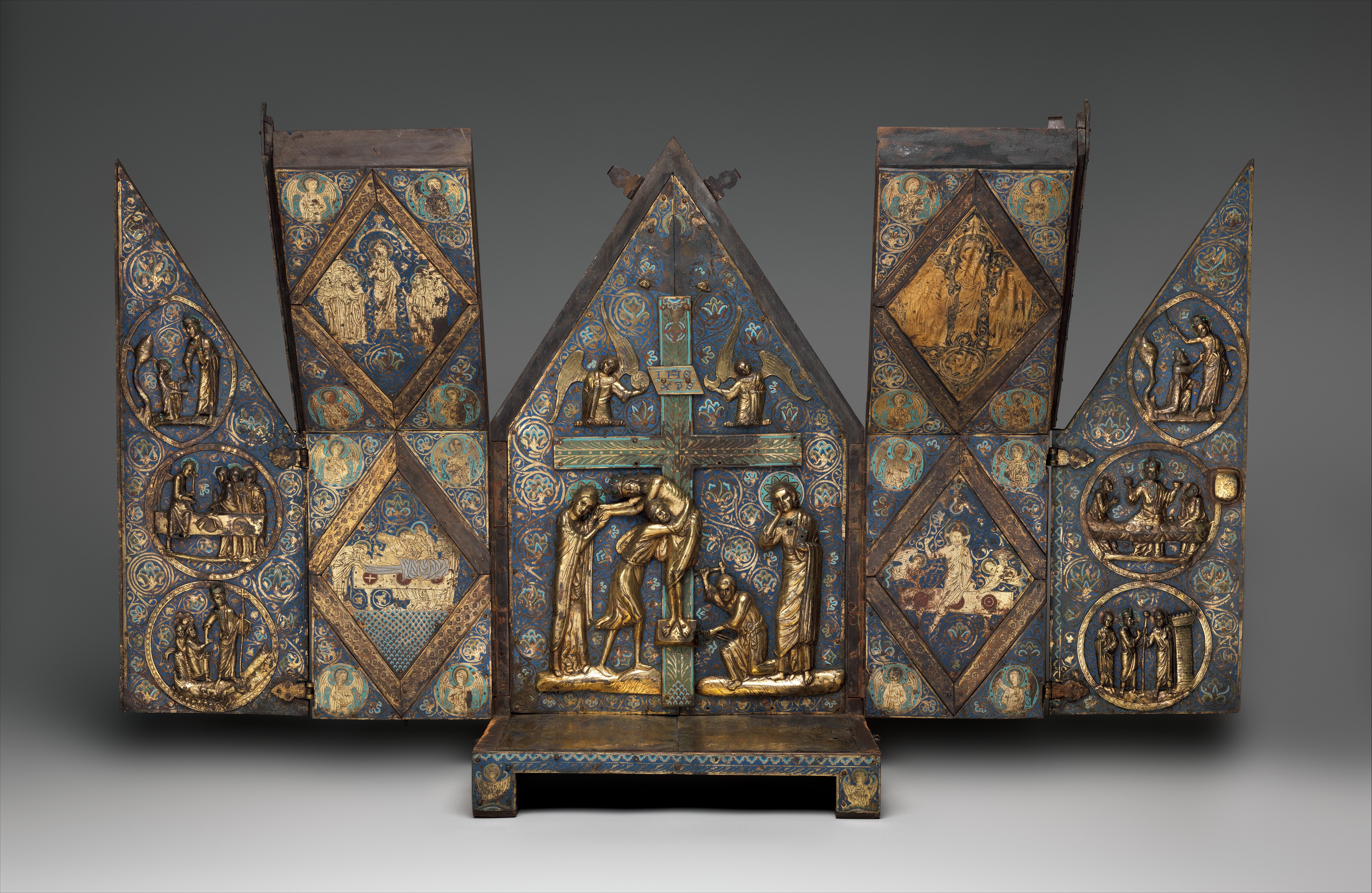
Tabernacle of Cherves (fully open)
Overall, all wings completely open

At the center of the open tabernacle, against its back wall, are appliqué figures representing the Descent from the Cross. Joseph of Arimathea takes the torso of the dead Christ in the arms as Nicodemus uses pliers and a hammer to remove the nails that still hold Christ’s feet to the green-enameled cross. The Virgin takes her son’s hands in hers and gently pulls them to her cheek; Saint John looks on from the opposite side, his head resting in his hand. Above the arms of the cross, two half-length angels hold emblems of the sun and moon. The Hand of God appears at the top of the cross; another figure of an angel once stood over it.

Tabernacle of Cherves (Harrowing of Hell)
The Harrowing of Hell

Tabernacle of Cherves (Empty Tomb)
The Holy Women at the Tomb

Tabernacle of Cherves (Noli me tangere)
“Noli me tangere” (The risen Christ appears to Mary Magdalene)

Tabernacle of Cherves (Road to Emmaus)
The Road to Emmaus

Tabernacle of Cherves (Supper at Emmaus)
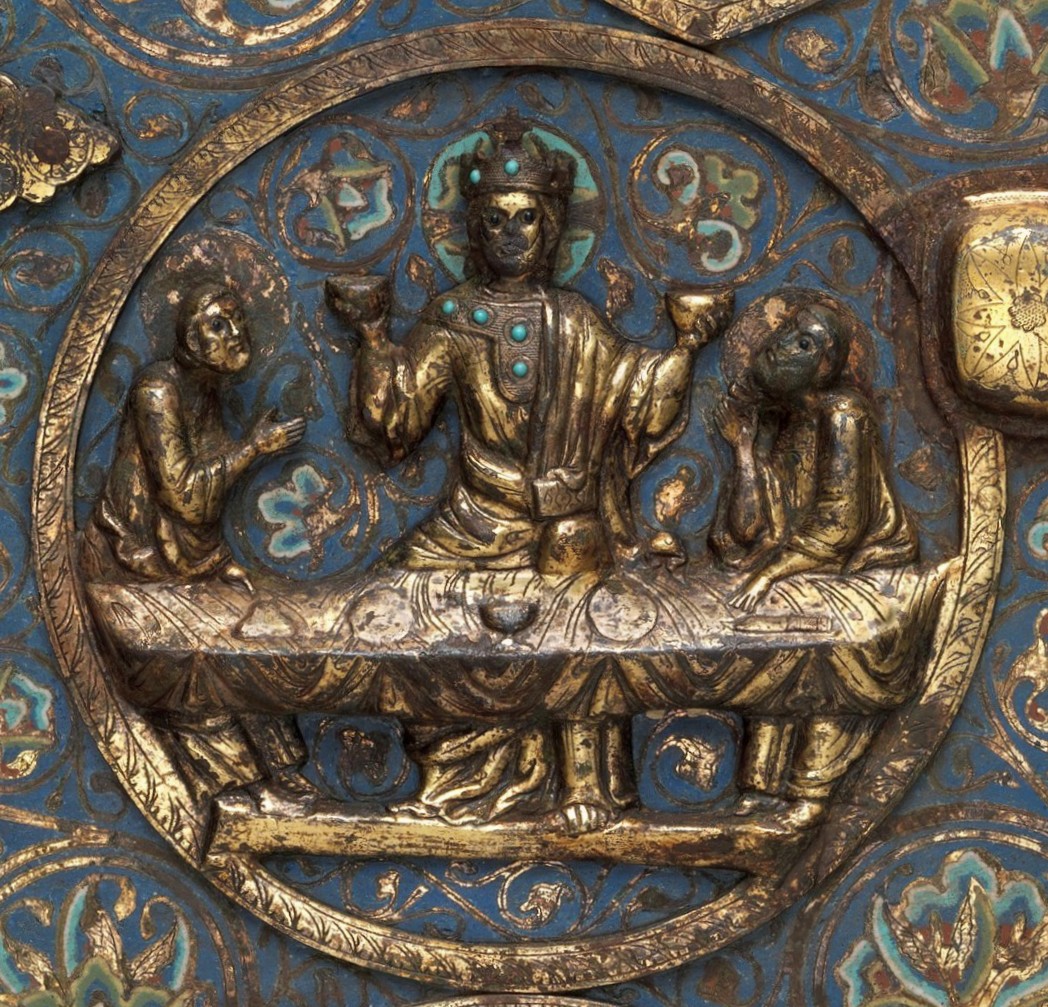
The Supper at Emmaus

Tabernacle of Cherves (Incredulity of Thomas)
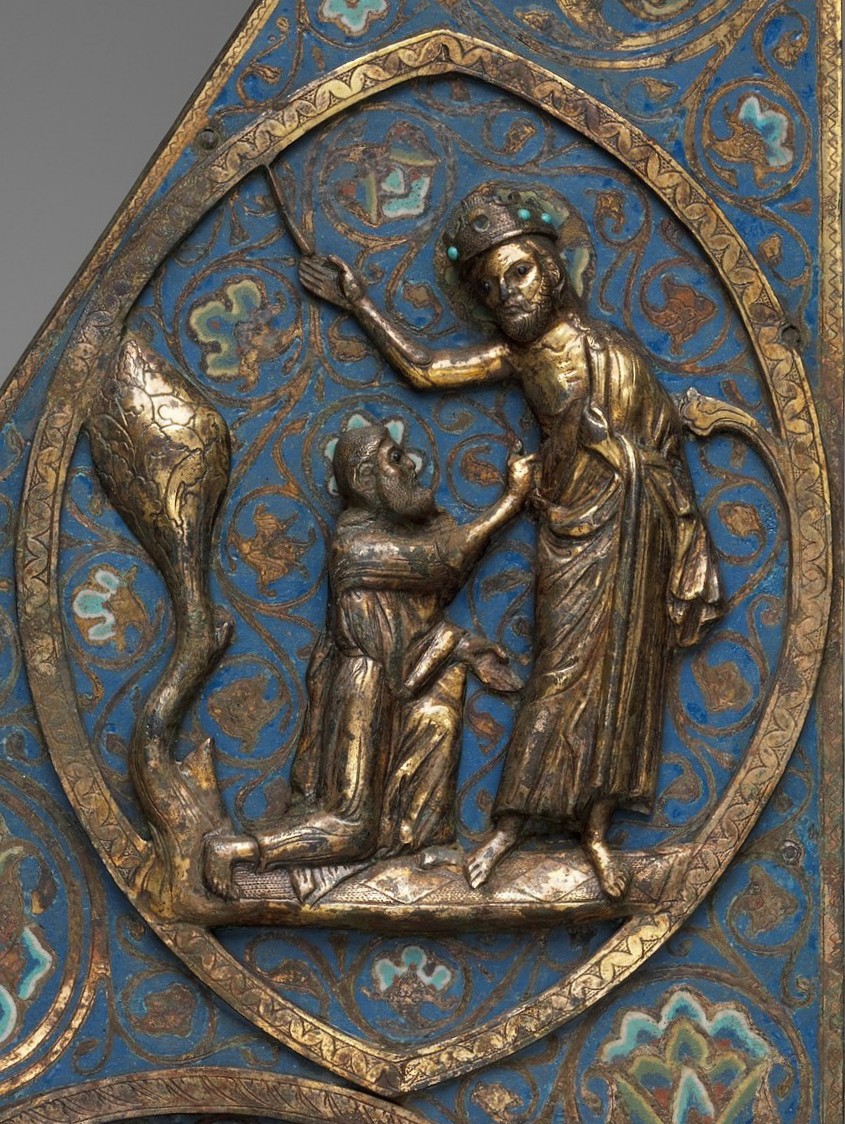
The Incredulity of Saint Thomas

On the insides of the doors are openwork medallions recounting the events that followed the Crucifixion, reading from lower left to upper right. The first is the Descent into Limbo, a nonscriptural image of Jesus leading souls by the hand out of the mouth of Hell, which is seen as the gaping mouth of a dragonlike beast. Set above it is the scene of the Holy Women arriving at the tomb of Jesus on Easter Sunday. Following the account in the Gospel of Mark (16:1), they bear jars of unguent to anoint the body and are greeted by a man, seen here as winged, who informs them that Jesus has risen. In the almond-shaped medallion above, Mary Magdalen meets the risen Christ in the garden (Mark 16:9; John 20:14–18), where he backs away and advises her not to touch him yet. At the lower right, the apostles on the road outside the walls of Emmaus (Luke 24:13–35) are greeted by Jesus, attired as a pilgrim; in the roundel above, they dine with him at Emmaus and realize who he is when he breaks bread with them. In the oval at the upper right, Saint Thomas (Doubting Thomas) touches the wound in Jesus’ side and is convinced of his Resurrection (John 20:24–29).

Tabernacle of Cherves (Entombment)
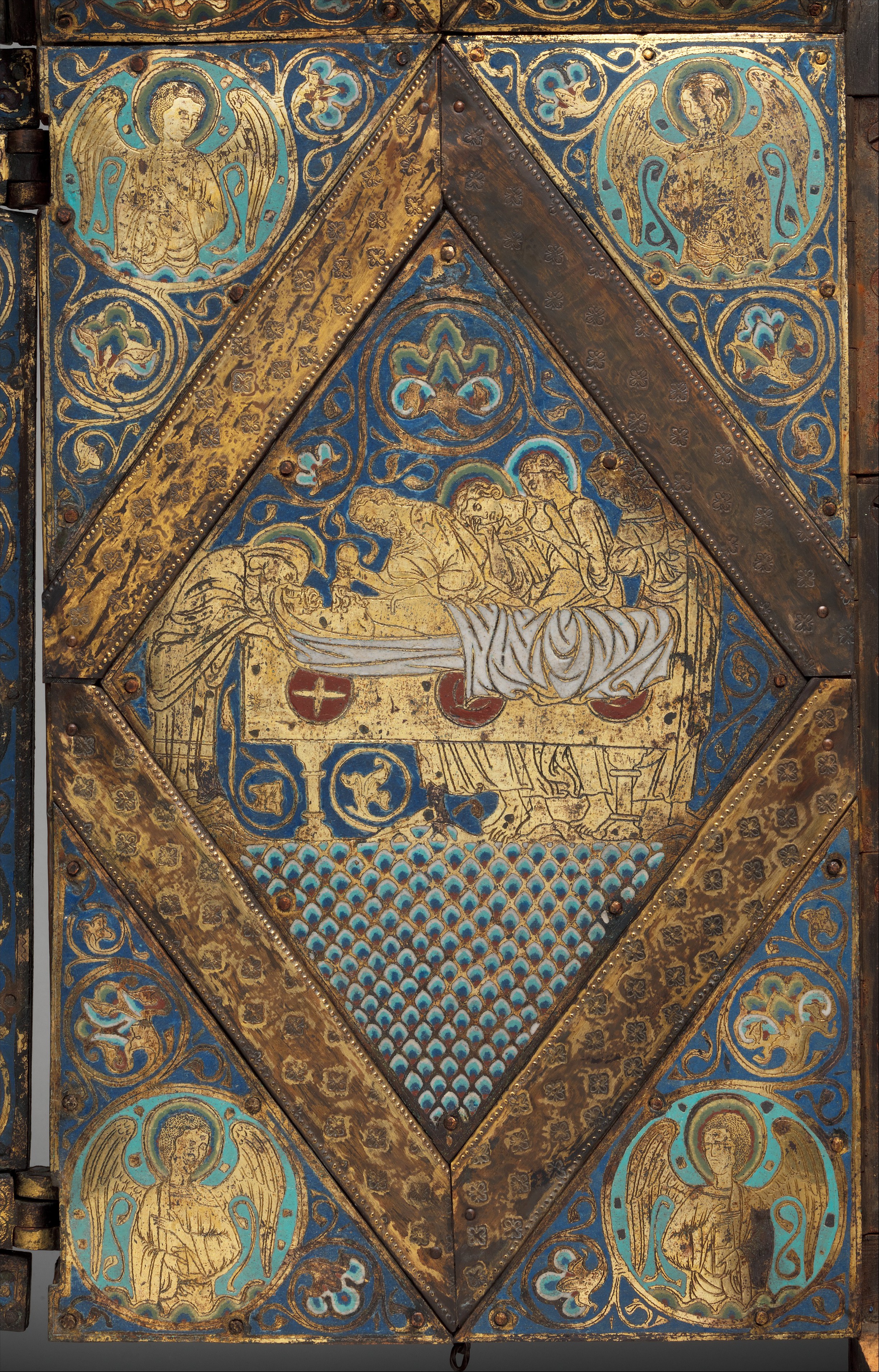
The Entombment

Tabernacle of Cherves (Resurrection)
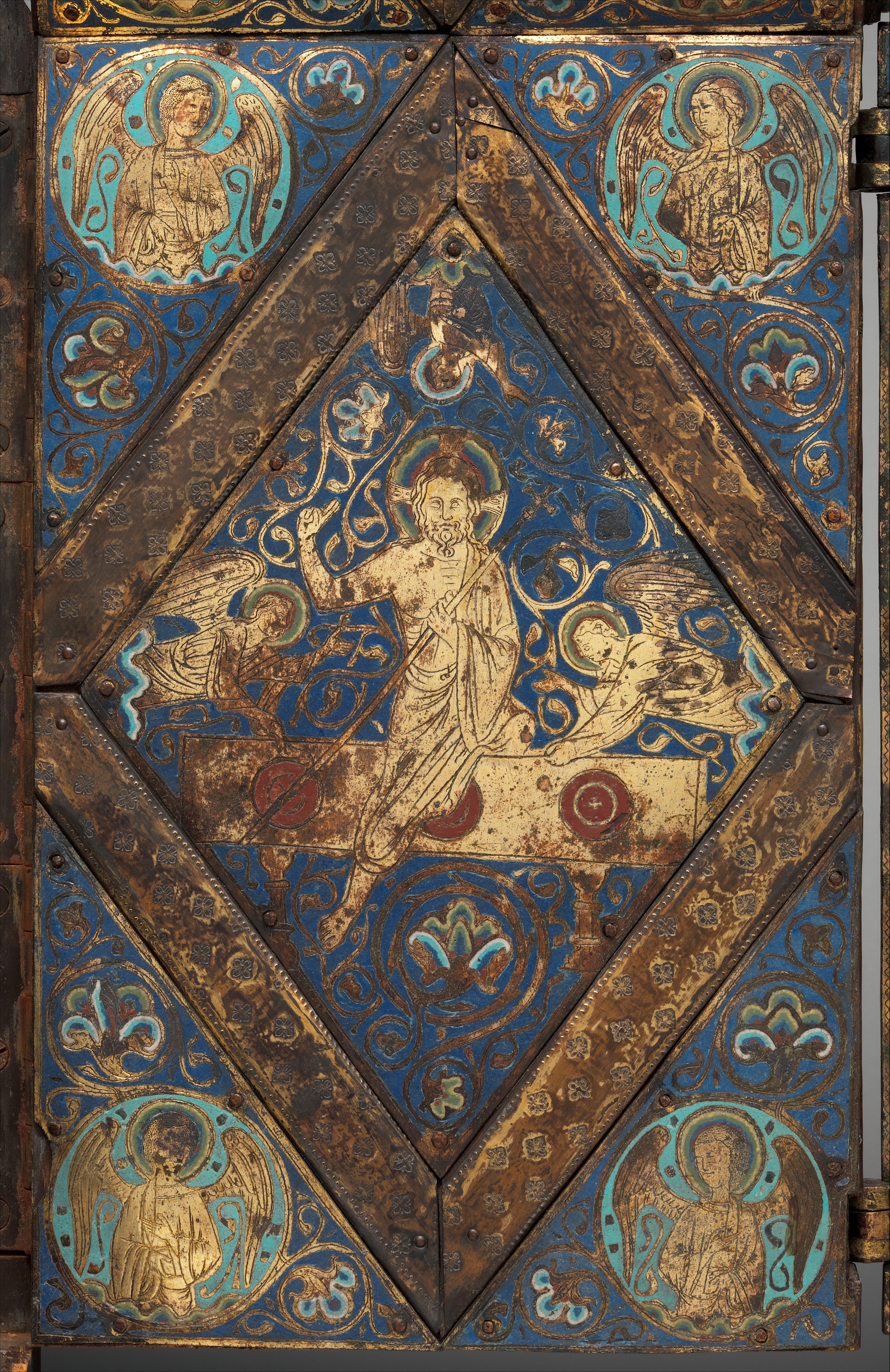
The Resurrection

Tabernacle of Cherves (Ascension)
The Ascension

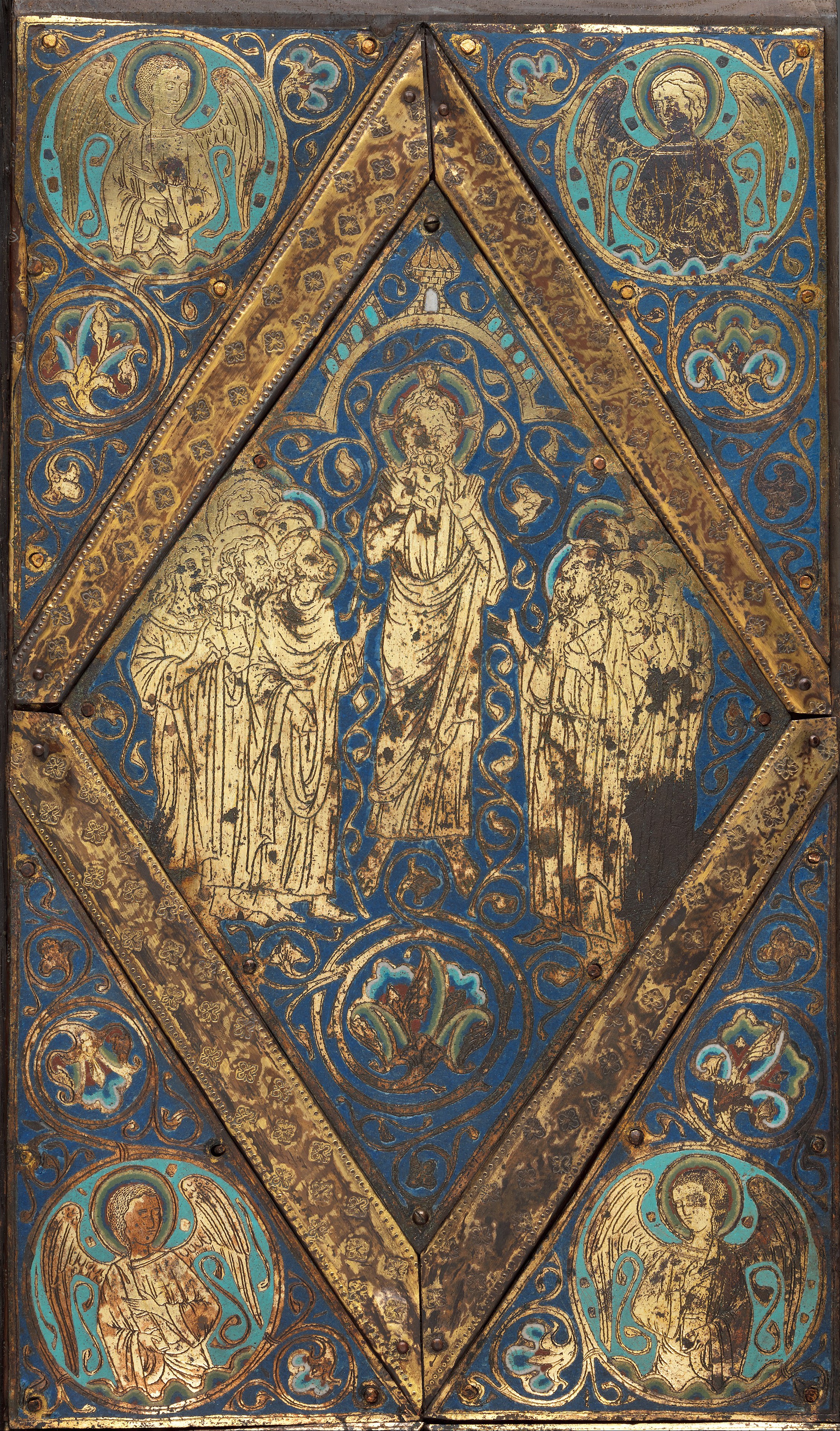
The interior side panels of the tabernacle have large lozenges with engraved figurative scenes framed at the corners by triangular enamel plaques, each depicting an angel in a roundel. At the lower left is the Entombment of Christ; at the upper left is the Ascension. At the lower right, Christ emerges from his tomb, with angels at either side. The base of the cupboard is covered with sheets of gilt copper depicting angels in roundels.

The tabernacle of Cherves is remarkable for its iconographic sophistication and for the dialogue established compositionally and visually between thematically related scenes. On the insides of the doors, Jesus guides souls out of the mouth of Hell at the lower left; at the lower right, he guides the apostles on the journey to Emmaus. On the center left roundel, the Holy Women seek Jesus’ body and find it gone; on the center right roundel, Jesus offers his body to the apostles in the sacrament of bread and wine. At the upper left, he tells the Magdalen it is too soon to touch him; at the upper right, he invites Thomas to touch his wound. In the inside lozenge at the left, Jesus is lowered into his tomb; at the right, he rises from it. At the upper left, he leaves his apostles and rises to heaven; at the upper right, the Holy Spirit descends from heaven on the apostles in a representation of Pentecost. [This latter scene is missing and has been replaced by a copy on paper or parchment of the Ascension image opposite it.]

Tabernacle of Cherves (Deposition)
The Descent from the Cross

The Descent from the Cross is both elegant and full of pathos, a masterpiece of Gothic relief sculpture. As such, it has rightly served as a point of comparison with works in other media, notably the ivory Descent from the Cross in the Louvre. A number of gilt-copper relief sculptures produced in the Limousin but now isolated from their original contexts can be compared with those on the Cherves tabernacle. Notable among these is the Descent from the Cross preserved in the Abegg-Stiftung, Bern, first recorded in 1870. Most of these reliefs are presumed to come from altar frontals.

The enameled ground of the Cherves tabernacle, with its strong concentric circles of reserved gilt copper enclosing full fleurons, seems to anticipate the enameled plate of the tomb effigy of John of France of after 1248.

The identification of this enameled cupboard as a tabernacle for the consecrated Host has not been confirmed: the Church of the Middle Ages had no universal custom for the reservation of the Eucharistic bread or regulations requiring a tabernacle. Nor is there a wealth of comparative medieval examples. Only one other Limoges tabernacle of this type is known; it was acquired by the cathedral of Chartes in the nineteenth century, and its earlier history is not known. The supposition that the enameled cupboard from Cherves is a Eucharistic tabernacle is based on its resemblance in form to later tabernacles, its subject matter, and even the gilt-copper base plate which would allow an enclosed pyx to slide easily in and out.

Soon after its discovery in 1896, the tabernacle was presented to the Société archéologique de la Charente by Maurice d’Hauteville, a curator at Angoulême and son-in-law of Ferdinand de Roffignac, on whose property it was unearthed. He suggested that the treasure could have come from the Benedictine monastery of Fontdouce, founded in 1117. More recently it has been supposed that the treasure at Cherves comes from the Grandmontain foundation at Gandory, of which, unfortunately, there are no remains.

Since its discovery, the tabernacle of Cherves has been recognized as a masterpiece of Limoges work in the Gothic period. Part of a larger treasure, . . . it was exhibited successively at Poitiers, Brive, and Limoges, and then at the Musée de Cluny before being sent to Great Britain.

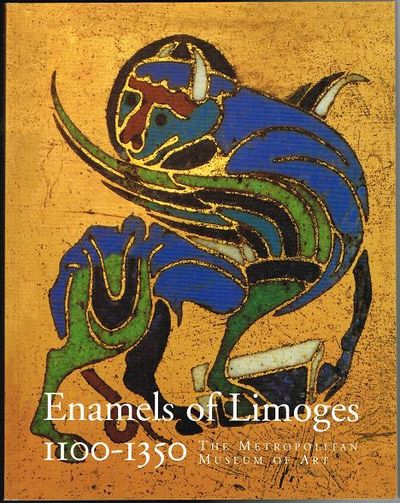
You can explore other champlevé enamels at the Met using its website’s advanced search function. If you wish to study the topic in more depth, the book I’ve quoted from is an excellent resource, featuring essays as well as photographs and descriptions of 157 objects not only from the Met’s collection but also from the Louvre and various other European and American museums, ecclesiastical institutions, and private collections. Click on the cover image to go to the book page.

Enamels of Limoges