
Roundup: World-rhythm hymns, the Hillbilly Thomists, 19th-century gameboards, and more

CALL FOR APPLICATIONS: 2025 Artist Residency at Village Church, Beaverton, Oregon:Village Church is seeking an Artist in Residence for 11 months of 2025, February to December, to create a lasting, creative impact on the wider community and church. The artist will create original work, lead art showcases, inspire future generations, and use art as a bridge between the tech culture surrounding the church, with the spiritual and theological. This residency offers the chance to create art that reflects God’s beauty, promotes worship, and connects people in meaningful ways.”

Applicants must have a minimum of five years of experience. If chosen, you will receive a monthly stipend, free housing, and studio space and will have the cost of all art supplies covered. The pastor tells me that the original application deadline of January 15 is being extended.

+++

NEW(ISH) ALBUM: The Hymnal by Life in Grooveland: Released last April. From World Music Central: “Life in Grooveland’s The Hymnal reimagines traditional hymns with dynamic, world music-influenced rhythms, creating an album that brings together spirituality and groove. Produced and arranged by Nashville session drummer and percussionist Justin Amaral, this fascinating instrumental collection features ten exquisitely crafted duets presenting some of Nashville’s most talented and inventive musicians, including Jeff Coffin (Dave Matthews Band, Béla Fleck), Fats Kaplin (Mitski, Jack White), Paul Niehaus (Lambchop), and Billy Contreras (Ricky Skaggs). Amaral’s versatile drumming, which ranges from subtle to explosive, provides the backbone for each track, layering rhythm to amplify each hymn.” Thanks to blog reader Ted Olsen for bringing this to my attention!

+++

PODCAST EPISODE: “The Hillbilly Thomists: Bourbon, Bluegrass, and the Bible,” No Small Endeavor: I really enjoyed this! “There aren’t many Billboard-charting bluegrass bands made up entirely of Dominican friars, who play their shows clad in white tunics and rosaries. In fact, there is precisely one such band: the Hillbilly Thomists. ‘A Thomist is someone who follows the thought and theological teaching of Saint Thomas Aquinas,’ they explain. ‘We combine it with a little bit of humor about our human condition.’ In this episode, they talk about their theology and vocation, as well as how they manage life on the road as priests who have taken a vow of poverty. Plus, they give live performances of some of their finest songs.”

+++

NEW POEM: “Jesus, Son of Gop” by Sarah M. Wells: Exposing the ridiculousness of followers of the nonviolent Christ sanctioning violence, this satirical poem is a response to a politician’s egregious misappropriation of the apostle Paul’s “armor of God” language. It’s an alternate history that rewrites how Jesus’s arrest in the garden went down. Listen to Wells discuss the poem on The Reformed Journal Podcast.

+++

EXHIBITION: Playing with Design: Gameboards, Art, and Culture, September 13, 2024–January 26, 2025, American Folk Art Museum, New York City: I saw this show last weekend and was absolutely delighted by it! Curated by Emelie Gevalt with Austin Losada, it features over one hundred handmade gameboards, mostly nineteenth century, from the exuberant collection of Bruce and Doranna Wendel. Many are of familiar games I used to play as a child—Parcheesi (which I learned originated in India, its name an adaptation of the Hindi word for “twenty-five”), checkers, Chutes and Ladders—and others are creative variations on the typical racing board game. There is also a fortune-telling game, in the vein of the Magic 8 Ball! The objects on display—hand-carved and hand-painted and from the imaginations of common folk—are interesting both culturally and aesthetically.
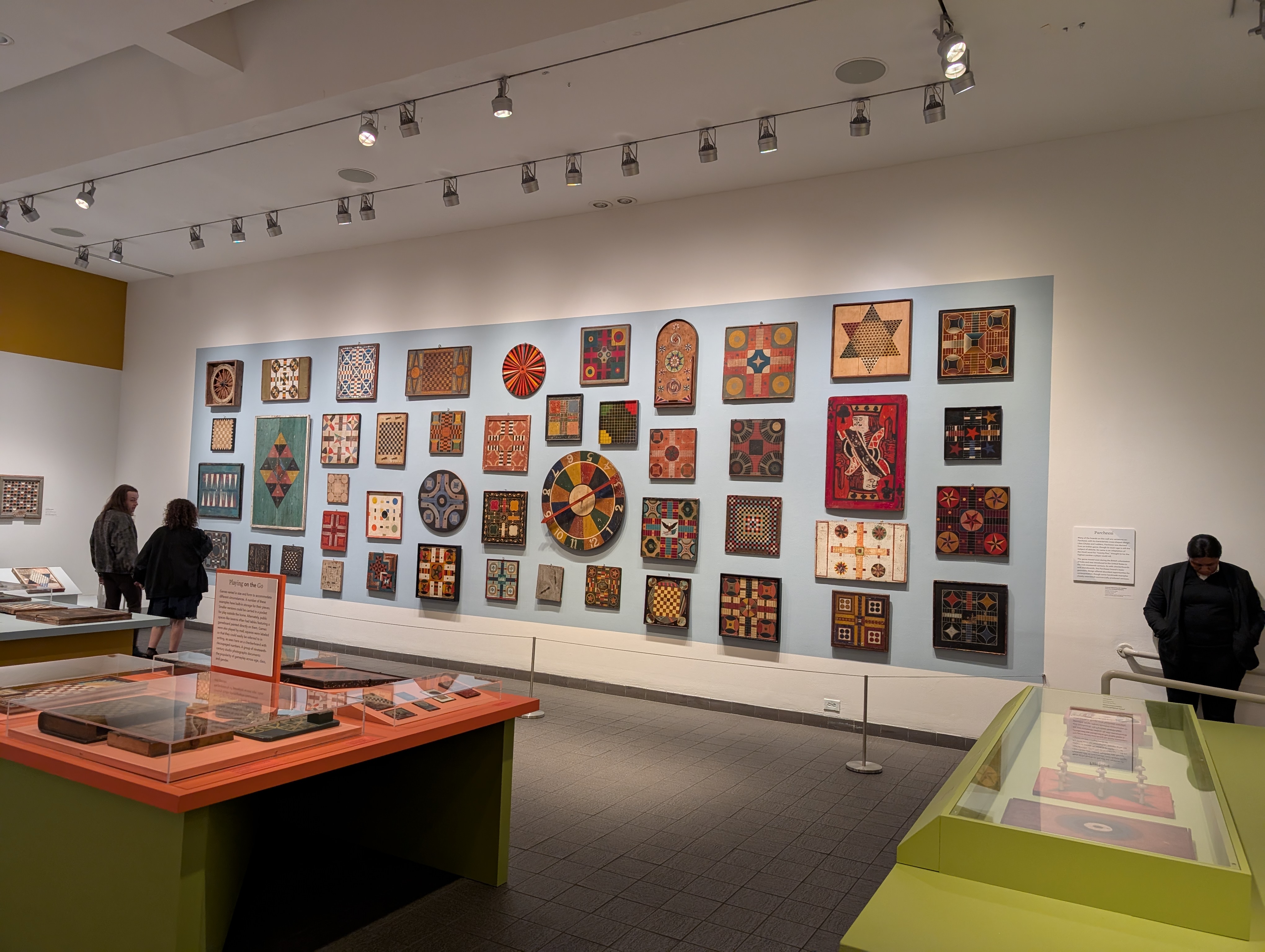
Gameboards exhibition

Two that made me chuckle contain religious references. “Gameplay, especially cards, was sometimes thought to encourage vice, in particular gambling or idleness,” the gallery label reads. So board makers sometimes incorporated spiritual aphorisms or precepts into the design to counteract the corrupting influence and remind players to uphold Christian virtues even in moments of leisure. A Parcheesi board instructs players to “Love God by loving each other”—and I can’t make out what the Chinese checkers board says, other than “The Lord . . . your . . . God . . .”
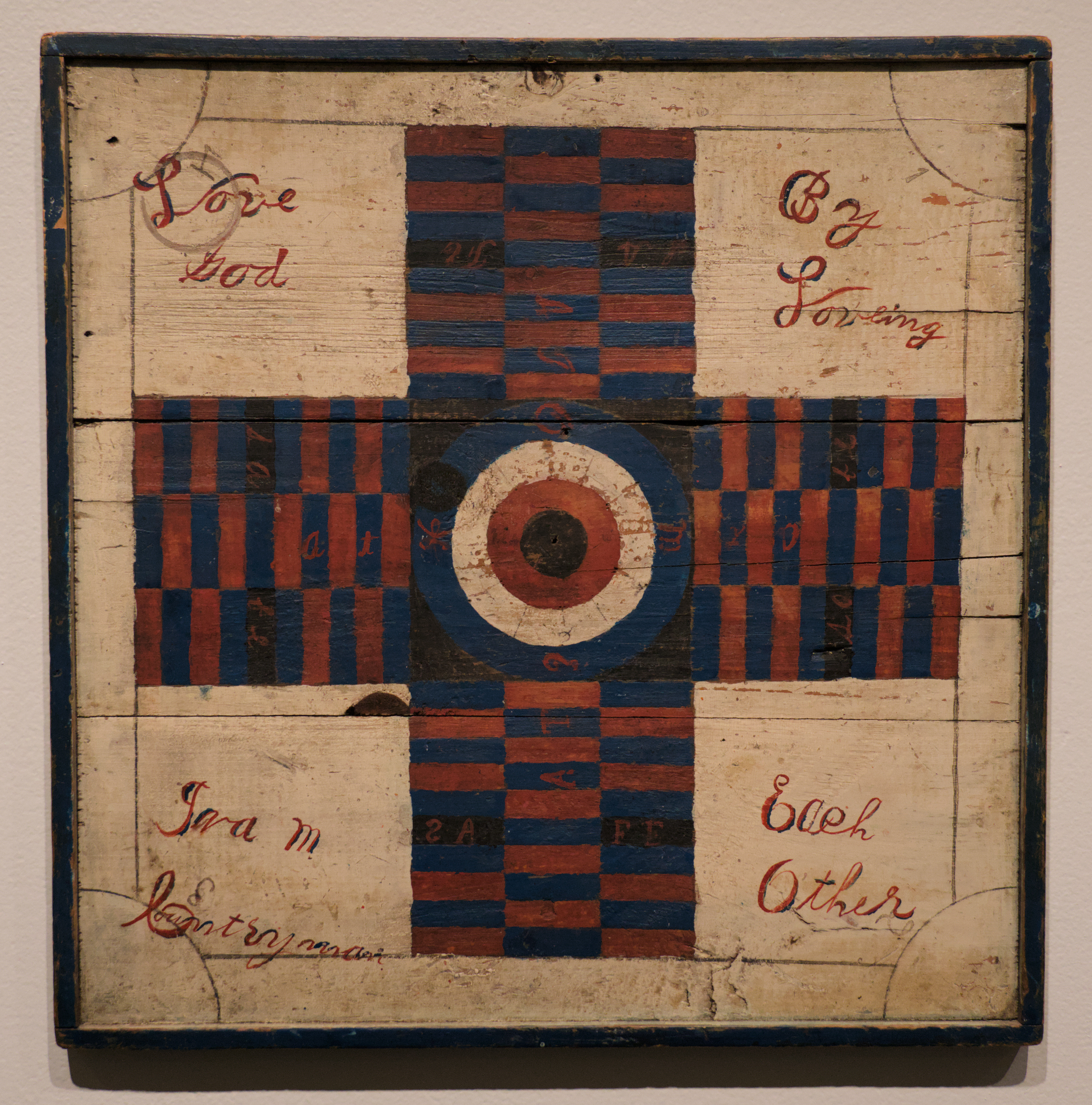
Parcheesi Board
Possibly Ira M. Countryman or Jimmy Hall, Parcheesi Board, late 19th century. Paint on wood, 21 × 21 in. American Folk Art Museum, Gift of Doranna and Bruce Wendel, 2024.7.3. Photo: Victoria Emily Jones.

Chinese Checkers Board
Possibly George Clark, Chinese Checkers Board, late 19th or early 20th century. Paint on wood, 17 1/2 × 15 in. Collection of Doranna and Bruce Wendel. Photo: Victoria Emily Jones.

There are just two weeks left to see the exhibition. (And as I mentioned in November, there’s also an exhibition of Shaker gift drawings on view, also through January 26.) View more photos at the AFAM link above, and also here.

The American Folk Art Museum is one of the few FREE museums in New York, and I’ve enjoyed it so much every time I’ve been there. (See the blog post “The biblical imagination of folk sculptor Annie Hooper,” documenting one of my previous visits.) It’s small—only three galleries. It’s on the Upper West Side of Manhattan, right off the Lincoln Center subway stop.

+++

Interested to see what books I read in 2024? Goodreads has put together a “My Year in Books” page! Follow me on Goodreads if you want to stay apprised of my latest reads, want-to-reads, and star ratings.

My Year in Books

Roundup: Call for Lord’s Prayer songs, two lectionary poems, new theology podcast takes kids’ questions, and more

NEW SONG + CALL FOR SUBMISSIONS: Sing the Prayer from BibleProject: To cap off their five-part podcast series on the Lord’s Prayer this month, BibleProject commissioned singer-songwriters Brian Hall (of the family band TENTS) and Liz Vice to write and record a new setting of the Lord’s Prayer, using the translation by Tim Mackie and the BibleProject Scholar Team:

Our Father who is in the skies, may your name be recognized as holy. May your kingdom come and may your will be done as it is in the skies, so also on the land. Our daily provision of bread, give to us today. And forgive us our debts, just as we also have forgiven those indebted to us. And don’t lead us to be tested, but deliver us from the evil one. Amen. (Matt. 6:9–13; cf. Luke 11:2–4)

(You may be wondering, as I did, where’s the final line, “For thine is the kingdom, and the power, and the glory, for ever.” As Mackie explains, that line is not in the earliest manuscripts of Matthew or Luke; the addition first appeared in the Didache, an early Christian teaching manual.)

You can listen to and download Hall and Vice’s new setting of the Lord’s Prayer, which Vice sings to Hall’s guitar accompaniment, at the “Sing the Prayer” link above. In addition, the Good Shepherd Collective video-recorded a more fully instrumented arrangement for a digital worship service; see here. And here are links to the recent Lord’s Prayer episodes of the BibleProject podcast:

  1. “How Does Jesus Teach Us to Pray?”
  2. “What Does ‘Hallowed Be Thy Name’ Mean?”
  3. “What Does Jesus Mean by ‘Daily Bread’?”
  4. “What Forgiveness Is and Isn’t”
  5. “Does God Lead Us into Temptation?”

All you composers out there can get involved too! Through September 15, 2024, BibleProject is accepting submissions of musical settings of the Lord’s Prayer. You can sing the text verbatim using a translation of your choice, or you can rephrase it or write a song based on the prayer’s themes. Purely instrumental responses are also welcome. Send in a song file using their online form, and they will select some of their favorites to host on their website (for streaming, not download). View the early selections at https://bibleproject.com/singtheprayer/all.

+++

TV SHOW EXCERPT: Opening montage from season 3, episode 4 of The Chosen, “Clean, Part 1”: Several people have asked for my opinion of The Chosen, a television adaptation of the Gospels created by Dallas Jenkins. I think it’s great! Creatively (not woodenly, as is too often the case) written, culturally and historically immersive, high production values, and humanizing—it portrays the disciples (the Twelve and others, including the women) as complex, rounded characters with backstories, families, and distinct personalities. Jonathan Roumie is fantastic as Jesus; so is Liz Tabish as Mary Magdalene. If I were to identify a weakness in the series, it would be the portrayal of the Roman soldiers and rulers, especially Quintus, as cartoonish, one-dimensional—although that begins to shift with at least one Roman in season 3—and the occasional awkward dialogue that’s used to explain to the audience ancient Jewish practices and law codes with which we’re likely to be unfamiliar.

I’m in the middle of season 3 right now and was particularly struck by the opening montage of episode 4, a narrative embellishment of Luke 10:1, which says that Jesus “sent them [his appointed followers] on ahead of him in pairs to every town and place where he himself intended to go.” In the series, this is the first time the disciples perform healings. They’re surprised and confused by, and even a little fearful of, the power working through them; they don’t understand it and aren’t always sure how to wield it. This eight-minute segment shows them growing into their roles as they bring the gospel in word and deed throughout the region, preparing the way for Jesus.

Hear the cast discuss the montage.

The Chosen is streaming for free on its own custom app, as well as on Hulu, Netflix, Amazon, and Peacock.

+++

POEMS:

This coming Sunday’s Gospel reading in the Revised Common Lectionary is Mark 5:21–43, which recounts the Healing of the Woman with an Issue of Blood and the Raising of Jairus’s Daughter. Here are two poems based on that passage. (As a side note related to the previous item: The Chosen, season 3, episodes 4–5 center on these two healing narratives; “Veronica’s” arc is especially cathartic!)

>> “Haemorrhoissa” by Leila Chatti: In her early twenties, the poet Leila Chatti [previously] had uterine tumors and suffered from severe bleeding and pain for two and a half years. She explores the shame, discomfort, isolation, and trauma of that condition as well as cultural taboos surrounding women’s bodies in her debut collection, Deluge (Copper Canyon Press, 2020), influenced by her dual Islamic-Christian heritage. In this poem she finds kinship with the unnamed hemorrhaging woman in the Synoptic Gospels and admires her boldness in touching Jesus’s hem. The title of the poem, a transliteration of “ἡ αἱμοῤῥοοῦσα,” is the Greek term used in the New Testament to refer to this woman, often translated as the “woman with an issue of blood” or “bleeding woman.”

(Related post: https://artandtheology.org/2022/03/09/lent-7/)

>> “Jairus” by Michael Symmons Roberts: The poetry collection Corpus by Michael Symmons Roberts (Jonathan Cape, 2004) also centers on the body, especially on the relationship between corporeality, death, and resurrection. This poem from it, in which the speaker (a disciple of Jesus’s, perhaps?) addresses Jairus, celebrates physical appetite, an instinctive desire that helps keep us alive and that here also represents the hunger for living.

+++

NEW PODCAST: Curiously, Kaitlyn: Launched this spring under the aegis of Holy Post Media, Curiously, Kaitlyn is a weekly podcast hosted by author and theologian Kaitlyn Schiess in which she and other scholars respond to theological questions submitted by kids, unpacking complex concepts in simple terms. Questions so far have included “Is God a boy or a girl?,” “What will we look like in heaven? ’Cause I want my Nana to look like Nana, but she might want to look younger!,” and the clarification-seeking “Does God bring heaven to earth?” (the latter of which occasioned a super-helpful distillation of a key theme in N. T. Wright’s teaching). I’ve really been enjoying this!

Curiously, Kaitlyn

+++

NEW DOCUMENTARY: God and Country, dir. Dan Partland: Released earlier this year, this documentary produced by Rob Reiner “looks at the implications of Christian Nationalism and how it distorts not only the constitutional republic, but Christianity itself. Featuring prominent Christian thought leaders, God & Country asks this question: What happens when a faith built on love, sacrifice, and forgiveness grows political tentacles, conflating power, money, and belief into hyper-nationalism?”

If you are an American Christian, you need to see this film. White Christian nationalism is becoming an increasingly larger threat in the US as it becomes more mainstream, and we need to be aware of it and denounce it. God and Country features interviews with several folks whom I’ve followed for years and deeply respect, including historians and best-selling authors Jemar Tisby and Kristin Kobes Du Mez, Holy Post podcaster and VeggieTales creator Phil Vischer, political commentator David French, and ethicist Russell Moore. Some of the footage from worship services is disturbing, to say nothing of the attack on the Capitol on January 6, 2021.

God and Country is currently available on Kanopy, an on-demand streaming service that many public and academic library patrons have free access to.