
Christmas, Day 3: The Infinite a Sudden Guest

LOOK: I Am Born by Ihor Paneyko
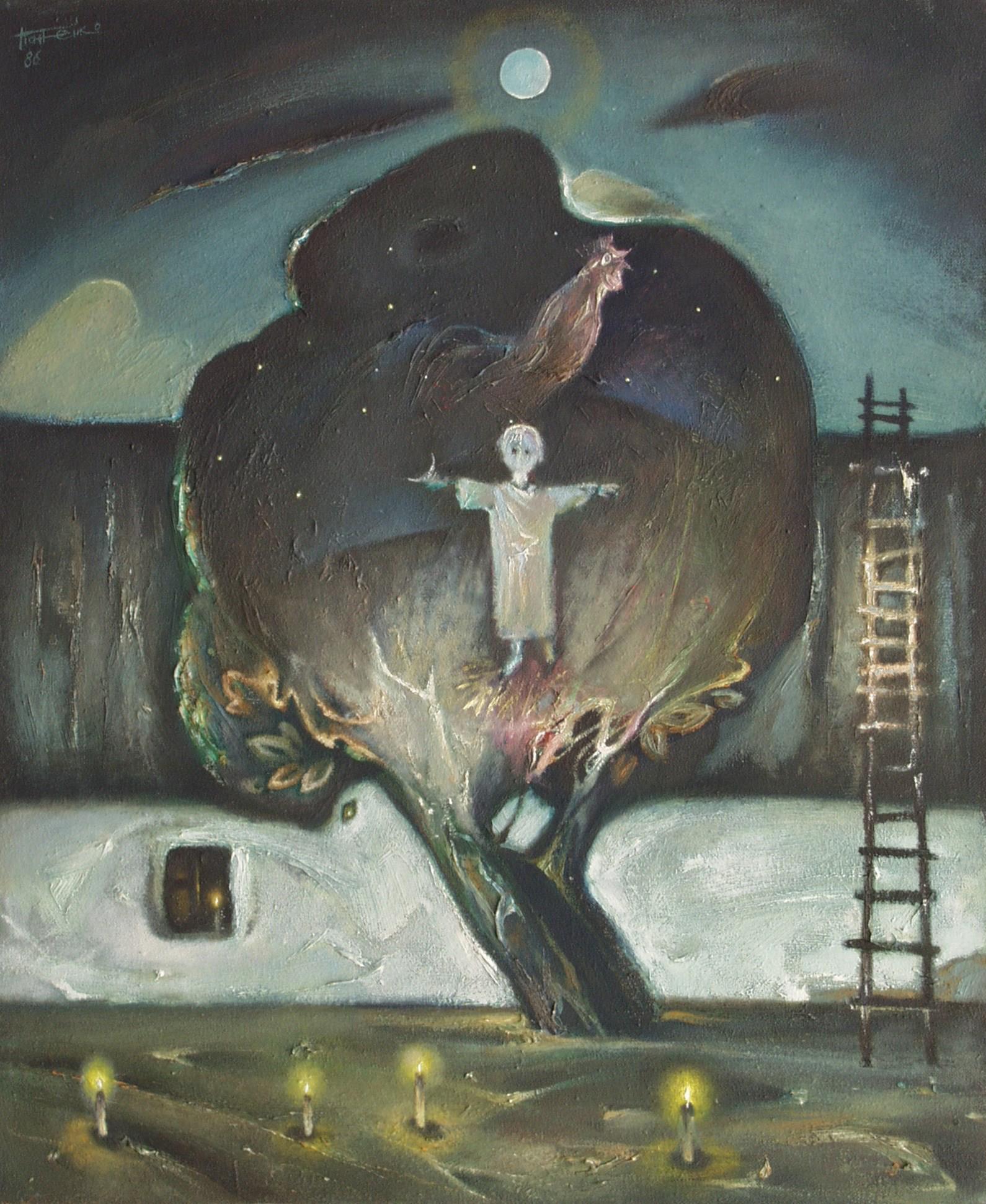
Paneyko, Igor_I Am Born
Ihor Paneyko (Ukrainian, 1957–), Я родився (I Am Born), 1986. Oil on canvas.

LISTEN: “The Infinite a Sudden Guest” by Josh Rodriguez, 2015 | Performed by New City Music on Songs from Engedi, 2015

The Infinite a sudden guest—

Awake, mankind!
For your sake God has become man.
Awake, you who sleep:
God has become man.
Awake, rise up from the dead,
And Christ will enlighten you.
For your sake, God became man.

You would have suffered eternal death,
Never freed from sinful flesh,
Had he not taken on himself
The likeness of sinful flesh;
Lost from everlasting unhappiness,
Had it not been for this mercy.
You would never have returned to life,
Had he not shared your death.

Let us celebrate the coming of salvation and redemption!
Let us celebrate the day who is the great and eternal day,
Came from the great and endless day of eternity
Into our own short day of time.

Christ, born of Mary.
Eternity entered time.
Truth has arisen from the earth:
Christ who said, “I am the Truth.”
And Justice looked down from heaven:
Because believing in this newborn child,
Man is justified not by himself but by God.

Truth has arisen from the earth:
Because the Word was made flesh,
And Justice looked down from heaven.
Justified by faith, let us be at peace with God.
For Peace and Justice have embraced in Jesus Christ.

The Infinite a sudden guest—
God
In time
In God
In time
In God
In time
In God
In time
In God
In time
In God
In time
In God.

In 2015 Josh Rodriguez [previously here and here] composed this piece for SATB choir, violin, and percussion for New City Presbyterian Church in Royal Oak, Michigan, where he served as music director at the time.

Its striking title and first line come from a short poem by Emily Dickinson, and the rest of the text is taken from a Christmas sermon by Augustine of Hippo (cataloged as Sermon 185 by scholars), which centers on Psalm 85:11: “Truth shall spring out of the earth; and righteousness shall look down from heaven.” Augustine sees this prophecy as fulfilled in Christ. The full sermon can be read in St. Augustine, Sermons on the Liturgical Seasons, trans. Mary Sarah Muldowney, RSM (vol. 38 of the Fathers of the Church series) (Washington, DC: Catholic University of America Press, 1959), 6–9. Section 1 can be read for free here.

Celebrating the entrance of God into human history, this choral work alternates between vigorous, exuberant passages and ones that are slower and more introspective. In the opening, there’s a wonderful crescendo on “guest”—an expansion that reflects the possibility opened up by the Incarnation. The final passage alternates between the phrases “in God” and “in time.” God is in time and time is in God, the infinite contracted to a span.


This post is part of a daily Christmas series that goes through January 6. View all the posts here, and the accompanying Spotify playlist here.
Christmas, Day 2: Born Every Day

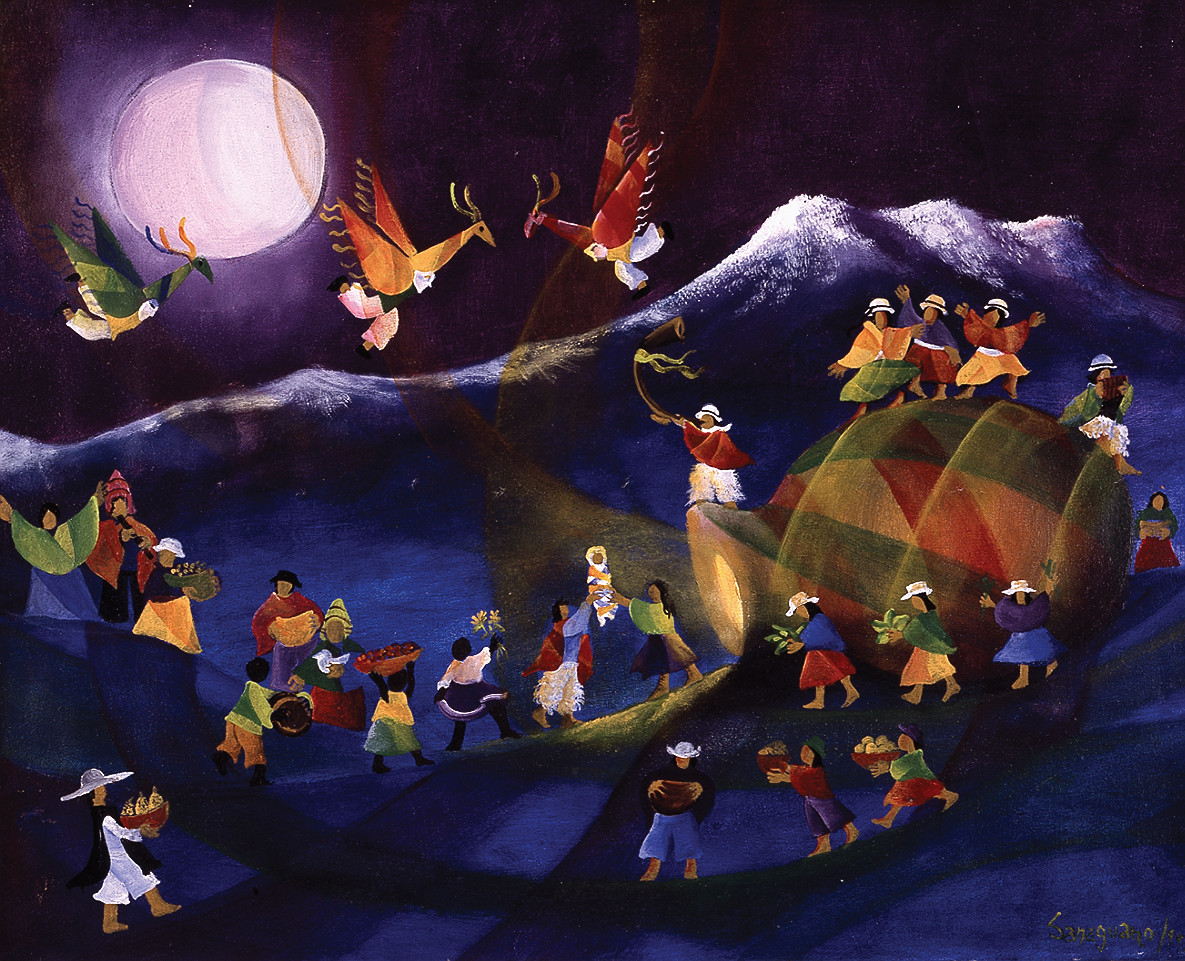
LOOK: Cristo nace cada día by Pablo Sanaguano

Sanaguano, Pablo_Christ Is Born Every Day
Pablo Sanaguano (Ecuadorian, 1964–), Cristo nace cada día (Christ Is Born Every Day), 1994. Acrylic on particle board, 41 × 50 cm. © missio Aachen.

In this celebratory painting with elements of the surreal, the birth of Christ is transplanted to Chimborazo province in the Andean highlands of Ecuador, where artist Pablo Sanaguano lives. Light spills from a giant overturned jug (which doubles as the cave of the Nativity), spotlighting the newborn child who is held aloft by his proud parents, Mary and Joseph. Summoned by a bocina (horn), villagers come bearing corn, potatoes, and other gifts from their harvest, while others play instruments—a bamboo panpipe, a quena (flute), a bomba (drum). The “angels” flying overhead are men in mythical bird costumes.

LISTEN: “Todos los días nace el Señor” by Juan Antonio Espinoza, 1976 | Performed by musicians at Iglesia Presbiteriana Comunidad de Esperanza (Community of Hope Presbyterian Church), Bogotá, Colombia, 2020

Para esta tierra sin luz, nace el Señor;
para vencer las tinieblas, nace el Señor;
para cambiar nuestro mundo,
todos los días nace el Señor.

Para traer libertad, nace el Señor;
nuestras cadenas rompiendo, nace el Señor;
en la persona que es libre,
todos los días nace el Señor.

Para quitar la opresión, nace el Señor;
para borrar la injusticia, nace el Señor;
en cada pueblo que gime,
todos los días nace el Señor.

Para vencer la pobreza, nace el Señor;
para los pobres que sufren, nace el Señor;
por la igualdad de las gentes,
todos los días nace el Señor.

Para traernos la paz, nace el Señor;
para esta tierra que sangra, nace el Señor;
en cada pueblo que lucha,
todos los días nace el Señor.

Para traernos amor, nace el Señor;
para vencer egoísmos, nace el Señor;
al estrechar nuestras manos,
todos los días nace el Señor.

Para este mundo dormido, nace el Señor;
para inquietar nuestras vidas, nace el Señor;
en cada nueva esperanza,
todos los días nace el Señor.

English translation:

Into a world without light, Jesus Christ is born.
Coming to conquer the darkness, Jesus Christ is born.
He comes to bring us a new world.
Jesus our Lord is born every day!

Freedom is coming to all, Jesus Christ is born.
Chains of oppression are breaking, Jesus Christ is born.
Liberating all of God’s children,
Jesus our Lord is born every day!

Justice is coming to all, Jesus Christ is born.
There will be no more oppression, Jesus Christ is born.
He hears the cry of his people.
Jesus our Lord is born every day!

He is the friend of the poor, Jesus Christ is born.
He brings hope to all who suffer, Jesus Christ is born.
Earth’s fruits are for all who labor.
Jesus our Lord is born every day!

He comes to bring us his peace, Jesus Christ is born.
Where there is strife, blood, and hatred, Jesus Christ is born.
Wherever his people are struggling,
Jesus our Lord is born every day!

He comes to teach us to love, Jesus Christ is born.
Throw off the shackles of hatred, Jesus Christ is born.
Join hands, sisters and brothers!
Jesus our Lord is born every day!

He wakes the world from its sleep, Jesus Christ is born.
He stirs and calls us to action, Jesus Christ is born.
In every heart that is hopeful,
Jesus our Lord is born every day! [1]

This contemporary Venezuelan carol is popular throughout Latin America. Its title and refrain translate to “Jesus our Lord is born every day!” This declaration does not dehistoricize the birth, but rather extends it. In what sense is Christ born every day? In the hearts and communities of those who embrace him.

The medieval German mystic Meister Eckhart once preached on Christmas Day,

Here, in time, we are celebrating the eternal birth which God the Father bore and bears unceasingly in eternity, because this same birth is now born in time, in human nature. St. Augustine says, “What does it avail me that this birth is always happening, if it does not happen in me? That it should happen in me is what matters.” We shall therefore speak of this birth, of how it may take place in us and be consummated in the virtuous soul, whenever God the Father speaks His eternal Word in the perfect soul. [2]

NOTES

1. English translation by Alvin Schutmaat, in Hans-Ruedi Weber, Immanuel: The Coming of Jesus in Art and the Bible (Geneva: World Council of Churches, 1984), 92.

2. Meister Eckhart, Dum medium silentium, Sermon on Wisdom 18:14–15, in The Complete Mystical Works of Meister Eckhart, trans. and ed. Maurice O’C. Walshe, rev. Bernard McGinn (New York: Herder & Herder: 2009), 29. The quote by Augustine is untraced. (Eckhart’s quotations from authorities are often free, from memory, and thus difficult to verify.)


This post is part of a daily Christmas series that goes through January 6. View all the posts here, and the accompanying Spotify playlist here.
Christmas, Day 1: Rejoice!

Merry Christmas!

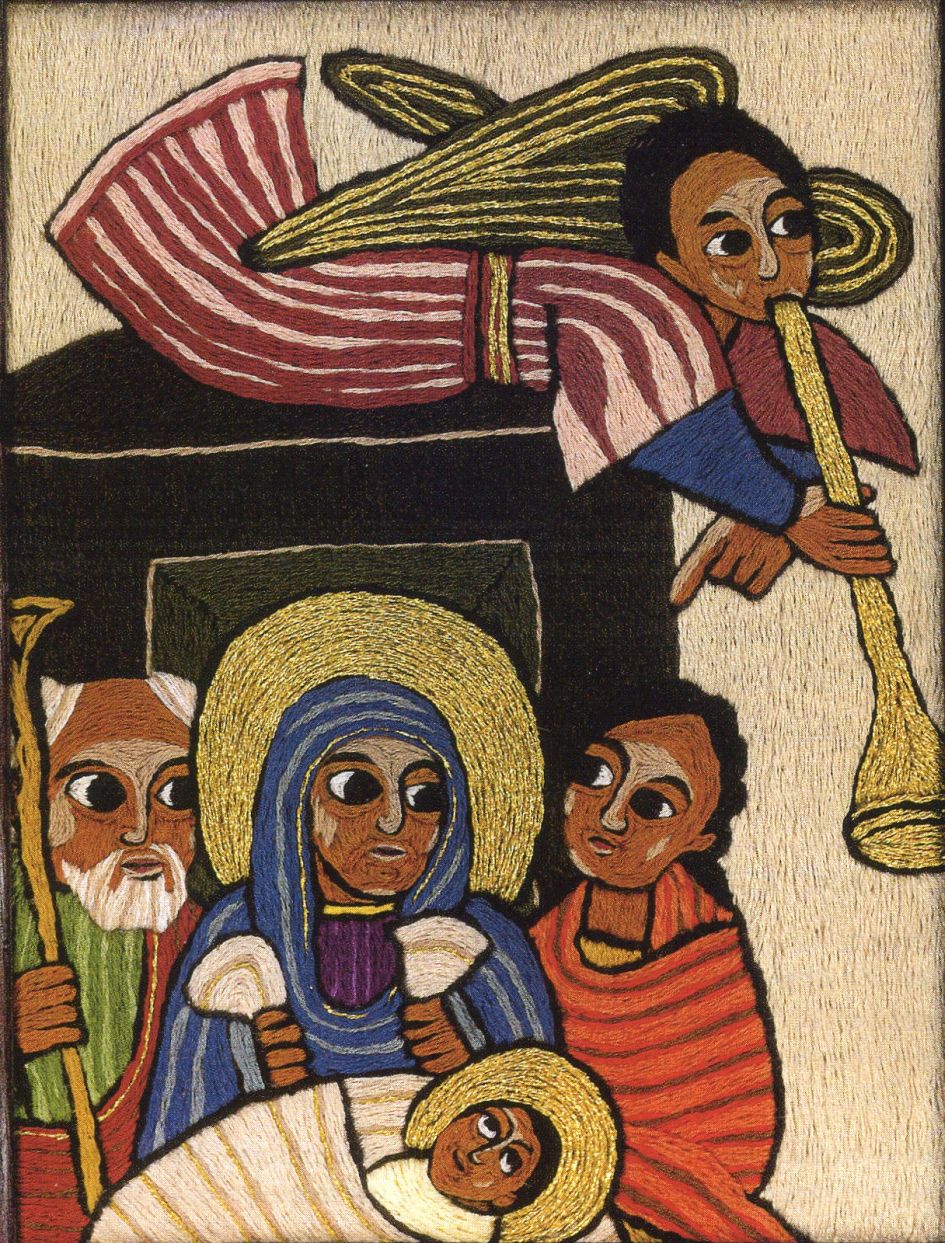
LOOK: Ethiopian Nativity tapestry

Ethiopian Nativity
Tapestry after: Tadesse Wolde Aregay (Ethiopian, 1953–), Joy in Heaven: Glory Be to God, 1985, painting on goatskin. Copyright of the original image belongs to Berliner Missionswerk and the Raad voor de Zending der NHK (Mission Council of the Dutch Reformed Church in the Netherlands).

I don’t know the maker or whereabouts of this charming tapestry, but I did find that it is based on a painting made by the Ethiopian artist Tadesse Wolde Aregay, which you can view here, along with three of Aregay’s other Christmas paintings. In it, a trumpeting angel points to the newborn Christ, whose mother, Mary, wraps him warmly in a blanket. Joseph stands on the left with a staff. On the right is Salome, a midwife and disciple of Jesus who appears in the Nagara Maryam (History of Mary), an apocryphal book of Marian legends from Ethiopia, and who is often portrayed in Ethiopian paintings of the Nativity and the Flight to Egypt.

LISTEN: “Christ Is Born Today” | Original German and Latin words attributed to Heinrich Suso (ca. 1295–1366); English translation by John Mason Neale, 1853 | Music: German dance tune, 14th century | Arranged by Elbertina “Twinkie” Clark and performed by the Clark Sisters on New Dimensions of Christmas Carols, 1978

Good Christian men, rejoice
With heart, and soul, and voice;
Give ye heed to what we say:
Good news!
Jesus Christ is born today!
Ox and ass before him bow;
He is in the manger now.
Christ is born today!

(Joy to the world)
Christ is born today!
(He’s in the manger now)
Christ is born today!
(Peace on earth, goodwill to men)
Christ is born today!
(Unto us)

And man is blessèd evermore.
Christ is born today!
(Christ is born today)
Christ is born today!
(Peace on earth, goodwill to men)
Christ is born today!
(Unto us a child is given)
Christ is born today!

This Christmas carol has its origins in late medieval Germany. It’s attributed to the Dominican friar Henry Suso—a legend says he had a vision of angels singing and dancing with joy about the birth of Christ, and, caught up in the mystic celebration, he penned the song.

I love the quick-tempoed, 6/8 version I grew up singing in church—but I also love what the Clark Sisters have done with it!

Officially formed in 1973 and active ever since, the Grammy-winning Clark Sisters are Jacky Clark Chisholm, Elbernita “Twinkie” Clark, Dorinda Clark-Cole, and Karen Clark Sheard. They were born in Detroit to gospel musician and choral director Dr. Mattie Moss Clark, who got them started in their singing careers. The group is a pioneer of contemporary gospel music, and last year they were inducted into the Black Music & Entertainment Walk of Fame in Atlanta.

The soloist on “Christ Is Born Today” is Denise “Niecy” Clark-Bradford, who left the group in 1986. In the first verse she mistakenly sings “groan” instead of “bow.”

Note that in hymnals today it is common to replace the first line with “Good Christian friends, rejoice” or “Good Christian folk, rejoice” to avoid the gendered “men,” and likewise in a later verse to change “And man is blessèd evermore” to “And we are blessed forevermore.” I get that “men” is being used in the broad sense of “humankind,” but where small lyrical changes for gender inclusivity are nondisruptive, as they are here, I am in favor of them.

The carol is written in the voice of the angels who excitedly proclaimed Christ’s birth to the shepherds, and their proclamation is taken up by Christians around the globe who sing this song, spurring one another to rejoice in the good news.


This post is part of a daily Christmas series that goes through January 6. View all the posts here, and the accompanying Spotify playlist here.