From the compilation album To: Kate—A Benefit for Kate’s Sake, sung with Allison Moorer, 2005:
Once upon a time in a far-off land Wise men saw a sign and set out across the sand Songs of praise to sing, they traveled day and night And precious gifts to bring, guided by the light
They chased a brand-new star, ever towards the west Across the mountains far, but when they came to rest They scarce believed their eyes, they’d come so many miles And this miracle they prized was nothing but a child
Refrain: And nothing but a child could wash those tears away Or guide a weary world into the light of day And nothing but a child could help erase those miles So once again we all can be children for a while
Now all around the world, in every little town Every day is heard a precious little sound And every mother kind and every father proud Looks down in awe to find another chance allowed [Refrain]
Outro: Nothing but a little baby Nothing but a child
This is the final post in my 2024/25 Advent–Christmas series. Thanks for journeying with me! If you feel so led, please consider donating; I’ve been having trouble with the embedded Stripe form often rejecting credit cards and then WordPress disabling it (do any of you know of a secure but reliable credit card processor that does not require donors to make an account and that integrates well with WordPress?), but PayPal and Amazon are still options.
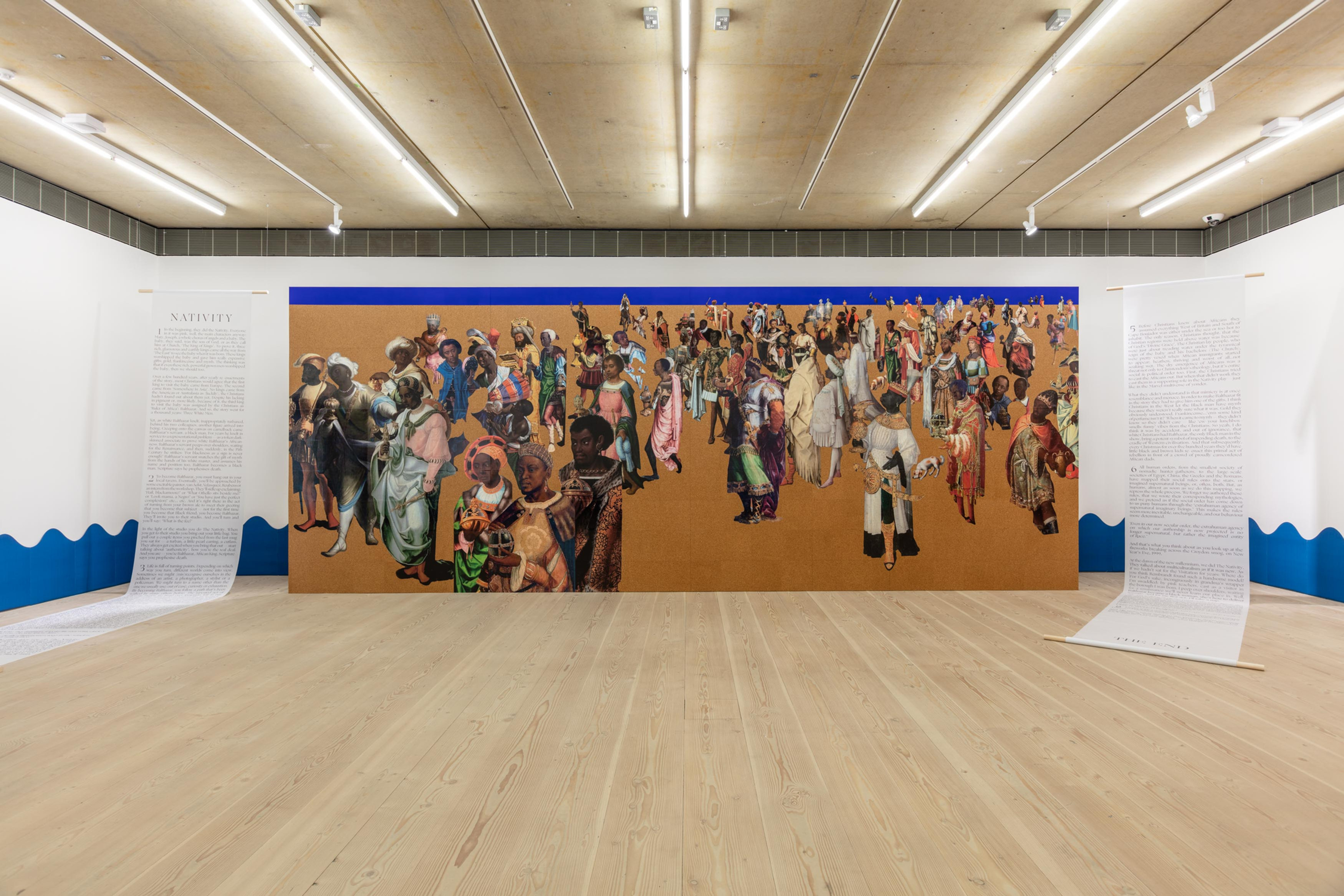
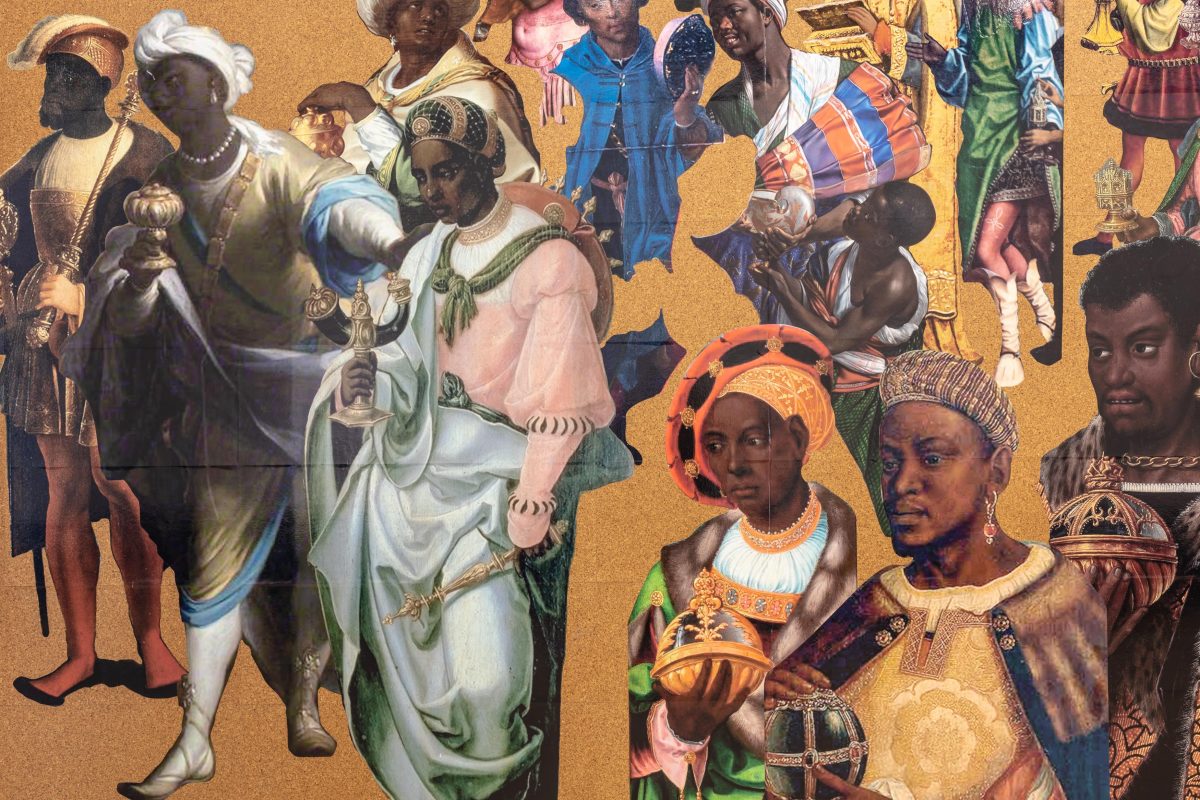
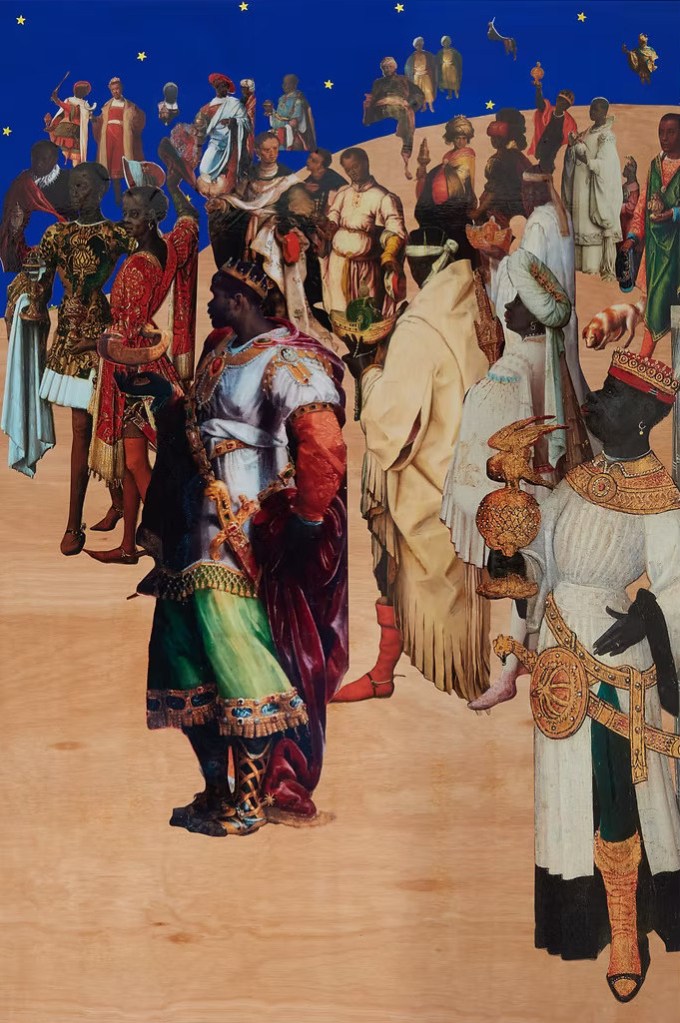
Rosa-Johan Uddoh (British, 1993–), Breaking Point, 2021. Billboard-style collage. Photo: Anna Lukala, from Practice Makes Perfect, Focal Point Gallery, Southend-on-Sea, England, May 18–August 28, 2021.Rosa-Johan Uddoh, Breaking Point (detail)
Rosa-Johan Uddoh is an interdisciplinary artist based in London who, “through performance, writing and multimedia installation, . . . explores places, objects and celebrities in British popular culture, and their effects on self-formation,” she writes on her website.
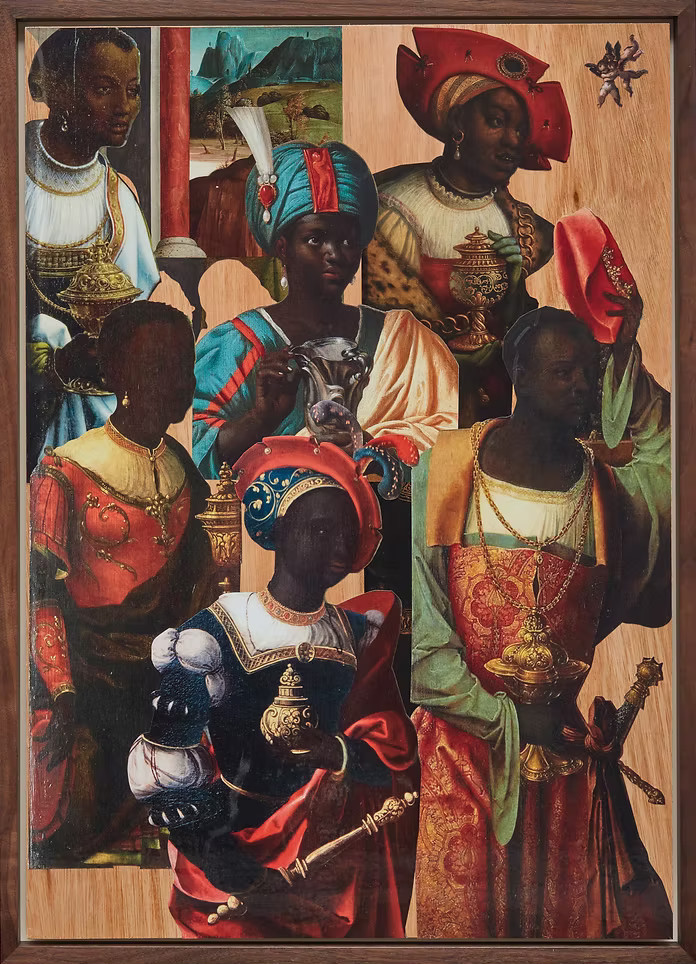
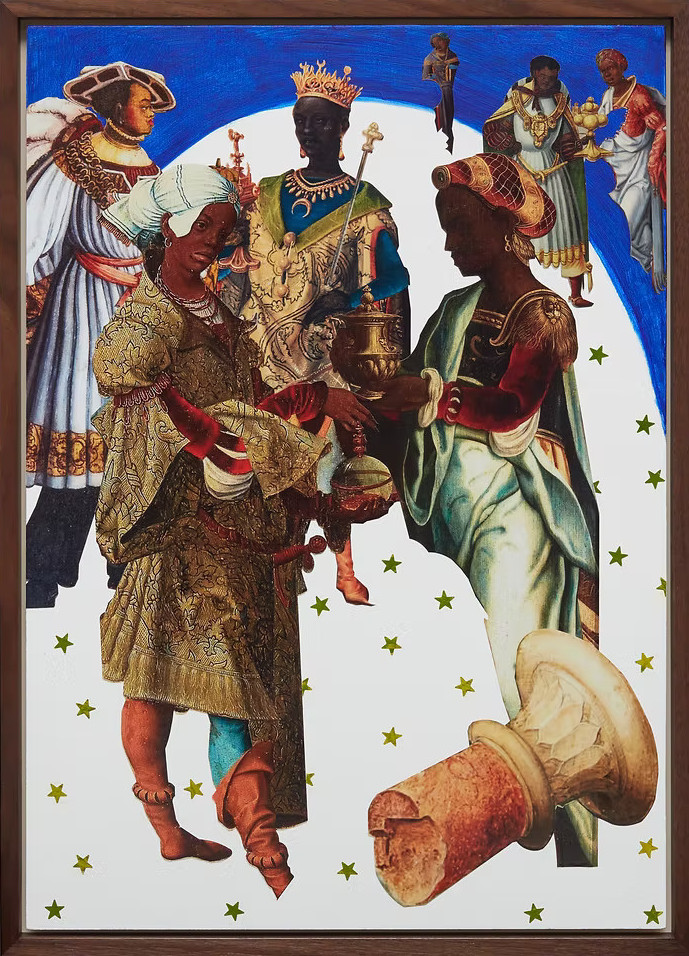
In her first institutional solo show, Practice Makes Perfect at Focal Point Gallery in Southend-on-Sea, she explored how the white European imagination constructed Blackness through the figure of Balthazar, who according to Christian tradition was one of the three magi who visited the infant Jesus, offering him the gift of myrrh. Since the fifteenth century Balthazar has typically been depicted as Black, as it was imagined that he came from Africa (whereas the other two magi were supposedly from Europe and Asia, the three known continents at the time). Uddoh notes that Balthazar is one of the first Black people of importance that British schoolchildren encounter, and in fact the first public performance she ever gave was as Balthazar in a primary-school Nativity play, a role she had been cast in by her teacher.
The centerpiece of the Practice Makes Perfect exhibition was Breaking Point, a billboard-sized mural that depicts 150 Black Balthazars extracted from European paintings from the late Middle Ages onward and rearranged into friendship groups. These groupings “allow Balthazar to escape the isolation associated with being the only Black character of importance in Christian iconography whilst also highlighting that the Black figures behind the artistic imagery were real sitters, which is also a testament to early African immigration into Europe, a phenomenon often overlooked in mainstream history.”
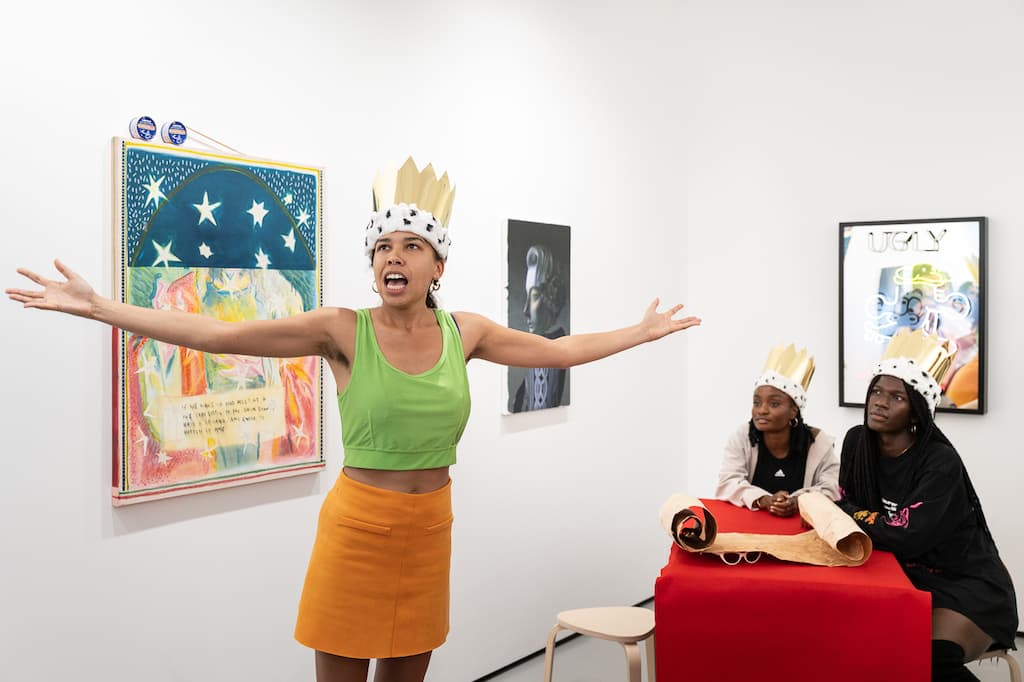
Installed on either side of Breaking Point was a scroll bearing a piece of experimental writing by Uddoh, titled Nativity. (She later performed this text in 2022 at the London art gallery Workplace, with Adeola Yemitan and Ebunoluwa Sodipo.) It opens, “In the beginning, they did the Nativity. Everyone in it was pink; well, the main characters anyway . . .”
Nativity, 2022, performance by Rose-Johan Uddoh with Adeola Yemitan and Ebunoluwa Sodipo at Workplace, London. Photo: Damian Griffiths.
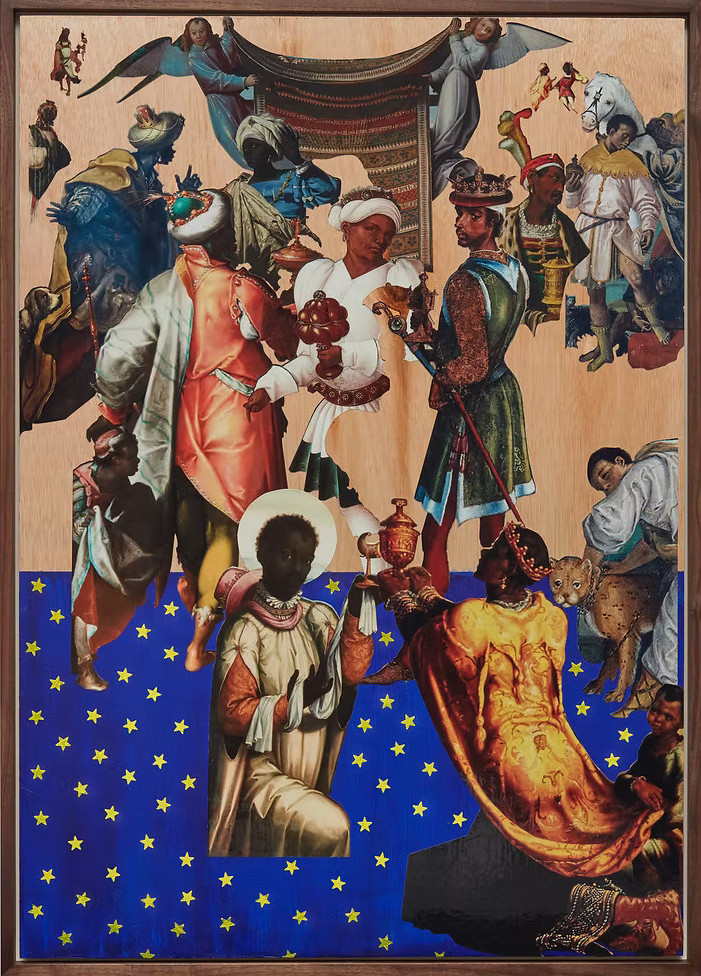
In 2022 Uddoh expanded this body of work with another solo show, Star Power at Workplace. It featured the series You Can Go Ahead and Talk Straight to Me and I Sell the Shadow to Support the Substance (scroll through select images below), the artworks made of acrylic and vinyl on board. The former title is a quote from Toni Morrison’s 1975 speech “A Humanist View,” given at Portland State University as part of a public forum on the theme of the American Dream. The latter is a quote from Sojourner Truth—she wrote the phrase on the bottom of a self-portrait she took, selling copies of it across America to raise funds for her abolitionist activism.
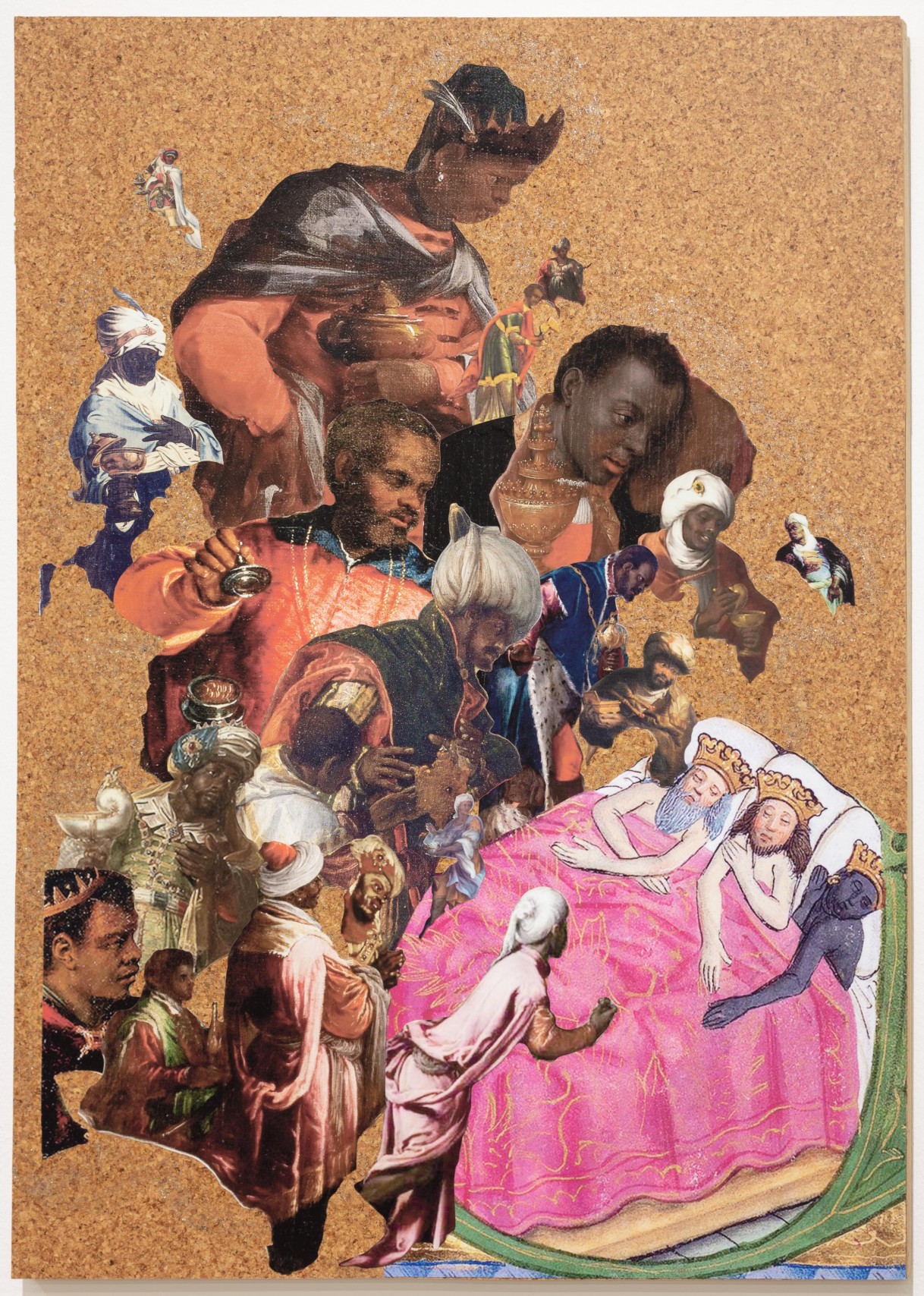
Lastly, here’s an amusing collage from Practice Makes Perfect:
Rosa-Johan Uddoh, Get up mate, we’re going to the protest, 2021
The image of the three kings in bed is taken from the ca. 1480 Salzburg Missal. (In the original they’re inside an initial E, which introduces the text for the introit for the Feast of the Epiphany, “Ecce advenit dominator Dominus.”) In the Middle Ages it was common for artists to depict the magi in bed together when they receive the angelic warning not to reveal the location of the baby Jesus to King Herod, who intends to harm him (Matt. 2:12). There’s nothing sexual about it—it’s just a compositional practicality, to show the three men in one space, having the same dream at the same time.
In Uddoh’s playful remix, she has a slew of Balthazars leaning over the bed to wake up their sleeping comrade so that he can join them in a protest for racial justice.
LISTEN: The Ballad of the Brown King by Margaret Bonds, 1954, rev. 1960 | Words by Langston Hughes, 1954/60 | Arranged by Malcolm J. Merriweather for strings, harp, and organ, 2018 | Performed by the Dessoff Choirs and Orchestra, dir. Malcolm J. Merriweather, on Margaret Bonds: The Ballad of the Brown King and Selected Songs, 2019 (soloists: Laquita Mitchell, soprano; Noah Stewart, tenor; Lucia Bradford, mezzo-soprano; Ashley Jackson, harpist)
I encourage you to listen to all nine movements! (The piece is twenty-five minutes long.) But if you want just a taste for now, here are two selections: movements 1 and 7.
I. Of the Three Wise Men
Of the three wise men who came to the King One was a brown man, so they sing Alleluia, Alleluia
Of the three wise men who followed the star One was a brown king from afar Alleluia, Alleluia
. . .
VII. Oh, Sing of the King Who Was Tall and Brown
Oh sing of the king who was tall and brown Crossing the desert from a distant town Crossing the desert on a caravan His gifts to bring from a distant land His gifts to bring from a palm tree land Across the sand by caravan With a single star to guide his way to Bethlehem To Bethlehem where the Christ child lay
Oh sing of the king who was tall and brown And the other kings that this king found Who came to put their presents down In a lowly manger in Bethlehem town Where the King of kings a babe was found The King of kings a babe was found Three kings who came to the King of kings And one was tall and brown
Margaret Bonds (1913–1972) was an African American composer, pianist, arranger, and teacher, best remembered for her popular arrangements of African American spirituals and her frequent collaborations with her friend Langston Hughes, especially the cantata The Ballad of the Brown King.
Dedicated to Rev. Dr. Martin Luther King Jr., The Ballad of the Brown King honors the African king Balthazar of Christian tradition, a figure extrapolated from the Gospel of Matthew’s account of the “wise men from the east” who came to worship the Christ child and bestow gifts. Bonds wanted to celebrate the wisdom and devotion of this dark-skinned brother, and his active presence at the Nativity, giving “the dark youth of America a cantata which makes them proud to sing,” she wrote in a letter.
She commissioned Hughes to write the libretto. She wrote to him, “It is a great mission to tell Negroes how great they are.” Remember, this was at the burgeoning of the civil rights movement. There were very few images of Black wealth and admirability being projected by mainstream culture at the time. Balthazar was an exception.
Regardless of the racial accuracy, this narrative [of an African king participating in the story of Christ’s birth] gives African Americans a positive image rarely portrayed in history, books, and art. A brown sovereign, traveling in majesty and splendor? It is unheard of. African Americans are not just descendants of slaves; we come from great kings or queens that ruled kingdoms with sophisticated political and economic systems on the continent of Africa.
The initial version of The Ballad of the Brown King premiered in December 1954, but Bonds and Hughes later revised and expanded it. The new version premiered December 11, 1960, at the Clark Auditorium of the YWCA in New York, sung by the Westminster Choir of the Church of the Master. The concert was presented as a benefit for the Southern Christian Leadership Conference.
The cantata is made up of nine movements with parts for soprano, tenor, baritone, and choir. Stylistically, the work has been described as neo-Romantic, but it also draws on gospel, jazz, blues, and calypso traditions.
The only commercial recording ever made of it is the one released by Avie Records in 2019. Newly arranged by Malcolm J. Merriweather, the piece is performed there by the Dessoff Choirs and Orchestra under Merriweather’s direction.
Bonds had scored the cantata for full orchestra—brass, woodwinds, strings (including harp), and percussion. But because hiring an orchestra of that size is expensive and he wants to see this work more widely performed, including in church contexts, Merriweather arranged the piece for a pared-down ensemble of harp, strings, and organ, omitting the winds and brass (whose parts he essentially absorbed into the new organ part). He also enlivened the harp part to add texture.
For more context on Bonds and on this most popular cantata of hers, here’s a great thirty-minute conversation between John Banther and Evan Keeley from a 2022 episode of the Classical Breakdown podcast, produced by WETA Classical in Washington, DC:
About 88 percent of the population of the Philippines is Christian—it’s the only Asian country where Christianity predominates—and Christmas is the most festive holiday of the year.
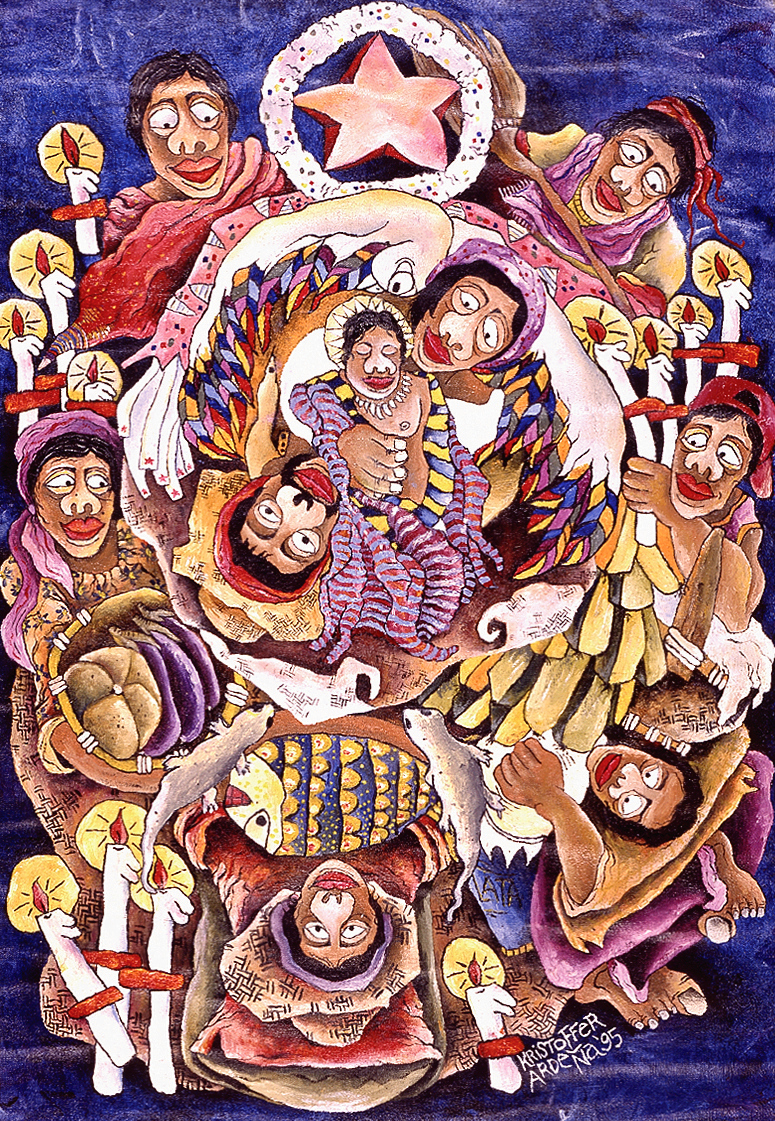
Filipino artist Kristoffer Ardeña celebrates the Christmas story and its ongoing impact in his painting Ang Kahulugan ng Pasko, which translates to “The Meaning of Christmas.” He wrote the following extended statement about it for the December 1996 issue of Image: Christ and Art in Asia, a publication of the Asian Christian Art Association. From what I can tell, this organization is no longer active.
Christmas—what does it really mean to us? Parties, extravagant decorations, frivolous gifts and all those materialistic things—do they manifest the true meaning of Christmas?
Sometimes we get so used to celebrating Christmas that we forget the truth behind it. In my painting Ang Kahulugan ng Pasko I want to express what Christmas means to me and to the ordinary people whom we hardly notice.
The Christmas lantern
The most popular Philippines Christmas symbol is the star lantern, or parol (see top of artwork). All that is needed to make a star lantern are ten long and five short bamboo sticks, string, starch and paper.
Although rice paper was traditionally used to cover the lantern, nowadays Japanese paper, foils or plastics are used and bulb lights have replaced the traditional candle inside the lantern.
The star lantern is a Filipino innovation of the Mexican piñata which was introduced to our country during the Spanish colonial period.
The five-pointed star lantern represents the star of Bethlehem. Stars produce the elements that make life possible, and in death they sow the seeds of new stars and planets across the heavens. The earth is built in part from the ashes of dead stars, and I think human beings are literally star children. We and all other life forms are collections of atoms forged in stellar furnaces.
It was through this star that the shepherds and the magi were guided, and it may well be the same star that calls us to remember and beckons us to search for the child in the manger—for he is the truth behind Christmas.
By living and dying, a star generates new worlds; the life and death of the infant that the star of Bethlehem symbolises created a new spiritual world.
The banig, or native handwoven mat
The banig is made from abacca, buri or other dried plant fibres woven together. Motifs and designs differ regionally. The banig is where gatherings happen. It is placed on the ground so that rituals, dialogues, recreation or mere eating sessions may occur. It calls us together, it draws us to gather.
The candles
The use of votive candles most probably came from the Roman practice of burning candles as a mark of respect to a person, and in this painting the candles symbolise respect for Christ. But there is more to a candle. It is believed that candles are also a form of prayer.
During fiestas and other holy occasions we offer candles, and we light candles during birthdays or when we visit our dear departed loved ones.
The bananas
During Christmas our front doors are adorned with three bunches of bananas still attached to their stalks. They are placed there during the Advent season and are not taken down before Epiphany. These bananas represent the Holy Family.
Whenever the visitors come to our home we offer them some of these bananas because we believe that these bananas have been blessed by God and that we should share His blessings with others.
I included these bananas as well as the star lantern in this painting because, just like my ancestors, I believe they add meaning to Christmas.
The people surrounding the Holy Family
(1) The northern tribesman of Luzon and the Metro Aide worker (the one who sweeps and keeps our streets clean). These two represent the people both near (the Metro Aide worker) and far (the tribesman) who have been guided by the star to bear witness to the birth of Jesus, just as the shepherds were led to the manger to pay homage to the king.
I chose the Metro Aide worker because I feel that we get used to his presence when he cleans our streets and we hardly take notice of him or thank him for what he does; yet here he is with his broom, giving praise and thanks.
(2) The fisherman, the vegetable vendor and the balut (duck egg) vendor. The Magi brought gold, incense and myrrh, and here are the fisherman with his best catch, the vegetable vendor with her freshest and best vegetables and the balut vendor with the best duck eggs to offer Jesus.
I placed these people in the painting rather than the rich and extravagantly dressed because I believe that Christmas is universal and for everybody. It is not only for the rich but for the modest poor people as well.
The offering we give to Jesus is not merely an act of human generosity; it is a religious act. It is an act which is sacramental and sacrificial. We have worked on these gifts, and we bring them to Jesus and offer them and offer ourselves.
(3) The comanchero. He is the “marine” of Christmas, the first to welcome and the last to go. He is the caroller. He sings and plays his instruments to the tune of Christmas songs to announce Christmas.
He uses ethnic as well as indigenous instruments—tambourines made of beer bottle caps, drums made of cans and cloth, maracas made of coconut shell with mango seeds inside. Just as the vendors offer their goods, he offers his songs to Jesus.
The dove and house lizards
Just as there were cows, horses and many farm animals, the dove and house lizards in this painting represent more than that. They are there to bear witness to this glorious event. The dove, which is the universal symbol of peace, unveils yet embraces the Holy Family.
With regard to the house lizards, I adhere to the superstition that every day at six in the evening they come down from the ceiling to kiss the floor in reverence to God. This belief tells me that we human beings, stewards of God’s creation, must do more than that.
La Sagrada Familia (The Holy Family)
In this painting I represented Joseph as a farmer and Mary as his wife. Jesus is wrapped in striped layette cloth distinctive to the Igorot tribe of Luzon, and as a sign of kingship he wears a necklace made of animal bones, which is characteristic of an Igorot chieftain.
LISTEN: “Ang Pasko Ay Sumapit” (Christmas Has Arrived) | Tagalog words by Levi Celerio, 1950, based loosely on a 1933 Cebuano carol text, “Kasadya Ning Takna-a,” by Mariano Vestil | Music by Vicente Rubi, 1933 | Performed by the Bayanihan Philippine Dance Company on A Philippine Christmas, 1964, reissued 1991
Ang Pasko ay sumapit
Tayo ay mangagsiawit
Ng magagandáng himig
Dahil sa ang Diyos ay pag-ibig

Nang si Kristo’y isilang
May tatlóng haring nagsidalaw
At ang bawat isá ay nagsipaghandóg
Ng tanging alay

Koro:
Bagong Taón ay magbagong-buhay
Nang lumigayà ang ating Bayan
Tayo'y magsikap upang makamtán
Natin ang kasaganaan!

Tayo’y mangagsiawit
Habang ang mundó'y tahimik
Ang araw ay sumapit
Ng Sanggól na dulot ng langit

Tayo ay magmahalan
Ating sundín ang Gintóng Aral
At magbuhát ngayon
Kahit hindî Paskô ay magbigayan!
Christmas has come
Come, let us go forth singing
Beautiful hymns
For God is love

When Christ was born
There were three kings who did visit
And each one did present
A unique offering

Refrain:
’Tis New Year, so we must reform our lives
That our nation might be joyful
Let us strive that we might achieve
Prosperity

Come, let us go forth singing
While the world is silent
The day has arrived
Of the Infant sent from heaven

Let us love one another
May we follow the Golden Rule
And from now on
Though it not be Christmas, let us keep giving [source]
I really like the recording above, which has rollicking instrumentation to back the voices, but here’s an a cappella performance that’s also good, from 2006, by the Philippine Madrigal Singers:
He has come, the Christ of God: Left for us his glad abode; Stooping from his throne of bliss To this darksome wilderness.
Refrain 1: He has come, the Prince of Peace: Come to bid our sorrows cease; Come to scatter with his light All the shadows of our night.
He, the mighty King, has come, Making this poor earth his home: Come to bear our sin’s sad load, Son of David, Son of God.
Refrain 2: He has come, whose Name of grace Speaks deliverance to our race: Left for us his glad abode, Son of Mary, Son of God.
Unto us a Child is born: Ne’er has earth beheld a morn, Among all the morns of time, Half so glorious in its prime.
Refrain 3: Unto us a Son is given: He has come from God’s own heaven, Bringing with him from above Holy peace and holy love.
While he was a worship pastor at Bayou City Fellowship in Houston, Ryan DeLange wrote a new tune for this nineteenth-century Christmas hymn by Horatius Bonar, a Scotsman who is best known for “Be Still, My Soul.” To hear DeLange discuss what drew him to this hymn, see season 2, episode 2 of the Hymnistry podcast, which aired December 5, 2016. He performs the song at 9:22 of the episode, and at 27:01, Pastor Jacob Breeze charges listeners to “keep the party going” for all twelve days of Christmas.
The 2016 video above is from Scarlet City Church in Columbus, Ohio. The singer is Janelle Jackson, and she’s accompanied on guitar by Rev. Mike Juday, who was the church’s music pastor at the time but who is now the associate rector of Village Church Anglican in Greenville, South Carolina.
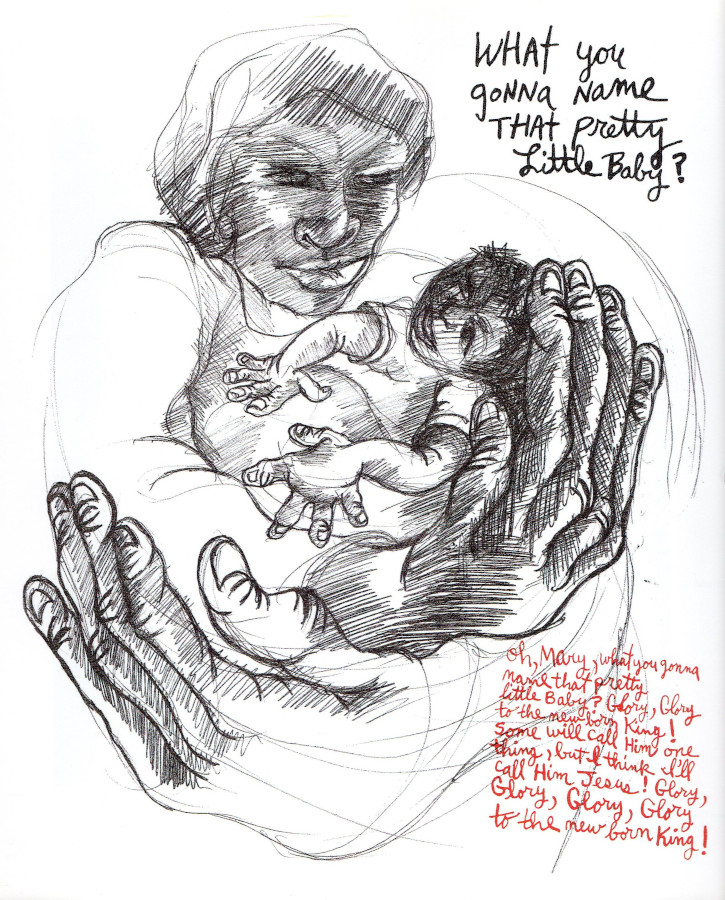
Aminah Brenda Lynn Robinson (1940–2015) was an artist working in multiple media whose work celebrates Black history and culture. She was a lifelong resident of Columbus, Ohio, and bequeathed her art, writings, home, and personal property to the Columbus Museum of Art, who established the Aminah Robinson Legacy Project in 2020.
The drawing above is one of twenty-six from Robinson’s excellent book The Teachings: Drawn from African-American Spirituals (Harcourt Brace Jovanovich, 1992). These drawings, she writes in the introduction, “have grown from the stories and songs that were given to me by my family and my early teachers, and I offer them here to the children of today’s troubled world and the children of tomorrow. They carry a message of dignity, knowledge, and wisdom . . . speak of survival, of freedom and determination, of love and faith, of justice and of hope . . .”
The artist’s estate is represented in the US by Fort Gansevoort in New York, which is currently showing Aminah Brenda Lynn Robinson: Character Studies through January 25.
Another exhibition of her work, Aminah Robinson: Journeys Home, a Visual Memoir, will be touring nationally for the next few years: to the Springfield Museum of Art in Ohio (February 1–July 13, 2025), the Newark Museum of Art in New Jersey (October 16, 2025–March 1, 2026), the Mobile Museum of Art in Alabama (March 26, 2026–January 9, 2027), and two remaining venues to be announced. This is a major exhibition that brings together Robinson’s drawings, prints, paintings, textiles, collages, homemade books, dolls, “hogmawg” sculptures (made of a mixture of mud, clay, twigs, leaves, lime, animal grease, and glue), and “RagGonNon” pieces (monumental swaths of fabric encrusted with buttons, beads, and other found objects) to create a portrait of her life.
LISTEN: “Mary, What You Gonna Name That Pretty Little Baby?,” African American spiritual | Arranged by Alex Bradford, 1961 | Performed by Princess Stewart and Marion Williams on Black Nativity: Gospel on Broadway! (Original Broadway Cast), 1962
Mary, Mary, what you gonna name that pretty little baby? Mmm, mmm, pretty little baby Mmm, mmm, pretty little baby Glory be to the newborn King
Some call him one thing, I think I’ll call him Jesus Mmm, mmm, sweet Jesus Mmm, mmm, (ain’t he sweet?) sweet Jesus Glory be to the newborn King
Some call him Jesus, I think I’ll call him Wonderful Mmm, mmm, wonderful Mmm, mmm, he’s so wonderful Glory be to the newborn King
Some call him Wonderful, I think I’ll call him Emmanuel Mmm, mmm, King Emmanuel Mmm, mmm, (ain’t he the king?) Emmanuel Glory be to the newborn King
Some call him Emmanuel, I’m gonna call him the Prince of Peace Mmm, mmm, Prince of Peace Mmm, mmm, Prince of Peace Glory be to the newborn King
Some call him Prince of Peace, I’m gonna call him Jesus Mmm, mmm, sweet Jesus Mmm, mmm, (ain’t he sweet?) sweet Jesus Glory be to the newborn King
Mary, Mary, what you gonna name that pretty little baby? Mmm, mmm, pretty little baby Mmm, mmm, pretty little baby Glory be to the newborn King
This Christmas spiritual, a dialogue between an unnamed visitor and the new mother Mary, has been recorded by many artists. I think I like the original cast recording from the Langston Hughes musical Black Nativity best, featuring soloist Princess Stewart on the first verse and Marion Williams on the remaining six, backed by the Stars of Faith.
But here’s a handful of other versions I like. Because the song was passed down orally, it has taken on different lyrical variations and accrued new verses. Some reference the wise men.
>> “The Virgin Mary Had One Son” by the Staple Singers, arr. Roebuck “Pops” Staples, on The 25th Day of December (1962):
>> “The Virgin Mary Had One Son” by Josh Garrels, on The Light Came Down (2016):
>> “What ’Cha Gonna Call the Pretty Little Baby” by the National Lutheran Choir, dir. David M. Cherwien, arr. Ronald L. Stevens, on Christ Is Born (2016):
>> “Glory to the Newborn King” by Chicago a Cappella, dir. Jonathan Miller, arr. Robert Leigh Morris, on Holidays a Cappella Live (2002):
>> “Virgin Mary Had One Son” by Joan Baez and Bob Gibson, live at the 1959 Newport Folk Festival (see also “Virgin Mary,” a bonus track on the 2001 Vanguard reissue of Baez’s 1966 album Noël):
A praising of God is what laughter is, because it lets a human being be human.
Laughter is a praise of God, because it lets a human being be a loving person.
Laughter is praise of God because it is a gentle echo of God’s laughter, of the laughter that pronounces judgment on all history.
Laughter is praise of God because it foretells the eternal praise of God at the end of time, when those who must weep here on earth shall laugh.
The laughter of unbelief, of despair, and of scorn, and the laughter of believing happiness are here uncannily juxtaposed, so that before the fulfillment of the promise, one hardly knows whether belief or unbelief is laughing.
Soichi Watanabe (Japanese, 1949–), You Shall Laugh, 2011. Oil on canvas, 16 × 12 in. (41 × 31 cm). Kwansei Gakuin University Chapel, Kobe, Japan. Photo courtesy of the artist.
Soichi Watanabe is a Japanese Christian artist who served as the 2008–9 artist in residence at the Overseas Ministries Study Center (OMSC) in New Haven, Connecticut (now at Princeton Theological Seminary). OMSC published a catalog of his work, titled For the Least of These: The Art of Soichi Watanabe, in 2010, featuring forty-three of his paintings.
Watanabe doesn’t supply facial features for his human figures because he wants viewers to be able to see themselves in the characters portrayed. He concentrates on form and color.
I was introduced to this painting of his through the OMSC-sponsored Zoom presentation he gave on February 3, 2021. There he said, “We can laugh as the love of God is being poured out on us . . . the laughter of knowing that the Lord is with us in pain and sorrow.” The wave shape at the bottom, he told me in an email, is a reference to the tsunami of March 11, 2011, which wiped out his home city of Ishinomaki and accelerated his mother’s dementia.
Watanabe also painted a companion piece, With Those Who Weep, which shows the same three figures huddled together in a mass, one comforting the two who are crying. Together, the paintings encourage us to fully feel our griefs and our hurts, and to be present to one another through those experiences, but also to hold on to joy, which transcends circumstance.
The artist pointed out to me that the three figures in You Shall Laugh resemble a flower spreading out its petals. The kanji for “bloom,” he says, originally meant “laugh” and was written as “birds sing, flowers laugh.”
LISTEN: “Jesus soll mein erstes Wort” (Jesus shall be my first word) from Gott, wie dein Name, so ist auch dein Ruhm (God, as your name is, so also your praise is to the ends of the world) (BWV 171) | Words by Picander (Christian Friedrich Henrici), 1728 | Music by Johann Sebastian Bach, 1728 | Performed by Kathleen Battle and Itzhak Perlman on J. S. Bach: Arias for Soprano and Violin, 1991
Jesus soll mein erstes Wort
In dem neuen Jahre heißen.
Fort und fort
Lacht sein Nam in meinem Munde,
Und in meiner letzten Stunde
Ist Jesus auch mein letztes Wort.
Jesus shall be my first word
uttered in the new year.
Again and again
his name laughs in my mouth,
and in my last hour
Jesus will also be my last utterance.
This aria is the fourth movement of a cantata Bach composed for his church in Leipzig for New Year’s Day 1729. January 1 is also the Feast of the Holy Name of Jesus, since Jesus was given his name when he was eight days old (Luke 2:21). Read the full libretto of BWV 171 here, and listen to the full cantata here. (It’s only sixteen minutes.)
For the excerpt I’ve chosen a recording by the legendary American operatic soprano Kathleen Battle, who is accompanied by the equally famous Israeli American violinist Itzhak Perlman.
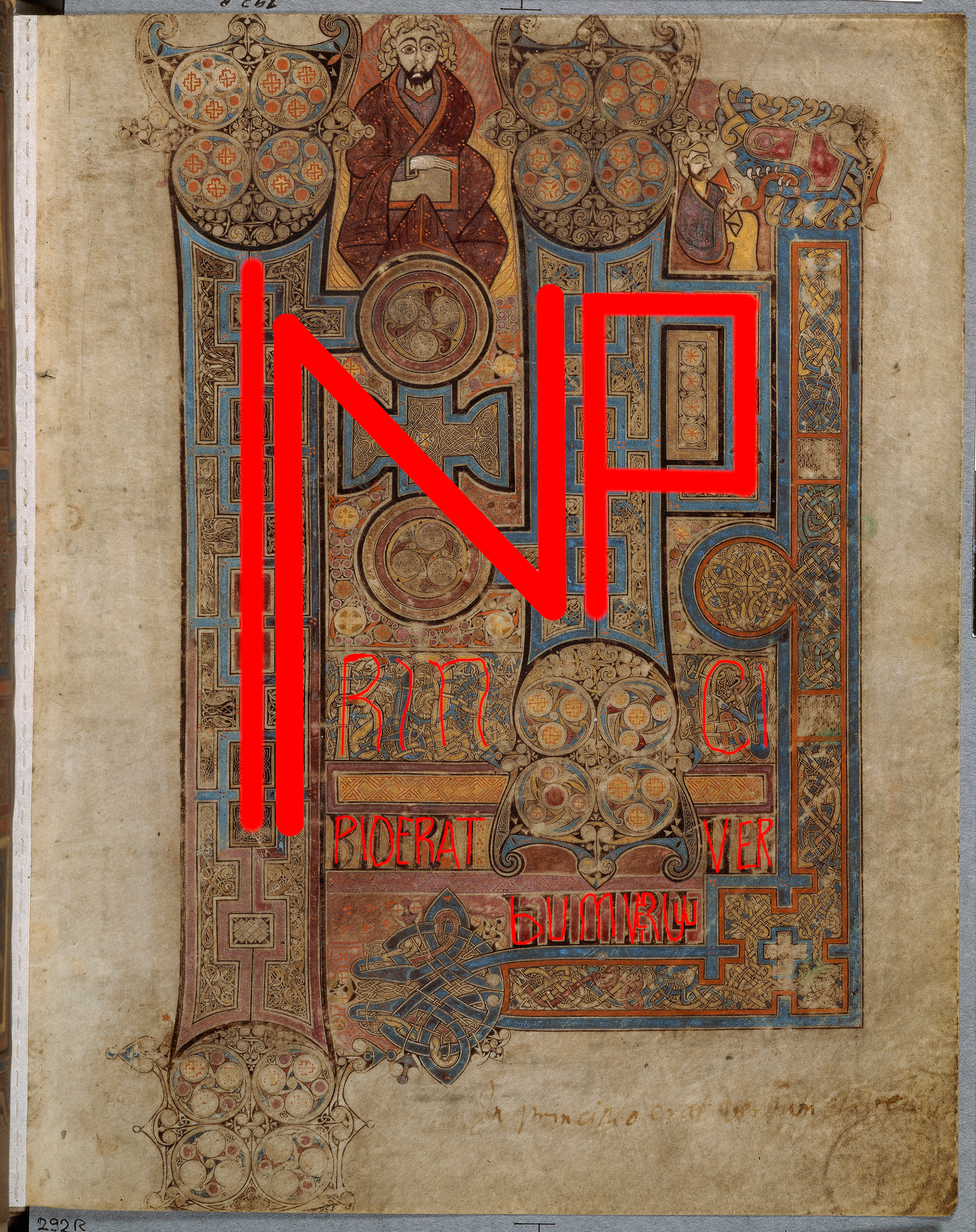
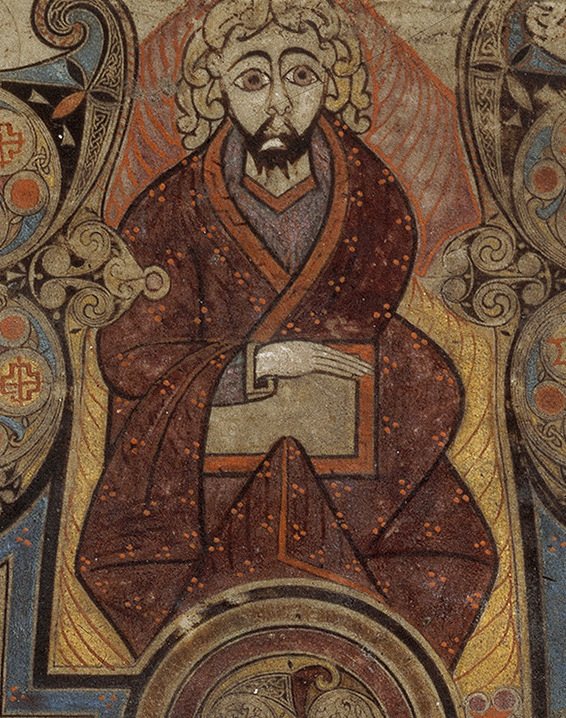
LOOK: Incipit to the Gospel of John from the Book of Kells
Incipit to the Gospel of John, Book of Kells, ca. 800. Trinity College Dublin MS 58, fol. 292r.
Made by Celtic monks in a Columban monastery around the year 800, the Book of Kells—an illuminated Gospel book named after the monastery of Kells in County Meath, Ireland, where it spent eight centuries—is one of the most beautiful manuscripts ever created. Pictured here is the lavishly decorated opening page of the Gospel of John, which bears the words “In p/rinci/pio erat ver/bum [et] ver[b]um” (“In the beginning was the Word, and the Word . . .”). The passage continues on the following page.
Bernard Meehan, the former head of research collections and keeper of manuscripts at Trinity College Dublin, describes the lettering on folio 292r:
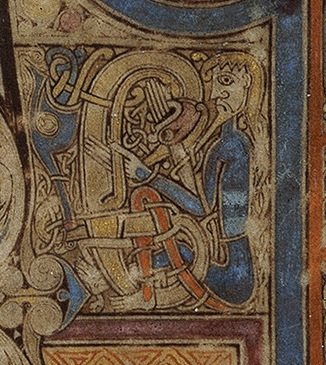
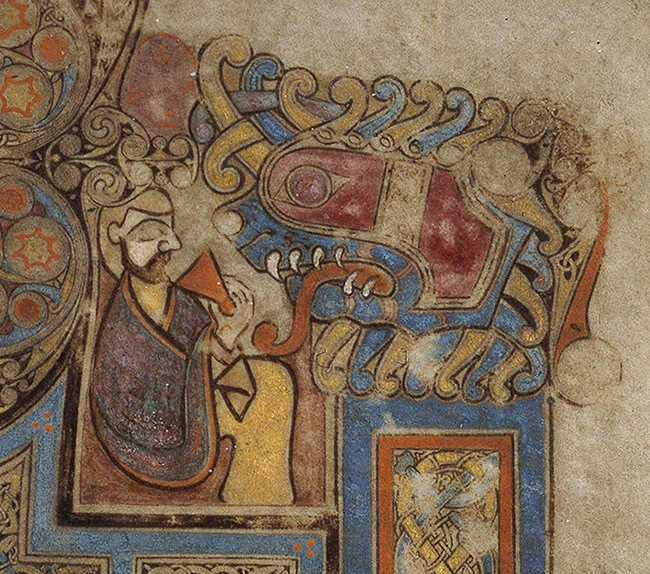
The letters IN P, filled with interlacing snakes, crosses and abstract ornament, dominate the composition. Snakes form the letters RIN and C, with C taking the form of a harp, played by the man who forms the letter I. The urge of the artist to decorate has taken precedence over legibility, to the extent that the letters ET and B are missing from the last line. [1]
Because some of the letters are difficult to discern, I’ve done my best to trace them in red in this graphic:
The text unfolds in four rows. The column on the left forms the I and doubles as the left stem of the N. The diagonal stroke of the N passes through the cross-shape, and its right stem is formed by another blue column, which also doubles as the stem of the P.
The following R, I, N, and C are beige and blue serpentine figures, tangled together, the latter shaped like a harp and being “played” by a seated man whose torso forms an I.
The remaining text is organized in two rows and is black. As Meehan mentioned, the artist-monk unintentionally omitted the ET and B in “et verbum.” And the final M is upside down, an artistic variation.
Scholars disagree on who the curly-haired figure at the top is, holding a book: some suppose it’s John the Evangelist, the author of the fourth Gospel, while others think it’s Christ the Logos. I’m in the latter camp. Christ is often shown in art sitting on a throne holding a book, representing the gospel—as on folio 32v of this very manuscript. And a full-page portrait of John already appears on the opposite page, folio 291v; granted, the iconography is similar, but it would be an unusual choice to repeat a person in the same pose on a single page spread. Also, as art historian Heather Pulliam points out, the yellow and red striations that encompass the figure resemble flame—a “throne of light,” writes Françoise Henry—an attribute more befitting of the figure of Christ than of John. [2]
The identity of the smaller figure on the right who’s drinking from a red chalice is also debated. Again, it could be either John or Christ. According to an apocryphal legend that first appeared in the second-century Acts of John and that was popularized in the thirteenth-century Golden Legend, a pagan priest challenged John to drink a cup of poisoned wine to test whether his God was truly powerful enough to protect him. John blessed the cup, downed the wine, and suffered no harm. That’s why in art one of John’s attributes is a chalice with a serpent in it, representing the poison rising out and the triumph of Christian faith.
On the other hand, the drinking figure may be Christ drinking the cup of suffering (John 18:11). The monstrous head to the right supports either interpretation—it could be Satan tormenting Christ in Gethsemane, or in John’s case, the threat of death by poison, or the evil intent of the pagan priest who sought to discredit him.
Additional possibilities have also been posited. Małgorzata Krasnodębska-D’Aughton argues that the man is meant to be a generic Christian partaking of the Eucharist, [3] whereas Pulliam suggests that the cup represents not the blood of Christ but “the chalice of wisdom received from the breast of Christ.” [4] She cites Augustine’s first tractate on the Gospel of John:
Thence John, who said these things, received them, brothers, he who lay on the Lord’s breast, and from the breast of the Lord drank in what he might give us to drink. But he gave us words; you ought then to receive understanding from the source, from that which he drank who gave to you; so that you may lift up your eyes to the mountains from where shall come your aid, so that from there you may receive, as it were, the cup, that is, the word, given you to drink; and yet, since your help is from the Lord, who made heaven and earth, you may fill your breast, from the source. [5]
In Pulliam’s interpretation, the man imbibes the words of God—that is, scripture—providing a model for us to emulate.
Bernard Meehan, The Book of Kells: An Illustrated Introduction to the Manuscript in Trinity College Dublin (Thames & Hudson, 1994, 2008), 34.
Heather Pulliam, Word and Image in the Book of Kells (Four Courts Press, 2006), 180–83; cf. Françoise Henry, The Book of Kells: Reproductions from the Manuscript in Trinity College, Dublin (Thames & Hudson, 1974).
Małgorzata Krasnodębska-D’Aughton, “Decoration of the In principio initials in early Insular manuscripts: Christ as a visible image of the invisible God,” Word and Image: A Journal of Verbal/Visual Enquiry 18, no. 3 (Fall 2002): 117.
Pulliam, Word and Image, 185.
Augustine, In Joannis Evangelium 1.1, PL 35: 1382.
LISTEN: “The Word Was God” by Rosephanye Powell, 1996 | Performed by the University of Pretoria Camerata, dir. Michael Barrett, 2022
In the beginning was the Word, and the Word was with God, and the Word was God.
The same was in the beginning with God.
All things were made that have been made. Nothing was made he has not made.
While this choral anthem is not a Christmas song per se, it is a setting of John 1:1–3, the opening of the great prologue of the Incarnation. These first three verses are about Christ’s eternal being, his oneness with the Father, and his active role in creation. I can’t hear them without anticipating verse 14: “And the Word was made flesh, and dwelt among us . . .”
“The Word Was God” is by Dr. Rosephanye Powell (pronounced ro-SEH-fuh-nee) (born 1962), an African American composer, singer, professor, and researcher. One of her most popular and widely recorded works, it is full of rhythmic energy and drive. Read detailed notes by Powell here, where she explains her musical choices and their theological significance.
Ivan Večenaj (Croatian, 1920–2013), Nativity, 1970. Oil on glass. Galerija Ivan Večenaj, Gola, Croatia.
Ivan Večenaj (1920–2013) was a self-taught artist from Croatia, a representative of the Hlebine school of naive painting. He loved nature and folk culture—many of his paintings depict local village life or biblical scenes set in Croatia’s rural countryside. His works are in the collections of the Croatian Museum of Naïve Art in Zagreb and the Vatican Museums, among others. There is also a museum dedicated to his work: the Galerija Ivan Večenaj (Ivan Večenaj Gallery) in his home village of Gola in the Prekodravlje region.
Večenaj’s 1970 Nativity sets Jesus’s birth in Gola. Mary bounces the boy Jesus on her knee under a makeshift shelter roofed with a purple blanket that resembles a mountain. Emerging from the snowy ground behind them is a red cross, a crown of thorns hanging from the center and blood dripping from a wedged nail on both terminals onto a barren tree and Mary’s cloak. But this sign of death is counterbalanced with signs of life—flowers, wheat, and a grapevine sprouting up around the two, references to the Eucharist and to the blossoming of salvation.
The scene emphasizes Jesus’s humble birth into a peasant family—the artist, too, had a peasant background—and foreshadows his atoning death.
LISTEN:“Ar gyfer heddiw’r bore”(For the sake of this very morning), aka “Faban Bach” (A Little Baby) | Words by David Hughes, early nineteenth century | Tune: MENTRA GWEN, traditional Welsh | Performed by Parti Fronheulog, 1967
Ar gyfer heddiw’r bore’n faban bach, faban bach, y ganwyd gwreiddyn Iesse’n faban bach; y Cadarn ddaeth o Bosra, y Deddfwr gynt ar Seina, yr Iawn gaed ar Galfaria’n faban bach, faban bach, yn sugno bron Maria’n faban bach.
Caed bywiol ddŵfr Eseciel ar lin Mair, ar lin Mair, a gwir Feseia Daniel ar lin Mair; Caed bachgen doeth Eseia, ’r addewid roed i Adda, yr Alffa a’r Omega ar lin Mair, ar lin Mair; mewn côr ym Meth’lem Jiwda, ar lin Mair.
Diosgodd Crist o’i goron, o’i wirfodd, o’i wirfodd, er mwyn coroni Seion, o’i wirfodd; i blygu’i ben dihalog o dan y goron ddreiniog i ddioddef dirmyg llidiog, o’i wirfodd, o’i wirfodd, er codi pen yr euog, o’i wirfodd.
Am hyn, bechadur, brysia, fel yr wyt, fel yr wyt, i ’mofyn am dy Noddfa, fel yr wyt i ti’r agorwyd ffynnon a ylch dy glwyfau duon fel eira gwyn yn Salmon, fel yr wyt, fel yr wyt, gan hynny, tyrd yn brydlon, fel yr wyt.
For the sake of this very morning, as a little baby, a little baby Was born the root of Jesse, as a little baby; The Strong one who came from Bosra, The Lawmaker of old on Sinai, The Redemption to be had on Calvary, as a little baby, a little baby, Suckling the breast of Mary, as a little baby.
The life-giving water of Ezekiel is found on Mary’s knee, on Mary’s knee, And the true Messiah of Daniel on Mary’s knee; Here is the wise boy-child of Isaiah, The promise made to Adam, The Alpha and Omega on Mary’s knee, on Mary’s knee; In the stall in Bethlehem of Judah, on Mary’s knee.
Christ took off his crown, of his freewill, of his freewill, In order to crown Zion, of his freewill; To bow his undefiled head Under the thorny crown, To suffer enraged derision, of his freewill, of his freewill, To raise the head of the guilty, of his freewill.
Therefore, sinner, hurry, as thou art, as thou art, To ask for his sanctuary, as thou art; For thee the well was opened Which washes thy wounds Like the snow on Salmon, as thou art, as thou art. For that, come promptly, as thou art.
With roots dating back to the pre-Reformation era, theplygain service is a Welsh Christmas tradition in which Christians gather at church from 3 a.m. to 6 a.m. on Christmas morning for community-led carol singing. One of the popular carols that’s sung is “Ar gyfer heddiw’r bore,” its text by the Welsh poet David Hughes (ca. 1794–1862), known by his bardic name of Eos Iâl. It’s twelve stanzas in all, which start with the Nativity and then move through various stages of Christ’s passion, from Gethsemane to Pilate’s hall to Golgotha to the garden of the tomb, commemorating the incarnation, the atonement, and Christ’s ascension and intercession for sinners.
The recording here is by Parti Fronheulog, a folk trio of brothers from southeast Denbighshire, Wales—Tom Williams (lead), Osmond Williams (tenor), and Ted Williams (bass)—who were active in the 1960s. They sing stanzas 1, 2, 5 and 12.
Maryam and Isa (Mary and Jesus), miniature from a Falnama, Mughal India, 1550–1600. Opaque paint, gold, and silver on paper, 49 × 35 cm. Wereldmuseum, Rotterdam, Netherlands, Inv. 07180329.
This delicate painting is from an Islamic manuscript made in India during the Mughal era. It shows Mary sitting outside with her son, Jesus, on her lap, whose flaming halo identifies him as a prophet. Enclosed by a gate, they are seated on a mat, and Jesus hands his mother a fruit that looks to me like a pomegranate—though a date would cohere better with the Qur’an’s Nativity account (19:25–26). Verdant pink hills rise up behind them, as does a palm tree, under which sits a pitcher of water. From the left, an anthropomorphized sun gazes down on the sacred pair. The inscriptions are in Persian.
Like Christians, Muslims revere Jesus—his birth is recounted in the Qur’an 19:16–34 and 3:45–53, and in that book he is also described as the Messiah, the Word of God, and the Spirit of God—but unlike Christians, Muslims do not regard Jesus as divine.
We remember today, O God, the slaughter of the holy innocents of Bethlehem by King Herod. Receive, we pray, into the arms of your mercy all innocent victims; and by your great might frustrate the designs of evil tyrants and establish your rule of justice, love, and peace; through Jesus Christ our Lord, who lives and reigns with you, in the unity of the Holy Spirit, one God, for ever and ever. Amen.
—Collect from the Book of Common Prayer
Western church calendars mark December 28 as the Feast of the Holy Innocents, or Childermas, a day set aside to remember the slaughter of male Bethlehemites aged two and under by Herod the Great, king of Judea, as recounted in Matthew 2:16–18. Historians estimate there were probably ten to twenty children of that age in Bethlehem at the time.
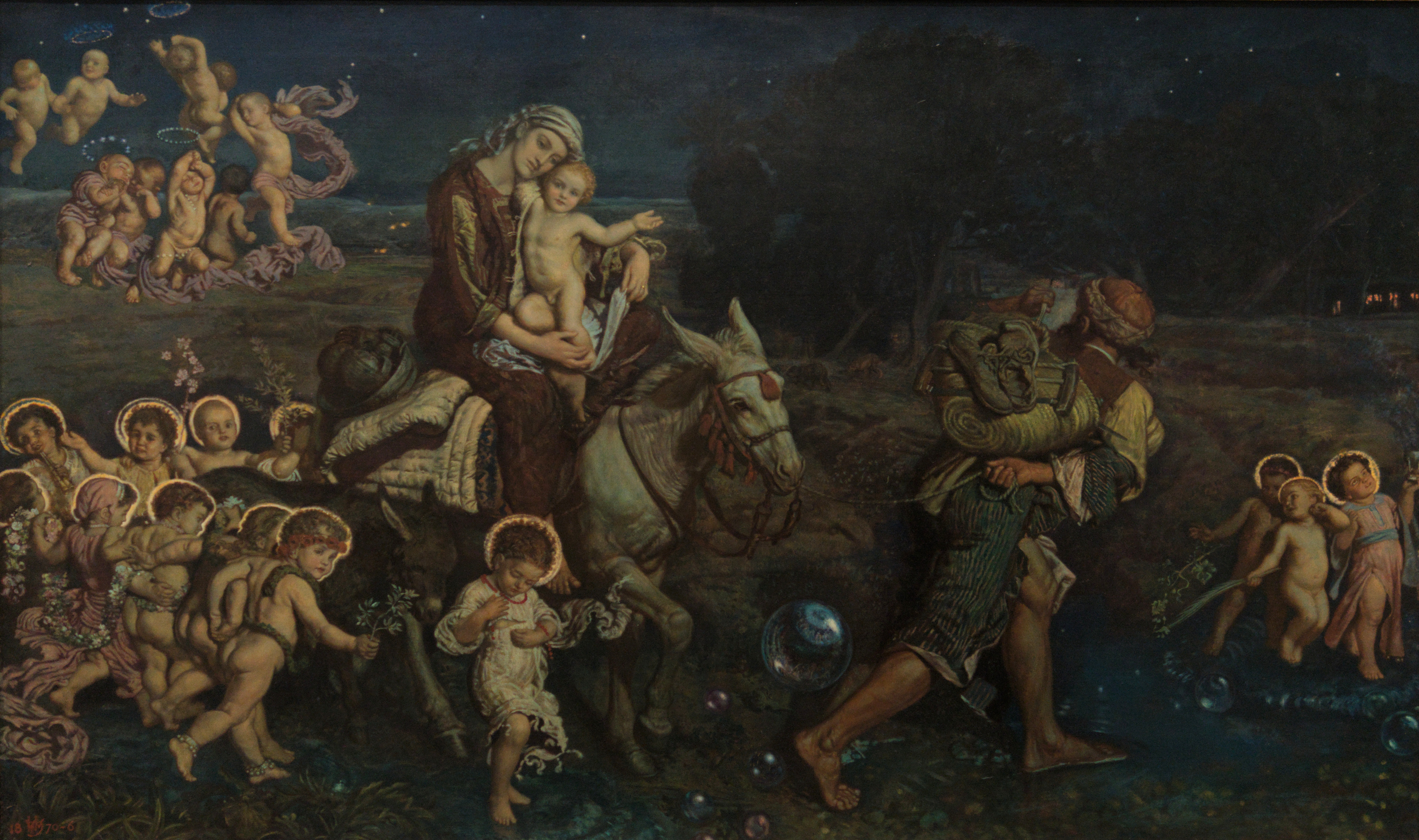
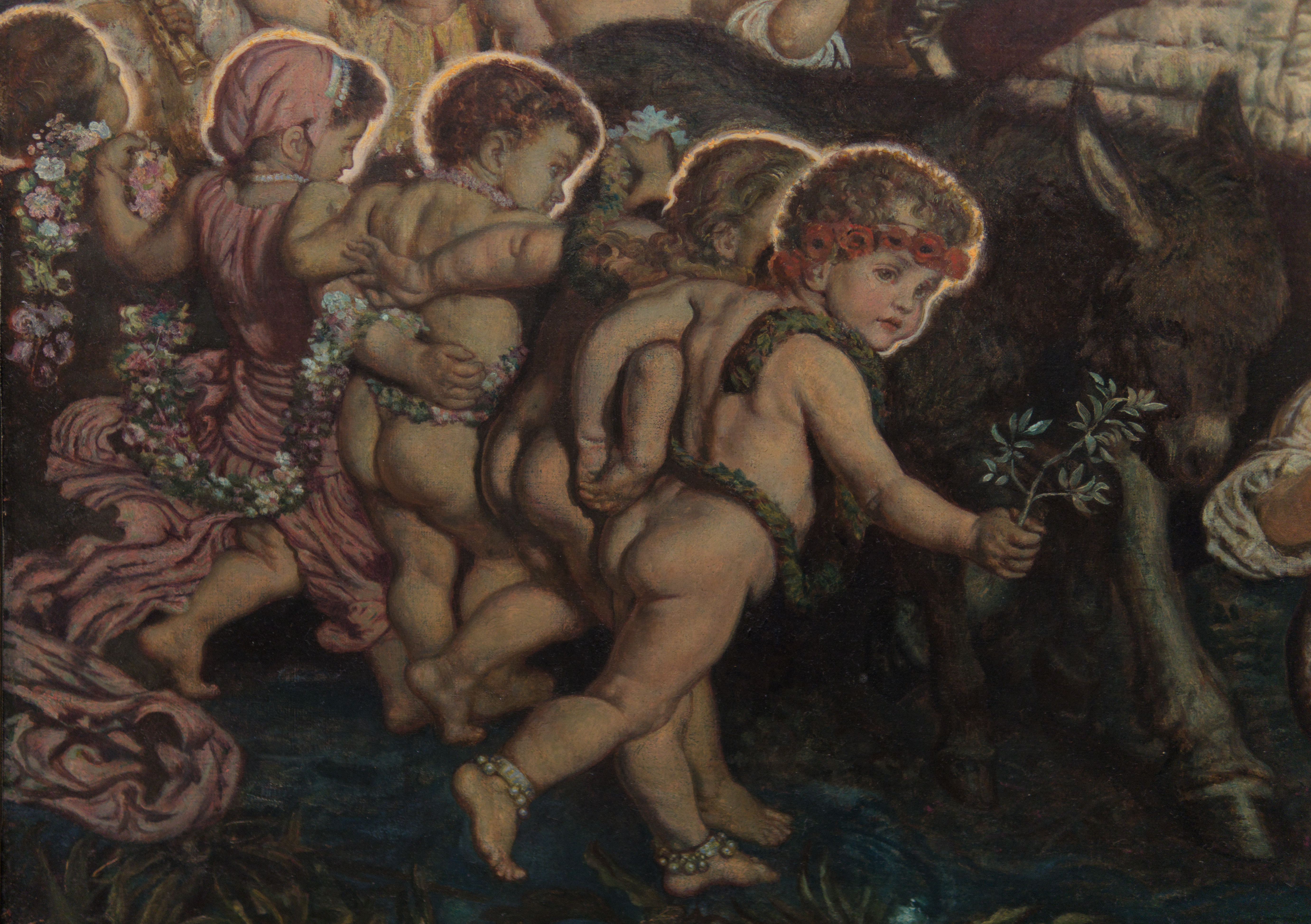
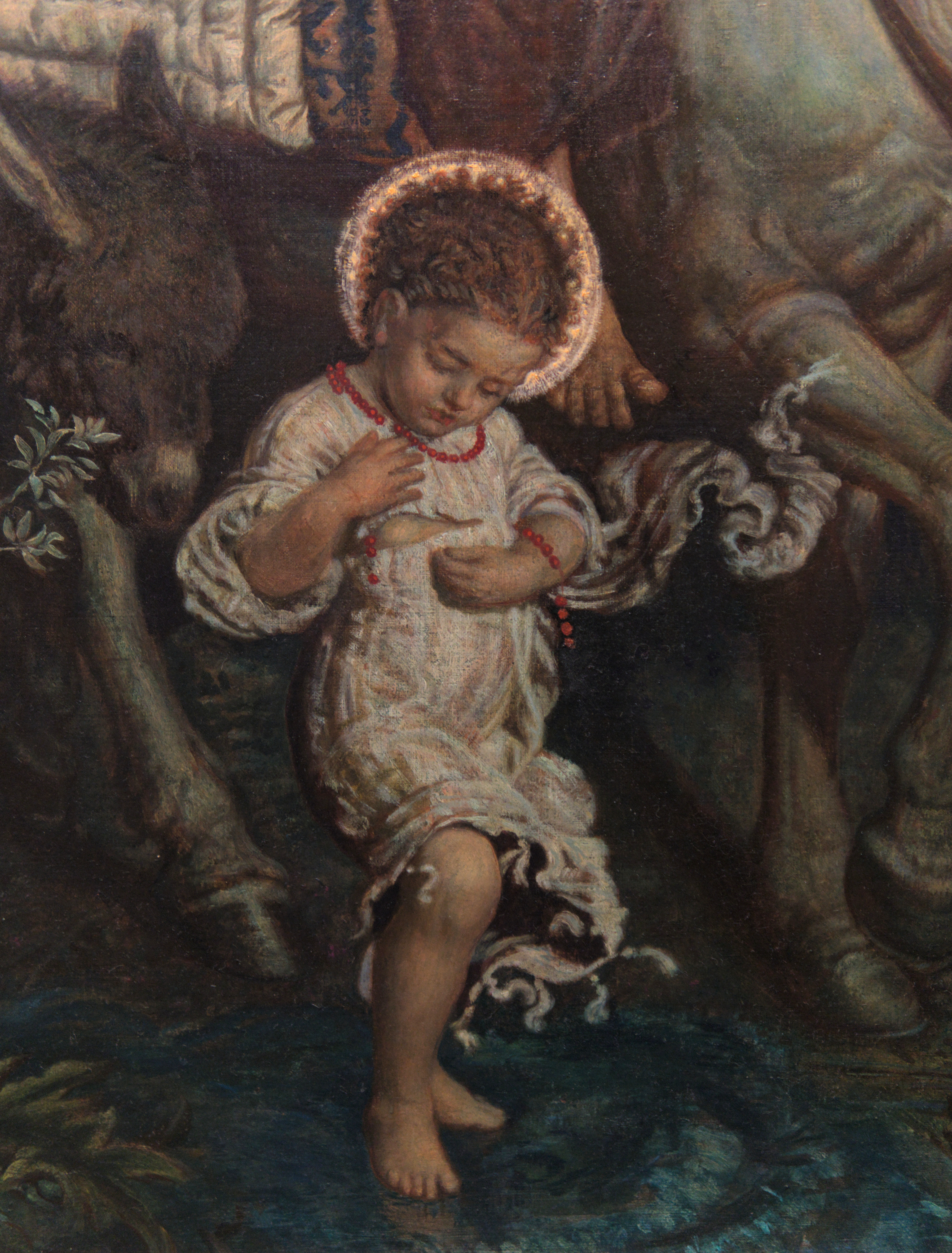
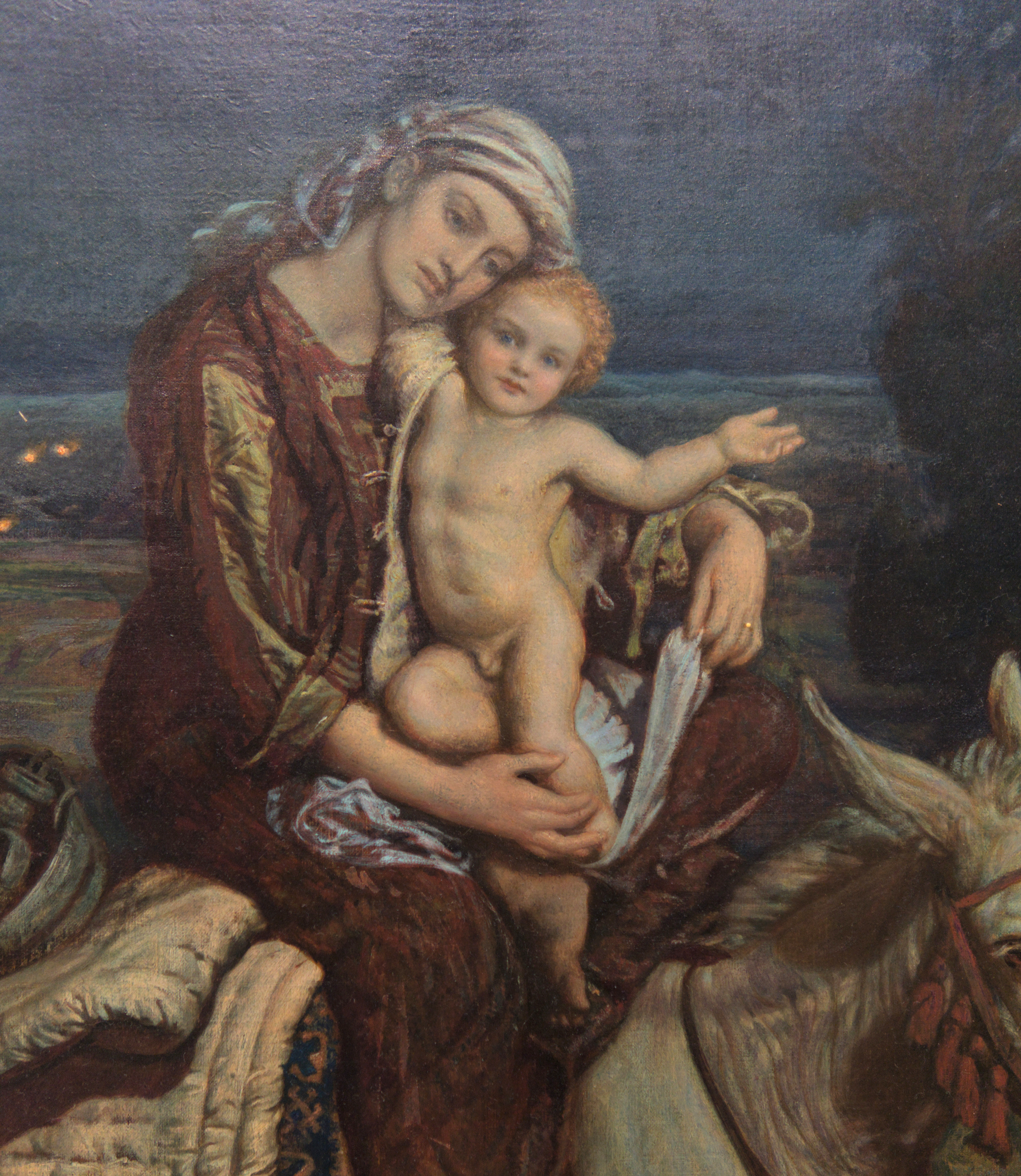
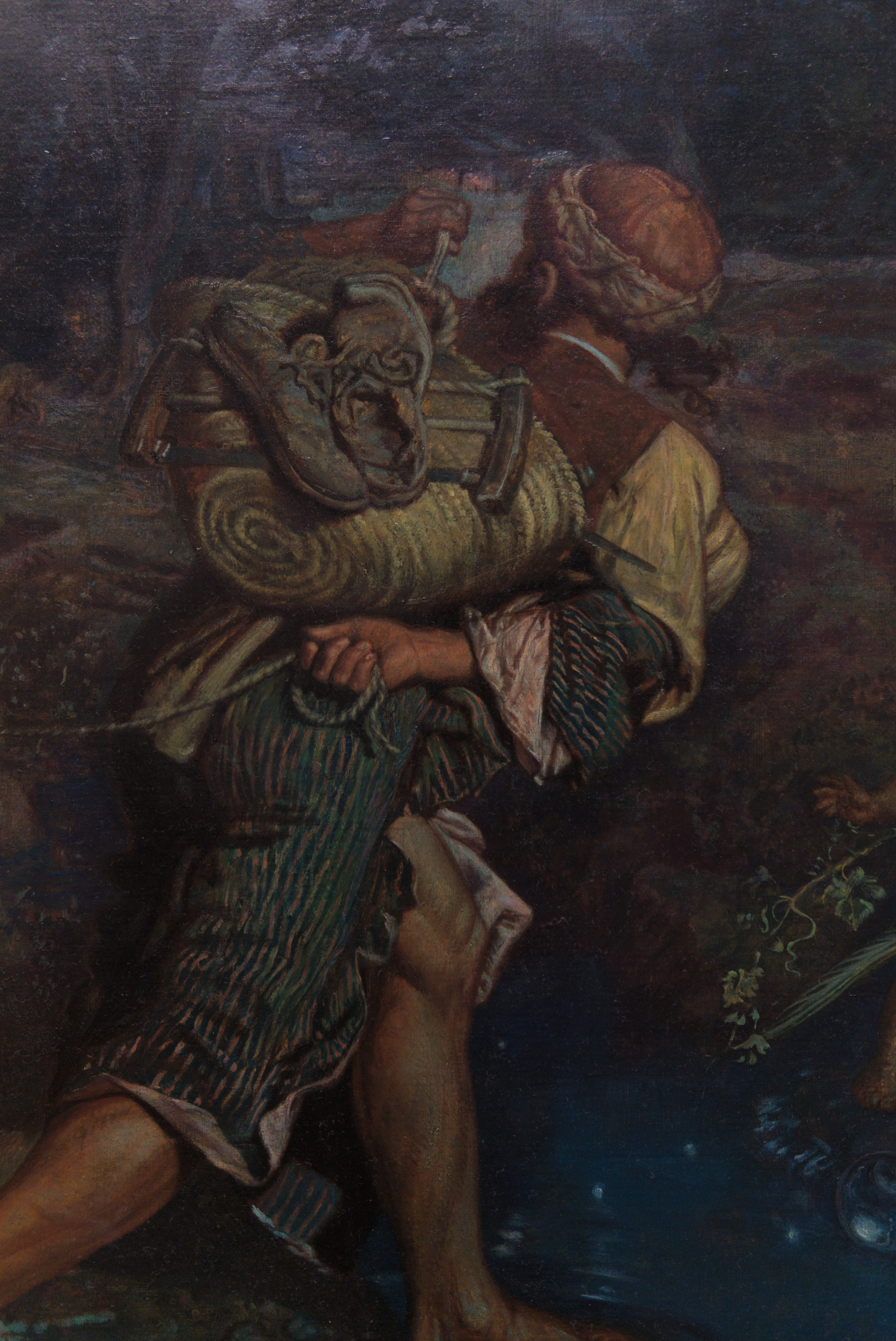
LOOK: The Triumph of the Innocents by William Holman Hunt
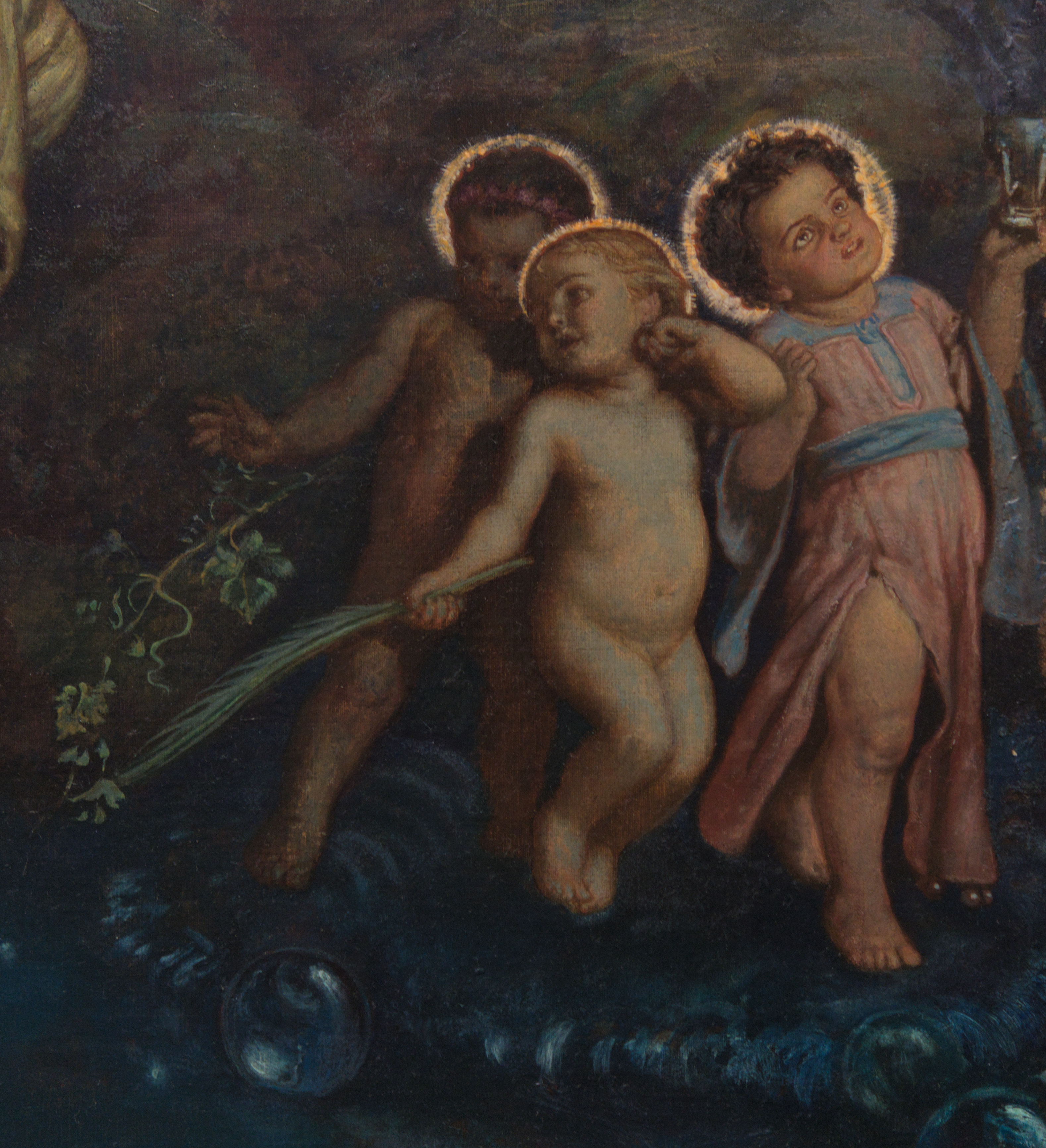
William Holman Hunt (British, 1827–1910), The Triumph of the Innocents, 1870–1903. Oil on canvas, 75.3 × 126 cm. Harvard Art Museums, Cambridge, Massachusetts. Photo: Victoria Emily Jones. [object record]
This visionary realist painting by the Pre-Raphaelite artist William Holman Hunt is a unique interpretation of the Flight to Egypt. It shows, surrounding the Holy Family on the run, the embodied spirits of all the little boys in Bethlehem—the “innocents”—who were slain at Herod’s behest. It’s the first of three versions Hunt painted of the subject, mostly completed by 1876, but with some of the background left unfinished until 1903. The other two versions are in the Tate Britain in London and the Walker Art Gallery in Liverpool.
The early church understood these boys as the first Christian martyrs. Though they were not conscious witnesses for Christ, they were killed because of him, casualties of a persecuting tyrant’s brooking no rival. Their death prefigures that of future Christian martyrs, starting with Stephen, as well as Christ’s own death.
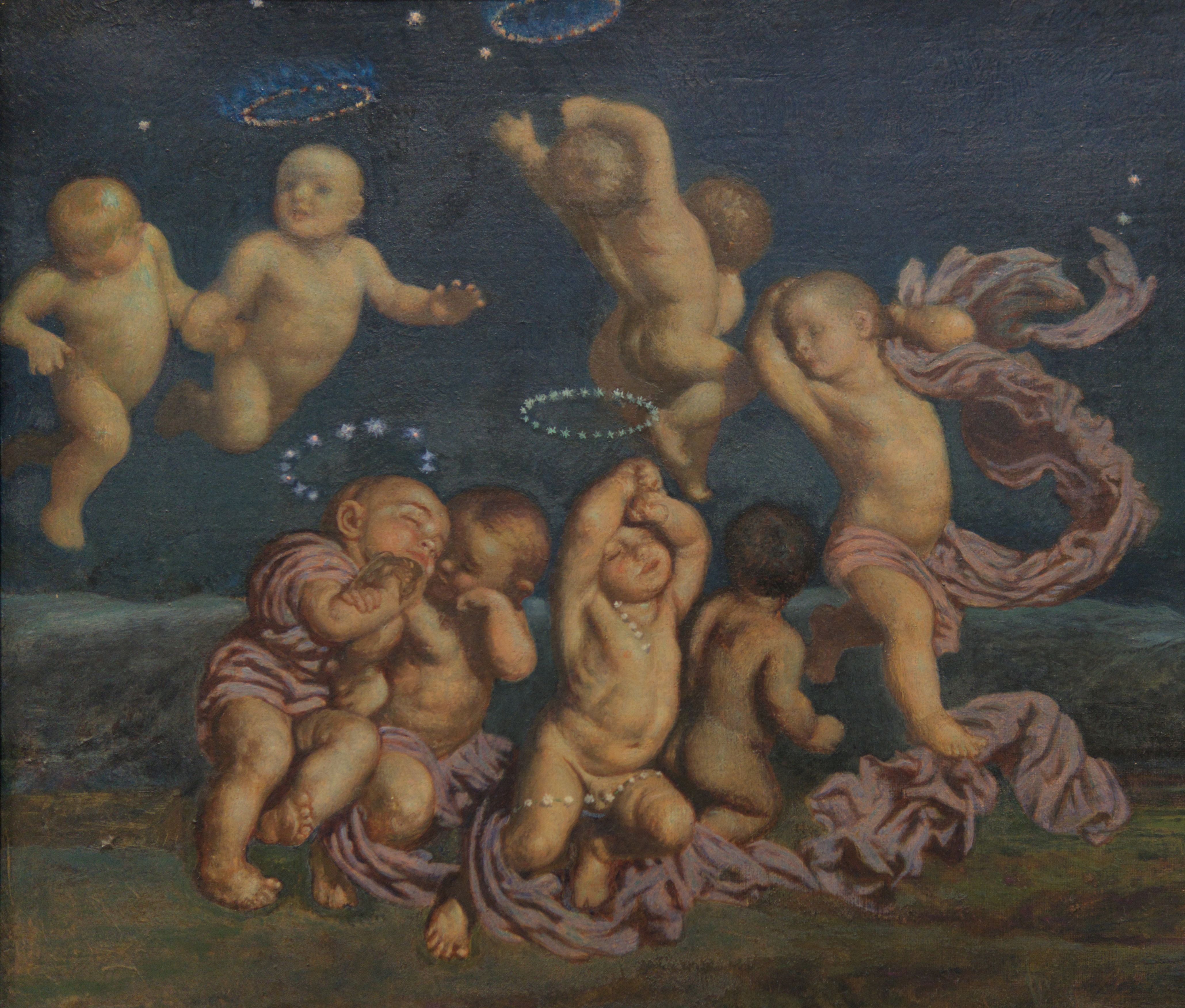
Despite the solemnity of this episode, Hunt casts it in a triumphant light. Instead of showing the infants dismembered or impaled in a bloodbath with their mothers wailing in helpless grief, as artists have historically done, Hunt shows them in the light of glory, carrying palms and other branches and wearing floral crowns and garlands. They are, in the words of John Powell Lenox, the “first of that glorious company whose shining ranks are nearest the throne of the Slain One.”
Floating in air, those at the upper left are just waking up to their new spiritual life—they open their eyes and stretch.
Those on the ground lock arms in solidarity and play, surrounding a little foal. One curly-locked lad wears a red necklace, the beads spilling from the chain reminiscent of blood drops. But the fatal chest wound that one of Herod’s soldiers had inflicted by sword is no more, as he looks down with wonder to discover through a tear in his tunic. Healed flesh!
In the center Mary rides a mule, holding Jesus, who greets his playmates with a wave and a smile. He’s the only one who’s aware of them, these mystic brothers accompanying him into exile. Joseph leads the way forward, staying alert to potential threats. His tool basket is slung over his shoulder, which he’ll use to make a living for his family in Egypt.
At the far right one of the child-martyrs, “in priestly office” and holding a censer, leads the celestial band, while his two companions “cast down their tokens of martyrdom in the path of their recognised Lord,” as Hunt wrote in the catalog for the 1885 exhibition of the Tate version by the Fine Art Society in London.
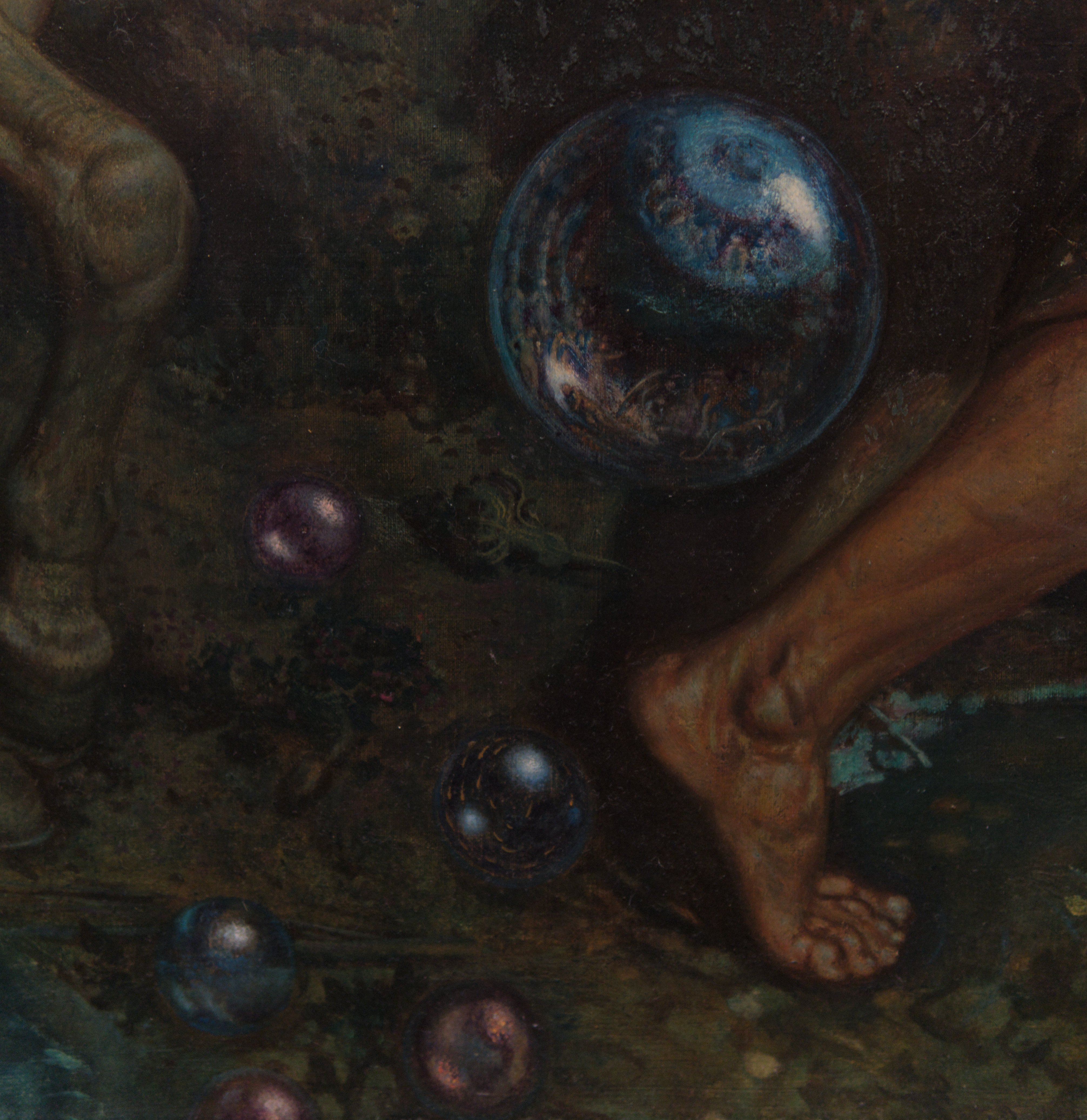
The children tread through “the living fountains of water, the streams of eternal life . . . ever rolling onward and breaking—where it might if real water be dissipated in vapour—into magnified globes which image the thoughts rife in that age in the minds of pious Jews . . . of the millennium which was to be the mature outcome of the advent of the Messiah.” The large bubble above Joseph’s right calf reveals Jacob’s dream at Bethel, which “first clearly speaks of the union of Earth and Heaven” that Christ will one day make total and permanent.
LISTEN: “Salvete Flores Martyrum” (Hail, Martyr Flowers) | Words by Aurelius C. Prudentius, early fifth century | Music by Claudio Dall’Albero, 2022 | Performed by the Choir of Sidney Sussex College, Cambridge, dir. David Skinner, on Vespertina Hymnodia: Sacred Music by Claudio Dall’Albero, 2022
Salvete flores Martyrum
Quo lucis ipso in limine
Christi in secutur sustulit
Ceu turbo nascentes rosas.

Vos prima Christi victima
Grex immolatorum tener
Aram ante ipsam simplices
Palma et coronatis luditis.

Jesu tibi sit Gloria
Qui natus es de Virgine
Cum Patre et almo Spiritu
In sempiterna saecula
All hail, ye little Martyr flowers,
Sweet rosebuds cut in dawning hours!
When Herod sought the Christ to find,
Ye fell as bloom before the wind.

First victims of the Martyr bands,
With crowns and palms in tender hands,
Around the very altar, gay
And innocent, ye seem to play.

All honor, laud, and glory be,
O Jesu, Virgin-born, to Thee;
All glory, as is ever meet,
To Father and to Paraclete.

Trans. Athelstan Riley
“Salvete flores martyrum” is the office hymn for Lauds on the Feast of the Holy Innocents. It is a cento from the 208-line Epiphany poem in the Cathemerinon by the ancient Latin Christian poet Prudentius, first assembled in the 1568 Breviary of Pope Pius V.
This text has been set to music by many composers ever since the Renaissance. My favorite setting is probably by the contemporary Italian composer Claudio Dall’Albero, from his cycle Five Hymns for Vespers, shared above.
Athelstan Riley’s is one of several metrical English translations, but here’s a prose translation provided by John Carden in his compilation A Procession of Prayers:
God keep you, O finest flowers of martyrs, who, at the dawn of life, were crushed by the persecutor of Christ and flung like petals before a furious wind.
You, the first to die for Christ, tender flocks of martyrs, now dance before the altar, now laugh candidly with your palms and gardens.







 Art & Theology