Christmas, Day 3: Stupendous Stranger

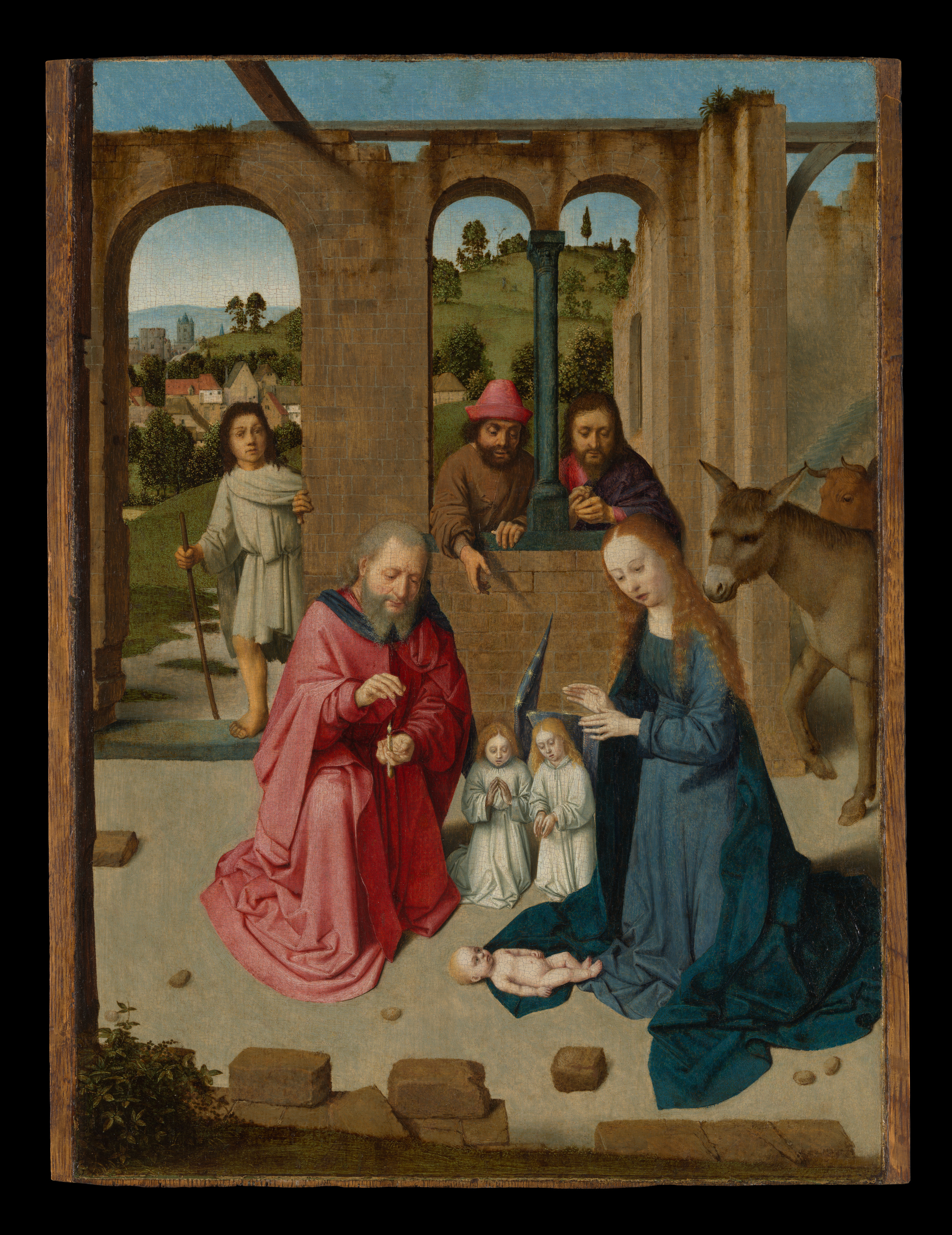
LOOK: The Nativity by Gerard David
David, Gerard_Nativity
Gerard David (Netherlandish, ca. 1455–1523), The Nativity, early 1480s. Oil on wood, 18 3/4 × 13 1/2 in. (47.6 × 34.3 cm). Metropolitan Museum of Art, New York.

LISTEN: “Where Is This Stupendous Stranger” | Words by Christopher Smart, 1765 | Music by Linda L. Hanson, 2012 | Performed by Fire (women’s a cappella chamber ensemble), 2020

Where is this stupendous Stranger?
Prophets, shepherds, kings, advise!
Lead me to my Master’s manger,
Show me where my Savior lies.

O most mighty, O most holy,
Far beyond the seraph’s thought,
Are you then so mean and lowly
As unheeded prophets taught?

O the magnitude of meekness,
Worth from worth immortal sprung!
O the strength of infant weakness,
If eternal is so young!

God all-bounteous, all-creative,
Whom no ills from good dissuade,
You have come to be a native
Of the very world you made.

The four verses of this Christmas hymn are excerpted from a nine-stanza poem by Christopher Smart [previously] published in Hymns and Spiritual Songs for the Fasts and Festivals of the Church of England (London, 1765). The poem was recovered in the twentieth century and since then has received multiple new musical settings—by composers such as I-to Loh, Charles Heaton, Conrad Susa, Joan A. Fyock, Leo Nestor, Alec Wyton, Thomas Gibbs Jr., Scott M. Hyslop, and Jacques Cohen—as well as pairings with older tunes.

My favorite setting of the text is by Linda L. Hanson, the founding director of Fire, a women’s a cappella chamber ensemble in Charlottesville, Virginia. The group performs the hymn in the video above, which Fire member Mary Welby von Thelen spliced together from thirteen solitary recordings during the COVID-19 pandemic. Hanson is in the top row, the third from the left.

The alliterative opening line of the hymn asks where the “stupendous Stranger” can be found—the divine one sent from heaven. Stupendous isn’t an adjective we use often. It means “causing astonishment or wonder: awesome, marvelous.” The poetic speaker begs the prophets, shepherds, and magi to divulge the location of the Christ child so that he can go and worship him.

The next two stanzas marvel at the paradoxes of the Incarnation—how Christ is “mighty” and “holy,” beyond the comprehension of even the angels, and yet “mean” (humble) and “lowly,” lying here in the dirt before us, visible, tangible, vulnerable, no longer far above us but in our very midst. What “magnitude of meekness,” what “strength of infant weakness.” The eternal one is born in time.

The omnibenevolent Creator has deigned to become part of his creation. No potential ill that he will suffer as a result—and he will suffer many and grievous ills, culminating in death by crucifixion—can deter him from making his beloved earth his home.

Hanson has generously allowed me to share the sheet music of “Where Is This Stupendous Stranger,” and says the hymn can be freely used by local church congregations. Anything outside that context will require her permission.
Christmas, Day 2: Angels

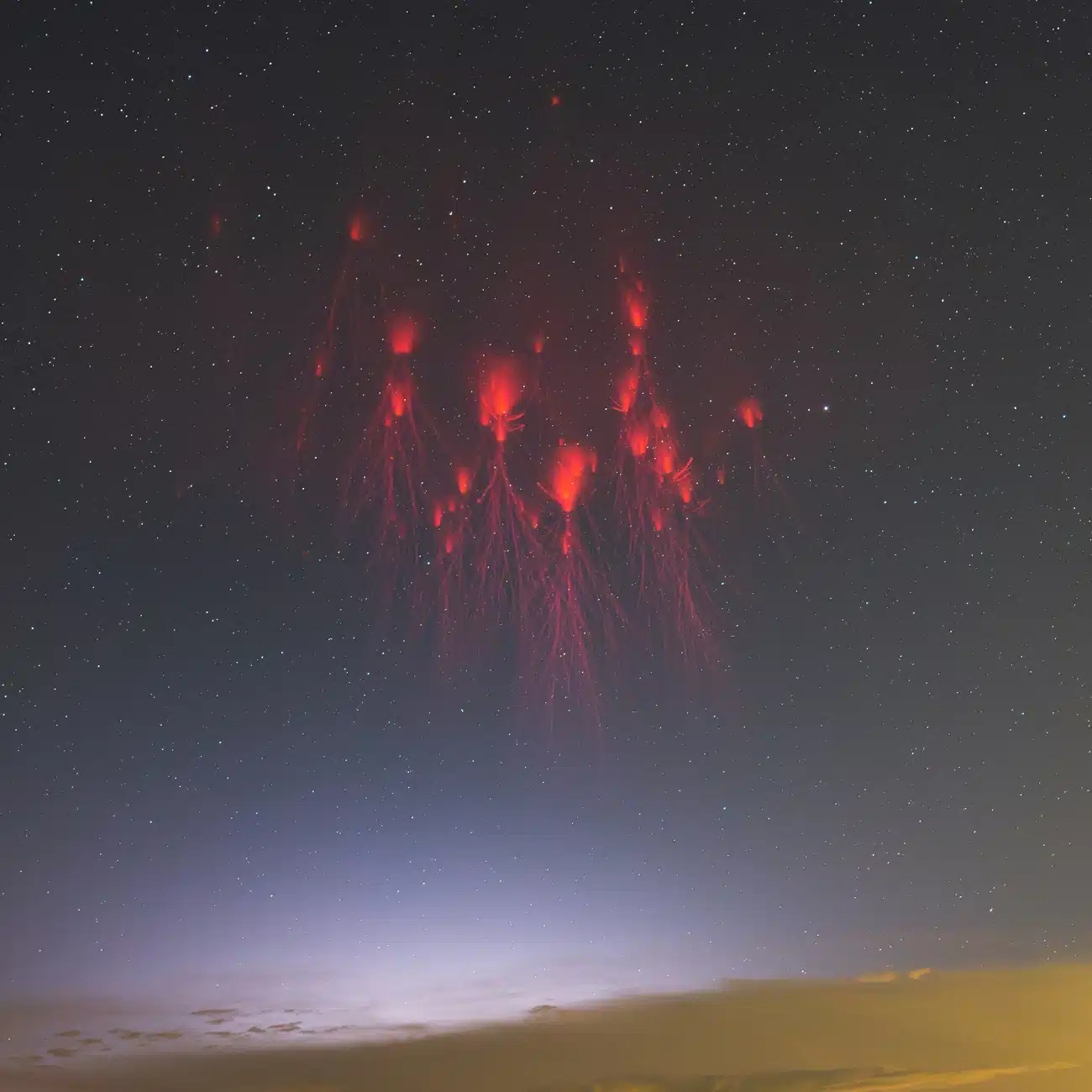
LOOK: Sprites Dancing in the Dark Night by Wang Xin

Wang Xin_Sprites Dancing in the Dark Night
Wang Xin, Sprites Dancing in the Dark Night, Chongming District, Shanghai, China, 2024

For this photograph, Wang Xin won the Royal Meteorological Society’s Standard Chartered Weather Photographer of the Year 2024. The society provides this description:

As multiple thunderstorms raged around Shanghai, Xin traveled to the Chongming District and adopted a trial-and-error approach by setting up the camera and waiting. After a few hours, a “faint red figure” flashed in Xin’s eyes, and this remarkable image was captured. The elusive sprites only last a few milliseconds, so Xin used a four-second exposure to achieve this photo.

Sprites occur due to electrical discharge, but unlike ordinary lightning, they occur well above cumulonimbus clouds, approximately 50 miles above the ground, in a layer of the atmosphere known as the mesosphere. Due to their fleeting nature, sprites are still not well understood, but they have been observed to occur after a strong, positive lightning bolt between the cloud and ground. The red color comes from changes in the energy of the electrons of nitrogen atoms high in the atmosphere.

LISTEN: “Angels from the Realms of Glory” | Words by James Montgomery, 1816 | Music by Henry Thomas Smart, 1867 | Performed by Hunter Fraser on Fraser Family Christmas, vol. 1, 2022

Angels from the realms of glory,
wing your flight o’er all the earth;
ye who sang creation’s story,
now proclaim Messiah’s birth.

Refrain:
Come and worship, come and worship,
worship Christ, the newborn king.

Shepherds, in the field abiding,
watching o’er your flocks by night:
God with man is now residing;
yonder shines the infant light. [Refrain]

Sages, leave your contemplations;
brighter visions beam afar.
Seek the great Desire of nations;
ye have seen his natal star. [Refrain]

Saints before the altar bending,
watching long in hope and fear:
Suddenly the Lord, descending,
in his temple shall appear. [Refrain]

Christmas, Day 1: He Came Down

LOOK: The Birth of Jesus by Engelbert Mveng

Mveng, Engelbert_The Birth of Jesus
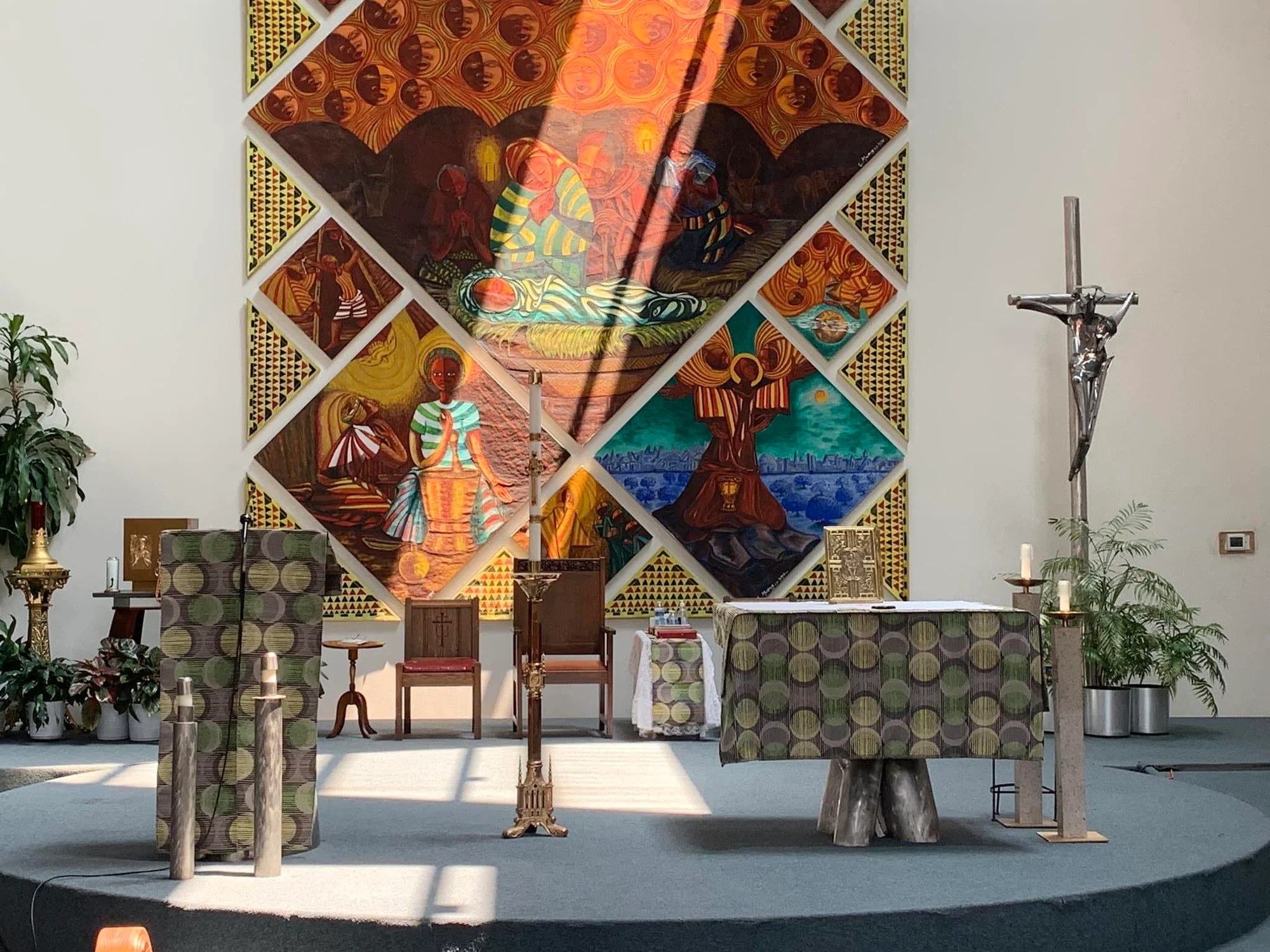
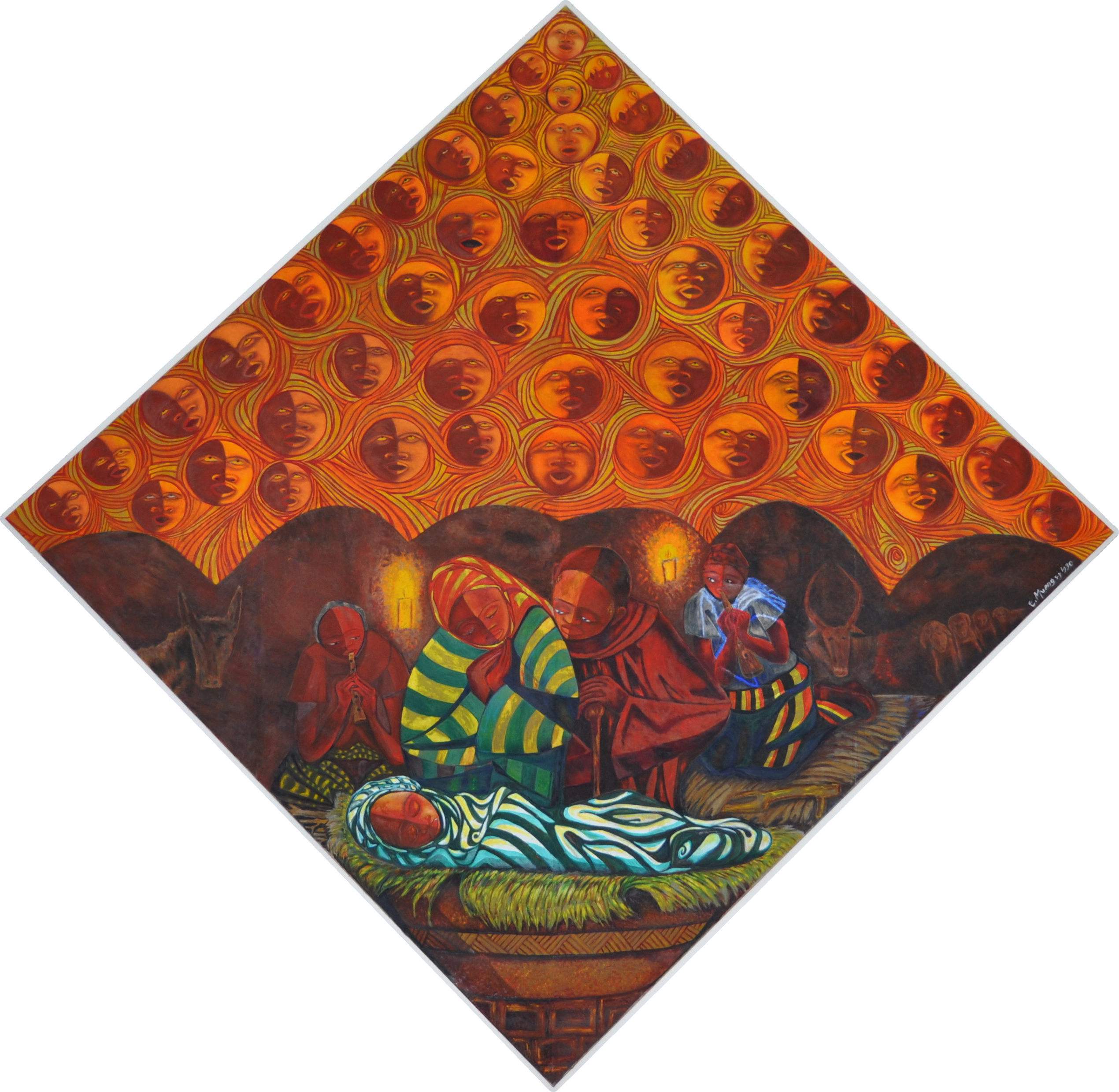
Fr. Engelbert Mveng, SJ (Cameroonian, 1930–1995), The Birth of Jesus, 1990. Central scene of mural at Our Lady of Africa Catholic Church, Chicago. All photos courtesy of the church.

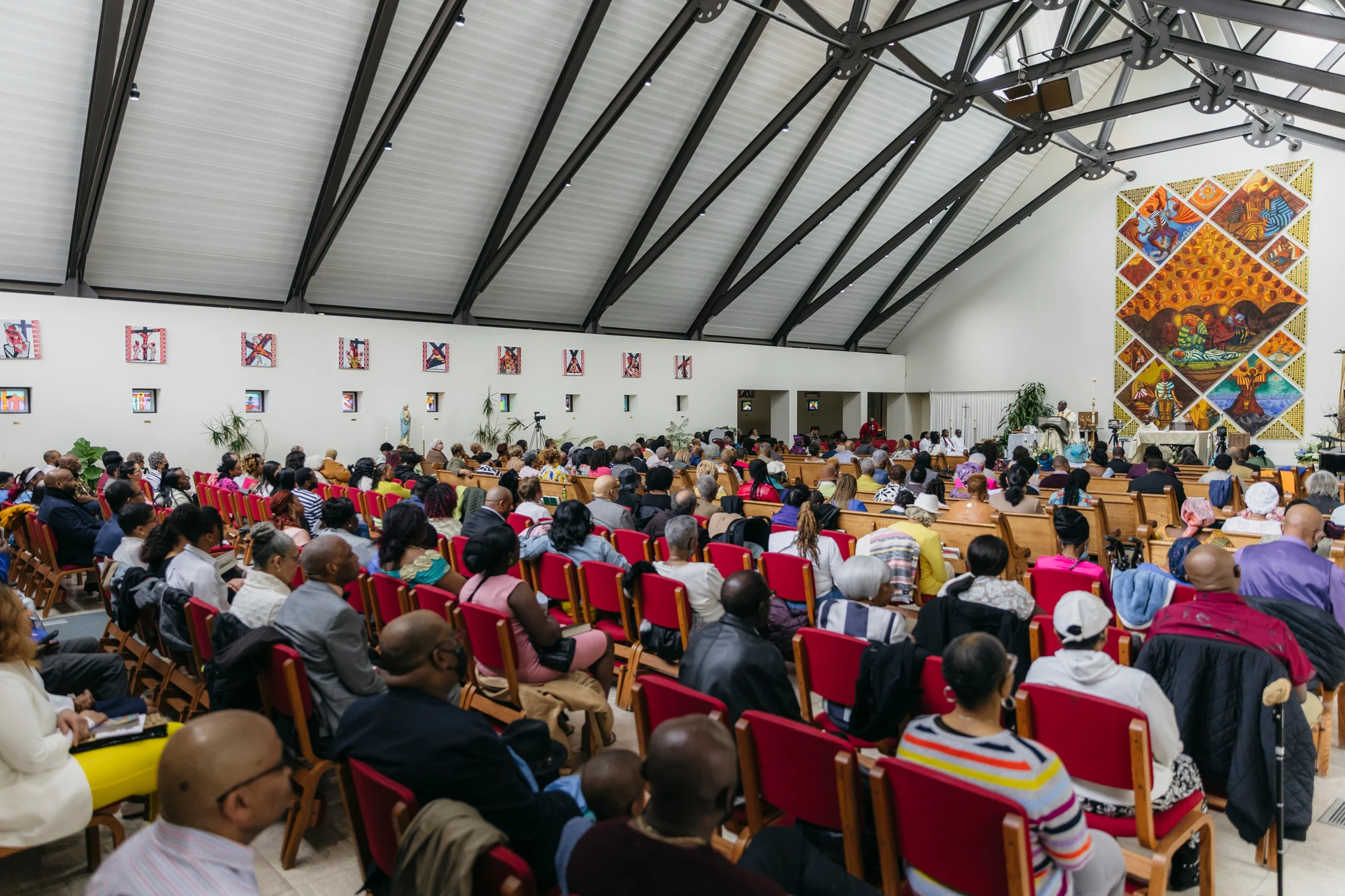
When Holy Angels Catholic Church on the south side of Chicago was rebuilt following a 1986 fire, the historic church commissioned the Cameroonian Jesuit priest, artist, and historian Engelbert Mveng (1930–1995) to paint a mural for behind the altar. He chose to represent moments of angelic intervention in biblical history. (See a close-up of the full mural here.)

The mural’s focal point is a Nativity scene, set in a hilly African landscape that’s pulsing with joy. The infant Jesus lies asleep on a grassy bed, adored by his parents and flanked by candles, pipers, and some curious animal onlookers. Caught up in the sky’s vibrant swirls are forty-nine disembodied angel heads, singing their Gloria.

In July 2021, Holy Angels merged with the faith communities of Corpus Christi, St. Ambrose, St. Anselm of Canterbury, and St. Elizabeth of Hungary in the Bronzeville/Kenwood area of Chicago to become Our Lady of Africa Parish, housed at the former Holy Angels church. The altar mural remains installed on the east end, a key visual feature of the worship space.

Mveng mural
Mveng mural

LISTEN: “He Came Down,” traditional Cameroonian carol | Transcribed and arranged by John L. Bell of the Iona Community, 1986 | Arranged and performed by Marty Haugen on Welcome the Child, 1992 [sheet music]

He came down that we may have life
Hallelujah, forevermore!

He came down that we may have peace . . .

He came down that we may have hope . . .

He came down that we may have joy . . .