Wayne Forte (Filipino American, 1950–), Jesus, Light of the World, 2009. Oil and acrylic on canvas, 30 × 24 in.
LISTEN: “Jesus, Light of the World” | Words by Charles Wesley (stanzas), 1739, and George D. Elderkin (refrain), 1890 | Music by George D. Elderkin, 1890 | Performed by Isaac Cates and Ordained on Carol of the Bells, 2014 (soloists: Margaret Rainey and Kami Woodard)
Hark! the herald angels sing. Jesus, the light of the world. Glory to the newborn King, Jesus, the light of the world.
We’ll walk in the light, beautiful light. Come where the dewdrops of mercy shine bright. Oh, shine all around us by day and by night. Jesus, the light of the world.
Joyful, all you nations, rise. Jesus, the light of the world. Join the triumph of the skies. Jesus, the light of the world.
Christ, by highest heav’n adored. Jesus, the light of the world. Christ, the everlasting Lord, Jesus, the light of the world.
Hail the heav’n-born Prince of Peace. Jesus, the light of the world. Hail the Sun of righteousness! Jesus, the light of the world.
In 1890 Chicago publisher George D. Elderkin adapted Charles Wesley’s beloved Christmas hymn text “Hark! the Herald Angels Sing,” using the first two lines of Wesley’s stanzas 1, 2, 3, and 5 and adding a refrain that’s based on a Fanny Crosby text from 1880. For the music, he wrote a gospel waltz. Although Elderkin was not African American, this hymn has become especially well loved in Black churches. Read a more detailed history of the hymn’s composition at the UMC Discipleship website.
Isaac Cates’s 2014 arrangement and recording is my favorite. Cates is a gospel vocalist, arranger, and pianist who performs with his choir, Ordained.
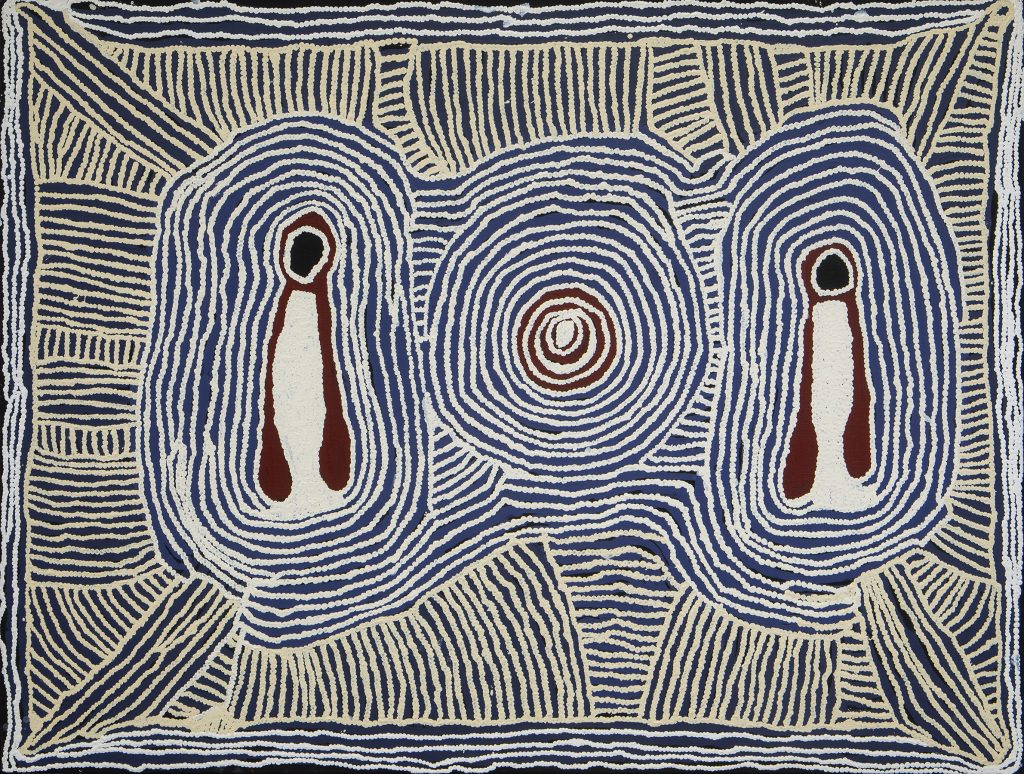
Linda Syddick Napaltjarri (Pintupi, ca. 1937–2021), Nativity, 2003. Acrylic on linen, 37 × 48 in. The Ahmanson Collection, Los Angeles.
Linda Syddick (Aboriginal name Tjunkiya Wukula Napaltjarri) (ca. 1937–2021) was a Pintupi artist from Australia’s Western Desert region whose work was influenced by her Christian and Indigenous beliefs and heritage. Living a seminomadic lifestyle until the age of eight or nine, she settled with her family at the Lutheran Mission at Haasts Bluff in the 1940s. She was taught to paint in the 1980s by her uncles Uta Uta Tjangala and Nosepeg Tjupurrula, who were both significant figures in the Papunya Tula art movement. She painted Tingari and biblical stories and was a three-time finalist for the prestigious Blake Prize, a religious art competition. Her works are held by the National Gallery of Australia, the Art Gallery of New South Wales, the Art Gallery of South Australia, and many other institutions.
In Syddick’s 2003 Nativity, a series of wavy, concentric blue and white lines encompass Joseph, baby Jesus, and Mary, while many more lines in blue and beige converge on the trio from the image’s border. To me the artwork conveys a vibrating joy! And myriad pathways leading to the birth of the Savior.
Jesus is the centerpiece of the composition, a little tot represented geometrically as a circle. What do you see in this form? A sun? An egg? A pebble thrown into a lake, sending ripples outward? A reverberant well?
LISTEN: “Shout Your Joy” | Original German words by Johannes David Falk, 1816 (stanza 1), and Heinrich Holzschuher, 1826 (stanzas 2–3) | English translator unknown | Music by Reindeer Tribe, 2011
O thou joyous day! O thou holy day! Gladsome Christmas is here again!
O thou joyous day! O thou holy day! Gladsome Christmas is here again! When the world was rent and torn, Christ was born on Christmas morn! Shout your joy to all the world! Shout your joy to all the world!
O thou joyous day! O thou holy day! Gladsome Christmas is here again! Christ now is living, his mercy giving. Shout your joy to all the world! Shout your joy to all the world!
O thou joyous day! O thou holy day! Gladsome Christmas is here again! Choirs of angels singing, joy and honor bringing, Shout your joy to all the world! Shout your joy to all the world!
This song by Reindeer Tribe has its origins in a tri-holiday hymn written in German in 1816 by Johannes David Falk. Falk wrote one stanza for each of the three main festivals of the church year—Christmas, Easter, and Pentecost—for the use of the children at the orphans’ school he ran in Weimar, paired with a preexisting tune known as O SANCTISSIMA or SICILIAN MARINERS. After Falk’s death, in 1826, his assistant Heinrich Holzschuher isolated the Christmas stanza and added two additional stanzas, turning it into a carol, known by its opening phrase, “O du Fröhliche” (O Thou Joyous [Day]). This Christmas carol is still widely sung in Germany today.
O du fröhliche, o du selige, gnadenbringende Weihnachtszeit! Welt ging verloren, Christ ist geboren: Freue, freue dich, o Christenheit!
O du fröhliche, o du selige, gnadenbringende Weihnachtszeit! Christ ist erschienen, uns zu versöhnen: Freue, freue dich, o Christenheit!
O du fröhliche, o du selige, gnadenbringende Weihnachtszeit! Himmlische Heere jauchzen Dir Ehre: Freue, freue dich, o Christenheit!
Reindeer Tribe chose one of the several available English translations (translator unknown) and wrote new music for it that really captures its celebratory spirit. They add a repeat of the last line of each stanza and call the song “Shout Your Joy.” If you’re looking for recordings in English that use the traditional tune, you can search under “O Thou Joyful Day” or “Oh How Joyfully.” For alternative English translations, which each has merit, see here, here, and (by Beale M. Schmucker) here.
Ring the bells for Christmas Vigil Ring the bells and light your candles now The stars are out
All the angels with covered faces Let all mortal flesh keep silence now All devout Keep silence now All devout
Ring the bells in every tower Ring the bells, let every hour tell All will be well
All the faithful come together Hear the name they love and know so well Emmanuel All is well Emmanuel
Ring the bells for Christmas Vigil Ring the bells and light your candles now The stars are out Keep silence now All devout
Lee Bozeman’s Jubilee is a wonderful little acoustic EP with three originals and a traditional. The title track, which Bozeman refers to as “a sorrow,” begins, “The kids won’t be home for Christmas . . .” That’s followed by “The First Artificial Snow of the Year,” an instrumental piano piece with jingle bells. Then “Down in Yon Forest,” a Renaissance-era carol from England that Bozeman sings a cappella. And lastly, “Christmas Vigil,” my favorite of the four—slow and solemn like the others, with understated echo effects, and I don’t know what that sound is he’s producing for the last thirty seconds, but it suggests an arrival.
Christmas Vigil is a common practice across church traditions, though the particulars may vary. Many churches hold their vigil around midnight on December 24, the time when Christmas Eve gives way to Christmas Day, so that the congregation can welcome in the feast of Christ’s birth just as soon as the clock ticks over into the a.m. (We have accounts of Midnight Masses being celebrated on Christmas Eve as early as the fourth century in Jerusalem.)
Other churches hold their Christmas Eve service earlier in the evening. Candlelight and corporate carol singing are usually involved. Churches that have lit an Advent wreath for each of the previous four Sundays will complete the wreath by lighting the Christ candle in the center.
Some Christians worship at home instead on this day with just their own family unit, perhaps with an informal liturgy or with special family traditions.
No matter how you mark the day, I pray that you are filled with excitement for God’s arrival in human flesh—that divine gift of himself—and with the peaceful assurance that, as God promised, all will be well.
This is the final post in the 2021 Advent Series—thank you for journeying with me through the season! Daily posts will continue throughout the twelve days of Christmas to the feast of Epiphany on January 6.
If you appreciated this series and have the means, please consider making a donation to the site to support future projects like this so that I won’t have to put them behind a paywall.
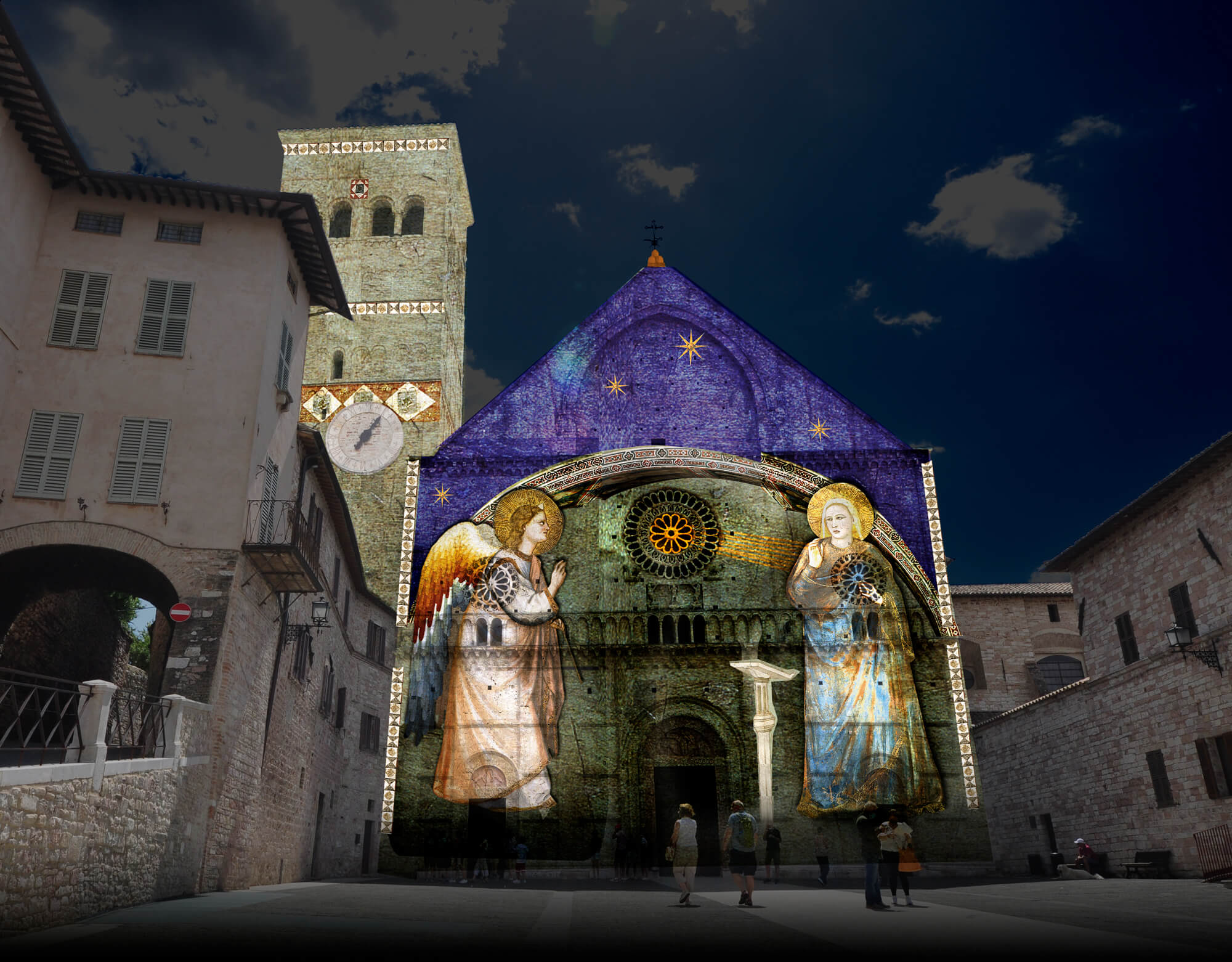
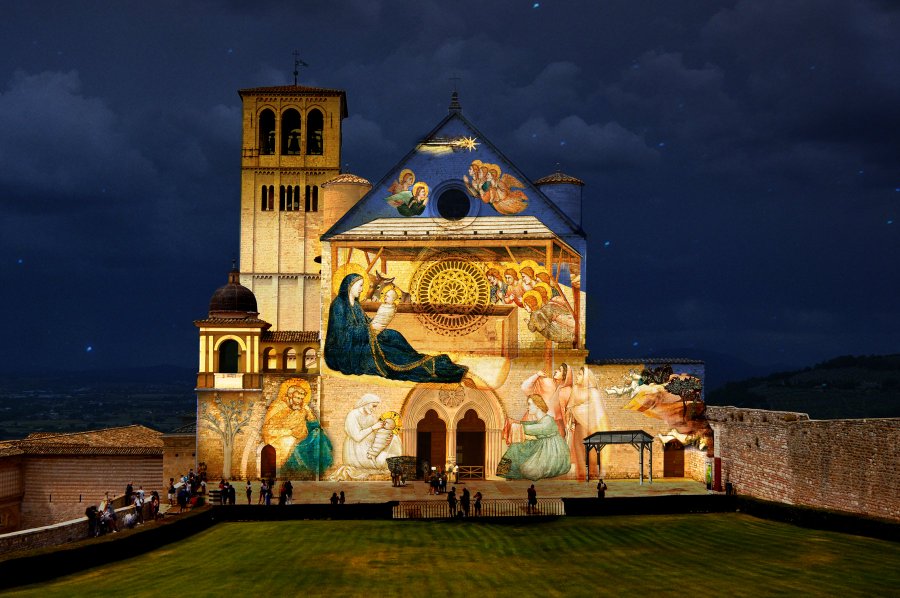
PROJECTION MAPPING INSTALLATION: Il Natale di Francesco (The Christmas of Francis): Last year the Sacro Convento in Assisi, a Franciscan friary, initiated an architectural lighting project called Il Natale di Francesco that featured projections of Christmas-themed frescoes by Giotto from the Lower Basilica of St. Francis onto several of the city’s landmark churches. Architect Mario Cucinella served as artistic director, and the company Enel X realized the installation, which ran throughout Advent and Christmastide, from December 8, 2020, to January 6, 2021 (and I hear it’s been reprised this year!). The pièce de résistance was the projection of Giotto’s Nativity onto the facade of the Upper Basilica of St. Francis. Other projections included the Annunciation on the Cathedral of San Rufino, the Visitation on the Basilica of Saint Clare, and the Adoration of the Magi on the abbey church of San Pietro in Valle—all images adapted using advanced technology to suit the spaces they illuminated.
Other components of the installation included frescoed stars from the main basilica’s vaults projected onto the streets; a re-creation of Giotto’s scenes with dozens of sculpted figures, including the addition of a masked nurse at the crèche in honor of all the frontline healthcare workers serving during the COVID-19 crisis; and every thirty minutes a video-mapping show that offered views of the basilica’s interior. I so love the creativity of bringing the sacred art treasures of the church out into the town squares when the pandemic necessitated church closures.
+++
VIRTUAL CONCERT: Christmas with the Sakhnini Brothers: The Sakhnini Brothers are Adeeb, Elia, and Yazeed, three Arabic-speaking brothers from Nazareth who are followers of Jesus. They play about twenty instruments collectively but specialize in piano, oud, and violin, respectively, and love to blend modern Western and ancient Middle Eastern musical styles.
In this half-hour living room concert that premiered December 13, they are joined by vocalist Nareen Farran, pianist Sireen Elias, and percussionist Firas Haddad. They perform an instrumental rendition of “God Rest Ye Merry Gentlemen”; “Amano Morio,” a traditional hymn from the Syriac Maronite liturgy, whose lyrics translate to “The Lord is with us day and night”; “O Come, All Ye Faithful” in Arabic; “Sobhan Al Kalima” (Glory to the Word), another traditional hymn in Syriac (see YouTube video description for full English translation); “Mary, Did You Know”; and “Laylet Eid” (Christmas Eve), a song by Fairuz to the tune of “Jingle Bells.” Their arrangements are fantastic! (You especially have to hear what they do with that closing number; I can’t stop smiling.)
Neeley also put together a listening guide so that you can follow along with the lyrics.
+++
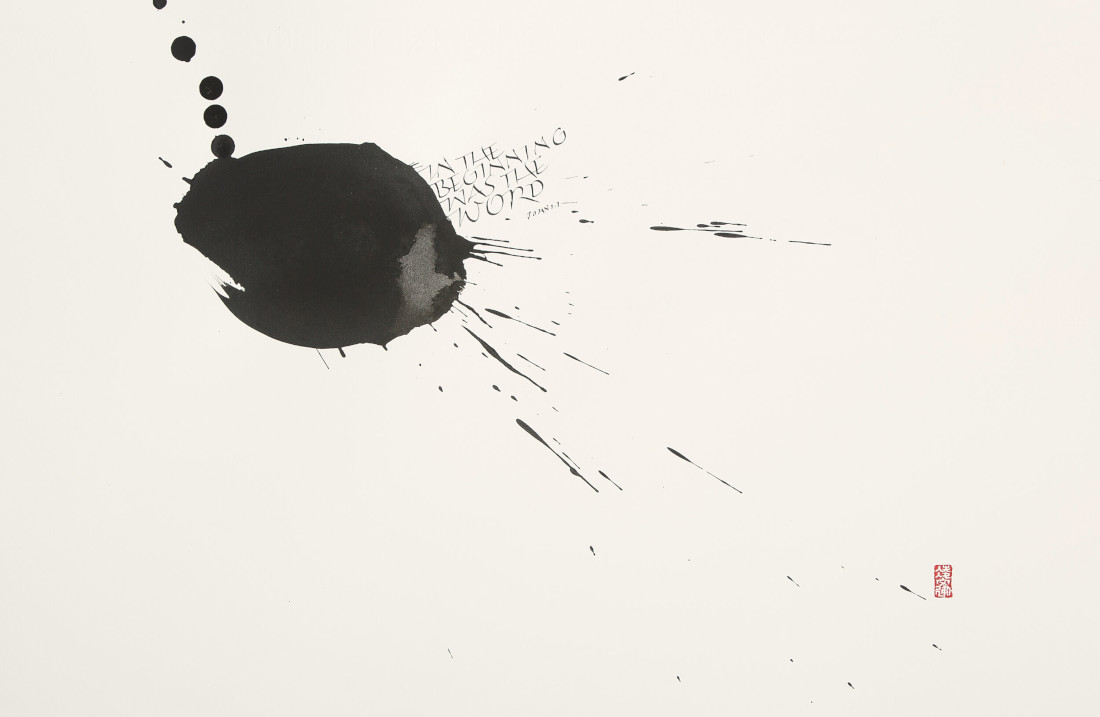
VIRTUAL EXHIBITION: Visual Music: Calligraphy and Sacred Texts, Henry Luce III Center for the Arts & Religion: “‘Form,’ wrote Jewish-American artist Ben Shahn, ‘is the very shape of content.’ Shahn’s statement serves as the guiding principle for this exhibit. Each of these fifteen pieces, all by living artists, is a calligraphic interpretation of a text sacred to Jews, Christians, or both. Each artist has pondered their chosen text, explored it inside and outside, and provided their own rendition of it—their own ‘translation’ into visual form.”
Jonathan Homrighausen, a doctoral student in Hebrew Bible at Duke University who writes and researches at the intersection of Hebrew Bible, calligraphic art, and scribal craft, has curated this wonderful online art exhibition for the Henry Luce III Center for the Arts & Religion at Wesley Theological Seminary in Washington, DC. I spent hours viewing all the rich content on the website, including Homrighausen’s illuminating commentaries (which take us beyond a simplistic “ooh, pretty” response), and following links to learn more. From the exhibition homepage you can click on any of the images for a detailed description, detail photos, embedded videos and music, and suggested articles for further reading.
Also check out the video presentation Homrighausen gave on December 12 for the Jewish Art Salon in New York City in which he discusses five of the Hebrew Bible–based pieces on display, plus two that render rabbinic quotes. The Q&A that follows is moderated by Jewish calligrapher Judith Joseph.
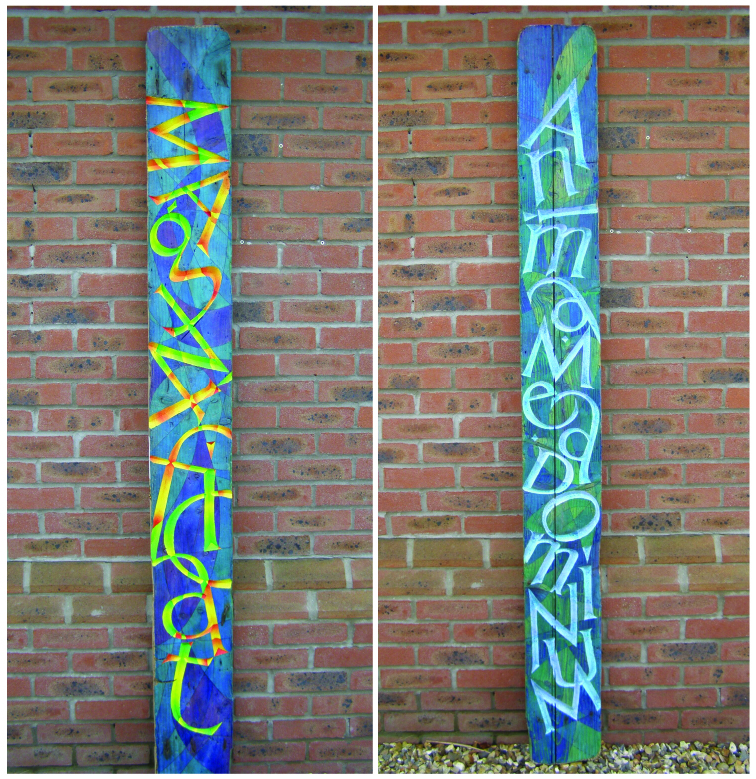
Since many of my blog readers will have just read Mary’s Magnificat from Luke 1 this past Sunday (it’s one of the assigned lections for Advent 4) and we’re just a few days away from the feast of Christmas, let me share these two timely images from the exhibition:
Martin Wenham (British, 1941–), Magnificat (front and back), 2008. Paint on found pinewood, 84 × 8 1/2 in.Manny Ling (Chinese, 1966–), ‘In the beginning was the word’ (John 1:1), 2018. Chinese ink on paper, 11 11/16 × 16 1/2 in.
+++
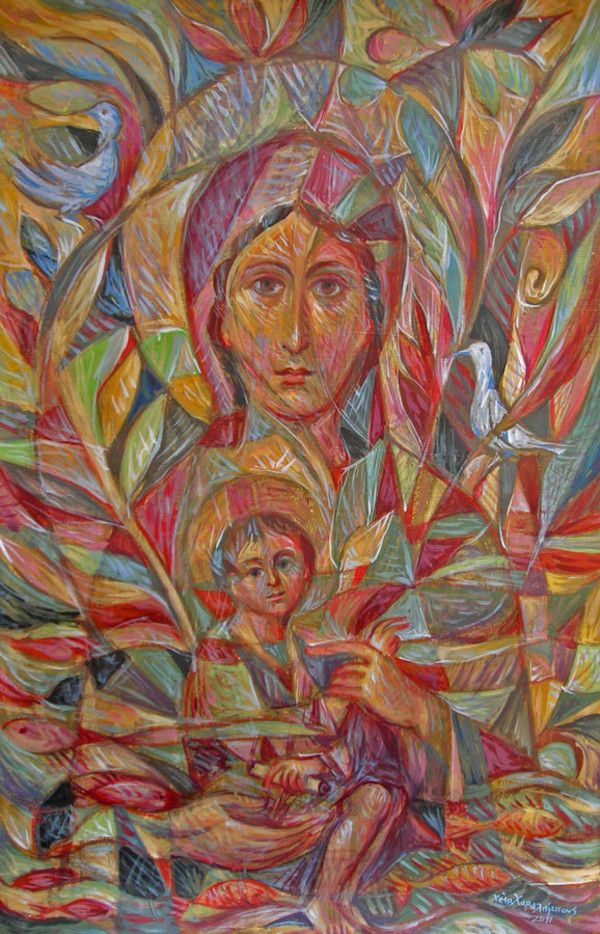
VISUAL MEDITATION: “An Icon of Deep Incarnation” by John A. Kohan: Art collector John A. Kohan reflects on the painting Madonna of the Woods by Cypriot artist Charalambos Epaminonda, a variation on the Virgin Hodegetria type. “God took on human flesh and entered creation not just to bring you and me personal salvation or rescue the human race from sin and death, but to restore and renew the entire earth and all that is therein. Contemporary theologians in our age of ecological awareness call this concept ‘deep incarnation’ . . .”
Charalambos Epaminonda (Cypriot, 1962–), Madonna of the Woods, 2011. Acrylic on canvas, 46 × 29 cm. Sacred Art Pilgrim Collection.
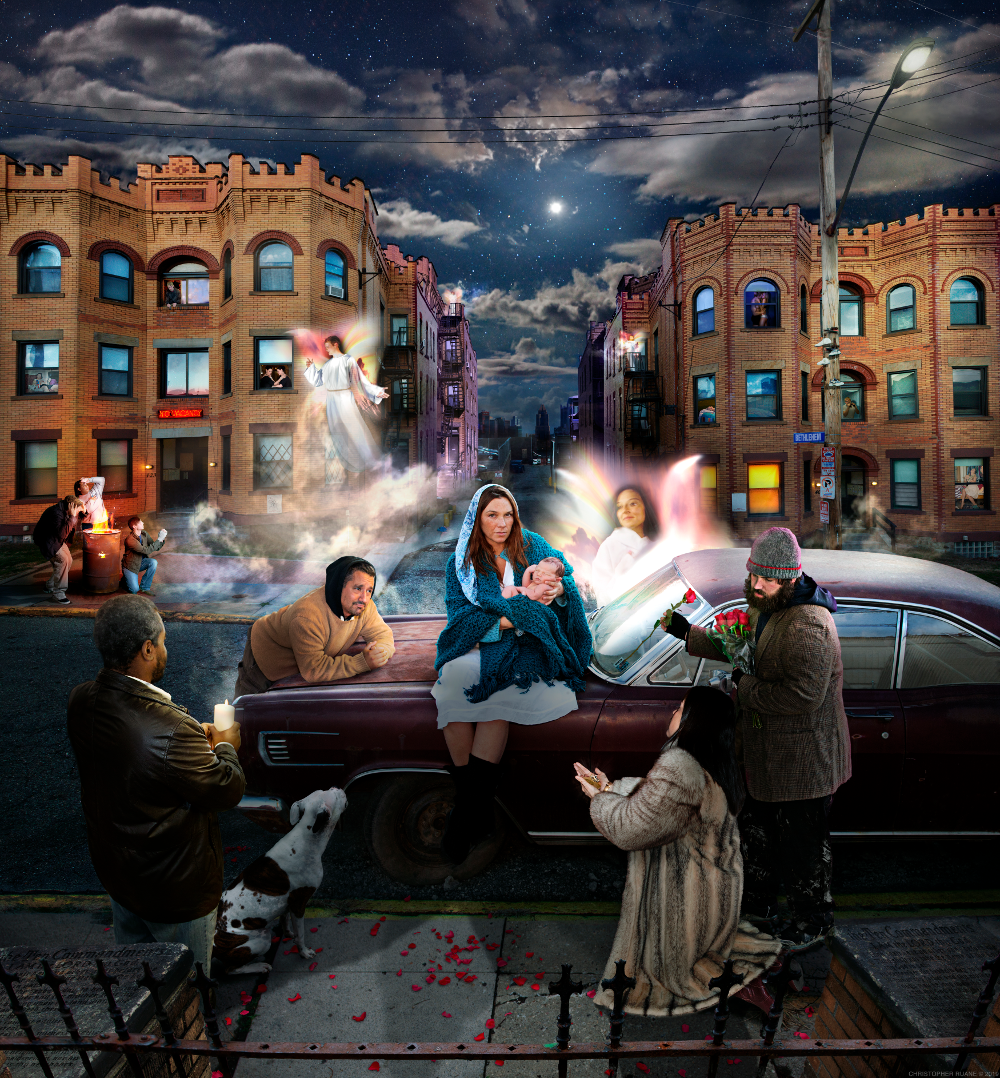
Christopher Ruane (American, 1981–), The Nativity, 2014. C-print, 52 × 48 in. Click the link to zoom in.
This image by photographer and composite artist Christopher Ruane sets the Nativity of Christ on an urban street corner marked “Bethlehem” and casts racially diverse models in the biblical roles. Mary sits on the hood of an old beat-up car holding her sweet newborn with a protective grip—she has presumably just given birth in the backseat. She’s wrapped in a blue afghan, the color traditionally associated with the Virgin. Joseph leans over, gazing proudly at his new baby son. Instead of the traditional cow and donkey looking on, there’s a spotted dog.
In the foreground are the three “wise men,” which here are two men and a woman, offering their gifts to the family. One man brings a candle; another, a rose. A wealthier woman in a fur coat brings gold jewelry. They stand or kneel on the sidewalk before this miracle baby who will be their deliverer, the way strewn with flower petals.
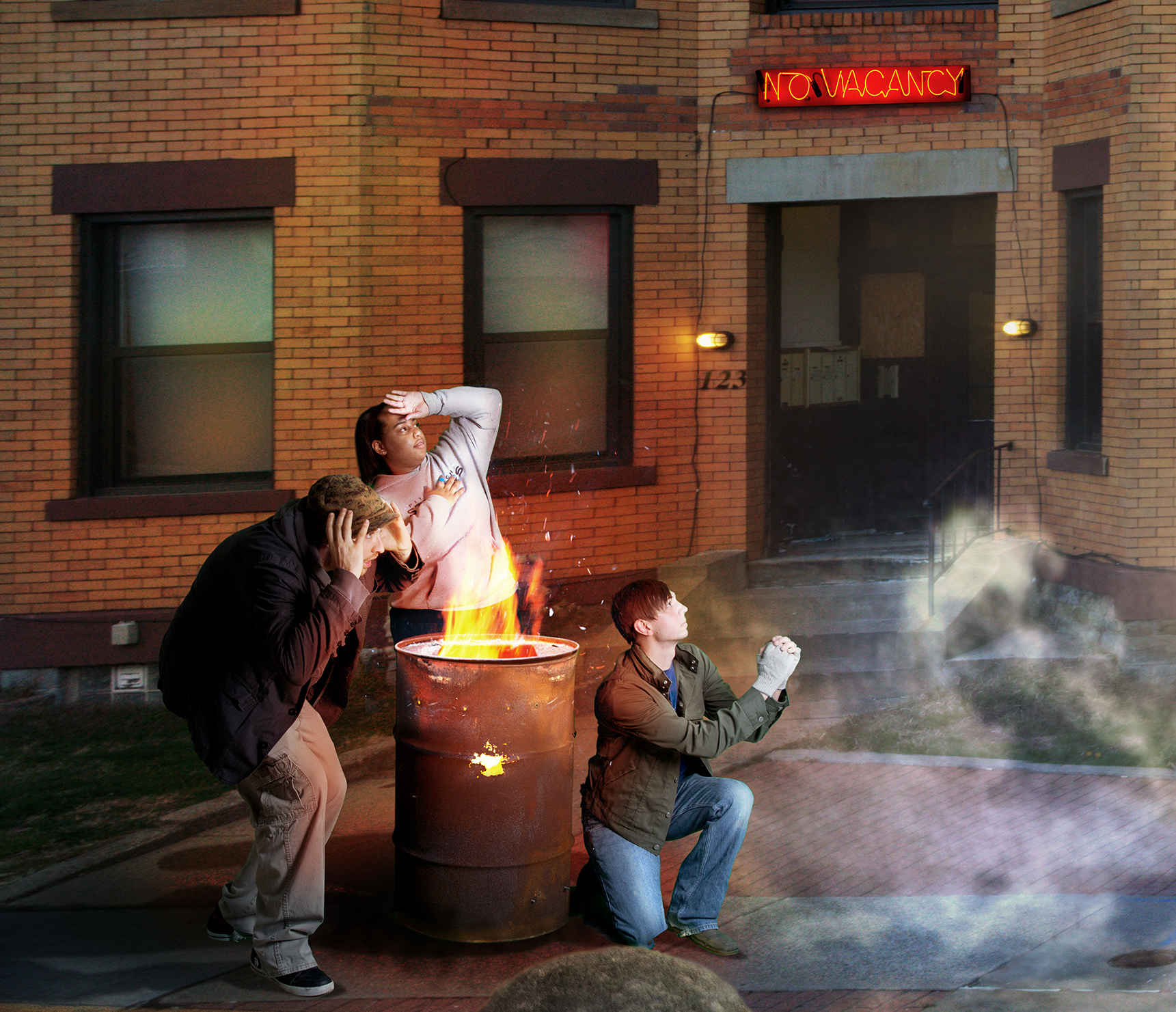
In the middle ground are three young unhoused people around a trashcan fire, standing in for the shepherds. A cloud of steam rises up out of a manhole before their eyes and coalesces with a heavenly apparition, come to personally announce to them the Messiah’s birth.
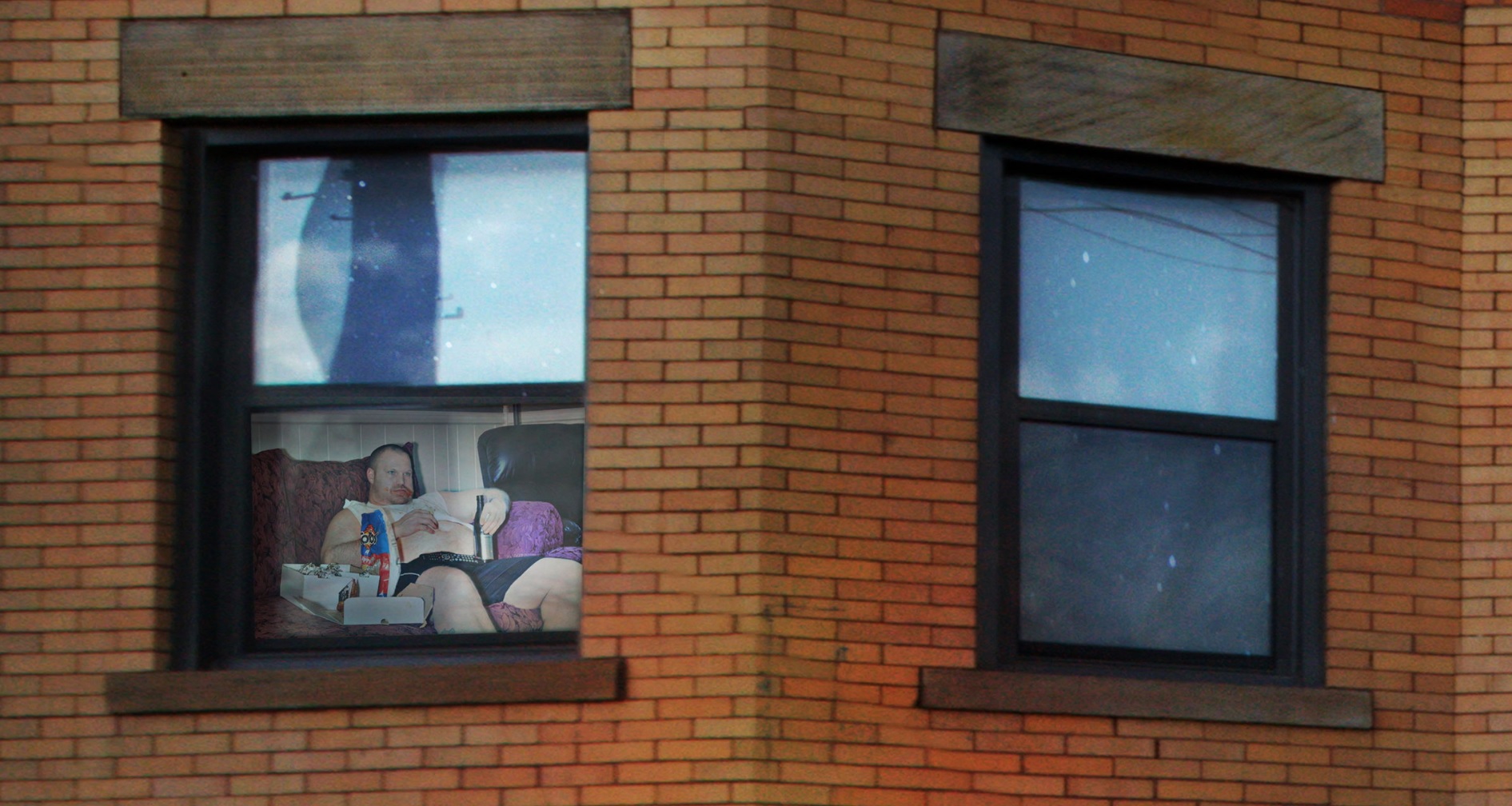
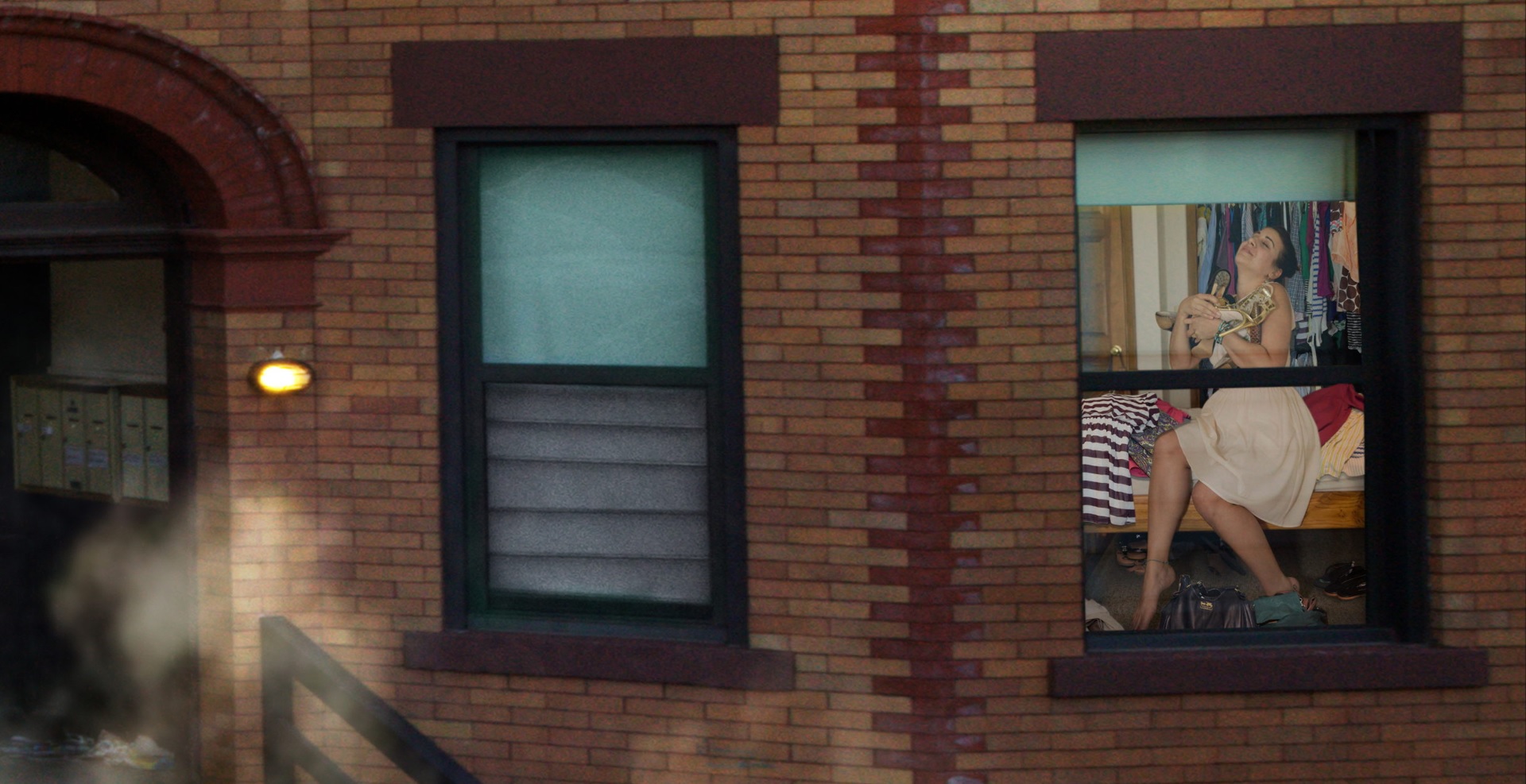
In the windows of the apartment building in the background are various people occupied with various activities. In one room a couple is engaging in sexual foreplay. Across the way, a man is vegging out in front of a TV. One woman, whose closet is spilling over with clothes, is hugging her collection of designer shoes.
These represent different values or dependencies—for example, materialism, a literal clinging to one’s possessions. But there’s also pain.
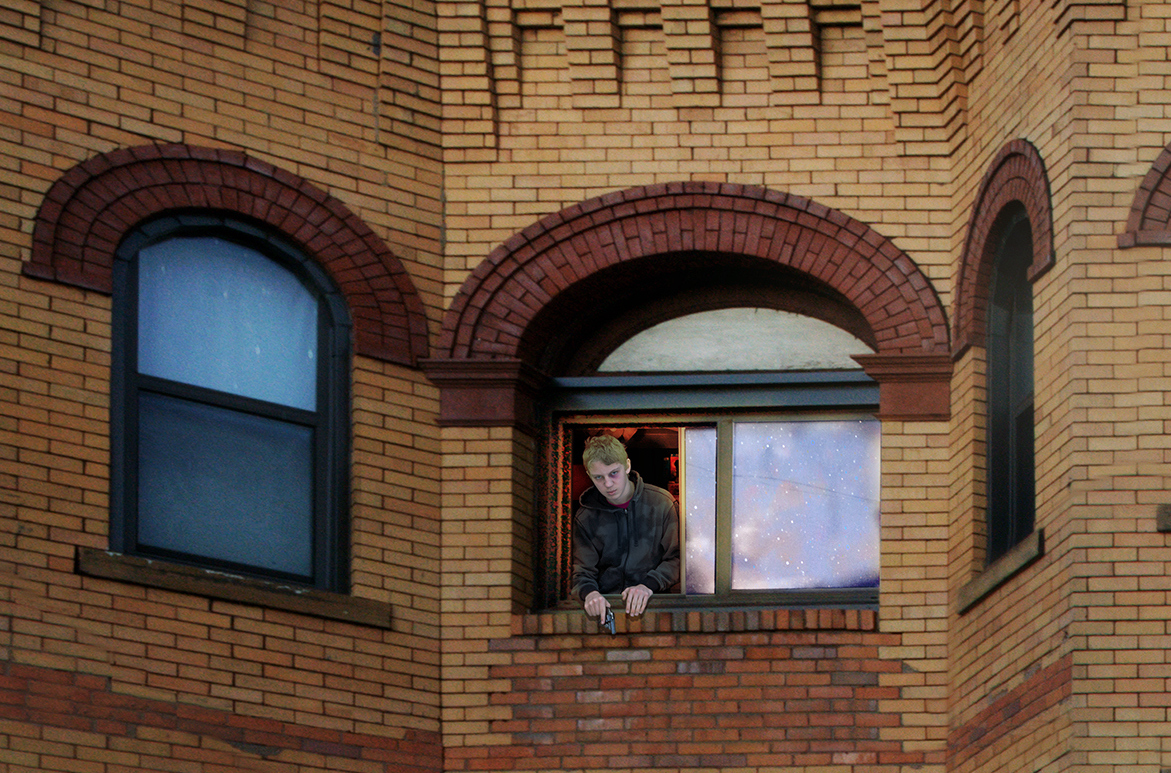
On the top floor there’s a young man in a hoodie with a black eye. Maybe he’s abused by his father. Or bullied at school. Or in too deep with a gang. Either way, he is bitter and angry and scared and distrustful and has a gun.
Christ was born into this world of hurt and false loves. He came to call us out of the darkness of these and into light, to give us abundant life in God. The bright star above beckons us all to follow the light to the feet of Jesus, Emmanuel, God-with-us.
Three wise men ridin’ hard through the cold Lost on some big city street with no place warm to go They are lookin’ for a manger, or a sign in the lights But they’re a long way from Bethlehem tonight
But they heard about a savior And a preacher in the park Who will camp with the homeless Where they shiver in the dark He’ll deliver salvation To the weary and the cold And he’ll bring joy, joy, joy to the wanderin’ soul
The cleaning lady sighs as she closes up the gate This job don’t quite pay the bills, and she’s always workin’ late But all in a moment comes a light from above It’s an angel speaking words of joy and love
And he tells her of a savior And a preacher in the park Who will camp with the homeless Under bridges in the dark He’ll deliver salvation To the weary and the cold And he’ll bring joy, joy, joy to the wanderin’ soul
Four in the mornin’ at the Tradewinds Motel The register reads, “All Full Up,” and the clerk thinks, “Just as well” But out in the toolshed by an old Coleman lamp A little family makes its meager camp
And the wise men bring presents And the angels gather round The cleaning lady slips in through the door without a sound And an old black dog looks on with the rest At the little babe upon his mother’s breast
And there comes a savior (Joy to the world) And a preacher in the park (The Lord is come) And he camps with the homeless (Let earth) Where they shiver in the dark (Receive her king) He delivers salvation To the weary and the cold (Let every heart sing) And he brings joy, joy, joy to the wanderin’ soul He brings joy, joy, joy to the wanderin’ soul
The American folk singer-songwriter Dave Carter was one half of the duo Dave Carter and Tracy Grammer, active from 1998 until Carter’s unexpected death in 2002. His songs have been covered by Joan Baez, Judy Collins, Willie Nelson, and others, and Grammer posthumously released several previously unreleased songs by Carter, including “American Noel.” She and Carter recorded the song sometime between 1999 and 2001 for a series of employee holiday gift compilations commissioned by the president of a hardware store chain.
Like Ruane’s digital photomontage, “American Noel” imagines the Incarnation happening on the margins of a modern American city, attracting low-wage workers and transients, among others. Jesus pitches his tent among the exhausted and despairing, “the weary and the cold,” coming not as an outsider to struggle but as one who will know it firsthand. His childhood, to say nothing of his adulthood, is marked by sudden flight from his homeland to escape a tyrannical king and by an upbringing in a country not his own.
City Church San Francisco put on a really enjoyable Lessons and Carols service last year, which was all-virtual given the COVID restrictions. Livestreamed December 13, 2020, it features guest vocalist Nicolas Bearde, the City Church Jazz Quintet (Patrick Wolff on tenor sax, Mike Olmos on trumpet, Marcus Shelby on bass, Adam Shulman on piano, and Jeff Mars on drums) with Karl Digerness, and a children’s ensemble. Here’s the abbreviated version I recommend, which is forty-five minutes:
The following songs are interspersed with scripture readings (the links will take you to the extracted song video on YouTube):
I suggest you light the fireplace (if you’re in a wintry clime, that is!), grab some hot cocoa, and gather the fam on the couch to give a listen together. Lyrics are printed onscreen for a few of the carols, for you to sing along with.
Or, perhaps you want to play the video while you’re doing some holiday baking!
The fuller-blown service, which is ninety minutes, includes a time of offering, a homily, communion, responsive prayers, church announcements, and a few additional songs and instrumental numbers that I’ve embedded below.
The City Church Little Big Band produced a Christmas jazz album in 2012, Go Tell It!, that includes recordings of many of the arrangements you hear here. Check it out.
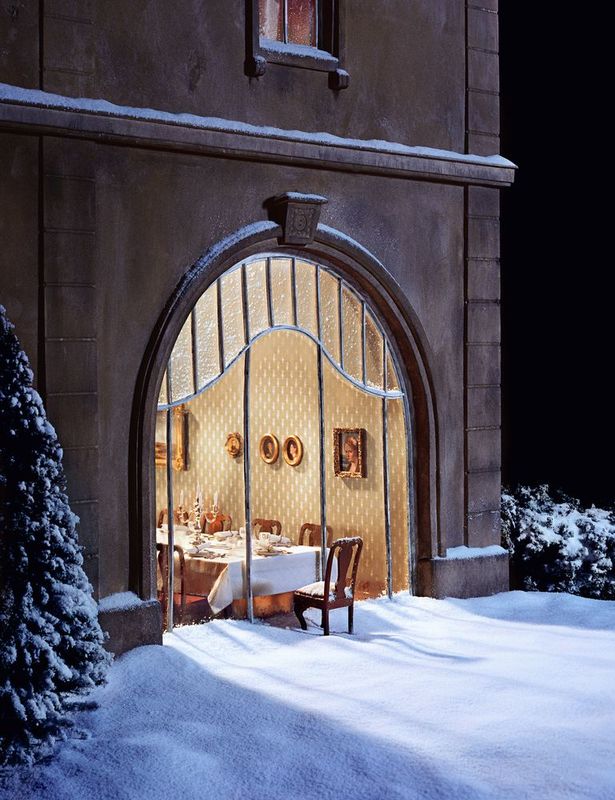
Frank Kunert (German, 1963–), Geschlossene Gesellschaft (Closed Society), 2011. C-print, 40 × 30 cm. Edition of 50 + 3 ap.
LISTEN: “The Ditchling Carol” (Roud 3216) | Words by William Robert Spencer, 1811 | Music by Peter Parsons, before 1901 | Performed by Waterson:Carthy on Broken Ground (1999; reissued 2013)
Be merry all, be merry all With holly dress the festive hall Prepare the song, the feast of all To welcome Merry Christmas
And all remember, gentles gay For you who bask in fortune’s ray The year is all a holiday The poor have only Christmas
When you with velvets mantled o’er Defy December’s tempest’s roar Oh spare one garment from your store To clothe the poor at Christmas
And all remember, gentles gay For you who bask in fortune’s ray The year is all a holiday The poor have only Christmas
When you the costly banquet deal To guests who never famine feel Oh spare one morsel from your meal To feed the poor at Christmas
And all remember, gentles gay For you who bask in fortune’s ray The year is all a holiday The poor have only Christmas
From blazing logs of fuel awhile Your homes are within summer’s smile Oh spare one log from off the pile To warm the poor at Christmas
And all remember, gentles gay For you who bask in fortune’s ray The year is all a holiday The poor have only Christmas
So shall each note of mirth appear More sweet to heaven than praise or prayer And angels in their carols there Shall bless the poor at Christmas
And all remember, gentles gay For you who bask in fortune’s ray The year is all a holiday The poor have only Christmas
This carol from Ditchling in East Sussex has a very Dickensian feel to it. More sobering than the usual Christmas fare, it contrasts the lavish holiday feasts of the well-off with the poverty that exists outside their doors. Think Lazarus and the rich man. The poor rely on the feelings of goodwill and generosity that Christmas engenders, but as this song acknowledges, the needs persist year-round. Those whom God has blessed with good fortune would do well to share it—not just with family and friends of like socioeconomic status but with neighbors of all classes, and not just during the “season of giving” but on a continuing basis.
Peter Parsons (1825–1901), a Ditchling shoemaker and leader of the village glee club, found the poem above on a broadside ballad sheet from the early nineteenth century and was moved to write a tune for it. I encountered the carol through a nineties recording by Norma Waterson, her husband Martin Carthy, and their daughter Eliza Carthy, who have been at the forefront of the English folk music scene for decades.
I would go even further than the lyrics do and say, don’t just give the poor a morsel or a log; invite them in! What might radical hospitality look like for you this Christmas? How might your merriment expand to embrace those who are typically excluded?
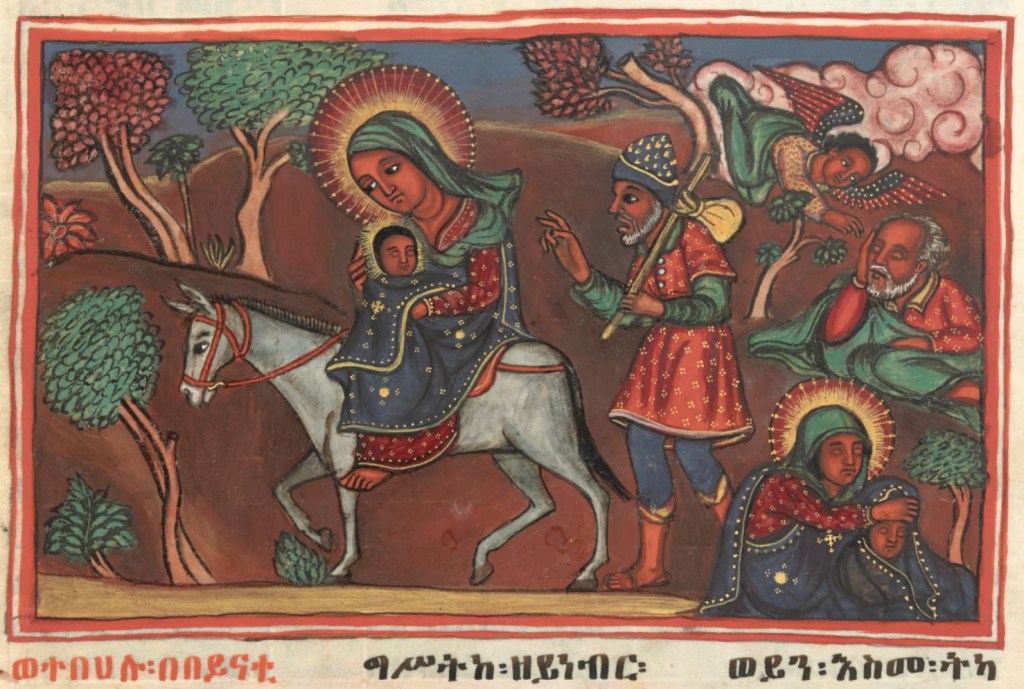
“The Christmas Story: Images from Ethiopic Manuscripts” by Eyob Derillo: The British Library has a fantastic collection of Christian manuscripts from seventeenth- and eighteenth-century Ethiopia. This blog post by curator Eyob Derillo shows Christmas-related illuminations from four different ones. Follow the links in the captions to explore each manuscript further.
“Flight into Egypt,” from the Nagara Māryām (History and Miracles of the Blessed Virgin Mary), Ethiopia, ca. 1730–55. British Library Or. 607, fol. 17r.
You can follow Derillo on Twitter @DerilloEyob. He’s always posting fascinating things about Ethiopian art and its intersection with the country’s history, culture, politics, and Christianity, including lots of Ethiopian saints’ stories!
A 16th c. Ethiopian book claims that the Magi, the 3 kings who visited Jesus were all Ethiopians. Legend has it that they consumed coffee on their journey to stay awake. In their memory #coffee in #Ethiopia is served 3 times. Serving are named after the Magi Abol, Tona & Baraka pic.twitter.com/mf0YyHcqcN
Animals with magical abilities are frequently recorded in biographies of #Ethiopian saints. They appear when hermits are praying in mountain caves, or at the death or funeral of a Saint. #birds appear on a birth or death of a saint, #lions reveal themselves to serve them. pic.twitter.com/ZdNHdREnc2
There are over 500,000 manuscripts in #Ethiopia housed in churches & monasteries located in remote places. The exact amount is not known. Most don't permit access to the archive. Some monastic libraries have #medieval MSS dated to the 6th c. a few have been digitised & conserved pic.twitter.com/gi6Lzgb0Jn
If you enjoyed the blog post, I recommend the highly accessible book The Road to Bethlehem: An Ethiopian Nativity, an interweaving of ancient (apocryphal) tales surrounding Jesus’s birth that flourished in Ethiopia, compiled and told by Elizabeth Laird, with the biblical narrative. It’s illustrated in full color with images from the British Library’s collection and is perfectly appropriate for children (and adults!). I’ve perused the Ethiopian manuscripts on the BL website but am not able to decode several of the images because I’m unfamiliar with the tales and cannot read Ge’ez, and Laird’s book helped me out in that respect, at least in part. For a deeper dive into Ethiopian art—which is inextricable from its patrons’ and makers’ Christian spirituality—see the informative and beautifully produced Ethiopian Art: The Walters Art Museum, a catalog from another museum that houses a fine collection of Ethiopian art.
+++
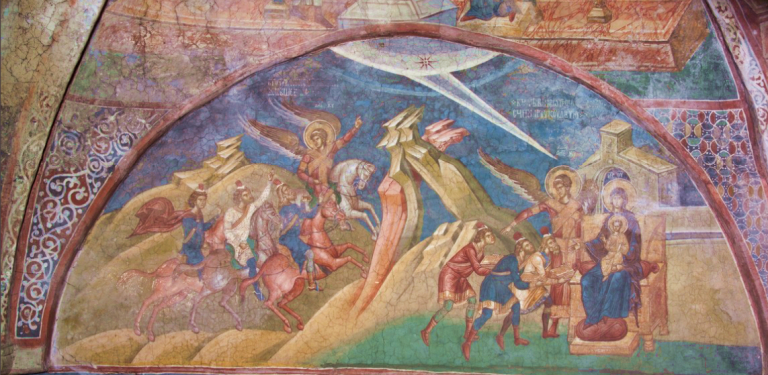
The Angel of the Lord in icons of the Magi: In this recent post from Icons and Their Interpretation [previously], icons consultant David Coomler spotlights a fresco from Decani Monastery in Serbia that shows an angel on horseback leading the magi to the Christ child, emphasizing supernatural direction. He identifies the same, idiosyncratic figure in a 1548 painting by Frangos Katelanos at Varlaam Monastery in Meteora, Greece, comparing it to two more common appearances of an angel with the magi in Eastern iconography: on foot beside the newborn king’s “throne,” presenting the magi to him.
Journey of the Magi and Adoration of the Magi, 14th century. Fresco, Decani Monastery, Serbia. View a modern copy here.
+++
SONG MEDLEY:“Christmas Around the World” by Acapals: “Acapals is a collaboration of four friends and a penguin who share a love for making a cappella music (despite not sharing much in the way of geography, culture or language).” They are Nick Hogben, tenor, from England; Leif Tse, baritone, from Hong Kong; Jacky Höger, alto, from Germany; and Prayer Weerakitti, soprano, from Thailand. In this video each of them arranged a holiday song in their native language, which they sing together: “Hark! The Herald Angels Sing” (English), “Silent Night” (Cantonese), “Es ist ein Ros’ entsprungen” (German), and “New Year Greeting” (Thai). [HT: Global Christian Worship]
+++
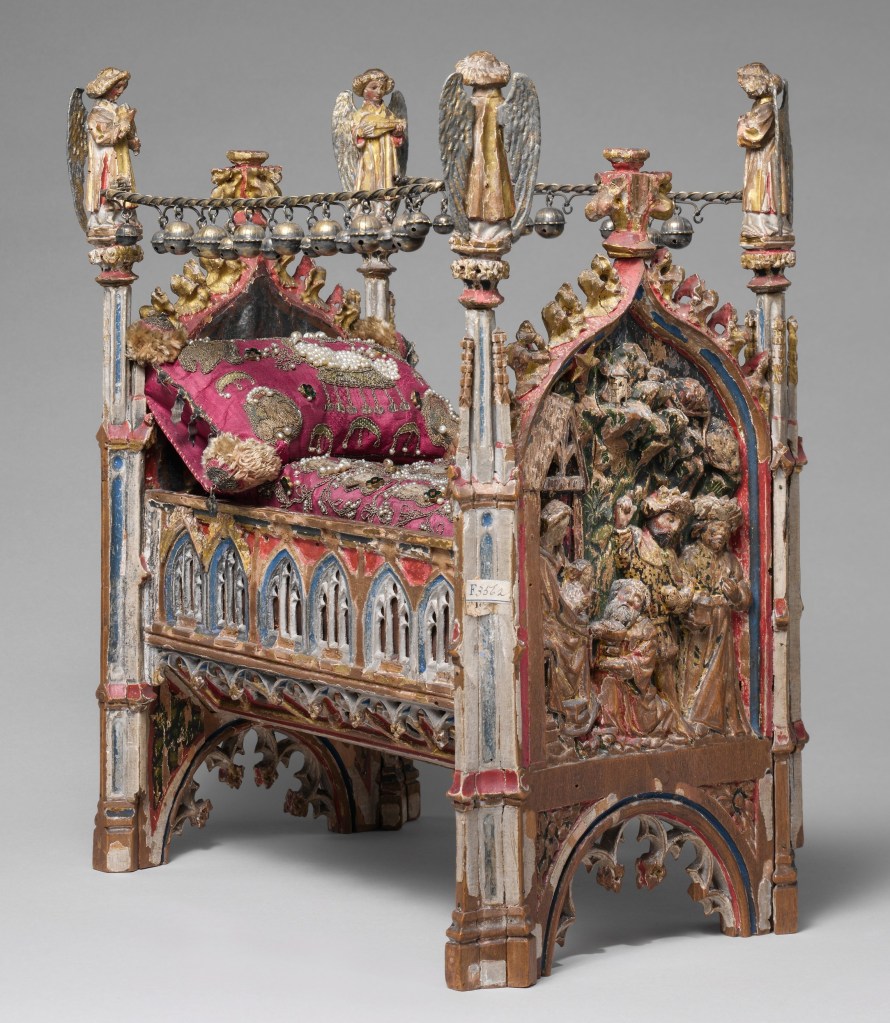
“The Cloister and the Cradle” by Shannon Reed: Some medieval nuns and lay religious women cared for baby Jesus dolls (ceramic or wooden) as a devotional practice—dressing them, playing with them, “feeding” them, singing to them, rocking them in cradles. Full of wit and tenderness, this Vela magazine essay by Shannon Reed explores that practice. “It is difficult to separate my modern reaction to the sight of a grown woman (in a habit!) acting in such bizarre ways, carrying a doll around and pretending it’s real,” Reed writes. “But I try to remember that for these women, this was an empowering opportunity to be Mary, most holy, most blessed.”
Reed considers women’s agency in the Middle Ages, mystical visions made tangible, and the desire for maternal intimacy, incorporating personal stories and reflections, as a single woman without children, about attending baby showers, nannying through grad school, shopping for godchildren, and teetering between enjoyment of her non-mom status and an inclination to mother. As a thirty-two-year-old woman who also does not have kids (though I am married) and is content but constantly surrounded by reminders of what I’m missing, I can relate to a lot of the feelings and experiences Reed articulates here. I chanced upon this essay when trying to find more information about a Beguine cradle I saw at the Met, pictured below (spurred, too, by the description of a Virgin and Child ivory). I found myself unexpectedly moved by the author’s vulnerability and by the connections she draws between modern-day longings for and expressions of motherhood and those played out in medieval Christian convents.
Crib of the Infant Jesus, 15th century, from the Grand Béguinage in Louvain (now at the Metropolitan Museum of Art). Click to view details of the carved Nativity and Adoration of the Magi at the head and foot and, on the embroidered coverlet, Jesus’s family tree.
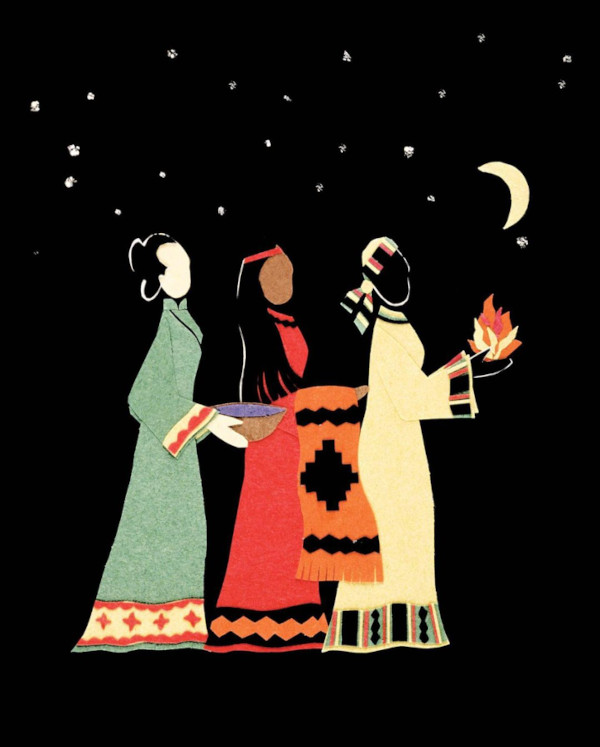
The Sanctuary Between Us: A Retreat for Women’s Christmas by Jan Richardson: Every year artist, writer, and Methodist minister Jan Richardson provides a new compilation of her art, blessings, and spiritual reflections as a free PDF download. The subtitle references the Irish custom of Nollaig na mBan, or Women’s Christmas, observed particularly in County Cork and County Kerry. “Women’s Christmas originated as a day when the women, who often carried the domestic responsibilities all year, took Epiphany [January 6] as an occasion to celebrate together at the end of the holidays, leaving hearth and home to the men for a few hours.” In this spirit Richardson offers an opportunity “to pause and step back from whatever has kept you busy and hurried in the past weeks or months, . . . spend[ing] time in reflection before diving into what this new year will hold.”
“Blessing to Summon Rejoicing,” “Blessing of Memory,” “Blessing the Body,” and “Blessed Are You Who Bear the Light” are among the several benedictions, thoughtfully introduced and many accompanied by collages, paintings, or encaustics. Some sections also include questions for personal reflection. For example: “How do you experience—or desire to experience—remembering in community? Who are the people who hold your memories with you? Are there ways you experience memory as a sacrament, a space where you know the presence and grace of God at work in your life? For whom might you be (or become) a sanctuary of memory as you help them hold their stories and their lives?”
The poem “Wise Women Also Came,” printed as an interlude, is especially compelling, describing how, in addition to the wise men mentioned in the biblical narrative, wise women also came to Jesus’s birth bearing gifts—“water for labor’s washing, / fire for warm illumination, / a blanket for swaddling.”
ONLINE LECTURES, organized by Bridge Projects: This Los Angeles gallery is offering a series of free online events to complement A Composite Leviathan, an exhibition of emerging Chinese artists that runs through February 27, 2021. Here are two I RSVPed for. (Both will be presented in English and Chinese.)
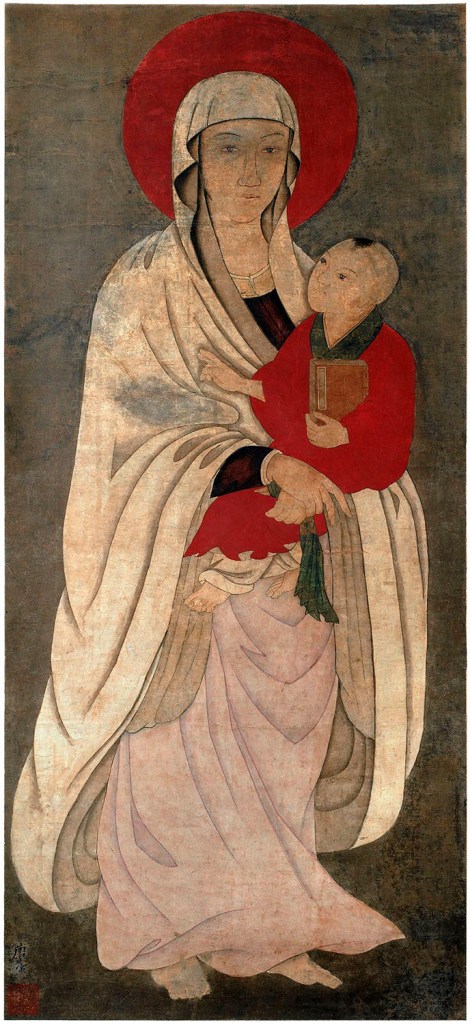
“The Virgin Mother, Her Majesty, Our Lady: Globalism, All-Under-Heaven, and Madonna In-Between” by Dong Lihui, January 12, 8–9:30 p.m. EST: Dong Lihui (PhD, art history), whose research centers on art exchange between East and West, is the author of Chinese Translation of Western Images: Christian Art in China in the 16th and 17th century. In this talk she will discuss the hybridization of European globalism and the Chinese “all-under-heaven” worldview as observed in Chinese Madonna icons made between the sixteenth and twentieth centuries.
Madonna and Child, China, 15th–17th century. Painting on silk, 8 feet high. Field Museum of Natural History, Chicago. Photo: John Weinstein.
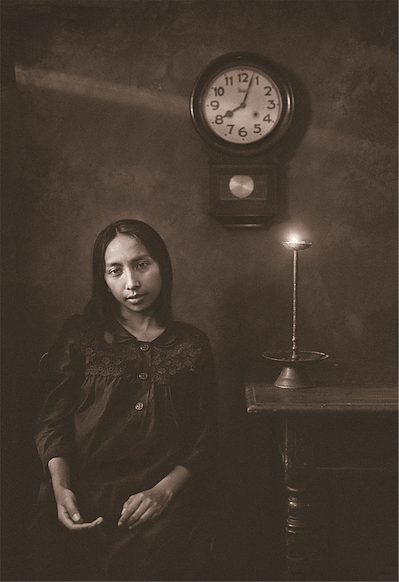
“Counterculture: Chinese Contemporary Christian Art and the Bible” by Clover Xuesong Zhou, January 26,8–9:30 p.m. EST: “The advent of modernity brought with it enmity between Christian traditions and a newly liberated art world. Similarly, contemporary artists in China found themselves at odds with the government beginning in the 1980s. All the while, Christianity has had a torrid relationship with Chinese government and culture. Thus, Chinese artists who are also practicing Christians work within these complex intersections.” Art writer and art theologian Clover Xuesong Zhou will be discussing some such artists, including photographer Stanley Fung (Feng Junlan), video artist Li Ran, and installation artist Gao Lei.
Stanley Fung (Chinese, 1961–), The Lord’s Handmaiden, 2012
+++
SONG: “O Holy Night” by Ben Caplan and friends: An absolutely stunning minor-key rendition by Canadian singer-songwriter Ben Caplan (who is often compared to Leonard Cohen) and a team of others, combining gypsy jazz, classical, and Jewish folksong influences. Caplan, who is Jewish, didn’t grow up listening to much Christmas music. “I have to admit that I find a lot of that music a bit corny. Where is that minor fall? Where is the major lift? Where is the bafflement?” He continues, “I have a deep felt belief that if you don’t like something, you should do something about it. It’s not enough to complain from the sidelines! There are some truly beautiful songs and carols out there, and I wanted to make something that tip-toes towards the sublime rather than shopping-mall-easy-listening.” Arcade Fire’s “My Body Is a Cage” was one of his reference points. (“I wanted to try to recreate that gradual build, and the sublime surrender to an enormous scale of sound.”) There are a few intentional semitone clashes to generate dissonance.
Filmed last year inside Halifax’s Fort Massey United Church and released in November, this recording was in the making for four years and is the result of much collaboration. The left-handed violinist in the video, Donald MacLennan (see, e.g., 1:34), reharmonized the carol, and he, Caplan, upright bass player Anna Ruddick, drummer Jamie Kronick, and vocalist Taryn Kawaja worked out an arrangement for their band, which they performed at a Christmas concert in 2016. Peter-Anthony Togni, who plays organ for the song, was brought in later to arrange the song for string quartet, pipe organ, and bass clarinet. Caplan chose the instrumentation and aesthetic shape. He recounts the process in detail and names all the people involved on his Bandcamp page. “I want to dispel the myth of the lone genius,” he says. “It took a lot of people with a lot of talent to pull this off. I am just the lead singer, and the guy who was stubborn enough to bring all the people together and spend an outlandish amount of money trying to achieve this vision.” Purchase on Bandcamp, and/or stream on Spotify.
I am truly moved by this atmospheric take on an old classic, which perfectly brings together the darkness and light of the Christmas season. “Original, and righteous—hymn for the COVID time,” says one YouTube user. “You’ve found things in this old carol that I never knew existed,” says another. And another: “A sensory feast. So deeply piercing.”
“Mele Kalikimaka” (“Merry Christmas”) is a Hawaiian-themed song written in 1949 by R. Alex Anderson. Born in Honolulu in 1894, Anderson, a Caucasian, became one of the most popular composers in the hapa haole (“half-white”) genre, which describes music with a Hawaiian tune, styling, and/or subject matter but lyrics that are mostly or entirely in English. Over his long career Anderson composed nearly two hundred songs, several of which became popular standards, and he was posthumously inducted into the Hawaiian Music Hall of Fame in 1998. “His ear for Hawaiian music’s special sound and rhythm was exceptional,” the HMHF wrote, “and he was regarded as a successor to Charles E. King in maintaining the melodic and lyrical qualities which are Hawaii’s musical identity.”
In a 1994 interview, shot just a year before his death at age 100, Anderson said he was inspired to write “Mele Kalikimaka” when a coworker lamented to him one day that there were no original Hawaiian Christmas songs; all that existed were Hawaiian translations of carols from other countries.
So he got to writing:
Jingle bells upon a steel guitar Through the palms we see the same bright star
“Mele Kalikimaka” is the thing to say On a bright Hawaiian Christmas Day That’s the island greeting that we send to you From the land where palm trees sway Here we know that Christmas will be green and bright The sun to shine by day and all the stars at night “Mele Kalikimaka” is Hawaii’s way To say “Merry Christmas” to you
A year later, in 1950, the song appeared on the flip side of Bing Crosby’s White Christmas album, featuring the Andrews Sisters.
Since then it has been covered by a range of artists, including the Monkees, Bette Midler, Jimmy Buffett, Train, Teresa Carpio, Ingrid Michaelson, She & Him, the Puppini Sisters, the Petersens, Leslie Odom Jr., and others. I especially like the playful version performed by married couple Gianni Nicassio and Sarah Blackwood of the Canadian indie-pop band Walk Off the Earth. They do vocals, ukulele, guitar, djembe, chimes, cymbals, and kazoo! The song can be purchased here.
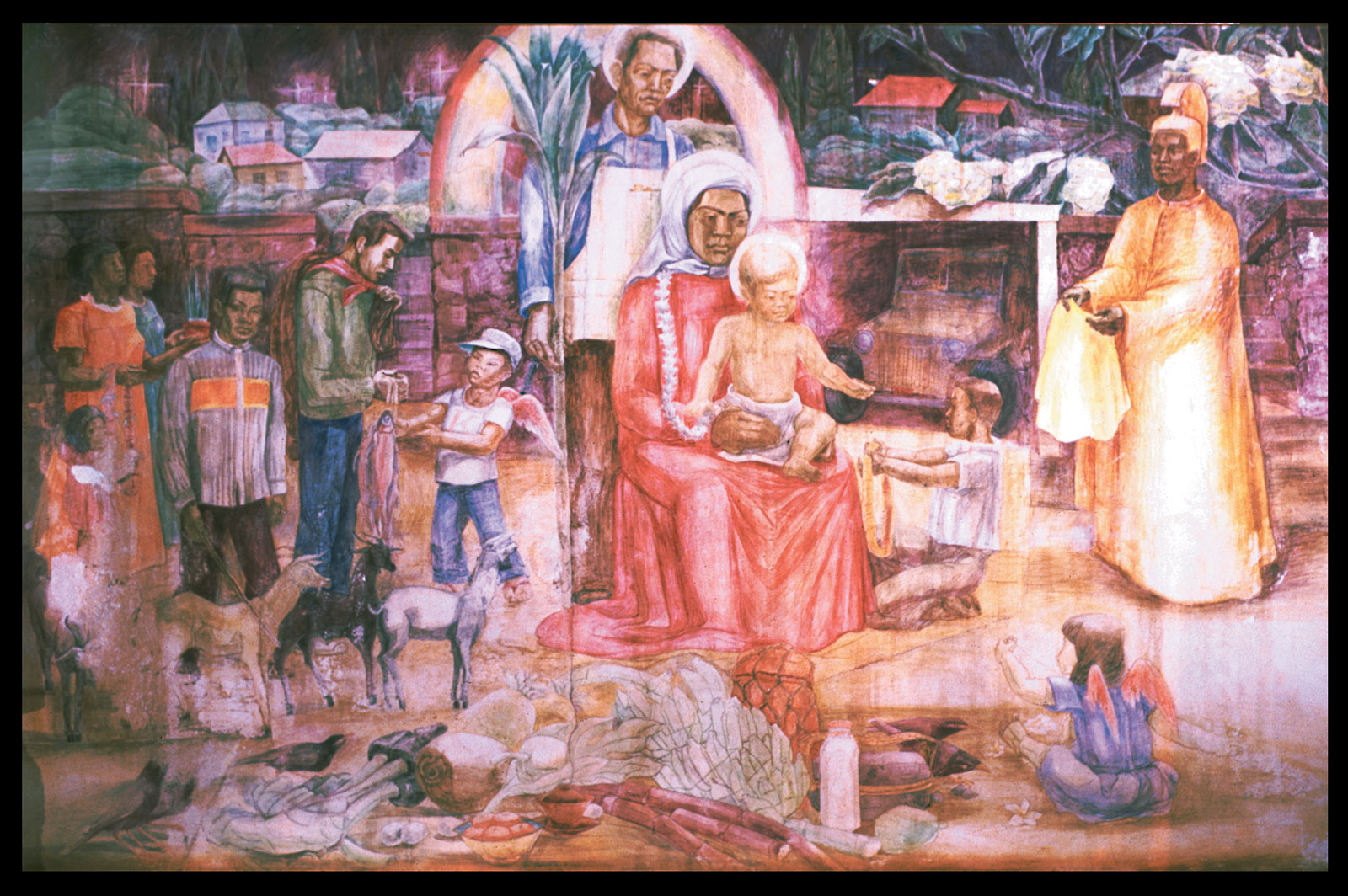
In the same decade that Bing Crosby catapulted Anderson’s Hawaiian Christmas song to nationwide popularity, painter Juliette May Fraser carried out a mural commission for the newly built St. Catherine’s Catholic Church in Kapa‘a, Kauai, commonly referred to as Hawaiian Nativity. Covering the makai (sea-facing) wall, it shows Hawaiians of various ethnicities presenting ho‘okupu (gifts) to the newborn Christ child, who sits on his mother’s lap.
Juliette May Fraser (American, 1887–1983), Hawaiian Nativity, 1958. Fresco, 4 1/2 × 8 ft. St. Catherine’s Catholic Church, Kapaʻa, Kauai, Hawaii. Photo: Timothy T. De La Vega, 1999.
Fraser is of Hawaiian, Chinese, Filipino, Portuguese, and Irish ancestry, and this multiculturalism is reflected in her Nativity. She wanted the painting to be modern and “international in flavor,” she said, reflecting Hawaii’s ethnic diversity.
Instead of a donkey, a jeep has brought the holy couple, who are portrayed as Native Hawaiian, to the place of their son’s birth. The license plate reads, “4-20-58,” the date on which St. Catherine’s was dedicated. Mary wears a muumuu and lei, while Joseph stands behind her with a sugar cane stalk. “The Holy Child is hapa [mixed race] with blond hair and strong Polynesian features,” writes Anthony Sommer in the 1999 article for the Honolulu Star-Bulletin that introduced me to this painting. That Jesus’s skin tone is the lightest of the bunch might be regarded by some as problematic, a subtle reinforcer of racial hierarchy. However, I see this more as the artist’s attempt, whether you deem it successful or not, to show a multiracial Christ, bearing the features of different peoples.
In Fraser’s fresco, locals approach with ho‘okupu, the fruits of their personal labors given freely as offerings in expression of gratitude, respect, and aloha. Filipino fishermen present their freshest catch, and Portuguese goatherds (as the artist identified them) come with their flocks; they are greeted by a Chinese angel in a T-shirt, jeans, a sideways ballcap, and flip-flops. From the right, a Hawaiian ali‘i (hereditary noble) comes with the gift of an ʻahu ʻula (feathered cloak), made only for royalty. He stands in line behind a child who offers Jesus a lei (flower garland). Traditionally, ho‘okupu are given to an akua (god), king, priest, doctor, or host, so this painting acknowledges Jesus as fulfilling all those roles.
The photo here, by Timothy T. De La Vega, was taken prior to the 2001–2 restoration; he emailed it to me when I reached out to him. I’ve sought out more recent photos through multiple channels—the church office, the parish Facebook page, a priest in the diocese, the restoration fundraiser—but have not had any success.
St. Catherine’s also houses frescoes by two other celebrated Hawaii artists: Compassionate Christ by Jean Charlot and Francis Xavier, Apostle of Asia by Tseng Yo Ho. Charlot, Tseng, and Fraser were hired by Father John McDonald—who (fun fact) was also the one who convinced movie producers to cast St. Catherine’s choir in the movies South Pacific and Blue Hawaii!



 Art & Theology