ONLINE DISCUSSION: “Poems of Advent, Christmas, and Epiphany” led by Brian Volck,December 13, 2025, 12–1:30 p.m. ET: Poet Brian Volck (whose work I’ve shared here and here) is leading a free online discussion on Advent, Christmas, and Epiphany poetry next Saturday. Sponsored by the Ekklesia Project, it will bring together diverse poetic styles and voices. “Each poem is read by a volunteer and then the group discusses what stood out, what struck them, and what questions the poem raises,” Volck says. “My goal is to encourage a diversity of responses rather than impose mine. No preparation is required.” Register here to receive the Zoom link and the poems in advance.
+++
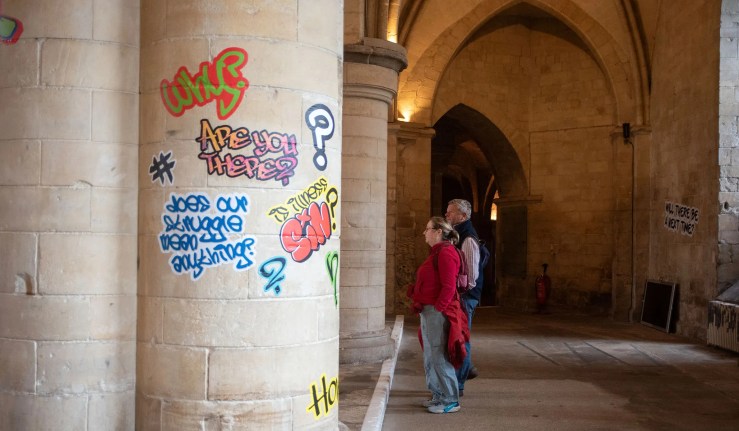
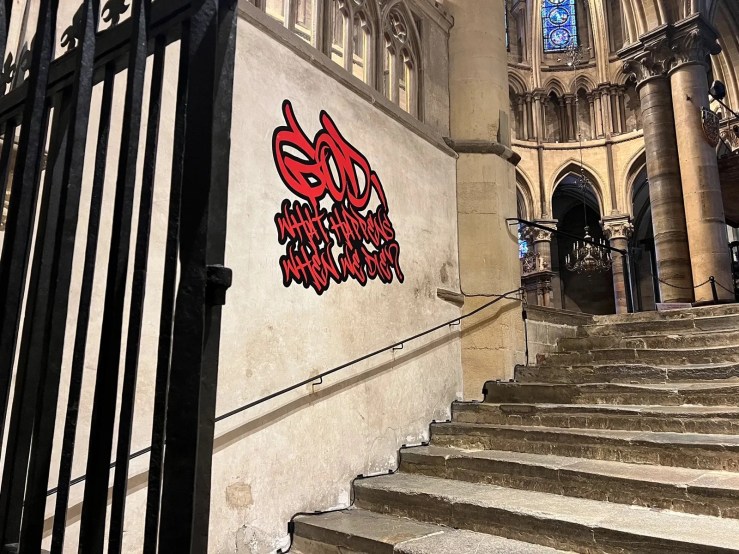
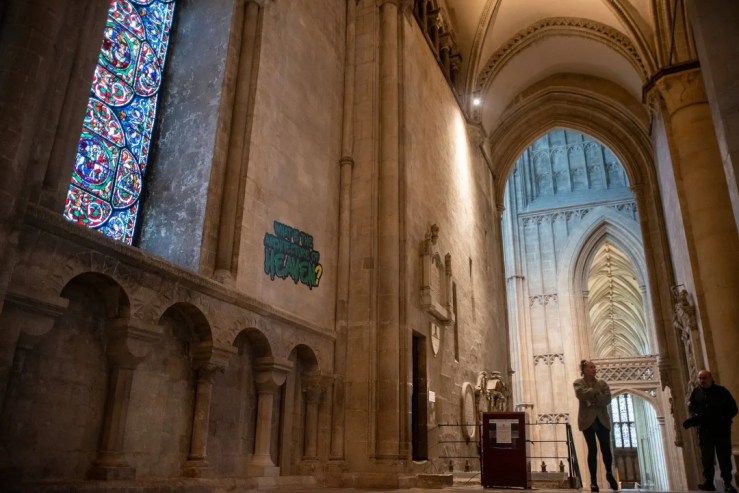
INSTALLATION: Hear Us, Canterbury Cathedral, October 17, 2025–January 18, 2026: Graffiti-style stickers are affixed to the medieval walls, floors, and pillars of England’s Canterbury Cathedral in the temporary installation Hear Us, voicing questions to God collected from local marginalized individuals, such as:
Why is there so much pain and destruction?
Is this all there is?
Are you there?
Does everything have a soul?
Do you ever regret your creations?
How do I break the cycle?
Does our struggle mean anything?
How is my dog Bear doing?
God, do you know me?
Photo: Krisztian Elek
Photo courtesy of Canterbury Cathedral
Photo: Krisztian Elek
Curator Jacquiline Creswell [previously], collaborating with poet Alex Vellis, organized a series of workshops led by artists Sven Stears, Henry Madd, Jasbir Dhillon, Adam Littlefield, Alice Gretton, and Callum Farley, which invited people who felt the cathedral was not for them to gather together and delve into discussions about their lives, experiences, and aspirations. Among the participants were members of the Black and Brown diasporas, LGBTQIA+ people, neurodivergent people, people in addiction recovery, and people with mental health disorders. They were asked to respond to the prompt “If you could ask God a question, what would it be?”
Many of the responses were then translated into big, colorful word graphics that cannot be overlooked. “All of the questions are prayers. All of the questions are already sacred,” Vellis says. “So by putting the questions into an already existent sacred space, we are saying you are valid, your words are valid, your prayers are in a place in which they can be heard and they can be seen and they can be supported.”
I learned about this installation from the Exhibiting Faith podcast’s interview with Creswell and Vellis—an episode I heartily commend. They explain how the exhibition was developed, how they persuaded the cathedral to agree to it, and how they have dealt with the storm of criticism it has generated. Many have called it an act of vandalism (even though the stickers were authorized by the dean and will leave no trace when they’re removed next month) and irreverence, desecration. US Vice President JD Vance said the exhibition “mak[es] a beautiful historical building really ugly,” and Elon Musk called it a “suiciding” of Western culture.
I have not seen the exhibition in person, and I am neither British nor Anglican, so I don’t possess the same sense of my identity or heritage being threatened that many Church of Englanders have expressed. But I personally like the confrontational clash of aesthetics: traditional juxtaposed with modern; majestic Gothic architecture, staid limestone, garishly “spray-painted” in a street style, bringing contemporary spiritual and theological questions into a nearly millennium-old church building. I also like the concept of amplifying rather than diminishing the voices of those who feel marginalized by the church but who still want to engage, who are curious—bringing their questions into the space where we gather as a community of Christ followers and using them as a portal into further faith conversations, as Creswell put it in a media interview.
+++
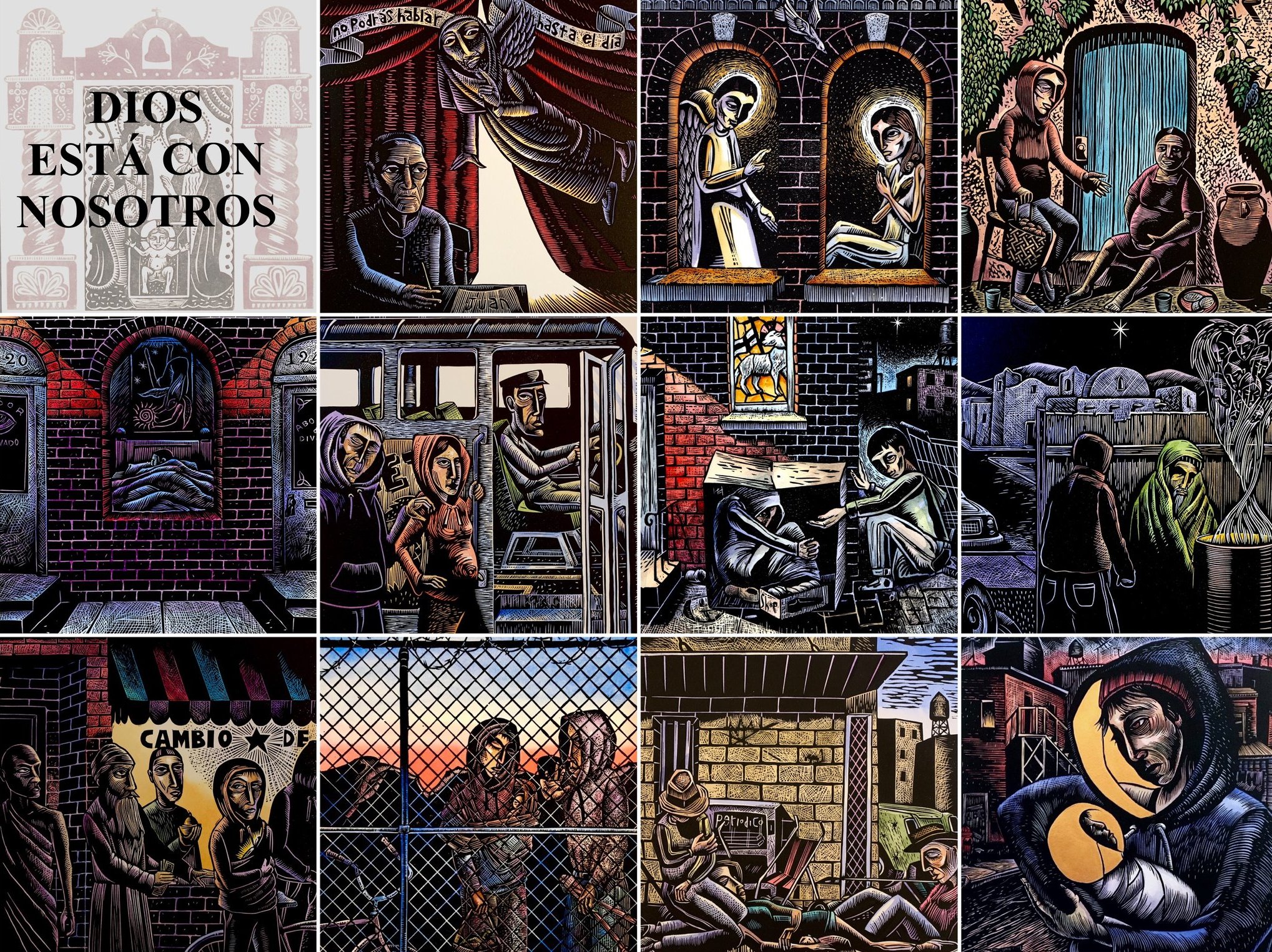
BLOCKPRINT SERIES: Dios con Nosotros (God with Us) by Kreg Yingst:Kreg Yingst [previously] is my favorite contemporary printmaker working on religious themes. Last December he shared a series of hand-colored linocut prints that he started in 2019 and that is ongoing, collectively titled Dios con Nosotros (God with Us)—“a modern-day American Christmas story which takes place somewhere south of the U.S. border,” he writes.
>> “Un Cuento de Navidad” (A Song of Christmas): This original song by Adrian Roberto and Melissa Romero is about a town that had lost its wonder—until a child discovered a Bible, and his reading aloud its story of a Savior sparked revival.
>> “What Child Is This / Child of the Poor”: The Hound + The Fox are Reilly and McKenzie Zamber, a husband-wife musical duo from Oregon. This song of theirs interleaves the classic Christmas carol “What Child Is This” by William Chatterton Dix with a 2008 song by Scott Soper that emphasizes Christ’s solidarity with the poor.
Here are the lyrics to Soper’s “Child of the Poor”:
Helpless and hungry, lowly, afraid, Wrapped in the chill of midwinter; Comes now, among us, born into poverty’s embrace, New life for the world.
Who is this who lives with the lowly, Sharing their sorrows, Knowing their hunger? This is Christ revealed to the world In the eyes of a child, a child of the poor.
Who is the stranger here in our midst, Looking for shelter among us? Who is the outcast? Who do we see amidst the poor, The children of God?
So bring all the thirsty, all who seek peace; Bring those with nothing to offer. Strengthen the feeble; Say to the frightened heart, “Fear not: here is your God!”
>> “Everybody Ought to Treat a Stranger Right”: Arranged and expanded by Dan Damon [previously], this traditional blues song is performed here by the Dan Damon Quartet, featuring guest vocalist Sheilani Alix, at a concert at Community Church of Mill Valley in California on December 10, 2023. “Blind Willie Johnson recorded this song in 1930 with two Christmas verses mixed in. I separated them out, added two verses to tell a fuller Christmas story, and recorded the Christmas version with my band on the album No Obvious Angels,” Damon explains. “According to the writer of Hebrews, some have entertained angels unawares.”
“One of poetry’s great gifts is to slow us down,” writes Peggy Rosenthal in Praying the Gospels through Poetry. “We’re used to racing ahead as we read, whether it’s a newspaper or an email memo or even an essay: language in these forms propels us forward, urging us to grab up its main points. But poetry doesn’t press ahead so much as hold us still—in the wonder of words crafted to open into another dimension.”
Below are twenty-five poems to “hold us still” this holiday season.
I’ve collected hundreds of Advent and Christmas poems over the past decade, but for this feature one of the selection criteria was that the poem must be freely available online. I chose the number twenty-five because that is standard in most Advent calendars—tools for counting down the days to Christmas. This way, you can choose, if you wish, to bookmark this page and read just one poem a day from December 1 to 25, each one a little treat.
The order progresses, in general, from Advent longing and anticipation to Christmas joy and wonder to post-nativity moments like the presentation in the temple and the visit of the magi.
1. “Advent Madrigal” by Lisa Russ Spaar: I’m not sure I understand this poem, but I like it. A madrigal is a part-song, and this is a song of waiting in simultaneous belief and doubt, of being irresistibly attracted to God’s story while also skeptical of aspects. The speaker compares the moon to a flashlight that a theater usher shines down the aisle to escort folks to their seats. What does it mean that “the treetops sough // & seize with” escape? Escape from what? And that the earth has been purloined? I don’t know, but the final couplet really lands for me—about how in the dark night of our not-knowing, we make our Advent wreaths, decking them with evergreens, their round shape an O of lament and awe before the yet-to-be-seen.
Source: University of Virginia Office of Engagement
2. “Prayer” by John Frederick Nims: The first in a sequence of five poems, “Prayer” expresses a sense of emptiness and desire, beckoning an unnamed one whom I read as Christ to come and fill. “Come to us, conceiver, / You who are all things, held and holder. / . . . / Come, infinite answer to our infinite want.”
3. “how he is coming then” by Lucille Clifton: This poem is part of a sequence on the life of Mary; it appears between “mary’s dream” (on the Annunciation) and “holy night” (on Mary’s ecstatic birthing experience). In answer to the title, Clifton gives three similes.
4. “Advent 2” by Anna A. Friedrich: This poem is the second in a series of Advent villanelles commissioned by the poet’s church in Boston last year to converse with one or more of the lectionary readings for each week of the season. Malachi 3:1–4 is the primary touchstone here, a formidable prophetic passage that compares God in the day of his coming to a blazing fire that refines metal. Stanza 3 references the fiery repentance-preaching of John the Baptist from Luke 3:1–6, and then Friedrich draws in another, unexpected “fire” text: Daniel 3, in which three young Hebrew men are thrown into a furnace by a Babylonian king for their refusal to worship his gods but are preserved from harm when a mysterious fourth person appears with them in the flames. Friedrich connects this story to the promise that the earth and its inhabitants will not be wholly consumed in the fire of God’s judgment—only the impurities, the dross, will be destroyed, so that all may be restored to their truest selves. Hence why, in Friedrich’s words, “We pray for His fire. We trust this flame.”
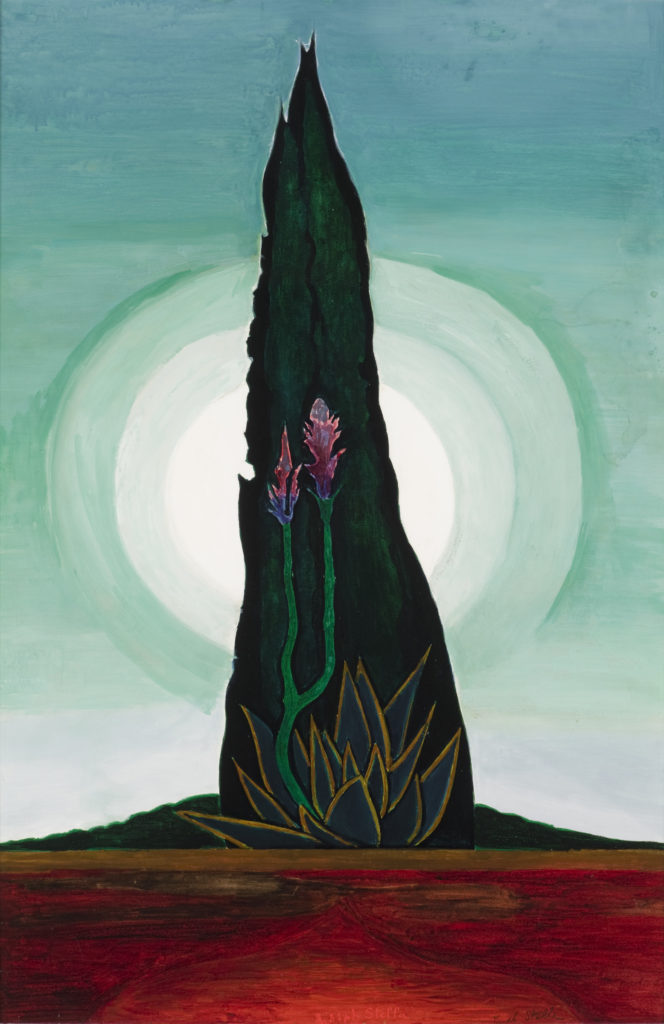
5.“Desert Blossoming” by Amit Majmudar: A reflection on the messianic promise of Isaiah 35:1–2, this poem celebrates how, through the deserts of Israel, Jesus “scattered his verses on the secretly gravid ground,” causing the wilderness to blossom. Majmudar mentions red, the color of fire (an image he connects to the light of faith), rhyming it with “bled.” Although he uses this final word in the sense of spreading into or through—oases bleeding into one another as dry land becomes water—one can’t help but think of Jesus’s sacrificial death, his blood extraordinarily fertile, producing life.
Joseph Stella (American, 1877–1946), Tree, Cactus, Moon, ca. 1928. Gouache on paper, 104.1 × 68.6 cm. Reynolda House Museum of American Art, Winston-Salem, North Carolina.
6.“Name One Thing New”by Seth Wieck: This six-line poem takes the Teacher of Ecclesiastes to task, responding to his cynical claim that “there is nothing new under the sun” (Eccles. 1:9) with a counterexample.
7.“For My Mother at Advent” by Brian Volck: The poet recalls a simple Advent tradition his mother established in his childhood and reflects on her spiritual legacy, her lifetime of Christ-inspired kindnesses that continue to pillow him. How might we soften the hardness of the world for others?
8. “Advent” by Suzanne Underwood Rhodes: This stunning poem makes unlikely intertextual connections, bringing Matthew 19:24 (one of Jesus’s hard sayings regarding wealth) to bear on John 1. Its unique angle on the Incarnation and its evocative imagery have inspired an experimental jazz composition and several paintings.
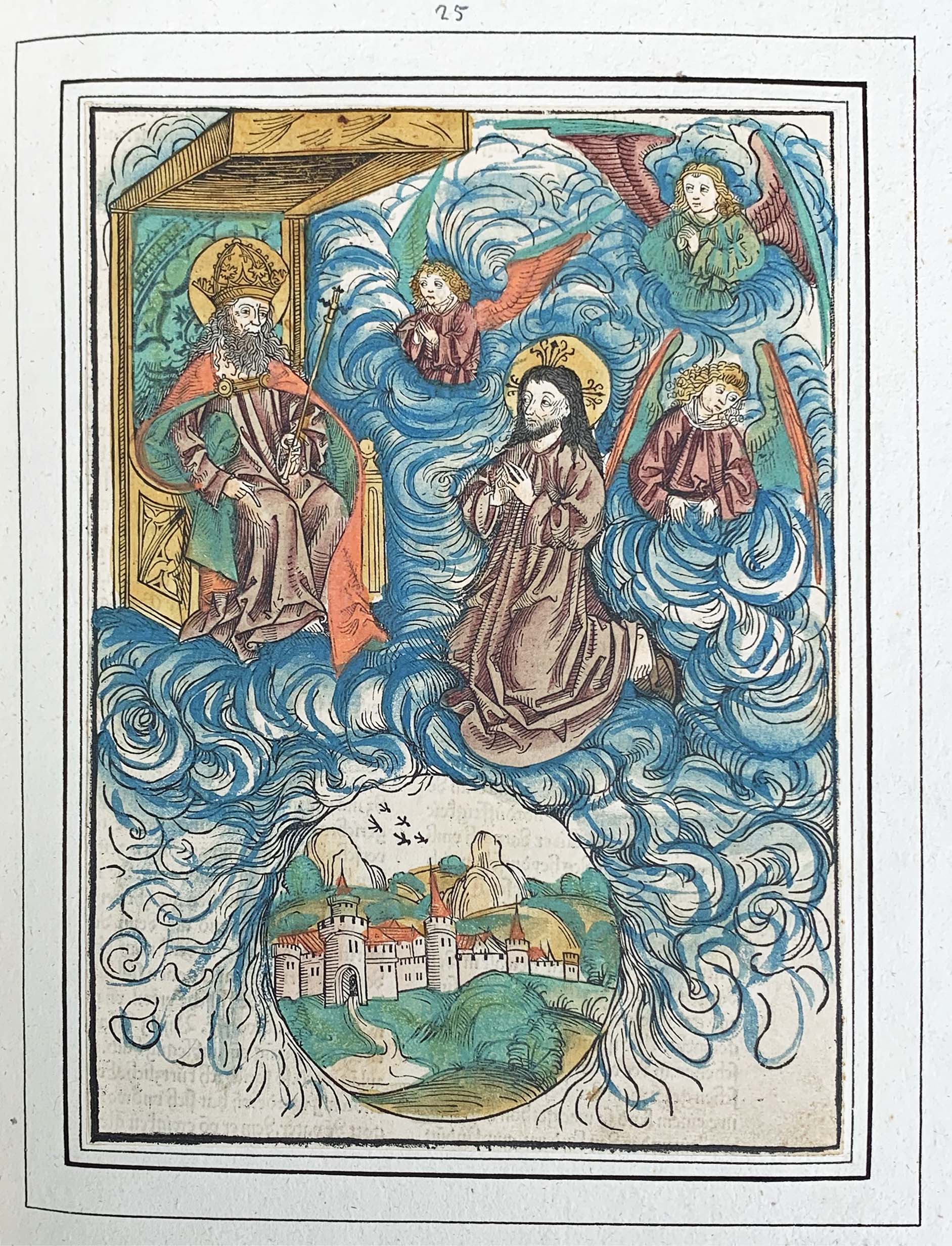
9. “An Hymn to Humanity” by Phillis Wheatley: “Lo! for this dark terrestrial ball / Forsakes his azure-pavèd hall / A prince of heav’nly birth!” So begins this poem on the Incarnation by Phillis Wheatley (ca. 1753–1784), the first African American to publish a book of poetry. In stanzas 2 and 3, God the Father dispatches the Son to establish his throne on earth, “enlarg[ing] the close contracted mind, / And fill[ing] it with thy fire.” The “languid muse” in stanza 5 refers to Wheatley herself, whereas the “celestial nine” are the ancient Greek inspirational goddesses of literature, science, and the arts. The “smiling Graces” is another classical reference.
Michael Wolgemut (German, 1434–1519), The Father sending the Son into the world, 1491. Hand-colored woodcut from the Schatzbehalter (published by Anton Koberger, Nuremberg), 43.7 × 27.5 cm. British Museum, London.
10. “In My Hand” by Sarah Robsdottir: Mary remembers the moment she conceived Jesus, one ordinary day when sitting down to a bowl of lentil stew.
Source: Aleteia, April 9, 2018
11. “The Risk of Birth, Christmas, 1973”by Madeleine L’Engle: Best known for her children’s novel A Wrinkle in Time, Madeleine L’Engle was also a poet. Here she compares our era to the one in which Jesus was born—both are characterized by violence and hate, and yet Jesus, the embodiment of divine love, willingly entered the peril.
12. “On Another’s Sorrow” by William Blake: Through the Incarnation, God lovingly, humanly, entered the world of human woe to experience it firsthand. “He doth give His joy to all,” Blake writes: “He becomes an infant small, / He becomes a man of woe, / He doth feel the sorrow too.” I featured this poem about Emmanuel, God-with-us, in a musical setting by singer-songwriter David Benjamin Blower in 2023 but was surprised that Blower omitted Blake’s final stanza, whose closing couplet I find striking, as it conveys Jesus’s continued identification with and compassion for humanity, how he moans alongside us in our suffering. For a different musical interpretation, also in an acoustic indie folk mode, see the one by Portland-based artist Michael Blake, from his 2021 album Songs of Innocence and Experience:
Source: Songs of Innocence and Experience (London, 1794). Public Domain.
13.“Missing the Goat”by Lorna Goodison: An immigrant from Kingston, Jamaica, to Toronto, Ontario, Goodison writes of the heightened feeling of exile but also of creative adaptations during the holidays as she tries to carry out the food traditions of her native country on a foreign soil where some of the ingredients are in more limited supply. For the sorrel wine, traditionally made with roselle (Hibiscus sabdariffa) petals, tropically grown, she has to make do with redbuds. And the local shops have run out of goat meat—“the host of yardies” (people of Jamaican origin) who’ve moved to the area have already bought it all up—so “we’ll feast then on curried some-other-flesh.” Despite the differences from home, Christmas is still Christmas, and she raises her “hybridized wassail cup” to her new place, her new neighbors (many of them, like her, also recent arrivals from the Caribbean), and the creation of new rituals in multicultural Toronto.
Source: Controlling the Silver (University of Illinois Press, 2010); compiled in Collected Poems (Carcanet, 2017)
14. “Word Made Flesh”by Kathleen Raine: Awarded the CBE (Commander of the Order of the British Empire) for her significant contributions to literature and culture, Raine has been described as a mystical and visionary poet. Here is her revoicing of John 1. What a powerful last two lines!
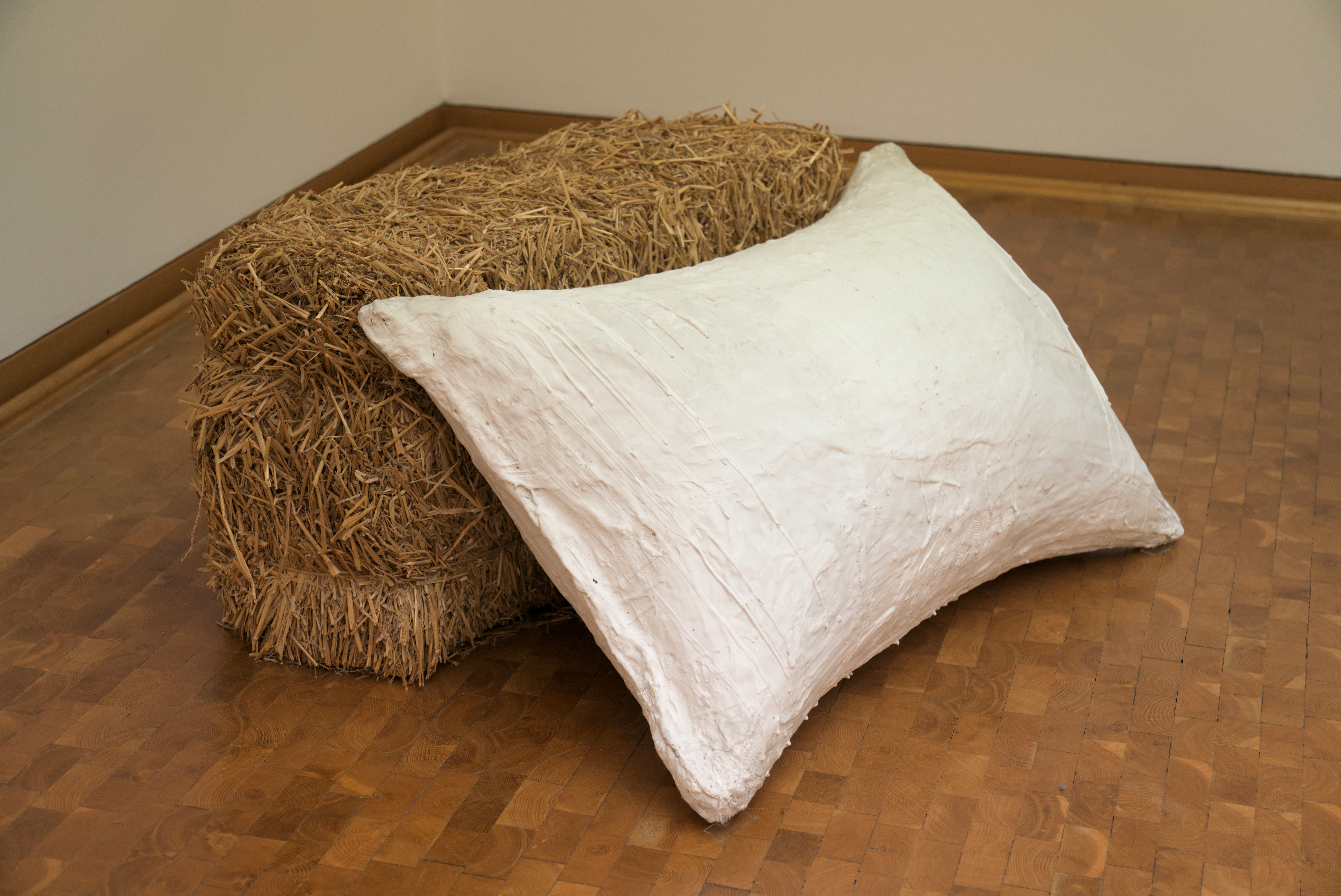
15.“Nativity”by Barbara Crooker: In the heavy dark, in the windy cold, “love is born in the world again” every December when we retell the story of Christ’s birth.
Gary Kuehn (American, 1939–), Straw Pillow, 1963. Straw, plaster. Ludwig Museum, Cologne, Germany, Inv. ML/SK 5185. Photo: Victoria Emily Jones.
16. “First Miracle”by A. E. Stallings: The first miracle Jesus performed, according to the Gospel of John, was turning water into wine. Stallings reflects on an earlier miracle performed by his mother’s body, and all birth-giving mothers’: turning nutrients from her blood into milk.
17.“What Sweeter Music Can We Bring” (or “A Christmas Carol, sung to the King in the Presence at Whitehall”)by Robert Herrick: “The Darling of the world is come”! Originally written as a song for soloists (each number corresponds to a different singer) and chorus, this poem reverses the typical seasonal imagery of Christmas, remarking how, at Jesus’s birth, “chilling Winter’s morn / Smile[s] like a field beset with corn” and “all the patient ground [is turned] to flowers.” The original music by Henry Lawes is lost, but many contemporary composers have written settings of the text, most famously John Rutter.
Source: Hesperides: Or, Works Both Human and Divine (London, 1648). Public Domain.
18.“Sharon’s Christmas Prayer”by John Shea: A five-year-old recounts the Christmas story, and when she reaches the clincher, she can’t hold back her glee.
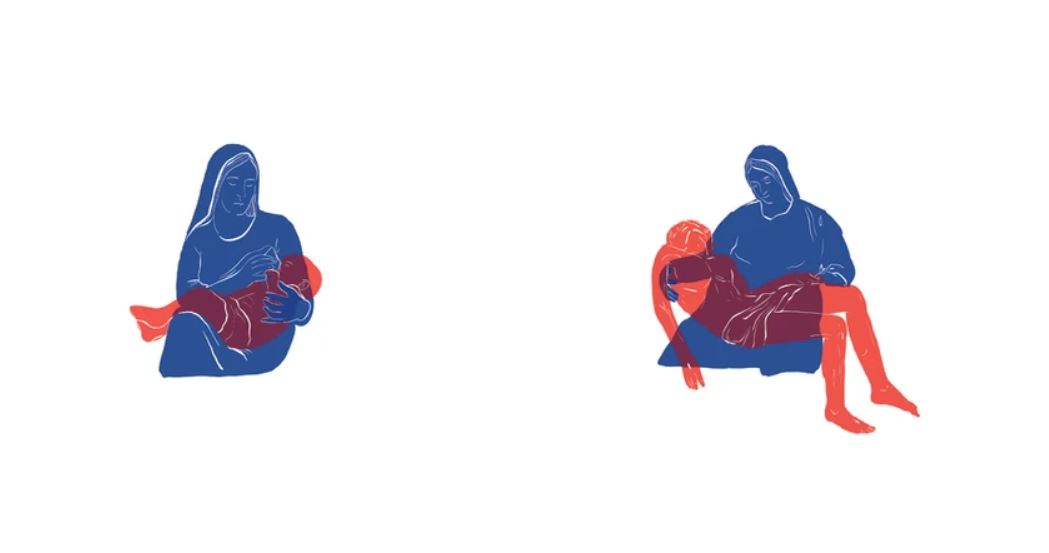
19.“God”by D. A. Cooper: Riffing on Williams Carlos Williams’s “The Red Wheelbarrow,” this spare poem attends to the birth and death of the incarnate God, upon which so much depends.
Source: Reformed Journal, September 3, 2024
Katarzyna Malinowska (Polish, 1989–), Juxtapose (diptych), 2021. Digital painting, 20 × 30 cm.
20. “Lullaby after Christmas”by Vassar Miller: The speaker wishes sweet sleep for the newborn Christ child, wishes to keep him innocent of his fate for as long as possible—for “even God has right to / Peace before His pain.” Consisting of four sestets whose second, fourth, and sixth lines rhyme, the poem has a sing-songy quality that is jarring for the juxtaposition of words like “soft,” “warm,” and “tinkling” with the likes of “blood,” “gore,” and “die.”
21. “Journey of the Magi”by T. S. Eliot: Eliot wrote this poem shortly after his conversion to Christianity in 1927. Opening with a passage from a Christmas sermon by the seventeenth-century Anglican bishop Lancelot Andrewes, it is from the perspective of one of the magi, who made a long, toilsome journey in search of the meaning of a mysterious guiding star. After the magi’s encounter with the Christ child, they would never be the same; their paganism would no longer satisfy. The poem is about the transformative impact Christ has on those with humility enough to see him for who he is (having followed the light of revelation) and to worship him accordingly. And that transformation is in some ways painful, as it involves giving up some of the things one once held dear.
“Were we led all that way for / Birth or Death?” the magus asks. Jesus’s wasn’t the only birth they witnessed; they, too, were (re)born in Bethlehem. But spiritual rebirth is also a sort of death—the magi died to their old selves and false loves and loyalties. Thus, when they returned to Babylon, they felt like strangers in a strange land. They were now citizens of a different kingdom, and filled with a longing for its consummation.
Source: Journey of the Magi (Ariel Poems) (Faber & Gwyer, 1927). Public Domain.
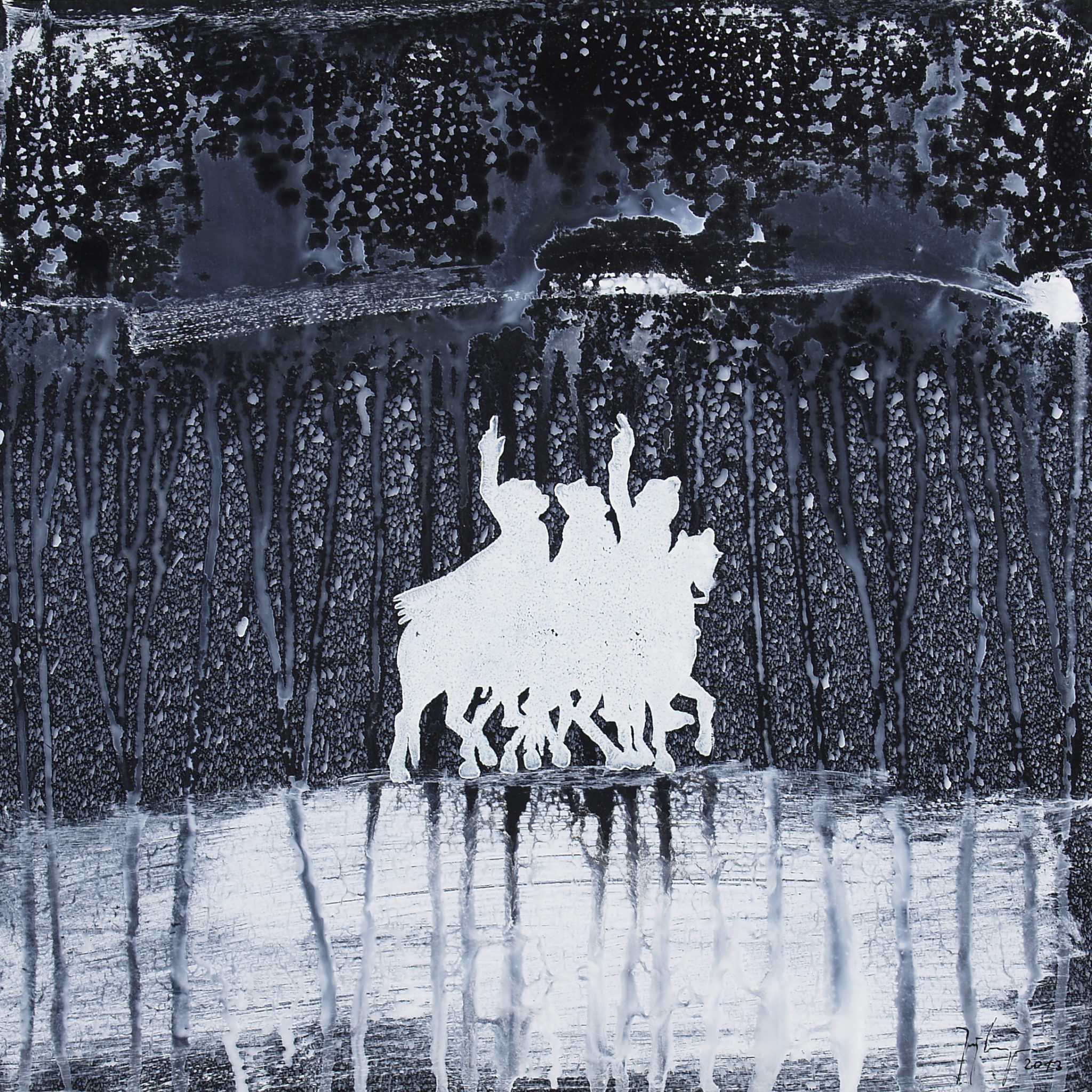
Jörg Länger (German, 1964–), The Three Kings, 2013. Linocut and gesso on aluminum dibond, 38 × 38 cm. The linocut is after a 12th-century illumination from the St Albans Psalter, held at the Dombibliothek, Hildesheim, Germany.
22. “Twelfth Night”by Sally Thomas: (Scroll to second poem.) As the Christmas season draws to a close, holly berries shrivel and drop, the “candles drown themselves in waxen lakes,” “the tree’s a staring corpse,” and a spider has built a web across the mantel nativity. Thomas uses the passing of the season to reflect more broadly on the passing of time and our own dustiness and desiccation—and by contrast, the unchangeability of God.
23. Untitled poemby S. E. Reid: Most reflections on the New Year are full of enthusiastic goal-setting and go-getting, but Reid, gardening in her greenhouse in the crisp cold of January, describes a “fall[ing] backwards,” “dropping into the dark,” “shivering,” herself a seed, latent in the soil, trusting God that growth will come.
24. “Anna the Prophetess” by Tania Runyan: Forty days after Jesus’s birth, Mary and Joseph presented him in the Jerusalem temple. Runyan imagines this event from the perspective of Anna, a woman who was widowed young and thenceforth lived at the temple into old age, devoted to prayer, fasting, praise, and prophecy.
25. “The Work of Christmas”by Howard Thurman: Drawing on Jesus’s mission statement in Luke 4, the great African American theologian and civil rights leader Howard Thurman urges us to continue the work of Christmas—finding, healing, feeding, etc.—throughout the year. Listen to the simple yet vigorous choral setting by Elizabeth Alexander.
Want to receive a daily pairing of art and music in your inbox during this Advent and Christmas season? Sign up here. (If you already subscribe to the blog, you’re all set.) Posts will run from November 29, the day before the first Sunday of Advent, to Epiphany on January 6. I have also planned a few poems and roundups to go out during that time.
Advent is my favorite season of the church year because it taps into the deep yearning I feel for this world to be set right, for God’s beauty to burst into it with an irrefutable finality—no more sin, no more sorrow. The season is a chance to practice hope, something I sometimes struggle with, as I tend to lean more cynical.
The readings, art, and music of Advent sweep me up into the grand narrative of scripture, attuning me to the ways God has always been coming to us, but fixing me especially on how in Bethlehem of Judea, he came in a very special way—as a human being—and nurturing my excitement for his imminent return to earth to wed it to heaven.
Advent themes include:
Lament and longing
Hope, peace, joy, love
Promise
John the Baptist, especially his call to repentance in preparation for the coming kingdom
The second coming of Christ (individual judgment, cosmic renewal)
The parable of the ten bridesmaids
The new heavens and the new earth
Isaiah’s messianic prophecies: a virgin conceiving, swords into plowshares, a peaceable kingdom, a great light shining on a people in darkness, a flowering branch from the root of Jesse, etc.
Pregnancy
Mary’s song
God with us
Based on these, I’ve curated dozens of visual and musical selections that I hope will make God’s story come alive to you in fresh ways. A thread installation, a soil-based performance, quilted detritus, a photograph from a war zone, confetti skies, stained glass oracles, a sixth-century apsidal mosaic from a Roman basilica, a medieval German New Year’s greeting by and for nuns, a Jemez Pueblo nativity in clay, a site-specific dance before a mural in Atlanta . . . these are some of the artworks that will be featured.
As for music, you’ll hear a classical setting of an Emily Dickinson poem, an adaptation of Psalm 27 by a Ugandan worship collective, a contemporary “Mass for Peace,” a Latin American song of the Annunciation, a dialogue between Mary and the infant Christ from Renaissance England, a responsory by the medieval polymath Hildegard of Bingen, offerings from many different singer-songwriters, and more.
Many of the songs will be drawn from my Advent playlist on Spotify, which I first published in 2020 but have been adding to each year:
If you know of anyone else who might be interested in an arts-based approach to Advent and Christmas devotions, please share with them the link to this post. You can peruse previous years’ entries to get a flavor:
I’m looking forward to sharing what I’ve curated for the start of this new liturgical year, as time unfolds across four hallowed weeks of expectant waiting and then Twelve Days of festivity and wonder.
From the compilation album To: Kate—A Benefit for Kate’s Sake, sung with Allison Moorer, 2005:
Once upon a time in a far-off land Wise men saw a sign and set out across the sand Songs of praise to sing, they traveled day and night And precious gifts to bring, guided by the light
They chased a brand-new star, ever towards the west Across the mountains far, but when they came to rest They scarce believed their eyes, they’d come so many miles And this miracle they prized was nothing but a child
Refrain: And nothing but a child could wash those tears away Or guide a weary world into the light of day And nothing but a child could help erase those miles So once again we all can be children for a while
Now all around the world, in every little town Every day is heard a precious little sound And every mother kind and every father proud Looks down in awe to find another chance allowed [Refrain]
Outro: Nothing but a little baby Nothing but a child
This is the final post in my 2024/25 Advent–Christmas series. Thanks for journeying with me! If you feel so led, please consider donating; I’ve been having trouble with the embedded Stripe form often rejecting credit cards and then WordPress disabling it (do any of you know of a secure but reliable credit card processor that does not require donors to make an account and that integrates well with WordPress?), but PayPal and Amazon are still options.
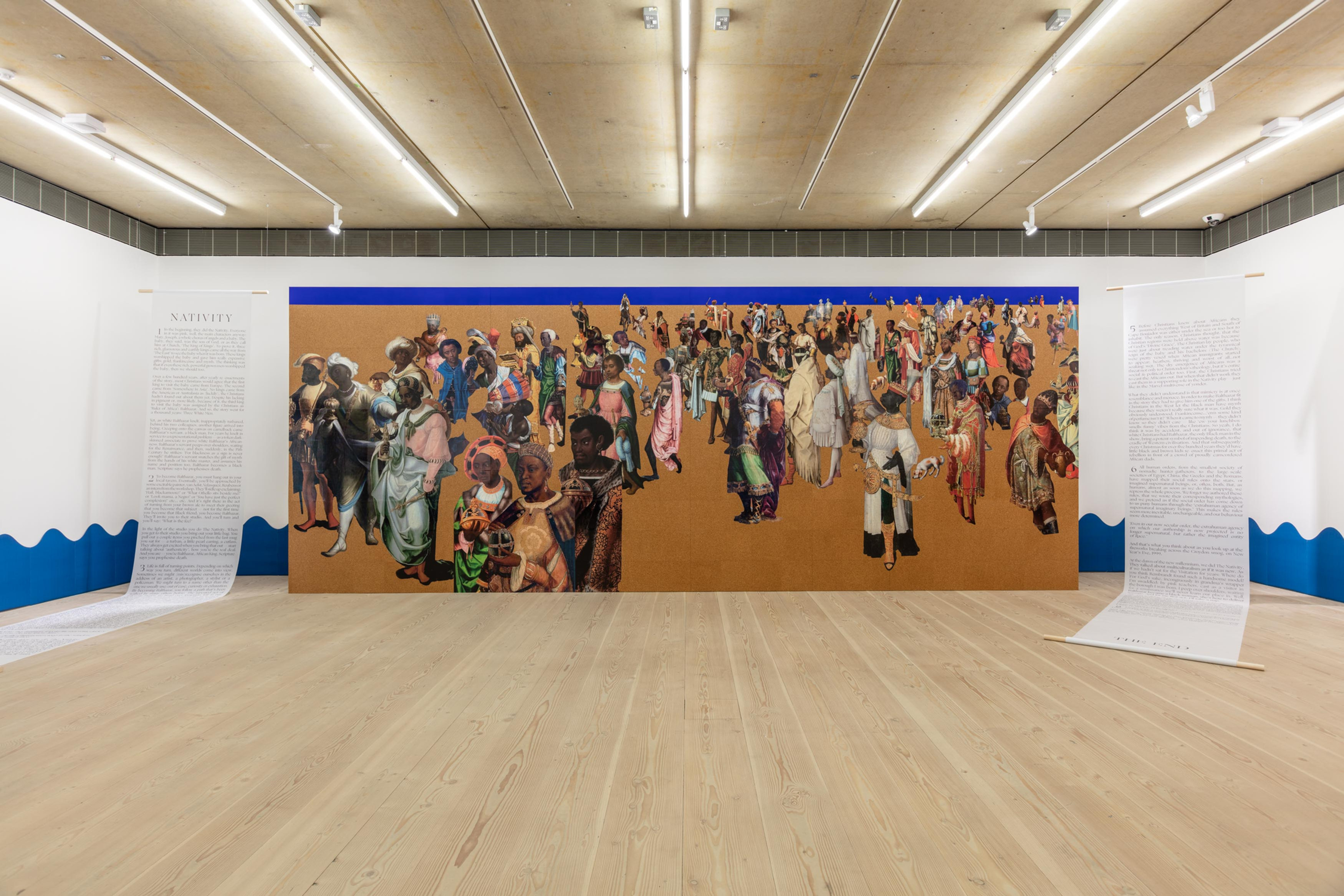
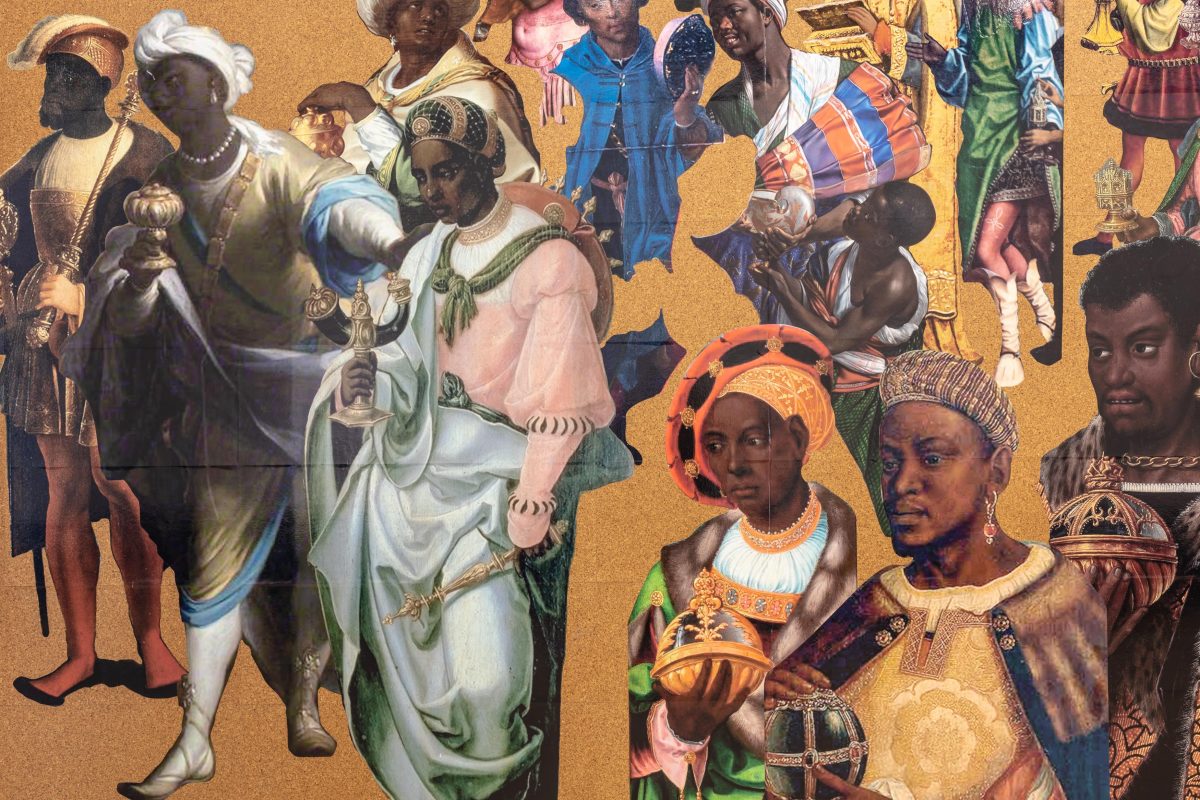
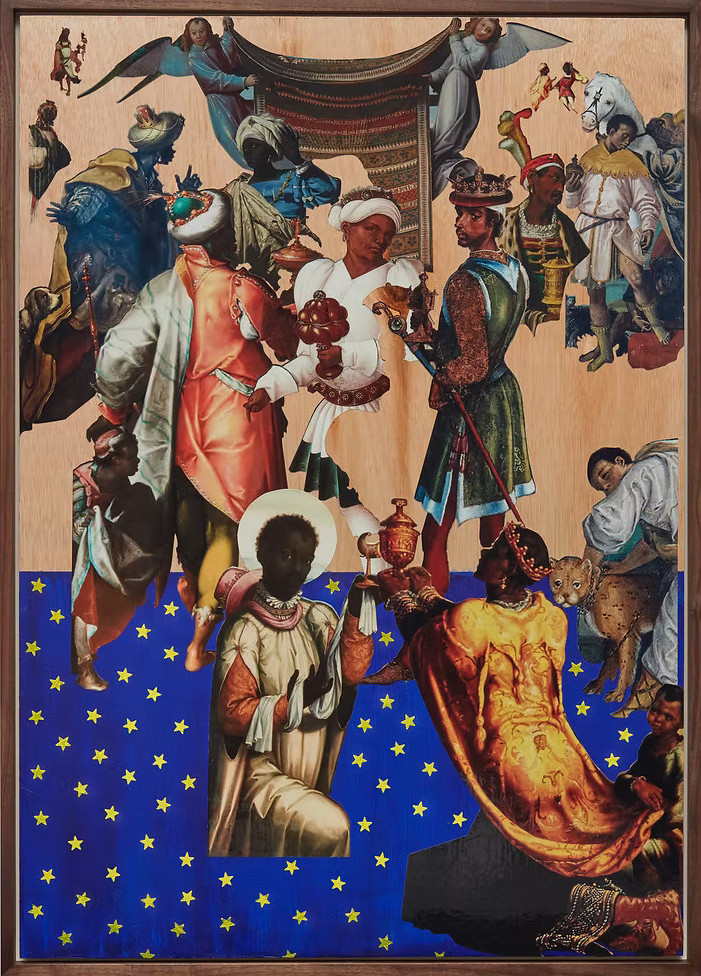
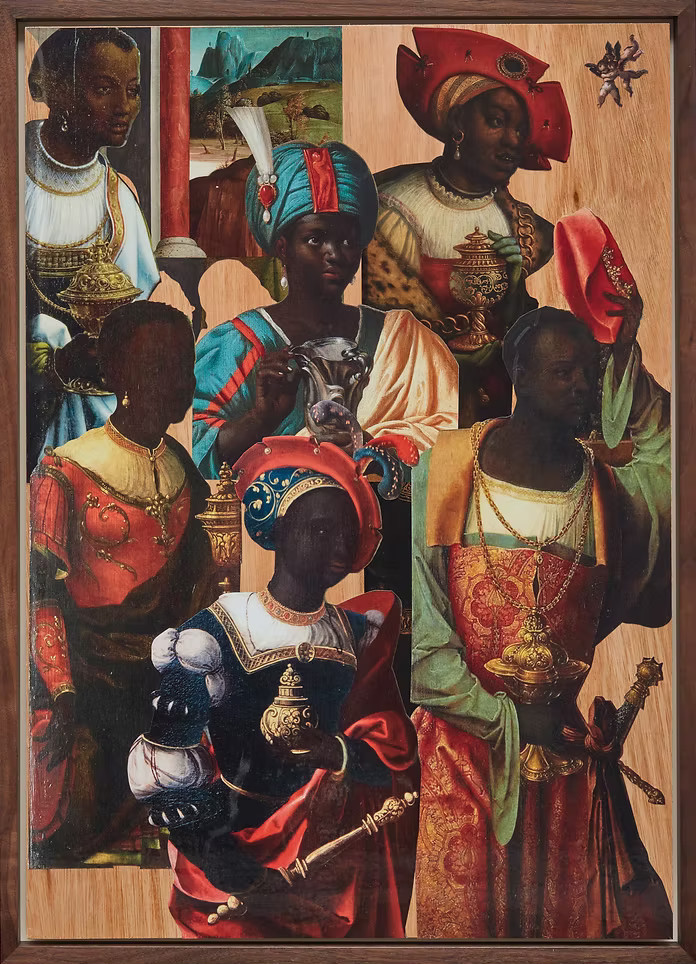
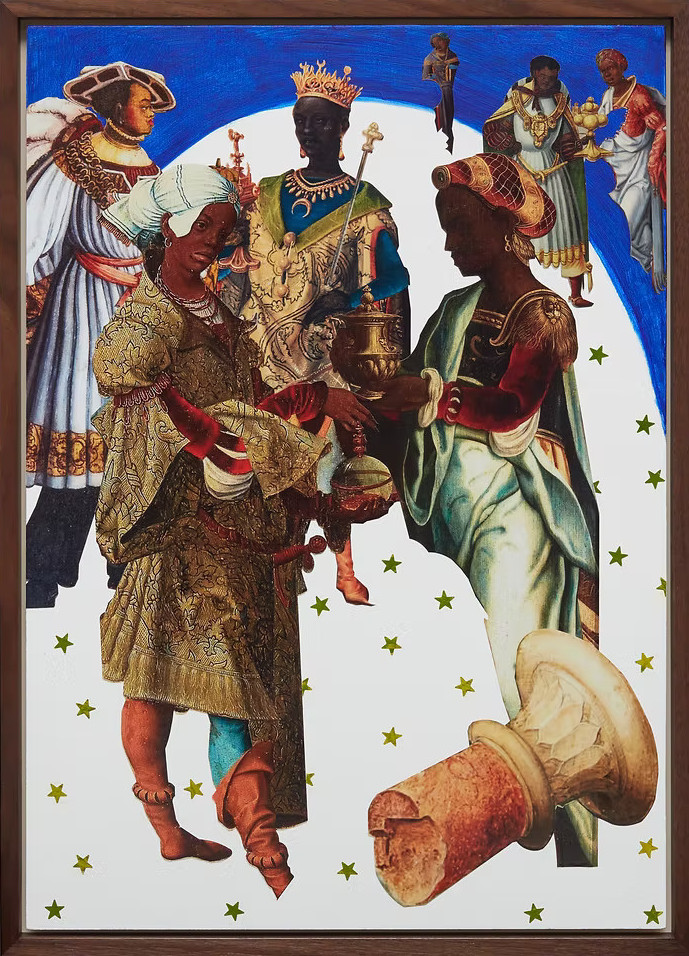
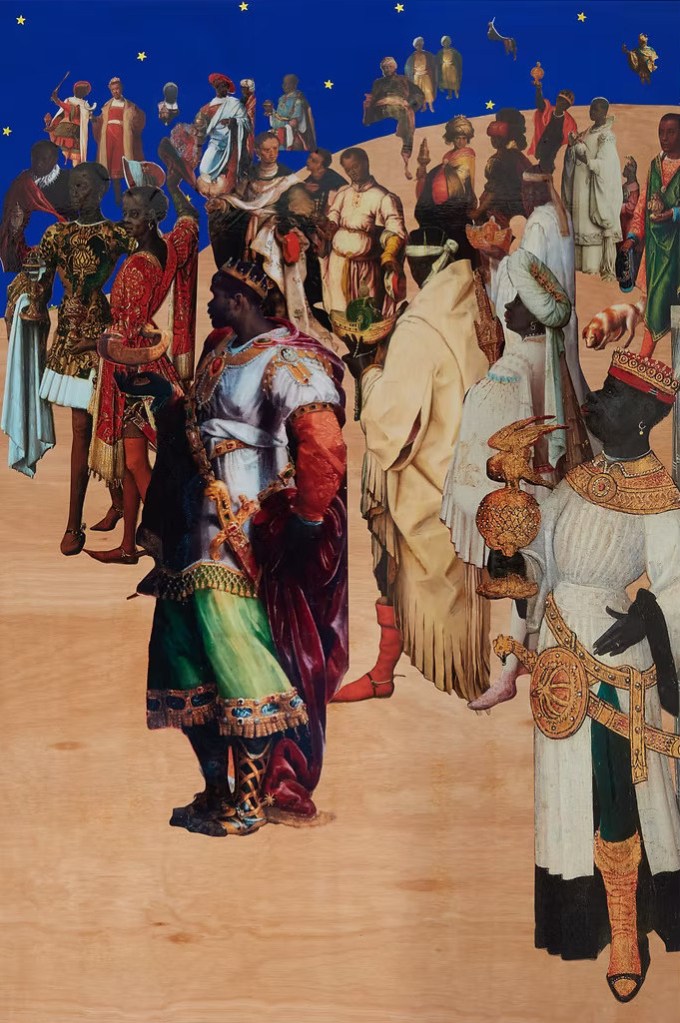
Rosa-Johan Uddoh (British, 1993–), Breaking Point, 2021. Billboard-style collage. Photo: Anna Lukala, from Practice Makes Perfect, Focal Point Gallery, Southend-on-Sea, England, May 18–August 28, 2021.Rosa-Johan Uddoh, Breaking Point (detail)
Rosa-Johan Uddoh is an interdisciplinary artist based in London who, “through performance, writing and multimedia installation, . . . explores places, objects and celebrities in British popular culture, and their effects on self-formation,” she writes on her website.
In her first institutional solo show, Practice Makes Perfect at Focal Point Gallery in Southend-on-Sea, she explored how the white European imagination constructed Blackness through the figure of Balthazar, who according to Christian tradition was one of the three magi who visited the infant Jesus, offering him the gift of myrrh. Since the fifteenth century Balthazar has typically been depicted as Black, as it was imagined that he came from Africa (whereas the other two magi were supposedly from Europe and Asia, the three known continents at the time). Uddoh notes that Balthazar is one of the first Black people of importance that British schoolchildren encounter, and in fact the first public performance she ever gave was as Balthazar in a primary-school Nativity play, a role she had been cast in by her teacher.
The centerpiece of the Practice Makes Perfect exhibition was Breaking Point, a billboard-sized mural that depicts 150 Black Balthazars extracted from European paintings from the late Middle Ages onward and rearranged into friendship groups. These groupings “allow Balthazar to escape the isolation associated with being the only Black character of importance in Christian iconography whilst also highlighting that the Black figures behind the artistic imagery were real sitters, which is also a testament to early African immigration into Europe, a phenomenon often overlooked in mainstream history.”
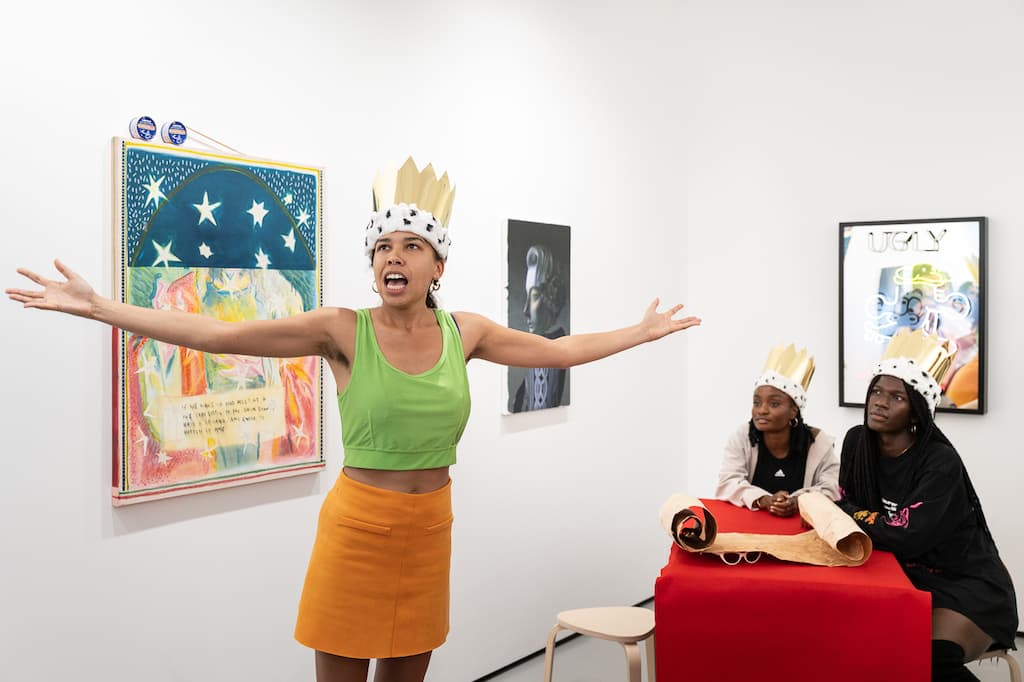
Installed on either side of Breaking Point was a scroll bearing a piece of experimental writing by Uddoh, titled Nativity. (She later performed this text in 2022 at the London art gallery Workplace, with Adeola Yemitan and Ebunoluwa Sodipo.) It opens, “In the beginning, they did the Nativity. Everyone in it was pink; well, the main characters anyway . . .”
Nativity, 2022, performance by Rose-Johan Uddoh with Adeola Yemitan and Ebunoluwa Sodipo at Workplace, London. Photo: Damian Griffiths.
In 2022 Uddoh expanded this body of work with another solo show, Star Power at Workplace. It featured the series You Can Go Ahead and Talk Straight to Me and I Sell the Shadow to Support the Substance (scroll through select images below), the artworks made of acrylic and vinyl on board. The former title is a quote from Toni Morrison’s 1975 speech “A Humanist View,” given at Portland State University as part of a public forum on the theme of the American Dream. The latter is a quote from Sojourner Truth—she wrote the phrase on the bottom of a self-portrait she took, selling copies of it across America to raise funds for her abolitionist activism.
Lastly, here’s an amusing collage from Practice Makes Perfect:
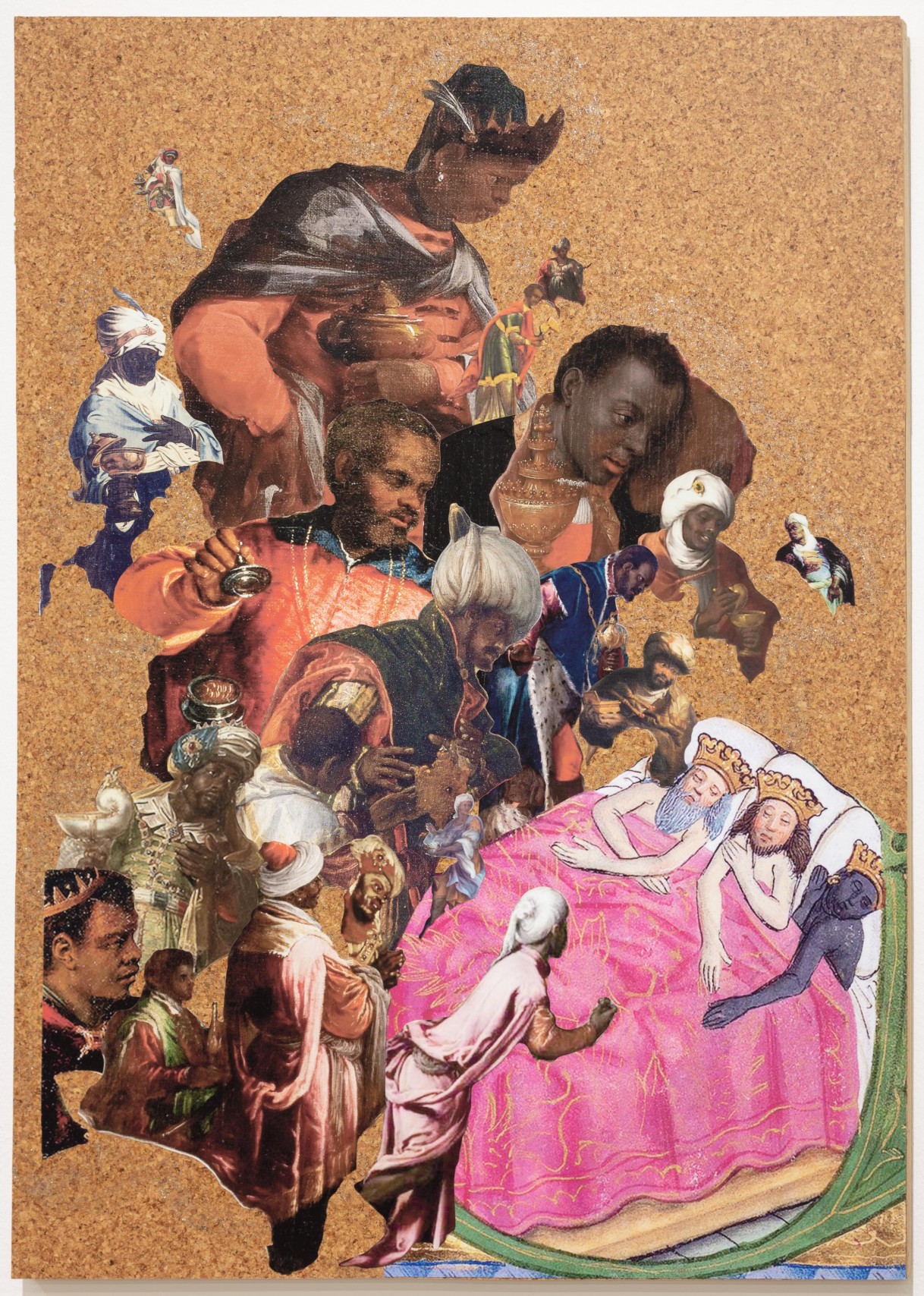
Rosa-Johan Uddoh, Get up mate, we’re going to the protest, 2021
The image of the three kings in bed is taken from the ca. 1480 Salzburg Missal. (In the original they’re inside an initial E, which introduces the text for the introit for the Feast of the Epiphany, “Ecce advenit dominator Dominus.”) In the Middle Ages it was common for artists to depict the magi in bed together when they receive the angelic warning not to reveal the location of the baby Jesus to King Herod, who intends to harm him (Matt. 2:12). There’s nothing sexual about it—it’s just a compositional practicality, to show the three men in one space, having the same dream at the same time.
In Uddoh’s playful remix, she has a slew of Balthazars leaning over the bed to wake up their sleeping comrade so that he can join them in a protest for racial justice.
LISTEN: The Ballad of the Brown King by Margaret Bonds, 1954, rev. 1960 | Words by Langston Hughes, 1954/60 | Arranged by Malcolm J. Merriweather for strings, harp, and organ, 2018 | Performed by the Dessoff Choirs and Orchestra, dir. Malcolm J. Merriweather, on Margaret Bonds: The Ballad of the Brown King and Selected Songs, 2019 (soloists: Laquita Mitchell, soprano; Noah Stewart, tenor; Lucia Bradford, mezzo-soprano; Ashley Jackson, harpist)
I encourage you to listen to all nine movements! (The piece is twenty-five minutes long.) But if you want just a taste for now, here are two selections: movements 1 and 7.
I. Of the Three Wise Men
Of the three wise men who came to the King One was a brown man, so they sing Alleluia, Alleluia
Of the three wise men who followed the star One was a brown king from afar Alleluia, Alleluia
. . .
VII. Oh, Sing of the King Who Was Tall and Brown
Oh sing of the king who was tall and brown Crossing the desert from a distant town Crossing the desert on a caravan His gifts to bring from a distant land His gifts to bring from a palm tree land Across the sand by caravan With a single star to guide his way to Bethlehem To Bethlehem where the Christ child lay
Oh sing of the king who was tall and brown And the other kings that this king found Who came to put their presents down In a lowly manger in Bethlehem town Where the King of kings a babe was found The King of kings a babe was found Three kings who came to the King of kings And one was tall and brown
Margaret Bonds (1913–1972) was an African American composer, pianist, arranger, and teacher, best remembered for her popular arrangements of African American spirituals and her frequent collaborations with her friend Langston Hughes, especially the cantata The Ballad of the Brown King.
Dedicated to Rev. Dr. Martin Luther King Jr., The Ballad of the Brown King honors the African king Balthazar of Christian tradition, a figure extrapolated from the Gospel of Matthew’s account of the “wise men from the east” who came to worship the Christ child and bestow gifts. Bonds wanted to celebrate the wisdom and devotion of this dark-skinned brother, and his active presence at the Nativity, giving “the dark youth of America a cantata which makes them proud to sing,” she wrote in a letter.
She commissioned Hughes to write the libretto. She wrote to him, “It is a great mission to tell Negroes how great they are.” Remember, this was at the burgeoning of the civil rights movement. There were very few images of Black wealth and admirability being projected by mainstream culture at the time. Balthazar was an exception.
Regardless of the racial accuracy, this narrative [of an African king participating in the story of Christ’s birth] gives African Americans a positive image rarely portrayed in history, books, and art. A brown sovereign, traveling in majesty and splendor? It is unheard of. African Americans are not just descendants of slaves; we come from great kings or queens that ruled kingdoms with sophisticated political and economic systems on the continent of Africa.
The initial version of The Ballad of the Brown King premiered in December 1954, but Bonds and Hughes later revised and expanded it. The new version premiered December 11, 1960, at the Clark Auditorium of the YWCA in New York, sung by the Westminster Choir of the Church of the Master. The concert was presented as a benefit for the Southern Christian Leadership Conference.
The cantata is made up of nine movements with parts for soprano, tenor, baritone, and choir. Stylistically, the work has been described as neo-Romantic, but it also draws on gospel, jazz, blues, and calypso traditions.
The only commercial recording ever made of it is the one released by Avie Records in 2019. Newly arranged by Malcolm J. Merriweather, the piece is performed there by the Dessoff Choirs and Orchestra under Merriweather’s direction.
Bonds had scored the cantata for full orchestra—brass, woodwinds, strings (including harp), and percussion. But because hiring an orchestra of that size is expensive and he wants to see this work more widely performed, including in church contexts, Merriweather arranged the piece for a pared-down ensemble of harp, strings, and organ, omitting the winds and brass (whose parts he essentially absorbed into the new organ part). He also enlivened the harp part to add texture.
For more context on Bonds and on this most popular cantata of hers, here’s a great thirty-minute conversation between John Banther and Evan Keeley from a 2022 episode of the Classical Breakdown podcast, produced by WETA Classical in Washington, DC:
BLOG POST: “On the Twelfth Day of Christmas: 12+ ways to keep celebrating with the rest of the world (loads of links!)” (Watch & Do for Twelfth Night and Epiphanytide) by Tamara Hill Murphy: In this blog post from 2019, spiritual director and writer Tamara Hill Murphy has compiled a wonderful roundup of resources for Twelfth Night (January 5) and the Feast of Epiphany (January 6), on such things as chalking the door, stargazing, making origami Christmas stars, baking a Three Kings Cake, Three Kings Day parades, Christmas tree bonfires, and more. She shares several videos, including this one of Denis Adide reading “The Journey of the Magi” by T. S. Eliot, shot in locations around Bristol:
I really love this unique rendition, which, with all its dissonance, is different from all the others I’m familiar with. James Johnson, one of the YouTube commenters on the video, writes: “I think this rendition is transporting. Listen to it. Close your eyes and you can feel the hot dry wind of the desert blowing in your face. You may wonder why make this trip at all, and then, that star. That amazing star. Yep, we can make it past a few more dunes, beyond Herod, and on to . . . ‘a manger’? And the rhythm section just pushes me on. . . . This earthly trinity, Melchior, Caspar, and Balthazar, are the hippest trio in Jerusalem and I want to go where they go, know what they know.”
This performance appears on the orchestra’s live album Big Band Holidays (2015) [previously].
+++
NEW ARTWORK: Christmas in the Air Raid Shelter by Olya Kravchenko: For Christmas 2024, with Russia still deploying cruise missiles and suicide drones against Ukraine, Ukrainian iconographer Olya Kravchenko constructed a three-dimensional painting that shows the Holy Family huddled in the basement of an apartment complex, hiding out from air raids. A large, bright star hovers overhead, showing the three magi to the spot where Jesus lies.
Olya Kravchenko (Ukrainian, 1985–), Christmas in the Air Raid Shelter, 2024. Plywood, tempera, and gilding, 67 × 40 × 25 cm.
This piece can be seen through January 26 at the eighty-fourth annual Krippenausstellung (Nativity Scene) exhibition at RELiGIO: Westfälisches Museum für religiöse Kultur (Westphalian Museum of Religious Culture) in Telgte, Germany, whose theme is “Heller Stern” (Bright Star).
+++
SONG: “Magi, Kings of Persia” by Michael Adamis, from the suite 4 Christmas Idiomela: Performed by Cappella Romana under the direction of Alexander Lingas, this choral piece by the Greek composer Michael Adamis (1929–2013) is a setting of an Eastern Orthodox liturgical text for Christmas that translates to:
The magi, kings of Persia, manifestly recognizing the King of heaven who was born on earth, arrived in Bethlehem, led by the radiant star, bearing choice gifts of gold, frankincense and myrrh; and falling down, they offered worship, for they beheld the Timeless One lying in the cave as a babe.
The video is from Cappella Romana’s 2020 Christmas concert.
+++
BLOG POST: “‘So glorious a gleam, over dale and down’” by Eleanor Parker: Medievalist Eleanor Parker shares two medieval English carols (text only; the original music does not survive) about the visit of the magi, a popular theme in that era. She translates them into modern English and provides commentary.
About 88 percent of the population of the Philippines is Christian—it’s the only Asian country where Christianity predominates—and Christmas is the most festive holiday of the year.
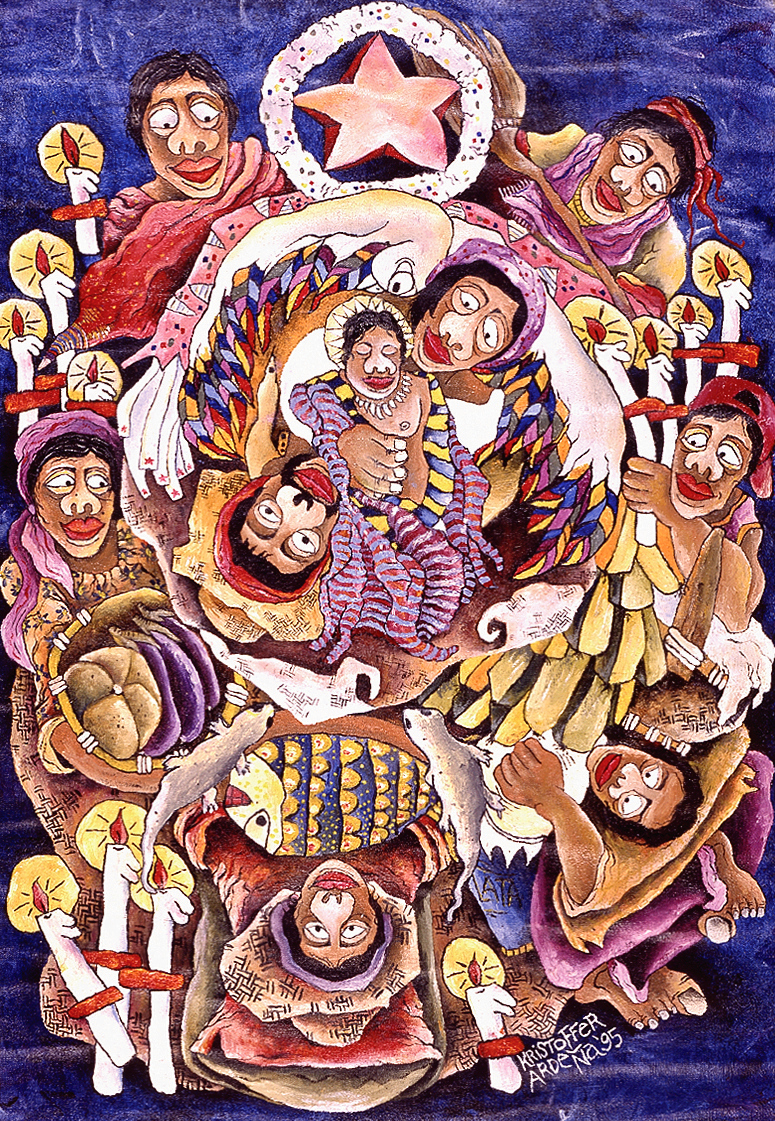
Filipino artist Kristoffer Ardeña celebrates the Christmas story and its ongoing impact in his painting Ang Kahulugan ng Pasko, which translates to “The Meaning of Christmas.” He wrote the following extended statement about it for the December 1996 issue of Image: Christ and Art in Asia, a publication of the Asian Christian Art Association. From what I can tell, this organization is no longer active.
Christmas—what does it really mean to us? Parties, extravagant decorations, frivolous gifts and all those materialistic things—do they manifest the true meaning of Christmas?
Sometimes we get so used to celebrating Christmas that we forget the truth behind it. In my painting Ang Kahulugan ng Pasko I want to express what Christmas means to me and to the ordinary people whom we hardly notice.
The Christmas lantern
The most popular Philippines Christmas symbol is the star lantern, or parol (see top of artwork). All that is needed to make a star lantern are ten long and five short bamboo sticks, string, starch and paper.
Although rice paper was traditionally used to cover the lantern, nowadays Japanese paper, foils or plastics are used and bulb lights have replaced the traditional candle inside the lantern.
The star lantern is a Filipino innovation of the Mexican piñata which was introduced to our country during the Spanish colonial period.
The five-pointed star lantern represents the star of Bethlehem. Stars produce the elements that make life possible, and in death they sow the seeds of new stars and planets across the heavens. The earth is built in part from the ashes of dead stars, and I think human beings are literally star children. We and all other life forms are collections of atoms forged in stellar furnaces.
It was through this star that the shepherds and the magi were guided, and it may well be the same star that calls us to remember and beckons us to search for the child in the manger—for he is the truth behind Christmas.
By living and dying, a star generates new worlds; the life and death of the infant that the star of Bethlehem symbolises created a new spiritual world.
The banig, or native handwoven mat
The banig is made from abacca, buri or other dried plant fibres woven together. Motifs and designs differ regionally. The banig is where gatherings happen. It is placed on the ground so that rituals, dialogues, recreation or mere eating sessions may occur. It calls us together, it draws us to gather.
The candles
The use of votive candles most probably came from the Roman practice of burning candles as a mark of respect to a person, and in this painting the candles symbolise respect for Christ. But there is more to a candle. It is believed that candles are also a form of prayer.
During fiestas and other holy occasions we offer candles, and we light candles during birthdays or when we visit our dear departed loved ones.
The bananas
During Christmas our front doors are adorned with three bunches of bananas still attached to their stalks. They are placed there during the Advent season and are not taken down before Epiphany. These bananas represent the Holy Family.
Whenever the visitors come to our home we offer them some of these bananas because we believe that these bananas have been blessed by God and that we should share His blessings with others.
I included these bananas as well as the star lantern in this painting because, just like my ancestors, I believe they add meaning to Christmas.
The people surrounding the Holy Family
(1) The northern tribesman of Luzon and the Metro Aide worker (the one who sweeps and keeps our streets clean). These two represent the people both near (the Metro Aide worker) and far (the tribesman) who have been guided by the star to bear witness to the birth of Jesus, just as the shepherds were led to the manger to pay homage to the king.
I chose the Metro Aide worker because I feel that we get used to his presence when he cleans our streets and we hardly take notice of him or thank him for what he does; yet here he is with his broom, giving praise and thanks.
(2) The fisherman, the vegetable vendor and the balut (duck egg) vendor. The Magi brought gold, incense and myrrh, and here are the fisherman with his best catch, the vegetable vendor with her freshest and best vegetables and the balut vendor with the best duck eggs to offer Jesus.
I placed these people in the painting rather than the rich and extravagantly dressed because I believe that Christmas is universal and for everybody. It is not only for the rich but for the modest poor people as well.
The offering we give to Jesus is not merely an act of human generosity; it is a religious act. It is an act which is sacramental and sacrificial. We have worked on these gifts, and we bring them to Jesus and offer them and offer ourselves.
(3) The comanchero. He is the “marine” of Christmas, the first to welcome and the last to go. He is the caroller. He sings and plays his instruments to the tune of Christmas songs to announce Christmas.
He uses ethnic as well as indigenous instruments—tambourines made of beer bottle caps, drums made of cans and cloth, maracas made of coconut shell with mango seeds inside. Just as the vendors offer their goods, he offers his songs to Jesus.
The dove and house lizards
Just as there were cows, horses and many farm animals, the dove and house lizards in this painting represent more than that. They are there to bear witness to this glorious event. The dove, which is the universal symbol of peace, unveils yet embraces the Holy Family.
With regard to the house lizards, I adhere to the superstition that every day at six in the evening they come down from the ceiling to kiss the floor in reverence to God. This belief tells me that we human beings, stewards of God’s creation, must do more than that.
La Sagrada Familia (The Holy Family)
In this painting I represented Joseph as a farmer and Mary as his wife. Jesus is wrapped in striped layette cloth distinctive to the Igorot tribe of Luzon, and as a sign of kingship he wears a necklace made of animal bones, which is characteristic of an Igorot chieftain.
LISTEN: “Ang Pasko Ay Sumapit” (Christmas Has Arrived) | Tagalog words by Levi Celerio, 1950, based loosely on a 1933 Cebuano carol text, “Kasadya Ning Takna-a,” by Mariano Vestil | Music by Vicente Rubi, 1933 | Performed by the Bayanihan Philippine Dance Company on A Philippine Christmas, 1964, reissued 1991
Ang Pasko ay sumapit
Tayo ay mangagsiawit
Ng magagandáng himig
Dahil sa ang Diyos ay pag-ibig

Nang si Kristo’y isilang
May tatlóng haring nagsidalaw
At ang bawat isá ay nagsipaghandóg
Ng tanging alay

Koro:
Bagong Taón ay magbagong-buhay
Nang lumigayà ang ating Bayan
Tayo'y magsikap upang makamtán
Natin ang kasaganaan!

Tayo’y mangagsiawit
Habang ang mundó'y tahimik
Ang araw ay sumapit
Ng Sanggól na dulot ng langit

Tayo ay magmahalan
Ating sundín ang Gintóng Aral
At magbuhát ngayon
Kahit hindî Paskô ay magbigayan!
Christmas has come
Come, let us go forth singing
Beautiful hymns
For God is love

When Christ was born
There were three kings who did visit
And each one did present
A unique offering

Refrain:
’Tis New Year, so we must reform our lives
That our nation might be joyful
Let us strive that we might achieve
Prosperity

Come, let us go forth singing
While the world is silent
The day has arrived
Of the Infant sent from heaven

Let us love one another
May we follow the Golden Rule
And from now on
Though it not be Christmas, let us keep giving [source]
I really like the recording above, which has rollicking instrumentation to back the voices, but here’s an a cappella performance that’s also good, from 2006, by the Philippine Madrigal Singers:
He has come, the Christ of God: Left for us his glad abode; Stooping from his throne of bliss To this darksome wilderness.
Refrain 1: He has come, the Prince of Peace: Come to bid our sorrows cease; Come to scatter with his light All the shadows of our night.
He, the mighty King, has come, Making this poor earth his home: Come to bear our sin’s sad load, Son of David, Son of God.
Refrain 2: He has come, whose Name of grace Speaks deliverance to our race: Left for us his glad abode, Son of Mary, Son of God.
Unto us a Child is born: Ne’er has earth beheld a morn, Among all the morns of time, Half so glorious in its prime.
Refrain 3: Unto us a Son is given: He has come from God’s own heaven, Bringing with him from above Holy peace and holy love.
While he was a worship pastor at Bayou City Fellowship in Houston, Ryan DeLange wrote a new tune for this nineteenth-century Christmas hymn by Horatius Bonar, a Scotsman who is best known for “Be Still, My Soul.” To hear DeLange discuss what drew him to this hymn, see season 2, episode 2 of the Hymnistry podcast, which aired December 5, 2016. He performs the song at 9:22 of the episode, and at 27:01, Pastor Jacob Breeze charges listeners to “keep the party going” for all twelve days of Christmas.
The 2016 video above is from Scarlet City Church in Columbus, Ohio. The singer is Janelle Jackson, and she’s accompanied on guitar by Rev. Mike Juday, who was the church’s music pastor at the time but who is now the associate rector of Village Church Anglican in Greenville, South Carolina.
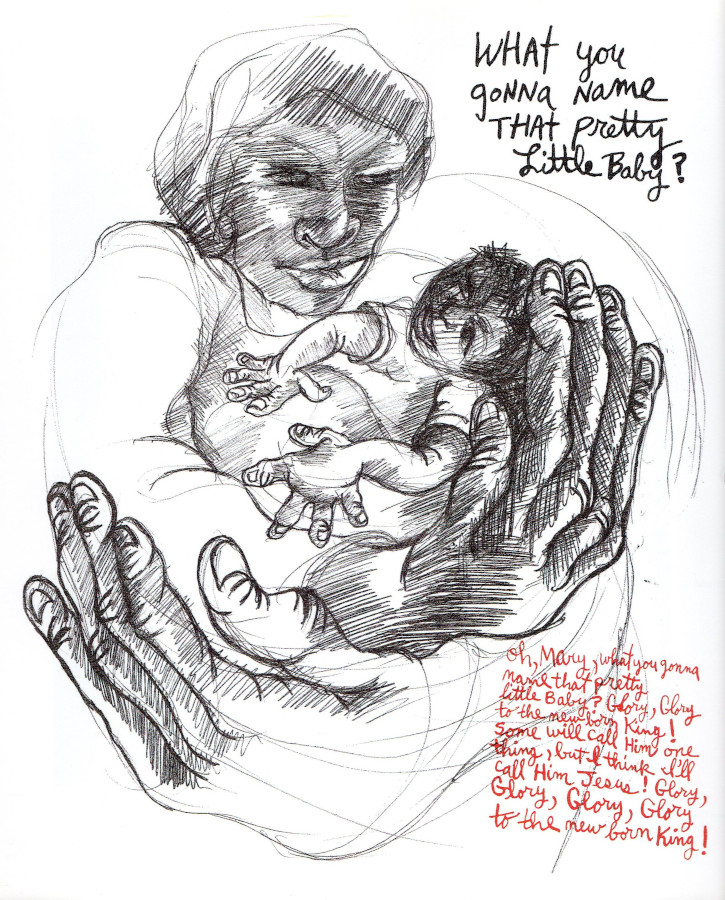
Aminah Brenda Lynn Robinson (1940–2015) was an artist working in multiple media whose work celebrates Black history and culture. She was a lifelong resident of Columbus, Ohio, and bequeathed her art, writings, home, and personal property to the Columbus Museum of Art, who established the Aminah Robinson Legacy Project in 2020.
The drawing above is one of twenty-six from Robinson’s excellent book The Teachings: Drawn from African-American Spirituals (Harcourt Brace Jovanovich, 1992). These drawings, she writes in the introduction, “have grown from the stories and songs that were given to me by my family and my early teachers, and I offer them here to the children of today’s troubled world and the children of tomorrow. They carry a message of dignity, knowledge, and wisdom . . . speak of survival, of freedom and determination, of love and faith, of justice and of hope . . .”
The artist’s estate is represented in the US by Fort Gansevoort in New York, which is currently showing Aminah Brenda Lynn Robinson: Character Studies through January 25.
Another exhibition of her work, Aminah Robinson: Journeys Home, a Visual Memoir, will be touring nationally for the next few years: to the Springfield Museum of Art in Ohio (February 1–July 13, 2025), the Newark Museum of Art in New Jersey (October 16, 2025–March 1, 2026), the Mobile Museum of Art in Alabama (March 26, 2026–January 9, 2027), and two remaining venues to be announced. This is a major exhibition that brings together Robinson’s drawings, prints, paintings, textiles, collages, homemade books, dolls, “hogmawg” sculptures (made of a mixture of mud, clay, twigs, leaves, lime, animal grease, and glue), and “RagGonNon” pieces (monumental swaths of fabric encrusted with buttons, beads, and other found objects) to create a portrait of her life.
LISTEN: “Mary, What You Gonna Name That Pretty Little Baby?,” African American spiritual | Arranged by Alex Bradford, 1961 | Performed by Princess Stewart and Marion Williams on Black Nativity: Gospel on Broadway! (Original Broadway Cast), 1962
Mary, Mary, what you gonna name that pretty little baby? Mmm, mmm, pretty little baby Mmm, mmm, pretty little baby Glory be to the newborn King
Some call him one thing, I think I’ll call him Jesus Mmm, mmm, sweet Jesus Mmm, mmm, (ain’t he sweet?) sweet Jesus Glory be to the newborn King
Some call him Jesus, I think I’ll call him Wonderful Mmm, mmm, wonderful Mmm, mmm, he’s so wonderful Glory be to the newborn King
Some call him Wonderful, I think I’ll call him Emmanuel Mmm, mmm, King Emmanuel Mmm, mmm, (ain’t he the king?) Emmanuel Glory be to the newborn King
Some call him Emmanuel, I’m gonna call him the Prince of Peace Mmm, mmm, Prince of Peace Mmm, mmm, Prince of Peace Glory be to the newborn King
Some call him Prince of Peace, I’m gonna call him Jesus Mmm, mmm, sweet Jesus Mmm, mmm, (ain’t he sweet?) sweet Jesus Glory be to the newborn King
Mary, Mary, what you gonna name that pretty little baby? Mmm, mmm, pretty little baby Mmm, mmm, pretty little baby Glory be to the newborn King
This Christmas spiritual, a dialogue between an unnamed visitor and the new mother Mary, has been recorded by many artists. I think I like the original cast recording from the Langston Hughes musical Black Nativity best, featuring soloist Princess Stewart on the first verse and Marion Williams on the remaining six, backed by the Stars of Faith.
But here’s a handful of other versions I like. Because the song was passed down orally, it has taken on different lyrical variations and accrued new verses. Some reference the wise men.
>> “The Virgin Mary Had One Son” by the Staple Singers, arr. Roebuck “Pops” Staples, on The 25th Day of December (1962):
>> “The Virgin Mary Had One Son” by Josh Garrels, on The Light Came Down (2016):
>> “What ’Cha Gonna Call the Pretty Little Baby” by the National Lutheran Choir, dir. David M. Cherwien, arr. Ronald L. Stevens, on Christ Is Born (2016):
>> “Glory to the Newborn King” by Chicago a Cappella, dir. Jonathan Miller, arr. Robert Leigh Morris, on Holidays a Cappella Live (2002):
>> “Virgin Mary Had One Son” by Joan Baez and Bob Gibson, live at the 1959 Newport Folk Festival (see also “Virgin Mary,” a bonus track on the 2001 Vanguard reissue of Baez’s 1966 album Noël):
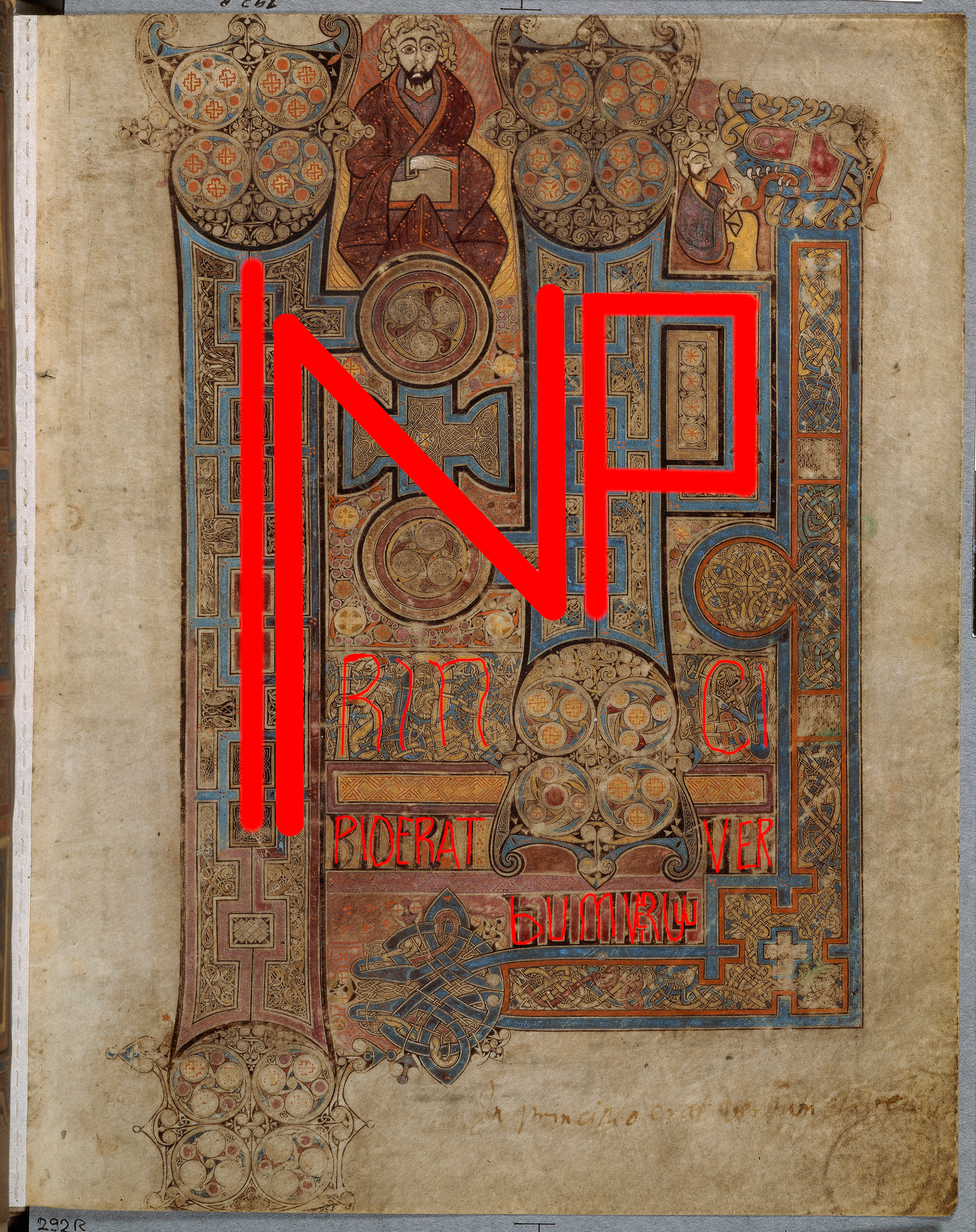
LOOK: Incipit to the Gospel of John from the Book of Kells
Incipit to the Gospel of John, Book of Kells, ca. 800. Trinity College Dublin MS 58, fol. 292r.
Made by Celtic monks in a Columban monastery around the year 800, the Book of Kells—an illuminated Gospel book named after the monastery of Kells in County Meath, Ireland, where it spent eight centuries—is one of the most beautiful manuscripts ever created. Pictured here is the lavishly decorated opening page of the Gospel of John, which bears the words “In p/rinci/pio erat ver/bum [et] ver[b]um” (“In the beginning was the Word, and the Word . . .”). The passage continues on the following page.
Bernard Meehan, the former head of research collections and keeper of manuscripts at Trinity College Dublin, describes the lettering on folio 292r:
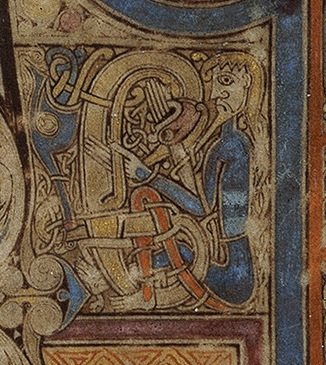
The letters IN P, filled with interlacing snakes, crosses and abstract ornament, dominate the composition. Snakes form the letters RIN and C, with C taking the form of a harp, played by the man who forms the letter I. The urge of the artist to decorate has taken precedence over legibility, to the extent that the letters ET and B are missing from the last line. [1]
Because some of the letters are difficult to discern, I’ve done my best to trace them in red in this graphic:
The text unfolds in four rows. The column on the left forms the I and doubles as the left stem of the N. The diagonal stroke of the N passes through the cross-shape, and its right stem is formed by another blue column, which also doubles as the stem of the P.
The following R, I, N, and C are beige and blue serpentine figures, tangled together, the latter shaped like a harp and being “played” by a seated man whose torso forms an I.
The remaining text is organized in two rows and is black. As Meehan mentioned, the artist-monk unintentionally omitted the ET and B in “et verbum.” And the final M is upside down, an artistic variation.
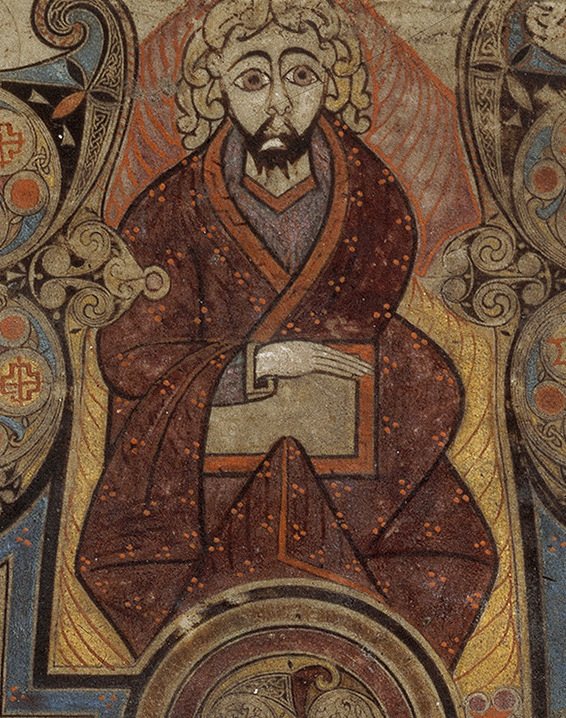
Scholars disagree on who the curly-haired figure at the top is, holding a book: some suppose it’s John the Evangelist, the author of the fourth Gospel, while others think it’s Christ the Logos. I’m in the latter camp. Christ is often shown in art sitting on a throne holding a book, representing the gospel—as on folio 32v of this very manuscript. And a full-page portrait of John already appears on the opposite page, folio 291v; granted, the iconography is similar, but it would be an unusual choice to repeat a person in the same pose on a single page spread. Also, as art historian Heather Pulliam points out, the yellow and red striations that encompass the figure resemble flame—a “throne of light,” writes Françoise Henry—an attribute more befitting of the figure of Christ than of John. [2]
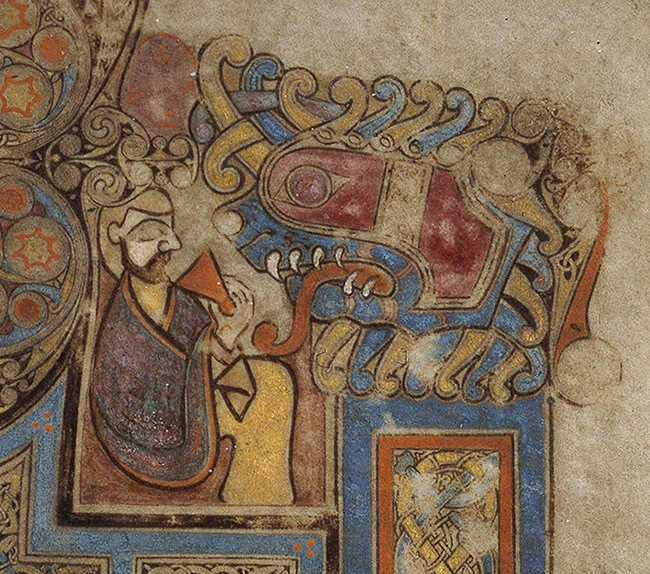
The identity of the smaller figure on the right who’s drinking from a red chalice is also debated. Again, it could be either John or Christ. According to an apocryphal legend that first appeared in the second-century Acts of John and that was popularized in the thirteenth-century Golden Legend, a pagan priest challenged John to drink a cup of poisoned wine to test whether his God was truly powerful enough to protect him. John blessed the cup, downed the wine, and suffered no harm. That’s why in art one of John’s attributes is a chalice with a serpent in it, representing the poison rising out and the triumph of Christian faith.
On the other hand, the drinking figure may be Christ drinking the cup of suffering (John 18:11). The monstrous head to the right supports either interpretation—it could be Satan tormenting Christ in Gethsemane, or in John’s case, the threat of death by poison, or the evil intent of the pagan priest who sought to discredit him.
Additional possibilities have also been posited. Małgorzata Krasnodębska-D’Aughton argues that the man is meant to be a generic Christian partaking of the Eucharist, [3] whereas Pulliam suggests that the cup represents not the blood of Christ but “the chalice of wisdom received from the breast of Christ.” [4] She cites Augustine’s first tractate on the Gospel of John:
Thence John, who said these things, received them, brothers, he who lay on the Lord’s breast, and from the breast of the Lord drank in what he might give us to drink. But he gave us words; you ought then to receive understanding from the source, from that which he drank who gave to you; so that you may lift up your eyes to the mountains from where shall come your aid, so that from there you may receive, as it were, the cup, that is, the word, given you to drink; and yet, since your help is from the Lord, who made heaven and earth, you may fill your breast, from the source. [5]
In Pulliam’s interpretation, the man imbibes the words of God—that is, scripture—providing a model for us to emulate.
Bernard Meehan, The Book of Kells: An Illustrated Introduction to the Manuscript in Trinity College Dublin (Thames & Hudson, 1994, 2008), 34.
Heather Pulliam, Word and Image in the Book of Kells (Four Courts Press, 2006), 180–83; cf. Françoise Henry, The Book of Kells: Reproductions from the Manuscript in Trinity College, Dublin (Thames & Hudson, 1974).
Małgorzata Krasnodębska-D’Aughton, “Decoration of the In principio initials in early Insular manuscripts: Christ as a visible image of the invisible God,” Word and Image: A Journal of Verbal/Visual Enquiry 18, no. 3 (Fall 2002): 117.
Pulliam, Word and Image, 185.
Augustine, In Joannis Evangelium 1.1, PL 35: 1382.
LISTEN: “The Word Was God” by Rosephanye Powell, 1996 | Performed by the University of Pretoria Camerata, dir. Michael Barrett, 2022
In the beginning was the Word, and the Word was with God, and the Word was God.
The same was in the beginning with God.
All things were made that have been made. Nothing was made he has not made.
While this choral anthem is not a Christmas song per se, it is a setting of John 1:1–3, the opening of the great prologue of the Incarnation. These first three verses are about Christ’s eternal being, his oneness with the Father, and his active role in creation. I can’t hear them without anticipating verse 14: “And the Word was made flesh, and dwelt among us . . .”
“The Word Was God” is by Dr. Rosephanye Powell (pronounced ro-SEH-fuh-nee) (born 1962), an African American composer, singer, professor, and researcher. One of her most popular and widely recorded works, it is full of rhythmic energy and drive. Read detailed notes by Powell here, where she explains her musical choices and their theological significance.





 Art & Theology