Christmas, Day 9: “Today the Virgin cometh unto a cave . . .”

LOOK: Nativity icon from St. Catherine’s Monastery

Coptic Nativity icon (St Catherine's)
The Nativity of Christ, Egypt, 7th century(?). Encaustic on wood. Holy Monastery of St. Catherine, Sinai, Egypt. Photo courtesy of the Michigan-Princeton-Alexandria Expeditions to Mount Sinai.

This Coptic icon of the Nativity bears all the traditional elements of Nativity icons. It shows Mary reclining in a cave next to her newborn son, Jesus, who lies in a manger, being affectionately licked by an ox and ass. Why those two animals? Because the church fathers read Isaiah 1:3 into the scene, which says, “The ox knows its owner and the donkey its master’s crib.”

The starry semicircle at the top represents the heavens. A thick beam of light descends from it onto Christ, confirming his divine paternity. On either side, from behind the grassy hills, angels rejoice, bringing glad tidings of the birth.

From the right, three magi approach with their gifts (unusually, their horses are placed apart from them in the bottom left), and in the center, a shepherd plays a pipe while his flock frolics on the grass.

In the bottom left, Joseph sits dejectedly with his head in his hands. He is being assailed once again by doubt as to Jesus’s true paternity. Could Mary’s outrageous story really be true? Or was she sexually unfaithful? In some Nativity icons Satan appears to Joseph in the guise of an old man to tempt him to distrust Mary and to doubt Jesus’s divinity. Anyone would be a fool to believe it, he taunts. It’s possible that the man with the pointed red cap at the far right of this icon is meant to be the devil on his way to Joseph, but if so, it would be an odd compositional choice. Anyway, in Nativity icons, Joseph stands for all skeptics, for those who struggle to accept that which is beyond reason, especially the incarnation of God.

Next to Joseph, two midwives bathe Jesus in a basin. (Jesus appears twice in the composition. He’s identified by the cross-shape in his halo.)

Art historian Matthew J. Milliner, who specializes in the Byzantine era, describes the Orthodox iconography of the Nativity in a 2021 podcast episode of For the Life of the World [shared previously]:

There’s just something wonderful about the classic Nativity icon. When you look at this, you’ve got Joseph in the corner. . . . And then you have this dome that is overarching the scene. That is, speaking in Charles Taylor’s terms, that’s the “immanent frame”—that’s the cosmos as we know it. And it’s shattered! By what? By the light that comes from outside. In other words, the Kantian universe has been pierced and God has revealed himself and said, “This is how I choose to come into the world.”

And there you have the Virgin Mary, and she almost looks seed-like when you look at these icons. She’s on her side because, thank you very much, she just gave birth. And there’s Christ. And the donkey and the ox are there, symbolizing both Jew and Gentile. In other words, the book of Romans in one shot. Boom. Right there.

Then you’ve got the magi sometimes off in the distance, to symbolize all corners of the earth, to symbolize most in particular the Assyrian Church of the East, the expansion of Christianity all the way to the Pacific Ocean by like the fifth century, folks. Gotta remember that! These are the Christians whom we have lost contact with. The global reality of Christianity is communicated by these icons.

And then, of course, you’ve got the shepherds to symbolize, we might even say, all classes incorporated into this faith—not just across the globe, but across socioeconomic status. All of it is communicated just by meditating upon it.

And then you have this cavern—not some sweet little stable, but a cavern, a cave. And folks, it’s the cave of your own psyche as well. It’s a depth-psychology dimension of the Christian tradition. A Nativity icon is what God wants to do in your soul. This is intended to be a spiritual experience.

The dating of the particular icon pictured above has been debated. It is circulating in many places online with an attribution of “seventh century,” perhaps in part because of its use of encaustic (a common medium for earlier icons). But Father Akakios at St. Catherine’s Monastery at Mount Sinai, the institution that owns and houses the icon, told me that’s probably too early, that it’s more likely a later icon that incorporates earlier elements.

From the Sinai Digital Archive, it appears that Kurt Weitzmann, an art historian from Princeton University who had the icon photographed on one of his four research expeditions to Sinai in the late 1950s and early ’60s, proposes the sixteenth or seventeenth century as its likely time of creation. Cathy Pense Garcia, head of Visual Resources Collections at the University of Michigan (which manages the Sinai Digital Archive jointly with Princeton), was unable to confirm an approximate date and said that more scholarly research is needed.

It’s such a wonderful icon! I hope to see some academic writing about it in the future, as my research turned up next to nothing.

LISTEN: “Kontakion of the Nativity of Christ” by Romanos the Melodist, 6th century | Chanted by Fr. Apostolos Hill, 2016

Today the Virgin cometh unto a cave to give birth to the Word who was born before all ages, begotten in a manner that defies description. Rejoice, therefore, O universe, if thou should hear and glorify with the angels and the shepherds. Glorify him who by his own will has become a newborn babe and who is our God before all ages.

(Η Παρθένος σήμερον, τον προαιώνιον Λόγον, εν σπηλαίω έρχεται, αποτεκείν απορρήτως. Χόρευε, η οικουμένη ακουτισθείσα, δόξασον, μετά Αγγέλων και των ποιμένων, βουληθέντα εποφθήναι, Παιδίον νέον, τον προ αιώνων Θεόν.)

This is the prooimoion (prologue) to Romanos the Melodist’s kontakion on the Nativity of Christ; the other twenty-four stanzas can be read in a translation by Ephrem Lash in St. Romano, On the Life of Christ: Kontakia—Chanted Sermons by the Great Sixth-Century Poet and Singer (HarperCollins, 1995).


This post is part of a daily Christmas series that goes through January 6. View all the posts here, and the accompanying Spotify playlist here.
Christmas, Day 8: They named him Jesus

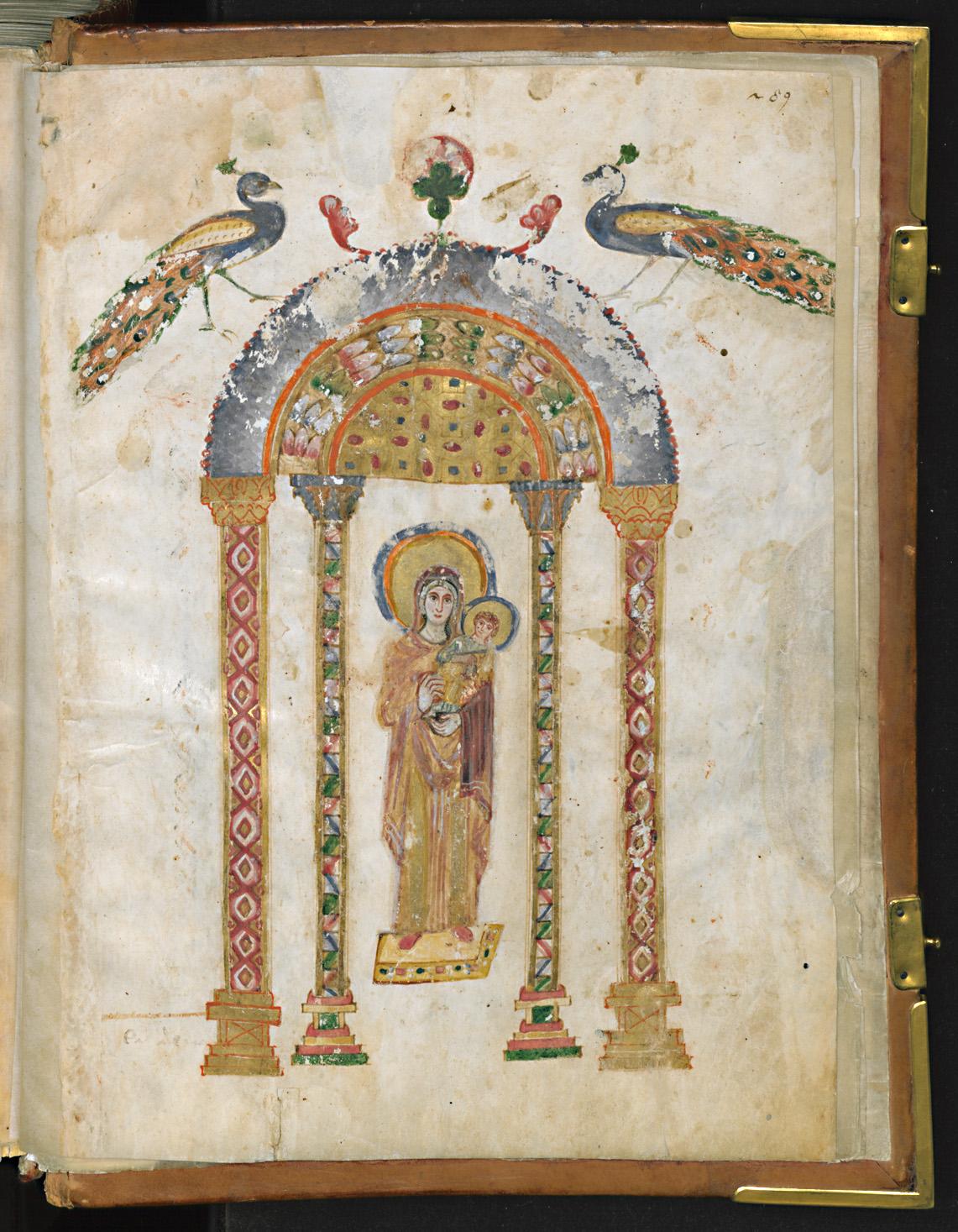
LOOK: Virgin and Child from the Rabbula Gospels

Virgin and Child (Rabbula Gospels)
Virgin and Child, from the Rabbula Gospels, Syria, 586 CE. Biblioteca Medicea Laurenziana, Florence (Plut.1.56, fol. 1v).

Among the earliest works of Byzantine iconography, this painting is from a sixth-century manuscript of the Gospels in Syriac (Peshitta version), completed at the Bēṯ Zaḡbā Monastery in northern Syria. It shows the Virgin Mary standing under a colorfully patterned aedicule, holding her son Jesus, who faces us. Perched on the roof are two peacocks, a symbol of resurrection and eternal life.

For a blog post on one of the Rabbula Gospels’ other full-page miniatures, see here.

LISTEN: “Jesus” by Glen Woodward, arr. Valeria A. Foster, 2000 | © 2000 GIA Publications, Inc. | Performed by choral students from Western Michigan and Calvin Christian High Schools and Calvin University, dir. James Abbington, with Brandon A. Boyd on piano, February 9, 2023

Jesus
Jesus
Jesus, Jesus
Jesus

I worship you
I worship you
Jesus, Jesus
Jesus

I love you, Lord
I love you, Lord
Jesus, Jesus
Jesus

Eight days after his birth, Jesus was circumcised as the Jewish law stipulates (Lev. 12:1–3) and given his name: “When the eighth day came, it was time to circumcise the child, and he was called Jesus, the name given by the angel before he was conceived in the womb” (Luke 2:21). Thus many churches celebrate January 1 as the Feast of the Holy Name of Jesus.

The name Jesus—or Yeshua (יֵשׁוּעַ), as he would have been known to his fellow Aramaic speakers (“Jesus” is the Greek transliteration)—means “Yahweh saves.”


This post is part of a daily Christmas series that goes through January 6. View all the posts here, and the accompanying Spotify playlist here.
Christmas, Day 7: Every Stone

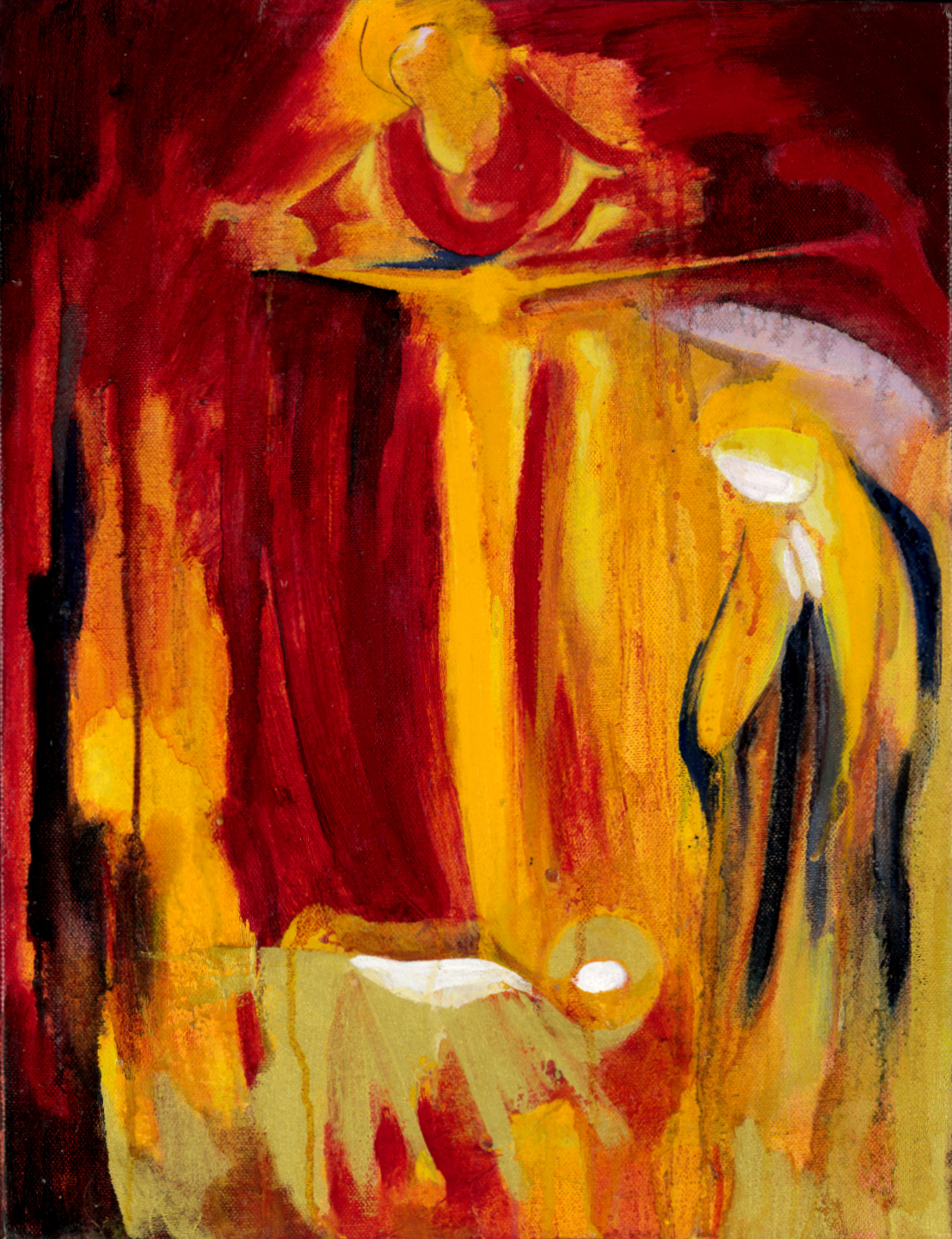
LOOK: Nativity by Judith Tutin

Tutin, Judith_Nativity
Judith Tutin (Irish, 1979–), Nativity, 2011. Oil on canvas, 60 × 40 cm. Private collection of Fr. Jim Doyle, Wexford, Ireland. Photo courtesy of the artist.

In this semiabstract Nativity painting by Judith Tutin, Mary and Joseph adore the newborn Christ child as God the Father looks down from above, holding in his arms a portent: the traces of a cross. One might also see, overlapping the intimation of a crossbar, the outstretched wings of the Holy Spirit as dove, hovering over the earthly scene below.

This central triad of Father, (crucified) Son, and Spirit evokes the Gnadenstuhl, or “Throne of Mercy,” an iconography of the Trinity that emerged in twelfth-century Europe. Tutin innovates on this type by showing, at the base of the cross, the Son in his infancy, thus drawing together the doctrines of the incarnation and the atonement.

Applied in broad, loose brushstrokes, the deep crimsons and golds further underscore the themes of blood and glory.

LISTEN: “A Stable Lamp Is Lighted” | Words by Richard Wilbur, 1958 | Music by Jennifer Wyatt, 2002 | Performed by Ardyth & Jennifer on WinterFire, 2002

A stable-lamp is lighted
Whose glow shall wake the sky;
The stars shall bend their voices,
And every stone shall cry.
And every stone shall cry,
And straw like gold shall shine;
A barn shall harbor heaven,
A stall become a shrine.

This child through David’s city
Shall ride in triumph by;
The palm shall strew its branches,
And every stone shall cry.
And every stone shall cry,
Though heavy, dull, and dumb,
And lie within the roadway
To pave his kingdom come.

Yet he shall be forsaken,
And yielded up to die;
The sky shall groan and darken,
And every stone shall cry.
And every stone shall cry
For stony hearts of men:
God’s blood upon the spear-head,
God’s love refused again.

But now, as at the ending,
The low is lifted high;
The stars shall bend their voices,
And every stone shall cry.
And every stone shall cry,
In praises of the Child
By whose descent among us
The worlds are reconciled.

Richard Wilbur (1921–2017) [previously] was a major American poet, serving as the nation’s second poet laureate and winning two Pulitzer Prizes and a National Medal of Arts. He was a champion of formalist poetry, working within the constraints of meter and rhyme.

He wrote this text to be sung at a December 7, 1958, candlelight service in the Memorial Chapel of Wesleyan University in Middletown, Connecticut, where he was a professor in the English Department. It premiered with a choral setting by Richard Winslow, director of the university’s choral society. Wilbur also sent out the text in his family Christmas cards that year.

A few years later, it was published in his collection Advice to a Prophet (1961) as “A Christmas Hymn,” with Luke 19:39–40 as an epigraph: “And some of the Pharisees from among the multitude said unto him, Master, rebuke thy disciples. And he answered and said unto them, I tell you that, if these should hold their peace, the stones would immediately cry out.” This passage takes place upon Jesus’s entry into Jerusalem the week of his death. People were lauding him as a king who came in the name of the Lord, which the Pharisees considered blasphemous. When they demand that Jesus repudiate such ridiculous claims, he instead validates them, replying that even the inanimate stones know his kingship and would shout, “Hosanna!” if human voices failed to.

The hymn stretches from Christmas to Palm Sunday to Good Friday, then circles back to Christmas, covering the span of Christ’s life.

“Not many other major poets in the past seventy years have written Christmas hymns, classic, straightforward Nativity celebrations with no irony to them, and which work beautifully in a traditional church service,” notes Bruce Michelson in Wilbur’s Poetry: Music in a Scattering Time. Wilbur is an example of a modern poet who was very accomplished at his craft and respected by the establishment as well as being a person of Christian faith.

“A Stable Lamp Is Lighted” appears in a few dozen hymnals. The standard tune for it is ANDÚJAR by David Hurd from 1983, but I prefer the one by Ardyth & Jennifer, Celtic harp and vocal duo Ardyth Robinson and Jennifer Wyatt, based in Shad Bay, Nova Scotia.


This post is part of a daily Christmas series that goes through January 6. View all the posts here, and the accompanying Spotify playlist here.

Christmas, Day 6: Celestial Hearts

LOOK: The Angel by Salvador Dalí

Dali, Salvador_The Angel
Salvador Dalí (Spanish, 1904–1989), The Angel, 1947. Ink and watercolor on paper, 12 3/4 × 10 1/4 in. Hallmark Art Collection, Kansas City, Missouri.

In 1947, Hallmark commissioned the famous modern artist Salvador Dalí to create a small set of original paintings for its Gallery Artists line of Christmas cards to hit the market in 1948. The Angel is one of them. Painted in his typical surrealist style, it shows a headless angel playing a lute, the snowy mountains in the background mimicking wings. At the bottom right, the newborn Christ lies naked on the ground, cushioned by straw and adored by his mother. On the left a shepherd sits on a tree stump, also playing a lute, its soundboard blending into the landscape in the background. At the warmth of their song, the snow begins to melt away.

LISTEN: “Celestial Hearts,” traditional Yorkshire carol | Arranged and performed by Kate Rusby on Holly Head (2019)

Come, let us all rejoice
To see this happy morn
We’ll tune our hearts and raise our voice
Tune our hearts and raise our voice
Upon this Christmas morn

Go, humble swain, said he
To David’s city fly
A promised infant born today
Does in a manger lie

Now angels all on high
Sing heav’nly peace on earth
Goodwill to men and angels’ joy
Resound across the earth

With looks and hearts serene
Go see the babe, your king
A host of angels then was seen
The shepherds heard them sing

From one of England’s most popular folk singers, Kate Rusby, comes a modern interpretation of the Yorkshire carol from Worrall and Oughtibridge known as “New Celestial” (Roud 17724). Rusby arranged this version with her husband and producer Damien O’Kane, adapting the traditional lyrics.


This post is part of a daily Christmas series that goes through January 6. View all the posts here, and the accompanying Spotify playlist here.
Christmas, Day 5: Poor Little Jesus

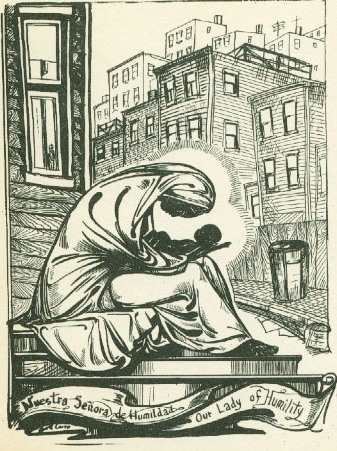
LOOK: Our Lady of Humility by Allan Rohan Crite

Crite, Allan Rohan_Our Lady of Humility
Nuestra Señora de Humildad / Our Lady of Humility by Allan Rohan Crite

Allan Rohan Crite (1910–2007) was a Boston-based African American artist best known for his religious paintings and drawings, many of which place holy personages among everyday people in Boston’s South End. He was Episcopalian.

On using Black figures to narrate biblical stories, Crite said:

I used the black figure in a telling of the story of the Lord, the story of the suffering of the Cross and the whole story of the Redemption of Man by the Lord, but . . . my use of the black figure was not in a limited racial sense, even though I am black, but rather I was telling the story of all mankind through this black figure. (quoted in Julie Levin Caro, Allan Rohan Crite: Artist-Reporter of the African American Community, p. 20)

The image above, which I found years ago at the now defunct brushesandpigments.com with very little captioning info, sets the Nativity in an urban neighborhood. Sitting on a stoop, Mary bends her head down to look lovingly at her son Jesus, cradled in her lap. The banderole at the bottom reads, “Nuestra Señora de Humildad / Our Lady of Humility.”

As indicated by the inscription, this pen and ink drawing belongs to a type of iconography especially popular in the fifteenth century, showing Mary sitting on the ground or on a low cushion, usually holding the Christ child in her lap. The word “humility” derives from the Latin humus, meaning “earth” or “ground.”

I’m not sure why Crite uses Spanish here—whether he spoke it as a second language, or had Spanish-speaking neighbors, or was working on commission—but I do know he visited Mexico and Puerto Rico. 

LISTEN: “Poor Little Jesus” (aka “Oh, Po’ Little Jesus”), African American spiritual

Oh, Po’ Little Jesus.
Dis world gonna break your heart.
Dere’ll be no place to lay your head, my Lord.
Oh, Po’ Little Jesus. (Hum)

Oh, Mary, she de mother.
Oh, Mary, she bow down an’ cry.
For dere’s no place to lay his head, my Lord.
Oh, Po’ Little Jesus.

Come down, all you holy angels,
Sing round him wid your golden harps,
For someday he will die to save dis worl’.
Oh, Po’ Little Jesus. (Hum)

>> Sung by the Morehouse College Glee Club, arr. Leonard de Paur, on New Born King (1999):

>> Sung by Maddy Prior and the Carnival Band, arr. Andrew Watts, on Carols and Capers (1992) (the video below is a live performance from 2004):

>> Arranged and sung by Rev Simpkins (Matt Simpkins), with Martha Simpkins, on Poor Child for Thee: 4 Songs for Christmastide (2020):

I find this spiritual so moving. The five-part harmonies—or even just the two parts in Rev Simpkins’s version—are lush and carry such pathos.

From his humble beginnings in a Bethlehem stable to his ignominious death on a Roman cross, Jesus was no stranger to want and sorrow. He wasn’t impoverished, but he wasn’t wealthy; he had a simple upbringing in the small town of Nazareth. His mother probably longed to give him more than she could. She understood in part the hardship of his calling, knew the rejection he would face—and so she sings, “This world’s gonna break your heart.”

Jesus spent three determinative years of his adult life as an itinerant preacher, traveling from place to place and reliant on the support of others; as he told a scribe who aspired to follow him: “Foxes have holes, and birds of the air have nests, but the Son of Man has nowhere to lay his head” (Matt. 8:19). That ministry culminated in false charges, abandonment, and a public execution.

The Incarnation required vulnerability on the part of God. God chose to make himself susceptible to hurt by entering fully into the life of human struggle. But out of the hurt and struggle that Christ endured came salvation.

“Poor Little Jesus” seeks to stir up pity for Jesus’s plight. Underlying that pity is a thank-you: thank you, Jesus, for taking on our flesh and dealing with our sin, so that we might be free.

The spiritual is not to be confused with another spiritual of the same name (recorded, for example, by Odetta) that goes, “It was poor little Jesus . . . didn’t have no cradle . . . wasn’t that a pity and a shame?”


This post is part of a daily Christmas series that goes through January 6. View all the posts here, and the accompanying Spotify playlist here.
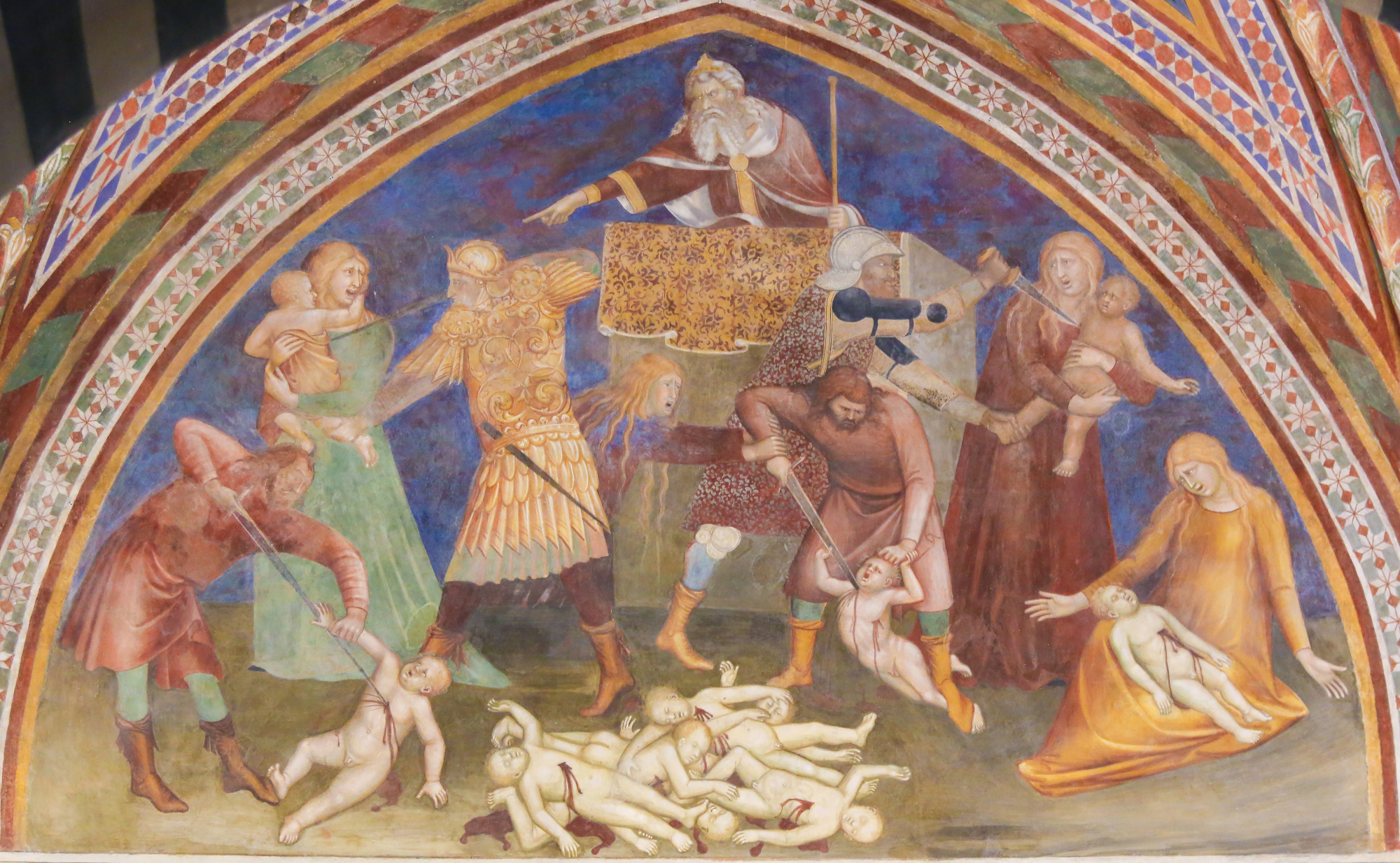
Christmas, Day 4: Herod Rages On

When Herod saw that he had been tricked by the magi, he was infuriated, and he sent and killed all the children in and around Bethlehem who were two years old or under, according to the time that he had learned from the magi. Then what had been spoken through the prophet Jeremiah was fulfilled:

A voice was heard in Ramah,
wailing and loud lamentation,
Rachel weeping for her children;
she refused to be consoled, because they are no more.

—Matthew 2:16–18

Even though we often omit it from our Christmas pageants and sermons, the Massacre of the Innocents recounted in Matthew 2 is part of the Christmas story. December 28 is set apart yearly to commemorate the babies who lost their lives in this slaughter. View posts on this subject from previous years here and here.

LOOK: Massacre of the Innocents by Lippo Memmi (attrib.)

Memmi, Lippo_Massacre of the Innocents
Attributed to Lippo Memmi (Italian, ca. 1291–1356), Massacre of the Innocents, ca. 1335–45. Fresco, Collegiate Church of San Gimignano, Italy.

In the Collegiate Church of San Gimignano, this scene is part of a narrative cycle on Christ’s infancy in six upper bays, comprising also the Annunciation, the Nativity and Adoration of the Shepherds, the Adoration of the Magi, the Presentation in the Temple, and the Flight to Egypt.

LISTEN: “And Herod Rages On” | Words by Kate Bluett, 2020 | Music by Elise Massa, 2020 | Performed by Elise Massa

The streets ran red in Bethlehem;
our little boys were gone
when soldiers came on Herod’s whim,
but Herod rages on.
No newborn king his light should dim;
he’d be the only dawn,
sent men to tear them limb from limb—
and Herod rages on.

Two thousand years, all filled with births
and stained as red as dawn
by blood that soaks the thirsty earth,
still Herod rages on.
And what is all this bloodshed worth,
our sons and daughters gone,
but barren fields and empty hearths,
while Herod rages on?

Dear infant Christ in Joseph’s arms,
escaped before the dawn,
O come and heal how we’ve been harmed,
for Herod rages on.
The sirens shriek, deep fear alarms;
when will you make them gone?
Or must we wait ’til hate’s disarmed?
For Herod rages on.

The stones that wept in Abel’s gore
cry out with every dawn
’til swords are laid down evermore,
while Herod rages on.
Someday he’ll fall to rise no more;
someday he will be gone.
Our hearts ’til then are bleeding sore,
and Herod rages on.

This song by Kate Bluett and Elise Massa views Herod as representative of any political leader whose policymaking or direct command threatens the lives of innocent children today. Lord, have mercy.


This post is part of a daily Christmas series that goes through January 6. View all the posts here, and the accompanying Spotify playlist here.
Christmas, Day 3: The Infinite a Sudden Guest

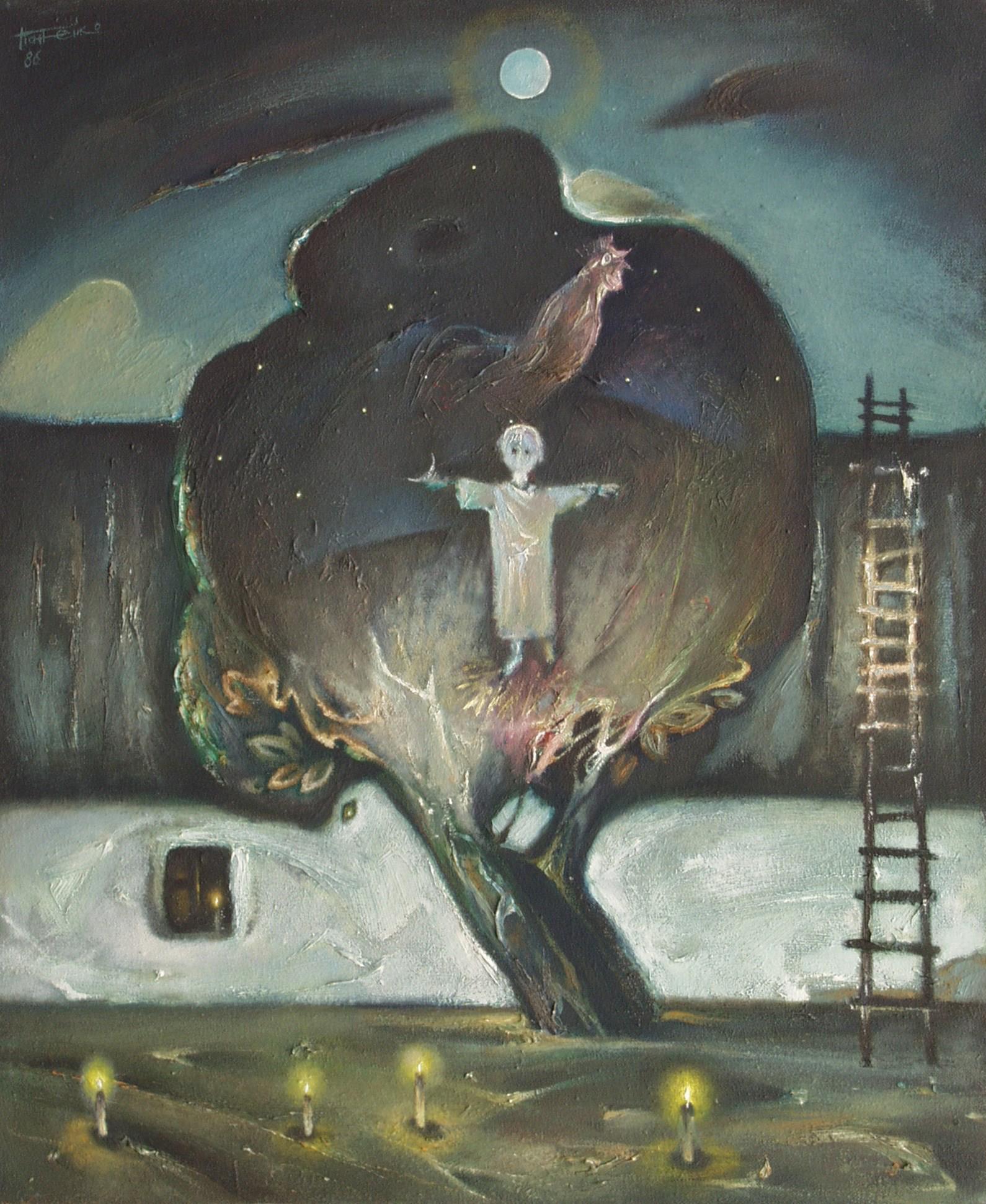
LOOK: I Am Born by Ihor Paneyko

Paneyko, Igor_I Am Born
Ihor Paneyko (Ukrainian, 1957–), Я родився (I Am Born), 1986. Oil on canvas.

LISTEN: “The Infinite a Sudden Guest” by Josh Rodriguez, 2015 | Performed by New City Music on Songs from Engedi, 2015

The Infinite a sudden guest—

Awake, mankind!
For your sake God has become man.
Awake, you who sleep:
God has become man.
Awake, rise up from the dead,
And Christ will enlighten you.
For your sake, God became man.

You would have suffered eternal death,
Never freed from sinful flesh,
Had he not taken on himself
The likeness of sinful flesh;
Lost from everlasting unhappiness,
Had it not been for this mercy.
You would never have returned to life,
Had he not shared your death.

Let us celebrate the coming of salvation and redemption!
Let us celebrate the day who is the great and eternal day,
Came from the great and endless day of eternity
Into our own short day of time.

Christ, born of Mary.
Eternity entered time.
Truth has arisen from the earth:
Christ who said, “I am the Truth.”
And Justice looked down from heaven:
Because believing in this newborn child,
Man is justified not by himself but by God.

Truth has arisen from the earth:
Because the Word was made flesh,
And Justice looked down from heaven.
Justified by faith, let us be at peace with God.
For Peace and Justice have embraced in Jesus Christ.

The Infinite a sudden guest—
God
In time
In God
In time
In God
In time
In God
In time
In God
In time
In God
In time
In God.

In 2015 Josh Rodriguez [previously here and here] composed this piece for SATB choir, violin, and percussion for New City Presbyterian Church in Royal Oak, Michigan, where he served as music director at the time.

Its striking title and first line come from a short poem by Emily Dickinson, and the rest of the text is taken from a Christmas sermon by Augustine of Hippo (cataloged as Sermon 185 by scholars), which centers on Psalm 85:11: “Truth shall spring out of the earth; and righteousness shall look down from heaven.” Augustine sees this prophecy as fulfilled in Christ. The full sermon can be read in St. Augustine, Sermons on the Liturgical Seasons, trans. Mary Sarah Muldowney, RSM (vol. 38 of the Fathers of the Church series) (Washington, DC: Catholic University of America Press, 1959), 6–9. Section 1 can be read for free here.

Celebrating the entrance of God into human history, this choral work alternates between vigorous, exuberant passages and ones that are slower and more introspective. In the opening, there’s a wonderful crescendo on “guest”—an expansion that reflects the possibility opened up by the Incarnation. The final passage alternates between the phrases “in God” and “in time.” God is in time and time is in God, the infinite contracted to a span.


This post is part of a daily Christmas series that goes through January 6. View all the posts here, and the accompanying Spotify playlist here.
Christmas, Day 2: Born Every Day

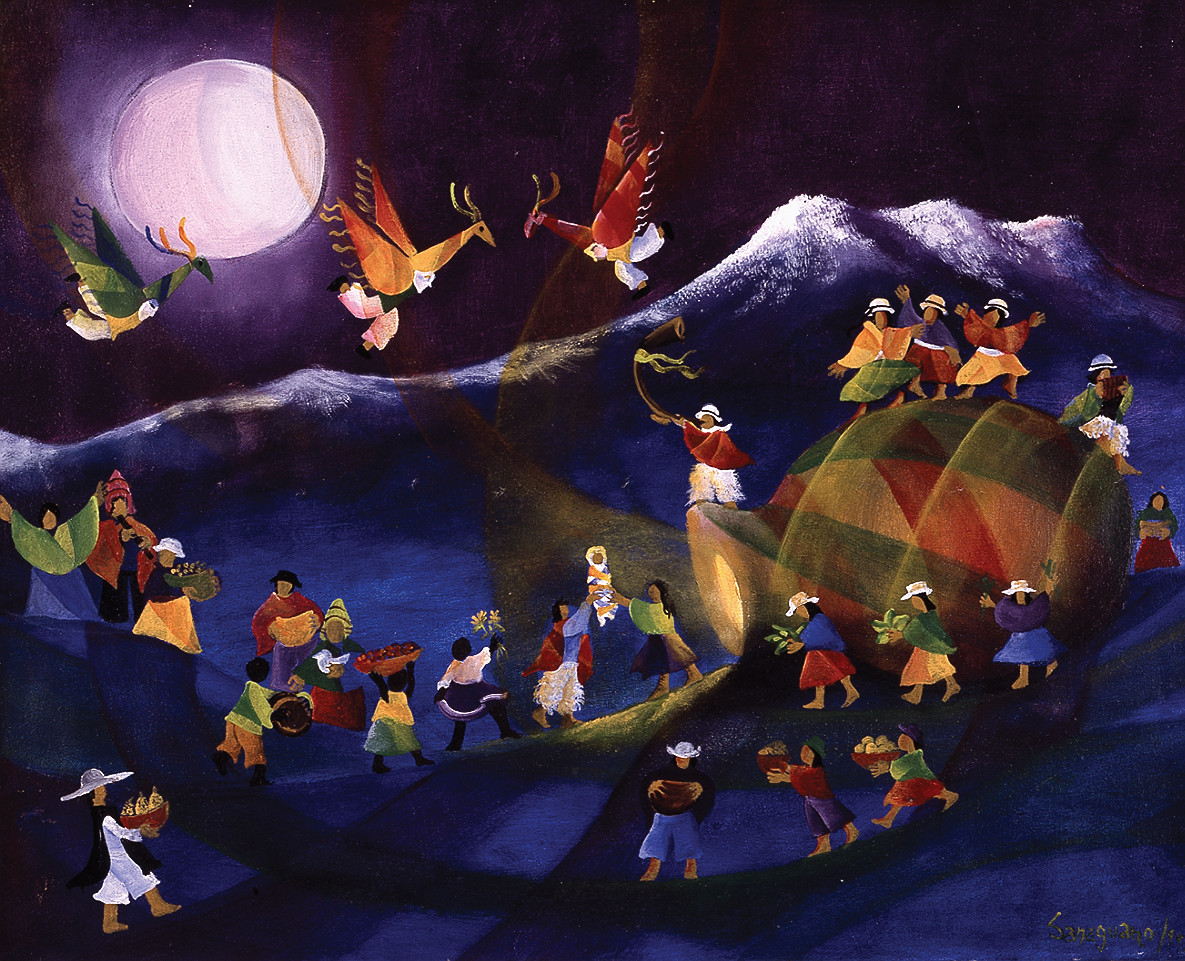
LOOK: Cristo nace cada día by Pablo Sanaguano

Sanaguano, Pablo_Christ Is Born Every Day
Pablo Sanaguano (Ecuadorian, 1964–), Cristo nace cada día (Christ Is Born Every Day), 1994. Acrylic on particle board, 41 × 50 cm. © missio Aachen.

In this celebratory painting with elements of the surreal, the birth of Christ is transplanted to Chimborazo province in the Andean highlands of Ecuador, where artist Pablo Sanaguano lives. Light spills from a giant overturned jug (which doubles as the cave of the Nativity), spotlighting the newborn child who is held aloft by his proud parents, Mary and Joseph. Summoned by a bocina (horn), villagers come bearing corn, potatoes, and other gifts from their harvest, while others play instruments—a bamboo panpipe, a quena (flute), a bomba (drum). The “angels” flying overhead are men in mythical bird costumes.

LISTEN: “Todos los días nace el Señor” by Juan Antonio Espinoza, 1976 | Performed by musicians at Iglesia Presbiteriana Comunidad de Esperanza (Community of Hope Presbyterian Church), Bogotá, Colombia, 2020

Para esta tierra sin luz, nace el Señor;
para vencer las tinieblas, nace el Señor;
para cambiar nuestro mundo,
todos los días nace el Señor.

Para traer libertad, nace el Señor;
nuestras cadenas rompiendo, nace el Señor;
en la persona que es libre,
todos los días nace el Señor.

Para quitar la opresión, nace el Señor;
para borrar la injusticia, nace el Señor;
en cada pueblo que gime,
todos los días nace el Señor.

Para vencer la pobreza, nace el Señor;
para los pobres que sufren, nace el Señor;
por la igualdad de las gentes,
todos los días nace el Señor.

Para traernos la paz, nace el Señor;
para esta tierra que sangra, nace el Señor;
en cada pueblo que lucha,
todos los días nace el Señor.

Para traernos amor, nace el Señor;
para vencer egoísmos, nace el Señor;
al estrechar nuestras manos,
todos los días nace el Señor.

Para este mundo dormido, nace el Señor;
para inquietar nuestras vidas, nace el Señor;
en cada nueva esperanza,
todos los días nace el Señor.

English translation:

Into a world without light, Jesus Christ is born.
Coming to conquer the darkness, Jesus Christ is born.
He comes to bring us a new world.
Jesus our Lord is born every day!

Freedom is coming to all, Jesus Christ is born.
Chains of oppression are breaking, Jesus Christ is born.
Liberating all of God’s children,
Jesus our Lord is born every day!

Justice is coming to all, Jesus Christ is born.
There will be no more oppression, Jesus Christ is born.
He hears the cry of his people.
Jesus our Lord is born every day!

He is the friend of the poor, Jesus Christ is born.
He brings hope to all who suffer, Jesus Christ is born.
Earth’s fruits are for all who labor.
Jesus our Lord is born every day!

He comes to bring us his peace, Jesus Christ is born.
Where there is strife, blood, and hatred, Jesus Christ is born.
Wherever his people are struggling,
Jesus our Lord is born every day!

He comes to teach us to love, Jesus Christ is born.
Throw off the shackles of hatred, Jesus Christ is born.
Join hands, sisters and brothers!
Jesus our Lord is born every day!

He wakes the world from its sleep, Jesus Christ is born.
He stirs and calls us to action, Jesus Christ is born.
In every heart that is hopeful,
Jesus our Lord is born every day! [1]

This contemporary Venezuelan carol is popular throughout Latin America. Its title and refrain translate to “Jesus our Lord is born every day!” This declaration does not dehistoricize the birth, but rather extends it. In what sense is Christ born every day? In the hearts and communities of those who embrace him.

The medieval German mystic Meister Eckhart once preached on Christmas Day,

Here, in time, we are celebrating the eternal birth which God the Father bore and bears unceasingly in eternity, because this same birth is now born in time, in human nature. St. Augustine says, “What does it avail me that this birth is always happening, if it does not happen in me? That it should happen in me is what matters.” We shall therefore speak of this birth, of how it may take place in us and be consummated in the virtuous soul, whenever God the Father speaks His eternal Word in the perfect soul. [2]

NOTES

1. English translation by Alvin Schutmaat, in Hans-Ruedi Weber, Immanuel: The Coming of Jesus in Art and the Bible (Geneva: World Council of Churches, 1984), 92.

2. Meister Eckhart, Dum medium silentium, Sermon on Wisdom 18:14–15, in The Complete Mystical Works of Meister Eckhart, trans. and ed. Maurice O’C. Walshe, rev. Bernard McGinn (New York: Herder & Herder: 2009), 29. The quote by Augustine is untraced. (Eckhart’s quotations from authorities are often free, from memory, and thus difficult to verify.)


This post is part of a daily Christmas series that goes through January 6. View all the posts here, and the accompanying Spotify playlist here.
“Christmas” by Adeline Dutton Train Whitney (poem)

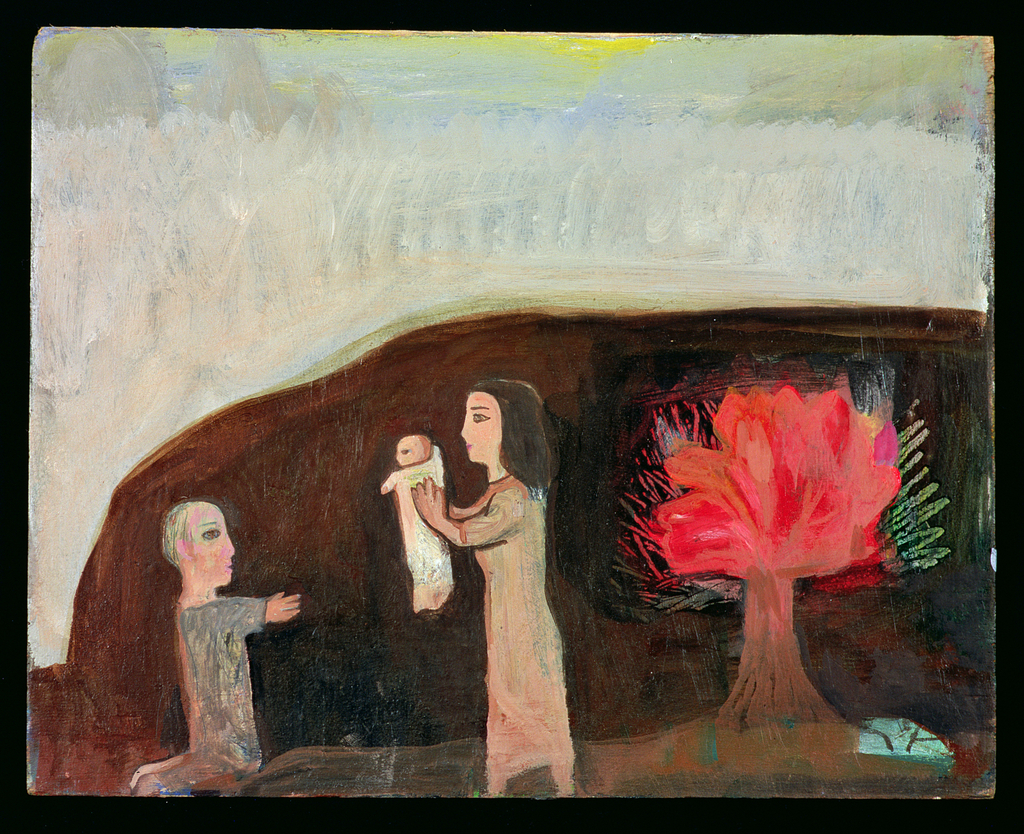
Herbert, Albert_Nativity with Burning Bush
Albert Herbert (British, 1925–2008), Nativity with Burning Bush, 1991. Oil on board, 27.9 × 35.6 cm. Private collection. Photo courtesy of England & Co., London / Bridgeman Images. © Estate of Albert Herbert.

            What is the Christ of God?
It is his touch, his sign, his making known,
His coming forth from out the all-alone,
            The stretching of a rod,

            Abloom with his intent,
From the invisible. He made worlds so:
And souls, whose endless life should be to know
            What the worlds meant.

            Christ is the dear “I am,”
The voice that the cool garden-stillness brake.—
The human heart to human hearts that spake,
            Long before Abraham.

            The word, the thought, the breath,—
All chrism of God that in creation lay,—
Was born unto a life and name this day;
            Jesus of Nazareth!

            With man whom he had made
God came down side by side. Not from the skies
In thunders, but through brother lips and eyes,
            His messages he said.

            Close to our sin he leant,
Whispering, “Be clean!” The high, the awful-holy,—
Utterly meek,—ah! infinitely lowly,—
            Unto our burden bent

            The might it waited for.
“Daughter, be comforted. Thou art made whole.
Son, be forgiven through all thy guilty soul.
            Sin—suffer ye—no more!

            “O dumb, deaf, blind, receive!
Shall he who shaped the ear not hear your cry?
Doth he not tenderly see, who made the eye?
            Ask me, that I may give!

            “O Bethany and Nain!
I show your hearts how safe they are with me.
I reach into my deep eternity
            And bring your dead again!

            “My kingdom cometh nigh.
Look up, and see the lightning from afar.
Over my Bethlehem behold the star
            Quickening the eastward sky!

            “From end to end, always,
The same Lord, I am with you. Down the night,
My visible steps make all the mystery bright.
            Lo! it is Christmas-day!”

This poem was originally published in Pansies: “…for Thoughts” by Adeline T. Whitney (London: Strahan & Co., 1872) and is in the public domain.

Adeline Dutton Train Whitney (1824–1906) was an American writer of poems and juvenile fiction, living in Massachusetts.

Christmas, Day 1: Rejoice!

Merry Christmas!

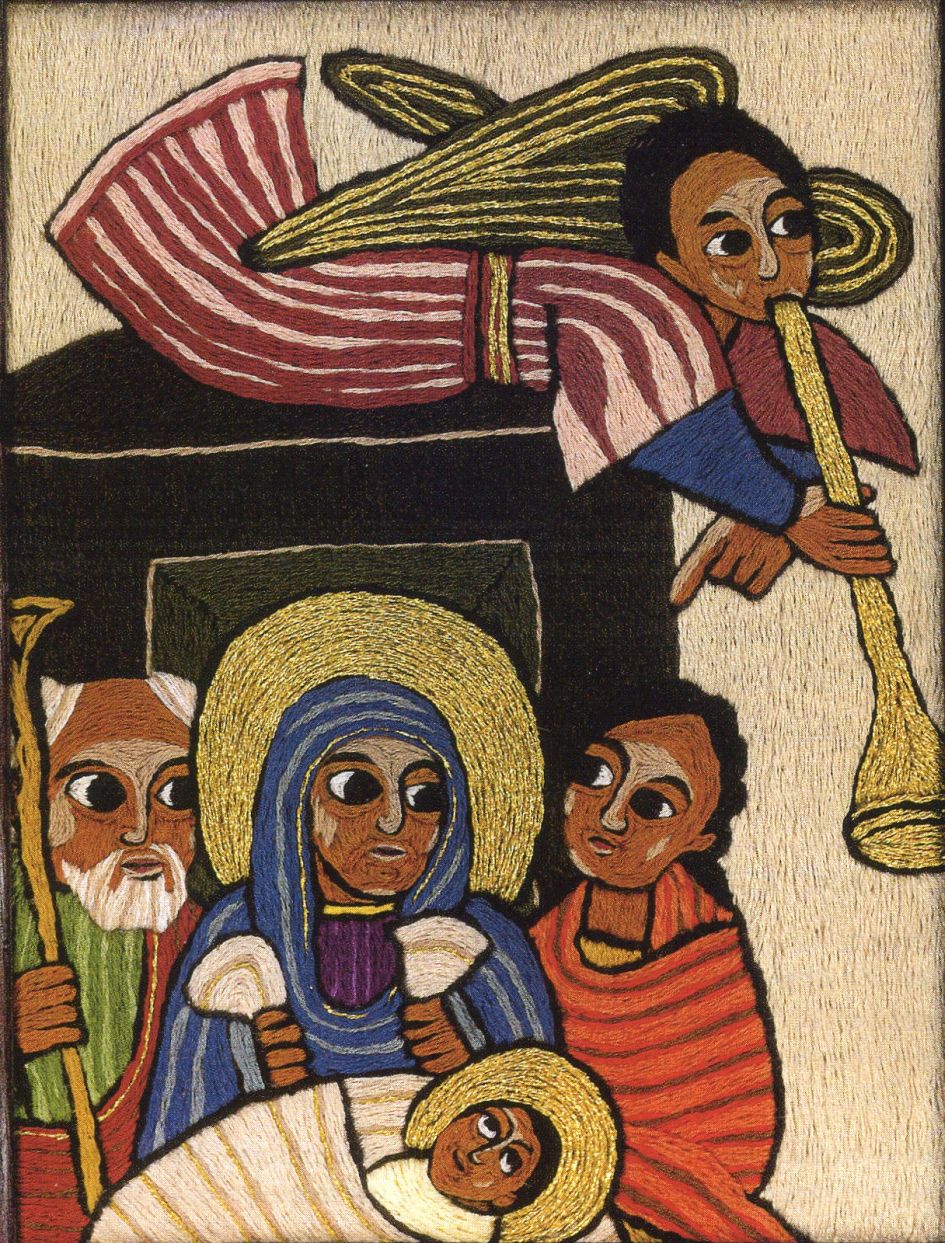
LOOK: Ethiopian Nativity tapestry

Ethiopian Nativity
Tapestry after: Tadesse Wolde Aregay (Ethiopian, 1953–), Joy in Heaven: Glory Be to God, 1985, painting on goatskin. Copyright of the original image belongs to Berliner Missionswerk and the Raad voor de Zending der NHK (Mission Council of the Dutch Reformed Church in the Netherlands).

I don’t know the maker or whereabouts of this charming tapestry, but I did find that it is based on a painting made by the Ethiopian artist Tadesse Wolde Aregay, which you can view here, along with three of Aregay’s other Christmas paintings. In it, a trumpeting angel points to the newborn Christ, whose mother, Mary, wraps him warmly in a blanket. Joseph stands on the left with a staff. On the right is Salome, a midwife and disciple of Jesus who appears in the Nagara Maryam (History of Mary), an apocryphal book of Marian legends from Ethiopia, and who is often portrayed in Ethiopian paintings of the Nativity and the Flight to Egypt.

LISTEN: “Christ Is Born Today” | Original German and Latin words attributed to Heinrich Suso (ca. 1295–1366); English translation by John Mason Neale, 1853 | Music: German dance tune, 14th century | Arranged by Elbertina “Twinkie” Clark and performed by the Clark Sisters on New Dimensions of Christmas Carols, 1978

Good Christian men, rejoice
With heart, and soul, and voice;
Give ye heed to what we say:
Good news!
Jesus Christ is born today!
Ox and ass before him bow;
He is in the manger now.
Christ is born today!

(Joy to the world)
Christ is born today!
(He’s in the manger now)
Christ is born today!
(Peace on earth, goodwill to men)
Christ is born today!
(Unto us)

And man is blessèd evermore.
Christ is born today!
(Christ is born today)
Christ is born today!
(Peace on earth, goodwill to men)
Christ is born today!
(Unto us a child is given)
Christ is born today!

This Christmas carol has its origins in late medieval Germany. It’s attributed to the Dominican friar Henry Suso—a legend says he had a vision of angels singing and dancing with joy about the birth of Christ, and, caught up in the mystic celebration, he penned the song.

I love the quick-tempoed, 6/8 version I grew up singing in church—but I also love what the Clark Sisters have done with it!

Officially formed in 1973 and active ever since, the Grammy-winning Clark Sisters are Jacky Clark Chisholm, Elbernita “Twinkie” Clark, Dorinda Clark-Cole, and Karen Clark Sheard. They were born in Detroit to gospel musician and choral director Dr. Mattie Moss Clark, who got them started in their singing careers. The group is a pioneer of contemporary gospel music, and last year they were inducted into the Black Music & Entertainment Walk of Fame in Atlanta.

The soloist on “Christ Is Born Today” is Denise “Niecy” Clark-Bradford, who left the group in 1986. In the first verse she mistakenly sings “groan” instead of “bow.”

Note that in hymnals today it is common to replace the first line with “Good Christian friends, rejoice” or “Good Christian folk, rejoice” to avoid the gendered “men,” and likewise in a later verse to change “And man is blessèd evermore” to “And we are blessed forevermore.” I get that “men” is being used in the broad sense of “humankind,” but where small lyrical changes for gender inclusivity are nondisruptive, as they are here, I am in favor of them.

The carol is written in the voice of the angels who excitedly proclaimed Christ’s birth to the shepherds, and their proclamation is taken up by Christians around the globe who sing this song, spurring one another to rejoice in the good news.


This post is part of a daily Christmas series that goes through January 6. View all the posts here, and the accompanying Spotify playlist here.