Roundup: New albums, historic Boston church to get new mural, new opera sets words of Mexican nun, and more

NEW ALBUMS:

>> The Divine Dark, vol. 1: This three-song EP was released December 15, 2024, on Re-Echo Records, a new label for music created by artists from Resurrection Philadelphia church. “The Divine Dark is an ongoing series of original arrangements and compositions for devotion, contemplation, and edification. The series takes its name from a phrase that emerged in the fifth century among Christian mystics to describe the ineffable unknowableness of God . . . in all his kindness, grace, and mystery.”

The first volume features new arrangements by Joshua Stamper [previously] of two seventeenth-century German hymns (both translated into English by Catherine Winkworth, and sung here by Sarah Long), plus one new hymn that Stamper wrote with his wife, Kory Stamper, whose refrain is taken from Psalm 127:4. The songs quietly explore the mysteries of salvation, the Eucharist, and God’s sovereignty as well as some of the paradoxes of God’s character, such as his being both storm and shelter (wild and thundering, but also safe and enfolding).

Volume 2 of The Divine Dark is likely to release later this year.

>> It Is Good to Be Here with You by Nick Chambers: Out today, the first full-length album by singer-songwriter Nick Chambers. These songs of spiritual seeking touch on sobriety, divine nearness, ambiguity and wonder, the pursuit of understanding or insight, the longing to be held and loved, and more. Chambers deftly weaves voices from scripture—the blind beggar Bartimaeus, who cried out to Christ for mercy; the sons of Korah, who thirsted for God like a deer thirsts for water; the apostle Paul, who experienced a frustrating tension between desire and action—with his own poetic voice, finding companionship with those ancient seekers who were transformed by their encounters God. There’s reference to the wrestling patriarch Jacob, the blazing bush-vision of Moses, Elijah in a wilderness cave, the mount of Transfiguration, the eighth day of creation. Besides biblical texts, the songs bear influences from writers Rainer Maria Rilke, Madeleine L’Engle, Gregory of Nyssa, and Esther de Waal.

The album features some co-writing contributions by Jon Guerra (“Hold Me”), Paul Zach (“A Sweeter Word,” “Always Already”), and Tyson Matthews (“It Is Good to Be Here with You”).

My favorite tracks: “To an Unknown God,” “Hear,” “Thanks Be to God.”

+++

NEW ART COMMISSION: Memorial to Enslaved Persons by Harmonia Rosales, King’s Chapel, Boston: Harmonia Rosales, an Afro-Cuban artist born and raised in Chicago and living in Los Angeles, is at work on a three-part commission for the historic King’s Chapel at 58 Tremont Street in Boston, a church originally built in wood in 1686 and then rebuilt in stone in the 1750s. One of the oldest churches in the United States, it (and its adjacent burying ground) is one of the stops along the Freedom Trail, and it still has an active congregation.
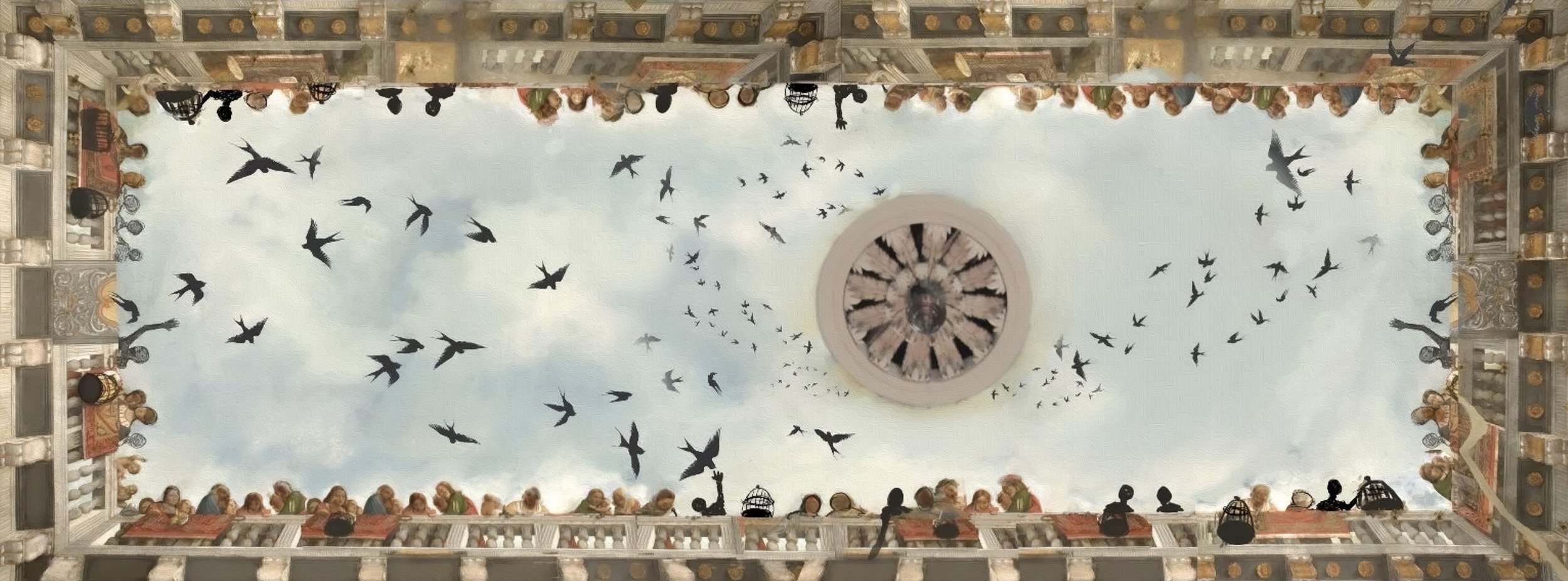
Rosales, Harmonia_King's Chapel ceiling mural
Conceptual image of the mural by Harmonia Rosales that’s being installed this year on the ceiling of King’s Chapel in Boston, Massachusetts

Despite being in the North, King’s Chapel has links to the slave trade. Historical documents reveal that at least 219 persons, most of them of African descent but at least two of them Native American, were enslaved by ministers and members of the church throughout its history, and that even after slavery was abolished in Massachusetts in 1783, donations to the church continued to flow in from people whose wealth depended on Southern slave labor, such as textile magnates. You can read more details in Slavery and King’s Chapel, the thirty-two-page report published by King’s Chapel’s Ad Hoc Committee on Slavery in 2018.

Until at least the mid-nineteenth century, people of color, both enslaved and free, who attended King’s Chapel were relegated to the balcony seats. We know the names of 182 enslaved attendees from the church’s baptismal, marriage, and burial registers. “As a community of faith,” the church writes on its website, “we are working to recover, honor, and remember these long-overlooked members of our community. We hope to make their lives and their presence in early Boston visible in new and powerful ways as we tell a more complete version of our history for our congregation, our city, and the 4 million people who walk the Freedom Trail each year.”

In addition to setting up a “living fund” to “provide monetary support for programs and engagement centered around reparative justice and reconciliation in the community,” the church has hired artist Harmonia Rosales, in partnership with the MASS Design Group, to create a physical commemoration of this history, which has three components: a figurative sculpture in the church’s courtyard, a collection of bronze birds perched throughout the church’s exterior and grounds, and a trompe l’oeil ceiling mural in the sanctuary. The memorial will be unveiled later this year. Here are two videos about it:

>> “How a Freedom Trail landmark is reckoning with its ties to slavery,” GBH News, July 19, 2023: This news segment features interview clips of Cassandra Dumay and Jessie Sage O’Leary, Boston University journalism students who are inquiring further into King’s Chapel’s links to the colonial slave trade; Rev. Joy Fallon, senior minister at King’s Chapel; Marissa Cheifetz, director of the King’s Chapel History Program; and memorial committee member David Waters.

>> “VCS Creative Conversations: Ben Quash with Harmonia Rosales,” Visual Commentary on Scripture, February 27, 2025: Theologian and VCS director Ben Quash sits down with artist Harmonia Rosales inside King’s Chapel to discuss her latest commission for that space, plus her paintings Birth of Oshun, The Creation of God, Strangler Fig, and more. Raised in the Santería religious tradition, in her art Rosales draws Yoruba deities (the orishas) into play with Christian ones and centers Black women. Speaking of the VCS’s commitment to showcasing biblical engagement from diverse vantage points, Quash tells Rosales, “We’ve always said that these conversations should not just be about the Bible’s importance to Christians or Jews, but the Bible’s importance to those of other traditions, as something to bounce off, to use, sometimes to object to. And you are a wonderful example of how to do that in a way that’s constantly creative and generous.”

+++

ARTICLE: “At the Cloisters, Sor Juana’s Words Ring Out in Song” by Elisabeth Vincentelli, The New York Times: Primero Sueño (First Dream) is a new opera by Magos Herrera and Paola Prestini that adapts to music the seventeenth-century mystical poem of the same title by the Mexican Catholic nun Sor Juana Inés de la Cruz, one of the greatest literary works of the Hispanic Baroque. Commissioned by the Metropolitan Museum of Art’s Department of Live Arts (MetLiveArts) and VisionIntoArt, it was conceived as a processional opera that meanders throughout the Met Cloisters, audience in tow—an appropriate choice, as the poem is about the soul’s journey. It premiered January 23, with Herrera playing Sor Juana, the nun in black, “sing[ing] in an earthy mezzo that complements the heavenly harmonies of the six nuns in white, performed by the German vocal ensemble Sjaella.” Accompaniment was provided by harps, hand percussion, theorbo, and Spanish guitar. Here’s a trailer (not filmed on location):
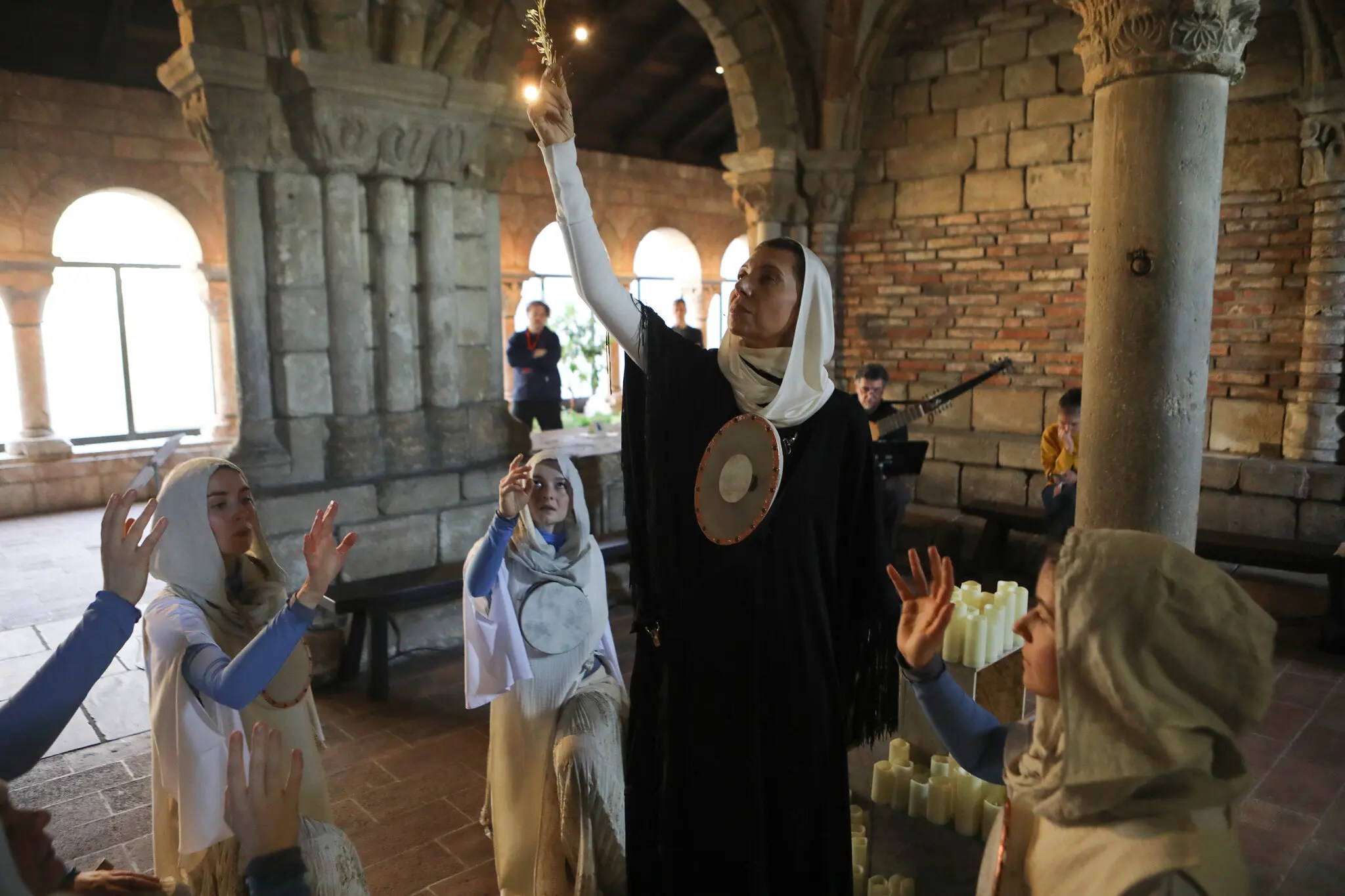
Primero Sueno performance
Magos Herrera, center, as Sor Juana in a rehearsal of the opera Primero Sueño at the Met Cloisters. Photo: Earl Wilson / The New York Times.

The Cloisters—a building designed to evoke a medieval European monastery and housing a sizeable portion of the Met’s medieval art collection—is one of my favorite spaces in all of New York. What a delight that Herrara, Prestini, and team utilized its halls and rooms as staging ground for this dramatic, musical reimagining of a historic sacred poem by a pioneering female Christian writer.

+++

INTERFAITH ART EXHIBITION: Cloud of Witnesses: Images of Faith and Divinity Today, St John’s Waterloo, London, March 4–April 27, 2025: A juried exhibition featuring the work of twenty-six artists from the UK, funded and supported by Art + Christianity; The God Who Speaks; St John’s Church, Waterloo; the Catholic Bishops’ Conference of England and Wales; Culham St Gabriel Trust; and Bible Society. Click here to view the exhibition catalog.

The image used for the cover of the exhibition catalog is Life 1, a linocut by Svetlana Atlavina consisting of fifty golden concentric circles that she said represent the vibrations of the heart—the sounds constantly being emitted from our cardiac valves, which mean we’re alive.
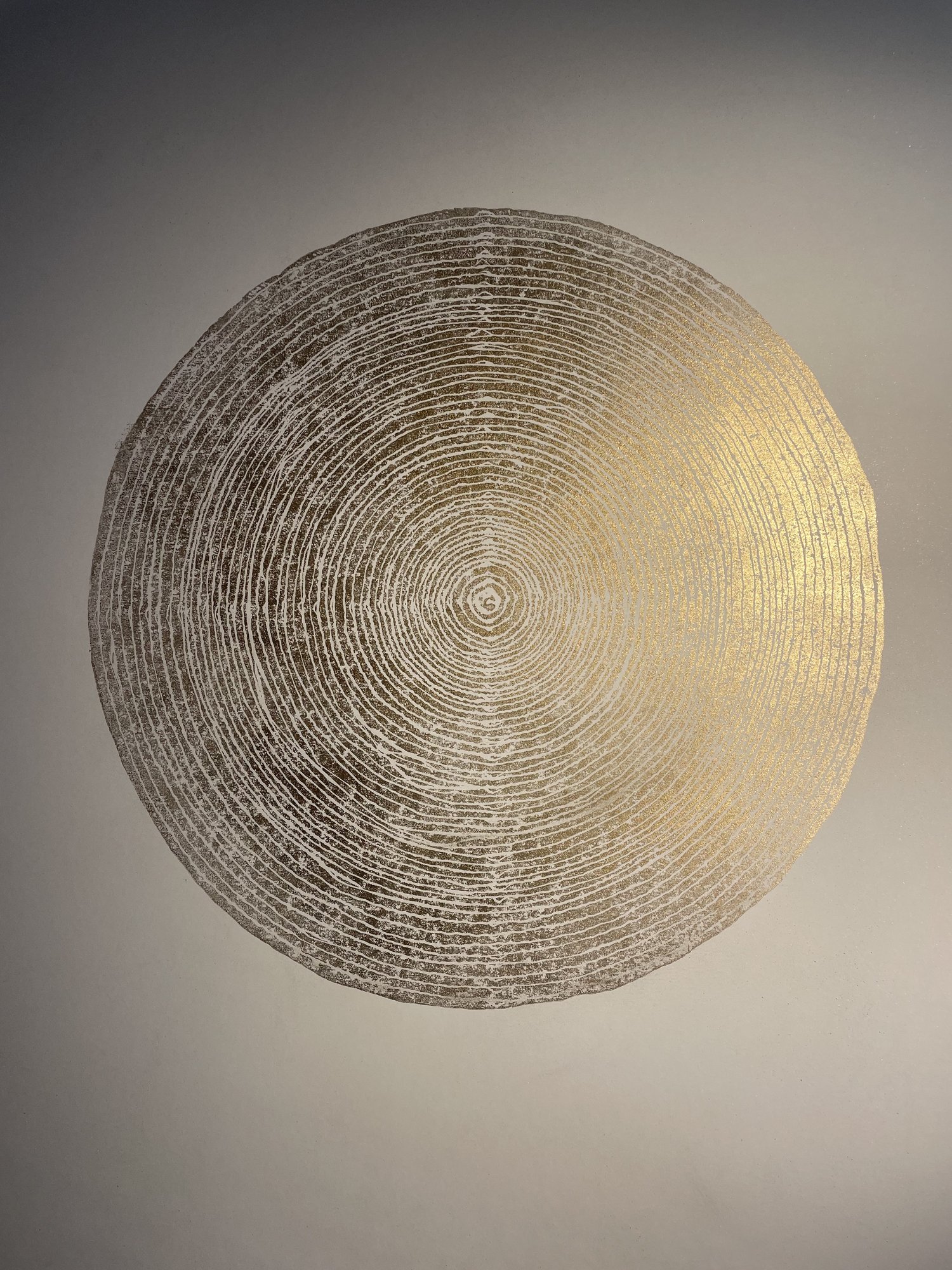
Atlavina, Svetlana_Life 1
Svetlana Atlavina, Life 1, 2024. Handmade linocut with gold ink on 300g white Somerset paper, 70 x 50 cm.

The work that I find most compelling is the eight-piece series of COME AND REST photographs by Kirsty Kerr.
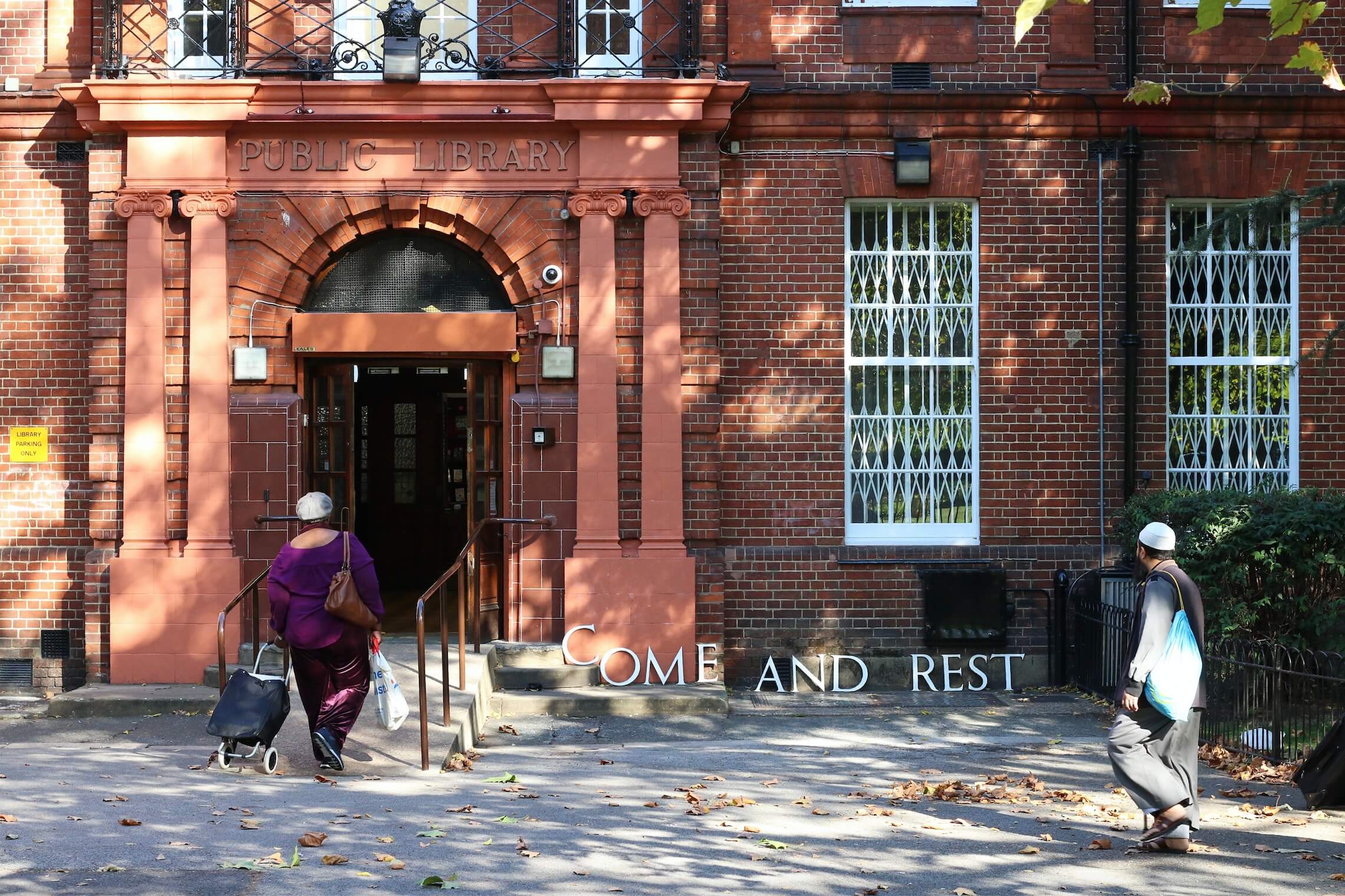
Come and Rest: Bethnal Green Library
Kirsty Kerr, COME AND REST: Bethnal Green Library, 2018. Photograph of a public intervention, from a series, 30.5 × 44 cm. Documentation by Will Alcock.

COME AND REST documents a series of public interventions informed by the demolition and rebuilding of Bethnal Green Mission Church. Taking letters from a scripture text that had hung on the old building (Jesus’ words: ‘Come to me and I will give you rest’), Kirsty spelt the phrase in Bethnal Green locations, recording the process with local filmmaker Will Alcock. The words were a gentle yet radical proclamation: of welcome, refuge, and quiet protest against loneliness and exhaustion often synonymous with city life. The act of spelling them out became a performed prayer, symbolic of the church’s continued presence and God’s enduring invitation.

Against the backdrop of this racially and religiously diverse neighbourhood, the words were both witnessed to and overlooked by passers-by of all faiths and none.

Kerr displayed Christ’s invitation in fields and basketball courts, on street corners and scaffolding and bandstand steps, outside subway stops and housing estates and libraries. View the full series here, using the right scroll arrow. I also enjoyed exploring the artist’s other projects on her website.

+++

EVENT: Taste of Heaven Intercultural Worship Festival, Coventry Cathedral, May 24, 2025: Organized by Intercultural Churches UK. “The Taste of Heaven Festival will be an exciting opportunity to celebrate the rich cultural diversity and creativity of the UK church through live performances, workshops, food and worship. The festival will take place in the iconic venue of Coventry Cathedral and its beautiful surrounding ruins. The day will trace our history of increasing diversity, by highlighting different cultural worship expressions from Celtic to Choral, South Asian and Caribbean, to more recent immigrant communities including Middle Eastern, African, and Hong Kong. It will culminate in a celebration of Intercultural Worship, demonstrating how churches can draw from different cultural streams in their corporate worship.” Tickets range from £10 to £25. Register here. [HT: Global Christian Worship]
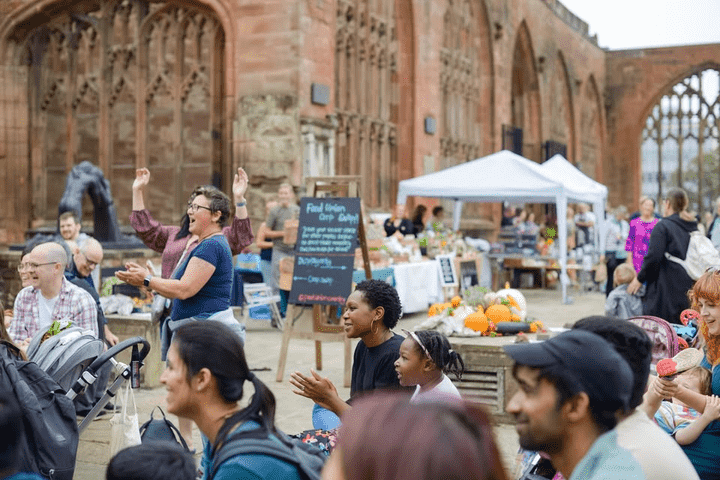
Intercultural Worship Festival

+++

SPOTIFY PLAYLIST: April 2025 (Art & Theology): The song selections on my short monthly playlists are somewhat random—a smorgasbord of what I’ve been listening to, a mix of brand-new releases and older faves—but for thematic playlists keyed to where we are in the liturgical calendar during April, see my Lent Playlist, Holy Week Playlist (I’m especially proud of this one!), and Eastertide Playlist.

Easter, Day 4: Kriste aghdga

LOOK: Anastasis, Georgian Orthodox church fresco

Harrowing of Hell (Georgia)
Anastasis (Harrowing of Hell), ca. 1207. Fresco, St. Nicholas Church, Kintsvisi Monastery, Shida Kartli region, Georgia.

In this (partially damaged) icon of the Resurrection from the main church at Kintsvisi Monastery in the country of Georgia, Christ stands over the pit of hell, atop its broken gates. He has come to take back his own from this place of death. He heaves Adam up first, and Eve next. On the right stand Kings Solomon and David and John the Forerunner (aka John the Baptist). The deliverance they’ve been awaiting has come.

Fresh from the tomb, Christ holds aloft his cross as a victory staff. As is common in Orthodox icons, it has three horizontal beams: a short one on top, representing the titulus that read, “King of the Jews”; the main one, onto which Jesus’s hands were nailed; and a footrest at the bottom.

(Related post: “‘Done Is a Battle’ by William Dunbar”)

LISTEN: “Kriste aghdga” (Christ Is Risen), the Paschal troparion in a traditional Georgian setting from the Svaneti region | Performed by the Sheehan Family, 2020

Krist’e aghdga mk’vdretit
sik’vdilita sik’vdilisa
dam trgun velida saplavebis shinata
tskhovrebis mimnich’ebeli.

English translation:

Christ is risen from the dead,
trampling down death by death,
and upon those in the tombs bestowing life.

Frederica Mathewes-Green, an Eastern Orthodox author and speaker from Johnson City, Tennessee, wrote the following on her Facebook page last year:

The troparion [short hymn] for Pascha is this brief and punchy one, written by St. John of Damascus (d. 749):

Christ is risen from the dead,
trampling down death by death,
and upon those in the tombs bestowing life.

We sing it many, many times—surely hundreds of times—before Pascha concludes on the day of Pentecost. It is always sung a capella, without accompaniment (apart from the vigorous ringing of bells, in some congregations). It is set to many, many different melodies. Each ethnicity has a half-dozen favorite melodies, so the options are very broad. . . .

But when Orthodox of other nations hear it sung in a Georgian tone, they stop and listen.

Georgian church music is unique. It is always sung in three parts, honoring the Trinity; but what’s striking is the sound of it, unlike anything we have in the West. Someone who is trained in Georgian chant might be able to explain it, but I can’t. 

Let’s hear from Dr. John A. Graham, an American musicologist specializing in the history of Georgian liturgical music and who runs the website www.georgianchant.org:

“Kriste aghdga” (Christ is Risen) is an important Easter hymn in the Georgian Orthodox tradition. It is sung when the priest knocks on the doors of the church, symbolizing entrance to the tomb of Christ, just before entering the sanctuary space to commence the all-night liturgy service [on the Saturday before Easter].

Then it is repeated in groups of three throughout the All-Night vigil service (4-7 hours). It is also sung in every service after Easter until Pentecost.

The chant survives in many musical variants, as chanters in each village and region perfected their individual style.

The most popular variant, the one you heard above, is from Svaneti, a highland region in northwest Georgia. The style is influenced by Svan folk music. This variant begins with a solo sung by the middle voice. You can purchase the vocal score here, as sung by the Sheehan family, or see the free transcription that Graham provides.

Here’s the Orthodox Virtual Quarantine Choir, directed by Steve Jacobs, singing the chant in English, interspersed with a Paschal reading taken from Psalm 68:1–3 (“Let God rise up . . .”) and Psalm 118:24 (“This is the day . . .”):

In his article, Graham lists seven characteristics of traditional Georgian chant, among which are its three-part voicing, its close harmonies (“The dissonances are integral to the desired sound. The tension-release in the music is symbolic of our prayers and supplications to God.”), and an ending in unison. He posts videos of several other regional musical variants of the troparion in Georgian.

This song, as performed by the Capitol Hill Chorale, is on the Art & Theology Eastertide Playlist.

Lent, Day 19

I am my beloved’s, and my beloved’s is mine . . .

—Song of Solomon 6:3a (cf. 2:16)

He brought me to the banqueting house, and his banner over me was love.

—Song of Solomon 2:4

I will extol thee, O LORD; for thou hast lifted me up . . .

—Psalm 30:1a

Blessed be the God and Father of our Lord Jesus Christ, who hath blessed us with all spiritual blessings in heavenly places in Christ . . .

—Ephesians 1:3

LOOK: Ethiopian Angels, Debre Birhan Selassie Church

Ethiopian church ceiling
Painted wood ceiling, early 19th century, Debre Birhan Selassie Church, Gondar, Ethiopia. Photo: A. Savin.

Debre Birhan Selassie (Trinity and Mountain of Light) Church in Gondar, the imperial capital of Ethiopia from 1636 to 1855, is famous for the colorful paintings that cover every inch of the interior walls and ceiling. The south wall concentrates on the Life of Christ, while the north wall depicts various saints. The focal point—on the east wall, in front of the holy of holies—is a Crucifixion scene and an icon of the Trinity. But the most celebrated visuals inside the church are the hundred-plus winged heads painted in rows between the wooden beams of the ceiling, representing the cherubim and God’s omnipresence.

The original church, which was round, was consecrated in 1693 by Emperor Iyasu I, but lightning destroyed it in 1707. The rectangular stone church that stands on the site now likely dates to the late eighteenth century, and it is the only one of the forty-four Orthodox Tewahedo churches in Gondar to survive the 1888 sack of the city by Mahdist soldiers from Sudan. (Locals say the marauders were miraculously rerouted by a swarm of bees.)

According to Ethiopia (Bradt Travel Guide) writer Philip Briggs, “The paintings are traditionally held to be the work of the 17th-century artist Haile Meskel, but it is more likely that several artists were involved and that the majority were painted during the rule of Egwala Seyon (1801–17), who is depicted prostrating himself before the Cross on one of the murals.”

Debre Birhan Selassie is still an active church, but priests also offer tours. Here’s some video footage of the inside (you’ll see it’s very dark, and flash photography is not allowed), and some drone footage of the exterior.

The church is part of a larger imperial compound, known as Fasil Ghebbi, that has been a UNESCO World Heritage Site since 1979 and that includes palaces, monasteries, and public and private buildings.

Angels (Debra Berhan Selassie Church)
Photo: Alan Davey

LISTEN: “His Banner Over Me Is Love” by B. C. Laurelton (pseudonym of Alfred B. Smith), 1965 | Performed by Christy Nockels on Be Held: Lullabies for the Beloved, 2017 | CCLI #28579

I am my Beloved’s and He is mine—
His banner over me is love.
I am my Beloved’s and He is mine—
His banner over me is love.
I am my Beloved’s and He is mine—
His banner over me is love,
His banner over me is love.

He brought me to His banqueting table—
His banner over me is love.
He brought me to His banqueting table—
His banner over me is love.
He brought me to His banqueting table—
His banner over me is love,
His banner over me is love.

He lifted me up to the heavenly places—
His banner over me is love.
He lifted me up to the heavenly places—
His banner over me is love.
He lifted me up to the heavenly places—
His banner over me is love,
His banner over me is love.

I sang a version of this song in children’s church regularly when I was little (with hand motions!) and have carried it with me all these years, a gentle assurance that I am divinely loved and protected. I’ve quoted the scriptures it’s drawn from above. Its refrain comes from Song of Solomon 2:4: “his banner over me was love.”

The Song of Solomon, aka the Canticle of Canticles, has traditionally been read, at least on one level, as an allegory of the love between God and the human soul—or, more specifically in the Christian tradition, Christ and his church.

From the root “to cover,” the Hebrew word for “banner” in this verse refers to a military standard. It is being used figuratively here to indicate that we enlist ourselves under Love’s banner, which goes forth in triumph and protects those under its billows. We belong to love, commit ourselves to love, overcome through love. The verse is perhaps an allusion to the names of generals being inscribed on the banners of their armies. God’s name is Love (1 John 4:8).

The image is at once vigorous and gentle. The NRSV translates the phrase as “his intention toward me was love.”

The song “His Banner Over Me Is Love” was written by Alfred B. Smith (1916–2001), an itinerant song leader, songwriter, and Christian music publisher. Smith compiled and published his first songbook, Singspiration One: Gospel Songs and Choruses, while he was a student at Wheaton College in 1941, to support the evangelistic meetings he was running with his roommate, Billy Graham (yes, that Billy Graham!). Two years later he founded Singspiration Publishing Company, which published several popular series of songbooks. In 1963 he sold Singspiration to Zondervan, but he ran other publishing ventures (i.e., Better Music Publications and Encore Publications) for the remainder of his ministerial career.

According to Music in the Air: The Golden Age of Gospel Radio by Mark Ward Sr., Smith composed “His Banner Over Me Is Love” in 1965 as an impromptu offertory while serving as a visiting song leader at First Baptist Church–Laurelton in Brick, New Jersey. Afterward he received requests from the congregation for the music. His original notation read “B. C. Laurelton” (for “Baptist Church Laurelton”) to designate where he wrote the song, and it was copied as such as people shared the music with others—so when the song was later published in 1972, Smith decided to adopt “B. C. Laurelton” as a pen name.

Singer-songwriter Christy Nockels [previously] sings “His Banner over Me” on an album of lullabies to a twinkling piano accompaniment.

May this truth—that God’s banner over you is love—soothe you and give you confidence.

Social critique in two Victorian Nativity paintings

Sometimes we rush to judgment of artworks that at first glance seem dull and conventional. We assume they have nothing to show us. But if we were to look more closely, we might find something unexpected. Even subtly subversive.

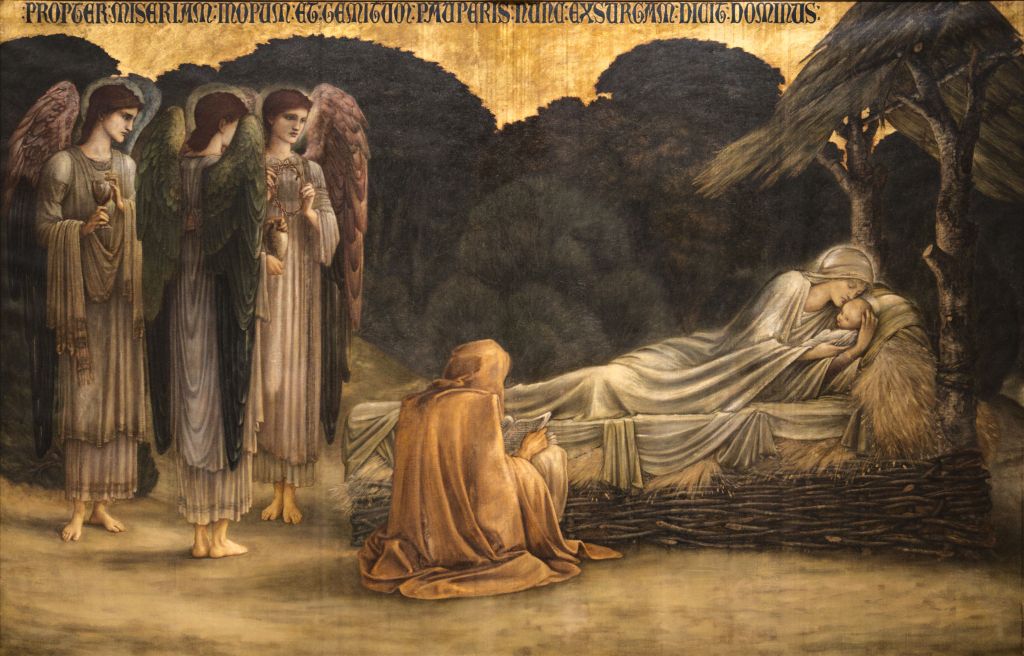
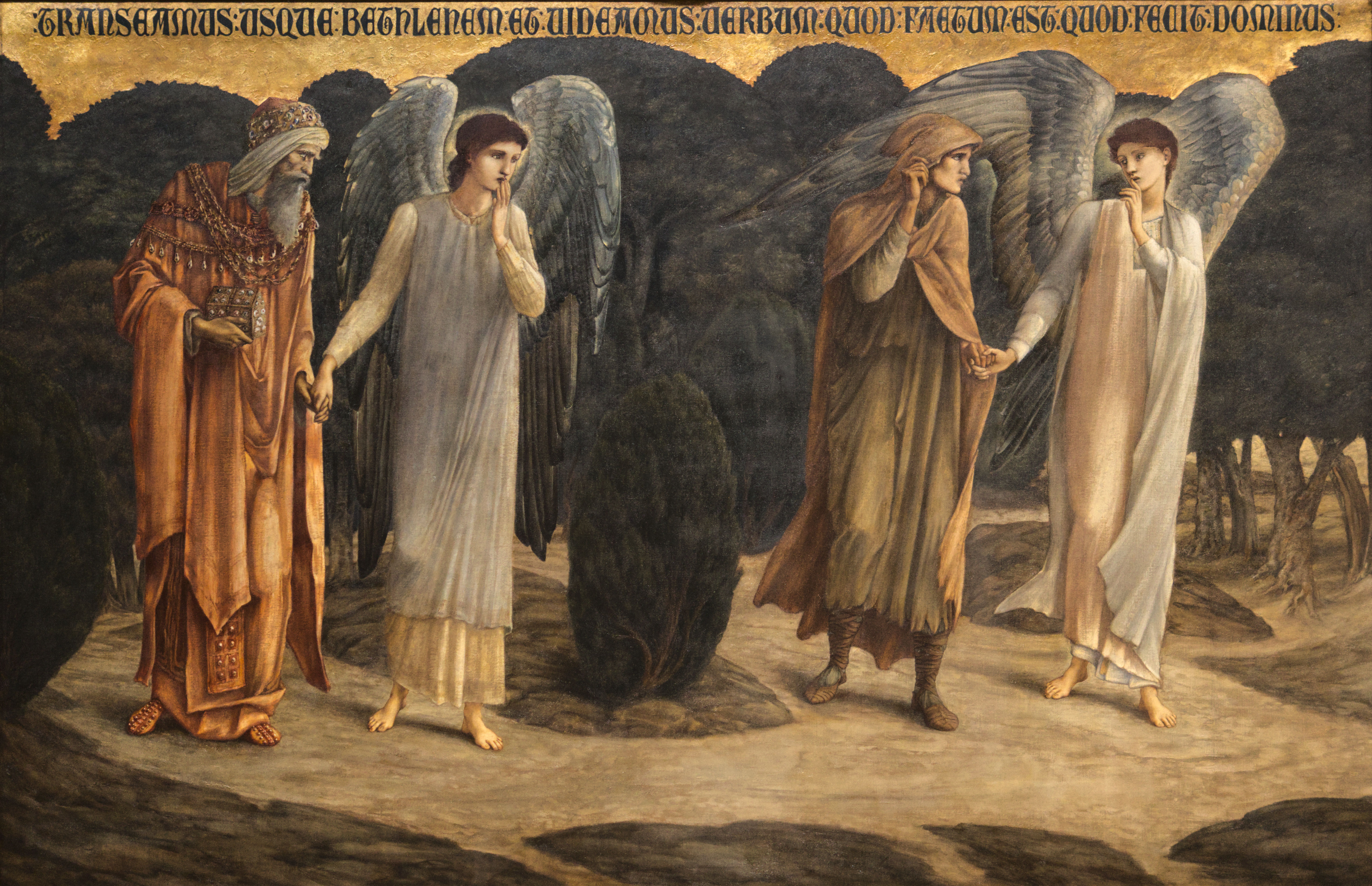
Such is the case with The Nativity and its companion piece, The King and the Shepherd, which were commissioned from the Pre-Raphaelite artist Edward Coley Burne-Jones in 1887 for the chancel of Saint John’s Church in Torquay, England. Seven by ten feet each, they hung on the north and south walls for just over a hundred years before being sold by the church in 1989 to pay for a new roof. (Copies were hung in their places.) Musical theater composer—and Victorian art collector!—Andrew Lloyd Webber bought them and, in 1997, donated them to the Carnegie Museum of Art in Pittsburgh, Pennsylvania. That’s where I saw them earlier this year.

Burne-Jones, Edward_Nativity
Sir Edward Coley Burne-Jones (British, 1833–1898), The Nativity, 1888. Oil on canvas, 81 × 124 1/2 in. (205.7 × 316.2 cm). Carnegie Museum of Art, Pittsburgh, Pennsylvania.

Burne-Jones, Edward_The King and the Shepherd
Sir Edward Coley Burne-Jones (British, 1833–1898), The King and the Shepherd, 1888. Oil on canvas, 81 1/4 × 124 1/2 in. (206.4 × 316.2 cm). Carnegie Museum of Art, Pittsburgh, Pennsylvania.

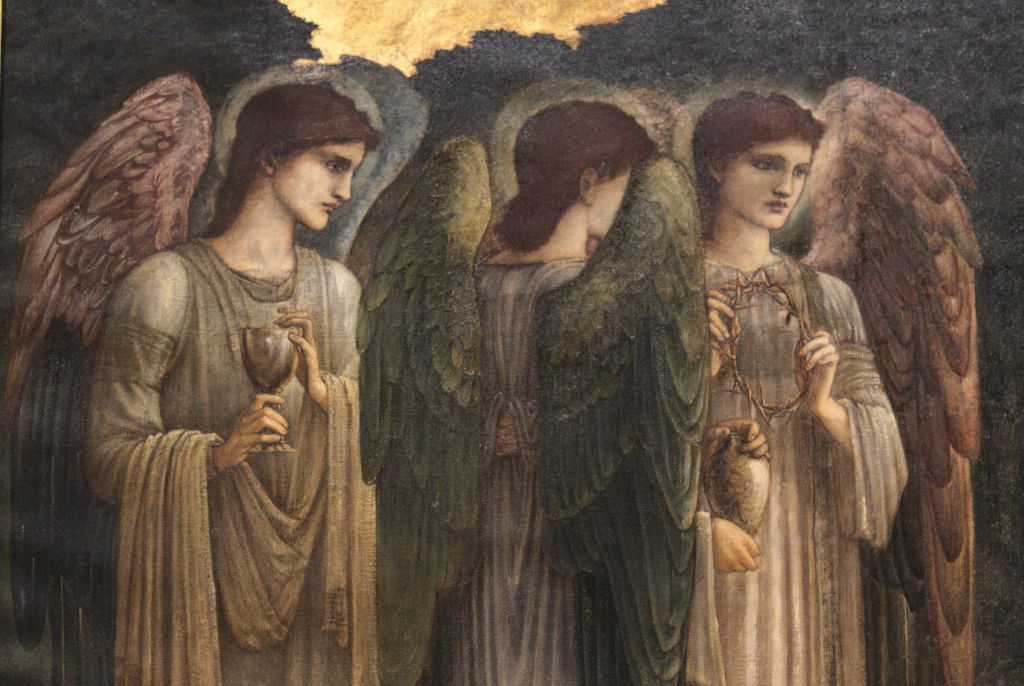
The Nativity shows Mary reclining outdoors on a rustic bed that resembles a bier with her newborn son, Jesus, both wrapped in shroud-like garments. Her partner, Joseph, who has his cloaked back to the viewer, sits on the ground reading a manuscript in Gothic script; the text is indiscernible, but I presume it’s meant to be the scriptures that prophesy the birth of a savior or his sacrificial death. Three angels stand to the side holding symbols of the passion: a crown of thorns, a chalice, and a jar of myrrh, a traditional burial spice. The painting, therefore, links the entrance of Jesus onto the world stage to his ultimate saving act on the cross.

(Related post: “Birth and death in Lavinia Fontana’s Holy Family painting”)

Burne-Jones, Edward_Nativity (pastel)
Pastel sketch for The Nativity by Sir Edward Coley Burne-Jones, 1887. The New Art Gallery Walsall, England.

Burne-Jones, Edward_Nativity (detail, angels)

This foreshadowing approach was not new in Nativity art. But in addition to gesturing toward the redemption from sin that Jesus would bring, the painting also quotes from a community lament psalm in which God’s people cry out for deliverance from those in authority who lie and manipulate. Propter miseriam inopum et gemitum pauperis nunc exsurgam dicit Dominus, the Latin inscription reads, which translates, “Because of the misery of the poor and the groaning of the needy, now will I arise, saith the LORD” (Psalm 12:5a). When God’s people are oppressed, God is aroused to action, and Burne-Jones’s choice of this atypical scripture text for a Nativity painting reminds us of the sociopolitical context of Jesus’s birth, which involved Roman occupation of Israel and a despotic ruler so obsessed with power that he mandated the extermination of Jewish male babies in Bethlehem, thinking he would quash the threat of usurpation. This is the reality into which Jesus was born. And though he didn’t deliver Israel from Rome during his lifetime, he did launch a new “kingdom” and declare a jubilee (Luke 4:16–21).

The biblical inscription speaks not only to Jesus’s day but also to contemporary times, which were marked by high unemployment and great hardship among London’s working class. It’s “a subtle allusion to the social miseries of Victorian Britain,” says Louise Lippincott, curator for the Carnegie at the time of acquisition. She speculates that Burne-Jones intended the painting “as his public statement, albeit a muted one, on 19th-century social horrors. . . . It is quite likely that he was thinking of reports of the bestial living conditions of the London poor that were appearing in the press in the early 1880s.” In 1886, 1887, and 1888, as Burne-Jones was planning and executing the painting, violent strikes and riots were going on in London to protest economic inequality. As people starved, those in power continued to fatten themselves with apparent disregard. The incorporation into this humble scene of a divine vow from the Psalms, where God states his commitment to the poor, expresses hope that God will again arise to deliver from affliction those who trust in him.

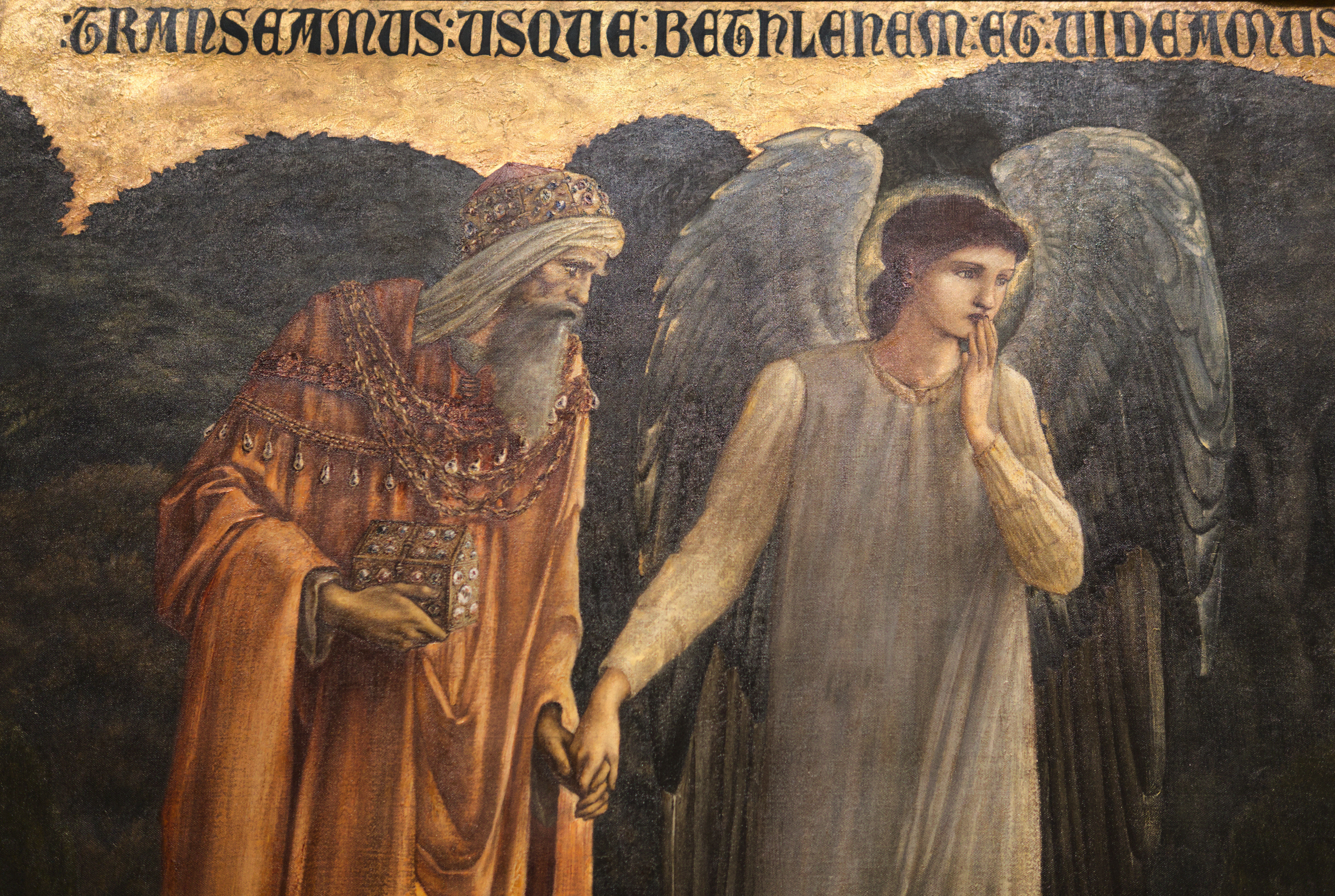
The King and the Shepherd extends this critique of the wealth gap by showing the two titular figures—one rich, the other poor—approaching the Christ child as equals. As was and still is common, Burne-Jones combines Matthew’s account of the magi with Luke’s account of the shepherds, showing both as welcome participants in the same event, but uniquely, he chooses only one figure to represent each group. (Traditionally, three magi attend the birth, along with a nonstandard number of shepherds.) An angel leads each traveler by the hand, reminding them to keep their voices low so as not to wake the sleeping infant.

Burne-Jones, Edward_The King and the Shepherd (detail, king)
Burne-Jones, Edward_The King and the Shepherd (detail, shepherd)

“The pairings visually suggest the equality, in the face of divinity, between the wealthy king and the humble peasant,” reads the museum wall text. “In the context of the enormous social inequalities rife in Victorian England, this message smacked of social and political radicalism.” The Latin inscription—Transeamus usque Bethleem et videamus hoc verbum quod factum est quod fecit Dominus [et ostendit nobis]—comes from the New Testament description of the journey of the shepherds. “Let us now go even unto Bethlehem,” they say, “and see this thing which is come to pass, which the Lord hath made known unto us” (Luke 2:15b).

God chose to reveal his Son’s birth not only to bookish scholars or, as tradition has it, royalty, but also to a bunch of blue-collar laborers. The shepherds’ and kings’ mutual presence at Christ’s bedside was only the beginning of the reconciliation across lines of division that Christ came to enact.

For further reflection on the inclusion of rich and poor in the biblical narratives of Jesus’s birth, see “Shepherds vs. Magi: Dynamics of Privilege within the Nativity Story” by Tony Kriz.

All photos, except for the pastel sketch, are by Victoria Emily Jones / ArtandTheology.org.

Roundup: Alabaster Gospels, the lone cathedral-builder, Pacheco at Chichester, lamenting racial injustice

Alabaster page spread

New Gospel-book set promotes aesthetic reading experience: Photographer Bryan Chung and designer Brian Chung, both campus ministers (and no relation), believe that beauty is fundamental to understanding who God is. So they’ve teamed up for project Alabaster: a brand-new design of the holy Gospels, in four volumes, integrated with contemplative photographs. They’ve already well exceeded their funding goal on Kickstarter, which means there’s already a lot of interest in having Bible reading be a visual experience—and at a 7½ × 9½ trim, the books are definitely wieldy, meant to be regularly handled and read! If you want a guaranteed copy, be sure to back the project on Kickstarter, as the number of names in the system will determine the size of the print order. You have until October 7; the publication month is April 2017. This project aligns so well with my mission here at Art & Theology, and I’m thrilled to see it in the works.

+++

90-year-old man spends lifetime building a cathedral by hand: From Great Big Story: “For 53 years, Justo Gallego has been building a cathedral by hand on the outskirts of Madrid almost entirely by himself. Gallego has no formal architecture or construction training, but that hasn’t stopped him from toiling on this herculean task. At 90 years old, Gallego knows that he will not be able to finish the project in his lifetime. But he keeps at it anyway, day after day, driven by his faith.”

+++

Shadows of the Wanderer by Ana Maria Pacheco
Ana Maria Pacheco (Brazilian, 1943–), Shadows of the Wanderer, 2008. Polychromed wood sculpture, 260 × 390 × 605 cm. Installation view at Norwich Cathedral, 2010, via Pratt Contemporary Art.

Art installation at Chichester Cathedral speaks to the refugee experience: Shadows of the Wanderer by Brazilian-born artist Ana Maria Pacheco is on display in the north transept of Chichester Cathedral through November 14. A multipiece figurative sculpture in polychromed wood, it has as its centerpiece a young man carrying an elderly man on his back—a reference to the Aeneid’s Aeneas carrying his lame father out of the ruins of Troy. The cathedral has organized events around the installation, including a lecture by Christopher Wintle on the representation of suffering in Pacheco’s art (audio here, transcript here); a series of workshops for schools and colleges exploring the refugee experience, developed in partnership with Amnesty International; a debate titled “Refugees: Problem or Gift?”; an interview with the artist; and a woodcarving workshop. The photo above is an installation view from 2010 inside Norwich Cathedral; to see photos of the work in its current location at Chichester, click here.

+++

Addressing racial injustice as a church: Paul Neeley at Global Christian Worship has compiled an excellent list of resources for churches looking for ways to address racial tensions in America with an eye toward healing, including a prayer service of lament by Paul Burkhart; two litanies by Fran Pratt; a list of relevant hymns, curated by the Hymn Society; an article by Sandra Van Opstal, “Reconciling Witness And Worship: Six Ways To Begin”; and materials from the 2016 Reconciliation and Justice Network conference. I’d like to add to it the lecture series “Race and the Church,” especially Jemar Tisby’s “Understanding the Heart Cry of #BlackLivesMatter,” which I live-streamed with my church back in July. (It definitely sparked fruitful conversation.) For common objections to the movement, like “What about black-on-black crime?” and “Don’t #AllLivesMatter?,” he refers listeners to the video below, produced by MTV.

+++

SONG: “Light a Candle”: Also on Neeley’s website I found a video performance of the song “Light a Candle” by Mary Louise Bringle (words) and Lori True (music). It’s sung here, to a ukulele accompaniment, by Becky Gaunt, director of music and liturgy at St. Jude of the Lake Catholic Church in Mahtomedi, Montana.

She posted it on her Facebook page in July along with this note:

We cannot continue to let language divide us. We cannot continue to let language distract us from loving one another. We cannot continue to let words like “black lives matter” or “all lives matter” cause us to keep missing the point!

I’m sad and tired. And you probably are too. But now is NOT the time to be neutral! The Sun may be shining outside, but we need to come together and light a candle in this oppressive darkness. This beautiful song by Lori True (amazing text by Mary Louise Bringle) is my prayer right now. I invite you to pray this with me.

Boy with a Candle by Gerard Sekoto
Gerard Sekoto (South African, 1913–1993), Boy with a Candle, 1943. Oil on canvas, 46.2 × 36 cm.

Wilcote altarpiece by Nicholas Mynheer

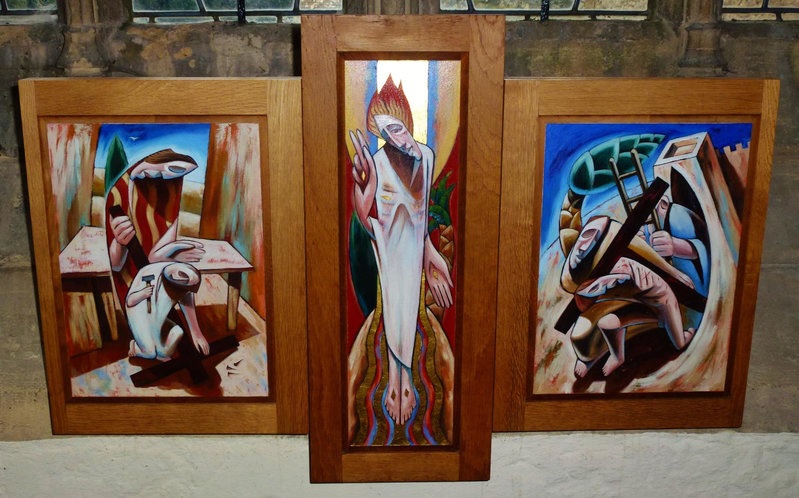
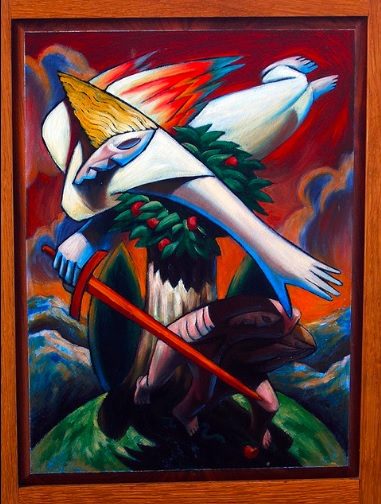
Oxford painter, sculptor, and glass designer Nicholas Mynheer works almost exclusively on religious themes, fulfilling commissions for churches throughout the UK (he’s working on two right now). His style is instantly recognizable—a distinctive blend of medieval, expressionist, and primitive influences resulting in simplified figures with exaggerated features and compositions full of color and movement.

In 1999 Mynheer was commissioned by St. Mary’s Church in North Leigh, Oxfordshire, to create an altarpiece for its fifteenth-century Wilcote Chapel. He decided to create a hinged polyptych (multipanel painting) that shows three Christ-based scenes in its closed view and then opens to reveal four additional scenes on the wings. (The center panel remains fixed.)

Wilcote Chapel, St. Mary's, North Leigh, Oxfordshire
Wilcote Chapel, St. Mary’s Church, North Leigh, Oxfordshire.

Wilcote altarpiece
Wilcote Chapel polyptych (open view) by Nicholas Mynheer (British, 1958–), 1999. Oil on oak panels. St. Mary’s Church, North Leigh, Oxfordshire, England.

Wilcote altarpiece (closed)
Wilcote Chapel polyptych (closed view) by Nicholas Mynheer (British, 1958–), 1999. Oil on oak panels. St. Mary’s Church, North Leigh, Oxfordshire, England.

One of the challenges of painting a polyptych is figuring out how to arrange various episodes into one unified story, or, if portraiture is used instead of narrative, how to draw multiple figures into thematic coherence. The panels should not be isolated pictures but should speak to one another, aiding the viewer in worship. Mynheer achieves this unity brilliantly by establishing visual links through symmetry, which suggest associations of contrast between an earlier event and a later one: the expulsion versus the resurrection of the saints (sin and redemption), the nativity versus the pietà (birth and death), Jesus in Joseph’s workshop versus Jesus carrying his cross (wood as an innocent building material, wood as a horrendous instrument of execution).

Expulsion

When the wings of the altarpiece are open, the leftmost panel depicts the expulsion of Adam and Eve from the Garden of Eden after they had broken fellowship with God. Miserable and ashamed, the couple departs under the shadow of sin’s curse while a cherub enforces the banishment with a red-hot sword. As they go, though, they step—seemingly unawares—on a snake, foreshadowing the Second Adam who would come to crush Satan, as prophesied in Genesis 3:15.   Continue reading “Wilcote altarpiece by Nicholas Mynheer”