SPOTIFY PLAYLIST: February 2025 (Art & Theology): I put these monthly playlists on pause for December and January, since I’ve already published long, dedicated playlists for the seasons of Advent, Christmas, and Epiphany, but now I’m picking back up my usual smorgasbord routine. Enjoy two hours of songs handpicked by me!
+++
PODCAST EPISODE: “Nadia Bolz-Weber: From Fundamentalism to Stand-Up Comedy to Ordained Pastor,”No Small Endeavor, January 27, 2025: “Christian Fundamentalism is often looked down upon for its dualistic, black-and-white outlook, which is often used for policing behavior. But, Nadia Bolz-Weber explains, these are the same extreme tendencies that she found in secular activism after she left the church. Later in life, after working as a comedian and entering recovery, Nadia began to untangle the mindset that had taken her from one extreme to the other. Her long journey has since led her to becoming a Lutheran pastor and a three-time bestselling author. In this episode, she tells her story.”
In conversation with host Lee C. Camp, Bolz-Weber [previously] discusses some of the gifts and wounds from her Church of Christ upbringing; how comedy prepared her for preaching; the influence of AA’s Twelve-Step Program on her life, especially her necessary reckoning with her powerlessness (“it doesn’t mean you don’t have access to power; it’s just that it doesn’t all come from you”); moving through the grief of losing her nephew; and her Red States Revival tour, which since the date of recording has been actualized!
+++
SUBSTACK POST: “Why go to church, anyway” by Amy Peterson, Making All Things New, November 20, 2024: Amy Peterson is an Episcopal priest from Asheville, North Carolina, and the author of one of my favorite books from 2020, Where Goodness Still Grows: Reclaiming Virtue in an Age of Hypocrisy. In this Substack post from last November, she shares some responses from when she asked on Instagram, “Why did you stop going to church?” and, to a different set of respondents, “Why do you go to church?” Then she answers the second question for herself, giving fourteen reasons why she would still go to church even if it wasn’t her job. I (a regular churchgoer who has been hurt in the past by the church, though not to the degree that many others have been) find these reasons so compelling and encouraging.
+++
SONG: “Good Trouble”by Thomas Keesecker: This choral work was inspired by the catchphrase of the civil rights icon John Lewis (1940–2020), who repeatedly called on Americans to “get in good trouble”—to agitate for liberty and justice for all. For example, on June 27, 2018, he tweeted, “Do not get lost in a sea of despair. Be hopeful, be optimistic. Our struggle is not the struggle of a day, a week, a month, or a year, it is the struggle of a lifetime. Never, ever be afraid to make some noise and get in good trouble, necessary trouble.” Similarly, on December 4, 2019, at the opening of the Library of Congress exhibition Rosa Parks: In Her Own Words, Lewis said, “Rosa Parks inspired us to get in trouble. And I’ve been getting in trouble ever since. She inspired us to find a way, to get in the way, to get in what I call good trouble, necessary trouble.”
Lewis was a crucial leader of the civil rights movement, chairing the Student Nonviolent Coordinating Committee (SNCC) from 1963 to 1966, participating in sit-ins and Freedom Rides, co-organizing the 1963 March on Washington, and, on March 7, 1965, physically leading, with Hosea Williams, some six hundred peaceful marchers across the Edmund Pettus Bridge from Selma to Montgomery to protest the disenfranchisement of African Americans, an action that erupted into what’s known as Selma’s Bloody Sunday. When the marchers refused to disperse, Alabama state troopers attacked them with billy clubs and teargas, fracturing Lewis’s skull. He survived and continued his political activism and advocacy for another half century, serving in the US House of Representatives for Georgia’s Fifth Congressional District from 1987 until his death in 2020.
To learn more about John Lewis and his remarkable Christian witness, see the documentary John Lewis: Good Trouble, which is streaming for free on Kanopy (ask your local library if they subscribe). Here’s a trailer:
+++
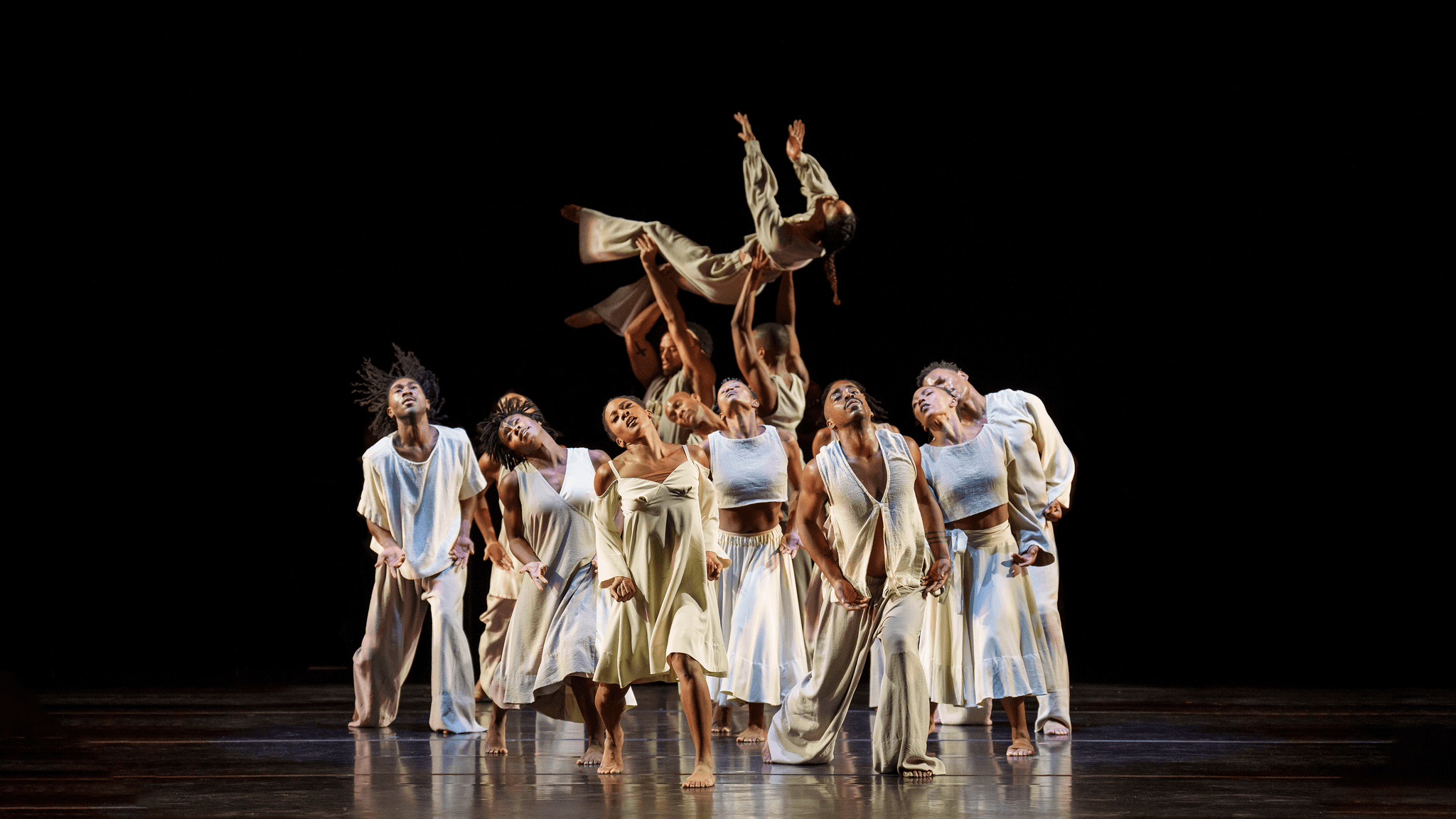
NEW ALBUM: Sacred Songs Suite by Du’Bois A’Keen: Last month I had the privilege of seeing Sacred Songs, a new dance work choreographed by Matthew Rushing and scored by Du’Bois A’Keen, performed by Alvin Ailey American Dance Theater. It was phenomenal! Both a visual and aural experience. The music was performed live with four vocalists (A’Keen sang lead) and a four-piece band, and throughout the evening, the verbal responses from the audience—“Mmmm” and “Amen” and “Yes, Lord!”—made me feel much more like I was in church than in a performing arts center.
Featuring original arrangements of nine spirituals, Sacred Songs “brings together and reimagines the sounds of jazz, West African drums, gospel, hip-hop, calypso, and more to call on the past, engage our present, and invite the listener into a magical, hopeful, and musical future.” A’Keen released the music, plus a few bonus tracks, on his album Sacred Songs Suite on January 18. “By the Waters” is one of the most memorable sections for me.
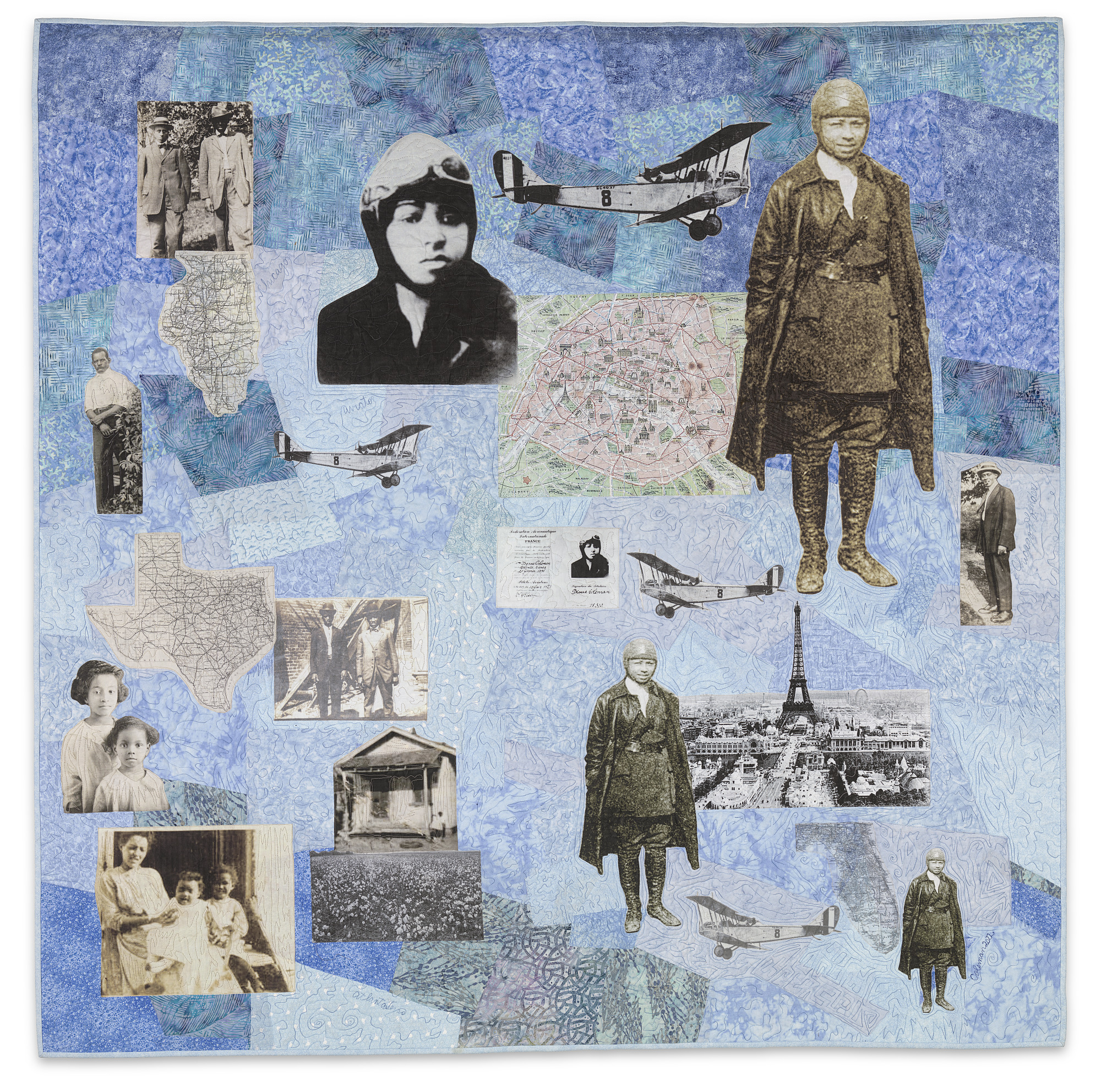
Marion Coleman (American, ?–2019), Her Heart Was in the Clouds, 2012. Cotton fabric, cotton thread, and cotton batt, 60 1/2 × 60 in. (153.7 × 152.4 cm). Smithsonian American Art Museum, Washington, DC.Marion Coleman (American, ?–2019), Tender Gardens, 2014. Cotton fabric and batt, 72 1/2 × 72 1/8 in. (184.2 × 183.2 cm). Smithsonian American Art Museum, Washington, DC.
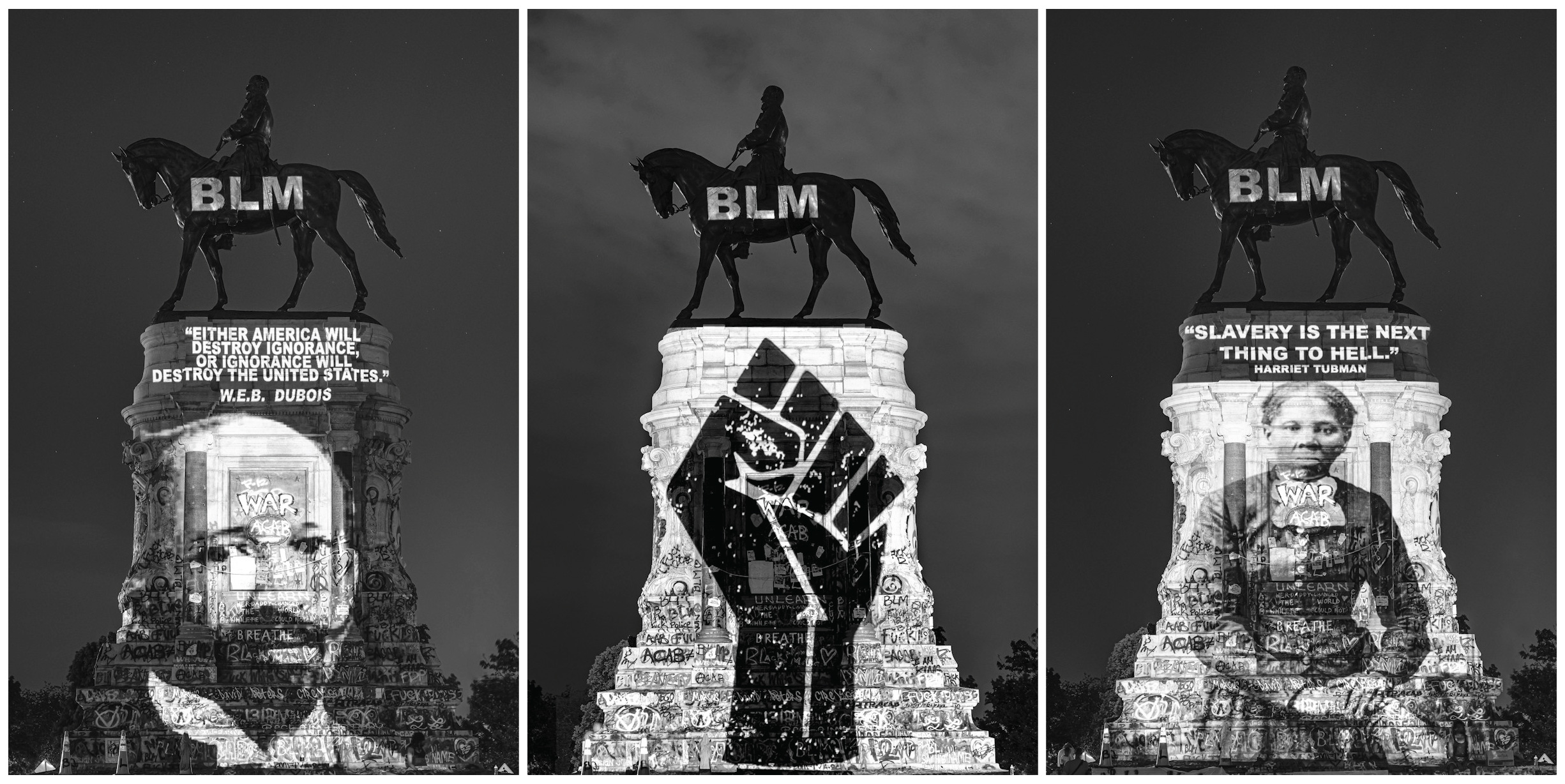
In summer 2020, artists Dustin Klein and Alex Criqui projected images of Black lament and empowerment onto the Robert E. Lee Monument at Marcus-David Peters Circle in Richmond, Virginia, part of their Reclaiming the Monument project. Read more at bottom of post.
Song of the Agitators
“Cease to agitate!” we will, When the slave whip’s sound is still; When no more on guiltless limb Fetters print their circlet grim; When no hound athirst for blood Scours the thorny Georgian wood; When no mother’s pleading prayer, On the sultry Southern air, Quivereth out in accents wild, “Master, give me back my child!” In the day when men shall be Brethren, equal-born, and free— Day for which we work and wait— We will “cease to agitate”!
When our statute books proclaim To the world no more our shame, And a freeman’s rights shall hold Dearer than the Judas gold; When the Polar Star shall give Light to the last fugitive; When our border lakes shall rise On the last lone bondman’s eyes, And their waves for him no more Haste to clasp the Northern shore; In the day when men shall be Brethren, equal-born, and free— Day for which we work and wait— We will “cease to agitate”!
Written by an anonymous abolitionist during the days of race-based chattel slavery in the United States, this poem was originally published in the Ohio Star (Ravenna, OH) in 1852 and was reprinted shortly after in the Anti-Slavery Bugle (Oct. 9, 1852) (Lisbon, OH), the Liberator (Nov. 19, 1852) (Boston), and the Voice of the Fugitive (Dec. 16, 1852) (Windsor, Ontario).
The poem addresses those who, with the status quo working in their favor, would tell the enslaved to stop complaining about the injustices being perpetuated against them, stop ruffling feathers and demanding change, and instead just sit back and be content with the way things are.
The speaker of the poem responds with a defiant no; they and their fellow activists will stop agitating only when their cause is won. When the enslaver’s whip ceases to crack the air, and shackles no longer imprint themselves on ankles and wrists. When bloodhounds are no longer unleashed on freedom seekers, and children are no longer forcibly separated from their parents. When the country’s founding documents are scrubbed of their racism, and its legislation protects the rights of all Americans in equal measure. When the North Star guides home and the Great Lakes give passage to every last person out of bondage into liberation.
Those who work for justice today still often encounter the demand, “Cease to agitate!” “Stop stirring up trouble.” “Don’t be such a downer.” “Why are you so angry?” “Why can’t you just be grateful for the progress we’ve made?” “When will you ever be satisfied?”
Struck by its contemporary relevance, Detroit-born, Vancouver-based musical artist Khari Wendell McClelland adapted the above poem and set it to music. “I sing this song for all those who are living under tyranny, escaping tyranny, and searching for peace,” he wrote in a 2015 Facebook post sharing a demo video.
McClelland’s “Song of the Agitator” appears on his 2018 album, Freedom Singer. The album is dedicated to his great-great-great-grandmother Kizzy, who fled US slavery through the Underground Railroad to Windsor, Ontario, settling in Detroit after slavery was abolished.
While the first stanza he sings almost verbatim from the nineteenth-century source material, the second stanza he reworks to highlight present-day grievances:
Now here we are today Still pushing for equal pay And these treaty rights don’t hold They’re shiny like the Judas gold The stain of blood remains A mother’s only son slain Our kids are crying out for more Continually being ignored
And here’s how he’s adapted the refrain:
On that day we will be Family, equal-born, and free Dawn will come, night will cease We’ll rejoice, mind at ease For that day we’ll work and wait That’s when we’ll cease to agitate
In a Geopoetics podcast interview that aired February 25, 2023, McClelland said, “For some of us, it’s been hundreds of years of incredible terror. And, you know, it’s a great luxury to feel in this moment like something’s wrong.” He continues, “It’s good to be agitated—to want to make things be different. When we start to become a little too comfortable with things being out of sort, being unjust, that’s where . . . it’s a problem. . . . Agitation is actually . . . good fuel.”
About the images above:
The Robert E. Lee Monument in Richmond, Virginia, was erected in 1890 during the Jim Crow era to glorify the Confederate general (who fought against the Union to preserve slavery). A bronze equestrian statue atop a giant plinth in the center of one of the historic city’s traffic circles, it had been controversial from the beginning, with many of Richmond’s Black residents regarding it as an oppressive and traumatic presence.
After the murder of George Floyd, the monument became an epicenter of Black Lives Matter protests as well as a site of vandalism, and Virginia governor Ralph Northam announced on June 4, 2020, that it would be removed. While the legality of that intent was being litigated, light projection artist and Richmonder Dustin Klein, later joined by collaborator Alex Criqui, cast nightly image projections onto the statue—first of Black victims of police violence, and then of Black activists, writers, theologians, artists, and politicians and associated quotes. In October 2020, the graffiti-covered, image-lit Robert E. Lee Monument was declared the most influential American protest artwork since World War II by the New York Times.
On September 2, 2021, the Virginia Supreme Court upheld Northam’s decision, and the statue was removed shortly after.
To view more photos and learn more about Klein and Criqui’s Reclaiming the Monument project, see www.reclaimingthemonument.com.
Juneteenth (June 19) is a federal holiday in the United States celebrating the liberation of enslaved African Americans in Texas in 1865. Abraham Lincoln had issued the Emancipation Proclamation on January 1, 1863, but it was not implemented in places still under Confederate control, and because Texas, being on the westernmost edge of the Confederacy, was farthest from the military action of the Civil War, Texans could conveniently continue to enslave, as there were no soldiers there to enforce the executive decree. But when Union troops, both white and Black, arrived in Galveston Bay on June 19, 1865, two months after the official end of the war, they saw to it by threat of force that the 250,000-plus enslaved Black people in the state were freed.
Also known as Emancipation Day or Jubilee Day (after the year of release mandated by ancient Israelite law), Juneteenth has been celebrated by African American communities in Texas ever since the first anniversary of the freeing event. Historically, the church has been at the center of these celebrations, as the formerly enslaved attributed their liberation to God, to whom they gave effusive thanks and praise. In the twentieth century, Juneteenth expanded into other states but still remained very niche, until 2021, when, after decades of lobbying by Black activists, President Joe Biden signed into law the Juneteenth National Independence Day Act, moving the holiday into the mainstream.
Juneteenth marks not only that one historic day but also, more broadly, freedom as an ongoing struggle. It’s not as if the illegalizing of chattel slavery, or even the passage of the Civil Rights Act of 1964, ended racial oppression or prejudices, which manifest today in, for example, the racial wealth gap, voter suppression, and disparities in policing. We have made important progress as a country, for sure, but there’s still a ways to go until everyone breathes free.
Bishop T. D. Jakes of The Potter’s House in Dallas says that Juneteenth must involve a reckoning with our nation’s sordid past and a commitment to identifying and rooting out whatever sordidness persists. “It’s vital we all must remember when liberty and justice is delayed or denied, it causes traumatic ripples throughout future generations. . . . As we collectively stop to acknowledge and learn from the delayed liberties of our nation’s ancestors, we must not allow those same systems to repeat injustices.”
In recognition of Juneteenth, I’ve compiled on Spotify 118 songs of Black joy, liberation, and faith. From Beyoncé to Duke Ellington, Adolphus Hailstork to Rhiannon Giddens, Mary Lou Williams to Richard Smallwood, these artists jubilate, extol, lament, protest, revel, testify, and hope.
I acknowledge the complications of me, a white person, offering this playlist. I have grappled with how to appropriately celebrate Juneteenth and how to balance its predominant tone of joy (am I allowed to feel joy?) with an honest accounting of past and present evils that mark the Black experience in America, especially slavery and its legacy. One basic piece of advice I’ve heard is to center Black voices. Listen to and lift up Black historians, Black theologians, Black novelists, Black songwriters, etc.
The Art & Theology Juneteenth Playlist combines sacred and so-called secular music written and/or performed by Black artists and exhibiting a spirit of defiant joy. It emphasizes the beauty, power, creativity, and divine belovedness of Black people.
Honoring the religious roots of Juneteenth and the faithful ongoing witness of the Black church, I have incorporated many Christian songs, especially those that speak to the imago Dei and to God’s faithfulness, guidance, and deliverance. The Bible is full of divine deliverance tales: the Israelites from slavery in Egypt; Daniel from the lions’ den; the three Hebrew boys from the fiery furnace; Jonah from the belly of the whale; Paul and Silas from prison. “Didn’t my Lord deliver Daniel? Then why not every man?” sings one spiritual. Another, “Go Down, Moses,” confronts Pharaoh, a stand-in for white Southern enslavers, with the demand “Let my people go,” while yet another exults in the toppling of Pharaoh’s power—“Pharaoh’s army got drownded.” The spiritual “Satan, We’re Gonna Tear Your Kingdom Down” addresses the Enemy directly, expressing resolve to overthrow demonic systems and ideologies, such as white supremacy.
There are also plenty of feel-good vibes on the playlist, lighter songs like Lee Dorsey’s “Occapella,” Count Basie’s “Jumpin’ at the Woodside,” and Jon Batiste’s “Freedom” (with its stylish, smile-inducing music video that I can’t get enough of!):
Its first verse is: “This joy that I have—the world didn’t give it to me. . . . The world didn’t give it, and the world can’t take it away.” “This strength,” “this love,” and “this peace” follow in subsequent verses—otherworldly qualities given to us by God, as Caesar makes explicit in the original, and which no one can ever steal from us. No matter what harm people may do to us, we still possess these inner gifts, which help us face whatever comes.
Composed in the antebellum South, “No More Slavery Chains for Me” (aka “Many Thousands Gone” or “No More Auction Block”) holds together proclamation and grief. The speaker boldly asserts her freedom: “No more slavery chains,” “no more auction block,” “no more peck of corn,” “no more driver’s lash,” “no more mistress’ call,” “no more children stole from me.” It could be spoken by someone who is still enslaved but who refuses to tolerate that condition any longer, or it could be spoken by someone recently freed, rejoicing in what she has escaped. But the solemn refrain, “Many thousands gone,” remembers the multitudes whom slavery has killed. Here’s a performance by mezzo-soprano Shirley Verrett, an international opera star active from the late 1950s through 1990s:
Often words fail to capture the emotional intensity one might feel. “Triptych: Prayer / Protest / Peace” by Max Roach, from his 1960 avant-garde jazz album We Insist!: Freedom Now Suite, featuring Abbey Lincoln, consists almost entirely of wordless vocal expressions, screaming, and sighing, along with drumming by Roach. It’s mournful and alarming. The only words are at the beginning of part 3: “I need peace.” Cued up here (starting at 5:50) is Lincoln and Roach’s performance of the first two parts of “Triptych” for a Belgian TV station that aired January 10, 1964. (The earlier song in the video is “Tears for Johannesburg,” from the same suite.)
In the liner notes for We Insist!, Nat Hentoff writes that “Triptych” is a “final, uncontrollable unleashing of rage and anger that have been compressed in fear for so long that the only catharsis can be the extremely painful tearing out of all the accumulating fury.”
From the same era and genre is “They Say I Look Like God” from The Real Ambassadors, a jazz musical by Dave Brubeck and Iola Brubeck that never made it to the stage but that was recorded in the studio in 1961 and released a year later. Sung by Louis Armstrong, the song opens with these humorous lines, which Armstrong delivers with chilling earnestness:
They say I look like God Could God be black? My God If all are made in the image of Thee Could Thou perchance a zebra be?
This is one-half of the first of four verses, all of which are interspersed with lines of scripture from Genesis 1 and 1 John 4 intoned, like a liturgical chant, by the trio Lambert, Hendricks & Ross, affirming the inherent goodness of Black folks, bearers of the divine breath. Verses 2 and 3 are addressed to God, pleading that he would show “that our creation was meant to be.” The final verse expresses longing for the day
When God tells man he’s really free Really free Really free Really free
The creation narrative of Genesis 1 is also where Sho Baraka’s “Black as Heaven” opens—with beautiful Blackness, sacred humanity. Historically the color white has been used to symbolize goodness, purity, and heaven, but Baraka turns that symbol inside out and declares that he is “black as heaven.” If God created all humans in his image and many of those humans have black skin, then Blackness is a reflection of God. The Creator loves what he created, and we should too.
Heaven is full of Black saints and will continue to fill with such. The song lists many from across the fields of politics, music, history, education, theology and homiletics, agricultural science, and the culinary arts: Dr. Martin Luther King Jr., King Ezana of Aksum, King Lalibela of the Zagwe dynasty, Mahalia Jackson, Athanasius, Mary McLeod Bethune, George Washington Carver, David Walker, Edna Lewis, Carter G. Woodson, Bishop G. E. Patterson, Sister Rosetta Tharpe. These men and women are all “black as gold,” not in the sense that they are commodities or currencies, but rather are holy, luminous; and black as life-giving soil.
This is one of the songs commissioned for the 2022 documentary Juneteenth: Faith and Freedom [previously], and it includes a rap by Mag44 of Zambia. There’s so much richness in it, and I encourage you to follow along and sit with the lyrics, investigating any unfamiliar references and, depending on your background, humbly receiving the critiques or gladly receiving the affirmations.
In addition to hip-hop and jazz, the playlist is full of songs from the civil rights movement, such as “Woke Up This Morning with My Mind.” This old gospel song was recorded by Roosevelt and Uaroy Graves in 1936 and adapted in 1961 by the Rev. Robert Wesby, a Baptist minister from Aurora, Illinois. Wesby first sang it while spending time in jail in Hinds County, Mississippi, as a Freedom Rider, replacing the repeated word “Jesus” with one of Jesus’s key platform goals, “freedom”: “Woke up this morning with my mind stayed on freedom.”
This song became an important one in civil rights marches, and is led in the above recording by the famous activist Fannie Lou Hamer. For subsequent verses, she sings “Walkin’ and talkin’ with my mind . . . ,” “Singin’ and prayin’ with my mind . . . ,” “Ain’t no harm to keep your mind . . .” Stayed on freedom.
“Ain’t No Grave” is another traditional gospel song, first recorded by Bozie Sturdivant in 1942 and then by Sister Rosetta Tharpe in 1946–47. It’s about the general resurrection, when the saints will be called up out of their graves, but it’s also about indestructibility, the refusal to be or stay buried. I chose a more recent arrangement performed by jazz vocalist Tiffany Austin [previously], from her 2018 album Unbroken:
Hers starts off with the percussive sounds of a ring shout, a style borrowed from the Gullah Geeche of South Carolina’s Sea Bird Islands, and then goes on to incorporate scat singing. It’s full of enthusiastic energy!
One of the most powerful songs on the playlist is “Make It Home” by Tobe Nwigwe, written after the murder of George Floyd in May 2020. The song is “for the nappy heads in heaven, with a nappy-head Christ by they side”—for Blacks who have died.
It’s also a prayer and a blessing for Blacks who are living. “I pray you catch a wave that doesn’t subside. . . . May your streets be paved with gold. Hope my whole hood make it home.” He prays that his friends, family, and neighbors are able to make it safely back to their homes each night and are not killed in the streets. But “home” operates on other levels as well. To be at home with yourself, for example, is to feel whole, confident, secure in your body. Home also implies belonging. And of course “home” can also mean heaven, that place of ultimate freedom and rest. Are we creating the necessary conditions for freedom and rest here on earth as it is in heaven?
Collectively, the songs on this playlist reflect the multifaceted spirit of Juneteenth, which encapsulates exultation, passion, power, praise, irrepressibility, resistance, sorrow, anger, and hope and trust. Like Juneteenth itself, the playlist is a looking back and a looking forward. We Americans are a people “on our way.” The work of emancipation is unfinished. These Black artists invite us to join the work.
I invite you, as a way of commemorating the holiday, to:
1. Choose one of the songs and pray from it.
2. Choose one of the artists and explore more of their oeuvre.
3. Choose one of the older songs and explore its origin and history, learning more about the context from which it arose and how it has been received over the decades. Listen to other renditions to see the different ways it’s been interpreted.
The image on the playlist cover is cropped from a photo I took a few years ago at Duke University Chapel of the linocut Ain’t No Grave by Steve A. Prince (2019), which shows a dancing winged figure emerging from the head of Carlotta Walls LaNier, the youngest of the Little Rock Nine, as she integrates the city’s high school in 1957. It is an embodiment of LaNier’s mighty spirit, and that of other Black “agents of God,” to use Prince’s term, who pursue freedom for themselves and others.
LECTURE: “PRESENCE: Illuminating Black History, Faith, and Culture” by Steve A. Prince: Printmaker, sculptor, draftsman, and “art evangelist” Steve Prince is the director of engagement and distinguished artist in residence at the Muscarelle Museum of Art at the College of William & Mary in Williamsburg, Virginia—and a personal friend of mine! In this lunchtime presentation organized last fall by Upper House, a center for Christian gathering and learning in Madison, Wisconsin, he discusses his body of work, which is influenced by his New Orleans background and is full of symbols and of figures from African American history. Bessie Mitchell and the Trenton Six, Mamie Till, the Little Rock Nine, Henrietta Lacks, the Greensboro Four, Amadou Diallo, John Coltrane, Harriet Jacobs, and Sarah Collins Rudolph are just a few of the people he references. He discusses the role of the arts in lament, healing, renewal, and celebration, framing the whole talk in terms of the first and second lines of the New Orleans jazz funeral—metaphors, he says, of life on earth (“the dirge”) and life in the hereafter.
Steve Prince (American, 1968–), Bird in Hand: Second Line for Michigan, 2012. Graphite drawing, 9 × 20 ft.
+++
ABOUT HARRIET POWERS:
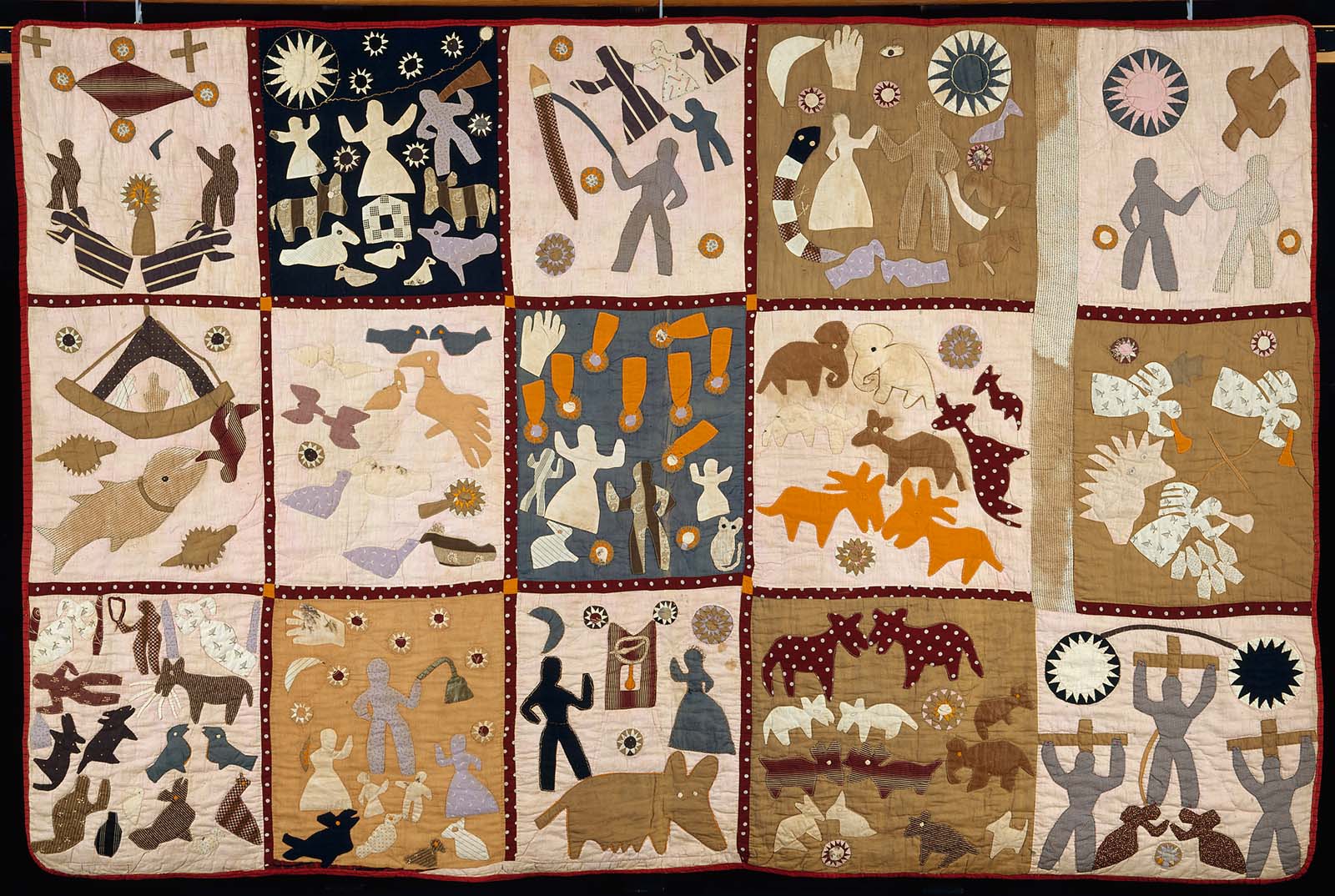
Harriet Powers (1837–1910) was an African American quilter from Georgia who used traditional appliqué techniques to record Bible stories, local legends, and astronomical events. Her two extant quilts, referred to as the Bible Quilt and the Pictorial Quilt, are considered among the finest examples of nineteenth-century Southern quilting. They really are extraordinary.
Harriet Powers (American, 1837–1910), Bible Quilt, ca. 1886. Cotton plain weave, pieced, appliqued, embroidered, and quilted, 75 × 89 in. (191 × 227 cm). National Museum of American History, Washington, DC.Harriet Powers (American, 1837–1910), Pictorial Quilt, 1895–98. Cotton plain weave, pieced, appliqued, embroidered, and quilted, 68 7/8 × 105 in. (175 × 266.7 cm). Museum of Fine Arts, Boston.
A breakdown of the individual squares on Powers’s quilts happens at 14:44–22:16, and conversation continues about Powers specifically until about the one-hour mark. Notably, when asked about the importance of the quilts, Hicks says, “They’re important because you have a woman who is testifying of her love for God 135 years after those quilts left her home. She continues to testify. When you think about all the people . . . I just think she’s a storyteller, but she’s a storyteller with a purpose, and I admire her for that.” The second hour is about story-quilting today—where a new generation of quilt-makers is taking the art form in the twenty-first century—and touches on functional use of quilts versus display.
>> “Blessed Assurance”: A Black gospel arrangement of a classic Fanny Crosby hymn, performed by the Portsmouth Gospel Choir from the University of Portsmouth in the UK.
>> “Parachute” by Arielle Howell and Moses Hooper: A song of surrender. Filmed in 2016, this was the first music video made under the aegis of Under the Belltower, a Biola University initiative (no longer active) that brought together student musicians, composers, and filmmakers to make art in community and showcase that work with an end product.
Today’s roundup brings together a theologian (Anderson Jeremiah), an art historian (Elissa Yukiko Weichbrodt), and a musician (Eric Lige and friends) who I think complement one another really well!
SONGS:
Eric Lige [previously] is “a music-maker who promotes Jesus, Justice, Faith, and Community.” He is the worship director at Ethnos Community Church in San Diego and the co-executive producer of The Ethnos Project, which creates a platform for new and emerging global voices in musical worship to be heard worldwide. Especially since COVID hit in 2019, he has been assembling multinational teams of musicians to produce YouTube videos, many of which are livestreamed as part of Ethnos worship services. Here are three examples (view more on Lige’s YouTube channel):
>> “Ξεδιψασμένος (No Longer Thirsty)” by Kostas Nikolaou: A contemporary Christian worship song in Greek, about how Christ, the living water, quenches our thirst for love and purpose. The lead vocalist is Nefeli Papanagi—and wow, do I love her voice!
>> “Ua Mau (Hosanna)” by Moses W. Kaaneikawahaale Keale (aka Keale Ta Kaula): Reyn and Joy Nishii perform this nineteenth-century Hawaiian hymn by Keale “the Prophet,” who converted to Christianity after calling on God during a hunting accident and finding rescue. The first verse translates to “Perpetual is the righteousness / That comes from the Father above / Let us gather together / In his goodness and grace.”
>> “Love’s in Need of Love Today” by Stevie Wonder: Edward Chen and friends—from Canada, the United States, Armenia, Venezuela, and Mexico—perform the opening track from Stevie Wonder’s Grammy-winning album Songs in the Key of Life. “God gave me this gift, and this particular song was a message I was supposed to deliver,” Wonder has said. “The concept I had in mind was that for love to be effective, it has to be fed.” See the full list of credits in the description on the video page. Eric Lige is the one in the maroon shirt.
+++
LECTURES:
>> “Many Faces of Jesus: Christologies from the Margins” by the Revd. Canon Dr. Anderson H. M. Jeremiah, October 12, 2021: Anderson Jeremiah is a senior lecturer in the politics, philosophy, and religion department at Lancaster University in the UK, whose areas of expertise include Christian theology in Asia, postcolonial approaches to theology, Dalit studies, liberation theology, modern missionary movements, and inculturation and faith. Ordained in the Church of South India (part of the Anglican Communion), he was installed as Canon Theologian of Blackburn Cathedral in September 2021, making him the first Dalit to be appointed to that role in any English cathedral.
In this half-hour online talk given last fall for the Diocese of Manchester, Jeremiah discusses the Incarnation as a continuous event—Christ being born into human cultures—as expressed through a selection of visual artworks from Ghana, Bolivia, China, Japan, and India. These images subvert the predominant Western image of Christ and sometimes provide critique. New to me was the black marble crucifix from the Anglican chapel inside Cape Coast Castle, a former trading post (now a museum) where enslaved Africans were held before being loaded onto ships and sold in the Americas. I’m not sure who commissioned the sculpture or when it was placed at this site, but it definitely looks modern.
The Q&A that followed on the original Zoom event is not included in the video, but here’s one of Jeremiah’s comments from it that I transcribed: “Jesus is not foreign to my own experience; this Jesus is part and parcel of my own existential reality. It [the image] enables people who are seeking peace and emancipation; [they are] emboldened in that process of seeing themselves reflected in the image of Jesus. The normative image the church has been holding on to has not created that space.” When one attendee asked if images of white Jesus are always “wrong” or to be discouraged, Jeremiah replied that there’s nothing wrong with such an image in itself, but the problem is when it is imposed on the entire world as the only way of looking at Jesus. “When we hold up one image as normative, we lose the diverse ways God intends to manifest himself in diverse contexts,” he said. (I couldn’t agree more!)
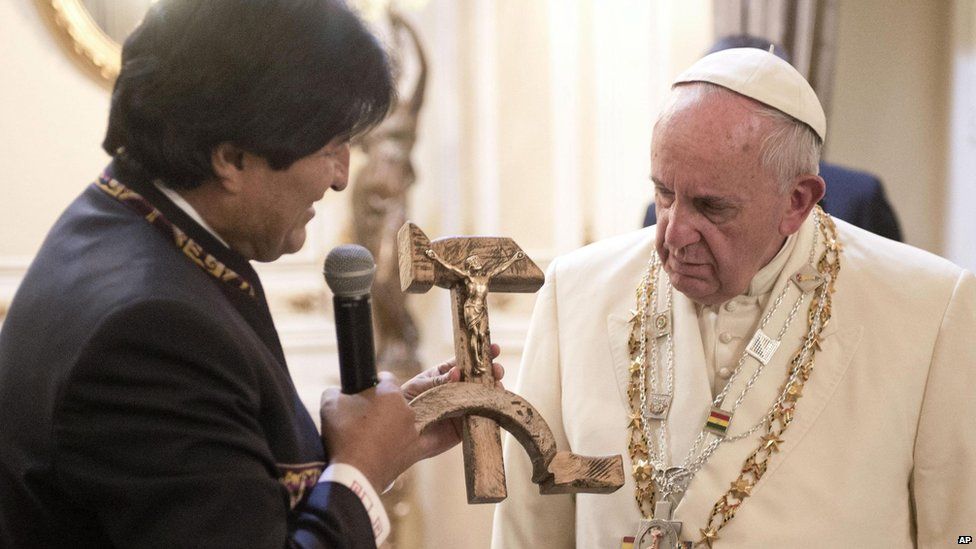
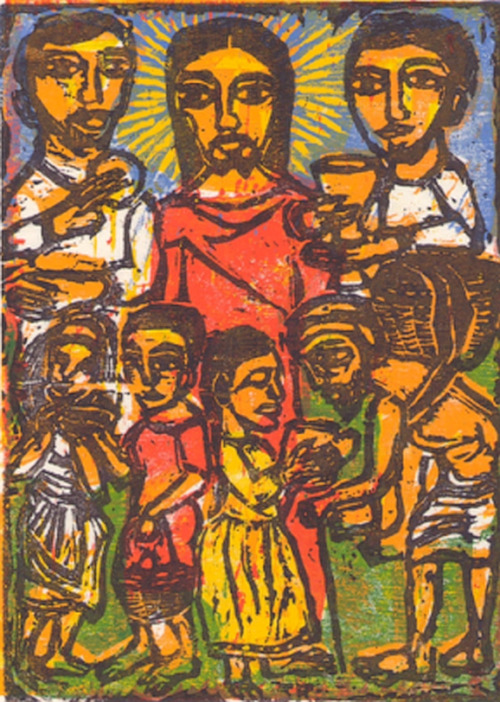
In July 2015 Bolivian president Evo Morales (who is Aymara) presented to Pope Francis a crucifix sculpted in the shape of a hammer and sickle. The crucifix is based on a design by Luís Espinal (1932–1980), a Jesuit priest assassinated in 1980 by right-wing militia. Bolivia’s communications minister, Marianela Paco, told Bolivian radio that “the sickle evokes the peasant, the hammer the carpenter, representing humble workers, God’s people.” Photo: AP.Solomon Raj (Indian, 1921–2019), The Lord Remembers the Hungry: Liberation from Hunger, 2006 (based on the 1988 original). Woodcut, from the series “Liberation in Luke’s Gospel.”
In this undergraduate lecture (starts at 4:06), Weichbrodt discusses how photography has been used to shape racial bias and even construct race, as well as gender, focusing on a famous 1957 photograph of school desegregation in Little Rock, Arkansas. She shows how this single photo is part of a larger web of meaning that contemporary news photos also play into. We’re always interpreting and categorizing images in relationship to things we’ve already seen, Weichbrodt says, creating a mental archive—for example, a file for “blackness,” a file for “womanhood.” And “as Christians called to recognize the dignity of God’s image in all people, we have to do actual work to acknowledge how our own archives may have hampered or distorted our love for our neighbors.” To look more faithfully, we need to look more; we need to build a broader archive.
Jesus began his public teaching ministry by reading the following passage from an Isaiah scroll at his local synagogue:
The Spirit of the Lord is upon me, because he has anointed me to bring good news to the poor. He has sent me to proclaim release to the captives and recovery of sight to the blind, to let the oppressed go free, to proclaim the year of the Lord’s favor. (Luke 4:18–19)
Some theologians call this the Nazareth Manifesto. It’s Jesus’s inauguration speech, if you will, where he lays out his platform, his values, his mission.
The freedom that Jesus came to bring is not just spiritual, although it is at least that. It is also physical. He came to liberate us body and soul—from sin and its many ugly manifestations, both personal and systemic, that prevent us and others from thriving.
As we await Christ’s second advent, we can look forward to this promise: freedom is coming.
Jessie B. Telfair (American, 1913–1986), Freedom Quilt, Parrott, Georgia, United States, 1983. Cotton, with pencil, 74 × 68 in. American Folk Art Museum, New York.
When Jessie Telfair invoked the power of a single word repeated over and over in this quilt, she knew the word would reverberate through the history of the United States, back to the “peculiar institution” of slavery and the freedom that she was still struggling to attain in the 1960s at the beginning of the Civil Rights movement. The making of the quilt was incited by an incident she suffered in those years, when registering to vote was enough to cost this African American woman her job in a school kitchen. The bitterness of that experience still burned years later, and fellow quiltmakers urged her to express the pain through her art. Worked in the colors of the American flag, the quilt cries freedom. In a subtle metaphor, Telfair has set each repeated letter in its own block; all are visually related, but no two are alike.
LISTEN: “Freedom Is Coming” from South Africa, third quarter of 20th century | Performed by Kate Marks and friends on Circle of Song: Chants and Songs for Ritual and Celebration, 1999
Freedom is coming Freedom is coming Freedom is coming Oh yes, I know!
Jesus is coming Jesus is coming Jesus is coming Oh yes, I know!
This South African freedom song originated during the apartheid era (1948–1994). It’s one of the many songs collected by Swedish musician Anders Nyberg when he traveled with his choir Fjedur to South Africa in 1978 at the invitation of the South African Lutheran Church. Upon his return, “Freedom Is Coming” and other South African freedom songs and hymns were published in Sweden and soon after in the United States in the collection Freedom Is Coming: Songs of Protest and Praise from South Africa (Utryck, 1984), which is still in print. Fjedur’s performance of “Freedom Is Coming” at the Budapest Assembly of the Lutheran World Federation in 1984 was instrumental in disseminating the song around the world, and afterward it started appearing in more hymnals.
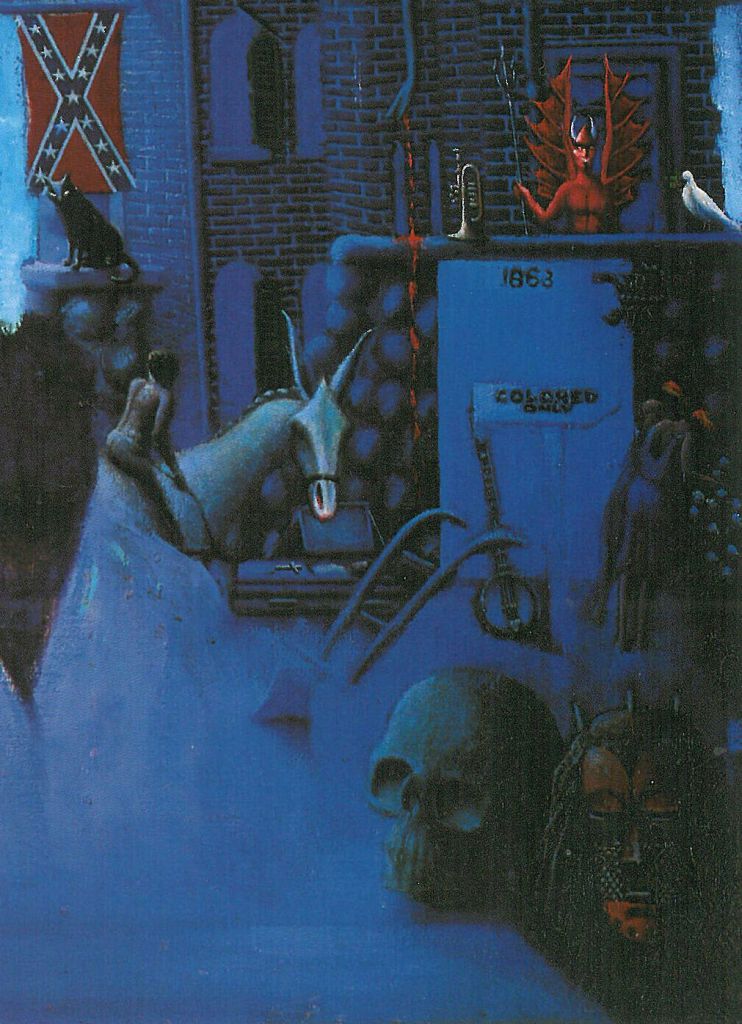
Archibald J. Motley Jr. (1891–1981) was one of the most important artists of the Harlem Renaissance. He’s best known for his paintings of urban Black culture, especially the Chicago jazz scene and other nightlife, and he was also a wonderful portraitist.
His final painting, however, shows none of the carefree conviviality that was characteristic of much of his work. On the contrary, it’s nightmarish. Begun in 1963 and reworked over the course of a decade, The First One Hundred Years: He Amongst You Who is Without Sin Shall Cast the First Stone: Forgive Them Father For They Know Not What They Do chronicles race relations in the United States from the Civil War to the civil rights era. It’s the most overtly political painting in Motley’s oeuvre, and once completed, he didn’t paint for the remaining nine years of his life.
The “one hundred years” in the title refers to the period since the Emancipation Proclamation took effect in 1863, changing the legal status of more than 3.5 million enslaved African Americans to “free.” The Civil War ended May 9, 1865, and slavery was officially abolished with the Thirteenth Amendment on December 18 of that year. But the legacy of that institution was still felt throughout the next century, in which Black people suffered disenfranchisement, segregation, lynchings, and a number of other injustices and terrors.
Motley visualizes the Black struggle for freedom and equality through symbols and vignettes.
At the top of the painting are the death masks of John F. Kennedy, Martin Luther King Jr., and Abraham Lincoln, all of whom were assassinated as they sought to advance the rights of African Americans.
Below King’s visage is a Confederate flag, hanging from the front porch of a crumbling Southern manse. The red is replicated in the blood running out the house’s downspout, a horned devil (who surveys the domain he’s claimed), the blood-drop cross insignia of a Ku Klux Klansman, and the tongue of a snarling police dog.
At the bottom right a traditional African mask lies beside a human skull, alluding not only to physical death but also to the fragmentation or loss of cultural identity experienced by those who were abducted from their homeland and brought across the Atlantic to live in captivity, separated from their families and communities and ways of life and even given new names by their oppressors. This wound is also felt by the enslaved persons’ descendants, who are unable to trace their lineage.
Above this still life is a Black person on horseback, operating a plow right next to a coffin. Besides the obvious reference to plantation labor, the vignette also evokes the African American spiritual that goes, “Keep your hand on the plow, hold on”—a song of endurance through hardship.
In the center of the painting the Statue of Liberty stands in ironic contrast to a lynched man, the color of her freedom torch echoed in the burning cross of the KKK. Just behind this dead Black man who hangs from a tree is another dead man hanging from another tree: Jesus on the cross. (For more on how these two symbols mutually interpret each other, see theologian James H. Cone’s The Cross and the Lynching Tree.) The hill of Calvary is the brightest part of the entire composition, which I imagine Motley, a practicing Catholic, intended to signify hope, enlightenment, and a call to repentance. The cross illuminates our sin and the love of God that compels us to love our neighbors. I will address this further, in relation to an MLK sermon, below.
In the shadow of the cross is a sea of protest and counterprotest signs. Alongside slogans like “We Want to Vote,” “Black Power,” and “We Shall Overcome” are swastikas, “America for Whites, Africa for Blacks,” and “Go home, niggers, and get your relief check.” To the left of this activity, a white police officer beats a Black man with a baton, and a fireman turns a high-pressure hose on Lady Justice. This vignette evokes the chilling news footage from May 1963, when Birmingham Public Safety Commissioner Bull Connor ordered the use of fire hoses and attack dogs on peaceful Black protesters, including children. The force of the jet streams ripped off boys’ shirts and pushed girls over the tops of cars. It was an assault on Black bodies and on justice itself.
Birmingham, Alabama, was, and still is, one of the most racially divided cities in the US, and in the 1960s it became a center of civil rights activism. From 1947 to 1965 it was the site of fifty racially motivated dynamite explosions, earning it the nickname “Bombingham.” The bombing that caught the most international attention was of Sixteenth Street Baptist Church on September 15, 1963. The blast killed four girls who were leaving Sunday school: Addie Mae Collins, Cynthia Wesley, Carole Robertson, and Carol Denise McNair. Motley alludes to this terrorist act with the stained glass window wherein the face of a white Jesus is blown out, as that’s actually what happened at Sixteenth Street Baptist. (“The absence of the face,” said James Baldwin, “is something of an achievement since we have been victimized so long by an alabaster Christ.”)
In the center foreground, emerging from the phantasmagoria, is another faceless figure, his form and features undefined. He’s a specter, really, walking toward us—or is it someone in a dream state? Motley mixes historical scenes of violence and terror with contemporary ones, showing how the ghosts of our nation’s past are still haunting us.
Scattered throughout the painting are animals that represent ill omens or evil: a bat, a vulture (who feeds on death), a black cat, a serpent, a scorpion (on the right, crawling across the door marked “1863”). The latter two call to mind Luke 10:19, where Jesus tells his disciples, “Behold, I give unto you power to tread on serpents and scorpions, and over all the power of the enemy . . .” A dove of peace, the only nonsinister animal presence, perches on the margins.
Church, listen up: we have the call and the power, in Christ(!), to tread on racism and every other evil that erects itself against the kingdom of God. Don’t let the Enemy have a stranglehold. Let us be active in confronting the evil of white supremacy and dismantling it—in our own hearts, our congregations, our government, and in all the other systems it operates in—so that the supremacy of Christ and his gospel of freedom and reconciliation can be made known.
Where Are We Today?
I encountered The First One Hundred Years through the 2015 retrospective Archibald Motley: Jazz Age Modernist and have been sitting with the image ever since, thinking: What progress have we made? Do I recognize this scene? What will “The Next One Hundred Years” look like in America?
It’s been almost fifty years since Motley completed the painting, and blood still flows. Black people are still being lynched (Ahmaud Arbery, killed by white vigilantes while out on a jog, is one example). Some people and businesses are still flying their Confederate flags. And racist hate groups are as active as ever. Last October the Department of Homeland Security named white supremacist extremists the country’s number one domestic terrorism threat, a threat that came to fruition January 6 when a mob of radical Trump supporters, catalyzed by the president himself, stormed the Capitol equipped with climbing gear, riot helmets, shields, gas masks, bear spray, flex cuffs, lead pipes, and baseball bats, attempting to overturn the 2020 presidential election results by force. The insurrectionists erected a functional gallows and noose on the lawn and shouted and graffitied death threats. A Confederate battle flag was marched through the halls of Congress, as were other neo-Confederate, neo-Nazi, and nationalist symbols, along with crosses, the Christian flag, a “Jesus 2020” banner, “Make America Godly Again,” etc. (Christian nationalism, on flagrant display at the Capitol, has been publicly denounced by several prominent American Christians these past four years, so I won’t get into it here.) The mob was a mishmash of different groups and individuals united around Trump’s claims of election fraud and trying to hold on to (white) power.
Law enforcement’s completely deficient planning for the white-led protest (and thus inability to properly respond when the protest turned into a siege) stood in stark contrast to the way Black Lives Matter protests in DC were handled last summer, with militarized officers at the ready, low-flying helicopters, and eight-foot-tall fences. Peaceful Black protesters in the streets were met with tear gas and rubber bullets, whereas January 6’s white protesters were able to invade the Capitol with little resistance.
Why the woeful lapse in security, despite clear intelligence that right-wing extremists would be gathering there the day Congress was convening to ratify Biden’s democratically won victory? Because despite the DHS’s recent Homeland Threat Assessment, white people are, in general, not perceived as dangerous; Black (and brown) people are. And because white people know the system works for them, those who stormed the Capitol felt empowered to do so with impunity. They weren’t scared of the police. They didn’t even try masking their identities; on the contrary, several posted photos and videos of their crimes online. After trespassing, assaulting police officers (one of whom died), and vandalizing and looting while federal legislators ran and hid in fear for their lives, the insurrectionists were gently told by President Trump to “Go home. We love you.” Only a few were detained. Investigations have since been launched and more and more arrests are being made. But I bring this all up to show just one recent instance of racial disparities in policing as well as the rise of white nationalist fervor, which are just two of the many symptoms that prove that America does indeed still have a race problem.
The Trump presidency has really brought white supremacy to the fore, forcing us to confront a national sin that perhaps we thought was mostly behind us. “Reckoning” is a word I’ve been seeing a lot. Activist and author Ibram X. Kendi says that if we can be thankful to Trump for anything, it’s this: “He has held up a mirror to American society, and it has reflected back a grotesque image that many people had until now refused to see: an image not just of the racism still coursing through the country, but also of the reflex to deny that reality.”
The Need for Enlightenment
The two subtitles of Motley’s painting are both quotations of Jesus, which together indict sin and ask God for mercy. “He amongst you who is without sin shall cast the first stone” (John 8:7) was spoken to pierce the consciences of a mob of religious elites who sought to stone a woman for adultery; it exposed their two-facedness, their eagerness to punish another’s sin but not to examine their own. Motley is thus urging viewers to confront the ways in which they themselves have violated God’s law, how they have said, by their words or actions (or inaction), that Black lives do not matter. Admit. Admitting sin, admitting that there’s a problem, is the first step in rooting it out.
“Forgive them, Father, for they know not what they do” (Luke 23:34) was spoken by Jesus on the cross. As he hung dying, he prayed to God on behalf of his killers, recognizing in them a spiritual blindness. Forgiveness is a nuanced concept whose complexities I won’t discuss here, but Jesus’s prayer expresses his goodwill toward his enemies, a spirit of wanting to see them reconciled to God. Jesus recognized that even as sinners hurt people, they themselves are also hurting. They don’t even realize how their sin binds them and blinds them.
In a ca. 1962 sermon on this text, Martin Luther King describes his oppressors (and Jesus’s) as suffering from an “intellectual and moral blindness . . . an ill which man inflicts upon himself by his tragic misuse of freedom and his failure to use his mind to its fullest capacity. There is plenty information available if we consider it as serious a moral obligation to be intelligent as to be sincere. One day we will learn that the heart can never be totally right if the head is totally wrong.” King describes how enslavers sought to rationalize their beliefs, drawing from “science,” history, and biblical interpretation, and segregationists were doing the same, ignoring all evidence that contradicted what they sincerely believed to be true. These days we’ve seen how those who benefit from white privilege seek to explain away racial inequalities or even simply refuse to believe they exist, because who wants to give up power? And of course they find online communities or curate social media feeds that bolster their view that everyone is treated equally in America, that skin color does not grant any unfair advantages, and so when another unarmed Black person is killed by police, they interpret it through the white lens of “Well, he must have been doing something wrong . . .”
Maybe as you read this very article you’re tensing up and want to tell me X, Y, and Z regarding why white privilege is a fallacy or how I’ve been taken in by a “liberal agenda,” or how my narrative of the recent event at the Capitol is completely off—it wasn’t an insurrection, and it had nothing to do with white supremacy, and those weren’t really Trump supporters (yes, I’ve actually heard people say that). Maybe you think it’s me who’s blind.
King talks about the need for enlightenment.
Light has come into the world. There is a voice crying through the vista of time calling men to walk in the light. Man’s earthly life will be reduced to a tragic cosmic elegy if he fails to heed this call. “This is the condemnation,” says John, “that light is come into the world, and men loved darkness rather than light.”
John’s saying, King says, is demonstrated vividly at the cross, which shows God at his best and humanity at its worst.
We must continue to see the Cross as a magnificent symbol of love conquering hate, and light overcoming darkness. But in the midst of this glowing affirmation, let us never forget that our Lord and Master was nailed to that Cross because of human blindness. Those who crucified him knew not what they did.
In what ways are we nailing Christ to the cross afresh, so to speak, unaware of what we’re doing? In what ways are we resisting the work of the Holy Spirit to expose sin, both personal and collective? In what ways are we closing our ears to the cries of our hurting Black brothers and sisters, and to the calls to action from those who are continuing King’s legacy of nonviolent resistance? I’m speaking to white American Christians in particular here. We all want America to heal. But the sin of racism must be acknowledged and confessed, and repentance undertaken, before healing can proceed.
Repenting of sin is a foundational Christian practice; it’s in the church’s DNA. And yet with this particular issue, there’s been a lot of unwillingness among Christians to see and to act. These past four years have been for me a time of self-examination and also critical examination of the evangelical tradition I grew up in and which you might say I’m still a part of. In addition, I’ve spent a lot of time relearning history, locating my privilege, unlearning biases, rereading the Psalms and the Prophets, repenting, exploring more deeply the witness of the Black church and all-around diversifying the voices I listen to, and slowly (admittedly, hesitantly!) wading into the waters of civic engagement. I have a long way to go, to be sure, but I’m on the journey.
I see Motley’s painting as a lament for all the racial injustices perpetrated in the US but also a statement of hope, as the cross beckons us to persist in (or join) the freedom struggle. It’s a prayer that the scales would fall off the eyes of white America—that we would shed willful ignorance—and that people of all races would walk together not only in the light of “liberty and justice for all” but, as King preached, in the light and Spirit of Christ.
SONG: “Ahavat Olam”: Back in April the Platt Brothers—Jonah, Henry, and Ben—posted a home-recorded video of themselves singing this traditional Jewish prayer arranged by Gabriel Mann and Piper Rutman. (I know actor-singer Ben Platt from The Politician, which is probably how the video came to be recommended to me by YouTube!)
It stoked a lot of public enthusiasm, so on September 21 they released a studio recording, available for streaming and download from all major music platforms.
With an eternal love have You loved your people Israel, by teaching us the Torah and its commandments, laws, and precepts. Therefore, Adonai our God, we shall meditate on Your laws when we lie down and when we rise up, and we shall rejoice in the words of Your Torah and Your commandments forever. For they are our life and the length of our days, and we shall reflect upon them day and night.
O may You never remove Your love from us. Blessed are You, Adonai, Who loves your people Israel. [source]
+++
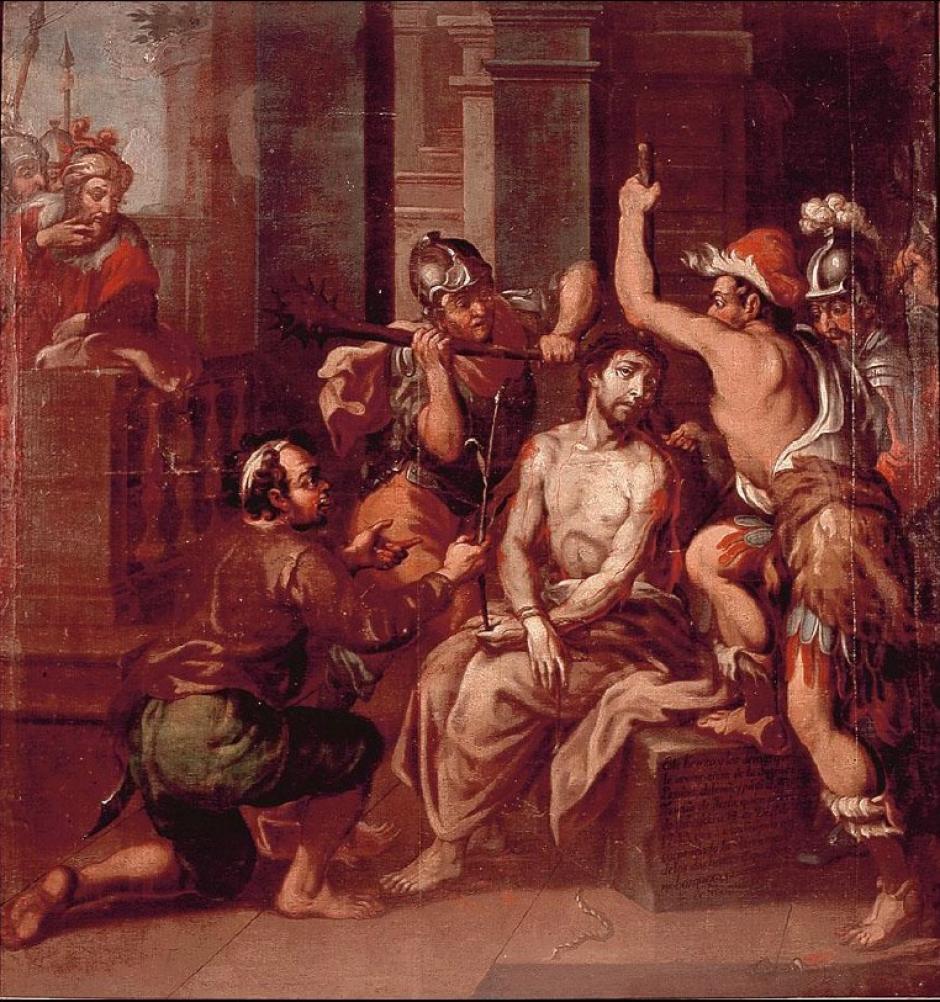
PIANO CONCERTO: Tomás de Merlo by Xavier Beteta: In February 2014 six religious paintings by the early eighteenth-century Guatemalan painter Tomás de Merlo were stolen from a church in Antigua. Although the thieves have been caught, the paintings have disappeared into the black market and have likely been smuggled out of the country. Wanting to preserve the essence of the paintings in music, Guatemalan composer Xavier Beteta wrote a piano concerto whose three movements, titled after the stolen paintings, are “La Oración en el Huerto” (The Prayer in the Garden), “La Piedad” (The Pietà), and “El Rey de Burlas” (The Mocking of Christ). Beteta said he may eventually compose three additional movements, one for each of the other three lost paintings.
Tomás de Merlo (Guatemalan, 1694–1739), El Rey de Burlas (aka La Coronación de Espinas), 1737
DOCUMENTARY: The Painter and the Thief (2020), dir. Benjamin Ree: A story of crime and trauma, love and redemption, this documentary follows Oslo-based Czech artist Barbora Kysilkova as she confronts one of the men, Karl-Bertil Nordland, who stole two of her most prized paintings. A mutual friendship develops, and it’s so beautiful to watch.
What I love about the film is how it captures the rehabilitation of both subjects—in a way that honors the complexity, the nonlinearity of that process—and the role art can play in healing. “Barbar” forgives “the Bertilizer” and helps him on his road to sobriety, and he helps her access deep parts of herself and come to grips with the history of abuse she’s suffered. They become, in a sense, each other’s muses. His stunned, tearful reaction when he sees the first portrait she paints of him melted me—someone sees him for the first time.
With documentaries I always wonder who’s the person making it and why. I had cynically assumed the project was instigated by the artist to try to vitalize her career, but no, the filmmaker, who has had an ongoing interest in art theft, contacted Kysilkova after reading about the gallery break-in in the news. As is true with most documentarians, he had no idea when he started filming that the story would evolve the way it did and shift genres, and even become feature-length. Streaming on Hulu.
+++
INTERVIEW: In 2016 Adelle M. Banks of the Religion News Service interviewed Rep. John Lewis about the National Book Award–winning graphic novel trilogy March, the role of music and religious faith in the civil rights movement, protest (and getting into “good trouble”) as a form of Christian ministry, the urgent need for the church to be a headlight, not a taillight, and more.
+++
VCS VIDEO EXHIBITION SERIES: The Visual Commentary on Scripture [previously] is an online, open-access resource for those looking to explore the biblical text through art. For every passage of scripture, an art historian, artist, theologian, media theorist, or other is solicited to select and comment on three art images that illuminate the text in some way. The site’s typical format is written commentaries, but by way of experimentation, the VCS has just released video commentaries instead for four new texts. Ben Quash comments on the story of Lot’s Wife through the lens of an early English stained glass panel, a Flemish Renaissance landscape, and a stunning photograph taken after the Allied bombing of Dresden. For Belshazzar’s Feast from the book of Daniel, Michelle Fletcher is guided by paintings from the Dutch Golden Age and the English Romantic period, which she juxtaposes with a contemporary room installation. But here I’ll highlight the videos for two New Testament passages.
The Burial of Christ, with commentary by Italian Renaissance art expert Jennifer Sliwka [previously], covers Andrea Mantegna’s innovatively foreshortened Christ on a marble slab; an altarpiece painting by Michelangelo, in which Christ’s dead body is held up for display, evoking the presentation of the eucharistic host; and a contemporary Pietà, of sorts, by Swiss artist Urs Fischer, which involves a skeleton and a fountain.
Michelle Fletcher, a feminist scholar and specialist on the book of Revelation, comments on the controversial apocalyptic figure known as The Whore of Babylon, which she discusses as a symbol of a city, as a satirization of the goddess Roma, and as bequeathing a legacy of vilification of prostitutes. Fletcher selected a didactic painting by street evangelist Robert Roberg, an ancient Roman coin, and William Hogarth’s A Harlot’s Progress.
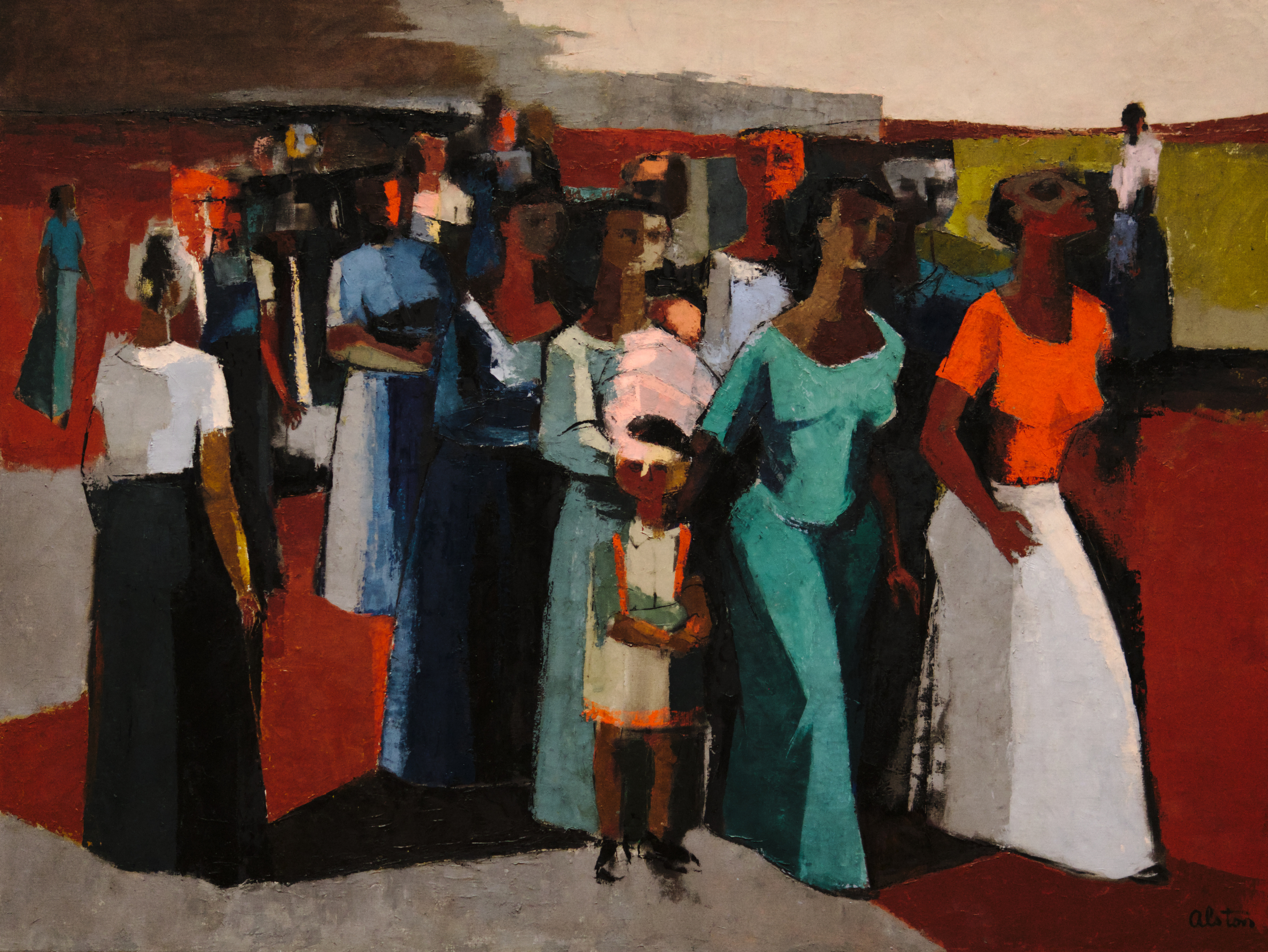
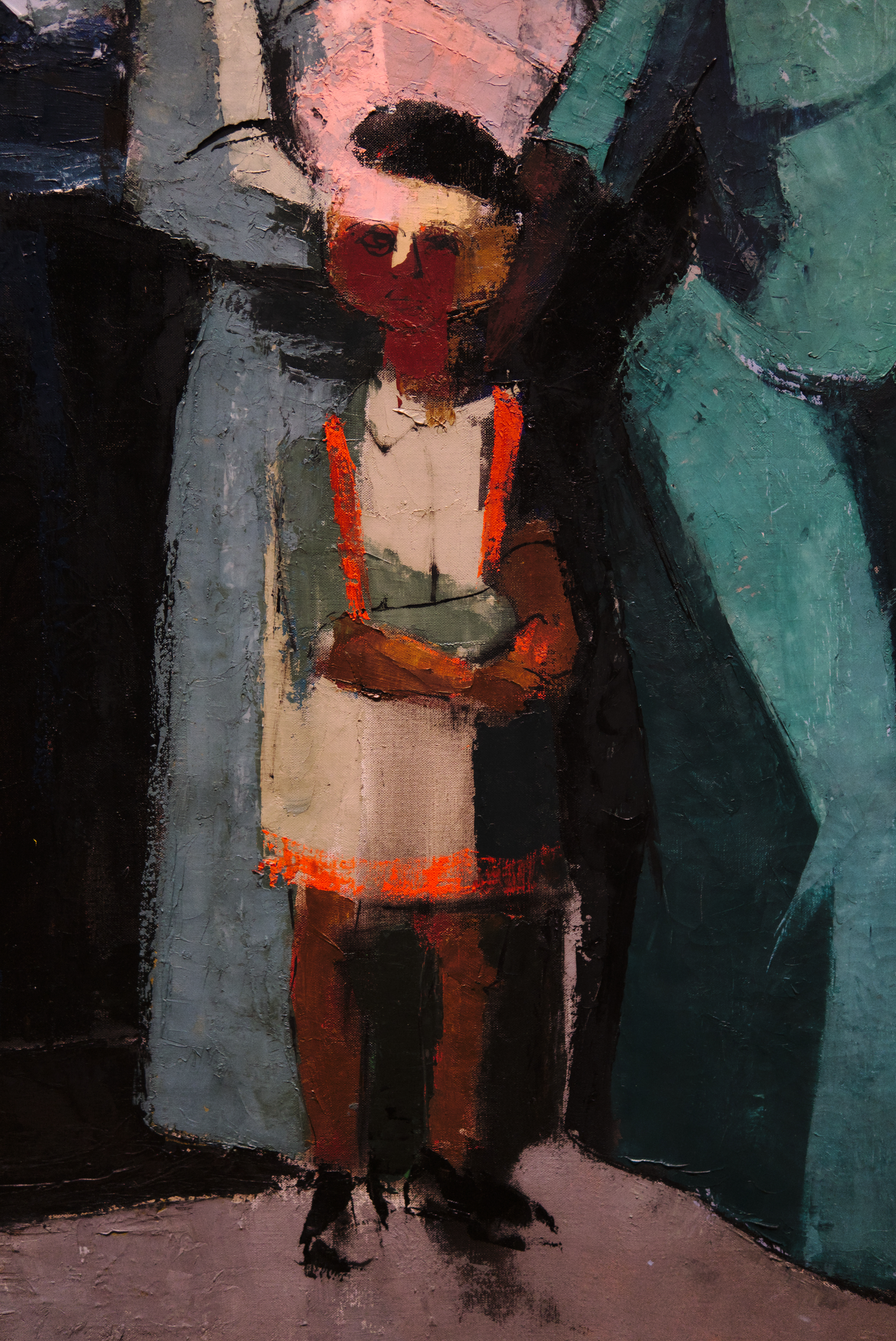
Charles Alston (American, 1907–1977), Walking, 1958. Oil on canvas, 48 3/8 × 64 3/4 in. (122.9 × 164.5 cm). Smithsonian National Museum of African American History and Culture, Washington, DC. Photo: Victoria Emily Jones.
If God is for us, who can be against us? . . . Who shall separate us from the love of Christ? Shall tribulation, or distress, or persecution, or famine, or nakedness, or danger, or sword? . . . No, in all these things we are more than conquerors through him who loved us.
Goodness is stronger than evil
Love is stronger than hate
Light is stronger than darkness
Life is stronger than death
Victory is ours through Him who loves us
First published in An African Prayer Book (Doubleday, 2006), this text is by Desmond Tutu, the famous South African Anglican cleric and theologian known for his work as an anti-apartheid and human rights activist. It has been set to music by several composers, most popularly John Bell but also James Whitbourn, David Schwoebel, Thomas Keesecker, and others. My favorite setting is the one in the video above, sung by an ecumenical choir from churches in and around Ridgewood, New Jersey, at the 2012 Hymn Festival at West Side Presbyterian Church. A few weeks ago I emailed the church’s music minister asking who the composer is but haven’t heard back, and extensive online searching has yielded no results. If you know who wrote the music, please do share! I’d also love to get my hands on some sheet music.
In the epistle reading from Sunday’s lectionary, the apostle Paul is writing to the church in Rome regarding religious persecution, assuring them that in Christ they have the power to face and overcome tribulations, distresses, and attacks of the enemy. Tutu extends that idea into the context of racial persecution, state-sponsored or otherwise. We must actively resist such injustice in the name of him who is Goodness, Love, Light, and Life. When we walk together in the Spirit on the side of these virtues, we will ultimately prevail against all counterforces.
+++
“A pivotal figure within the Harlem Renaissance, Charles Henry Alston was passionately dedicated to empowering African Americans through cultural enrichment and artistic advancement. Throughout his distinguished career as an artist and an educator, he continually sought to reclaim and explore racial identity with its complicated implications. Inspired by the modern idiom of Modigliani and Picasso, as well as African art, Alston’s work addresses both the personal and communal aspects of the black experience.” (Read more)
Alston’s Walking was inspired by the Montgomery bus boycott of 1955–56, a massive protest campaign against racial segregation in public transit, organized by black women’s political groups and facilitated through churches. The boycott was a seminal event in the civil rights movement in the US, coming years before the Selma to Montgomery marches in Alabama in 1965. “The idea of a march was growing,” Alston recalled of the time of the painting, 1958. “It was in the air . . . and this painting just came. I called it Walking on purpose. It wasn’t the militancy that you saw later. It was a very definite walk—not going back, no hesitation.”
This post belongs to the weekly series Artful Devotion. If you can’t view the music player in your email or RSS reader, try opening the post in your browser.
To view all the Revised Common Lectionary scripture readings for Proper 12, cycle A, click here.