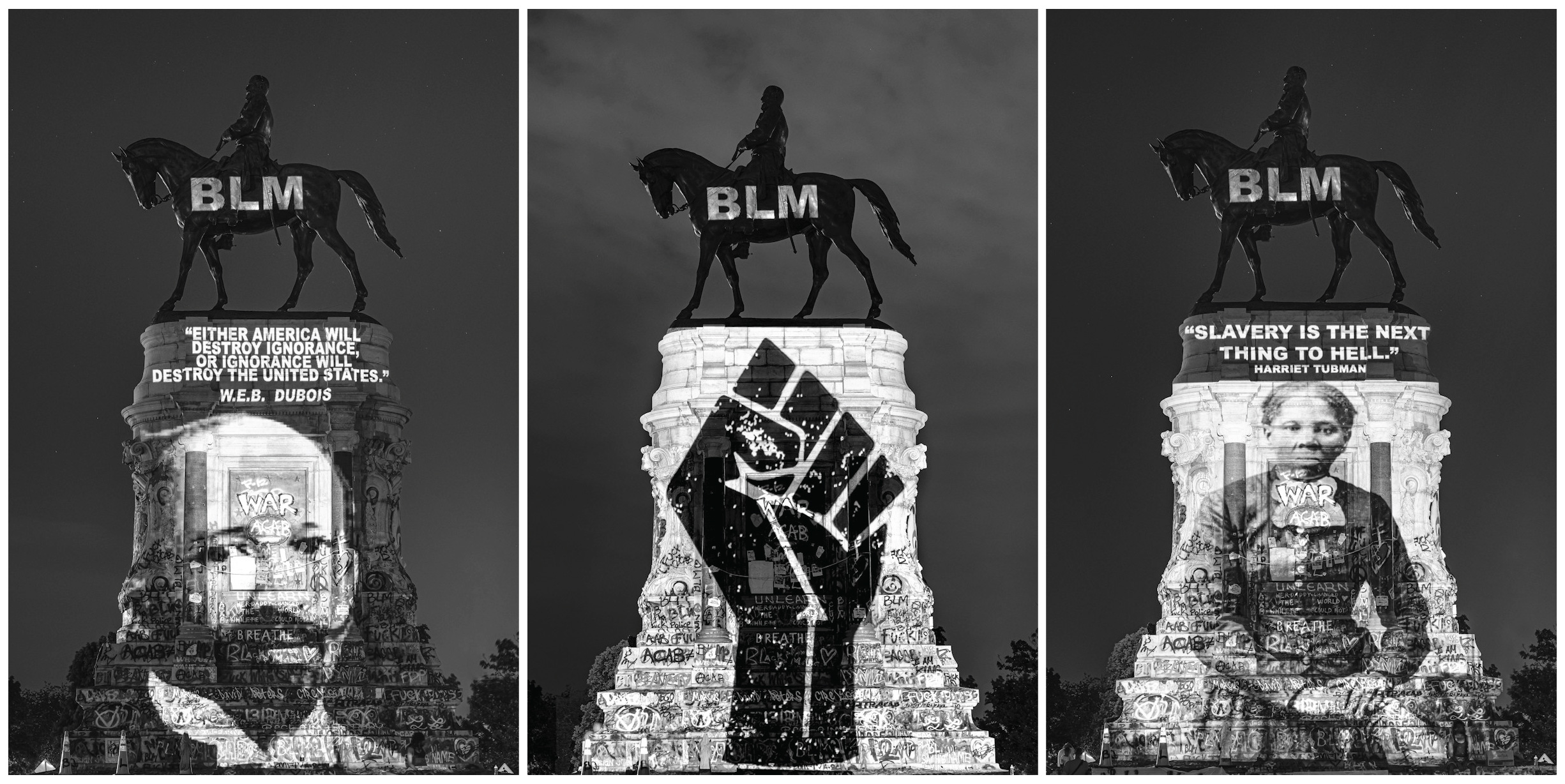
In summer 2020, artists Dustin Klein and Alex Criqui projected images of Black lament and empowerment onto the Robert E. Lee Monument at Marcus-David Peters Circle in Richmond, Virginia, part of their Reclaiming the Monument project. Read more at bottom of post.
Song of the Agitators
“Cease to agitate!” we will, When the slave whip’s sound is still; When no more on guiltless limb Fetters print their circlet grim; When no hound athirst for blood Scours the thorny Georgian wood; When no mother’s pleading prayer, On the sultry Southern air, Quivereth out in accents wild, “Master, give me back my child!” In the day when men shall be Brethren, equal-born, and free— Day for which we work and wait— We will “cease to agitate”!
When our statute books proclaim To the world no more our shame, And a freeman’s rights shall hold Dearer than the Judas gold; When the Polar Star shall give Light to the last fugitive; When our border lakes shall rise On the last lone bondman’s eyes, And their waves for him no more Haste to clasp the Northern shore; In the day when men shall be Brethren, equal-born, and free— Day for which we work and wait— We will “cease to agitate”!
Written by an anonymous abolitionist during the days of race-based chattel slavery in the United States, this poem was originally published in the Ohio Star (Ravenna, OH) in 1852 and was reprinted shortly after in the Anti-Slavery Bugle (Oct. 9, 1852) (Lisbon, OH), the Liberator (Nov. 19, 1852) (Boston), and the Voice of the Fugitive (Dec. 16, 1852) (Windsor, Ontario).
The poem addresses those who, with the status quo working in their favor, would tell the enslaved to stop complaining about the injustices being perpetuated against them, stop ruffling feathers and demanding change, and instead just sit back and be content with the way things are.
The speaker of the poem responds with a defiant no; they and their fellow activists will stop agitating only when their cause is won. When the enslaver’s whip ceases to crack the air, and shackles no longer imprint themselves on ankles and wrists. When bloodhounds are no longer unleashed on freedom seekers, and children are no longer forcibly separated from their parents. When the country’s founding documents are scrubbed of their racism, and its legislation protects the rights of all Americans in equal measure. When the North Star and the Great Lakes are no longer needed to guide people, and offer passage, out of bondage, because everyone is already home and free.
Those who work for justice today still often encounter the demand “Cease to agitate!” “Stop stirring up trouble.” “Don’t be such a downer.” “Why are you so angry?” “Why can’t you just be grateful for the progress we’ve made?” “When will you ever be satisfied?”
Struck by its contemporary relevance, Detroit-born, Vancouver-based musical artist Khari Wendell McClelland adapted the above poem and set it to music. “I sing this song for all those who are living under tyranny, escaping tyranny, and searching for peace,” he wrote in a 2015 Facebook post sharing a demo video.
McClelland’s “Song of the Agitator” appears on his 2018 album, Freedom Singer. The album is dedicated to his great-great-great-grandmother Kizzy, who fled US slavery through the Underground Railroad to Windsor, Ontario, settling in Detroit after slavery was abolished.
While the first stanza he sings almost verbatim from the nineteenth-century source material, the second stanza he reworks to highlight present-day grievances:
Now here we are today Still pushing for equal pay And these treaty rights don’t hold They’re shiny like the Judas gold The stain of blood remains A mother’s only son slain Our kids are crying out for more Continually being ignored
And here’s how he’s adapted the refrain:
On that day we will be Family, equal-born, and free Dawn will come, night will cease We’ll rejoice, mind at ease For that day we’ll work and wait That’s when we’ll cease to agitate
In a Geopoetics podcast interview that aired February 25, 2023, McClelland said, “For some of us, it’s been hundreds of years of incredible terror. And, you know, it’s a great luxury to feel in this moment like something’s wrong.” He continues, “It’s good to be agitated—to want to make things be different. When we start to become a little too comfortable with things being out of sort, being unjust, that’s where . . . it’s a problem. . . . Agitation is actually . . . good fuel.”
About the images above:
The Robert E. Lee Monument in Richmond, Virginia, was erected in 1890 during the Jim Crow era to glorify the Confederate general (who fought against the Union to preserve slavery). A bronze equestrian statue atop a giant plinth in the center of one of the historic city’s traffic circles, it had been controversial from the beginning, with many of Richmond’s Black residents regarding it as an oppressive and traumatic presence.
After the murder of George Floyd, the monument became an epicenter of Black Lives Matter protests as well as a site of vandalism, and Virginia governor Ralph Northam announced on June 4, 2020, that it would be removed. While the legality of that intent was being litigated, light projection artist and Richmonder Dustin Klein, later joined by collaborator Alex Criqui, cast nightly image projections onto the statue—first of Black victims of police violence, and then of Black activists, writers, theologians, artists, and politicians and associated quotes. In October 2020, the graffiti-covered, image-lit Robert E. Lee Monument was declared the most influential American protest artwork since World War II by the New York Times.
On September 2, 2021, the Virginia Supreme Court upheld Northam’s decision, and the statue was removed shortly after.
To view more photos and learn more about Klein and Criqui’s Reclaiming the Monument project, see www.reclaimingthemonument.com.
This week I’ve been editing and captioning a backlog of photos from my camera, and I’ve come to a batch I took last August from Every Day: Selections from the Collection at the Baltimore Museum of Art, a reinstallation of the museum’s contemporary collection centered on the Black artistic imagination. I thought I’d share some of these photos here as a way to introduce you to some of today’s leading Black American artists.
+++
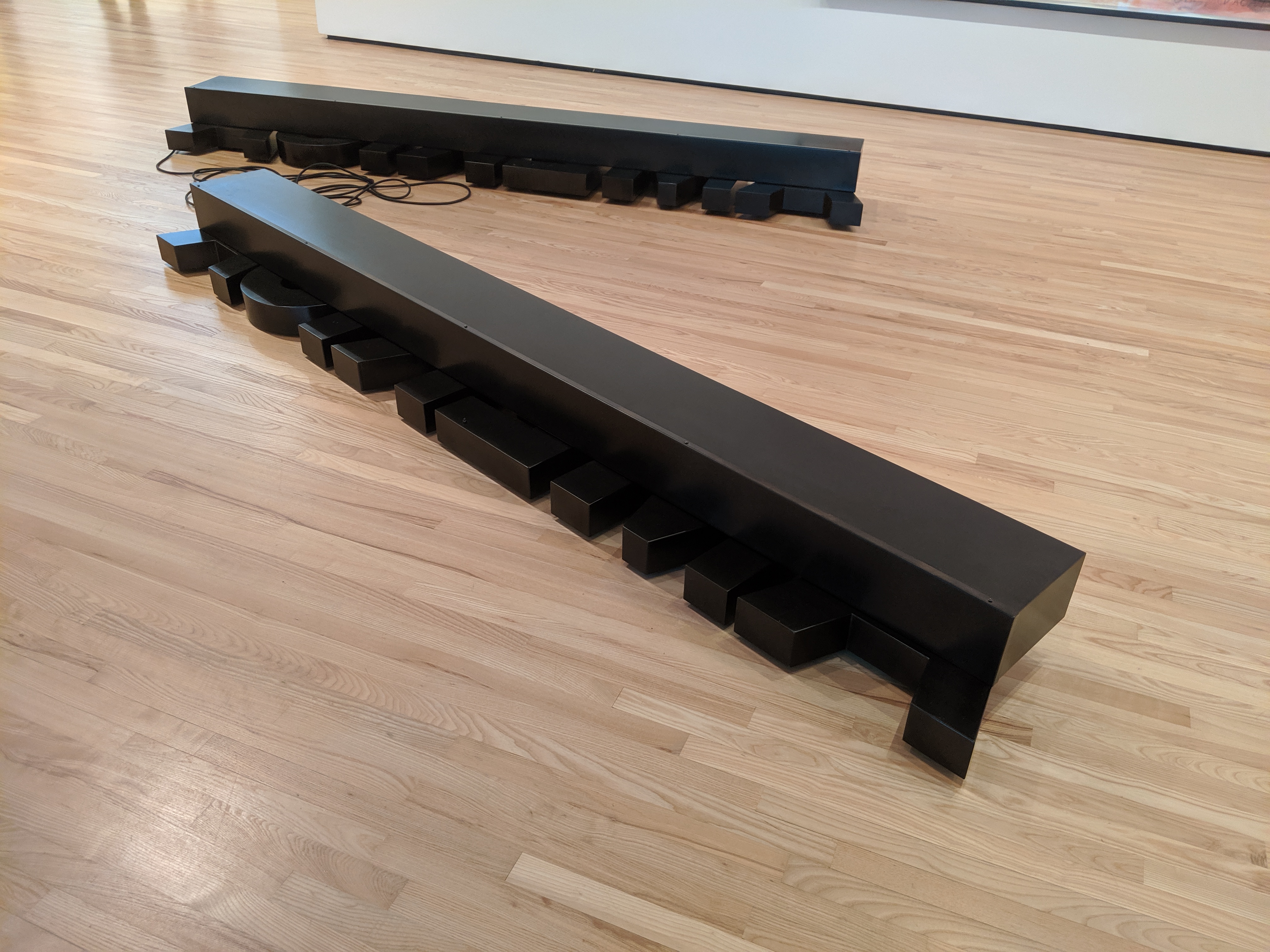
In the first gallery, an untitled neon sculpture by Glenn Ligon confronts the viewer, consisting of two black lightbox letter signs lying face-down on the floor, which each read, with some difficulty, “America.” They emit a flickering white light that pulsates at random. The piece is part of a series of variations on that word—a word, Ligon says, that means different things to different people.
Foreground: Glenn Ligon (American, 1960–), Untitled (America America), 2015. Neon and blackened steel, 22 × 125 × 10 in. each. Baltimore Museum of Art, Maryland. Photo: Victoria Emily Jones.
He said his “double America” motif was inspired by the opening lines of Charles Dickens’s A Tale of Two Cities: “It was the best of times, it was the worst of times, it was the age of wisdom, it was the age of foolishness . . . it was the spring of hope, it was the winter of despair . . .” The wall text continues: “Dickens used a series of opposing statements to capture a moment in European history [1775–92] in which wealth coexisted with poverty, war with leisure and comfort, and aspirational ideals with harsh realities. Ligon sees similar extremes at work in the twenty-first century: ‘There is this sense that America, for all its dark deeds, is still this shining light.’”
In the age of MAGA I’m reminded of a poem by Langston Hughes published in July 1936, “Let America Be America Again,” in which he laments that as a country, we’ve never been what we’ve aspired to be: a place of liberty and justice for all. He loves America and the ideals on which it was founded but is forced to reckon with its failures, pointing out the hypocrisy of a nation that proclaims in its founding document that “all men are created equal” while segregating, disenfranchising, and brutalizing African Americans. (And the poem goes on to cite inequalities experienced by other groups too.) It’s very much in the spirit of Frederick Douglass’s speech less than a century earlier, “What to the Slave Is the Fourth of July?”
Let America be America again.
Let it be the dream it used to be.
Let it be the pioneer on the plain
Seeking a home where he himself is free.
(America never was America to me.)
Let America be the dream the dreamers dreamed—
Let it be that great strong land of love
Where never kings connive nor tyrants scheme
That any man be crushed by one above.
(It never was America to me.)
O, let my land be a land where Liberty
Is crowned with no false patriotic wreath,
But opportunity is real, and life is free,
Equality is in the air we breathe.
(There’s never been equality for me,
Nor freedom in this “homeland of the free.”)
. . .
O, let America be America again—
The land that never has been yet—
And yet must be—the land where every man is free.
. . .
Hear Ligon discuss his art practice in the “A Closer Look” interview from the BMA, below, and zoom in on some of his artworks at Google Arts & Culture.
+++
Behind Ligon’s neon sculpture was a large gouache by Kara Walker titled Terrible Vacation. It was impossible to get a decent photo with the glare on the glass, so here is a professional photo of the painting, unframed, from Sikkema Jenkins & Co.
Kara Walker (American, 1969–), Terrible Vacation, 2014. Gouache on paper, 72 1/2 × 159 1/2 in. Baltimore Museum of Art, Maryland.
Best known for her room-size tableaux of cut-paper silhouettes addressing the history of race in America, here she pays homage to J. M. W. Turner’s 1840 Slave Ship, the Romantic painter’s abolitionist response to the Zong massacre of 1781, in which the captain of a British slave ship en route to Jamaica threw 133 sick enslaved people overboard to collect insurance on them as property “lost at sea.” Human and elemental violence converge in Turner’s painting, as a ship sails through a stormy ocean filled with flailing human limbs in chains.
Walker’s painting after Turner brings this mass murder to the attention of a new public, and though it references the past of England in particular, America, as a fellow player in the transatlantic slave trade, is implicated too.
+++
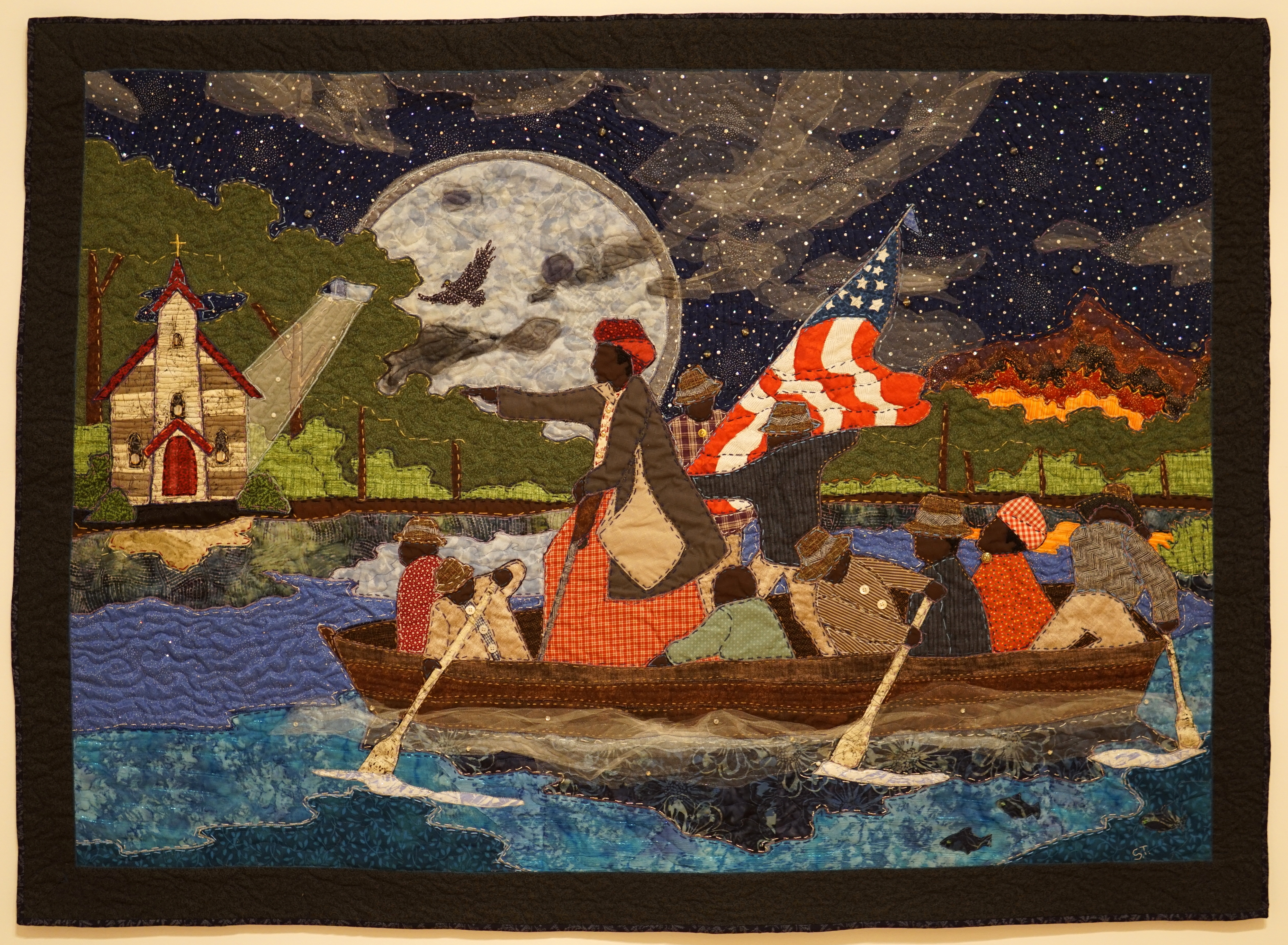
On the left wall was a story quilt by Baltimore artist Stephen Towns [previously], one is a series paying tribute to Harriet Tubman.
Stephen Towns (American, 1980–), We Shall Pass through the Combahee, 2019. Natural and synthetic fabric, nylon tulle, polyester and cotton thread, metallic thread, crystal glass beads, and resin and metal buttons. Baltimore Museum of Art, Maryland. Photo: Victoria Emily Jones.
Titled We Shall Pass through the Combahee, it records the historic military operation, led by Harriet Tubman, known as the Raid on Combahee Ferry, which succeeded in freeing seven hundred-plus slaves. During the Civil War, on June 1–2, 1863, Tubman guided two of Lincoln’s gunboats, peopled with Union Army soldiers, along the Combahee in South Carolina to strategic points near the shore where slaves awaited rescue, avoiding rebel torpedoes along the way.
Towns modeled the scene after Emanuel Leutze’s famous 1851 painting Washington Crossing the Delaware, set during the Revolutionary War, but he recasts Tubman as the American hero, bravely leading her people and her nation to victory. The church in the background likely represents the historic Tabernacle Baptist Church in Beaufort, where the escapees gathered after the raid, further up the river, before being relocated to St. Helena Island. It is illuminated as if by divine light because Tubman always said it was God who gave her direction in making certain critical moves during her many rescue operations—as Underground Railroad conductor and as military leader.
Towns describes the piece, and his complicated relationship to history and patriotism:
To learn about another body of Towns’s work, A Path Between Two Continents, see this video by York College Galleries:
+++
New York–based Afro-Dominican artist Firelei Báez examines through her art the historical narratives of the Afro-Caribbean diaspora, focusing on the politics and cultural ambiguities of place, writes ArtDaily. May 19, 2017, 6:05 p.m. (an idiom playing out its history) at the Baltimore Museum of Art commemorates New Orleans’s removal of its monument to Confederate general Robert E. Lee, erected in 1884, from “Lee Circle.” “It’s a gesture that reacts in time both forward and backwards, almost like a prayer, in solidarity with the people who had to suffer through that space and the resistance moving forward,” Báez said.
Firelei Báez (Dominican American, 1981–), May 19, 2017, 6:05 p.m. (an idiom playing out its history), 2018. Oil, oil stick, and graphite on canvas, 92 × 120 in. Baltimore Museum of Art, Maryland. Photo: Victoria Emily Jones.
Katie A. Pfohl, a curator at the New Orleans Museum of Art, writes about the series to which this piece belongs, which focuses on key chapters from New Orleans’s past:
In these new paintings, Báez overlays figures, symbolic imagery, and calligraphic gestures onto architectural surveys from the 1930s-era Historic American Buildings Survey, a project of the Works Progress Administration, of significant sites across New Orleans. Blurring the lines between past, present, and future, Báez paints new imagery upon these archival drawings, and in the process overwrites the often divisive history these older documents represent. Báez carries portraiture into a space where identity is rooted in history, but can likewise become untethered—and liberated—from it.
Another Báez piece in the BMA’s collection is Convex (recalibrating a blind spot), which consists of a diagram of the American Sugar Refinery in New Orleans overpainted with vibrant colors.
+++
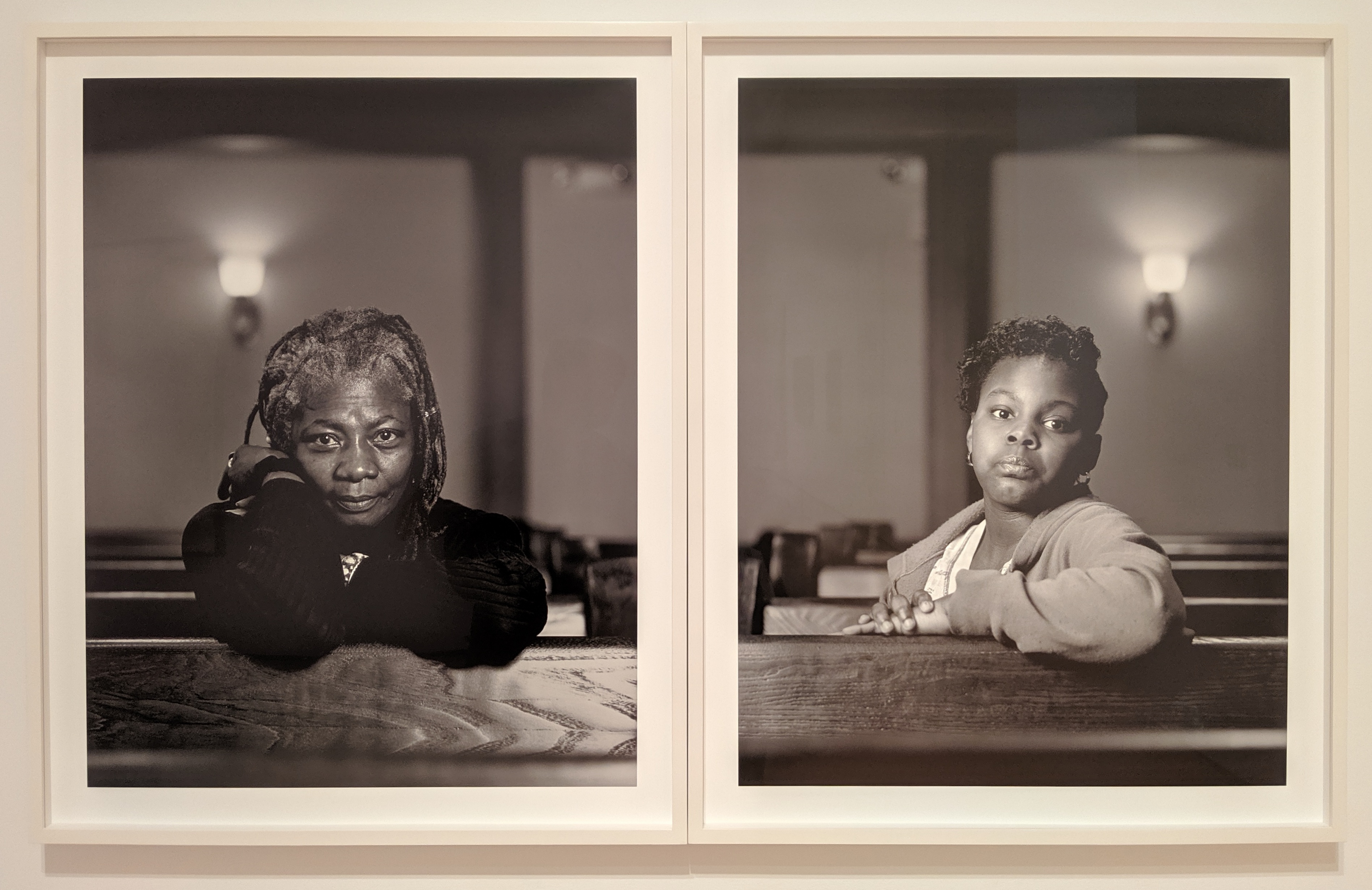
Dawoud Bey (American, 1953–), The Birmingham Project: Mathes Manafee and Cassandra Griffen, 2012. Inkjet prints, pigment-based, 40 × 32 in. each. Baltimore Museum of Art, Maryland. Photo: Victoria Emily Jones.
In the same gallery as the previous four pieces was a photograph diptych by Dawoud Bey, from his Birmingham Project series.
On September 15, 1963, four young black girls—Addie Mae Collins, Denise McNair, Carole Robertson, and Cynthia Wesley—were killed when white supremacists bombed the Sixteenth Street Baptist Church in Birmingham, Alabama. Fifty years later, Dawoud Bey worked with Birmingham residents to memorialize them, to pay “tribute to those who were in Birmingham at that difficult moment and those who have been born since.” He photographed adolescents the same ages as those who had died, and men and women in the fifties and sixties, the ages those young people would be had they lived.
+++
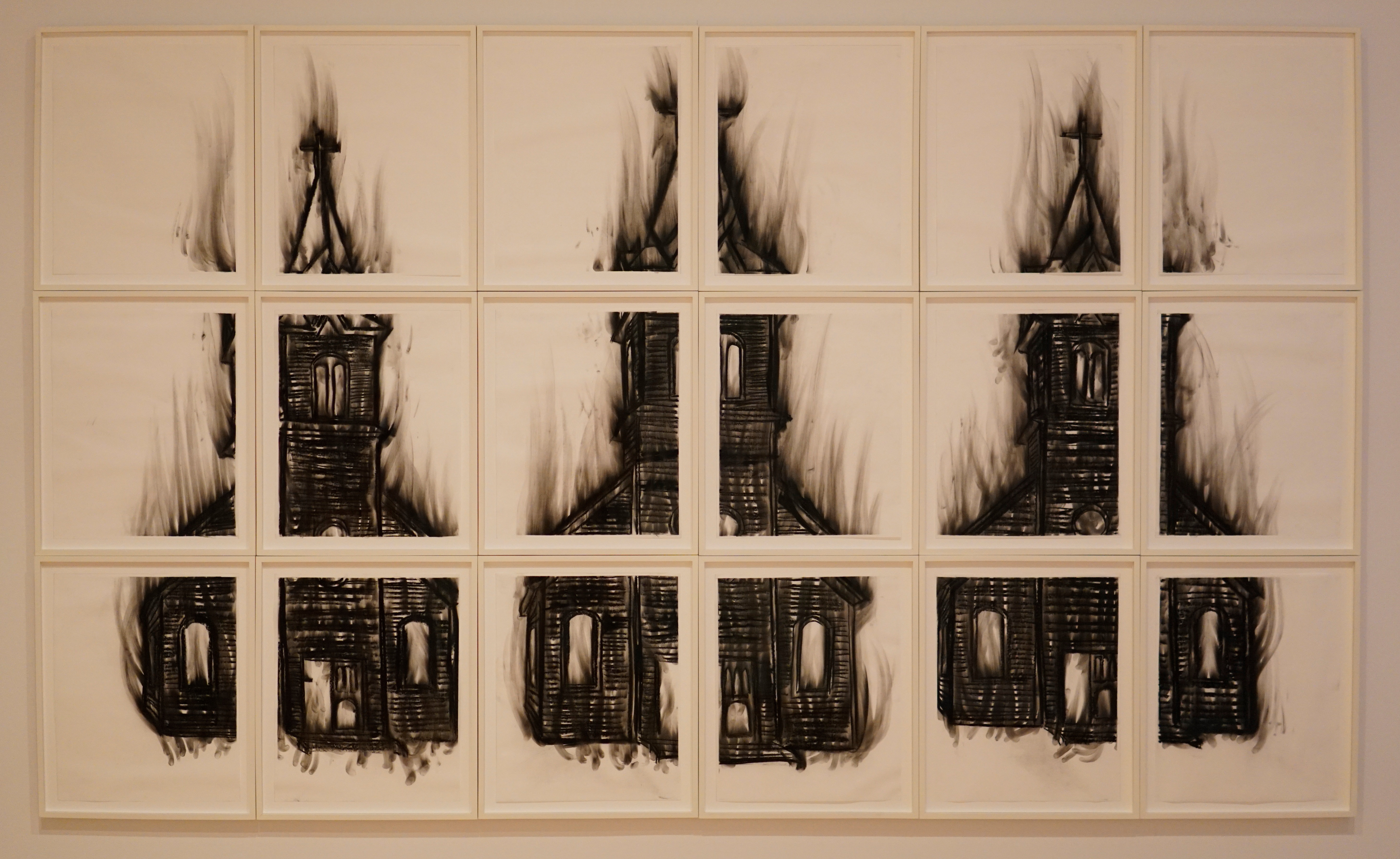
Gary Simmons (American, 1964–), Triple Burn, 2003. Charcoal with smudging on paper, 66 3/4 × 110 1/4 in. Baltimore Museum of Art, Maryland. Photo: Victoria Emily Jones.
Over and over again, white supremacists have sought to terrorize black communities by setting fire to black churches. The 1990s saw an increase in such terrorist acts and images circulated widely of burning churches, past and present. In this drawing, Gary Simmons blended his recollections of these images into a composite picture of a single church, repeated three times. He used his fingers to smudge trails of charcoal dust across the paper, creating ghostly impressions of flames of smoke. “I do this as a way of creating a feeling of something familiar but displaced,” the artist explains. “The image is intended to hang in one’s memory . . . the further one gets from an experience, the more it becomes abstracted.”
Ernest Shaw, a local artist and art educator, points out how the white frames around the paper create crosses, representing crossroads as well as Black spirituality:
+++
How long is a chain?
How long is a change?
How heavy is a chain?
How heavy is a change?
—Melvin Edwards, 1970
Melvin Edwards (American, 1937–), Scales of Injustice, 2017/2019. Barbed wire, chain, and steel. Baltimore Museum of Art, Maryland. Photo: Victoria Emily Jones.
In Scales of Injustice, a steel platform resembling one half of a weighted scale holds a tangle of barbed wire. It is suspended over a length of chain sprawled out on the floor, and the whole scene, sited in a corner, is separated from the viewer by a barbed-wire barrier. This conceptual sculpture by Melvin Edwards is an adaptation of a site-responsive work he exhibited at the Whitney Museum in 1970, Corner for Ana, the title a reference to his young daughter and to the notion of “timeout.”
The materials—steel chain, barbed wire—evoke brutality and oppression. Perhaps it’s change, in a larger sense, that hangs in the balance, precarious and unsure.
Edwards said this re-creation was in response to the death of Pateh Sabally, a twenty-two-year-old Gambian refugee who drowned in the Grand Canal of Venice on January 21, 2017, as onlookers taunted and filmed his struggles and offered no help.
+++
Lorna Simpson (American, 1960–), Easy to Remember (still), 2001. 16 mm film transferred to DVD (black and white, sound); 2:35 min. Baltimore Museum of Art, Maryland.
For this video, Lorna Simpson recorded fifteen professional singers separately humming along to jazz saxophonist John Coltrane’s haunting interpretation of Rogers and Hart’s “It’s Easy to Remember.” Simpson then combined the recordings to create a choir of voices. This layered tune becomes the soundtrack for a grid of moving images, each focused tightly on one singer’s lips. The individuality of each participant emerges in variations among the mouths, a part of the body integrally linked to expression and physicality. The video demonstrates that even within a collective experience, including one of songs and the emotions they conjure, independent voices persist and disrupt.
+++
David Hammons grew up in Springfield (Illinois), studied art in Los Angeles, and then settled in New York City in 1974, where he still lives. Traveling is one of his many “basketball drawings,” which he made by bouncing a Spalding around the streets of Harlem and onto a nine-foot-tall sheet of paper, creating atmospheric gray pebbling that resembles clouds in the sky or light and shadow on the ground.
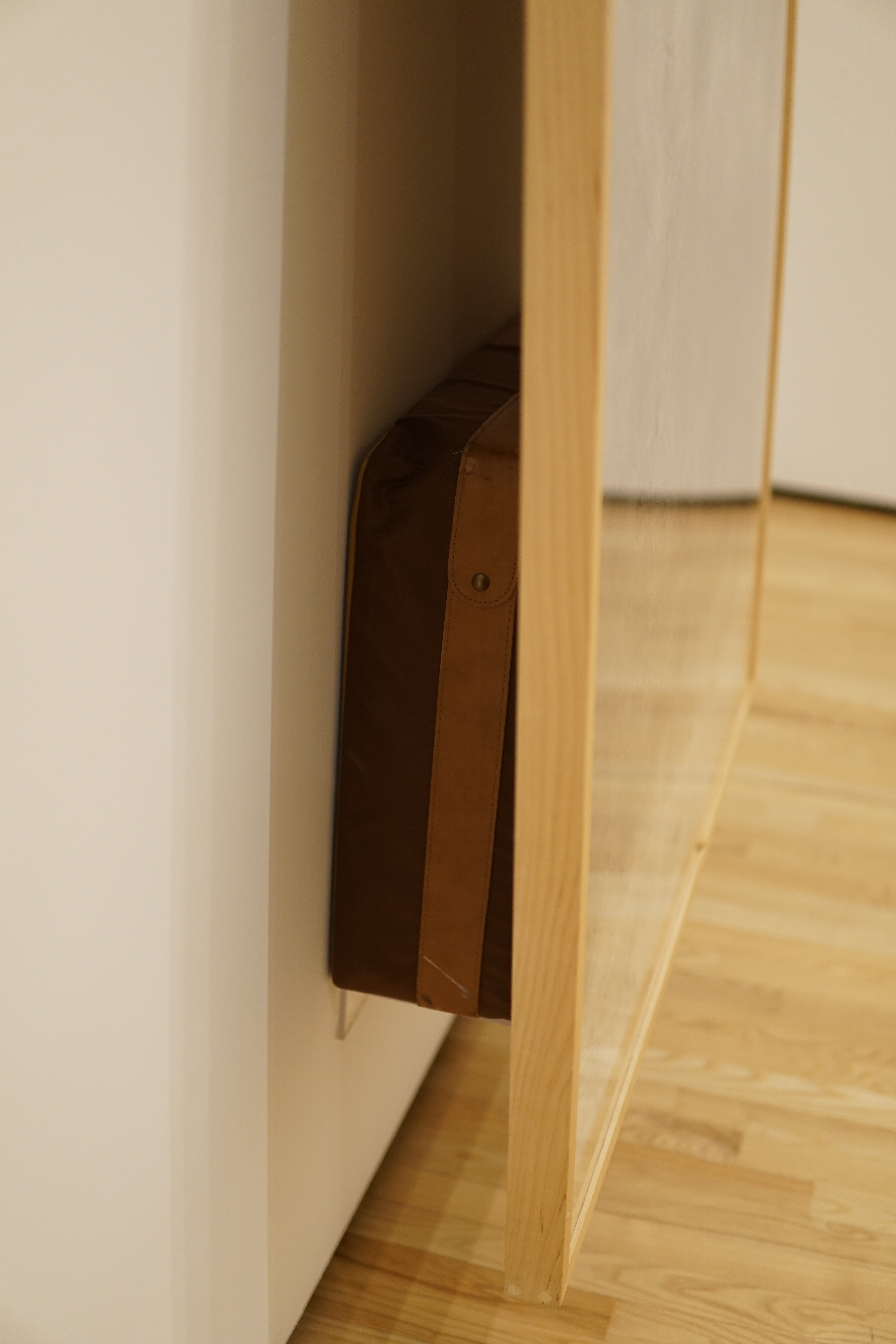
David Hammons (American, 1943–), Traveling, 2001–2. Harlem dirt on paper and suitcase, 109 5/16 × 41 3/4 × 9 1/2 in. Baltimore Museum of Art, Maryland. Photo: Victoria Emily Jones.
I love the love of place this piece promotes. “Harlem dirt” is listed as the primary material! Hammons is sanctifying the dust of his neighborhood (“the ephemeral stuff of black urban experience”) by bringing it into a high-art context, essentially saying, “My background, my experiences, are worthy.” Martin Herbert, writing for Frieze, discusses the multivalence of the title:
The title of this work, Traveling, evokes many things: the eponymous rule of basketball that says you can’t take the ball and run with it; Hammons’ own movement across the Atlantic and that of the grimy orange sphere across the room; the upward mobility of dirt-into-art, and its direct social analogue—the ‘coming up from the streets’ dream/boast of a million aspiring rappers and pro-court players in environments where, as hip-hopper Mos Def put it, ‘you can either get paid or get shot’.
The artwork juts out from the wall at a slight angle, and one discovers propped behind it a thin brown suitcase.
+++
Like Stephen Towns, Amy Sherald lives in Baltimore. She is known for her large-scale portrait paintings that use grisaille to portray skin tones as a way of “challenging the concept of color-as-race,” and was chosen to paint the official portrait of First Lady Michelle Obama.
Amy Sherald (American, 1973–), Planes, rockets, and the spaces in between, 2018. Oil on canvas, 100 × 67 in. Baltimore Museum of Art, Maryland. Photo: Victoria Emily Jones.
About Planes, rockets, and the spaces in between, Sherald writes,
I wanted the environment to be in what would be perceived as an American landscape. These two figures are witnesses of a very American moment in history. . . . One key thing to note in all of my paintings is that the figures in the work will never be passive participants. Eye contact plays an extraordinary and crucial role in human connection. The figure gazing off at the rocket as she holds her friend’s hand solidifies the moment, as the second figure looks back to meet the gaze of the viewer.
I’ve appreciated how conscientious the Baltimore Museum of Art has been, in the past two years especially, in expanding its collection to better reflect the city it’s in. In 2018 it deaccessioned redundancies in its contemporary holdings to enable the purchase of new works by female artists and artists of color. Such acquisitions “enhance our ability to tell the uniquely varied and layered narratives that exist across the history of art and into the present,” said BMA director Christopher Bedford in a press release.
I also appreciate the video interviews with artists that the museum has been producing, which I hope to see more of.







 Art & Theology