
Wondering why I’m still posting Christmas content? Because Christmas is a twelve-day feast that began December 25 and extends through January 5. While the stores and most media have moved on, the church continues to celebrate. So I encourage you to keep your Christmas decorations up, keep singing and playing carols, and keep partying!
Here’s a link to my Christmastide playlist, comprising over twenty-seven hours of hand-picked sacred Christmas music. Also check out my Epiphany playlist for January 6.
+++
SONGS:
>> “Mary’s Boy Child / Oh My Lord” by Boney M.: The calypso carol “Mary’s Boy Child” was written in 1956 by Jester Hairston and popularized by Harry Belafonte, who recorded it that year. The most famous cover, though, is by Boney M., a reggae, funk, and disco band founded in 1975 in West Germany by the record producer Frank Farian. Its four original members were Liz Mitchell and Marcia Barrett from Jamaica, Maizie Williams from Montserrat, and Bobby Farrell from Aruba. Boney M. released their disco-lite version of “Mary’s Boy Child,” in medley with the new song “Oh My Lord” (by Frank Farian and Fred Jay), as a single in 1978 and then on their full-length Christmas album in 1981. It’s one of the best-selling singles of all time in the UK.
The song makes me smile so much—it’s bright and catchy—especially when I watch the music video, which shows the band singing and dancing in a white room wearing furry white coats. It’s one of two music videos they made for the song, the other cut together with kids enacting the Nativity.
>> “O Ho, Masih Aaya, Zameen Par” (Oh, Christ Has Come! There Is Joy on Earth!) by Akshay Mathews: This contemporary carol from India opens, “Oh, Christ has come! There is joy on earth, there is joy throughout the heavens. Oh, Christ has come!” Then it describes the Annunciation to the Shepherds. Read the Hindi lyrics here. In the video, singer-songwriter Akshay Mathews [previously], who lives in Delhi, triplicates himself using a clone effect so that he is shown playing all three accompanying instruments: guitar, keyboard, and hand drum.
>> “There’s a Fire in Bethlehem,” arr. Conrad Susa: I learned of this traditional Spanish villancico, “En Belén tocan a fuego,” from Calvin University’s 2022 Lessons and Carols Service, For God So Loved the Cosmos. As part of that program, the song was performed in English by the university’s Women’s Chorale, as arranged by Conrad Susa. It opens with imagery of the fire of God’s love flaring out from a stable, and develops into a scene of fish, rivers, and birds rejoicing in the birth of their Redeemer. There was a recording error that puts the lips out of sync with the sound, but the music otherwise comes across just fine.
I love the playful chorus, where the tempo picks up and the pianist shifts to staccato technique (detached and bouncy): “Fish in the river are glistening and dancing, dancing and leaping to celebrate his birthday.” In the sixteenth-note piano run that signals the transition between chorus and verse, I can picture the cavorting, splashing, and darting of our gill-bearing brothers. Although several animal characters make an appearance in Christmas songs, fish usually aren’t one of them. I like how the anonymous writer of this song includes them among the ones who celebrate Christ’s birth. Reminds me a bit of the animated Christmas short from Russia that I shared back in 2017.
To hear a professional recording by the Balthasar-Neumann-Chor, click here.
+++
ARTICLES:
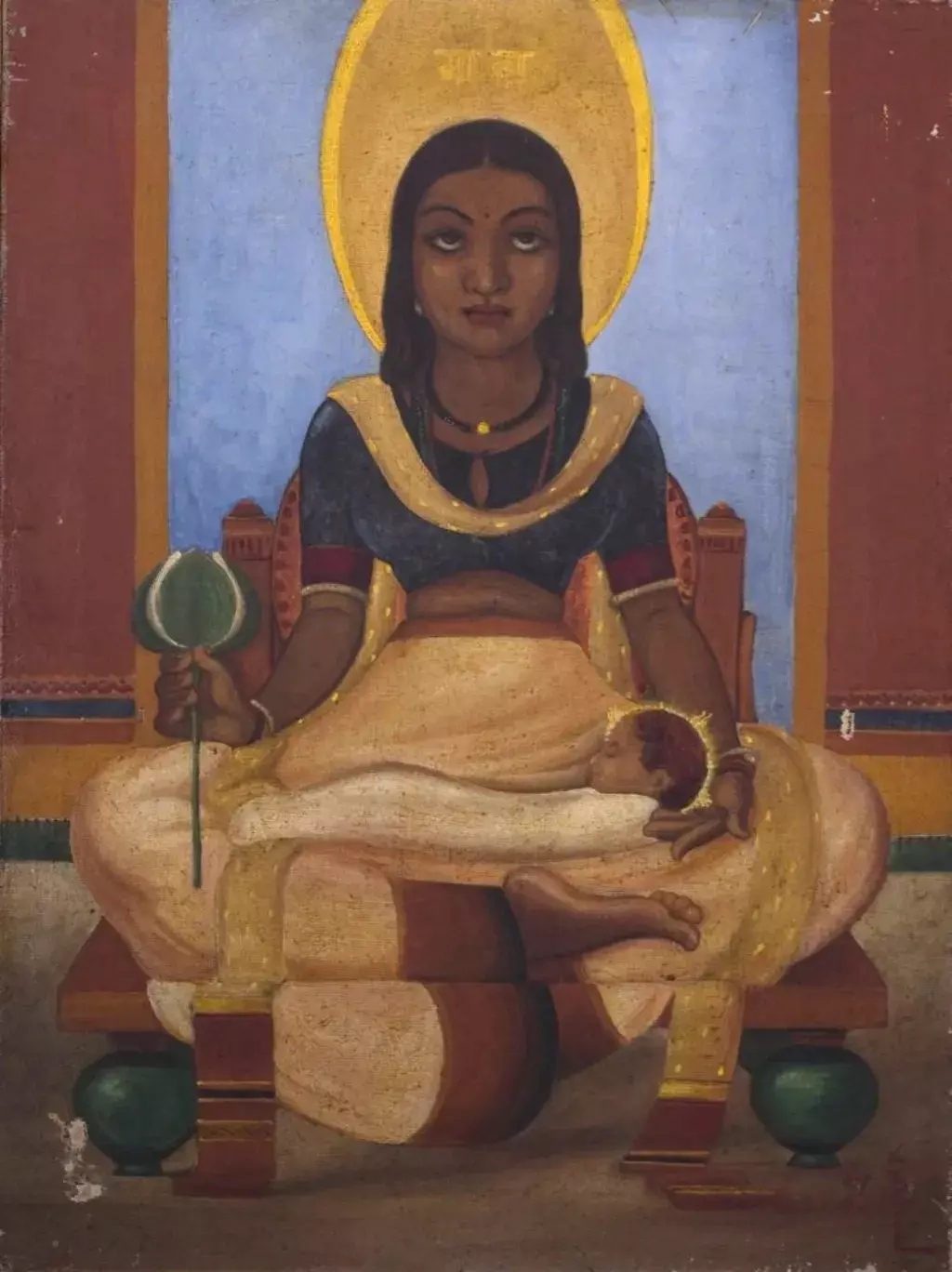
>> “Modernism and Islamic motifs: How Indian artists envisioned Christ’s birth” by Cherylann Molan, BBC News Mumbai: This article explores a handful of Indian depictions of the Virgin and Child by Mughal-era artists, Jamini Roy, and Angelo da Fonseca, all of which present Jesus’s birth from a local perspective.
>> “A Resolution for People Who Are Already Doing Their Best” by Kate Bowler, Everything Happens (Substack): “Every January, we perform this ritual together. We shake off the indulgence of the holidays and brace ourselves for improvement. We tell ourselves that this will be the year we get it together . . . that any mess was temporary . . . that with the right plan, the right habits, the right mindset, we can finally become the person we were always supposed to be. This is not a small thing. In the United States and Canada (bless us all), New Year’s resolutions have become a kind of secular sacrament—an annual recommitment to the belief that limits are a problem to be solved. But what if they aren’t?”
Kate Bowler [previously], an award-winning author, podcaster, and historian of American self-help, breaks the illusion of unlimited agency and shares the question she’s asking herself for the new year instead of “What should I fix?”
 Art & Theology