Open-Access Image Archive of Middle Eastern Art, Architecture, and Archaeology

Based at the Faculty of Classics at the University of Oxford, the Manar al-Athar (“Guide to Archaeology”) digital archive provides high-resolution photographs of archaeological sites, buildings, and art from the Levant, North Africa, the Caucasus, and the Balkans, covering the time of Alexander the Great (ca. 300 BCE) through the Byzantine and early Islamic periods, with special emphasis on late antiquity. All the images are freely downloadable, made available for teaching, research, and academic publication under a Creative Commons Attribution-NonCommercial-ShareAlike 2.0 UK (CC BY-NC-SA 2.0) license.

Manar al-Athar was established in 2012 by Dr. Judith McKenzie (1957–2019) and since 2020 has been directed by Dr. Ine Jacobs. It is in continuous development. The photos are cataloged by geographical region and are labeled in both English and Arabic. They picture a range of historical structures—some intact, others in ruins; both interiors and exteriors, where applicable—including mausoleums, churches, mosques, khanqahs (Sufi lodges), hammams (public bathhouses), palace complexes, madrasas (colleges for Islamic instruction), forums, fountains, cisterns, aqueducts, civic buildings, theaters, markets, fortifications, and hostels.

Of primary interest to me is the Christian art from churches and tombs, from countries such as Egypt, Syria, Turkey, Armenia, Georgia, and Serbia, and Jewish art that pictures stories from the Hebrew Bible.

Unfortunately, the subjects of the artworks aren’t labeled and there’s no commentary or transcription/translation of inscriptions, nor are the buildings or artworks dated. Inevitably, many of the frescoes and mosaics have degraded with age, sometimes making the iconography difficult to read. There’s also no way to filter by religion; Christianity accounts for only a portion of the images, with others coming from Jewish, Islamic, or pagan traditions, and a number are from nonreligious contexts. I’d love to see a more robust tagging system and advanced searchability functions as the archive continues to evolve.

The archive is by no means comprehensive, but I hope it will encourage further scholarship and attract more digital image donations.

Below is a sampling of the hundreds of images you can find on the Manar al-Athar website.


One of the earliest surviving and best-preserved Christian cemeteries in the world, used by Christians from the third to eighth centuries, is Bagawat Necropolis in the Kharga Oasis in Egypt’s Western Desert. The Chapel of Peace is one of 263 mud-brick funerary chapels in the cemetery, celebrated for the painting of biblical, early Christian, and allegorical figures inside its dome.
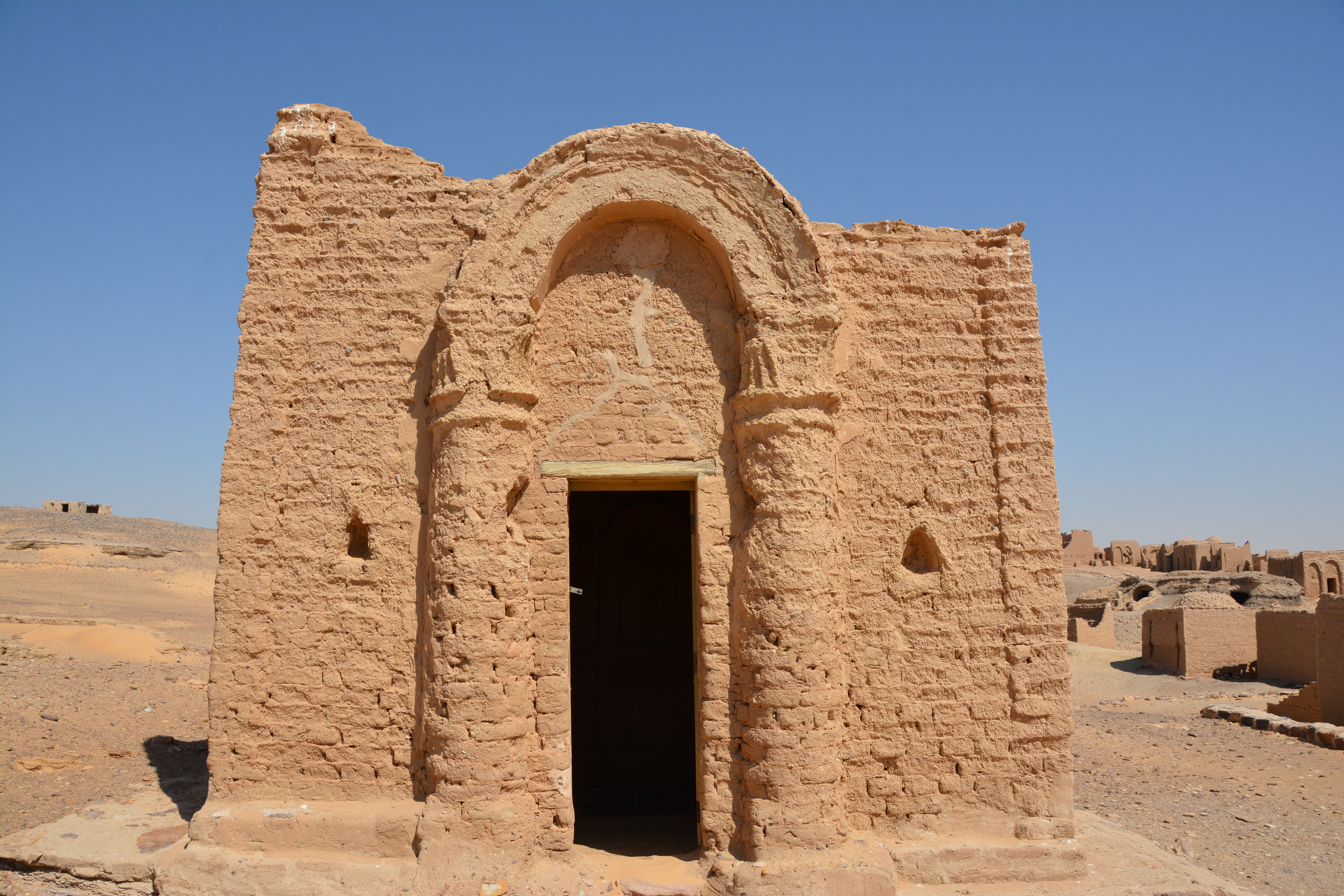
Chapel of Peace (Bagawat, Egypt)
The Chapel of Peace, a monumental Christian tomb at Bagawat Necropolis, Kharga Oasis, Egypt, built 5th or 6th century. Photo: Mohamed Kenawi / Manar al-Athar.

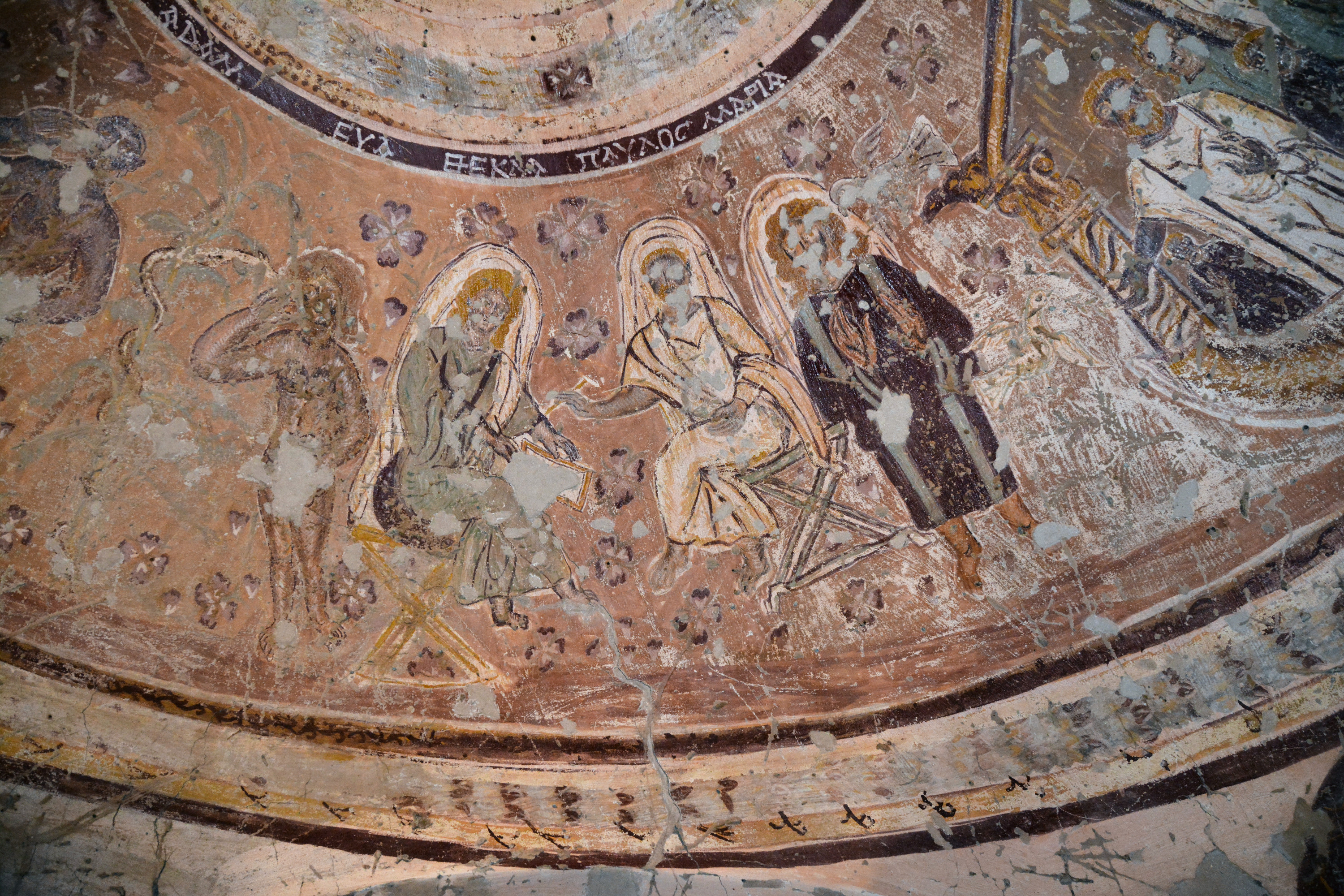
Paul and Thecla (Chapel of Peace)
Dome fresco detail from the Chapel of Peace at Bagawat Necropolis in Kharga Oasis, Egypt, 5th or 6th century. Photo: Mohamed Kenawi / Manar al-Athar.

The detail pictured above shows the female saint Thecla (Θέκλα), a first-century Christian preacher and martyr, learning from the apostle Paul (Παῦλος), as described in the ancient apocryphal Acts of Paul and Thecla. They both sit on stools, Thecla holding open a book on her lap, pen in hand, while Paul points out a particular text.

In addition to Paul and Thecla, the dome fresco also depicts, clockwise from that pair: Adam and Eve; Abraham about to sacrifice his son Isaac, with Sarah stretching out her hand (it’s unclear whether this gesture signifies her surrender to God’s will or an attempt to stop her husband’s act); Peace, holding a scepter and an ankh; Daniel in the Lions’ Den; Justice, holding a cornucopia and balance scales; Prayer; Jacob; Noah’s Ark; and the Virgin Annunciate, the New Eve, who heard the word of God and obeyed it and thus brought forth life, unlike her ancestor, who listened to the lies of the Evil One and brought forth death (the snake and dove at the women’s respective ears emphasize this contrast). View a facsimile of the full dome here.

Also in the Egyptian folder are photos of one of Byzantine Egypt’s most glorious encaustic-painted sanctuaries, that of the Red Monastery Church, a triconch (three-apse) basilica that’s part of the (Coptic Orthodox) Monastery of Apa Bishuy near Sohag.
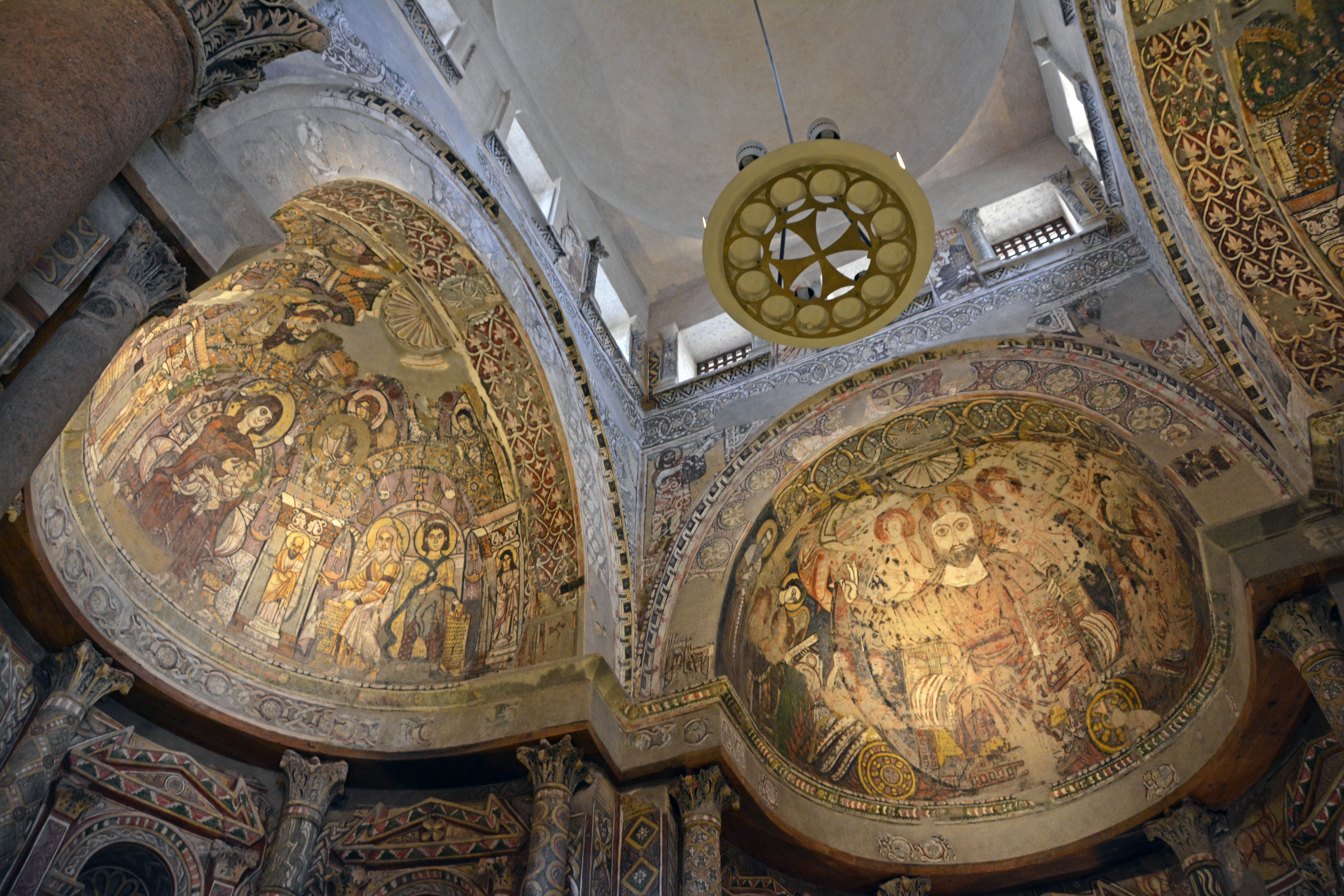
Red Monastery Church
North apse (Virgin Galaktotrophousa, aka the Nursing Madonna) and east apse (Christ Pantocrator), painted 6th–7th or 8th century, Red Monastery Church, near Sohag, Egypt. Photo: Mohamed Kenawi / Manar al-Athar.

Here’s a video that presents a 3D reconstruction and fly-through of the basilica:

Moving northeast into Israel, we come to the sixth-century Bet Alpha (sometimes rendered as Beit Alfa) Synagogue, located in the Beit She’an Valley. The excavation of Jewish sacred sites like this one reveal that, contrary to what is popularly alleged, Judaism is not a strictly aniconic religion. Many Jewish communities have understood the prohibition against graven images in Exodus 20:3–6 and Leviticus 26:1 as a prohibition against idol worship, not figurative art (art that depicts people and animals) in general. Thus several ancient synagogues, not to mention Jewish manuscripts, portray episodes from the biblical narrative, such as the Akedah (Binding [of Isaac]), told in Genesis 22.
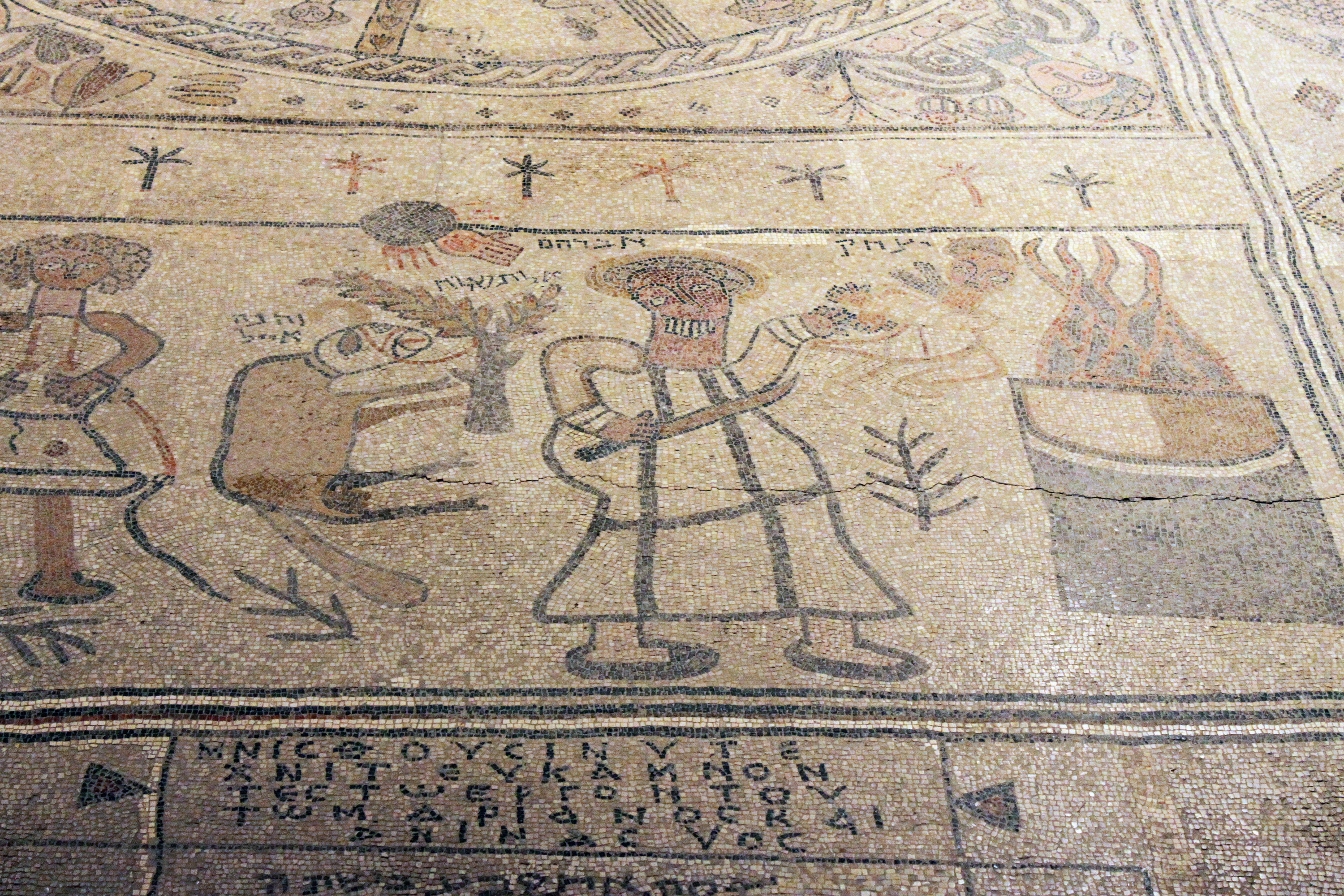
Sacrifice of Isaac (Bet Alpha mosaic)
The Binding of Isaac, early 6th century. Mosaic pavement, Bet Alpha (Beit Alfa) Synagogue, Heftziba, Israel. Photo: Sean Leatherbury / Manar al-Athar.

Rendered in a primitive style, this scene is one of three from the mosaic pavement in the central hall of Bet Alpha. It shows Abraham, sword in hand, about to throw his son Isaac onto a fiery altar, when God, represented by a hand from the sky, intervenes, telling him to stop; it’s then that Abraham notices a ram tangled up in a nearby thicket, which he sacrifices instead. The Hebrew inscriptions read, from right to left, “Yitzhak” (Isaac), “Avraham” (Abraham), “al tishlakh” (Do not lay [your hand on the boy]), and “v’hineh ayil” (Here is a ram). Stylized palm trees line the top of the scene.

Here is video footage of the full floor mosaic in its space, showing wide views as well as details, including of the remarkable zodiac wheel in the center:

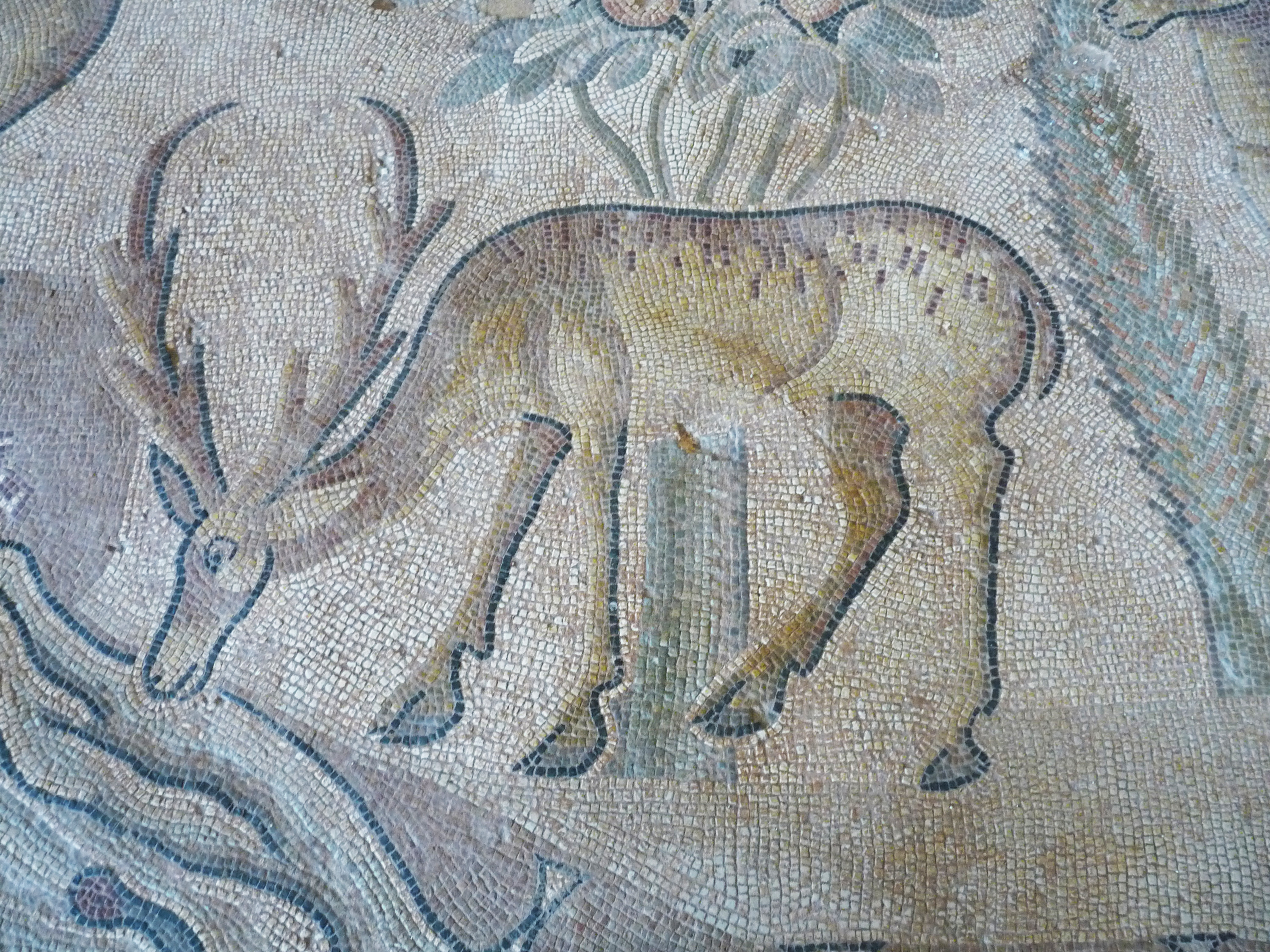
Mosaic was a common form of late antique decoration in places of worship. Here are two examples from Syria:
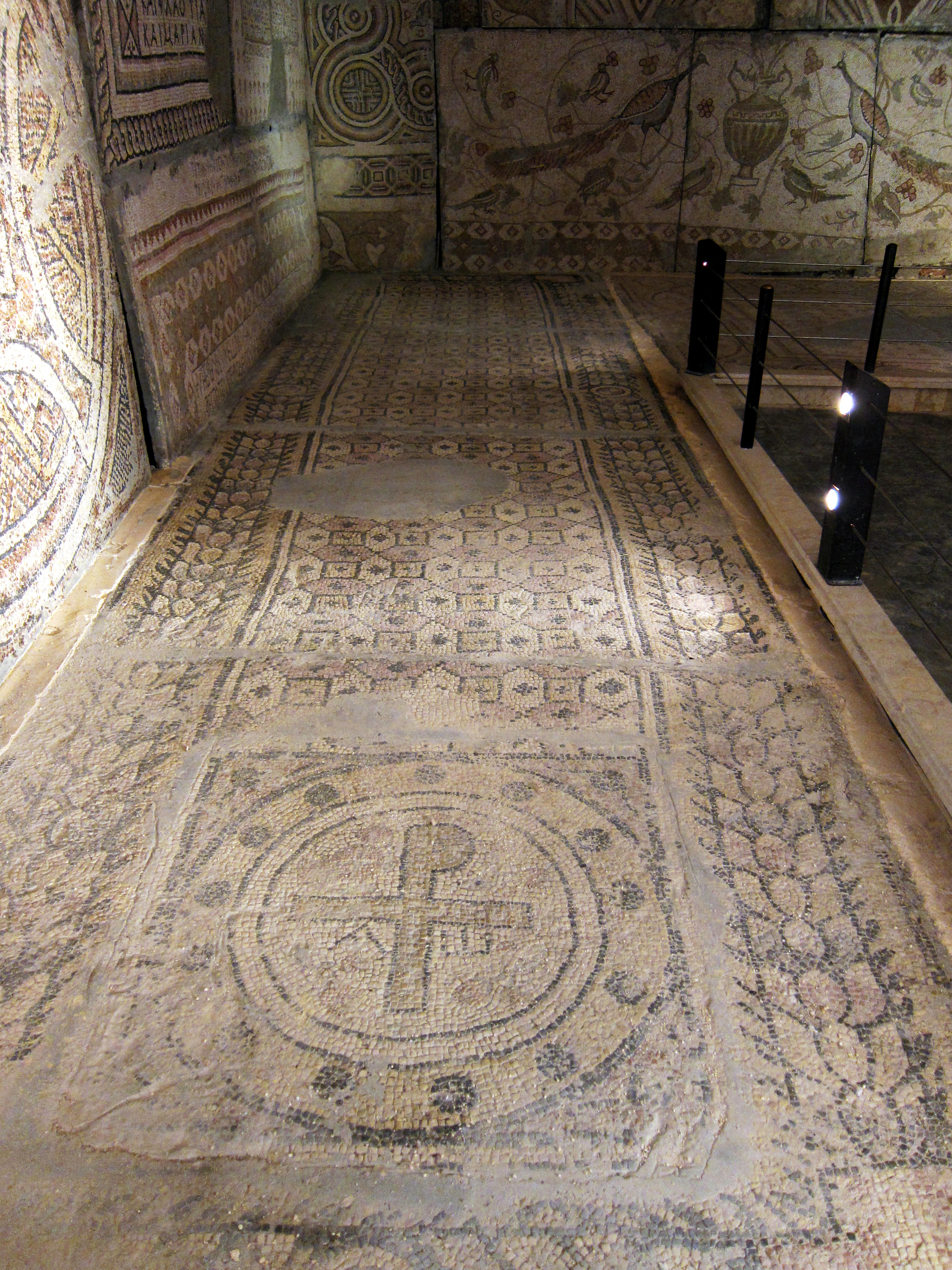
Tell Aar church mosaics
Mosaics from the ancient Tell Aar church, including a chi-rho monogram with an alpha and omega (foreground) and peacocks flanking an amphora (background), housed in the Maarat al-Numan Museum, Syria. Photo: Sean Leatherbury / Manar al-Athar.

Deer drinking water
Deer drinking from a stream, 5th century. Mosaic, Church of the Martyrs, Taybat al-Imam, Syria. Photo: Jane Chick / Manar al-Athar.

To the north of Syria in Turkey—cataloged by Manar al-Athar under “Anatolia,” the ancient name for the peninsula that comprises the majority of the country—there are the Cappadocian cave churches, hewn out of volcanic tufa. They began to be built in the fifth century, with a boom happening in the ninth through eleventh centuries, which is the period to which almost all the surviving paintings can be dated. There are over a thousand such churches, some very simple inside, and others elaborately painted. The architecture has been described as eccentric and enchanting. I like to imagine the monks, nuns, and other Christians who worshipped there all those centuries ago.
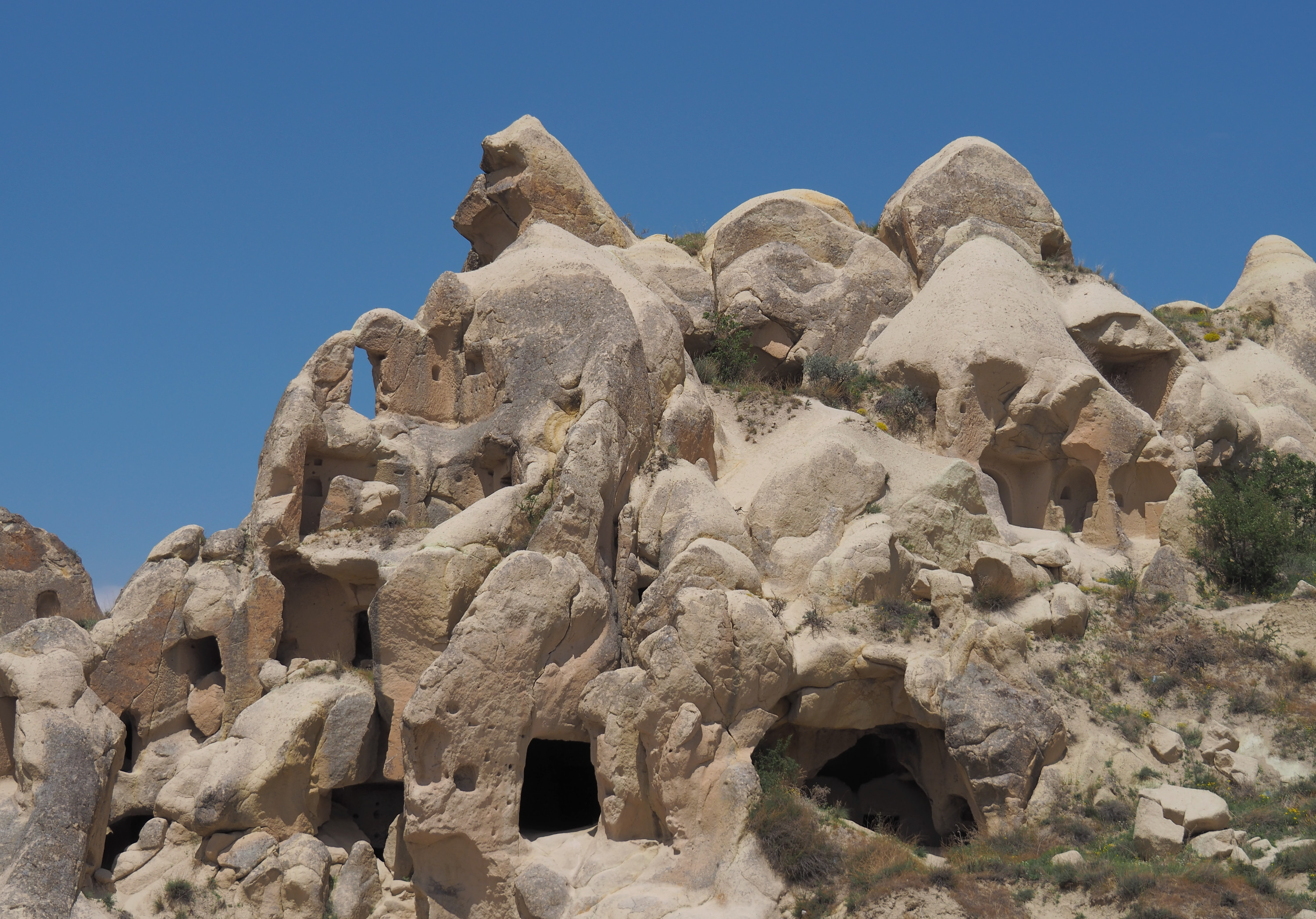
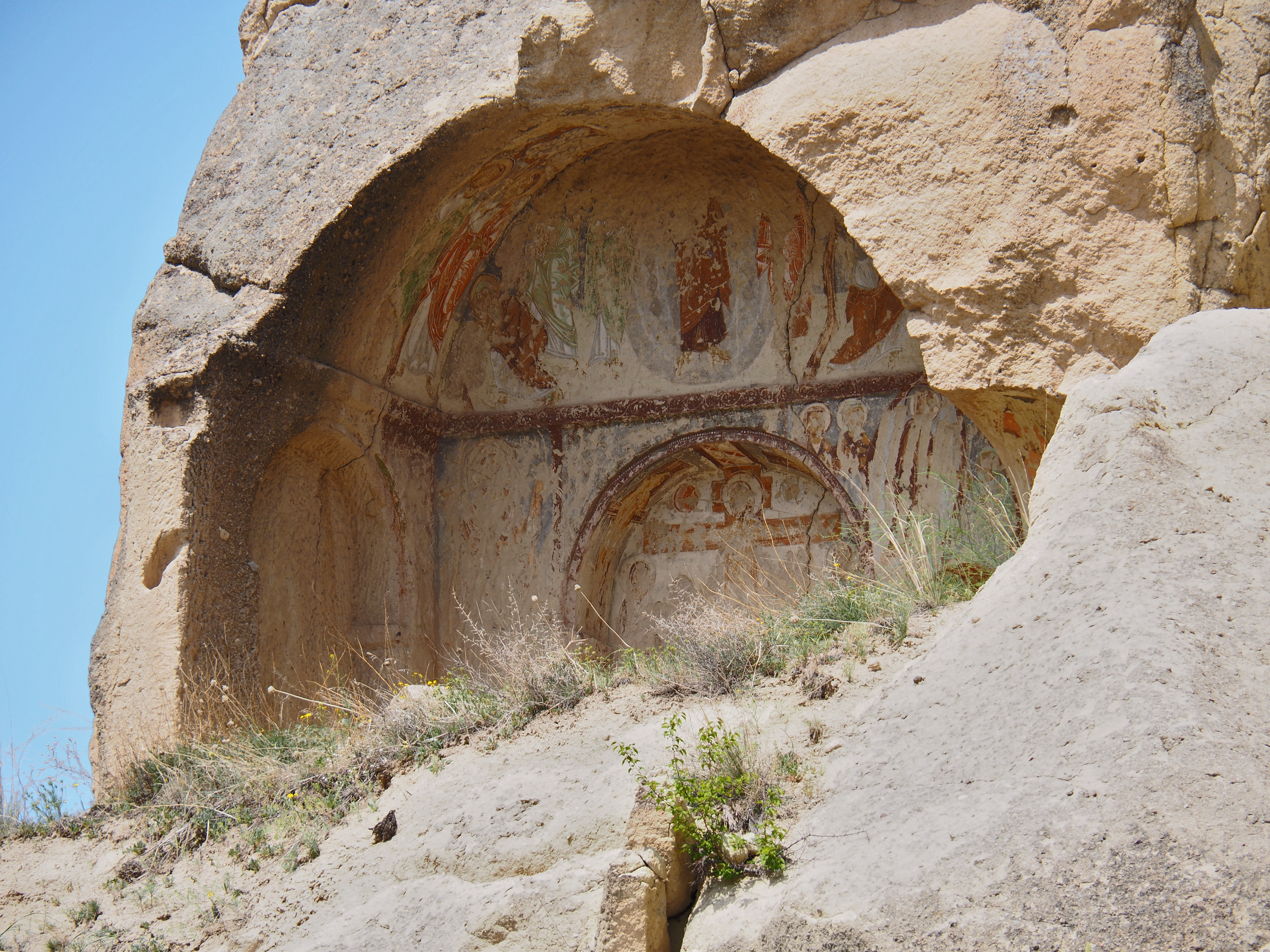
Rock-hewn chapel, Cappadocia
Middle Byzantine cave church, Göreme Open Air Museum, Cappadocia, Turkey. Photo: Marlena Whiting / Manar al-Athar.

Crucifixion and Transfiguration
Frescoes depicting the Crucifixion and the Transfiguration, from a rock-cut chapel at the Göreme Open Air Museum, Cappadocia, Turkey. Photo: Marlena Whiting / Manar al-Athar.

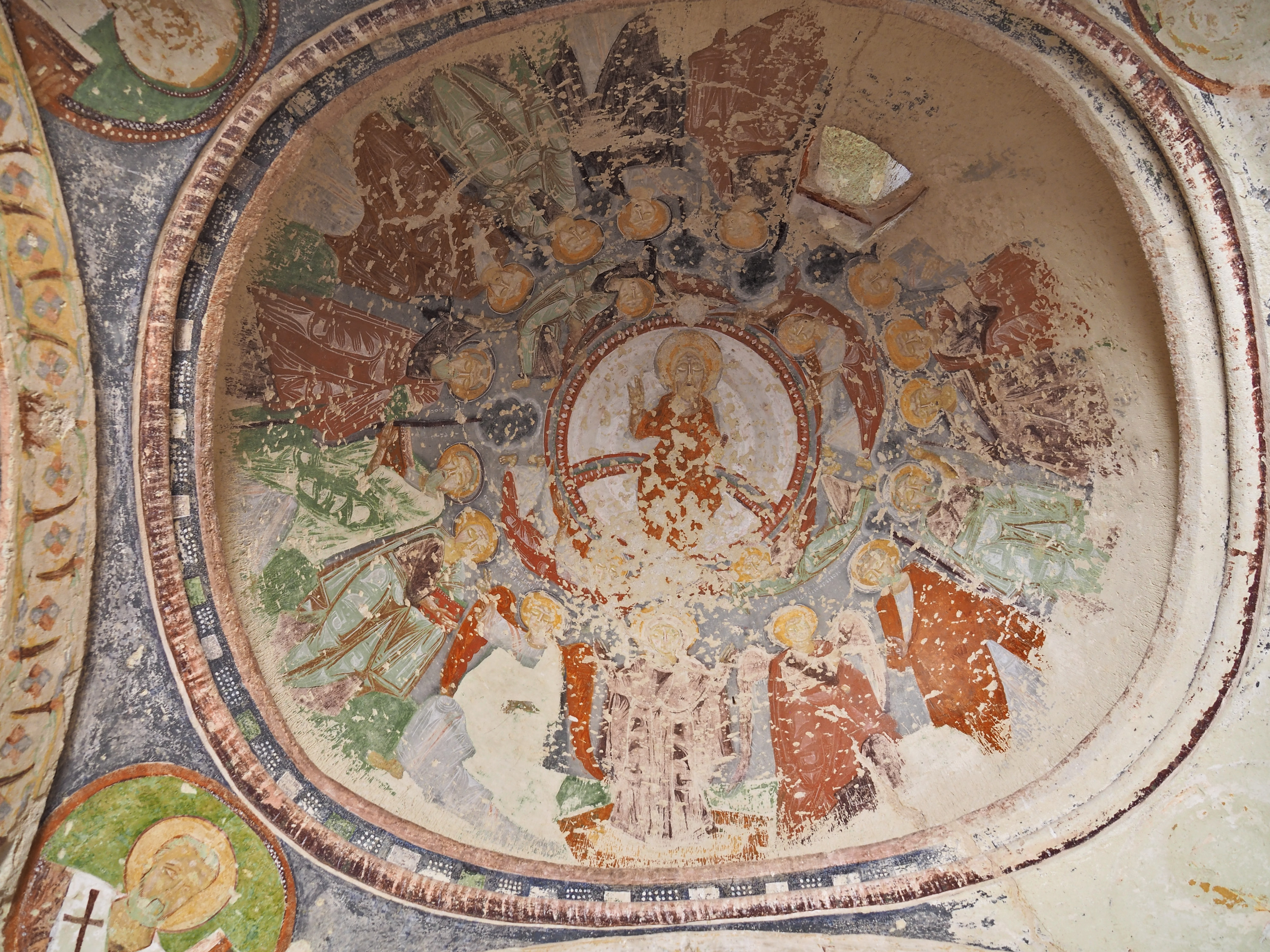
Christ in Glory (Turkey)
The Ascension of Christ, 10th century. Dome fresco, Church of the Evil Eye (El Nazar Kilise), Göreme, Cappadocia, Turkey. Photo: Marlena Whiting / Manar al-Athar.

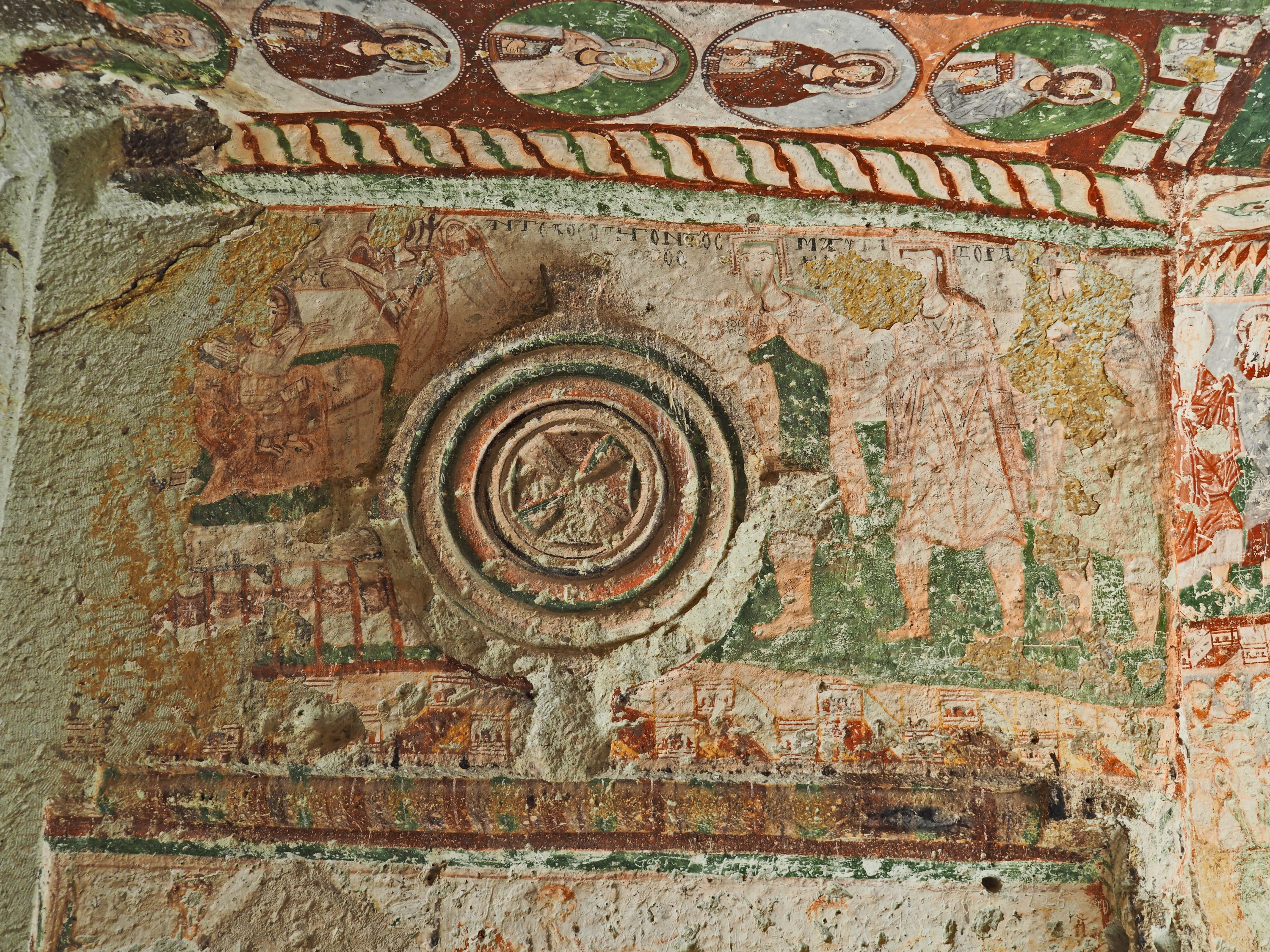
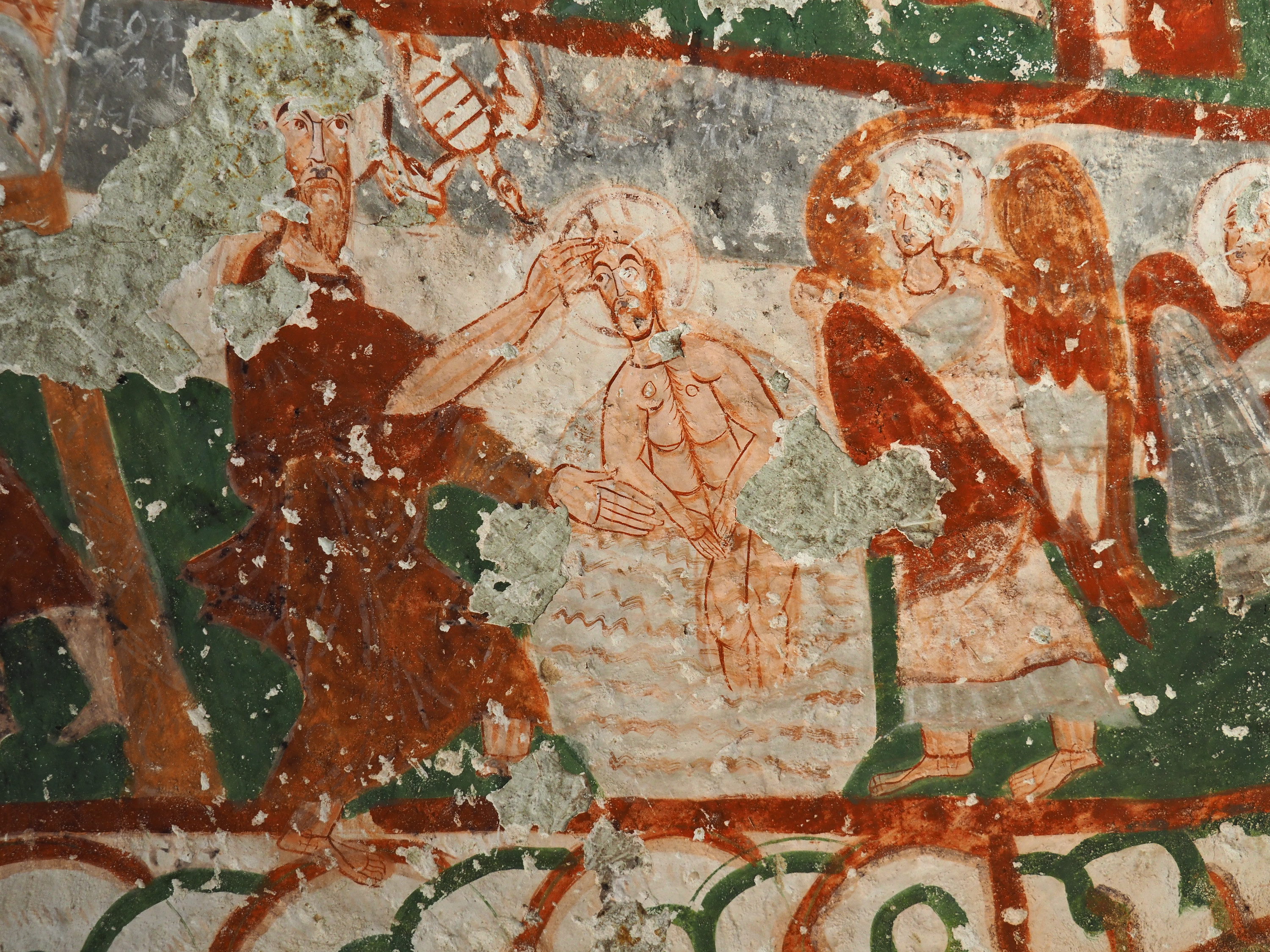
One of the cave churches in Cappadocia, part of an ancient monastic settlement, is Pancarlik Church, home to an impressive fresco cycle on the Life of Christ that’s painted mainly in rusty red and bean green.
Adoration of the Magi (Turkey)
Adoration of the Magi fresco and Greek cross relief carving, probably early 11th century. Pancarlik Church, Cappadocia, Turkey. Photo: Marlena Whiting / Manar al-Athar.

Baptism of Christ (Pancarlik Church, Turkey)
The Baptism of Christ, probably early 11th century. Fresco, Pancarlik Church, Cappadocia, Turkey. Photo: Marlena Whiting / Manar al-Athar.

Beyond Cappadocia but also in Turkey is Hagia Sophia (Holy Wisdom) in Trabzon, not to be confused with the more famous Hagia Sophia in Istanbul, 650 miles away. Originally a Greek Orthodox church, it was converted into a mosque following the conquest of Trabzon (then called Trebizond) by Mehmed II in 1461. During prayer the frescoes in the nave, made by Christians who built and previously occupied the space, are covered by curtains to honor the Islamic prohibition against images—the veils are pulled aside during tourist hours—while the frescoes in the narthex remain uncovered at all times.
Breakfast on the Shore (Hagia Sophia, Trabzon)
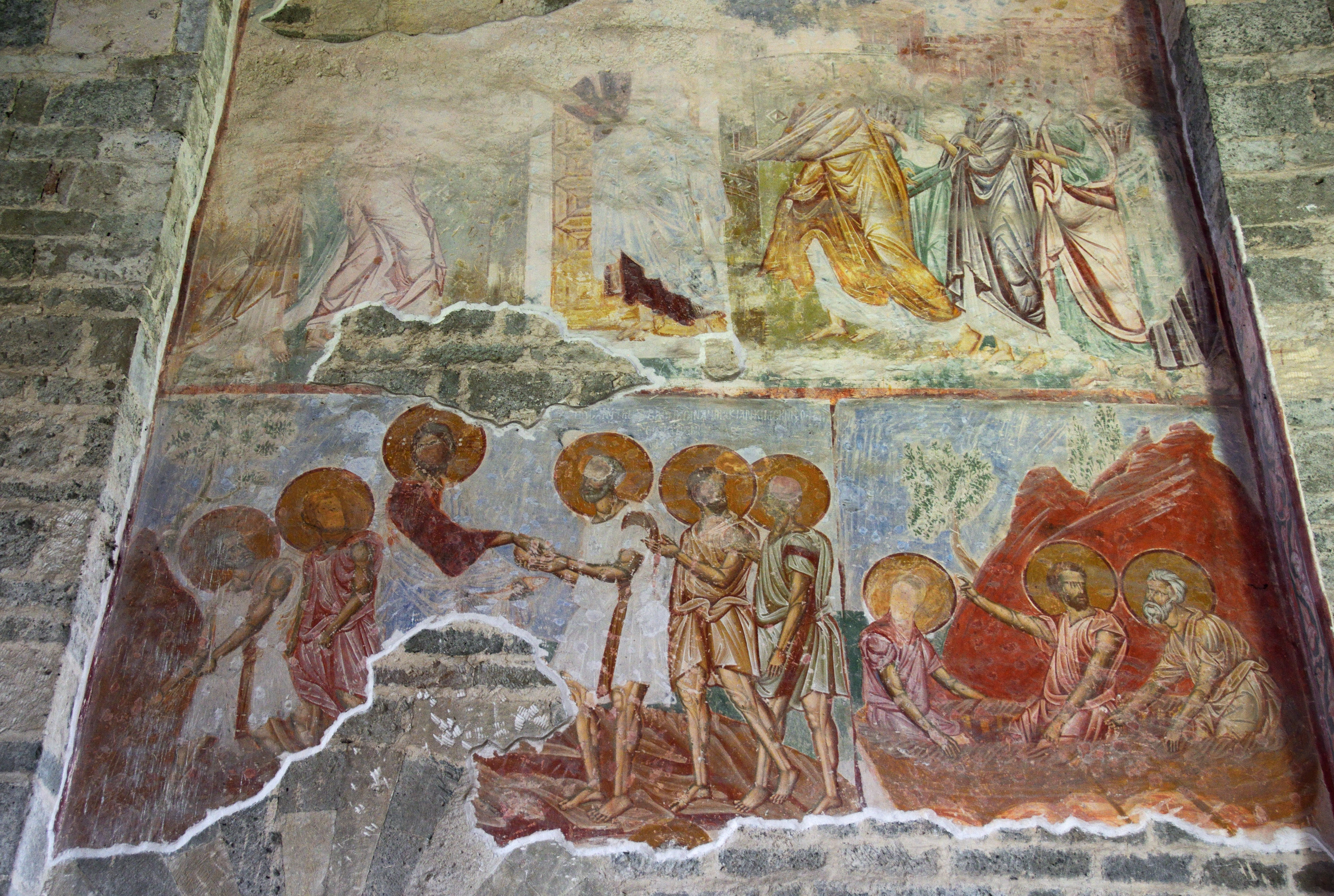
The Incredulity of St. Thomas (top) and The Risen Christ Appears on the Shore (bottom), late 13th century. Frescoes, Hagia Sophia (Aya Sofya Mosque), Trabzon, Turkey. Photo courtesy of Manar al-Athar.

One of the frescoes shows Christ appearing to his disciples after his resurrection on the shore of the Sea of Galilee. He hands a fish and a loaf of bread to Peter, who stands at the front of the group, so that they can all share a joyous breakfast together after the tragic, upending events of the previous week.
Tetramorph (Hagia Sophia, Trabzon)
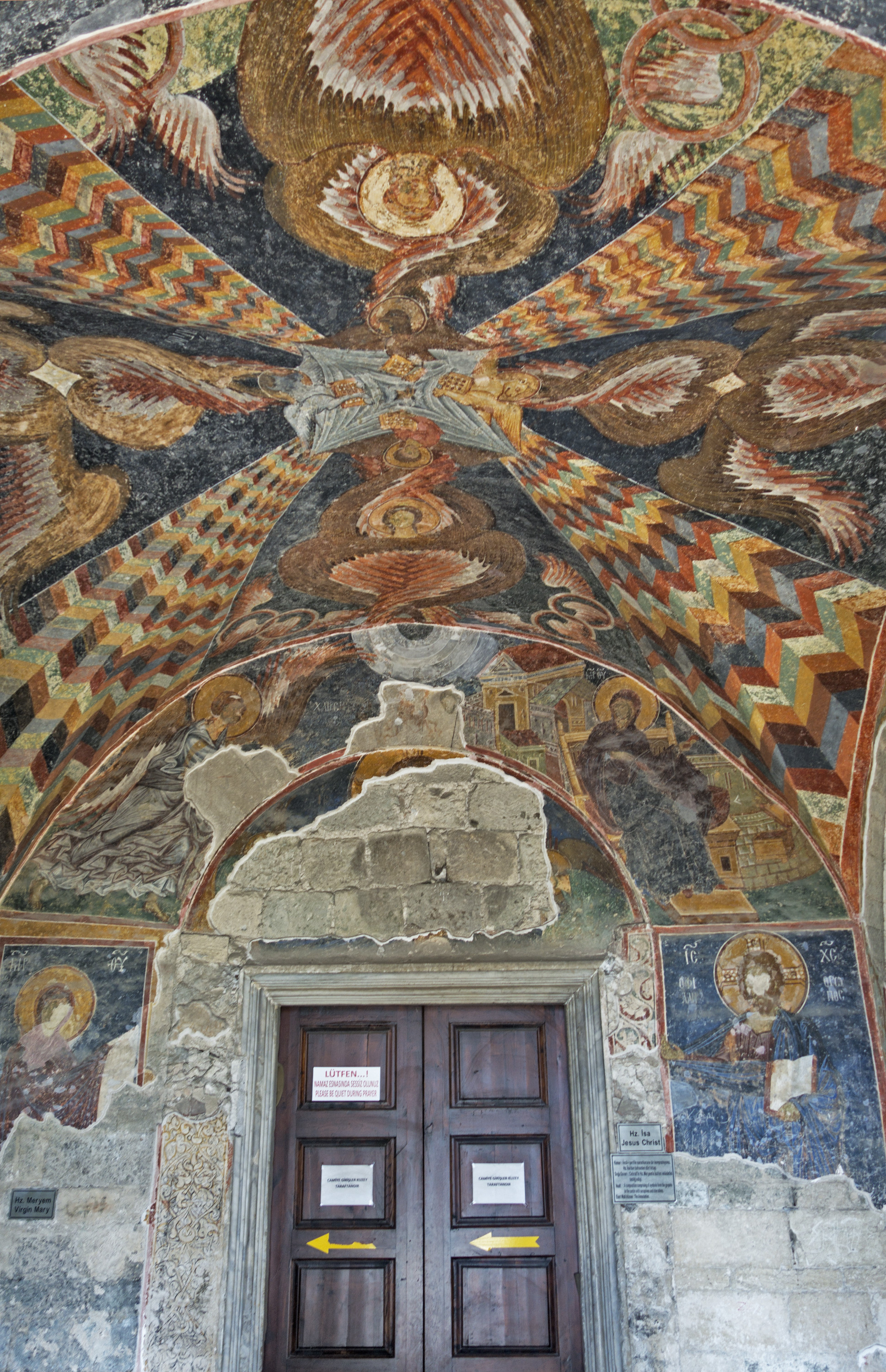
Frescoed narthex, late 13th century, Hagia Sophia (Aya Sofya Mosque), Trabzon, Turkey. Photo: Matthew Kinloch / Manar al-Athar.

Another fresco, on the vaulted ceiling of the narthex, shows the four living creatures of Revelation 4—long interpreted by Christian artists as symbols of the Four Evangelists—situated along the four sides of the canopy of the heavens, each holding a golden Gospel-book and surrounded by seraphim and blazes of rainbow light.

In the Caucasus region, Armenia has a long and rich tradition of Christian art, especially relief carving and painting, as the faith took root there early on in the fourth century.
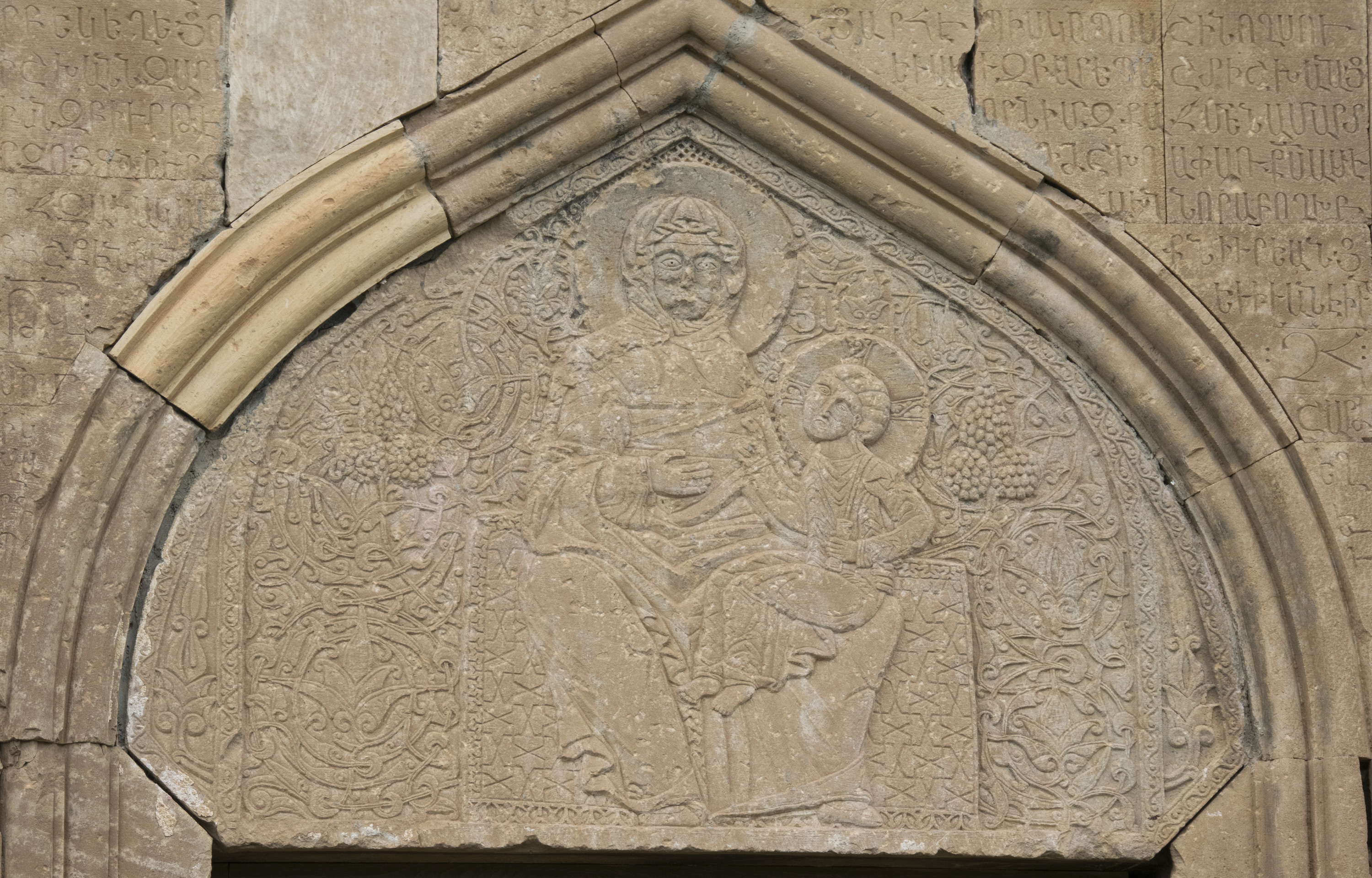
Virgin and Child
Momik Vardpet, Virgin and Child, ca. 1321. Carved tympanum, west portal, Church of St. Astvatsatsin (Holy Mother of God), Areni, Armenia. Photo courtesy of Manar al-Athar.

Overlooking the village of Areni on the eastern bank of the river Arpa is the Church of St. Astvatsatsin, which has a beautiful relief carving in the tympanum above the west portal by the Armenian architect, sculptor, and manuscript illuminator Momik Vardpet (died 1333). It depicts the Christ child seated on the lap of his mother, holding a scroll in one hand and raising the other in blessing. Decorative vines rise up behind and around the pair, suggesting verdancy.

The most distinctive Christian art form in Armenia is the khachkar, a carved memorial stele bearing a cross and often botanical motifs, and only occasionally a Christ figure. In the village of Sevanavank, at a different Church of St. Astvatsatsin, there’s a particularly striking khachkar that portrays the crucified Christ in the center, and below that, a scene of the Harrowing of Hell.
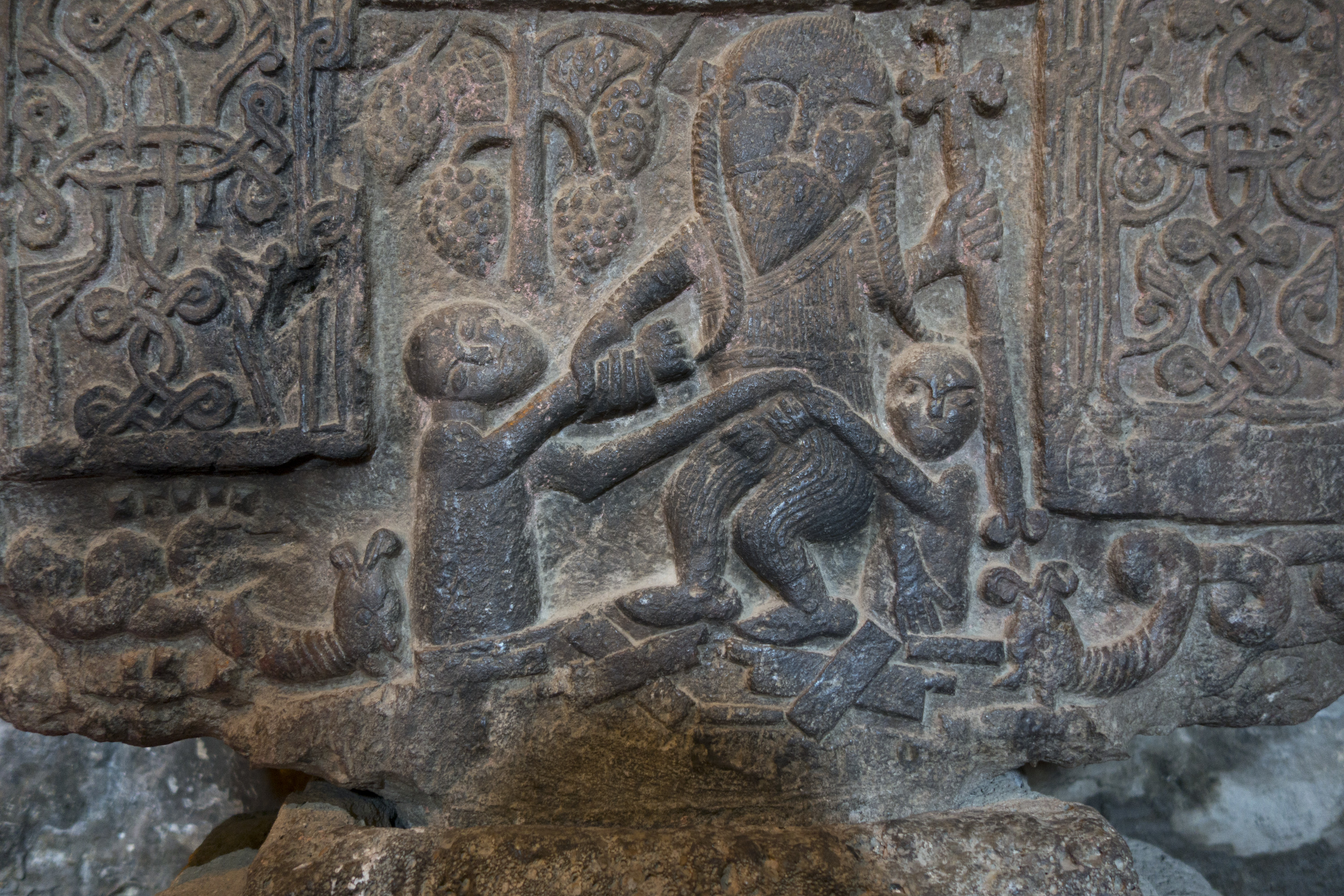
Harrowing of Hell (Armenia)
The Harrowing of Hell, detail of a khachkar from the Church of St. Astvatsatsin (Holy Mother of God) in Sevanavank, Armenia. Photo: Matthew Kinloch / Manar al-Athar. [view full khachkar]

Holding aloft his cross as a scepter, the risen Christ breaks down the gates of death and rescues Adam and Eve, representatives of redeemed humanity, while serpents hiss vainly at his heels. I’m struck by the uniqueness of Christ’s hair, which flows down in two long braided pigtails. Was this a common hairstyle for males in medieval Armenia? I have no idea.

The last artwork from Armenia that I’ll share is an icon of paradise from the Church of St. Astvatsatsin (yes, it’s a popular church name in that country!) at Akhtala Monastery.
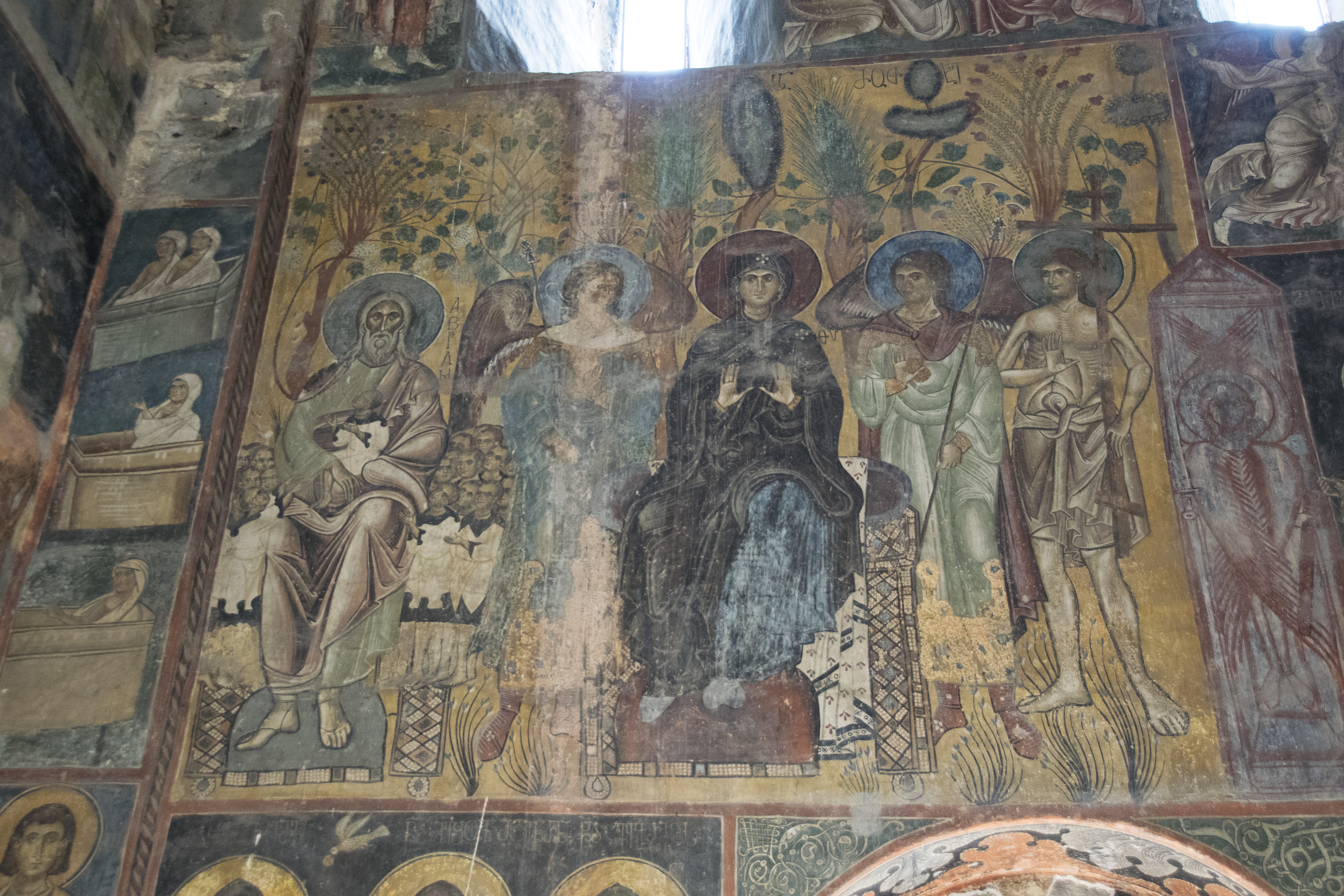
Paradise (Armenia)
Paradise, 1205–16. Fresco, west wall, Church of St. Astvatsatsin (Holy Mother of God), Akhtala Monastery, Akhtala, Armenia. Photo courtesy of Manar al-Athar.

In the center is the Mother of God flanked by two angels. On the left is Abraham with a child, representing a blessed soul, sitting on his lap (Luke 10:22 describes how the righteous dead go to “Abraham’s bosom,” a place of repose). On the right is Dismas, the “good thief” who repented on the cross of his execution, and to whom Jesus promised paradise (Luke 23:39–43); he is venerated as a saint in the Catholic and Orthodox churches.

The image is part of a larger Last Judgment scene that covers the entire west wall. A few panels above, at the very top, Christ is enthroned on a rainbow.

The neighboring country of Georgia has also cultivated a tradition of Christian icon painting. The main church of Gelati Monastery, founded in 1106, is richly decorated with painted murals dating from the twelfth through seventeenth centuries. One of them is the Lamentation over the Dead Christ: The Virgin Mary gently cradles the head of her son and Mary Magdalene throws her arms up in grief while the apostle John leans in close to mourn the loss and Joseph of Arimathea begins to wrap the body in a shroud.
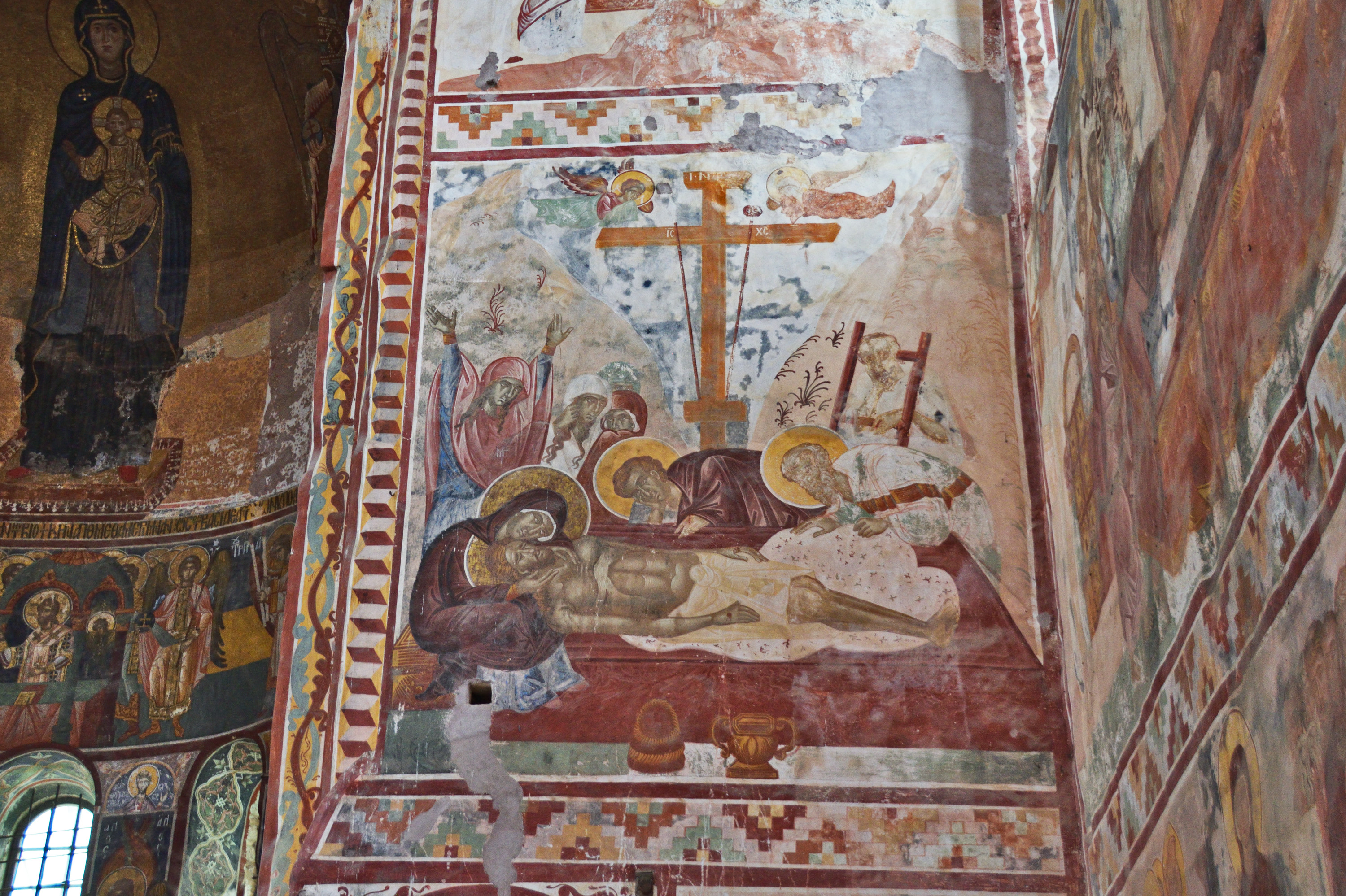
Lamentation (Georgia)
Lamentation over the Dead Christ, fresco, Church of the Blessed Virgin, Gelati Monastery, near Kutaisi, Georgia. Photo courtesy of Manar al-Athar.

Another Georgian icon painting, from the central dome of the Church of St. Nicholas in Nikortsminda, shows angels bearing aloft a jeweled cross, surrounded by the twelve apostles.
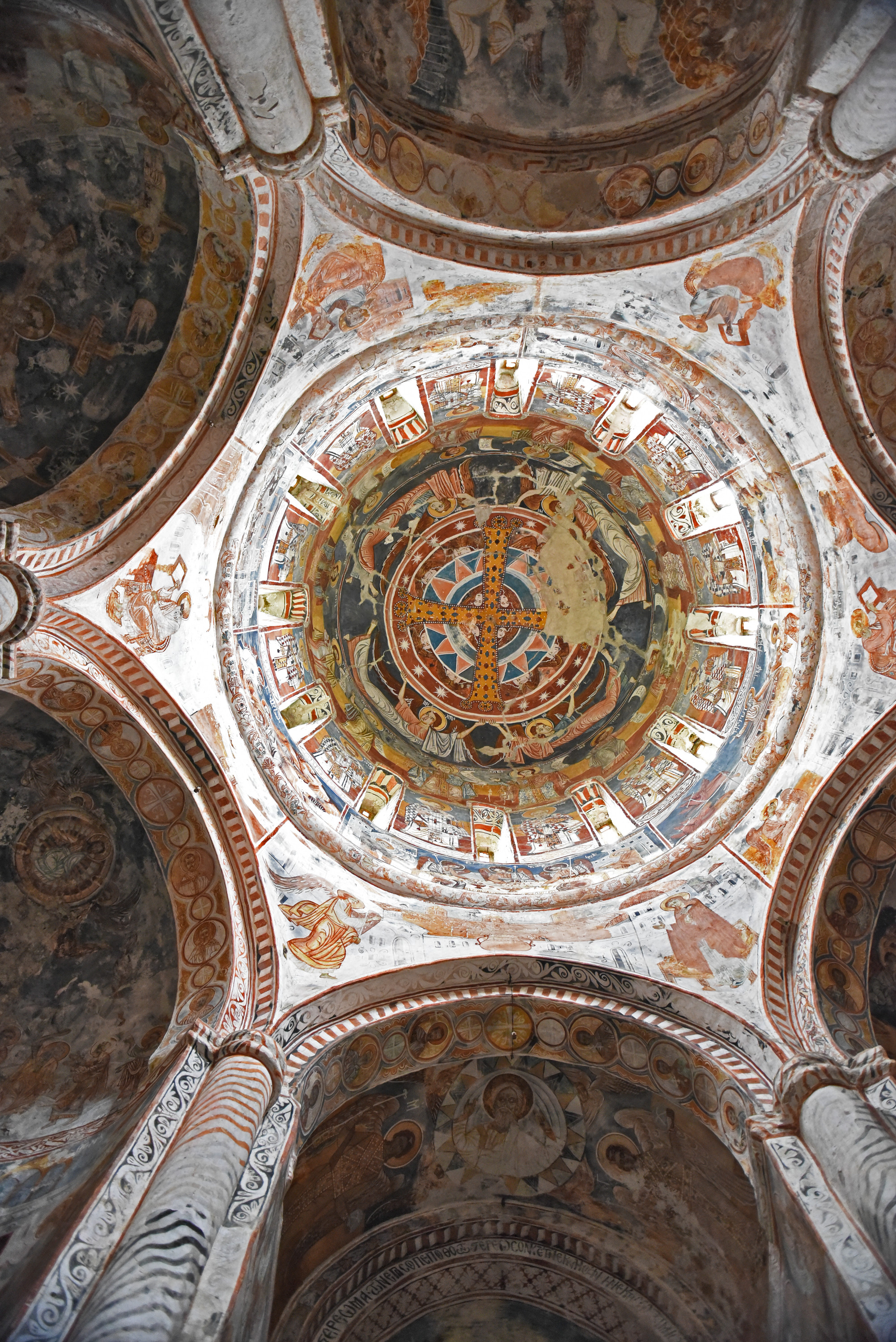
Georgian church dome
Central dome, Church of St. Nicholas, Nikortsminda, Georgia. Photo: Ross Burns / Manar al-Athar.

Lastly, from the Balkans, I want to point out Decani Monastery in Kosovo, a Serbian Orthodox monastery built in the fourteenth century in an architectural style that combines Byzantine and Romanesque influences. The tympana of its katholicon (main church) lean into the Romanesque. The one over the south entrance portrays John baptizing Jesus in the river Jordan, and the Serbian inscription below describes the monastery’s founding.
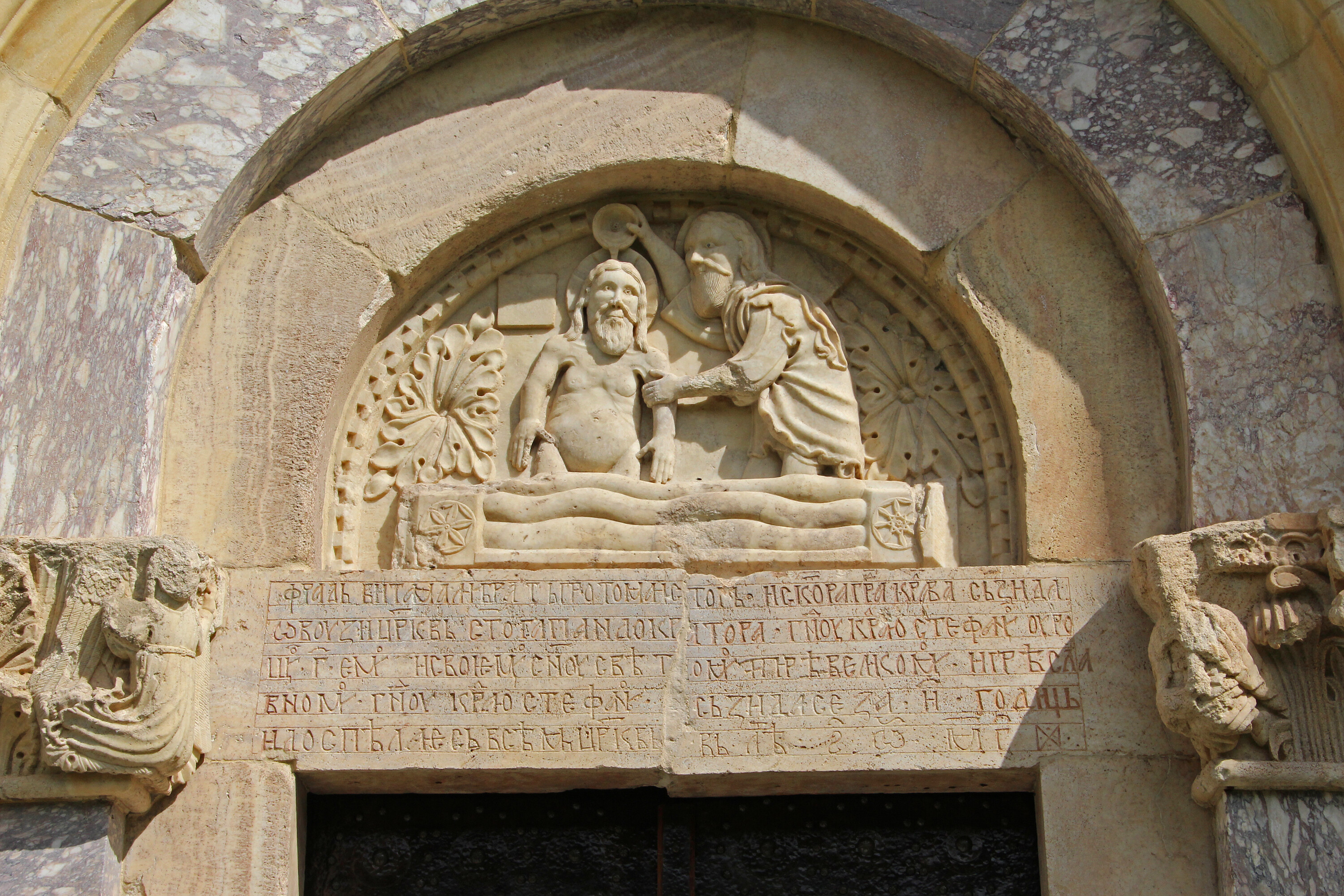
Baptism of Christ tympanum (Decani)
The Baptism of Christ, 1327–35. Carved tympanum, south portal, Christ Pantocrator Church, Decani Monastery, near Deçan, Kosovo. Photo: Mark Whittow / Manar al-Athar.

Decani’s katholicon is the largest and best-preserved medieval church in the Balkans and due to continuing ethnic strife in the region is under international military protection. The Blago Fund website has more and better photos of the extensive frescoes inside, from the fourteenth through seventeenth centuries.

It’s important to note that this is one of a number of churches from the Manar al-Athar archive that are still active sites of Christian worship, where communities of believers are nurtured through word, image, and sacrament.


If you are interested in volunteering with Manar al-Athar—helping with image processing, labeling, fundraising, or web building—or if you have taken any photographs that may be of interest to the curatorial team, email manar@classics.ox.ac.uk.

Website: https://www.manar-al-athar.ox.ac.uk/

Miniatures from a Coptic-Arabic Gospel Book, 13th century

Christianity has had a long and deep presence in Egypt. The art historical record is one means of exploring that.

From mid-thirteenth-century Egypt there survives an illuminated New Testament written in Bohairic Coptic with glosses in Arabic. It was copied in Cairo in 1249–50 by Gabriel III (born al-Rashīd Farajallāh), who would serve as patriarch of Alexandria from 1268 to 1271, for the private use of a prosperous lay patron of the Coptic Church. The images are most likely the work of a single artist and his assistant.

This Coptic-Arabic New Testament is divided between two locations: the Four Holy Gospels in Paris (Institut Catholique, Ms. Copte-Arabe 1), and Acts of the Apostles and the Epistles in Cairo (Coptic Museum, Bibl. 94). In this post I will showcase the art from the Gospels portion.

Drawing on Byzantine and Islamic artistic influences, Copte-Arabe 1 “represents the culmination of painting in Egypt and the allied territory of Syria for the Ayyubid period [1171–1260] as a whole,” writes art historian Lucy-Anne Hunt. [1] The manuscript contains fourteen full-page miniatures and four Gospel headpieces. A later hand clumsily retouched in black ink some facial details that had become abraded over the years—so no, those marks most noticeable on folios 56v and 178v are not intended as mockery.

Of the fourteen full-page miniatures, four are portraits of the Evangelists (i.e., Gospel-writers): Matthew, Mark, Luke, and John. These are the most refined and celebrated paintings in the manuscript.

Coptic-Arabic Portrait of Matthew
fol. 1v: Portrait of Matthew the Evangelist

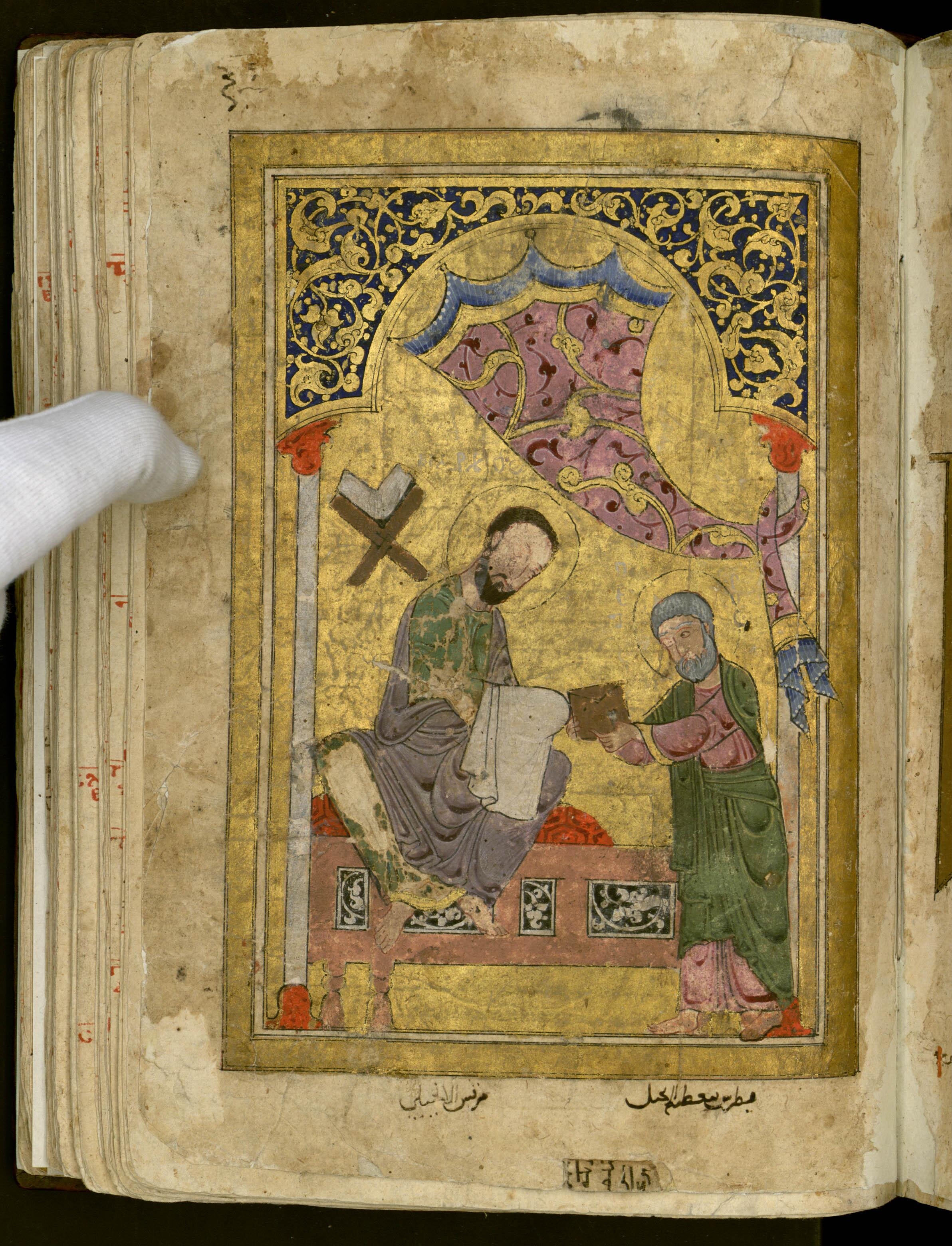
65v: Mark Receives the Gospel from Peter
fol. 65v: Mark the Evangelist Receiving the Gospel from Peter

Coptic-Arabic Portrait of Luke
fol. 105v: Portrait of Luke the Evangelist

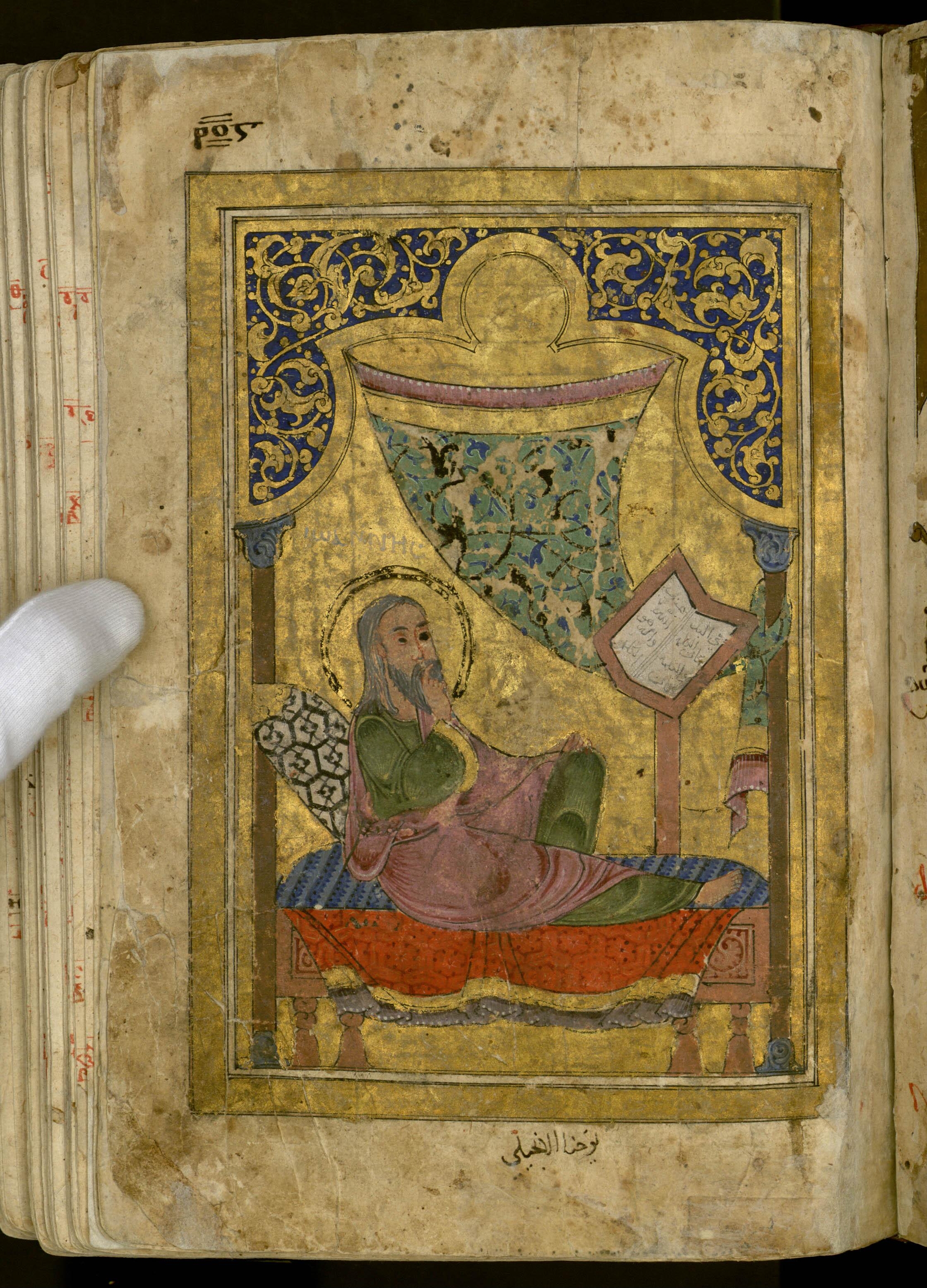
Coptic-Arabic Portrait of John
fol. 174v: Portrait of John the Evangelist

Each Evangelist is shown under a cusped arch—Matthew copying his Gospel in Arabic, Luke seated in front of a pulled-back curtain with a lotus design pattern, and John uniquely reclining, a pose adapted from secular models.

But the most interesting of the four Evangelist portraits is Mark’s, because there’s another figure with him. The owning institution labels the page “Marc l’évangéliste; Pierre lui donnant l’Evangile” (Mark the Evangelist; Peter giving him the Gospel). I had to look into this!

Traditionally, a man named John Mark is credited as the author of the Gospel that begins, “The beginning of the good news of Jesus Christ.” (It came to be called the Gospel of Mark by the end of the second century.) John Mark was a disciple of Peter, whom he is believed to have used as his primary source in composing his Gospel. The two were close companions, and Peter even refers to him as a son (1 Pet. 5:13). John Mark’s mother, Mary, hosted a house church that Peter was connected with (Acts 12:12). John Mark was also a cousin of Barnabas of Cyprus (Col. 4:10) and accompanied Paul in some of his apostolic travels (Acts 12:25; 13:1–5; 15:36–39).

Papias of Hierapolis, Irenaeus, Justin Martyr, Clement of Alexandria, Eusebius, Tertullian, and Origen—church fathers of the first two centuries of Christianity—all mention in their writings that Mark wrote his Gospels based on Peter’s eyewitness testimony and teachings. [2]

So folio 65v of Copte-Arabe 1 shows Peter passing on his intimate knowledge of Christ to Mark. As a sign of respect, Mark’s hands are covered with a cloth, ready to receive Peter’s notes.

Examining artistic precedents of this pair of men, Hunt writes:

Middle Byzantine iconographic sources can . . . be suggested for the Copte-Arabe 1 portrait of Mark with Peter (fol. 65v), which relates to the broad category of Evangelist portraiture with a second, usually inspiring figure. Mark appears seated, with Peter, who stands before him bearing the Gospel. More frequent are portraits of Peter dictating to Mark, the earliest known being that in the mutilated Greek New Testament in Baltimore (Walters Art Gallery W. 524) in which both are seated. Greek manuscripts with such portraits would have been accessible through the Syrian and Armenian communities. Two such twelfth century Gospels today in Jerusalem are the Greek Taphou 56 and the Armenian Theodore Gospels (Armenian Patr. 1796), showing the standing Peter dictating to the seated Mark. It has often been pointed out that secondary figures, either inspiring or presenting, are particularly common in Coptic and other oriental Christian art. [3]

Now let’s take a look at the narrative images. I went through them all and attempted to identify each scene as best I could (I can’t read the Arabic inscriptions), which I label in the caption along with the scripture passage it illustrates. These descriptive titles are preceded by the folio number. Note that in manuscript studies, “fol.” or “f.” stands for “folio” (page), “v” stands for “verso” (a left-hand page), and “r” stands for “recto” (a right-hand page).

All the image files are sourced from La bibliothèque numérique de l’Institut Catholique de Paris (The Digital Library of the Catholic Institute of Paris), which hosts a full scan of the manuscript. If you wish to reproduce any of the images singly, I suggest the following caption: Page from a Coptic-Arabic Gospel Book, Cairo, Egypt, 1249–50. Illuminations on parchment, 25.5 × 17.5 cm. Bibliothèque de Fels (Fels Library), Institut Catholique de Paris, Ms. Copte-Arabe 1, fol. _.

The first narrative scene in the manuscript, a header to the Gospel of Matthew, is a Nativity, with Mary reclining in the hollow of a cave and the Christ child lying swaddled beside her, adored by an ox and ass. An angel with folded hands peers reverently over a rocky outcrop, while shepherds approach from the left and magi from the right. Joseph is seated near his wife, eyeing the coming visitors.

Coptic-Arabic Nativity
fol. 2r: The Nativity (Matt. 1:25; 2:9–11; cf. Luke 2:1–7)

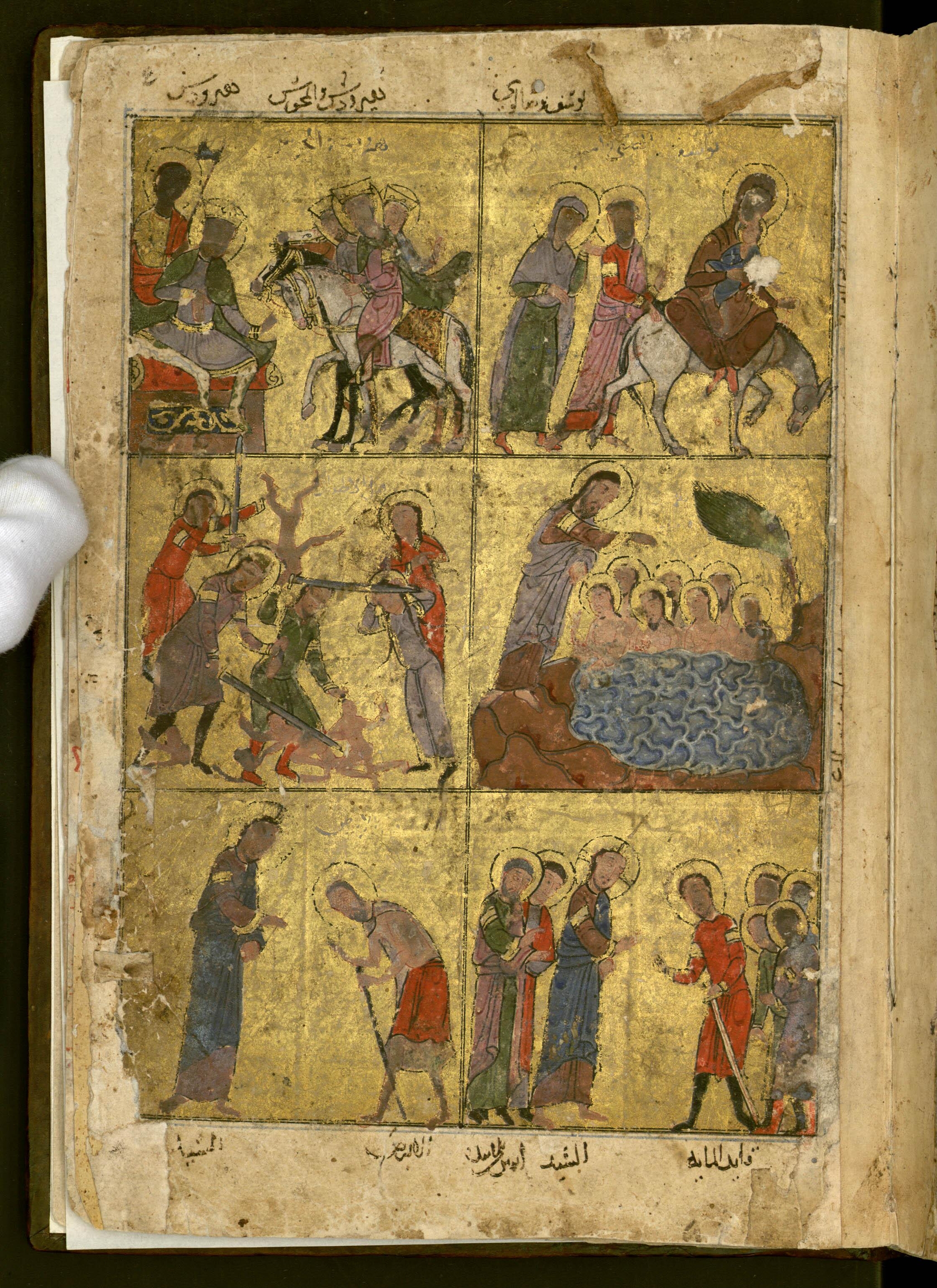
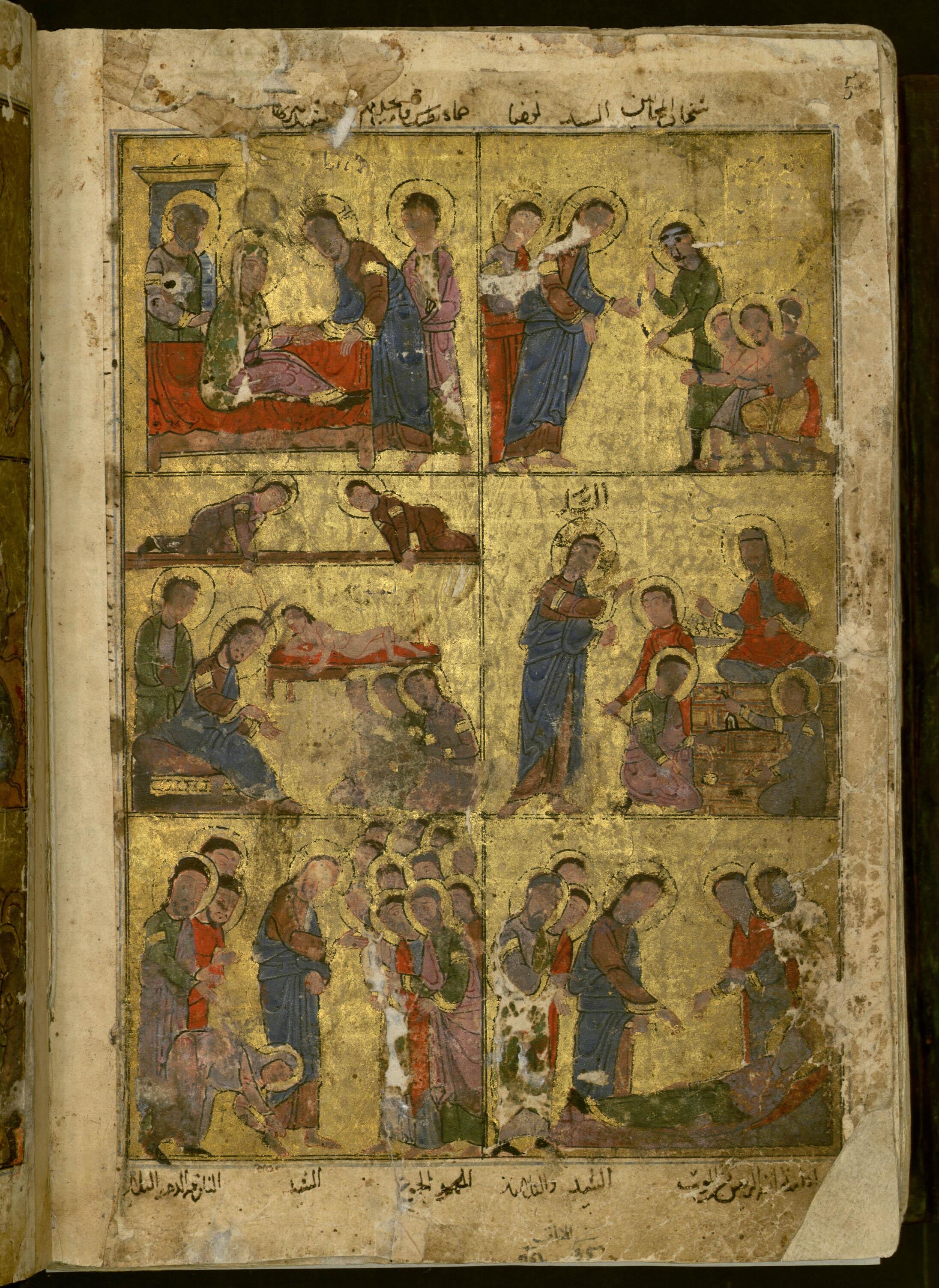
Later there follow six pages illuminating various stories from the Gospel of Matthew—the largest image sequence in the manuscript. As in the Gospels of Luke and John (there are none for Mark), these scenes are arranged on a grid system of six small squares to a page.

Coptic-Arabic illumination
fol. 4v: The Magi before Herod (Matt. 2:7–8); The Flight to Egypt (Matt. 2:13–15); The Massacre of the Innocents (Matt. 2:16–18); John the Baptist Baptizes Converts (Matt. 3:1–12); Jesus Heals a Man with Leprosy (Matt. 8:1–4); A Centurion of Capernaum Seeks Healing for His Servant (Matt. 8:5–13)

Coptic-Arabic illumination
fol. 5r: The Healing of Peter’s Mother-in-Law (Matt. 8:14–15); Jesus Restores Two Demon-Possessed Men (Matt. 8:28–24); The Healing of the Paralytic (Matt. 9:1–8); The Calling of Matthew (Matt. 9:9–13); The Healing of the Woman with the Issue of Blood (Matt. 9:20–22); The Raising of Jairus’s Daughter (Matt. 9:18–19, 23–26)

Coptic-Arabic illumination
fol. 18v: Messengers from John the Baptist (Matt. 11:2–5); The Beheading of John the Baptist (Matt. 14:1–12); The Feeding of the Multitudes (Matt. 14:13–21); The Transfiguration (Matt. 17:1–13); Jesus Heals a Demon-Possessed Boy (Matt. 17:14–20); The Mother of James and John Requests a Favor (Matt. 20:20–28)

Coptic-Arabic illumination (Passion Week)
fol. 19r: Jesus’s Disciples Fetch a Donkey (Matt. 21:1–6); Christ’s Entry into Jerusalem (Matt. 21:7–11); The Parable of the Wise and Foolish Virgins (Matt. 25:1–13); The Anointing at Bethany (Matt. 26:6–13); Jesus Washes His Disciples’ Feet (John 13:1–17); The Last Supper (Matt. 26:20–29)

From having seen other similar compositions, I know that the man holding the scroll and gesturing toward the donkey on folio 19r/1 is the prophet Zechariah, and that his scroll contains a portion of Zechariah 9:9: “Rejoice greatly, O daughter Zion! Shout aloud, O daughter Jerusalem! See, your king comes to you; triumphant and victorious is he, humble and riding on a donkey, on a colt, the foal of a donkey.”

Coptic-Arabic illumination (Passion Week)
fol. 56v: The Agony in the Garden (Matt. 26:36–46); The Kiss of Judas (Matt. 26:47–49); The Arrest of Christ (Matt. 26:50–56); Christ before Caiaphas (Matt. 26:57–66); The Denial and Repentance of Peter (Matt. 26:69–75); Christ before Pilate (Matt. 27:11–23)

Coptic-Arabic illumination (Passion Week)
fol. 57r: Judas Returns the Blood Money and Hangs Himself (Matt. 27:1–10); Pilate Washes His Hands (Matt. 27:24–26); Christ Carries His Cross (Matt. 27:31); The Crucifixion (Matt. 27:33–56); The Deposition (Matt. 27:57–59); The Entombment (Matt. 27:59–61)

Strikingly, all the figures in this manuscript are given halos around their heads, not just holy figures—for example, King Herod, antagonistic Pharisees, Judas, the Roman soldiers who arrest and taunt Jesus, and the foolish virgins. I’m not sure the reason for this; it’s possible it marks the imago Dei in each and every human, even those who oppose Christ. I welcome the input of scholars better versed in Coptic art than I.

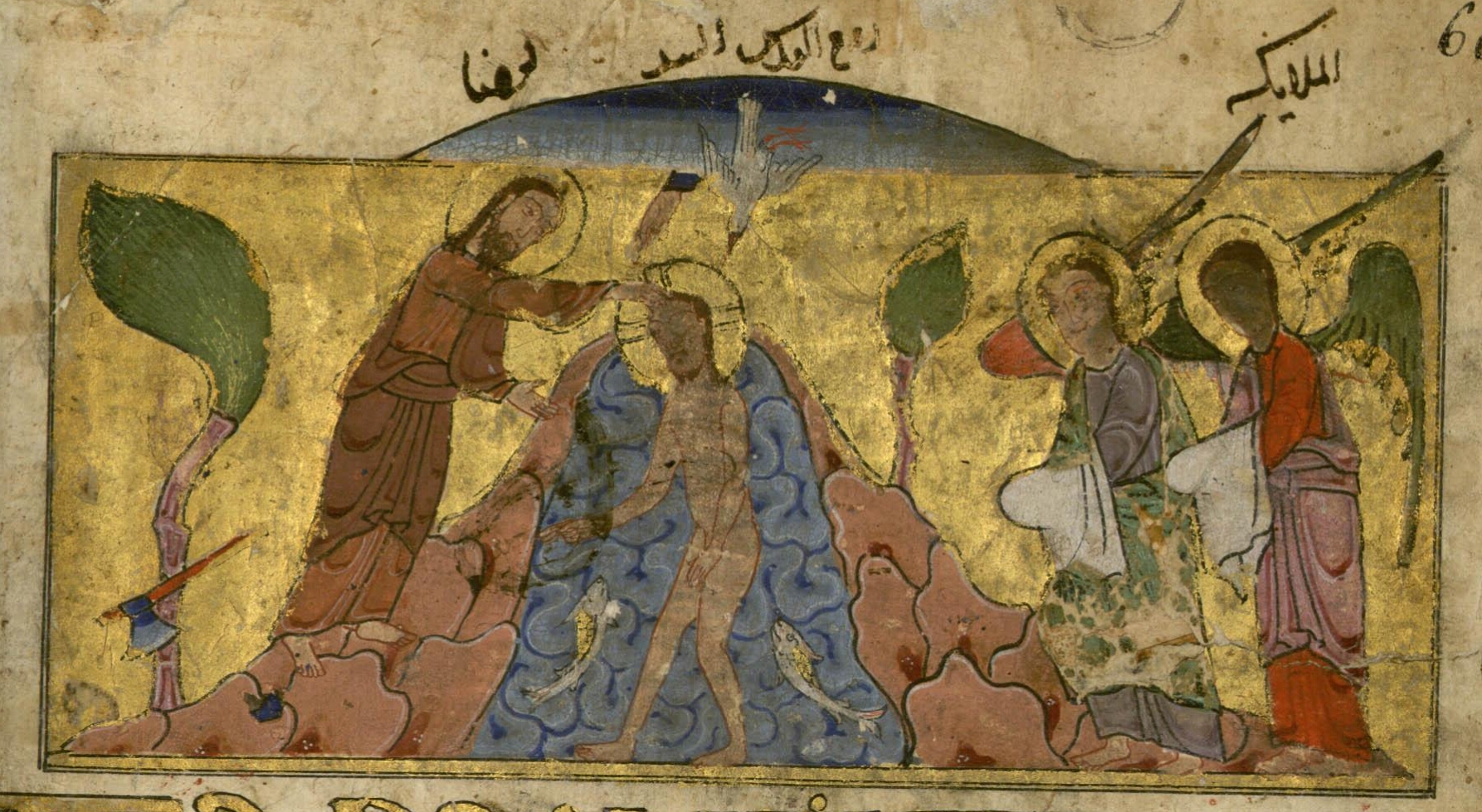
The headpiece to the Gospel of Mark portrays the Baptism of Christ. Fully nude, he is submerged in the Jordan River. John the Baptist stands on the bank and touches Christ’s head, while the hand of God the Father emerges from the heavens, pronouncing blessing over the Son, and the Holy Spirit as dove hovers above. Again, the manus velatae (veiled hands) motif appears, this time with the angels, signaling their reverence. On the left an ax cuts into the base of a tree, a reference to John the Baptist’s stark warning to the Sadducees and Pharisees who observe the baptisms: “Even now the ax is lying at the root of the trees; therefore every tree that does not bear good fruit will be cut down and thrown into the fire” (Matt. 3:10).

Coptic-Arabic Baptism of Christ
fol. 66r: The Baptism of Christ (Mark 1:9–11)

The next illumination is folio 106r, which opens the Gospel of Luke. It shows three scenes from Luke 1: the angel Gabriel announcing to the priest Zechariah that his wife, Elizabeth, will bear a son named John; Gabriel announcing to the virgin Mary that she will bear a son named Jesus; and Mary and Elizabeth rejoicing together in the unexpected news of their pregnancies and the divine deliverance they signal.

Coptic-Arabic Annunciation, Visitation
fol. 106r: The Annunciation to Zechariah (Luke 1:5–23); The Annunciation to Mary (Luke 1:26–38); The Visitation (Luke 1:39–56)

In the first full-page miniature from Luke (below), the third scene confuses me a bit. I’m fairly sure it’s supposed to be the twelve-year-old Jesus sitting among the doctors of the law in the temple at Jerusalem, as narrated in Luke 2:41–51; this episode is typically included in image cycles on the Life of Christ. But here he’s shown as a full-grown adult. The arch above the group is similar to the one shown in the previous frame where the infant Christ is presented in the temple forty days after his birth, suggesting that this is the temple, not a synagogue.

Coptic-Arabic illumination
fol. 109v: The Birth of John the Baptist (Luke 1:57–58); The Presentation in the Temple (Luke 2:22–38); Christ Disputing with the Doctors in the Temple (Luke 2:46–47); Jesus Teaching in the Synagogue at Nazareth (Luke 4:16–20); The Religious Leaders Attempt to Push Jesus Off a Cliff (Luke 4:28–30); Jesus Raises the Son of the Widow of Nain (Luke 7:11–17)

Regardless, the next episode, portrayed on folio 109v/4, is one of my favorites in Luke’s Gospel: Jesus interpreting the Isaiah scroll at his hometown synagogue, announcing himself as the long-awaited Messiah and thereby launching his ministry.

When he came to Nazareth, where he had been brought up, he went to the synagogue on the Sabbath day, as was his custom. He stood up to read, and the scroll of the prophet Isaiah was given to him. He unrolled the scroll and found the place where it was written:

The Spirit of the Lord is upon me,
    because he has anointed me
        to bring good news to the poor.
He has sent me to proclaim release to the captives
    and recovery of sight to the blind,
        to set free those who are oppressed,
to proclaim the year of the Lord’s favor.

And he rolled up the scroll, gave it back to the attendant, and sat down. The eyes of all in the synagogue were fixed on him. Then he began to say to them, “Today this scripture has been fulfilled in your hearing.” (Luke 4:16–20; cf. Isa. 61)

When asked to expound, Jesus emphasizes how God’s plan of salvation is for all people, recounting two stories from the Hebrew scriptures in which God showed favor to Gentiles—namely, the widow of Zarephath and the Syrian general Naaman. Well, this really raises the ire of his Jewish audience, who believed the Messiah should act exclusively on their behalf. The artist of Copte-Arabe 1 shows on folio 109v/5 the culmination of this contentious encounter between the up-and-coming Jewish teacher making his way through Galilee and the old guard: an attempted murder!

When they heard this, all in the synagogue were filled with rage. They got up, drove him out of the town, and led him to the brow of the hill on which their town was built, so that they might hurl him off the cliff. But he passed through the midst of them and went on his way. (Luke 4:28–30)

On the following page, in the fifth frame, the Rich Man and Lazarus is one of Jesus’s three parables depicted in the manuscript. (The other two are of the Ten Virgins and the Good Samaritan.) The artist depicts not the impoverished, sore-laden Lazarus begging outside the wealthy Dives’s door in this life, but the afterlife. Lazarus, now whole, sits comfortably in Abraham’s bosom, while Dives, who lacked mercy on earth, is denied it in hell; he languishes in flames.

Coptic-Arabic illumination
fol. 110r: Jesus Is Anointed by a Sinful Woman (Luke 7:36–50); The Parable of the Good Samaritan (Luke 10:25–37); The Healing of the Woman with a Bent Back (Luke 13:10–17); The Healing of the Man with Edema(?) (Luke 14:1–6); The Rich Man and Lazarus (Luke 16:19–31); The Healing of the Ten Lepers (Luke 17:11–19)

I’m not sure what the center right scene depicts, but given its placement in the sequence, its setting in a lavish interior, and Jesus’s clear presence at the left (as indicated by the cross in his halo; which I’d say precludes the figures being characters in a parable), my best guess is it represents the healing of the man with edema (dropsy), which takes place in the house of a prominent Pharisee.

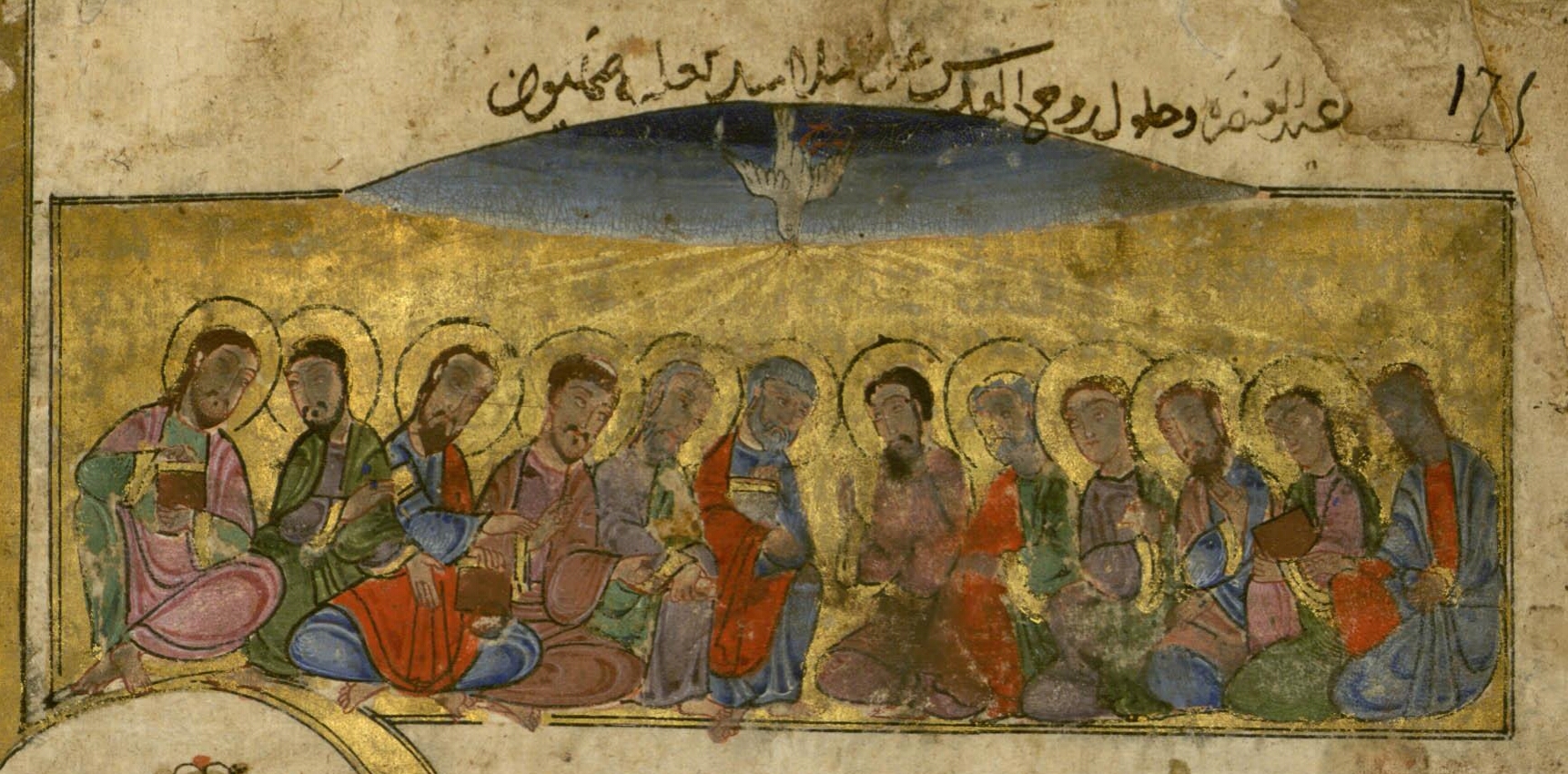
Further into the manuscript, our anonymous artist commences the fourth and final Gospel, John, with a depiction of the descent of the Holy Spirit on the apostles at Pentecost—an event described not in John’s Gospel but in the book of Acts.

Coptic-Arabic Pentecost
fol. 175r: The Descent of the Holy Spirit (Acts 2:1–13)

Coptic-Arabic illumination
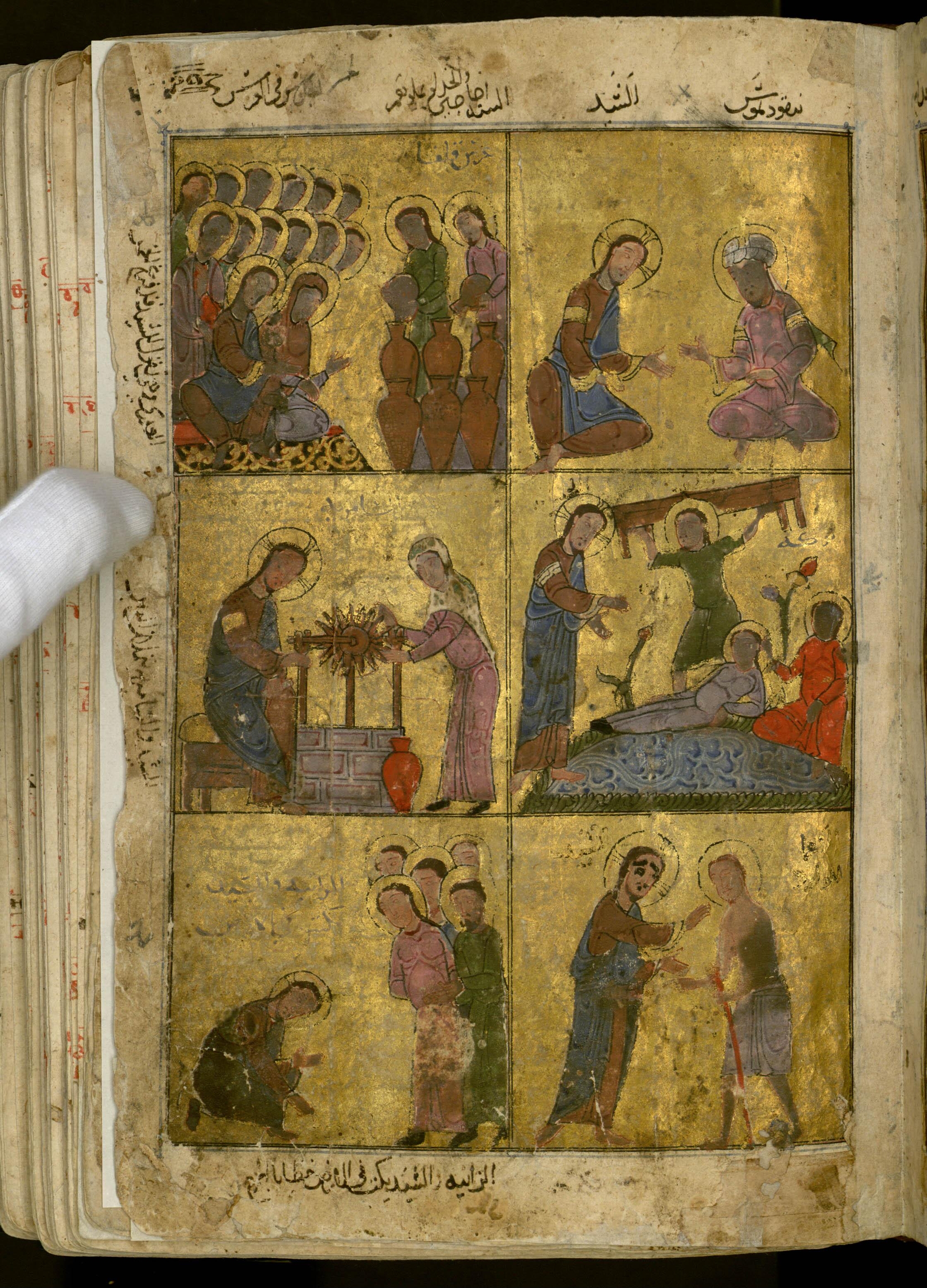
fol. 178v: The Wedding at Cana (John 2:1–12); Jesus Teaches Nicodemus (John 3:1–21); The Woman at the Well (John 4:1–26); The Healing at the Pool of Bethesda (John 5:1–15); The Woman Caught in Adultery (John 8:1–11); The Healing of the Man Born Blind (John 9:1–12)

Coptic-Arabic illumination (Resurrection)
fol. 179r: The Raising of Lazarus (John 11:1–44); The Holy Women at the Tomb (Mark 16:1–8); The Road to Emmaus (Luke 24:13–27; cf. Mark 16:12); The Incredulity of Thomas (John 20:24–29); The Miraculous Catch of Fish (John 21:1–14); The Ascension (Luke 24:50–53)

Folio 179r also contains scenes whose scriptural referents are from other Gospels: four women arriving at Christ’s empty tomb on Easter morning (John mentions only Mary Magdalene, Matthew mentions two women, Mark mentions three, and Luke speaks generally of “the women”); the risen Christ meeting two pilgrims on the road to Emmaus; and Christ’s ascent into heaven. I suppose it’s because this final full-page miniature is Resurrection-themed, so the artist harmonizes the four Gospels, pulling relevant highlights from each.


NOTES

1. Lucy-Anne Hunt, “Christian-Muslim Relations in Painting in Egypt of the Twelfth to Mid-Thirteenth Centuries: Sources of Wallpainting at Deir es-Suriani and the Illustration of the New Testament MS Paris, Copte-Arabe 1 / Cairo Bibl. 94,” Cahiers Archéologiques 33 (1985): 111–55, here 111. Reprinted in Lucy-Anne Hunt, Byzantium, Eastern Christendom and Islam: Art at the Crossroads of the Medieval Mediterranean, vol. 1 (London: Pindar, 1998): 205–81.

2. J. Warner Wallace, “Is Mark’s Gospel an Early Memoir of the Apostle Peter?,” Cold-Case Christianity, July 25, 2018.

3. Hunt, “Christian-Muslim Relations,” 129.

Christmas, Day 9: “Today the Virgin cometh unto a cave . . .”

LOOK: Nativity icon from St. Catherine’s Monastery

Coptic Nativity icon (St Catherine's)
The Nativity of Christ, Egypt, 7th century(?). Encaustic on wood. Holy Monastery of St. Catherine, Sinai, Egypt. Photo courtesy of the Michigan-Princeton-Alexandria Expeditions to Mount Sinai.

This Coptic icon of the Nativity bears all the traditional elements of Nativity icons. It shows Mary reclining in a cave next to her newborn son, Jesus, who lies in a manger, being affectionately licked by an ox and ass. Why those two animals? Because the church fathers read Isaiah 1:3 into the scene, which says, “The ox knows its owner and the donkey its master’s crib.”

The starry semicircle at the top represents the heavens. A thick beam of light descends from it onto Christ, confirming his divine paternity. On either side, from behind the grassy hills, angels rejoice, bringing glad tidings of the birth.

From the right, three magi approach with their gifts (unusually, their horses are placed apart from them in the bottom left), and in the center, a shepherd plays a pipe while his flock frolics on the grass.

In the bottom left, Joseph sits dejectedly with his head in his hands. He is being assailed once again by doubt as to Jesus’s true paternity. Could Mary’s outrageous story really be true? Or was she sexually unfaithful? In some Nativity icons Satan appears to Joseph in the guise of an old man to tempt him to distrust Mary and to doubt Jesus’s divinity. Anyone would be a fool to believe it, he taunts. It’s possible that the man with the pointed red cap at the far right of this icon is meant to be the devil on his way to Joseph, but if so, it would be an odd compositional choice. Anyway, in Nativity icons, Joseph stands for all skeptics, for those who struggle to accept that which is beyond reason, especially the incarnation of God.

Next to Joseph, two midwives bathe Jesus in a basin. (Jesus appears twice in the composition. He’s identified by the cross-shape in his halo.)

Art historian Matthew J. Milliner, who specializes in the Byzantine era, describes the Orthodox iconography of the Nativity in a 2021 podcast episode of For the Life of the World [shared previously]:

There’s just something wonderful about the classic Nativity icon. When you look at this, you’ve got Joseph in the corner. . . . And then you have this dome that is overarching the scene. That is, speaking in Charles Taylor’s terms, that’s the “immanent frame”—that’s the cosmos as we know it. And it’s shattered! By what? By the light that comes from outside. In other words, the Kantian universe has been pierced and God has revealed himself and said, “This is how I choose to come into the world.”

And there you have the Virgin Mary, and she almost looks seed-like when you look at these icons. She’s on her side because, thank you very much, she just gave birth. And there’s Christ. And the donkey and the ox are there, symbolizing both Jew and Gentile. In other words, the book of Romans in one shot. Boom. Right there.

Then you’ve got the magi sometimes off in the distance, to symbolize all corners of the earth, to symbolize most in particular the Assyrian Church of the East, the expansion of Christianity all the way to the Pacific Ocean by like the fifth century, folks. Gotta remember that! These are the Christians whom we have lost contact with. The global reality of Christianity is communicated by these icons.

And then, of course, you’ve got the shepherds to symbolize, we might even say, all classes incorporated into this faith—not just across the globe, but across socioeconomic status. All of it is communicated just by meditating upon it.

And then you have this cavern—not some sweet little stable, but a cavern, a cave. And folks, it’s the cave of your own psyche as well. It’s a depth-psychology dimension of the Christian tradition. A Nativity icon is what God wants to do in your soul. This is intended to be a spiritual experience.

The dating of the particular icon pictured above has been debated. It is circulating in many places online with an attribution of “seventh century,” perhaps in part because of its use of encaustic (a common medium for earlier icons). But Father Akakios at St. Catherine’s Monastery at Mount Sinai, the institution that owns and houses the icon, told me that’s probably too early, that it’s more likely a later icon that incorporates earlier elements.

From the Sinai Digital Archive, it appears that Kurt Weitzmann, an art historian from Princeton University who had the icon photographed on one of his four research expeditions to Sinai in the late 1950s and early ’60s, proposes the sixteenth or seventeenth century as its likely time of creation. Cathy Pense Garcia, head of Visual Resources Collections at the University of Michigan (which manages the Sinai Digital Archive jointly with Princeton), was unable to confirm an approximate date and said that more scholarly research is needed.

It’s such a wonderful icon! I hope to see some academic writing about it in the future, as my research turned up next to nothing.

LISTEN: “Kontakion of the Nativity of Christ” by Romanos the Melodist, 6th century | Chanted by Fr. Apostolos Hill, 2016

Today the Virgin cometh unto a cave to give birth to the Word who was born before all ages, begotten in a manner that defies description. Rejoice, therefore, O universe, if thou should hear and glorify with the angels and the shepherds. Glorify him who by his own will has become a newborn babe and who is our God before all ages.

(Η Παρθένος σήμερον, τον προαιώνιον Λόγον, εν σπηλαίω έρχεται, αποτεκείν απορρήτως. Χόρευε, η οικουμένη ακουτισθείσα, δόξασον, μετά Αγγέλων και των ποιμένων, βουληθέντα εποφθήναι, Παιδίον νέον, τον προ αιώνων Θεόν.)

This is the prooimoion (prologue) to Romanos the Melodist’s kontakion on the Nativity of Christ; the other twenty-four stanzas can be read in a translation by Ephrem Lash in St. Romano, On the Life of Christ: Kontakia—Chanted Sermons by the Great Sixth-Century Poet and Singer (HarperCollins, 1995).


This post is part of a daily Christmas series that goes through January 6. View all the posts here, and the accompanying Spotify playlist here.