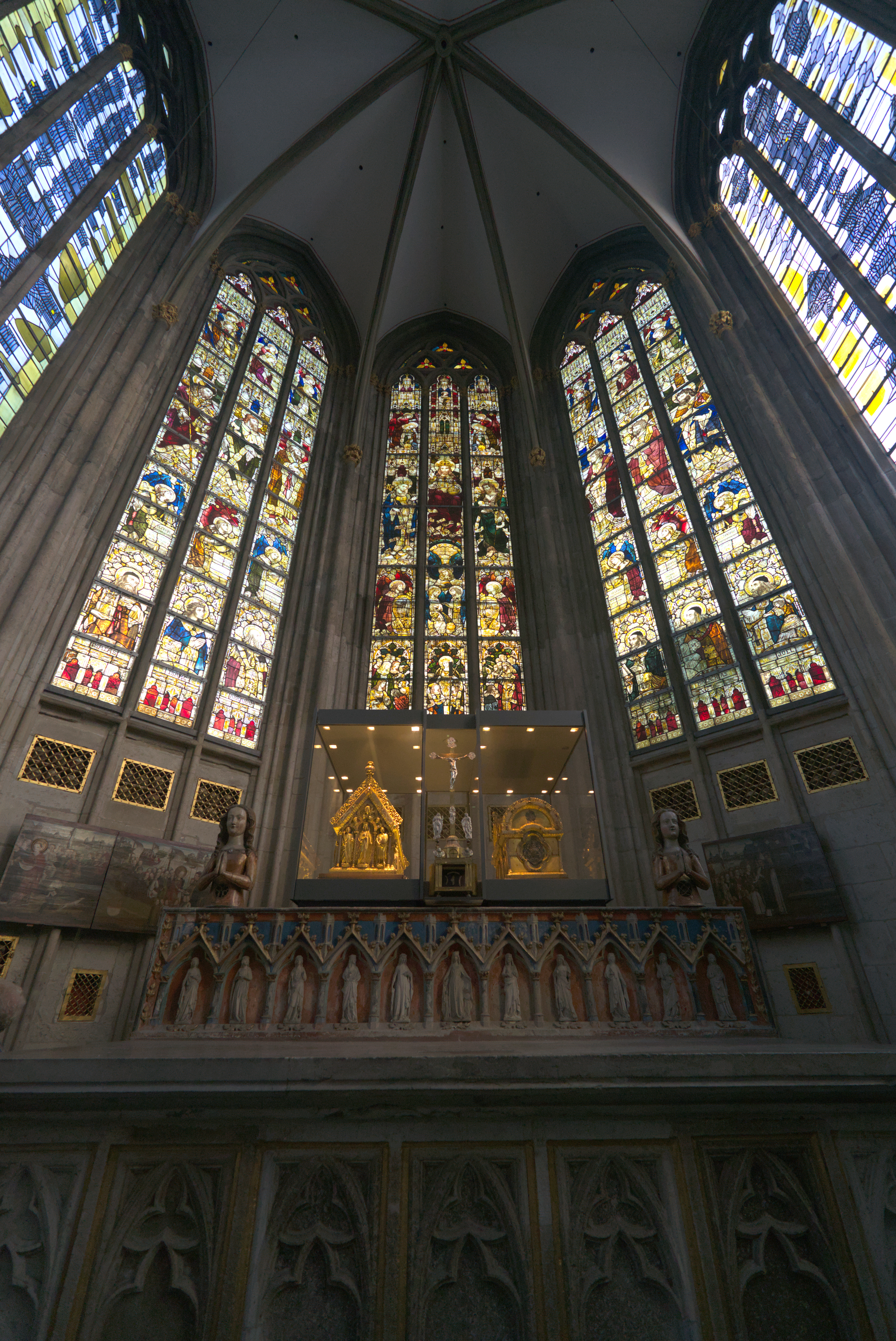
Day Trip to Würzburg, Part 1: Marienkapelle

All photos in this post are my own.

Late this August, my husband and I flew to Frankfurt, Germany, and from there traveled south, spending nine days in the state of Bavaria. I built our itinerary mainly around religious art I’d been wanting to see, an interest my husband indulges and even appreciates (just not to the same degree I do!).

Bavaria is most associated with the Baroque and Rococo art and architectural styles, which are not styles I gravitate to. I was on the lookout for medieval treasures mostly, but with an openness to surprises.

I planned for us to stop in the city of Würzburg en route from Frankfurt to Rothenburg ob der Tauber because I wanted to see a unique fifteenth-century tympanum relief in the north portal of the Roman Catholic Marienkapelle (pronounced ma-REE-en-kah-PEL-lay), or St. Mary’s Chapel, depicting one of my favorite Gospel stories. More on that below.
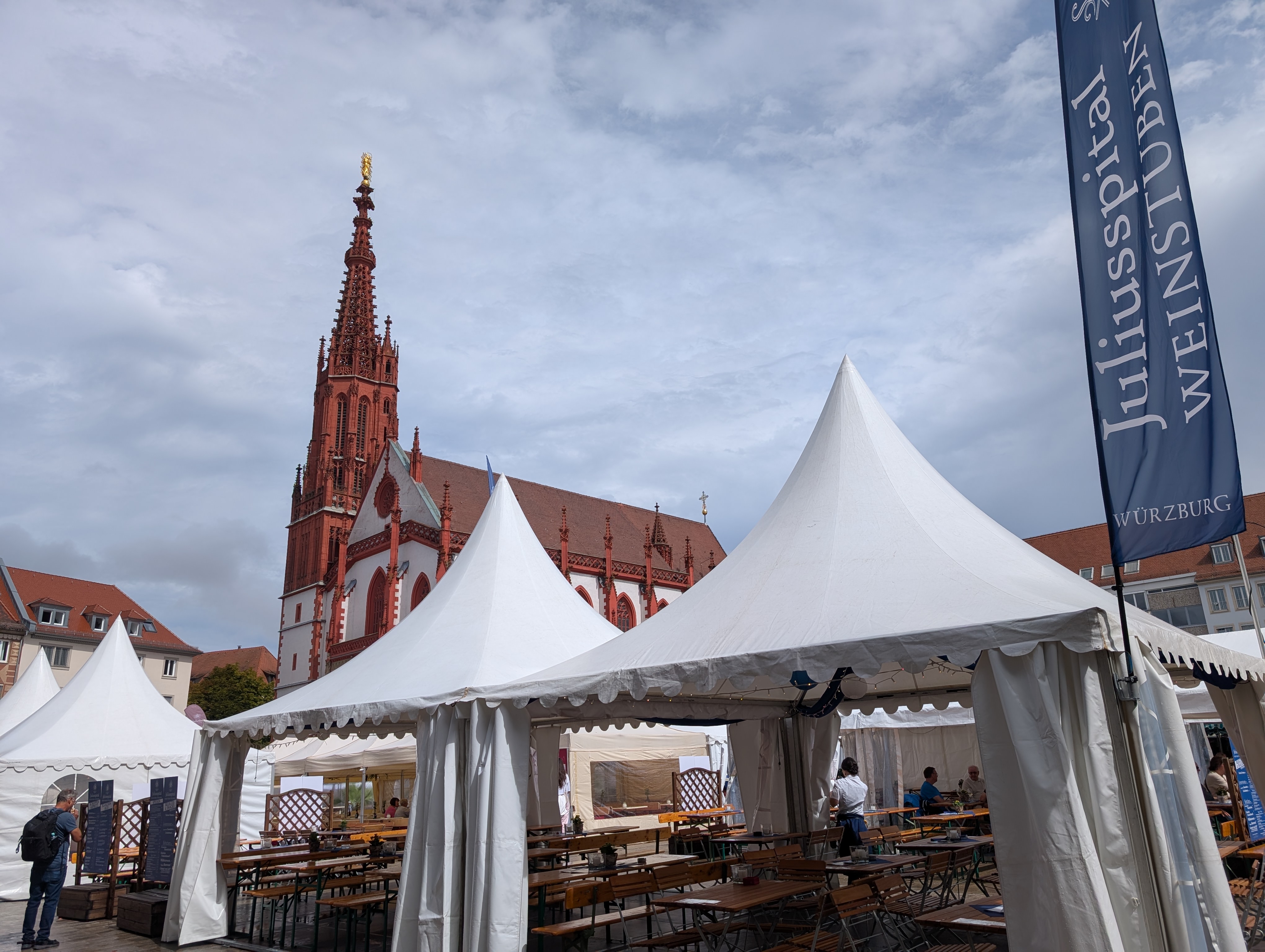
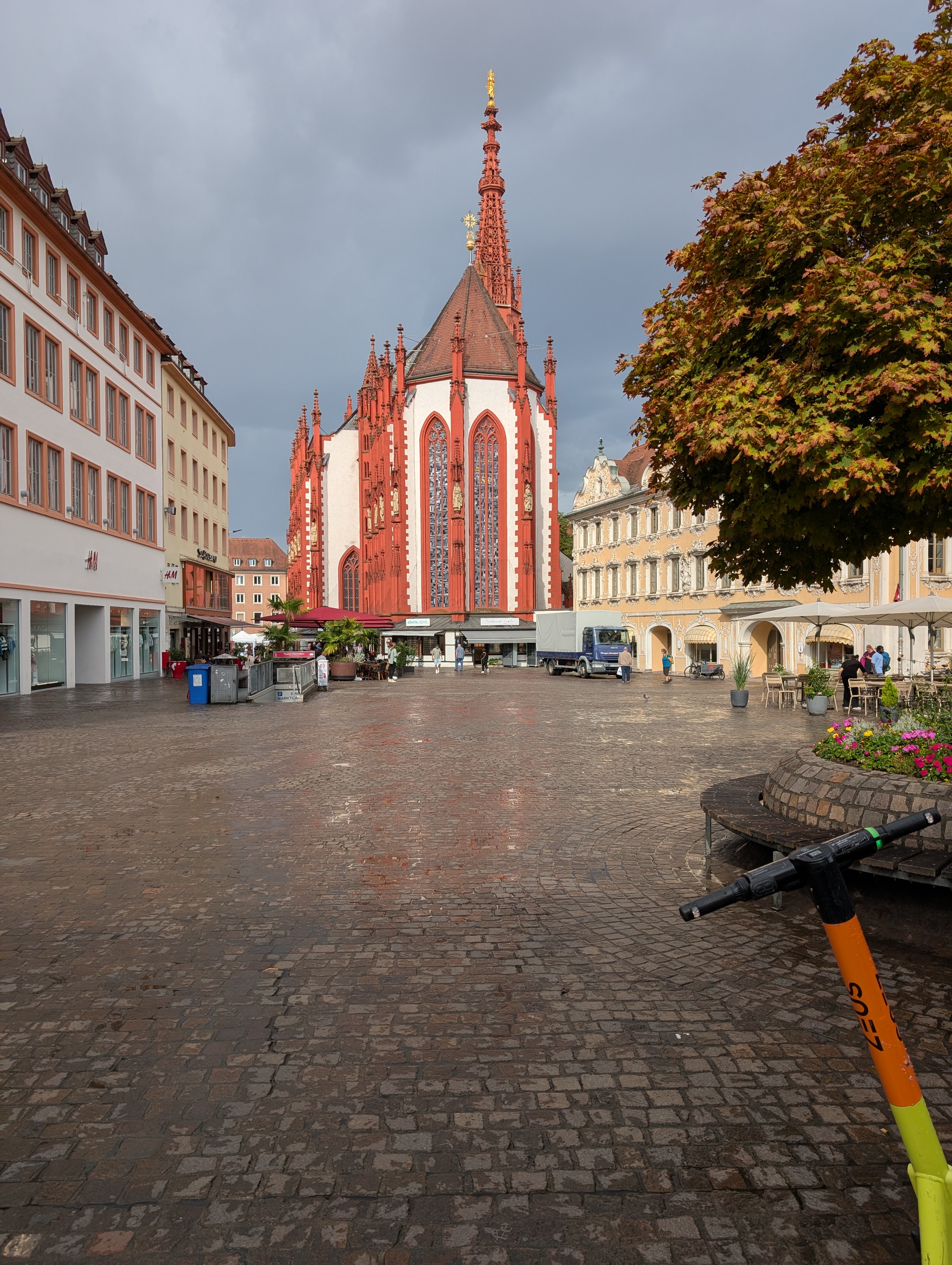
Food tents outside the Marienkapelle
Marienkapelle

Situated in the town’s Marktplatz (market square), the Marienkapelle is a Late Gothic place of worship built in the late fourteenth and fifteenth centuries. It was heavily damaged by an Allied bombing raid on March 16, 1945—the same raid that, in less than twenty minutes, destroyed 90 percent of the historic city and killed an estimated five thousand people—and was rebuilt and restored in 1948–61.

Various little “swallow shops,” selling gifts and pastries, are built into the exterior base and buttresses.

Because of the building’s size and central location, the Marienkapelle is often mistaken for Würzburg’s cathedral, but it is not: A cathedral is the official seat of a diocesan bishop, and that’s St. Kilian’s, a five-minute walk away. In fact, the Marienkapelle is not even technically a church, according to canon law, because it does not have its own independent parish. It’s legally classified as a “chapel.” However, it is a church in the loose sense of the word, as it hosts regular worship services, administered by the united parishes of St. Kilian’s and Neumünster, which we’ll visit in separate posts.

Thankfully, although the Royal Air Force incendiaries destroyed the timber-framed interior of the Marienkapelle, the heavy masonry portals and recessed entryways largely protected the medieval relief carvings on the exterior.

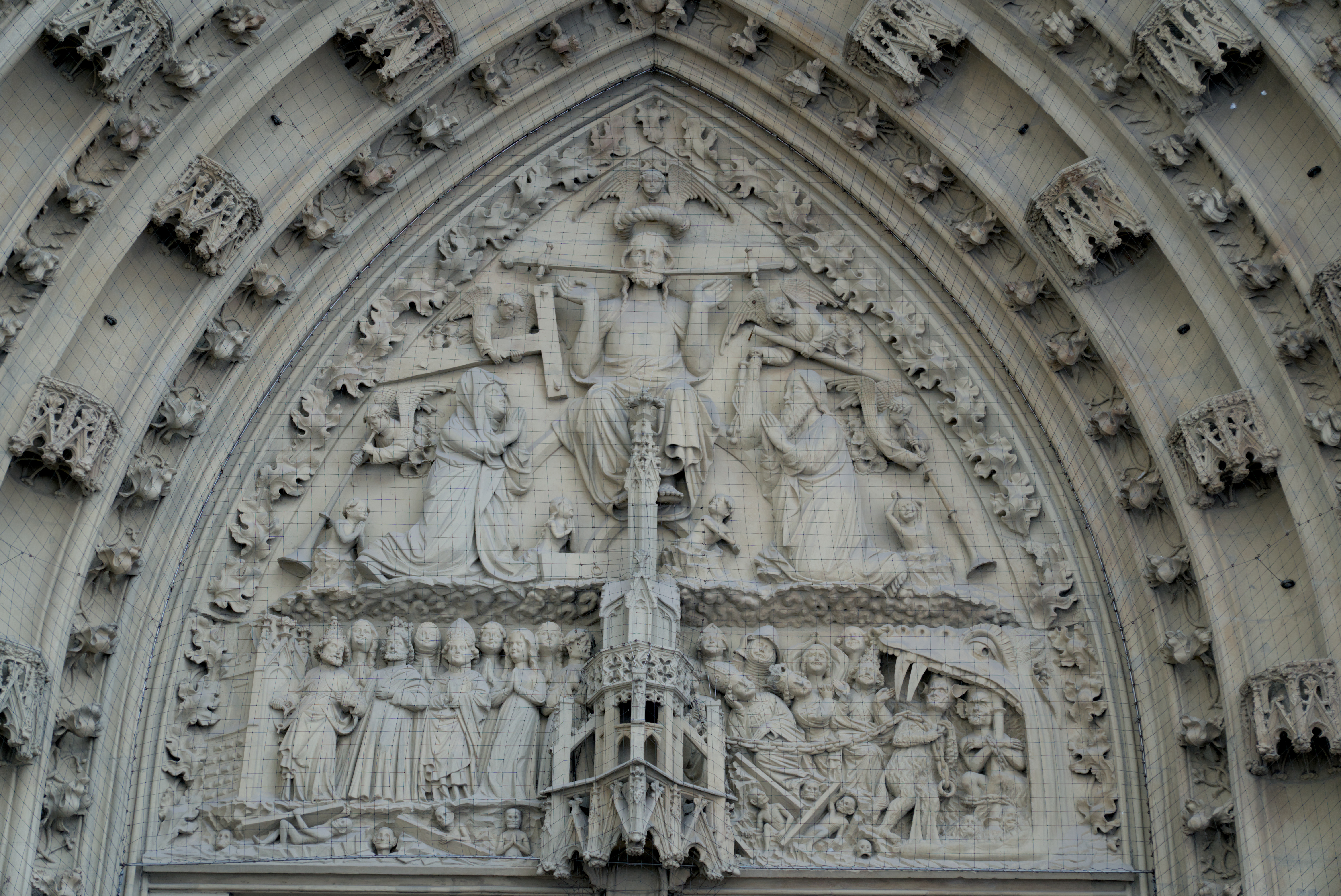
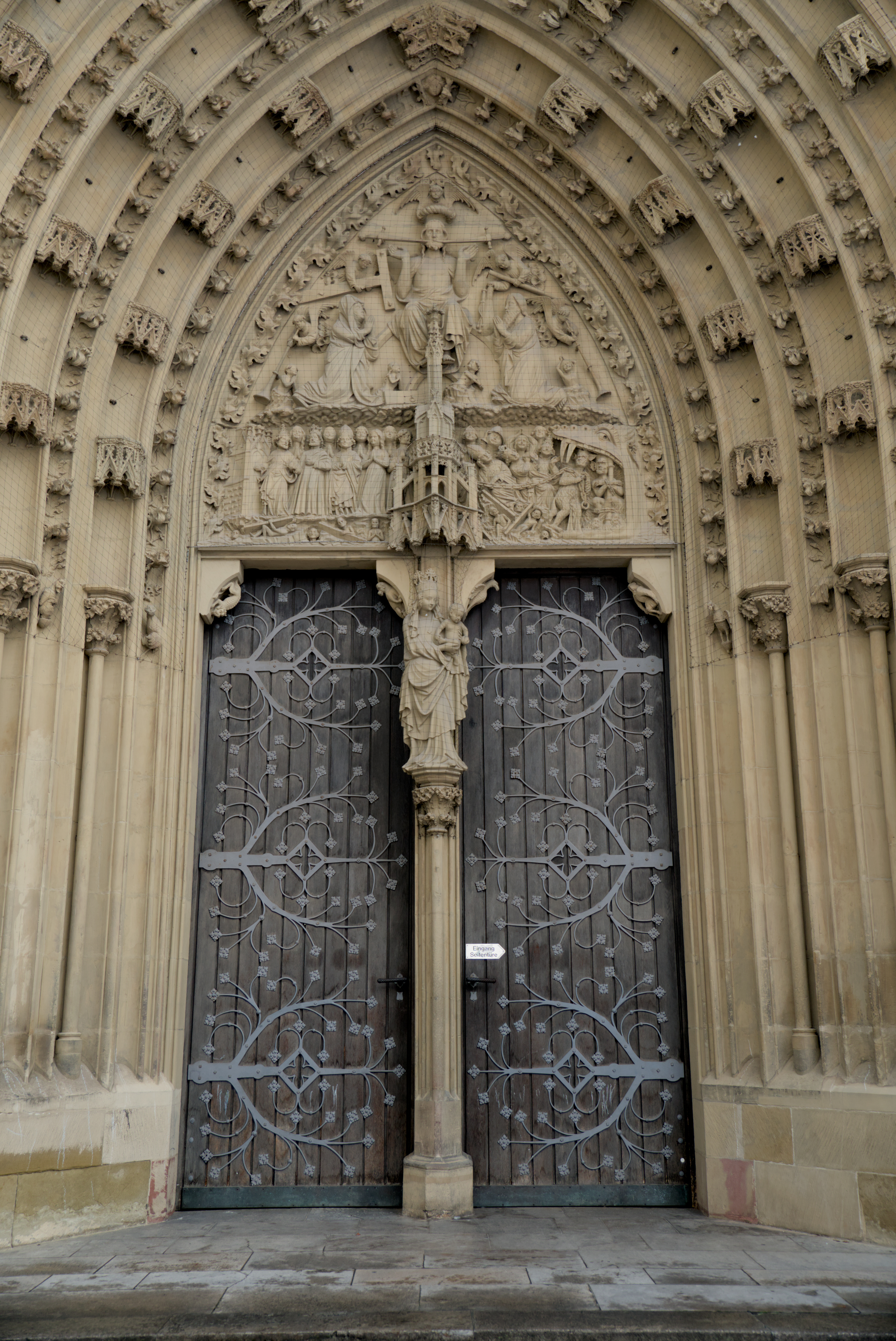
The tympanum of the main, west portal, through which you enter the chapel, portrays the Last Judgment. Jesus Christ is seated on a rainbow throne, being crowned by an angel. Drawing on Revelation 1:16 and 19:15, two swords protrude from his mouth, the one on his right a (likely mistaken) departure from traditional iconography, which has a lily instead, symbolizing mercy, which acts alongside his justice.
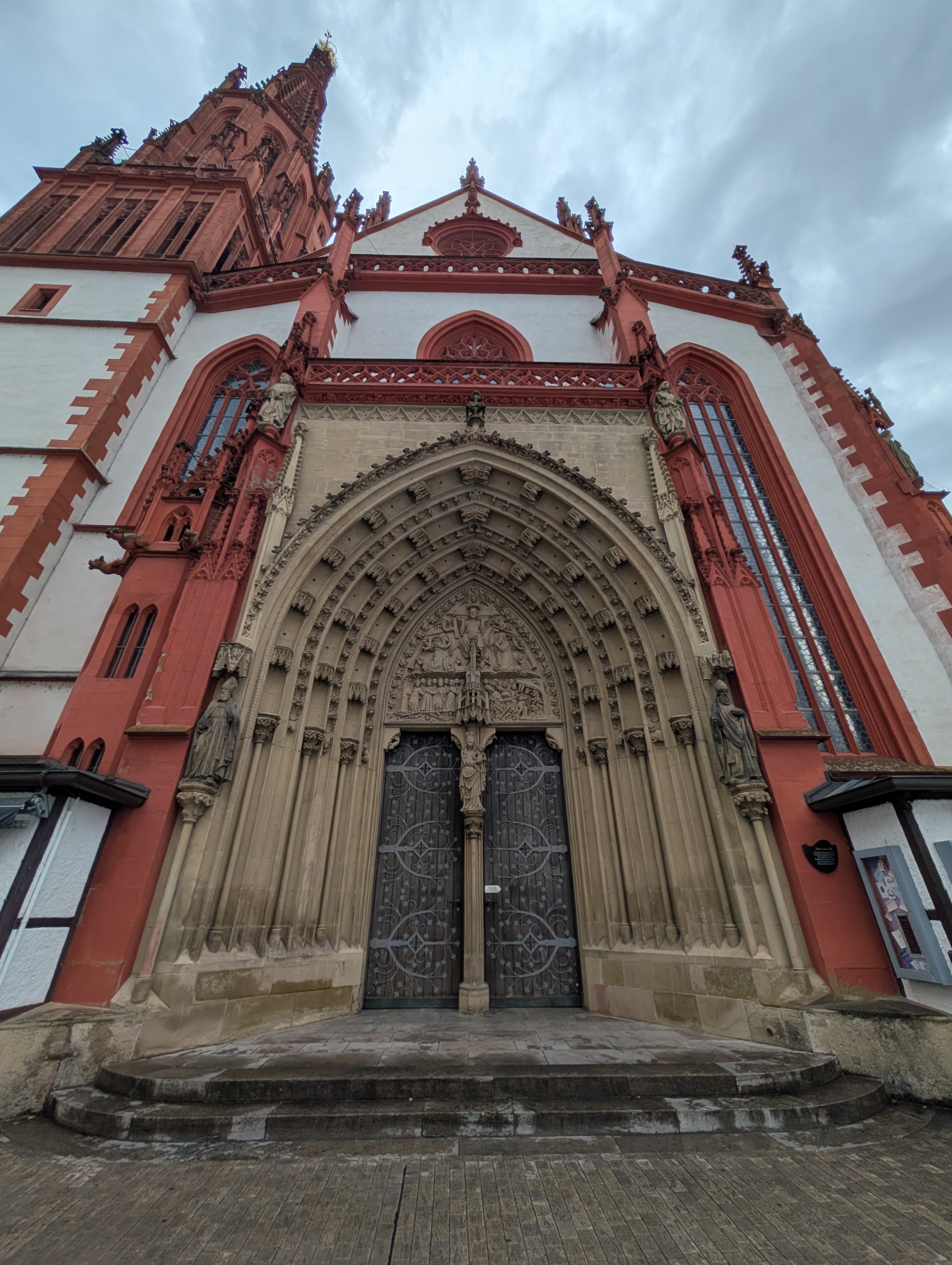
Last Judgment, west portal, Marienkapelle
Last Judgment, west portal
Last Judgment tympanum, Marienkapelle

He is flanked by angels carrying instruments of his passion—a cross, a column and whip—and two others blowing trumpets, which wakes the dead from their graves. Mother Mary and John the Baptist intercede for those rising to judgment.

On Christ’s right (our left) are the blessed, and on his left (our right) are the damned, being dragged by a hairy devil into a gaping hellmouth. Among the latter group are kings, knights, and bishops, showing that wealth and institutional status earn you no favors with God, and that outward acts of piety or noble deeds count for nothing if they proceed out of an impure heart.
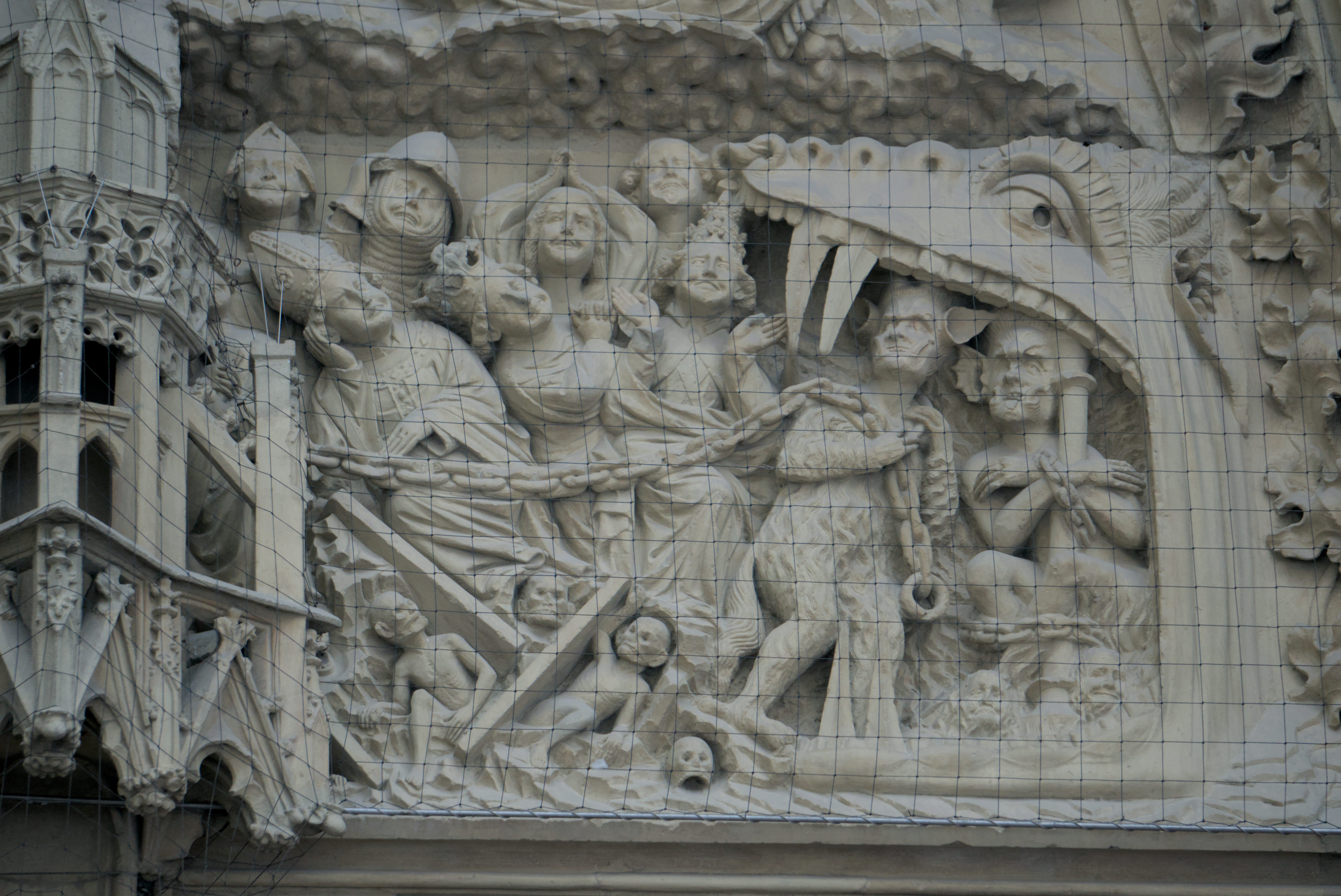
Last Judgment detail, Marienkapelle

I love the detail at the bottom of people’s skeletons taking on flesh as they push aside the lids of their coffins! This is the general resurrection, the promised reuniting of body and soul prefigured in Ezekiel 37.

On the trumeau (central pillar) of the west portal stands a copy of a stone Madonna and Child from around 1441; the original is located inside the chapel. The Christ child holds an apple.
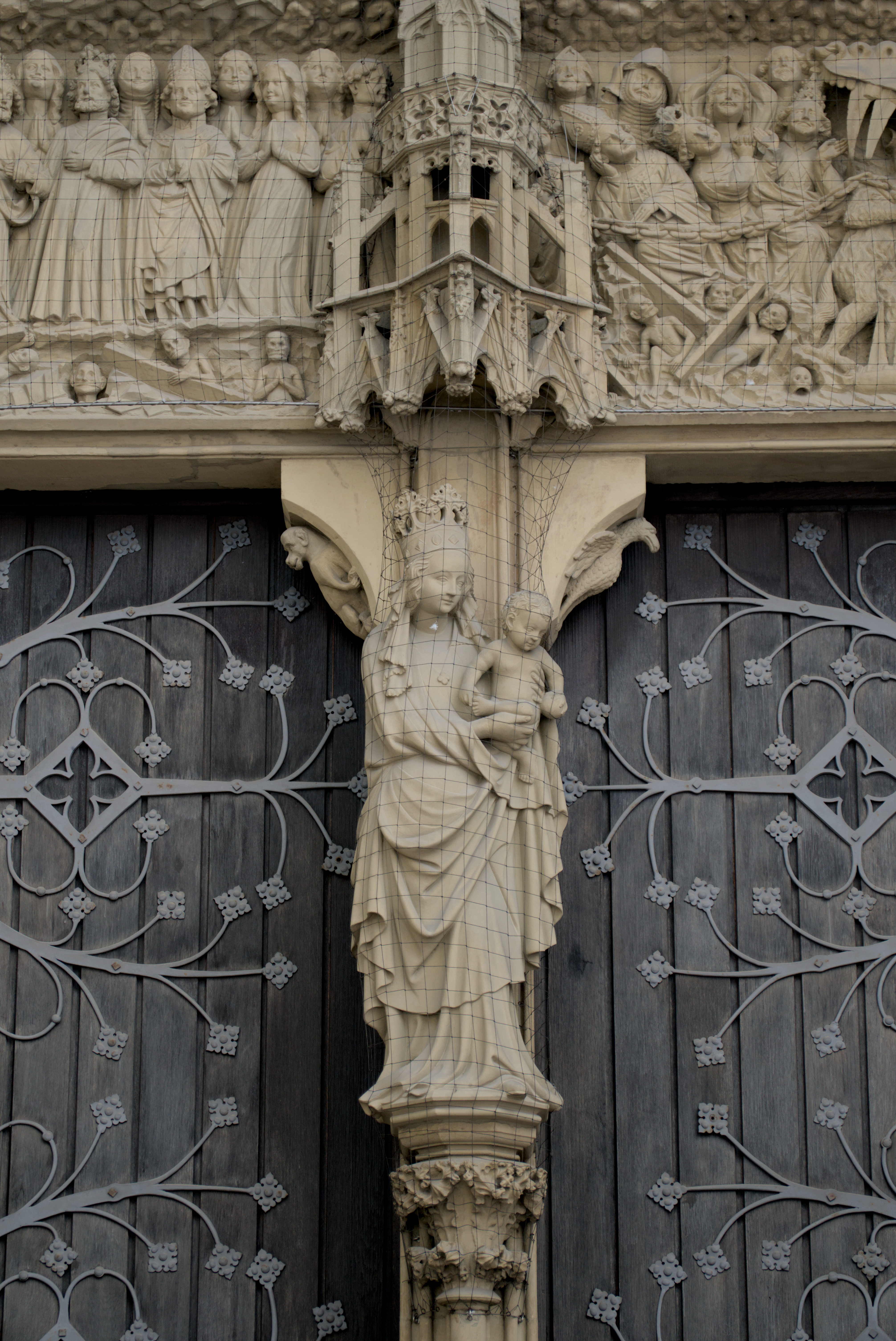
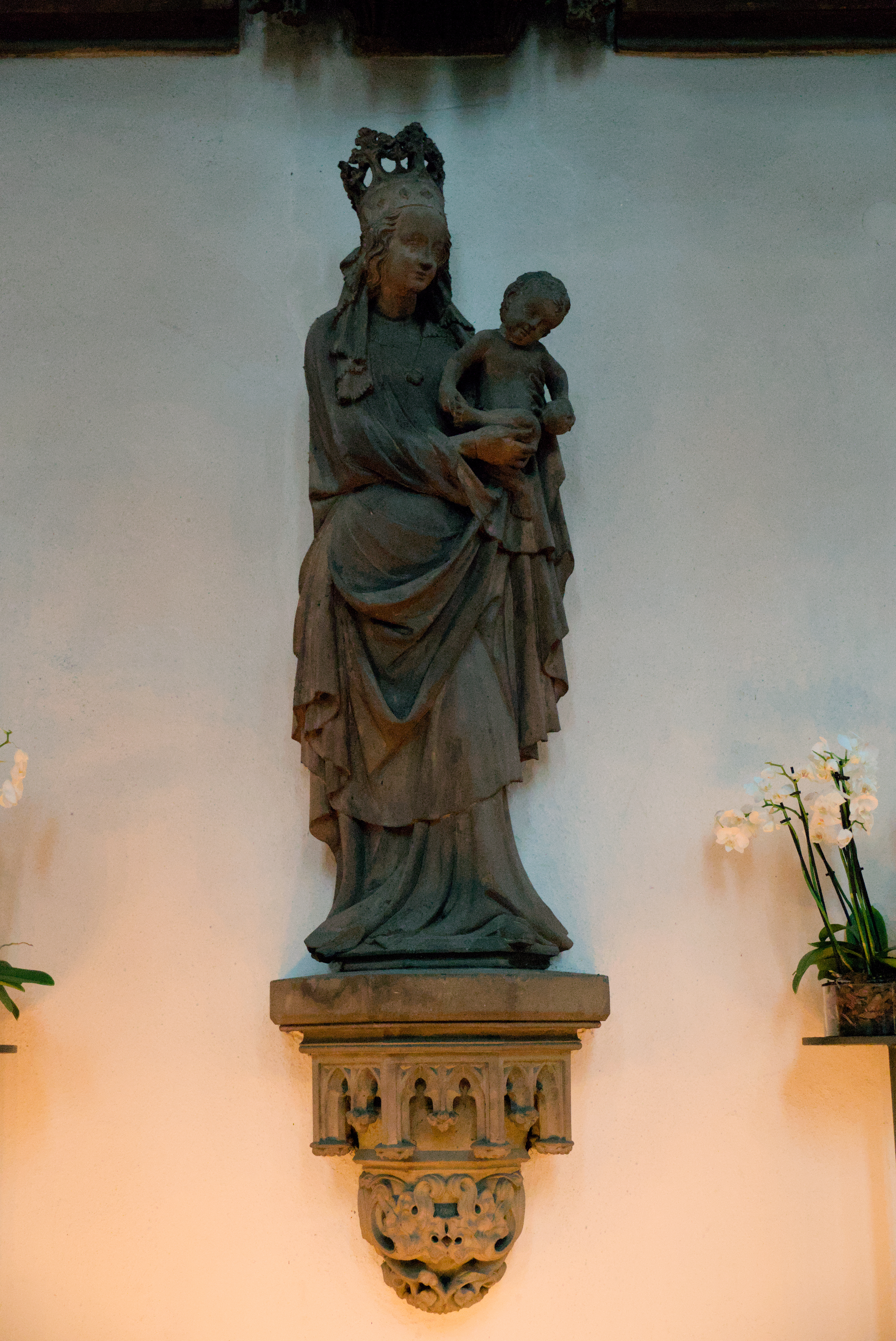
Copy: Virgin and Child, ca. 1441, from the west portal of the Marienkapelle
Madonna and Child, Marienkapelle

Another entrance to the church is on the south side.
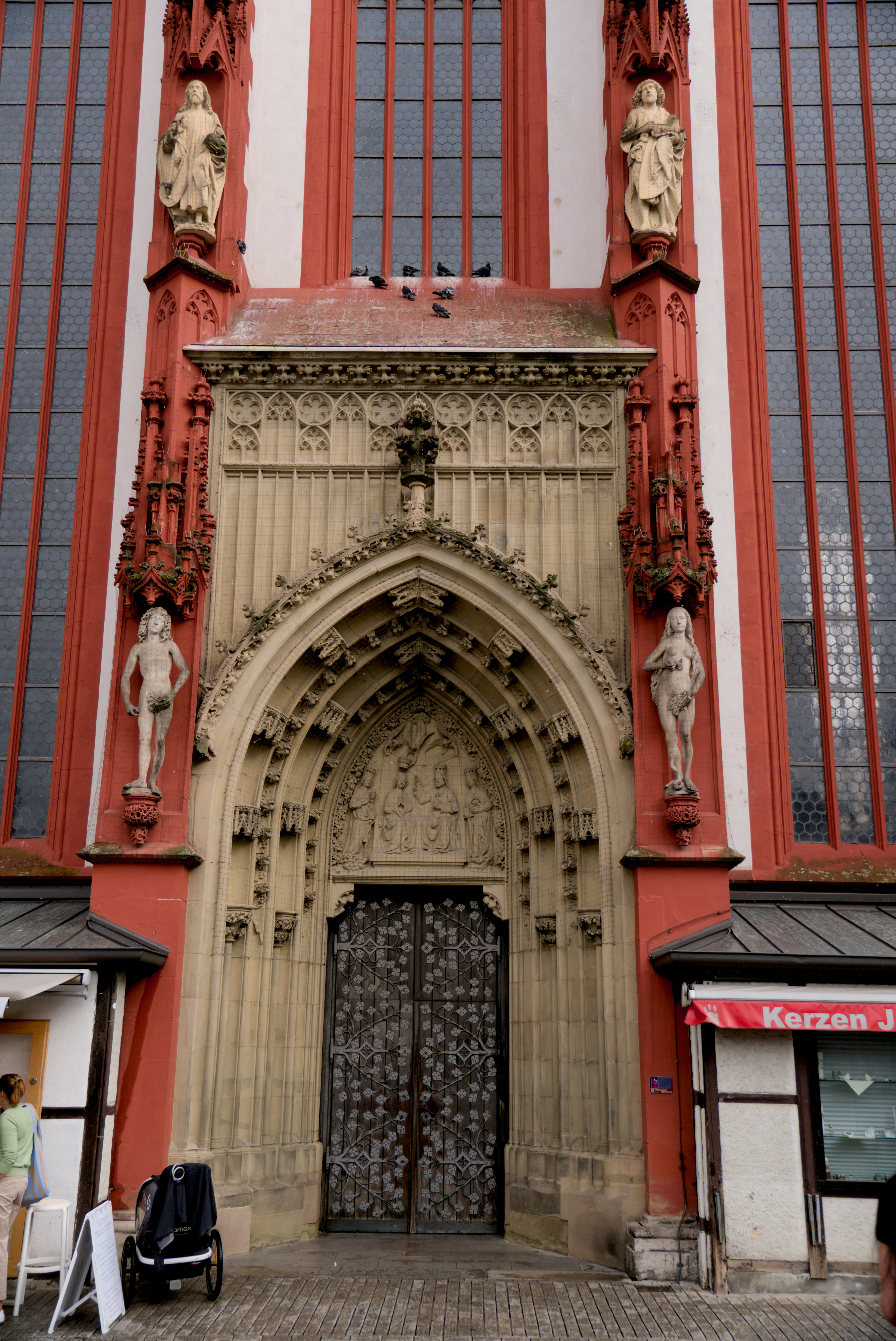
South portal, Marienkapelle

The south tympanum portrays the Coronation of Mary, an extrabiblical subject that grew out of the belief that if Jesus is the King of kings, Mary is the queen mother. To either side of them are St. Barbara, holding a chalice, and St. Catherine of Alexandria, holding the breaking wheel on which she was sentenced to be executed.
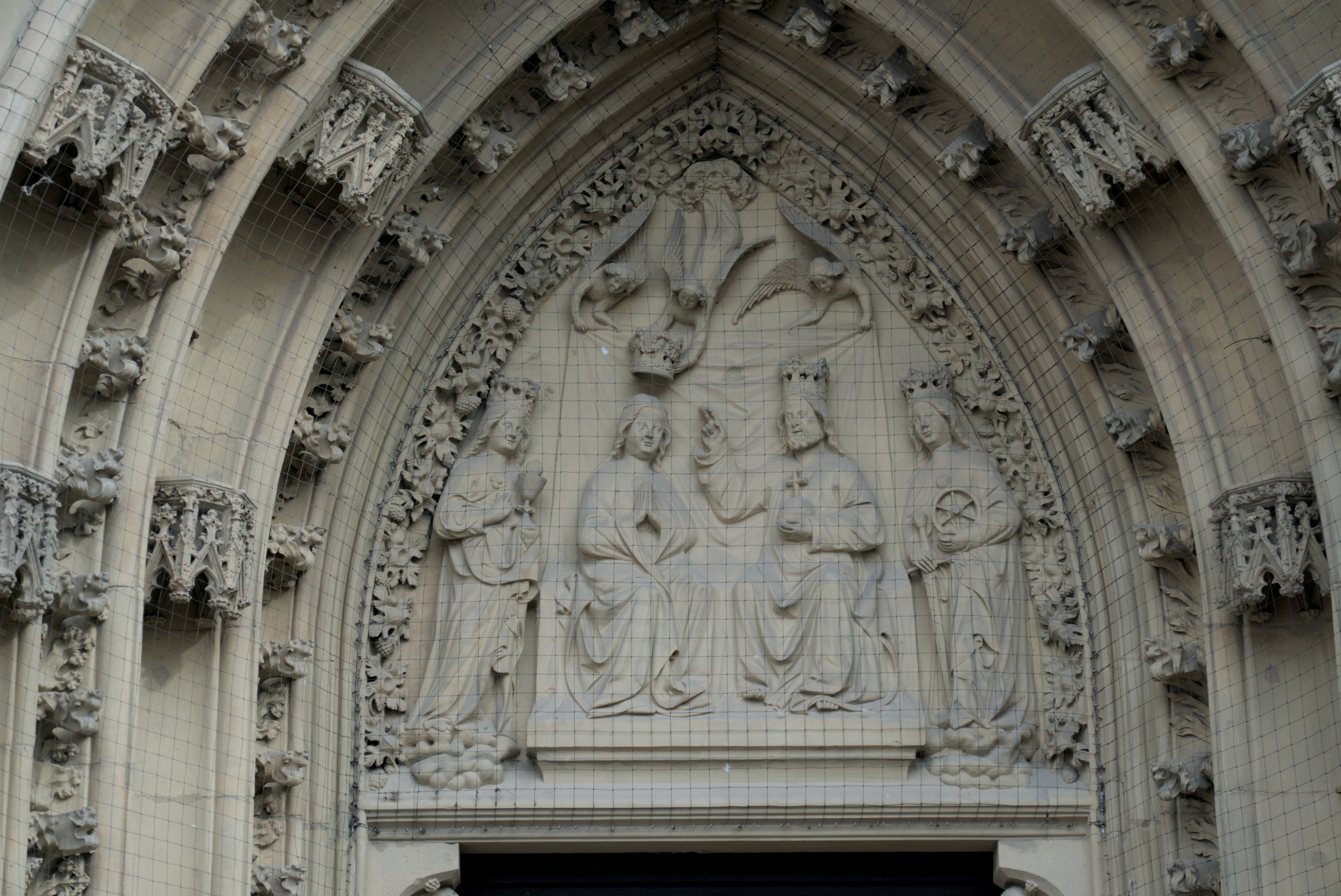
Coronation of the Virgin

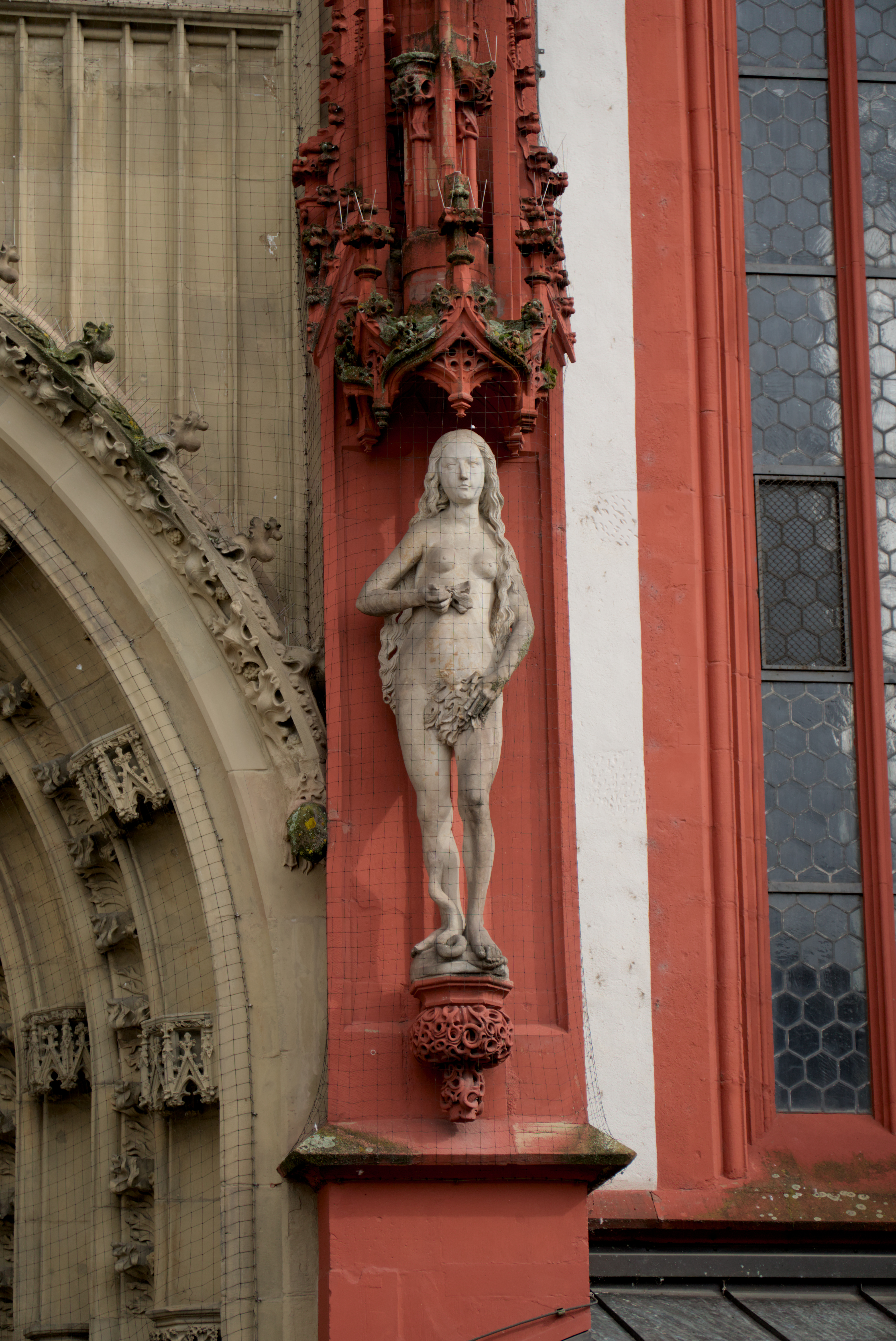
The most striking feature of the south portal is the Adam and Eve sculpture pair by the preeminent German sculptor Tilman Riemenschneider (ca. 1460–1531). Exquisite! Carved in gray sandstone, they are actually copies (all the freestanding sculptures on the exterior are); the originals, from 1493, are in the Museum für Franken, also in Würzburg—which I’ll share about in part 4. Adam and Eve stand on plinths decorated with foliage, sheltered under tabernacles (tower-like crowning structures).
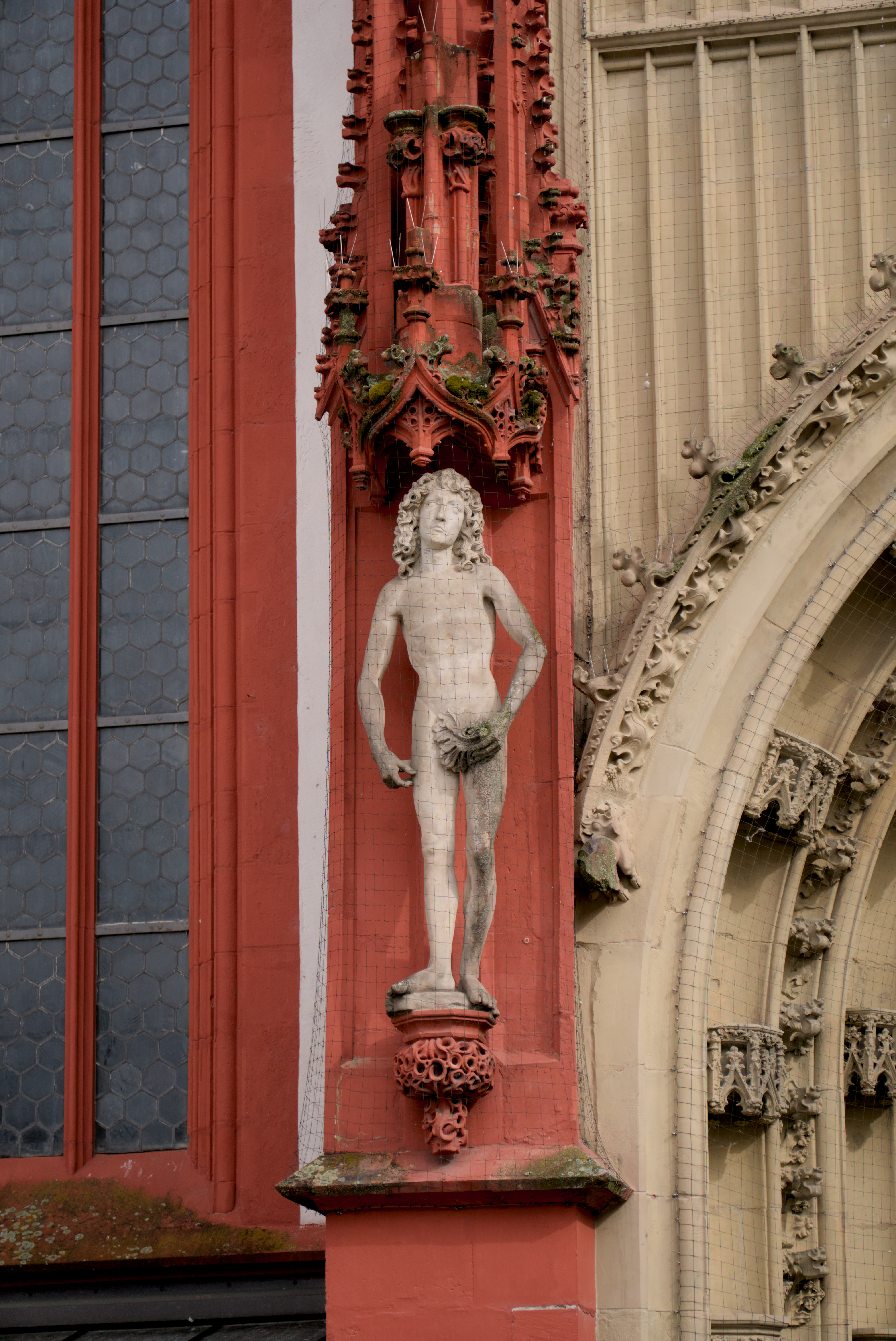
Adam, Marienkapelle
Eve, Marienkapelle

In addition to these, Riemenschneider and his workshop supplied sculptures of the twelve apostles for the buttresses, and of Christ and John the Baptist, who are situated above Adam and Eve. Christ, as Salvator Mundi, holds a globe, and John the Baptist holds a lamb, a symbol of the self-sacrificial Christ, who takes away the sin of the world.
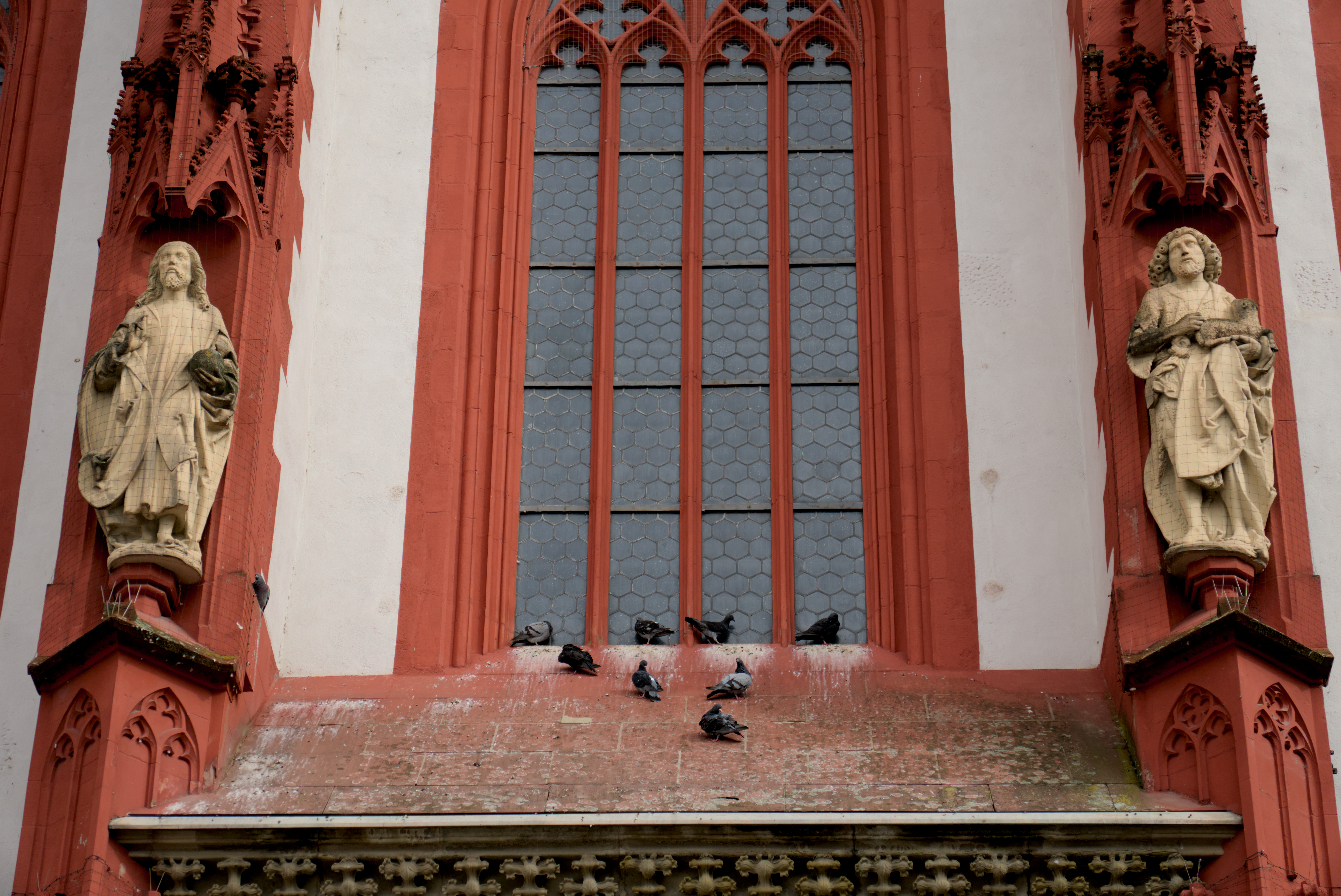
Jesus Christ and St. John the Baptist

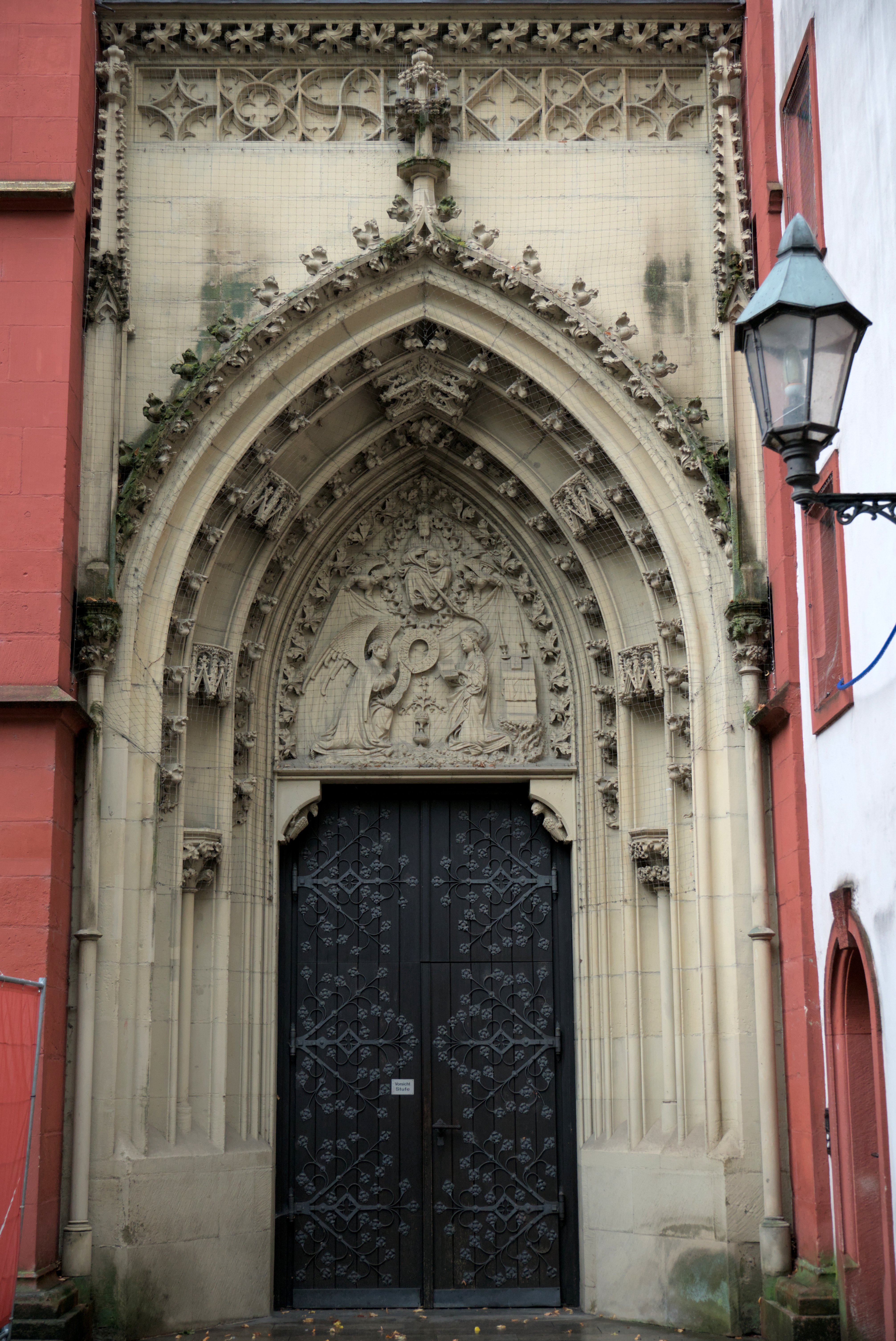
But now, what I consider the most thrilling artwork at the Marienkapelle, immensely amusing, is the Annunciation tympanum in the north portal, carved around 1430.

It’s in the least prominent of all three portals, tucked away off the main square, next to, when I was there, a fence banner advertising a local wine festival. No one was stopping to look at it.
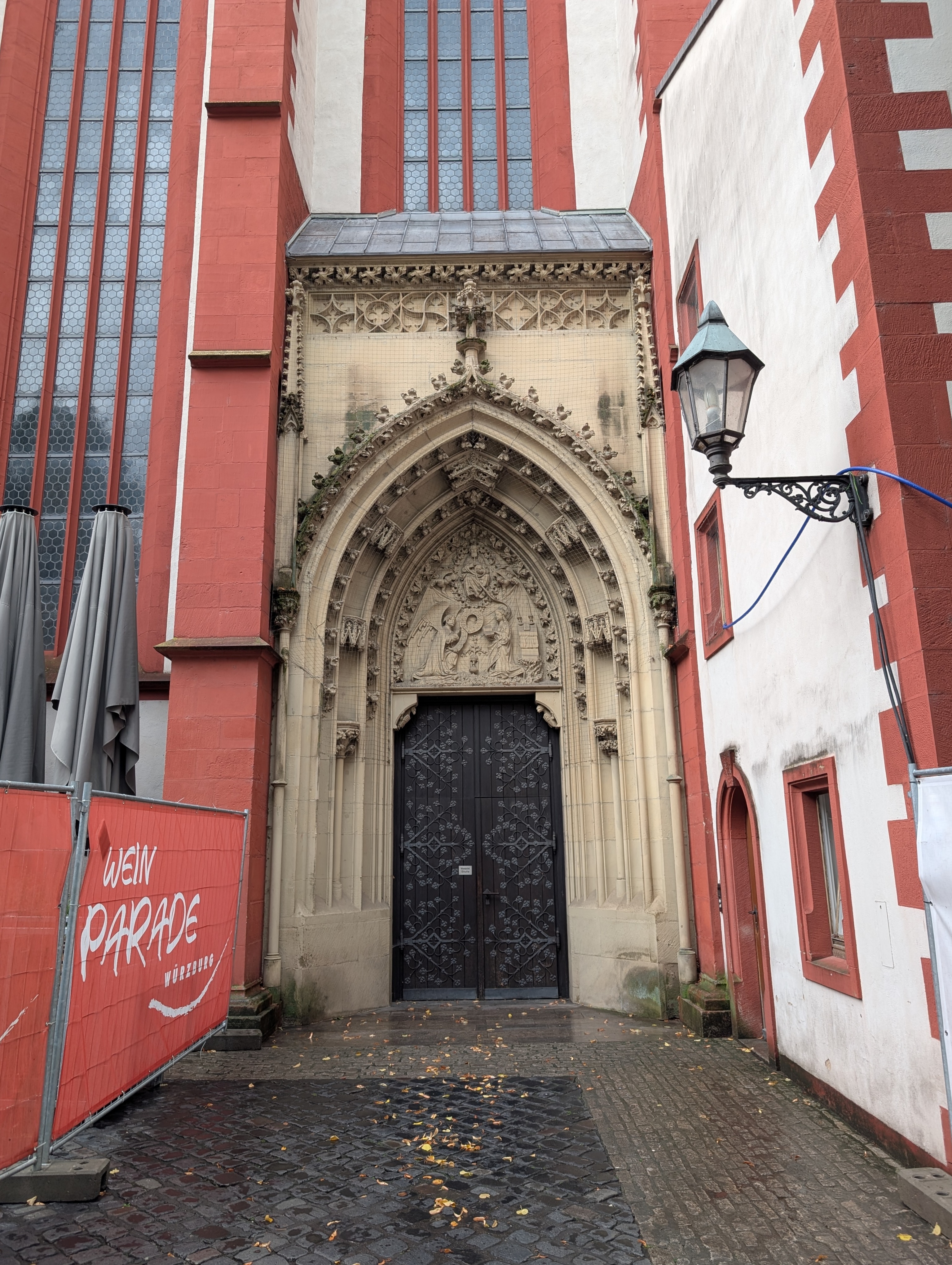
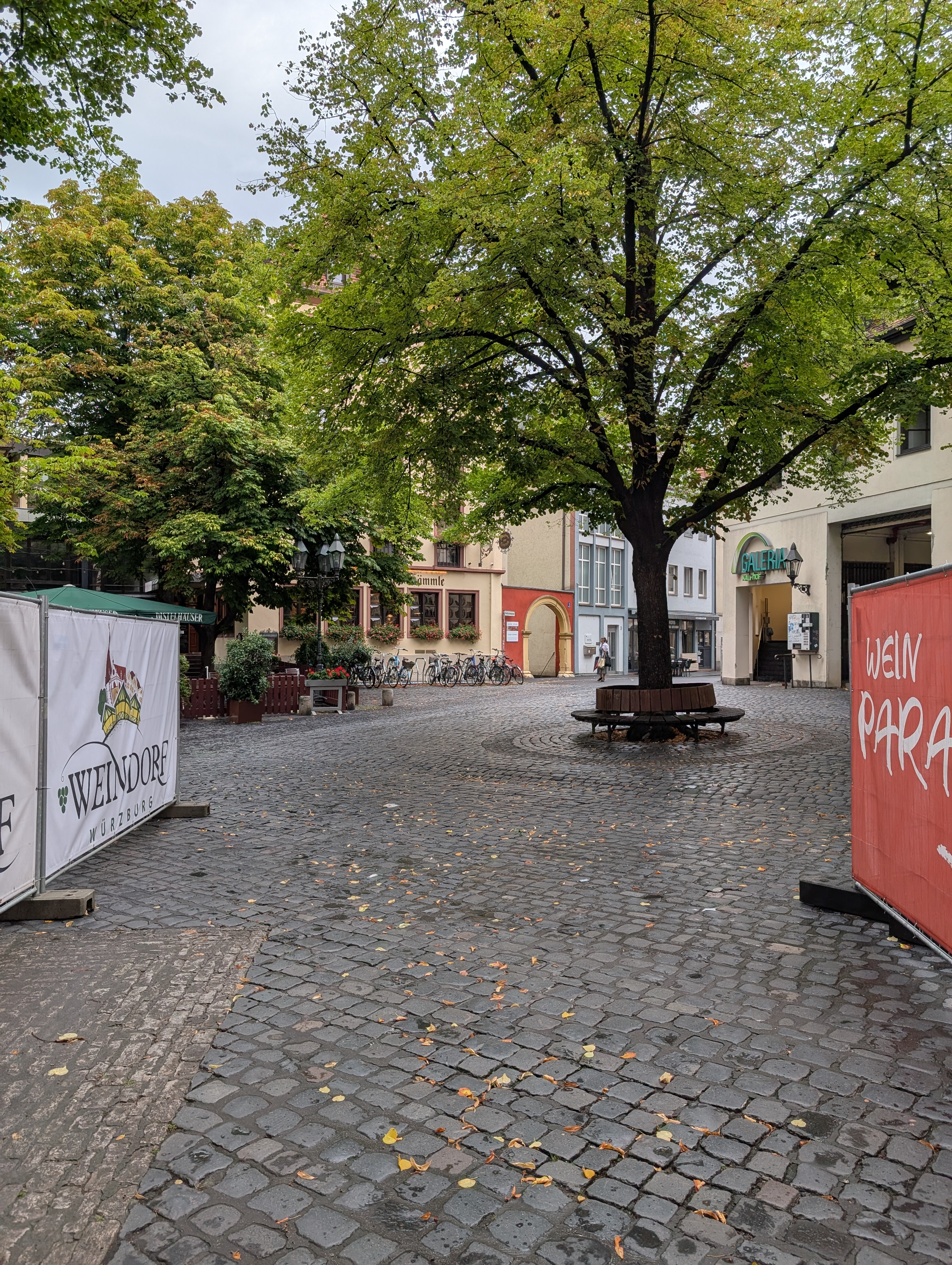
Annunciation portal, Marienkapelle
View from the west portal
View from the north portal

Annunciation, north portal, Marienkapelle

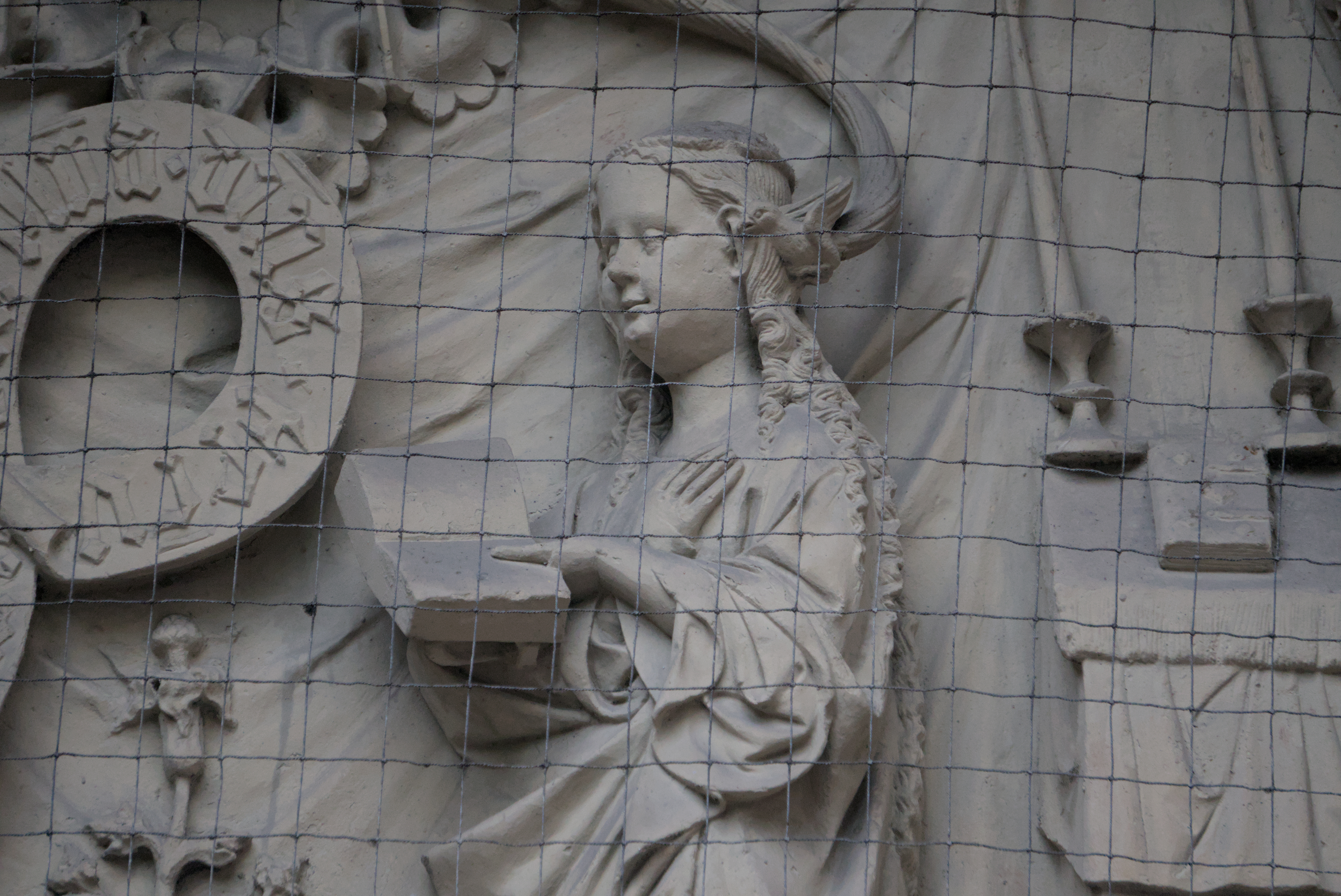
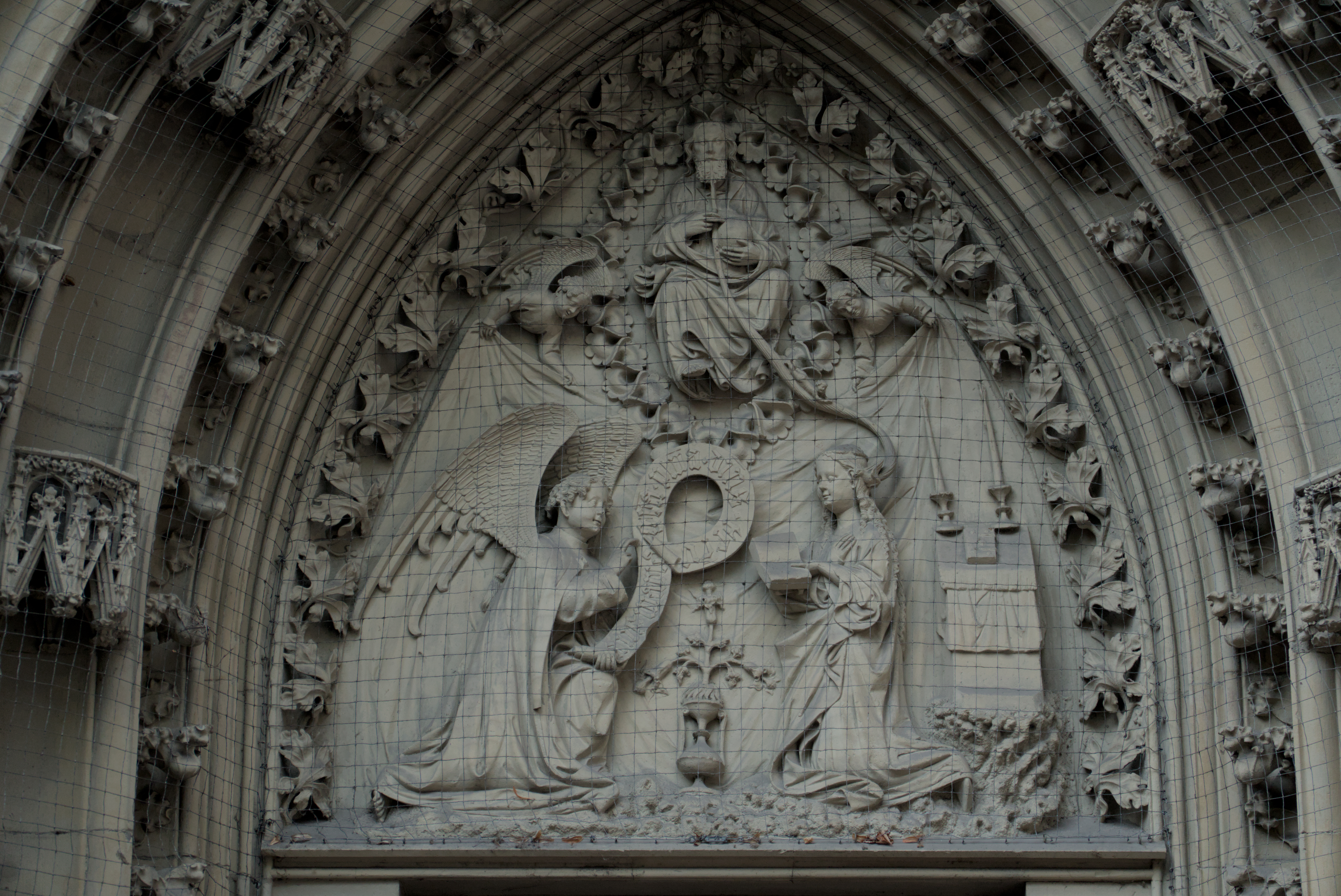
But I knew to search it out—this peculiar carving that visualizes the theological idea, introduced in the fourth century and solidified in the fifth, that Mary conceived Jesus through her sense of hearing. Known as the conceptio per aurem, this teaching stems from a typological connection between Eve and Mary: Whereas Eve listened to the serpent’s lies and conceived death, Mary listened to the angel’s truth and conceived life. The teaching presents Mary as a model of attentive listening to God’s word, which produces fruit; for receiving it into ourselves, bearing it about. It also serves to desexualize the encounter between Mary and Gabriel, focusing attention away from Mary’s genital region and onto her head.
Annunciation tympanum, Marienkapelle

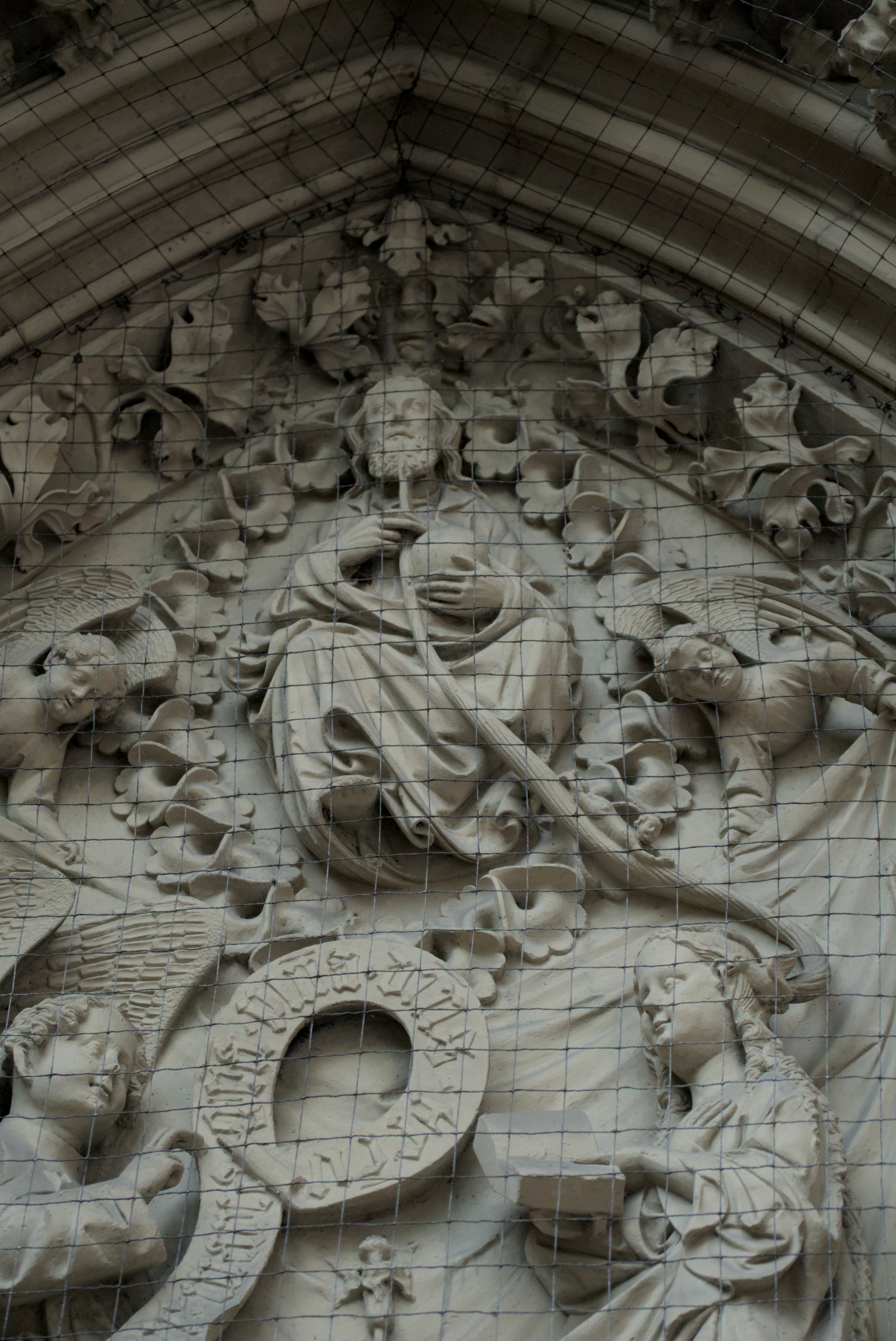
Look at how this artist visualizes the conception by ear! God the Father sits at the top center inside a flowery mandorla, blowing into a serpentine tube that’s attached to Mary’s ear. As he does, a gleefully naked infant Christ glides down the tube on his belly like it’s a waterslide—only it’s not water that’s propelling him; it’s the Father’s breath.

Journeying down this transdimensional slide, he twists and turns and plunges right into his chosen mother’s open auditory canal, where the Holy Spirit as dove enunciates a sacred whisper: “You will conceive in your womb and bear a son, and you will name him Jesus . . .” All three persons of the Trinity are present at this moment—their number echoed by the three-branched lily in the vase on the floor.
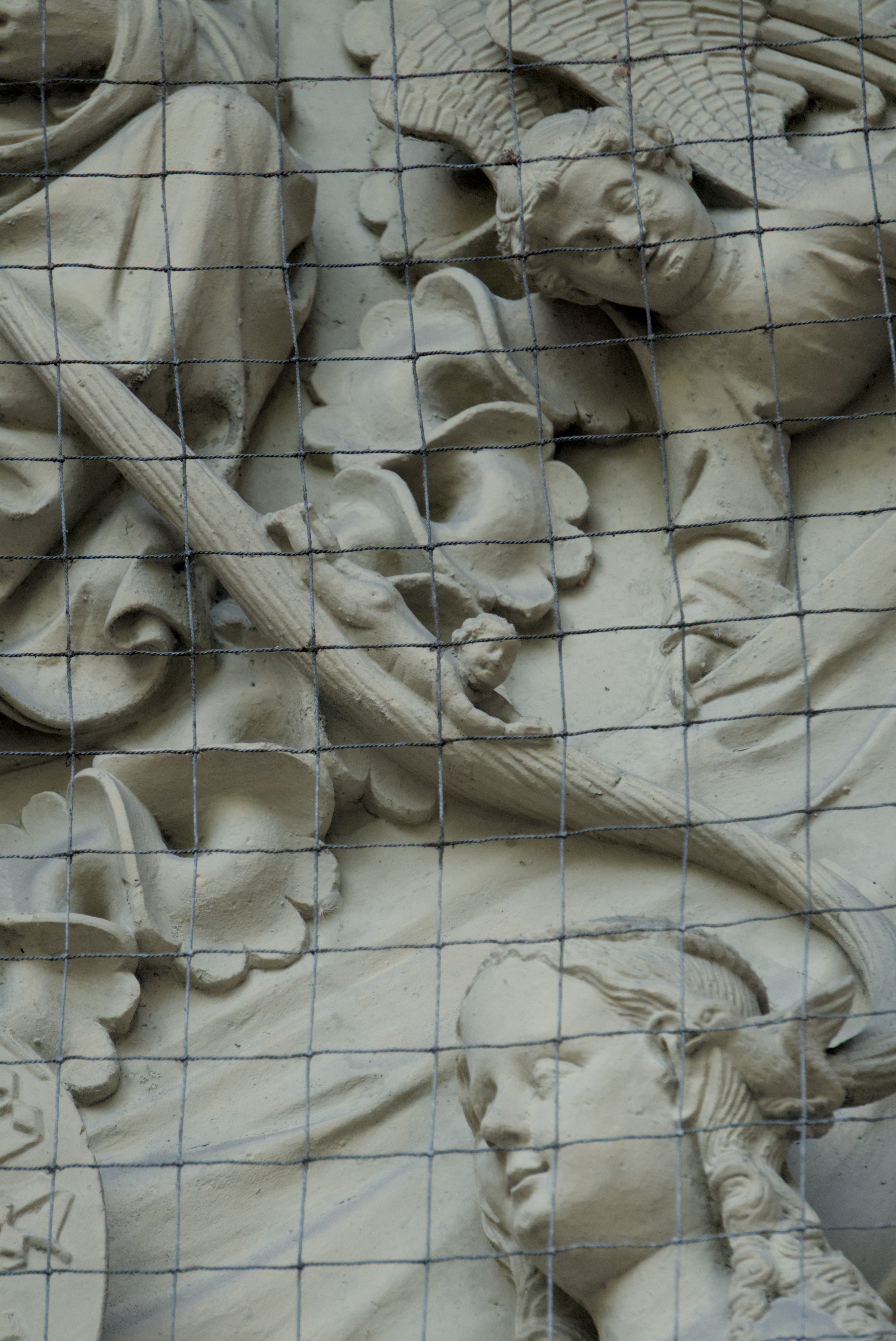
Annunciation
homunculus
Annunciation detail

Behind Mary, two angels hold up a cloth of state, befitting royalty.

The conceptio per aurem was developed in both the East and the West by Christian writers and preachers such as Ephrem of Syria, Augustine of Hippo, Theodotus of Ancyra, Proclus of Constantinople, Cyrus of Panopolis, Zeno of Verona, Athanasius of Alexandria, and Bernard of Clairvaux. To learn more, I recommend the excellent book Divine Conception: The Art of the Annunciation by Sarah Drummond (Unicorn, 2019) and Proclus of Constantinople and the Cult of the Virgin in Late Antiquity: Homilies 1–5 by Nicholas Constas (Brill, 2003), each of which devotes an entire chapter to the motif.

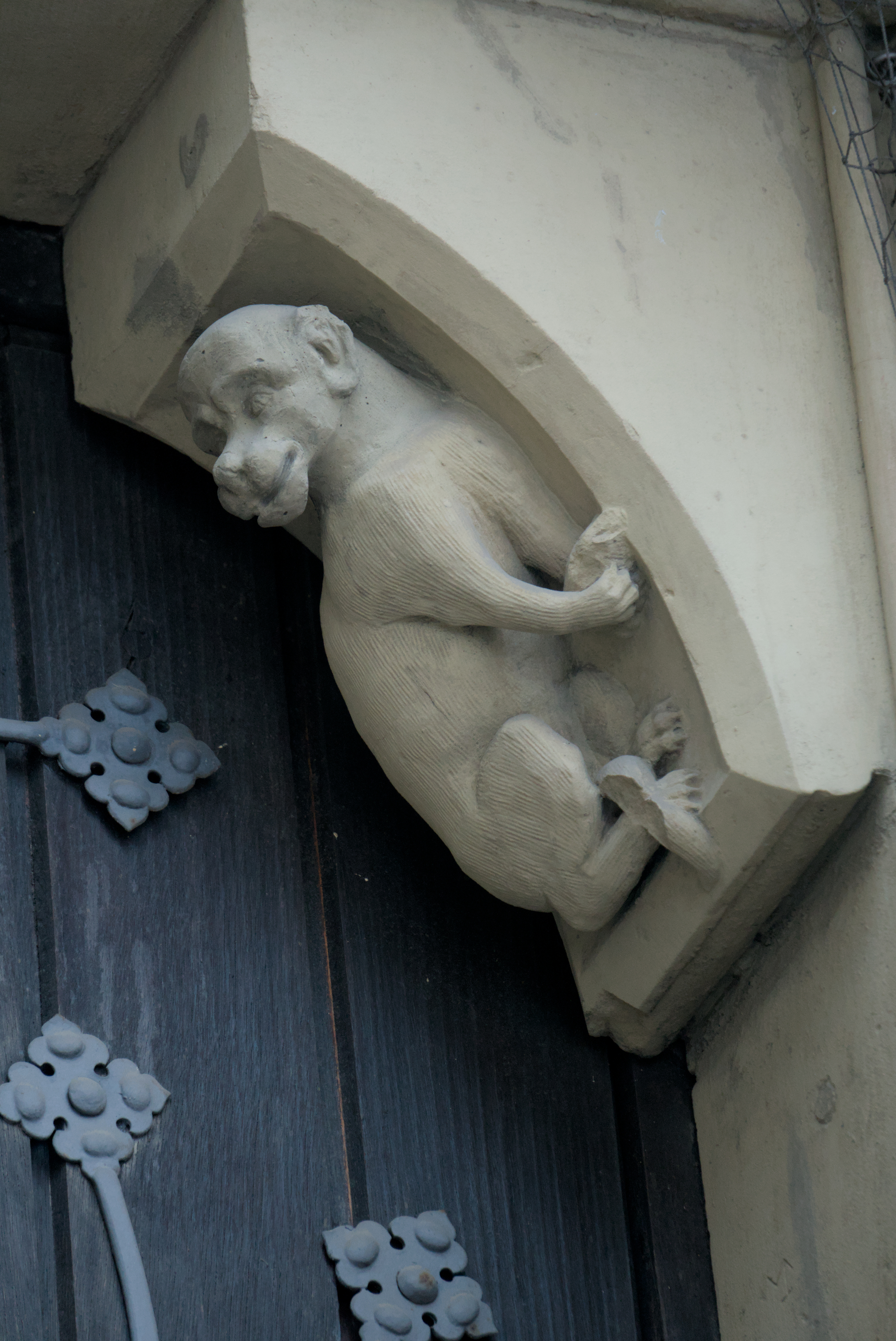
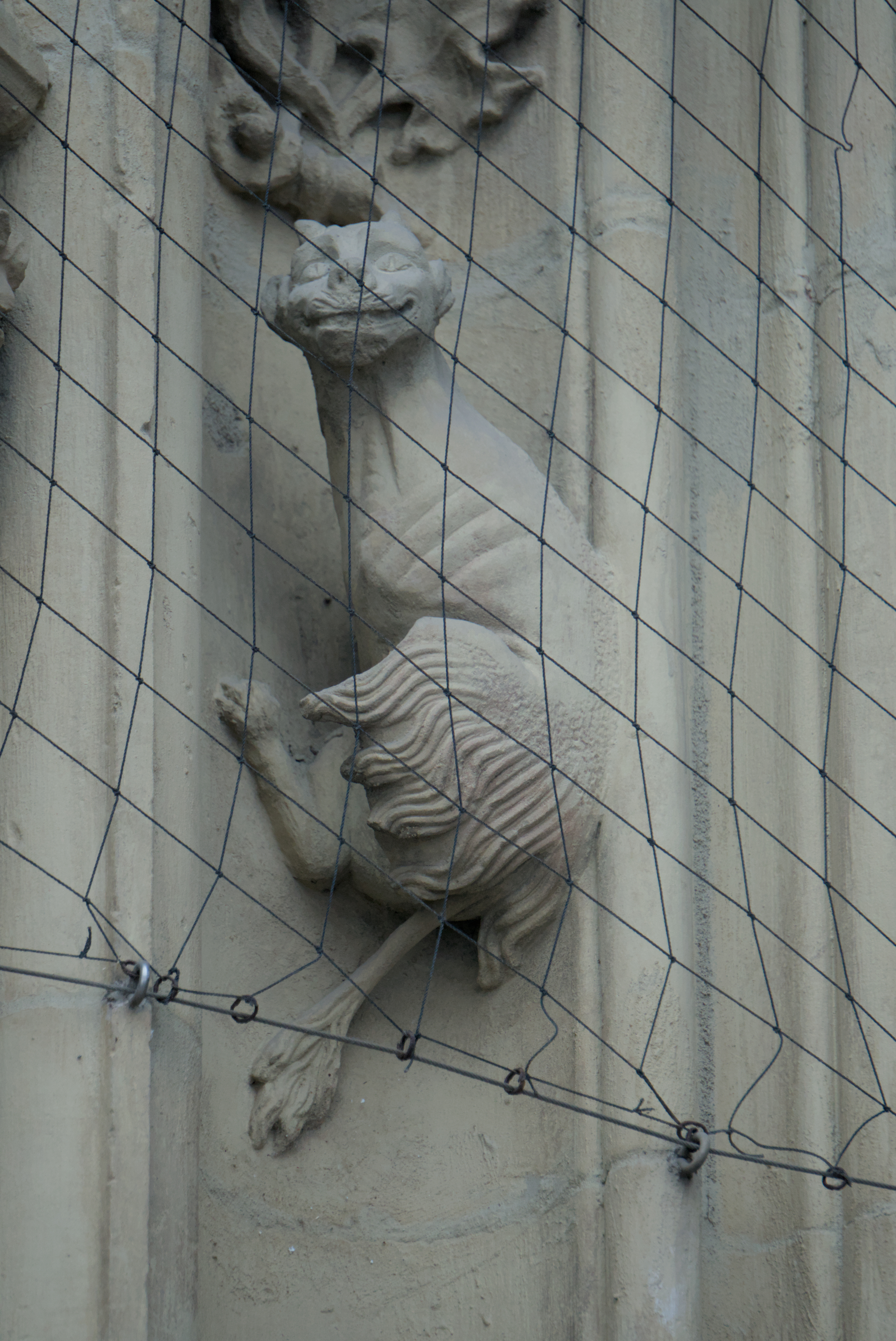
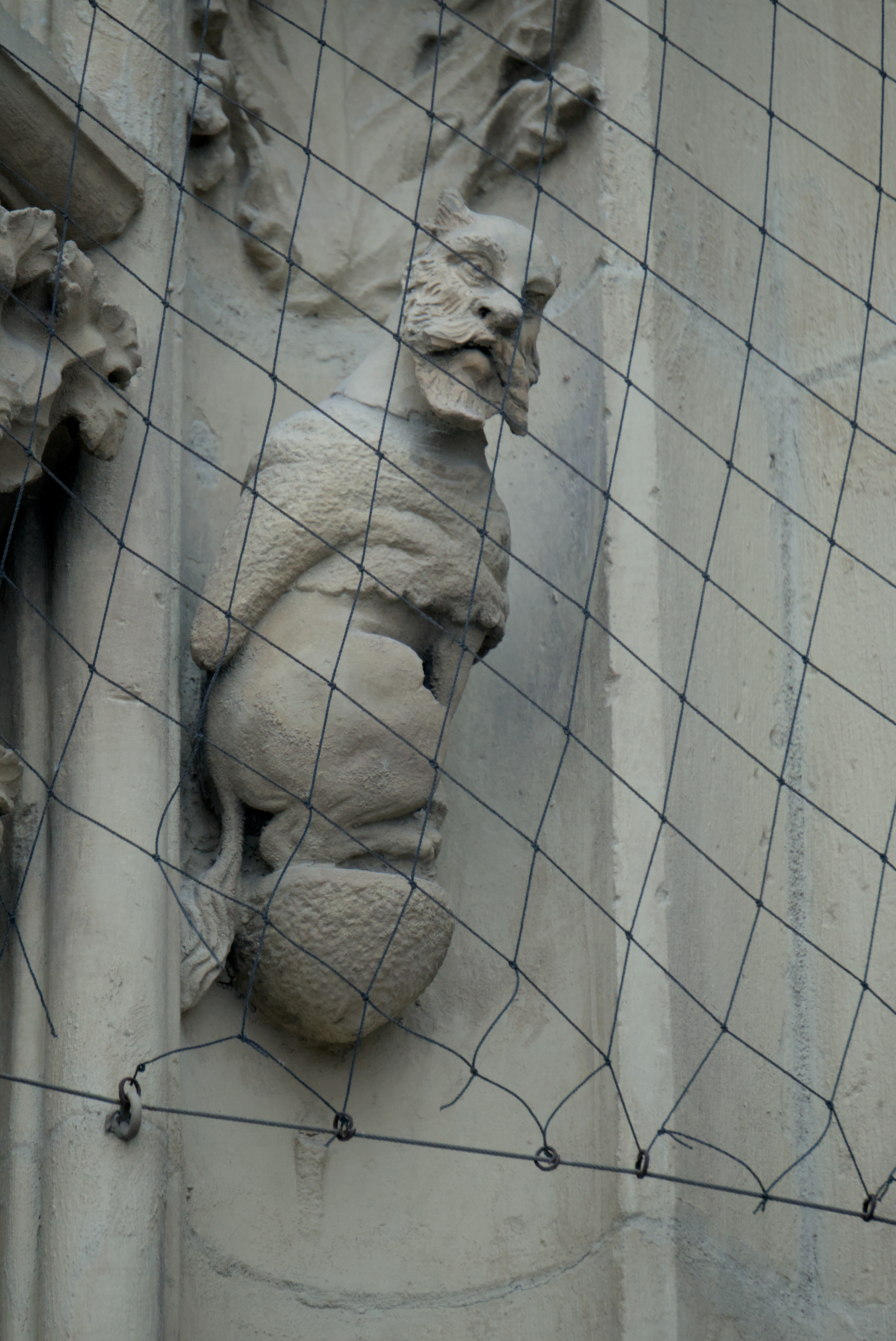
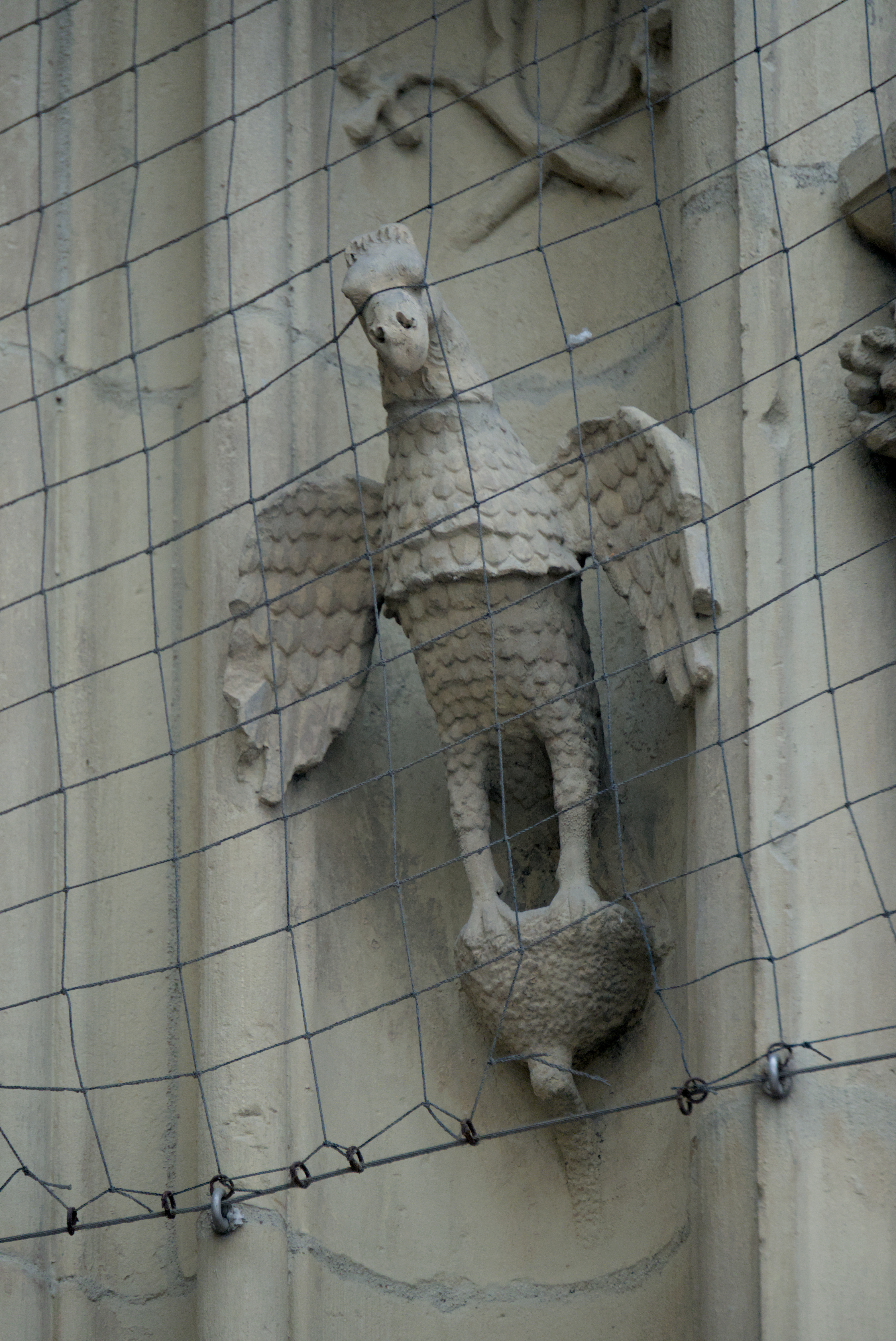
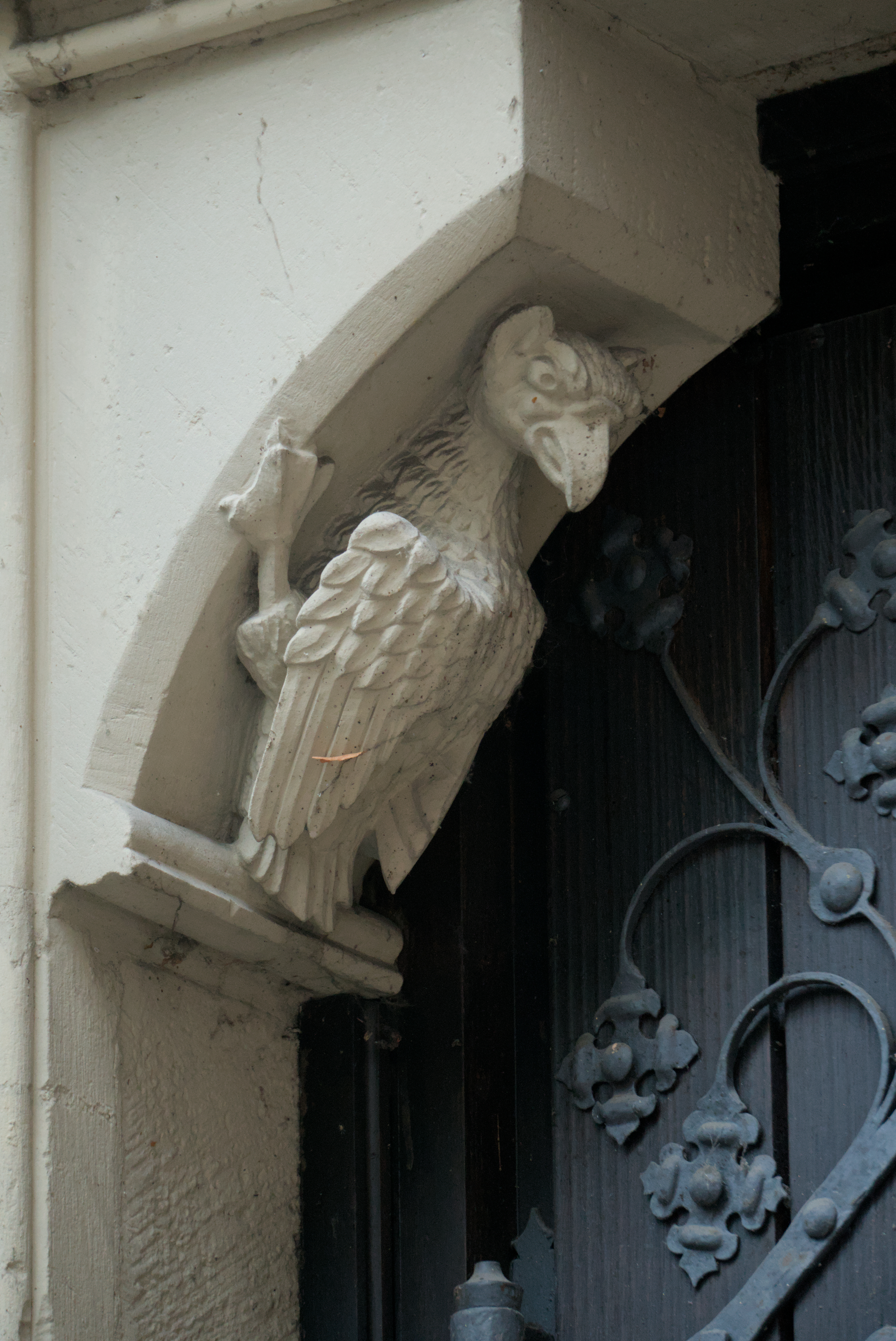
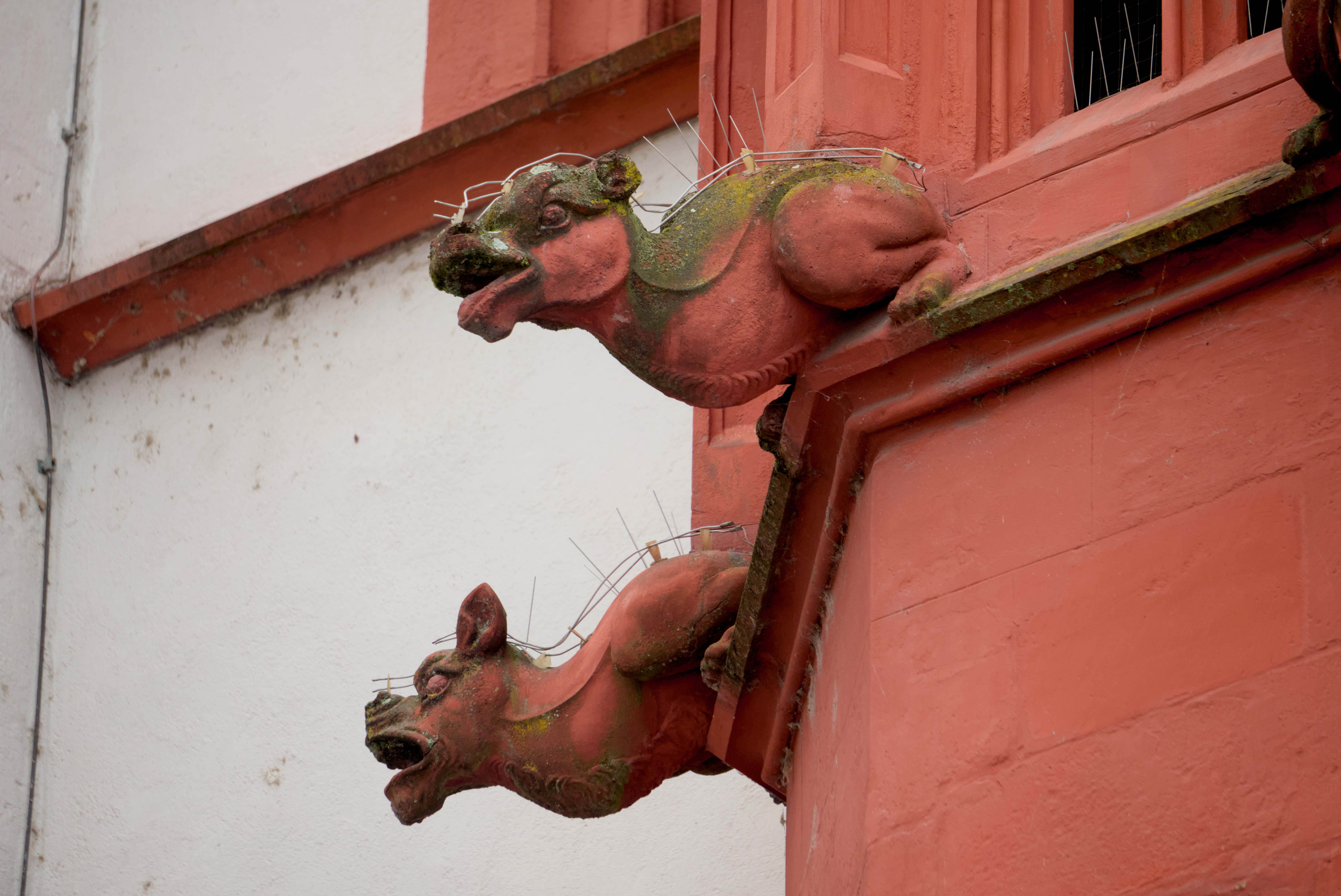
Also on the exterior of the Marienkapelle are a handful of fantastical creatures in the jambs and archivolts and under corbels, and red sandstone grotesques on the eaves.
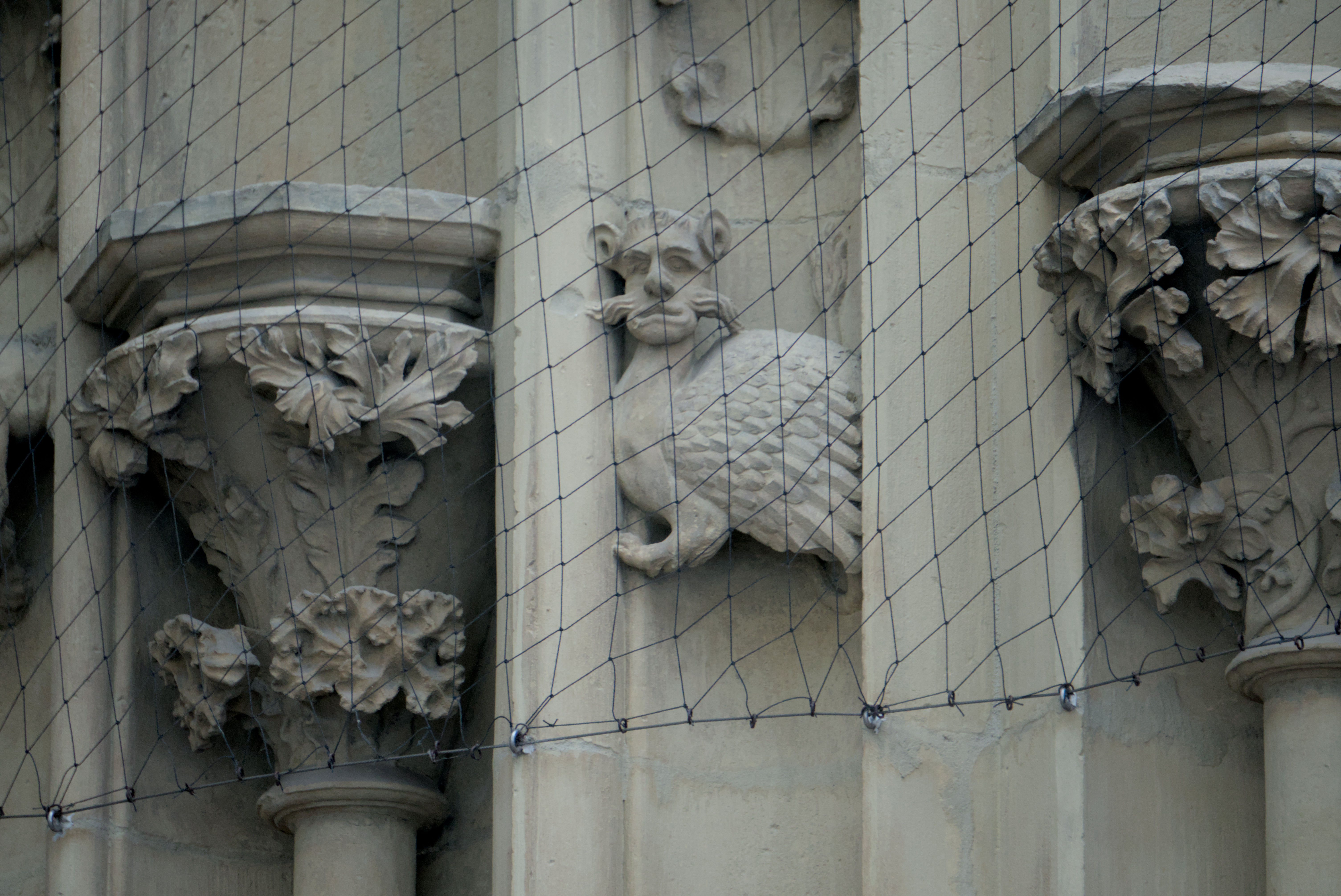
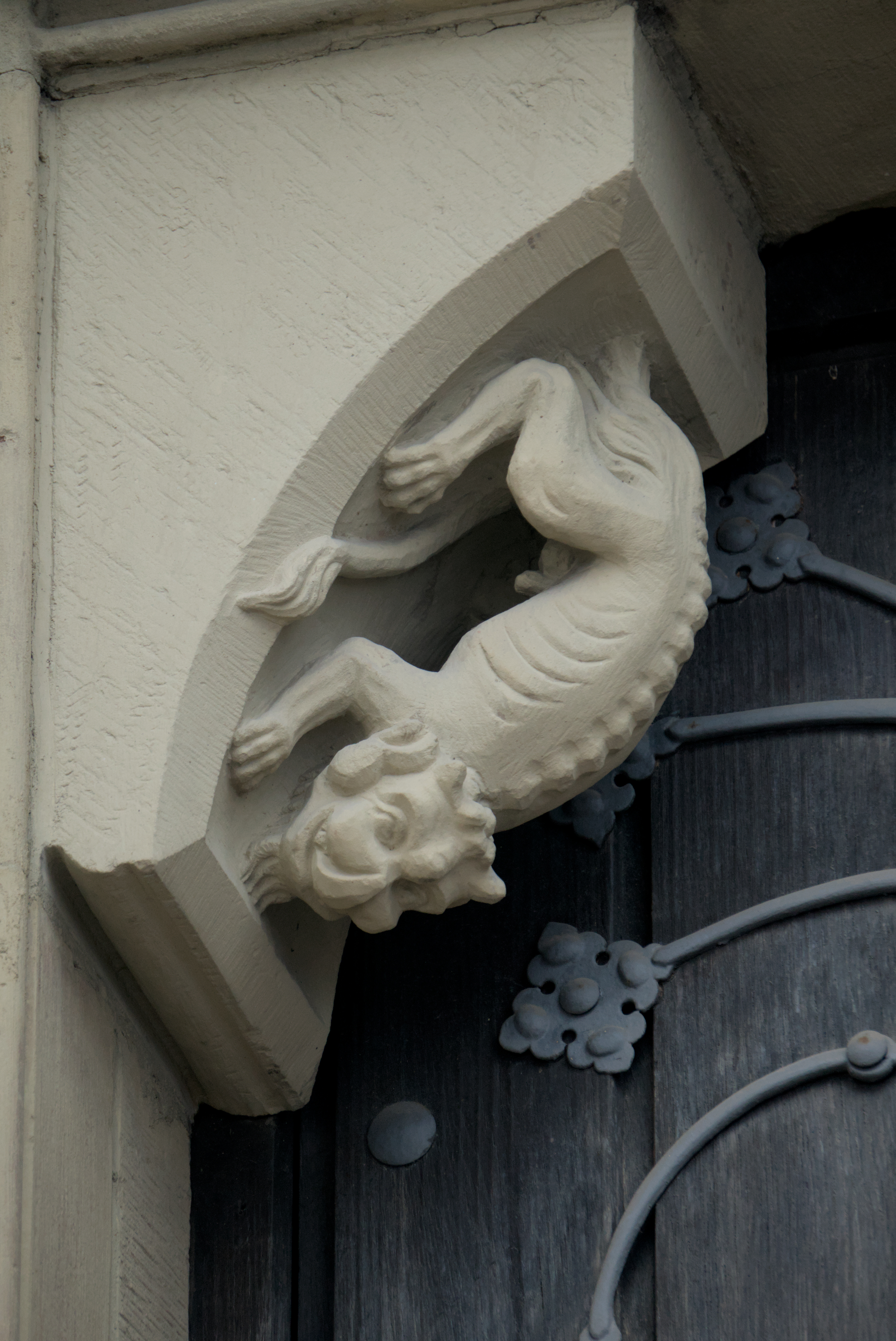
Grotesques above the west portal, Marienkapelle

Moving inside, the locally quarried pink and white sandstone columns that support the rib vault down the length of the nave are lovely. So are the post–World War II stained glass windows in the choir. But the main visual attraction is the high altarpiece, painted by an unidentified Franconian artist in 1514.
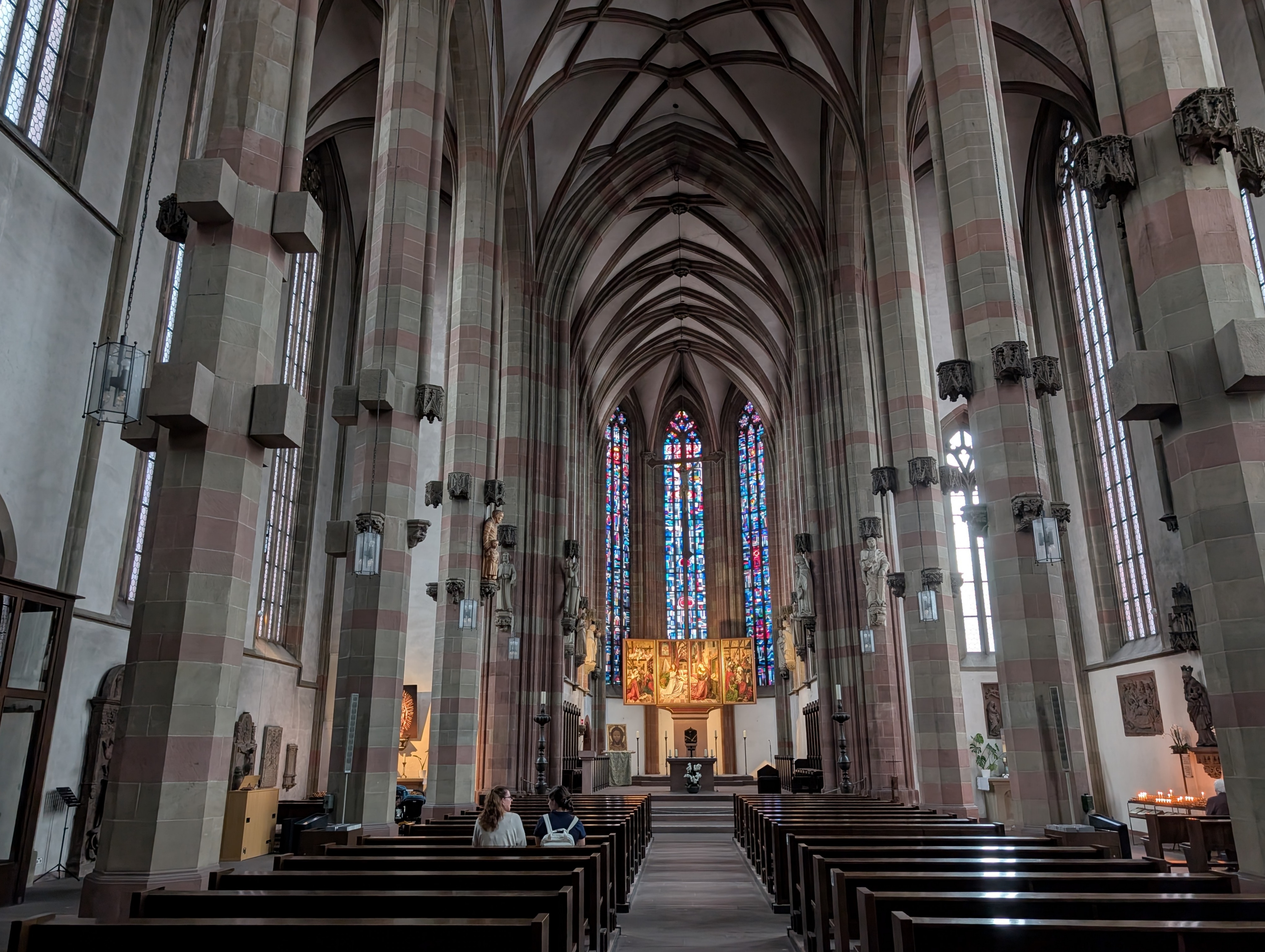
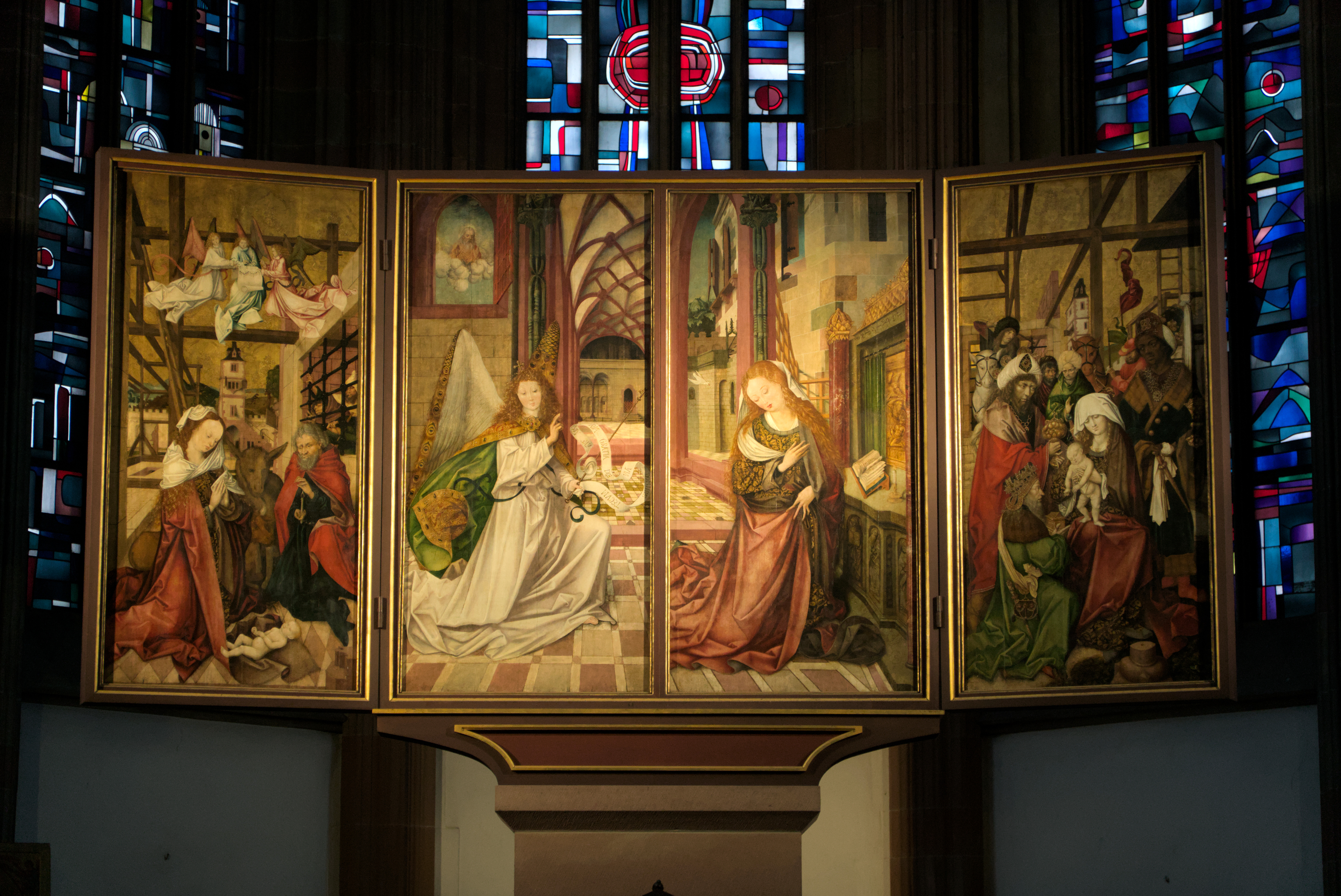
Marienkapelle interior
High altarpiece, Marienkapelle

The central scene, consisting of two panels, shows the Annunciation, set inside a well-appointed domestic interior. Mary is interrupted from her prayers by a ruddy-faced messenger, whose banner bears his greeting: “Hail, Mary, full of grace, the Lord is with thee.”
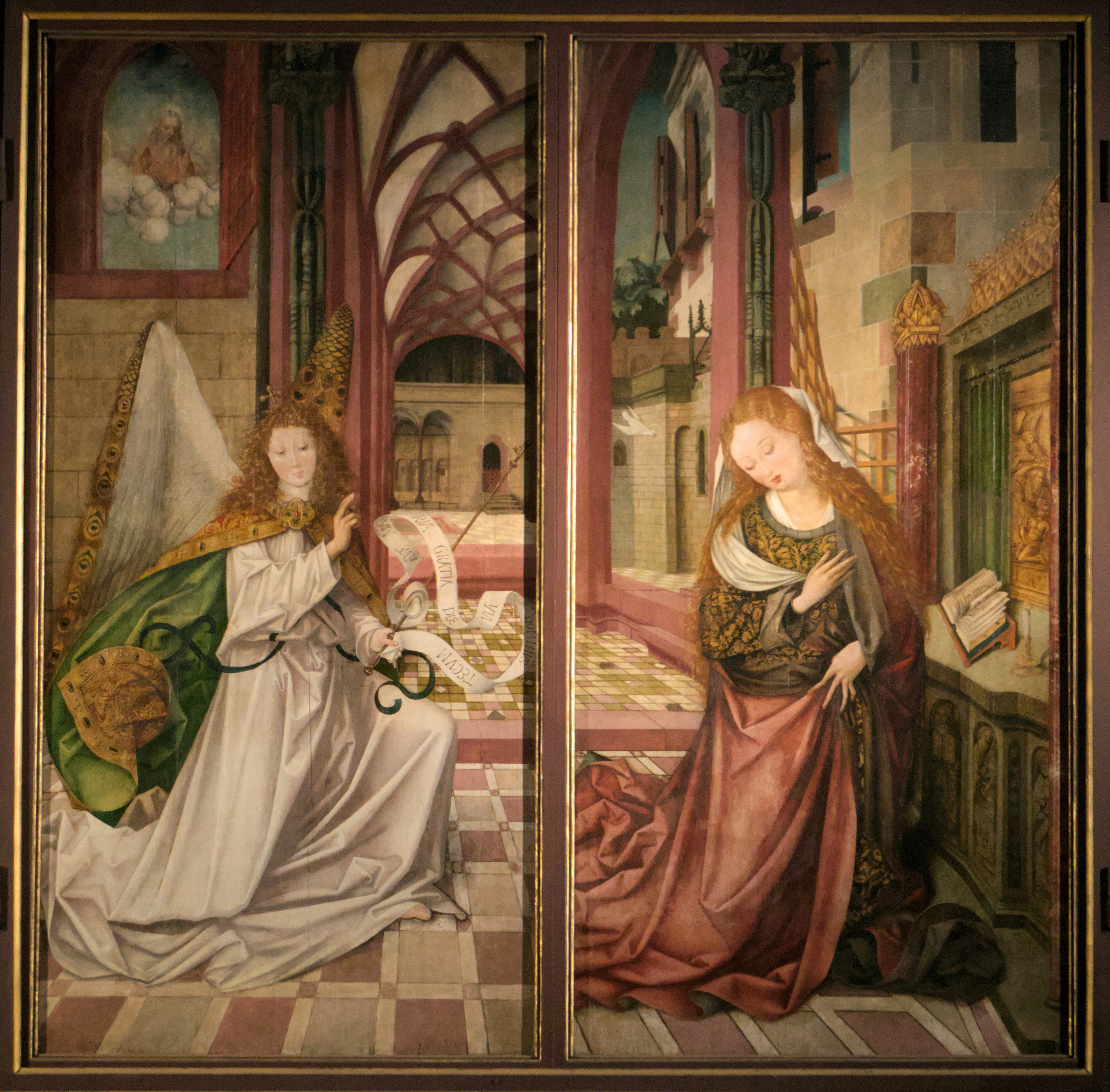
Annunciation

The left wing depicts the Nativity inside a half-built or dilapidated structure that’s exposed to the elements. Mary has laid the infant Christ on the ground, cushioning him as much as possible with her extended cloak. Shepherds peep through the metal bars of the window, craning their necks to see. An ox and ass have front-row seats. Joseph holds a candle, and a trio of angels sing from a song sheet.
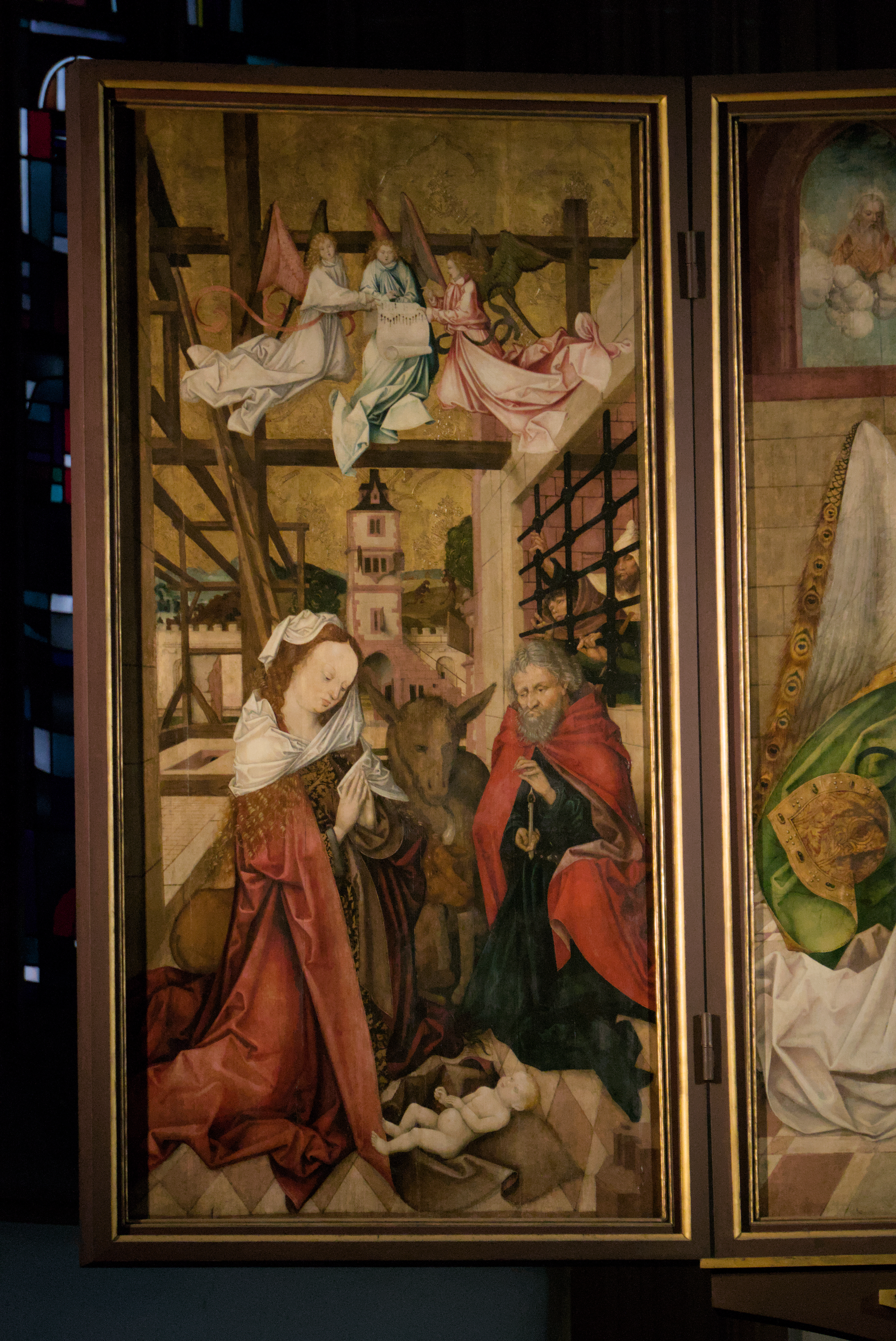
Nativity

The right wing depicts the Adoration of the Magi. The three foreign men of means present gifts to the Christ child while their entourages stand by patiently in the background. As is traditional, one of them is portrayed as Black.
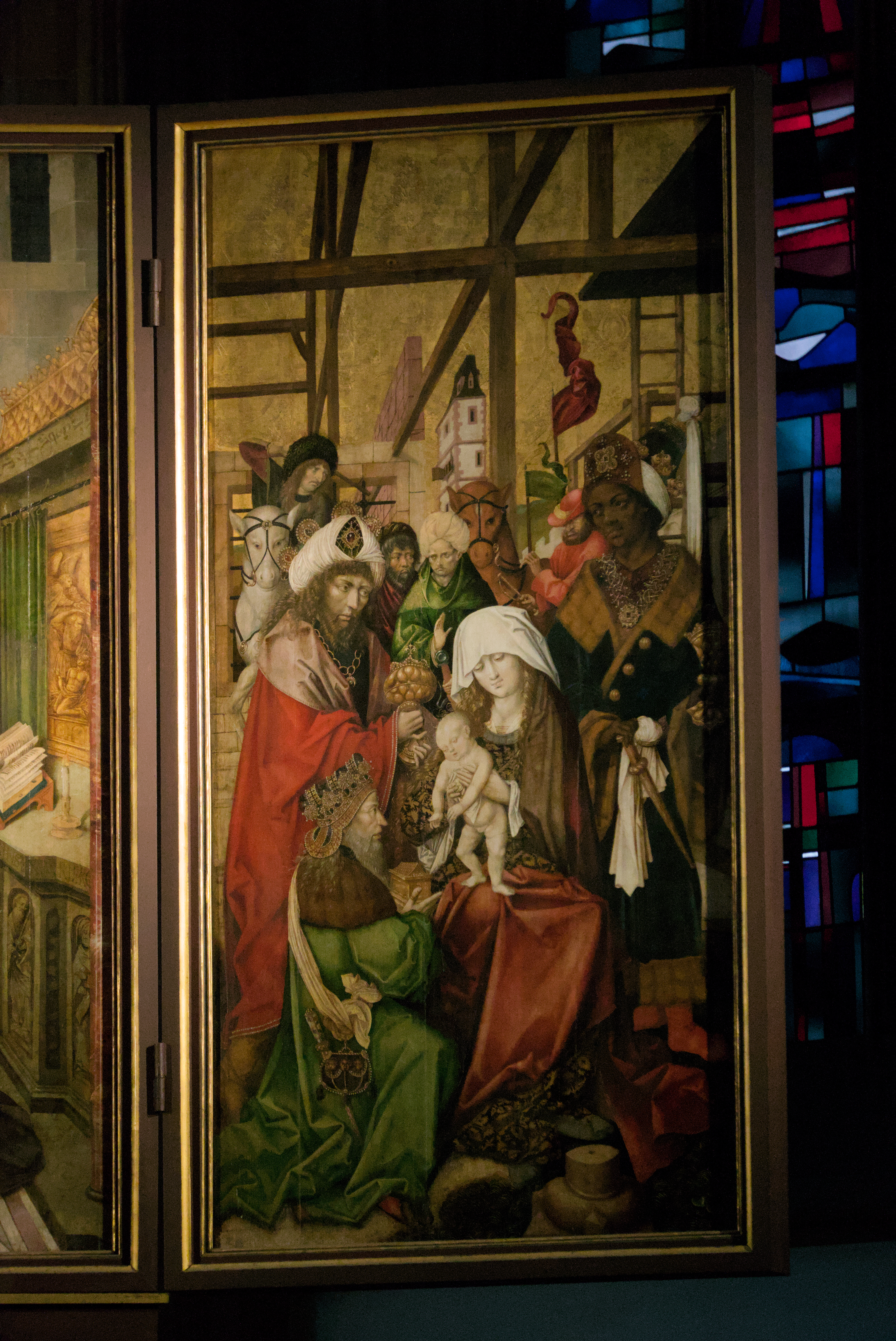
Adoration of the Magi

Stay tuned for my next Würzburg post, where I’ll share photos from Neumünster, a church that was on my radar because of the unusual crucifix that hangs above one of its side altars.
Bone chapel, anti-Nazi martyrs’ memorial, and contemporary stained glass at the Basilica of St. Ursula, Cologne

(All photos in this article are my own, taken either by me or my husband.)

I knew very little about the virgin martyr St. Ursula before visiting the basilica dedicated to her in Cologne, Germany, last month. She’s the patron saint of the city, where, according to hagiography, she was murdered sometime in the fourth century.

There’s no historical veracity to her story, which is why her name was removed from the Catholic calendar of saints when it was revised in 1969. But her feast day is still observed by many on October 21.

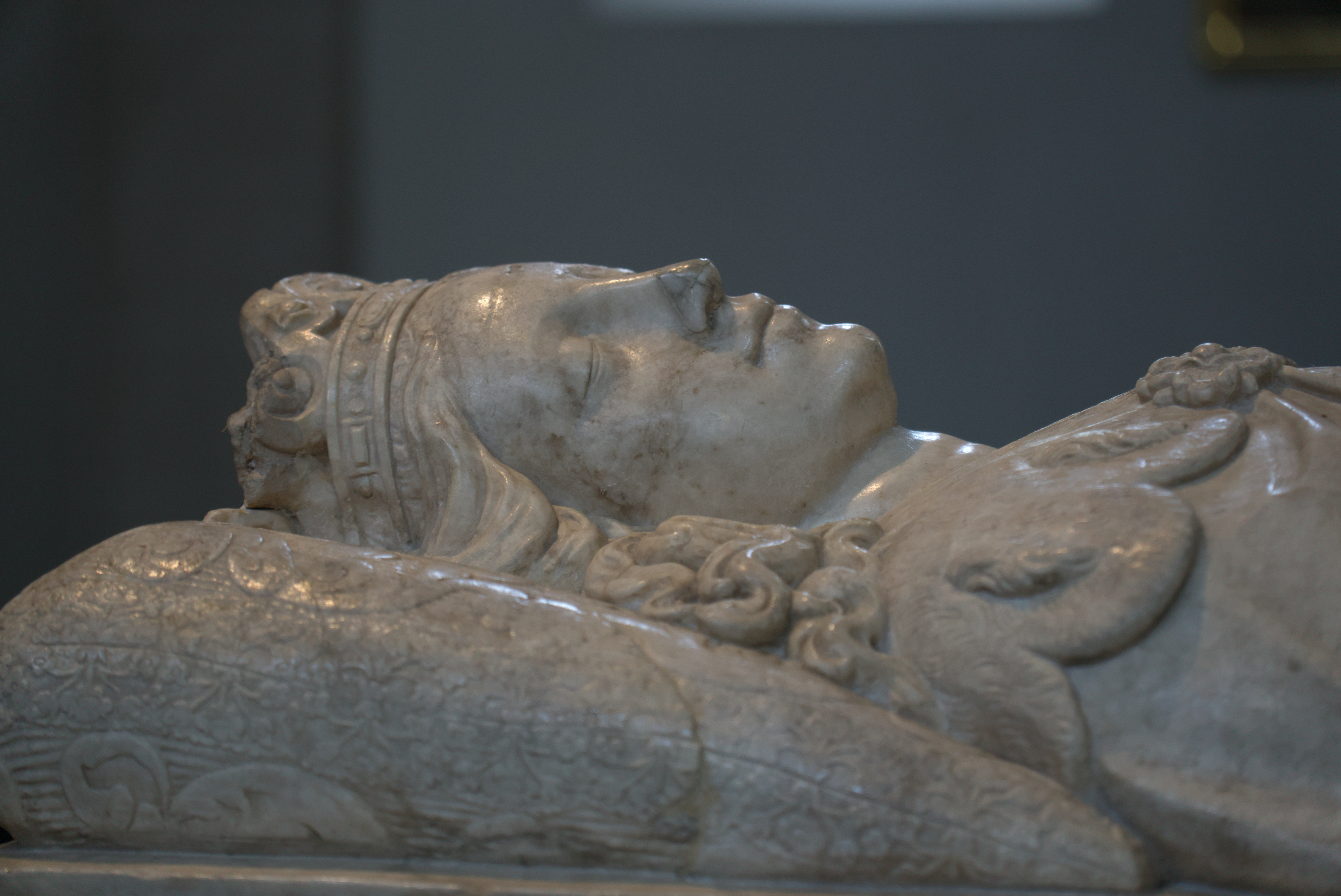
St. Ursula alabaster
Johann T.W. Lentz, St. Ursula (detail), 1659. Alabaster. North transept, Basilica of St. Ursula, Cologne. This reclining figure of the saint lies over her Baroque tomb made of black marble.

As legend has it, Ursula was a Romano-British princess and a Christian. She was engaged to be married to a pagan prince. To delay the wedding, she successfully requested that she first be allowed to take a three-year pilgrimage to Rome, and that she be accompanied by eleven thousand virgins (a ridiculous number that was likely embellished from what was originally eleven). On their voyage, she converted all eleven thousand to the faith.

On their way back to Britain from Rome, they were traveling through Cologne when it was besieged by the Huns, a group of nomadic warriors from Central Asia. Ursula and her companions refused the soldiers’ sexual advances and were slaughtered as a result. One version of the legend says the women’s souls then formed a celestial army that drove out the Huns, saving Cologne.

The earliest possible reference to Ursula and company—though they are unnamed and unnumbered—is a stone plaque dated to 400. Now incorporated into the choir wall of the present Basilica of St. Ursula, it mentions a basilica restored on this site by the Roman senator Clematius to commemorate the “martyred virgins coming from the east, in fulfillment of a vow, . . . holy virgins [who] spilled their blood in the name of Christ.” This inscription not only provides the seed of what would become the Ursula legend; it’s also the earliest evidence of Christianity in Cologne, attesting to the presence of a church there in the fourth century.

It wasn’t until the tenth century that the name Ursula emerged, identified as the leader of the group of virgins, and that their number, which had previously ranged from two to thousands, became fixed at eleven thousand. The women were never officially canonized, but their veneration as saints grew immensely in the twelfth century after a large, late antique Roman cemetery was discovered in 1106 near the aforementioned Church of the Holy Virgins in Cologne during an excavation project to expand the city’s fortifications. The skeletal remains in the hundreds of graves were purported to be those of the martyred women (notwithstanding the presence of many men’s and children’s bones among them).

The discovery of these putative relics called for the rebuilding of the predecessor church to house them. Construction began in the second quarter of the twelfth century, and it’s that structure, with later renovations, refurbishments, additions, and (post–World War II) restorations and repairs, that stands today. The church was elevated to the status of minor basilica in 1920.

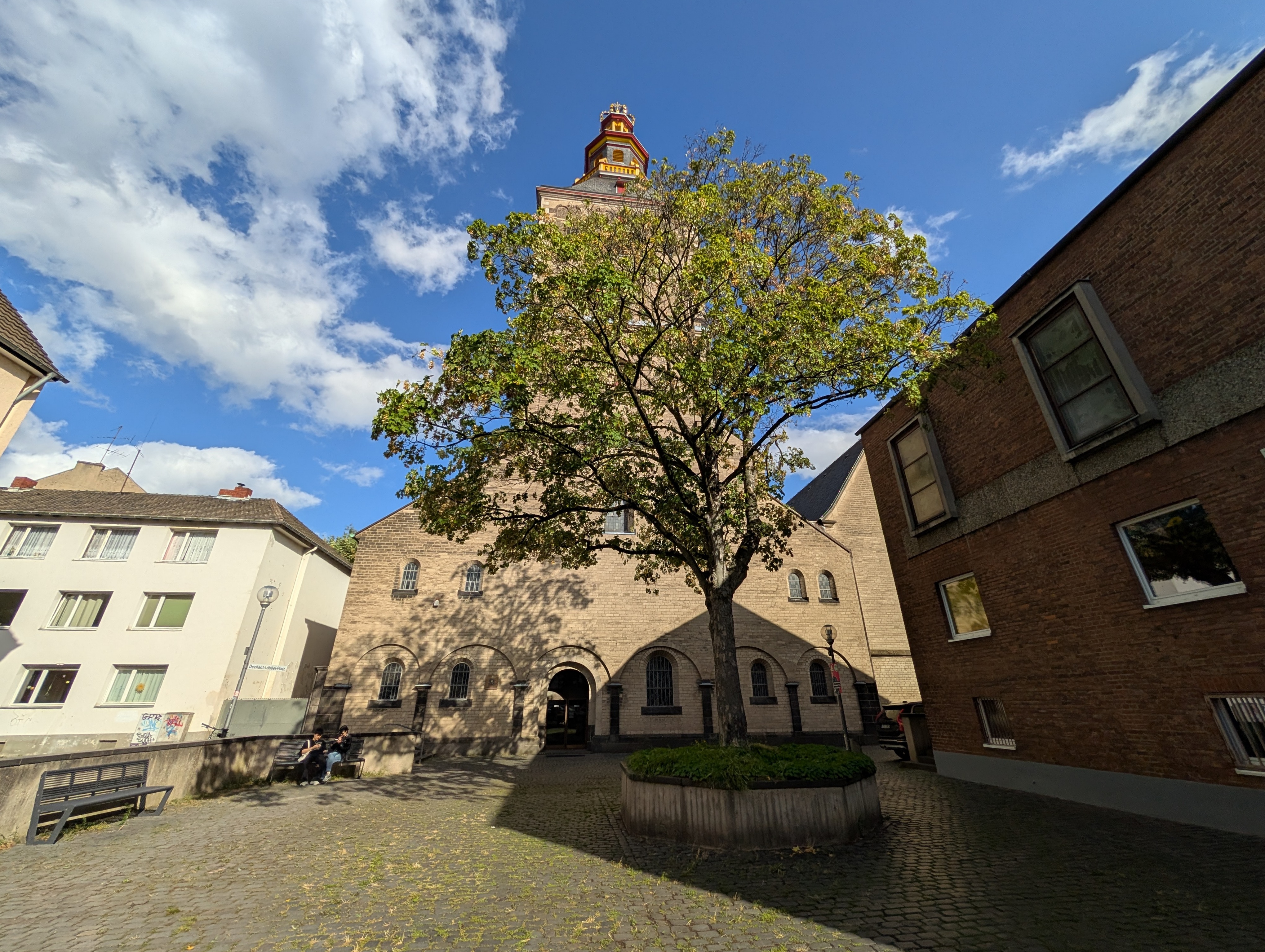
Basilica of St. Ursula, Cologne
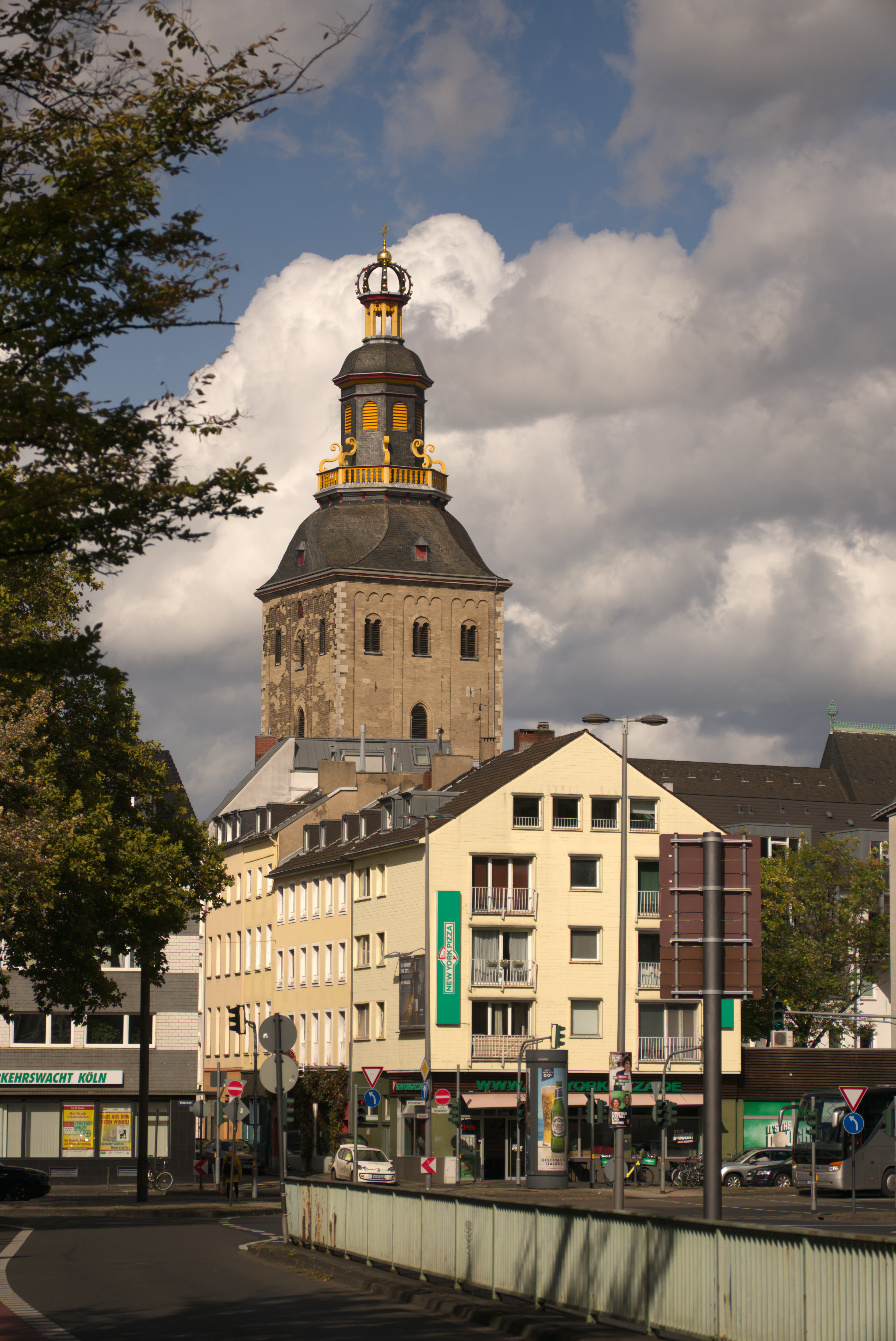
West facade, where you enter

Basilica of St. Ursula
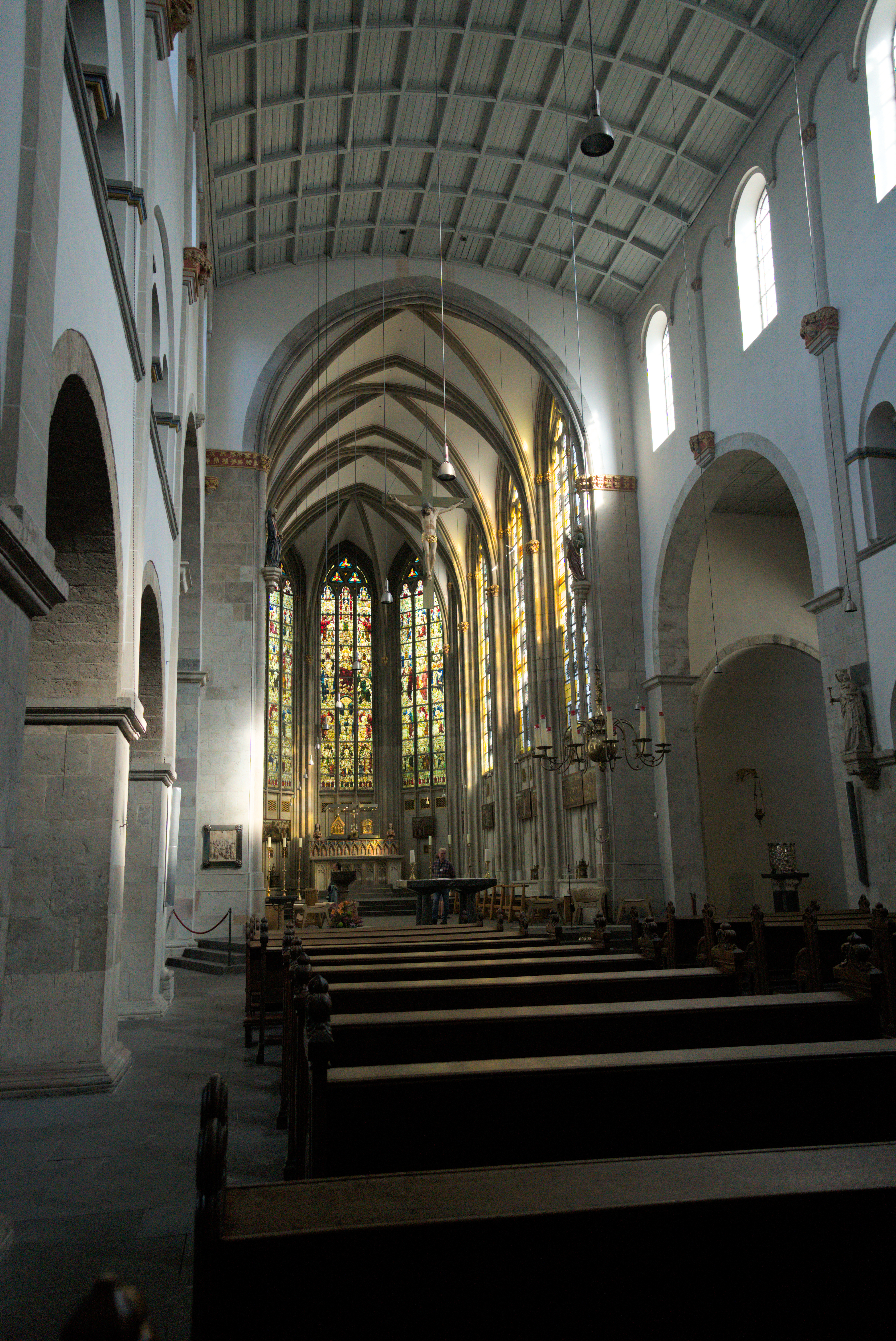
The nave and the main tower of the Basilica of St. Ursula are Romanesque, but the choir was rebuilt in the Gothic style.

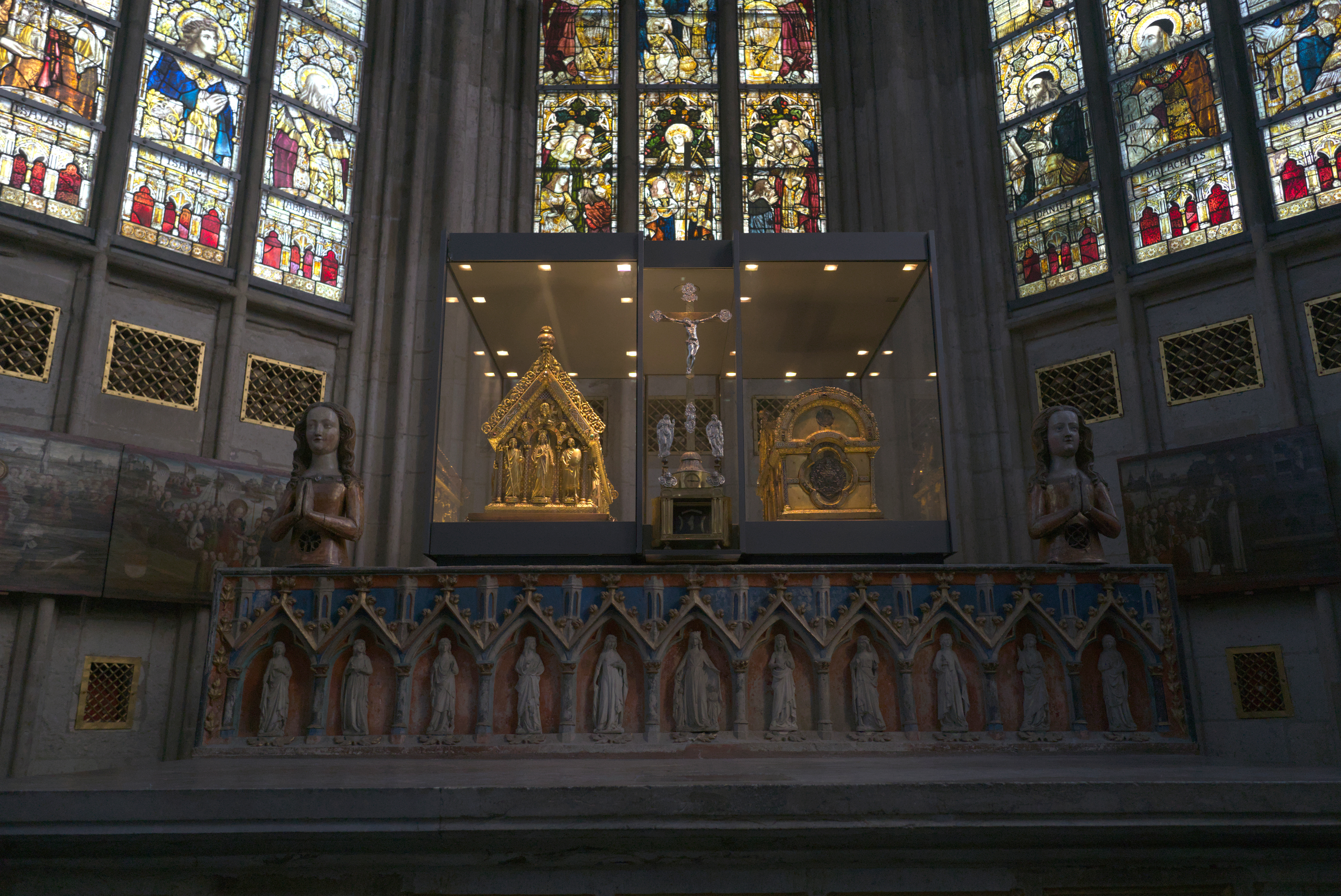
Shrine altar
Shrine altar in the choir apse, containing the relics of Ursula, Etherius, and Hippolytus. Behind it are grilled reliquary niches and paintings of the Legend of St. Ursula from from the “long cycle” of 1456.

Chancel windows
Chancel windows by Francis William Dixon, 1892. Left: St. James the Greater, St. Andrew, and St. Peter, accompanied by angels; lower register: Isaiah, Isaac, and Abraham. Center: Christ enthroned, with Mary and St. John the Baptist (Deesis) at his side; lower register: St. Ursula of Cologne with her companions. Right: St. James the Lesser, St. Matthew, and St. Thomas, accompanied by angels; lower register: Daniel, Malachi, and Joel.

The reason the Basilica of St. Ursula was on my list of stops was I wanted to see its so-called Golden Chamber.

The Golden Chamber

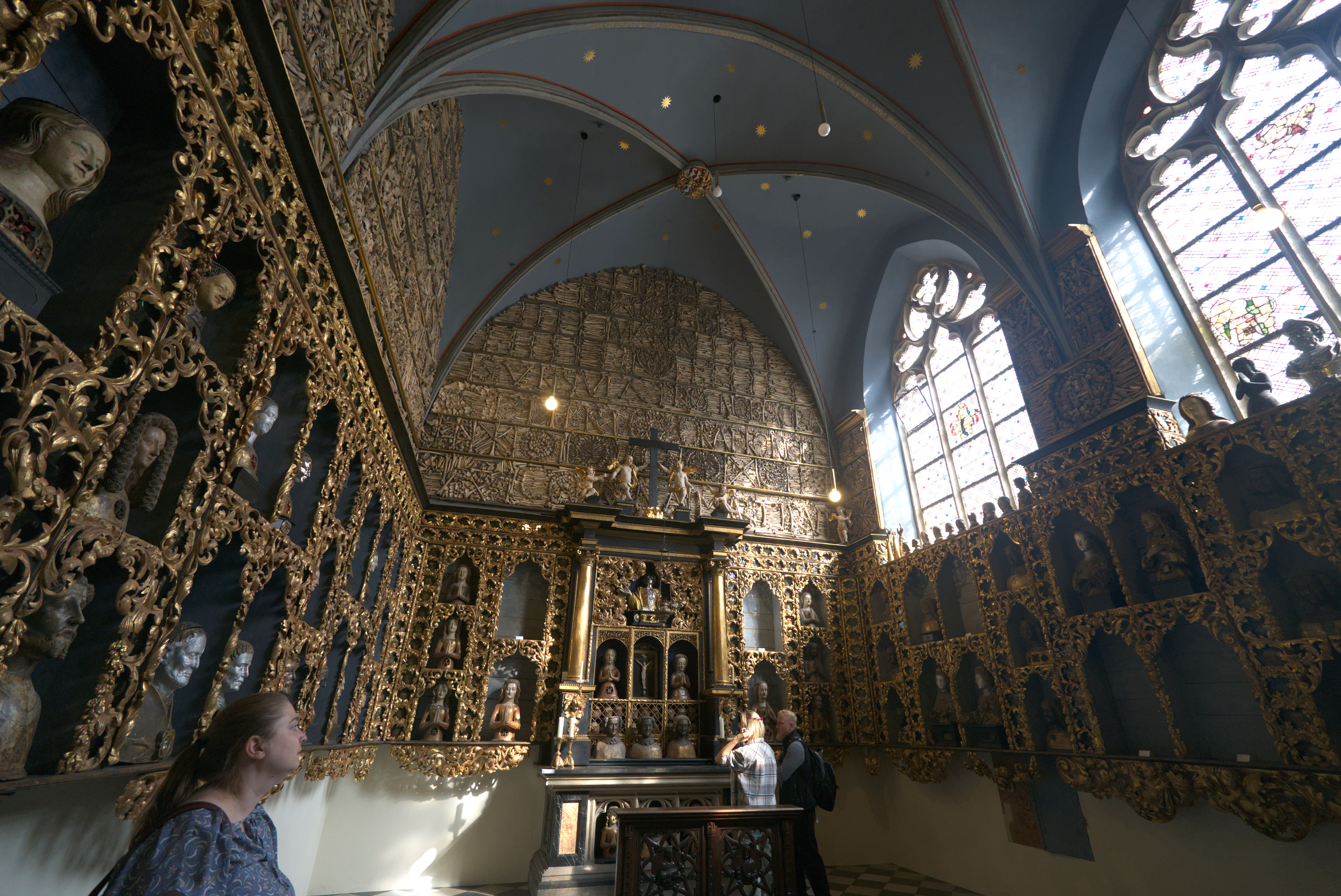
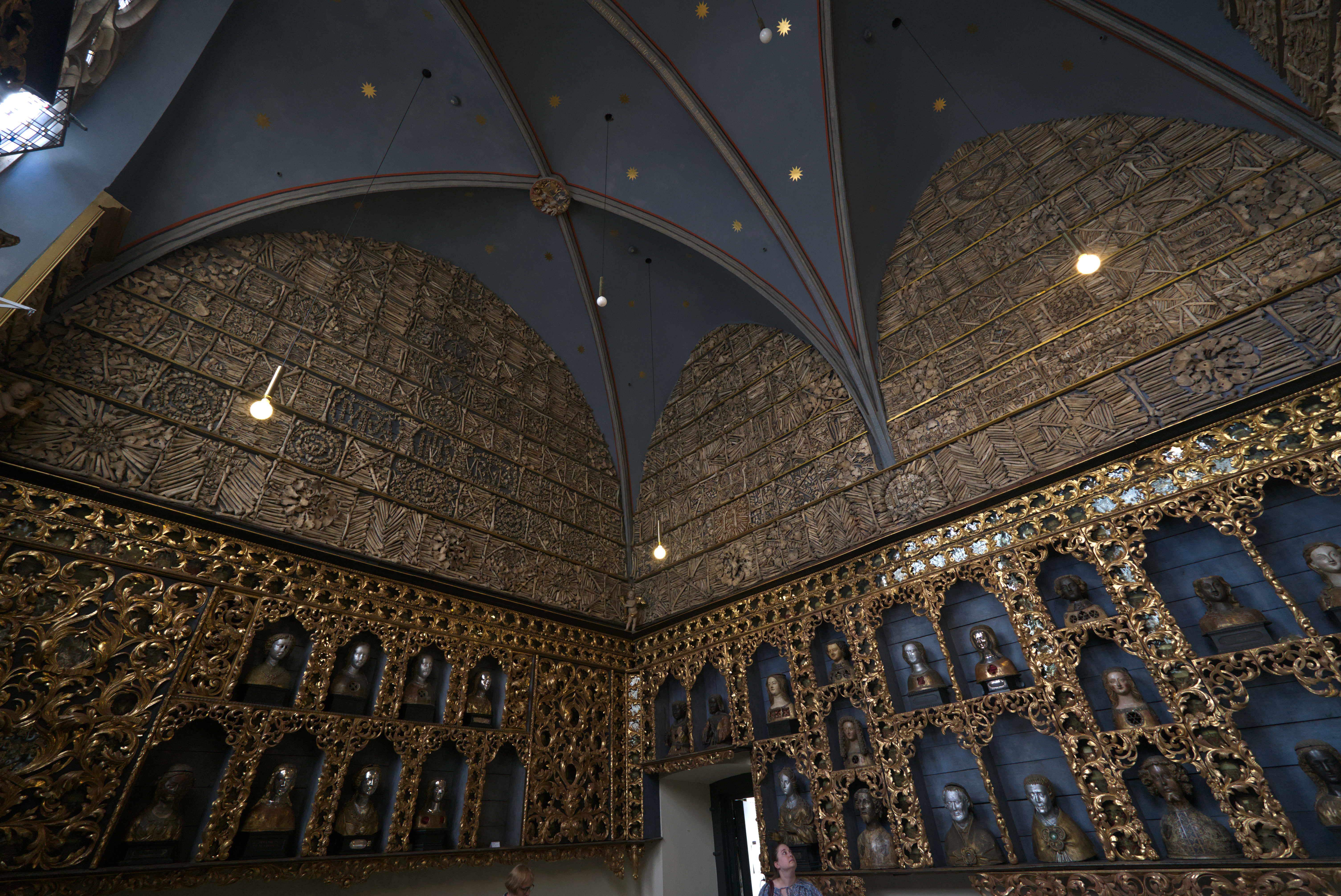
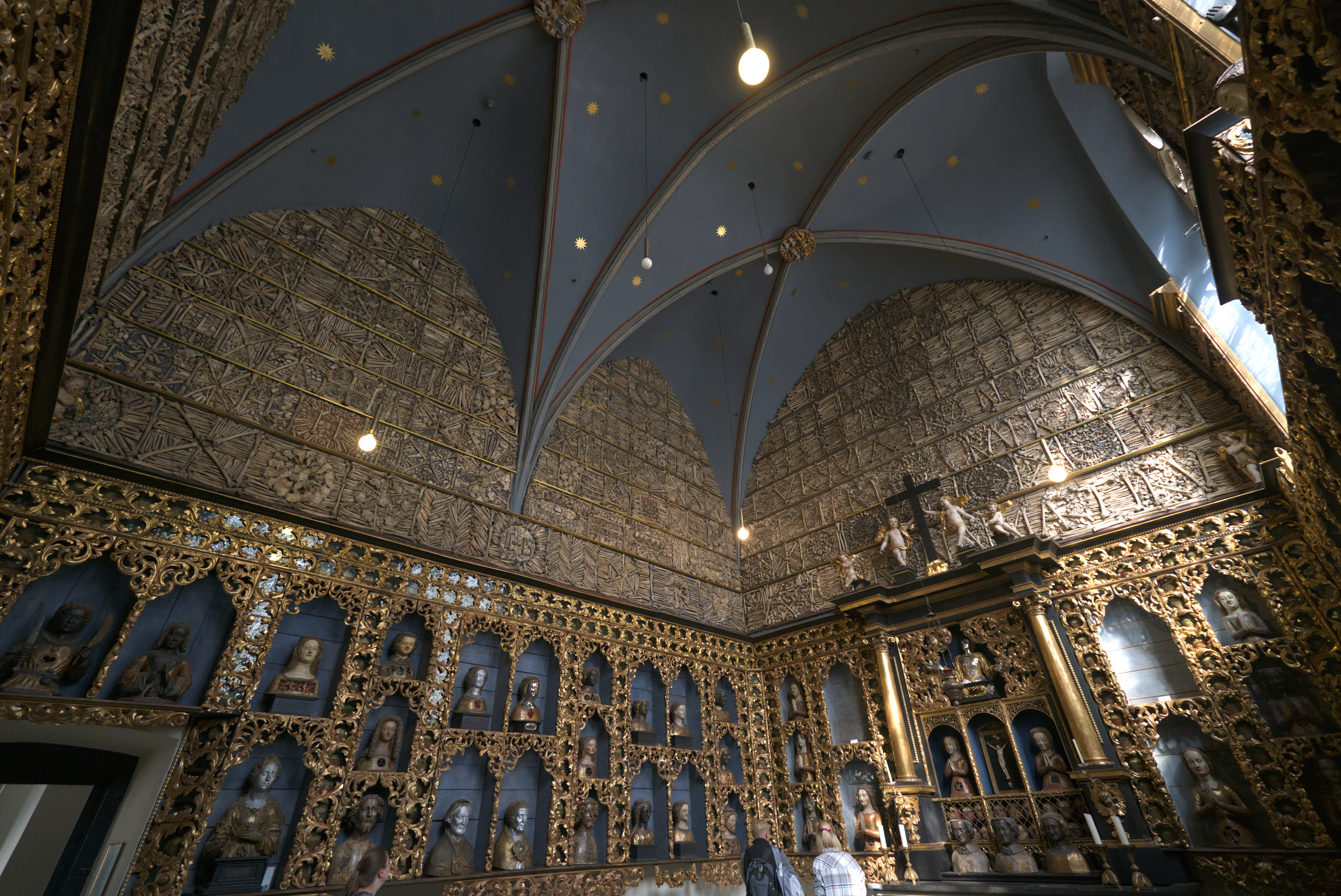
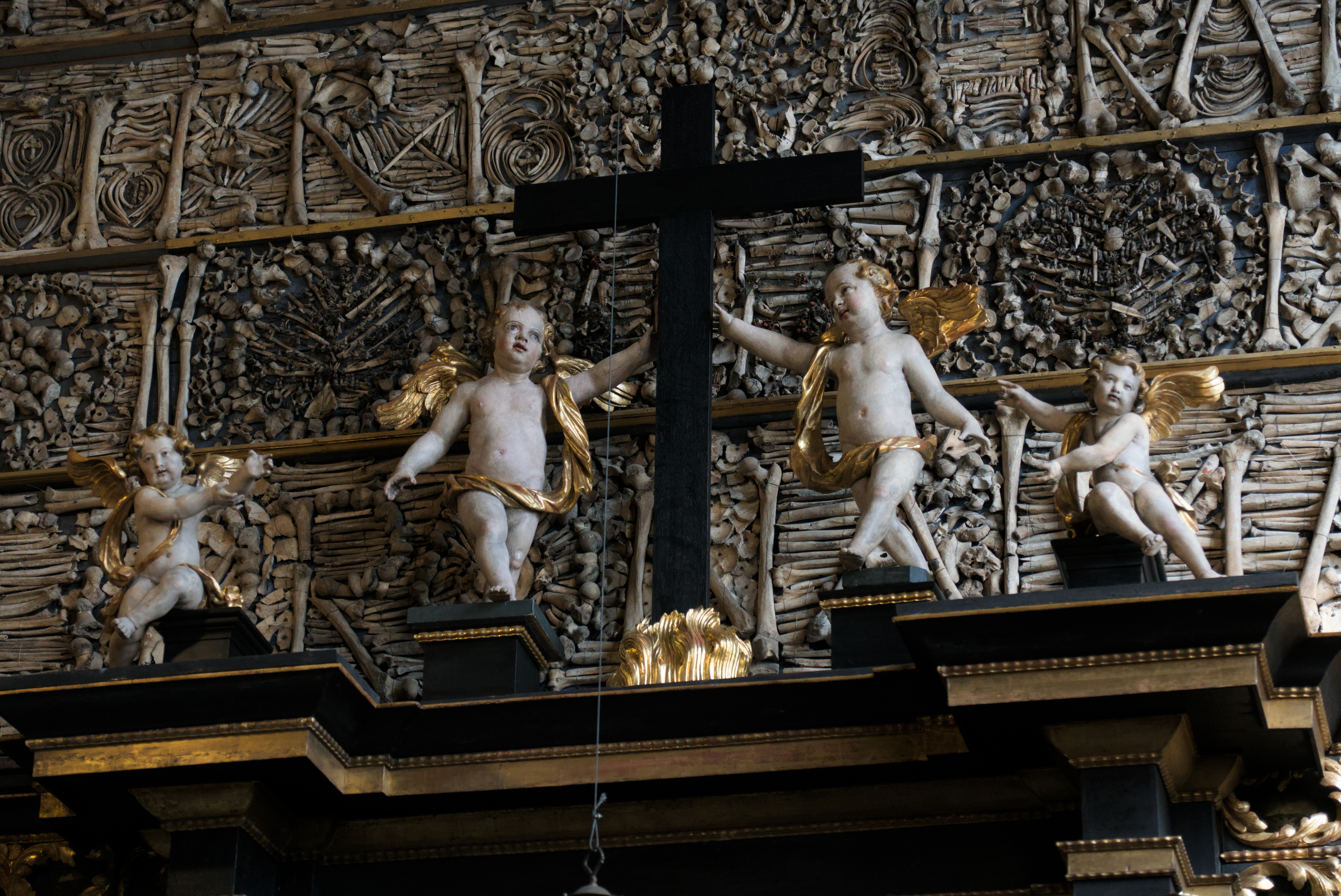
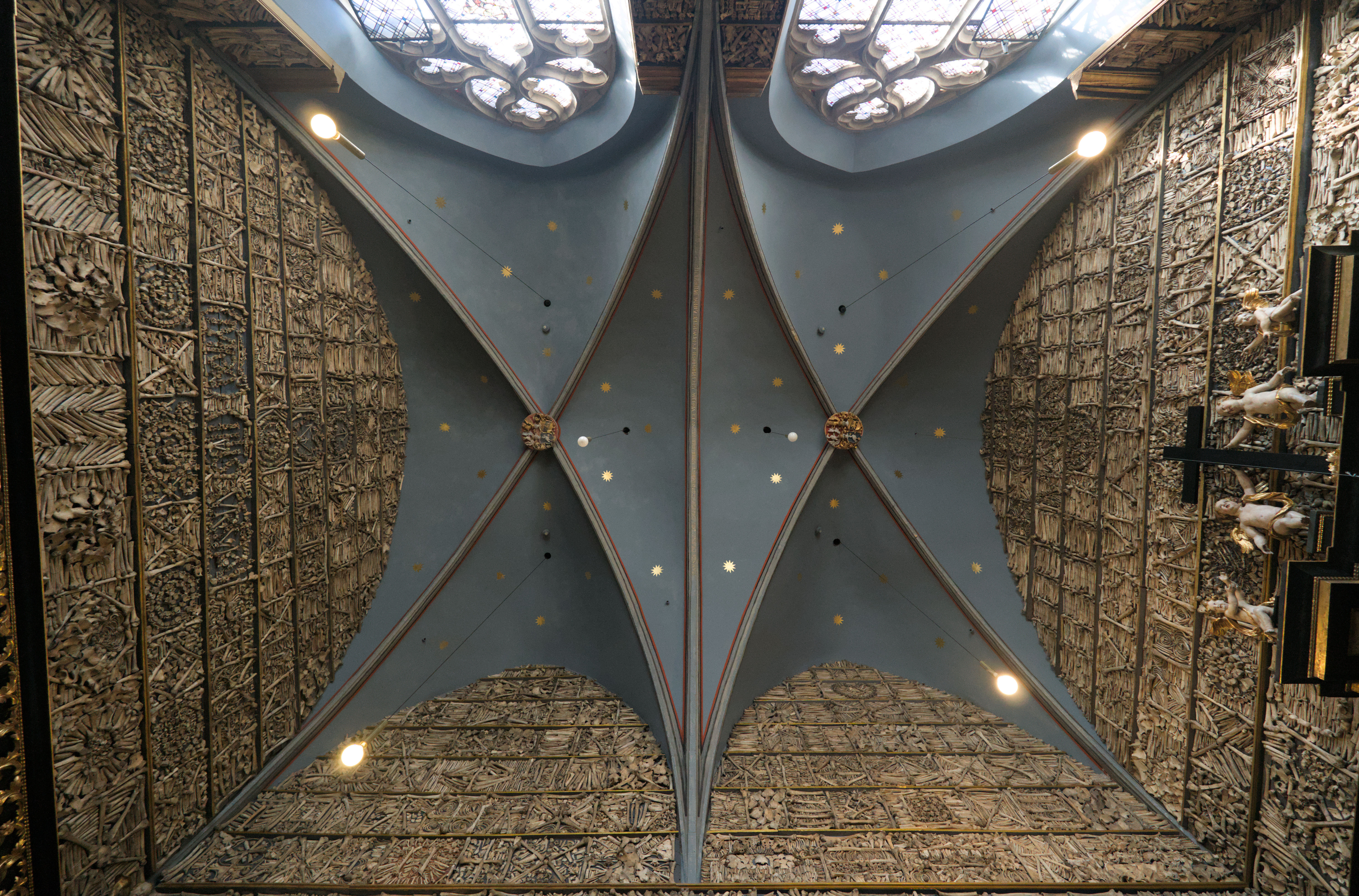
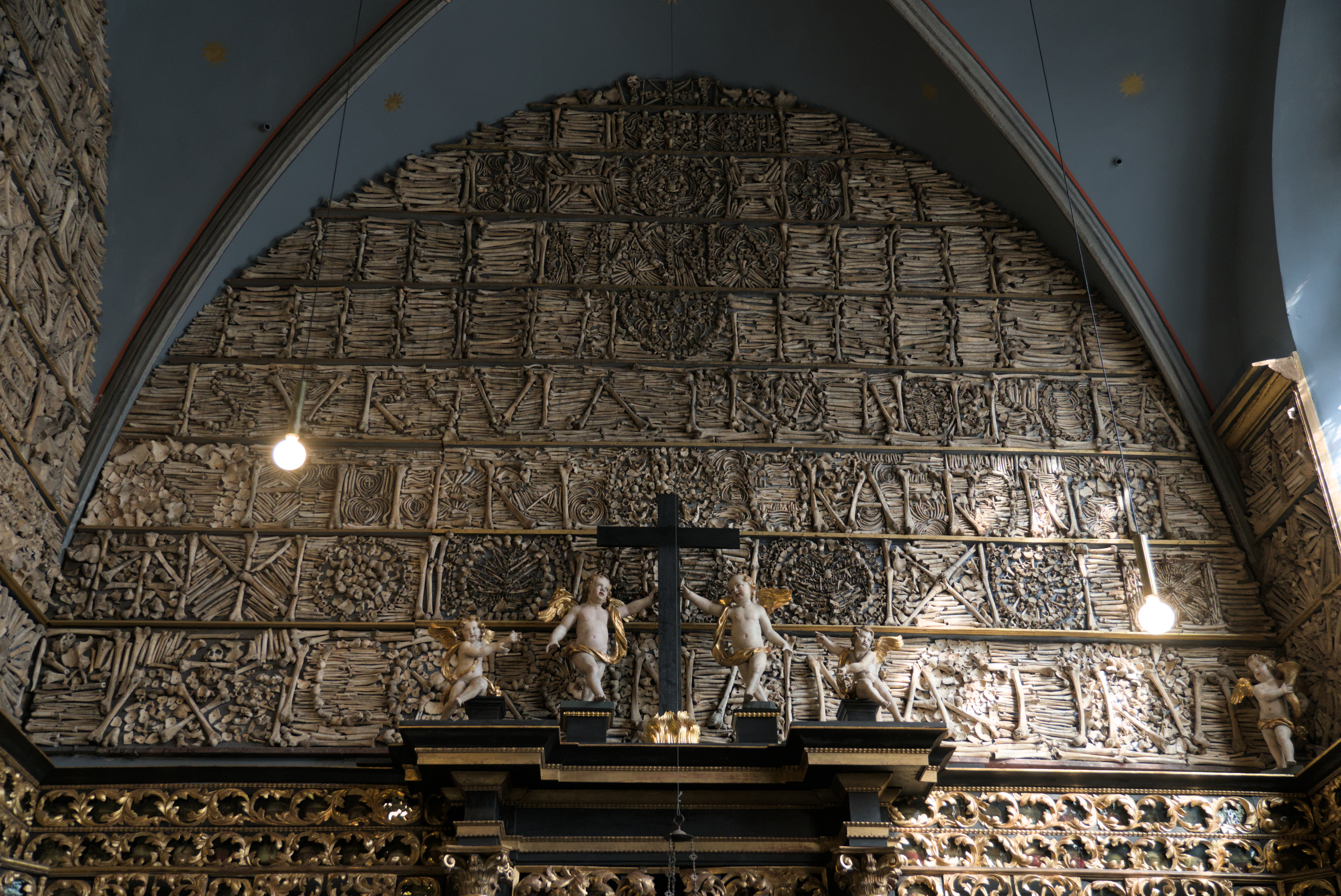
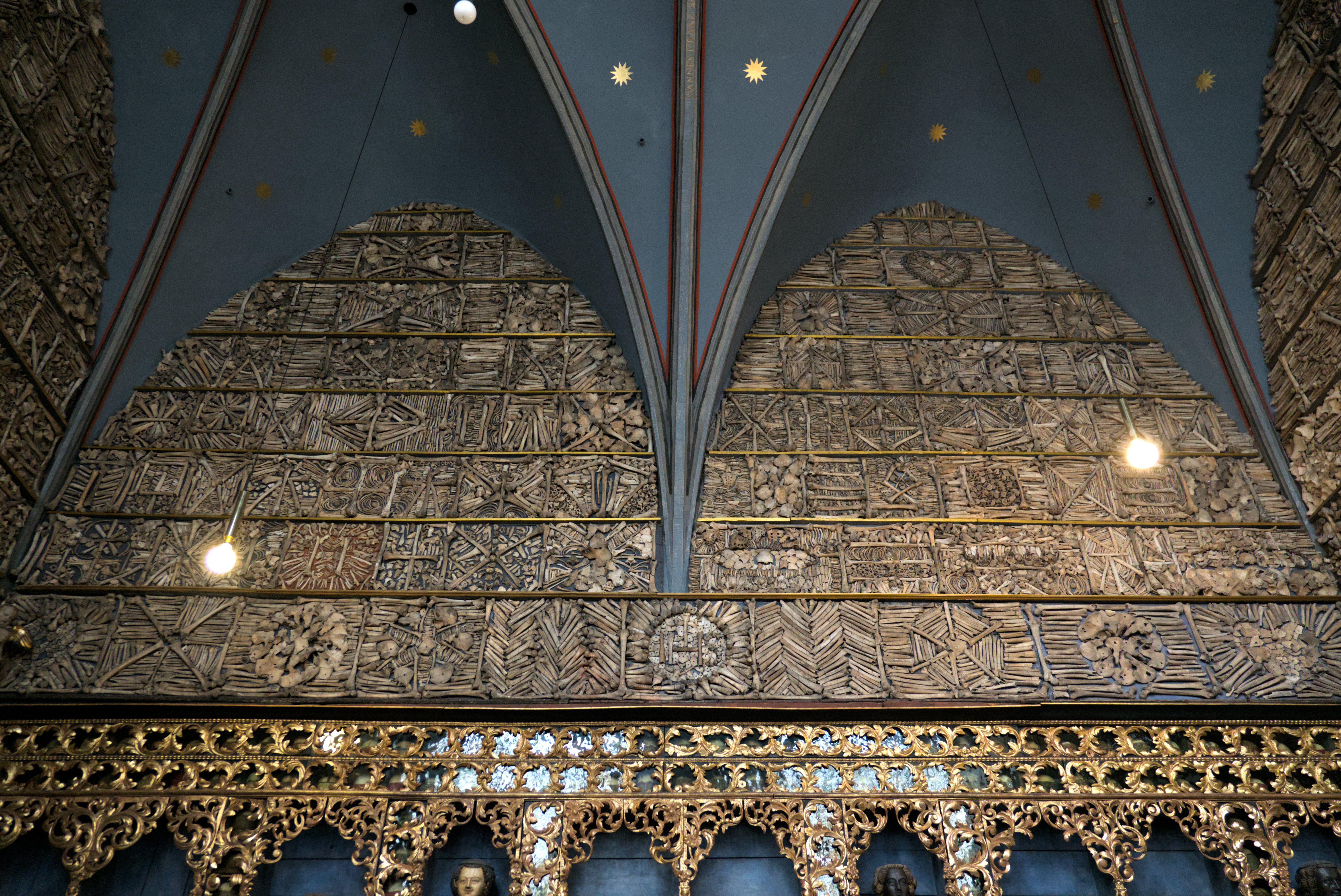
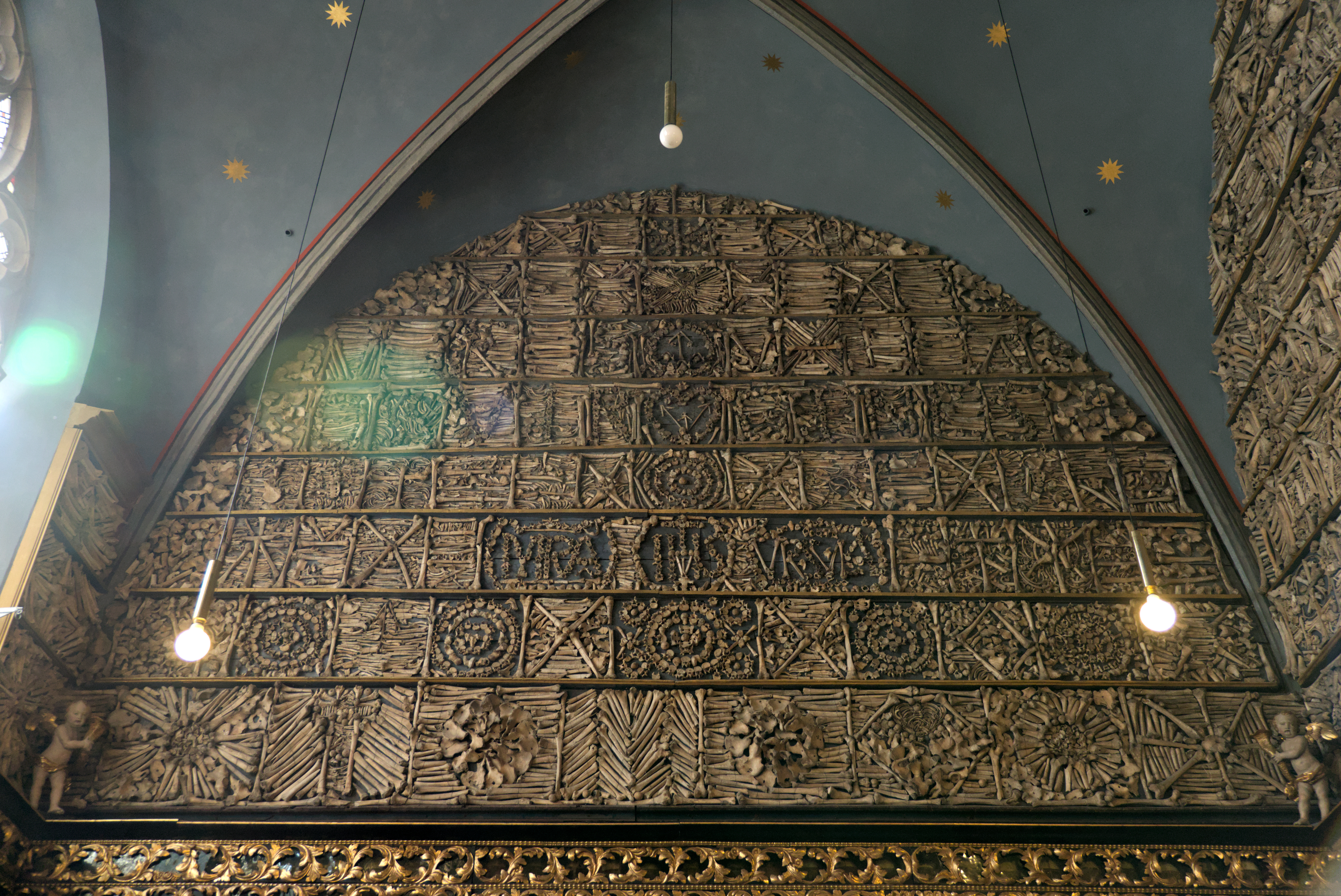
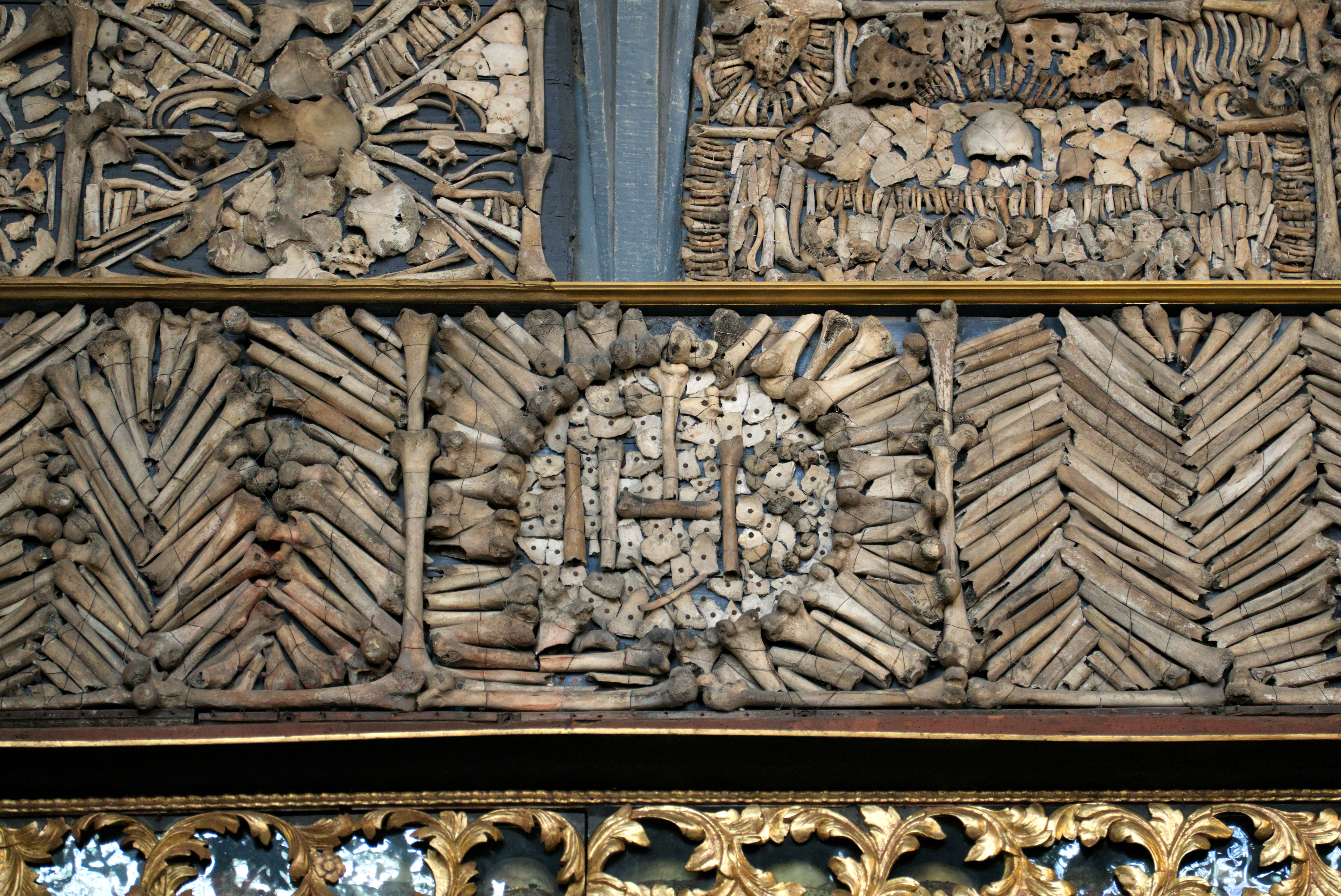
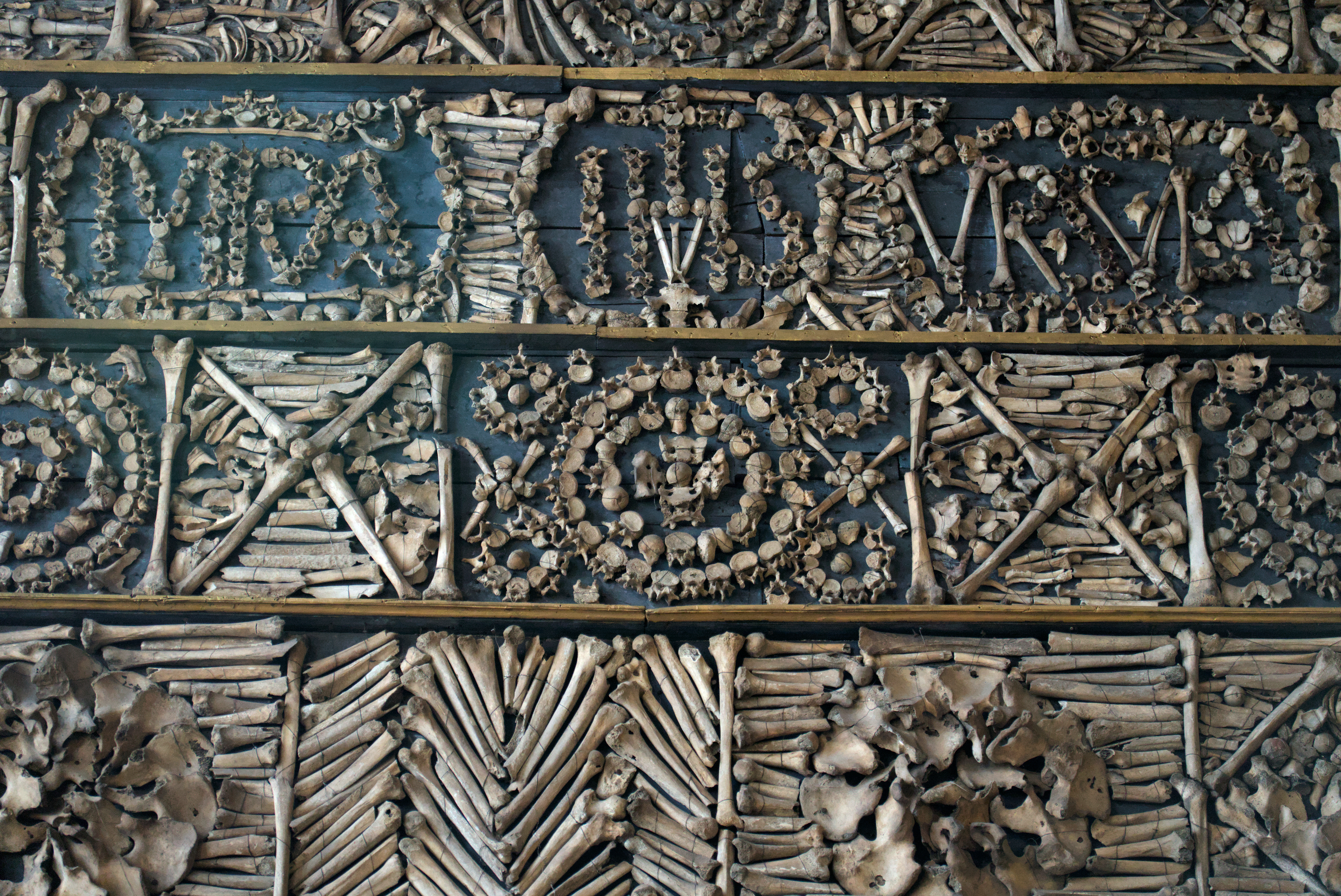
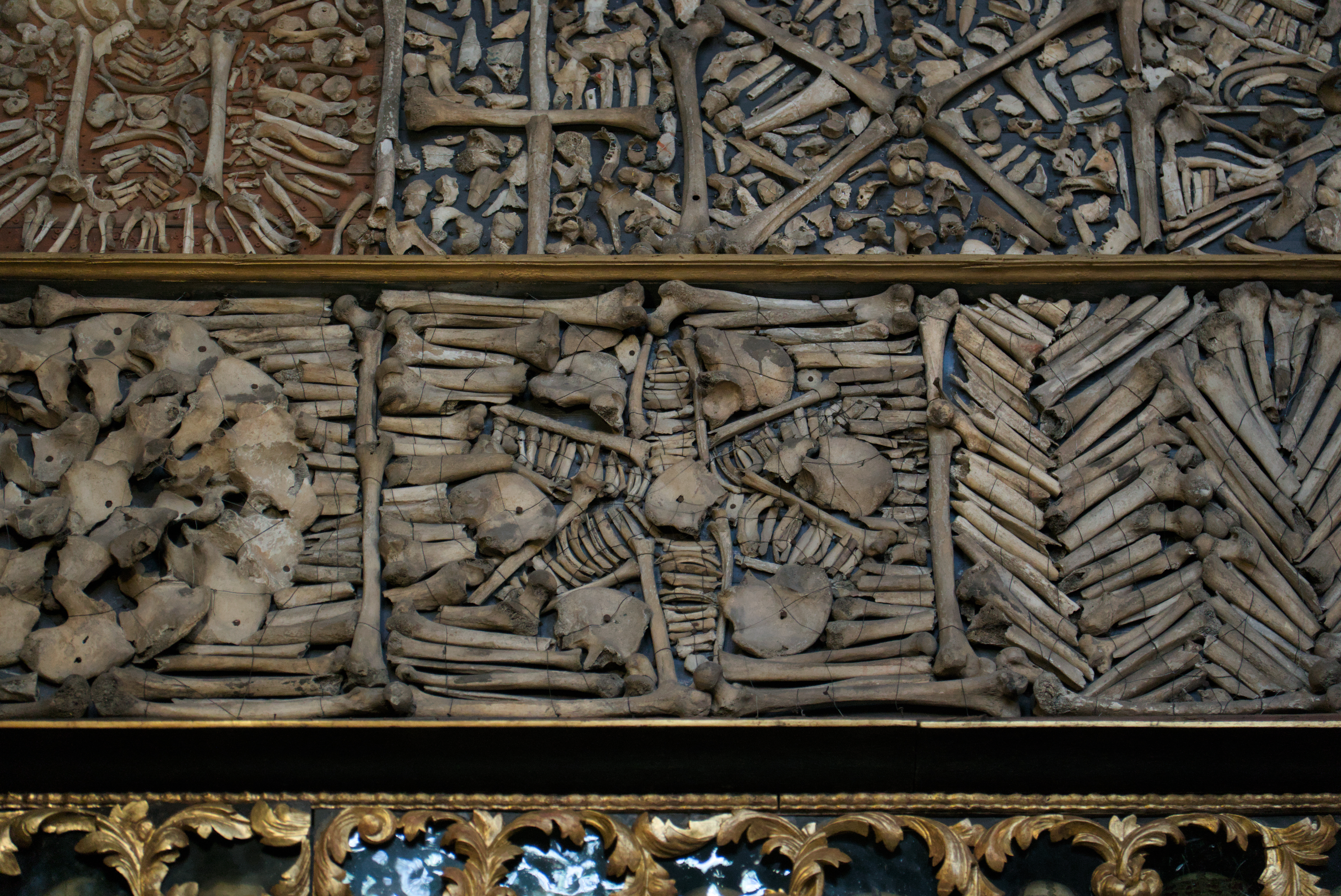
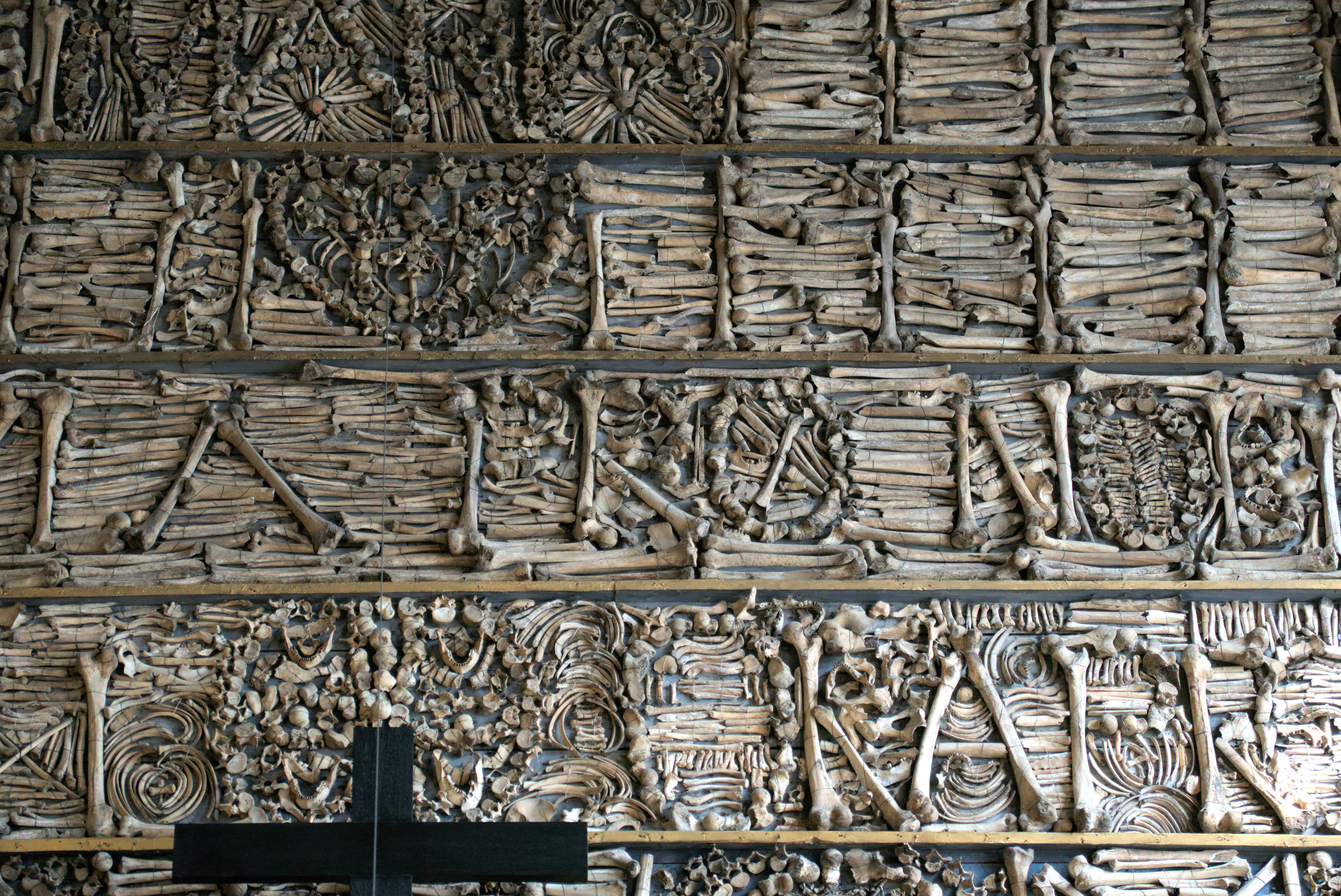
The largest ossuary north of the Alps, the Goldene Kammer (Golden Chamber) is decorated with the bones of, allegedly, St. Ursula and her eleven thousand travel mates, which are artfully arranged across the walls in geometric patterns, rosettes, and even words! Unlike most other relic displays I had seen before, where the relics are kept in some kind of encasement and usually only partially visible, this one puts many of the bones right out in the open, making the whole room a walk-in reliquary.

Golden Chamber
That’s me at the left, taking it in.

Golden Chamber
Golden Chamber
Golden Chamber

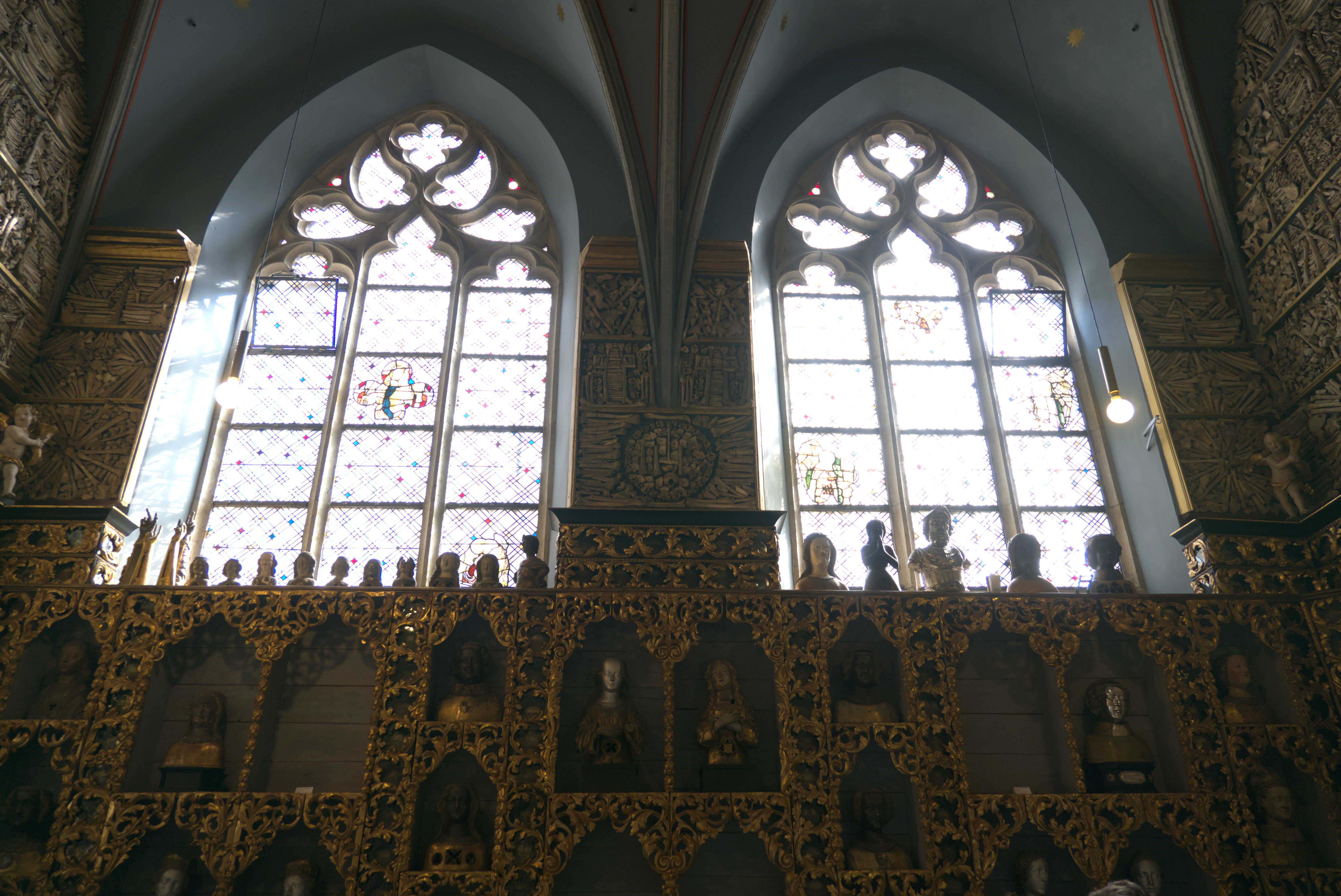
A Baroque marvel, the Golden Chamber was established on the south side of the church in 1643 through a donation by the imperial court councilor of the Holy Roman Empire Johann von Crane and his wife, Verena Hegemihler. It replaced a smaller medieval camera aurea (treasury and relic chamber), where the bones had previously been displayed. Crane and Hegemihler oversaw the design and construction of the space, with its ribbed, star-studded, sky-blue vault, and the arrangement of the bones into their present form.

Golden Chamber

Above the altar, tibias, fibulas, femurs, humeri, and other bones spell out “Sancta Ursula Ora Pro Nobis” (Saint Ursula, pray for us). Also rendered in bones are the name Etherius—Ursula’s fiancé, who converted to Christianity at her insistence and met her in Cologne to die with her—and a mention of the holy virgins.

Golden Chamber
Golden Chamber
Golden Chamber

Other sections of the wall use vertebrae, pelvic bones, ribs, shoulder blades, and so on to create ornamental designs like hearts, spirals, webs, flowers, and crosses.

Golden Chamber
“IHS” is a popular Latin acronym for “Iesus Hominum Salvator” (Jesus, Savior of Humankind).

Golden Chamber
Golden Chamber
Golden Chamber

Similar visual displays of bones in charnel houses, writes art historian Jackie Mann, had become increasingly common in Europe by the late fourteenth century.

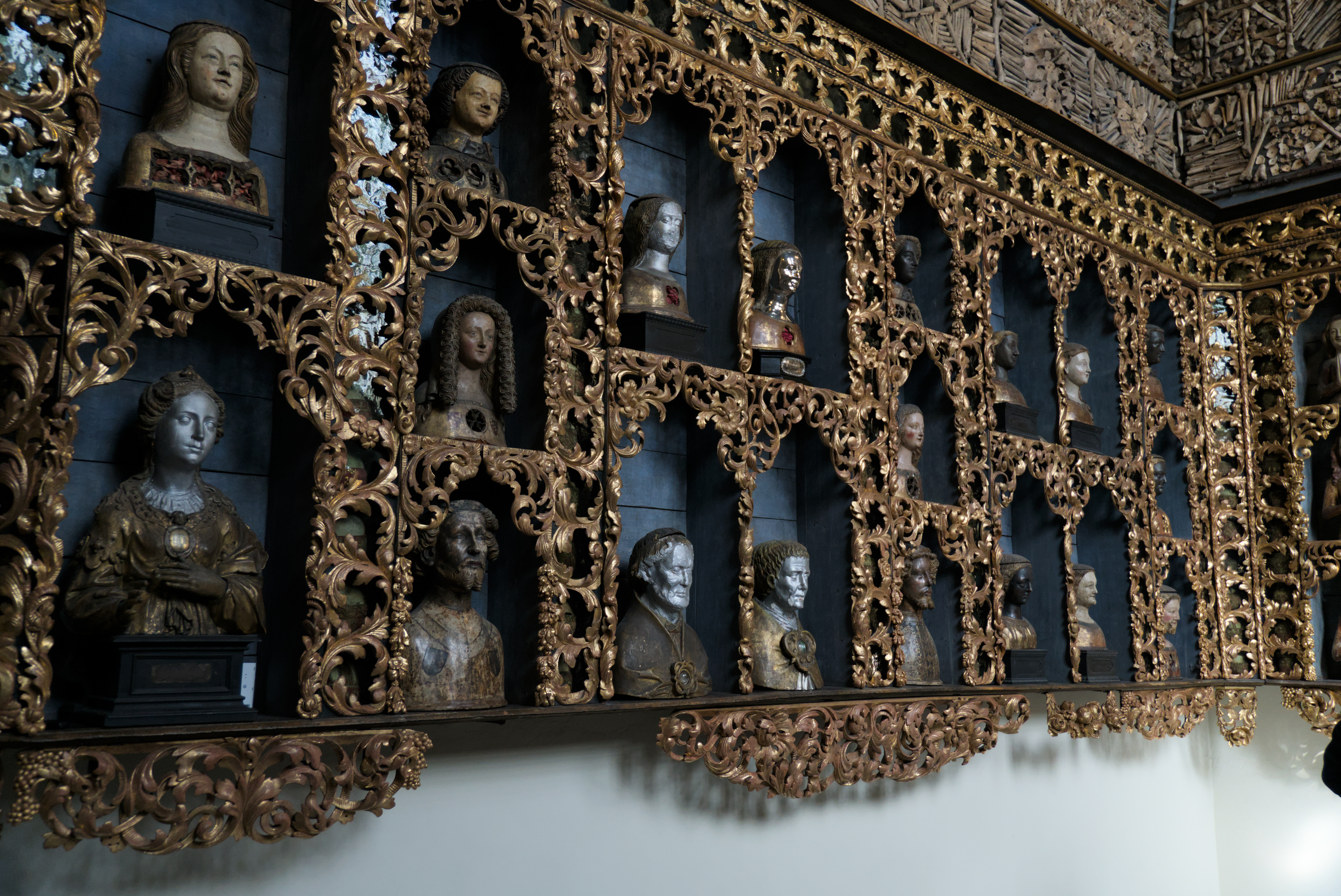
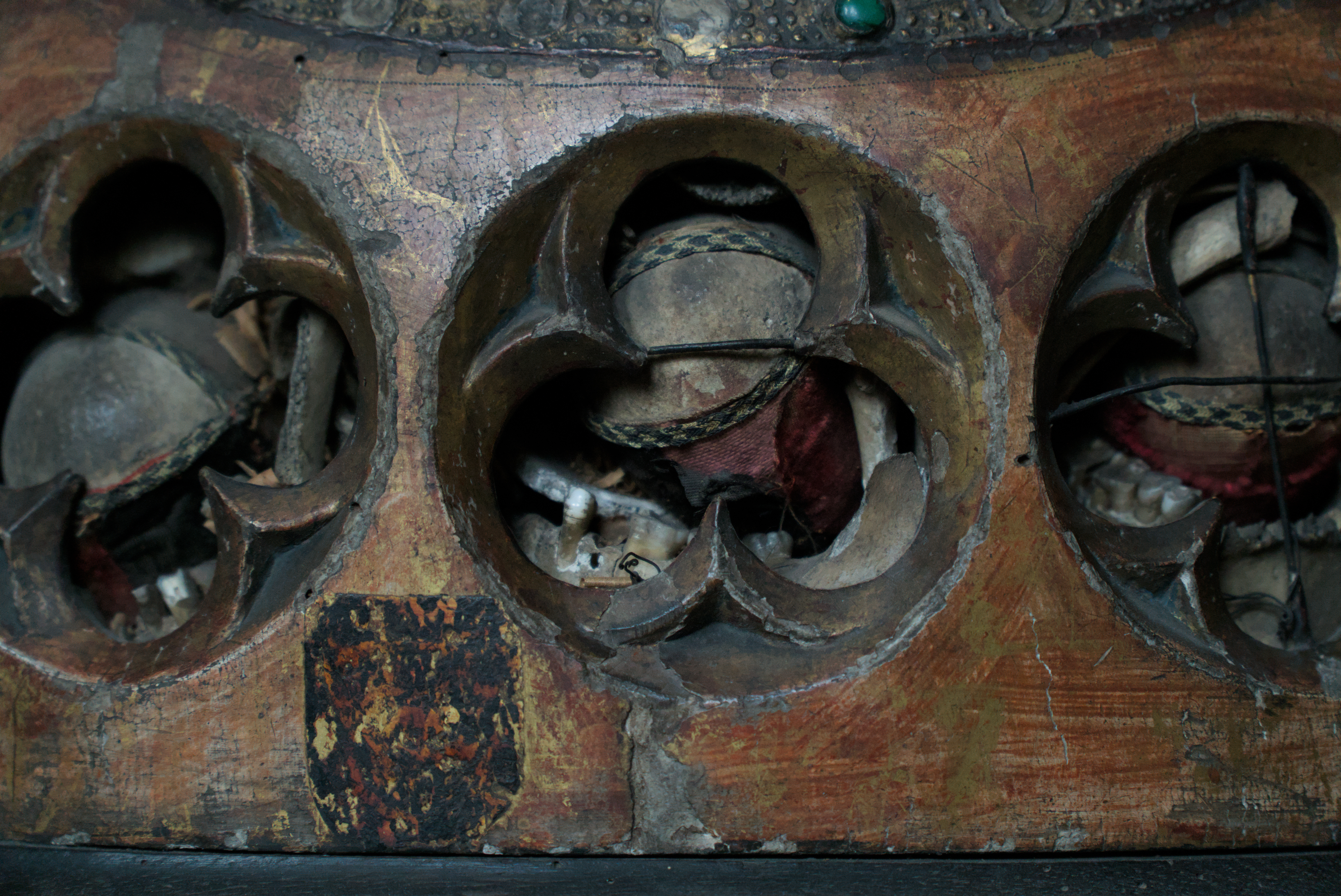
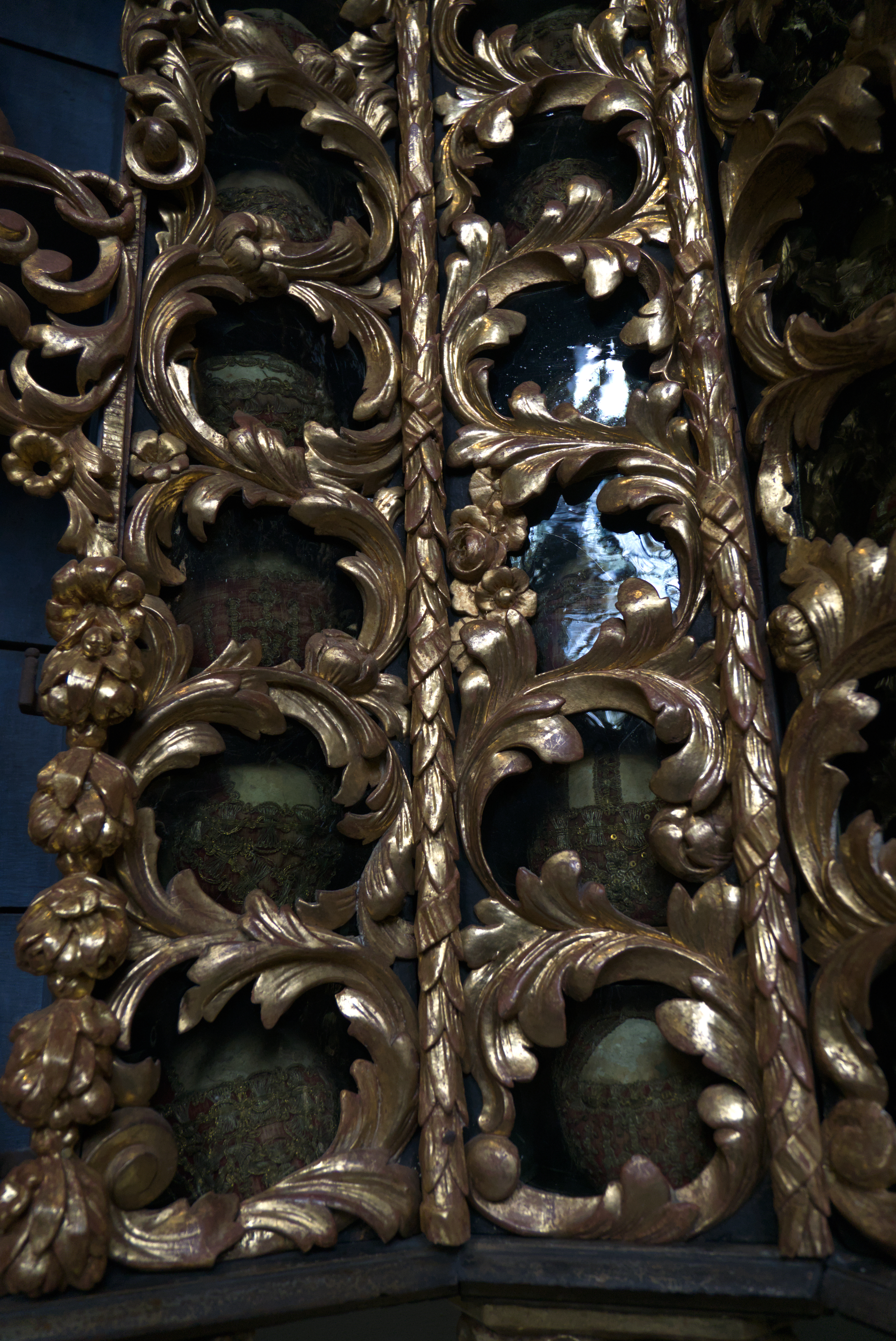
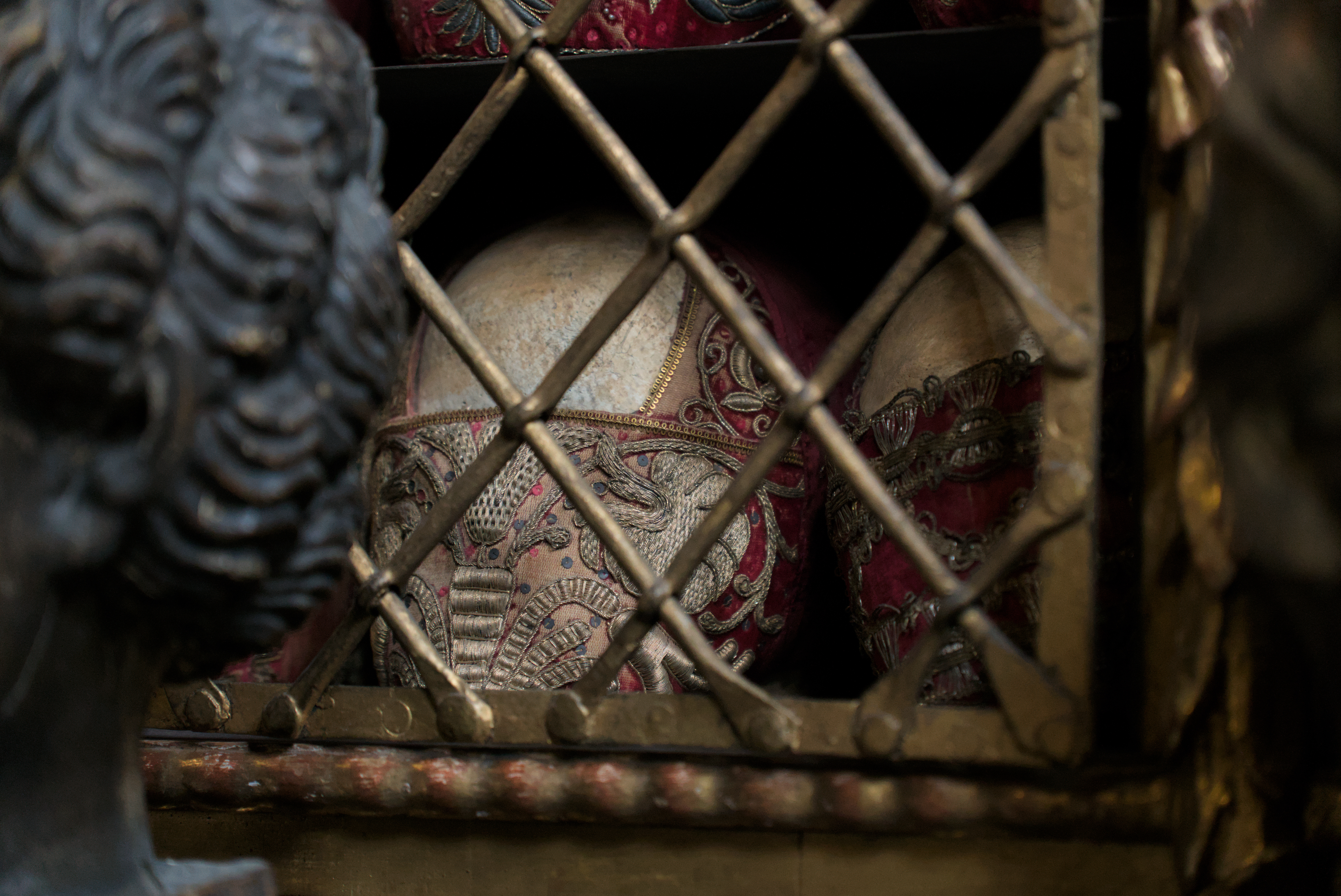
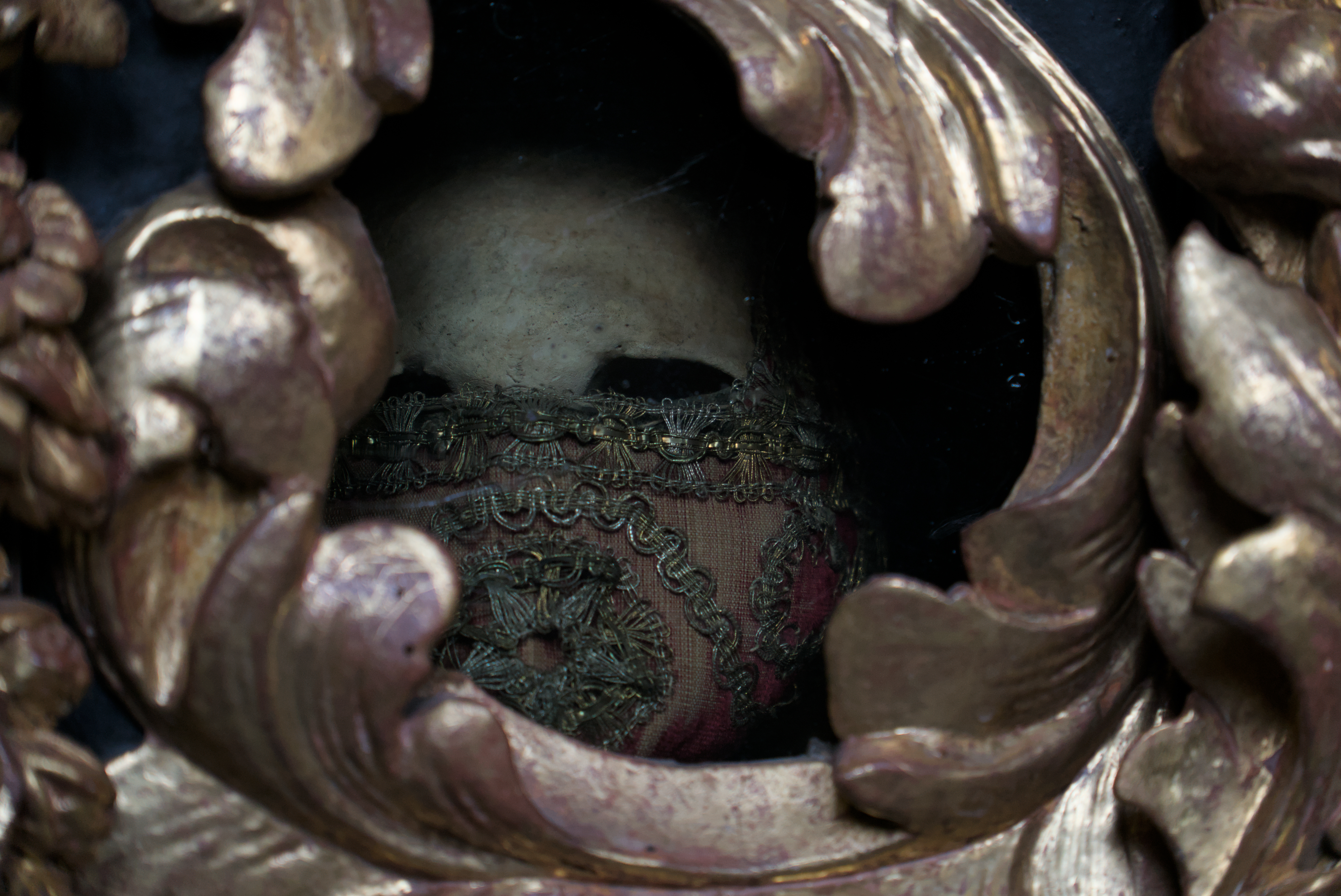
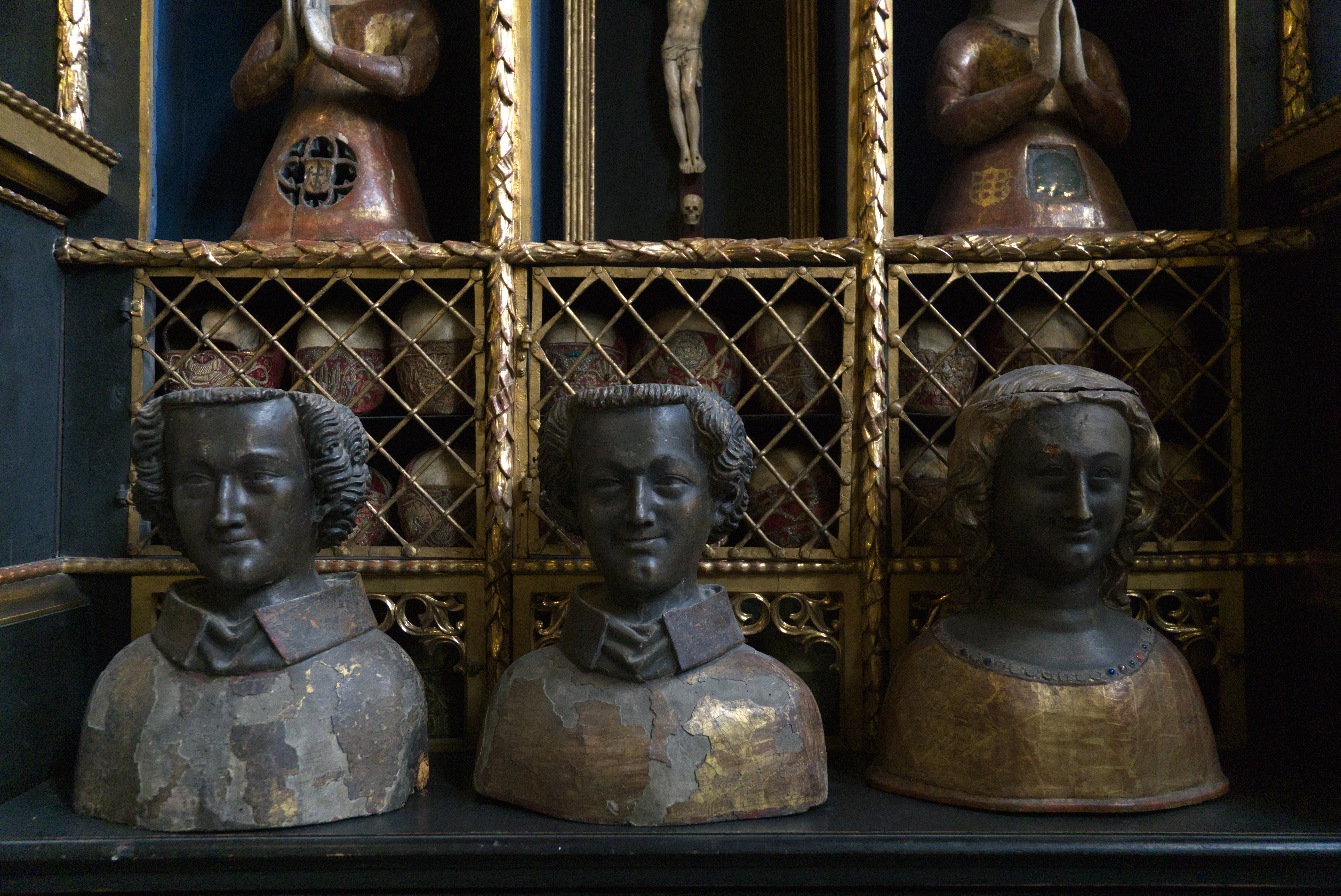
The shelving cabinets below the bone decor belong to the second phase of furnishings around 1700. They contain niches that house 112 reliquary busts (most of them produced between 1260 and 1400 and made of polychromed wood), as well as gilded acanthus tendrils that encompass some 600 skulls. Out of reverence, many of the skulls are at least partially wrapped in red velvet with gold and silver embroidery made by the nuns of the nearby Ursuline convent.

Golden Chamber
Golden Chamber
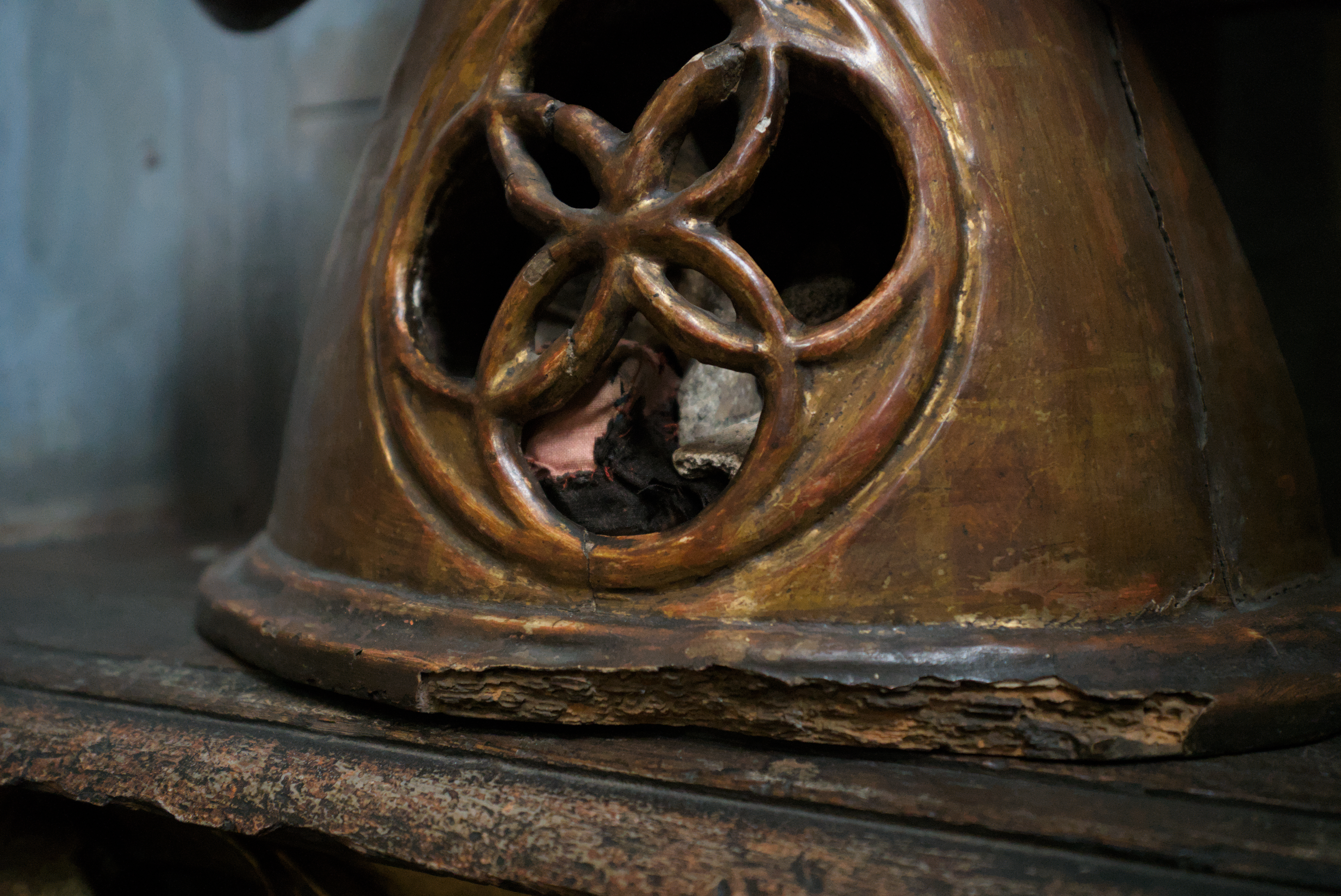
Inside a reliquary bust
Skulls
Skulls

Occasionally, where the wrapping has slipped, you’ll see an eye hole staring back at you.

Skulls

To account for the presence of men’s bones in the ancient Roman churchyard, the legend of St. Ursula was adapted in the twelfth century to include male martyrs—namely, Etherius and his retinue. That’s why the Golden Chamber contains several male busts alongside the female.

Golden Chamber

To the average person, the Golden Chamber is a weird, macabre spectacle. But for Catholics, displaying human bones is not meant to be creepy or horror-inducing. Rather, by bringing remnants of the dead into spaces of the living, we are reminded of: (1) our own mortality, (2) the community of saints that transcends time, and (3) the promise of universal, bodily resurrection (dem bones gonna rise again!).

Memento mori (“remember you will die”) was a common trope in seventeenth-century art and devotion, meant to increase one’s awareness of the fleetingness of life and to encourage one to live in light of heaven. Mann calls the Golden Chamber an “immersive memento mori.” Again, the traditional Christian summons to remember our mortality is not meant to frighten. It’s meant to inspire us to live whole and holy lives.

While death is an ending in one sense, it’s also an entry into life immortal. The Golden Chamber gathers together the fragments of local saints that had been scattered in ancient burial ruins, preserving them for the saints of later generations as a witness that our bodies will never be finally lost; they will be raised and renewed by God on the last day and reunited with our souls. Christians treat the remains of the deceased with honor in recognition that our bodies—including the framework of bones that support our soft tissues, protect our organs, enable our movement, store minerals for our use, and produce our blood cells—are not just temporary shells encasing who we really are, but rather are a part of who we are. Hence why we proclaim, in the Apostles’ Creed, that “we believe . . . in the resurrection of the body.”

Memorial for the Martyrs of Today

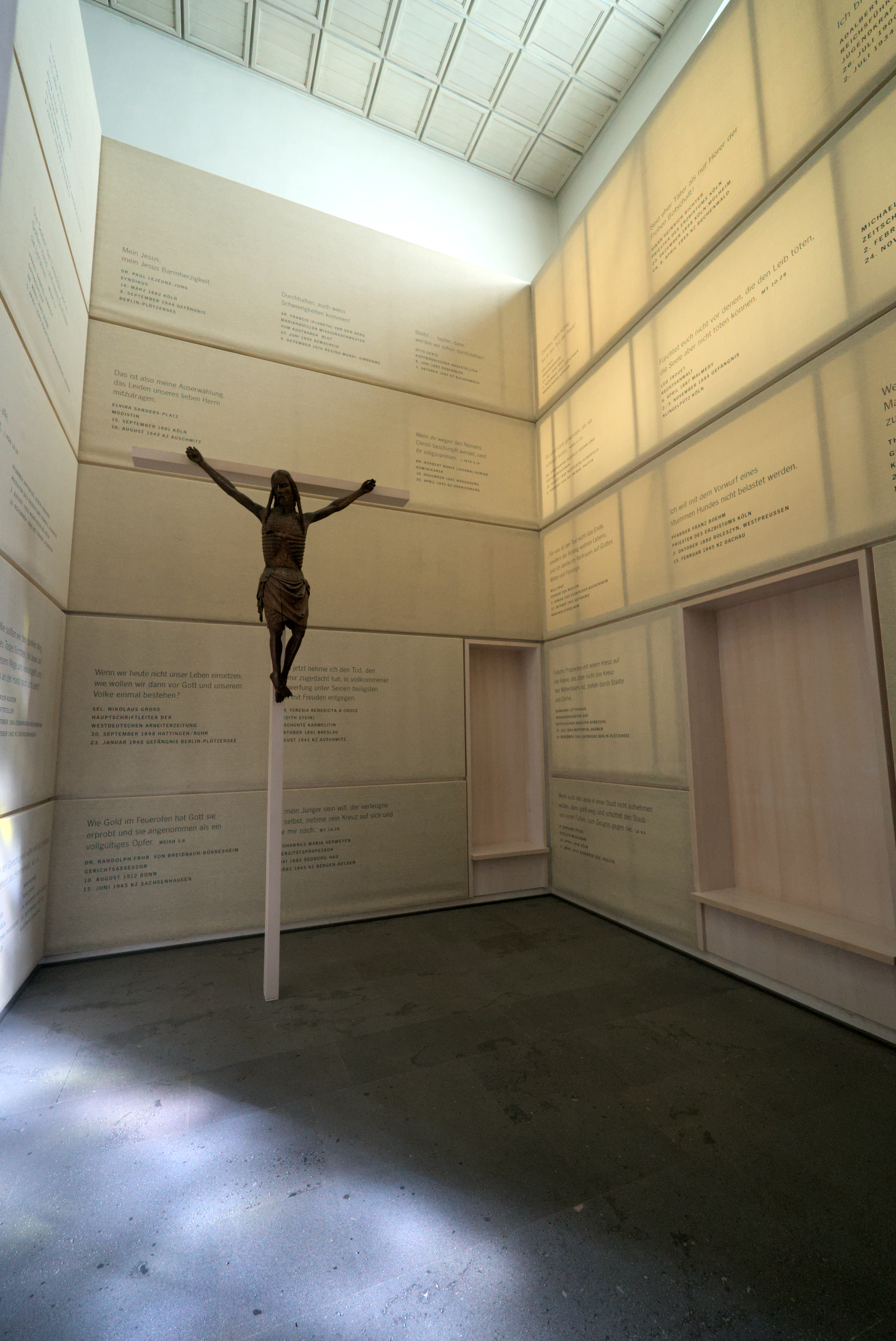
While the Golden Chamber is the primary draw for visitors to the Basilica of St. Ursula, there are other sights in the church worth spending time with, ones I was not expecting. One of them is the Gedenkstätte für die Märtyrer der Gegenwart (Memorial for the Martyrs of Today), a chapel in the south transept that commemorates the Christians in Cologne, both religious and lay, who were killed for resisting the Nazi regime—or, in the case of Sr. Teresa Benedicta of the Cross (Edith Stein) and Elvira Sanders-Platz, for being ethnically Jewish.

Memorial for the Martyrs of Today
Gedenkstätte für die Märtyrer der Gegenwart (Memorial for the Martyrs of Today), designed and built by the firm Kister Scheithauer Gross, 2003–5. South transept, Basilica of St. Ursula, Cologne.

Memorial for the Martyrs of Today

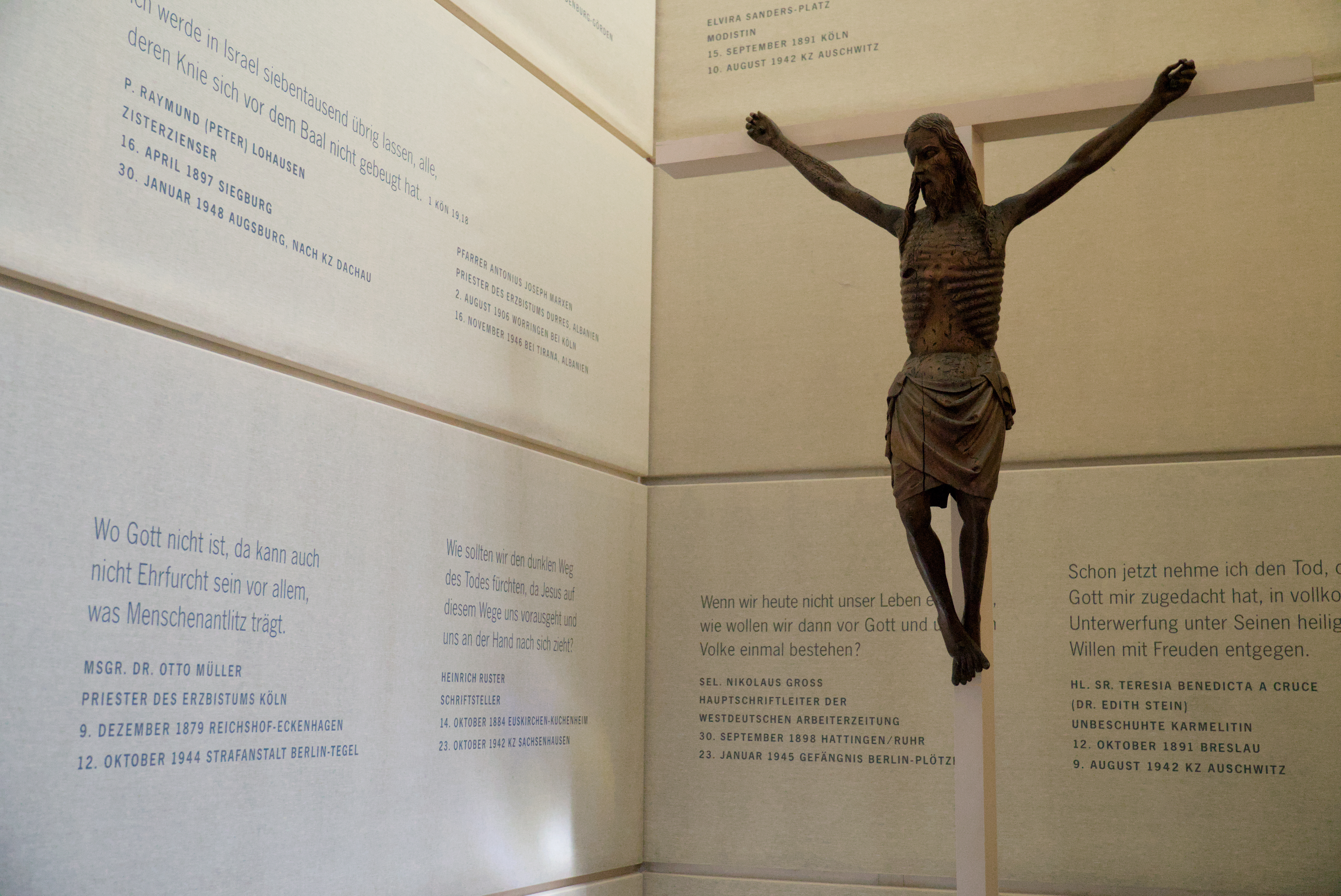
Made by the architectural and design firm Kister Scheithauer Gross, the chapel consists of a double-shelled, slightly transparent canvas construction printed on the inside with the names and dates of the martyrs, as well as quotes they gave before their deaths. Sunlight enters from the window to the right of the chapel, causing the space to glow. There’s a small bench on each of the three sides, for people to sit and pray or reflect.

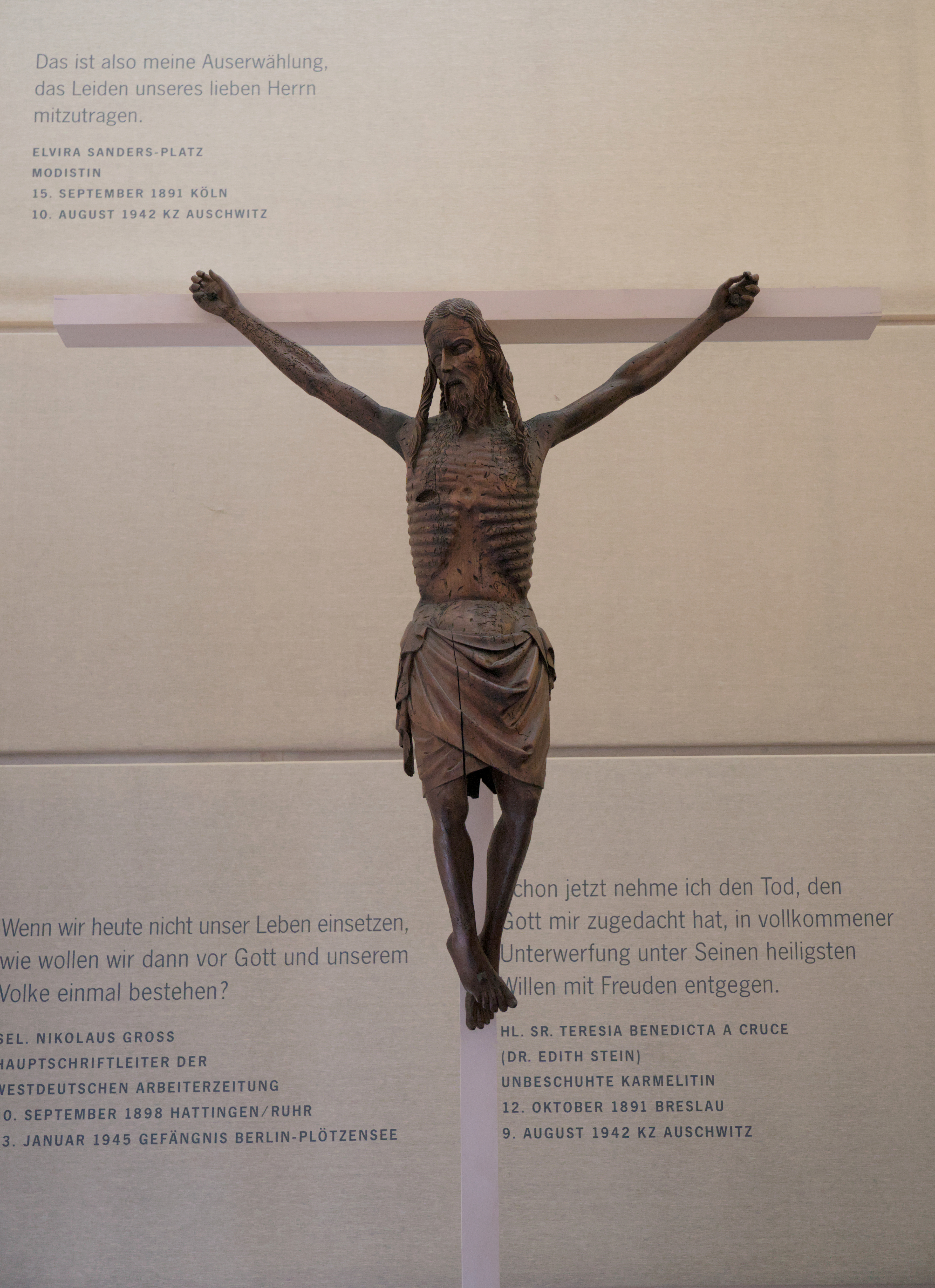
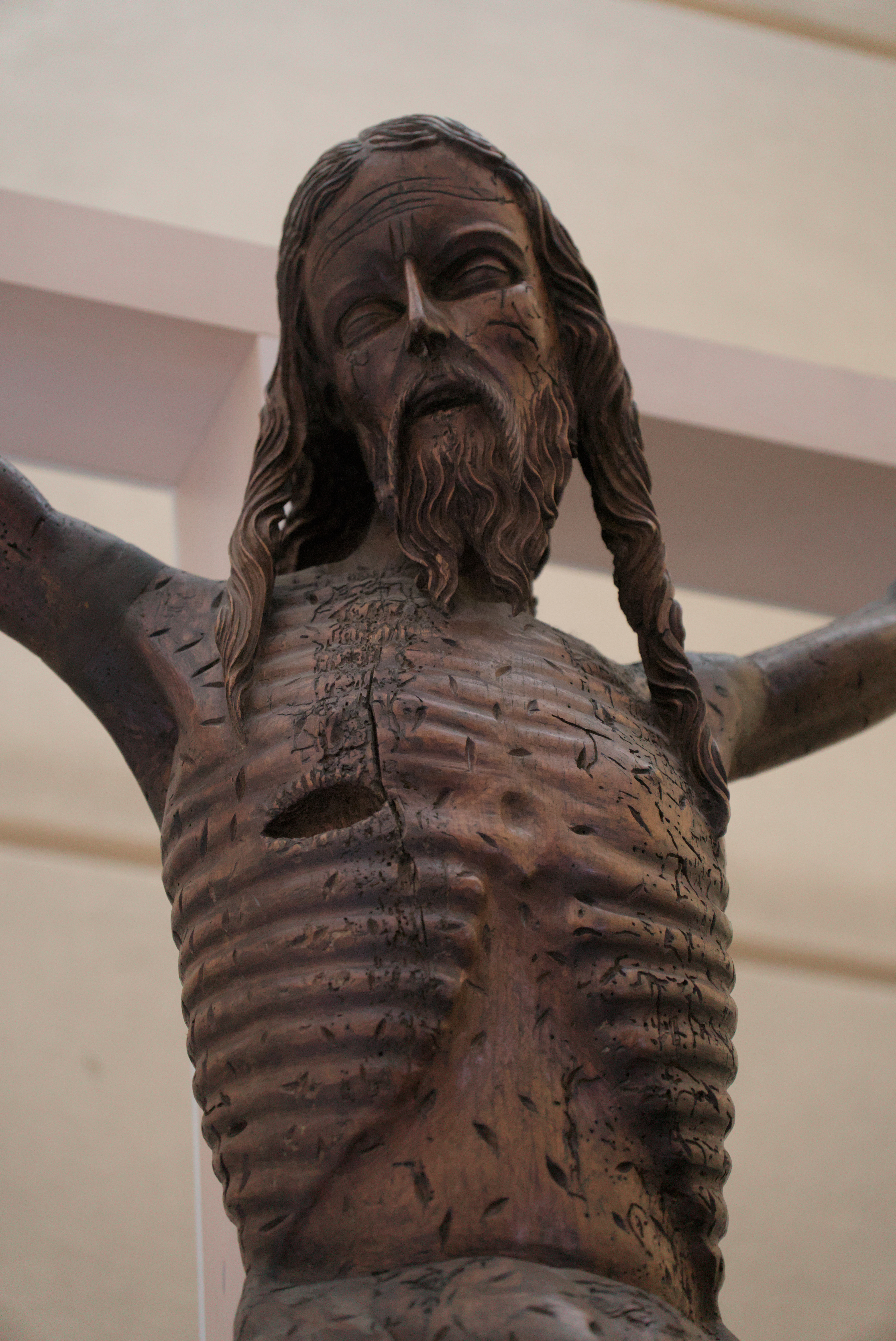
In the center is a life-size wood crucifix. The gaunt Christ figure is pierced all over and bears a deep wound in his side where the centurion’s spear went through. Like those whose names surround him, Jesus preached and pursued love and justice, ultimately laying down his life—a loss that God turned to gain in the Resurrection and in the redemption of the world.

A language barrier prevented me from effectively asking the staff person, or understanding the answer, whether the crucifix was carved in the early 2000s specifically for the chapel, or if it’s medieval. There’s no info inside the church about this chapel.

Crucifix
Crucifix

The Memorial for the Martyrs of Today is an example of what Christian martyrdom looked like in Cologne in the twentieth century. Fr. Otto Müller, Br. Norbert Maria Kubiak, writer Heinrich Ruster, medical student Willi Graf, Catholic Youth leader Adalbert Probst . . . The stories of the many individuals who were executed for subverting Hitler, for calling out his evils, in the name of Christ are far more compelling to me than the fabulous and convoluted story of an ancient princess killed in a land invasion and then heroized—for her virginity?

Contemporary Stained Glass

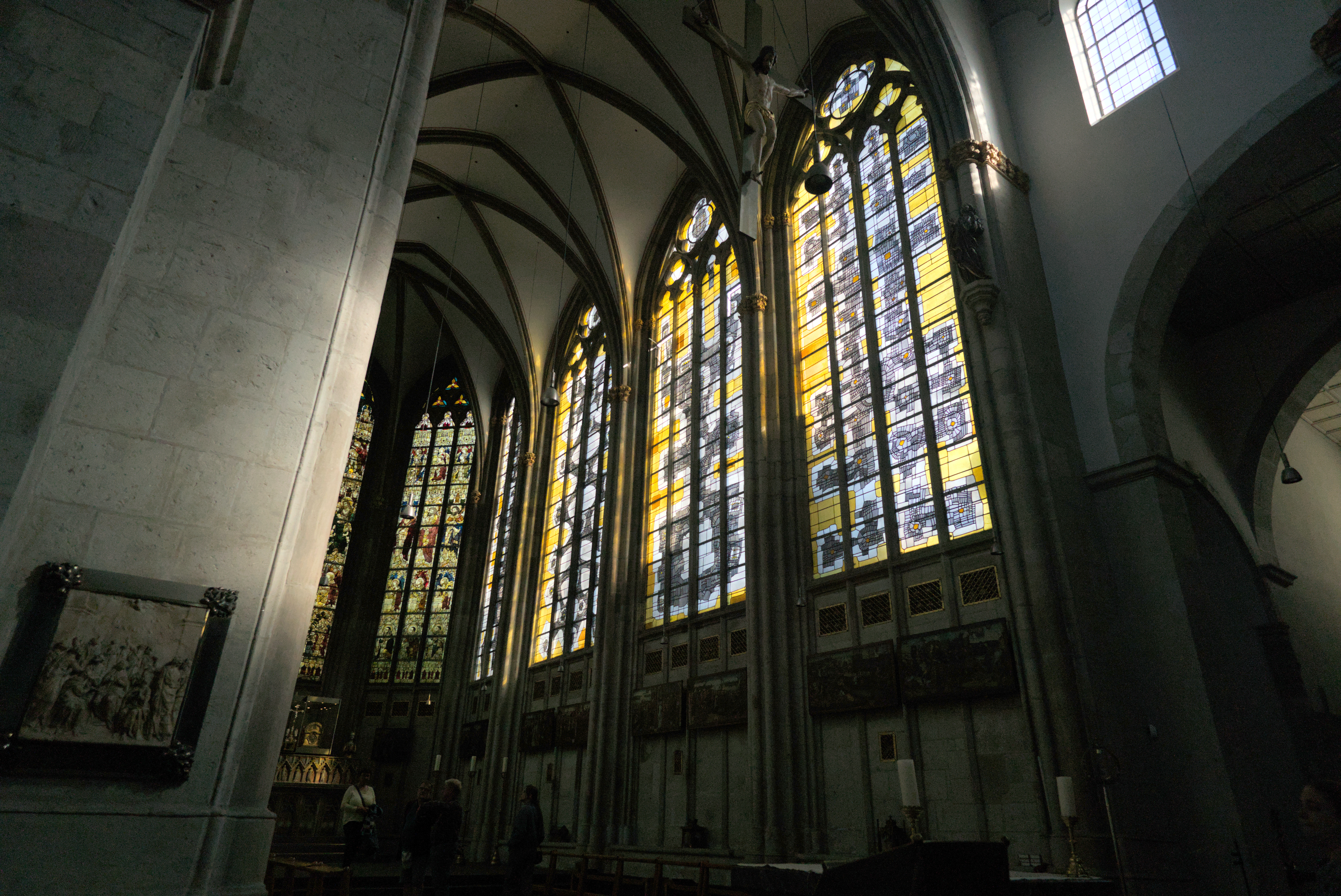
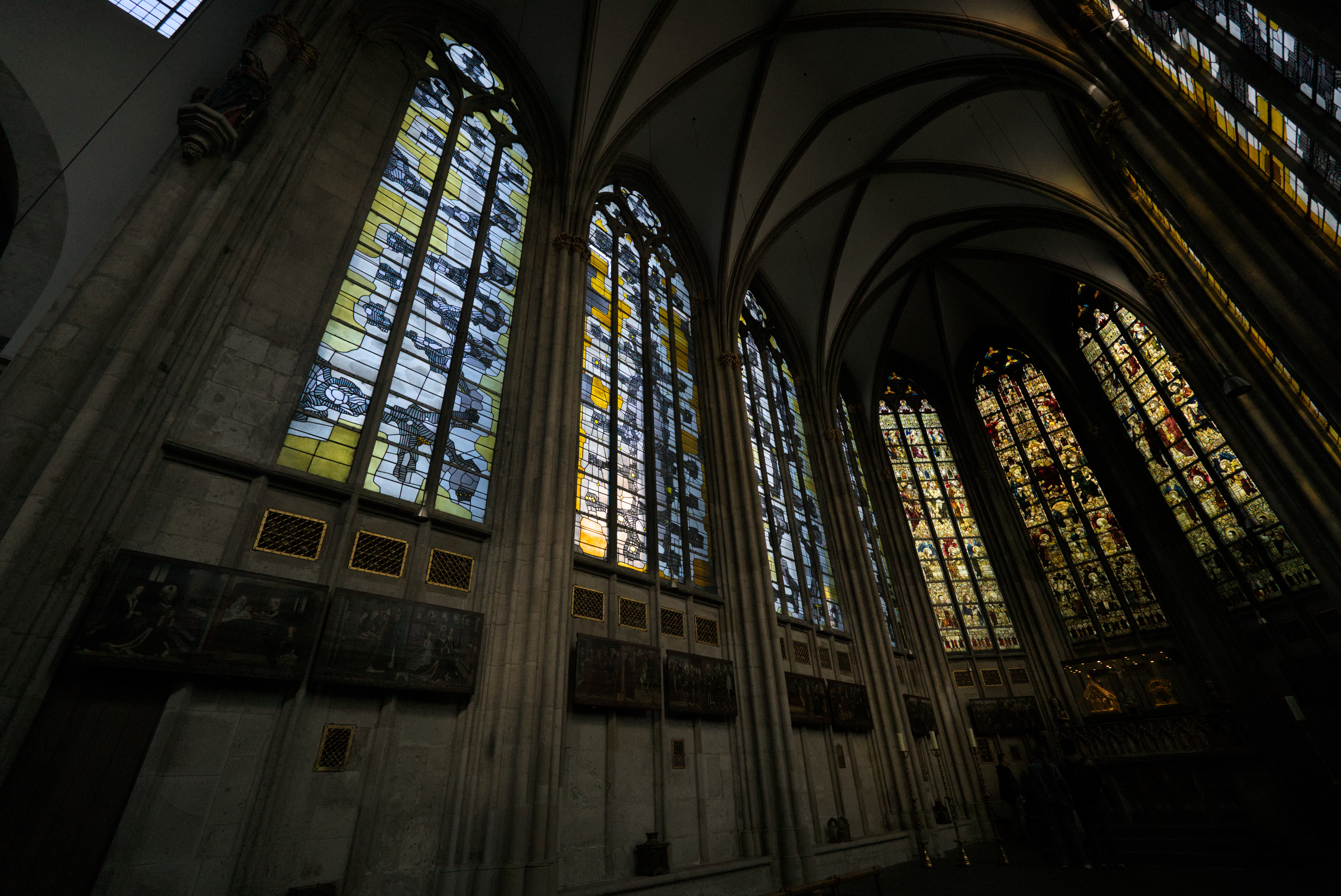
I also liked the contemporary stained glass in the church. In the choir, there’s a set of eight windows by Wilhelm Buschulte—abstract compositions in yellow, white, and gray.

Wilhelm Buschulte
Stained glass windows by Wilhelm Buschulte (German, 1923–2013), 1962, choir, Basilica of St. Ursula, Cologne

Wilhelm Buschulte

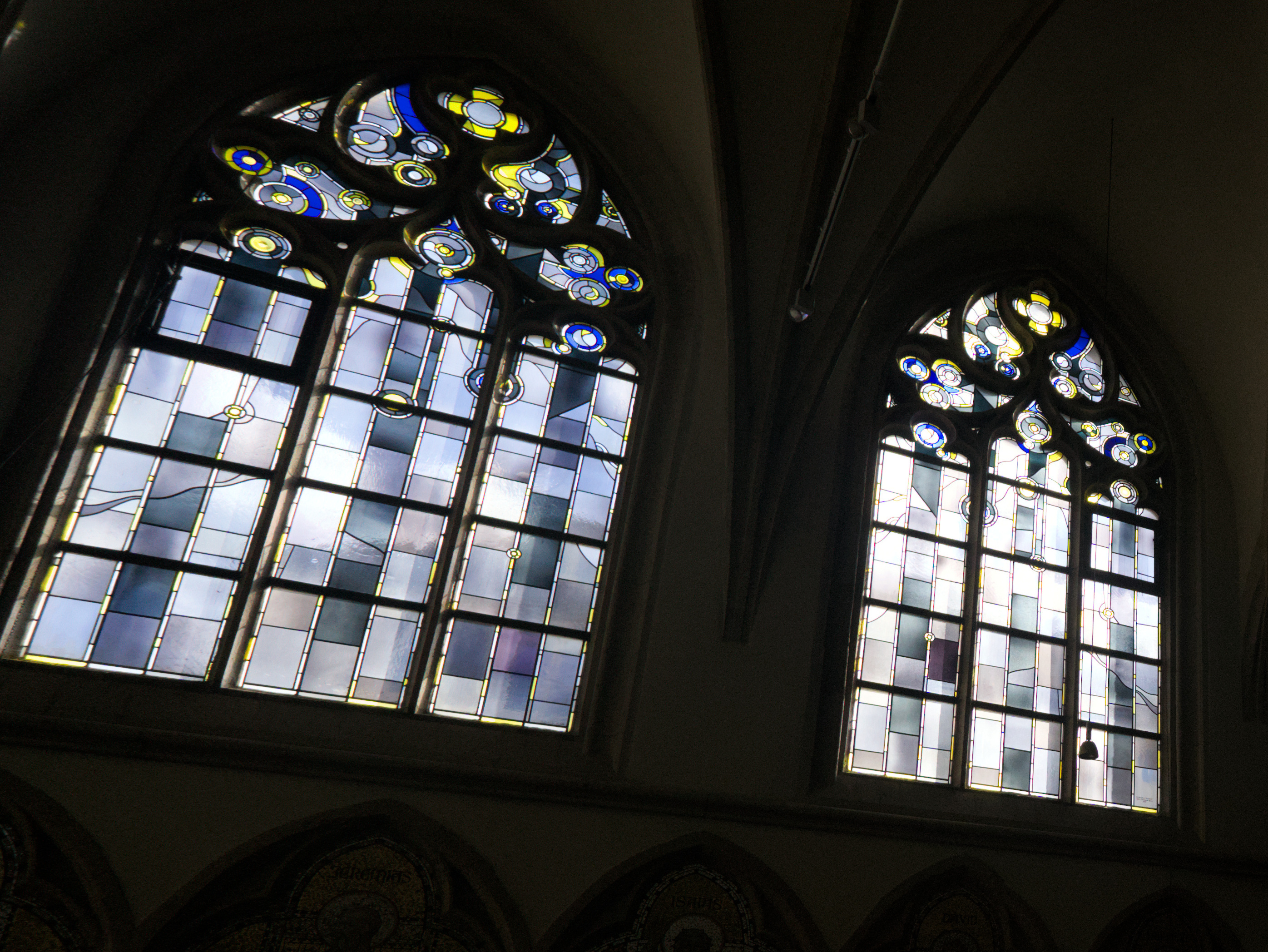
In the south aisle are two round-arched windows by Will Thonett, also abstract: a grid of blues, grays, and lavender, with yellow circles and thin vertical bands.

Will Thonett
Stained glass windows by Will Thonett (1931–1973), 1967, south aisle, Basilica of St. Ursula, Cologne

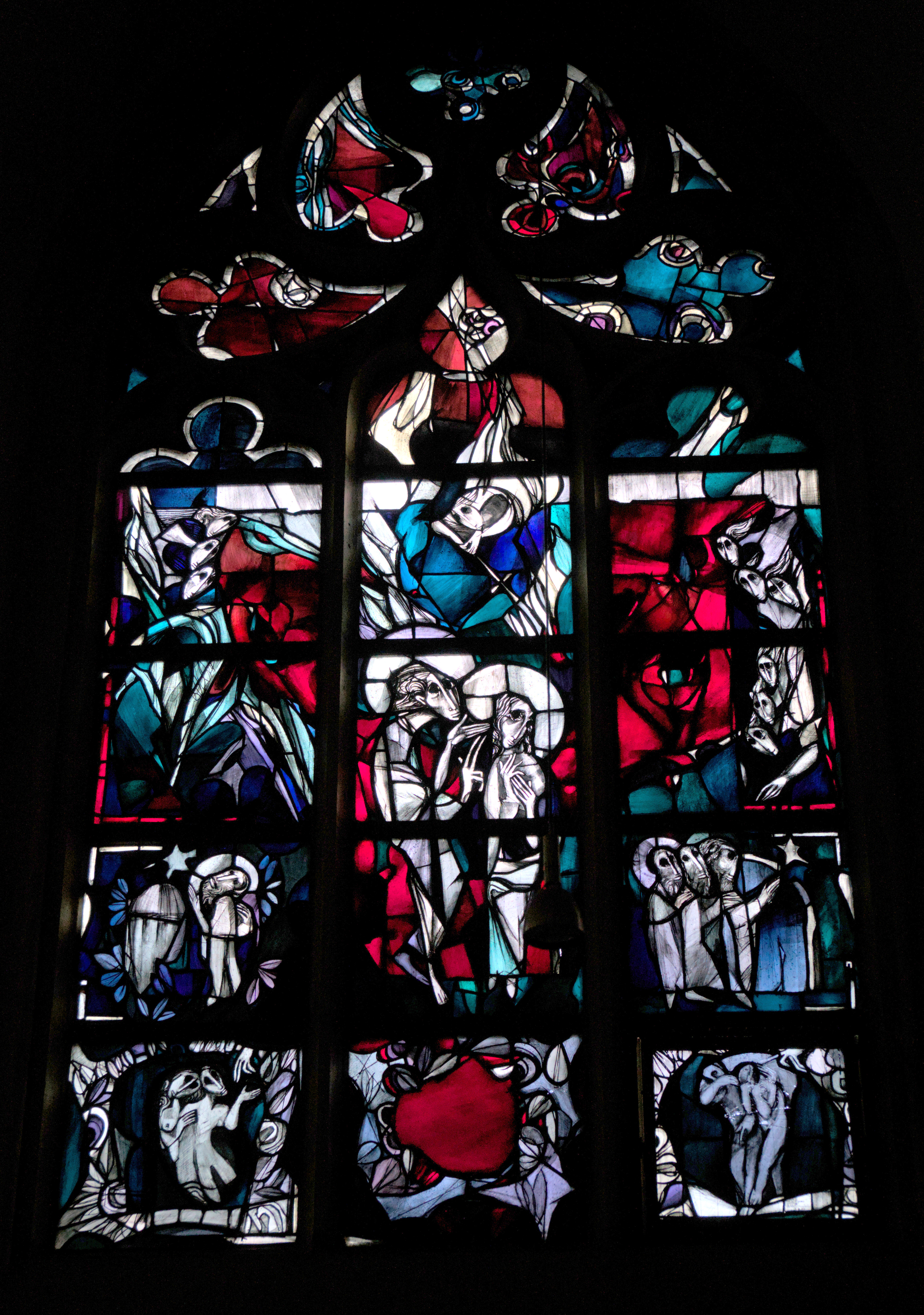
To the right of these are three Mary-themed windows by Hermann Gottfried. The primary scene of the first one is the Annunciation. A giant red rose appears in the background, probably a reference to Mary as the Rosa Mystica. Below this scene, to the left, is the Creation of Adam and Eve, and to the right, the Expulsion from Paradise; these contextualize Christ’s conception in the greater narrative of scripture. The peripheral scenes in the middle register show the magi following the star to Bethlehem.

Hermann Gottfried_Annunciation
Stained glass window by Hermann Gottfried (German, 1929–), 1984, south aisle, Basilica of St. Ursula, Cologne

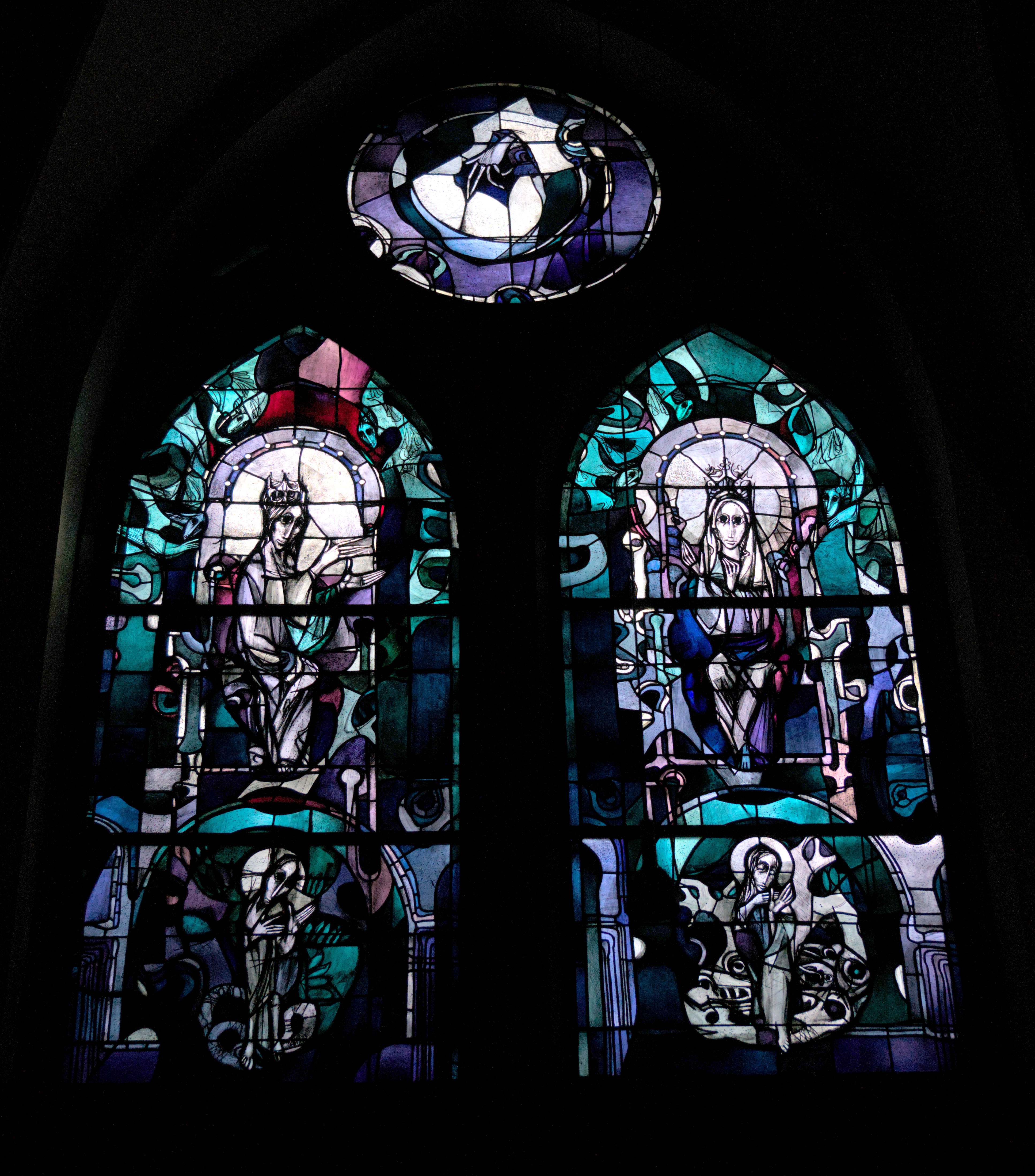
The central window portrays the Coronation of Mary. I believe both figures in the left lancet are Christ—crowning his mother as Queen of Heaven, and at the bottom, crushing the serpent, as the protoevangelium in Genesis 3:15 prophesied. Beneath the enthroned Mary on the right is a smaller vignette, which I think may be Mary again, also stepping on the serpent’s head, since by her cooperation with God’s plan, she shares in the victory over Satan. This imagery is also related to Woman of the Apocalypse described in Revelation 12, whom Catholics interpret as Mary. The hand of God dispenses blessing from above.

Hermann Gottfried_Coronation of the Virgin
Stained glass window by Hermann Gottfried (German, 1929–), 1984, south aisle, Basilica of St. Ursula, Cologne

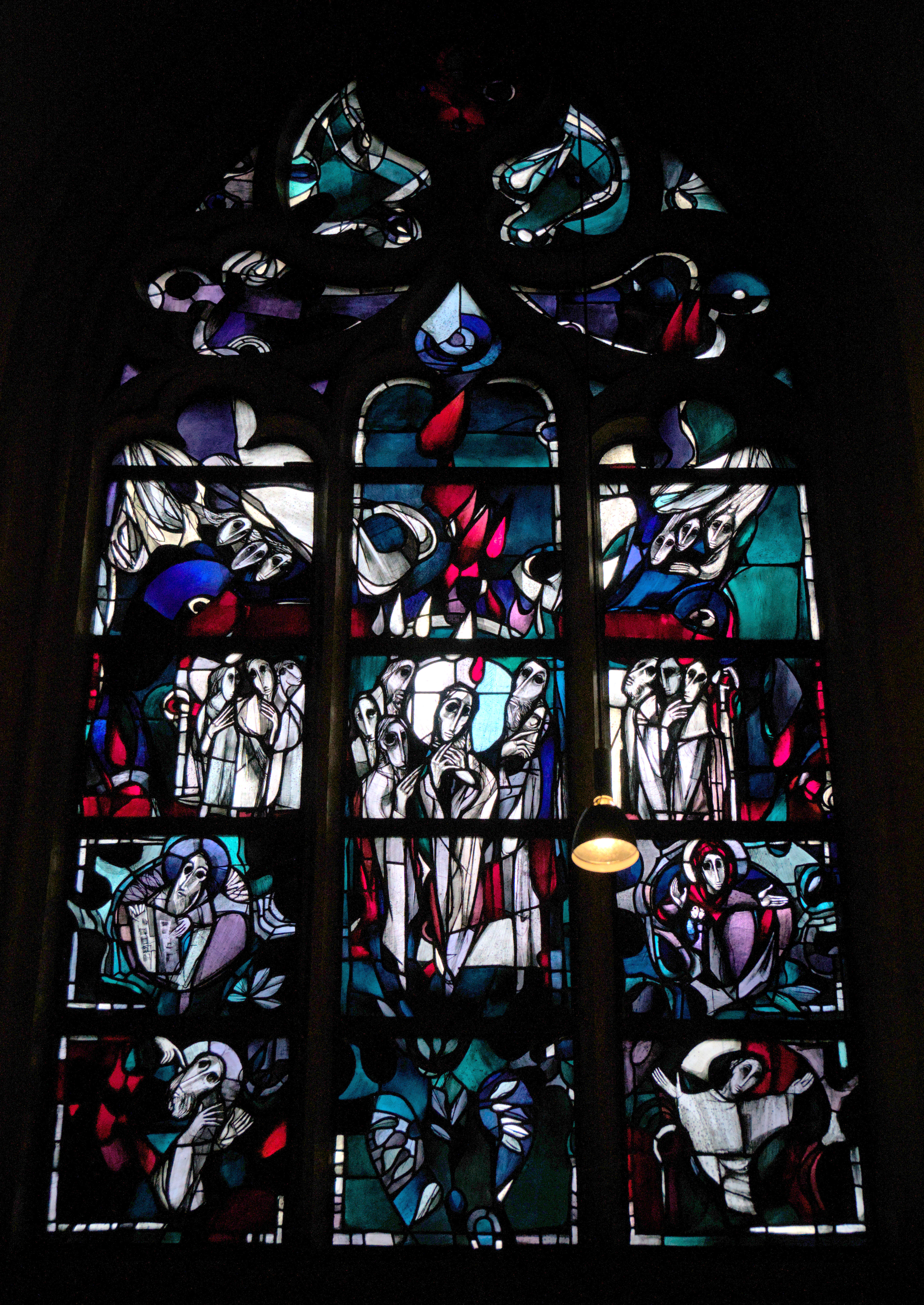
The final window in this trio portrays the Descent of the Holy Spirit at Pentecost. The two quadrants at the bottom right show Moses before the burning bush, in which Mary appears; Catholic teaching compares Mary to the burning bush of Exodus because for nine months she held the fire of divinity within her womb (God incarnate) and was not consumed. On the left Moses is receiving the tablets of the law on Mount Sinai, an event often read in parallel with the story of Pentecost in Acts 2, where God writes his word not on stone but on people’s hearts by giving his Spirit to dwell within them.

Hermann Gottfried_Pentecost
Stained glass window by Hermann Gottfried (German, 1929–), 1984, south aisle, Basilica of St. Ursula, Cologne


If you’re ever in Cologne, I encourage you to include the Basilica of St. Ursula on your itinerary. Entry to the church is free, but the Golden Chamber costs €2 (only cash is accepted, I believe). There are six large standing posters in the narthex that provide a timeline, in German, of the church’s history, and when I was there, there were two attendants who were available to answer questions, one of whom spoke some English.

For more comprehensive photos of the church’s art and architecture, see https://www.sakrale-bauten.de/kirche_koeln_st_ursula.html and https://www.winckelmann-akademie.de/wp-content/uploads/Koeln_St._Ursula.pdf.