Rainer Maria Rilke (1875–1926) was a primarily German-language lyric poet, playwright, and short story writer. Born of Catholic parents in Prague, then part of the Austro-Hungarian empire, he came to reject church dogma as an adult, though he maintained a lifelong fascination with Christian imagery and biblical stories. His volumes of poetry include Das Stunden-Buch (The Book of Hours) (1899–1903), about the search for God; Das Buch der Bilder (The Book of Images) (1902–6); Das Marienleben (The Life of Mary) (1913), a thirteen-poem cycle about the Virgin; the Duineser Elegien (Duino Elegies) (1922), which weigh beauty and existential suffering; and Sonette an Orpheus (Sonnets to Orpheus) (1922). After Rilke’s death from leukemia, a young mentee of his, Franz Xaver Kappus, compiled ten of the letters Rilke had written to him about creativity, the poetic vocation, and the inner life; published as Briefe an einen jungen Dichter (Letters to a Young Poet) (1929), this correspondence has influenced generations of writers and other artists.
Anita Barrows (born 1947) is a clinical psychologist, political activist, poet, and translator from German, French, and Italian. She lives in the Bay Area of California.
Joanna Macy (1929–2025) was a scholar of Buddhism, general systems theory, and deep ecology. A respected voice in movements for peace, justice, and environmentalism, she wove her scholarship with decades of activism.
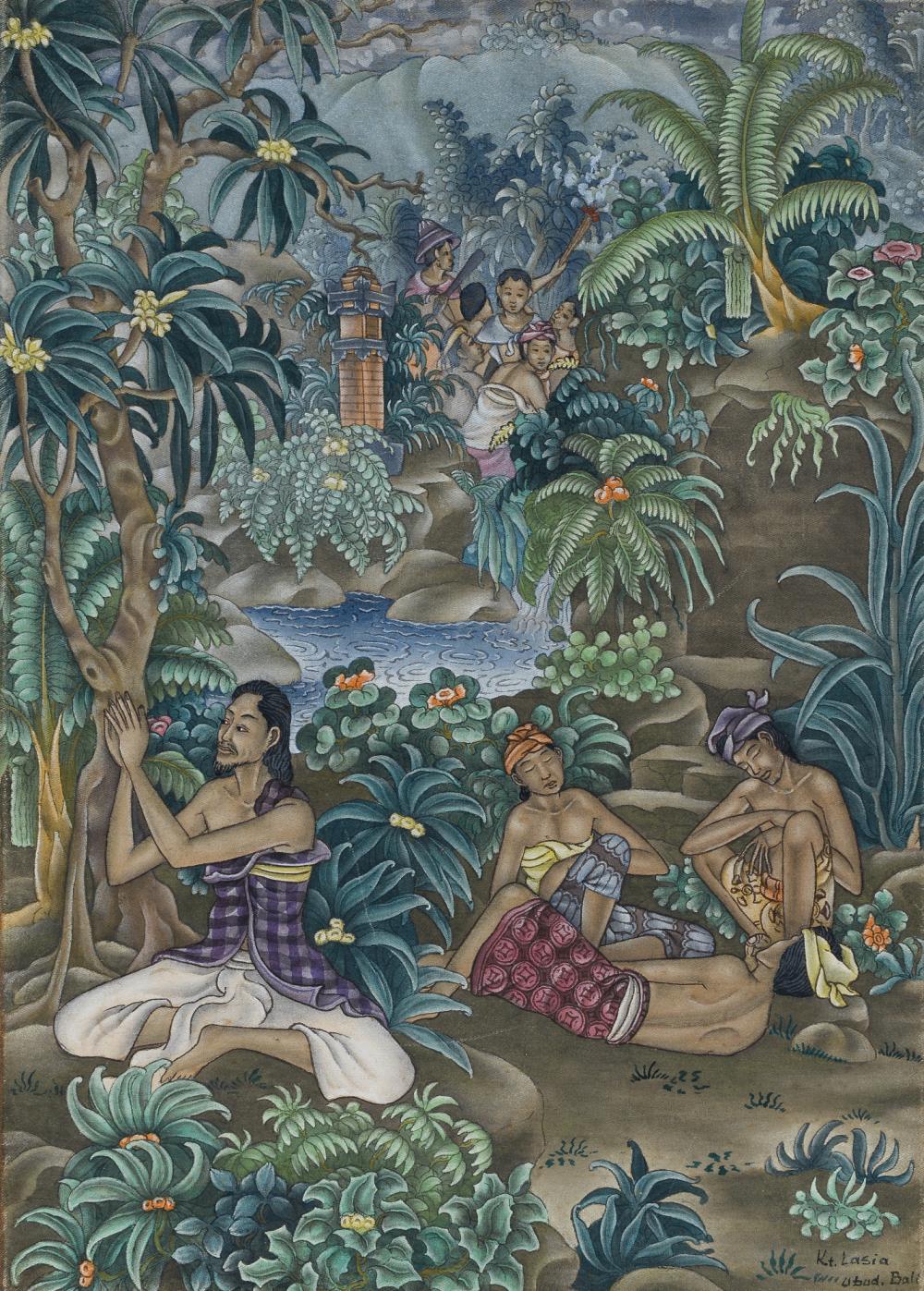
BROADCAST NEWS SEGMENT: “Ketut Lasia: The Last Generation of Ubud Traditional Painters,” UTV Televisi Indonesia, January 7, 2025: This three-minute video was filmed in the home studio of Ketut Lasia (born 1945), one of the last traditional Balinese painters, who studied under I Wayan Turun (1935–1986) and is still active at age eighty. As an adult, Lasia converted from Hinduism to Christianity, and he paints primarily biblical scenes. The video shows his visual interpretations of Jesus calming the storm, Jesus’s entry into Jerusalem, the miraculous catch of fish, the Crucifixion, Jesus in the house of Mary and Martha, and the Ascension.
Ketut Lasia (Indonesian, 1945–), Gethsemane, n.d. Acrylic on canvas, 61 × 43 cm.
+++
ESSAY: “Christian Art in Indonesia” by Volker Küster, Karel Steenbrink, and Rai Sudhiarsa: This chapter is from the thousand-page, open-access book A History of Christianity in Indonesia, edited by Karel A. Steenbrink and Jan S. Aritonang (Brill, 2008). The authors discuss the development of an indigenized Indonesian Christian art, starting with the West Javanese sculptor Iko, a Muslim who worked in both wood and stone and fulfilled commissions for the (Catholic) Sacred Heart Chapel on the premises of the Joseph Schmutzer sugar estate in Ganjuran in the 1920s. They then cover a handful of artists who came in the wake of the Second Vatican Council in the 1960s and amid the global trend toward contextual theology promoted by international Protestantism—focusing especially on the most famous two, Bagong Kussudiardja (1929–2004) [previously] and Nyoman Darsane (1939–2024), both Christian converts.
Iko, Christ the King with Angels, 1924–27. Jati wood. Missiemuseum Steyl, Limburg Province, Netherlands. Photo: Fred de Soet, 2019.Crucifixion batik by Bagong Kussudiardja, Yogyakarta, Indonesia. Private collection, Geneva. Jesus is rendered in the style of a Javanese shadow puppet. Source: On a Friday Noon by Hans-Ruedi Weber (Eerdmans / World Council of Churches, 1979)Nyoman Darsane, Creation of Sun and Moon, 1979
(This essay is not to be confused with the one I shared in 2022, where Volker Küster profiles five Christian artists from Yogyakarta, including one overlap with this present essay.)
+++
VIDEO PROMO:“OMSC Artist in Residence Program”: “Each year, the director of the Overseas Ministries Study Center at Princeton Theological Seminary (OMSC@PTS) invites one Artist in Residence to the Princeton campus to stay with us for a full academic year (September to May). Since its inauguration in 2001, the OMSC Artist in Residence program has hosted outstanding artists from the global South. Today, OMSC’s art collection is comprised of over one hundred fifty pieces, many of which are now on display throughout the campus of Princeton Theological Seminary. They represent some of the finest work being done by contemporary artists who are Christian.” Artists include Sawai Chinnawong (Thailand), Nalini Jayasuriya (Sri Lanka), Wisnu Sasongko (Indonesia), and Emmanuel Garibay (Philippines), among others.
The current OMSC artist in residence is KimyiBo, a Korean American artist based in Berlin. Explore more at http://www.omsc.org/.
+++
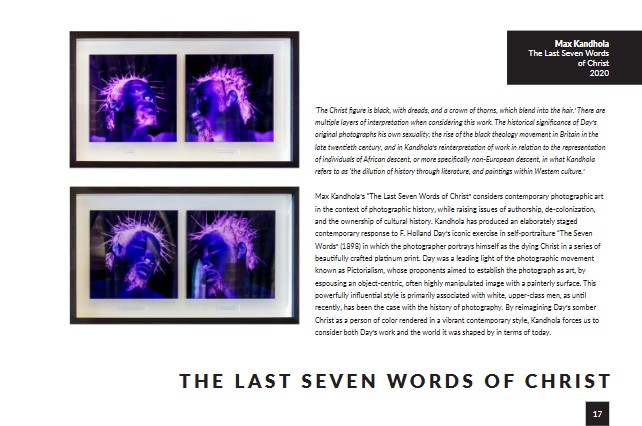
EXHIBITION CATALOG: Global Images of Christ: Challenging Perceptions: This free digital catalog documents an art exhibition that ran from September 25 to October 30, 2021, at Chester Cathedral in the UK. Artists include Lorna May Wadsworth, Max Kandhola, Silvia Dimitrova, John Muafangejo, Solomon Raj, Jyoti Sahi, and more.
+++
FIJIAN HYMN: “Oqo Na Noqu Masu” (This Is My Prayer): This Christian hymn is sung regularly in Fiji in churches and at rugby training camps and matches. The lyrics translate roughly to: “Lord, this is my prayer. I need your help in my time of need. I will always praise your name, and I ask that you grant me the desires of my heart. I sing and cry to you, Lord—to you and you alone. Hallelujah.” Here are some examples:
>> From the Rugby League World Cup, Fiji v. USA, 2017:
>> Again, the Fiji Bati rugby team singing before a match, this time against Papua New Guinea in 2022:
>> And here’s the hymn in a church context—sung by the Nawaka Methodist Village Choir in Nadi, Fiji:
Awareness of the deep-rooted Fijian tradition of four-part Christian hymn singing increased last summer when videos of the country’s Olympic team went viral. In the Christianity Today article “Yes, Fiji Olympians Are Singing Hymns,” Kelsey Kramer McGinnis writes,
Although Fijian hymnody grew out of Methodist songs brought by 19th-century missionaries, it has become a deeply rooted tradition that makes space for indigenous practices across the diverse country. Christianity’s connection to the legacy of colonialism in Fiji (which was a British colony from 1847 to 1970) is undeniable, but Fijian vocal music stands as an example of the ways Fijians have been contextualizing Christian worship and integrating it into their communities for nearly two centuries.
Here’s a 2024 video from a Sunday worship service at the Team Fiji camp in the Olympic Games Village in Paris, showing the team singing a different hymn, whose title and words I don’t know:
CHILDREN’S BOOK: Let There Be Light by Desmond Tutu, illustrated by Nancy Tillman: I saw this enchanting little book at my local library recently—a retelling of the creation narrative from Genesis 1 by the late South African Anglican bishop, theologian, and Nobel Peace Prize laureate Desmond Tutu. Published by Zonderkidz in 2014, it opens, “In the very beginning, God’s love bubbled over when there was nothing else . . .” Hear it read aloud, and view the illustrations, in this video from the Seuss’s Gooses YouTube channel:
+++
ARTICLES:
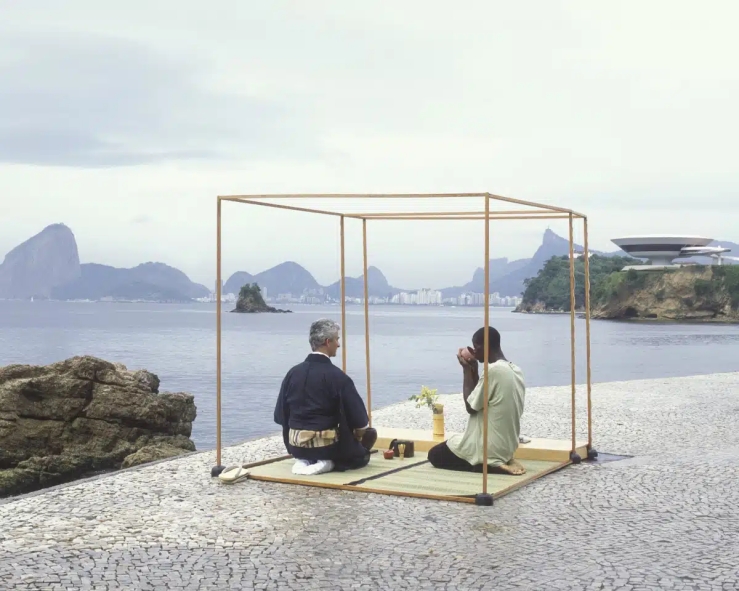
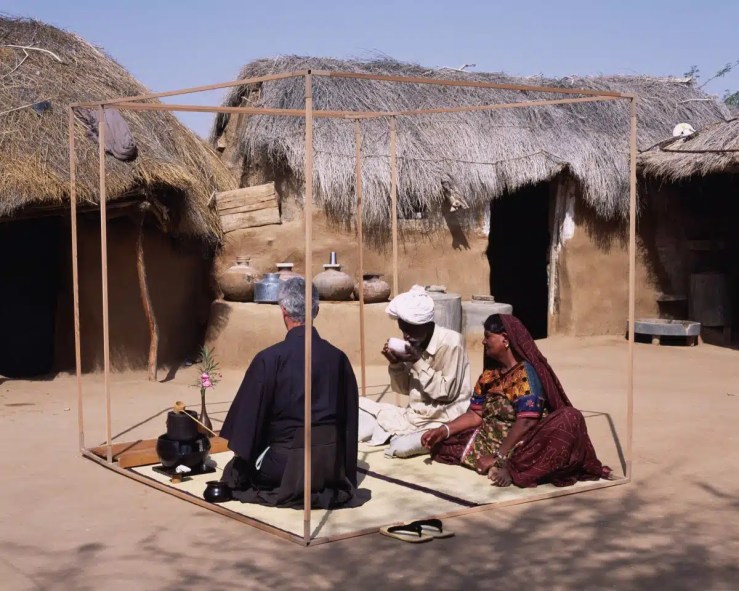
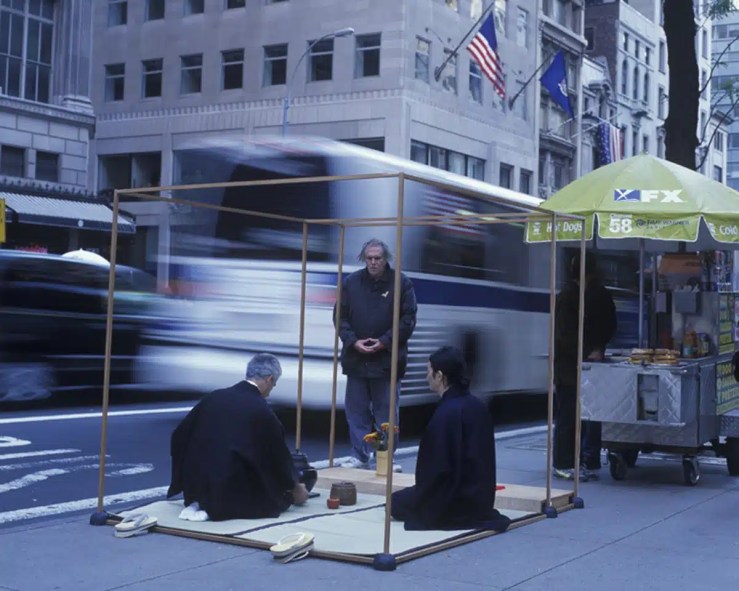
>> “Artist Traveled to Over 30 Cities to Perform Tea Ceremony with Strangers,” an interview with Pierre Sernet by Jessica Stewart: From 2001 to 2008, artist Pierre Sernet (French-born and residing in Japan) traveled to over thirty countries to spontaneously enact abbreviated Japanese tea ceremonies, inviting passersby to come sit and drink the cup of matcha he prepared in front of them. From deserts and beaches to villages and construction sites, he would set up a portable, open-air wooden cube that denoted the “tea room,” and the ensuing encounters were documented with photography. Called One (and nicknamed Guerrilla Tea), the series was meant to promote respect across cultures and “to emphasize to viewers the importance of each moment we live in.”
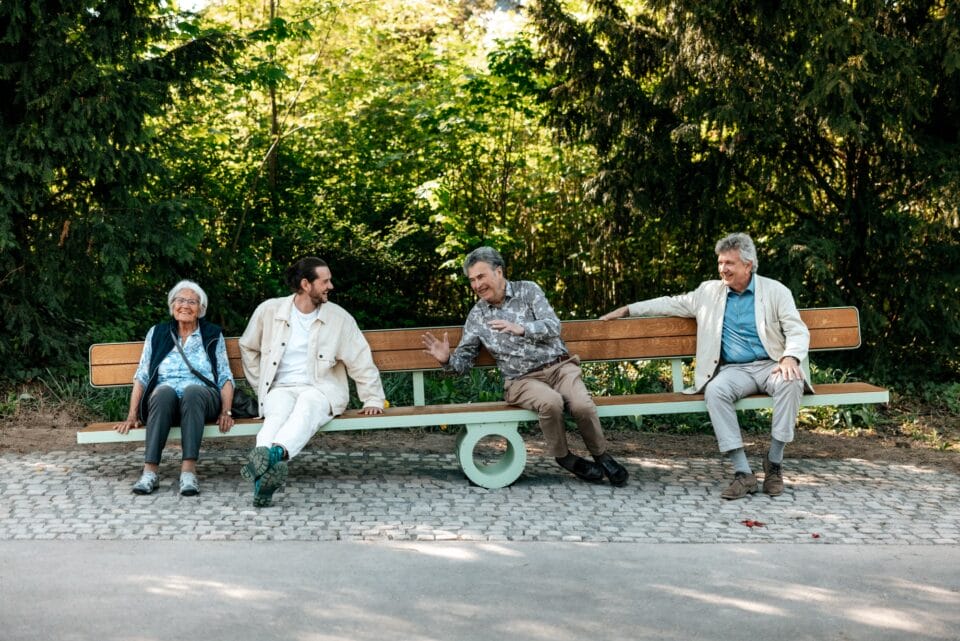
>> “A Teeter-Totter Style Bench Invites Sitters to Find Common Ground” by Grace Ebert: “In the Garden of Generations in Einbeck, Germany, a playful new installation asks park goers to find equilibrium with their neighbors. ‘Balance Bench” is the latest project of Berlin-based artist Martin Binder. Installed in his hometown, the interactive artwork rests on a central cylinder rather than four legs, requiring that at least two people sit on either side to level. ‘It cannot be used alone—it demands awareness, consensus, and cooperation between people to become a functional public space,’ he says.”
Martin Binder (German, 1990–), Balance Bench, 2025. Steel, oak. Installation at the Garden of Generations, Einbeck, Germany. Construction by Henning Müller Sondermaschinen. Photo by Spieker Fotografie.
+++
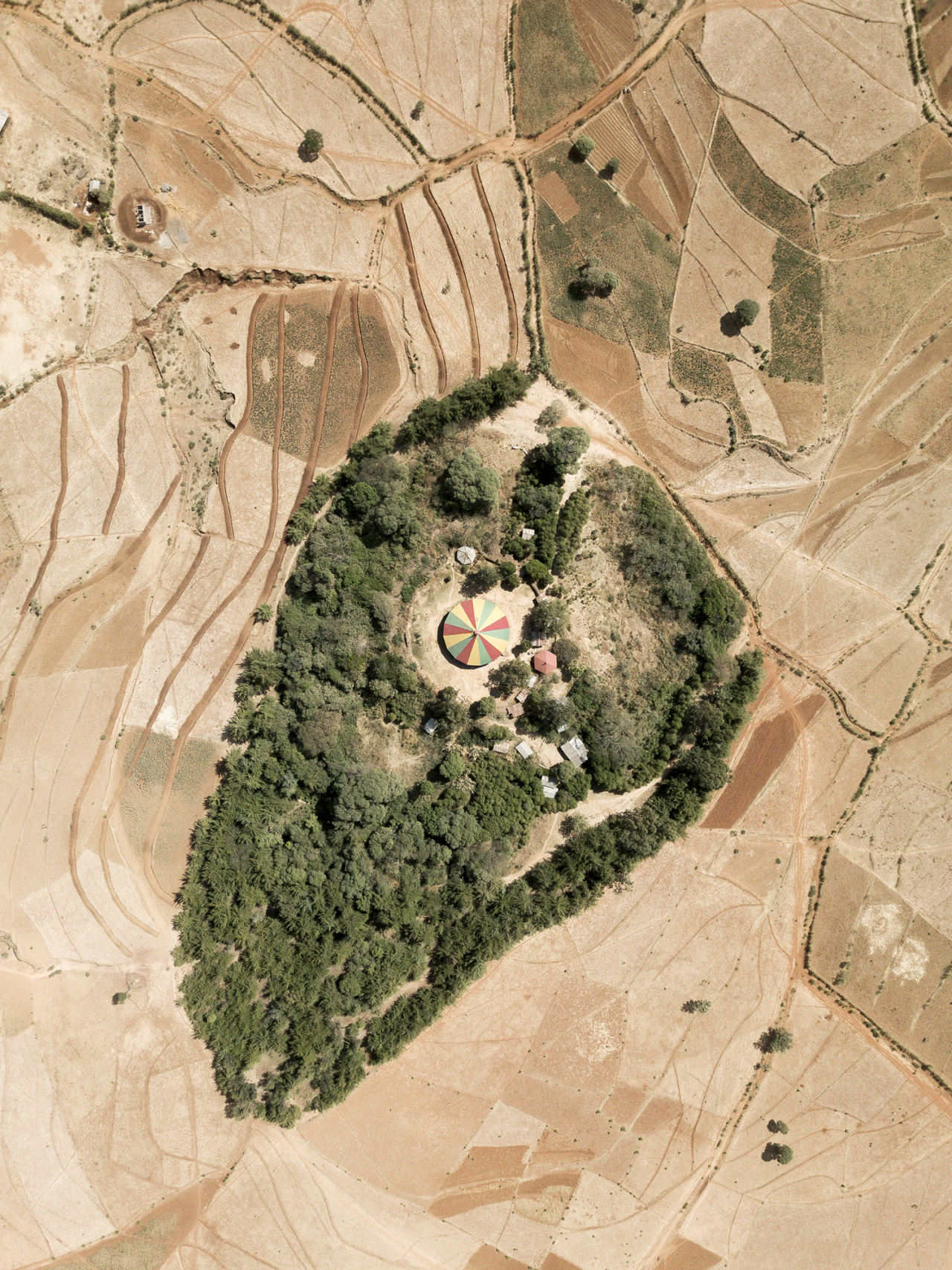
PHOTO SERIES: Hierotopia by Kieran Dodds: “Kieran Dodds (Scottish, b. 1980) is a non-fiction photographer known for his research-driven photo stories and portraiture. His personal work considers the interplay of environment and culture, and the importance of spiritual belief in global conservation.” In his Hierotopia series (from the Greek for “sacred place”), carried out from 2015 to 2018, he explores the green “church forests” east of Lake Tana in Ethiopia—little islands of biodiversity scattered throughout the region’s desert landscape. “To its guardians,” Dodds writes, “each forest resembles a miniature Garden of Eden and is essential to the dignity of the building. . . . The air inside the forests is cool, fragrant and filled with a cacophony of life. This is in stark contrast to the arid silence of the surrounding land which is feeling the strain of centuries of human activity and agriculture.”
Debre Mihret Arbiatu Ensesa church near Anbesame, Ethiopia, surrounded by woodland and fields. Photo: Kieran Dodds, from the Hierotopia series, 2015–18.
“The core Christian belief in stewardship for the environment is a powerful concept,” Dodds continues, remarking on the Ethiopian Orthodox Tewahedo Church’s commitment to conservation, “and, if applied globally by people who are at least nominally Christian, could transform the world for better.”
+++
SONGS:
>> “Hold You in Our Circle” by Emily Roblyn: This simple song of blessing by UK-based singer-songwriter and retreat leader Emily Roblyn has been sung at the bedsides of the sick or dying, over women about to be released from prison, and through myriad other life transitions and trials, by friends and communities seeking to voice their support. “We hold you in our circle, hold you in our love.” [HT: Nadia Bolz-Weber]
>> “The Lord Bless You and Keep You” by Peter C. Lutkin: Performed by the Capital University Chapel Choir in 2020, this song is a choral setting by the Midwestern composer Peter C. Lutkin (1858–1931) of the Aaronic Blessing from Numbers 6:24–26: (in Lutkin’s rendering) “The LORD bless you and keep you; the LORD lift his countenance upon you, and give you peace; the LORD make his face to shine upon you, and be gracious unto you.” God instructed the Levitical priests of ancient Israel to pronounce these words over the people, and though the Levitical priesthood is no more, this particular benediction is still used regularly in Jewish and Christian liturgies.
Out of the living word
Come flower, serpent and bird.

All things that swim or fly
Or go upon the ground,
All shapes that breath can cry
Into the sinews of sound,
That growth can make abound
In the river of the eye
Till speech is three-ply
And the truth triply wound.

Out of the living word
Come flower, serpent and bird.
Howard Nemerov (1920–1991) was a major figure in midcentury American poetry, whose Collected Poems won the Pulitzer Prize, the National Book Award, and the Bollingen Prize. He served as US poet laureate from 1963 to 1964 and again from 1988 to 1990, and he also wrote fiction and essays. “Romantic, realist, comedian, satirist, relentless and indefatigable brooder upon the most ancient mysteries—Nemerov is not to be classified,” Joyce Carol Oates remarked in the New Republic. From an artistic family, Nemerov was the older brother of the photographer Diane Arbus.
The exuberantly decorated Book of Kells is widely agreed to be the most beautiful book ever made. The crown jewel of Celtic art, it is a manuscript copy of the Four Holy Gospels in Latin, with ten surviving full-page illuminations and many more marginal illuminations and decorated initials throughout the other 670 pages—the work of three artists and four scribes.
Most art historians believe the book was created on the Scottish island of Iona by a group of monks sometime around 800. Viking raids at that time forced the monks to flee to the monastery of Kells in Ireland; they were able to save the book, but it was left unfinished.
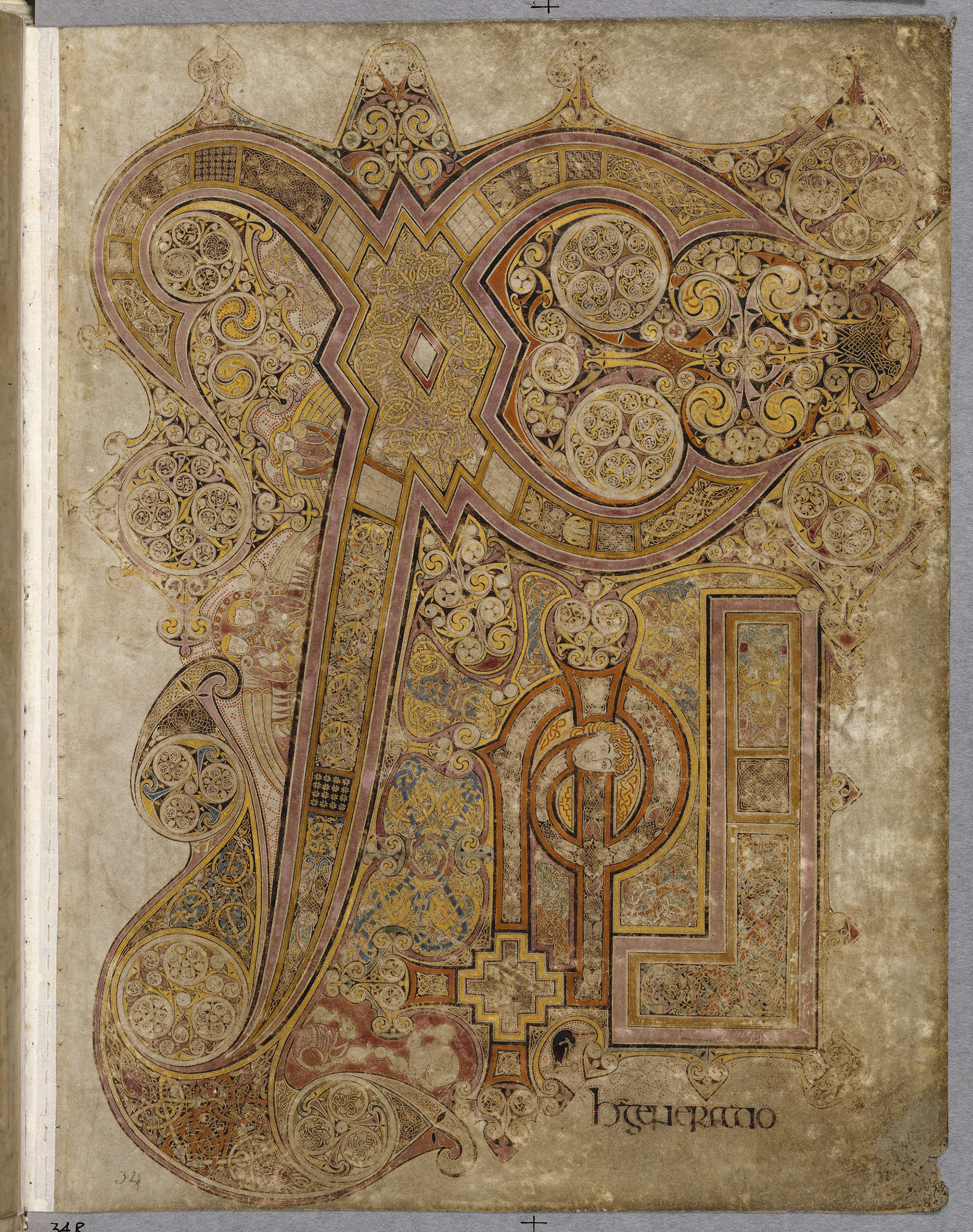
The most famous page from the Book of Kells is folio 34r, often referred to as the Christi autem or Chi-Rho page.
The Chi-Rho page from the Book of Kells, ca. 800. Trinity College Dublin MS 58, fol. 34r.
The page illuminates the “second beginning” of the Gospel of Matthew, following the genealogy and opening the narrative of the life of Christ: Christi autem generatio (“Now the birth of Christ . . .”) (Matt. 1:18). The anonymous artist represents the Holy Name of Jesus with a monogram, enlarged and embellished, consisting of the Greek letters chi (Χ) (pronounced “kai”), rho (ρ), and iota (ι), the first three letters in the word Χριστός, Christos. H generatio (where h is shorthand for autem) is written in Latin in Insular majuscule script at the bottom right of the page.
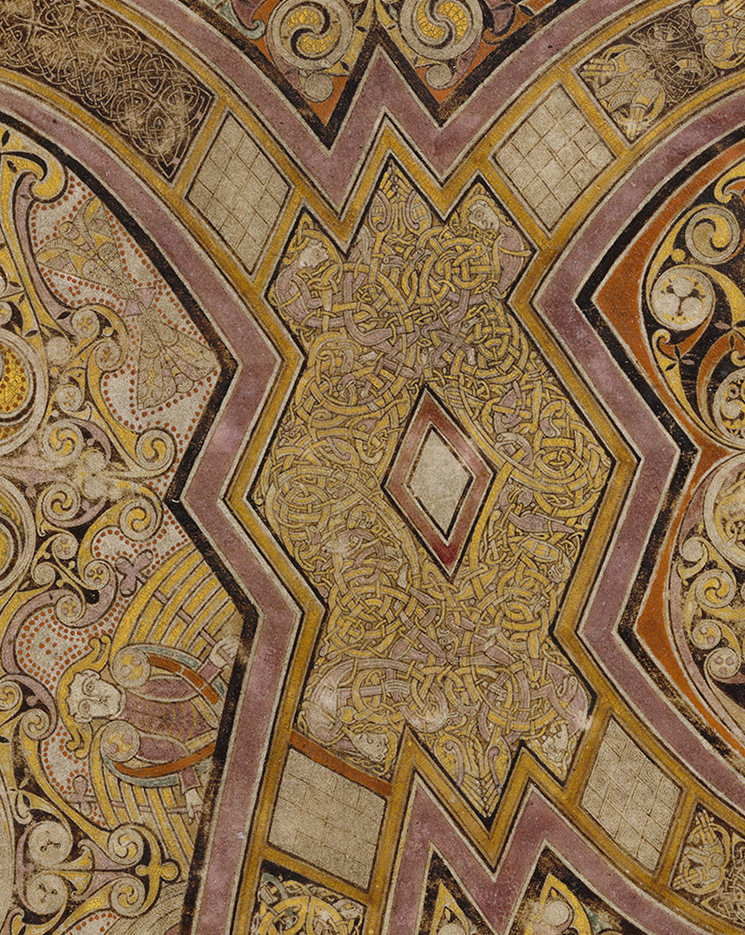
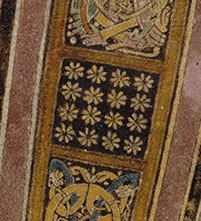
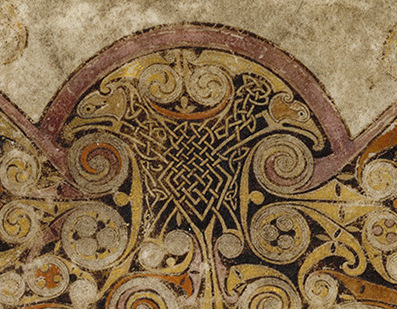
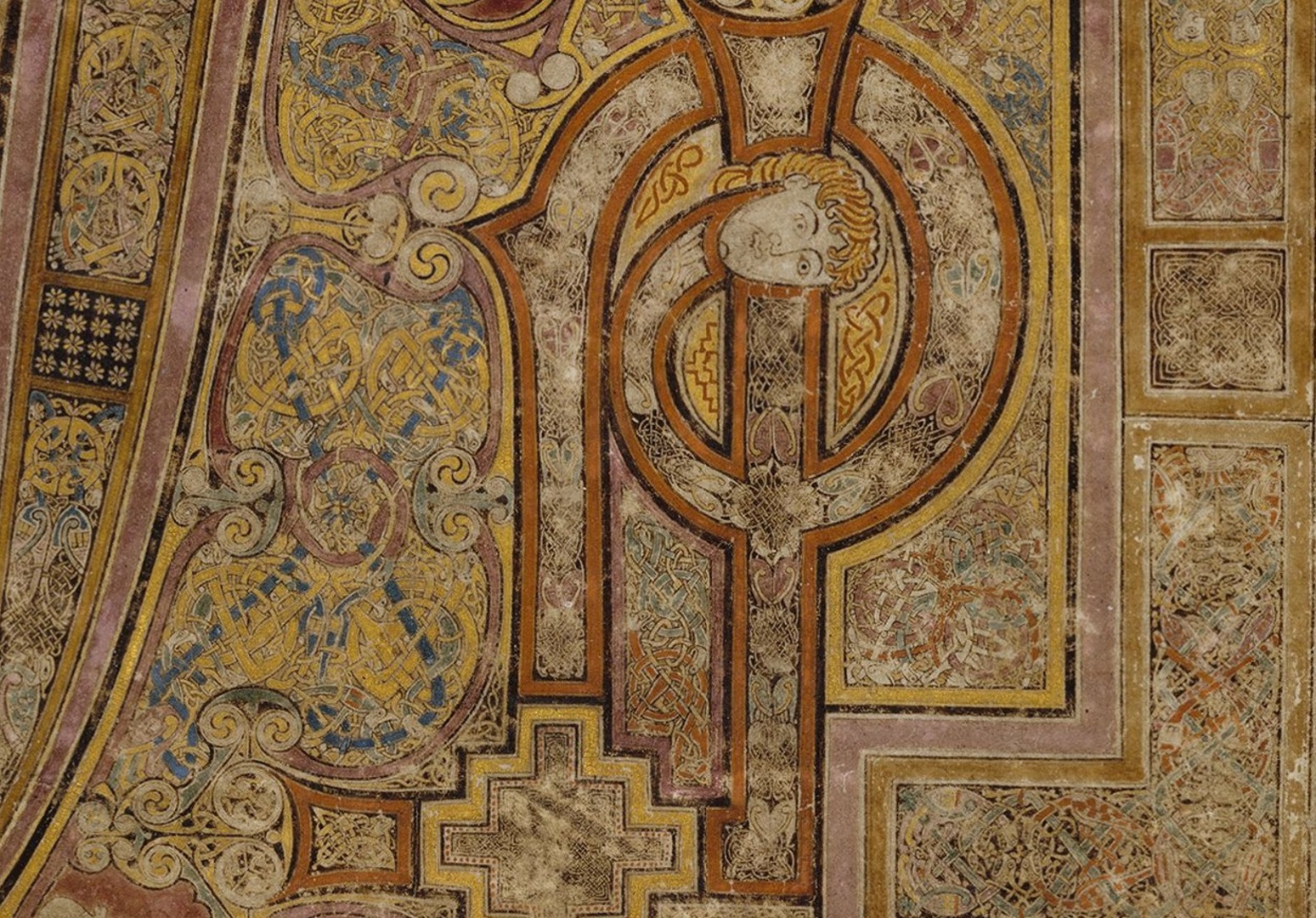
The chi-rho monogram is accorded special dignity in Christian art. Here the chi takes up nearly the whole page, its arms and legs extending to the four corners, exuding a kinetic energy. It reaches, it leaps; it blossoms and enfolds. It is beautified with intricate interlaces, spirals, and lozenges, and it’s teeming with life! Creatures of the land, air, and sea dwell within and around—cats and mice (nibbling on a eucharistic wafer!), birds and moths, an otter and a fish, humans and angels. There are vines and flowers too, and the whirling gears of the cosmos—all of it spilling out of the precious name of Christ.
Peering out from the inner tip of the rho is a red-haired man. Might this represent Jesus? Scholars tend to think so.
This illuminated page combines word (speech) and Word (Logos) with glorious liveliness. “The decoration of the text of Christ’s birth suggests the identification of Christ incarnate with Christ the Creator-Logos,” writes art historian Jennifer O’Reilly. “Christ as the divine Word is here revealed in a word, a single letter, concealed within the design. Similarly, commentators meditating on the name at this point in Matthew’s gospel, described his divinity as lying hidden in his creation, beneath his human flesh at his Incarnation and beneath the literal letter of the scriptural text.”
In his ekphrastic poem “The Book of Kells,” Howard Nemerov subtly draws out this theology—Christ as the Creator of the universe in and by whom all things consist (Col. 1:17). Bearing a rhyme scheme of aa bcbccbbc aa, the poem opens and closes with the same couplet: “Out of the living word / Come flower, serpent and bird.” Again, the word “word” is multivalent, referring to the written word “Christ” that fills the Book of Kells page in the form of a stylized monogram, as well as to Christ the person, the living Word of God, the source of all life. It can also refer to the Bible, which is “living and active” (Heb. 4:12) and which reveals Christ.
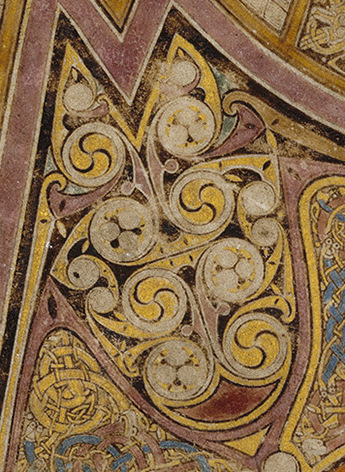
Nemerov alludes to the Chi-Rho page’s knotwork, its geometric shapes, its zoomorphic interlaces, and its triskeles (triple spirals), glorying in the sacred beauty and abundance they signify, which some unnamed early medieval monk laboriously sketched and painted over the course of who knows how long, to honor the story of the birth of Jesus Christ.
The Book of Kells’ Chi-Rho page is a phenomenal work of art. The symbol of Christ is all-encompassing, and all of creation is united in harmony with it.
The 2009 animated fantasy drama The Secret of Kells, made by the Irish studio Cartoon Salon, features a wondrous animation of the Chi-Rho page at the end, bringing to life some of its many details:
(All Art & Theology posts are optimized for viewing in a web browser—ideally on a computer, but they should also display adequately on a phone. If you’re receiving this post by email, simply click on the hyperlinked title at the top of the message for a better reading experience.)
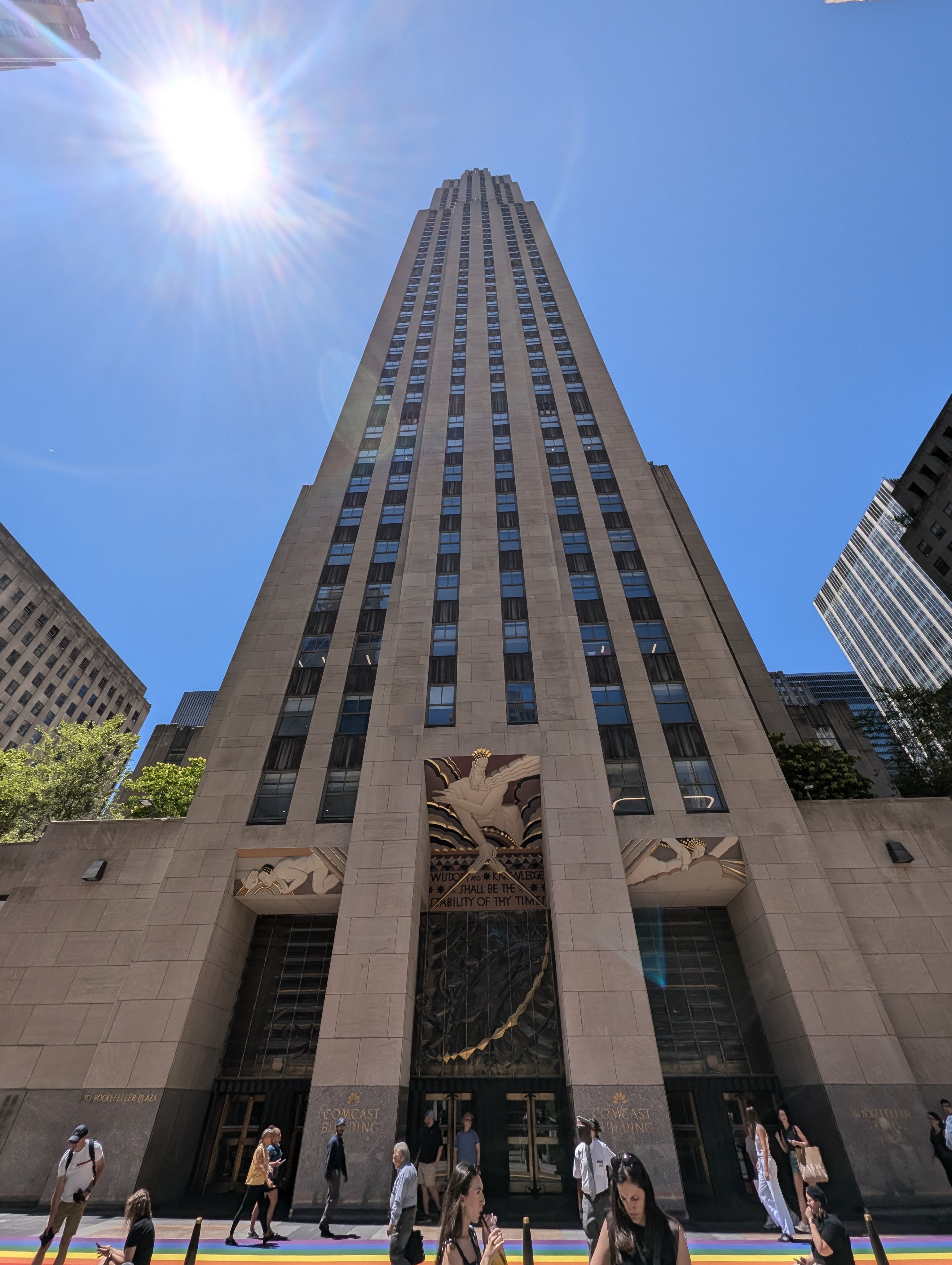
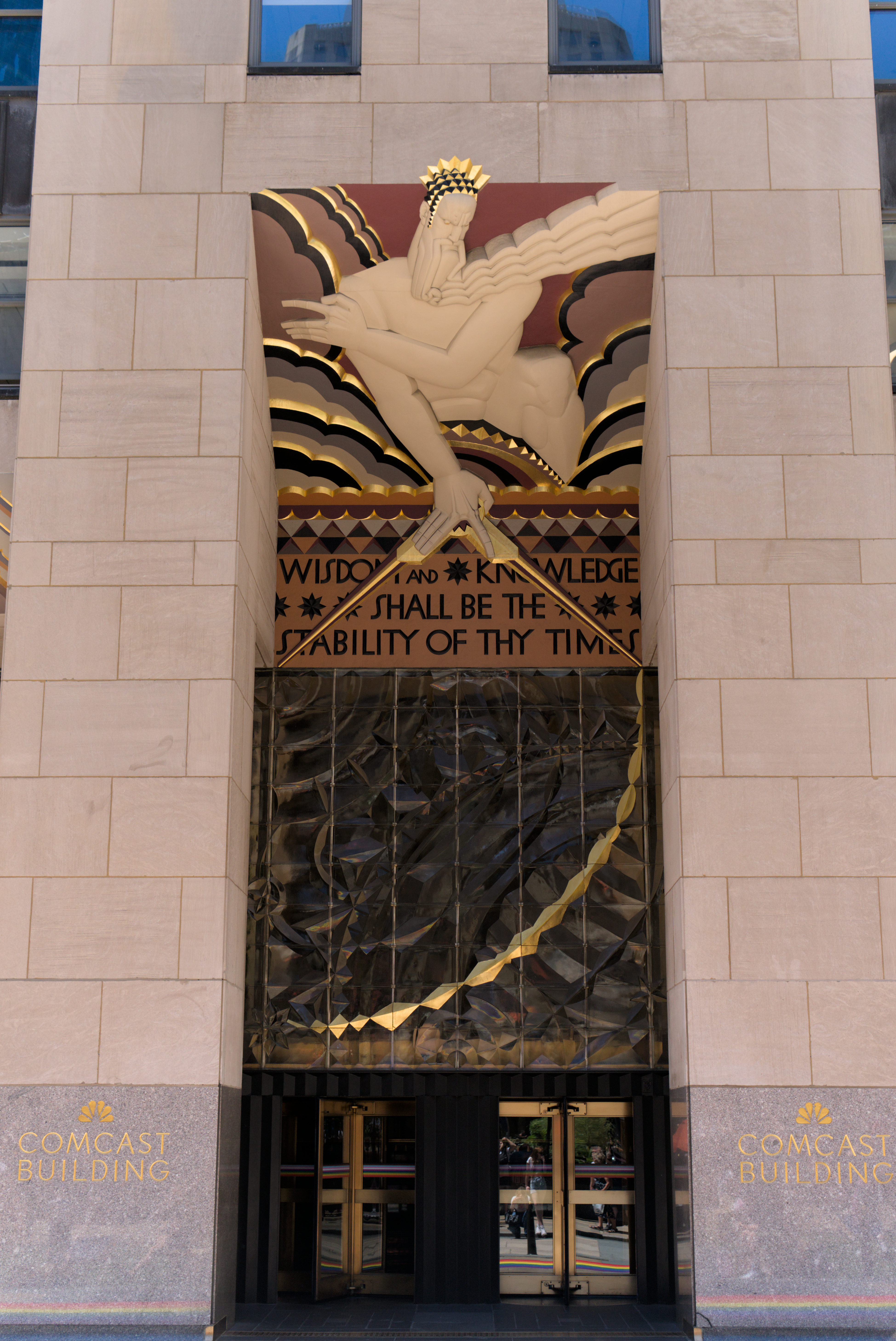
30 Rock. Home to NBC Studios and a slew of other business offices, it’s an iconic skyscraper in midtown Manhattan, towering 850 feet and capped by the ticketed Top of the Rock Observation Deck. It forms the backdrop to the famous ice-skating Rink at Rockefeller Center and, in December, New York City’s largest Christmas tree. Designed by architect Raymond Hood, it was originally named the RCA Building (1933–1988) after its main tenant, and then the GE Building (1988–2015), but since 2015 it has been the Comcast Building.
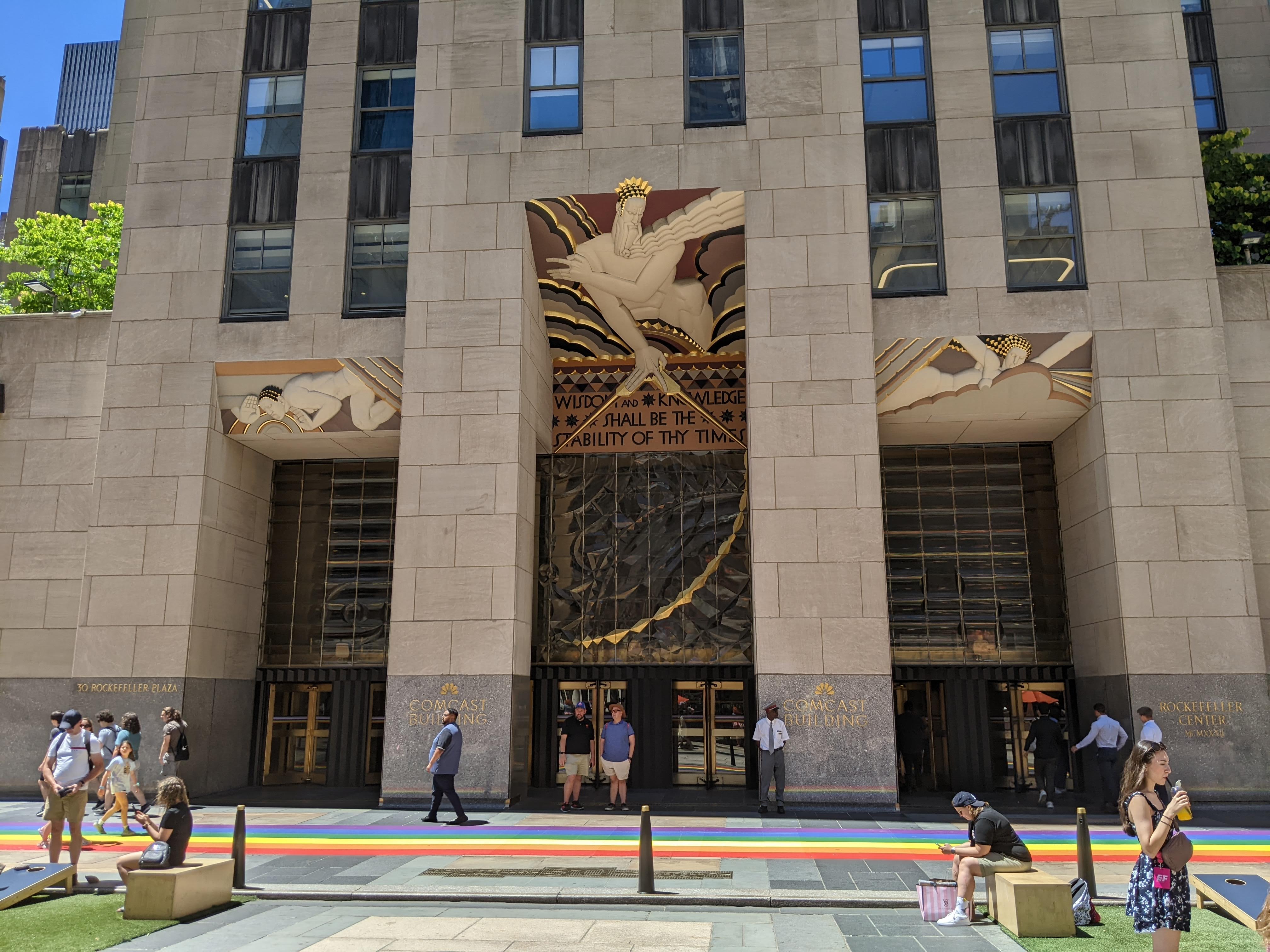
In June I stopped by to take in the art deco sculptures on the exterior, particularly the three limestone bas-reliefs over the main entrance, depicting Wisdom in the center, flanked by Sound on the left and Light on the right. This sculpture group was carved by Lee Lawrie (1877–1963) and painted and gilded by Léon-Victor Solon (1873–1957), who designed the color scheme for Rockefeller Center. Underneath is a trifold screen comprising 240 rectangular blocks of glass cast in eighty-four different molds, executed by Corning Glass Works.
Lee Lawrie (American, 1877–1963), Wisdom, with Light and Sound, 1933. Polychromed limestone, 240 cast-glass bricks. Comcast Building, 30 Rockefeller Plaza, New York City. Photo: Victoria Emily Jones.
I wanted to see how the iconography works, as I knew the central lintel to feature a Bible verse. It’s an excerpt from Isaiah 33:6: “And wisdom and knowledge shall be the stability of thy times, and strength of salvation: the fear of the LORD is his treasure” (KJV). In this oracle from the eighth century BCE, the prophet Isaiah is speaking to the people of Israel as they face threats from Assyria. He assures them that a wealth of salvation, wisdom, and knowledge is theirs as long as they revere God.
It’s not surprising that for this commercial building built in 1933, the biblical quote is truncated to exclude mention of God—the ancient prophet’s words are appropriated to suit a modern corporate context in religiously pluralistic America. Instead of (explicitly) honoring a divine source of wisdom and knowledge, the decorative program celebrates human ingenuity, which is practiced by workers inside the building in the fields of media, medicine, law, and finance, among others.
So what of the imagery that this Bible verse captions?
The central figure of this work represents the genius which interprets to the human race the laws and cycles of the cosmic forces of the universe, and thus rules over all of man’s activities. On the right of the central panel is represented Light, and on the left, Sound—two of these cosmic forces. The compass of the genius marks, on the glass screen below, the cycles of Light and Sound.
Although there are other cosmic forces which govern the universe, Mr. Lawrie selected those of Light and Sound because they are an active and vital part of everyday life, and particularly because within contemporary times great discoveries have been made by means of them, and man’s technical knowledge of the laws of these two forces has been vastly enlarged.
The official title of the sculpture group is Wisdom, a Voice from the Clouds, with Light and Sound. A commanding presence, Wisdom, depicted as a nude male with a long windswept beard, measures, discerns, harnesses, creates. With his right hand he wields a compass to scribe a circle, and with his left he shoves back clouds of ignorance. He embodies humanity’s accumulated philosophical and scientific knowledge and creative power. The male and female figures on either side of him “herald the advent of radio (sound) and the motion picture industry and television (light), two industries that were achieving global significance as the Center was being built,” the Rockefeller Center website says. Circles emanate from Sound’s mouth, and electrical signals from Light’s raised arms.
It’s a humanistic artwork, exuding optimism and complemented throughout the Center by other works such as the four lobby murals by José Maria Sert collectively titled Man’s Intellectual Mastery of the Material Universe (1934), which picture the evolution of machinery, the abolition of slavery, the suppression of war, and the conquest of disease; American Progress (1937), another mural, by Sert; Lee Lawrie’s bronze Atlas(1937), showing the titular Titan holding the celestial vault on his shoulders; and Paul Manship’s gilded bronze Prometheus (1934), depicting the Titan champion of humanity who stole fire (representing technology and culture) from the gods and gave it to humans.
In the art at Rockefeller Center, human agency and advancement are emphasized, but the Christian God is not entirely absent from the narrative they collectively tell. Frank Brangwyn’s Man’s Search for Eternal Truth (1933) in the south corridor of the 30 Rock lobby addresses the importance of Jesus’s teachings in the Sermon on the Mount, particularly on love and brotherhood, depicting modern folks gathered around an elevated Christ figure and an inscription that reads, “Man’s ultimate destiny depends not on whether he can learn new lessons or make new discoveries and conquests, but on his acceptance of the lesson taught him close upon two thousand years ago.”
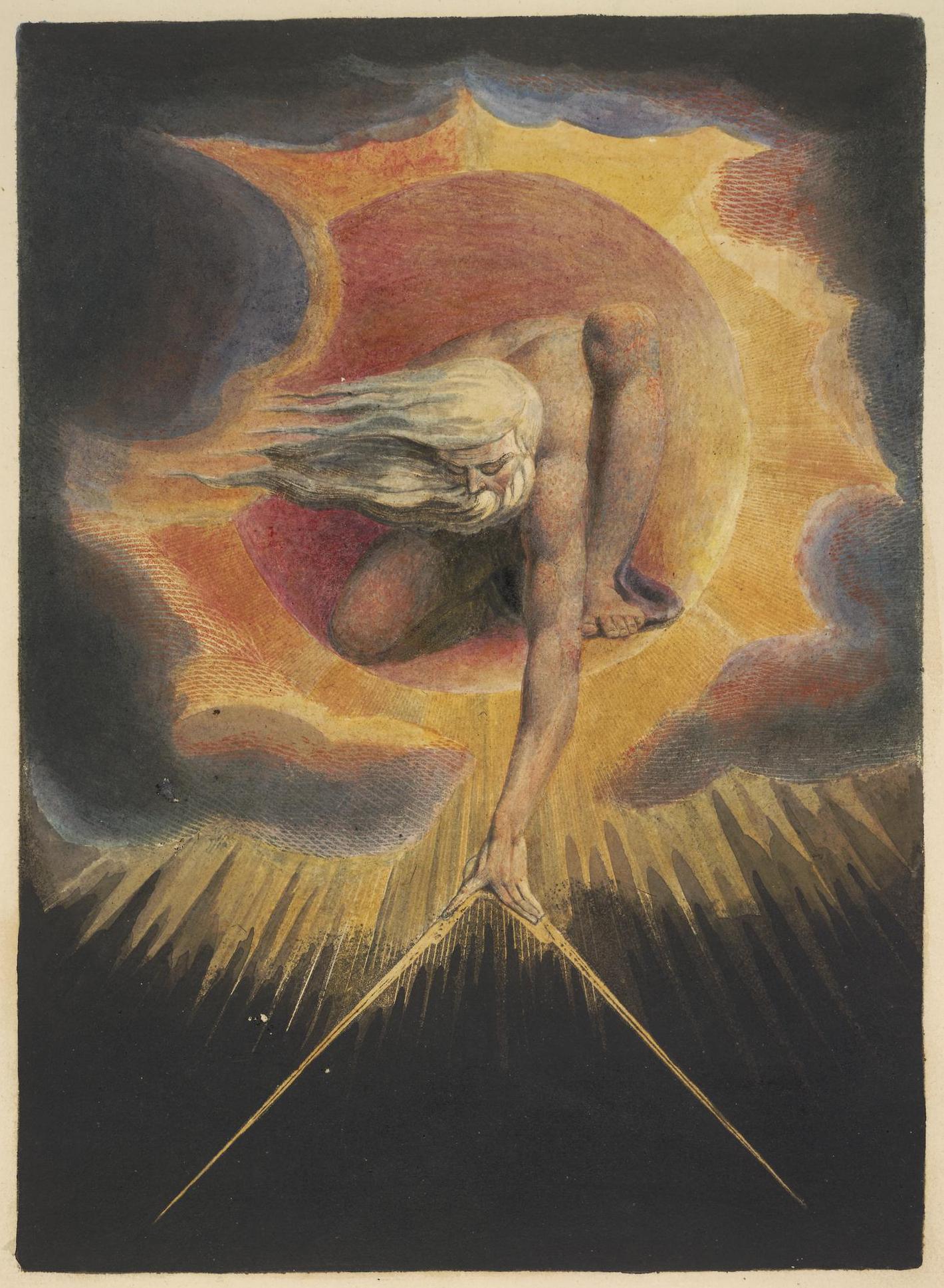
A key visual influence on Lawrie’s Wisdom sculpture was William Blake’s Ancient of Days, a hand-colored relief etching that shows a white-bearded nude male crouching in a heavenly sphere with a large golden compass, creating the world. This is Urizen, a mythological deity invented by Blake to personify reason and law.
William Blake (British, 1757–1827), The Ancient of Days, 1794. Relief etching with watercolor, 23.3 × 16.8 cm. This hand-colored print is the frontispiece to Blake’s poem Europe, a Prophecy, copy D, owned by the British Museum in London.
Urizen is a reconfigured version of Yahweh in the Old Testament. The title of Blake’s print is taken from a prophetic vision of the Divine in the book of Daniel: “As I looked, thrones were set in place, and the Ancient of Days took his seat. His clothing was as white as snow; the hair of his head was white like wool. His throne was flaming with fire, and its wheels were all ablaze” (Dan. 7:9 NIV).
This verse has inspired centuries’ worth of iconography picturing God as an old man—because hey, he’s ancient (in fact, he’s the oldest being there is, as he has always existed), and Daniel saw him with white hair! Also, age and wisdom are traditionally correlated.
Depictions of God the Father as a fully anthropomorphized, aged being with white hair didn’t show up until the late Middle Ages and didn’t become a trend until the Renaissance.
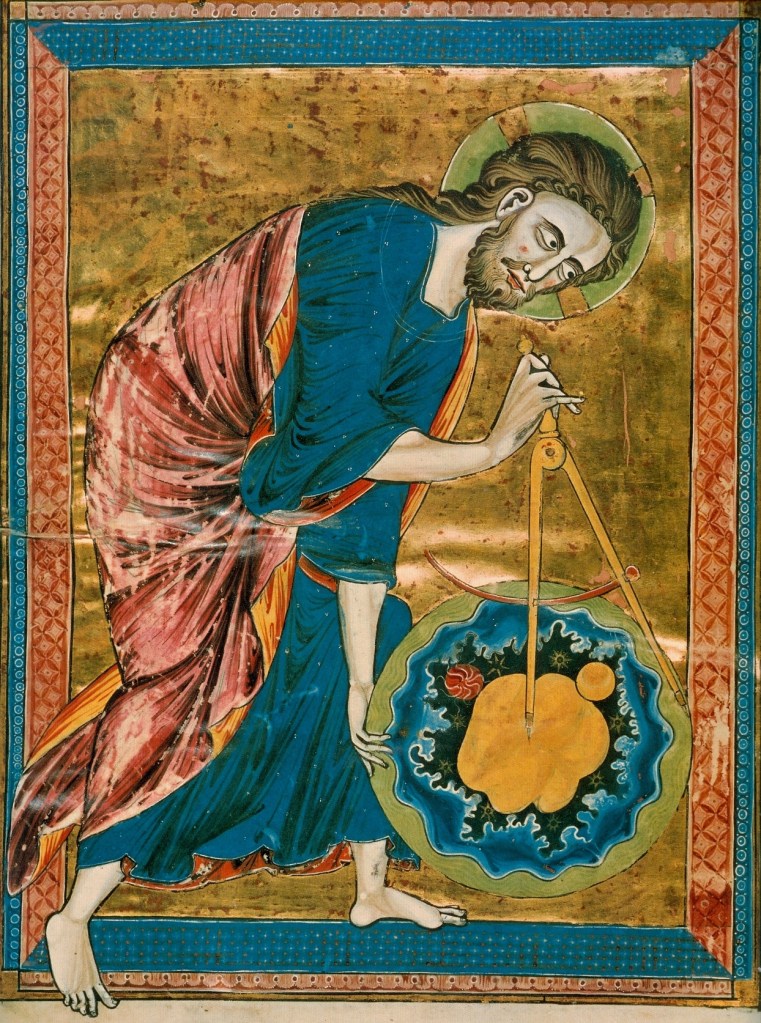
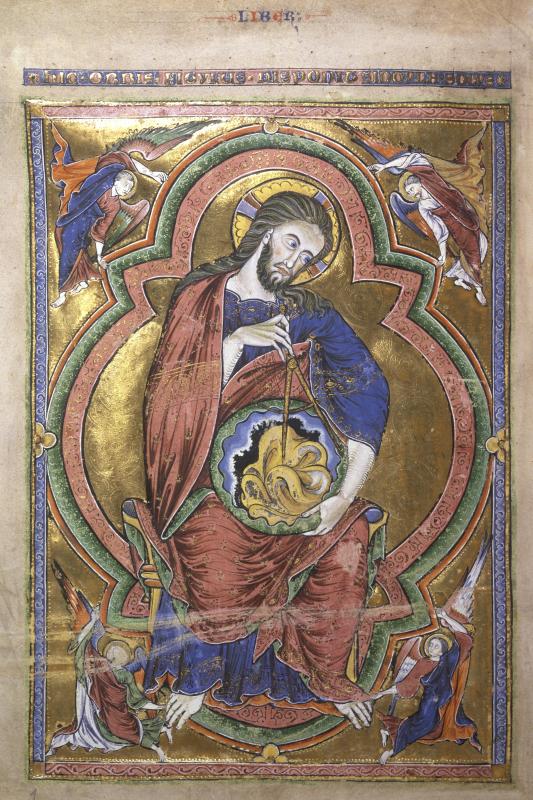
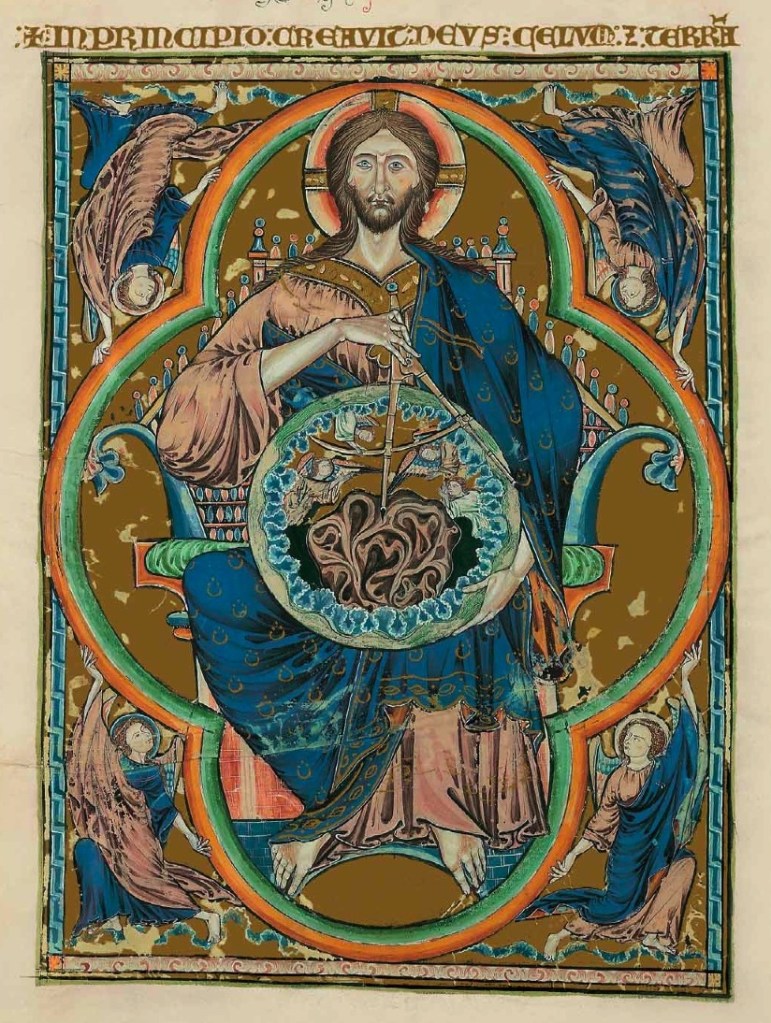
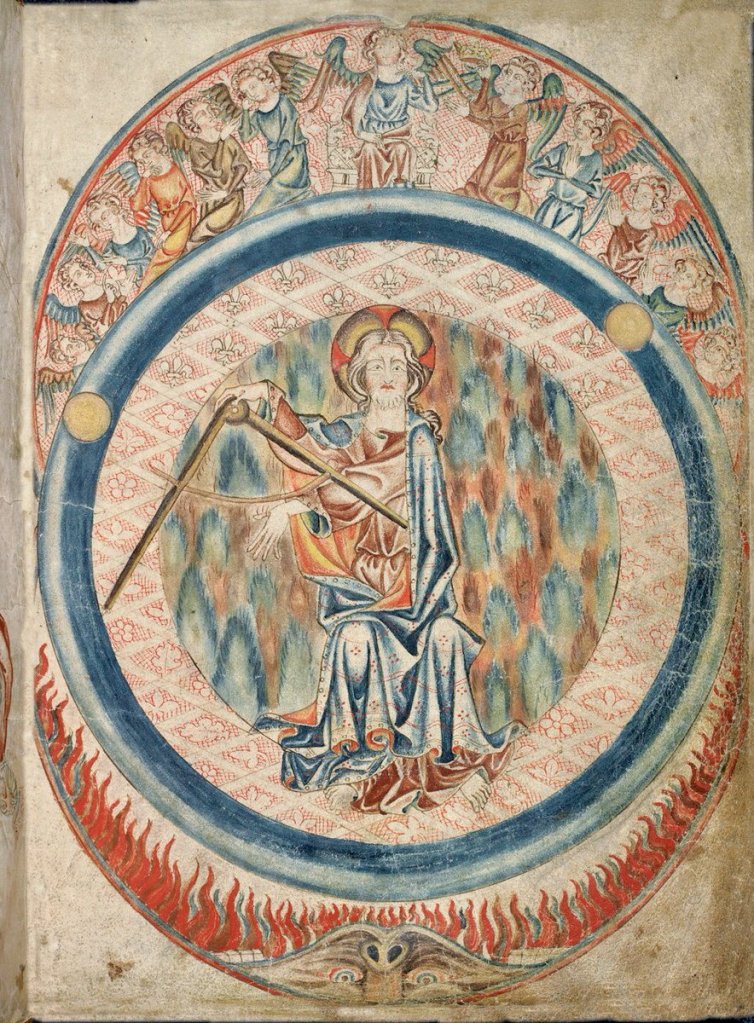
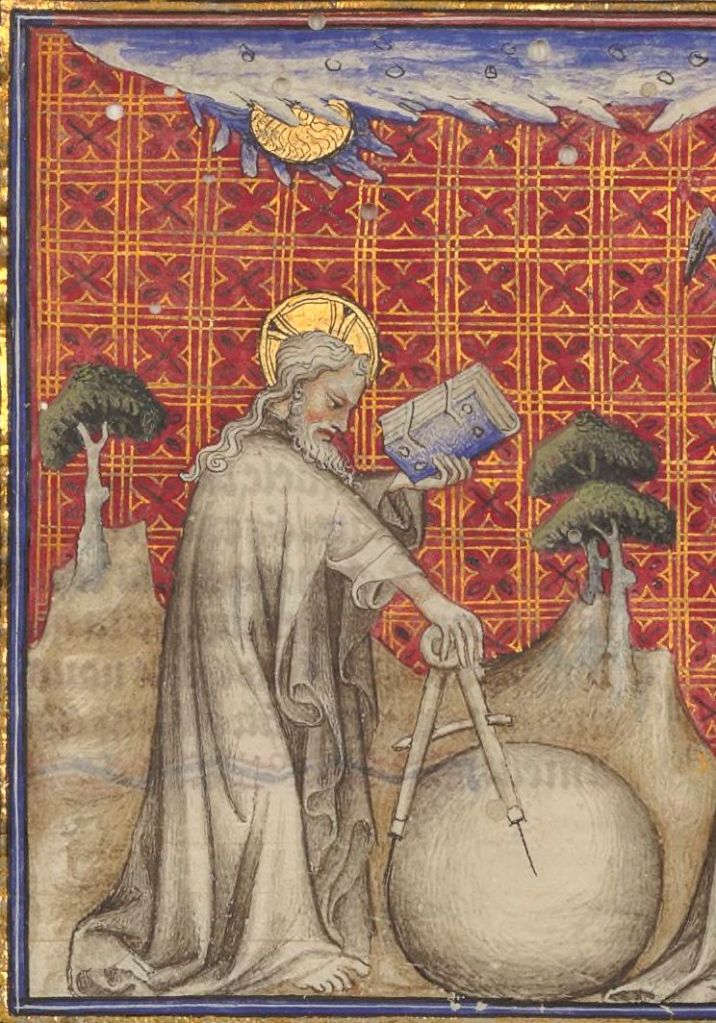
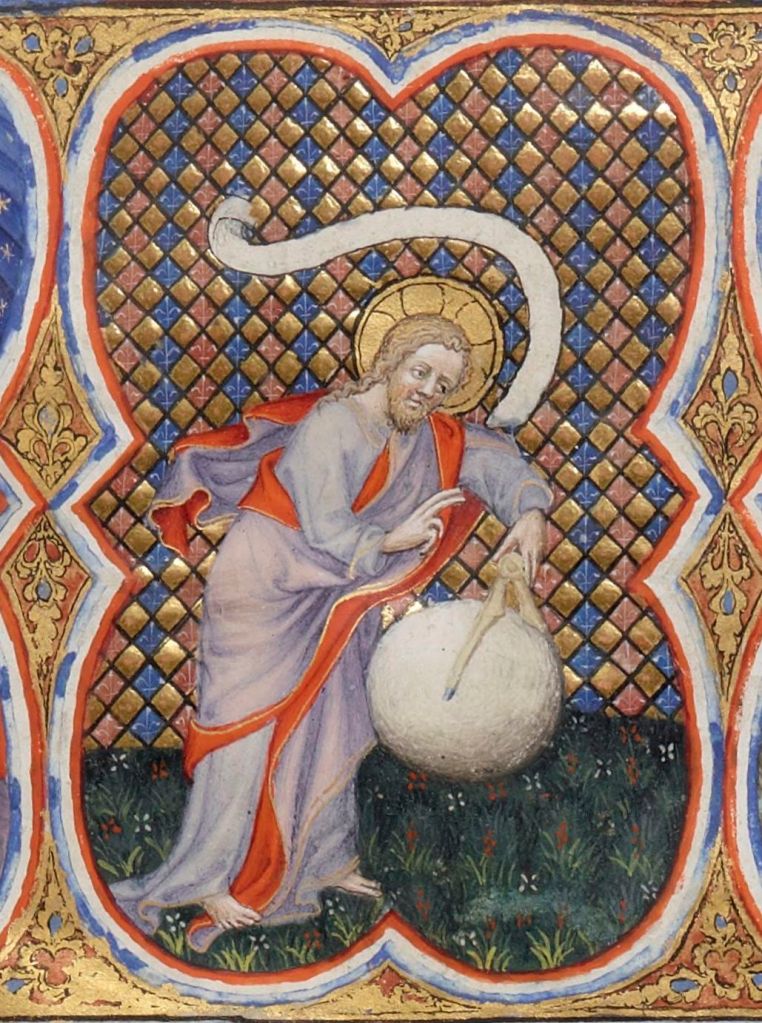
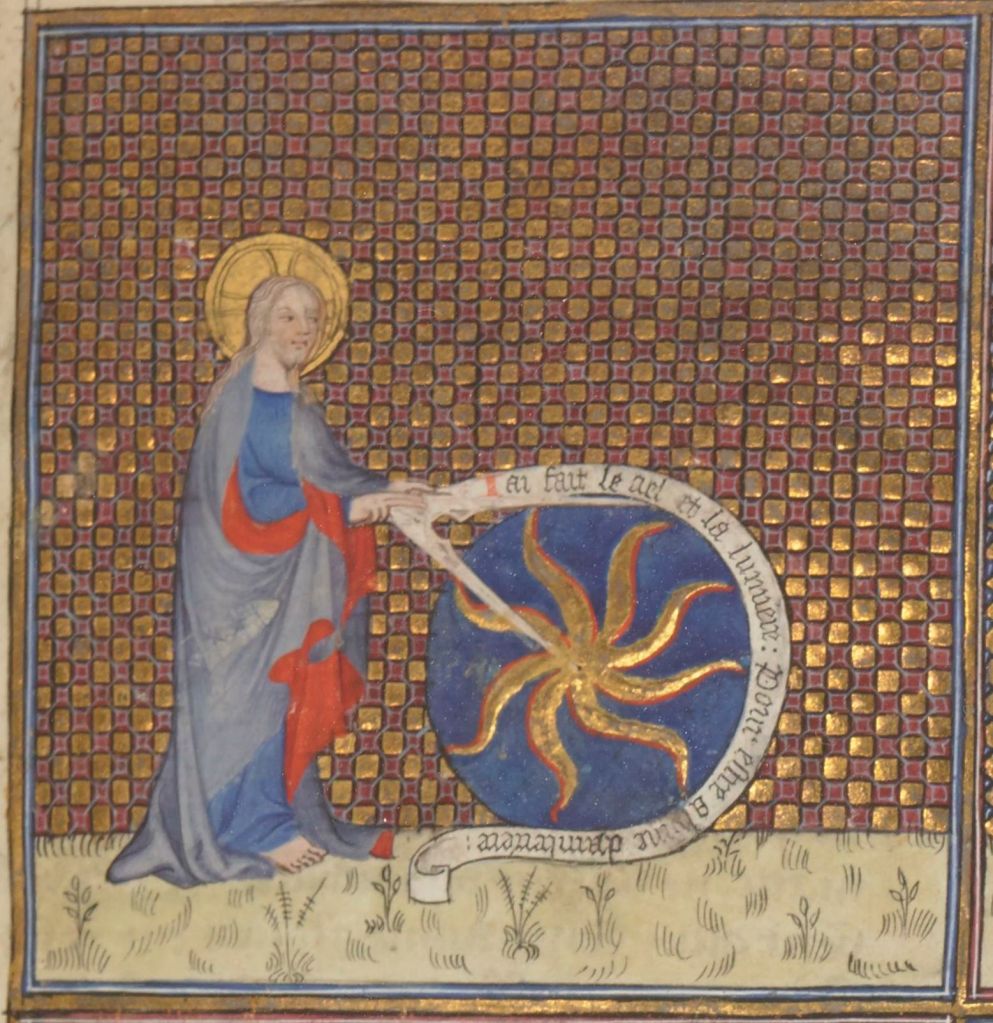
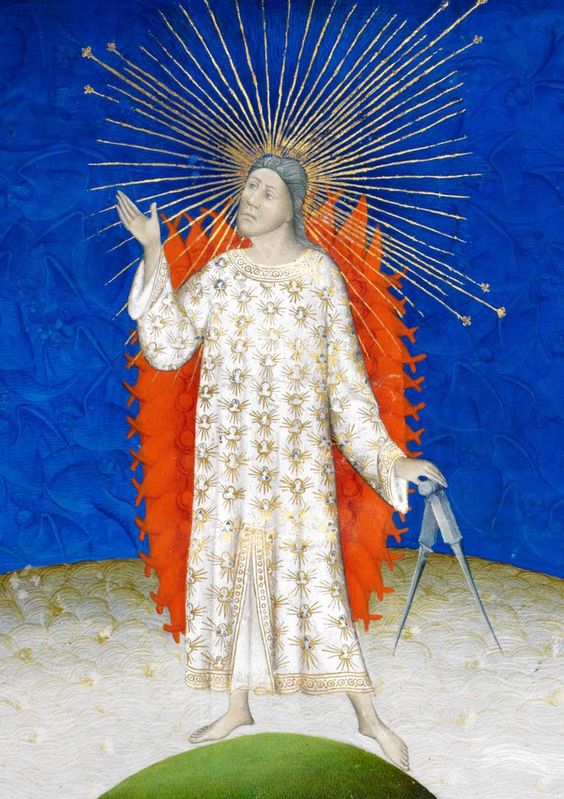
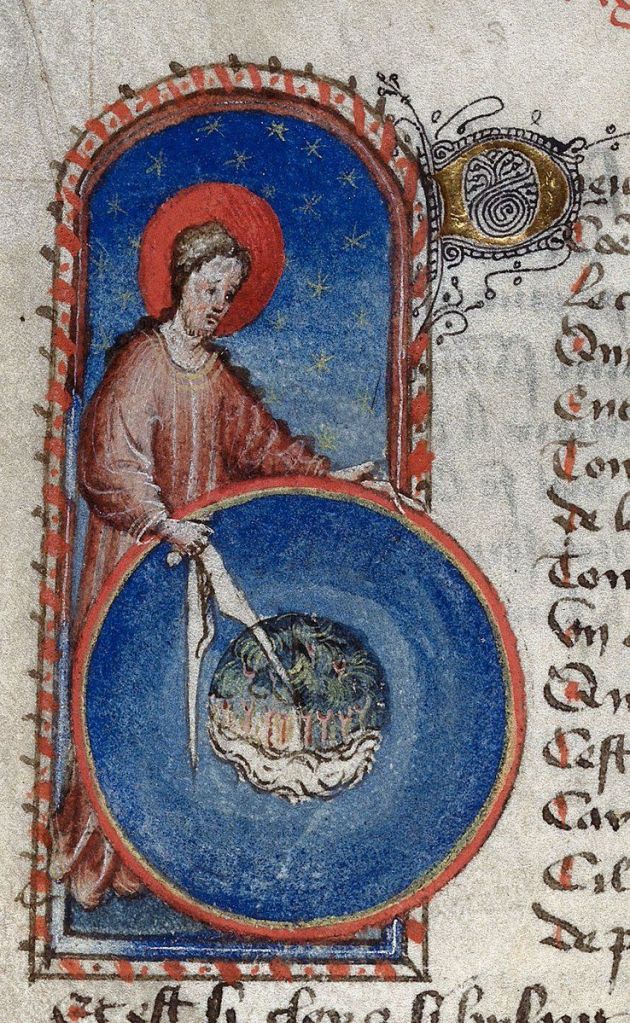
When medieval artists portrayed scenes from Genesis 1 and 2, they typically cast Christ in the role of Creator, intentionally avoiding depicting the first person of the Trinity, who is spirit, but also drawing on New Testament references like John 1:1–4 and Colossians 1:15–17 that describe Christ as participating in the creation of the universe. They often gave him a compass, an architectural tool, to show him marking out the planet Earth and celestial bodies with studied precision. Christ is sometimes identified with the person of Wisdom in Proverbs 8, who proclaims that “when he [God] prepared the heavens, I was there: when he set a compass upon the face of the depth . . .” (v. 27 KJV, emphasis mine).
From a Bible moralisée, France, ca. 1225–50. Vienna, Österreichische Nationalbibliothek, Cod. 2554, fol. 1v.From a Bible moralisée, France, ca. 1225–50. Vienna, Österreichische Nationalbibliothek, Cod. 1179, fol. 1v.From the Bible of St. Louis (Bible of Toledo), vol. 1, fol. 1v, France, 1226–34. Toledo Cathedral, Toledo, Spain.From the Holkham Bible Picture Book, England, ca. 1327–35. London, British Library, Add. 47682, fol. 2r.From a French translation of Augustine’s De Civitate Dei (The City of God), France, ca. 1370–80. Paris, Bibliothèque nationale de France, Français 22913, fol. 2v. From the Bible historiale of Jean de Berry, France, 1380–90. Paris, Bibliothèque nationale de France, Français 20090, fol. 3r. From Histoire ancienne, depuis la création (Ancient History, Since Creation), France, 15th century. Bibliothèque nationale de France, Français 250, fol. 13r.From a Bible historiale, France, 1411. London, British Library, Royal 19 D III, fol. 3.From a verse redaction of L’Image du monde, France, 1425–50. London, British Library, Harley MS 334, fol. 34v.
In his epic poem Paradise Lost, John Milton describes how the “Omnific Word” created all that is:
. . . . . . . . . . . . . . . . . . . . . . . . . . . . and in his hand He [Jesus] took the golden compasses, prepared In God’s eternal store, to circumscribe This universe, and all created things: One foot he centered, and the other turned Round through the vast profundity obscure, And said, “Thus far extend, thus far thy bounds, This be thy just circumference, O world.” (VII.224–31)
In his making of Ancient of Days, Blake was no doubt influenced by the many visual and literary depictions of God as architect of the universe, as compass-wielding geometer, that came before. And so Lawrie, too, implicitly drew on this heritage when he sculpted the majestic figure of Wisdom for the main building of Rockefeller Center.
At first glance, you might interpret the prominent trio at the Center’s entrance as God creating the heavens and the earth, assisted by angels. But while Christian iconography factored into the design, and a Judeo-Christian sacred text forms the inscription, the sculpture group is mainly meant to represent the promise of science and technology.
Construction began at 30 Rockefeller Plaza during the Great Depression (though the Center was conceived prior to that national economic crisis, in 1927); John D. Rockefeller Jr. said he wanted to build a place where New Yorkers could come and surround themselves with art and motifs that celebrated the best of the human spirit. When you step off West 49th or 50th Street into the plaza that’s featured in so many New York City–set movies and TV shows, Rockefeller’s wish was that you’d feel hopeful and energized.
When I was there, during Pride Month (hence the temporarily rainbow-painted sidewalk), the mood was indeed uplifting, with locals and tourists alike passing through with ice-cream cones and lemonades and conversation. It being summer, the Rink was transformed into an al fresco dining area with umbrella-topped tables providing some relief from the heat.
While my faith in humanity’s future is rooted in God and not ultimately our own capabilities, I am obviously grateful for and supportive of progress and achievement. God wants us to grow in knowledge and skill and to use them responsibly and imaginatively to better the world.
In his essay “On Fairy-Stories,” J. R. R. Tolkien says that we humans are “sub-creators” under God, expressing the image of our Creator by exercising creativity. While he was talking specifically about writers creating fantasy worlds, the principle applies to people in any vocation, whether you’re making a book, a bed, or a nanochip. God bids us, “Create!” That we would see ourselves in Lawrie’s Wisdom, crowned and bearing power and authority, is therefore not necessarily arrogant or sacrilegious, as the cultural mandate in Genesis 1:28 charges humans with the noble task of cultivating the stuff of creation, including discovering and leveraging the physical laws of nature, for the flourishing of all.
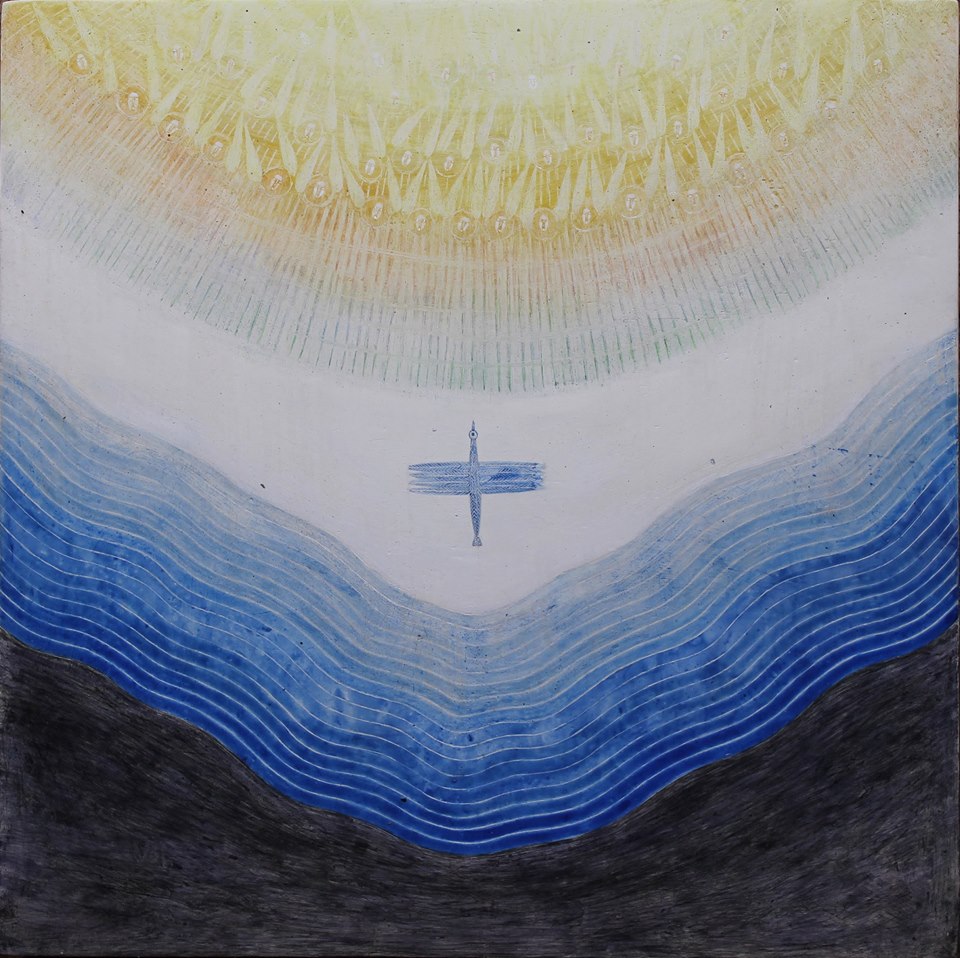
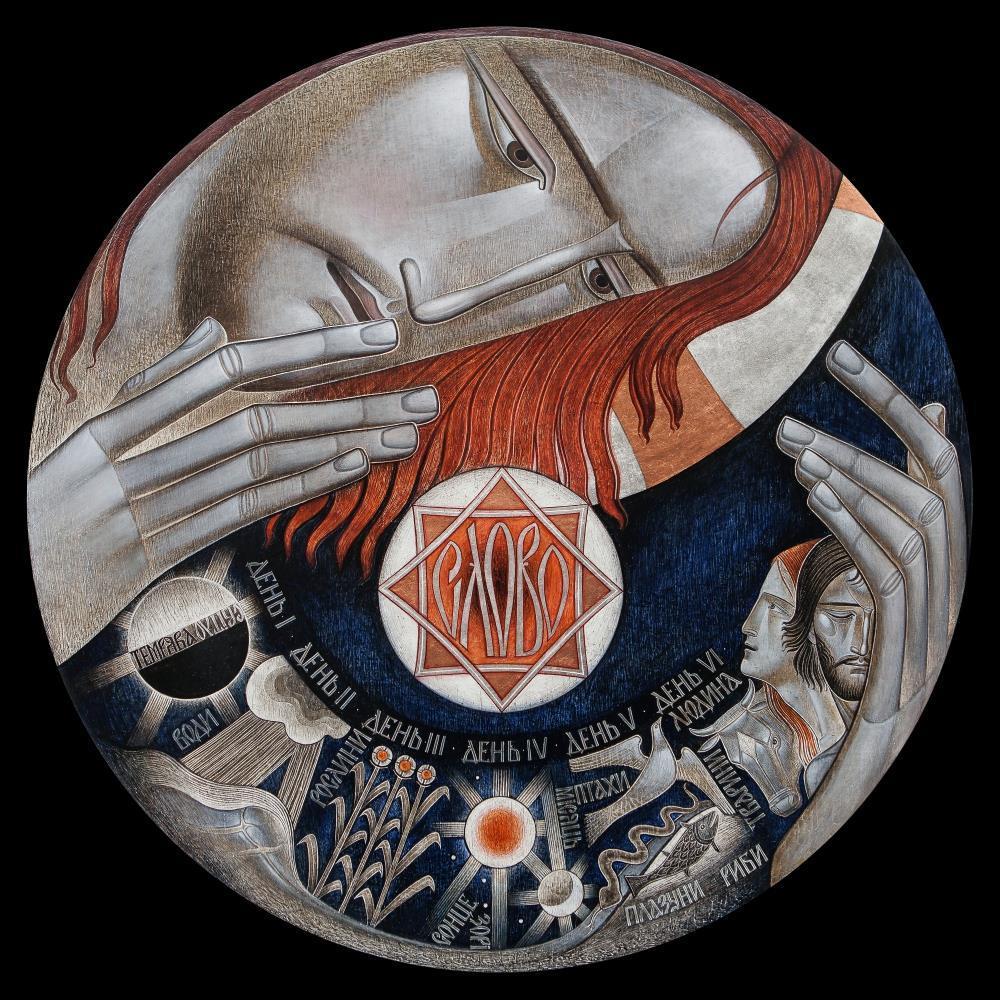
Natalya Rusetska (Ukrainian, 1984–), First Day of Creation, 2017. Egg tempera on gessoed wood board, 30 × 30 cm.
LISTEN: “Let There Be” by Michael and Lisa Gungor, on Ghosts Upon the Earth (2011)
Darkness hovering Grasping everything it sees Void, empty Absent life and absent dream
Let there be Let there be Let there be Let there be
Angels toil and crack open scrolls of ancient dreams Countless worlds of his Brilliant stars and breath and stream
Let there be Let there be Let there be Let there be Let there be Let there be Let there be light
Let there be light Where there is darkness Let there be light Where there is nothing Let there be light
The opening track on Gungor’s Ghosts Upon the Earth, “Let There Be” narrates God’s creation of the universe. What starts out as ethereal becomes increasingly more solid as the floating notes on piano and guitar coalesce into chords and meld with the cellos. Represented by a small choir, the Triune community voices its fiat: “Let there be . . .” A synthesized xylophone and tremolos from the strings suggest lively activity—“angels toil”—as the cosmos begins to take shape. In the second refrain the voices crescendo to a thunderous climax, a drum beating loud and steady as if laying down a foundation.
While this song is most fundamentally about the Genesis 1 creation story, it can also be read in light of John’s Gospel prologue, where he describes Jesus as light coming into the world, and similarly, Luke’s Annunciation narrative, where “ancient dreams” put down in prophetic scrolls are fulfilled in the conception of Christ in Mary’s womb, initiating a new epoch.
The Advent season begins in darkness. Taking stock of this darkness, we ask for God’s light to break in once again—into our hearts and lives, our communities, our world.
In the beginning the Spirit hovered over the void and breathed life into it. Millennia later the Spirit hovered over a virgin’s empty womb and did it again, making the Word flesh. And into our present lack, into our chaos, the Spirit still is coming, re-creating, so that Christ, the light, might be born in us.
Here’s a recent cover of “Let There Be” by IAMSON, which he combines with another Gungor song, “Crags and Clay”:
I didn’t post an Artful Devotion this week, as I struggled to satisfactorily put together image and song for any of the readings, but I’ve now cycled through all three lectionary years on the blog, which are stored in the archives. For content on Sunday’s lectionary reading from the psalms, Psalm 133, see “When Brothers Dwell in Unity (Artful Devotion)” (featuring a Chicago mural by William Walker and a joyful new psalm setting from the Psalter Project); see also the poem “Aaron’s Beard” by Eugene Peterson.
+++
NEW ALBUM: Quarantine Sessions by Eric Marshall: Eric Marshall is the frontman of and songwriter for the meditative art rock band Young Oceans. During the COVID-19 quarantine he recorded eleven of the band’s old songs acoustically in his home studio—just his voice and guitar—and has released them digitally on Bandcamp. Several music artists have been making stripped-down records during this season, and I’m digging it!
+++
ART COMMENTARIES from ART/S AND THEOLOGY AUSTRALIA
Art/s and Theology Australia is an online publication that aims to provoke public reflection and promote research on conversations between the arts and theology, predominantly in Australian contexts. Here are a few articles from the recent past that I particularly enjoyed.
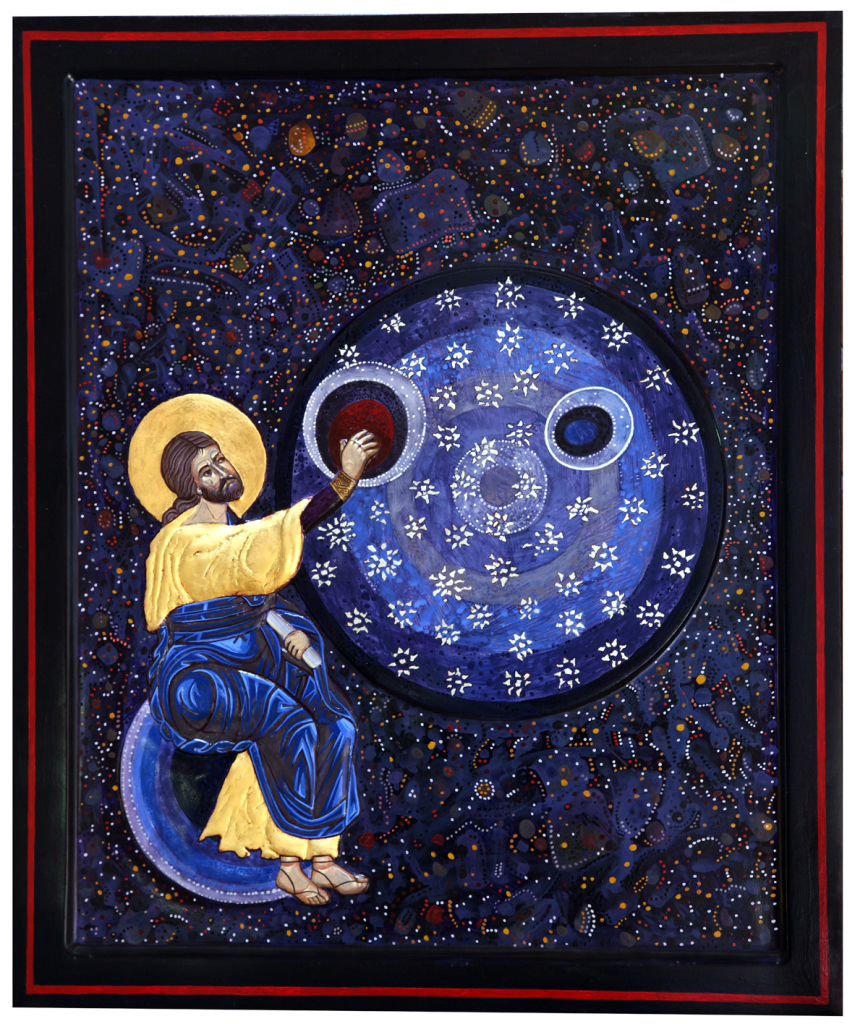
Michael Galovic (Serbian Australian, 1949–), Creation of Lights in the Heavens, n.d.
^^“Jesus Dreaming: A Theological Reaction to Michael Galovic’s Creation of Lights in the Heavens” by Merv Duffy:Creation of Lights in the Heavens by contemporary artist and iconographer Michael Galovic is an authentically Australian reading and rewriting of one of the Byzantine creation mosaics at Monreale Cathedral. Like its visual referent, it shows the Logos-Christ seated on the cosmos, hanging the sun in place (medieval artists tended to show God the Son, who is depictable, as Creator), but the gold background, used in icons to represent the eternal uncreated light of God, is replaced with dots, curves, and circles that represent the Dreamtime of Aboriginal theology, the origin of time and eternity.
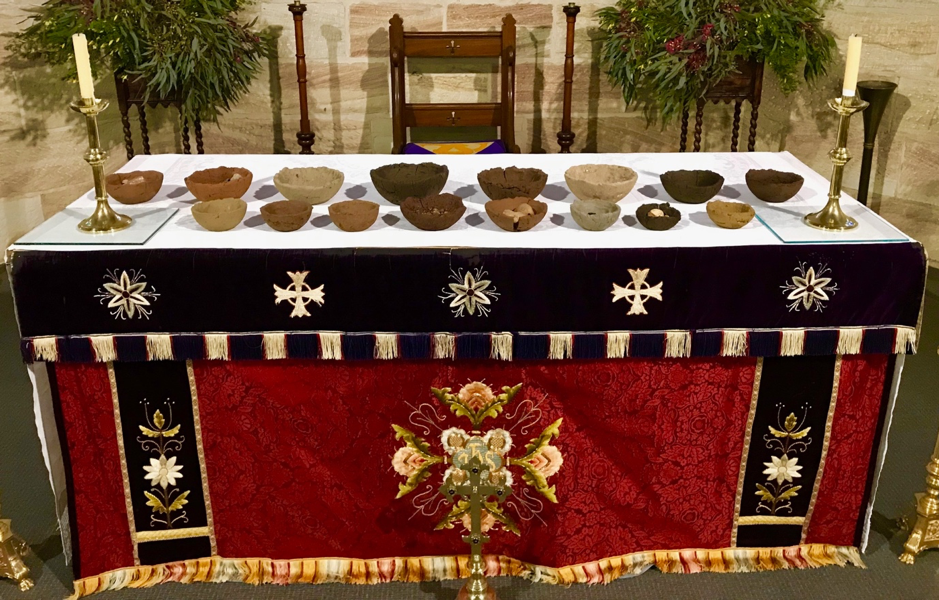
Penny Dunstan, Sixteen Earth Bowls, 2018. Installed at Holy Trinity Anglican Church, Merriwa, for the Festival of the Fleeces.
^^ “Sixteen Earth Bowls” by Penny Dunstan: Soil scientist and visual artist Penny Dunstan has crafted bowls out of topsoil from rehabilitated coal mines in the Hunter Valley in Warkworth, New South Wales, which she exhibits in churches, among other places. “Making earth bowls is a way of thinking about my ethical responses to soil use in a post-mining landscape,” she writes. “It is a way of thinking with my heart and not just my head. As I work with each Hunter Valley topsoil, I come to understand each as an individual, a special part of God’s creation. Each soil behaves according to its own chemical nature and historical past when I fashion it into a bowl shape. . . .
“These soils, full of tiny lives, are responsible for growing our food, making our air and storing atmospheric carbon. Our very lives as humans on the earth depend on them. By fashioning these soils into bowls and placing them in sacred places, I hope to remind us to honour the earth that we stand upon, that earth that speaks to us by pushing back at our feet.” (Note: See also Rod Pattenden’s ArtWay visual meditation on Dunstan’s work.)
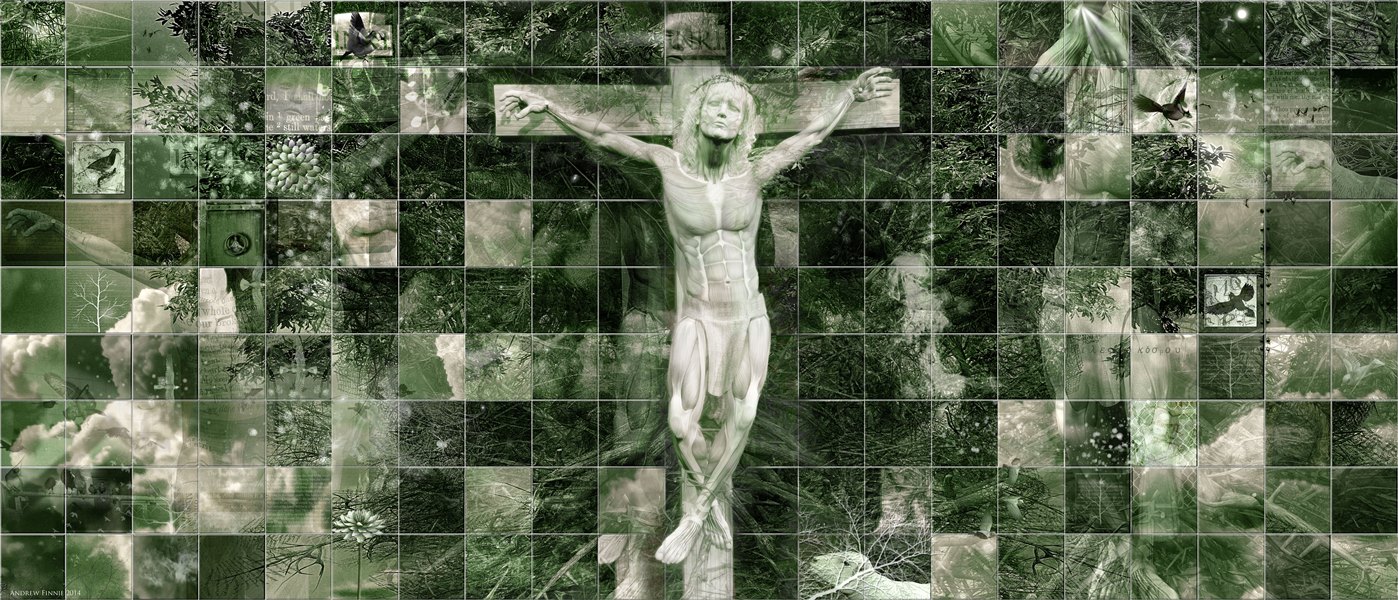
Andrew Finnie (Australian, 1957–), The Body of Christ, The Tree of Life, 2014. Pigment print on Hahnemuhle paper, 78 × 182 cm.
^^“The Cross and the Tree of Life” by Rod Pattenden: “One of the pressing questions for the Church is how we see Christology being renewed in the face of climate change and the potential for the quality of life on this planet to decline,” writes art historian Rod Pattenden [previously]. “Who is Jesus for us in the midst of the profound changes that are occurring to the earth, water, and air of our world? . . .
“Andrew Finnie’s image The Body of Christ, The Tree of Life”—a large-scale ecotheological digital collage—“is an attempt to re-imagine the figure of Christ in conversation with the earth and the networks that sustain human life in all its thriving beauty. Here, the traditional figure of the cross has become entwined in the roots of the tree, a tree of life that is giving form to the variety and beauty of the natural world.”
+++
SONG: “Kadosh” by Wally Brath, sung by Nikki Lerner: The Kedushah is part of the Amidah, the central prayer of the Jewish liturgy. Its first verse is taken from the song of the seraphim in Isaiah 6:3: “Holy, holy, holy, is the LORD of hosts; the whole earth is full of his glory!” (Kadosh means “holy.”) In this original composition for voice, piano, and string quartet, Wally Brath [previously] has combined this Hebrew exclamation from the book of the prophets with an English excerpt from the Lord’s Prayer taught by Jesus in Matthew 6:10: “Thy kingdom come, thy will be done on earth as it is in heaven.” [HT: Multicultural Worship Leaders Network]
The performance captured in this video, featuring Nikki Lerner, took place at Winona Lake Grace Brethren Church in Winona Lake, Indiana, on July 11, 2020. A full list of performers is given in the YouTube description.
+++
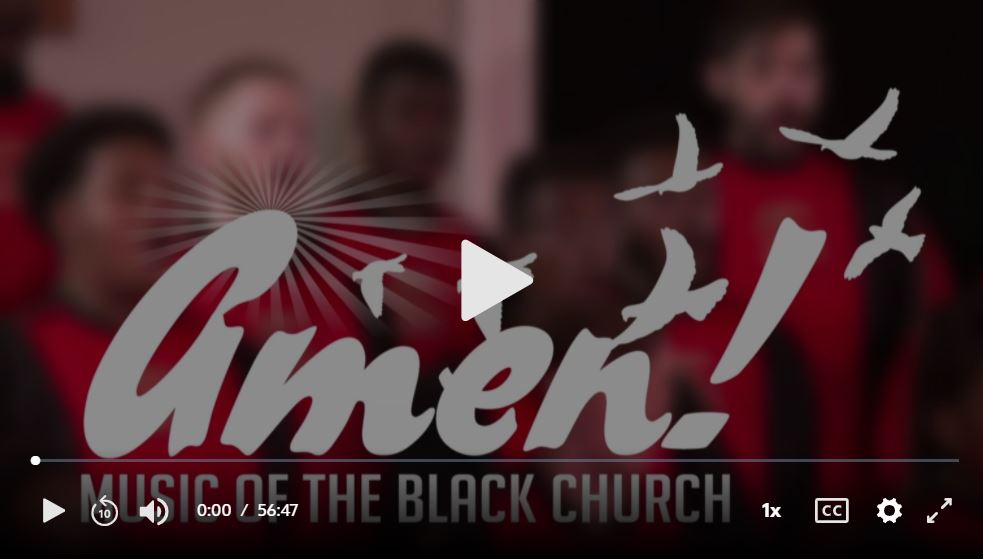
CONCERT FILM: Amen! Music of the Black Church: Recorded before a live audience at the Second Baptist Church in Bloomington, Indiana, and airing April 26, this PBS special explores the rich traditions, historical significance, and meaning of black church music. Dr. Raymond Wise leads the Indiana University African American Choral Ensemble in twenty-one spirituals, hymns, and gospel songs, showing how black church music is not monolithic. He demonstrates the stylistic spectrum you can find among black church communities using a song text derived from Psalm 24:7–10 (“Lift up your heads . . .”): one performed with the European aesthetic preferred in more affluent congregations, one a classical-gospel hybrid, and one pure gospel. One thing I learned from the program is that there is a tradition of shape-note singing in the black church! (See, e.g., The Colored Sacred Harp.) [HT: Global Christian Worship]
Here’s the set list:
“We’ve Come This Far by Faith” by Albert Goodson
“Kumbaya”
“Run, Mary, Run”
“Oh Freedom”
“What a Happy Time” by J. M. Henson and J. T. Cook
“Amazing Grace” by John Newton
“Ain’t Got Time to Die” by Hall Johnson
“I’ve Been ’Buked”
“Lift Up Your Heads” by Emma Louise Ashford, arr. Lani Smith
“Lift Up Your Heads” by Clinton Hubert Utterbach
“Lift Up Your Heads, All Ye Gates” by Raymond Wise
“Glory, Glory, Hallelujah”
“Jesus on the Mainline”
“I Need Thee Every Hour” by Annie S. Hawks and Robert Lowry
“You Can’t Beat God Giving” by Doris Akers
“Come to Jesus” by E. R. Latta and J. H. Tenney
“We Shall Overcome” by Charles Tindley
“Lord, Keep Me Day by Day” by Eddie Williams
“Lord, Do It for Me” by James Cleveland
“Oh Happy Day” by Edwin Hawkins
“I’ve Got a Robe” by Raymond Wise
“Hallelujah, Praise the Lord, Amen” by Raymond Wise
+++
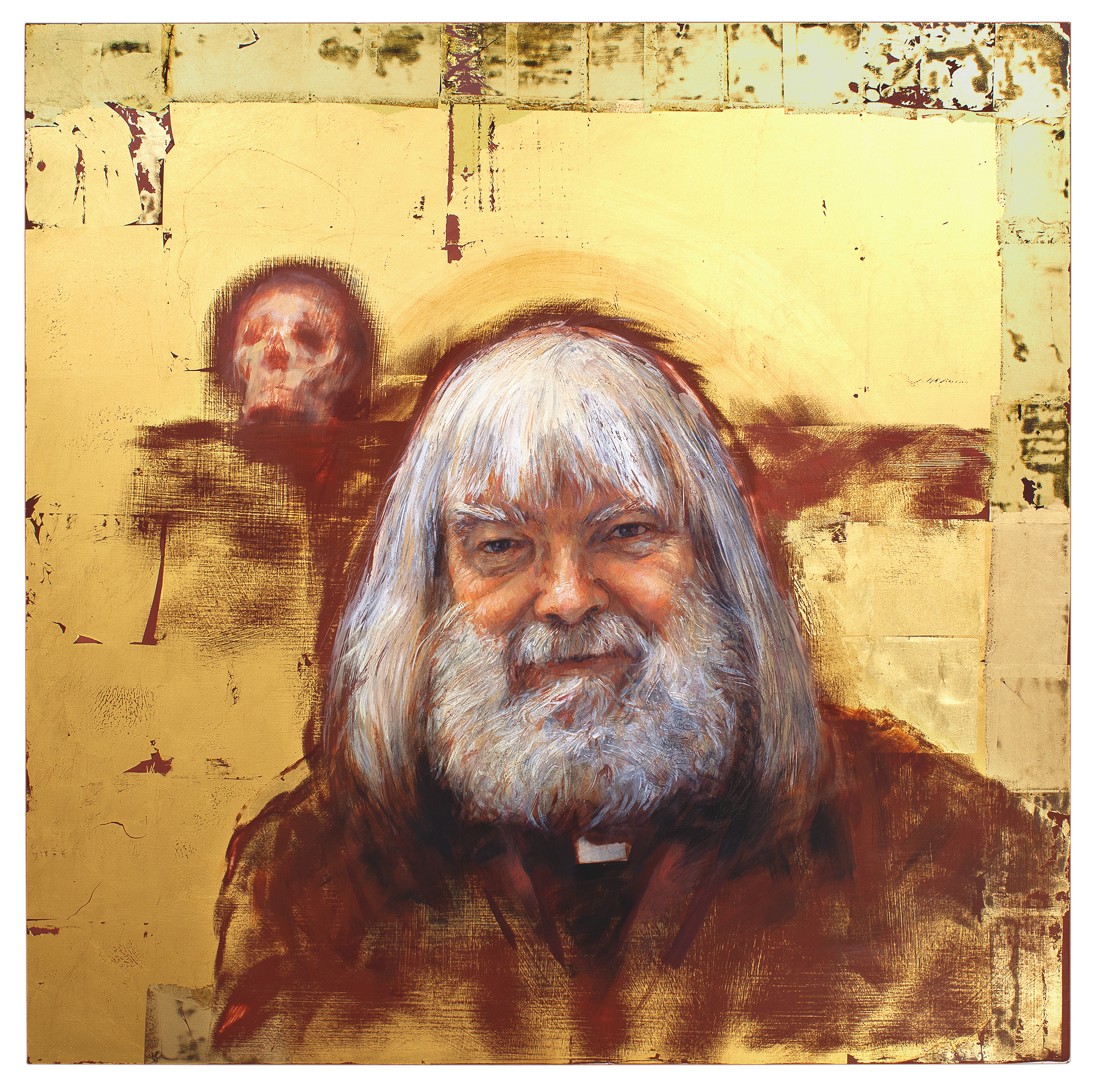
INTERVIEW: Last September The Cultivating Project interviewed Malcolm Guite [previously] on his latest poetry collection After Prayer, the poet-priest George Herbert, the life of a writer, art as faithful service, doubt and despair, his Ordinary Saints collaboration with Bruce Herman and J.A.C. Redford, his friendship with Michael Ward (author of Planet Narnia), the blessing of seasons (both earthly and liturgical), and making room for joy. The interview includes three of Guite’s poems: “Christ’s side-piercing spear,” “A Portrait of the Artist,” and “St. Augustine and the Reapers.”
Bruce Herman (American, 1953–), Malcolm Guite, 2016. Oil on panel with gold leaf, 30 × 30 in.
On September 15 I was invited by North Decatur Presbyterian Church in Georgia to lead a visio divina exercise during their morning worship services. Visio divina, or sacred seeing, is the practice of gazing on an image and opening yourself up to receive the gift that it holds. I approach images this way all the time, and while some people formalize the practice with a set of steps to follow, timed silences, restrictions, and such, my approach is a bit looser.
Because Pastor David Lewicki was preaching on Genesis 2, I chose Aaron Douglas’s painting The Creation. The leadership had already programmed in a reading of the James Weldon Johnson poem that directly inspired the painting, so introducing this visual corollary seemed particularly appropriate.
Note: I disagree with the popular notion, perpetuated by Johnson, that God created humanity because he was lonely; because he is in himself a loving community of Three, he did not lack companionship. Lewicki addresses this concern somewhat in his sermon and rightfully notes how the Genesis 2 creation account presents a God who is closer to humanity and the created world (he digs in the dirt!) and more vulnerable and improvisational than the God we meet in Genesis 1. I don’t believe Johnson’s beautiful poem should be scrapped because of those two (in my opinion) theologically problematic lines, but discretion should be used before presenting it in a worship context. For example, this wouldn’t fly at my church. The NDPC congregation, however, is more welcoming of imaginative engagements with the biblical story that might challenge traditional readings, so those lines were not for them impediments to worship, and I appreciated that Lewicki commented on them in his sermon, wondering about the “holy longing” the Creator must have felt for us.
Below are Johnson’s poem, Douglas’s image, and the transcript of my contribution, which I peppered with substantial pauses. To promote a better visio divina experience on your computer, I’d recommend right-clicking the image and selecting “Open link in new window,” then split-screening that window with this one; that way, you can more easily reference the image while you read. (In the future, I will try to produce audio for exercises like these.)
+++
Aaron Douglas (American, 1899–1979), The Creation, 1935. Oil on Masonite, 48 × 36 in. Howard University Gallery of Art, Washington, DC.
“The Creation”by James Weldon Johnson
And God stepped out on space,
And he looked around and said: I’m lonely— I’ll make me a world.
And far as the eye of God could see
Darkness covered everything,
Blacker than a hundred midnights
Down in a cypress swamp.
Then God smiled,
And the light broke,
And the darkness rolled up on one side,
And the light stood shining on the other,
And God said: That’s good!
Then God reached out and took the light in his hands,
And God rolled the light around in his hands
Until he made the sun;
And he set that sun a-blazing in the heavens.
And the light that was left from making the sun
God gathered it up in a shining ball
And flung it against the darkness,
Spangling the night with the moon and stars.
Then down between
The darkness and the light
He hurled the world;
And God said: That’s good!
Then God himself stepped down—
And the sun was on his right hand,
And the moon was on his left;
The stars were clustered about his head,
And the earth was under his feet.
And God walked, and where he trod
His footsteps hollowed the valleys out
And bulged the mountains up.
Then he stopped and looked and saw
That the earth was hot and barren.
So God stepped over to the edge of the world
And he spat out the seven seas—
He batted his eyes, and the lightnings flashed—
He clapped his hands, and the thunders rolled—
And the waters above the earth came down,
The cooling waters came down.
Then the green grass sprouted,
And the little red flowers blossomed,
The pine tree pointed his finger to the sky,
And the oak spread out his arms,
The lakes cuddled down in the hollows of the ground,
And the rivers ran down to the sea;
And God smiled again,
And the rainbow appeared,
And curled itself around his shoulder.
Then God raised his arm and he waved his hand
Over the sea and over the land,
And he said: Bring forth! Bring forth!
And quicker than God could drop his hand,
Fishes and fowls
And beasts and birds
Swam the rivers and the seas,
Roamed the forests and the woods,
And split the air with their wings.
And God said: That’s good!
Then God walked around,
And God looked around
On all that he had made.
He looked at his sun,
And he looked at his moon,
And he looked at his little stars;
He looked on his world
With all its living things,
And God said: I’m lonely still.
Then God sat down—
On the side of a hill where he could think;
By a deep, wide river he sat down;
With his head in his hands,
God thought and thought,
Till he thought: I’ll make me a man!
Up from the bed of the river
God scooped the clay;
And by the bank of the river
He kneeled him down;
And there the great God Almighty
Who lit the sun and fixed it in the sky,
Who flung the stars to the most far corner of the night,
Who rounded the earth in the middle of his hand;
This Great God,
Like a mammy bending over her baby,
Kneeled down in the dust
Toiling over a lump of clay
Till he shaped it in his own image;
Then into it he blew the breath of life,
And man became a living soul.
Amen. Amen.
We are filled with the divine breath; we breathe God.
Take a moment to meditate on Aaron Douglas’s painting The Creation, made in response to the James Weldon Johnson poem that was just read.
What colors do you notice? What shapes? What movement? What shimmers for you in this image? Whatever it is, fix your eyes there. Now expand your gaze to encompass the whole image.
For me, what shimmers are the purples and blues, and especially the hand of God that reaches through the undulating atmosphere. In this image, creation swirls and dances, rises and rolls—the colors river every which way. Eight spheres—the planets, perhaps—float playfully like bubbles. It’s all a wondrous, dynamic, primordial burst of life, and we’re a part of it.
At the bottom, man emerges plant-like from the shadows, his face extending into an arc of light, the light of God. His feet are planted in the soil of earth, but heaven blazes all around him. He is an amphibious creature, belonging to both worlds, which here are united.
The poet uses maternal language to describe God’s ultimate creative act, saying that he knelt down at a riverbank and gently scooped up clay from its bed—then, like a mother coddling her baby, he formed humanity. Majesty stooping down in tenderness.
“Then into it he blew the breath of life,
And man became a living soul.
Amen. Amen.”
VISUAL MEDITATION: Pentecost by Andrew Wyeth, written by Victoria Emily Jones: In 2017 I took a day trip up to Chadds Ford, Pennsylvania, to attend the major Andrew Wyeth retrospective organized by the Brandywine River Museum of Art. Though some critics dismiss him as a “regional nostalgist” who, in sticking to realism, failed to keep with the times, I was enthralled by his hundred-plus paintings on display, not least of which was Pentecost. Created in 1989, it shows a pair of old fishing nets blowing in the wind on the Maine island his wife purchased and revitalized. Wyeth was not religious, but he was fascinated by the supernatural, and his paintings are often celebrated for their spiritual quality, for the sense of presence they evoke. Click on the link to read my reflection on this painting, named after the annual Christian feast that the church celebrates today (June 9) in honor of the Holy Spirit’s descent.
SONG: “Come, Holy Ghost,”arranged and performed by Nichlas Schaal and friends: The ninth-century Latin invocation “Veni Creator Spiritus,” attributed to Rabanus Maurus, has been translated into English more than fifty times since the English Reformation, under such titles as “Come, Holy Ghost, our souls inspire” and “Creator Spirit, by whose aid.” Originally seven verses sung in Gregorian chant, the hymn is usually condensed to four verses in modern hymnals and paired with one of three tunes. This super-fun arrangement by the Schaals, so full of joy (and “la-da-da-das”!), uses a nineteenth-century translation by Edward Caswell and tune by Louis Lambillotte. I’ve been listening to it on repeat all week as I’ve been gearing up for Pentecost. [HT: Liturgy Letter]
Come, Holy Ghost, Creator blest,
And in our hearts take up thy rest;
Come with thy grace and heav’nly aid
To fill the hearts which thou hast made,
To fill the hearts which thou hast made.
O Comforter, to thee we cry,
Thou heav’nly gift of God most high,
Thou fount of life, and fire of love,
And sweet anointing from above,
And sweet anointing from above.
O Holy Ghost, through thee alone
Know we the Father and the Son;
Be this our firm unchanging creed,
That thou dost from them both proceed,
That thou dost from them both proceed.
Praise we the Lord, Father and Son,
And Holy Spirit with them one;
And may the Son on us bestow
All gifts that from the Spirit flow,
All gifts that from the Spirit flow.
+++
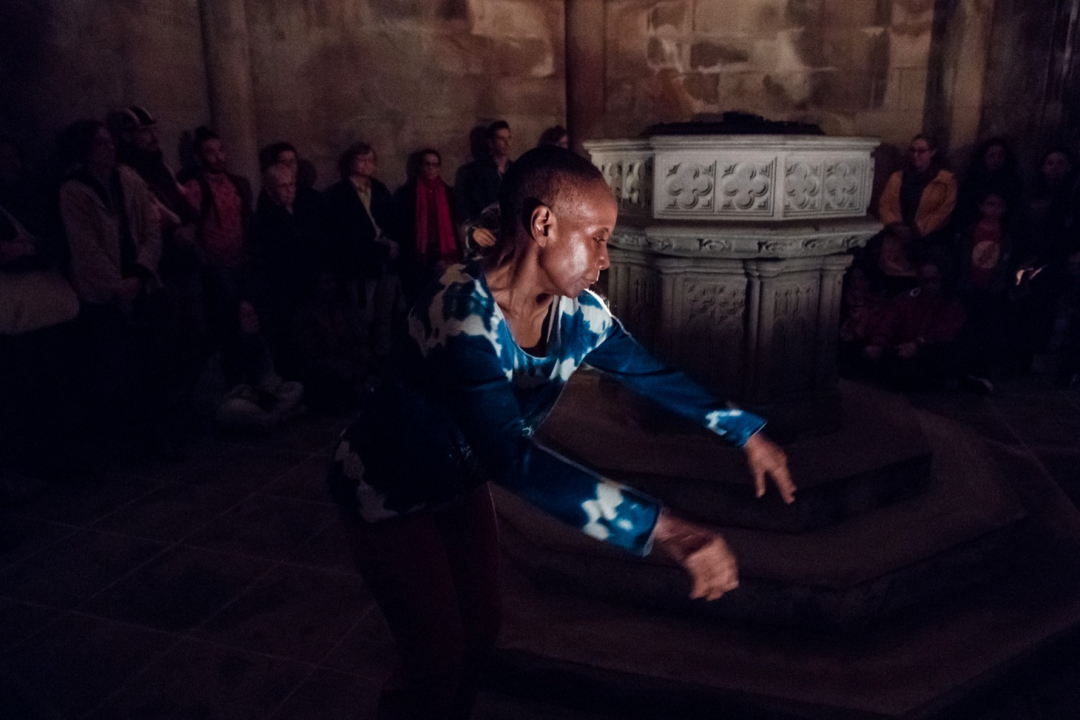
DANCE PERFORMANCES: Grounds That Shout!, curated by Reggie Wilson: It interests me to see how sacred spaces, especially Christian ones, inspire new artistic creations. Here’s one example from last month: “Curated by award-winning choreographer Reggie Wilson, Grounds that Shout! (and others merely shaking) is a series of performances that respond to the layered histories of Philadelphia’s religious spaces through contemporary dance, reflecting on the relationships and connections between practices of movement and worship. Over two weeks, eight choreographers and performance groups . . . perform[ed] in four historic Philadelphia churches, drawing from site and spirit to present original and re-situated works of dance.”
For “Souls a-Stirring” by Germaine Ingram, two female dancers shuffled around the large stone baptismal font at Church of the Advocate, sounding out rhythms as Ingram joined them and sang, “When temptation calls out to me / When dark clouds merge and follow me / I ask god to take my hand / Can he not / Can she not / Inspire a woman to teach God’s love?” Photo: Daniel Kontz/Hyperallergic.
+++
ART INSTALLATIONS
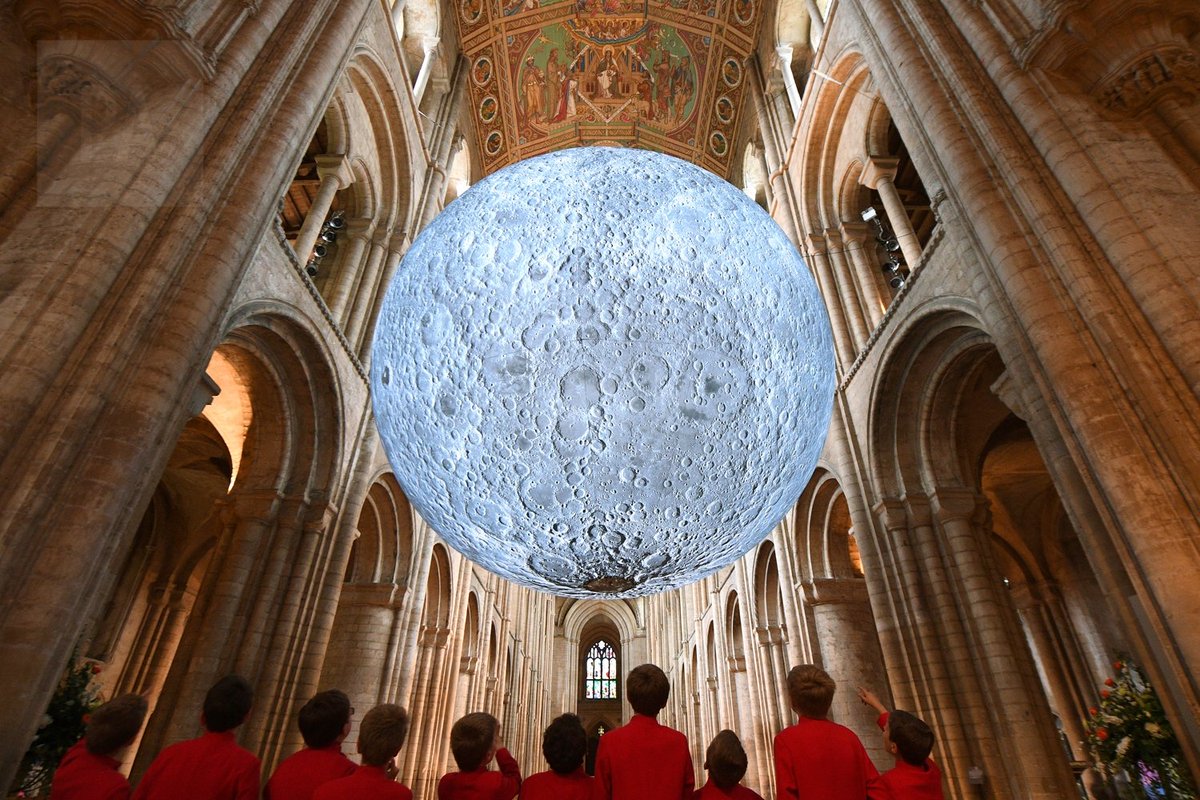
Museum of the Moon at Ely Cathedral: Today’s the last day to see Luke Jerram’s Museum of the Moon installation at Ely Cathedral in Cambridgeshire, a twenty-three-foot replica of the moon that utilizes high-resolution NASA satellite imagery and a sound composition by Dan Jones. The internally lit spherical sculpture hovers under the cathedral’s painted nave ceiling and is the main attraction of the cathedral’s science festival, “The Sky’s the Limit,” celebrating the fiftieth anniversary of the first moon landing (July 16, 1969). Jerram has produced several moons, which are touring the world, hoisted up in churches and other spaces, indoor and outdoor. For some really stunning photos as well as a tour schedule, check out https://my-moon.org/.
Installation view of Luke Jerram’s Museum of the Moon at Ely Cathedral, May 2019. Photo: Joe Giddens/Press Association.
Jerram has also created replicas of Earth, scaled down by a factor of 1.8 million and titled Gaia. They are currently being displayed inside Salisbury and Liverpool cathedrals and will thereafter continue their world tours. (The bronze font by William Pye at Salisbury, designed to reflect and extend the surrounding architecture, makes for some truly amazing photographs of Gaia! Not to mention the significant meaning generated by the interaction of the two.)
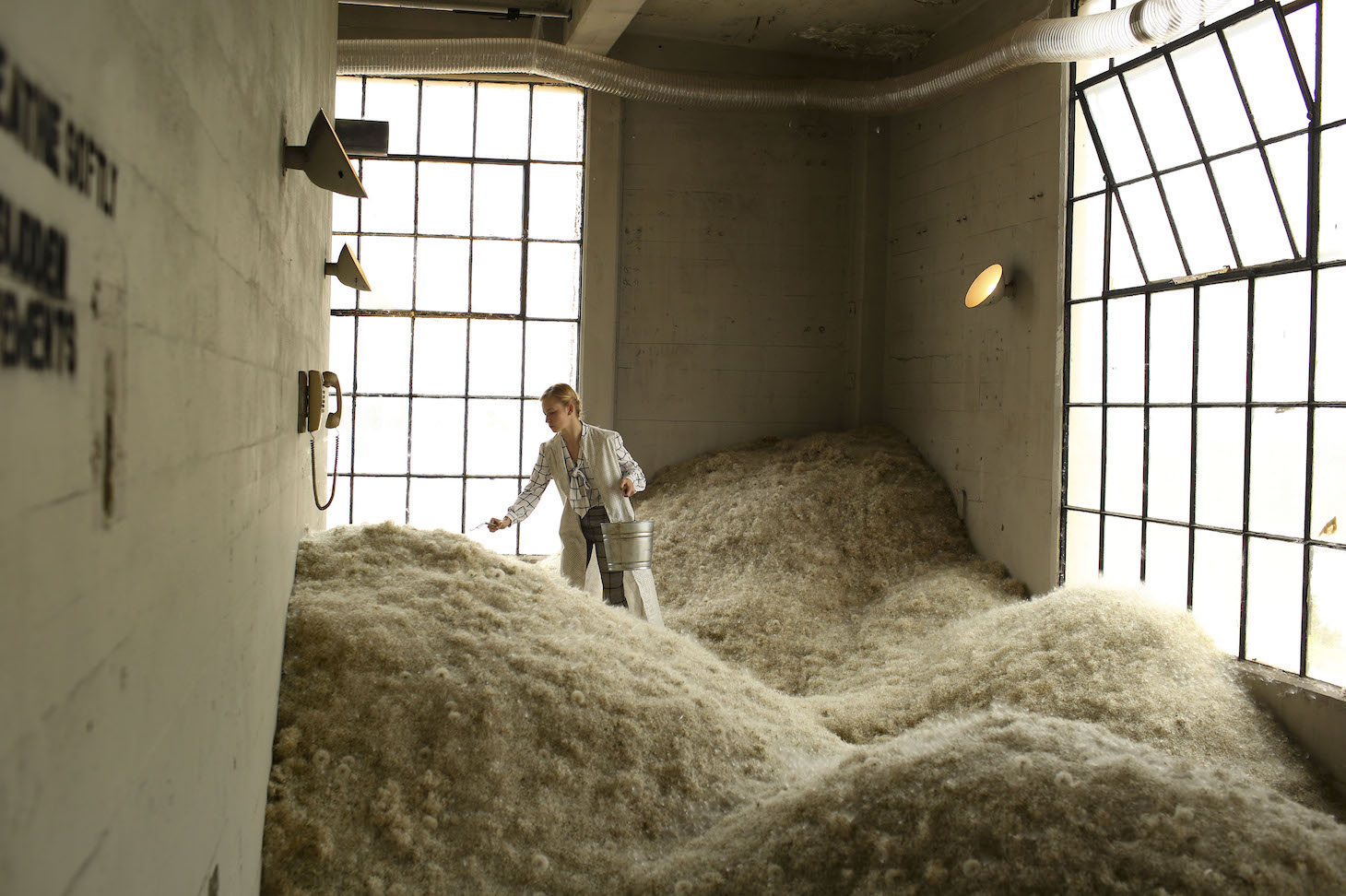
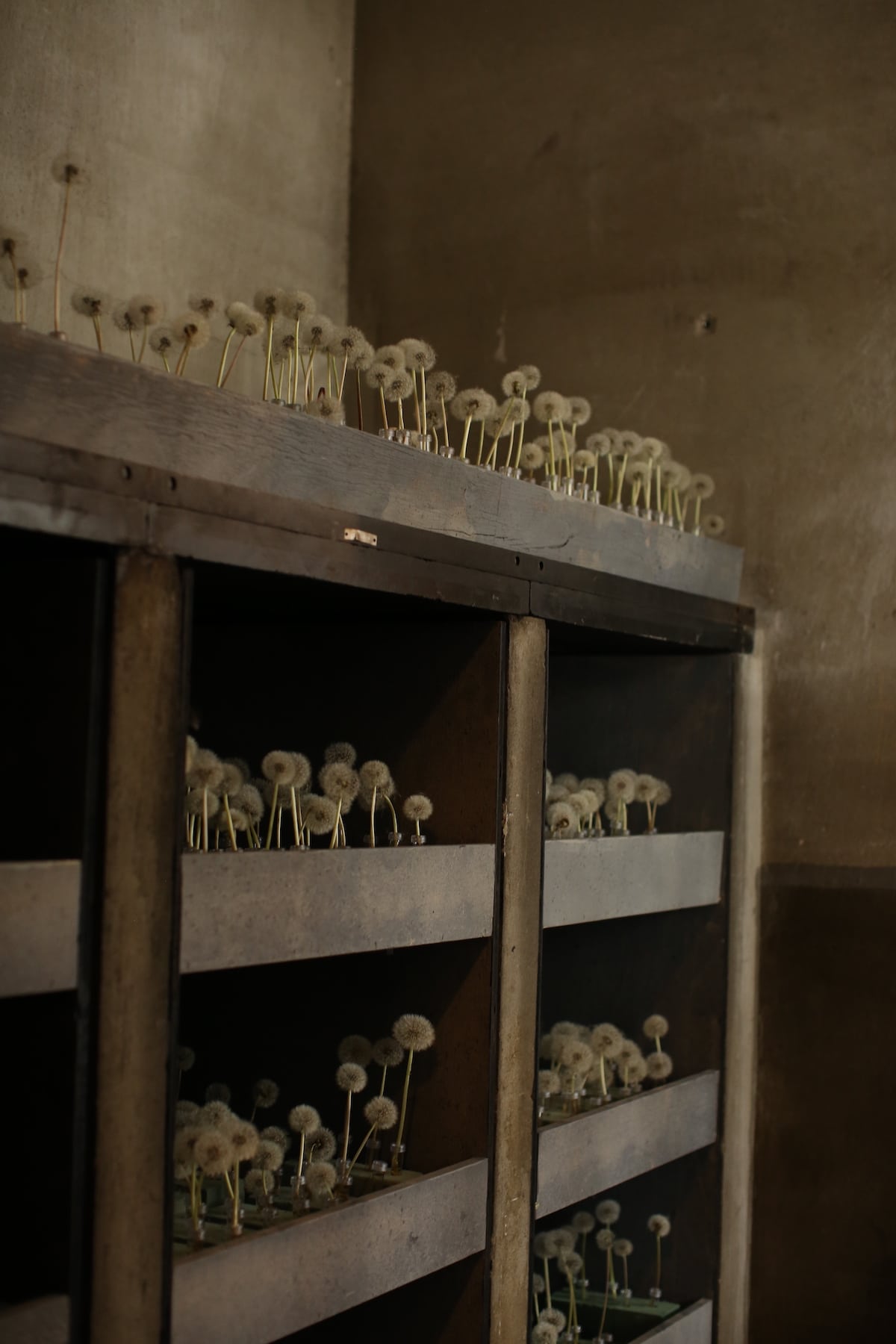
Dandelions by The Art Department: From May 11 to 12, a decommissioned building at the Laguna Bell electrical substation in Commerce, California, was transformed into a “wish-processing facility,” where visitors submitted their wishes for questioning and analysis before taking a dandelion and blowing its seeds down a chute. Part installation, part performance, Dandelions was put together by the anonymous collective The Art Department. When asked to define wish, the collective replied, “For some, a wish is a prayer fulfilled by a higher power. For some, a wish is an aspiration imbued with rational optimism. For some, wishes represent unfulfilled longing.”
Art often gives us occasion to confront who we are and what we desire, and with this piece, that was done in a playful way, with a mock bureaucracy that included the Department of Small Things That Float and various logistical assessments. View more photos and read an interview with the creators at My Modern Met, and see also the Hyperallergic review.
Photo: Michèle M. Waite, courtesy of The Art Department
Photo: Michèle M. Waite, courtesy of The Art Department
+++
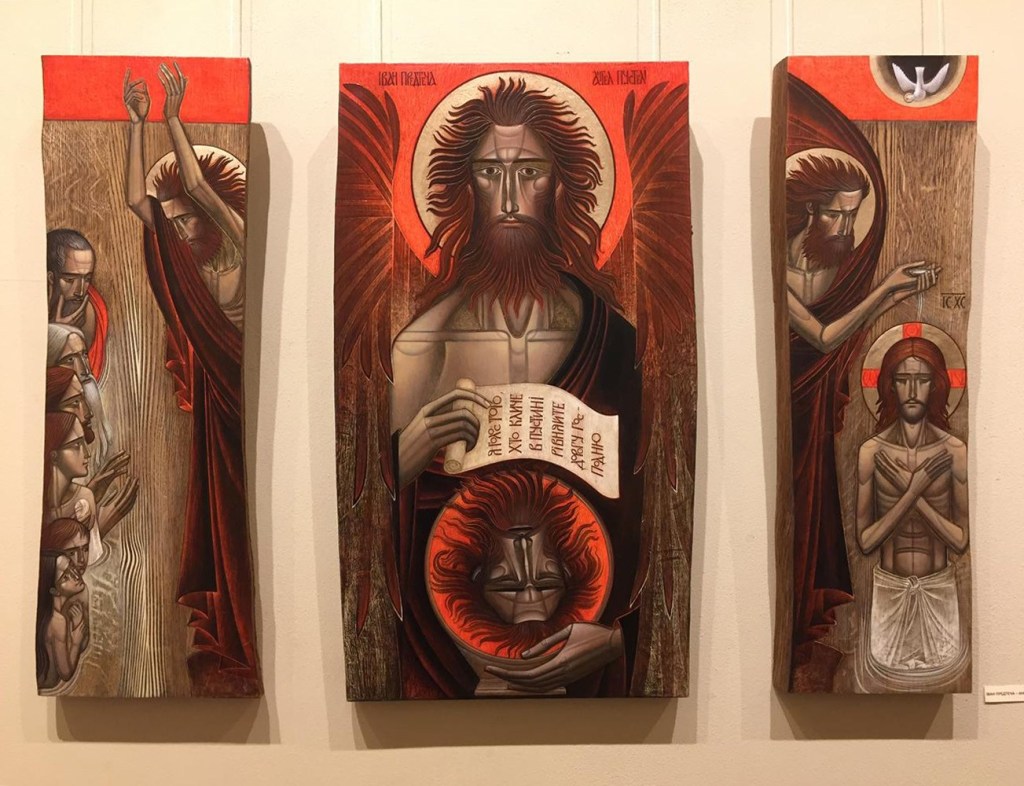
EXHIBITION: “Renewal: Icon Paintings by Lyuba Yatskiv”: Through June 30, the Iconart Contemporary Sacred Art Gallery in Lviv, Ukraine, is hosting a solo show of new work by Lyuba Yatskiv, one of the country’s several experimental iconographers. Among the subjects on display are the Creation of the World (he’s got the whole world in his hands!), Noah’s Ark, David the Psalmist, the Annunciation, the Flight to Egypt, John the Baptist, and the Holy Women at the Tomb.
Lyuba Yatskiv (Ukrainian, 1977–), Creation of the World, 2019. Acrylic and gold on gessoed board.
Lyuba Yatskiv (Ukrainian, 1977–), St. John the Forerunner, Angel of the Desert, 2019. Acrylic and gold on gessoed boards.
Articlesandessays have been pouring forth from the web in tribute to the poet Mary Oliver since her passing on January 17. America’s most-read contemporary poet by far, Oliver approached the world with open-eyed wonder and delight, writing simply about nature and spirituality. “When it’s over, I want to say: all my life / I was a bride married to amazement,” she wrote in “When Death Comes.”
Photo: Angel Valentin / New York Times
Although Oliver won a National Book Award and a Pulitzer Prize, she has been dismissed by many poetry critics as trivial, unsubtle, just an old-fashioned romantic. But that’s precisely what so many of her readers love about her: her uncomplicated free verse that finds beauty and mystery in the ordinariness of the natural world. She always insisted that poetry “mustn’t be fancy”; it should be clear, so as to be understood.
The subjects of most of her poems are the flora and fauna of, most especially, New England, where she lived most of her adult life. Herons, egrets, swans, geese, goldfinches, owls, loons; turtles, snakes, and toads; foxes, porcupines, moles, bears, deer, and dogs (a whole volume on dogs!); ants and grasshoppers, beetles and bees; whelks and whales and sea mice; daisies and goldenrod, roses and poppies and peonies; and so forth.
Oliver, though influenced by the Christianity of her youth, did not ultimately join the church. But, like Whitman and Thoreau before her, she perceived an unseen, transcendental Presence within the natural world. She even sometimes called that Presence “God” and even “Lord,” especially in her later poems. She carried on the long tradition of reading with relish the “book of nature”—nature as a source of divine revelation, a teacher of spiritual lessons. For example, in “Some Herons,” she describes the bird as “a blue preacher,” and in “The Chat,” she writes,
oh, Lord,
what a lesson
you send me
as I stand
listening
to your rattling, swamp-loving chat
singing
of his simple, leafy life—
how I would like to sing to you
all night
in the dark
just like that.
Oliver’s “How the Grass and the Flowers Came to Exist, a God-Tale” is one of my favorite Creation poems, and this isn’t the only poem of hers that acknowledges a Creator God. “Spring at Blackwater: I Go Through the Lessons Already Learned” opens tenderly, sweetly, “He gave the fish / her coat of foil, / and her soft eggs.”
Some things I’ve learned from Mary Oliver: Gratitude. Awe. Silence. Prayer. Attention. And these five qualities are all interconnected. Her personal manifesto can be summed up by the fourth section of her poem “Sometimes”:
Instructions for living a life: Pay attention. Be astonished. Tell about it.
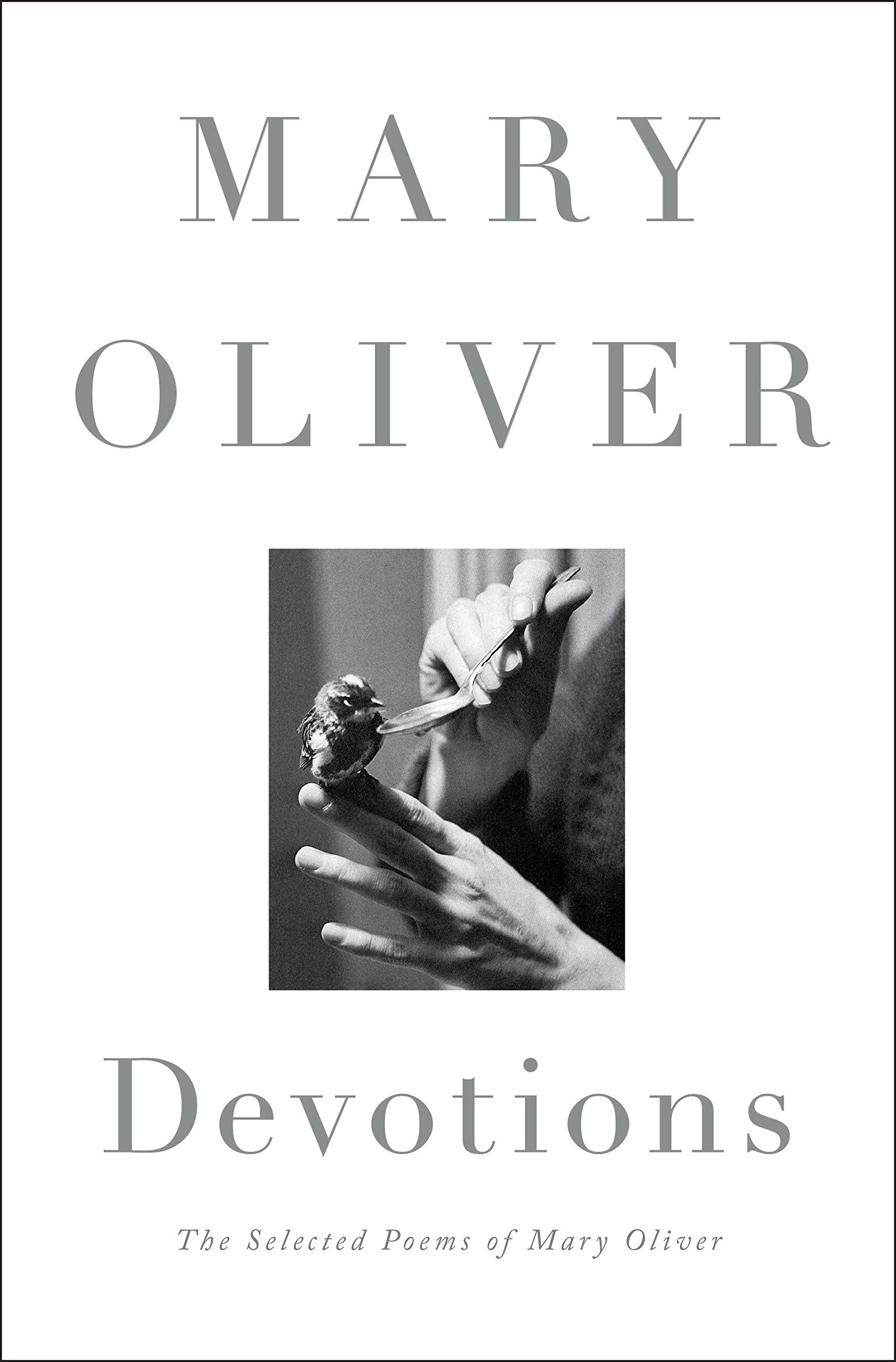
If you’d like to read Mary Oliver, I highly recommend her final book, Devotions (2017), a compilation of 200+ previously published poems selected by Oliver herself and put out by Penguin. Spanning her career of more than fifty years, the book, though not exhaustive, presently serves as the definitive collection of her work.
Coincidentally, I was in the middle of reading this volume when I found out about Oliver’s death. Several of her poems confront mortality, the transience of life, and many of her obituary writers have been fond of recalling those oft-quoted final lines of “The Summer Day.” But I am drawn to her “Prayer,” which when I read it instantly made me think of my play-full, wonder-full aunt whose ashes, too, now dance in the ocean:
May I never not be frisky,
May I never not be risqué.
May my ashes, when you have them, friend,
and give them to the ocean,
leap in the froth of the waves,
still loving movement,
still ready, beyond all else,
to dance for the world.
This post contains Amazon affiliate links, meaning that Art & Theology will earn a small commission on any purchase that originates here.










 Art & Theology