The Art of Dom Gregory de Wit

One of the joys of blogging at Art & Theology is being introduced to new artists by my readers. I was pleased to receive in the mail recently, as a gift from one such reader, a color booklet and a 2018 documentary on the art of Dom Gregory de Wit (1892–1978), a Dutch artist and Benedictine monk who between 1938 and 1955 lived in the United States painting murals for Catholic churches and monasteries. This was the first time I’ve encountered the artist, and I enjoyed getting to know him better through these materials.

All photos in this post are provided courtesy of Edward Begnaud or Stella Maris Films.

Gregory was born Jan Aloysius de Wit on June 9, 1892, in Hilversum, Netherlands. He entered the monastic life in 1913 at age twenty-one, joining Mont César Abbey in Leuven, Belgium, and there taking the name Gregory. (His interest in liturgy and ecumenism is what drew him to that particular abbey.) de Wit was passionate about art making since a young age, and his order encouraged him to further develop his talent as a painter. He therefore studied at the Brussels Academy of Art, the Munich Academy, and throughout Italy. In 1923 he exhibited at The Hague and ended up selling forty-five paintings in one month! He then went on to fulfill three sacred art commissions—one in Bavaria, two in Belgium—while continuing to live as a monk.

Jesus as servant
This mural, painted in 1930 and photographed here in black-and-white, shows Jesus serving wine at a monastic banquet. It’s one of nine murals Gregory de Wit painted in the refectory of St. Michael’s Abbey in Metten, Bavaria, Germany.

In 1938, Abbot Ignatius Esser of Saint Meinrad Archabbey in southern Indiana met de Wit in Europe and invited him to design and execute paintings for the abbey’s church and chapter room—which he gladly accepted.

Here he started to develop his own style, which would come to be marked by brilliant (sometimes garish) colors, bold outlines, distortion or disfiguration (e.g., disproportionate hands), and “overlapping” perspective.

In Christus, Jesus is borne upward by a red-winged chariot. In his right hand he holds a victory wreath, and in his left, an open book that declares, EGO SUM VITA (“I am the Life”). The three small Greek letters in the rays of his halo, a traditional device in Orthodox iconography, mean “I am the Living One,” a New Testament echo of God’s “I am who I am” in Exodus 3:14.

Christus by Gregory de Wit
This figure of the risen Christ, painted by Gregory de Wit in the 1940s, is found high on the wall of the church of Saint Meinrad Archabbey, St. Meinrad, Indiana.

+++

Shortly after de Wit arrived in the US, World War II broke out, and even after he completed his work at Saint Meinrad, he couldn’t return to Belgium. Luckily, another stateside commission came his way, from the newly built Sacred Heart Catholic Church in Baton Rouge, Louisiana. The parish priest, Father Dominic Blasco, hired him to paint a series of murals, which resulted in de Wit’s most polarizing work: his Christ Pantocrator in the apse behind the altar. Many of the parishioners hated it (and I have to say, I’m not partial to it). A humorous anecdote in the documentary recalls Maria von Trapp, who had once visited the church, expressing her horror at the image to de Wit, not knowing he was its artist!

Not only did de Wit’s art garner dislike, but so did his temperamental personality and sometimes irreverent behavior. For example, while at Sacred Heart, he smoked while he painted, dropping cigarette butts onto the floor during services. Although he did have his supporters, he was eventually fired from Sacred Heart. The last painting he did for the church was of the Samaritan woman at the well—descried as “pornographic” by the sisters of the school because of the suggestive way her dress clings to her forwardly posed thigh.

The painting at Sacred Heart that I’m most intrigued by is the Pietà in the narthex, which shows Mary holding her dead son. Genesis 3 is invoked by the thorns that not only crown Christ’s brow but that rise up all around him, symbolic of the curse. What’s more, a half-bitten apple rolls from his limp hand; he, like his forefather, Adam, has tasted death. And this he did willingly out of love, signified by the fiery, thorn-enwrapped heart of his that he holds in his right hand, whose glow illuminates the darkness.
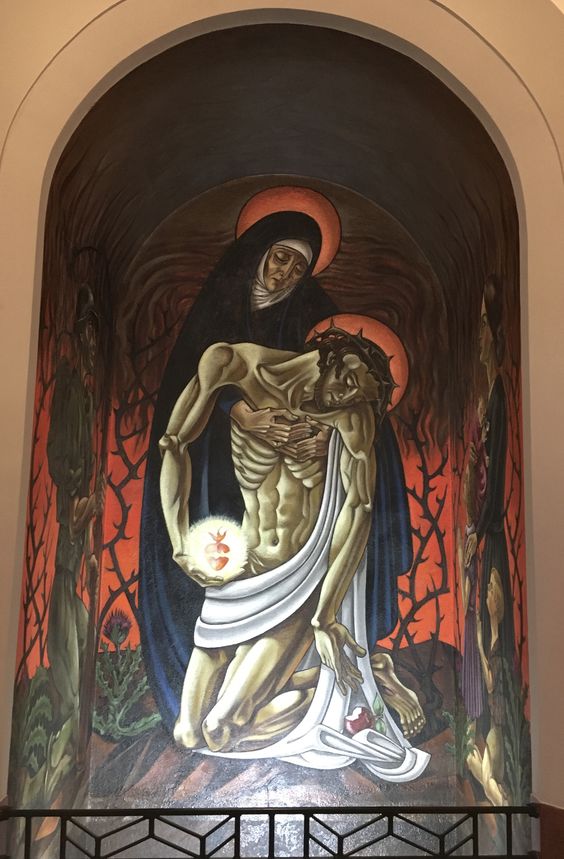
Pieta by Gregory de Wit
Dom Gregory de Wit, OSB, Pietà, 1940–42. Narthex, Sacred Heart Catholic Church, Baton Rouge, Louisiana.

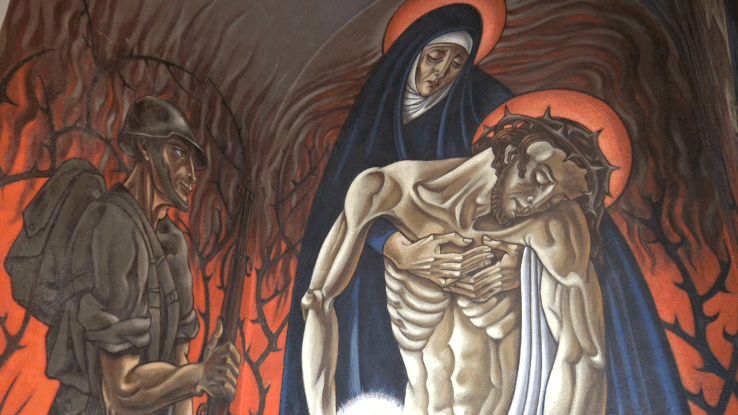
Pieta by Gregory de Wit

Because de Wit painted this image during the war, it is contextualized with a soldier on one side and the soldier’s wife and three children on the other, praying for his safe return. Why do they belong in this scene? Some wartime artists drew parallels between Christ and the soldiers’ sacrificial laying down of their lives (cf. John 15:13). I’m uneasy with this comparison for several reasons, not least of which is my Christian pacifism. But de Wit’s painting seems, rather, to use the soldier and his family as a representation of war and to suggest that Jesus, the Suffering Servant, is with us in our present suffering. He entered our world, after all, and died to redeem us from its evils—sin and death and all their extensions. The presence of Mary, Our Lady of Sorrows, must have been a comfort to the mothers at Sacred Heart whose sons were overseas fighting.

Moreover, even though its hieratic style may be off-putting to some, I also really like the crucifix de Wit created for Sacred Heart (but which is now at St. Paul the Apostle Catholic Church, also in Baton Rouge). The corpus is painted on solid mahogany, with real nails driven through the hands.  Continue reading “The Art of Dom Gregory de Wit”

Creation Psalm (Artful Devotion)

And the Mountains Rose by Barbara Wolff
Barbara Wolff (American), “And the Mountains Rose” (vv. 5–8), from Psalm 104: You Renew the Face of the Earth, 2006–10. Contemporary pigments and precious metals on goatskin. Morgan Library and Museum, New York. MS M.1190, fol. 2.

Bless the LORD, O my soul!
O LORD my God, you are very great!
You are clothed with splendor and majesty,
covering yourself with light as with a garment,
stretching out the heavens like a tent.
He lays the beams of his chambers on the waters;
he makes the clouds his chariot;
he rides on the wings of the wind;
he makes his messengers winds,
his ministers a flaming fire.

He set the earth on its foundations,
so that it should never be moved.
You covered it with the deep as with a garment;
the waters stood above the mountains.
At your rebuke they fled;
at the sound of your thunder they took to flight.
The mountains rose, the valleys sank down
to the place that you appointed for them.
You set a boundary that they may not pass,
so that they might not again cover the earth.

You make springs gush forth in the valleys;
they flow between the hills;
they give drink to every beast of the field;
the wild donkeys quench their thirst.
Beside them the birds of the heavens dwell;
they sing among the branches.
From your lofty abode you water the mountains;
the earth is satisfied with the fruit of your work.

You cause the grass to grow for the livestock
and plants for man to cultivate,
that he may bring forth food from the earth
and wine to gladden the heart of man,
oil to make his face shine
and bread to strengthen man’s heart.

The trees of the LORD are watered abundantly,
the cedars of Lebanon that he planted.
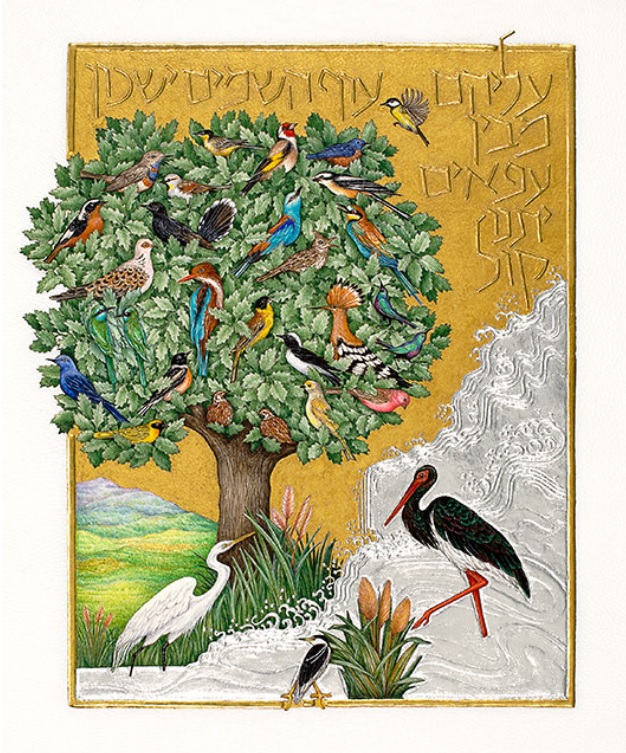
In them the birds build their nests;
the stork has her home in the fir trees.
The high mountains are for the wild goats;
the rocks are a refuge for the rock badgers.

He made the moon to mark the seasons;
the sun knows its time for setting.
You make darkness, and it is night,
when all the beasts of the forest creep about.
The young lions roar for their prey,
seeking their food from God.
When the sun rises, they steal away
and lie down in their dens.
Man goes out to his work
and to his labor until the evening.

O LORD, how manifold are your works!
In wisdom have you made them all;
the earth is full of your creatures.
Here is the sea, great and wide,
which teems with creatures innumerable,
living things both small and great.
There go the ships,
and Leviathan, which you formed to play in it.

These all look to you,
to give them their food in due season.
When you give it to them, they gather it up;
when you open your hand, they are filled with good things.
When you hide your face, they are dismayed;
when you take away their breath, they die
and return to their dust.
When you send forth your Spirit, they are created,
and you renew the face of the ground.

May the glory of the LORD endure forever;
may the LORD rejoice in his works,
who looks on the earth and it trembles,
who touches the mountains and they smoke!
I will sing to the LORD as long as I live;
I will sing praise to my God while I have being.
May my meditation be pleasing to him,
for I rejoice in the LORD.
Let sinners be consumed from the earth,
and let the wicked be no more!
Bless the LORD, O my soul!
Praise the LORD!

—Psalm 104

+++

SONG: “Psalm 104” | Text: Psalm 104:1–5 (Hebrew) | Traditional Jewish Babylonian melody, arranged by Yonnie (Jonathan) Dror | Performed by Yamma Ensemble, 2012

An ancient setting of the first five verses of Psalm 104, composed by the Jewish diaspora community in Babylon and passed down aurally, is refreshed through this modern arrangement by Yamma Ensemble, whose instrumentation blends the old and the new. It opens with a virtuosic oud solo by Sefi Asfuri. At 1:13, the other instrumentalists come in, creating rhythmic complexity: Yonnie Dror (clarinet and flute), Aviad Ben Yehuda (darbuka), and Avri Borochov (double bass). The lead vocalist, Talya G.A Solan, enters at 2:00. At 3:48, all the instruments drop out, and male vocals are added.

While this particular performance is from 2012, an earlier one, from 2011, can be heard on the album Yamma under the title “Bless the Lord, O My Soul.” The lyrics are on YouTube.

Yamma Ensemble presents original contemporary Hebrew music in which group members stay true to the character of the Middle East, the region where they were born and raised. The soulful, exotic music is accompanied by ancient musical instruments (kopuz, duduk, ney, oud, shofar, hand drums), which are typical of the Middle East. In addition to this unique art, Yamma also performs the traditional music and material of the various Jewish diasporas. We present songs of the Jewish communities from Yemen, Babylon, and Sefarad, as well as Hasidic music, with the fascinating forms and rhythms that have been preserved by generations of Jewish traditions. [source]

To hear more from Yamma Ensemble, visit their Facebook page and YouTube channel. If you like their music, consider supporting them on Patreon.

+++

The manuscript illumination above is one of ten from Barbara Wolff’s unbound cycle Psalm 104: You Renew the Face of the Earth. The artist writes (in the third person),

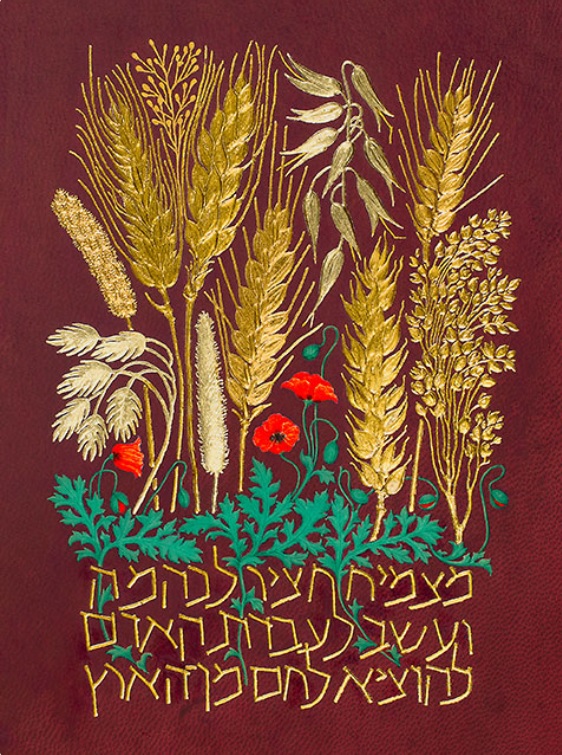
The 104th Psalm is a song in celebration of all creation. The psalmist marvels at the infinite variety of life on earth. With words that reflect a deep awareness of our finitude and an implicit faith in the eternity of creation, we are reminded of the intricate web which connects all living creatures. In the ten illuminations which comprise Psalm 104: You Renew the Face of the Earth, Barbara Wolff has attempted to reflect some of the light and brilliance of this word picture of the cosmos and illuminate its profound sense of reverence for all creation. In a number of the paintings she has portrayed flora and fauna which the ancient Psalmist would certainly have known, and which still may be found in the land of Israel today. She has included the flowers and grasses of its fields and forests, birds which pass through the land each spring and fall, and sea creatures of the Mediterranean, from a precious Murex snail to the great whales.

Among the Branches They Sing by Barbara Wolff
Barbara Wolff (American), “Among the Branches They Sing” (v. 12), from Psalm 104: You Renew the Face of the Earth, 2006–10. Contemporary pigments and precious metals on goatskin. Morgan Library and Museum, New York. MS M.1190, fol. 3.
To Bring Forth Bread by Barbara Wolff
Barbara Wolff (American), “To Bring Forth Bread” (v. 14), from Psalm 104: You Renew the Face of the Earth, 2006–10. Contemporary pigments and precious metals on goatskin. Morgan Library and Museum, New York. MS M.1190, fol. 4.
Leviathan Whom Thou Hast Formed by Barbara Wolff
Barbara Wolff (American), “Leviathan Whom Thou Hast Formed” (vv. 25–26), from Psalm 104: You Renew the Face of the Earth, 2006–10. Contemporary pigments and precious metals on goatskin. Morgan Library and Museum, New York. MS M.1190, fol. 8.
You Renew the Face of the Earth by Barbara Wolff
Barbara Wolff (American), “You Renew the Face of the Earth” (v. 30), from Psalm 104: You Renew the Face of the Earth, 2006–10. Contemporary pigments and precious metals on goatskin. Morgan Library and Museum, New York. MS M.1190, fol. 9.

Prior to pursuing a career in fine art, Wolff spent many years illustrating natural science texts, honing her eye to see and her hands to reproduce the miniscule details of different plant, animal, and insect species. In the early 2000s, on a whim, she took a course on medieval manuscript illumination, learning, among other things, how to work with parchment, gesso, mineral pigments, and precious metal leaf (silver, gold, and platinum). “It just changed by life,” she said. She has since devoted the bulk of her time to illuminating Jewish texts, a focus made possible by individual and institutional patrons. Her Psalm 104 and Rose Haggadah were commissioned by philanthropists Daniel and Joanna S. Rose and subsequently donated to the Morgan Library and Museum in New York City. Other patrons of hers include the Israel Museum and the Jewish Theological Seminary of America.

Joanne Palmer, reviewing Wolff’s work for the Jewish Standard, writes,

Psalm 104 is about beauty. It is about other things as well, true, but it starts with beauty and returns to it as a touchstone. It describes the world with rapturous metaphor. God, who is “clothed with glory and majesty,” who covers himself with “light as with a garment, who stretches out the heavens like a curtain,” has made the world in his image.

When you [see Wolff’s illumination cycle], you are surrounded by the wild precise beauty of that creation, in rich, lush, exquisite, witty, masterfully detailed, controlled miniatures. To [view these paintings] is to be stunned by beauty.

To view all ten illuminations from Wolff’s Psalm 104 cycle and to purchase facsimiles, visit http://www.artofbarbarawolff.com/projects.php?psalm. To learn more about the materials Wolff uses and to read commentaries on individual folios, see the links below.

Further Reading:

“Hebrew Illumination for Our Time: The Art of Barbara Wolff,” Morgan Library and Museum press release, January 5, 2015.

Holly Cohen, “A conversation with Barbara Wolff,” Letter Arts Review 26:1 (Winter 2012): 47–58.

Mark Michael Epstein, ed., Skies of Parchment, Seas of Ink: Jewish Illuminated Manuscripts (Princeton, NJ: Princeton University Press, 2015). Wolff contributed a chapter to this book, and folio 9 from her Psalm 104 graces the front cover.


This post belongs to the weekly series Artful Devotion. If you can’t view the music player in your email or RSS reader, try opening the post in your browser.

To view all the Revised Common Lectionary scripture readings for Proper 24, cycle B, click here.