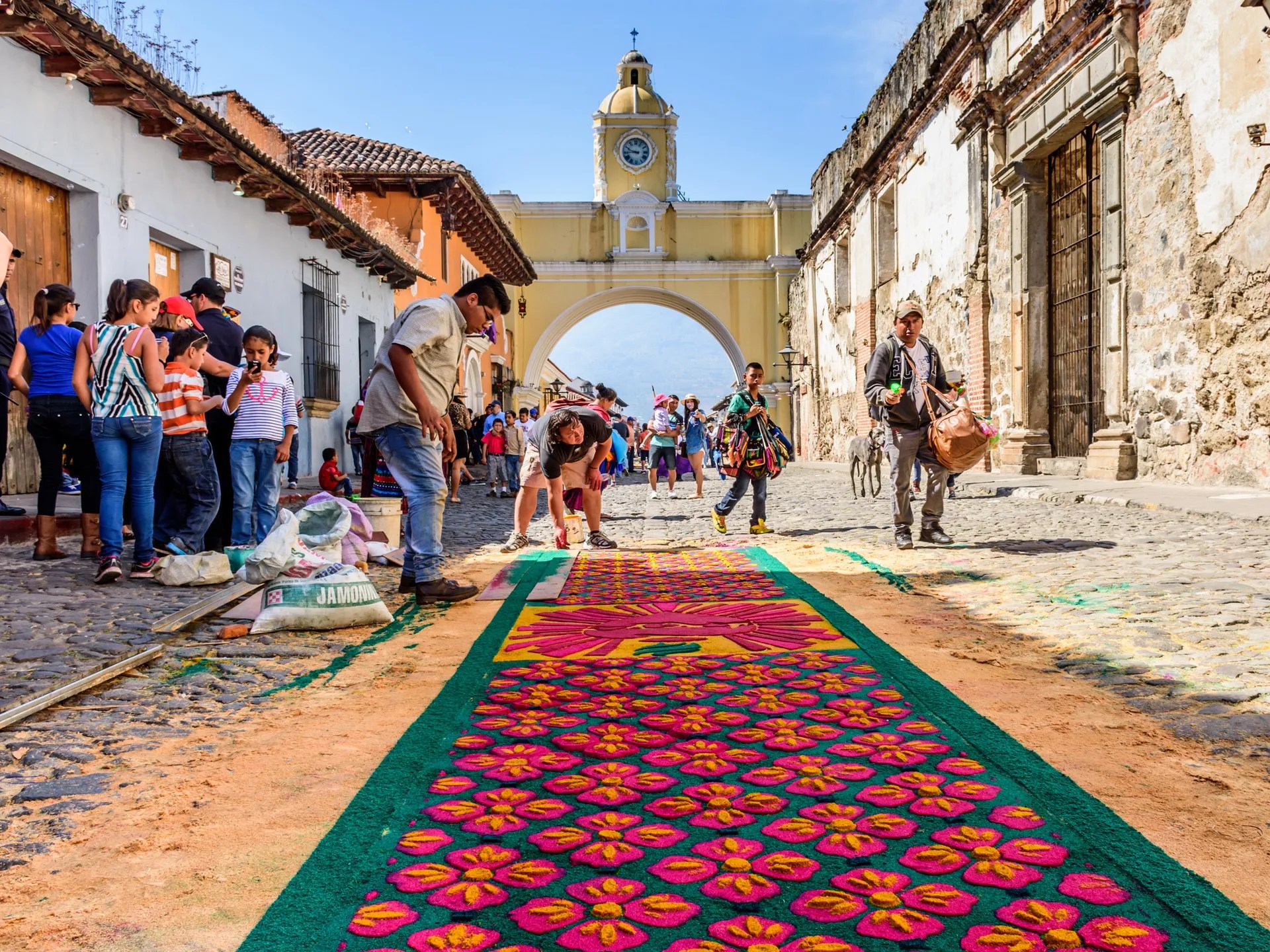
HOLY WEEK TRADITION: Antigua, Guatemala, is renowned for its annual Good Friday observance, which involves the laying out of alfombras (carpets) of multicolored sawdust through the city’s cobblestone streets, hundreds of feet long. On Maundy Thursday, the city closes so that families and businesses can spend the day constructing the carpets, applying the sawdust to planned designs using stencils and strainers and adding pine needles, flowers, fruits, and other natural materials as well.
People watch while locals make an alfombra (carpet) of dyed sawdust for Antigua’s Good Friday processions, the most famous in Latin America. Photo: Lucy Brown, 2016.
At 4 a.m. on Good Friday, the processions begin, with people carrying floats that bear statues of Christ carrying his cross, followed by marching bands playing solemn music. (This is a remembrance of Jesus’s walk to Calvary.) As their feet pass over the alfombras, the dust scatters. Locals and visitors gather along the streets dressed in black for mourning, and at 11 p.m. a figure of Jesus is laid to rest in the church.
Here are two resources for exploring this tradition further:
>> VIDEO: “Alfombras de Semana Santa en Guatemala,” dir.Federica Dominguez: This short film (in Spanish, with English subtitles) interviews Rolando Ortiz, an alfombrero who is also a shoemaker. He explains that the carpets hark back to Jesus’s triumphal entry into Jerusalem, when the crowds strewed his path with palm branches (giving him the red carpet treatment, so to speak). Even though the alfombras last only a brief time, locals spare no expense in bringing them to fruition each year—“for Jesus,” Ortiz says. “It is an act of gratitude above all.” An offering of beauty and praise.
+++
NEW ALBUM: As Foretold, Part 3 by Poor Bishop Hooper: Released today, this is the final album in a trilogy based on the prophetic fulfillment passages in the Gospel of Matthew. It centers on Jesus’s passion and concludes with a resurrection epilogue. As with all their music, the duo graciously offers it for free download from their website.
+++
SONGS performed by Emorja Roberson: Emorja Roberson [previously] is a singer, gospel choir conductor, and assistant professor of music and African American studies at Oxford College of Emory University in Georgia. I enjoy following his YouTube channel. Here are two songs that are especially fitting for Holy Week.
>> “I Know It Was the Blood”: Roberson sings three verses of this beloved African American spiritual: the title verse, “They whipped him all night long,” and “He never said a mumblin’ word.” The song is more typically sung in a major key, and its full lyrics span Christ’s passion, resurrection, ascension, and second coming. But Roberson slows down the tempo and sings in a minor key, homing in on the sorrow of Good Friday.
>> “He Decided to Die” by Margaret Pleasant Douroux: Roberson, on keys, sings a gospel classic with friends Marcus Morton and Cameron Scott, a song that emphasizes Christ’s resoluteness on the cross, his endurance for love.
+++
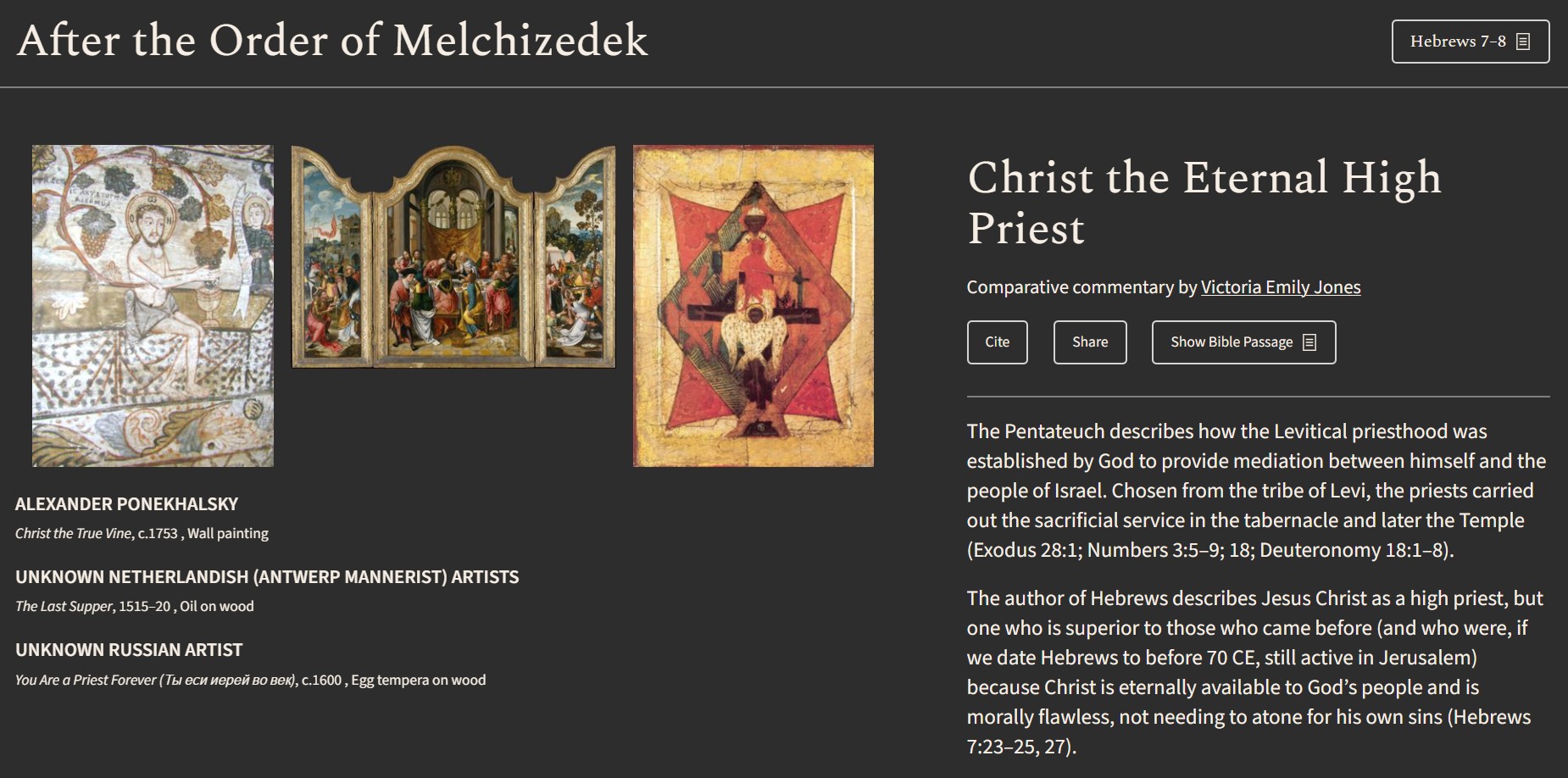
VISUAL COMMENTARIES: “After the Order of Melchizedek” by Victoria Emily Jones: My latest contribution to the Visual Commentary on Scripture, a project based out of King’s College London, was published earlier this month. Tasked with choosing and commenting on three artworks that dialogue with Hebrews 7–8, I landed on a “You Are a Priest Forever” icon from Russia (very strange!), an Antwerp Mannerist triptych that centers the Last Supper, and (my favorite) a wall painting of Christ the Grapevine from a Romanian church. I was interested to explore the idea of how Jesus, in giving his body and blood, is both the offerer and the offered, both priest and sacrifice.
+++
POEM: “The Death of Christ” by Emperor Kangxi: Emperor Kangxi (1654–1722) ruled in China for sixty-one years during the Qing Dynasty. In 1692 he issued the Edict of Toleration, which barred attacks on churches and legalized the practice of Christianity among Chinese people. Curious about and respectful of other faiths, he penned this short poem on the Crucifixion using the classical qi-yen-she form.
+++
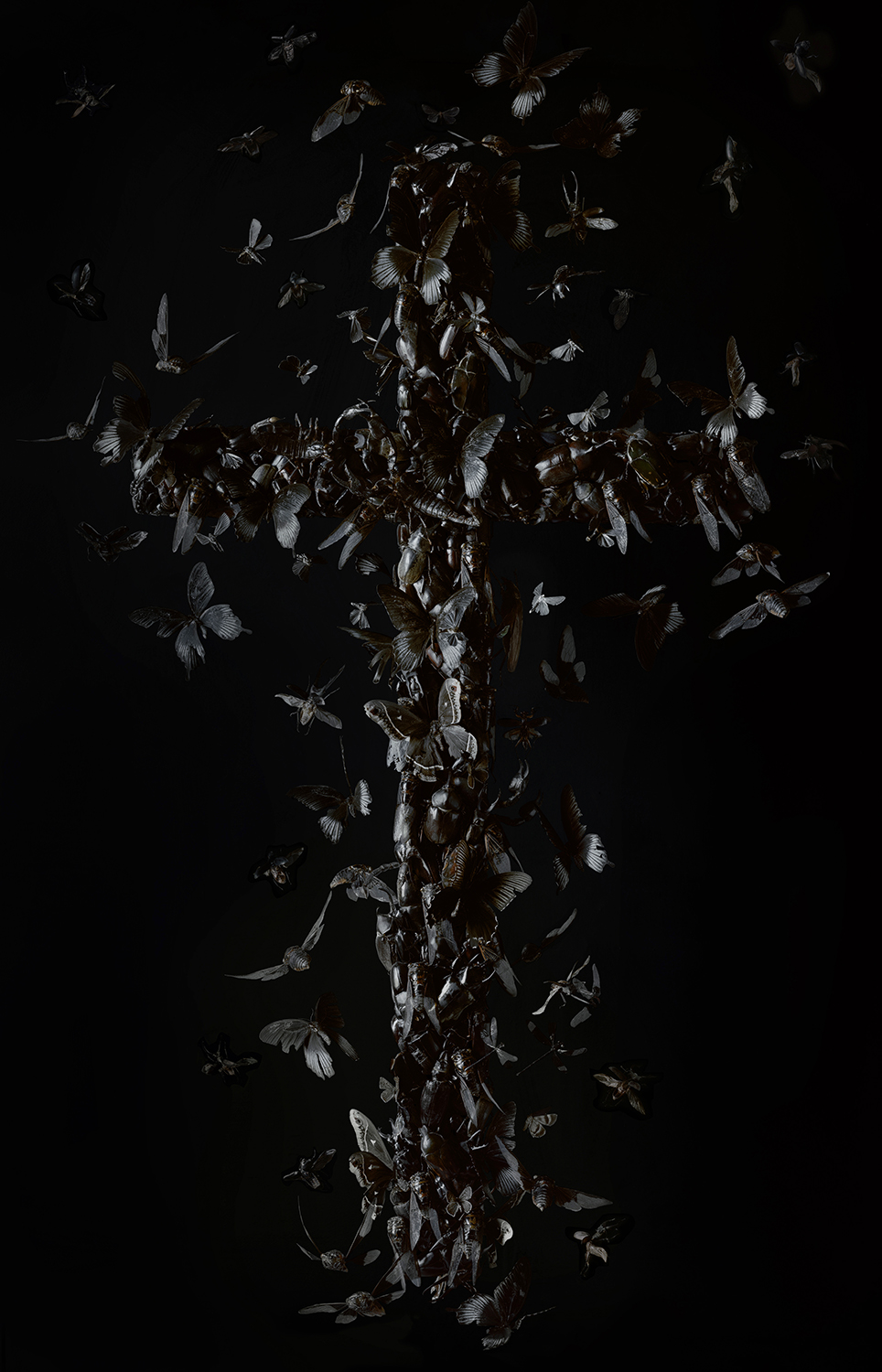
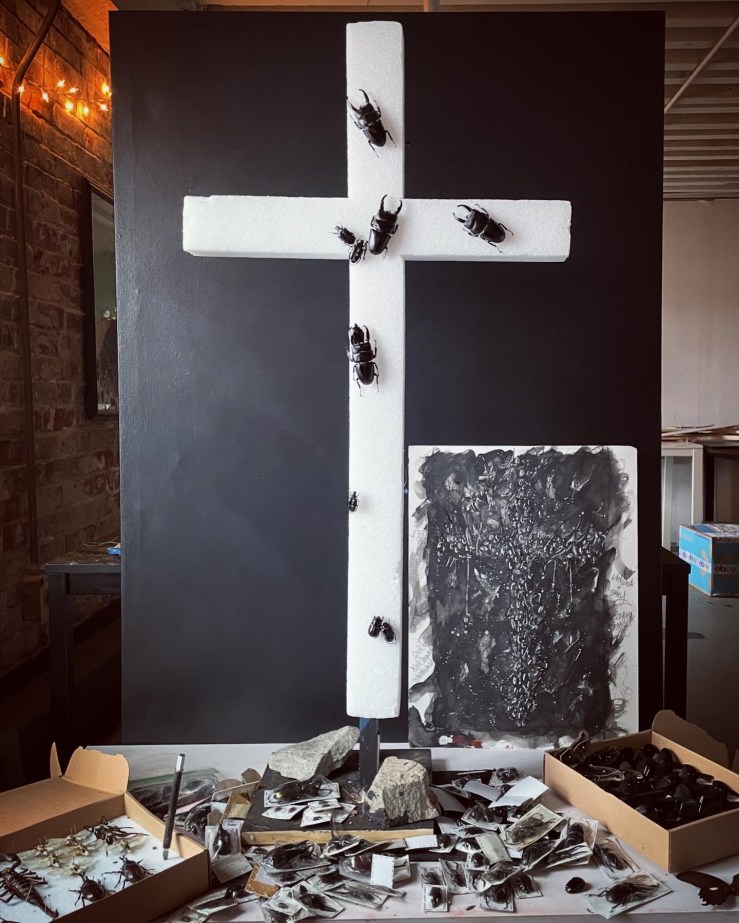
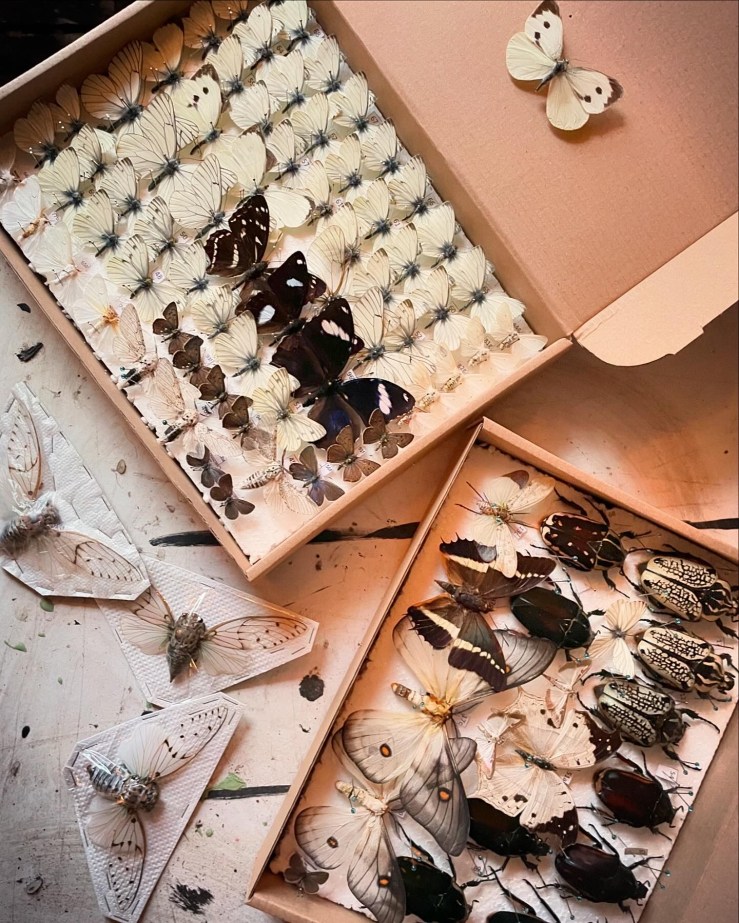
EXHIBITION: Tara Sellios: Ask Now the Beasts, Fitchburg Art Museum, January 18, 2025–January 18, 2026:Tara Sellios is a multidisciplinary artist from South Boston working mainly in large-format photography. Delighting in detail and complex symbolism, she often uses insects, dried fauna, bone, and other organic matter to create elaborate still lifes that she then photographs under dramatic lighting. She is inspired by art historical representations of the end of the world, especially the bizarre paintings of Hieronymus Bosch and Albrecht Dürer’s Apocalypse woodcuts, and by seventeenth-century Dutch vanitas paintings.
The photographs in her current solo show, Ask Now the Beasts at Fitchburg Art Museum in Massachusetts, are “contemporary allegories of suffering and transcendence.” The exhibition’s title comes from Job 12:7.
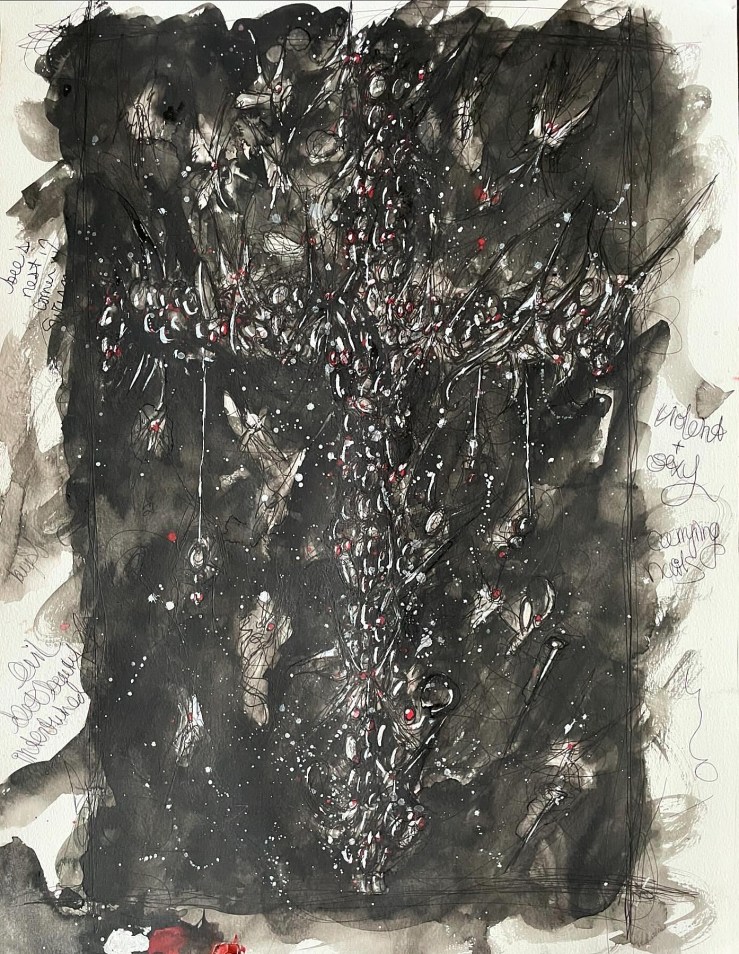
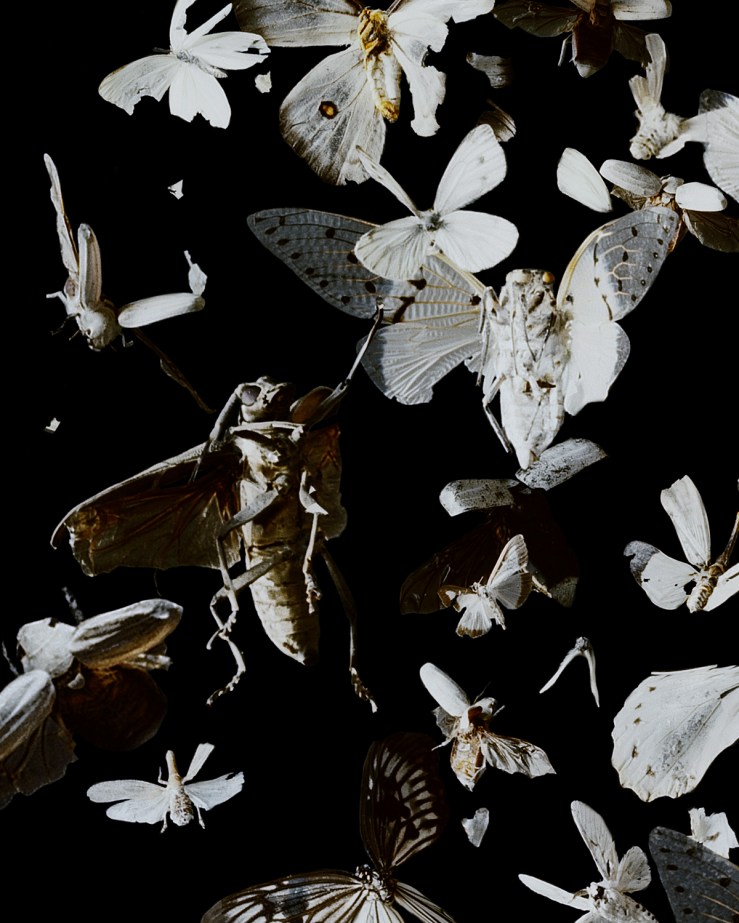
Two of the works on display are a pair of crosses: Umbra (Latin for “darkness” or “shadow”) and Dilucesco (“to begin to grow light, to dawn”), which together suggest a movement from death to resurrection. Constructed with a throng of black beetles and other black insects, the Umbra cross evokes the detail from the Synoptic Gospels’ Crucifixion accounts that at noon, “darkness came over the whole land until three in the afternoon, while the sun’s light failed” (Luke 23:44–45; cf. Matt. 27:45; Mark 15:33). Dilucesco, on the other hand, shows the cross seemingly exploding into light, as white moths and other winged insects break out of their cruciform shape. View these two photographic artworks, plus a few process photos and sketches the artist sent me, below. See, too, www.tarasellios.com.
Tara Sellios (American, 1987–), Umbra, 2024, from the series Ask Now the Beasts. Inkjet print from 8 × 10 negative, 55 × 35 in. Courtesy of the artist.Tara Sellios (American, 1987–), Dilucesco, 2024, from the series Ask Now the Beasts. Inkjet print from 8 × 10 negative, 55 × 35 in. Courtesy of the artist.
All photos in this post, except for the last one (of the processional icon), are my own.
(Note: WordPress seems to have disabled the feature that allows you to expand an image upon clicking, but if you’re reading on a computer, you can right-click an image and open it in a new tab to view it in full resolution; if you’re reading on a phone, you can pinch to zoom.)
Located in the Horn of Africa and with access to the Red Sea, Nile River, Mediterranean Sea, and Indian Ocean, Ethiopia stands at the nexus of historical travel, trade, and pilgrimage routes that brought it into contact with surrounding cultures and influenced its artistic development. Coptic Egypt, Nubia, South Arabia, Byzantium, Armenia, Italy, India, and the greater African continent were among those influencers. But Ethiopia not only absorbed influences; it transmitted them too.
A major art exhibition is centering Ethiopia’s artistic traditions in a global context. For Ethiopia at the Crossroads at the Walters Art Museum in Baltimore (running through March 3), curator Christine Sciacca has brought together more than 220 objects from the Walters’ own extraordinary Ethiopian art collection and private and institutional lenders both domestic and international. Icons, wall paintings, processional crosses and hand crosses, illuminated Gospel books and psalters, sensuls (chain manuscripts), healing scrolls, and more are on display throughout the galleries, whose walls have been painted bright green, yellow, and red—the colors of the Ethiopian flag. To round off the exhibition, guest curator Tsedaye Makonnen, an Ethiopian American multidisciplinary artist, was tasked with curating a few works from contemporary artists of the Ethiopian diaspora.
The majority of objects are Christian, made for liturgical or private devotional use. Ethiopia is one of the world’s oldest Christian nations: in the early fourth century, persuaded by a missionary from Syria, King Ezana of Aksum embraced Christianity, and it has been the dominant religion of Ethiopia ever since. But the exhibition does also include some Islamic and Jewish objects.
One of the first works you’ll encounter is a mural that would have originally been mounted on the outer wall of an Ethiopian Orthodox church sanctuary (mäqdäs), portraying the Nativity, the Presentation of Christ in the Temple, and the Adoration of the Magi.
Nativity, Presentation of Christ in the Temple, and Adoration of the Magi, Ethiopia, 18th century. Glue tempera on overlapping canvas pieces mounted to a new stretched canvas, 49 3/16 × 66 15/16 in. (124.9 × 170 cm). Walters Art Museum, Baltimore. [object record]
Remarkably, at the Nativity, there is a feast taking place, and Jesus is feeding his mother with what looks like a Communion wafer! As the theologian Lester Ruth has said, “The sound from most baby beds is a cry to be fed. But the cry from the manger is an offer to feed on his body born into this world.”
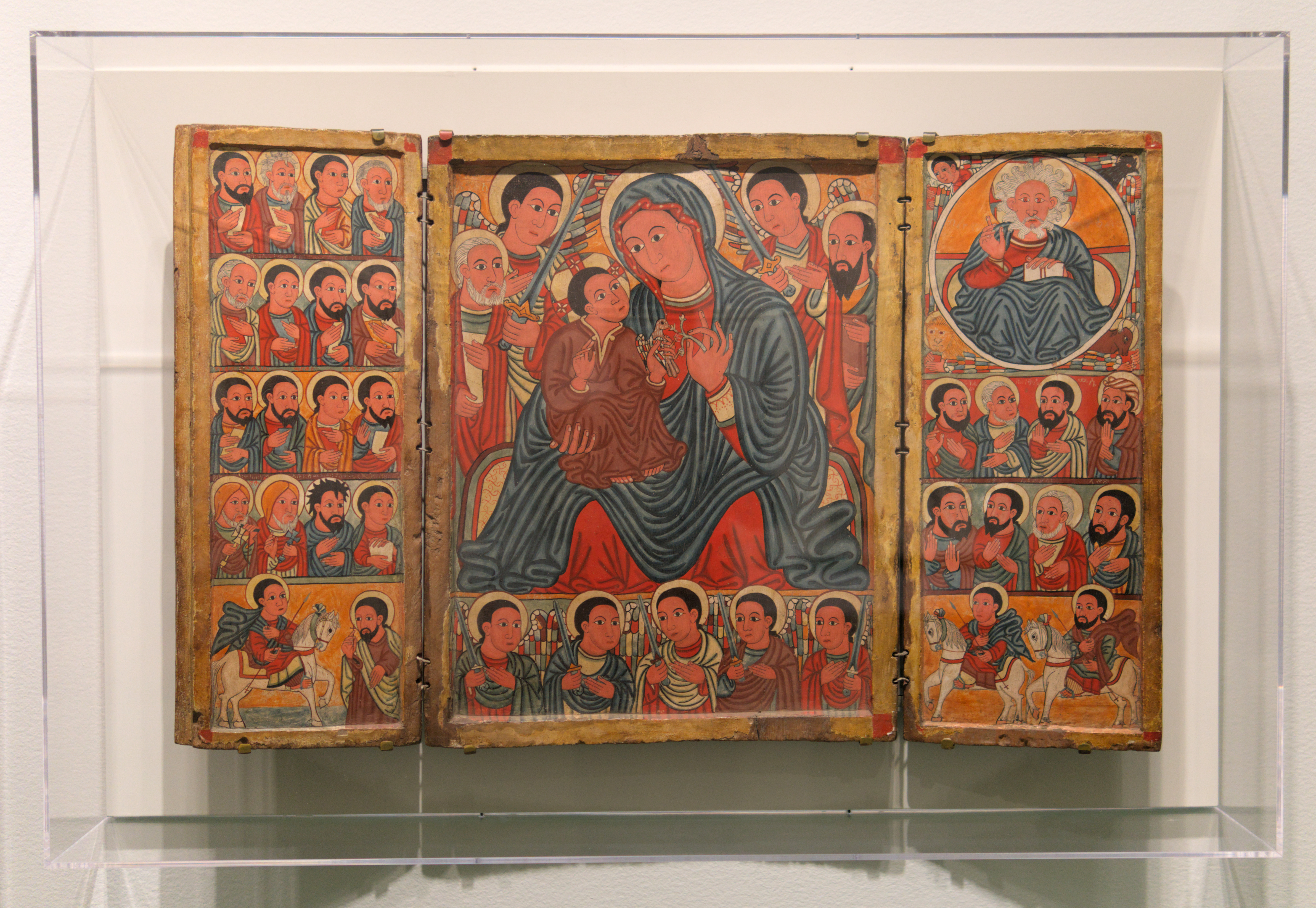
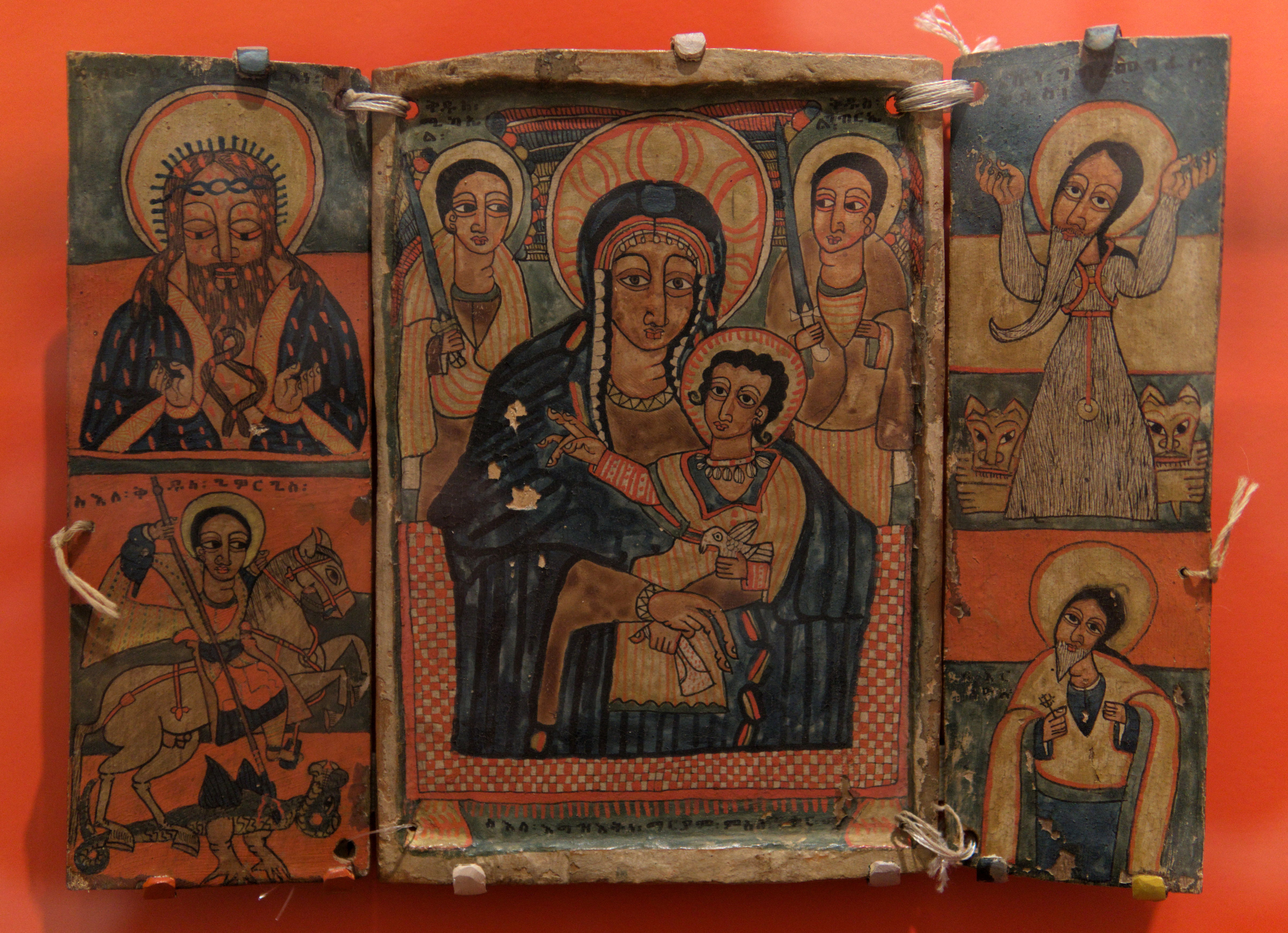
One of history’s most famous Ethiopian painters is Fre Seyon, who worked at the court of Emperor Zara Yaqob (r. 1434–1468) and was of the first generation of Ethiopian artists who painted icons on wood panels. He was also a monk. He likely introduced one of the characteristic features of Ethiopian icons of the Virgin and Child: the archangels Michael and Gabriel flanking them with drawn swords, acting as a kind of honor guard.
Fre Seyon (Ethiopian, active 1445–1480), Triptych Icon with the Virgin Mary and Christ Child Flanked by Archangels and Saints (center), Twelve Apostles and Saints (left), and Prophets and Saints (right), mid- to late 15th century. Tempera on gesso-primed wood. Institute of Ethiopian Studies, Addis Ababa University, acc. no. IESMus4186.
My two favorite details of this triptych by Fre Seyon are (on the right wing) the image of the Ancient of Days surrounded by the tetramorph, his wild gray locks being blown about, and in the center, the bird that Christ holds, its feet grasping at a three-branched twig. On a literal level, the bird is a plaything for the boy that charmingly emphasizes his humanity (in the late Middle Ages, at least in Europe—I’m not sure about in Ethiopia—it was common for young children to keep tame birds as pets). On another level, the bird may be symbolic. In traditional Western art, Jesus sometimes holds a goldfinch, a bird with distinctive red markings that’s fond of eating thistle seeds and gathering thistle down and thus came to be read as a prefiguration of Christ’s thorny, blood-spilt passion. I’m not sure whether Fre Seyon intended a symbolic significance for this bird.
Here’s another triptych from the exhibition, this one from a century and a half later:
Triptych Icon with the Virgin Mary and Christ Child Flanked by Archangels, Scenes from the Life of Christ, Saint George, and Saints Honorius, Täklä Haymanot, and Ewostatewos, Ethiopia (Tigray), early 17th century. Glue tempera on panel, 16 3/4 × 22 5/16 in. (42.5 × 56.7 cm). Walters Art Museum, Baltimore. [object record]
The composition of the Virgin and Child is based on prints of a painted icon from Santa Maria Maggiore in Rome brought to Ethiopia by Portuguese Jesuit missionaries—but it innovates. As the wall text notes, “Mary’s cloak stretch[es] out in either direction to embrace the scene of Christ Teaching the Apostles below. Umbrella-like, Mary appears as both the protector and personification of the church.”
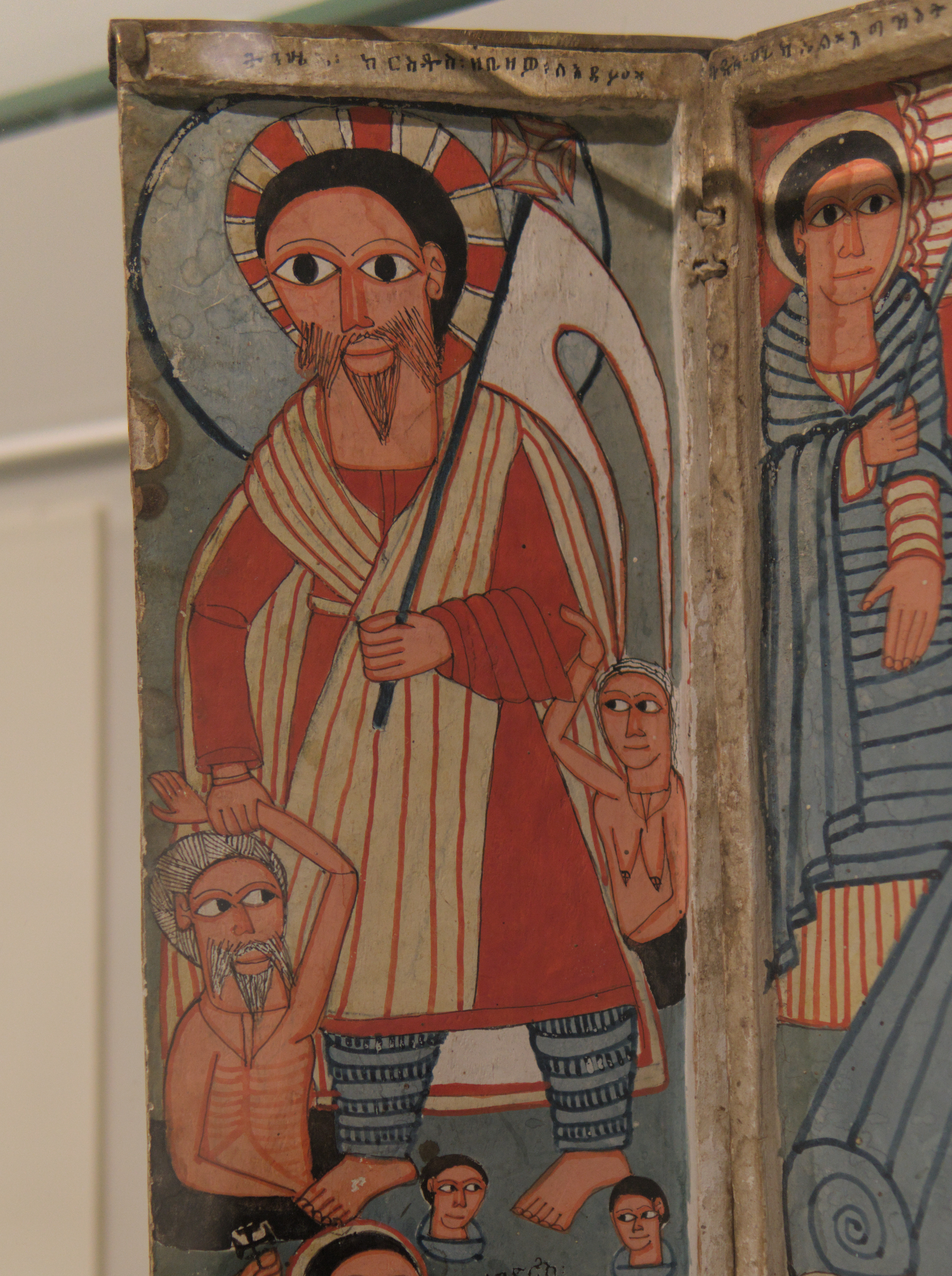
On the right wing, angels hold up chalices to collect the blood that flows from Jesus’s wounds on the cross, while below that, Joseph of Arimathea and Nicodemus carry Jesus’s wrapped corpse to the tomb. On the left wing is one of my favorite traditional religious scenes: the Harrowing of Hell, or Christ’s Descent into Limbo, in which, on Holy Saturday, Jesus enters the realm of his dead to take back those whom Death has held captive, first of which are our foreparents Adam and Eve. Below that scene is an image of the dragon-slaying Saint George, a late third-century figure from the Levant or Cappadocia who is the patron saint of Ethiopia.
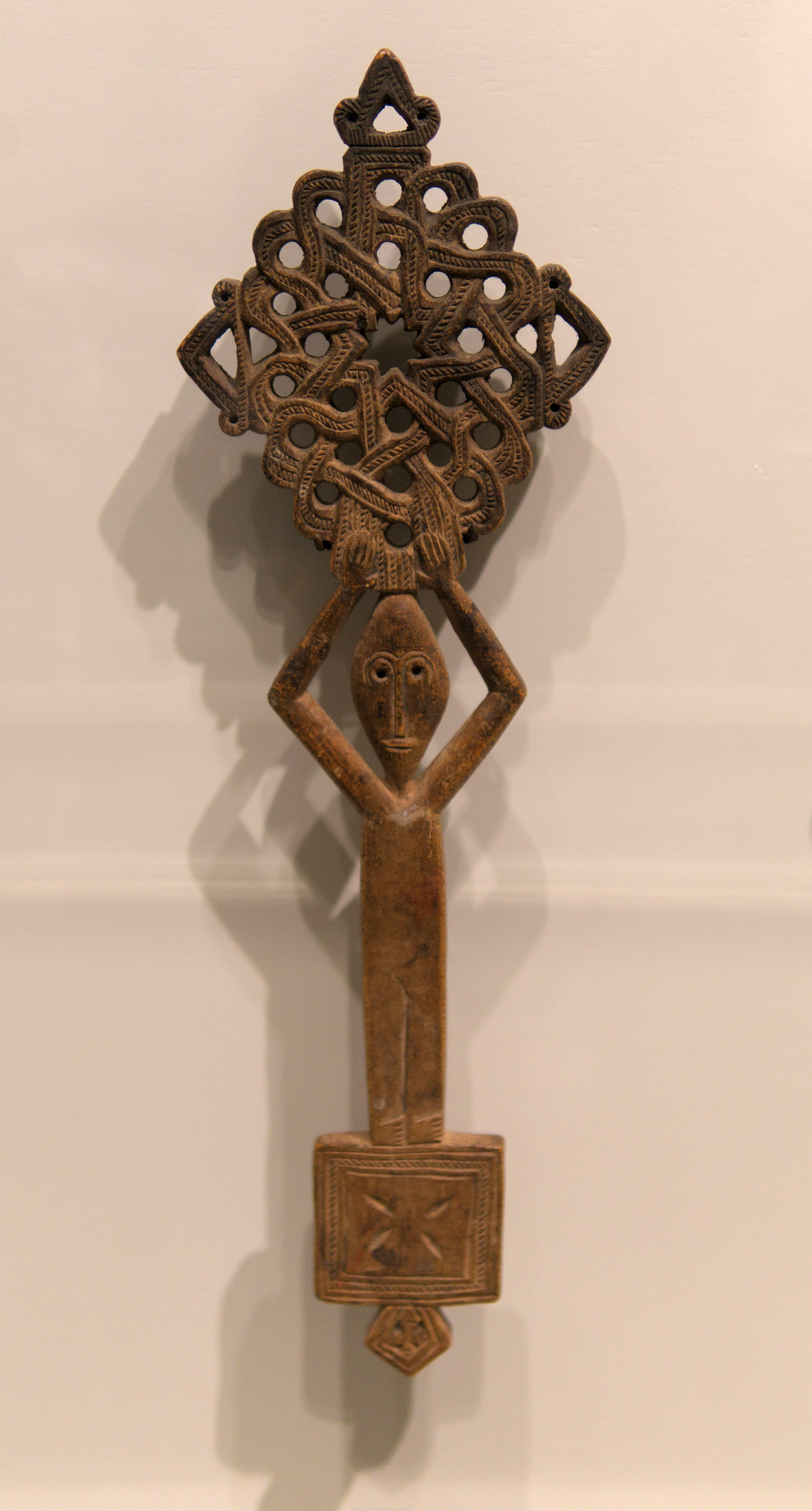
At the bottom center is a scene of Christ teaching the twelve apostles, plus two Ethiopian saints. They all hold hand crosses, like those carried by Ethiopian priests and monks.
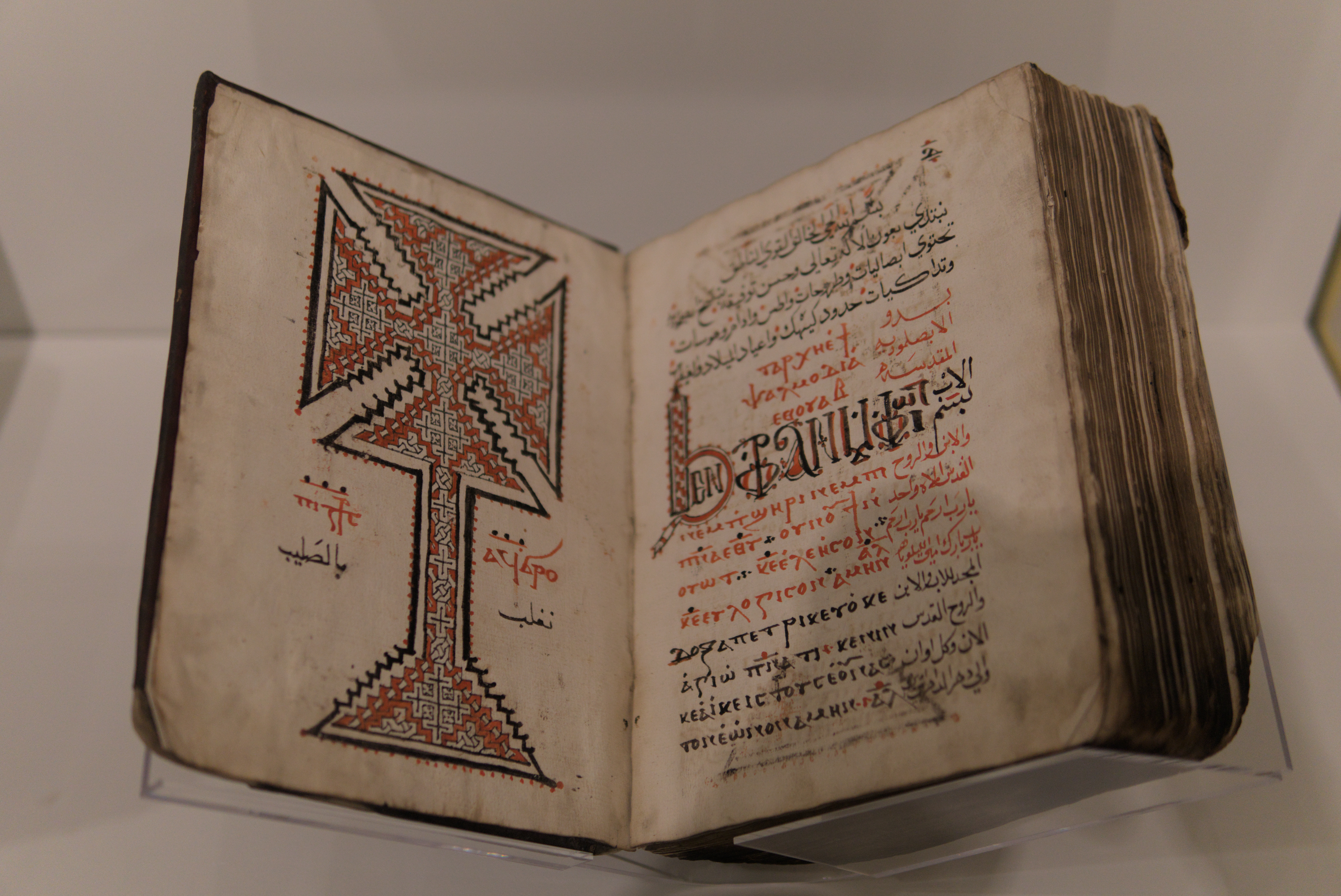
Hand Cross with Figure, Ethiopia, probably 18th–19th century. Wood, 13 3/8 × 4 3/16 × 9/16 in. (34 x 10.7 × 1.4 cm). Walters Art Museum, Baltimore. [object record]Coptic-Arabic Book of Prayer, Egypt, 18th century. Tempera and ink on parchment, 11 3/4 × 9 in. (29.8 × 22.8 cm). Melikian Collection. [object record]
One of the hallmarks of the exhibition is its multisensory nature: attendees are immersed not only in the sights of Ethiopia but also in the sounds and smells. Scratch-and-sniff cards invite people to take a whiff of frankincense, which would have filled the censer on display. Or to smell berbere, a hot spice blend that would have been stored in the woven baskets nearby.
This olfactory element was produced by the Institute for Digital Archaeology, which, as part of its efforts to record and preserve ephemeral culture, has launched an ambitious program to preserve the heritage of smells. “The aim is to provide the technical means for documenting the aromas of today for the benefit of future generations – and to find new methods and opportunities for experiencing the odors of the past.”
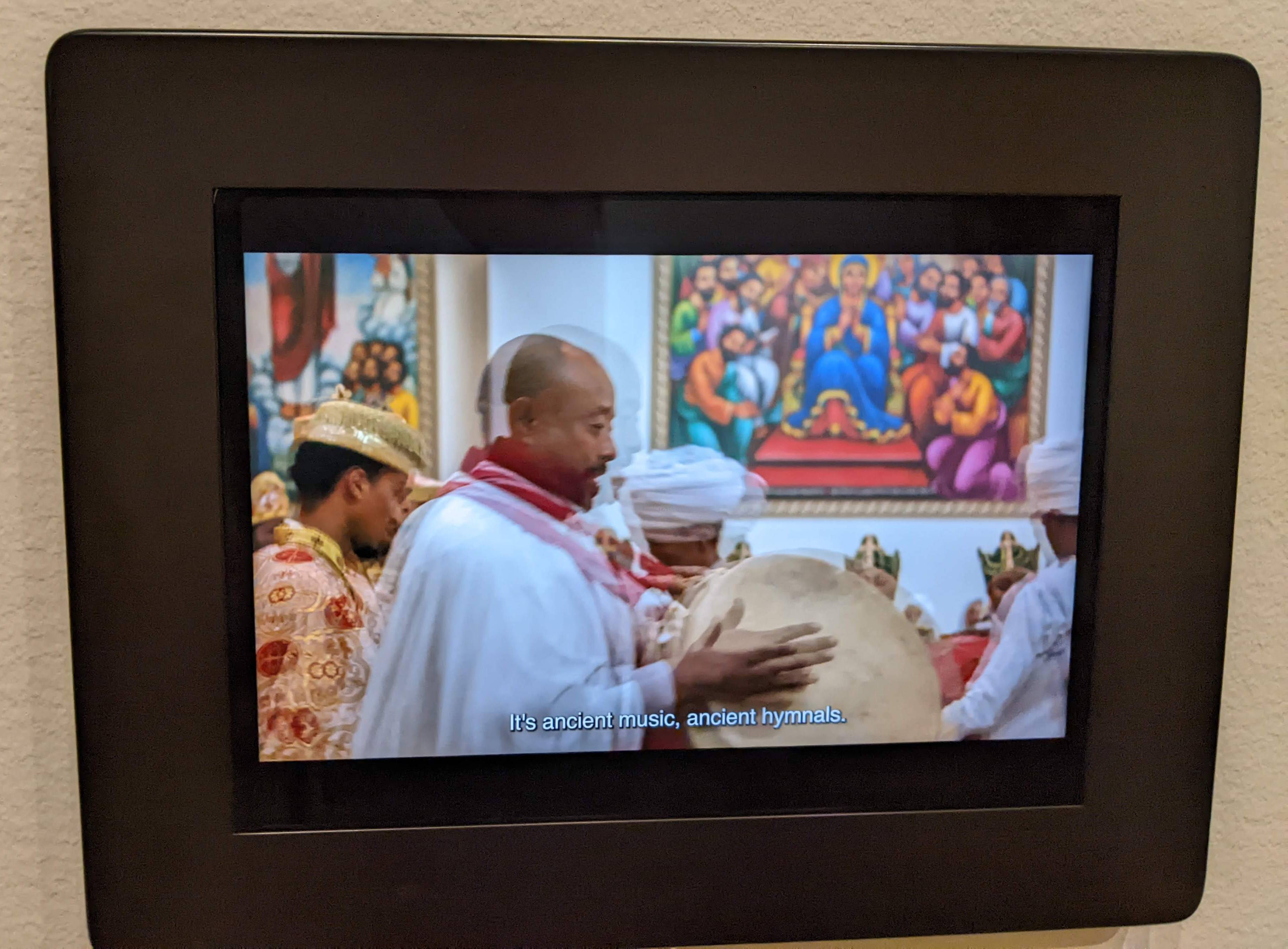
Also in the exhibition there are screens where you can watch videos of Ethiopian Orthodox worship, including music and liturgies, where you will see some of the objects in use. You can also listen to interviews with members of the local Ethiopian diaspora community. (The Washington metropolitan area has the largest Ethiopian population outside Ethiopia.)
Further contextualizing the objects and enhancing the sense of place, pasted onto the wall is a blow-up photograph of a Christian holy-day celebration wending through the streets. This serves as a backdrop to two physical artifacts present in the room: a qämis (dress) and a debab (umbrella).
The inscriptions on many of the Ethiopian icons and manuscript illuminations, which identify the figures and scenes, are in Ge‘ez (aka classical Ethiopic), an ancient South Semitic language that originated over two thousand years ago in what is now northern Ethiopia and Eritrea. It’s no longer spoken in daily life, but it is still used as the language of the Ethiopian Orthodox Church and taught to boys in Sunday school. I really wish I could read it, as it would be a great help in interpreting the Ethiopian images I come across in my studies!
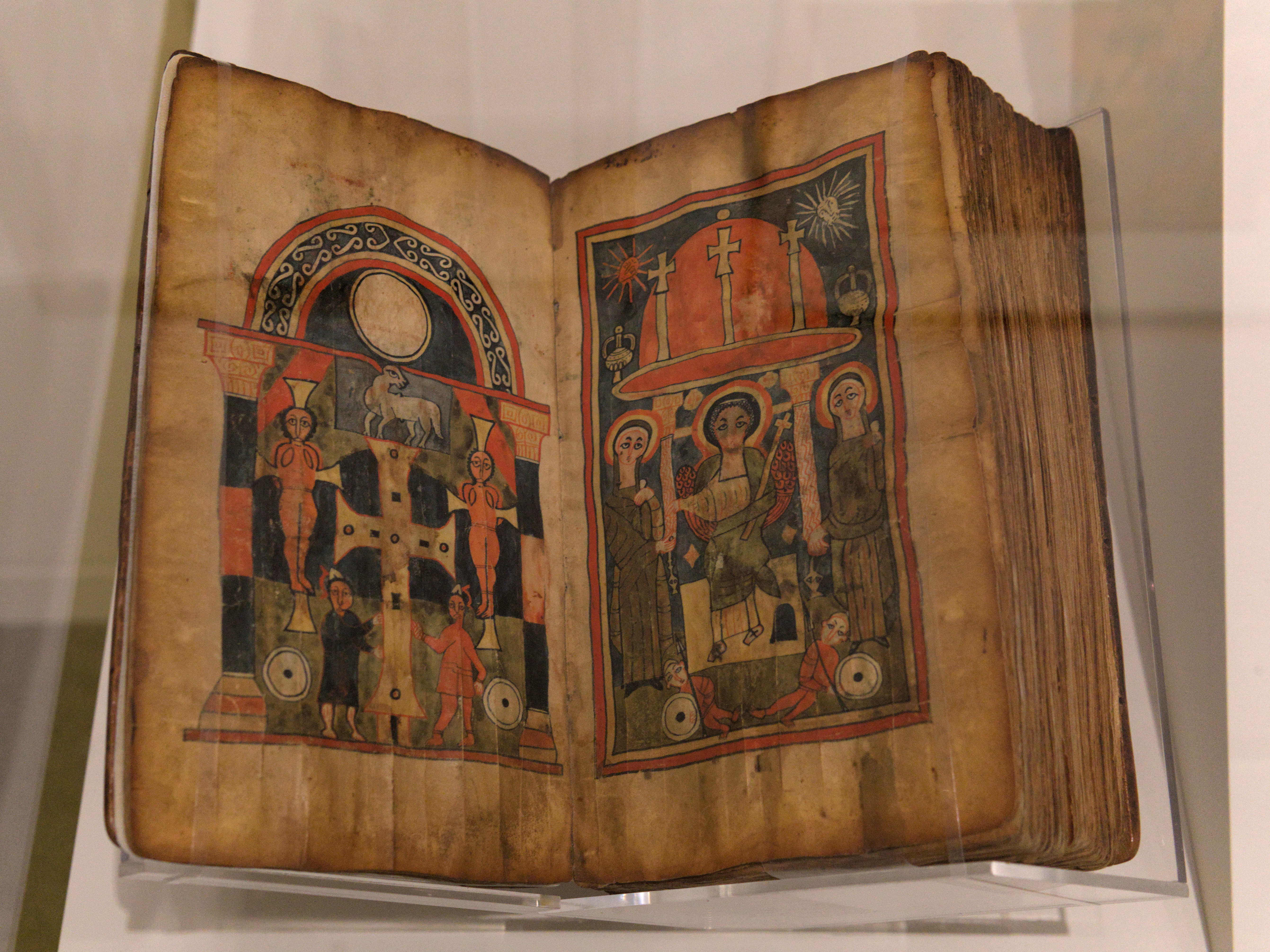
Contrary to what some may assume, Ethiopians in the medieval era were not an isolated people. They traveled—to Rome, to Jerusalem, and so forth. Evidence of Holy Land pilgrimage is suggested by an early fourteenth-century Gospel book that includes the domed Church of the Holy Sepulcher as the backdrop for Christ’s resurrection:
Gospel Book with the Crucifixion and Christ’s Resurrection, Ethiopia (Tigray), early 14th century. Ink and paint on parchment, 10 1/2 × 6 11/16 in. (26.7 × 17 cm). Walters Art Museum, Baltimore, W.8.36, fols. 6v–7r. [object record]
This is an extraordinary book, one of the oldest surviving Ethiopian manuscripts and the oldest in North America. Ethiopian artists weren’t yet depicting Jesus on the cross, so to represent the Crucifixion, this artist has painted a living lamb surmounting a bejeweled cross, with the two thieves crucified on either side.
Also from the fourteenth century, a manuscript opened to a page spread of Christ’s Entry into Jerusalem:
Christ’s Entry into Jerusalem, folios added from an earlier Gospel book to a Ta’ammera Maryam manuscript, Ethiopia, 14th century. Tempera and ink on parchment. Private collection.
I like how the scene extends across both pages, creating a sense of forward progression, and the two onlookers above the city gate.
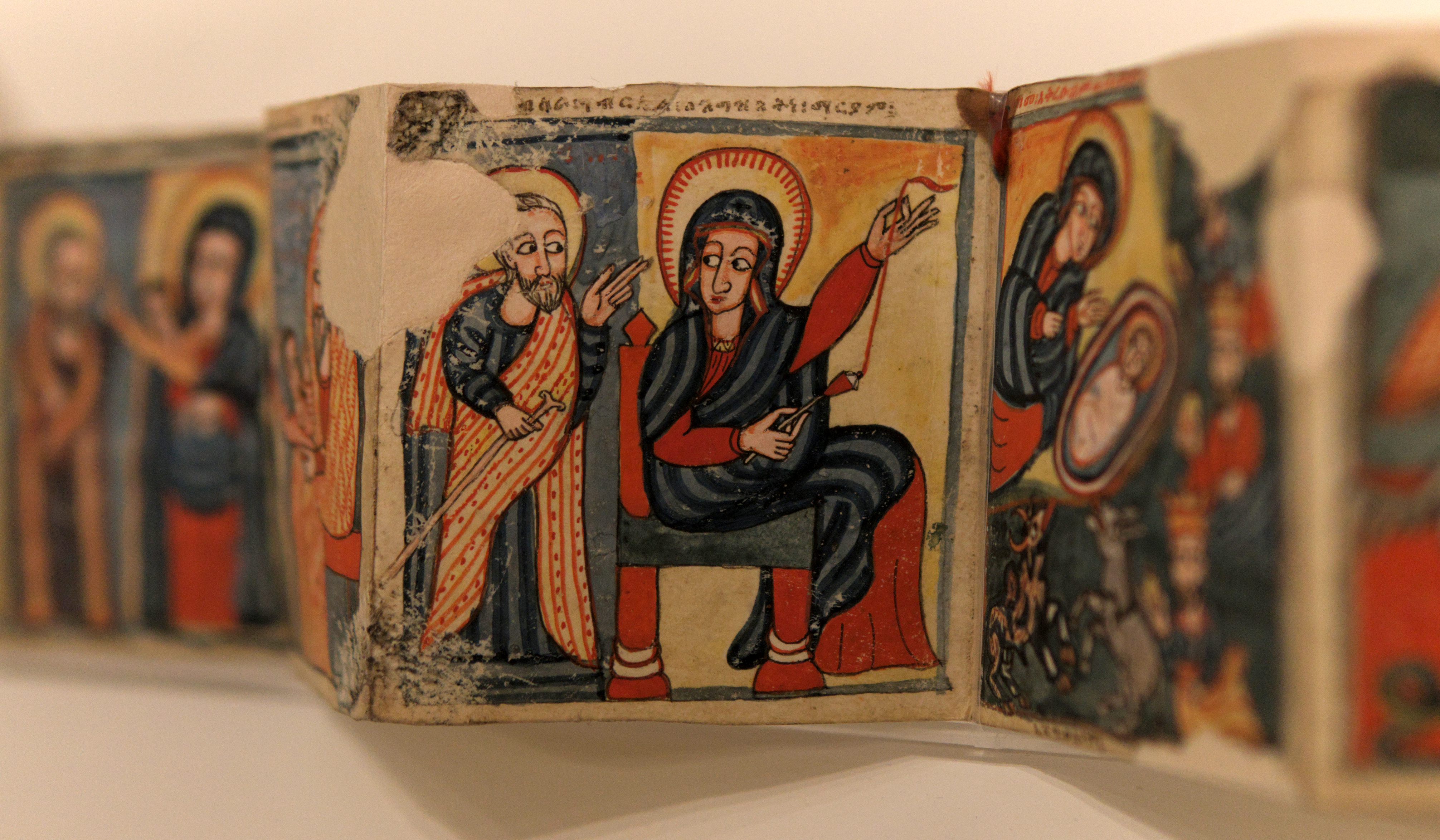
One of my favorite objects from the exhibition is a sensul from Gondar depicting ten scenes from the life of Mary. A sensul is an Ethiopian chain manuscript, in this case pocket-size, created out of a single folded strip of parchment attached to heavy hide boards at each end, which creates a small book when folded shut. Here’s a detail showing the Annunciation:
Annunciation, from a Gondarine sensul (chained manuscript), Ethiopia (Gondar), late 17th century. Ink and paint on parchment, each panel 3 5/8 × 3 1/8 in. (9.2 × 9 cm). Walters Art Museum, Baltimore. [object record] [GIF]
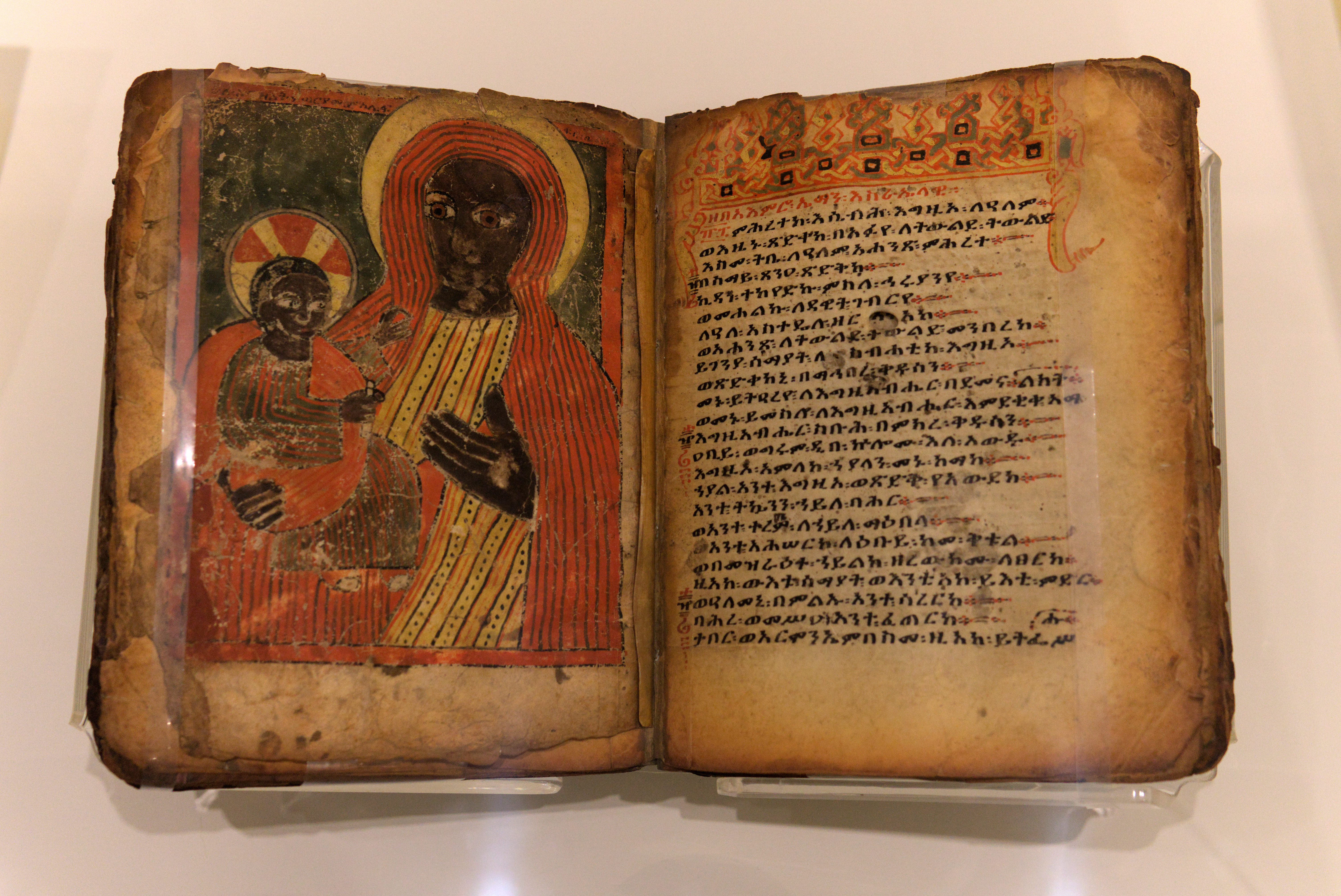
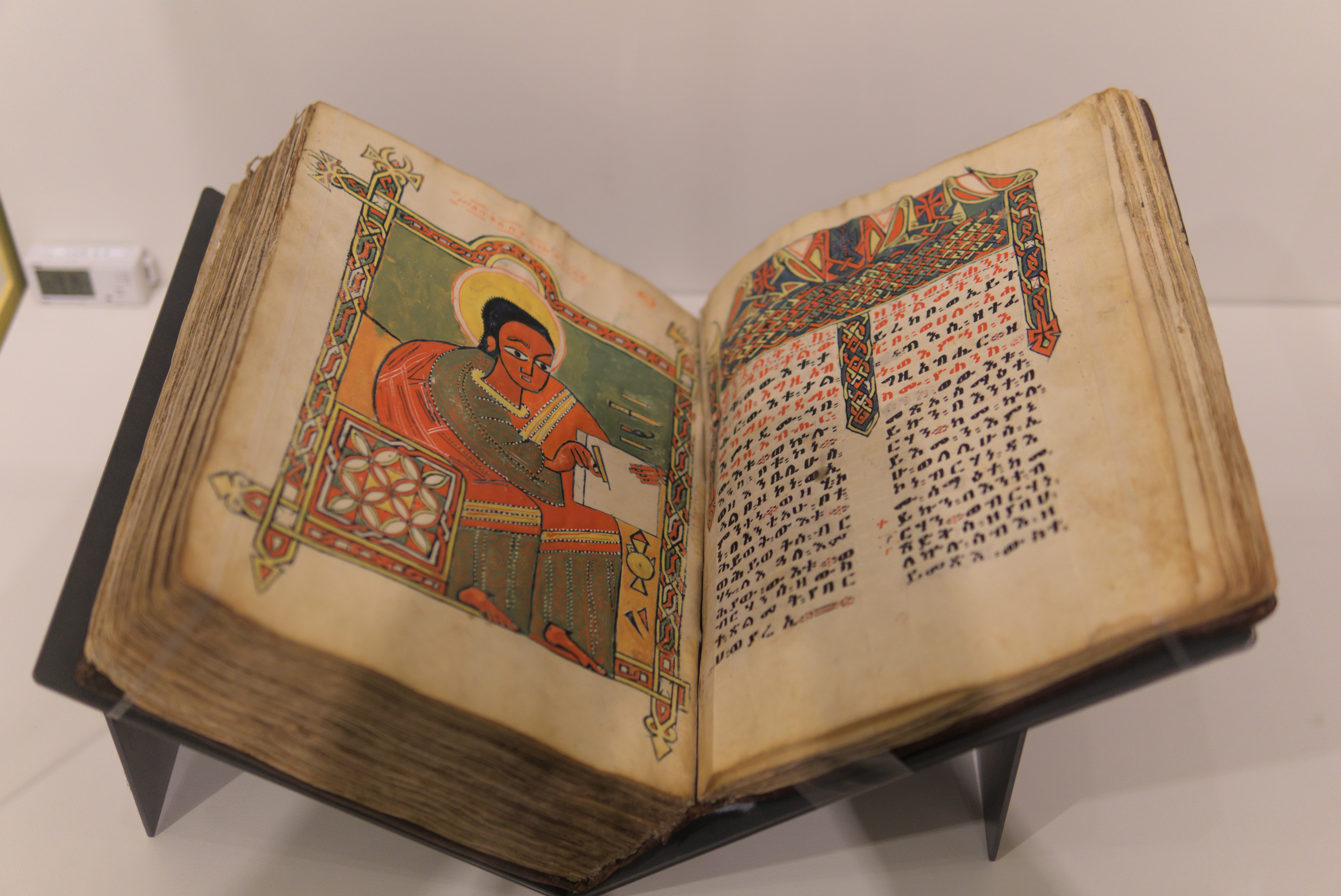
It’s a common misconception that Ethiopians have always depicted biblical figures as dark-skinned to reflect the local population. Such treatment didn’t become normative until the eighteenth century, although some earlier artists did choose black complexions for holy persons:
Virgin and Child, from a Psalter with the Wəddase Maryam (Praise of Mary) and Mähalǝyä Näbiyyat (Canticles of the Prophets), Ethiopia, 15th century. Ink and pigments on parchment with wooden boards, open: 8 7/8 × 6 11/16 × 3 15/16 in. (22.5 × 17 × 10 cm). Toledo Museum of Art, Ohio. [object record]The Opening of the Gospel of John, from a Gospel book, Ethiopia, ca. 1504–5. Tempera on parchment, 13 9/16 × 10 7/16 in. (34.5 × 26.5 cm). J. Paul Getty Museum, Los Angeles, Ms. 102, fols. 215v–216r. [object record]Triptych Icon with the Virgin Mary and Christ Child Flanked by Archangels (center), the Kwer‘atä re’esu (Man of Sorrows) and Saint George (left), and Saint Gäbrä Mänfäs Qeddus and Abba Arsanyos (right), Ethiopia (Gondar), late 17th–early 18th century. Tempera on gesso-primed wood. Institute of Ethiopian Studies, Addis Ababa University, acc. no. IESMus3492.
In the triptych shown above, not only is the infant Jesus depicted as Black, but he also wears a necklace made of cowrie shells, which are traditionally given to Ethiopian children for protection!
My favorite artwork from the exhibition is probably this triptych:
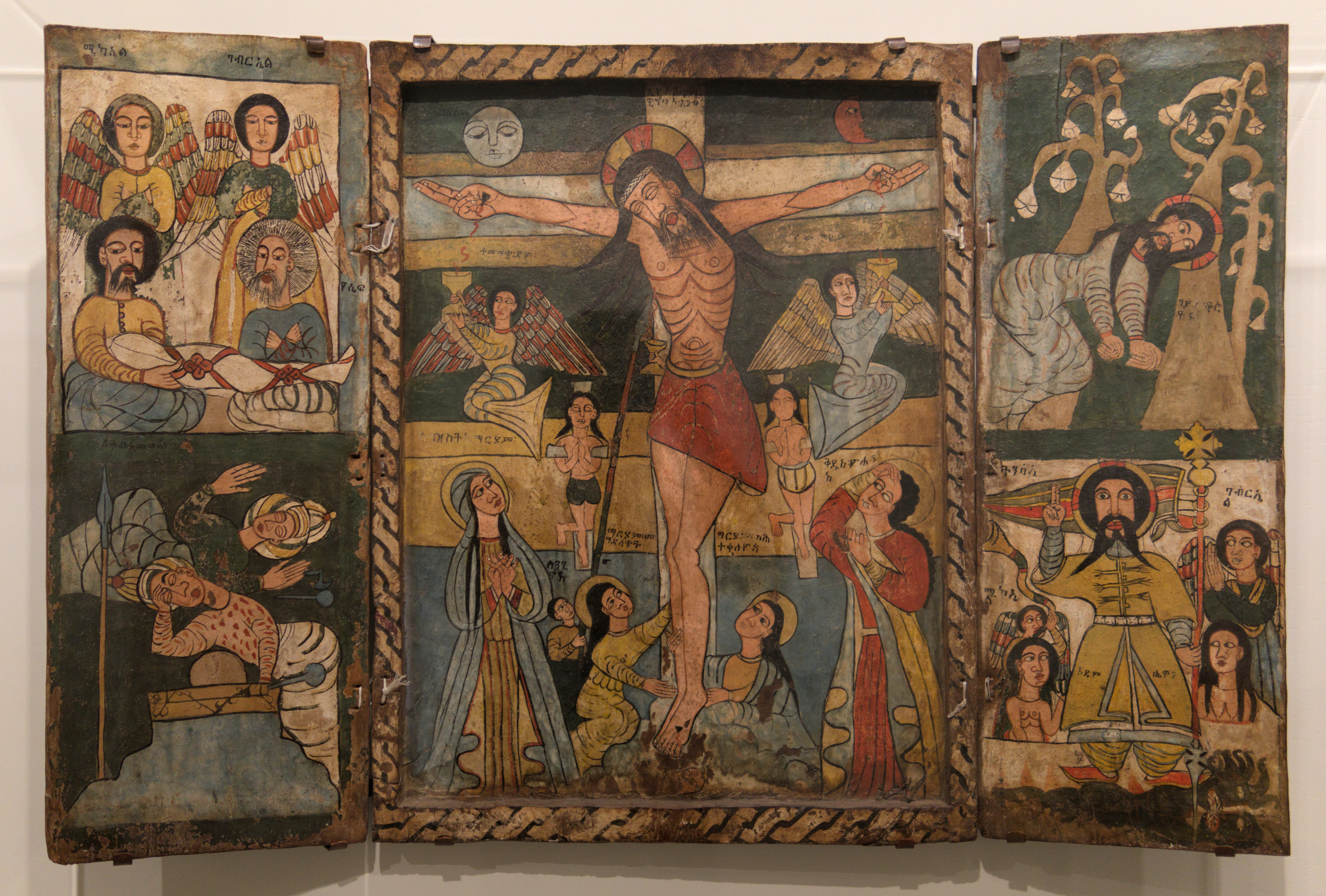
Triptych Icon with the Crucifixion (center), Entombment and Guards at the Tomb (left), and Temptation in the Wilderness and the Resurrection of Christ (right), Ethiopia, late 16th century. Tempera on gesso-primed wood. Institute of Ethiopian Studies, Addis Ababa University, acc. no. IESMus4126.
Its central panel depicts the Crucifixion, Christ’s head bowed in death and his fingers gesturing blessing, even as his palms are nailed. At the top, the sun and the moon mourn his passing. As we saw before, angels catch the blood that drips from his body (notice the cute little hand sticking out from behind his torso!). At the base, the two larger-scale figures are the Virgin Mary and St. John, while next to Mary on a smaller scale is Longinus, the centurion who pierces Christ’s side with a spear.
The left wing shows the Entombment of Christ, with two guards, wearing pointed turbans, sleeping at their post. The right wing shows a scene that the label identifies as “Temptation in the Wilderness” (presumably a translation of the inscription on the tree) but that looks to me more like an Agony in the Garden. Below that is the Resurrection, with Christ holding a victory banner, standing atop Hades. An angel blows a shofar and the dead rise up out of their graves, following Christ, the firstfruits of the resurrection (1 Cor. 15:20–22). Christ wears a short-sleeved, knee-length jacket with frog closures, and bunched sleeves and trousers, both of which reflect clothing from regions east of Africa.
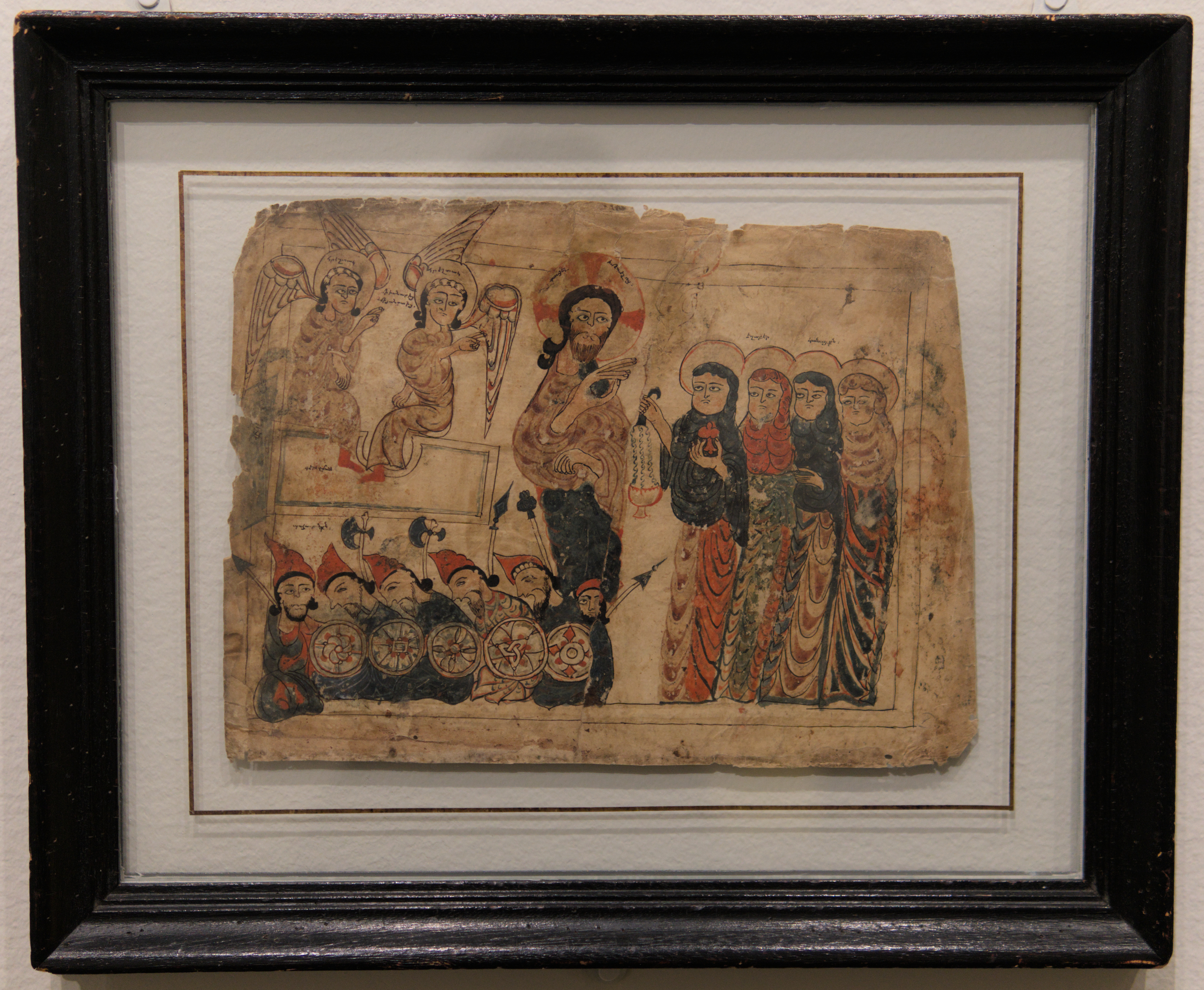
The wall text notes the fine, wavy lines used to render the figures’ draperies, perhaps influenced by Armenian artists from the Lake Van region.
Yovsian of Vaspurakan (Armenian), Leaf from a Gospel book with the Resurrection of Christ and Visit of the Women to the Tomb of Christ, ca. 1350. Tempera on cotton paper. Private collection.
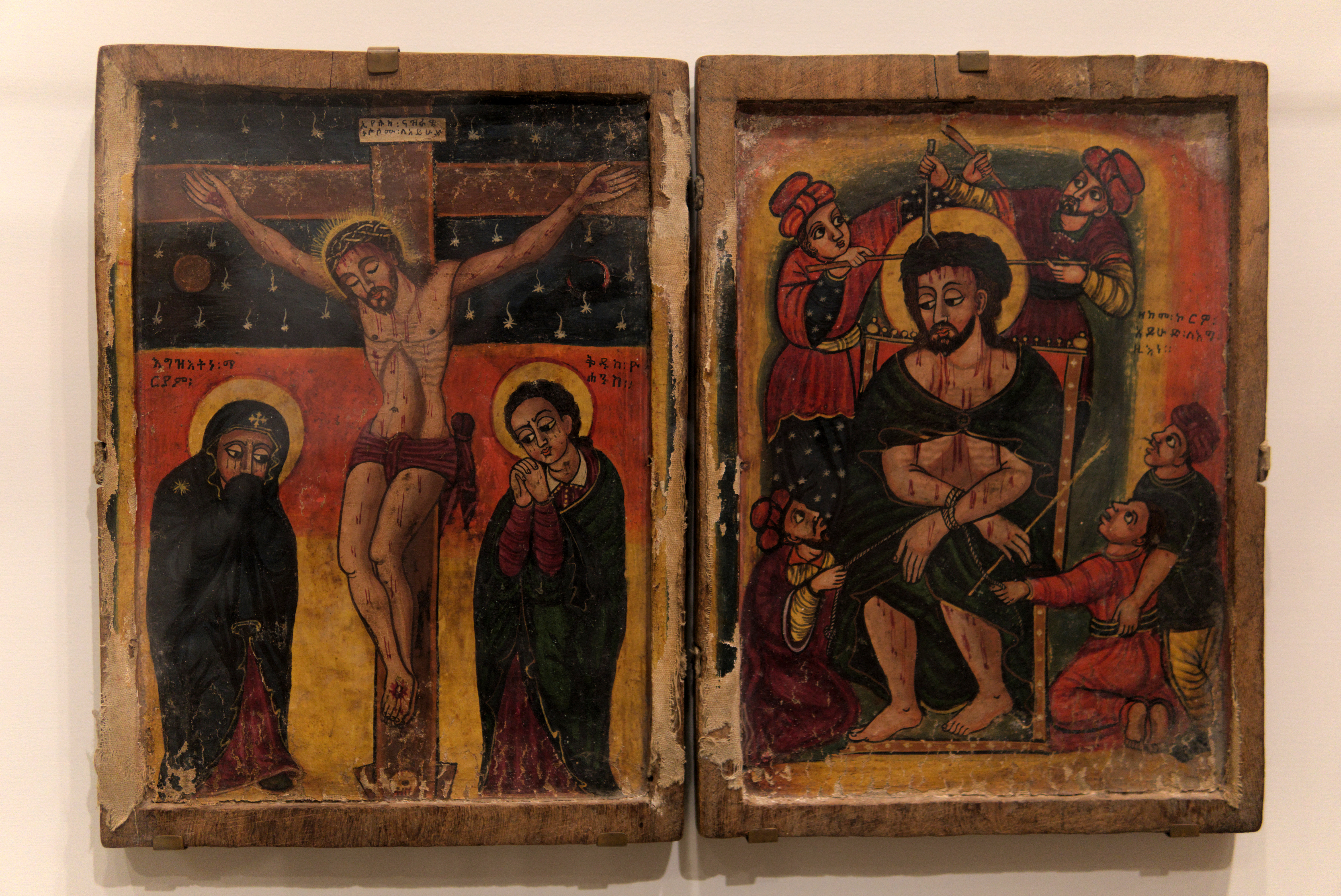
Here’s another Crucifixion, this one painted in what’s called the Second Gondarine style, characterized by smoothly modeled figures, often with darker skin tones, and wide horizontal bands of red, yellow, and green filling the background:
Diptych Icon with the Crucifixion (left) and the Mocking of Christ (right), Ethiopia, late 17th–early 18th century. Wood, polychrome, 13 1/2 × 9 7/8 in. (34.3 × 25.1 cm). Virginia Museum of Fine Arts, Richmond. [object record]
The squiggles behind Christ at the top left may simply be a decorative motif, but to me they look like falling stars, an apocalyptic sign, and as if the sky is weeping.
The right panel of the diptych shows Christ being cruelly fitted with a crown of thorns.
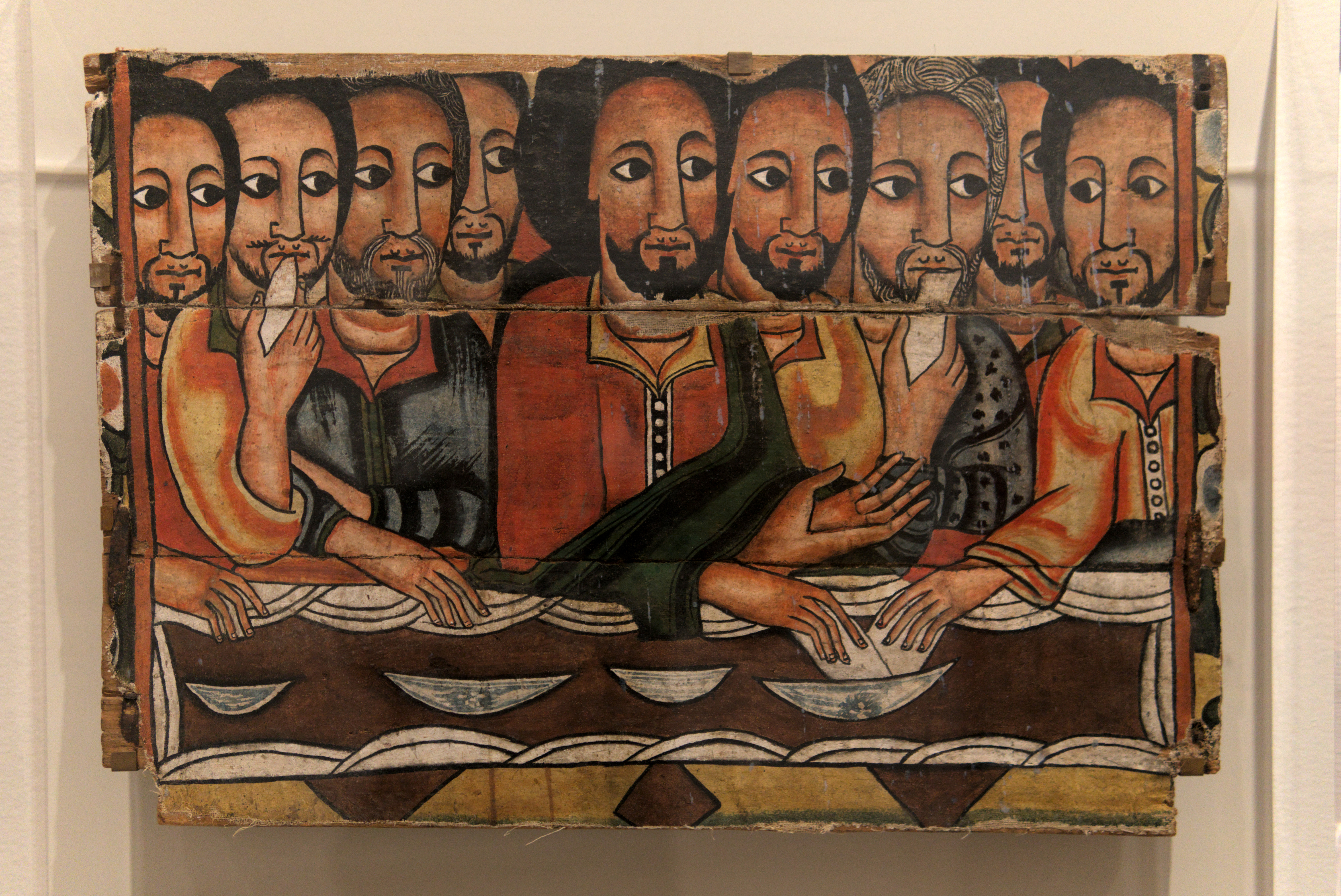
Two other passion images I want to share are a Last Supper wall painting and an Entombment from a disbound album.
Last Supper, Ethiopia, 18th century. Tempera on linen, mounted on panel, 16 3/4 × 24 in. (42.6 × 61 cm). Virginia Museum of Fine Arts, Richmond. [object record]Album Leaf with the Entombment of Christ, Ethiopia (Sawa?), late 17th century. Pigments on vellum. Minneapolis Institute of Art, 2009.39.3y. [object record]
In the Last Supper, Jesus and Judas both dip their bread (injera!) into the same bowl and exchange a knowing glance.
In the Entombment, Jesus, wrapped in white linen, is lowered into the ground, mourned by several of his women followers. The portrayal of his mother Mary’s weeping, her hands covering her eyes and her face stained with tears, is particularly poignant. This leaf is from a set of forty-four, now matted separately but originally arranged in series and likely painted on several long sheets of parchment that were sewn together and folded accordion-style to form a sensul.
One of the most extraordinary objects on display is a rare folding processional icon that adopts the form of a fan, from the late fifteenth century:
Folding Processional Icon in the Shape of a Fan, Ethiopia, late 15th century (Stephanite). Ink and paint on parchment, thread, extended: 24 1/4 × 154 1/8 × 4 3/4 in. (61.6 × 391.4 × 12 cm). Walters Art Museum, Baltimore. Photo courtesy of the museum. [object record]
Thirty-eight identically sized figures span the surface of this elongated parchment: the early Christian martyrs Julitta (Juliet) and Cyricus, St. George, St. John the Baptist, the archangel Michael, the Virgin Mary, the archangel Raphael, St. Paul, the Ethiopian artist-priest Afnin, and unidentified Old Testament patriarchs and prophets. There would have been a wooden handle attached to either end that, when pulled together, created a double handle for a giant wheel to be displayed during liturgical processions and church services (see here). As the museum website notes, “The Virgin Mary, whose hands are raised in a gesture of prayer, is then at the top of the wheel. By depicting Mary in the company of saints and angels, the icon powerfully evokes the celestial community of the church.”
This is just a sampling of all the wonderful art objects that are a part of the Ethiopia at the Crossroadsexhibition. I’ll share more photos on Instagram (@art_and_theology) in the coming weeks.
I strongly encourage you to go see this! I think it would be enjoyable for children as well, especially Christian children, who will be able to identify many of the painted stories. For Christians, it’s an opportunity to connect with our artistic heritage and with African church history. If you can’t catch the exhibition at the Walters in Baltimore before it closes March 3, it will be traveling to the Peabody Essex Museum in Salem, Massachusetts (April 13–July 7, 2024), and the Toledo Museum of Art in Ohio (August 17–November 10, 2024).
Colin McCahon (New Zealand, 1919–1987), Tomorrow will be the same but not as this is, 1958–59. Solpah and sand on board, 188.6 × 127.8 cm. Christchurch Art Gallery, Christchurch, South Island, New Zealand.
I will lift up mine eyes unto the hills, from whence cometh my help.
My help cometh from the LORD, which made heaven and earth.
He will not suffer thy foot to be moved: he that keepeth thee will not slumber.
Behold, he that keepeth Israel shall neither slumber nor sleep.
The LORD is thy keeper: the LORD is thy shade upon thy right hand.
The sun shall not smite thee by day, nor the moon by night.
The LORD shall preserve thee from all evil: he shall preserve thy soul.
The LORD shall preserve thy going out and thy coming in from this time forth, and even for evermore.
—Psalm 121
+++
SONG: “Traveler’s Psalm” by Donald Boyd | Arranged and performed by Andy Zipf, on Traveler’s Psalms and Carols (2009)
I will lift my eyes unto the hills
Whence cometh my help
My help cometh from the Lord
Who made heaven and earth
He will not allow my foot to stumble
For he’s always on my side
And he’ll guide me through all of the days of my life
Now and forevermore
Andy Zipf received this original song from his maternal grandfather, Donald Boyd (1919–1998), who, in addition to writing hymns, was the choir director of a church in Roland, Iowa, for fifty-one years. He had bought Zipf his first guitar and always encouraged him to sing. As a tribute to Grandpa Boyd and his formative impact, Zipf has made the song available for free download at Bandcamp.
+++
The dusky, reverberant landscape painting Tomorrow will be the same but not as this is by Colin McCahon [previously] shows a sun setting behind a range of dark New Zealand hills, with a gray body suggesting water in the midground. Art critic Justin Paton surmises that the mysterious form in the upper left corner (which he jokingly calls “the windshield wiper of God”) is the tail of a cross, because McCahon did a whole series of drawings of flying crosses within landscapes.
“I think it’s a kind of resurrection painting,” Paton said in an RNZ Saturday Morning interview last November. “It’s talking about the way in which an immense spiritual event could shake your world, but then you go to bed and you wake up the next day. It is still the same world, but how has it altered?” Paton continues, “He [McCahon] deals in visions, he deals in miracles, he deals in cataclysmic and elating spiritual events, but it’s always earthed in the everyday—in a world we recognize, a world we can smell . . .” The medium in Tomorrow is commercial flooring paint mixed with sand.
This post belongs to the weekly series Artful Devotion. If you can’t view the music player in your email or RSS reader, try opening the post in your browser.
To view all the Revised Common Lectionary scripture readings for the Second Sunday of Lent, cycle A, click here.
Bartolomé Esteban Murillo (Spanish, 1617–1682), The infant Christ asleep on the cross, ca. 1660–65. Oil on canvas, 24 4/5 × 34 3/5 in. (63 × 88 cm). Prado Museum, Madrid.
When, in the cavern darkness, Jesus
opened his small, bleating mouth (even before
his eyes widened to the supple world his
lungs had sighed into being), did he intuit
how hungrily the lungs gasp? Did he begin, then,
to love the way air sighs as it brushes in and out
through the portals of tissue to sustain
the tiny heart’s iambic beating? And how,
fueled by air, the dazzling blood tramps
the crossroads of the brain like donkey tracks,
corpuscles skittering to the earlobes and toenails?
Bottle of the breath of God, speaking in stories,
shouting across wild, obedient water, his voice
was stoppered only by inquisition, unfaith
and anguish. Did he know that he would,
in the end, leak all his blood, heave a final
groan and throw his breath,
oxygen for the world, back to its Source
before the next dark cave?
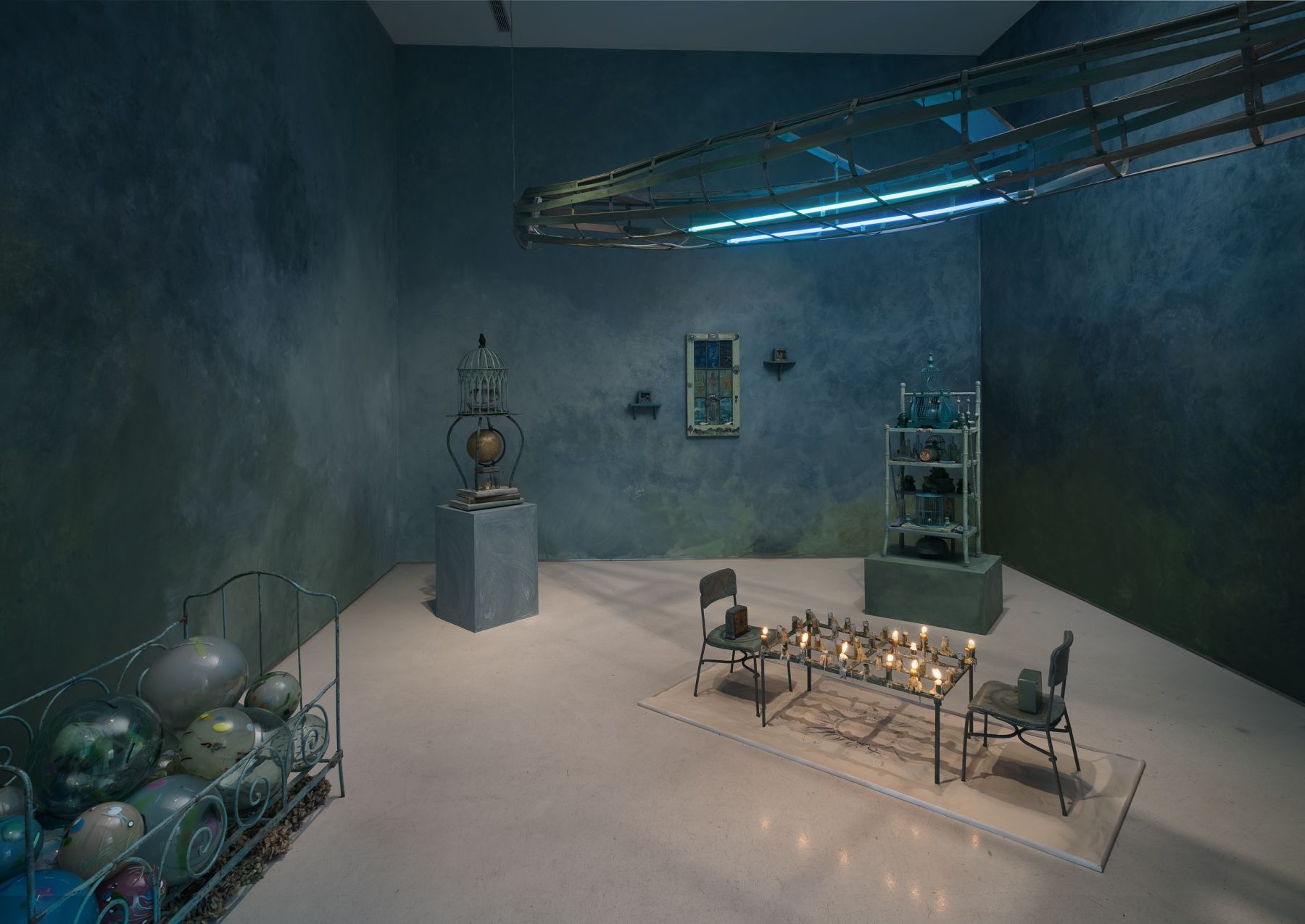
VISUAL MEDITATION: On The Alpha & The Omega by Betye Saar: A few weeks ago my commentary on a Betye Saar installation was published on ArtWay.eu. The idiomatic Hebrew in the title is a reference not to Christ but to the beginning and the end of life, a theme Saar explored by arranging around a blue-painted room such found objects as an antique cradle, dried hydrangeas, a boat shell, a mammy figurine, a washboard, empty apothecary bottles, books, clocks, a moon-phase diagram, etc.
Betye Saar, The Alpha & The Omega: The Beginning & The End, 2013. Installation at Roberts & Tilton, Culver City, California.
With an educational background in design, Saar began her career as a printmaker and working in theater on costumes and sets. She then ventured into collage, which led to assemblage (for which she is most celebrated), sculpture, and installations. With installations, she likes how “the whole body has the experience”—how you are quite literally inside the work. Saar is one of today’s leading American contemporary artists, with twoexhibitions currently running in the United States: one at MoMA, and the other at LACMA. I first encountered her in a college art history course, through her most famous work, The Liberation of Aunt Jemima. Race, memory, and spirituality are recurring themes in her oeuvre.
+++
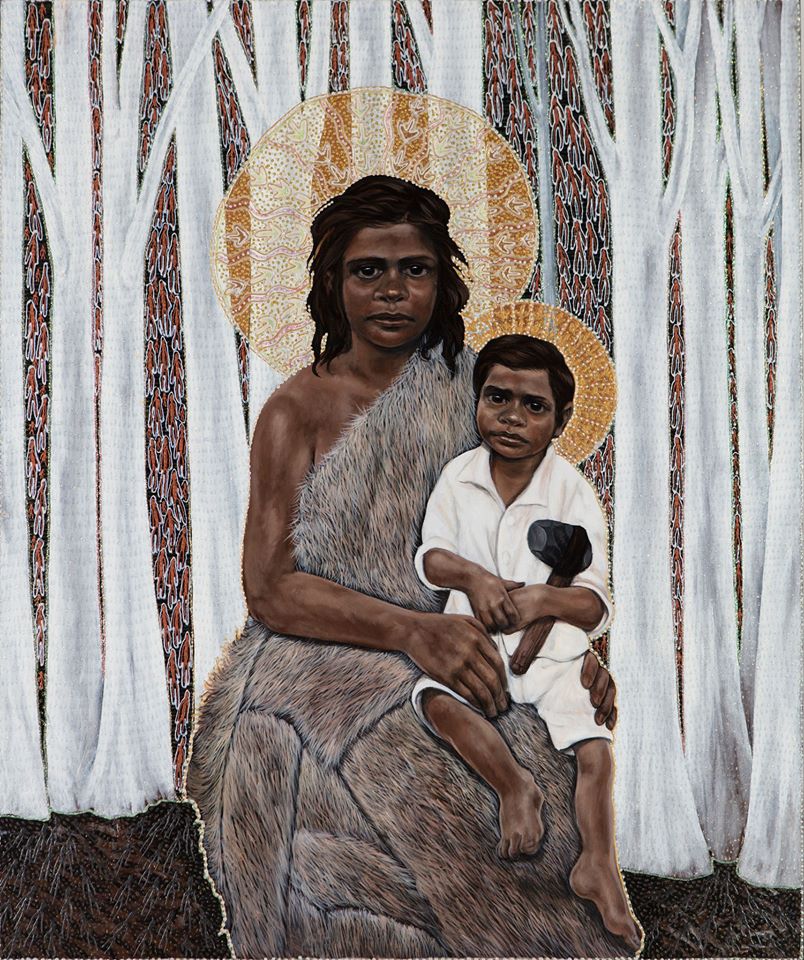
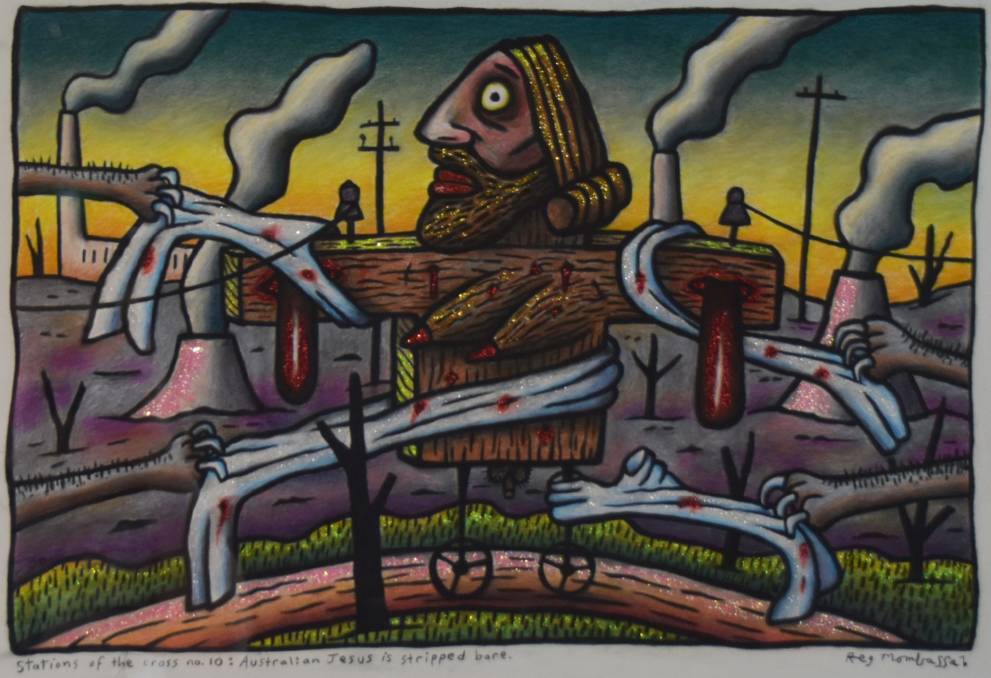
ESSAY: “‘A pretty decent sort of bloke’: Towards the quest for an Australian Jesus” by Jason A. Goroncy: “What happens to religious images and symbols when they get employed outside of their traditional contexts and charged with unapproved and heterodox interpretations?” asks Goroncy. “From many Aboriginal elders, such as Tjangika Napaltjani, Bob Williams and Djiniyini Gondarra, to painters, such as Arthur Boyd, Pro Hart and John Forrester-Clack, from historians, such as Manning Clark, and poets, such as Maureen Watson, Francis Webb and Henry Lawson, to celebrated novelists, such as Joseph Furphy, Patrick White and Tim Winton, the figure of Jesus has occupied an endearing and idiosyncratic place in the Australian imagination. It is evidence enough that ‘Australians have been anticlerical and antichurch, but rarely anti-Jesus’. But which Jesus? In what follows, I seek to listen to what some Australians make of Jesus, and to consider some theological implications of their contributions for the enduring quest for an Australian Jesus.” [HT: Art/s and Theology Australia]
Julie Dowling (Badimaya/Yamatji/Widi, 1969–), Black Madonna: Omega, 2004. Synthetic polymer paint, red ocher, glitter, and metallic paint on canvas, 120 × 100 cm. Art Gallery of Western Australia. “I painted this in honour of First Nation mothers who have their children stolen from them by white governments in order to assimilate their children.”
Chris O’Doherty (aka Reg Mombassa) (Australian, 1951–), Australian Jesus Is Stripped Bare, station 10 from the Stations of the Cross cycle. Chapel at the Australian Centre for Christianity and Culture, Barton, ACT, Australia. Photo: Katherine Spackman.
Goroncy quotes Wilson Yates, who says that Jesus has become “a part of the culture and life far beyond the final control of the church, . . . imaged in diverse ways by non-Christian as well as Christian artists, often contrary to the church’s dominant interpretation. . . . This should not be viewed as threatening,” however, but rather as “a means by which, paradoxically, the traditional symbols are kept vital – are kept alive in the midst of human life.”
+++
AUDIO INTERVIEW: Justin Paton on New Zealand artist Colin McCahon: In celebration of the centenary of Colin McCahon’s birth, art critic and curator Justin Paton has published McCahon Country, which examines nearly two hundred of the artist’s paintings and drawings. In this Saturday Morning (RNZ) interview, Paton says that McCahon is one of the great modern religious artists; an unabashed Christian, he grappled with how to make religious art in a post-religious age, often interweaving biblical themes and texts with New Zealand landscapes. His paintings, Paton says, are “an unequivocal statement of faith,” painted at times with “sophisticated unsophistication.” In 1948 one critic described them dismissively as “like graffiti in some celestial lavatory”—a comparison Paton affirms but sees as commendatory.
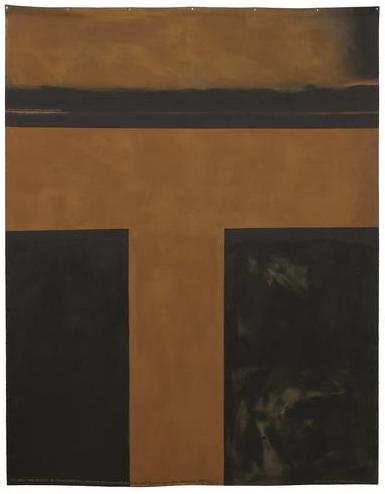
Colin McCahon (New Zealand, 1919–1987), The days and the nights in the wilderness showing the constant flow of light passing into a dark landscape, 1971
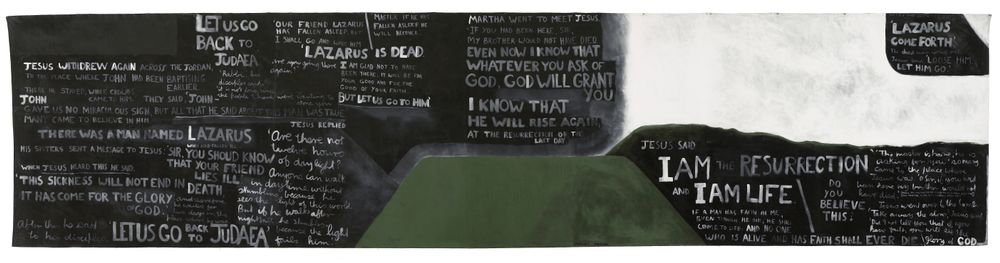
Colin McCahon (New Zealand, 1919–1987), Practical religion: The resurrection of Lazarus showing Mount Martha, 1969–70. Acrylic on unstretched canvas, 207.5 × 807 cm. Te Papa (Museum of New Zealand), Wellington.
I was familiar with McCahon’s early works—Annunciations, Crucifixions—but not so much the later ones featured here. For example, The days and the nights, about which Paton says,
You could take a first look at this thing and you could think it’s not so exciting, in a way. It’s . . . smeary blacks and then there’s this . . . kind of clay color—muddy, you might say. . . . The form is this kind of ocher cross with black surrounding it. But give it some time, and you realize that the space above describes a horizon line. You can see the riffle of clouds along that horizon. If you know Muriwai on the West Coast, you can recognize it as a West Coast landscape, which is of course the spirit landscape up which souls travel in Maori mythology. And then you realize that this cross is also a kind of estuary, that it is descending through to areas or gates. So it is at once the Christian cross, it’s the Buddhist idea of light as grace which descends towards us . . .
About Lazarus:
McCahon said the Lazarus story was one of the great stories about seeing: all those people who were witnesses to this event saw as never before. What’s wonderful in the work is, as you read your way from left to right—and it really is this kind of epic telling of the story—when you’re about two-thirds of the way across, he almost makes you into Lazarus. He puts you into the position of this person who is emerging from the tomb, because there’s this sliver of light that opens up and bursts then fills the right-hand third of the painting. It’s like coming out of a dark space and suddenly being blinded by sunlight.
It’s a great example of what a great reader he was. He got into these texts with the avidity of a fan. You really felt he was there with these people in this ancient story and then tries to put us inside it as we stand and walk in front of this giant canvas. It has a terrific oscillation between something worldly and vernacular and then something exalted and sacred at the other end.
CHANT: “I Am Here in the Heart of God” by Erin McGaughan, adapt. & arr. Chandra Rule: At the Singing Beloved Community workshop held in September in Cincinnati, song leader Chanda Rule led participants in a chant that she adapted from Erin McGaughan. To McGaughan’s original, Rule added three new verses with a modulation between each, and she presented the whole of it in a call-and-response format. [HT: Global Christian Worship]
I am here in the heart of God
God is here in the heart of me
Like the wave in the water and the water in the wave
I am here in the heart of God
I am here in the breath of God
God is here in the breath of me
Like the wind in the springtime and the springtime in the wind
I am here in the breath of God
I am here in the soul of God
God is here in the soul of me
Like the flame in the fire and the fire in the flame
I am here in the soul of God
I am here in the mind of God
God is here in the mind of me
Like the earth in my body and my body in the earth
Like the flame in the fire and the fire in the flame
Like the wind in the springtime and the springtime in the wind
Like the wave in the water and the water in the wave
I am here in the heart of God
+++
SONG: “I Hunger and I Thirst,” words by John S. B. Monsell (1866), with new music by Wally Brath: I was listening to the video recording of the Grace College Worship Arts jazz vespers service that took place November 8 at Warsaw First United Methodist Church in Indiana, when I heard this striking hymn. Written by a nineteenth-century Anglican clergyman, it was set to music by Wally Brath, an assistant professor of worship arts at Grace College, who’s playing the piano in the video. The performance features Grammy Award–winning bassist John Patitucci, and vocalist Ethan Leininger. Click here to listen to the whole service and to see the full list of musicians. [HT: Global Christian Worship]
I hunger and I thirst:
Jesu, my manna be;
ye living waters, burst
out of the rock for me.
Thou bruised and broken Bread,
my life-long wants supply;
as living souls are fed,
O feed me, or I die.
Thou true life-giving Vine,
let me thy sweetness prove;
renew my life with thine,
refresh my soul with love.
Rough paths my feet have trod
since first their course began:
feed me, thou Bread of God;
help me, thou Son of Man.
For still the desert lies
my thirsting soul before:
O living waters, rise
within me evermore.
ALBUM FUNDRAISER: Love Secrets by John Mark Pantana: I really enjoyed Pantana’s 2017 debut album, Mighty Grace, so I jumped at the opportunity to support his next project on Indiegogo: Love Secrets. His voice is so soothing! So are his original lyrics, all about God’s love and grace. Visit him at https://www.johnmarkpantana.com/, and listen to one of the songs from his upcoming album, “Abba,” below. Fundraising campaign ends February 9.
+++
EXHIBITIONS
I love the curatorial approach of these two current exhibitions, which bring art from the Middle Ages or Renaissance into conversation with contemporary art. Rather than doing this to prove a disjunction sparked by modernity, the curators stress continuity between the artists of yesterday and today.
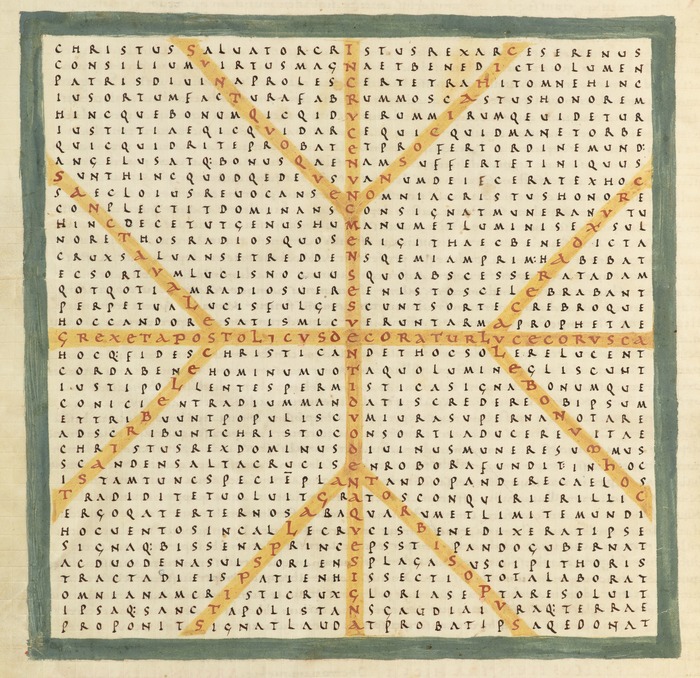
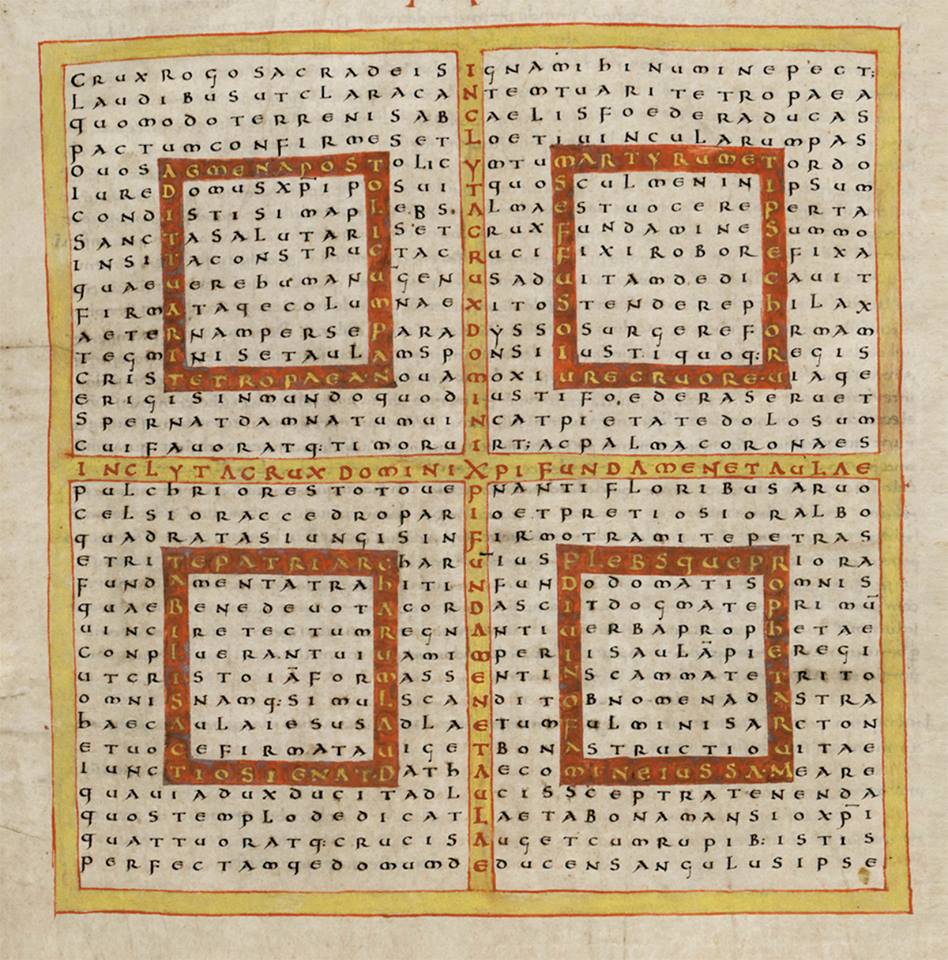
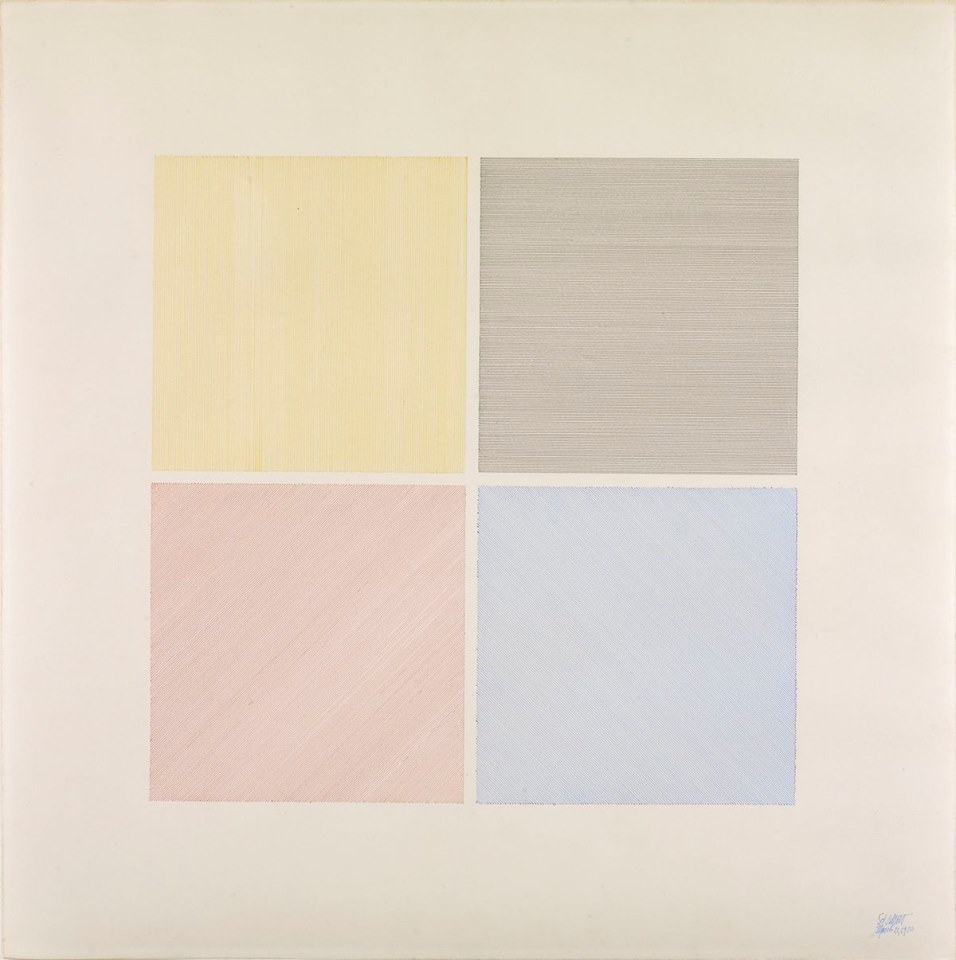
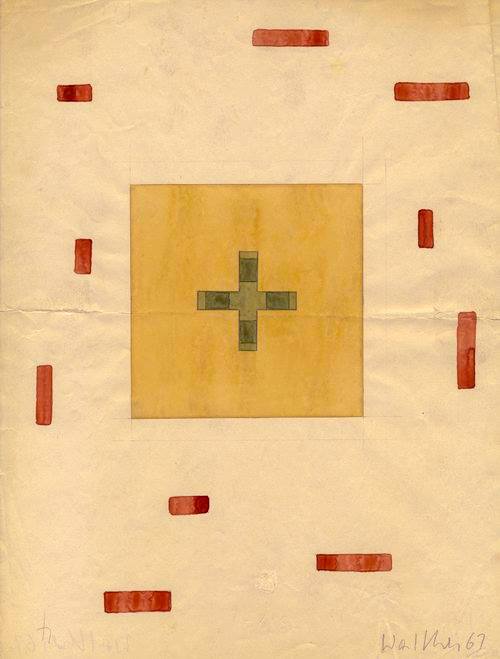
“Make It New: Conversations with Medieval Art,” Bibliothèque nationale de France (National Library of France), Paris, November 5, 2018–February 10, 2019: Curated by Dutch artist Jan Dibbets, “Make It New” explores the relationship between works of contemporary art and the medieval art of Raban Maur (Hrabanus Maurus), a ninth-century monk from Fulda, Germany, and a major figure of the Carolingian renaissance. The centerpiece of the exhibition is Raban Maur’s De laudibus sanctae crucis (In Praise of the Holy Cross), a Latin manuscript comprising twenty-eight highly sophisticated poems whose letters are arranged in simple grids over colorful, geometric cross patterns. At the BnF, these compositions are placed in dialogue with thirty-plus works by some of today’s minimalist, conceptual, and land artists, including Sol LeWitt, Carl Andre, François Morellet, Niele Toroni, and Franz E. Walther, stressing similarities in form, color, proportion, and perspective. [press release (English)] [compilation of Maur images]
The original figure poem cycle was produced around 810 at the scriptorium in Fulda, and Raban Maur had a hand in making at least five other copies during his lifetime (of which France’s National Library owns two: Lat. 2423 and Lat. 2422); seventy-four additional copies from the Middle Ages are extant. The Burgerbibliothek Bern in Switzerland has digitized its early eleventh-century copy (Cod. 9), and it’s really fascinating! Full-resolution downloads are enabled. According to the Benedictine abbot Odilo of Cluny, “no work more precious to see, more pleasing to read, sweeter to remember, or more laborious to write can or could ever be found.” I don’t know Latin, but visually, I can really appreciate these fine pages. I was hoping to find more information about the work but could really only find a single French lecture given back in 2007 by Denis Hüe, a professor of medieval and Renaissance language and literature at the Université Rennes 2 Haute-Bretagne.
Figure poem by Raban Maur, Fulda, Germany, ca. 822–847. BnF Lat. 2422, fol. 10v.
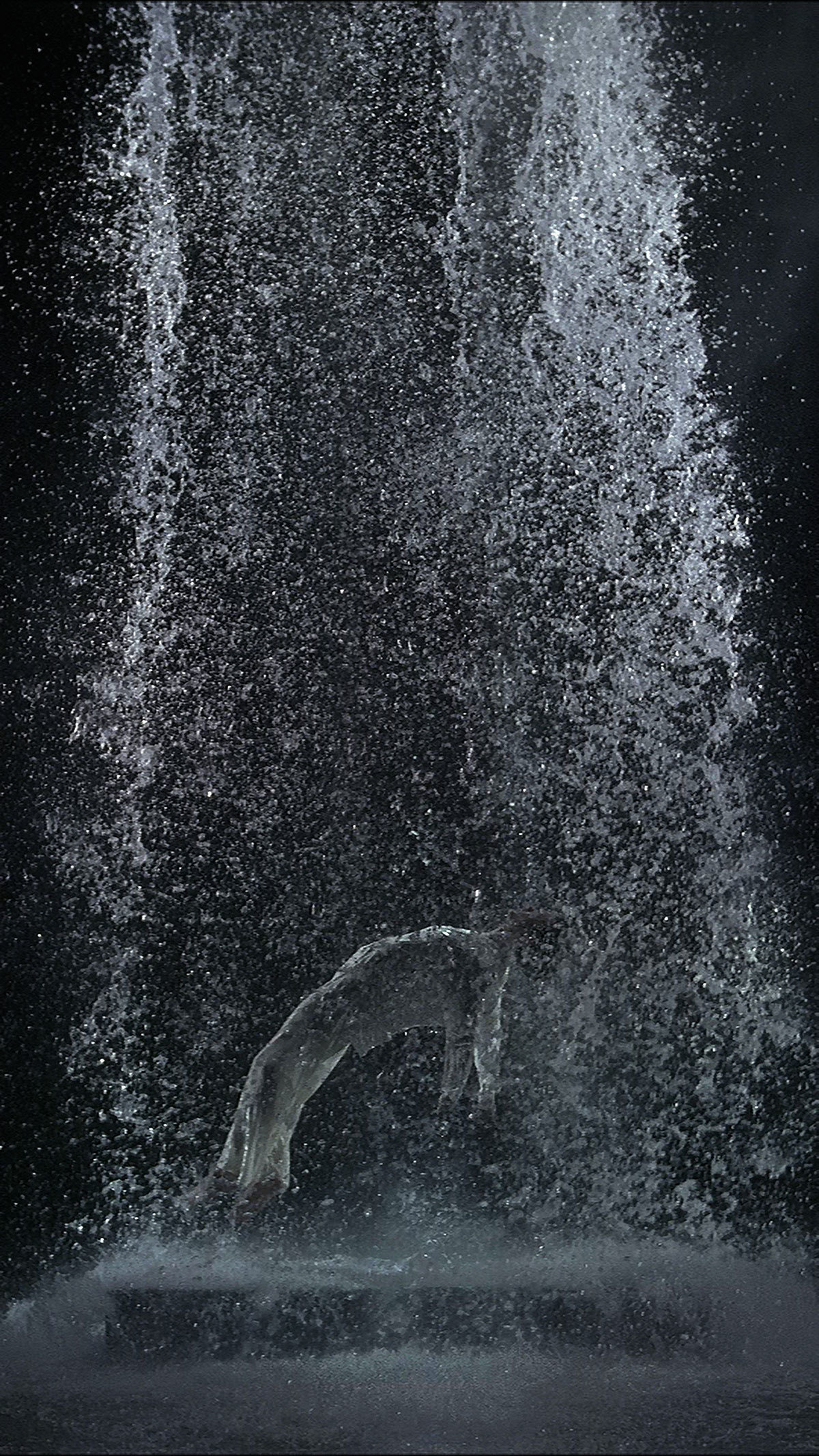
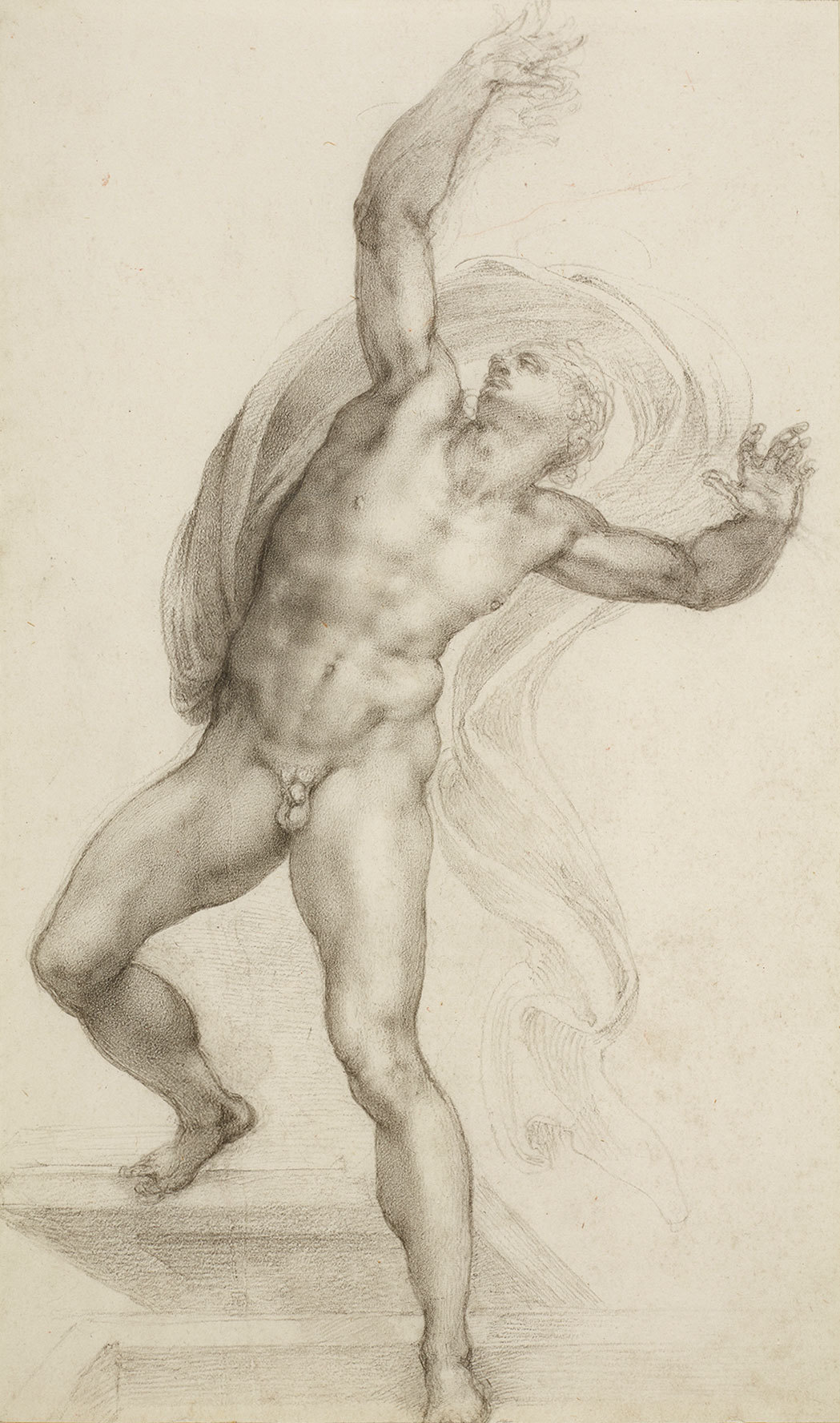
“Bill Viola / Michelangelo: Life, Death, Rebirth,”Royal Academy of Arts, London, January 26–March 31, 2019: When pioneering video artist Bill Viola saw a collection of Michelangelo’s exquisite drawings at Windsor Castle in 2006, he was astonished by the Renaissance master’s expressive use of the body to convey emotional and spiritual states. Here the two artists are exhibited side by side, showing their common grappling with life’s fundamental questions, albeit in vastly different mediums. “Both artists harness the symbolic power of sacred art, and both show us physical extremes and moments of transcendence.” Among the twelve major installations from Viola, spanning his career, is Tristan’s Ascension(The Sound of a Mountain Under a Waterfall), a sixteen-foot-high projection depicting the ascent of the soul after death.
For February 16, the Royal Academy has organized a full day of events keyed to the exhibition, including poetry readings, a documentary screening, and a panel discussion with cultural historian Marina Warner, theologian Ben Quash, and artist Mariko Mori, titled “Art as fulfilment: the use of religion and spirituality in contemporary art.” Questions for the day include: Does art connect us? Can art be transformative or transcendental? Can art influence society—that is, change opinions or human behavior? Other offerings in addition to this program are a curator’s introduction on February 1, a short course on figure drawing, and a talk on the limitations and opportunities of digital art. Plus, the London Art Salon is hosting a talk on the exhibition by art historian Marie-Anne Mancio.
Bill Viola (American, 1951–), Tristan’s Ascension (The Sound of a Mountain Under a Waterfall), 2005. Video/sound installation. Performer: John Hay. Photo: Kira Perov. Courtesy Bill Viola Studio.
Michelangelo Buonarroti (Italian, 1475–1564), The Risen Christ,” ca. 1532–33. Black chalk on paper, 37.2 × 22.1 cm. Royal Collection Trust, UK.
+++
NEW COMIC BOOK PUBLISHER: Cave Pictures Publishing, founded in fall 2018 by Mark Rodgers, is committed to the telling of “modern myths” that “speak to the soul” through comic books in the genres of action-adventure, sci-fi, historical fiction, and fantasy. Pitched for the spiritually inclined, the stories they publish “seek to make sense of our world . . . draw us toward the source of goodness . . . uncover what we worship.” Says Rodgers in a Hollywood Reporter interview: “Just as cave paintings were humanity’s initial attempt to process through the tough ultimate questions of human existence, we look at our stories as ‘sherpas of the soul,’ to contribute to the individual and collective human journey towards meaning and a greater reality,” the One True Myth. Read more about the company’s influences and aspirations in this Convivium essay. See also the interview in Sojourners.
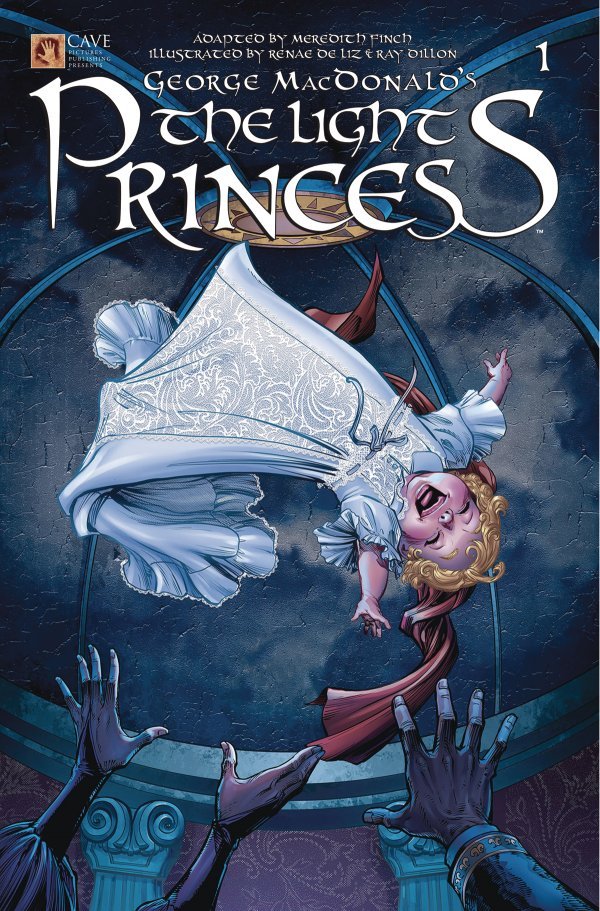
One of their five inaugural series is The Light Princess, an adaptation of one of George MacDonald’s best-loved fairy tales, about a princess who is cursed with weightlessness and is only brought down to earth by a true, sacrificial love. MacDonald was a Scottish author, poet (e.g., here, here, and here), and Christian minister who deeply influenced C. S. Lewis and J R. R. Tolkien. Speaking of Tolkien, I’m really digging this quote of his on Cave Pictures’ website, which affirms the value of story: “Legends and myths are largely made of ‘truth,’ and indeed present aspects of it that can only be received in this mode. . . . Long ago certain truths and modes of this kind were discovered and must always reappear.”












.jpg)
 Art & Theology