
SPEECH: “Address of His Holiness Pope Francis to Artists for the 50th Anniversary of the Inauguration of the Vatican Museums’ Collection of Modern Art”: On June 23, at the invitation of Pope Francis, some two hundred select visual artists, filmmakers, composers, poets, and other creatives gathered at the Sistine Chapel to commemorate the fiftieth anniversary of the Vatican Museums’ Collection of Modern and Contemporary Art, inaugurated in 1973 by Pope John Paul VI. “One of the things that draws art closer to faith is the fact that both tend to be troubling,” Pope Francis said last Friday. “Neither art nor faith can leave things simply as they are: they change, transform, move and convert them.” He applauded how “artists take seriously the richness of human existence, of our lives and the life of the world, including its contradictions and its tragic aspects. . . . Artists remind us that the dimension in which we move, even unconsciously, is always that of the Spirit. Your art . . . propel[s] us forward.” For reporting on this event by the New York Times, see here.
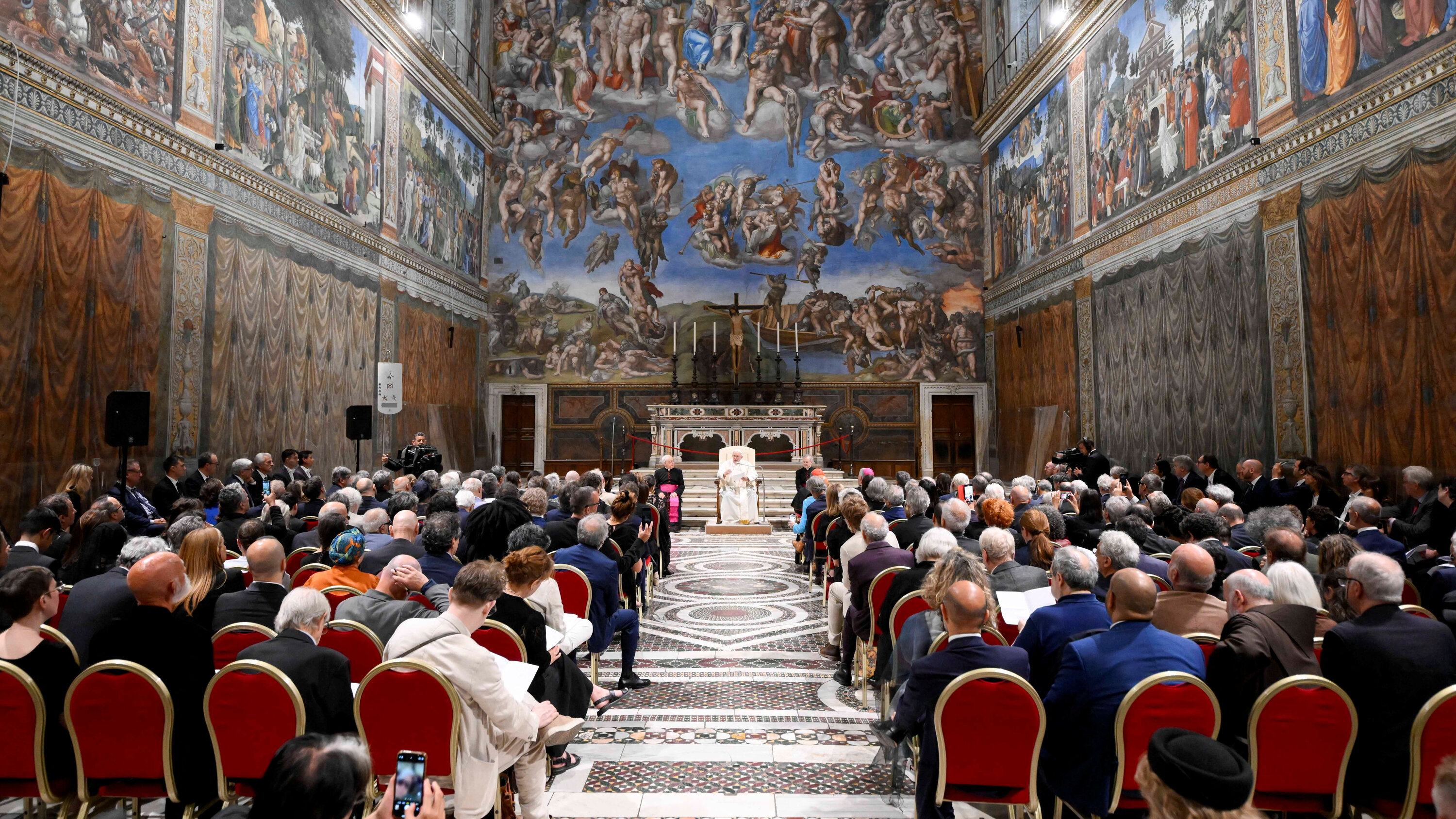
This papal address came less than a month after the pope addressed another gathering of artists at the Vatican for the conference The Global Aesthetics of the Catholic Imagination, sponsored by La Civiltà Cattolica with Georgetown University (read that address here).
+++
VISUAL COMMENTARY ON SCRIPTURE: “I Live by Faith (Galatians 2:15–21)” by Victoria Emily Jones: My latest set of commentaries for the VCS went live this month! It centers on one of Paul’s famous sayings: “I have been crucified with Christ, and it is no longer I who live, but it is Christ who lives in me.” I was bummed that one of the three commentaries I originally wrote had to be scrapped because the image permission was ultimately denied; I thus had to reconfigure and replace, and I ended up with two artworks in the three-piece exhibition that aren’t as diverse from each other as I had hoped. But still, each artwork brings a unique and compelling lens through which to examine this passage. (Note: If you’re viewing the exhibition on your phone, after you “Enter Exhibition,” you’ll need to expand the “Exhibition Menu” to access the “Show Commentary” button.)
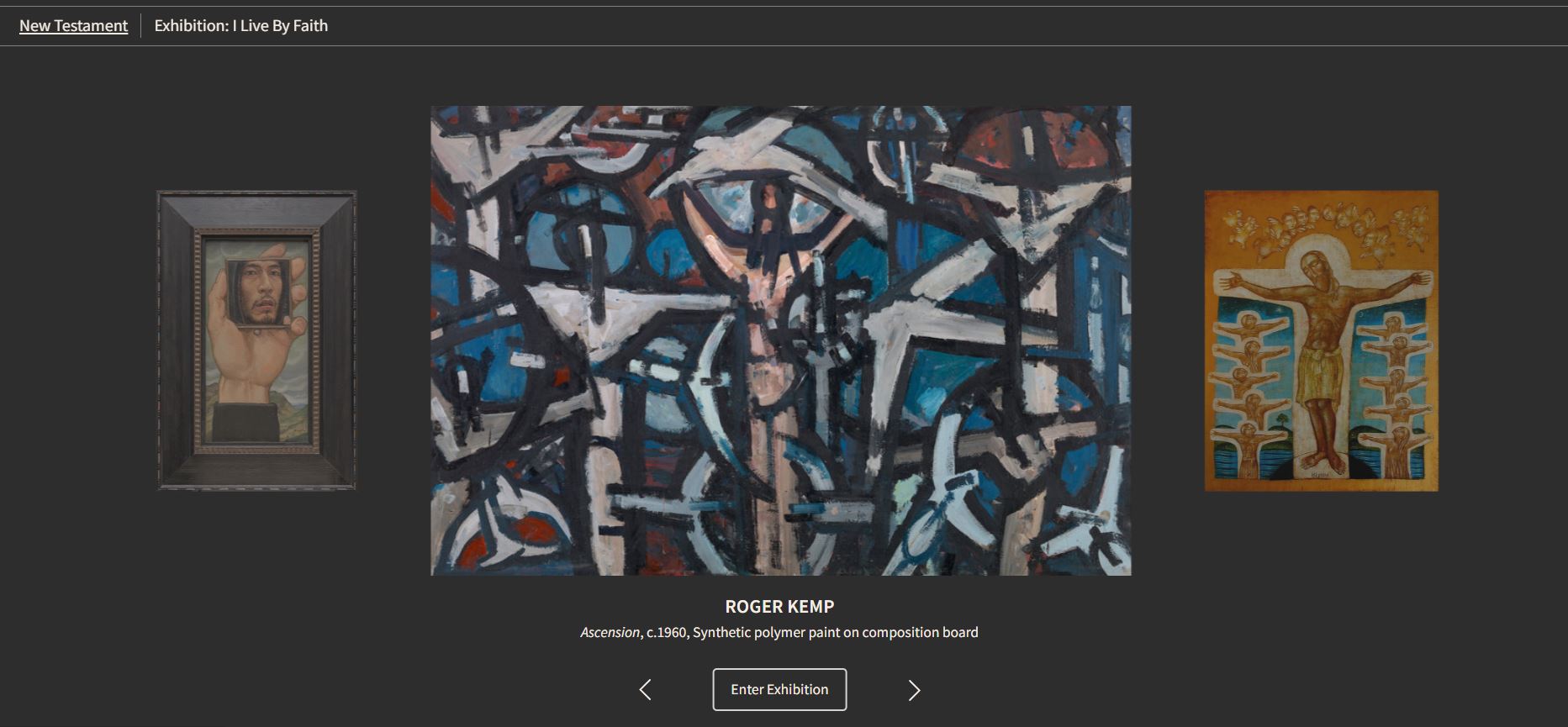
The VCS was covered by The Art Newspaper in a recent article by Anna Somers Cocks. “Theology is making a comeback as an important tool for interpreting art,” reads the URL.
+++
VIDEO: “Abraham: An Interfaith Discussion at the Bode-Museum, Berlin”: Besides publishing written commentaries on works of art in dialogue with Bible passages, the Visual Commentary on Scripture also produces videos. This one brings together an Anglican Christian priest (who directs the VCS), a Jewish rabbi, and a Muslim theologian around a fifth-century ivory pyxis depicting Abraham, a figure held in common by all three faith traditions.
+++
POEM: “Gate A-4” by Naomi Shihab Nye: I’ve always loved this heartwarming poem about an unexpected moment of communion shared with strangers at an airport, made possible through kindness and the letting down of one’s guard. Listen to commentary by Joanne Diaz and Abram Van Engen on the Poetry for All podcast, episode 19; they answer the question “Why is this a poem?” Here’s a video of Nye reading it herself:
+++
NEW ALBUMS:
>> April 21: Worship for Workers by the Porter’s Gate: “In 2022 a group of songwriters, pastors, and professionals gathered in Nashville, Tennessee to write a series of worship songs for workers. Over three days they discussed the spiritual, emotional, and material struggles facing workers around the world today. Soon enough, they began to compose a series of songs specifically designed to help Christians carry their daily work before the Lord.” Here’s one of the thirteen songs on the album, “You Hold It All”:
The Worship for Workers album is part of a larger project, sponsored by the Brehm Center and a number of other institutions, to provide music, prayers, art, liturgies, and training to the church around the topic of work. It grew out of the book Work and Worship: Reconnecting Our Labor and Liturgy by Matthew Kaemingk and Cory Willson.
>> May 5: Glory Hour by Victory: Victory Boyd [previously] is a Grammy-winning soul and gospel artist who got her start singing with her siblings in the group Infinity Song but whose career really kicked into high gear when she worked as a songwriter for Kanye West’s Jesus Is King (2019). Glory Hour is her second full-length album as a solo artist; its title refers to the time of the morning when the sun rises. Most of the tracks are original songs or spoken word, but there are also three classic hymns/gospel songs: “His Eye Is on the Sparrow,” “Great Is Thy Faithfulness,” and “I Know It Was the Blood.” Here’s the music video for “Just like in Heaven,” based on the Lord’s Prayer:
>> May 19: Seven Psalms by Paul Simon: Paul Simon released this original seven-movement composition about doubt and belief as a single thirty-three-minute track, as it is meant to be listened to in one sitting. I’m a Simon fan; one of my early blog posts is a review of his and Garfunkel’s debut album, Wednesday Morning, 3 A.M. But if I’m honest, I was underwhelmed by this much-anticipated release. I’m in the minority there, so I think I’ll need to give it another listen. What do you think of it? Here’s the trailer:
>> June 2: Byrd: Mass for Five Voices by the Gesualdo Six: One of my favorite vocal ensembles has just come out with an album of songs by William Byrd—his setting of the Mass along with a handful of motets. A Catholic composer in Protestant England in the late Renaissance, Byrd wove together musical “notes as a garland to adorn certain holy and delightful phrases of the Christian rite,” as he wrote in the preface to his second book of Gradualia (1607). Here’s the Gesualdo Six’s performance of his “Afflicti pro peccatis nostris,” a Latin prayer, a desperate plea for sanctification, that translates to “Afflicted by our sins, each day with tears we look forward to our end: the sorrow in our hearts rises to thee, O Lord, that you may deliver us from those evils that originate within us”:

 Art & Theology