“To Calvary he bore his cross,” aka “My Fearful Dream”: An Early Tudor Passion Carol from the Fayrfax Manuscript

The English Crucifixion lyric “My Fearful Dream” (also known by the beginning of its first line, “To Calvary he bore his cross”) was written anonymously in the fifteenth century. It is preserved, with music by Gilbert Banastir (sometimes spelled Banaster or Banester) (ca. 1445–1487), on folios 77v–82r of the famous Tudor songbook BL Add. MS. 5465, intended for use at the court of King Henry VII. Compiled around the year 1500, this manuscript is commonly referred to as the Fayrfax Manuscript after Robert Fayrfax, the Tudor composer who was organist of St. Albans and a Gentleman of the Chapel Royal—that is, an adult male singer in the monarch’s household choir. It contains twelve sacred songs and thirty-seven secular songs, all in English—with, “beyond question, the finest music written to vernacular words which survives from pre-Reformation England,” writes John Stevens in Early Tudor Songs and Carols (xvi). It is unknown whether the text or the music was written first.

In 1982 “My Fearful Dream” was performed by Pro Cantione Antiqua under the direction of Mark Brown at the Church of St. John-at-Hackney in London. The recording of this performance was originally released in 1985 in vinyl format on A Gentill Jhesu: Music from the Fayrfax Ms. and Henry VIII’s Book (Hyperion A66152) and was later reissued by Regis Records in 2006 on the CD Tears & Lamentations: English Renaissance Polyphony (RRC 1259). Unfortunately, the CD is out of print, the choral group is inactive, and I can find no performances online. I thus provide the recording of “My Fearful Dream” (or “My Fearfull Dreme,” as the track list spells it) directly below for educational purposes. It is a song for three voices: alto, tenor, bass.

Below is the original text as transcribed by Richard Leighton Greene from the Fayrfax Manuscript in The Early English Carols (Oxford: Clarendon Press, 1935), page 124, followed by a version with modernized spellings and updates of a few antiquated words. The text also appears in John Stevens, Music and Poetry in the Early Tudor Court (London: Methuen, 1961), no. 56, and the music in John Stevens, ed., Early Tudor Songs and Carols (Musica Britannica 36) (London: Stainer and Bell, 1975), page 476.

Pro Cantione Antiqua does not sing the third stanza.

van der Weyden, Rogier_Crucifixion (Philadelphia)
Rogier van der Weyden (Netherlandish, 1399/1400–1464), The Crucifixion, with the Virgin and Saint John the Evangelist Mourning, ca. 1460. Oil on panel, overall 71 × 73 in. (180.3 × 185 cm). Philadelphia Museum of Art.

Most people today use the word “carol” as synonymous with a cheerful Christmas song. But up until about 1550, the term was used for lyrics of a certain form rather than a certain subject or spirit. Greene defines the medieval or Renaissance carol as “a song on any subject, composed of uniform stanzas and provided with a burden . . . [that is,] an invariable line or group of lines which is to be sung before the first stanza and after all stanzas” (Early English Carols, xxxii–xxxiii). He distinguishes a burden from a refrain: “The refrain, as defined in this essay, is a repeated element which forms part of a stanza, in the carols usually the last line. The burden, on the other hand, is a repeated element which does not form any part of a stanza, but stands wholly outside the individual stanza-pattern” (clx).

That’s why “My Fearful Dream” can properly be called a carol. The two lines beginning “My fearful dream” open the song and repeat after each stanza.


My Feerfull Dreme

My feerfull dreme nevyr forgete can I:
Methought a maydynys childe causless shulde dye.


To Calvery he bare his cross with doulfull payne,
And theruppon straynyd he was in every vayne;
A crowne of thorne as nedill sharpe shyfft in his brayne;
His modir dere tendirly wept and cowde not refrayne.
Myn hart can yerne and mylt
When I sawe hym so spilt,
Alas, for all my gilt,
Tho I wept and sore did complayne
To se the sharpe swerde of sorow smert,
Hough it thirlyd her thoroughoute the hart,
So ripe and endles was her payne.

My feerfull dreme . . .

His grevous deth and her morenyng grevid me sore;
With pale visage tremlyng she strode her child before,
Beholdyng ther his lymmys all to-rent and tore,
That with dispaire for feer and dred I was nere forlore.
For myne offence, she said,
Her Son was so betraide,
With wondis sore araid,
Me unto grace for to restore:
‘Yet thou are unkynd, which sleith myn hert,’
Wherewith she fell downe with paynys so smert;
Unneth on worde cowde she speke more.

My feerfull dreme . . .

Saynt Jhon than said, ‘Feere not, Mary; his paynys all
He willfully doth suffir for love speciall
He hath to man, to make hym fre that now is thrall.’
‘O frend,’ she said, ‘I am sure he is inmortall.’
‘Why than so depe morne ye?’
‘Of moderly pete
I must nedis wofull be,
As a woman terrestriall
Is by nature constraynyd to smert,
And yet verely I know in myn hart
From deth to lyff he aryse shall.’

My feerfull dreme . . .

Unto the cross, handes and feete, nailid he was;
Full boistusly in the mortess he was downe cast;
His vaynys all and synowis to-raff and brast;
The erth quakyd, the son was dark, whos lyght was past,
When he lamentable
Cried, ‘Hely, hely, hely!’
His moder rufully
Wepyng and wrang her handes fast.
Uppon her he cast his dedly loke,
Wherwith soddenly anon I awoke,
And of my dreme was sore agast.

My feerfull dreme . . .

My Fearful Dream (modernized)

My fearful dream never forget can I:
Methought a maiden’s child causeless should die.


To Calvary he bore his cross with doleful pain,
And thereupon strained he was in every vein;
A crown of thorns, sharp as needles, shoved in his brain.
His mother dear tenderly wept and could not refrain.
My heart did yearn and melt
When I saw him so spilt,
Alas, for all my guilt,
And I wept and did sore complain
To see the sharp sword of sorrow smart,
How it pierced her straight through the heart,
So ripe and endless was her pain.

My fearful dream never forget can I:
Methought a maiden’s child causeless should die.


His grievous death and her mourning grieved me sore;
With pale visage, trembling, she strode before her child,
Beholding his limbs all rent and torn,
That with despair for fear and dread I was near forlorn.
For my offense, she said,
Her Son was so betrayed,
With wounds sore arrayed,
Me unto grace for to restore:
“Yet thou art unkind, which slayeth my heart,”
Wherewith she fell down with pains so smart;
Hardly one word could she speak more.

My fearful dream never forget can I:
Methought a maiden’s child causeless should die.


Saint John then said, “Fear not, Mary; all his pains
He willfully suffers for the special love
He has to man, to make him free that’s now in thrall.”
“O friend,” she said, “I am sure he is immortal.”
“Why, then, do you mourn so deeply?”
“Of motherly pity
I needs must woeful be,
As a terrestrial woman
Is by nature constrained to smart,
And yet verily I know in my heart
From death to life he shall arise.”

My fearful dream never forget can I:
Methought a maiden’s child causeless should die.


Unto the cross, hands and feet, he was nailed;
Violently into the mortise he was cast down;
His veins and sinews were all riven apart and burst;
The earth quaked, the sun was dark, whose light was past,
When he, lamenting,
Cried, “Eli, Eli, Eli!”
His mother was ruefully
Weeping and wrung her hands fast.
Upon her he cast his deathly look,
Wherewith suddenly anon I awoke,
And of my dream was sore aghast.

My fearful dream never forget can I:
Methought a maiden’s child causeless should die.

The speaker of this carol has a dream—a nightmare—of Calvary, where he beholds the ignominious death of Jesus and the agonizing grief of Jesus’s mother and realizes that such suffering was undertaken for his sake, to save him from sin and its fatal consequences. The accusation that Mary hurls at the speaker in her hour of torment is biting: “You slay my heart!” My son is dead because of you. It’s such a humanizing passage, this expression of a mother’s anger at a death that didn’t have to be.

This is the Mater Dolorosa (Latin for “Sorrowful Mother”) of Christian tradition, who is sometimes depicted with a sword (or seven!) in her chest, literalizing Simeon’s prophecy to her as a teen and evoking the piercing sensation of losing a child. In Rogier van der Weyden’s Crucifixion diptych that I’ve reproduced here, created in roughly the same period as “My Fearful Dream” but in the Low Countries, there’s no sword, but Mary’s sorrow is evident in her tear-stained face, the wringing of her hands, and her literally collapsing under the unbearable weight of what she’s been asked to endure.

van der Weyden, Rogier_Crucifixion (detail)

(Related post: https://artandtheology.org/2023/09/15/her-stations-of-the-cross-by-marjorie-maddox/)

In the carol, the apostle John, present with Mary at the foot of the cross, catches her in her swoon and offers consolation, reassuring her that Jesus suffers willingly out of love. She responds that she knows it in her heart, and that she knows too that he will ultimately rise from death, but that that doesn’t diminish the sharpness of the pain she feels, deep in her body, watching her son shamed and wounded so.

The final image in the dream is of Jesus looking on his mother with a deathly pallor. With that, the speaker is jolted awake and sits with the horror.

On this side of the resurrection, it can be easy to breeze past Good Friday (“He didn’t stay dead!”) or to meditate on the Crucifixion only in a spiritual or theological sense. But this poem, this carol, sticks us in medias res, before the resurrection, into a physical human drama full of emotional intensity, so that we can feel what it might have been like to be present at the execution of the Son of God. Maybe you feel that the graphic details are gratuitous (the thorns shoved in his brain[!], his sinews riven apart, etc.), that sensory engagement with the scene is an exercise that fails to honor the bigger picture, and that it’s fruitless to generate pity for Christ or his mother, as the event is passed and what’s done is done. But centuries of faithful Christians have found otherwise: that meditating on Christ’s pain and that of his mother can help us better appreciate the real-life as opposed to merely mythic dimensions of the story and can cultivate in us a proper horror of sin and a deeper gratitude for Christ’s sacrifice.

The word “causeless” in the burden of the carol—the speaker sees a woman’s child dying without cause—does not imply that Jesus’s death served no purpose, but rather that he was put to death on wrongful charges. The Jewish tribunal charged him with blasphemy for calling himself the Son of God, and the Roman courts charged him with sedition, with inciting insurrection against the empire. But he was telling the truth about his identity and did so in ultimate reverence for God, not lack of it, and while the path he called his followers to would in some ways challenge the values of Rome and reorient ultimate loyalties, he never took up arms or encouraged his followers to do so (quite the contrary), and he never sought political power or overthrow.

Listen once more to Pro Cantione Antiqua’s performance of this carol as it would have been performed for the first Tudor monarch, Henry VII, presumably in private religious services for him and his family. May the depths to which God went to save God’s beloved world be something you never can forget.

van der Weyden, Rogier_Crucifixion (right panel)

“Upon the Bleeding Crucifix” by Richard Crashaw (poem)

Vision of St. Bernard (Crucifixion)
Vision of Saint Bernard (Blood Crucifix), by a nun from the Lower Rhine, 14th century. Ink and colored washes on paper, 25.5 × 18 cm. Museum Schnütgen, Cologne.

Jesu, no more! It is full tide;
From thy hands and from thy feet,
From thy head, and from thy side,
All the purple rivers meet.

What need thy fair head bear a part
In showers, as if thine eyes had none?
What need they help to drown thy heart,
That strives in torrents of its own?

Water’d by the showers they bring,
The thorns that thy blest brow encloses
(A cruel and a costly spring)
Conceive proud hopes of proving roses.

Thy restless feet now cannot go
For us and our eternal good,
As they were ever wont. What though?
They swim, alas! in their own flood.

Thy hand to give thou canst not lift,
Yet will thy hand still giving be.
It gives, but O, itself’s the gift,
It gives though bound, though bound ’tis free.

But, O thy side, thy deep-digg’d side,
That hath a double Nilus going:
Nor ever was the Pharian tide
Half so fruitful, half so flowing.

No hair so small, but pays his river
To this Red Sea of thy blood;
Their little channels can deliver
Something to the general flood.

But while I speak, whither are run
All the rivers named before?
I counted wrong: there is but one;
But O that one is one all o’er.

Rain-swol’n rivers may rise proud,
Bent all to drown and overflow;
But when indeed all’s overflow’d,
They themselves are drowned too.

This thy blood’s deluge (a dire chance,
Dear Lord, to thee) to us is found
A deluge of deliverance,
A deluge lest we should be drown’d.

Ne’er wast thou in a sense so sadly true,
The well of living waters, Lord, till now.

This poem was published in the second edition of Steps to the Temple: Sacred Poems, with Other Delights of the Muses (London, 1648) under the title “On the Bleeding Body of Our Crucified Lord”; an earlier version appeared in the book’s first edition in 1646 under the title “On the Bleeding Wounds of Our Crucified Lord.” I use the title by which it is most commonly known, “Upon the Bleeding Crucifix,” first assigned to it in Crashaw’s posthumously published collection Carmen Deo Nostro (Paris, 1652). I’ve modernized the spellings.


Richard Crashaw (1612–1649) was one of the major Metaphysical poets of seventeenth-century England, a movement marked by the use of elaborate figurative language, original conceits, paradoxes, and philosophical exploration. He was also a priest. Ordained in the Church of England in 1638, he was installed as curate of the Church of St Mary the Less in Cambridge, embracing the high-church reforms of Archbishop William Laud, for which he was persecuted. In 1643, during the English Civil War, Oliver Cromwell and his Puritan posse forced Crashaw into exile in France, where he converted to Roman Catholicism. Waiting for a papal retainer, he struggled with poverty and ill health. Pope Innocent X finally granted Crashaw a post at a seminary in Rome in 1647, and two years later he was given a cathedral benefice in Loreto, where he died of a fever at age thirty-six. He published two collections of poetry during his lifetime.

For more Crashaw on the blog, see the article “The ‘Nothing’ that won our salvation.”

Landmark exhibition “Ethiopia at the Crossroads” explores cross-cultural influences on Ethiopian art

All photos in this post, except for the last one (of the processional icon), are my own.

(Note: WordPress seems to have disabled the feature that allows you to expand an image upon clicking, but if you’re reading on a computer, you can right-click an image and open it in a new tab to view it in full resolution; if you’re reading on a phone, you can pinch to zoom.)

Located in the Horn of Africa and with access to the Red Sea, Nile River, Mediterranean Sea, and Indian Ocean, Ethiopia stands at the nexus of historical travel, trade, and pilgrimage routes that brought it into contact with surrounding cultures and influenced its artistic development. Coptic Egypt, Nubia, South Arabia, Byzantium, Armenia, Italy, India, and the greater African continent were among those influencers. But Ethiopia not only absorbed influences; it transmitted them too.

A major art exhibition is centering Ethiopia’s artistic traditions in a global context. For Ethiopia at the Crossroads at the Walters Art Museum in Baltimore (running through March 3), curator Christine Sciacca has brought together more than 220 objects from the Walters’ own extraordinary Ethiopian art collection and private and institutional lenders both domestic and international. Icons, wall paintings, processional crosses and hand crosses, illuminated Gospel books and psalters, sensuls (chain manuscripts), healing scrolls, and more are on display throughout the galleries, whose walls have been painted bright green, yellow, and red—the colors of the Ethiopian flag. To round off the exhibition, guest curator Tsedaye Makonnen, an Ethiopian American multidisciplinary artist, was tasked with curating a few works from contemporary artists of the Ethiopian diaspora.

Ethiopia at the Crossroads exhibition view

The majority of objects are Christian, made for liturgical or private devotional use. Ethiopia is one of the world’s oldest Christian nations: in the early fourth century, persuaded by a missionary from Syria, King Ezana of Aksum embraced Christianity, and it has been the dominant religion of Ethiopia ever since. But the exhibition does also include some Islamic and Jewish objects.

One of the first works you’ll encounter is a mural that would have originally been mounted on the outer wall of an Ethiopian Orthodox church sanctuary (mäqdäs), portraying the Nativity, the Presentation of Christ in the Temple, and the Adoration of the Magi.

Nativity, Presentation of Christ in the Temple, and Adoration of the Magi, Ethiopia, 18th century. Glue tempera on overlapping canvas pieces mounted to a new stretched canvas, 49 3/16 × 66 15/16 in. (124.9 × 170 cm). Walters Art Museum, Baltimore. [object record]

Remarkably, at the Nativity, there is a feast taking place, and Jesus is feeding his mother with what looks like a Communion wafer! As the theologian Lester Ruth has said, “The sound from most baby beds is a cry to be fed. But the cry from the manger is an offer to feed on his body born into this world.”

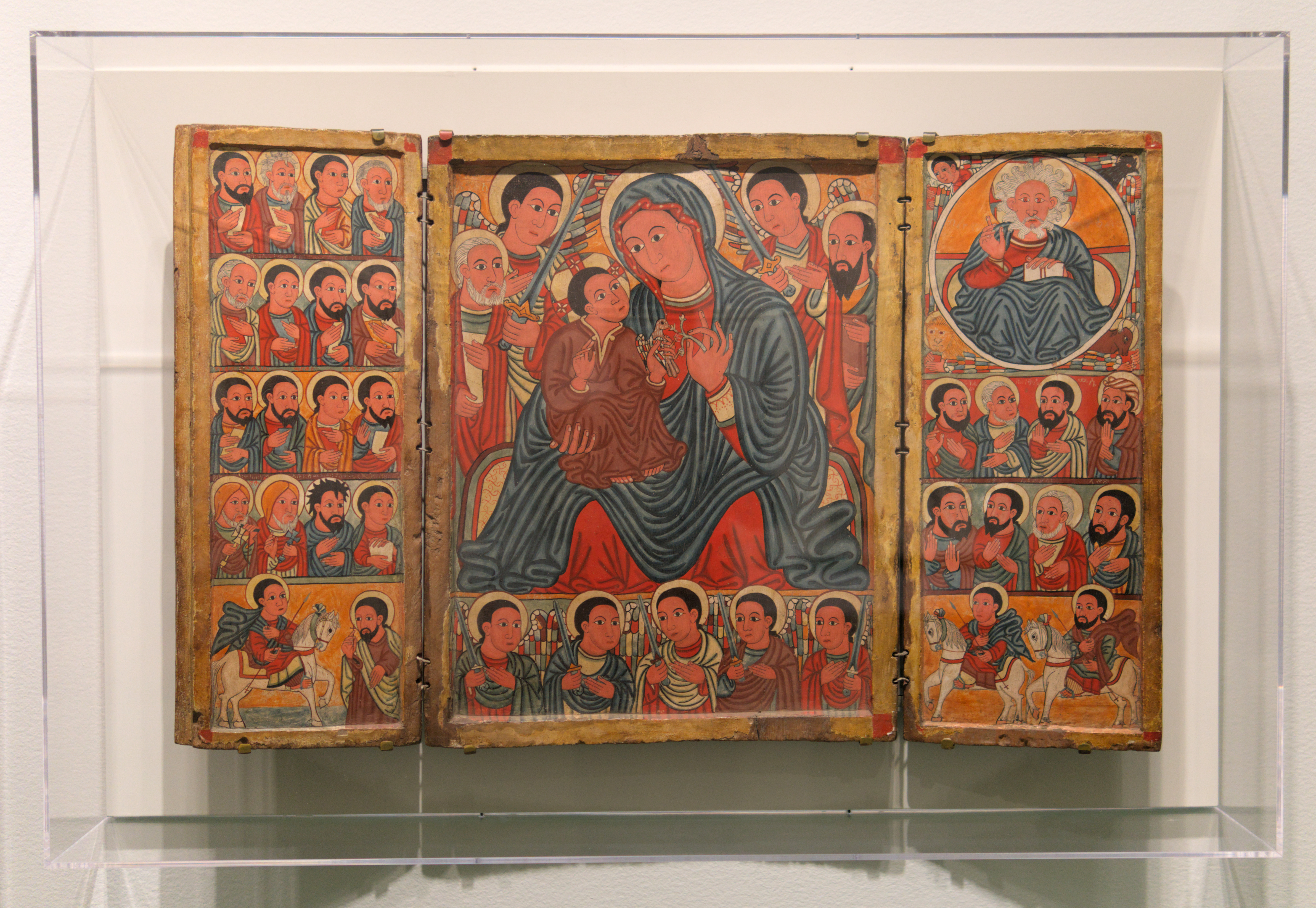
One of history’s most famous Ethiopian painters is Fre Seyon, who worked at the court of Emperor Zara Yaqob (r. 1434–1468) and was of the first generation of Ethiopian artists who painted icons on wood panels. He was also a monk. He likely introduced one of the characteristic features of Ethiopian icons of the Virgin and Child: the archangels Michael and Gabriel flanking them with drawn swords, acting as a kind of honor guard.

Fre Seyon triptych
Fre Seyon (Ethiopian, active 1445–1480), Triptych Icon with the Virgin Mary and Christ Child Flanked by Archangels and Saints (center), Twelve Apostles and Saints (left), and Prophets and Saints (right), mid- to late 15th century. Tempera on gesso-primed wood. Institute of Ethiopian Studies, Addis Ababa University, acc. no. IESMus4186.

My two favorite details of this triptych by Fre Seyon are (on the right wing) the image of the Ancient of Days surrounded by the tetramorph, his wild gray locks being blown about, and in the center, the bird that Christ holds, its feet grasping at a three-branched twig. On a literal level, the bird is a plaything for the boy that charmingly emphasizes his humanity (in the late Middle Ages, at least in Europe—I’m not sure about in Ethiopia—it was common for young children to keep tame birds as pets). On another level, the bird may be symbolic. In traditional Western art, Jesus sometimes holds a goldfinch, a bird with distinctive red markings that’s fond of eating thistle seeds and gathering thistle down and thus came to be read as a prefiguration of Christ’s thorny, blood-spilt passion. I’m not sure whether Fre Seyon intended a symbolic significance for this bird.

The Ancient of Days, enthroned in the tetramorph

Here’s another triptych from the exhibition, this one from a century and a half later:

Virgin and Child triptych
Triptych Icon with the Virgin Mary and Christ Child Flanked by Archangels, Scenes from the Life of Christ, Saint George, and Saints Honorius, Täklä Haymanot, and Ewostatewos, Ethiopia (Tigray), early 17th century. Glue tempera on panel, 16 3/4 × 22 5/16 in. (42.5 × 56.7 cm). Walters Art Museum, Baltimore. [object record]

The composition of the Virgin and Child is based on prints of a painted icon from Santa Maria Maggiore in Rome brought to Ethiopia by Portuguese Jesuit missionaries—but it innovates. As the wall text notes, “Mary’s cloak stretch[es] out in either direction to embrace the scene of Christ Teaching the Apostles below. Umbrella-like, Mary appears as both the protector and personification of the church.”

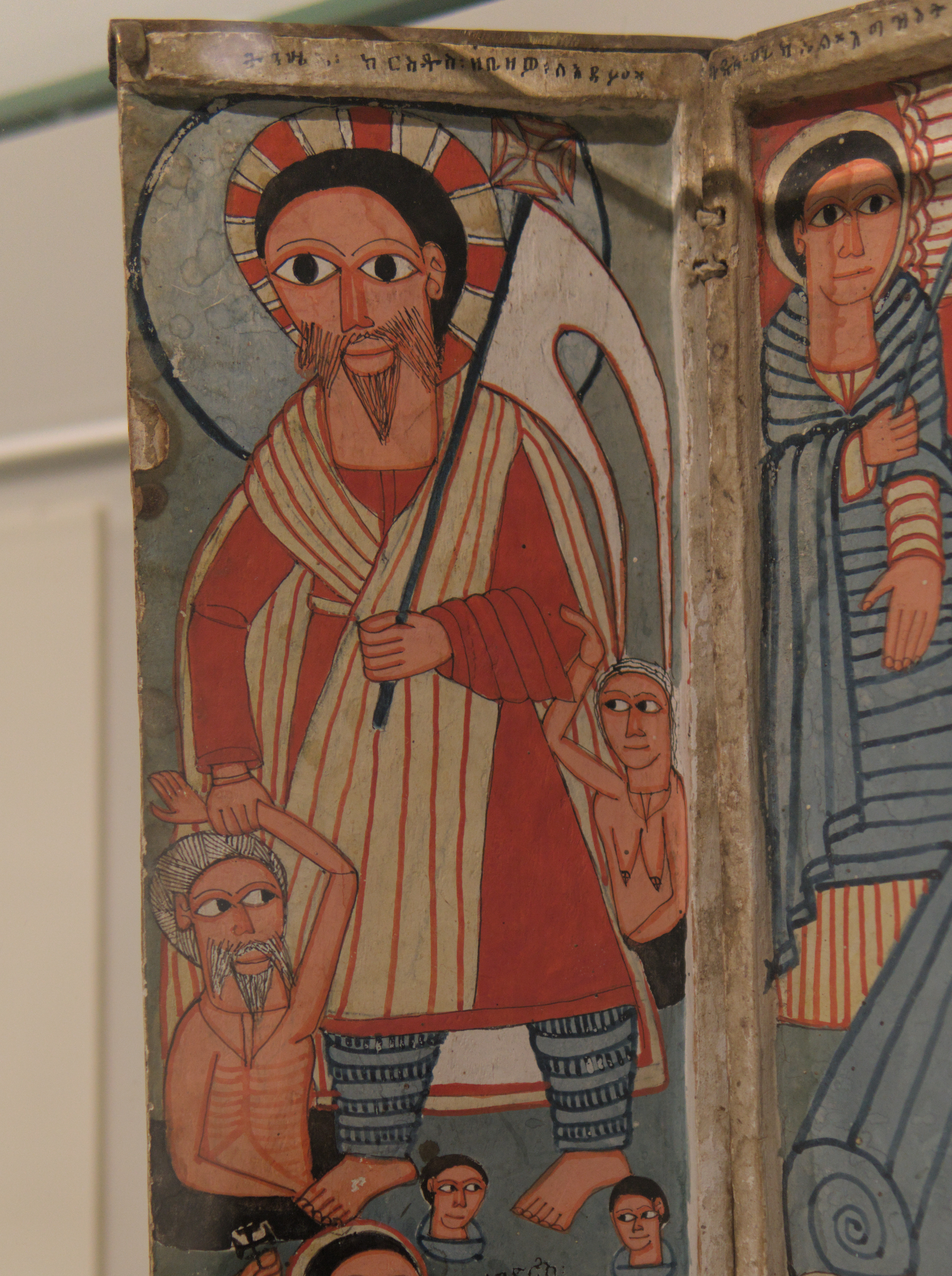
Harrowing of Hell

On the right wing, angels hold up chalices to collect the blood that flows from Jesus’s wounds on the cross, while below that, Joseph of Arimathea and Nicodemus carry Jesus’s wrapped corpse to the tomb. On the left wing is one of my favorite traditional religious scenes: the Harrowing of Hell, or Christ’s Descent into Limbo, in which, on Holy Saturday, Jesus enters the realm of his dead to take back those whom Death has held captive, first of which are our foreparents Adam and Eve. Below that scene is an image of the dragon-slaying Saint George, a late third-century figure from the Levant or Cappadocia who is the patron saint of Ethiopia.

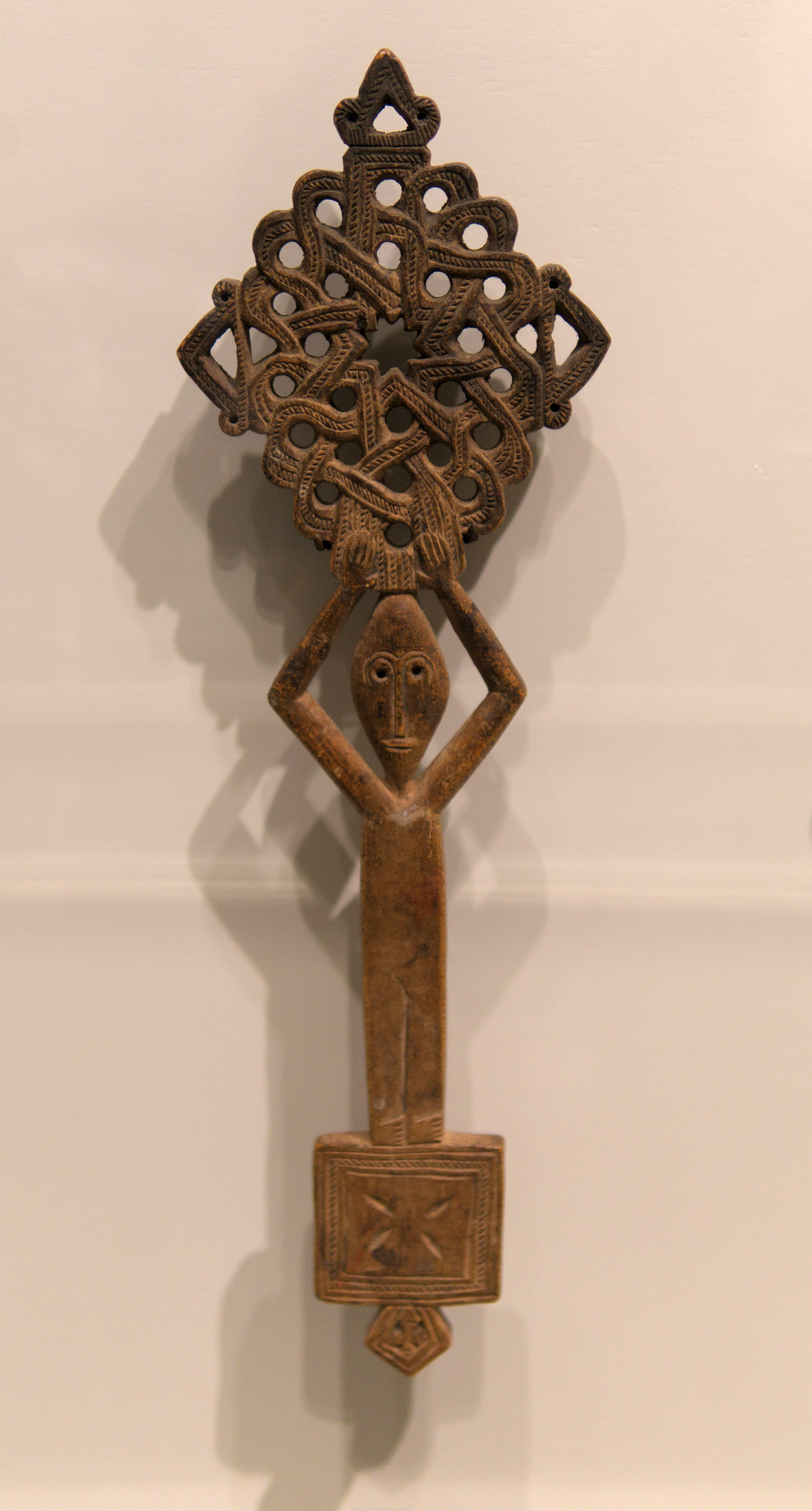
At the bottom center is a scene of Christ teaching the twelve apostles, plus two Ethiopian saints. They all hold hand crosses, like those carried by Ethiopian priests and monks.

Hand Cross with Figure
Hand Cross with Figure, Ethiopia, probably 18th–19th century. Wood, 13 3/8 × 4 3/16 × 9/16 in. (34 x 10.7 × 1.4 cm). Walters Art Museum, Baltimore. [object record]

Coptic-Arabic Book of Prayer
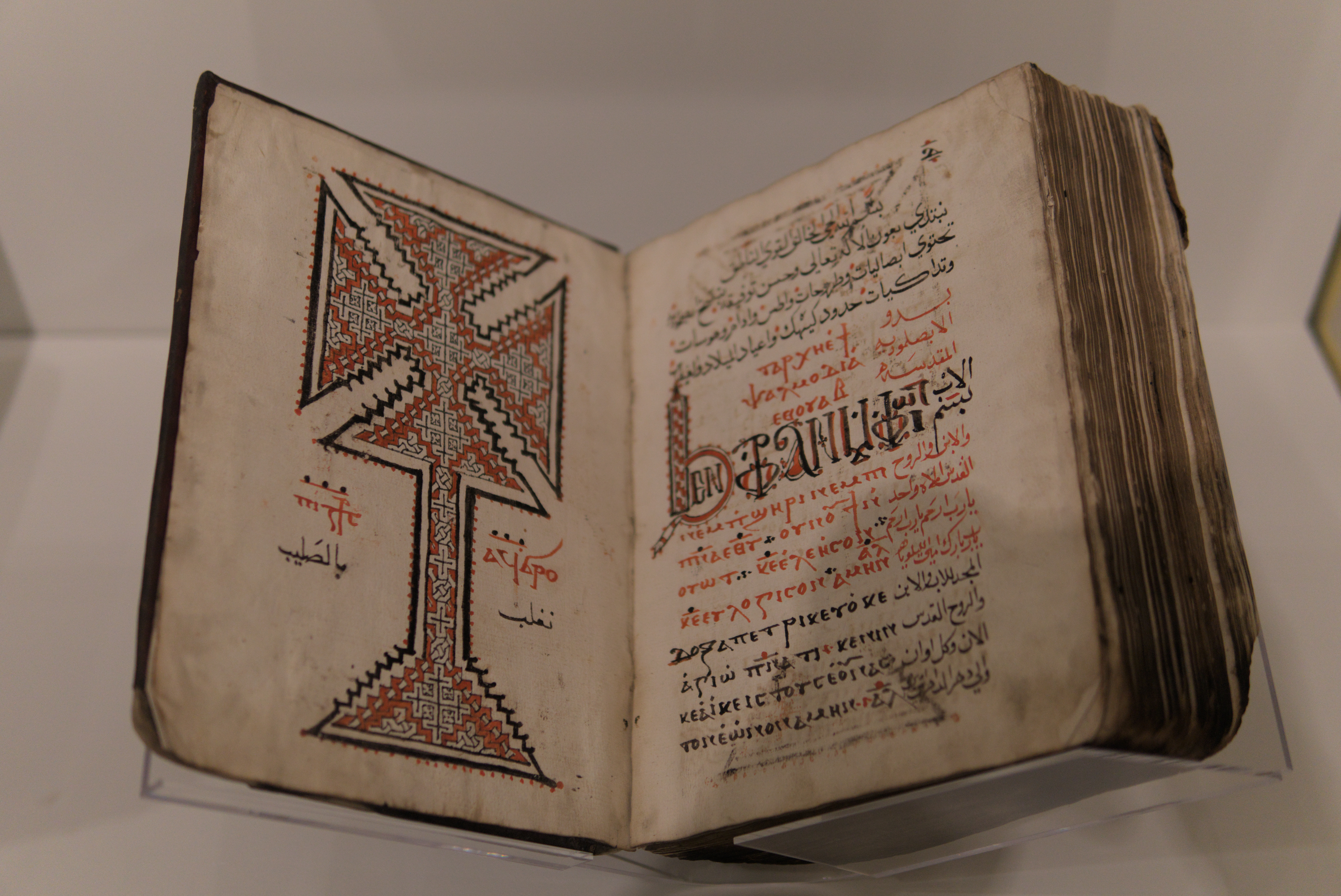
Coptic-Arabic Book of Prayer, Egypt, 18th century. Tempera and ink on parchment, 11 3/4 × 9 in. (29.8 × 22.8 cm). Melikian Collection. [object record]

One of the hallmarks of the exhibition is its multisensory nature: attendees are immersed not only in the sights of Ethiopia but also in the sounds and smells. Scratch-and-sniff cards invite people to take a whiff of frankincense, which would have filled the censer on display. Or to smell berbere, a hot spice blend that would have been stored in the woven baskets nearby.

Frankincense

This olfactory element was produced by the Institute for Digital Archaeology, which, as part of its efforts to record and preserve ephemeral culture, has launched an ambitious program to preserve the heritage of smells. “The aim is to provide the technical means for documenting the aromas of today for the benefit of future generations – and to find new methods and opportunities for experiencing the odors of the past.”

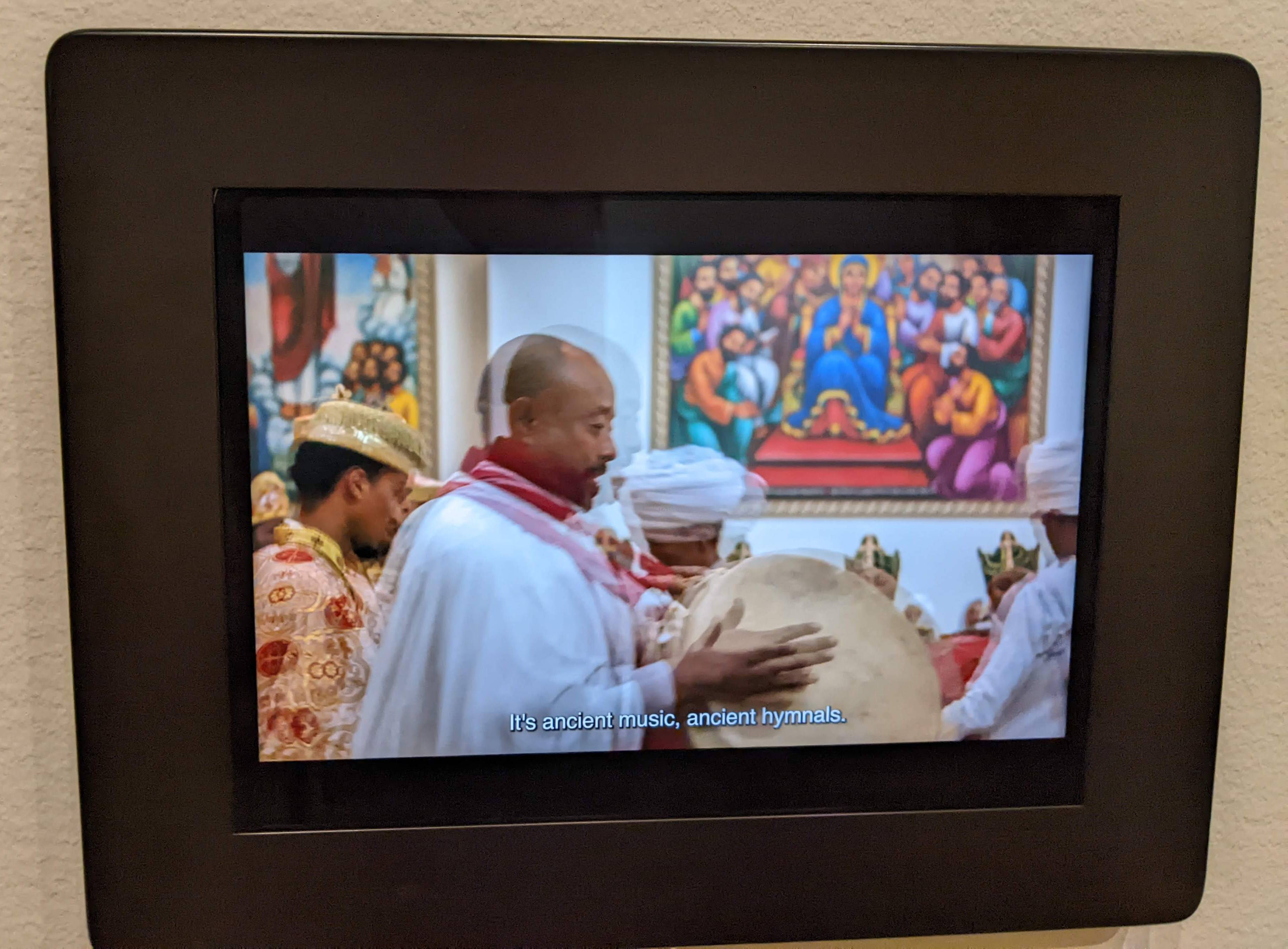
Also in the exhibition there are screens where you can watch videos of Ethiopian Orthodox worship, including music and liturgies, where you will see some of the objects in use. You can also listen to interviews with members of the local Ethiopian diaspora community. (The Washington metropolitan area has the largest Ethiopian population outside Ethiopia.)

Further contextualizing the objects and enhancing the sense of place, pasted onto the wall is a blow-up photograph of a Christian holy-day celebration wending through the streets. This serves as a backdrop to two physical artifacts present in the room: a qämis (dress) and a debab (umbrella).

Dress and umbrella
Left: Dress (qämis), Ethiopia, 20th century(?), cotton, Peabody Essex Museum, E72559. Right: Umbrella (debab), Ethiopia, 20th century, silk and velvet, Peabody Essex Museum, E68713.

The inscriptions on many of the Ethiopian icons and manuscript illuminations, which identify the figures and scenes, are in Ge‘ez (aka classical Ethiopic), an ancient South Semitic language that originated over two thousand years ago in what is now northern Ethiopia and Eritrea. It’s no longer spoken in daily life, but it is still used as the language of the Ethiopian Orthodox Church and taught to boys in Sunday school. I really wish I could read it, as it would be a great help in interpreting the Ethiopian images I come across in my studies!

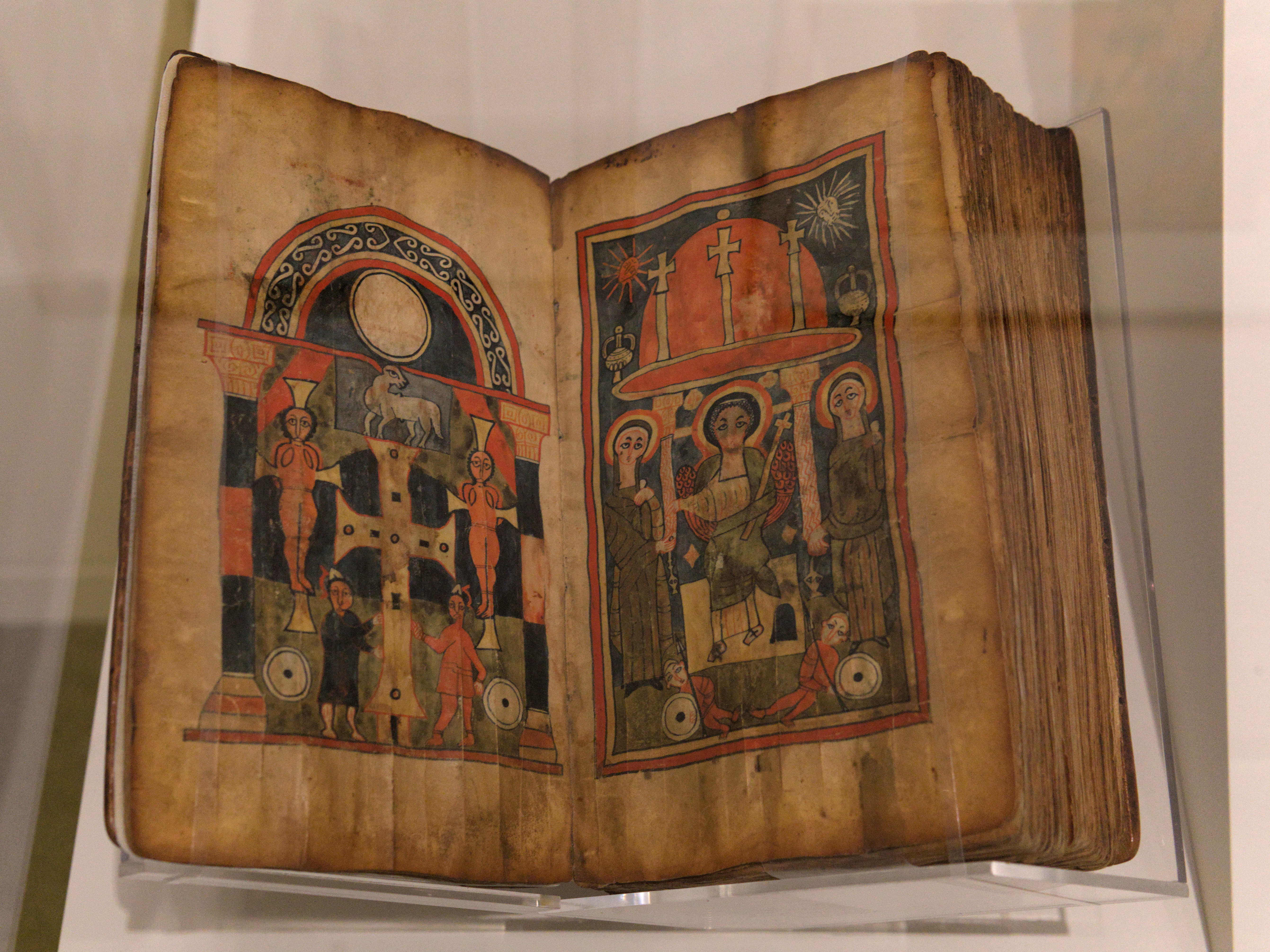
Contrary to what some may assume, Ethiopians in the medieval era were not an isolated people. They traveled—to Rome, to Jerusalem, and so forth. Evidence of Holy Land pilgrimage is suggested by an early fourteenth-century Gospel book that includes the domed Church of the Holy Sepulcher as the backdrop for Christ’s resurrection:

Crucifixion and Resurrection
Gospel Book with the Crucifixion and Christ’s Resurrection, Ethiopia (Tigray), early 14th century. Ink and paint on parchment, 10 1/2 × 6 11/16 in. (26.7 × 17 cm). Walters Art Museum, Baltimore, W.8.36, fols. 6v–7r. [object record]

This is an extraordinary book, one of the oldest surviving Ethiopian manuscripts and the oldest in North America. Ethiopian artists weren’t yet depicting Jesus on the cross, so to represent the Crucifixion, this artist has painted a living lamb surmounting a bejeweled cross, with the two thieves crucified on either side.

Also from the fourteenth century, a manuscript opened to a page spread of Christ’s Entry into Jerusalem:

Triumphal Entry
Christ’s Entry into Jerusalem, folios added from an earlier Gospel book to a Ta’ammera Maryam manuscript, Ethiopia, 14th century. Tempera and ink on parchment. Private collection.

I like how the scene extends across both pages, creating a sense of forward progression, and the two onlookers above the city gate.

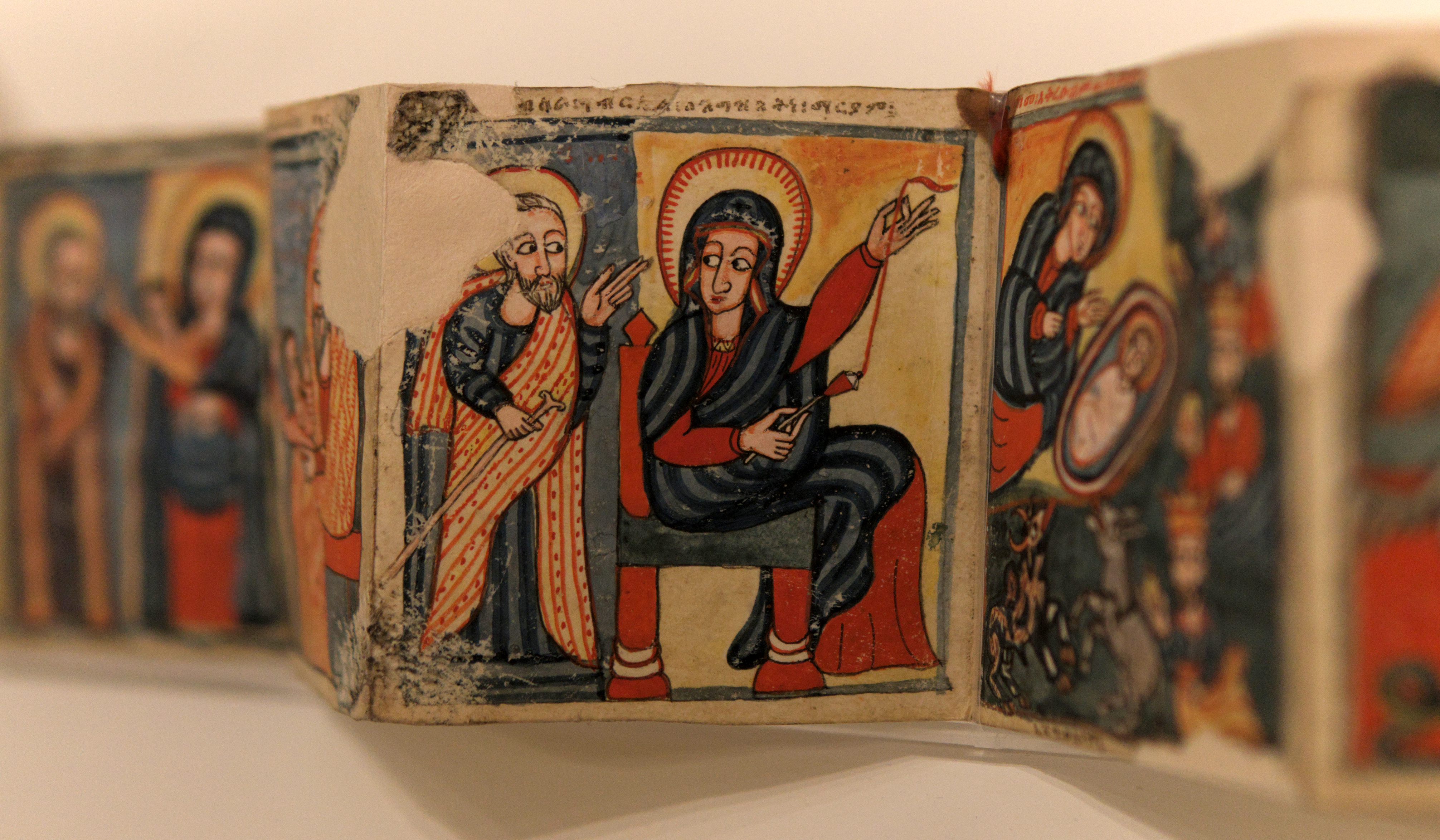
One of my favorite objects from the exhibition is a sensul from Gondar depicting ten scenes from the life of Mary. A sensul is an Ethiopian chain manuscript, in this case pocket-size, created out of a single folded strip of parchment attached to heavy hide boards at each end, which creates a small book when folded shut. Here’s a detail showing the Annunciation:

Annunciation (from a sensul)
Annunciation, from a Gondarine sensul (chained manuscript), Ethiopia (Gondar), late 17th century. Ink and paint on parchment, each panel 3 5/8 × 3 1/8 in. (9.2 × 9 cm). Walters Art Museum, Baltimore. [object record] [GIF]

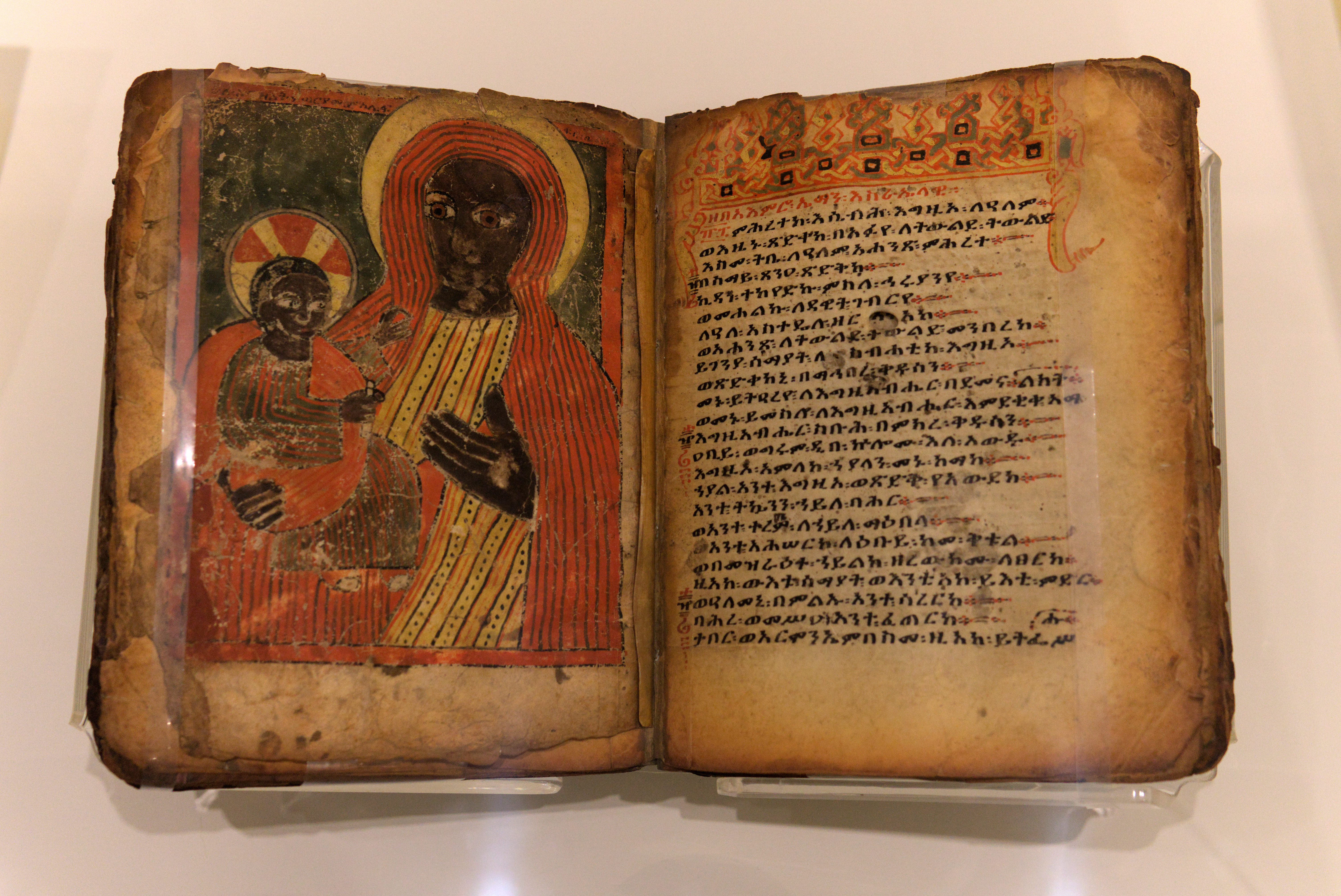
It’s a common misconception that Ethiopians have always depicted biblical figures as dark-skinned to reflect the local population. Such treatment didn’t become normative until the eighteenth century, although some earlier artists did choose black complexions for holy persons:

Virgin and Child
Virgin and Child, from a Psalter with the Wəddase Maryam (Praise of Mary) and Mähalǝyä Näbiyyat (Canticles of the Prophets), Ethiopia, 15th century. Ink and pigments on parchment with wooden boards, open: 8 7/8 × 6 11/16 × 3 15/16 in. (22.5 × 17 × 10 cm). Toledo Museum of Art, Ohio. [object record]

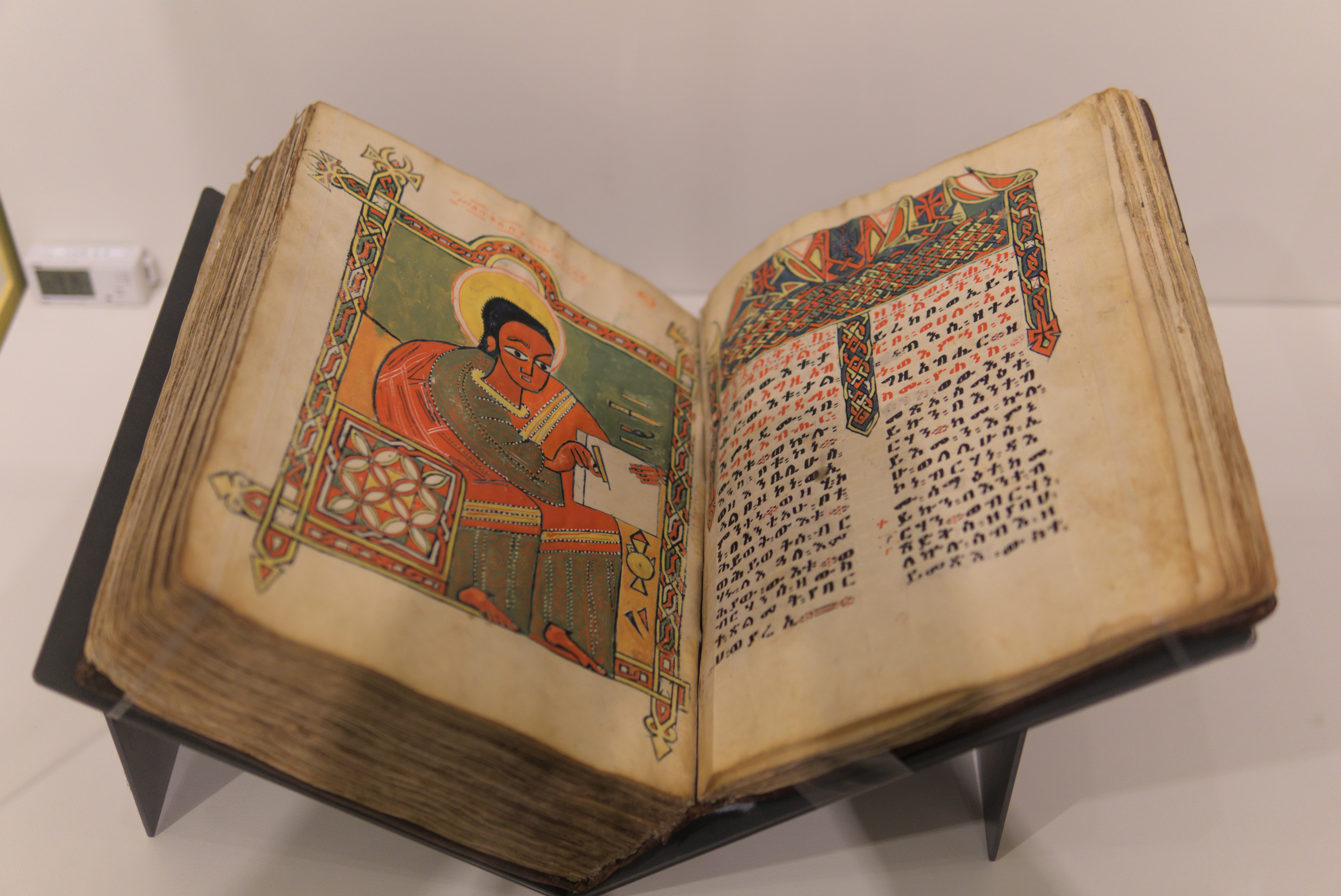
Portrait of John the Evangelist
The Opening of the Gospel of John, from a Gospel book, Ethiopia, ca. 1504–5. Tempera on parchment, 13 9/16 × 10 7/16 in. (34.5 × 26.5 cm). J. Paul Getty Museum, Los Angeles, Ms. 102, fols. 215v–216r. [object record]

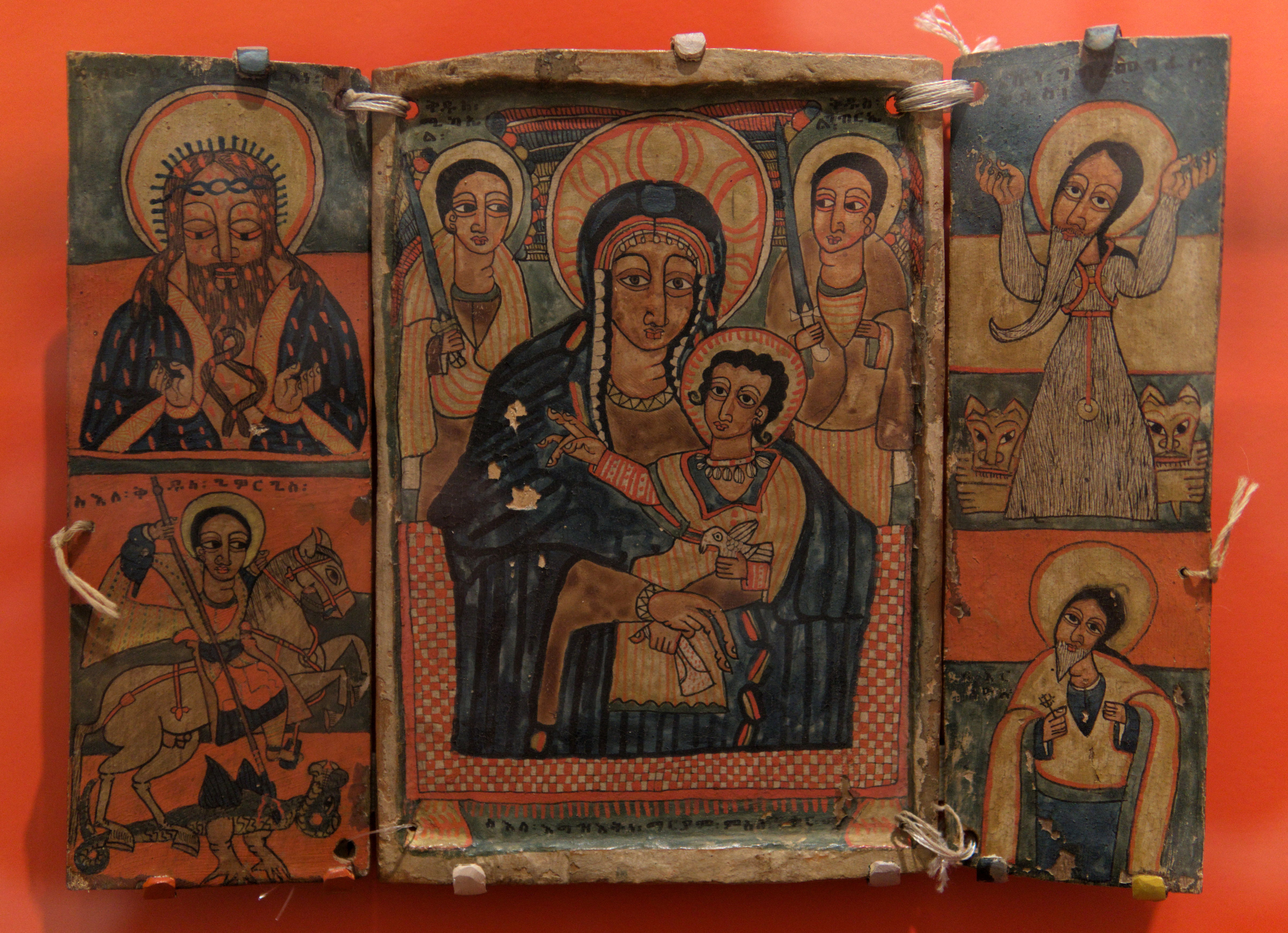
Virgin and Child triptych
Triptych Icon with the Virgin Mary and Christ Child Flanked by Archangels (center), the Kwer‘atä re’esu (Man of Sorrows) and Saint George (left), and Saint Gäbrä Mänfäs Qeddus and Abba Arsanyos (right), Ethiopia (Gondar), late 17th–early 18th century. Tempera on gesso-primed wood. Institute of Ethiopian Studies, Addis Ababa University, acc. no. IESMus3492.

In the triptych shown above, not only is the infant Jesus depicted as Black, but he also wears a necklace made of cowrie shells, which are traditionally given to Ethiopian children for protection!

My favorite artwork from the exhibition is probably this triptych:

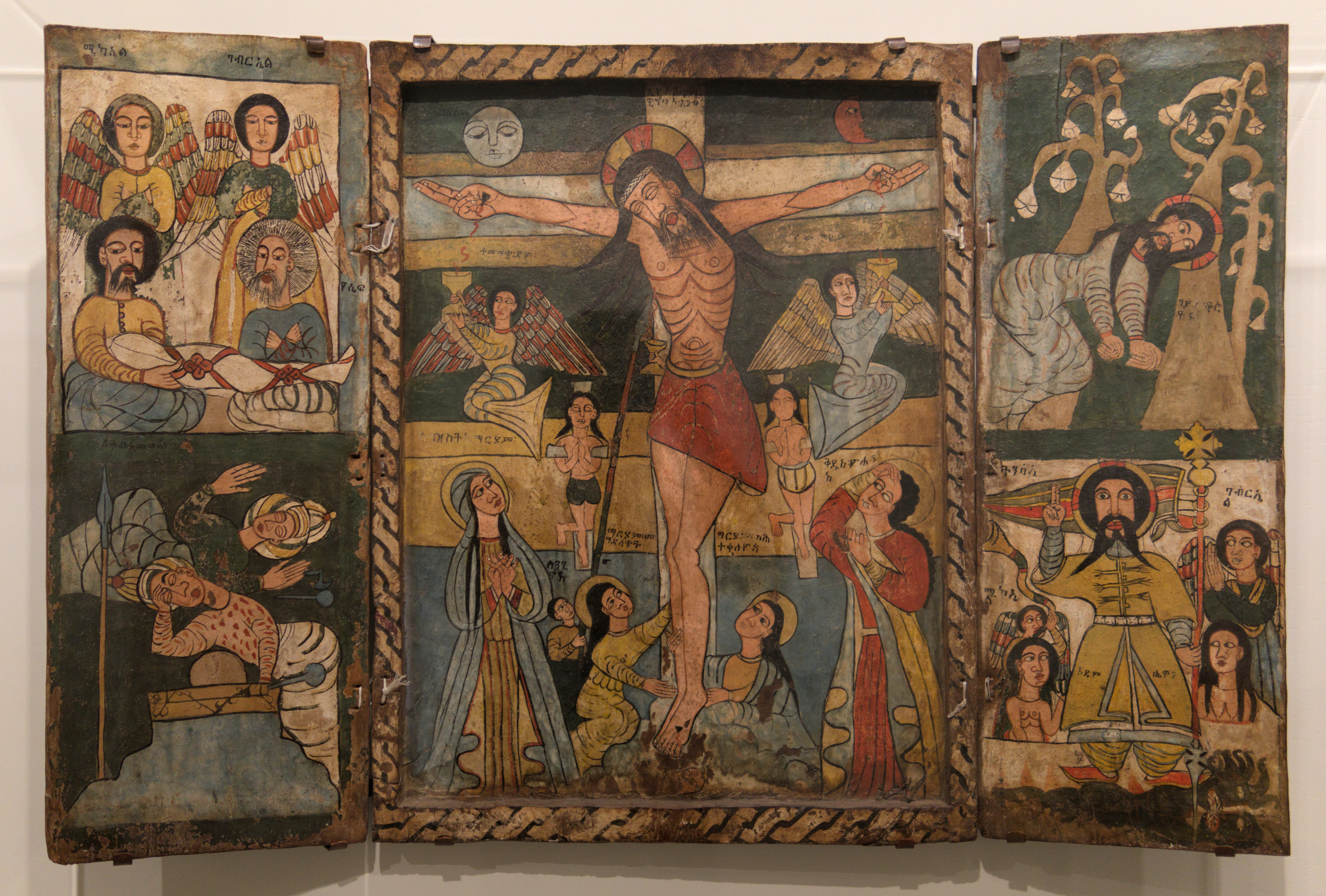
Crucifixion triptych
Triptych Icon with the Crucifixion (center), Entombment and Guards at the Tomb (left), and Temptation in the Wilderness and the Resurrection of Christ (right), Ethiopia, late 16th century. Tempera on gesso-primed wood. Institute of Ethiopian Studies, Addis Ababa University, acc. no. IESMus4126.

Its central panel depicts the Crucifixion, Christ’s head bowed in death and his fingers gesturing blessing, even as his palms are nailed. At the top, the sun and the moon mourn his passing. As we saw before, angels catch the blood that drips from his body (notice the cute little hand sticking out from behind his torso!). At the base, the two larger-scale figures are the Virgin Mary and St. John, while next to Mary on a smaller scale is Longinus, the centurion who pierces Christ’s side with a spear.

The left wing shows the Entombment of Christ, with two guards, wearing pointed turbans, sleeping at their post. The right wing shows a scene that the label identifies as “Temptation in the Wilderness” (presumably a translation of the inscription on the tree) but that looks to me more like an Agony in the Garden. Below that is the Resurrection, with Christ holding a victory banner, standing atop Hades. An angel blows a shofar and the dead rise up out of their graves, following Christ, the firstfruits of the resurrection (1 Cor. 15:20–22). Christ wears a short-sleeved, knee-length jacket with frog closures, and bunched sleeves and trousers, both of which reflect clothing from regions east of Africa.

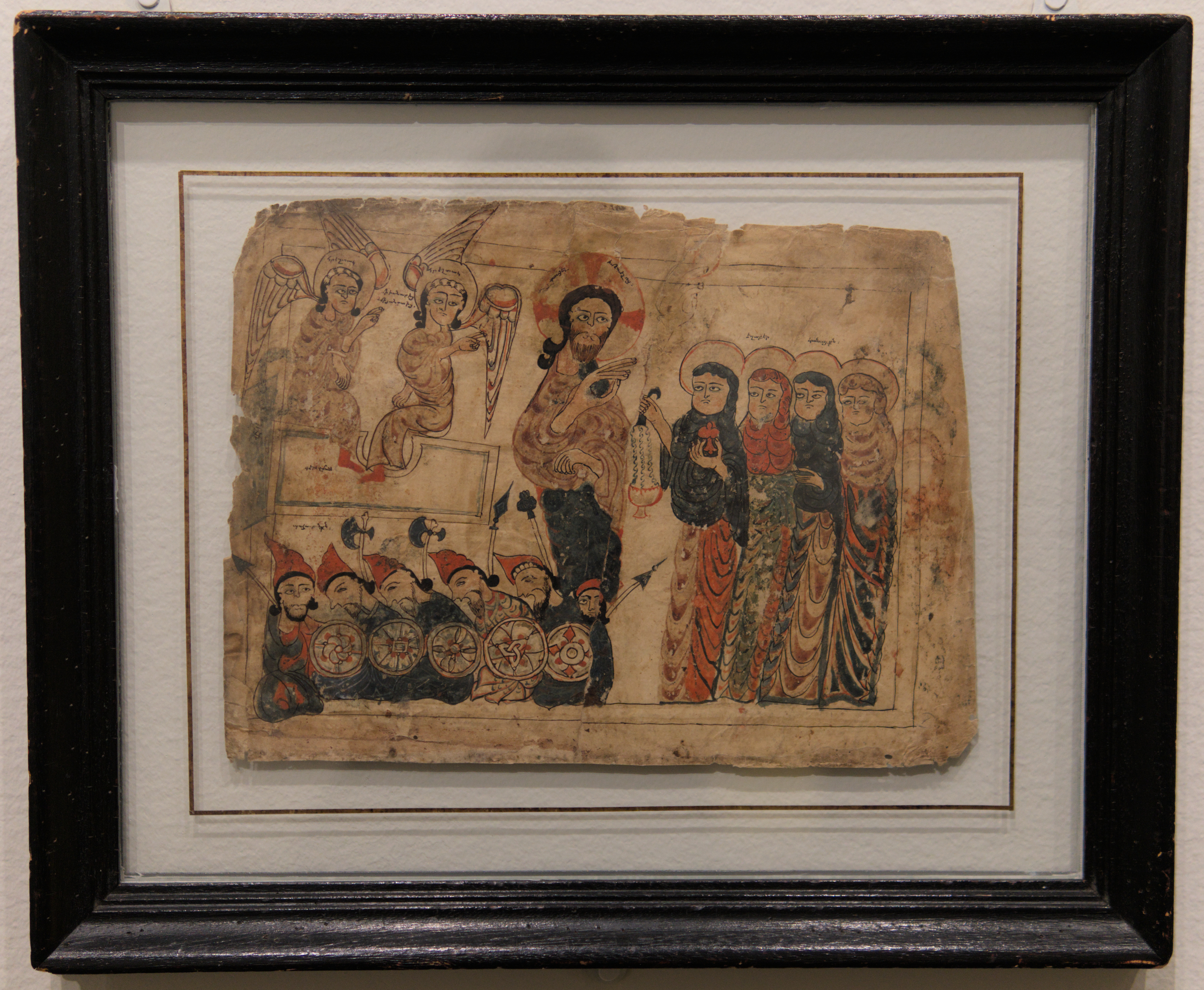
The wall text notes the fine, wavy lines used to render the figures’ draperies, perhaps influenced by Armenian artists from the Lake Van region.

Armenian Resurrection
Yovsian of Vaspurakan (Armenian), Leaf from a Gospel book with the Resurrection of Christ and Visit of the Women to the Tomb of Christ, ca. 1350. Tempera on cotton paper. Private collection.

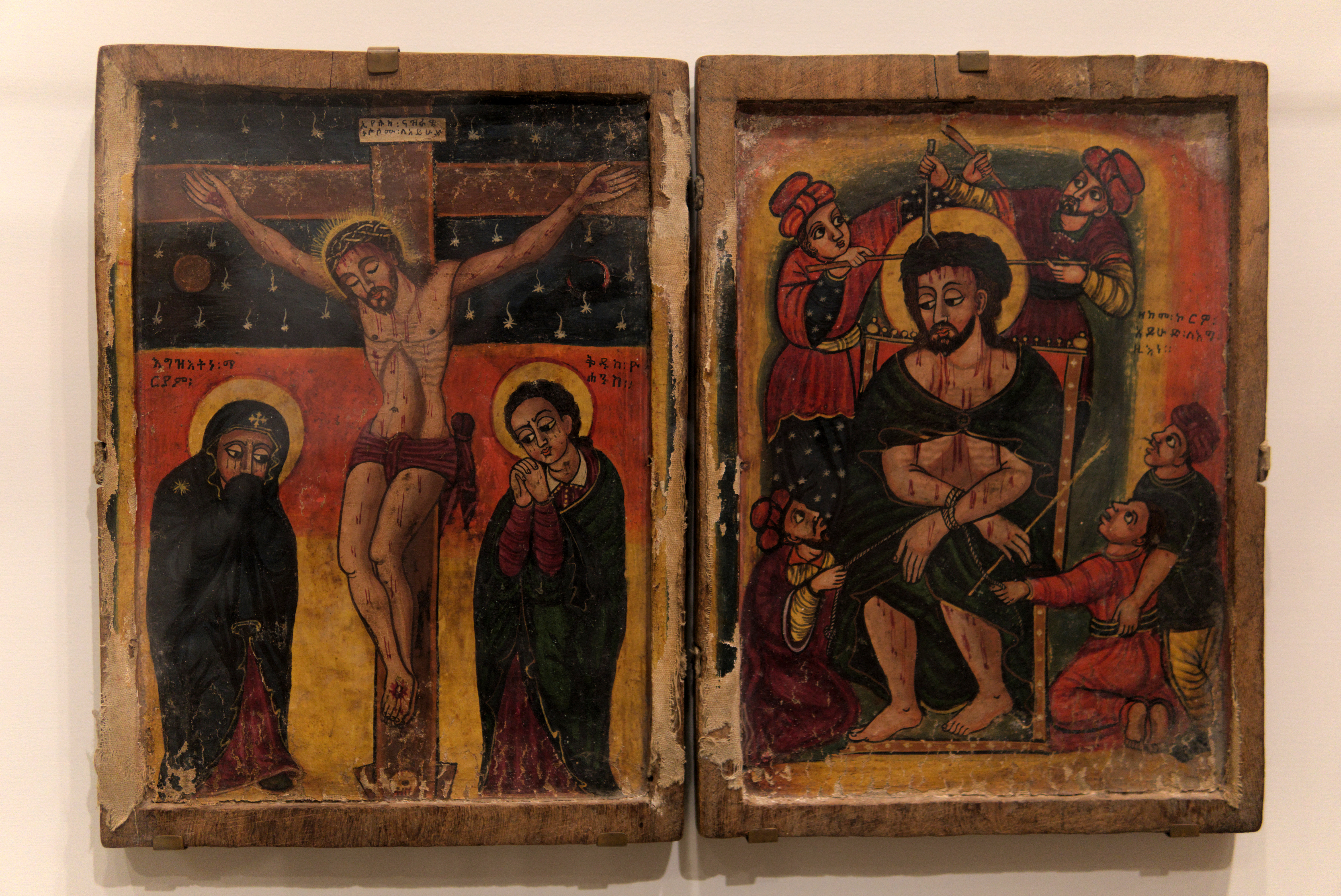
Here’s another Crucifixion, this one painted in what’s called the Second Gondarine style, characterized by smoothly modeled figures, often with darker skin tones, and wide horizontal bands of red, yellow, and green filling the background:

Crucifixion-Mocking diptych
Diptych Icon with the Crucifixion (left) and the Mocking of Christ (right), Ethiopia, late 17th–early 18th century. Wood, polychrome, 13 1/2 × 9 7/8 in. (34.3 × 25.1 cm). Virginia Museum of Fine Arts, Richmond. [object record]

The squiggles behind Christ at the top left may simply be a decorative motif, but to me they look like falling stars, an apocalyptic sign, and as if the sky is weeping.

The right panel of the diptych shows Christ being cruelly fitted with a crown of thorns.

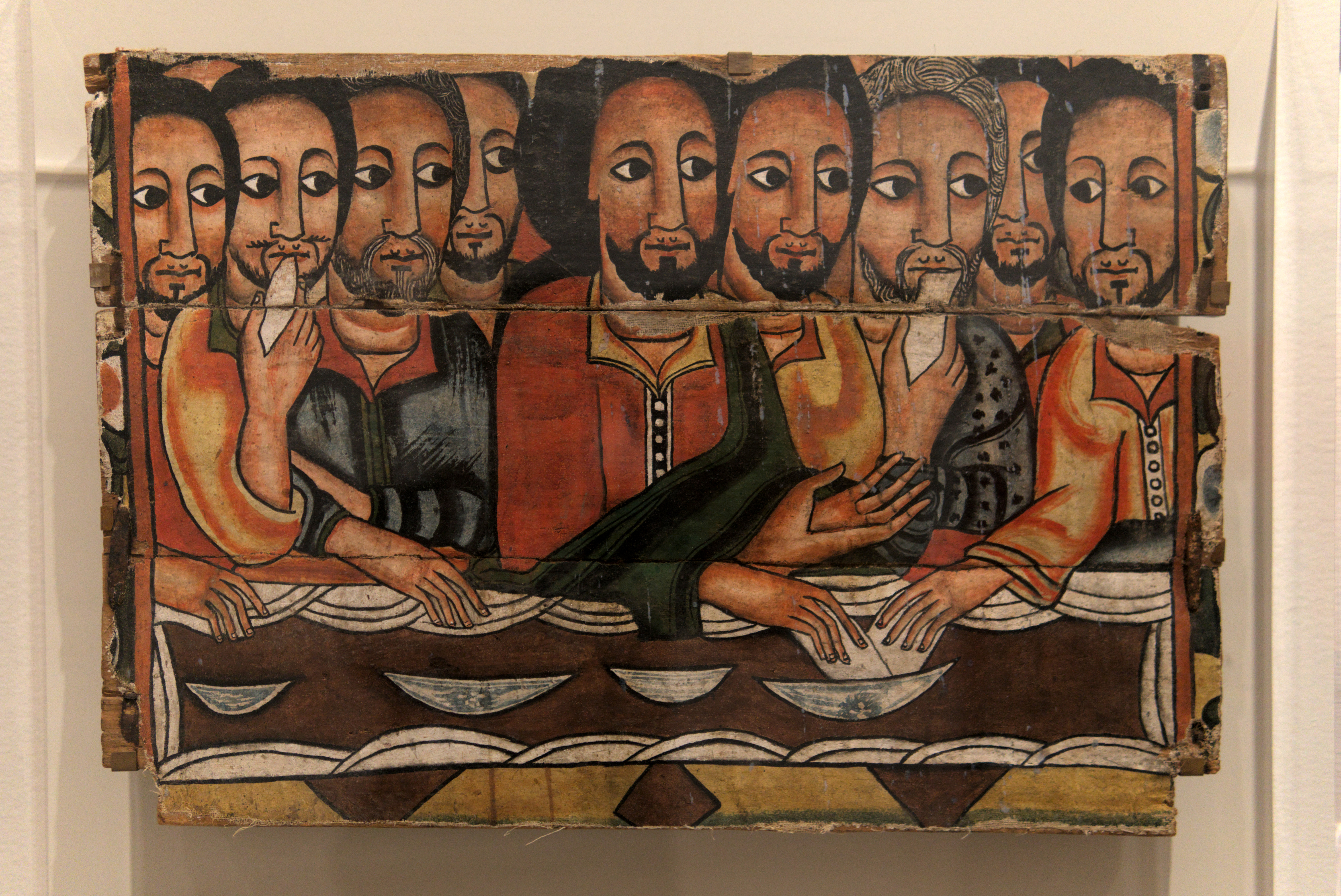
Two other passion images I want to share are a Last Supper wall painting and an Entombment from a disbound album.

Last Supper
Last Supper, Ethiopia, 18th century. Tempera on linen, mounted on panel, 16 3/4 × 24 in. (42.6 × 61 cm). Virginia Museum of Fine Arts, Richmond. [object record]

Entombment
Album Leaf with the Entombment of Christ, Ethiopia (Sawa?), late 17th century. Pigments on vellum. Minneapolis Institute of Art, 2009.39.3y. [object record]

In the Last Supper, Jesus and Judas both dip their bread (injera!) into the same bowl and exchange a knowing glance.

In the Entombment, Jesus, wrapped in white linen, is lowered into the ground, mourned by several of his women followers. The portrayal of his mother Mary’s weeping, her hands covering her eyes and her face stained with tears, is particularly poignant. This leaf is from a set of forty-four, now matted separately but originally arranged in series and likely painted on several long sheets of parchment that were sewn together and folded accordion-style to form a sensul.

One of the most extraordinary objects on display is a rare folding processional icon that adopts the form of a fan, from the late fifteenth century:

Processional icon (Ethiopia)
Folding Processional Icon in the Shape of a Fan, Ethiopia, late 15th century (Stephanite). Ink and paint on parchment, thread, extended: 24 1/4 × 154 1/8 × 4 3/4 in. (61.6 × 391.4 × 12 cm). Walters Art Museum, Baltimore. Photo courtesy of the museum. [object record]

Thirty-eight identically sized figures span the surface of this elongated parchment: the early Christian martyrs Julitta (Juliet) and Cyricus, St. George, St. John the Baptist, the archangel Michael, the Virgin Mary, the archangel Raphael, St. Paul, the Ethiopian artist-priest Afnin, and unidentified Old Testament patriarchs and prophets. There would have been a wooden handle attached to either end that, when pulled together, created a double handle for a giant wheel to be displayed during liturgical processions and church services (see here). As the museum website notes, “The Virgin Mary, whose hands are raised in a gesture of prayer, is then at the top of the wheel. By depicting Mary in the company of saints and angels, the icon powerfully evokes the celestial community of the church.”

This is just a sampling of all the wonderful art objects that are a part of the Ethiopia at the Crossroads exhibition. I’ll share more photos on Instagram (@art_and_theology) in the coming weeks.

I strongly encourage you to go see this! I think it would be enjoyable for children as well, especially Christian children, who will be able to identify many of the painted stories. For Christians, it’s an opportunity to connect with our artistic heritage and with African church history. If you can’t catch the exhibition at the Walters in Baltimore before it closes March 3, it will be traveling to the Peabody Essex Museum in Salem, Massachusetts (April 13–July 7, 2024), and the Toledo Museum of Art in Ohio (August 17–November 10, 2024).

Also, a catalog is coming out in April, where you will find photos of all the artworks in addition to illuminating essays.

Advent, Day 10: Lo, He Comes

To him who loves us and freed us from our sins by his blood and made us a kingdom, priests serving his God and Father, to him be glory and dominion forever and ever. Amen.

Look! He is coming with the clouds;
    every eye will see him,
even those who pierced him,
    and all the tribes of the earth will wail on account of him.

So it is to be. Amen.

—Revelation 1:5b–7

LOOK: The Last Judgment by Jan van Eyck  

van Eyck, Jan_Last Judgment
Jan van Eyck (Netherlandish, ca. 1390–1441), The Last Judgment, ca. 1436–38. Oil on canvas, transferred from wood, 22 1/4 × 7 2/3 in. (56.5 × 19.7 cm). Metropolitan Museum of Art, New York.

What is your reaction to this image? Terror? Awe? Gratitude? Disgust? Intrigue? Indifference?

I’m often repulsed by how the Last Judgment was interpreted by medieval and Renaissance artists, with graphic displays of torture intending to compel people to righteous living through fear. To be sure, the subject has made for some truly remarkable paintings, full of fantastical grotesqueries and masterfully executed—like this one—but I worry that the scare tactics such paintings use are not helpful and are even harmful.

Nonetheless, the Last Judgment is an unavoidable topic in scripture. The Bible refers several times to God as judge and describes a final accounting of sin upon Christ’s return, resulting in reward for the righteous and punishment for the unrighteous. It’s also in our creeds: “He [Jesus Christ] will come again to judge the living and the dead” (see 2 Tim. 4:1; 1 Pet. 4:5). Those who seek to be faithful to scripture must reckon with the idea of the Last Judgment. Advent, which is penitential in character, has historically been a period for the church to do that. As the Episcopal priest and author Fleming Rutledge points out in her published collection of Advent sermons, judgment is one of the four traditional themes of the season—the other three being death, heaven, and hell.

The early Northern Renaissance master Jan van Eyck’s Last Judgment from ca. 1436–38 is one of history’s most famous and most gruesome. “The diabolical inventions of Bosch and Brueghel,” writes art historian Bryson Burroughs, “are children’s boggy lands compared to the horrors of the hell [van Eyck] has imagined.”

The midground portrays the resurrection of the dead, who rise up out of their graves on land or at sea to be judged by Christ. One of the inscriptions on the frame is Revelation 20:13: “And the sea gave up the dead which were in it; and death and hell delivered up the dead which were in them: and they were judged every man according to their works.”

In the center Saint Michael the Archangel, dressed in his jewel-studded armor and with sword unsheathed, stands atop the giant batlike wings of Death personified, which are inscribed with the words CHAOS MAGNVM (“great chaos”) and UMBRA MORTIS (“shadow of death”). Death is a skeletal figure who excretes the damned through his bowels into hell’s dark slime, where bestial demons tear at, choke, devour, crush, and impale them. One man’s legs are being ripped apart at the anus.

Even kings and clergymen are part of the tragic death-heap—see the bishop’s miter, the cardinal’s galero, the royal crown. Not all who say, “Lord, Lord,” will enter heaven (Matt. 7:21); even the most outwardly pious will have their sins exposed on the last day, and those who prove to be hypocrites, who have harmed others and shamed God without repentance, will be thrown into the pit.

Shooting down like arrows into this pit is the double inscription ITE VOS MALEDICTI IN IGNEM ETERNAM (“Go, ye cursed, into everlasting fire”), taken from Matthew 25:41. And Deuteronomy 32:23–24, a warning from God via Moses to the people of God in their disobedience, is one of the inscriptions on the frame:

I will heap mischiefs upon them; I will spend mine arrows upon them. They shall be burnt with hunger, and devoured with burning heat, and with bitter destruction: I will also send the teeth of beasts upon them, with the poison of serpents of the dust.

Perhaps your chest is tightening right now, your stomach churning. How does this picture cohere with the God of love and mercy?

Look up.

See Jesus Christ, the Son of Man, coming in glory. See his glowing stigmata, beacons of love and mercy. He is dressed in a long, red, open mantle and is barefoot, revealing all five wounds. All around him, angels bear the instruments of his passion: the cross, the three nails, the crown of thorns, the lance, the sponge-tipped reed. See him flanked by all the ranks of the redeemed, including, on a larger scale, the Virgin Mary and John the Baptist, the first two witnesses of Jesus’s divinity.

VENITE BENEDICTI PATRIS MEI, read the inscriptions fanning out from Christ’s elbows: “Come, ye blessed of my Father” (Matt. 25:34). This good word is taken from Jesus’s parable of the sheep and the goats, in which he teaches that those who feed the hungry, clothe the naked, shelter the immigrant, care for the sick, and visit the imprisoned will be honored by God on the last day.

Another benediction is inscribed on the picture’s frame:

And I heard a loud voice from the throne saying,

“See, the home of God is among mortals.
He will dwell with them;
they will be his peoples,
and God himself will be with them and be their God;
he will wipe every tear from their eyes.
Death will be no more;
mourning and crying and pain will be no more,
for the first things have passed away.” (Rev. 21:3–4 NRSV)

Van Eyck’s Last Judgment does not stand alone. For centuries it has been configured as a diptych (two-paneled artwork) with a Crucifixion on the left and is thus intended to be read in light of God’s supreme act of vulnerable love and self-giving:

van Eyck, Jan_Crucifixion and Last Judgment
Jan van Eyck (Netherlandish, ca. 1390–1441), The Crucifixion; The Last Judgment (with recently conserved frame), ca. 1436–38. Oil on canvas, transferred from wood, each panel 22 1/4 × 7 2/3 in. (56.5 × 19.7 cm). Metropolitan Museum of Art, New York.

Originally these two paintings very likely served as the wings of a triptych with a painted or sculpted centerpiece, or as the doors to a tabernacle or reliquary shrine. In 2019 the Metropolitan Museum of Art had the frames restored from their modern brass color to their original red.

So, what are we to make of this image today? Is there value in meditating on it?

I’ve presented it here, so I think it’s definitely worth knowing about. It’s a stunning art object that gives us a glimpse into the religious imagination of late medieval Christians. But I would also advise caution, especially to those who have been traumatized by hell teachings in the past. While Christians are called to cultivate a holy fear of God, a soberness around the weight of our sin and the power of God’s justice, this fear is not supposed to be the kind of fear that induces anxiety or paralyzes. That kind of fear will never lead us to love God.

We are never meant to think on hell apart from the grace Christ extends to us with his pierced and outstretched hands, which plead our case before God. Van Eyck holds both together in this painting, but the more visually immersive bottom half seems to indulge some pretty sick fantasies that could well generate an unhealthy fear of God if one were to stay stuck there, not to mention create the false impression that God is monstrously vindictive.

There is debate within Christianity, and has been since the patristic era, whether Jesus’s justice is merely punitive or ultimately restorative—that is, whether hell is a place of eternal conscious torment or a place where one is purged of evil and that will in the end be emptied. (There is biblical support for both views, which I won’t get into here.) There is also disagreement as to whether the Bible’s language about hell, such as its being a place of “fire” and “brimstone” (sulfur) (e.g., Rev. 21:8), is meant to be taken literally or figuratively.

Whatever the duration, physical nature, and ultimate purpose of hell, I want to emphasize that biblical passages about the Last Judgment ought not drive us to despair; they should drive us into the arms of Christ, who receives into his presence all those who trust in his merits and turn from their wickedness. The wounds that Christ so prominently displays in van Eyck’s painting are tokens of divine forgiveness as well as a model of the kind of selfless love we are to follow, a love vulnerable enough to receive injury but never to inflict it. Those who tumble into the depths of the underworld to be ravaged by externalizations of their own destructive evils have rejected the call to “do justice, love mercy, and walk humbly with [their] God” (Mic. 6:8). Many of them are ones who on earth bore much power but used it to abuse others or were neglectful.

For more on the characterization of Jesus as judge in the art and theology of the Middle Ages (whose influence was felt in the Renaissance and later eras), see chapter 2, “The Judge,” of Jesus through Medieval Eyes by Grace Hamman. “The promise of answering unanswered evil, acknowledging the recognized and unrecognized wrongs of the mortal world—everlasting justice and compassion—is ultimately what Christ the Judge signifies. It’s a promise, a prophecy, and a call for action now,” Hamman writes (28). She discusses how neighborliness and fear of God are twinned: “Am I seeing the immortal being, the image of God, Jesus himself, in every person I encounter?” medieval imagery prompted viewers to ask (37). “Jesus the Judge reminds us of our divine community and invites a fear that guides us to love our neighbor as we love ourselves. . . . Fear of Jesus the Judge becomes a gift for our practice of justice, in the radiant light of his justice. Such a fear softens flinty hearts” (21, 36). In the chapter Hamman does also acknowledge the complications and misuses of fear in the medieval church and its legacy today.

I urge you to consider the van Eyck diptych in light of the retuned hymn below as you meditate on Christ’s return and his role as judge.

LISTEN: “Lo! He Comes with Clouds Descending” | Words by Charles Wesley, 1758 | Music by Thomas Vito Aiuto, 2012 | Performed by the Welcome Wagon on Precious Remedies Against Satan’s Devices, 2012

Lo! he comes with clouds descending,
once for favored sinners slain;
thousand, thousand saints attending
swell the triumph of his train.

Ev’ry eye shall now behold him,
robed in dreadful majesty;
those who set at naught and sold him,
pierced, and nailed him to the tree,
deeply wailing, deeply wailing,
shall the true Messiah see.

Ev’ry island, sea, and mountain,
heav’n and earth, shall flee away;
all who hate him must, confounded,
hear the trump proclaim the day:
Come to judgment, come to judgment!
Come to judgment, come away!
Alleluia, alleluia!
God appears on earth to reign.

The dear tokens of his passion
Still his dazzling body bears,
Cause of endless exultation
To his ransomed worshippers.
With what rapture, with what rapture
Gaze we on those glorious scars!
Alleluia, alleluia!
God appears on earth to reign.

Yea, amen! Let all adore thee,
high on thine eternal throne;
Savior, take the pow’r and glory,
claim the kingdom for thine own.
O come quickly, O come quickly;
everlasting God, come down.
O come quickly, O come quickly;
everlasting God, come down.
O come quickly, O come quickly;
everlasting God, come down.

I’m struck by the bright, celebratory, homey tone of the new tune Rev. Vito Aiuto gave this old Wesley hymn about Christ’s second coming. One might expect, with its verses about judgment, to have a dark or foreboding tone. But for those who are in Christ, his return, and even the day of judgment, will be an occasion of rejoicing!

Note that “dreadful” here is used in the archaic sense of inspiring awe or reverence.


This post is part of a daily Advent series from December 2 to 24, 2023 (with Christmas to follow through January 6, 2024). View all the posts here, and the accompanying Spotify playlist here.

“Her Stations of the Cross” by Marjorie Maddox (poem)

Kazanivska, Solomia_Mother of God
Solomia Kazanivska (Соломія Казанівська) (Ukrainian, 1996–), Mother of God, 2019. Acrylic and soil on wood, 60 × 40 cm.

I.
Here mothers move more than others
into Mary’s mourning, each chorus
a soul full of crosses, weighted
with her child dying
continuously in the contemplation 
of our contrition.

II. 
That once-upon-a-time angel’s voice
stretching anew her middle-aged womb,
she who once sang Magnify, O Magnify,
when all she screams for now
is mercy in her urgent rebirth
of sorrow.

III.
When he stumbles,
she cannot fix his fall,
cannot cradle the boyhood
scrapes and bruises bleeding
into crowd-sanctioned murder.
No cock crows; she hears his groans
as if the world’s bones
are splintering within her.

IV.
Besides the tree, he carries
the tears of the one who carried him
beneath her Eve ribs, lifted him
into a world he breathed as good,
gone now into this God-crucified-
as-her-son catastrophe
for salvation’s sake.

V. 
Simon of Cyrene stands close.
Understanding too well the two sorrows—
mother and son helpless to comfort the other—
he heaves up and shoulders
the burdens of both,
his back the black tablet
of Moses’ commandments fulfilled
to the jot and tittle.

VI. 
Veronica—eyes swollen
for the Madonna and Child
wrenched from their rightful honor—
lifts her veil to cool the Savior’s pain,
alleviate, however slightly, a mother’s anguish.

VII.
Thorns gouge the brow she stroked. 
The sweat-caked man that came out of her 
stumbles again. Already,
the sharp nails gnaw her own palms.

VIII.
Oh, daughters of Jerusalem,
your tears sweep the streets,
wet the weary soles of Mary.
Weep for your own children
forever dashing away from Yahweh.

IX.
Wretched stones that tip her sinless child,
dirt that drives down the innocent son.
His own earth hurts him more each tumble.
Three times he trips,
crashes to the dust we are,
mortal muscles turning their backs
on Man and his Mother.

X. 
Threads twisted by her own fingers,
tugged carefully through cloth:
this is the tunic they rip from him,
fabric tattooed with red;
she remembers his baby body
blood-splattered and matted.

XI. 
Her soul stabbed by the tree
that slays her son. Her heart nailed.
She swears his life spurts
from her barely breathing body.

XII.
Death is indigo and indelible, 
the Roman sky collapsed and re-scribbled
on the shreds of her memories.
She cannot bear to look upon his face
when breath forgets its maker.

XIII.
Ten thousand stillborns better
than this: his torso in her arms, 
icon of the inconsolable,
the flesh Pietà with its nails of pain, 
pounding, pounding. 

XIV.
The hewn tomb seals her grief.
She remembers his first words,
his final prayer. All else rots
within her. They swaddle him,
implant him quickly behind stone.

This poem is from Weeknights at the Cathedral (Cincinnati: WordTech Communications, 2006) and is anthologized in slightly revised form, as here, in Poems of Devotion: An Anthology of Recent Poets, ed. Luke Hankins (Eugene, OR: Wipf & Stock, 2012). Used by permission of the author.

Note: The Stations of the Cross are a form of Catholic devotion organized around the events of Christ’s passion, from his condemnation by Pilate to his crucifixion and burial.

Marjorie Maddox (born 1959) is the author of fourteen poetry collections, including Begin with a Question (Paraclete, 2022); Transplant, Transport, Transubstantiation from the Poiema Poetry Series (Wipf & Stock, 2018); and True, False, None of the Above (Wipf & Stock, 2016). She has also published a short story collection, four children’s and YA books, and 650-plus stories, essays, and poems in journals and anthologies. Living in Central Pennsylvania, she is a professor of English and creative writing at Lock Haven University and is the assistant editor of Presence: A Journal of Catholic Poetry.

Good Friday: Indodana

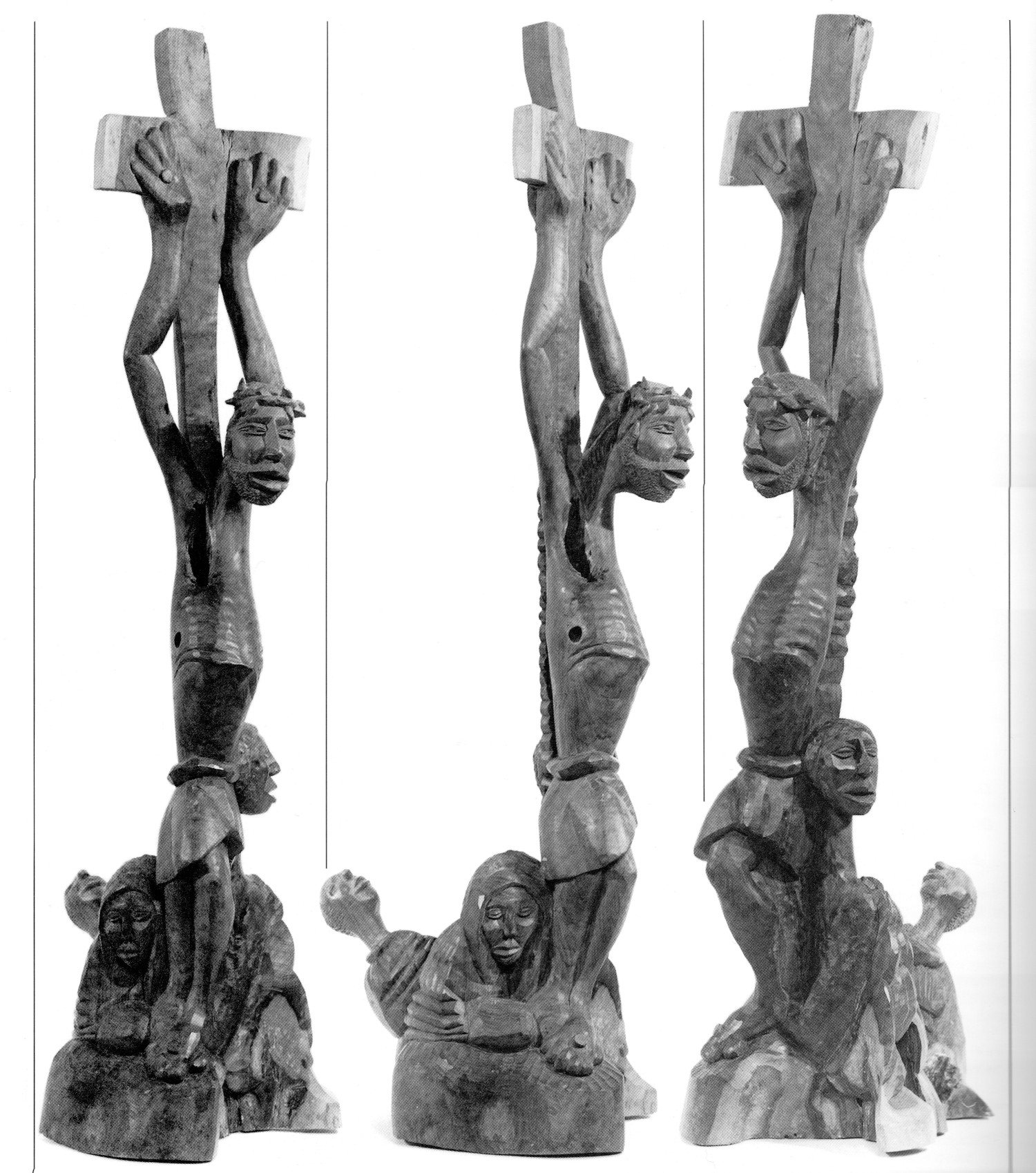
LOOK: Olivewood crucifix, South Africa

Olivewood Crucifix (South Africa)
Olivewood crucifix, South Africa, 1978. Source: Christliche Kunst in Afrika, p. 263

LISTEN: “Indodana” (Son), traditional isiXhosa song from South Africa | Arr. Michael Barrett and Ralf Schmitt, adapt. André van der Merwe, 2014 | Performed by the Stellenbosch University Choir, 2014

Ngob’umthatile eh umtwana wakho 
Uhlale nathi, eh hololo helele
(Repeat)

Indodana ka Nkulunkulu 
Bayi’bethelela, hololo helele 
(Repeat)

Oh Baba! Baba, Baba Yehova! 
Baba, hololo helele
(Repeat) 
You took your own son
Who lived among us [wailing]
(Repeat)

The Son of God
Was crucified [wailing]
(Repeat)

Oh Father! Father, Father Jehovah!
Father! [wailing] 
(Repeat)

[source]

This song so well captures the mood of mourning that characterizes Good Friday, when the Son of God was slain. “Hololo” and “helele” are wordless expressions of grief. So is the “Zjem zjem zja” sung by the basses, like heaving sobs, on the title word in verse 2. One soprano who performed this piece said that singing the “Oh’s” above the melody felt like singing tears.

“Indodana” is on the Art & Theology Holy Week Playlist.

Roundup: Historiated crosses, English ballad carol of the Crucifixion, and more

Holy Week begins Sunday. I will be publishing short daily devotional posts during that time and through the first eight days of Easter. Also: don’t forget about the Art & Theology Holy Week Playlist and Eastertide Playlist! I’ve made some new song additions since last year, mixed in to preserve the narrative flow.

+++

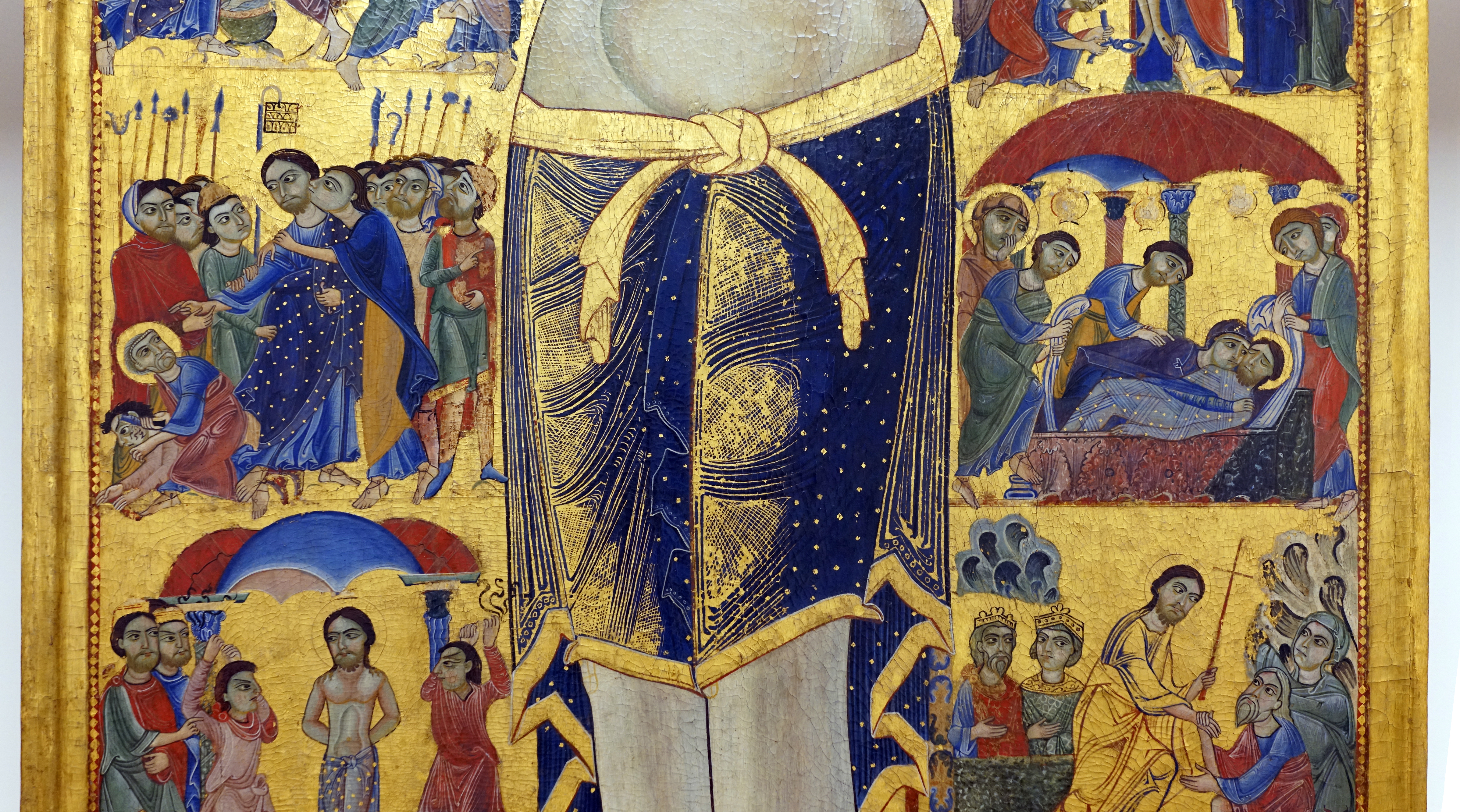
ART VIDEO: “The Crucifixion, c. 1200 (from Christus triumphans to Christus patiens)”: When I was a student in Florence for a semester, my first paper for my Italian history, art, and culture class traced the evolution of the painted wood-panel crucifix in late medieval Italy, from the Christus Triumphans (Triumphant Christ) type to Christus Patiens (Suffering Christ). I lived less than a five-minute walk from the Uffizi, which has in its collection a beautiful example of each—explored by Drs. Steven Zucker and Beth Harris in this short Smarthistory video. Longtime readers of the blog may recognize the latter, which I posted back in 2018.

Painted cross, Pisa (detail)
Painted cross (detail), Pisa, ca. 1180–1200. Tempera and gold leaf on wood, 277 × 231 cm. Galleria degli Uffizi, Florence, Inv. 432. [object record]

Zucker provides wonderful photos of both in high resolution on his Flickr page (start here and scroll right)—the full crosses and details of each apron scene—available for free noncommercial use under a Creative Commons license. And there are many other art historical images there as well!

+++

ONLINE EXPERIENCE: “Anamnesis: Journey through the Stations of the Cross”: This year visual artist Daniel Callis and the music and liturgy collective The Many collaborated on a self-guided set of online Stations of the Cross. There are fifteen total, which are being released one at a time every morning and evening from March 30 through April 5. Each station consists of an artwork, a prayer, a song, and a written meditation that help us enter into lament.

Callis, Dan_Grief Station 1
Daniel Callis (American, 1955–), Grief Station #1, Prognosis, 2022. Ink, oil, palm ash, fiber, clay, ash, fabric, 60 × 24 × 24 in. (total work). Photo courtesy of the artist.

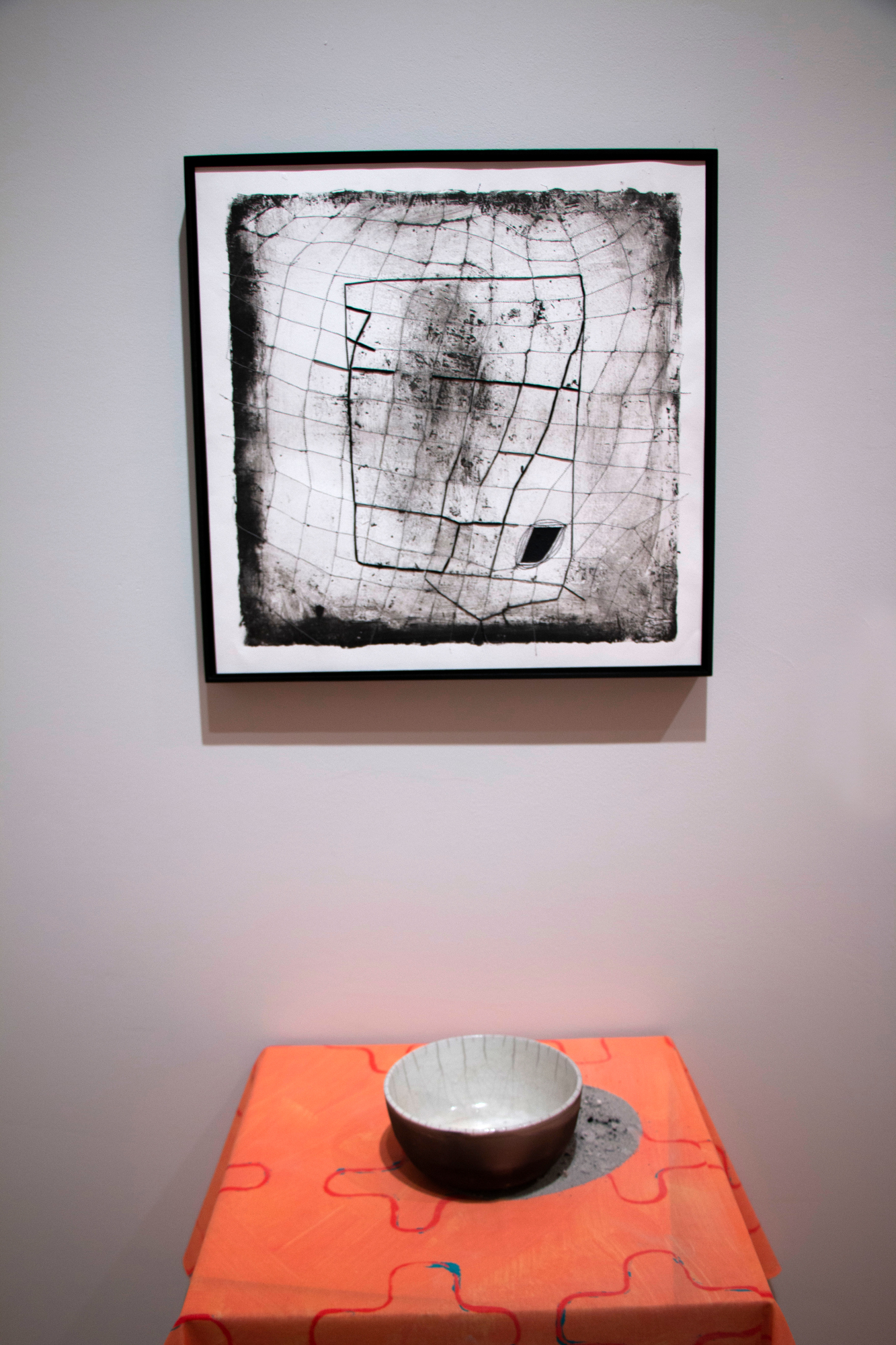
The artworks are by Callis, and they’re from his Stations: Resurgam series, a body of work that was just exhibited this month at Green Art Gallery at Biola University in La Mirada, California. He began the series in January 2021 in response to the death of his son, Jeremy David Callis (1980–2020). It consists of fifteen mixed-media works on paper (his process involves printing, “wounding,” stitching, etc.) and fifteen raku-fired offering bowls that incorporate, from the cooling process, copies of letters, hospital documents, and drawings from Jeremy. “They are about pain and the absurd insistent pursuit of hope,” Callis says of the series. Resurgam is Latin for “I shall rise again.”

The songs are by The Many.

+++

BOOK EXCERPT from The Unvarnished Jesus: A Lenten Journey by Brian Zahnd: In this post from his blog, Pastor Brian Zahnd excerpts a passage from his book The Unvarnished Jesus (2019). “To interpret the meaning of the cross is more than a life’s work—in fact, it has and will remain the work of the church for millennia,” he writes. “The cross is the ever-unfolding revelation of who God is, and it cannot be summed up in a simple formula. This is the bane of tidy atonement theories that seek to reduce the cross to a single meaning. The cross is many things: It’s the pinnacle of God’s self-disclosure. It’s divine solidarity with all human suffering. It’s the shaming of the principalities and powers. It’s the point from which the satan is driven out of the world. It’s the death by which Christ conquers Death. It’s the abolition of war and violence. It’s the supreme demonstration of the love of God. It’s the re-founding of the world around an axis of love. It’s the enduring model of co-suffering love we are to follow. It’s the eternal moment in which the sin of the world is forgiven . . .” Read more.

+++

SONGS:

>> “The Leaves of Life”: “The Leaves of Life,” alternatively titled “The Seven Virgins,” is a traditional English ballad carol of Christ’s passion, first set down in the nineteenth century. It is narrated by (the apostle?) Thomas, who on a fateful Friday runs into the Virgin Mary and six of her companions, who are looking for Jesus. He directs them to the hill where Jesus is being crucified (“And sit in the gallery” may be a corruption of “The city of Calvary”). The women tearfully fly to the site, and Jesus tries to console his mother from the cross before breathing his last. The song ends with Thomas imbibing a strong scent of rose and fennel as he meditates on Christ’s love. [HT: Global Christian Worship]

Here the song is performed in the chapter house of Wells Cathedral in Somerset by William Parsons, founder of the British Pilgrimage Trust and author of Singing for Our Supper: Walking an English Songline from Kent to Cornwall, a book about the seven months he spent as a wandering minstrel. Parsons refers to it as a gypsy carol because Ralph Vaughan Williams collected one version of it from the Roma singer Esther Smith during his 1908–13 collecting trips that resulted in the publication, with Ella May Leather, of Twelve Traditional Carols from Herefordshire (1920).

>> “Were You There”: This African American spiritual is performed here by Pegasis, a vocal trio of sisters—Marvelis, Rissel, and Yaina Peguero Almonte—originally from the Dominican Republic but now living in Green Bay, Wisconsin. It’s as if they’re the three Marys singing their testimony! The song is on their 2016 album Peace Through Praise, which they released under the name The Peguero Sisters. Their harmonies are gorgeous.

+++

PODCAST EPISODE: “Malcolm Guite: Poems on the Passion”: In this special passion- and resurrection-themed Nomad devotional episode from 2018, Malcolm Guite reads and reflects on three of his poems, and David Benjamin Blower performs an original three-part song that he wrote in response and that has not been released elsewhere (see 4:30, 16:04, and 27:18).

Guite’s “Jesus dies on the cross,” part of his Stations of the Cross sonnet cycle, was inspired by a line from George Herbert’s poem “Prayer”: “God’s breath in man returning to his birth.” And his “Easter Dawn” [previously] is based in part on a sermon by the seventeenth-century Anglican bishop Lancelot Andrewes. Paraphrasing Andrewes, Guite says, “Jesus is the gardener of Mary [Magdalene]’s heart—her heart is all rent and brown and wintery, and with one word, he makes all green again.” Beautiful! For more on the theme of Jesus as gardener, see my 2016 blog post “She mistook him for the gardener.”

The Ascent of the Cross: Christ’s Death as a Volitional Act

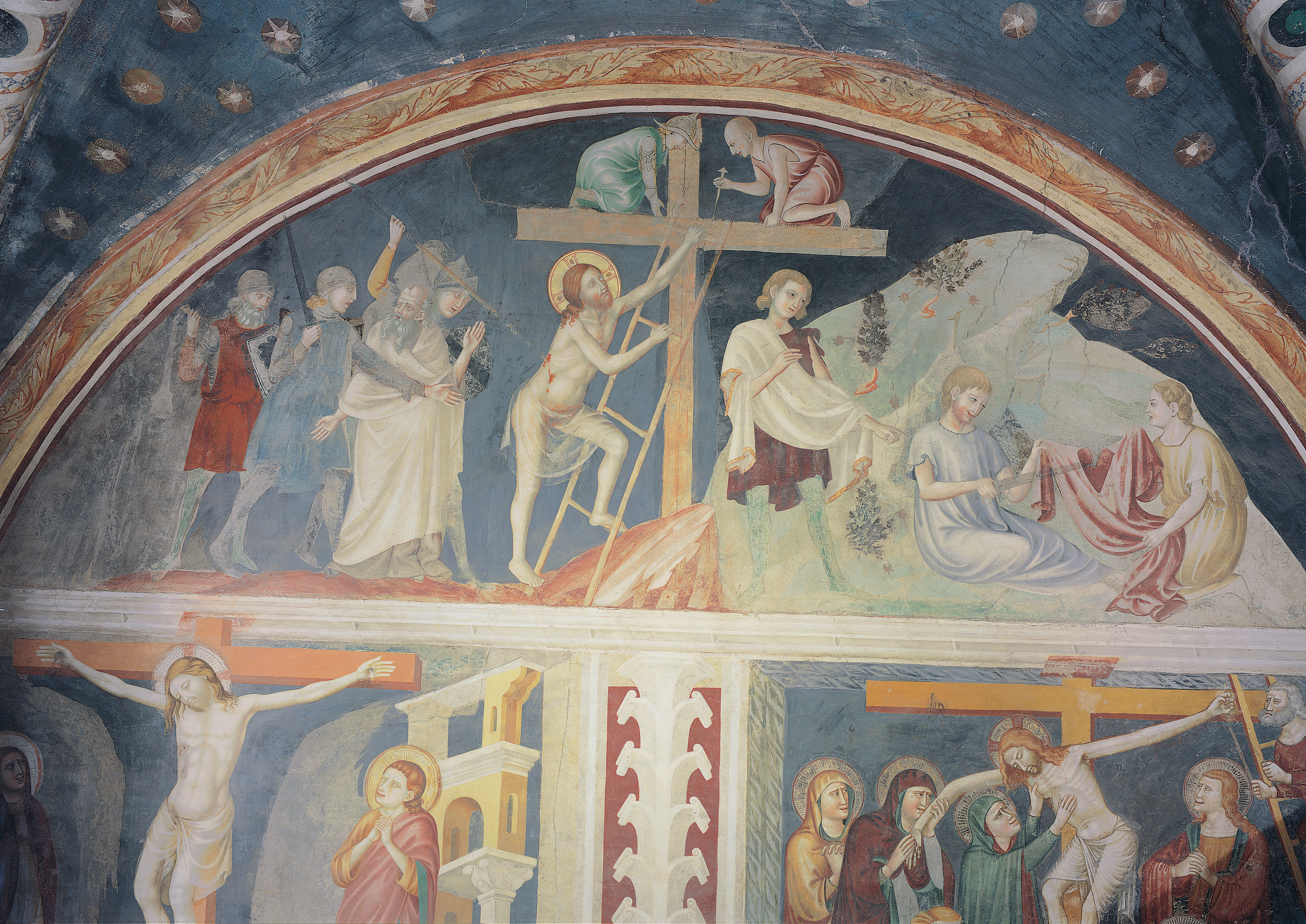
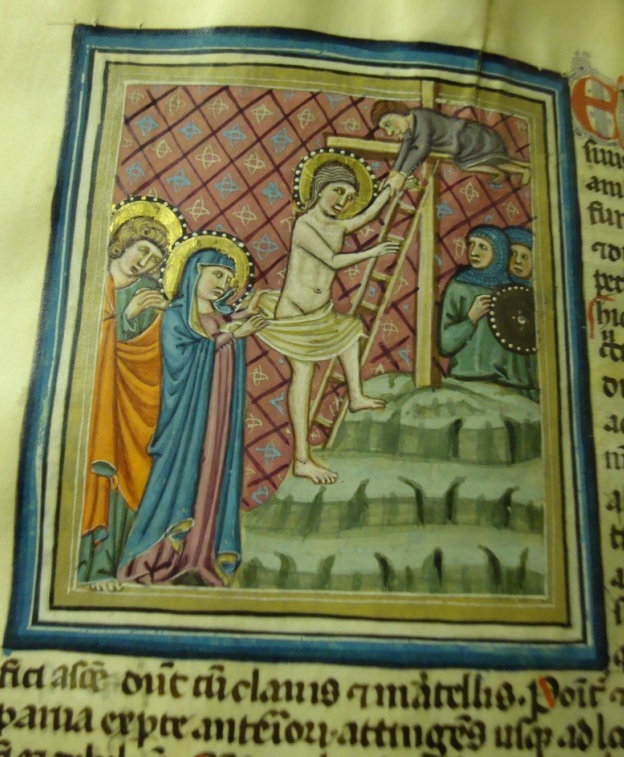
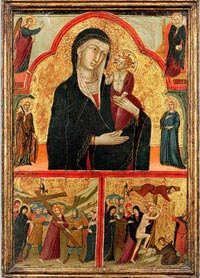
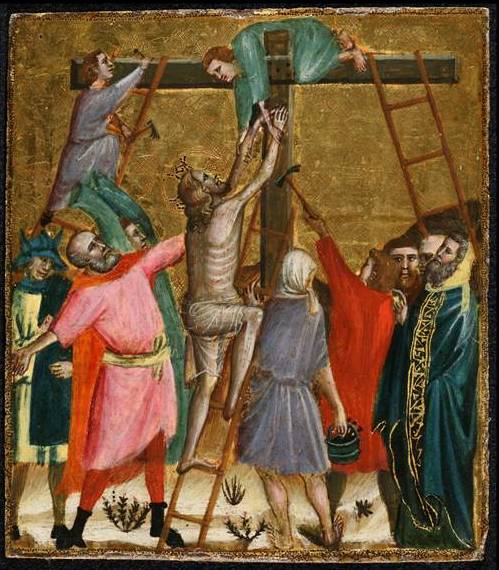
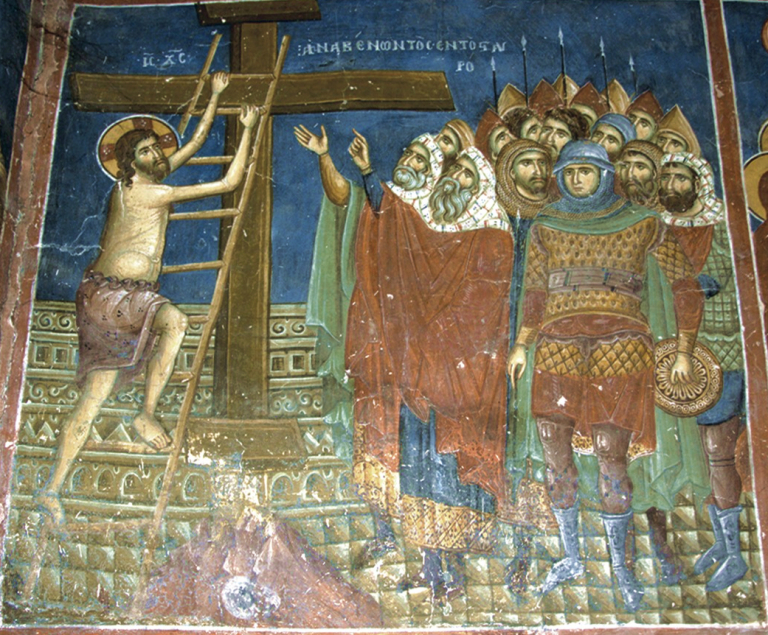
In the thirteenth century, a new subject emerged in painted Passion cycles in both East and West: Christ resolutely climbing a ladder to the cross. He ascends willingly, even enthusiastically, demonstrating a heroic acceptance of death. In taking those steps up onto the instrument of his martyrdom, he exercises agency. As he tells a gathered crowd in John 10:18, “No one takes [my life] from me, but I lay it down of my own accord. I have power to lay it down . . .” Out of love for the world, he gives himself as a sacrifice, bringing about reconciliation between God and humanity.

The iconography of the Ascent of the Cross (alternatively referred to as “Christ Mounts the Cross”) is of Byzantine origin and can be found in Macedonian and Serbian church frescoes.

Ascent of the Cross (Macedonia)
Michael Astrapas and Eutychios, Ascent of the Cross (at right), 1295. Fresco, Church of the Holy Mother of God Peribleptos (aka Church of Saint Clement), Ohrid, North Macedonia. Photo: Vera Zavaritskaya.

Ascent of the Cross (Macedonia)
Ascent of the Cross, 1298. Fresco, Church of St. Nicholas, Prilep, North Macedonia. Photo: P. S. Pavlinov.

Ascent of the Cross (St George, Staro Nagoricane)
Ascent of the Cross, 1317. Fresco, Church of St. George, Staro Nagoričane, North Macedonia.

Ascent of the Cross (St George, Polosko)
Ascent of the Cross, 1343–45. Fresco, Church of St. George, Pološko, North Macedonia.

In a fresco from the Church of St. George at Staro Nagoričane, a small Roman military detachment has just led Jesus to the site of his execution. A young enslaved Roman fixes the cross into the ground, instructed by an older slave who holds a basket of nails, while a third stands on the suppedaneum and waits to nail Jesus’s hands into place. Caiaphas, the Jewish chief priest, points to the cross, indicating to Christ to ascend it. Christ grabs hold of the rungs and climbs, while at the top left, from behind a rock, the Virgin Mary and John look on in grief.

Byzantine painting greatly influenced the Italian painters of the thirteenth and early fourteenth centuries. Many of them adopted Byzantine models, of which the Ascent of the Cross is one example.

Pacino di Bonaguida_Ascent of the Cross
Pacino di Bonaguida (Italian, Florentine, 1280–1340), Ascent of the Cross, from the picture-book Scenes from the Life of Christ and the Life of the Blessed Gerard of Villamagna, ca. 1320. Tempera and gold leaf on parchment, 9 5/8 × 6 7/8 in. (24.5 × 17.6 cm). Pierpont Morgan Library, New York, M. 643, fol. 12r.

In a Ferrarese church lunette fresco in the Benedictine nuns’ monastic complex of Sant’Antonio in Polesine, two men kneel on the cross’s patibulum as Christ mounts the ladder propped against it. He wears a translucent loincloth, emphasizing his nakedness and humiliation. Knowing Christ’s innocence, an elderly Jewish man tries to intervene to prevent the brutality, but he is restrained by soldiers. On the right, a group of Romans argues over who will get to keep Christ’s cloak, a souvenir from this regional celebrity.

Ascent of the Cross (Ferrara)
Christ Mounts the Cross on a Ladder, 14th century. Fresco, Monastery of Sant’Antonio in Polesine, Ferrara, Italy.

In some versions of the Ascent of the Cross, Jesus is pushed or pulled into position, or at least aided, by soldiers, with whom he readily cooperates. Such is the case in the earliest identified instance of the subject, from an eleventh-century Armenian Gospel-book. (Armenians were the largest non-Greek ethnicity in the Byzantine Empire.)

Ascent of the Cross (Armenian)
Ascent of the Cross, from the Vehapar Gospels, Armenia, early 11th century. Matenadaran, Yerevan, MS 10780, fol. 125v.

Art historian Thomas F. Mathews says that in the Armenian tradition, Golgotha is identified with the place where the Jewish patriarch Jacob had a vision of angels trafficking a ladder connecting heaven and earth. “How awesome is this place! This is none other than the house of God, and this is the gate of heaven,” Jacob exclaimed, dubbing it Bethel, Hebrew for “house of God” (Gen. 28:10–22). In Armenian manuscript illuminations, Mathews argues, the subject of Christ ascending the cross, very often followed by a depiction of Christ’s dead body descending from the cross, was thus interpreted as an extension of Jacob’s vision, as by climbing up and down the ladder of the cross, Christ opened heaven’s gate.[1]

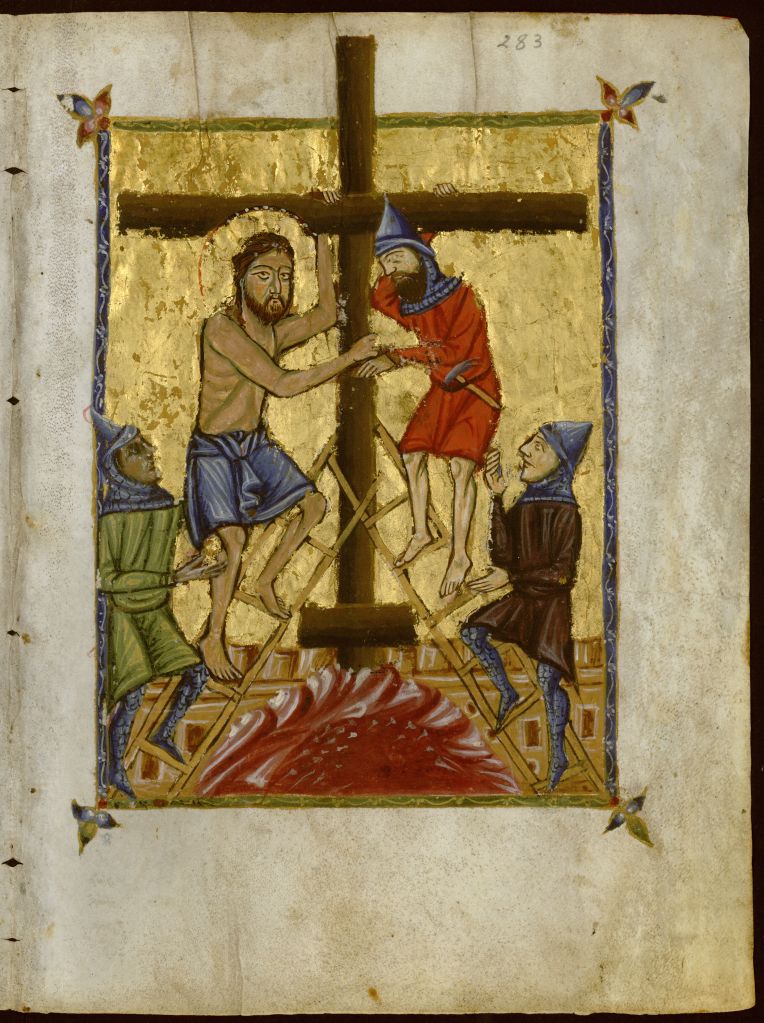
Another Armenian Gospel-book miniature of the subject, from the early fourteenth century, is particularly striking in how it shows Christ turning, mid-climb, toward the viewer, his direct gaze engaging our pity and love.

Ascent of the Cross (Gladzor Gospels)
T‘oros Taronec‘i, Ascent of the Cross, from the Gladzor Gospels, Armenia, 1300–1307. UCLA Library Special Collections, Los Angeles, Armenian MS 1, p. 283.

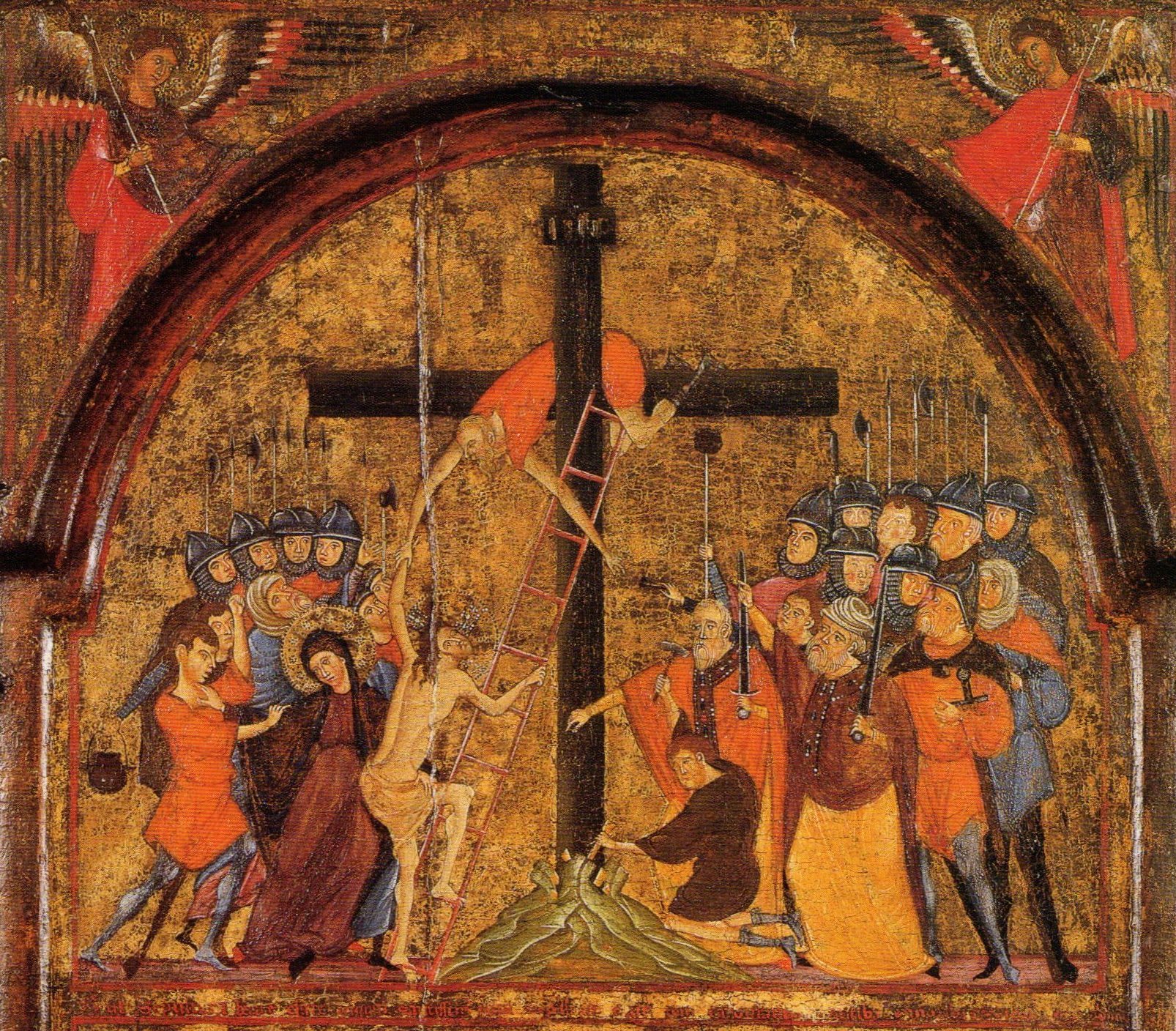
In some versions from Italy, Mary grabs her son around the waist, trying to prevent him from experiencing further torture. Take, for example, the panel painting by Guido da Siena that was originally part of the Madonna del Voto altarpiece in Siena’s cathedral. Her mama-bear instinct kicking in, Mary pushes away one of her son’s tormentors with one arm and with the other protectively encircles her son, unable to let him go.  

Guido da Siena_Ascent of the Cross
Guido da Siena (Italian, Sienese, 1230–1290), Ascent of the Cross, ca. 1265–74. Tempera on poplar wood, 34.5 × 46 cm. Museum Catharijneconvent, Utrecht, Netherlands.

Some Christians are wary of suggesting that the Mother of God would seek to deter God’s plan, but let’s remember that, devout as she was, Mary was not superhuman. The death sentence passed against her son and the violence that followed naturally unleashed a flood of emotion in her and an impulse to resist. What mother wouldn’t do everything in her power to save her child from harm? No matter how much she believed in her son’s mission, what mother wouldn’t reach out for one last embrace, if only to delay the inevitable?

That said, Mary’s gesture here may be one of attempting not to impede his ascent but to cover his nakedness. In the widely influential Meditations on the Life of Christ, a text that originated in early fourteenth-century Tuscany and circulated in Latin and all the major European vernaculars,[2] Mary responds in agony to Jesus’s being shamefully stripped for all to see, and she intervenes with a small mercy:

Oh what anguish this was to his mother, to see her most sweet son naked like this, standing like a lamb among these wicked wolves!

Then the mother, full of sorrow, went up close to her most sweet son and took the veil from her head and wrapped it around Lord Jesus Christ with bitter sorrow. And I do not know how she did not fall dead to the earth.[3]

Closely related to the Guido panel is one by an anonymous artist from Umbria or Tuscany that was the central panel of a portable altarpiece with two wings, possibly painted for the Basilica of Santa Chiara in Assisi. It depicts the Ascent of the Cross—again, with the Virgin Mary interceding—above a scene of the Funeral of Saint Clare (d. 1253), a close follower of Saint Francis and the founder of the Poor Clares religious order.

Christ Mounting the Cross (Wellesley panel)
Christ Mounting the Cross and the Funeral of Saint Clare (detail), Umbria or Tuscany, 1290s. Tempera and silver leaf on panel, overall 31 1/4 × 20 3/8 in. (79.4 × 51.8 cm). Davis Museum, Wellesley College, Wellesley, Massachusetts.

For the iconography of the Ascent of the Cross, art historian Anne Derbes identifies a possible literary source as Pseudo-Bede’s De meditatione passionis Christi: “Then, when the cross had been prepared, they [the people] cry: ‘Ascend, Jesus, ascend.’ O how freely He ascends, with what great love for us He bore everything, with what patience, what gentleness!”[4]

Terser references to this episode, Derbes points out, appear in Pseudo-Anselm’s Dialogus, which mentions that Christ “ascends the wood of the cross,”[5] and in Ambrose’s commentary on Luke, in which Ambrose remarks that “it was not his cross that Christ ascended, but ours,” and that Christ ascended the cross “as a victor ascends a triumphal chariot.”[6]

Derbes also notes the possible influence of the adoratio crucis (adoration of the cross) ritual, known in Jerusalem from the fourth century and in the West from the seventh or eighth, which states, “O Lord Jesus Christ, I adore you climbing onto the cross.”[7]

[In the tiled gallery below, click on the image to view the caption and source URL.]

The long Latin version of the Meditations, which, from the mid-fourteenth century, postdates most of the paintings shown here, also mentions the Ascent of the Cross, perhaps itself influenced by trecento visual culture:

Now diligently behold the process of Crucifixion. Two ladders are accustomed to be placed, one on the one side, the other on the other; upon these, wicked men go up, with nails and hammers; while another ladder is placed in front, reaching to that part of the Cross where the feet are to be nailed. Contemplate now each event Our Lord may have been compelled by means of this small ladder to ascend the Cross, for He does whatsoever they bid Him, humbly, without resistance or complaint. Having reached the top of the ladder, He turns Himself round, it may be, opens His arms, and extends His Hands—so royal and beautiful—and yields Himself up to His crucifiers.

. . . Some there are who think that this was not the method of Crucifixion, i.e. by making our Lord ascend a ladder before the nailing of His Body to the Cross; but that they fastened Him to the Cross when it was laid on the ground before it was raised.[8]

Interestingly, the writer, as he does elsewhere in the manuscript, allows for the possibility that the action may have occurred in one of two ways. Actually, probably neither of the two options he describes for how Christ was nailed to the cross is accurate. Ancient historians think it most likely that Jesus was nailed to the horizontal crossbeam while it lay on the ground, which was then lifted up, his body attached, and dropped into a notch in the permanently fixed vertical post.[9]

However, the Ascent of the Cross isn’t so much meant to be a literal portrayal of what happened historically as it is an expression of the theological truth that Christ went to his death voluntarily. He was not forced onto the cross against his will. The Ascent suggests divine initiative and purpose. Even in those images where Christ is being prodded by his executioners, he does not resist. Instead, he bounds onward and upward to his chosen end.

In medieval English literature, the freedom and strength of Christ in his death is often emphasized. In the Old English poem “The Dream of the Rood” from the eighth century, the cross says, “Then I saw mankind’s Lord / hasten with great zeal, as though he wanted to climb on me.”[10] In Middle English religious lyrics, which come down to us mainly through preaching manuscripts, Christ mounts the cross much like a knight does his steed, prepared for battle, but of a spiritual kind.[11]

One anomalous example of the Ascent of the Cross that I found comes from Reformation Germany. A copperplate engraving by Augustin Hirschvogel[12] shows a muscly Christ mounting the cross with three figures slung over his shoulder: a clawed, beaked, horned creature representing the devil; a skeleton representing death; and what looks like a bloated corpse, probably representing sin. The tone is triumphant, as Christ’s death defeats this formidable trio. They are nailed to the cross with him, but unlike him, never to rise.

Christ Ascending the Cross with Sin, Death, and the Devil
Augustin Hirschvogel (German, 1503–1553), Christ Ascending the Cross with Sin, Death, and the Devil, 1547. Etching, 11.8 × 14.8 cm (image) / 15.1 × 14.8 cm (sheet). National Gallery of Art, Washington, DC.

Christ Ascending the Cross with Sin, Death, and the Devil is one of a group of over one hundred etchings of biblical scenes commissioned by the Hungarian aristocrat and politician Peter Perényi (1502–1548) for his Concordance of the Old and New Testaments, first published in Vienna by the printer Aegidius Adler in 1550. Perényi selected the scenes and wrote the letterpress captions beneath them. This one reads,

Noch mer Christus am creutz uberwand
Desshalben von Gott war selb gesandt
Und den teueffel Hell alles band
Drumb er unser erlöser ist genannt.
Luc. 23e. Corinth.5f.

On the cross, it says, Christ overcame hell and the devil, and that’s why we call him “Redeemer.” The biblical citations are to the Crucifixion account in Luke 23 and to 2 Corinthians 5:14–21, which begins, “For the love of Christ urges us on, because we are convinced that one has died for all; therefore all have died. And he died for all, so that those who live might live no longer for themselves but for the one who for their sake died and was raised” (NRSV).

A follower of Martin Luther and a friend of Philip Melanchthon, Perényi was an influential protector of Protestant preachers in the kingdom of Hungary. But his shifting political allegiances got him into trouble when in 1542 he was imprisoned by Ferdinand I, a Habsburg prince, for disloyalty. It was from a prison in Vienna that he worked on his concordance project.

All these artworks of Christ ascending the cross show his bravery, dignity, and poise in the face of persecution, his heroic self-giving that wins the world’s salvation. Despite his mother’s tearful entreaties, and despite the pain he knows is coming, he remains steadfast, his eyes fixed on the prize that will be attained on Easter morning.


As an independent scholar, I rely on your donations to keep publishing articles like this, as they require a large time investment, and in this case, a photo licensing fee (for the Ferrara fresco). If you appreciate having access to researched, illustrated articles on theological art, would you consider making a donation to support my work, either monetarily (via PayPal or the secure form below) or by buying me a book? Thank you!

One-Time
Monthly
Yearly

Make a one-time donation

Make a monthly donation

Make a yearly donation

Choose an amount

$5.00
$15.00
$100.00
$5.00
$15.00
$100.00
$5.00
$15.00
$100.00

Or enter a custom amount

$

Your contribution is appreciated.

Your contribution is appreciated.

Your contribution is appreciated.

DonateDonate monthlyDonate yearly

NOTES

1. Thomas F. Mathews and Avedis K. Sanjian, Armenian Gospel Iconography: The Tradition of the Glajor Gospel (Washington, DC: Dumbarton Oaks Research Library and Collection, 1990), 131–32.

2. This text is traditionally attributed to a Franciscan friar known as Pseudo-Bonaventure and believed to have originated in Latin (title: Meditationes de vitae Christi), but Sarah McNamer has persuasively argued that its originator was a woman, a Poor Clare from Pisa, who wrote it in Italian for her fellow nuns sometime between 1300 and 1325. Within the next decade and a half, McNamara proposes, a Franciscan friar expanded and altered it to make it more didactic, creating first another Italian version (the “testo minore”) and then translating this into Latin to “authorize” it and make it more disseminatable. The long Latin text has become canonical but is, McNamara argues, inferior to the base text, compromising its narrative pacing and emotional impact. See Sarah NcNamer, Meditations on the Life of Christ: The Short Italian Text (Notre Dame, IN: University of Notre Dame Press, 2018).

3. Translated by Sarah McNamer from Oxford, Bodeleian Library MS Canonici Italian 174 (the “testo breve”), in Meditations, 141.

4. “Deinde parata cruce dicunt ei, ascende, Jesu, ascende. O quam libenter ascendit, o quanto amore ista omnia pro nobis sustinuit, o quanta patientia, o quanta mansuetudo!”(PL 94:565). Translated by Anne Derbes in Picturing the Passion in Late Medieval Italy: Narrative Painting, Franciscan Ideologies, and the Levant (Cambridge, UK: Cambridge University Press, 1996), 154.

5. “Ascendit arborem crucem” (PL 159:289). Qtd. Derbes, 241n56.

6. “Non enim suam, sed nostram crucem christus ascendit” (PL 15:1923); “currum suum triumphator ascendit” (PL 15:1924). Qtd. Derbes, 242n56.

7. “Domine Ihesu Christi, adoro te in cruce ascendentem,” qtd. Derbes, 242n56, from Karl Young, The Drama of the Medieval Church, vol. 1 (Oxford: Clarendon, 1933), 117–19.

8. S. Bonaventure, The Life of Christ, trans. and ed. Rev. W. H. Hutchings (London: Rivingtons, 1881), 267, xiii–xiv. Sarah McNamer says that while (what she argues is) the original Meditations text describes a crucifixion method known as jacente cruce—Christ nailed to the cross as it lies prone on the ground—the Italian recension and subsequent translations and versions that came soon after privilege the erecta cruce method, in which Christ ascends a ladder to an upright cross and thus is nailed from an elevated position (Meditations, 228n126).

9. Martin Hengel, Crucifixion in the Ancient World and the Folly of the Message of the Cross (Philadelphia: Fortress, 1977), 25; Robin Jensen, The Cross: History, Art, and Controversy (Cambridge, MA: Harvard University Press, 2017), 10.

10. “Geseah ic þā Frēan mancynnes / efstan elne micle,⁠ þæt hē mē wolde on gestīgan.”

11. The metaphor of Christ’s cross as a horse that he bravely mounts as if for battle occurs in MS Balliol 149 (cf. MSS Magdalen 93 and Trinity Dublin 277), Nicolas Bozon’s poem “Sa sele fu trop dure, et mout l’ad anguise,” MS Bodley 649, and MS Harley 2316. See Rosemary Woolf, Art and Doctrine: Essays on Medieval Literature (London: The Hambledon Press, 1986), 113–15.

12. Hirschvogel was trained as a stained-glass painter in the workshop of his father, but when his hometown of Nuremberg accepted Luther’s Protestant teachings, the workshop lost its church commissions. Hirschvogel thus pivoted to designing maps and fortification plans and, in his final decade, making landscape etchings as part of the Danube School. Richard Manly Adams Jr., “One Acquisition, Two Great Traditions at Pitts,” Reformation Notes no. 56 (Summer 2021): 5.

Roundup: Musical Passions beyond Bach; Angola inmates enact the Passion; and more

VIDEO: “Waiting with Christ: An Artful Meditation for Holy Week”: A collaboration between Duke Initiatives in Theology and the Arts in Durham, North Carolina, and City Church in Cleveland, Ohio, this half-hour video from 2021 presents a small collection of scripture readings, poems, visual art, and music for Holy Week, interspersed with reflections by theologian Jeremy Begbie. The artistic selections are a spoken word performance by Paul Turner, Malcolm Guite’s sonnet “Jesus Meets His Mother,” the Adagio movement of Schubert’s String Quintet in C Major, the painting Riven Tree by Bruce Herman, and Bifrost Arts’ “Our Song in the Night,” performed by Salina Turner, Allison Negus, and Joel Negus [previously].

+++

ARTICLE: “6 Musical ‘Passions’ Beyond Bach” by Josh Rodriguez: Composer, professor, and Deus Ex Musica cofounder Josh Rodriguez is an excellent classical music curator and guide. In this article he introduces us to six modern large-scale musical works about Jesus’s final week: The Passion of Yeshua by Richard Danielpour, La Pasión Según San Marcos by Osvaldo Golijov, The Passion of the Christ Symphony by John Debney, Johannes-Passion by Sofia Gubaidulina, Simeron by Ivan Moody, and the St. John Passion by James MacMillan. He interweaves composer biography, musical analysis, and meaning in concise ways, with nods to music history. Stylistic influences for these diverse selections range from Byzantine chant to salsa! Audio/video excerpts are provided, such as the cued-up “¿Por qué?” from Golijov’s Pasión (see below), a movement centering on the woman who anointed Jesus’s feet with perfume (Mark 14:3–9).

+++

PRINT SERIES: The Passion and Its Objects (after Dürer) by Marcus Rees Roberts:The Passion and Its Objects (after Dürer) is a series of etchings and monotypes by Marcus Rees Roberts. The images derive from fragments from Albrecht Dürer’s series of woodcuts The Small Passion (1511). Images of the Passion – and of the crucifixion in particular – are so embedded in Western consciousness that we forget that it is a depiction of betrayal, prejudice, and torture. In this version of the Passion by Dürer, one of several he made, small, everyday objects lie scattered within the images – a jug, pliers, a hammer, a coil of rope. Even five hundred years later, we recognise these objects as our own; we can identify with them. But in so doing, we enter the depicted space, and we become complicit in the cruelty. This is one reason why Dürer’s Small Passion is both so powerful and so uncomfortable.”

Roberts, Marcus Rees_Passion I
Marcus Rees Roberts (British, 1951–), The Passion and Its Objects (after Dürer) I, 2019. Diptych etching and aquatint with chine collé printed on Somerset Satin soft white 300gsm, each plate 29.5 × 21 cm (overall 29.5 × 42 cm). Edition of 15.

+++

PHOTOGRAPHY SERIES: Passion Play by Deborah Luster: “There are more than 5,300 inmates at the Louisiana State Penitentiary at Angola. Nearly 4,000 of them are serving life without parole. In 2012 and 2013 the Angola Prison Drama Club staged a play unlike any other in the prison’s experience. The Life of Jesus Christ featured 70 inmates, men and women acting together for the first time—in costume, with a real camel, performing for the general public. For the untrained actors, this production held special meaning as they saw pieces of their own lives revealed in the characters they played.”

Luster, Deborah_Layla "Roach" Roberts (Inquisitor)
Layla “Roach” Roberts (Inquisitor), sentenced to LIFE, Angola Prison, Louisiana. Photograph by Deborah Luster, from the Passion Play series, 2013.

Luster, Deborah_Bobby Wallace (Jesus)
Bobby Wallace (Jesus), Angola Prison, Louisiana. Photograph by Deborah Luster, from the Passion Play series, 2013.

+++

SONGS:

>> “May I Go with You” by January Lim: This Maundy Thursday song was written in 2020 in the voice of Jesus in Gethsemane, speaking to God the Father. In the first stanza, it seems to me that Jesus is asking to be taken up to heaven, like Elijah—just whisked away back to glory, and spared tomorrow’s cruelties and pain. But in the second stanza that same request seems to shift in meaning as Jesus expresses a desire to go with God’s plan and asks for the strength to follow through. The song was released on the EP Gathered Sighs (2021), put out by Evergreen Baptist Church of Los Angeles, where Lim serves as worship arts pastor. [HT: Global Christian Worship]

>> “Calvary” (Traditional): In this excerpt from Washington National Cathedral’s 2020 Good Friday noon service, Imani-Grace Cooper performs Richard Smallwood’s arrangement of the African American spiritual “Calvary,” accompanied on piano by Victor Simonson. Wow. Chilling!

See also Cooper’s performance of “Lamb of God” by Twila Paris and “Were You There” from the same service, which I cued up at those time-stamped links.

Rare iconography of Hades impaled on Golgotha

The Metropolitan Museum of Art in New York has in its collection a Byzantine Crucifixion ivory from Constantinople with an unusual figure at the bottom: a burly, bearded man in a reclining position, being stabbed through his belly by the cross. The Greek inscription clues us in to his identity: “The Cross Implanted in the Stomach of Hades.” This is the ruler of the underworld being subdued by Christus Victor, the conquering Christ!

Crucifixion with Hades stabbed
Icon with the Crucifixion, made in Constantinople, mid-10th century. Ivory, 5 15/16 × 3 1/2 in. (15.1 × 8.9 cm). Metropolitan Museum of Art, New York.

Hades is associated with death. The New Testament writers use the word, roughly equivalent to the Hebrew Sheol, to refer to the unseen realm of the dead, where people’s souls reside between death and the general resurrection, or sometimes to the grave, the place of bodily decay.

The iconography of Hades being stabbed is unique among surviving Byzantine representations of the Crucifixion, though it is present in some depictions of the Anastasis (Resurrection), known in English as the Harrowing of Hell.

There is also an ancient literary tradition of Hades experiencing gastric troubles in response to Christ’s redemptive work—either being speared through his midsection with Jesus’s cross, or his stomach churning in nervous anticipation of Jesus’s approach. Byzantine art curator Margaret English Frazer cites several such examples in her essay “Hades Stabbed by the Cross of Christ”:

  • “With this precious weapon [the cross] Christ tore apart the voracious stomach of Hades and blocked the treacherous fully opened jaws of Satan. Seeing this, Death quaked and was terrified, and released all whom he held beginning with the first man.”—Ephrem the Syrian, “Sermo in pretiosam et vivicam crucem” (Sermon on the Precious and Life-Giving Cross)
  • In the Gospel of Nicodemus, Hades frets to Satan about Jesus’s coming to the underworld after his crucifixion: “I not long ago swallowed down one dead, Lazarus by name; and not long after, one of the living by a single word dragged him up by force out of my bowels: and I think that it was he of whom thou speakest. If, therefore, we receive him here, I am afraid lest perchance we be in danger even about the rest. For, lo, all those that I have swallowed from eternity I perceive to be in commotion, and I am pained in my belly.”
  • In the Gospel of Bartholomew, upon hearing footsteps descending the stairs to his abode, Hades says, “My belly is rent, and mine inward parts are pained: it cannot be but that God cometh hither.”
  • In a sermon among the spuria of John Chrysostom of the fifth to seventh century, the infernal serpent laments that a nail is implanted in his heart and a wooden lance pierces him, tearing him apart. (“In adorationem venerandae crucis,” Patrologia Graeca 62, col. 748)
  • Hades, to the snake: “Let us both bitterly lament,
    Since in His descent He has attacked my stomach,
    So that I vomit forth those whom I formerly devoured.
    But now lament with me, for we are despoiled of our common glory.”
    —Romanos the Melodist, Fourth Hymn of the Resurrection, trans. Marjorie Carpenter in Kontakia of Romanos, Byzantine Melodist
  • Again, Hades, crying out: “I am pierced in the stomach;
    I do not digest the One whom I devoured;
    Just so, on the third day, the whale disgorged Jonas.
    Now I disgorge Christ and all of those who are Christ’s;
    Because of the race of Adam I am being chastised.”
    —Romanos the Melodist, Fifth Hymn of the Resurrection, trans. Marjorie Carpenter in Kontakia of Romanos, Byzantine Melodist

But again, the context of all these passages is Christ’s descent into Hades, part of the resurrection narrative celebrated on Easter. Is there any precedent for Hades being stabbed at the moment of Christ’s death?

Frazer identifies the most likely literary inspiration for our anonymous ivory carver as Romanos the Melodist’s hymn “On the Triumph of the Cross” from the sixth century, which was sung on Good Friday in the Byzantine church. Here’s an excerpt, translated from the Greek by Marjorie Carpenter:

Pilate fixed three crosses on Golgotha,
Two for the robbers, and one for the Giver of life.
When Hades saw Him, he said to those below:
“O my priests and forces, who has fixed the nail in my heart?
A wooden spear has pierced me suddenly and I am torn apart.
I am in pain—internal pain; I have a bellyache;
My senses make my spirit quiver,
And I am forced to vomit forth
Adam and those descended from Adam, given to me by a tree.
The tree leads them back
Again into Paradise.”

Satan tries to calm Hades, but he is inconsolable in his defeat, replying,

“Run and uncover your eyes, and see
The root of the tree within my spirit;
It has gone down into my vitals,
So that like iron it will draw up Adam.”

As is common in the New Testament and early patristic writings, Romanos interprets the Crucifixion as Christ’s victory over death. Through Christ’s self-sacrifice, death is disemboweled, no longer posing a threat. The gates of eternal life with God are now opened.

As I study this tenth-century ivory, I wonder who first owned it and how it supported their faith, and I marvel that after more than a thousand years, this precious object still beckons and speaks. It is the central panel of a small triptych whose two wings are now lost. Its diminutive size—no bigger than a hand—means it was likely a personal devotional object.

The artist places the scene under a baldachin. Jesus’s arms are extended over the crossbeam and his feet rest on a suppedaneum, below which three seated soldiers cast lots for his cloak. The Virgin Mary and Saint John stand on either side in an attitude of mourning. But their tears will soon give way to rejoicing, because the cross’s wooden stake plunges decisively into the stomach of Hades, doing him in; see the blood welling up at the wound. The cross is portrayed as the weapon with which Christ wins humanity’s salvation.

This is a symbolic image, one that manifests physically the metaphysical drama playing out beneath the surface of things. Hades embodies death, the opposite of life, so his impalement represents an end to his reign of terror. Symbolism is a common tool of the religious artist for signposting the viewer toward an invisible spiritual truth, and here the artist uses it to show how Christ has, surprisingly, vanquished death by death.


FURTHER READING

Margaret English Frazer, “Hades Stabbed by the Cross of Christ,” Metropolitan Museum Journal 9 (1974): 153–61