
Roundup: Social music with Dan Zanes, the Green Man, and more

Lancaster Digital Collections has published twelve webpages of “iconography-inspired sacred art,” with downloadable images made available by permission of the artists. I especially like the paintings of Janet McKenzie [previously] and Khrystyna Kvyk [previously].
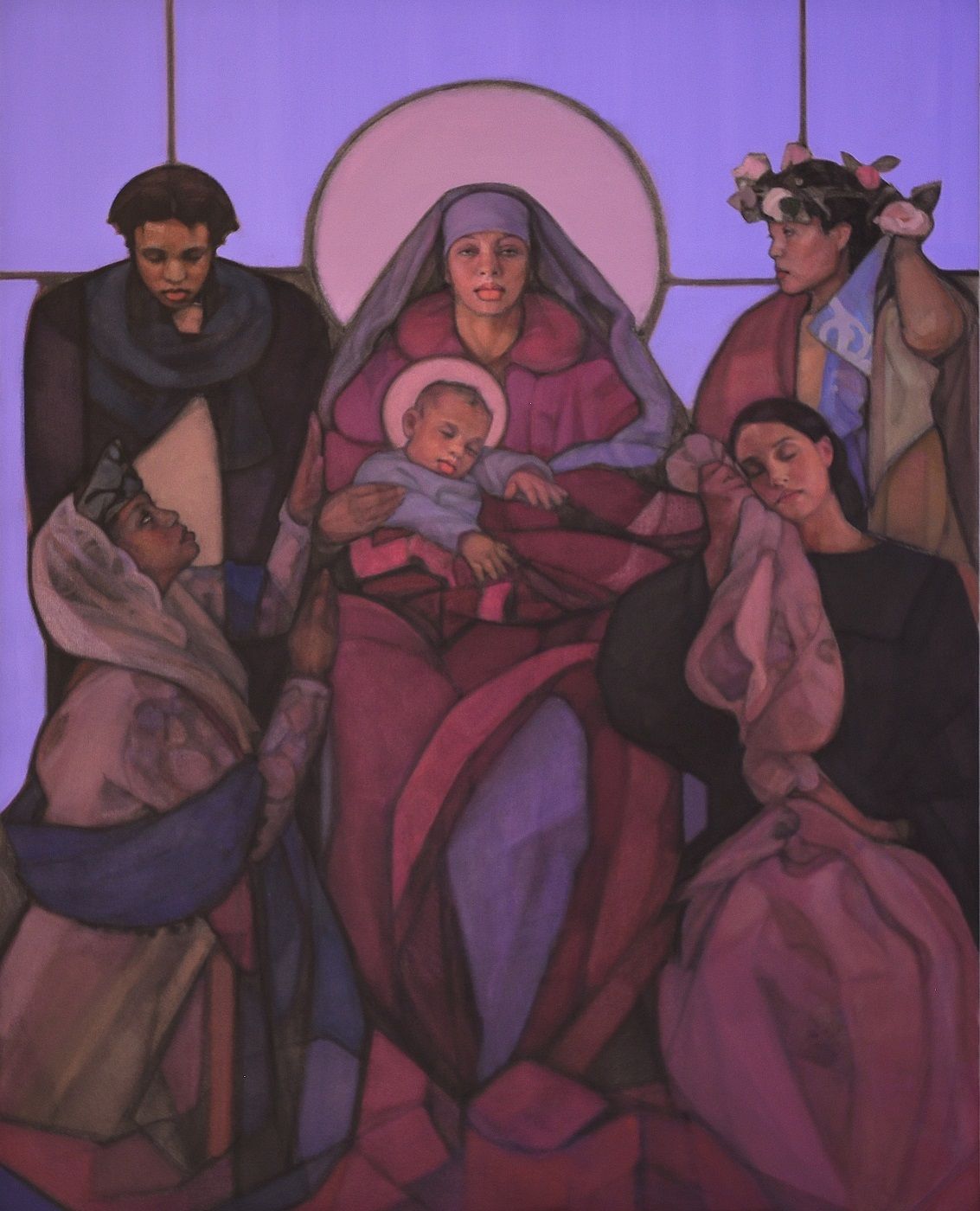
McKenzie, Janet_The Divine Journey
Janet McKenzie, The Divine Journey: Companions of Love and Hope, 2017. Oil on canvas, 48 × 36 in. Memorial Church, Harvard University, Cambridge, Massachusetts.

Kvyk, Khrystyna_The Descent into Hell
Khrystyna Kvyk (Ukrainian, 1994–), The Descent into Hell, 2023. Acrylic on gessoed wood, 40 × 40 cm. Private collection.

+++

FREE ZOOM CONVERSATION: Social music with Dan Zanes, July 16, 2025, 8 p.m. ET: I met the Baltimore-based folk musicians Dan and Claudia Zanes [previously] two years ago at a local family concert they put on. Joyous, bighearted, faith-filled, community-focused, committed to social justice—I love who they are and what they’re about and all the rich music they share.

In a social media post on June 11, Dan posed the question, “Is there anyone out there who wants to become a music maker and help uplift their community?” Followed by a generous offer: “I can teach you how to play guitar and sing songs (and write songs if you want). No cost, this is a different approach. It will be through a series of Zoom lessons (unless you live down the street). Whether you’re a beginner or someone who’s been dabbling and wants to take it out of the house, I can get you to a confident place so you can play for and with people.” The caveat? You just have to promise to put in the practice and to share your music freely in your community! And to teach someone else what you’ve learned.

“There are so many ways to make positive social change,” Dan says, “and creating music in our communities is certainly one of them.” I believe he has already selected a set of students to take on, but having received so many messages of interest, he has also decided to host a Zoom conversation on social music this coming Wednesday evening. On July 9, he wrote on social media:

Social music in chaotic times, people! Let’s talk about it. I’ve been hearing from many folks who want to be more useful in their communities and see music as the way.

Yes! Music can be healing, galvanizing, uplifting, energizing, and calming. Imagine if every community had many more music makers to play for the young folks, the elders, to lead singalongs and dance parties, to offer songs during times of loss and celebration. Of course it’s happening now, and still I believe there’s so much more that is possible.

If you’re interested in joining the meeting, send Dan an Instagram message @danzanes or a Facebook message @danandclaudiazanes and he’ll send you the link.

To give you a sense of Dan and Claudia’s vibes, here’s one of their original songs, which they debuted on their YouTube channel in 2020:

+++

ONLINE RETREAT: “Read for Your Life: Creating a Story-Formed Home” with Sarah Clarkson, August 5, 2025: Join author Sarah Clarkson [previously] for a daylong online retreat exploring children’s literature, childhood reading, and the development of imagination. “My goal,” she writes, “is to provide a vision for the beauty of the reading life, some good research, and a generous stack of practical booklists to help you begin to outfit and build a home library for the children in your life.” The cost is $35. The event begins at 9:30 a.m. UK time, but all live sessions will be recorded and offered on-demand afterward to registrants.

+++

PODCAST EPISODE: “The Green Man,” Gone Medieval, June 23, 2025: In this episode, Dr. Eleanor Janega talks with Imogen Corrigan, author of The Green Man: Myth and Reality (Amberley, 2025), about the enigmatic “green man” figure, or foliate head, which can be found in almost every pre-Reformation English cathedral and in many churches, decorating arches, corbels, roof bosses, choir stalls, and chancel screens. Corrigan claims that “the image has to be one of the most misunderstood, misinterpreted and misrepresented in the history of church carvings,” having nothing to do with pagan fertility rites. She suggests, rather, that the Green Man gestures toward the resurrection of, and resurrection in, Christ—to spiritual rebirth and eternal life.

Green Man misericord
Misericord from King’s Lynn Minster, England, ca. 1370s, depicting a Green Man disgorging oak leaves. Photo: Lucy Miller. (Click on image for great compilation!)

The two medievalists speak on location at St Mary’s at Minster-in-Thanet and St Nicholas-at-Wade in Kent. The conversation really starts to pick up at 19:47.

+++

This past month has seen the death of two rock ’n’ roll legends whose music, which played regularly on Oldies 100.7 WTRG, formed part of the soundtrack of my 1990s childhood: Brian Wilson (of the Beach Boys) and Sly Stone (of Sly and the Family Stone).

Much has been written about both trailblazers. I just want to mention two things:

1. Love and Mercy, the 2014 film directed by Bill Pohlad about Brian Wilson (played by Paul Dano and John Cusack), is excellent. Elliot Roberts makes the case that it’s the best music biopic ever made, and I’m inclined to agree; New York Times film critic Alissa Wilkinson also cites it as her favorite, at least within the rock genre. The story alternates between Wilson’s production of the Pet Sounds album in the mid-sixties and his abusive psychological treatment under his therapist and conservator Eugene Landy in the late 1980s, which coincided with his meeting Melinda Ledbetter, who would become his wife. The title is taken from one of Wilson’s solo songs from 1988. Here’s the film trailer:

2. Active from 1966 to 1983, Sly and the Family Stone was one of the very few multiracial, mixed-gender bands of the time, modeling integration when the notion was still fairly new in America. Perhaps you’ve heard their most famous hit, “Everyday People,” a call for unity across lines of difference (“There is a blue one who can’t accept the green one / For living with a fat one, tryna be a skinny one . . .”). Sly Stone was the front man—singer, songwriter, multi-instrumentalist, and producer. As is common among so many African American musicians, he got his musical start in church; from infancy, he was immersed in gospel music as a member of the Church of God in Christ, and his musical talent was nurtured there. I learned that in the fifties, he and three of his four siblings even formed a gospel group called the Stewart Four, locally releasing a single in August 1956. Here’s the B-side, “Walking in Jesus’ Name,” with a thirteen-year-old Sly singing lead:

Advent, Day 24

LOOK: Night Travelers by Delita Martin

Martin, Delita_Night Travelers
Delita Martin (American, 1972–), Night Travelers, 2016. Gelatin printing, conté, collage, fabric, hand-stitching, and decorative paper, 72 × 149 in.

I saw an exhibition last year of Delita Martin’s work at the National Museum of Women in the Arts in Washington, DC, and I was so taken by it. Though this piece wasn’t included, I was able to get a good sense of Martin’s unique technical approach, which combines printmaking, drawing, painting, and hand-stitching. The strength of African American women is a key theme in Martin’s work, as are African tradition, community, memory, and the spirit world.

LISTEN: “For the Long Night” by Dan + Claudia Zanes, on Let Love Be Your Guide (2021)

Sister, here’s a song for the long night
Sister, here’s a song for the longest night
Sister, here’s a song for the long night
And I’ll sing with you till the morning comes

Brother, here’s a prayer for the long night
Brother, here’s a prayer for the longest night
Brother, here’s a prayer for the long night
And I’ll pray with you till the morning comes

Mama, here’s a dream for the long night
Mama, here’s a dream for the longest night
Mama, here’s a dream for the long night
And I’ll dream with you till the morning comes

Father, what’s your wish for the long night?
Father, what’s your wish for the longest night?
Father, what’s your wish for the long night?
And I’ll wish for you till the morning comes

Neighbor, here’s a hand in the long night
Neighbor, here’s a hand in the longest night
Neighbor, here’s a hand in the long night
And I’ll build with you till the morning comes

And I’ll build with you (We will sing)
Till the morning comes (We will pray)
And I’ll build with you (We will dream)
Till the morning comes

Dan + Claudia Zanes [previously] wrote this song last year during the early waves of the COVID-19 pandemic, premiering it as part of their Social Isolation Song Series on YouTube the week of George Floyd’s murder. It is included on the duo’s debut album in a version that features a kora solo by Amadou Kouyate.

A song of consolation, “For the Long Night” is especially fitting for December 21, the shortest day (longest night) of the year in the northern hemisphere. Sometimes it feels like we’re traveling through a night with no end, with no dawn on the horizon—but realizing that there are others in our boat, making the journey with us, is a tremendous encouragement. Together we must continue to sing, pray, dream, and build “till the morning comes.”

This year for the first time I learned about the Christian tradition of Blue Christmas / Longest Night services. Typically held on the winter solstice (either December 21 or 22), these services hold space for grief, whether over relationship loss or fracture, the death of a loved one, physical or mental health struggles, racialized hate and violence, financial hardship, loneliness, disappointment, or anything else. They also gesture toward hope and healing.

The Rev. Lisa Ann Moss Degrenia has provided a Blue Christmas service outline at The Pastor’s Workshop website, and Marcie Alvis-Walker of @blackcoffeewithwhitefriends has put together A Christmas Liturgy for Those Who Are Mourning.

The Music of Dan + Claudia Zanes

Dan + Claudia Zanes are a husband-wife folk music duo who sing songs of joy, love, and justice for intergenerational and interracial audiences, harnessing the social power of music. Their first album together, Let Love Be Your Guide, was released September 10 by Smithsonian Folkways. Here’s the description from the label:

Let Love Be Your Guide, the first duo album by internationally renowned family musicians Dan + Claudia Zanes, is a collection of songs to spark intergenerational conversations about anti-racism, racial justice, and the joys of community. Conceived during the 2020 Black Lives Matter uprisings and coronavirus pandemic, the songs describe the new terms of togetherness—how we understand it, how we build it, and how we strive for more. Rooted in many different traditions, including gospel, R&B, and Haitian folk song, the eclectic, warm, and accessible music the duo makes reflects the kindness and openness that underpin their message: out of isolation and hardship we can learn how to accept and heal the wounds of the past, and how to change and face the future with grace and compassion, regardless of our age.

The title track, “Let Love Be Your Guide (For John Lewis),” is an homage to the late congressman and civil rights leader whose final New York Times opinion piece admonishes readers to “walk with the wind, brothers and sisters, and let the spirit of peace and the power of everlasting love be your guide.”

(There are also music videos for “Coming Down” and “Reparations Is a Must (4th of July Love Song).”)

“The music made it possible for us to show up in our fullness, singing about matters near and dear to our hearts,” Claudia wrote in a release-day email. “The songs remind us that there are reasons to celebrate and laugh from the gut. There’s joy in unifying and coming together. There are things to ponder, and of course moments to pause and take deep breaths.” The album has a real invitational quality.

In the 1980s Dan Zanes sang lead for the critically acclaimed rock band the Del Fuegos. After his daughter, Anna, was born, he began playing family music with a group of other fathers he had met at the playgrounds in and around Brooklyn. This originally informal collective that distributed self-produced cassette tapes around the neighborhood evolved into the Grammy Award–winning Dan Zanes and Friends.

Claudia, who is Haitian American, is a board-certified music therapist who often works with children on the autism spectrum, both verbal and nonverbal, as well as geriatric clients. She has also toured internationally as a jazz vocalist.

She and Dan met in fall 2016 (at a dining-room singalong!), married in 2018, and moved to Baltimore at the end of 2019, shortly before the city shut down because of the pandemic. On March 15, 2020, they started what they call their Social Isolation Song Series, posting daily videos on YouTube—for two hundred days! The series includes a mix of folk songs, show tunes, and pop songs (Little Richard, the Beach Boys, Whitney Houston, etc.), as well as gospel songs, hymns, and spirituals, some of my favorites of which I’ve posted below. They’re so much fun!

Dan and Claudia Zanes (photo by Anna Zanes)

Both musicians have been heavily shaped by the Black church tradition, which Claudia grew up in and Dan came to faith in after meeting her. “I owe my spiritual focus, growth, and understanding to Claudia’s tremendous inspiration and to these Black churches,” he says, referring to Bethel AME in Boston, Lenox Road Baptist Church in Brooklyn, and Pleasant Hope Baptist Church in Baltimore, their current church home.

(Related post: “Songs of Lament and Justice by The Porter’s Gate”)

The couple integrates their music, activism, and Christian faith in a really beautiful way. “We try to go into it [music making] to do God’s work, whatever that might look like,” Dan said in an interview with podcaster Leo Sidran (I commend the whole interview to you!). Collective liberation is something they’re especially passionate about, so it’s a recurring theme in their music.

What follows are fourteen of their two hundred “social isolation” songs, in reverse chronological order (check out the rest on their YouTube channel). Sheet music for some can be found in Dan Zanes’ House Party!: A Family Roots Music Treasury (2018), a book that conveys “a love of songs as cultural currency—currency that tells us in poetic, emotional, nonsensical, sobering, and illuminating ways who we are and where we came from—and a belief that the joy of music making is something that’s available to one and all.”

“Woke Up This Morning with My Mind Stayed on Jesus”:

“Freedom Is a Constant Struggle” by Roberta Slavitt:

“In Gratitude” (original):

“Peace, Perfect Peace” by Toots Hibbert, a Jamaican singer-songwriter who passed away last year from COVID-19:

“Leaning on the Everlasting Arms” by Anthony Showalter and Elisha Hoffman:

“The Storm Is Passing Over” by Charles Albert Tindley:

“In These Troubled Times” (original, included on their album):

“Near the Cross” by Fanny Crosby (text) and William Doane (music):

“Go Down, Moses”:

“Salaam,” a Tunisian song from the Gnawa tradition, which the Zaneses learned from their Palestinian American friend, the buzuq player Tareq Abboushi:

(“Salaam alaikum,” Arabic for “peace to you,” is a traditional Muslim greeting.)

“This Little Light of Mine,” with a rap by Jendog Lonewolf:

“Come and Go with Me to That Land”:

“Daniel in the Lions’ Den”:

“How Great Thou Art” by Carl Boberg, with “Glory, Glory, Hallelujah”:

To learn more about Dan + Claudia Zanes, visit their website, www.danandclaudia.com. You can also follow them on Facebook, Twitter, and/or Instagram.