Roundup: More Christmas music, and icons of the Incarnation

CHRISTMAS EVE SERVICE 2021, Good Shepherd New York: Good Shepherd New York is an interdenominational church located in the Chelsea neighborhood of Manhattan. When the pandemic hit in 2020, like many churches, they pivoted to online services. This video-only format enabled them to expand their music ministry, soliciting participation from nonlocal musicians, who collaborated virtually with the church’s in-house musicians to release some stellar worship music—beautiful arrangements and performances. While GSNY now meets again in person for worship, they also release separate digital worship services on their YouTube channel to reach a wider community. Last year I tuned in to their Christmas Eve service, which I really enjoyed, particularly the music. “Mary’s Lullaby,” written by associate pastor David Gungor and sung by his wife, Kate, with harmonizing vocals by Liz Vice, is my favorite from the list.

  • Children’s skit
  • 4:31: Prelude: “Carol of the Bells,” cello solo by David Campbell
  • 5:20: Welcome
  • 7:22: “Mary, Did You Know,” feat. Charles Jones
  • 11:04: “O Come, All Ye Faithful”
  • 13:55: “Joy to the World!”
  • 16:55: “Angels We Have Heard on High”
  • 20:51: “Hark! the Herald Angels Sing”
  • 23:51: “O Holy Night,” feat. Charles Jones
  • 28:05: “Mary’s Lullaby” (by The Brilliance), feat. Kate Gungor and Liz Vice
  • 30:03: Sermon by Michael Redzina
  • 44:55: “Silent Night,” feat. Matthew Wright and Liz Vice
  • 48:43: “Happy Xmas (War Is Over)” (by John Lennon)

Many of these songs were released last month on the Good Shepherd Collective’s debut Christmas album, Christmas, Vol. 01, available wherever music is sold or streamed.

Good Shepherd New York will be holding an in-person candlelight service at 5 p.m. on Christmas Eve this year in the Chapel of the Good Shepherd at 440 West 21st Street. Musician Charles Jones will be there.

+++

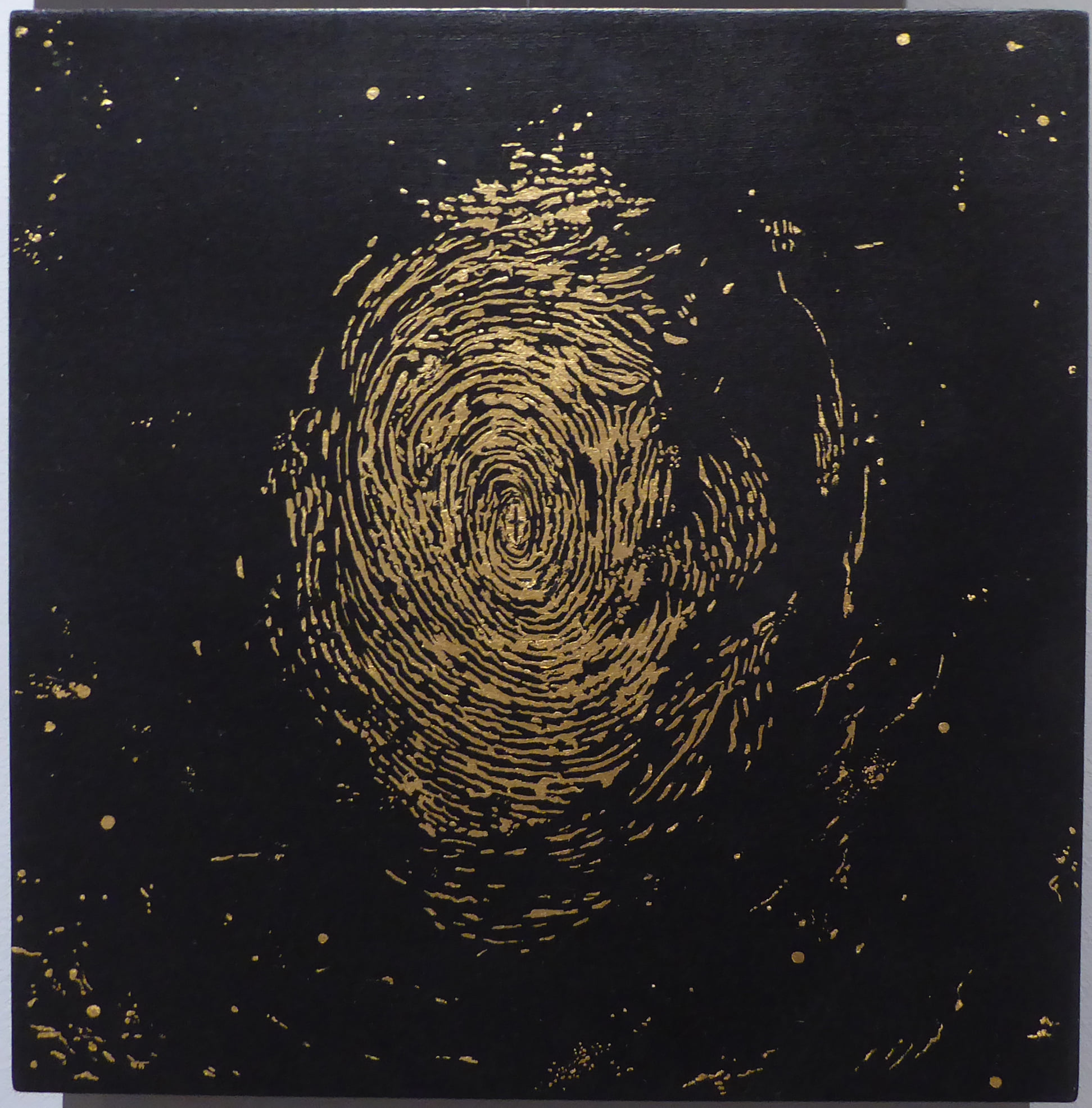
EXHIBITION WALK-THROUGH: Słowo stało się Ciałem (The Word Became Flesh), Warsaw Archdiocese Museum, March 3–31, 2021: Last year a collection of contemporary Ukrainian and Polish icons on the theme of Incarnation was exhibited in Warsaw. In this video, curator Mateusz Sora and Dr. Katarzyna Jakubowska-Krawczyk, head of the Department of Ukrainian Studies at the University of Warsaw, discuss some of the pieces. I don’t speak a lick of Polish, and closed captioning is not available, so I’m not sure what is said—but the camera gives a good visual overview. You can also view a full list of artists and photos of select icons in this Facebook post.

Kuziv, Kateryna_Annunciation
Kateryna Kuziv (Катерина Кузів) (Ukrainian, 1993–), Annunciation, 2020. Egg tempera and gilding on gessoed wood, 40 × 40 cm. [IG: @kateryna_kuziv]

Fiodorowicz, Boris_3,1415926535879323846264338327
Borys Fiodorowicz (Polish), 3,1415926535879323846264338327, 2020. God has fingerprints! [IG: @borysfiodorowicz]

ON A RELATED NOTE: There’s a public exhibition of icons by several of these artists happening in North Carolina at Gordon-Conwell Theological Seminary–Charlotte through February 17, 2023: East Meets West: Women Icon Makers of Western Ukraine. I attended an earlier iteration of East Meets West in Massachusetts back in 2017 (mentioned here), and it was wonderful. The icons are owned by the American collector and former news correspondent to the USSR John A. Kohan, and he has added more pieces to this area of his collection since I last saw it.

There will be a special event on Wednesday, February 1, from 7 to 9 p.m., featuring a talk about the history of iconography by Professor Douglas Fairbairn and a video introduction by Kohan; RSVP here.

+++

ICON INTERPRETATION: “The ‘All-Seeing Eye of God’ Icon” by David Coomler: Icons expert David Coomler unpacks a preeminent example, and two variants, of this unusual icon type that emerged in Russia at the end of the eighteenth century, influenced by the “Eye of Providence” symbol found, for example, on the Great Seal of the United States. Moving from the center outward, four concentric circles show a young Christ Emmanuel, a sun-face, the Theotokos (Virgin Mary), and the angelic hosts, with Lord Sabaoth (God the Father) at the top and symbols of the Four Evangelists at the corners. Inscriptions include “As the burning coal that appeared to Isaiah, a sun arose from the virgin’s womb, bringing to those who wandered in darkness the light of the knowledge of God” (a variant of the Irmos, Tone 2, from the Easter Octoechos) and “My eyes [shall be] on the faithful of the land, that they may dwell with me” (Psalm 101:6).

All-Seeing Eye icon
All-Seeing Eye of God icon, Russia, late 19th or early 20th century

For more icons of this type, see Dr. Sharon R. Hanson’s Pinterest board. And for a fascinating history of the disembodied eye–in-triangle that’s most often associated (unwarrantedly) with Freemasonry in the popular imagination, read Matthew Wilson’s BBC article “The Eye of Providence: The symbol with a secret meaning?” (I learned that one of its earliest appearances is in a Supper at Emmaus painting by Pontormo! It was a Counter-Reformation addition, to cover up the newly banned trifacial Trinity that Pontormo had painted.)

+++

SONG: “Almajdu Laka” (Glory to You) (cover) by the Sakhnini Brothers: The Sakhnini family has lived in Nazareth—Jesus’s hometown!—for generations and is part of the town’s minority Arab Christian population. Adeeb, Elia, and Yazeed Sakhnini [previously] record traditional and original Arabic worship songs together as the Sakhnini Brothers. This is their latest YouTube release, just in time for Christmas. The song is by the Lebanese composer Ziad Rahbani. Turn on “CC” to view the lyrics in English, and see the full list of performers in the video description.

+++

BLOG SERIES: Twelve Days of Carols by Eleanor Parker: There’s a plethora of medieval English Christmas carols preserved for us in medieval manuscripts, a few of which are still part of the repertoire around the world but most of which have fallen into disuse or that are at least lesser known. Medievalist Eleanor Parker spotlights twelve from the latter category. She ran this series back in 2012–13 with the intention of doing twelve posts, one for each day of Christmas, but she stopped short at seven—so I’ve added links to additional carol-based posts of hers from other years. She provides modern translations of the Middle English and, in some cases, brief commentary.

Note that #11 contains an Old English word that Tolkien adopted in his Lord of the Rings!

  1. “Welcome, Yule” (below)
  2. “The Sun of Grace”
  3. “Come kiss thy mother, dear”
  4. “A Becket Carol”
  5. “The Jolly Shepherd”
  6. “Be Merry, and the Old Year”
  7. “Behold and See”
  8. “Hand by hand we shall us take”
  9. “King Herod and the Cock” (below)
  10. “Be merry, all that be present”
  11. “Hail Earendel”
  12. “Christmas Bids Farewell”

Icons roundup

As a caveat, I am a Protestant, and while I do have a profound respect and appreciation for icons, my theology of images, including my definition of sacred art, is not the same as the Orthodox Church’s—even though elements of it are influenced by the Orthodox position. All the same, I believe it’s important for Christians of all denominations to understand the significance of icons and what differentiates them from noniconic religious images. Those lines are being blurred a bit by the new schools of iconography coming out of western Ukraine and Poland, which honor tradition even as they push it forward into the contemporary era. Here are a few icon-related videos, articles, and weblinks that I’ve gathered over the past several months.

LECTURES:

>> “The Meaning of Icons” by Fr. Maximos Constas, November 13, 2019, Notre Dame Seminary: Father Maximos Constas, professor of patristics and Orthodox spirituality at Hellenic College Holy Cross Greek Orthodox School of Theology, explains the significance of icons in the Orthodox Church, with special attention to their aesthetic features and theological meaning, which is informed by the church’s Christology and cosmology. He answers such questions as, Why do the figures in icons look bored and unnatural? And, Doesn’t the Second Commandment forbid representations of Christ? He does not address icon veneration or details of the making process.

Constas spends the first fifteen minutes juxtaposing Eastern and Western approaches to religious images, discussing how the Renaissance values of humanism and naturalism came to prevail in the West. The Orthodox, he says, see this as the “secularization” or “carnalization” of sacred art—in its commitment to depicting observable realities, Western art from the Renaissance onward typically lacks overt signs of transcendence.

Constas also discusses the dogmatization of sacred images in the East. Icons are never simply works of art or pedagogical tools, he says. “They were understood to be visual artistic expressions of the church’s theology. And in the same way that church doctrines could not be changed, neither could the image in which the doctrines were embodied.”

Here are some notes I took on the talk, including some transcriptions:

  • An icon can be a panel painting, a fresco, a mosaic, a relief carving, an enameled plaque, a manuscript illumination, etc. “What ultimately defines an icon has nothing to do with artistic medium or style but rather depends on how the image is used and, most importantly, what it is believed to be. And every icon is a means of spiritual encounter and dialogue. It offers us the possibility of such an encounter because it shares in the holiness of the sacred figure whose likeness it bears.”
  • An icon is not a work of art but a work of witness that makes use of art.
  • “Icons are not simply portraits but manifestations of human persons in their new heavenly condition. They are images of the spiritual character of human beings reborn, as it were, in the womb of eternity.”
  • “The icon has the ability to evoke within me the memory of the forgotten depth of my own being. It enables me to see my true face. It orients me toward my destiny in God. And this vision, this remembrance, this knowledge fills me with unspeakable joy and profound consolation.”
  • We not only can but must make images of Christ; “to deny the icon is to deny the reality of the Incarnation.”
  • “All created things are intrinsically good, and all, therefore, have spirit-bearing potentialities. And to this essential goodness and beauty of the material world, the icon bears joyful witness. In the icon, we see matter restored to harmony and so fulfilling its true vocation, which is to reflect and transmit the divine glory. The icon, then, safeguards not only the authenticity of Christ’s physical body, but also the true value of creation in its unfallen state as created by God. Inherent in the very fact of the icon is an optimistic, affirmative vision of the material creation. As spirit-bearing matter, the icon has what we would call eschatological significance—it anticipates the final transfiguration of the cosmos at the last day, when the created world will be delivered from its present bondage to corruption, to quote St. Paul, and will enter into the glorious liberty of the children of God.”
  • Icons as:
    • windows, doors, thresholds into heaven (spiritual places of passage)
    • mirrors, a reflection of their living source
    • tracks or traces
  • 32:40: Portrayal of figures in icons
    • Alteration of the natural symmetries and proportions of the body, including the features of the face (eyes and ears enlarged; nose elongated; mouth small and closed)
    • Full frontality—wholeness, completion, perfection; makes the icon dialogical and relational
    • Serene, controlled facial expression
  • No shadows cast; illumined from within

>> “Rajaton hengellinen kuva: Kärsimyksen ja ylösnousemuksen kuvat” (Boundless Spiritual Image: Images of Suffering and Resurrection) by Ari Luomajoki, March 26, 2021, Kuopio Cathedral, Kuopio, Finland: I don’t speak Finnish, but I share this seventy-minute video for the visuals (and of course for any Finnish speakers!) and to show how contemporary icons are spreading west. In August 2016 under the leadership of Pastor Ari Luomajoki, the Lutheran Monastic Community of Enonkoski in Ihamaniemi, Finland, organized its first international icon workshop (read more here, and follow @LutheranIcon on Facebook), which attracted iconographers from Poland and Ukraine, as well as a few domestic artists. It was reprised in 2017 (I mentioned this second workshop here). Icons that came out of these workshops have been exhibited several times in Finland, and have facilitated relationships that have led to new exhibitions—such as Kärsimyksen ja ylösnousemuksen kuvat (Images of Suffering and Resurrection) at Kuopio Cathedral, which ran March 26–April 11, 2021. Follow the boldface link to see a taping of the opening, which includes opening comments, a tour, and a lecture.  

Movchan, Danylo_Descent from the Cross
Danylo Movchan (Ukrainian, 1979–), Descent from the Cross, 2021. Watercolor on paper, 33 × 38 cm.

Mindewicz, Basia_Entombment of Christ
Basia Mindewicz (Polish, 1978–), Lamentation, 2016. Acrylic on wood, 26 × 20 cm.

In the first sixteen minutes of the video, Pastor Olli Viitaniemi, one of the main organizers of the exhibition (with Pastor Salla Tyrväinen), shows screen captures from the website he built connected to the exhibition, https://sielunkuvat.net/. At around 16:24 he gives a tour of the exhibition around the church sanctuary.

At 32:48 Luomajoki—who is a Lutheran pastor in Kouvola, Finland, and has a master’s degree in art history—starts his half-hour lecture. He introduces Międzynarodowe Warsztaty Ikonopisów w Nowicy (International Iconography Workshop in Nowica) in Poland and Lviv National Academy of Arts and the Iconart gallery in Ukraine, two centers of contemporary Eastern iconography that inspired the icons project at the Enonkoski monastery in Finland. At 47:41 Luomajoki does side-by-side image comparisons to show similarities and differences across time. At 50:41 he discusses the use of images in early Lutheranism. He goes on to show some examples of religious art in Finland in the past century (including a really compelling Crucifixion painting by Helene Schjerfbeck and crucifix by Paavo Halonen!). He closes by spotlighting Hidden Life in Nazareth by Ivanka Demchuk and a Nativity by Arsen Bereza, participants in the workshop.

Luomajoki is a wonderful photographer of art. Follow him on Instagram @ari.luomajoki.

+++

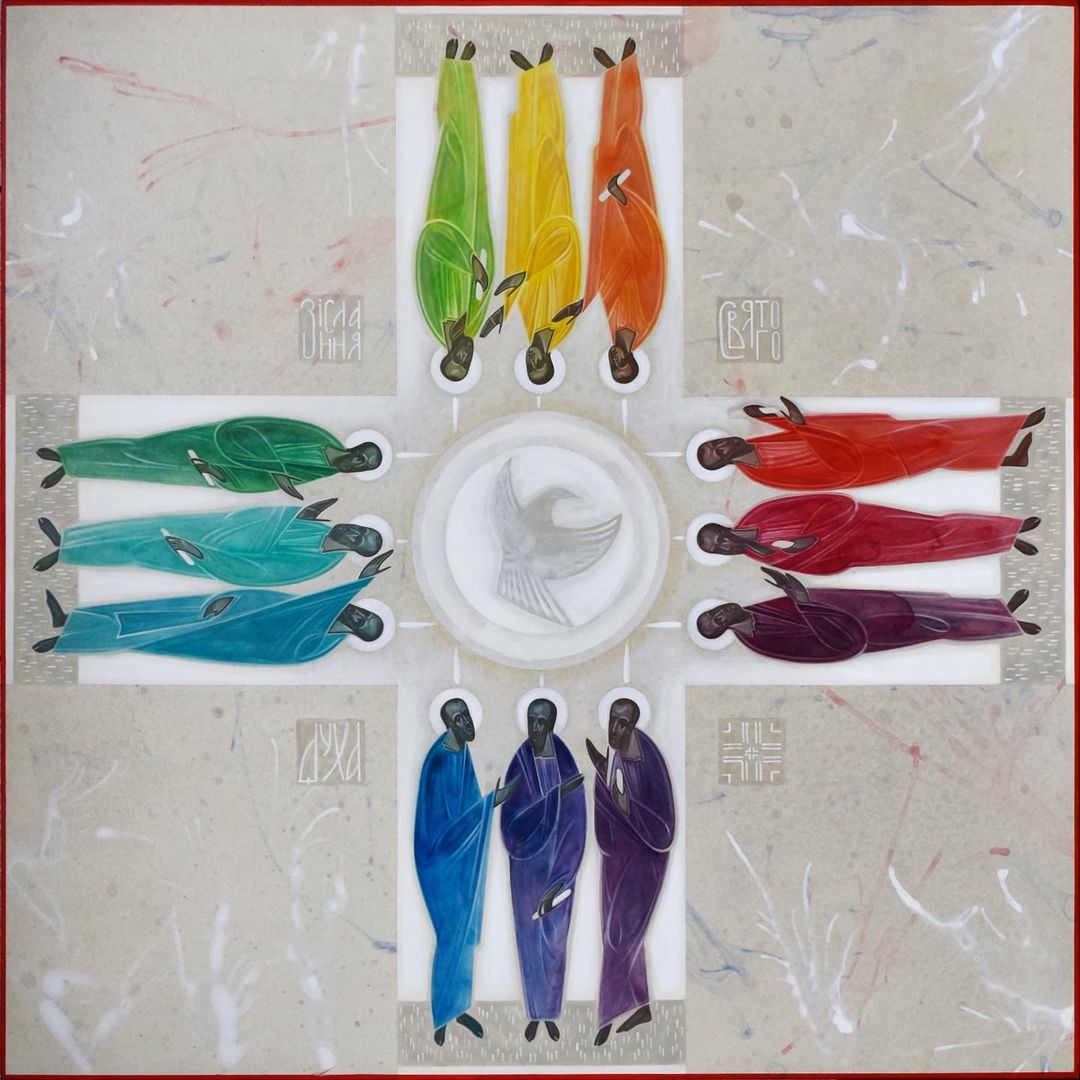
INTERVIEW with contemporary iconographer Khrystyna Kvyk, by Kevin Antlitz: OK, Patheos blog posts are painful to read because of all the obtrusive ads, which is why I rarely link to them. But I’m making an exception for this one, where American Anglican pastor Kevin Antlitz interviews Ukrainian Greek Catholic iconographer Khrystyna Kvyk, who earned a master’s degree in sacral art in 2020. She discusses her process of painting icons, what makes an icon an icon, timelessness and transfiguration, the relationship between tradition and innovation, the idea of divine light as reflected in two of her icons, and more. I really love her work and was delighted to hear some of her own words about it.

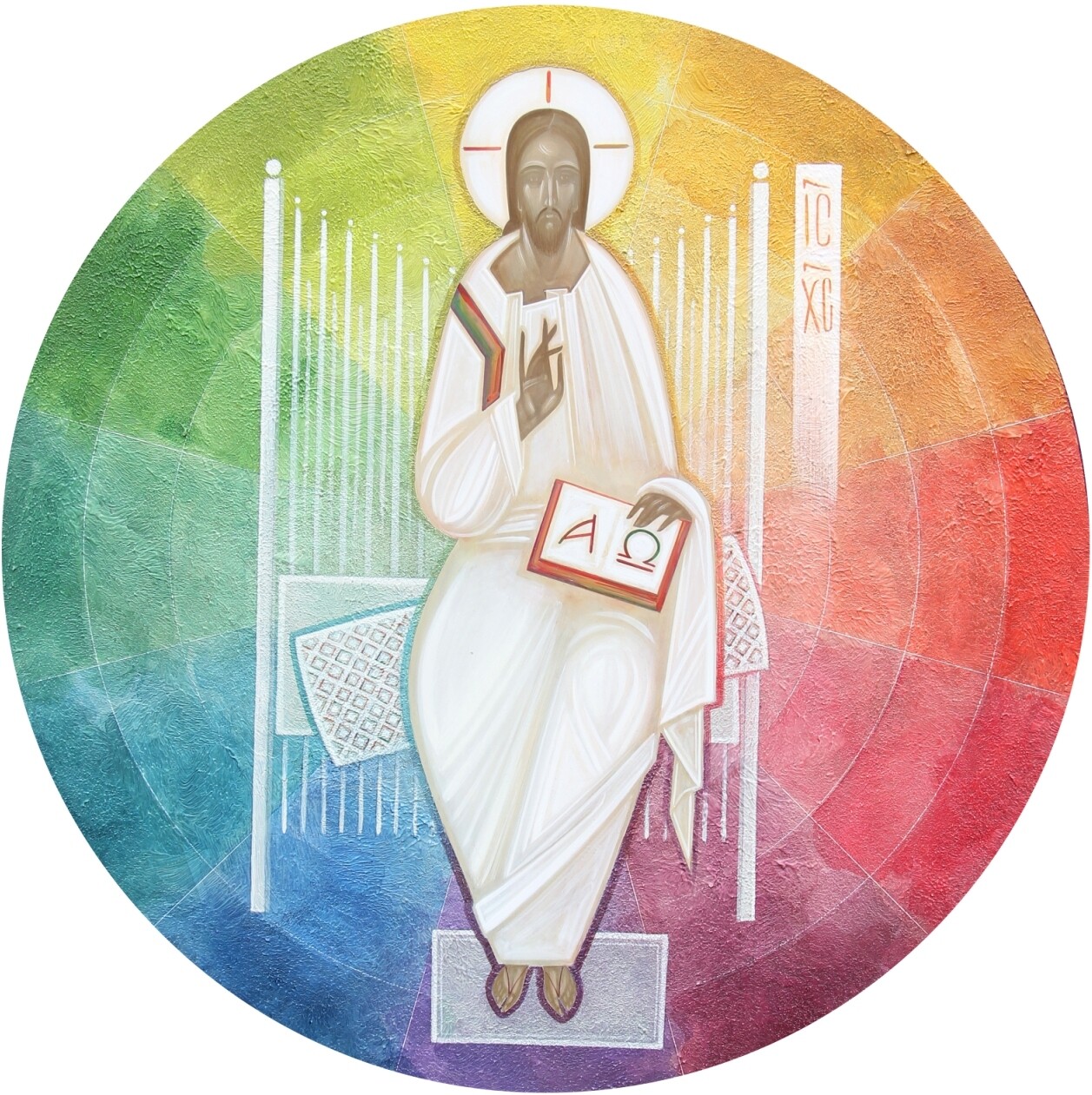
Kvyk, Krystyna_I Am the Light of the World
Khrystyna Kvyk (Ukrainian, 1994–), I Am the Light of the World, 2021. Acrylic on gessoed wood, diameter 35 cm.

Kvyk, Khrystyna_Pentecost
Khrystyna Kvyk (Ukrainian, 1994–), Pentecost, 2021. Acrylic on gessoed wood, 45 × 45 cm.

This is the final installment of a three-part series by Antlitz. Part 1 answers, What Are Icons?, and part 2 is about “Praying Through Icons.”

+++

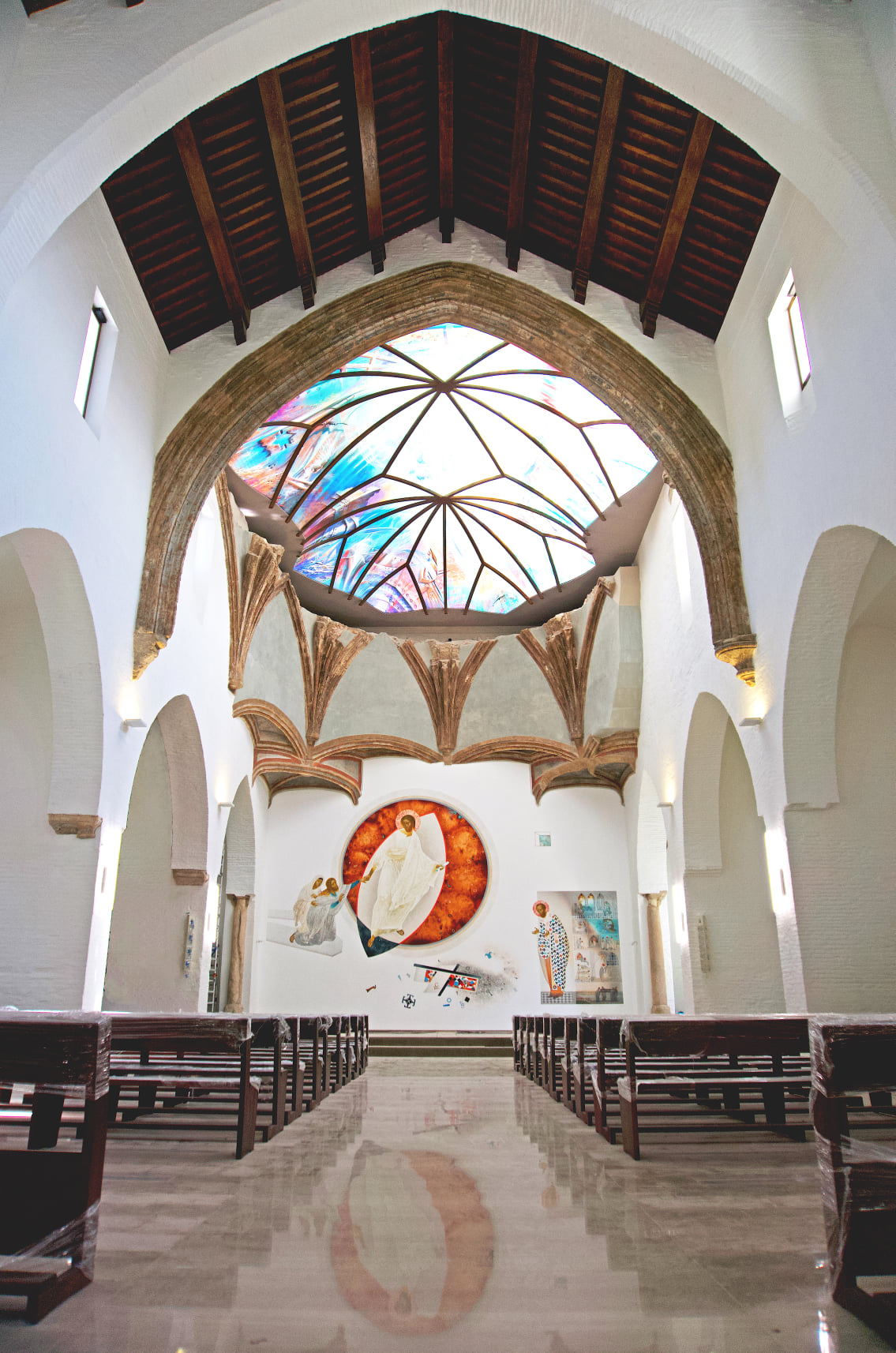
NEW CHURCH COMMISSION: Wall paintings at Iglesia de San Nicolás by Ivanka Demchuk and Arsen Bereza: Ukrainian artists Ivanka Demchuk and Arsen Bereza—a married couple!—have completed a monumental painting on the east wall of the Catholic church of Saint Nicholas in Granada. It was deeply influenced by Byzantine iconography, in which they’ve both been trained, but also contains some modern abstract and geometric elements.

The church building is from the sixteenth century and recently underwent extensive renovations, finally reopening to the public in April, which is when Demchuk and Bereza’s mural was unveiled. It portrays the Anastasis, the Eastern Orthodox image of Christ’s resurrection, which shows him breaking down the doors of hell to release its captives. In the video (which is in Ukrainian with Spanish subtitles), Demchuk describes how they painted two mandorlas behind him: the almond-shaped one symbolizing his divine light, and a round one symbolizing the cosmos.

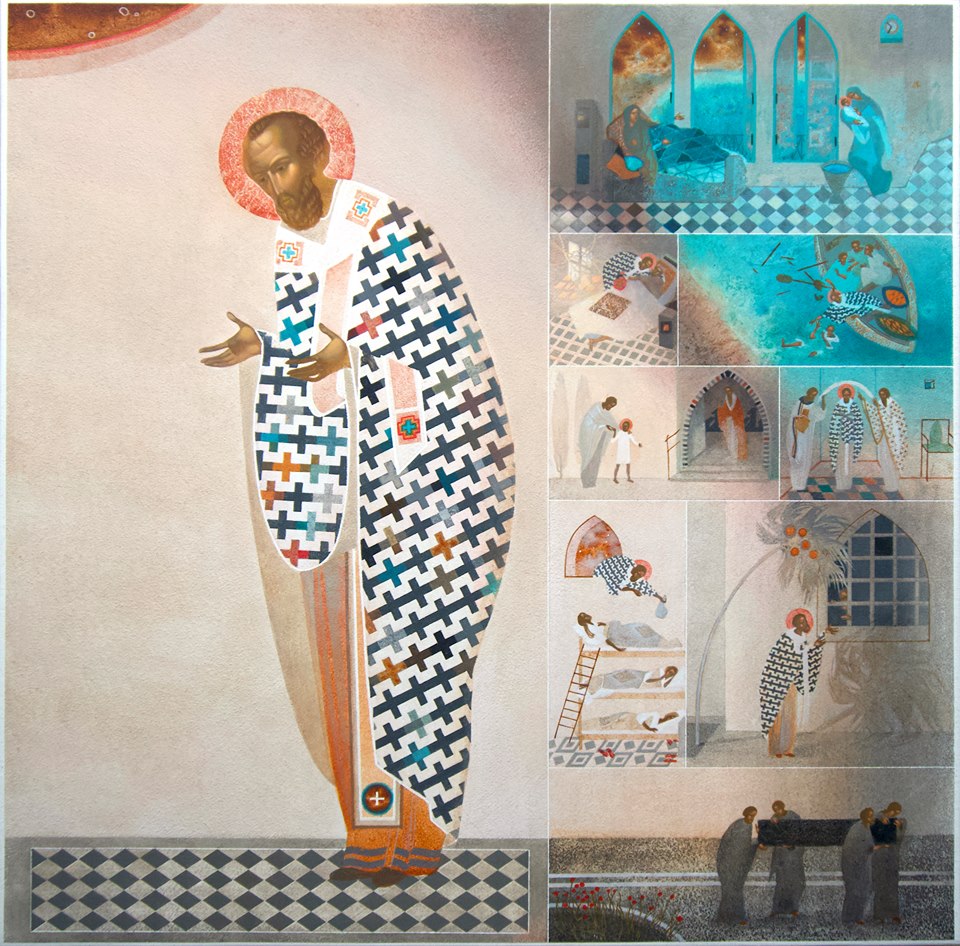
Appearing alongside this focal point is a portrait of the church’s namesake, Saint Nicholas, with eight scenes from his life—including my favorite, where he tosses three bags of gold through the window of an impoverished family’s home. (The legend of Santa Claus—Claus being a shortened form of “Nicholas”—evolved from this story of anonymous gift giving.)

Demchuk, Ivanka_Anastasis (in situ)
Iglesia de San Nicolás, Granada, Spain, 2022, with east end mural by Ivanka Demchuk and Arsen Bereza

Demchuk, Ivanka_Resurrection
Ivanka Demchuk (Ukrainian, 1990–), Resurrection, 2018. Mixed media on wood. Design for the Church of St. Nicholas, Granada, Spain.

Demchuk, Ivanka_St. Nicholas with Scenes from His Life
Ivanka Demchuk (Ukrainian, 1990–), Saint Nicholas with Scenes from His Life, 2018. Mixed media on wood. Design for the Church of St. Nicholas, Granada, Spain.

See more photos of the project on Demchuk’s Facebook page.

+++

BLOG POST: “The Meaning of Melchizedek in Icons” by David Coomler: Though he’s not religious, David Coomler is an expert on Christian icons and often consults on them. On his blog he unpacks the iconography of standard types but also more unusual ones, like You Are a Priest Forever After the Order of Melchizedek, inspired by Hebrews 7. This rare type is meant to show that Jesus is both the offering and the offerer. The variation pictured below shows, I think, three representations of Christ: as crucified seraph (still quite puzzling to me, but Coomler points out that the Greek of Isaiah 9:6 refers to the Messiah as the “Messenger of Great Counsel”), Holy Wisdom (aka Sophia), and high priest—hence the man in ecclesiastical garb in the back. Wild!

Icon with Jesus High Priest

Roundup: Ethiopian illuminations, convent cradles, Women’s Christmas, and more

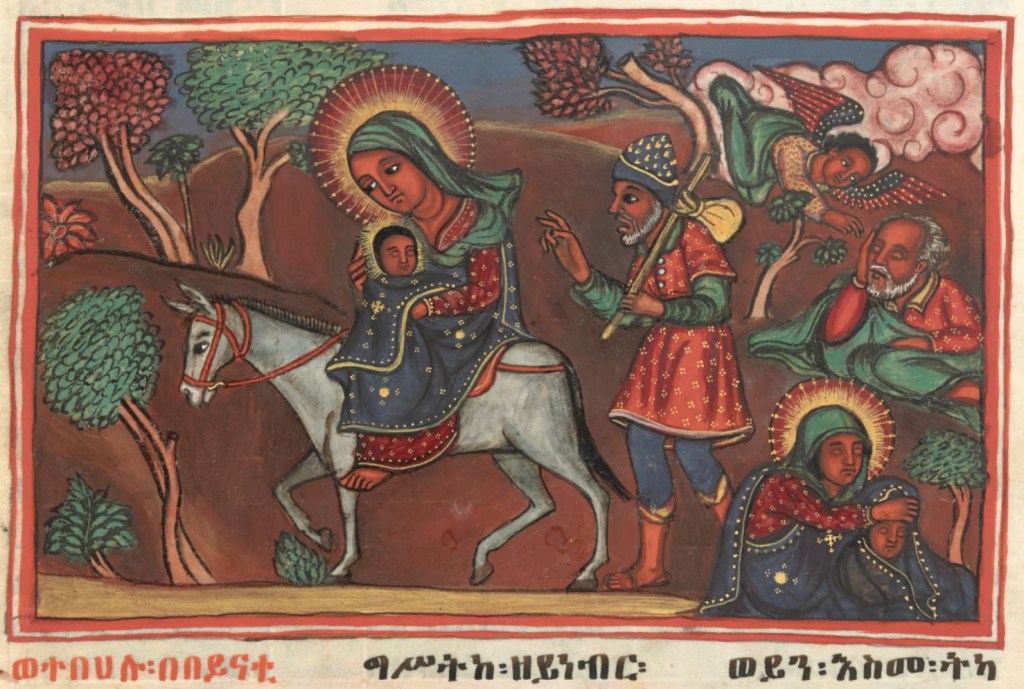
“The Christmas Story: Images from Ethiopic Manuscripts” by Eyob Derillo: The British Library has a fantastic collection of Christian manuscripts from seventeenth- and eighteenth-century Ethiopia. This blog post by curator Eyob Derillo shows Christmas-related illuminations from four different ones. Follow the links in the captions to explore each manuscript further.

Flight to Egypt (Ethiopian)
“Flight into Egypt,” from the Nagara Māryām (History and Miracles of the Blessed Virgin Mary), Ethiopia, ca. 1730–55. British Library Or. 607, fol. 17r.

You can follow Derillo on Twitter @DerilloEyob. He’s always posting fascinating things about Ethiopian art and its intersection with the country’s history, culture, politics, and Christianity, including lots of Ethiopian saints’ stories!

If you enjoyed the blog post, I recommend the highly accessible book The Road to Bethlehem: An Ethiopian Nativity, an interweaving of ancient (apocryphal) tales surrounding Jesus’s birth that flourished in Ethiopia, compiled and told by Elizabeth Laird, with the biblical narrative. It’s illustrated in full color with images from the British Library’s collection and is perfectly appropriate for children (and adults!). I’ve perused the Ethiopian manuscripts on the BL website but am not able to decode several of the images because I’m unfamiliar with the tales and cannot read Ge’ez, and Laird’s book helped me out in that respect, at least in part. For a deeper dive into Ethiopian art—which is inextricable from its patrons’ and makers’ Christian spirituality—see the informative and beautifully produced Ethiopian Art: The Walters Art Museum, a catalog from another museum that houses a fine collection of Ethiopian art.

+++

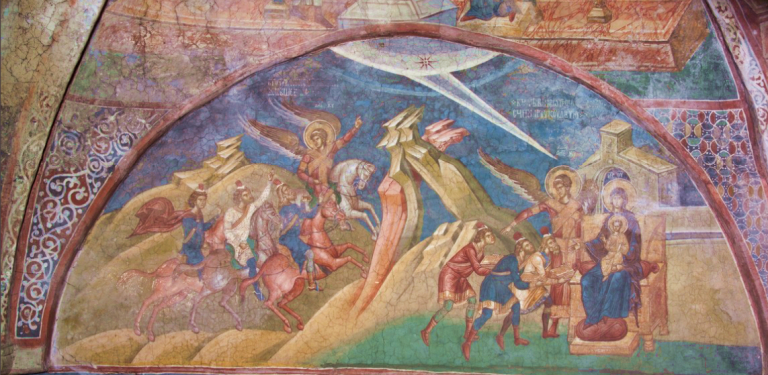
The Angel of the Lord in icons of the Magi: In this recent post from Icons and Their Interpretation [previously], icons consultant David Coomler spotlights a fresco from Decani Monastery in Serbia that shows an angel on horseback leading the magi to the Christ child, emphasizing supernatural direction. He identifies the same, idiosyncratic figure in a 1548 painting by Frangos Katelanos at Varlaam Monastery in Meteora, Greece, comparing it to two more common appearances of an angel with the magi in Eastern iconography: on foot beside the newborn king’s “throne,” presenting the magi to him.

Journey and Adoration of the Magi (icon)
Journey of the Magi and Adoration of the Magi, 14th century. Fresco, Decani Monastery, Serbia. View a modern copy here.

+++

SONG MEDLEY: “Christmas Around the World” by Acapals: Acapals is a collaboration of four friends and a penguin who share a love for making a cappella music (despite not sharing much in the way of geography, culture or language).” They are Nick Hogben, tenor, from England; Leif Tse, baritone, from Hong Kong; Jacky Höger, alto, from Germany; and Prayer Weerakitti, soprano, from Thailand. In this video each of them arranged a holiday song in their native language, which they sing together: “Hark! The Herald Angels Sing” (English), “Silent Night” (Cantonese), “Es ist ein Ros’ entsprungen” (German), and “New Year Greeting” (Thai). [HT: Global Christian Worship]

+++

“The Cloister and the Cradle” by Shannon Reed: Some medieval nuns and lay religious women cared for baby Jesus dolls (ceramic or wooden) as a devotional practice—dressing them, playing with them, “feeding” them, singing to them, rocking them in cradles. Full of wit and tenderness, this Vela magazine essay by Shannon Reed explores that practice. “It is difficult to separate my modern reaction to the sight of a grown woman (in a habit!) acting in such bizarre ways, carrying a doll around and pretending it’s real,” Reed writes. “But I try to remember that for these women, this was an empowering opportunity to be Mary, most holy, most blessed.”

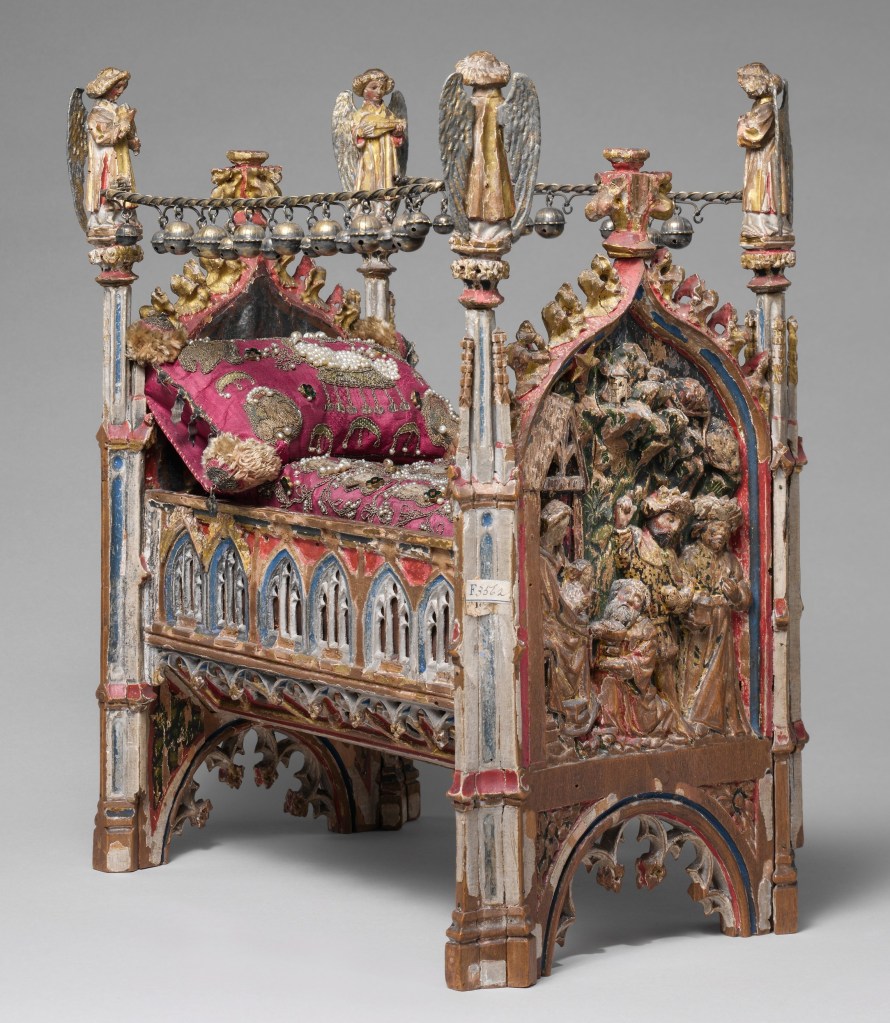
Reed considers women’s agency in the Middle Ages, mystical visions made tangible, and the desire for maternal intimacy, incorporating personal stories and reflections, as a single woman without children, about attending baby showers, nannying through grad school, shopping for godchildren, and teetering between enjoyment of her non-mom status and an inclination to mother. As a thirty-two-year-old woman who also does not have kids (though I am married) and is content but constantly surrounded by reminders of what I’m missing, I can relate to a lot of the feelings and experiences Reed articulates here. I chanced upon this essay when trying to find more information about a Beguine cradle I saw at the Met, pictured below (spurred, too, by the description of a Virgin and Child ivory). I found myself unexpectedly moved by the author’s vulnerability and by the connections she draws between modern-day longings for and expressions of motherhood and those played out in medieval Christian convents.

Beguine cradle (The Met)
Crib of the Infant Jesus, 15th century, from the Grand Béguinage in Louvain (now at the Metropolitan Museum of Art). Click to view details of the carved Nativity and Adoration of the Magi at the head and foot and, on the embroidered coverlet, Jesus’s family tree.

To learn more about how some medieval women mediated their relationship with Christ in part through dolls and cradles, see “Crib of the Infant Jesus” from Feminae: Medieval Women and Gender Index, “Cradling Power: Female Devotions and Early Netherlandish Jésueaux” by Annette LeZotte, “Female Spirituality and the Infant Jesus in Late Medieval Dominican Convents” by Ulinka Rublack, and “Encounter: Holy Beds” by Caroline Walker Bynum.

+++

The Sanctuary Between Us: A Retreat for Women’s Christmas by Jan Richardson: Every year artist, writer, and Methodist minister Jan Richardson provides a new compilation of her art, blessings, and spiritual reflections as a free PDF download. The subtitle references the Irish custom of Nollaig na mBan, or Women’s Christmas, observed particularly in County Cork and County Kerry. “Women’s Christmas originated as a day when the women, who often carried the domestic responsibilities all year, took Epiphany [January 6] as an occasion to celebrate together at the end of the holidays, leaving hearth and home to the men for a few hours.” In this spirit Richardson offers an opportunity “to pause and step back from whatever has kept you busy and hurried in the past weeks or months, . . .  spend[ing] time in reflection before diving into what this new year will hold.”

“Blessing to Summon Rejoicing,” “Blessing of Memory,” “Blessing the Body,” and “Blessed Are You Who Bear the Light” are among the several benedictions, thoughtfully introduced and many accompanied by collages, paintings, or encaustics. Some sections also include questions for personal reflection. For example: “How do you experience—or desire to experience—remembering in community? Who are the people who hold your memories with you? Are there ways you experience memory as a sacrament, a space where you know the presence and grace of God at work in your life? For whom might you be (or become) a sanctuary of memory as you help them hold their stories and their lives?”

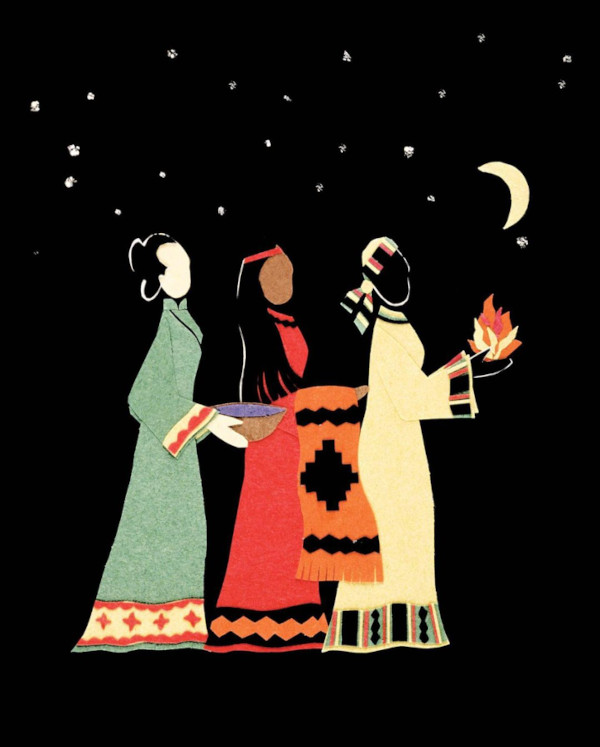
Wise Women Also Came by Jan Richardson
Wise Women Also Came © Jan L. Richardson [purchase]

The poem “Wise Women Also Came,” printed as an interlude, is especially compelling, describing how, in addition to the wise men mentioned in the biblical narrative, wise women also came to Jesus’s birth bearing gifts—“water for labor’s washing, / fire for warm illumination, / a blanket for swaddling.”