My roundups aren’t typically thematic, but in this one I’ve pulled together content around the Psalms—plus a link to my new monthly playlist, from which I call out particular psalms.
SPOTIFY PLAYLIST: June 2026 (Art & Theology): Most months of the year, I release a playlist of thirty songs, mostly by Christian artists—an assortment of psalms, hymns, and other spiritually inclined music. The psalm settings I feature this month are Psalm 10:1 for choir by the South Korean composer Jung Jae-il (known for his work on Parasite and Squid Game); “Psalm 55” by Poor Bishop Hooper (they’ve set all 150 songs from the Psalter!); Psalm 97:11 in Hebrew (“Light dawns for the righteous and joy for the upright in heart”) by the Jewish women’s a cappella ensemble Vocolot; Psalm 103:1, a new cover of Andraé Crouch’s “Bless His Holy Name” by Paul Zach, Jessica Fox, and IAMSON; Psalm 117, in English and Spanish and with Latin rhythms, by The Soil and The Seed Project (see below); a song by the indie singer-songwriter Sam Wilson that uses Psalm 119:103 as a refrain; and “Psalm 139” by the New Jersey–based DJ duo (and married couple) KNGDM REVIVAL.
+++
NEW ALBUM: Psalms by The Soil and The Seed Project: Released last month, this double album contains thirty-four new songs and one re-release. The first disc consists of word-for-word settings of psalms using the NIV or NRSV translations—hence why the album is classified as part of their “Bible Memory Collection”—whereas the second disc comprises songs inspired by the Psalms—loose paraphrases and, more commonly, songs that talk to God in a psalmic vein, encompassing the same broad emotional range as the biblical Psalter. There are songs of praise and gratitude, of weariness and lament, as well as petitionary songs seeking rescue or direction, presence or protection, stillness or fruitfulness.
Here’s the bilingual Psalm 117 setting “Praise the LORD, All You Nations”—the shortest psalm and the shortest chapter in the entire Bible—by Seth Thomas Crissman and Jorge Eliecer Triana, sung by Nicolas Melas and Lauren Yoder. I’ve followed it with “Lord, I Get Grumpy” by Clara Weaver, which she sings with Nichole Barrows while, it sounds like, doing dishes! “Lord, I need your patience” is something I pray a lot; now I can sing it.
Led by my friend Seth Thomas Crissman (MDiv, Eastern Mennonite Seminary), The Soil and The Seed Project is more than just a songwriting collective; they create all kinds of “creative resources that help us together turn towards Jesus in the ordinary moments of life.” Their latest Psalms package includes, in addition to the album, coloring pages and a Little Liturgies booklet with responsive readings, reflection questions, and suggested activities, all written with children in mind. You can download all these resources for FREE from their website!
+++
VIDEOS:
>> “Shaped by the Psalms: A Psalm Festival,” Calvin Institute of Christian Worship: In February, Calvin University in Grand Rapids, Michigan, hosted “Psalms 150: A Conference Experience,” bringing together a variety of guest speakers, musicians, and artists around the Psalms. This video is one of the worship services held at the conference, featuring litanies, prayers, meditations, and seventeen psalm-based songs by artists such as Rawn Harbor, Kiran Young Wimberly and the McGraths, and Bellwether Arts, who were present to lead. The choirs were conducted by either Nate Glasper, Mark Stover, or guest conductor Vinroy D. Brown Jr. There was also a live painting by Joel Schoon-Tanis.
>> “Considering Lament: Psalms of Protest, Pain and Hope,” Presbyterian Church in Ireland: This video presents Considering Lament: Psalms of Protest, Pain and Hope, a suite of eight lament psalms composed in 2026 by David and Karen Campbell based on the experiences of victims and first responders to the Troubles, a violent ethno-nationalist-religious conflict in Northern Ireland that lasted from the late 1960s to 1998 but whose wounds are still felt. The suite grew out of a project conceived by the Peace and Reconciliation Panel of the Presbyterian Church in Ireland’s Council for Public Affairs, which involved Rev. Dr. Karen Campbell and her husband David convening Psalm study groups in eight locations across Northern Ireland over the course of two years. The stories, thoughts, and feelings shared in response to the eight given lament psalms—Psalms 5, 7, 39, 59, 64, 82, 109, and 140—and in relation to the sectarian traumas the participants have endured informed the Campbells’ musical adaptations of these psalms. Click on the link above for the song list.
The lament psalms, Campbell says, “provided vessels to channel all kinds of emotions – from disappointment, anger, betrayal and sorrow – without losing hope,” an avenue “to present our hurts before the One who knows what it means to experience pain . . . and grief.” The Considering Lament suite was recorded by local artists in a studio in South Armagh and is available for free streaming, and you can download an accompanying booklet that includes sheet music. It premiered March 26 at an evening of live worship (see video) that interwove the eight songs with painful stories told firsthand, with a liturgy to connect them and to guide worshippers in prayer and reflection around the theme of suffering and loss.
To learn more about the Considering Lament project, read this wonderful interview with Karen Campbell, conducted by Joan Huyser-Honig for the Calvin Institute of Christian Worship.
+++
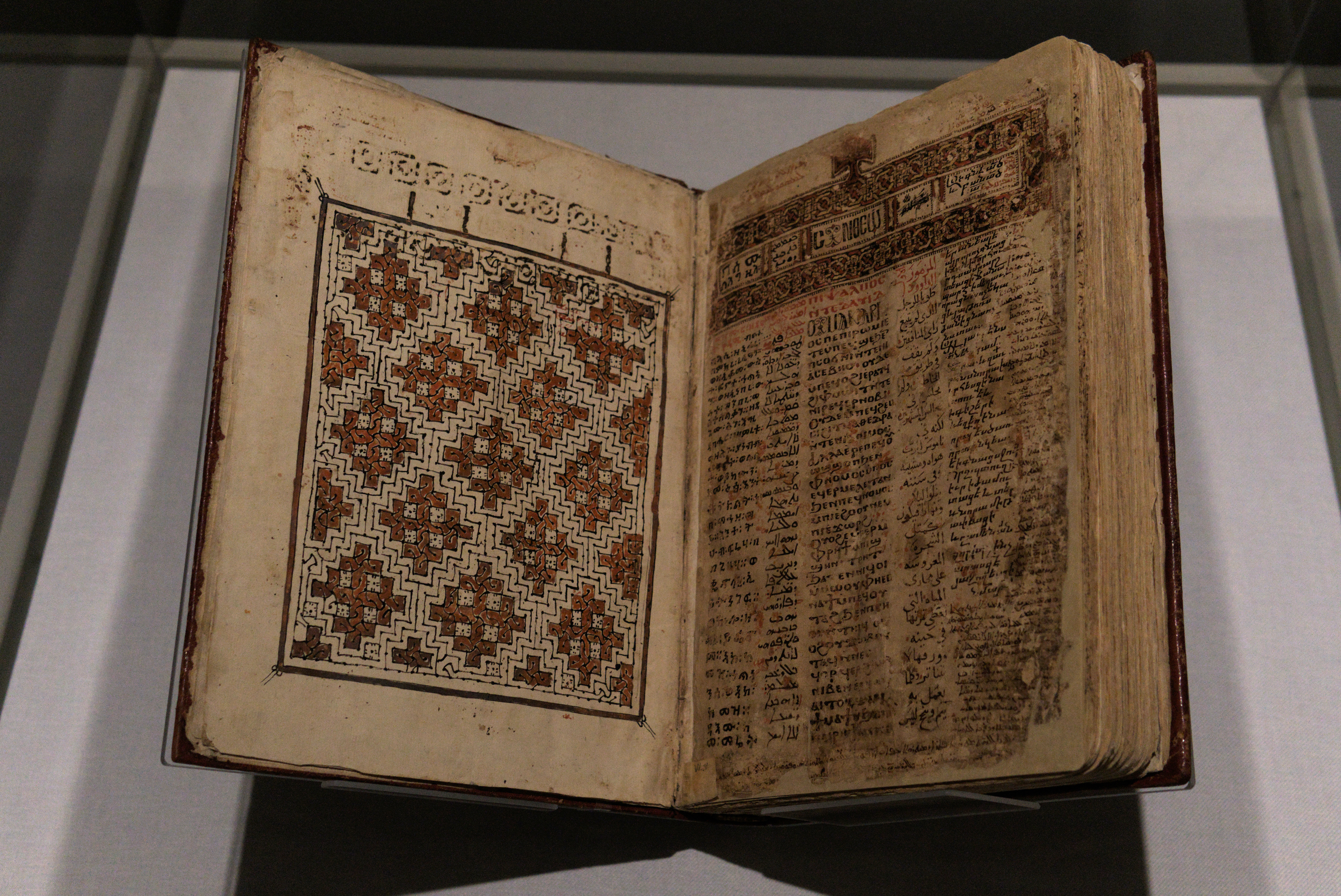
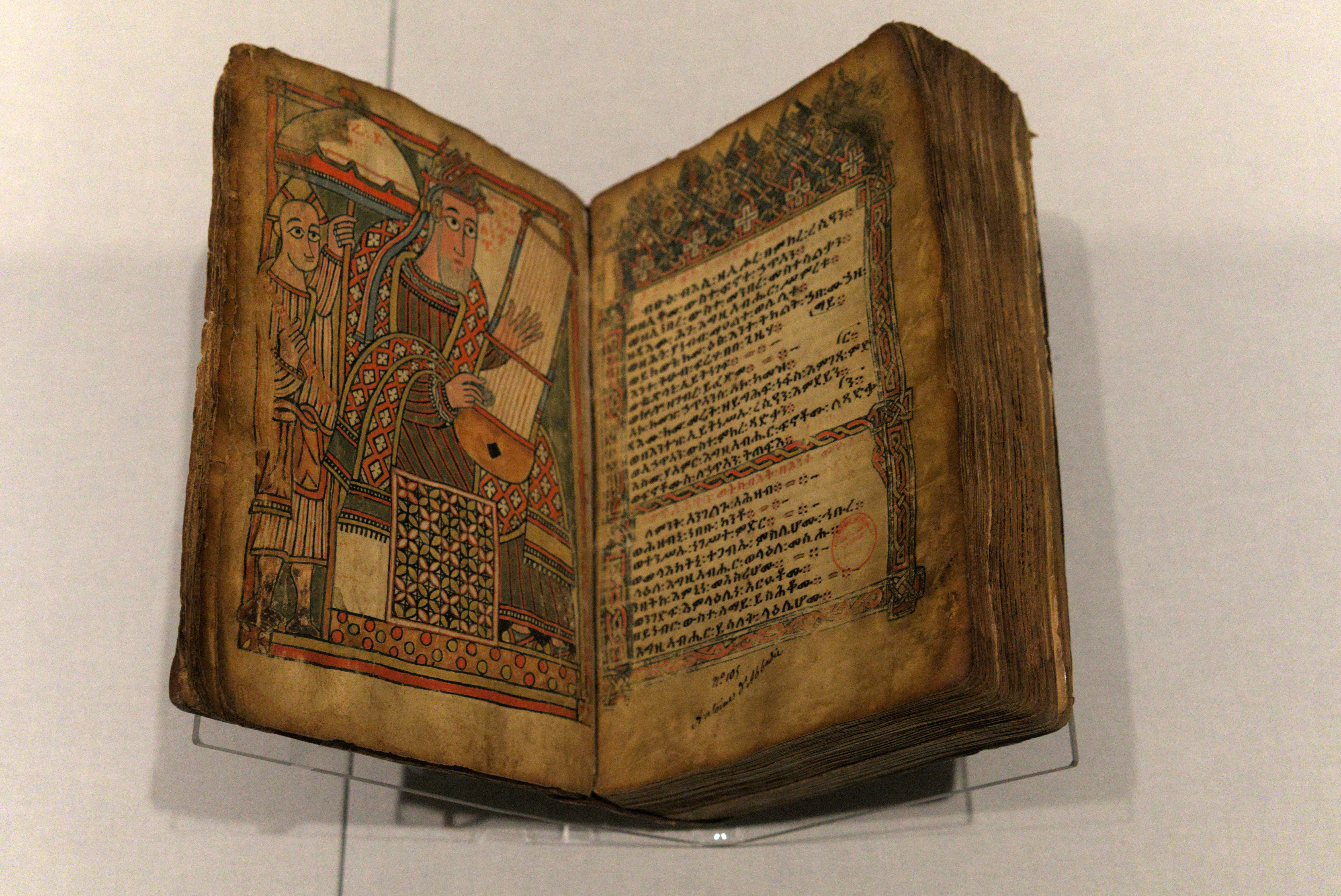
HISTORICAL PSALTERS: Barberini Oriental 2 and Ethiopien d’Abbadie 105: As you know, I’m very interested in Christian material culture, and if a cultural object has an appealing aesthetic, all the better! Here are two psalters (a volume containing the biblical book of Psalms) I photographed at the Africa and Byzantium exhibition at the Metropolitan Museum of Art in 2023. The first, dated to somewhere between the twelfth and fourteenth centuries, is a pentaglot (five-language) psalter from Dayr al-Suryan, a multicultural and multilinguistic monastic community in Egypt. From left to right in parallel columns are Ge‘ez, Syriac, Coptic, Arabic, Armenian, and Syriac again. This format would have facilitated comparative study of the Bible as well as common readings in the liturgy.
Another psalter, from fifteenth-century Ethiopia, was open to a full-page illustration of King David, the author of many of the psalms, playing an Ethiopian box lyre called a begena, traditionally played by elite and royal men. He is shaded by an attendant with a ceremonial umbrella. In most countries at the time, it was common practice for artists to contextualize the Old and New Testament saints of the ancient Near East to their own culture. (Think, for example, of the contemporaneous Italian and Dutch Renaissance paintings.) This anonymous artist has signified “imperial ruler” by giving David the familiar trappings of an Ethiopian emperor. The manuscript would have been used by a priest or monk in the Ethiopian Orthodox Church in both his personal devotions and liturgical services.
+++
POEM: “OLD HUNDRED” by Lucille Clifton: I originally wrote the following commentary for the Daily Prayer Project’s Ordinary Time 2024 periodical, which was Psalms-themed:
OLD HUNDRED is a famous hymn tune from the Genevan Psalter, so named because it came to be associated with William Kethe’s metrical paraphrase of Psalm 100, “All People That on Earth Do Dwell.” In her early poem “OLD HUNDRED,” written in the latter half of the 1960s, the African American poet Lucille Clifton (1936–2010) also engages with the Hundredth Psalm, interleaving its first line with the opening lyric of the spiritual “Nobody Knows the Trouble I’ve Seen” and blues-like phrases to create a multitextured expression of praise and lament.
Like the Psalter itself, life encompasses both gladness and sorrow. While many of the psalms call us to rejoice and give thanks, others express deep pain and questioning. The vocalist and composer Ruth Naomi Floyd says the greatest blues line ever written is Psalm 22:1, which Jesus “sings” from the cross: “My God, my God, why have you forsaken me?”
Clifton had seen trouble; so had Jesus. (“Nobody knows but Jesus . . .”) And Jesus is a friend who stands with us in hardship, weathering it alongside. When God’s promises seem far off and we can’t muster a hallelujah, looking to Jesus can give us the strength, both to be honest about our trouble and to put it in God’s hands and so lay hold of joy. “OLD HUNDRED” wrestles through that.
Does this poem feel disjunctive or integrated? What do you make of Clifton’s use of all-caps? After reading the poem, read Psalm 100 and the lyrics to “Nobody Knows” and compare them. Consider how they both fit into the church’s repertoire of songs.
“OLD HUNDRED” can be found in Clifton’s Collected Poems, a volume I highly recommend.