
“The Fury of Sunrises” by Anne Sexton (poem)

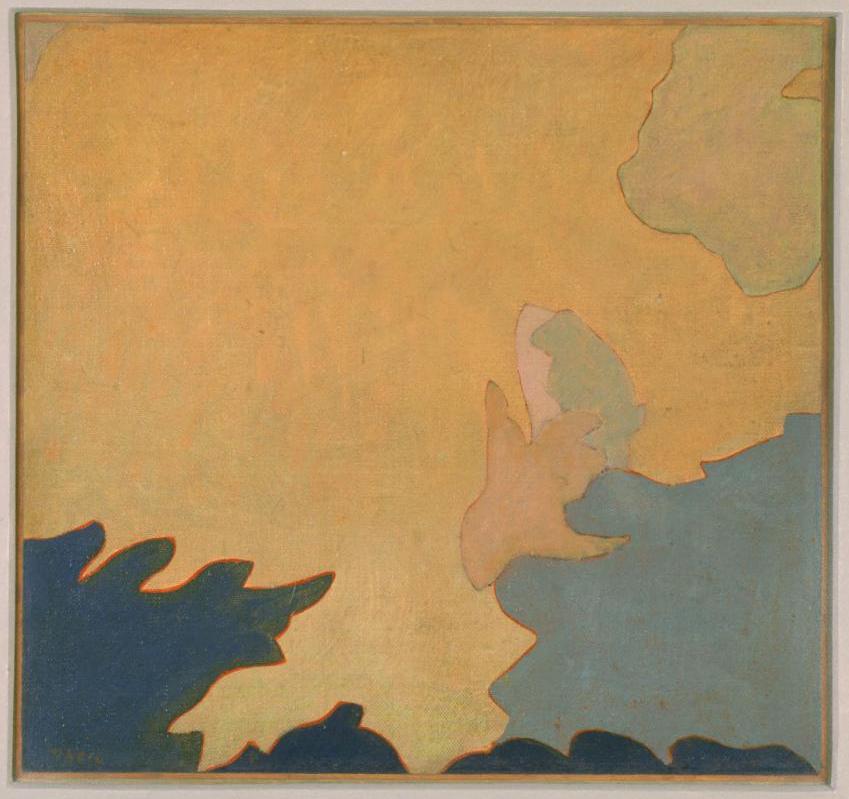
Tack, Augustus Vincent_Dawn
Augustus Vincent Tack (American, 1870–1949), Dawn, 1934–36. Oil on canvas mounted on hardboard, 23 3/4 × 24 3/4 in. (60.3 × 62.9 cm). Phillips Collection, Washington, DC.

Darkness
as black as your eyelid,
poketricks of stars,
the yellow mouth,
the smell of a stranger,
dawn coming up,
dark blue,
no stars,
the smell of a lover,
warmer now
as authentic as soap,
wave after wave
of lightness
and the birds in their chains
going mad with throat noises,
the birds in their tracks
yelling into their cheeks like clowns,
lighter, lighter,
the stars gone,
the trees appearing in their green hoods,
the house appearing across the way,
the road and its sad macadam,
the rock walls losing their cotton,
lighter, lighter,
letting the dog out and seeing
fog lift by her legs,
a gauze dance,
lighter, lighter,
yellow, blue at the tops of trees,
more God, more God everywhere,
lighter, lighter,
more world everywhere,
sheets bent back for people,
the strange heads of love
and breakfast,
that sacrament,
lighter, yellower,
like the yolk of eggs,
the flies gathering at the windowpane,
the dog inside whining for food
and the day commencing,
not to die, not to die,
as in the last day breaking,
a final day digesting itself,
lighter, lighter,
the endless colors,
the same old trees stepping toward me,
the rock unpacking its crevices,
breakfast like a dream,
and the whole day to live through,
steadfast, deep, interior.
After the death,
after the black of black,
this lightness—
not to die, not to die—
that God begot.

“The Fury of Sunrises” is the last of fifteen poems from Anne Sexton’s “The Furies” cycle, published in The Death Notebooks (Houghton Mifflin, 1974). Copyright is held by the Estate of Anne Sexton, represented by Sterling Lord Literistic.

Anne Sexton (1928–1974) was a Pulitzer Prize–winning confessional poet from New England who wrote in starkly personal terms about her psychiatric struggles (she suffered from bipolar disorder and died by suicide), sexuality, and other taboo subjects. Much of her poetry expresses a yearning for the ecstatic and sublime and explores religious questions, referencing God and faith—even though she characterized herself, in a 1968 BBC interview, as an atheist, albeit one who was “rather attracted to Catholicism.”

Advent, Day 17: Yonder Come Day

Be attentive to this [God’s message] as to a lamp shining in a dark place, until the day dawns and the morning star rises in your hearts.

—2 Peter 1:19b

LOOK: Bridge of Glory by Nicholas Roerich

Roerich, Nicholas_Bridge of Glory
Nicholas Roerich (Russian, 1874–1947), Bridge of Glory, 1923. Tempera on canvas, 82 × 163 cm. Nicholas Roerich Museum, New York.

LISTEN: “Yonder Come Day,” African American spiritual | Performed by the Schola Cantorum of St. Peter’s in the Loop, dir. J. Michael Thompson, on Music for Advent II (2005)

Yonder come day, day is a-breakin’
Yonder come day, O my soul
Yonder come day, day is a-breakin’
Sun is a-risin’ in my soul

This spiritual originated in the nineteenth century in the enslaved Black communities of St. Simons Island off the coast of Georgia. Daybreak here can be read as a metaphor for salvation, happiness, death/beatification, or possibility. The latter was an especially common application, as the song was typically sung at Watch Night services, a New Year’s Eve tradition of Christian prayer, worship, song, and dance lasting from around 7 p.m. until midnight.

Recorded in 1963 in Los Angeles, the performance below is from the short film Georgia Sea Island Singers (1964), available on the DVD The Films of Bess Lomax Hawes (2003) and streaming on Kanopy:

The singers are, from left to right, John Davis, Bessie Jones, Emma Ramsay, Henry Morrison, and Mabel Hillary. They sing these lyrics:

Yonder come day
(O day)
Yonder come day
(O day)
Yonder come day
Day done broke
Into my soul

Yonder come day
(I was on my knees)
Yonder come day
(I was on my knees)
Yonder come day
(I was on my knees)
Yonder come day
Day done broke
Into my soul

. . . I heard him say . . .

. . . It’s a New Year’s day . . .

. . . Come on, child . . .

In 2016, Paul John Rudoi arranged “Yonder Come Day” together with “Hush, Hush,” “Steal Away,” and “Swing Low, Sweet Chariot,” creating a medley of spirituals in which “Yonder” is the through line. The medley is performed in the following video by the University of Oregon Chamber Choir, featuring soloist Alexa McCuen:

The coming of Christ is often described as the rising of a new day. That goes for his first advent in Bethlehem; his second, future advent; and his advent in the human heart, as people receive him and are flooded with spiritual light. “Yonder Come Day” is an apt song for remembering with gratitude one’s own conversion, that moment when Christ came to you and transformed you from the inside out.


This post is part of a daily Advent series from December 2 to 24, 2023 (with Christmas to follow through January 6, 2024). View all the posts here, and the accompanying Spotify playlist here.

Dawning Light (Artful Devotion)

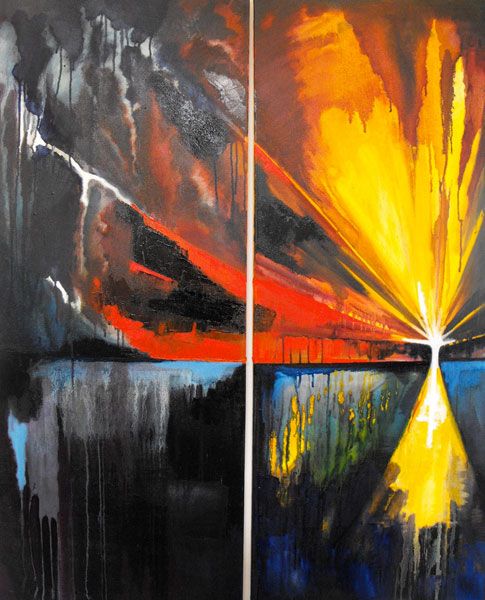
Tutin, Judith_Breaking
Judith Tutin (Irish, 1979–), Breaking, 2011. Diptych, St. Aidan’s Cathedral, Enniscorthy, County Wexford, Ireland.

But there will be no gloom for her who was in anguish. In the former time he brought into contempt the land of Zebulun and the land of Naphtali, but in the latter time he has made glorious the way of the sea, the land beyond the Jordan, Galilee of the nations.

The people who walked in darkness
have seen a great light;
those who dwelt in a land of deep darkness,
on them has light shone.
You have multiplied the nation;
you have increased its joy;
they rejoice before you
as with joy at the harvest,
as they are glad when they divide the spoil.
For the yoke of his burden,
and the staff for his shoulder,
the rod of his oppressor,
you have broken as on the day of Midian.
For every boot of the tramping warrior in battle tumult
and every garment rolled in blood
will be burned as fuel for the fire.

—Isaiah 9:1–5

Now when he heard that John had been arrested, he withdrew into Galilee. And leaving Nazareth he went and lived in Capernaum by the sea, in the territory of Zebulun and Naphtali, so that what was spoken by the prophet Isaiah might be fulfilled:

“The land of Zebulun and the land of Naphtali,
the way of the sea, beyond the Jordan, Galilee of the Gentiles—
the people dwelling in darkness
have seen a great light,
and for those dwelling in the region and shadow of death,
on them a light has dawned.”

From that time Jesus began to preach, saying, “Repent, for the kingdom of heaven is at hand.”

—Matthew 4:12–17

+++

SONG: “The Dawning Light” by James Ward, 1998 (CCLI 4200451)


This song was recorded live in 1998 at the Resurrection Youth Convention in Gatlinburg, Tennessee. The MP3 can be downloaded for free, along with sheet music, at http://ncfmusic.com/resource/dawning-light/.

For a previously featured James Ward song, see the Artful Devotion “Death Is Ended.”

+++

The Jewish prophet Isaiah was active during the Assyrian captivity in the second half of the eighth century B.C. The Israelite lands of Zebulun and Naphtali were, along with Gilead in Transjordan, the first to fall to Assyria; the people were deported, and their lands became Assyrian provinces. But these three areas, according to Isaiah 9:1, would also be the first to see the dawning of a glorious new era, where the people step out of darkness and desolation into the fruits of God’s victory, and all military equipment is cast once and for all into an enormous bonfire, for war is over, and oppression is no more.

In The Prophecy of Isaiah: An Introduction and Commentary, biblical scholar J. Alec Motyer emphasizes how Isaiah 9:2–5 is couched in past tenses, even though what it describes has not yet occurred:

The future is written as something which has already happened, for it belonged to the prophetic consciousness of men like Isaiah to cast themselves forward in time and then look back on the mighty acts of God, saying to us: ‘Look forward to it, it is certain, he has already done it!’ Because of this confidence, Isaiah can place the light of 9:1ff. in immediate proximity to the darkness of 8:22, not because it will immediately happen but because it is immediately evident to the eye of faith; those walking in the darkness can see the light ahead and are sustained by hope. . . .

Isaiah insists here that hope is a present reality, part of the constitution of the ‘now’. The darkness is true but it is not the whole truth and certainly not the fundamental truth. (98–99)


This post belongs to the weekly series Artful Devotion. If you can’t view the music player in your email or RSS reader, try opening the post in your browser.

To view all the Revised Common Lectionary scripture readings for the Third Sunday after Epiphany, cycle A, click here.