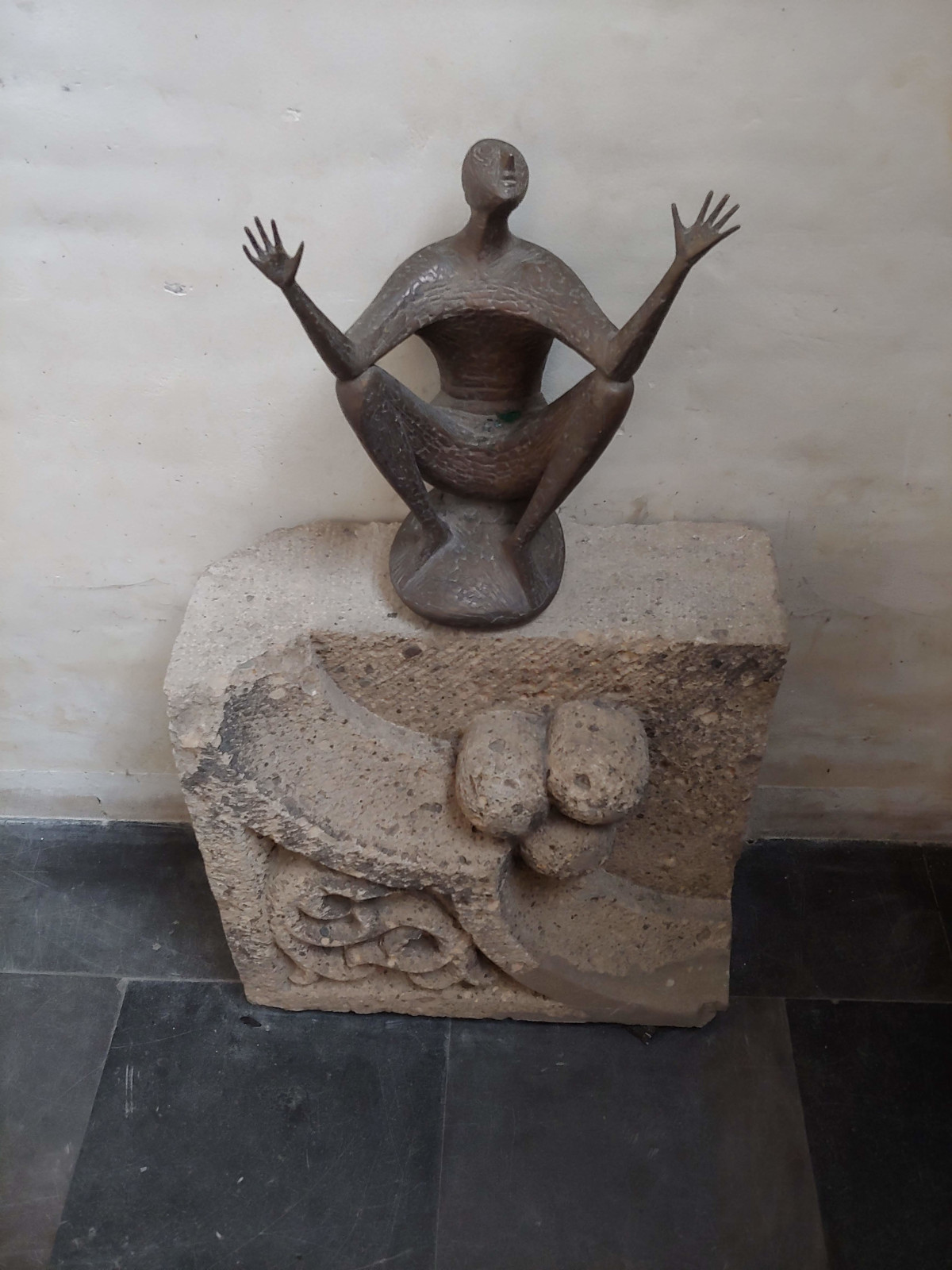
Unidentified sculpture at the Grote of Sint-Laurenskerk (Church of Saint Lawrence), Rotterdam, Netherlands. Photo: Victoria Emily Jones.
Would God I knew there were a God to thank
     When thanks rise in me, certain that my cries
Do not like blind men’s arrows pierce the skies
     Only to fall short of my quarry’s flank.
Why do I thirst, a desperate castaway
     Quaffing salt water, powerless to stop,
Sick lark locked in a cellar far from day,
     Lone climber of a peak that has no top?

To praise God is to bellow down a well
     From which rebounds one’s own dull booming voice,
          Yet the least leaf points to some One to thank.
The whorl embodied in the slightest shell,
     The firefly’s glimmer signify Rejoice!
          Though overhead, clouds cruise a sullen blank.
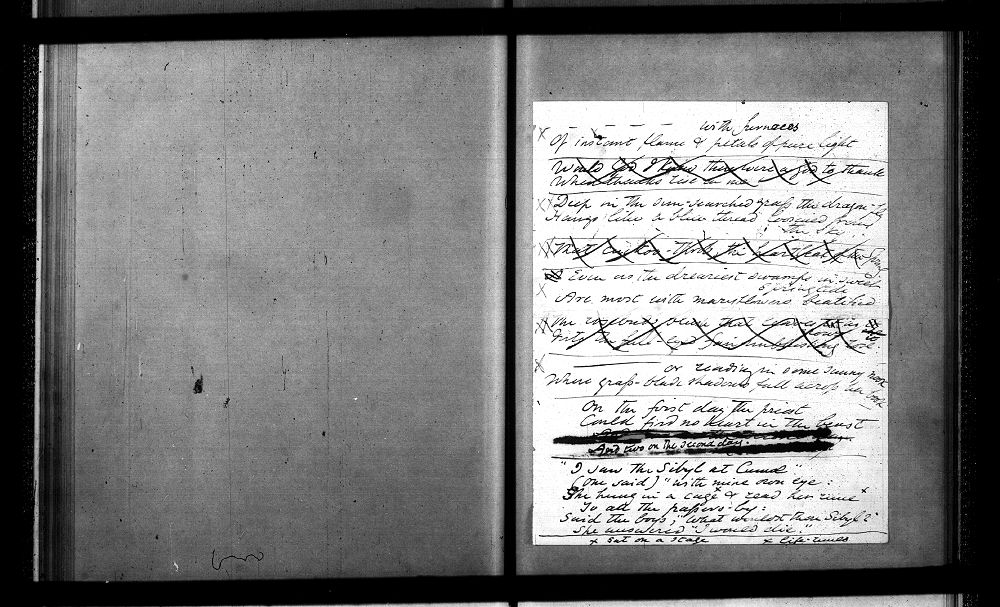
The first line and a half of this sonnet are a crossed-out fragment from one of the notebooks of the British poet and artist Dante Gabriel Rossetti (1828–1882), which he used to work out poetic ideas. This one never went anywhere. But Rossetti’s brother, William Michael Rossetti, saw something in it worthy of preservation; he salvaged it and other select scraps from his brother’s papers, publishing them posthumously in a “Versicles and Fragments” section of Rossetti’s collected works in 1901.
Page 16 of Sonnets and Fragments by Dante Gabriel Rossetti (Princeton/Troxell bound manuscript volume), 1848–81. The first deletion, by Rossetti’s hand, is “Would God I knew there were a god to thank / When thanks rise in me.” [object record]
The modern American poet X. J. Kennedy developed Rossetti’s fragment into a full poem that grapples with the silence of God and, despite such, the impulse to praise. The speaker is confounded by the contradiction that the world seems infused with God’s presence—the natural world points to a Creator—and yet God is unresponsive when the speaker initiates contact. The prayers he launches toward heaven like arrows appear not to reach their target. He’s experiencing spiritual aridity. He feels like a thirsty castaway whose only drink is salt water (why doesn’t God satiate as promised?); a bird trapped in a dark cellar; a mountain climber endlessly climbing, never catching sight of the vista.
The poem tugs back and forth between despondency and awe, between clench-fisted frustration and open-handed surrender. Each glorious tree leaf, the intricate design of conch shells, the whimsy of lightning bugs—these are gifts, but where’s the giver? Gratitude must be directed to someone, but whom does one thank for the wonders and small joys experienced in nature? Who or what is their source? Oh, how I wish I knew there were a God out there to thank, when thanks well up in me. The speaker wants to place his thanks somewhere, but when he places them in God, he receives no confirmation of receipt. There’s a disconnect between what nature testifies and what the speaker has suffered: the “sullen blank” of heaven.
Dante Gabriel Rossetti’s brother, William, wrote in 1895 that, unlike their devout sister Christina [previously], Dante was “a decided sceptic. He was never confirmed, professed no religious faith, and practised no regular religious observances; but he had sufficient sympathy with the abstract ideas and the venerable forms of Christianity to go occasionally to an Anglican church—very occasionally, and only as the inclination ruled him.” Starting in mid-adolescence, he rejected organized religion.
Kennedy, similarly, was raised in a religious household: his father was Catholic, his mother Methodist. And yet in his adulthood he has come to question and reject some of the tenets of orthodox Christianity. But still, he searches for God. “There is a clash in his poems between his skepticism or uneasy agnosticism and his unresolved longing for faith in God,” reads his bio on the Harvard Square Library website. Kennedy’s desire to believe but his inability to do so is expressed recurringly in his work—as in this poem, in which he, taking the baton from Rossetti, is very likely the speaker.
X. J. Kennedy (born 1929) is an American poet, translator, editor, and author of children’s literature and textbooks on English literature and poetry. Born Joseph Charles Kennedy in Dover, New Jersey, he adopted the nom de plume X. J. Kennedy in 1957 to avoid being mistaken for the better-known Joseph Kennedy, then US ambassador to England and father of future president John F. Kennedy. His award-winning poetry collections include Nude Descending a Staircase (1961) and Cross Ties (1985). He lives in Lexington, Massachusetts.
ONLINE EVENT: “Theodicy of Beauty” by Sarah Clarkson, March 6, 2:30 p.m. ET: “The question of suffering is one of the central, aching questions of faith. Too often, we meet suffering with an argument for God’s goodness, rather than an invitation to find and discover his goodness anew. Join me for an exploration of what it means to encounter and trust the beauty of God in our times of darkness, suffering, and pain. Drawing on my own story of mental illness and depression, I’ll explore what it means to engage with God’s goodness in a radically healing way, one that restores our capacity to imagine, hope, and create. We’ll use literature, art, and poetry to discern the ways that God arrives in our darkness to heal us, and also to restore us as agents of his loveliness in the midst of a broken world.”
This Crowdcast talk by Sarah Clarkson is based on her book This Beautiful Truth: How God’s Goodness Breaks into Our Darkness. Registration is $7 and includes a complimentary downloadable copy of “Encountering Beauty,” an arts-based reader’s guide to Clarkson’s book. I have appreciated her From the Vicarage: Books, Beauty, Theology newsletter and her wise, gentle reflections on spirituality, literature, and motherhood on Instagram @sarahwanders, so I’m looking forward to hearing from her on this topic!
+++
LECTURES (available on podcast platforms):
>> “The Loving Look” by Dr. Elissa Yukiko Weichbrodt: In this keynote address for the 2018 Beautiful Orthodoxy conference, art historian Elissa Yukiko Weichbrodt [previously], author of Redeeming Vision: A Christian Guide to Looking at and Learning from Art, discusses how contemporary art—which can sometimes be confounding or otherwise challenging—can drive us to confession, empathy, and love. Sharing her encounters with three contemporary artworks, she talks about art as a place where we can experience sanctification and common grace; how the Incarnation further vested our material world with significance; art as an invitation to embodied knowledge; art as part of how we order and understand our physical world; artworks as mirrors and shapers of culture; and how viewers, not just artists, are called to faithfulness.
She cites Esther Lightcap Meek’s Loving to Know: Covenant Epistemology, in which Meek says that all acts of coming to know are integrative; they become part of us. Knowledge is an act of covenantal care, Meek says. We don’t know in order to love; we love in order to know. Weichbrodt says, “For me, contemporary art—particularly art made by artists grappling with histories and experiences that have remained largely unseen, unknown, and unloved by the dominant culture—has served as a catalyst for faithful knowing.”
>> “The Arts as a Means to Love” by Dr. Mary McCampbell: In this lecture given for English L’Abri, Mary McCampbell [previously], an associate professor of humanities at Lee University, discusses some of the ideas from her book Imagining Our Neighbors as Ourselves: How Art Shapes Empathy. I appreciate how her writing and teaching embraces the arts of film and television alongside literature, such that not only are works like The Power and the Glory by Graham Greene, “A Good Man Is Hard to Find” by Flannery O’Connor, and Beloved by Toni Morrison explored, but so are, for example, the comedy-drama Lars and the Real Girl and the drama series Better Call Saul. Discrediting the recent odd assertion from a prominent evangelical corner that empathy is a sin, McCampbell affirms that empathy is, on the contrary, an essential Christian virtue, and one that the narrative arts are adept at forming in us, exposing us to people and stories outside our realms of experience and helping us recognize the image of God in unlikely places.
+++
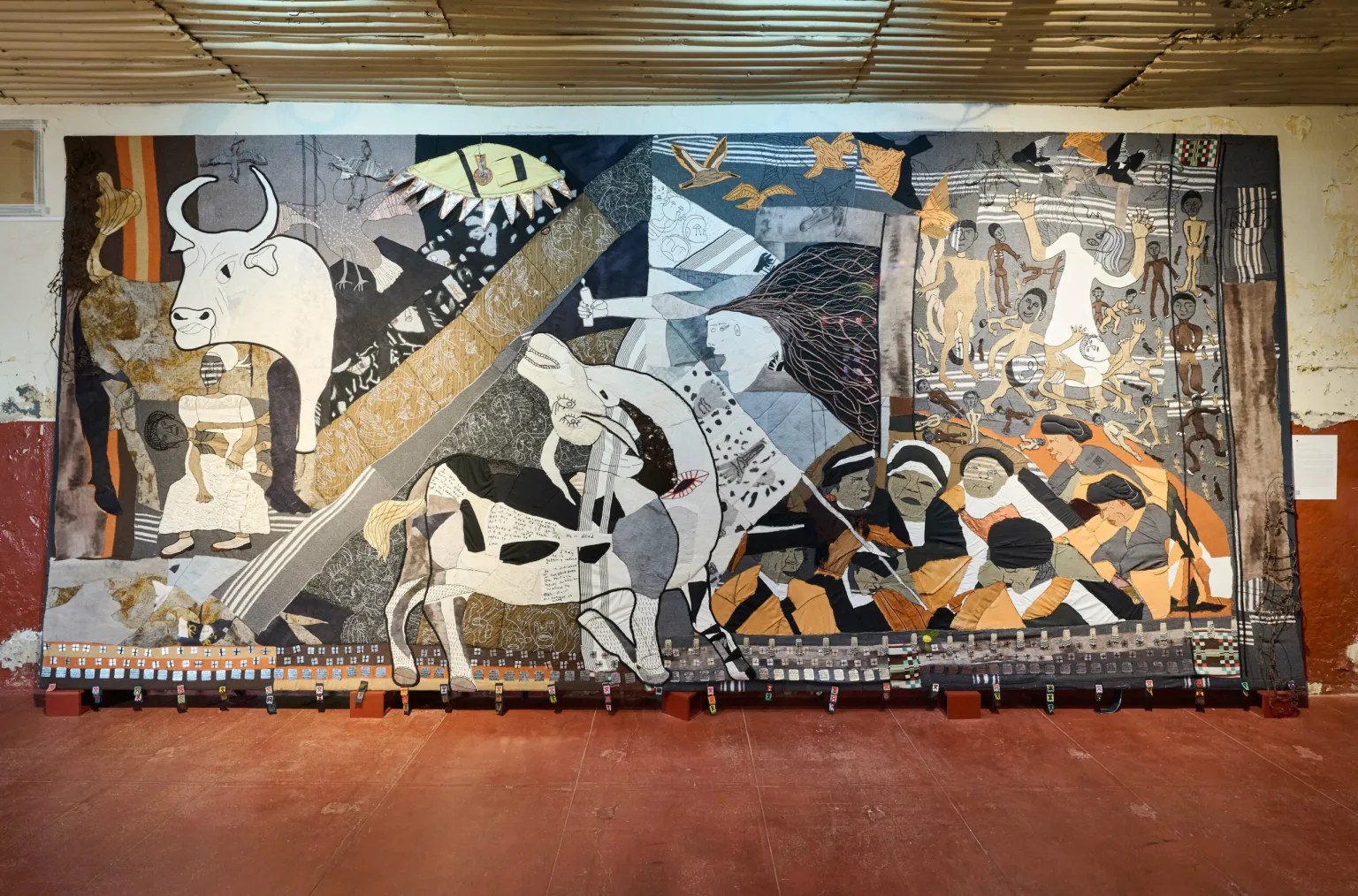
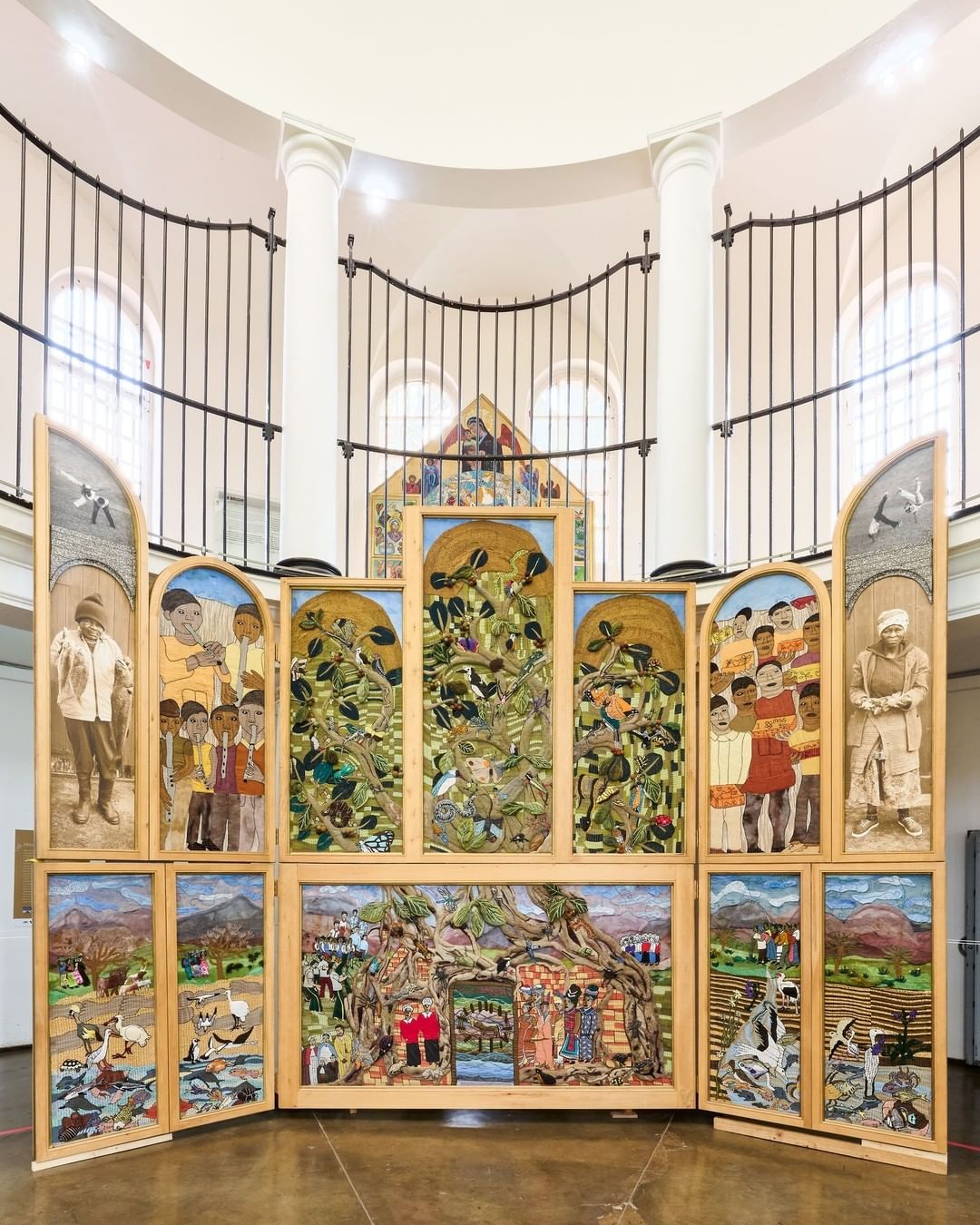
EXHIBITION REVIEW: “Mourning and Perseverance Stitched into South African Tapestries” by Alexandra M. Thomas: Through March 24 at Constitution Hill in Johannesburg, you can see Umaf’evuka, nje ngenyanga, dying and rising, as the moon does, a major retrospective of the work of the Keiskamma Art Project. Founded in 2000, the project archives the collective memory and oral histories of the rural Eastern Cape of South Africa through textile artworks, mainly by Xhosa women. Monumental and small-scale works tell stories of trauma, grief, hope, faith, resilience, and celebration. One of my favorite art research projects has been the one I did on the Isenheim-inspired Keiskamma Altarpiece in 2015, which resulted in the article “Sewing seeds of hope in South Africa”; this altarpiece is one of the many works on display. Let me call out just two others. The photos are from the current exhibition.
Keiskamma Guernica, 2010. Mixed media, including appliqué, felt, embroidery, rusted wire, metal tags, beaded AIDS ribbons, used blankets, and old clothes, 3.5 × 7.8 m. Collection of Javett Art Centre at the University of Pretoria, Tshwane, South Africa. Photo: Anthea Pokroy / Keiskamma Trust.Creation Altarpiece, 2007. Mixed media, including felt, embroidery, photographs, beadwork, wirework, and appliqué, 3.8 × 5.2 m (open). Collection of Unisa Art Gallery, Tshwane, South Africa.
Keiskamma Guernica, after Picasso’s famous antiwar painting, laments the limited access to HIV treatment in rural South Africa in the 2000s and the negligence of government hospitals, which resulted in many HIV/AIDS deaths. The piece repurposes the blankets and clothes of the deceased and serves as an expression of outrage as well as a form of commemoration. Creation Altarpiece, modeled loosely after the Ghent Altarpiece, exults in the region’s abundant wildlife and natural resources and in life-giving initiatives like Hamburg’s music education program, its capoeira group (a dance-like martial art), and the memory boxes made by orphaned children to remember their parents. The three top central panels depict a fig tree eating up an old hotel built by colonialists (a real-life scene observed in the nearby village of Bell!), and the bottom three show villagers of all kinds gathering around Christ, represented as a bull (whereas lambs were commonly sacrificed in ancient Israelite religion, traditional Xhosa religion calls for bull sacrifices).
SONG: “Kyrie” by Ngwa Roland:Ngwa Roland is a composer and the director of De Angelis Capella [previously], a Catholic choir from Yaoundé, Cameroon. Here is his choral setting of the Kyrie eleison (Greek for “Lord, have mercy”), an important Christian prayer used in liturgies around the world.
+++
ARTICLES:
>> “To One Kneeling Down No Word Came” by Jonathan Chan, Yale Logos:Jonathan Chan is a Singapore-based poet and essayist who graduated with a master’s degree in East Asian Studies from Yale in 2022. In this personal essay he reflects on the poetry of R. S. Thomas, a twentieth-century Anglican priest from Wales, particularly as it relates to the toil of prayer—prayer as a discipline requiring persistence and solitude. Thomas’s poems often express a sense of alienation from God, which is not what we might expect from a pastor, but, as Chan remarks, “God’s absence cultivates a desire for God’s presence.”
>> “Stabat Mater: How a 13th Century Lament Resonates Today” by Josh Rodriguez, Forefront: Back in July 2020, composer Josh Rodriguez [previously here and here] published this article on four modern settings of one of the most celebrated Latin hymns of all time, the twenty-stanza Stabat Mater Dolorosa (lit. “The sorrowful mother was standing”), about Mary mourning the death of her son Jesus. Written in the Middle Ages, it continues to inspire composers today, and it remains “a powerful vehicle for ‘grieving with those who grieve,’” Rodriguez writes. He spotlights the settings by James Macmillan, Julia Perry, Hawar Tawfiq, and Paul Mealor, analyzing some of the musical elements of each and quoting the composers in regards to the piece’s meaning to them.
The Rothschild Canticles is the name of a lavishly illuminated manuscript of Franco-Flemish origin, produced at the turn of the fourteenth century. “A potpourri of biblical verses, liturgical praise, dogmatic formulas, exegesis, and theological aphorisms, . . . the manuscript leads its user step by step through meditations on paradise, the Song of Songs, and the Virgin Mary to mystical union and, finally, contemplation of the Trinity,” describes Barbara Newman in her excellent essay “Contemplating the Trinity: Text, Image, and the Origins of the Rothschild Canticles.” It’s a diminutive little book, with a trim size of just four and a half inches by about three and a quarter.
The manuscript lacks any provenance before 1856, but Newman proposes that it was made at the Benedictine abbey of Bergues-Saint-Winnoc in Flanders, located at what is today the northern tip of France. The compiler of its texts, she suggests, was probably the same person who designed its remarkable images—most likely a monk of Saint-Winnoc, who probably employed a professional lay artist from Saint-Omer to execute the designs. The book’s patron was probably a canoness at the nearby abbey of Saint-Victor. It is now preserved at the Beinecke Rare Book and Manuscript Library at Yale University in New Haven, Connecticut. All photographs in this post are courtesy of the Beinecke. Click here to page through the fully digitized manuscript.
The most extraordinary section of the book is a florilegium (collection of literary extracts) on the Trinity, which comprises folios 39v–44r and 74v–106r and draws especially on Augustine’s De Trinitate. Within these pages are nineteen full-page miniatures that exhibit “the most stunning iconographic creativity, . . . bearing witness to a distinctive Trinitarian theology.”
The representation of the Holy Trinity poses one of the most difficult iconographic problems in Christian art. How is one to portray three distinct, divine persons who share one essence? Historical attempts have included the following:
Three identical Christomorphic men (this one is relatively rare)
Three mystically conjoined faces, or three separate heads sharing one body (nicknamed the “monstrous Trinity” and condemned by the Roman Catholic Church)
The Gnadenstuhl (Throne of Mercy, or Throne of Grace), in which the Father is shown holding a crucifix or, in a later variation known as the Mystic Pietà, his slumped Son, while the Holy Spirit in the form of a dove hovers between them
Triangles, trefoils, triquetras, or other abstract geometric designs that suggest Three-in-Oneness
In the Eastern Orthodox Church, the Holy Trinity is represented by three angels seated at a table. These are the three mysterious visitors of Abraham in Genesis 18, believed to be a theophany (visible manifestation of God).
The artist of the Rothschild Canticles relies on none of these conventions, inventing instead an almost wholly original visual language to express the rich yet daunting doctrine. In contrast to other depictions of the Trinity, in the Rothschild Canticles we find, says Newman,
a playful, intimate approach to the triune God, marked by spontaneity rather than solemnity, dynamism rather than hieratic stasis, wit rather than awe. There is no hint of narrative, but something more like an eternal dance. . . . The divine persons are caught up in an everlasting game of hide-and-seek with humans while they enact among themselves, in ever-changing ways, that mutual coinherence that the Greek fathers called perichoresis—literally “dancing around one another.” (135)
Jongleurs (itinerant medieval entertainers proficient in juggling, acrobatics, music, and recitation), angels, and various pointing figures play the role of implied viewers and manifest a joyous attitude. For example,
on fol. 79r a celestial percussionist attacks a row of bells with mallets; on fol. 84r, angels in the upper left and right play a game of ring toss; on fol. 88r, musicians . . . strum whimsically shaped zithers embellished with animal heads. . . . In the lower right corner of fol. 96r, an elfin figure bends over backward to play an instrument whose pinwheel shape mimics the great solar wheel behind which divine Wisdom hides. Four characters in the corners of fol. 98r stretch their arms as if to join hands in a cosmic dance, while on fol. 100r, three spectators raise their hands in wonder beneath a divine apparition, imitating the stunned postures of Peter, James, and John at the Transfiguration. . . . Collectively, they seem to proclaim that the reader need not be ashamed or afraid, even though all human attempts to comprehend the Trinity are comically inept. Nonetheless, she can merrily follow the Lord of the Dance. (135–36)
The quirkiness is so endearing!
Newman continues,
In the Rothschild Canticles, coinherence is the dimension of Trinitarian theology to which the artist seems most profoundly committed. The complex relationality of the three persons is conveyed through the delicate interplay of touch, gesture, and changing positions. Sometimes the Father and Son join hands; on fol. 104r they touch feet behind the wheel they hold. Sometimes they grasp the sides, wings, or talons of the dove, and sometimes they unite around a fourth figure representing the Divine Essence. (143–44)
Moreover,
the artist invented some simple devices to keep the paradox of triunity before the mind’s eye at all times. For example, a prime signifier of divinity—the golden sun with its waving, tentacle-like rays—is sometimes single (fols. 44r, 81r, 88r, 90r), sometimes triple (fols. 40r, 83r, 94r). Elsewhere the artist complicated this formula. On fol. 79r, three small suns for each person are superimposed on one large sun; fols. 92r and 100r insert a smaller sun inside a bigger one; and on fol. 96r, two suns interlock to form a double wheel with spokes radiating both inward and outward. (141)
I particularly like fol. 94r, where the three persons of the Godhead wear the sun like a collar. And fol. 100r, where we see just three feet and three hands, each belonging to a different person, peeping out from behind a giant sun disc!
Another recurring and versatile motif in the Trinity cycle is the veil, which signifies both God’s presence and God’s hiddenness. Sometimes it forms a hammock in which the Trinity rests, partially covered (fols. 75r, 88r); or is braided in an enclosing circle, dangling down for humans to touch (fol. 81r); or is looped about the Father, Son, and Spirit, nestling them snugly (fol. 84r); or is knotted and clutched (fol. 92r); or is draped over bands of cloud (fol. 106r). In this artistic program, veils both conceal and reveal, communicating the paradoxical nature of God who is ensconced in mystery—incomprehensible—and yet accessible, wanting to be known.
Notably, the profusion of Trinitarian imagery is supplemented in the manuscript with textual reminders of the limitations of images. In De Trinitate 8.4.7, for example, Augustine says that all manmade images of God are false, and yet, he says, they are useful insofar as they help the mind cling to the invisible reality to which they point.
Below is a complete compilation of Trinity miniatures from the Rothschild Canticles, reproduced in the order they appear in the manuscript. I have prefaced most with one or more of the quotations that appear on its facing page (thanks to Newman’s identifications) so that you can see how intricately text and image relate. If you wish to reproduce any of these images singly, I suggest the following credit:
Trinity miniature from the Rothschild Canticles (MS 404, fol. _), made in Flanders, ca. 1300. Beinecke Rare Book and Manuscript Library, Yale University, New Haven, Connecticut.
“Dominus in orisunte eternitatis et supra tempus” (The Lord is on the horizon of eternity and beyond time):
Fol. 40rFol. 42r
“Tu es vere Deus absconditus” (Truly you are a hidden God) (Isa. 45:15):
Fol. 44r
“Bene ergo ipsa difficultas loquendi cor nostrum ad intelligentiam trahit, et per infirmitatem nostram coelestis doctrina nos adjuvat: ut quia in Deitate Patris, et Filii, et Spiritus sancti nec singularitas est, nec diversitas cogitanda, vera unitas et vera Trinitas possit quidem simul mente aliquatenus sentiri, sed non possit simul ore proferri.”—Pope Leo I, Sermo 76.2
(“This difficulty in expressing clearly by speech draws our hearts to the power of discerning, and, through our weakness, the heavenly doctrine helps us, that, because of the divinity of Father, Son, and Holy Spirit, neither singularity nor diversity is to be considered. The true unity and true Trinity can be apprehended ‘at the same time’ by the mind, but cannot be produced at the same time by the lips.” Trans. Jane Patricia Freeland, CSJB, and Agnes Josephine Conway, SSJ)
Fol. 75r
“Pater complacet sibi in Filio et Filius in Patre, et Spiritus sanctus ab utroque” (The Father is well pleased in the Son, and the Son in the Father, and the Holy Spirit is from both):
Fol. 77rFol. 79r
“Dicebat enim intra se si tetigero tantum vestimentum eius salva ero” (She said within herself, if I touch the hem of his garment, I will be healed) (Matt. 9:21):
81r
(Also illustrated on fol. 81r is the Holy Spirit as the person “qui facit ex utroque unum” [who makes both one; cf. Eph. 2:14], as cited on the facing page. Notice the shared halo.)
“Trinus personaliter et unus essentialiter” (Three in persons and one in essence):
Fol. 83rFol. 84r
“Dominus Deus noster Deus unus est” (The Lord our God is one God) (Mark 12:29):
Fol. 88r
“Ita et singula sung in singulis, et omnia in singulis, et singula in omnibus, et omnia in omnibus, et unum omnia. Qui videt hec vel ex parte, vel per speculum et in enigmate, gaudeat cognoscens Deum.”—Augustine, De Trinitate 6.12
(“They are each in each and all in each, and each in all and all in all, and all are one. Whoever sees this even in part, or in a puzzling manner in a mirror [1 Cor. 13:12], should rejoice at knowing God.” Trans. M. Mellet, OP, and Th. Camelot)
Fol. 90r
“Sapientia sua, que pertendit a fine usque ad finem fortiter et disponit omnia suaviter” (His wisdom, which reaches from end to end mightily and orders all things sweetly) (Wis. 8:1):
Fol. 92r
“Tres vidit et unum adoravit” (He saw three and worshipped one), a liturgical verse referring to the Trinitarian epiphany in Genesis 18:1–3, in which Abraham saw three men, fell down in worship, and then addressed his divine visitors in the singular:
Fol. 94r
“Gyrum caeli circuivi sola et in profundum abyssi penetravi et in fluctibus maris ambulavi” (I [Wisdom] have circled the vault of heaven alone) (Ecclus. 24:8):
Fol. 96rFol. 98r
“Abscondes eos in abdito faciei tuae” (Thou hidest them [the saints] in the covert of thy presence) (Psa. 30:21):
Fol. 100r
“Optime et pulcrius loquitur qui de Deo tacet” (He speaks best and most beautifully who is silent about God):
Fol. 102r
“Centrum meum ubique locorum, cirumferentia autem nusquam” (My center is in all places, my circumference nowhere). Also, “Quod Deus est, scimus. Quid sit, si scire velimus, / Contra nos imus. Qui cum sit summus et imus, / Ultimus et primus, satis est; plus scire nequimus.” (We know that God is; if we wish to know what he is, / We go against ourselves. That he is the highest and the lowest, / The last and the first, is enough; we can know no more.) And another: “Deus fuit semper et erit sine fine; ubi semper fuit, ibi nunc est. / Et ubi nunc est ibi fuit tunc.” (God always was and shall be without end; where he always was, there he is now. And where he is now, there he was then.)
Fol. 104r
(I love this detail of the Father and Son touching feet behind the wheel to brace themselves up! And the implosion of the sun.)
And lastly, the final text page in the Trinity cycle, which faces a nonfigural miniature of concentric rings of fire and cloud, contains this unidentified apophatic dialogue:
—Domine, duc me in desertum tue deitatis et tenebrositatem tui luminis, et duc me ubi tu non es. —Mea nox obscurum non habet, sed lux glorie mee omnia inlucessit. —Bernardus oravit: Domine duc me ubi es. —Dixit ei: Barnarde, non facio, quoniam si ducerem te ubi sum, annichilareris michi et tibi.
(—Lord, lead me into the desert of your divinity and the darkness of your light; and lead me where you are not. —My night has no darkness, but the light of my glory illumines all things. —Bernard prayed, Lord, lead me where you are. —He said to him, Bernard, I will not, for if I led you where I am, you would be annihilated both to me and to yourself.)
Fol. 106r
My hope is that pastors, theologians, seminarians, and Christians in general spend time studying, meditating on, and delighting in these artworks, which present profound theological content in a compact and sensory format. Visual theology at its best.
Though our efforts to visualize the Trinity will always be clumsy and imperfect, I do think the Rothschild Canticles artist has been more successful than anyone before or since. His miniatures convey, with whimsy and warmth, the eternal relationship of love at the heart of the universe.




 Art & Theology