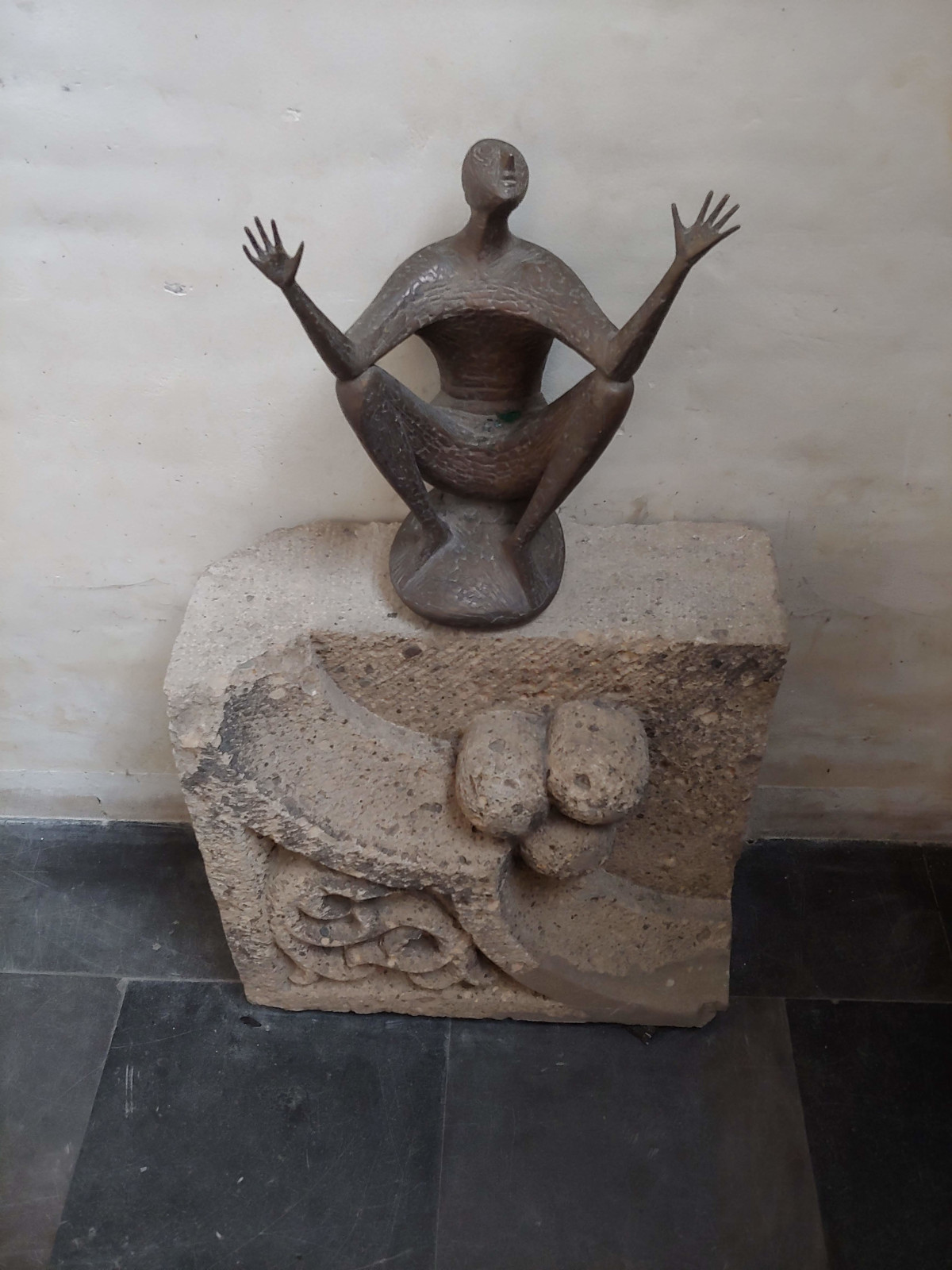
Unidentified sculpture at the Grote of Sint-Laurenskerk (Church of Saint Lawrence), Rotterdam, Netherlands. Photo: Victoria Emily Jones.
Would God I knew there were a God to thank
     When thanks rise in me, certain that my cries
Do not like blind men’s arrows pierce the skies
     Only to fall short of my quarry’s flank.
Why do I thirst, a desperate castaway
     Quaffing salt water, powerless to stop,
Sick lark locked in a cellar far from day,
     Lone climber of a peak that has no top?

To praise God is to bellow down a well
     From which rebounds one’s own dull booming voice,
          Yet the least leaf points to some One to thank.
The whorl embodied in the slightest shell,
     The firefly’s glimmer signify Rejoice!
          Though overhead, clouds cruise a sullen blank.
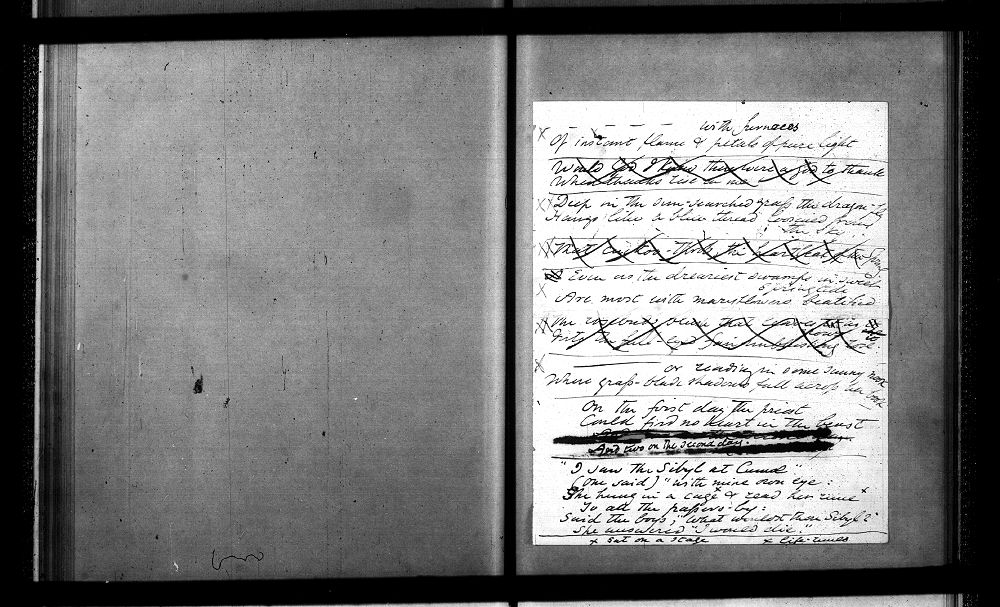
The first line and a half of this sonnet are a crossed-out fragment from one of the notebooks of the British poet and artist Dante Gabriel Rossetti (1828–1882), which he used to work out poetic ideas. This one never went anywhere. But Rossetti’s brother, William Michael Rossetti, saw something in it worthy of preservation; he salvaged it and other select scraps from his brother’s papers, publishing them posthumously in a “Versicles and Fragments” section of Rossetti’s collected works in 1901.
Page 16 of Sonnets and Fragments by Dante Gabriel Rossetti (Princeton/Troxell bound manuscript volume), 1848–81. The first deletion, by Rossetti’s hand, is “Would God I knew there were a god to thank / When thanks rise in me.” [object record]
The modern American poet X. J. Kennedy developed Rossetti’s fragment into a full poem that grapples with the silence of God and, despite such, the impulse to praise. The speaker is confounded by the contradiction that the world seems infused with God’s presence—the natural world points to a Creator—and yet God is unresponsive when the speaker initiates contact. The prayers he launches toward heaven like arrows appear not to reach their target. He’s experiencing spiritual aridity. He feels like a thirsty castaway whose only drink is salt water (why doesn’t God satiate as promised?); a bird trapped in a dark cellar; a mountain climber endlessly climbing, never catching sight of the vista.
The poem tugs back and forth between despondency and awe, between clench-fisted frustration and open-handed surrender. Each glorious tree leaf, the intricate design of conch shells, the whimsy of lightning bugs—these are gifts, but where’s the giver? Gratitude must be directed to someone, but whom does one thank for the wonders and small joys experienced in nature? Who or what is their source? Oh, how I wish I knew there were a God out there to thank, when thanks well up in me. The speaker wants to place his thanks somewhere, but when he places them in God, he receives no confirmation of receipt. There’s a disconnect between what nature testifies and what the speaker has suffered: the “sullen blank” of heaven.
Dante Gabriel Rossetti’s brother, William, wrote in 1895 that, unlike their devout sister Christina [previously], Dante was “a decided sceptic. He was never confirmed, professed no religious faith, and practised no regular religious observances; but he had sufficient sympathy with the abstract ideas and the venerable forms of Christianity to go occasionally to an Anglican church—very occasionally, and only as the inclination ruled him.” Starting in mid-adolescence, he rejected organized religion.
Kennedy, similarly, was raised in a religious household: his father was Catholic, his mother Methodist. And yet in his adulthood he has come to question and reject some of the tenets of orthodox Christianity. But still, he searches for God. “There is a clash in his poems between his skepticism or uneasy agnosticism and his unresolved longing for faith in God,” reads his bio on the Harvard Square Library website. Kennedy’s desire to believe but his inability to do so is expressed recurringly in his work—as in this poem, in which he, taking the baton from Rossetti, is very likely the speaker.
X. J. Kennedy (born 1929) is an American poet, translator, editor, and author of children’s literature and textbooks on English literature and poetry. Born Joseph Charles Kennedy in Dover, New Jersey, he adopted the nom de plume X. J. Kennedy in 1957 to avoid being mistaken for the better-known Joseph Kennedy, then US ambassador to England and father of future president John F. Kennedy. His award-winning poetry collections include Nude Descending a Staircase (1961) and Cross Ties (1985). He lives in Lexington, Massachusetts.
George MacDonald (1824–1905) was a Scottish preacher, poet, essayist, and writer of both realist and fantasy fiction. He was a great influence on J. R. R. Tolkien and C. S. Lewis, the latter of whom published, in 1946, a compilation of MacDonald’s theological writings excerpted from his sermons, novels, and other sources. “I know of hardly any other writer who seems to be closer, or more continually close, to the Spirit of Christ Himself,” Lewis wrote in the preface to George MacDonald: An Anthology.
MacDonald is best known for his fairy tales, such as The Princess and the Goblin (my entrée to the author as a child, via a 1991 animated film adaptation from Wales) and Phantastes. But more recently I have been appreciating his devotional poetry.
George MacDonald, as photographed by his friend and fellow writer Lewis Carroll, 1863
While in his fifties, MacDonald published A Book of Strife in the Form of the Diary of an Old Soul (1880), a collection of 366 short, original, untitled devotional poems, one for each day of the year. (Read it for free online.) Addressed to God, these poems voice discouragement, weariness, restlessness, desire, doubt, and trust. MacDonald asks God for healing and refreshment; for a vulnerable, stripped-down soul, clothed anew in Christ; for salvation from his stubbornness and folly; for guidance through his dark night of the soul; for rightly ordered loves; for Christian growth. He searches for God, confesses his sinful tendencies, praises God for God’s love and faithfulness, and prays for words when words fail him.
Below are my favorite selections—some full poems, some just single lines or excerpts—from MacDonald’s Diary of an Old Soul, which is in the public domain. The headings are my own, to aid in navigating more easily to different topics, and the trifold dividers mark separate entries.
When the book was printed privately in 1880, all the left-hand pages were left blank to encourage thoughtful reader responses; “Let your white page be ground, my print be seed,” MacDonald wrote in the dedication. I’d encourage you, too, to grab a journal and record your own prayers and reflections prompted by any of these verses, or simply to copy out the lines that resonate. And songwriters and composers: I can see potential for musical settings here!
A New Song
Barb thou my words with light, make my song new.
Seeing with the Inner Eye
That thou art nowhere to be found, agree
Wise men, whose eyes are but for surfaces;
Men with eyes opened by the second birth,
To whom the seen, husk of the unseen is,
Descry thee soul of everything on earth.
Who know thy ends, thy means and motions see:
Eyes made for glory soon discover thee.
+++
Lord, in the land of things that swell and seem,
Help me to walk by the other light supreme,
Which shows thy facts behind man’s vaguely hinting dream.
God Transcends All Imagining
What the heart’s dear imagination dares,
Thou dost transcend in measureless majesty
All prayers in one—my God, be unto me
Thy own eternal self, absolutely.
+++
Oh, let me live in thy realities,
Nor substitute my notions for thy facts,
Notion with notion making leagues and pacts;
They are to truth but as dream-deeds to acts,
And questioned, make me doubt of everything.—
“O Lord, my God,” my heart gets up and cries,
“Come thy own self, and with thee my faith bring.”
Be My All
Be thou the well by which I lie and rest;
Be thou my tree of life, my garden ground;
Be thou my home, my fire, my chamber blest,
My book of wisdom, loved of all the best;
Oh, be my friend, each day still newer found,
As the eternal days and nights go round!
Nay, nay—thou art my God, in whom all loves are bound!
In Him and by Him All Things Consist
Thy fishes breathe but where thy waters roll;
Thy birds fly but within thy airy sea;
My soul breathes only in thy infinite soul;
I breathe, I think, I love, I live but thee.
Oh breathe, oh think,—O Love, live into me;
Unworthy is my life till all divine,
Till thou see in me only what is thine.
Practicing the Presence of God at Work
Two things at once, thou know’st I cannot think.
When busy with the work thou givest me,
I cannot consciously think then of thee.
. . . . . . . . . . . . . . . . . . . . . . . . . . . . . . . . . .

Therefore I make provision, ere I begin
To do the thing thou givest me to do,
Praying,—Lord, wake me oftener, lest I sin.
Amidst my work, open thine eyes on me,
That I may wake and laugh, and know and see,
Then with healed heart afresh catch up the clue,
And singing drop into my work anew.
“The life is more than meat, the body more than raiment”
Thy will be done. I yield up everything.
“The life is more than meat”—then more than health;
“The body more than raiment”—then than wealth;
The hairs I made not, thou art numbering.
Thou art my life—I the brook, thou the spring.
Because thine eyes are open, I can see;
Because thou art thyself, ’tis therefore I am me.
On Prayer
Sometimes, hard-trying, it seems I cannot pray—
For doubt, and pain, and anger, and all strife.
Yet some poor half-fledged prayer-bird from the nest
May fall, flit, fly, perch—crouch in the bowery breast
Of the large, nation-healing tree of life;—
Moveless there sit through all the burning day,
And on my heart at night a fresh leaf cooling lay.
+++
In my dead moments, master, stir the prayers.
+++
My prayer-bird was cold—would not away,
Although I set it on the edge of the nest.
Then I bethought me of the story old—
Love-fact or loving fable, thou know’st best—
How, when the children had made sparrows of clay,
Thou mad’st them birds, with wings to flutter and fold:
Take, Lord, my prayer in thy hand, and make it pray.
Prayers in Times of Spiritual Destitution
When I no more can stir my soul to move,
And life is but the ashes of a fire;
When I can but remember that my heart
Once used to live and love, long and aspire,—
Oh, be thou then the first, the one thou art;
Be thou the calling, before all answering love,
And in me wake hope, fear, boundless desire.
+++
There is a misty twilight of the soul,
A sickly eclipse, low brooding o’er a man,
When the poor brain is as an empty bowl,
And the thought-spirit, weariful and wan,
Turning from that which yet it loves the best,
Sinks moveless, with life-poverty opprest:—
Watch then, O Lord, thy feebly glimmering coal.
A Prayer for Joy in All Circumstances
Do thou, my God, my spirit’s weather control;
And as I do not gloom though the day be dun,
Let me not gloom when earth-born vapours roll
Across the infinite zenith of my soul.
Should sudden brain-frost through the heart’s summer run,
Cold, weary, joyless, waste of air and sun,
Thou art my south, my summer-wind, my all, my one.
A Prayer for Victory over Temptation
Haste to me, Lord, when this fool-heart of mine
Begins to gnaw itself with selfish craving;
Or, like a foul thing scarcely worth the saving,
Swoln up with wrath, desireth vengeance fine.
Haste, Lord, to help, when reason favours wrong;
Haste when thy soul, the high-born thing divine,
Is torn by passion’s raving, maniac throng.

Fair freshness of the God-breathed spirit air,
Pass through my soul, and make it strong to love;
Wither with gracious cold what demons dare
Shoot from my hell into my world above;
Let them drop down, like leaves the sun doth sear,
And flutter far into the inane and bare,
Leaving my middle-earth calm, wise, and clear.
A Prayer for Endurance through Trials
Thou wouldst not have thy man crushed back to clay;
It must be, God, thou hast a strength to give
To him that fain would do what thou dost say;
Else how shall any soul repentant live,
Old griefs and new fears hurrying on dismay?
Let pain be what thou wilt, kind and degree,
Only in pain calm thou my heart with thee.
A Prayer for Sanctification
Lord, in my silver is much metal base,
Else should my being by this time have shown
Thee thy own self therein. Therefore do I
Wake in the furnace. I know thou sittest by,
Refining—look, keep looking in to try
Thy silver; master, look and see thy face,
Else here I lie for ever, blank as any stone.

But when in the dim silver thou dost look,
I do behold thy face, though blurred and faint.
Oh joy! no flaw in me thy grace will brook,
But still refine: slow shall the silver pass
From bright to brighter, till, sans spot or taint,
Love, well content, shall see no speck of brass,
And I his perfect face shall hold as in a glass.
A Prayer against Workaholism
Help me to yield my will, in labour even,
Nor toil on toil, greedy of doing, heap.
“My yoke is easy, and my burden is light”
I cannot see, my God, a reason why
From morn to night I go not gladsome, free;
For, if thou art what my soul thinketh thee,
There is no burden but should lightly lie,
No duty but a joy at heart must be:
Love’s perfect will can be nor sore nor small,
For God is light—in him no darkness is at all.
God Our Mother
. . . Weary and worn,
Why not to thee run straight, and be at rest?
Motherward, with toy new, or garment torn,
The child that late forsook her changeless breast,
Runs to home’s heart, the heaven that’s heavenliest . . .
Faith and Doubt
Doubt swells and surges, with swelling doubt behind!
My soul in storm is but a tattered sail,
Streaming its ribbons on the torrent gale;
In calm, ’tis but a limp and flapping thing:
Oh! swell it with thy breath; make it a wing,—
To sweep through thee the ocean, with thee the wind
Nor rest until in thee its haven it shall find.
+++
Ever above my coldness and my doubt
Rises up something, reaching forth a hand:
This thing I know, but cannot understand.
Is it the God in me that rises out
Beyond my self, trailing it up with him,
Towards the spirit-home, the freedom-land,
Beyond my conscious ken, my near horizon’s brim?
New Life
If thou hadst closed my life in seed and husk,
And cast me into soft, warm, damp, dark mould,
All unaware of light come through the dusk,
I yet should feel the split of each shelly fold,
Should feel the growing of my prisoned heart,
And dully dream of being slow unrolled,
And in some other vagueness taking part.

And little as the world I should foreknow
Up into which I was about to rise—
Its rains, its radiance, airs, and warmth, and skies,
How it would greet me, how its wind would blow—
As little, it may be, I do know the good
Which I for years half darkling have pursued—
The second birth for which my nature cries.
+++
“Wake, thou that sleepest; rise up from the dead,
And Christ will give thee light.” I do not know
What sleep is, what is death, or what is light;
But I am waked enough to feel a woe,
To rise and leave death. Stumbling through the night,
To my dim lattice, O calling Christ! I go,
And out into the dark look for thy star-crowned head.
+++
Lord, wake me up; rend swift my coffin-planks;
I pray thee, let me live—alive and free.
Rooted in Christ
Thou in my heart hast planted, gardener divine,
A scion of the tree of life: it grows;
But not in every wind or weather it blows;
The leaves fall sometimes from the baby tree,
And the life-power seems melting into pine;
Yet still the sap keeps struggling to the shine,
And the unseen root clings cramplike unto thee.
Dying to Self
Lord, I have fallen again—a human clod!
Selfish I was, and heedless to offend;
Stood on my rights. Thy own child would not send
Away his shreds of nothing for the whole God!
Wretched, to thee who savest, low I bend:
Give me the power to let my rag-rights go
In the great wind that from thy gulf doth blow.
+++
Lord of essential life, help me to die.
To will to die is one with highest life,
The mightiest act that to Will’s hand doth lie—
Born of God’s essence, and of man’s hard strife:
God, give me strength my evil self to kill,
And die into the heaven of thy pure will.—
Then shall this body’s death be very tolerable.
+++
With every morn my life afresh must break
The crust of self, gathered about me fresh;
That thy wind-spirit may rush in and shake
The darkness out of me, and rend the mesh
The spider-devils spin out of the flesh—
Eager to net the soul before it wake,
That it may slumberous lie, and listen to the snake.
Lost Sheep
Things go not wrong when sudden I fall prone,
But when I snatch my upheld hand from thine,
And, proud or careless, think to walk alone.
Then things go wrong, when I, poor, silly sheep,
To shelves and pits from the good pasture creep;
Not when the shepherd leaves the ninety and nine,
And to the mountains goes, after the foolish one.
“Forgive us our debts, as we forgive our debtors”
Keep me from wrath, let it seem ever so right:
My wrath will never work thy righteousness.
Up, up the hill, to the whiter than snow-shine,
Help me to climb, and dwell in pardon’s light.
I must be pure as thou, or ever less
Than thy design of me—therefore incline
My heart to take men’s wrongs as thou tak’st mine.
Spiritual Riches
Lord, in thy spirit’s hurricane, I pray,
Strip my soul naked—dress it then thy way.
Change for me all my rags to cloth of gold.
Who would not poverty for riches yield?
A hovel sell to buy a treasure-field?
Who would a mess of porridge careful hold
Against the universe’s birthright old?
The Prodigal God
Gloriously wasteful, O my Lord, art thou!
Sunset faints after sunset into the night,
Splendorously dying from thy window-sill—
For ever. Sad our poverty doth bow
Before the riches of thy making might:
Sweep from thy space thy systems at thy will—
In thee the sun sets every sunset still.
God’s Stability
Father of me, thou art my bliss secure.
Make of me, maker, whatsoe’er thou wilt.
Let fancy’s wings hang moulting, hope grow poor,
And doubt steam up from where a joy was spilt—
I lose no time to reason it plain and clear,
But fly to thee, my life’s perfection dear:—
Not what I think, but what thou art, makes sure.
God’s Universality
Where should the unknown treasures of the truth
Lie, but there whence the truth comes out the most—
In the Son of man, folded in love and ruth?
Fair shore we see, fair ocean; but behind
Lie infinite reaches bathing many a coast—
The human thought of the eternal mind,
Pulsed by a living tide, blown by a living wind.
Searching for Pleasure
Ah, me, my God! in thee lies every bliss
Whose shadow men go hunting wearily amiss.
+++
I see a little child whose eager hands
Search the thick stream that drains the crowded street
For possible things hid in its current slow.
Near by, behind him, a great palace stands,
Where kings might welcome nobles to their feet.
Soft sounds, sweet scents, fair sights there only go—
There the child’s father lives, but the child does not know.
Perfect Love
Thou dost demand our love, holy Lord Christ,
And batest nothing of thy modesty;—
Thou know’st no other way to bliss the highest
Than loving thee, the loving, perfectly.
Thou lovest perfectly—that is thy bliss:
We must love like thee, or our being miss—
So, to love perfectly, love perfect Love, love thee.
+++
Lord, with thy breath blow on my being’s fires,
Until, even to the soul with self-love wan,
I yield the primal love, that no return desires.
Surrender
O Christ, my life, possess me utterly.
Take me and make a little Christ of me.
+++
O Master, my desires to work, to know,
To be aware that I do live and grow—
All restless wish for anything not thee
I yield, and on thy altar offer me.
Let me no more from out thy presence go,
But keep me waiting watchful for thy will—
Even while I do it, waiting watchful still.
+++
My Lord, I have no clothes to come to thee;
My shoes are pierced and broken with the road;
I am torn and weathered, wounded with the goad,
And soiled with tugging at my weary load:
The more I need thee! A very prodigal
I stagger into thy presence, Lord of me:
One look, my Christ, and at thy feet I fall!
Freedom
So bound in selfishness am I, so chained,
I know it must be glorious to be free
But know not what, full-fraught, the word doth mean.
By loss on loss I have severely gained
Wisdom enough my slavery to see;
But liberty, pure, absolute, serene,
No freest-visioned slave has ever seen.
+++
So shall abundant entrance me be given
Into the truth, my life’s inheritance.
Lo! as the sun shoots straight from out his tomb,
God-floated, casting round a lordly glance
Into the corners of his endless room,
So, through the rent which thou, O Christ, hast riven,
I enter liberty’s divine expanse.
Receptivity to the Spirit
Faith opens all the windows to God’s wind.
Aging
O Life, why dost thou close me up in death?
O Health, why make me inhabit heaviness?—
I ask, yet know: the sum of this distress,
Pang-haunted body, sore-dismayed mind,
Is but the egg that rounds the winged faith;
When that its path into the air shall find,
My heart will follow, high above cold, rain, and wind.
+++
Thou, healthful Father, art the Ancient of Days,
And Jesus is the eternal youth of thee.
Our old age is the scorching of the bush
By life’s indwelling, incorruptible blaze.
O Life, burn at this feeble shell of me,
Till I the sore singed garment off shall push,
Flap out my Psyche wings, and to thee rush.
+++
My harvest withers. Health, my means to live—
All things seem rushing straight into the dark.
But the dark still is God. I would not give
The smallest silver-piece to turn the rush
Backward or sideways. Am I not a spark
Of him who is the light?—Fair hope doth flush
My east.—Divine success—Oh, hush and hark!
Death
God, thou from death dost lift me. As I rise,
Its Lethe from my garment drips and flows.
Ere long I shall be safe in upper air,
With thee, my life—with thee, my answered prayer,
Where thou art God in every wind that blows,
And self alone, and ever, softly dies,
There shall my being blossom, and I know it fair.
+++
I was like Peter when he began to sink.
To thee a new prayer therefore I have got—
That, when Death comes in earnest to my door,
Thou wouldst thyself go, when the latch doth clink,
And lead him to my room, up to my cot;
Then hold thy child’s hand, hold and leave him not,
Till Death has done with him for evermore.
The Diary of an Old Soul represents only a fraction of the poetry George MacDonald wrote. To explore more, see The Poetical Works of George MacDonald, vols. 1 and 2 (1893). Seeing as next year is the bicentenary of his birth, I expect to be hearing his name a lot more!
Besides the self-guided “Stations of the Cross” audio tour of the Smithsonian’s American art collection, here are some other opportunities to engage in person with visual art this Lent:
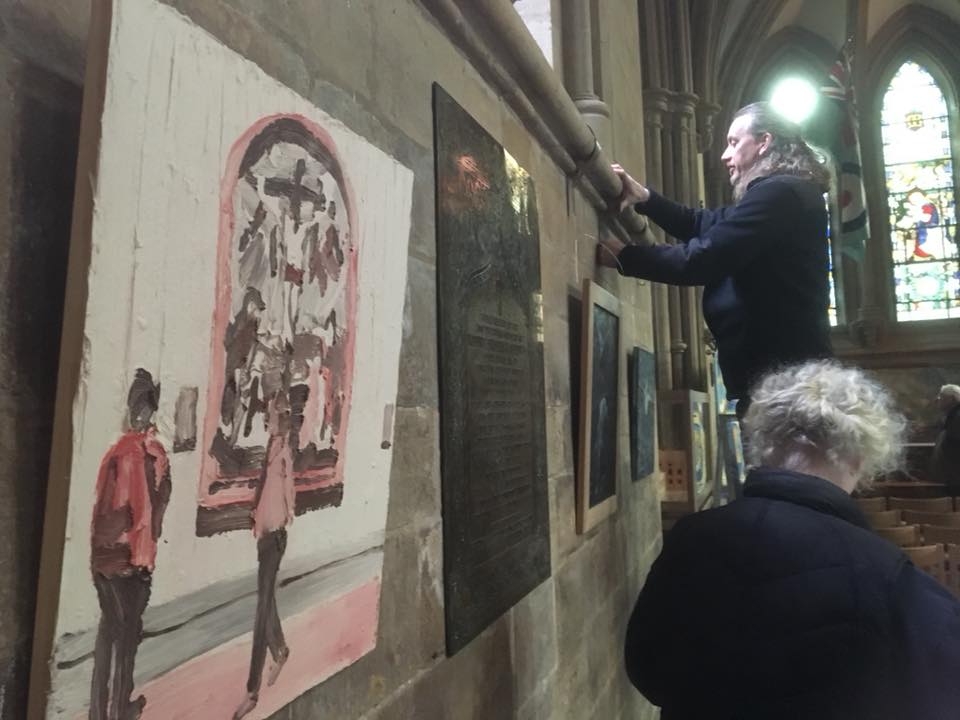
Hanging the “Crossings” exhibition at Southwell Minster. Pictured at left: Enzo Marra (British, 1975–), Observers Raphael (The Mond Crucifixion), 2018. Oil on board, 24 × 20 in. Photo courtesy of the cathedral.
“Crossings: Art and Christianity Now,” February 9–May 10, 2018, Southwell Minster, Nottinghamshire, England: Featuring works in a variety of media by thirty-six contemporary artists, this major exhibition will unfold in two parts: “Crucifixion Now,” on view during Lent through March 21, and “Resurrection Now,” on view during Easter from April 1 to May 10. Each artist produced two new works, one for each phase, exploring the twin aspects of the gospel story: death and new life. Supporting events include music, lectures, workshops, and a conference on March 10, “The Spirit in Art Now.” Entry is free, and exhibition guides (with color photos and descriptions of all the artworks) are available for £5.
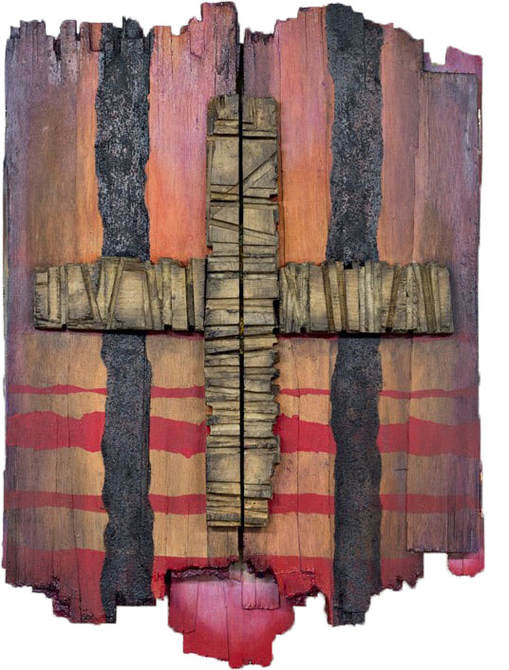
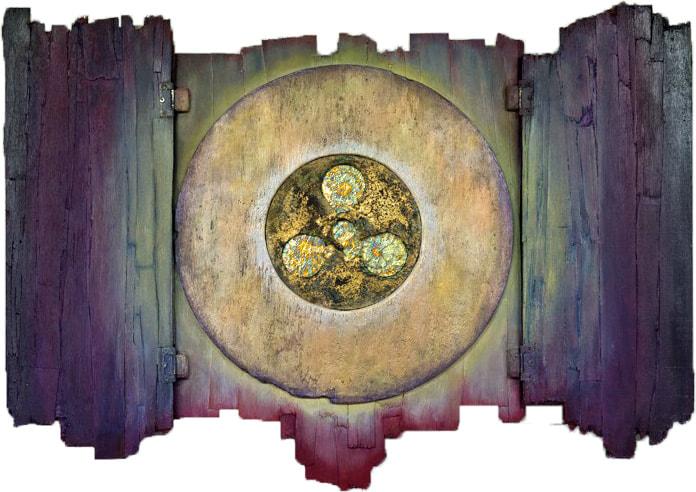
One outstanding work from the exhibition is a triptych by Sophie Hacker (artist previously featured here), formed from a variety of found materials, including cedarwood, Icelandic black sand, rusted metal, and metallic leafs. During Lent it will remain closed, showing a jagged cross “marked with stark wounds” against a background of soil and blood, but on Easter it will open, “giv[ing] way inside to rounded forms and lustrous colours, revealing all at once the stone rolled away, the cave filled with glory and the triumph of God in Trinity.”
Sophie Hacker (British), Triptych: Crucifixion Now, Resurrection Now, 2017. Mixed media, 32 × 24 in. (closed).
Sophie Hacker (British), Triptych: Crucifixion Now, Resurrection Now, 2017. Mixed media, 32 × 48 in. (open).
+++
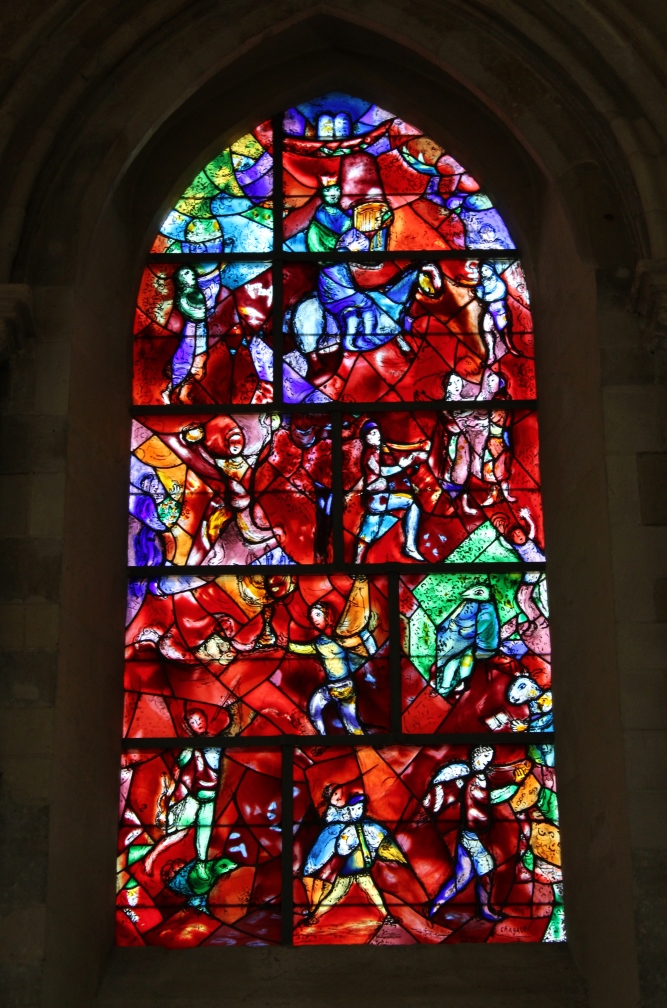
“Chichester Art Pilgrimage Trail,” Chichester, West Sussex, England: A twelfth-century Norman-Gothic structure filled with medieval, Victorian, and modern art, Chichester Cathedral is a beautiful blend of old and new. I’ve come across many of its modern art treasures before in essays and books—the tapestry by John Piper, Noli me tangere by Graham Sutherland, the Icon of the Divine Light altarpiece by Cecil Collins, and Marc Chagall’s Psalm 150 window. All these artists, commissioned by Walter Hussey (one of the twentieth century’s biggest champions of religious art), were giants in the field.
Stained-glass window by Marc Chagall (Russian/French, 1887–1985), installed in Chichester Cathedral in 1978. Photo: Jonathan Evens.
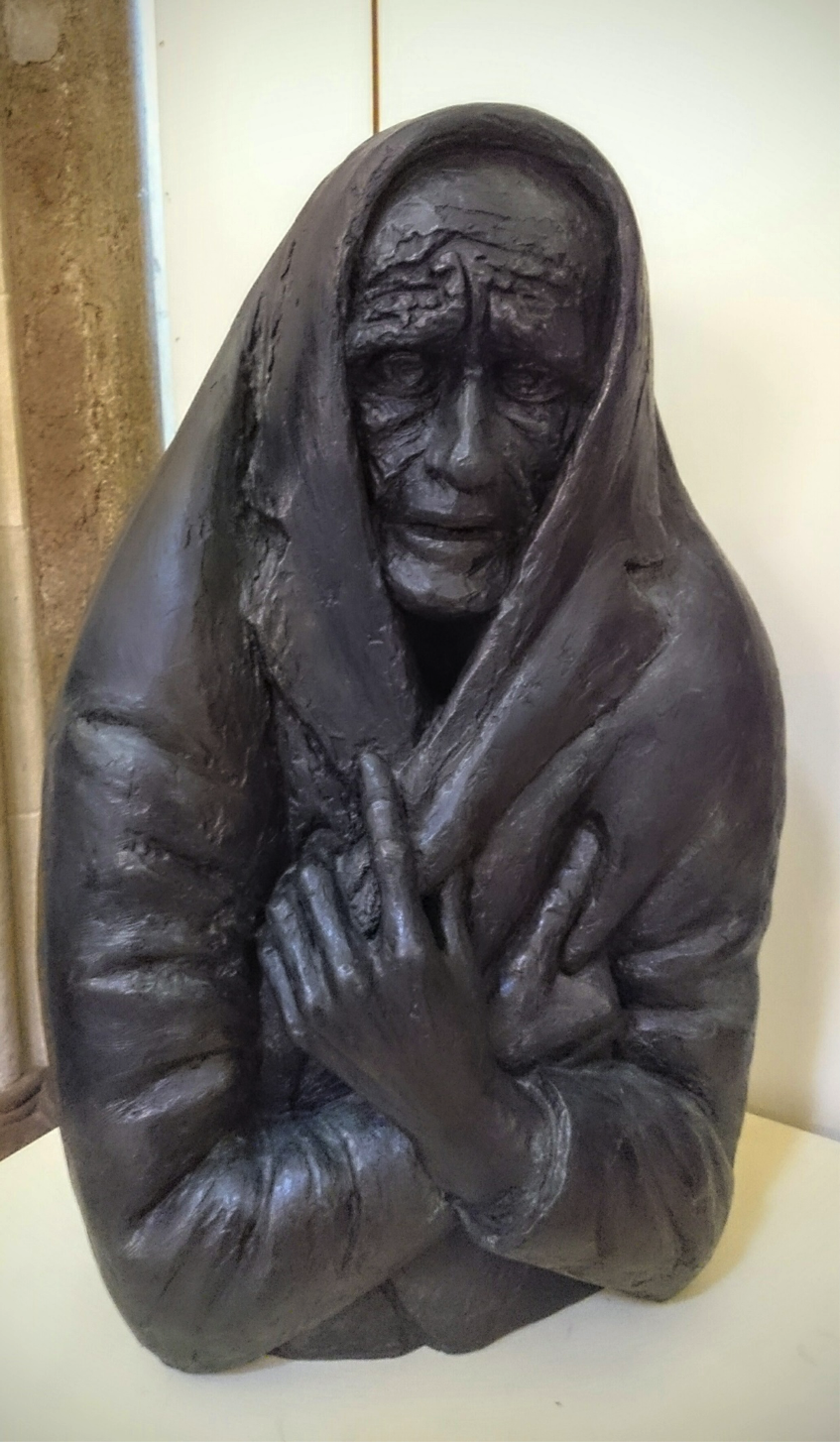
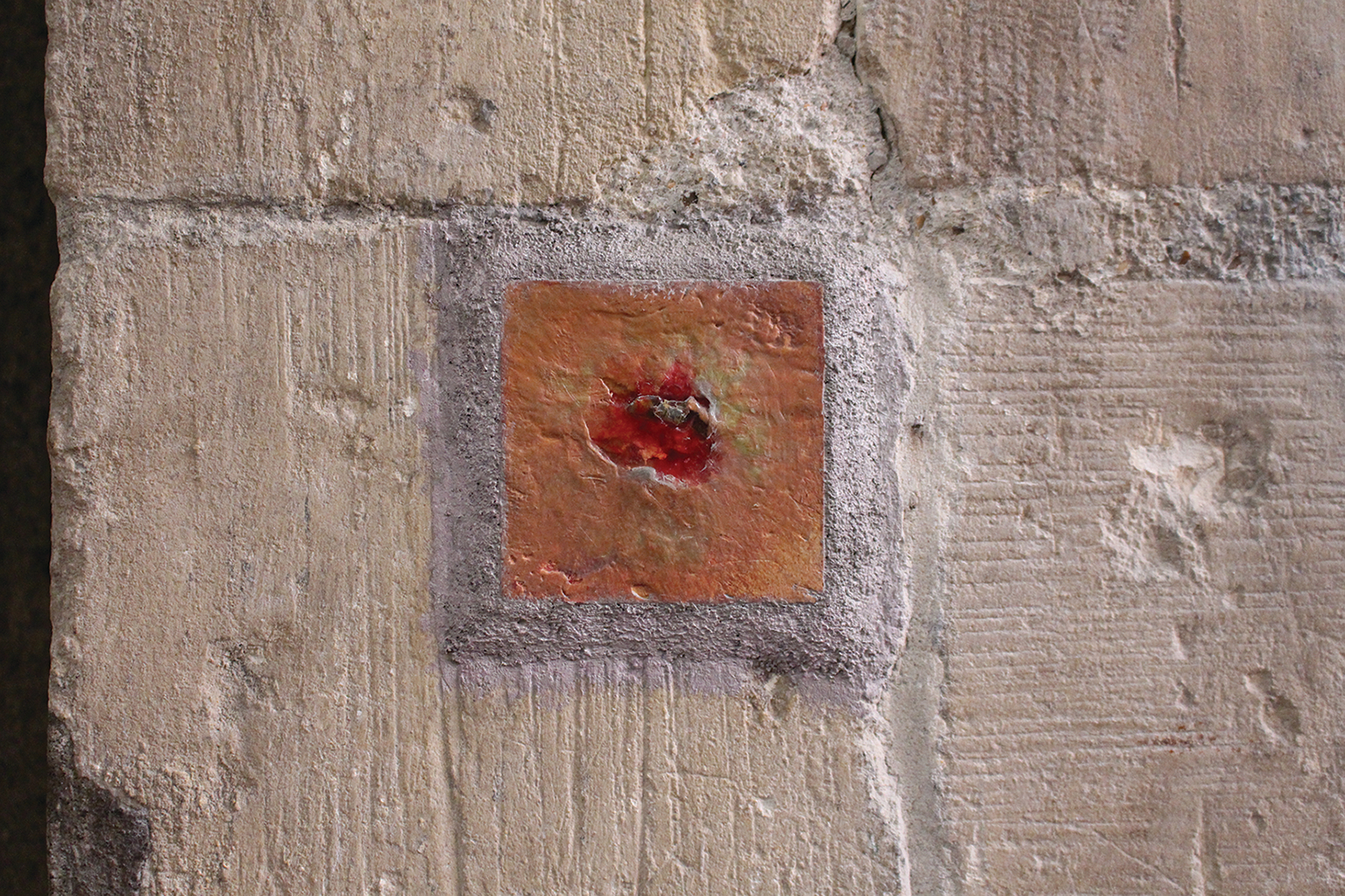
These pieces and more are the subjects of an audio tour released this Lent on the Alight app. (If geography prevents you from walking the trail in person, travel it from your armchair, like me!) Starting at one of the three old Roman gates to the walled city, the trail runs via the “market cross” to the cathedral, with thirteen stops inside. Besides those listed above, they are the rare Anglo-Saxon Lazarus reliefs, the Arundel Tomb, the Lambert Barnard panels, the nineteenth-century south transept window, a St. Richard icon, The Baptism of Christ by Hans Feibusch, the Anglo-German Tapestry by Ursula Benker-Schirmer, The Refugee by Diana Brandenburger, and Five Wounds by Michael Clark. The latter two, pictured below, are new to me; in addition to learning more about them through the Alight commentary, you can also read a discussion group report (a debrief of visitor reactions) on the Bishop Otter Scholar’s blog.
Diana Brandenburger (British, 1932–2008), The Refugee, 2008. Bronze. Chichester Cathedral, West Sussex, England. Photo: Keith Gulliver.
Michael Clark (British, 1954–), Five Wounds (detail), 1994. Layers of glaze on five canvases, 2.2 × 2.2 in. each. Chichester Cathedral, West Sussex, England.
Clark’s piece comprises five tiny canvases built up with layers of jewel-like glaze and set into the cathedral’s walls—two at the west end (representing Christ’s foot wounds), one in each transept (hand wounds)—and high altar (side wound). The Rev. Canon Dr. Anthony Cane, chancellor at the cathedral, says,
When I see Michael Clark’s Wounds of Christ, they remind me that the imposing cathedral building would not exist without the particular flesh and blood of a human life, a life visibly marked by suffering. The five wounds are mapped onto the cruciform shape of the architecture, so that the very space I walk through becomes the body of Christ. Most artworks are looked at; this one is lived within.
+++
“Stations of the Cross” in New York City, February 14–April 1, 2018: After success with the “public art pilgrimage” model they used in London in Lent 2016 and then later in Washington, DC, Aaron Rosen and a team of other theologians and art writers decided to organize a contemplative journey across Manhattan. Weaving through religious as well as secular spaces, from The Cloisters museum to the Cathedral of St. John the Divine to the 9/11 Memorial, this trail aims to raise awareness of those in need of refuge through art. The same app that hosts the Chichester Art Pilgrimage also hosts this Stations tour, providing easy navigation through the city and audio commentary on each artwork. Participating artists come from different faith backgrounds, and programmed events include concerts, artist talks, panel discussions with local refugee organizations, and interfaith scripture readings related to hospitality and care for the stranger. The next event is Monday, February 26, at 7 p.m.: a free performance of Marcel Dupré’s Stations of the Cross organ suite at St. James’s Church.
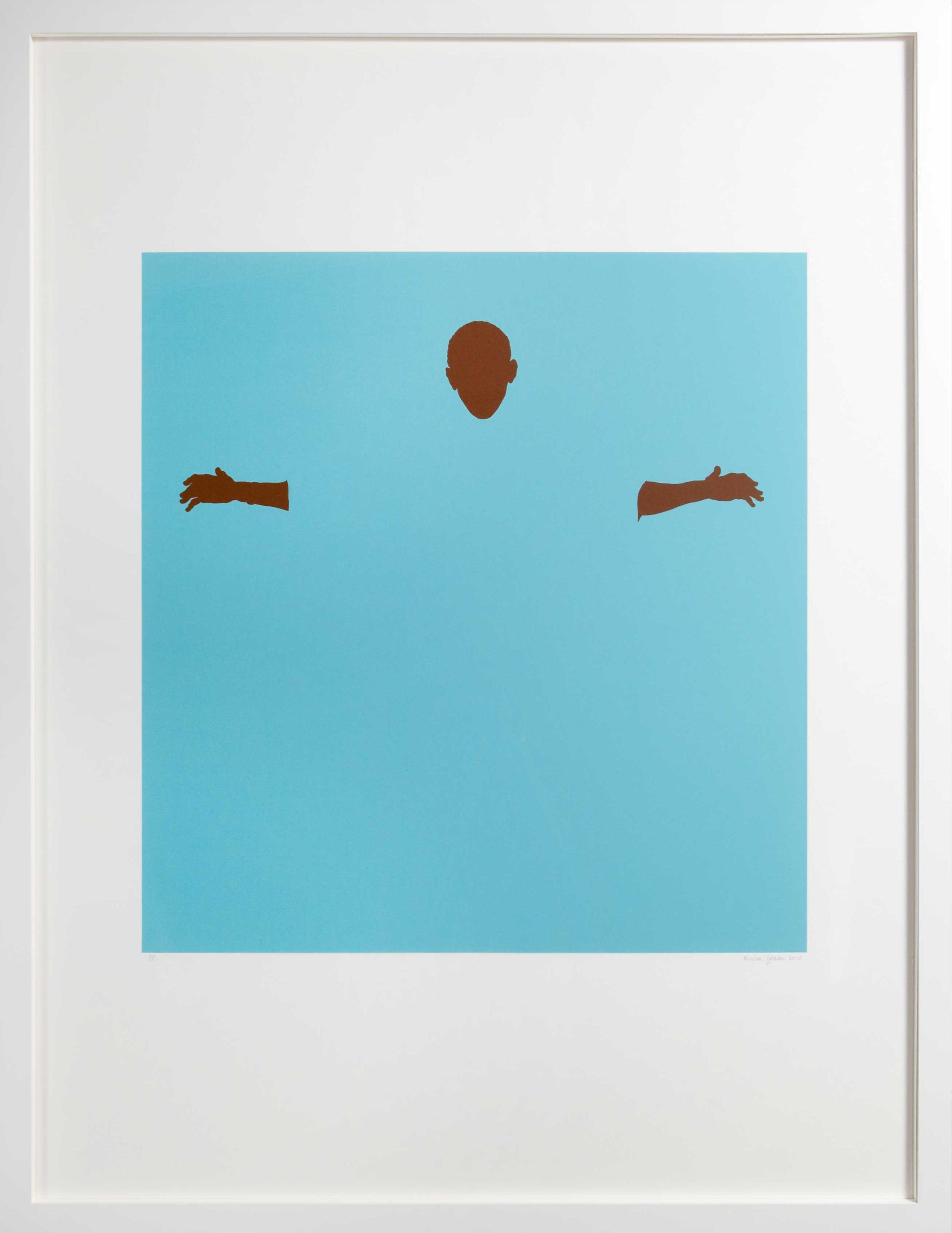
Nicola Green (British, 1972–), Sacrifice/Embrace, 2010. Silkscreen print, 152 × 102 cm (paper) / 64 × 64 cm (image). No. 6 of 7 from the series “In Seven Days.”
I found Nicola Green’s Sacrifice/Embrace silkscreen print, on view as station 7 at the Church of St. Paul the Apostle, particularly engaging. Read or listen to Fr. Frank Sabatté’s reflection on the work on the Art 2018 page.
+++
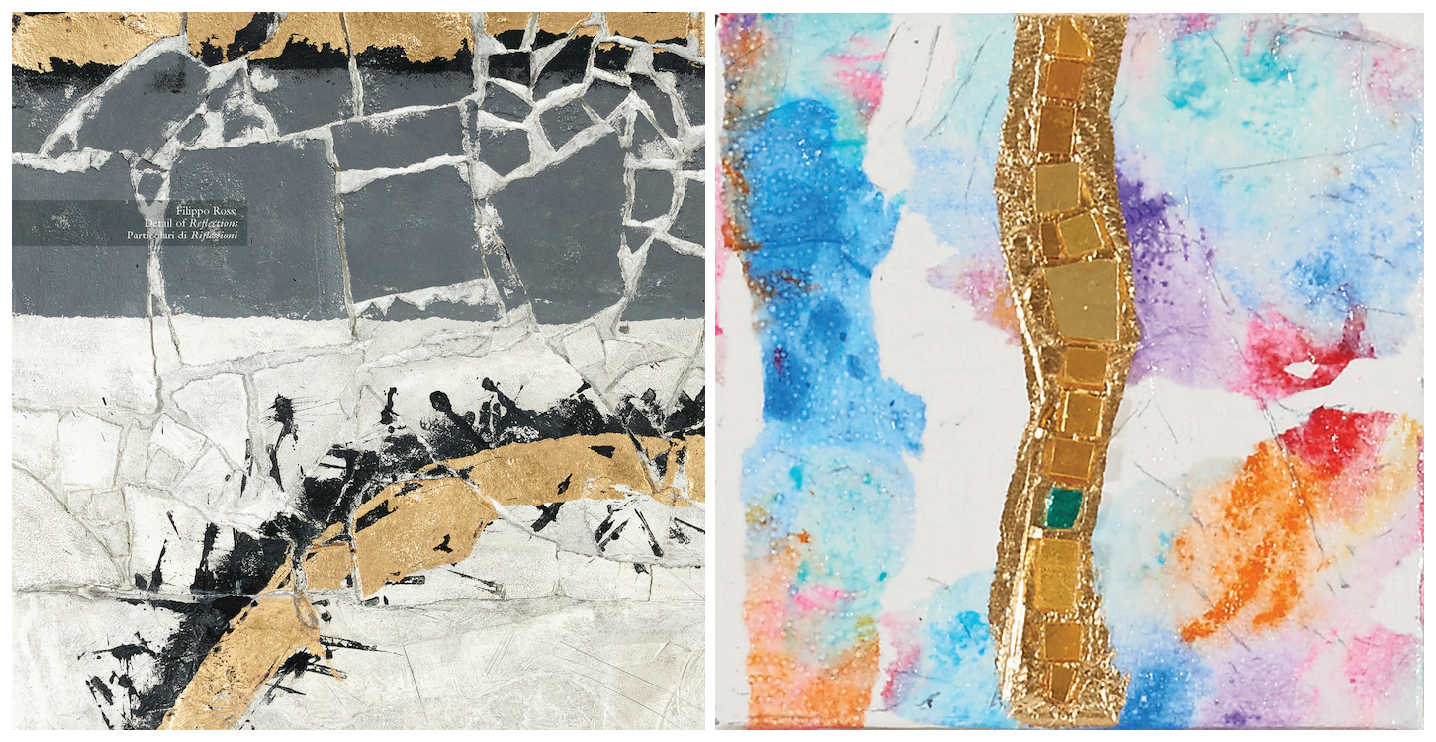
“Through Light,”February 23–April 8, 2018, Patmos Art Center, Community of Jesus, Orleans, Massachusetts: In this two-person show of abstract sacred art, Italian Catholic artist Filippo Rossi and American Protestant artist Susan Kanaga, CJ, explore imagery of light. I’ve been to the ecumenical monastery on Cape Cod where this exhibition is being held and had the privilege of seeing both artists’ work there on the grounds. I don’t usually take to nonrepresentational paintings, but theirs drew me in richly. If you attend the exhibition, be sure to spend some time nearby inside the beautiful Church of the Transfiguration and Priory Books and Gifts. (Paraclete Press, whose catalog is full of books on the visual and literary arts and choral music recordings, is the publishing arm of the Community of Jesus.)
LEFT: Filippo Rossi (Italian, 1970–), Reflections (detail), 2017. Acrylic, gold leaf, wax, and polystyrene, 220 × 120 cm. RIGHT: Susan Kanaga, CJ (American, 1954–), Joy, 2017. Acrylic, mixed media, gold leaf, and gold smalti on canvas, 20 × 20 cm.
+++
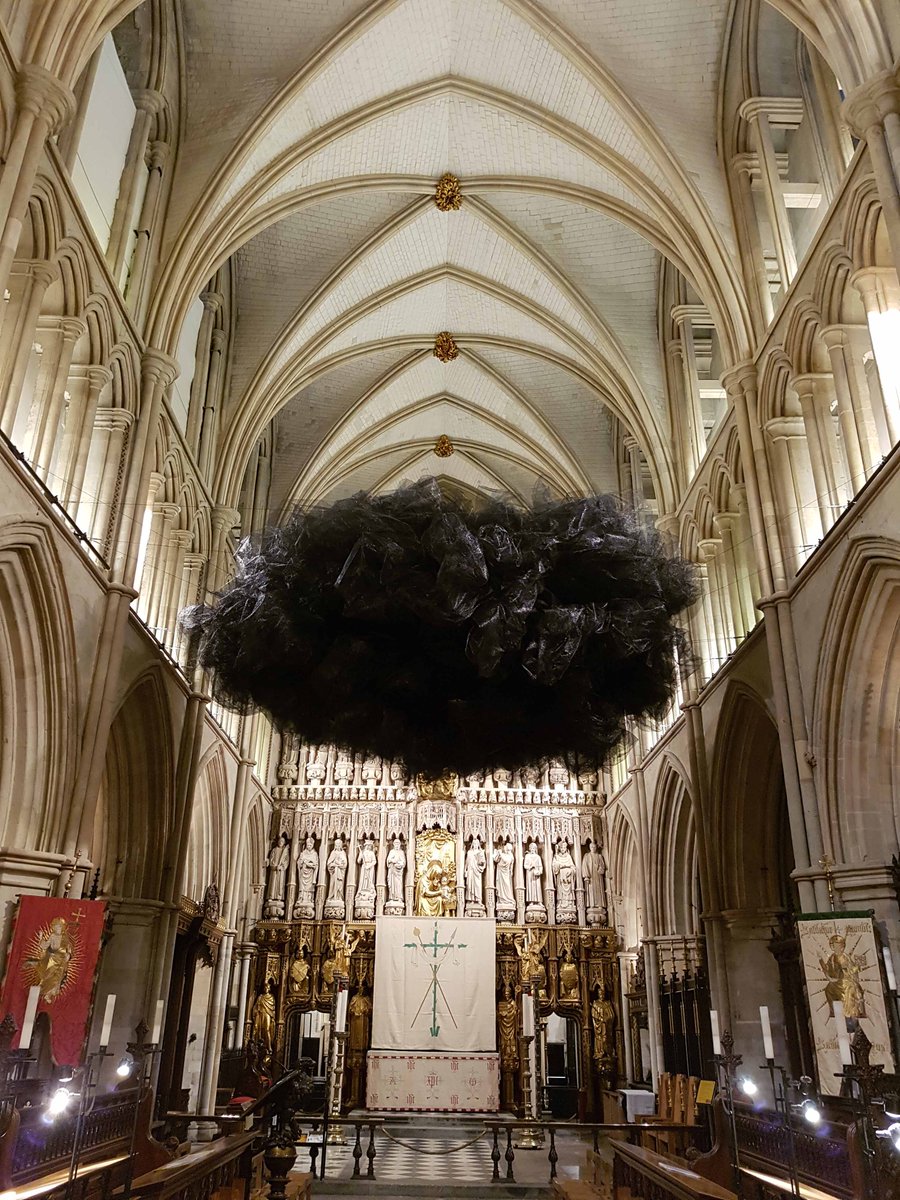
INSTALLATION: Doubt by Susie MacMurray,February 14–March 30, 2018, Southwark Cathedral, London: For the seventh year in a row, Southwark Cathedral has commissioned a contemporary art installation during the season of Lent. This year Susie MacMurray has created a large nest of black plastic netting suspended from the ceiling above the high altar, evoking a dark cloud; it’s called Doubt. The Very Rev. Andrew Nunn, dean of Southwark, says,
Popular imagination might expect faith to be lived out in bright clear sunshine, but from that moment when Moses climbed the holy mountain, shrouded in cloud, and experienced the presence of God, [darkness] has been a familiar experience and theme. . . . And as Jesus died on the cross the clouds brought night into day and the onlookers were plunged into darkness.
An embodiment of the difficulties of faith, the cloud is nevertheless made of open mesh that allows some light to pass through. As sub dean Michael Rawson points out, “As you look at the cloud, above is a representation of Jesus in the stained-glass window, so Jesus is shining through that cloud of doubt.”
I like the concept but am unsure how I feel about its dominant placement in the sanctuary. I’ve only seen photos, but its presence seems oppressive, like it could impinge on worship. I’d be interested to hear how parishioners have responded.
To see more of MacMurray’s site-specific installations, click here.
+++
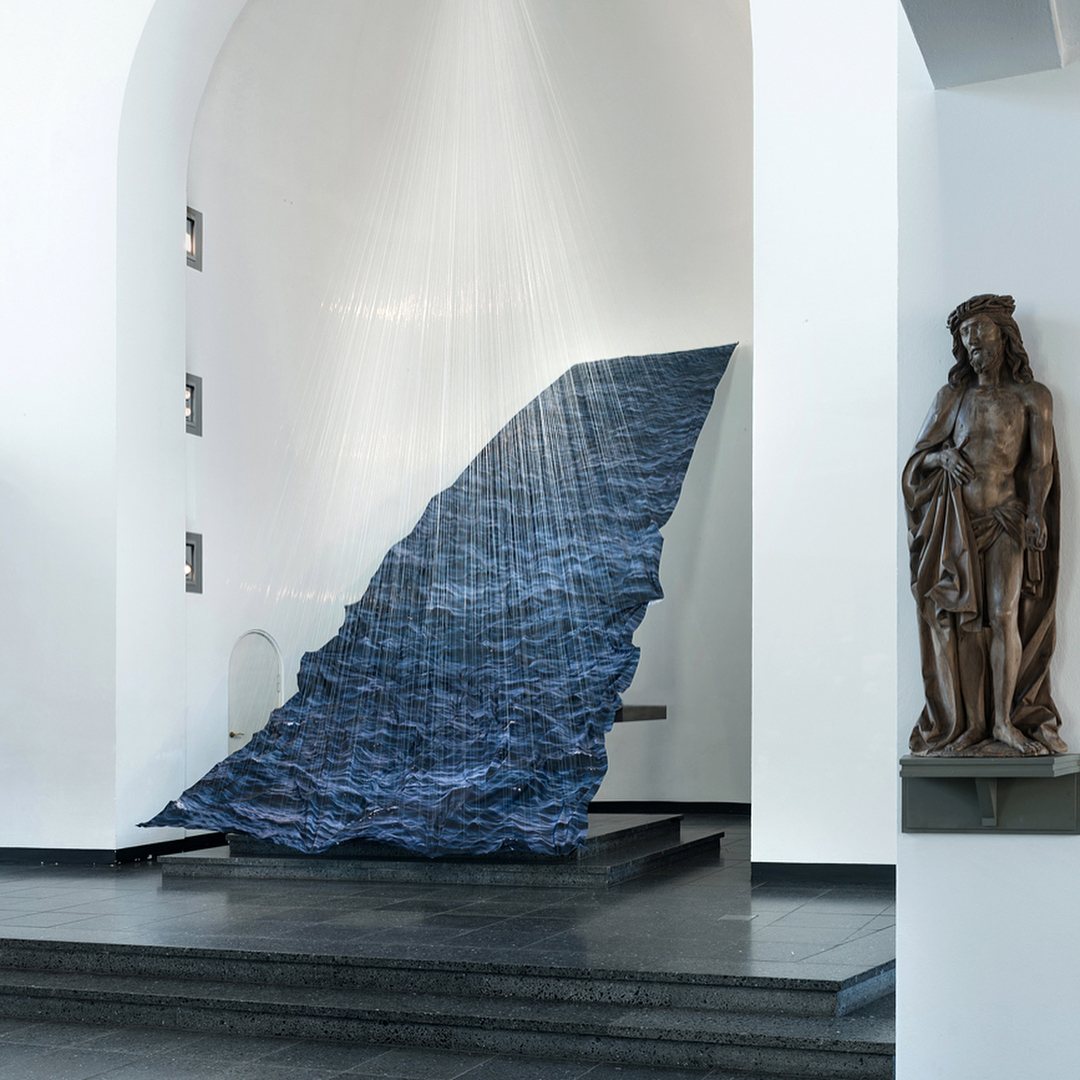
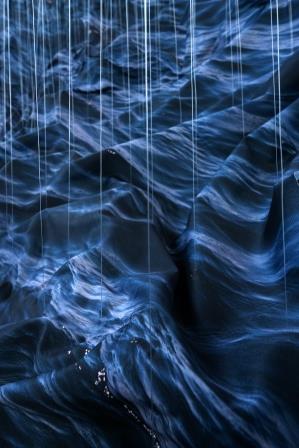
INSTALLATION: De profundis by Miguel Rothschild, St. Matthew’s Church, Berlin: Over eight meters long and suspended by 1,500 strands of fishing wire, the fabric installation De profundis by multimedia artist Miguel Rothschild mimics the texture of an ocean surface. Its title is the Latin incipit for Psalm 130, translated as “Out of the depths” (it’s a traditional Lenten practice to pray the penitential psalms):
Miguel Rothschild (Argentinian, 1963–), De profundis, 2018. Print on fabric, fishing line, lead balls, 900 × 800 × 400 cm. St. Matthäus-Kirche, Berlin.
Out of the depths I cry to you, O LORD!
O LORD, hear my voice!
Let your ears be attentive
to the voice of my pleas for mercy!
If you, O LORD, should mark iniquities,
O LORD, who could stand?
But with you there is forgiveness,
that you may be feared.
I wait for the LORD, my soul waits,
and in his word I hope;
my soul waits for the LORD
more than watchmen for the morning,
more than watchmen for the morning.
O Israel, hope in the LORD!
For with the LORD there is steadfast love,
and with him is plentiful redemption.
And he will redeem Israel
from all his iniquities.
Recalling the medieval German liturgical use of what’s known as a hungertuch (read more here), the fabric will cover the high altar until Easter. Water has many associations in the Bible, both positive and negative. Sometimes it signifies judgment, as in the story of Noah, or turbulent suffering, as in Psalm 42:7 (“Deep calls to deep at the roar of your waterfalls; all your breakers and your waves have gone over me.”). But God’s praiseworthy righteousness is also referred to as a “mighty flood” that crashes into our moral deserts (Amos 5:24), and the psalmist proclaims, “With you is the fountain of life” (Psalm 36:9). Rothschild’s installation, which looks like a rushing stream inundating the sanctuary, is a strong and multivalent visual—and I imagine it’s all the more so for those who live with it for weeks as worshipers in that space.
Affiliate links:Art & Theology is now a participant in the Amazon Associates program, an affiliate marketing tool that enables me to potentially collect a little change by hosting Amazon links on my website. I already do that anyway—link to Amazon product pages when I mention books, movies, or less often, music (I try to drive sales directly to the artist’s website, if one exists)—so you will not notice any change in blog post appearance or the frequency of links. But now that I’m registered, if you were to click through one of those Amazon links (for example, Shout Because You’re Free or The Seventh Seal below) and make a purchase, any purchase, I would earn a referral fee of 2.5% to 5% of the purchase price. I have to generate at least three purchases every 180 days to stay in the program. As of now, this is the website’s sole income stream.
+++
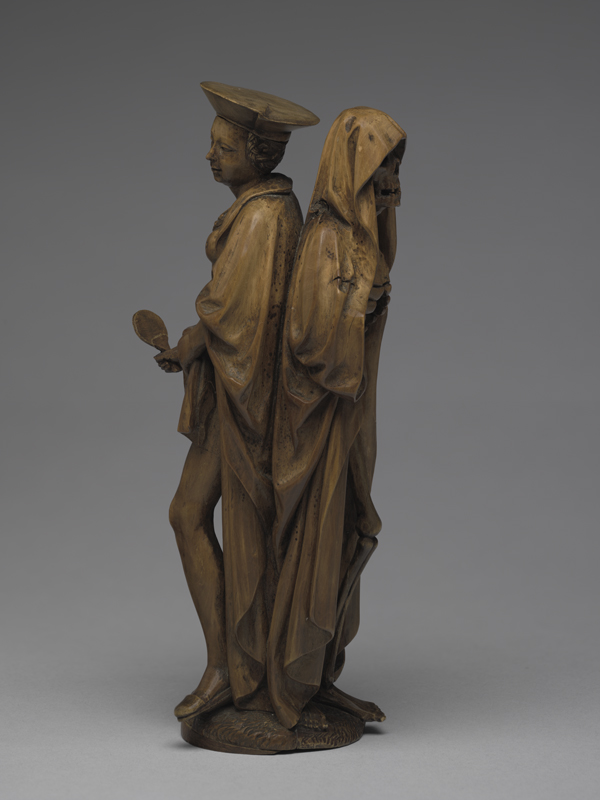
EXHIBITION: “The Ivory Mirror: The Art of Mortality in Renaissance Europe,” June 24–November 26, 2016, Bowdoin College Museum of Art, Brunswick, Maine: Skeletons, skulls, and other dark images of death from the fourteenth and fifteenth centuries were meant to remind their owners of life’s brevity and thereby prompt repentance. Some target specific sins, like clinging too tightly to one’s wealth or good looks. “This exhibition represents a significant contribution to our understanding of the rich visual culture of mortality in Renaissance Europe. The appeal of the memento mori, featuring macabre imagery urging us to ‘remember death,’ reached the apex of its popularity around 1500, when artists treated the theme in innovative and compelling ways. Exquisite artworks—from ivory prayer beads to gem-encrusted jewelry—evoke life’s preciousness and the tension between pleasure and responsibility, then and now.” A symposium, “Last Things: Luxury Goods and Memento Mori Culture in Europe, ca. 1400-1550,” will be held November 3–4. You can read a review of the exhibition at Hyperallergic.
Ivory prayer bead, France or southern Netherlands, 1530. Victoria and Albert Museum, London. On one side of the carving is a man, on another a woman, and grinning sardonically between them is a skull, worms crawling through its bared teeth.
Vanitas, Germany, ca. 1525. Boxwood. Harvard Art Museums/Busch-Reisinger Museum, Cambridge, Massachusetts.
+++
ART COMMENTARY:The Seven Works of Mercyby the Master of Alkmaar: The corporal works of mercy, seven in number, are a traditional Catholic practice of serving the physical needs of others. Derived from Matthew 25:31–46 (cf. Isaiah 58:6–10) and Tobit 1:16–22, they are to: (1) feed the hungry, (2) give water to the thirsty, (3) clothe the naked, (4) shelter the homeless, (5) care for the sick, (6) visit the imprisoned, and (7) bury the dead. Earlier this month Marleen Hengelaar-Rookmaaker wrote a two-part visual meditation on a Netherlandish polyptych (altarpiece with four or more panels) from the sixteenth century that treats this topic. In the background of each contemporary enactment of mercy stands a silently affirming Jesus. To view the panels in high resolution, visit the Rijksmuseum website.
The Master of Alkmaar, The Seven Works of Mercy, 1504. Oil on seven panels, 120 × 472 cm. Rijksmuseum, Amsterdam.
+++
ALBUM:Spirituals and Shout Songs from the Georgia Coastby the McIntosh County Shouters: The McIntosh County Shouters from coastal Georgia are the last community in America to perform the traditional ring shout, a shuffle-step devotional movement, accompanied by singing, that is rooted in the ritual dances of West Africa and was forged by the Atlantic slave trade. Shouting differs from traditional black religious music in repertory, style, and execution, Art Rosenbaum writes in Shout Because You’re Free: The African American Ring Shout Tradition in Coastal Georgia. In 1980 two folklorists, astonished to find the form still in use, encouraged practitioners to take it public. The community thus assembled a small touring group, and in 1984, under the Smithsonian Folkways label, they released their first album. This year they released their second, with a mostly new selection of songs (all but three) and all-new performances. You can watch “Jubilee” below. (Thanks, Global Christian Worship, for the tip!)
+++
FILM: The Seventh Seal (1958): After receiving several recommendations, I finally watched this classic of world cinema, directed by Ingmar Bergman, and actually enjoyed it more than I expected. It follows the medieval knight Antonius Block as he returns, disillusioned and exhausted, from a decade-long Crusade, only to encounter Death, whom he challenges to a fateful game of chess. (This central image, Bergman said, was inspired by a church fresco, reproduced below.)
Albertus Pictor (Swedish, ca. 1440–ca. 1507), Death Playing Chess, 1480s. Fresco, Täby Church, Uppland, Sweden.
The movie’s title is taken from Revelation 8:1—“And when the Lamb opened the seventh seal, there was silence in heaven for about half an hour”—establishing the silence of God as a major theme. Antonius’s monologue in the chapel confessional evinces his struggle between doubt and belief:
I want to confess as best I can, but my heart is void. The void is a mirror. I see my face and feel loathing and horror. My indifference to men has shut me out. I live now in a world of ghosts, a prisoner in my dreams. . . .
Is it so hard to conceive God with one’s senses? Why must he hide in a mist of vague promises and invisible miracles? How are we to believe the believers when we don’t believe ourselves? What will become of us who want to believe but cannot? And what of those who neither will nor can believe? Why can I not kill God within me? Why does he go on living in a painful, humiliating way? I want to tear him out of my heart, but he remains a mocking reality which I cannot get rid of. . . .
I want knowledge. Not belief. Not surmise. But knowledge. I want God to put out his hand, show his face, speak to me. . . . I cry to him in the dark, but there seems to be no one there.
But along his way he ends up meeting a “holy family”—simple and with pure faith and hope—whose names, Mia and Jof, are diminutives of Mary and Joseph. Bergman presents their worldview as a contrast to the bitter skepticism of Antonius.
When Jesus’s disciples asked him how to pray, he recited a sample that has come to be known as the “Lord’s Prayer,” or the Pater Noster (Our Father). In it the pray-er addresses God as Father and asks him to bring his kingdom down to earth, to accomplish his will far and wide. The pray-er asks, too, for the daily provision of food, forgiveness, and freedom from temptation and evil. Then he concludes with an attribution of power and glory to God. Amen.
If Jesus told us to request these things of God, surely the implication is that God loves to give them, do them. But why, then, is his kingdom so obviously not breaking in? Why does temptation continue to trip us up? Why does evil still run rampant, both inside us and outside?
Singer-songwriter Corey Kilgannon finds the Lord’s Prayer hard to pray sometimes—so in the tradition of the Jewish psalms, he wrote his own “Doubter’s Prayer,” which engages Jesus’s prayer rubric with sincere questioning and seeking. To the line “Our Father, who art in heaven,” he responds, “Why are you so far away?” In response to “thy kingdom come, thy will be done,” he insists that God clarify what it means for earth to manifest heaven—what would that even look like? Is it really possible? Regarding God’s promise to lead us out of temptation, he wonders, “Were you being honest when you said” it?
The prayer ends on a note of humility, with the speaker acknowledging his crookedness, asking forgiveness for his doubt, and begging for the presence of God to be made real to him. Continue reading ““Doubter’s Prayer” by Corey Kilgannon”→





 Art & Theology