Easter, Day 8: Sent

Now the eleven disciples went to Galilee, to the mountain to which Jesus had directed them. When they saw him, they worshiped him, but they doubted. And Jesus came and said to them, “All authority in heaven and on earth has been given to me. Go therefore and make disciples of all nations, baptizing them in the name of the Father and of the Son and of the Holy Spirit and teaching them to obey everything that I have commanded you. And remember, I am with you always, to the end of the age.”

—Matthew 28:16–20

Jesus said to [his disciples] again, “Peace be with you. As the Father has sent me, so I send you.” When he had said this, he breathed on them and said to them, “Receive the Holy Spirit.”

—John 20:21–22

LOOK: The Great Commission by He Qi

He Qi_Great Commission
He Qi (Chinese, 1950–), The Great Commission, 2017. Oil on canvas. [purchase giclée print]

In this painting by the Chinese artist He Qi (pronounced huh chee), Jesus holds a staff in his right hand (he is the Good Shepherd) and with the other points to the world outside Jerusalem’s gates, to which he calls his disciples to carry his all-renewing gospel. A modern cityscape rises up behind the figures, indicating that this call extends to the present era.

In the foreground, a minister baptizes a kneeling woman in red, their forms intercut with a fishing boat. The boat is a reference to Peter and Andrew’s original vocation as fishers and to Jesus’s promise, should they choose to follow him, to make them “fishers of people” (Matt. 4:19)—that is, gatherers of folks into the wide net of (proto-)Christian community, proclaiming and living out the kingdom of God in the power of God’s Spirit.

The Holy Spirit is represented as a dove sweeping down from the heavens, caressing the edge of Jesus’s halo. He’s the wind in the sails of the woman at the right, who goes forth into the darkness bearing the light of God’s word—her cheeks aglow with it, her feet eager to publish it abroad.

Her predecessors in the task of preaching the good news of Christ’s resurrection are portrayed in the background—the three women who first discovered the empty tomb and who then proceeded to “go quickly and tell” (Matt. 28:7).

LISTEN: “As the Father Sent Me” by Alana Levandoski, on Behold, I Make All Things New (2018)

As the Father sent me
So I send you


This is the final “artful devotion” post of this Easter season—but Eastertide continues until June 8! Spiritual director Tamara Hill Murphy explains on her Substack:

Easter Sunday marks the beginning of a week in the liturgical calendar known as the Easter Octave, followed by a seven-week festival called Eastertide, also referred to as the Great Fifty Days.

Beginning with the Feast of the Resurrection and including the Feast of the Ascension, Eastertide lasts fifty days, paralleling the forty days Christ spent on earth after His resurrection, plus the ten days the disciples spent waiting for the promised Spirit of Jesus. Exclamatory worship and celebratory feasting characterize the prayers and practices of Eastertide, which include invitations for baptism, thanksgiving, savoring beauty, feasting, play, and caring for creation. It is a time of celebration for the new creation that Jesus inaugurates for all of us.

So keep celebrating! I will continue posting Easter content throughout the season, just at a lesser frequency.

On this eighth day of Easter and ever forward, may you be filled with the transforming knowledge, excitement, and power of Christ’s resurrection, and go out and share it with the world.

Easter, Day 7: The Lamb Has Overcome

LOOK: Adoration of the Lamb from Filotheou Monastery

Adoration of the Lamb (Athon fresco)
Adoration of the Lamb, 1765. Fresco in the exonarthex of the katholikon of Filotheou Monastery, Mount Athos, Greece.

LISTEN: “The Lamb Has Overcome” by Luke Morton, 2011 | Performed by Red River Hymnal, feat. Matt McCloskey, 2014

The Lamb has overcome
The battle’s done
And the victory is won
For the Lamb has overcome

No grave could hold him down
Up from the ground
“He is risen!” was the sound
No grave could hold him down

At God’s right hand is he
Our Perfect Plea
As he lives to intercede
At God’s right hand is he

Refrain:
Worthy is the Lamb who was slain
Glory be unto his name
Worthy is the Lamb who was slain
Glory be unto his name

The table now is spread
This wine and bread
Broken body and blood shed
The table now is spread

The day is drawing near
He shall appear
And will wipe away each tear
The day is drawing near [Refrain]

The Lamb has overcome
The battle’s done
And the victory is won
For the Lamb has overcome

Easter, Day 6: “Let us keep the festival”

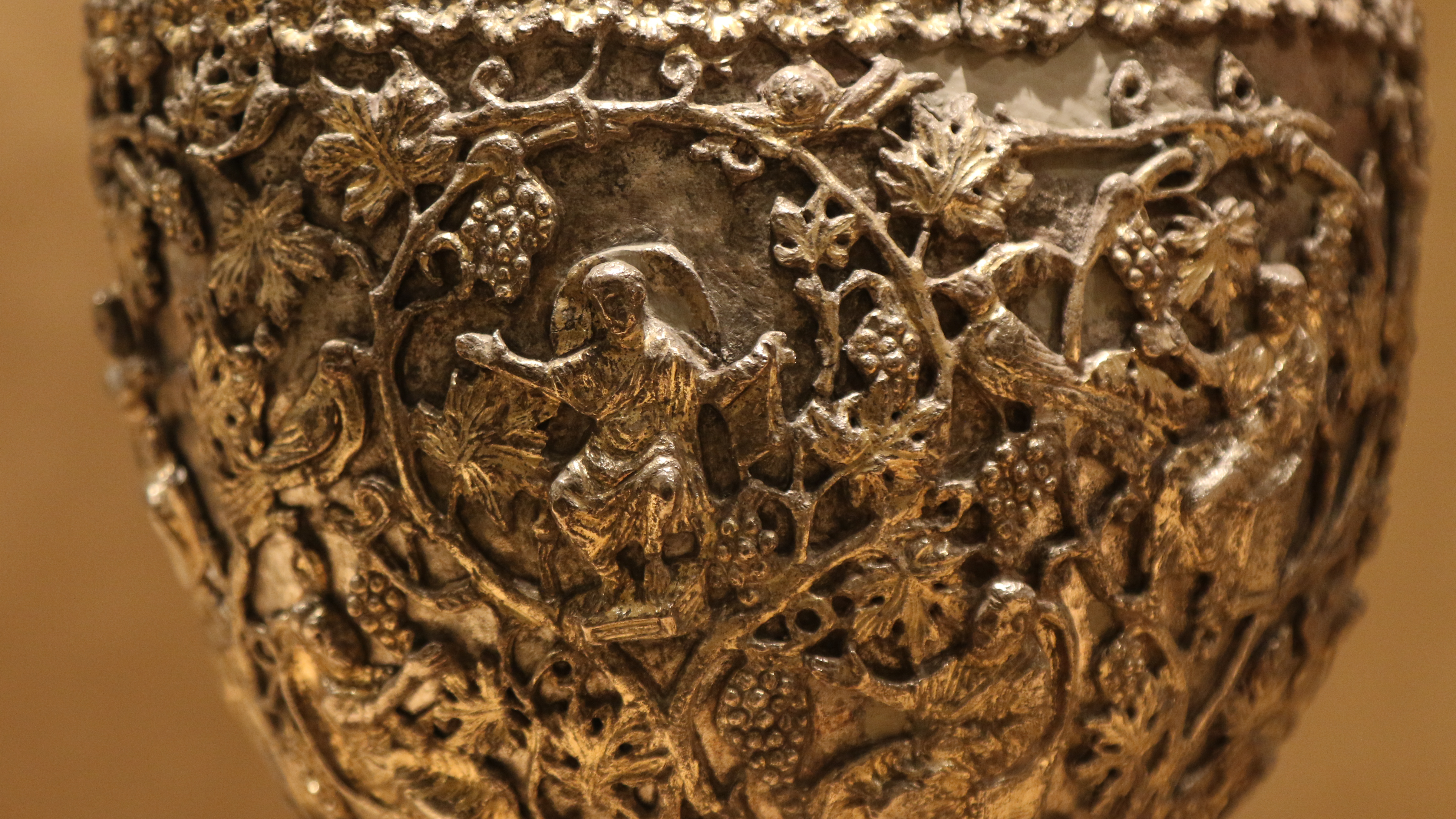
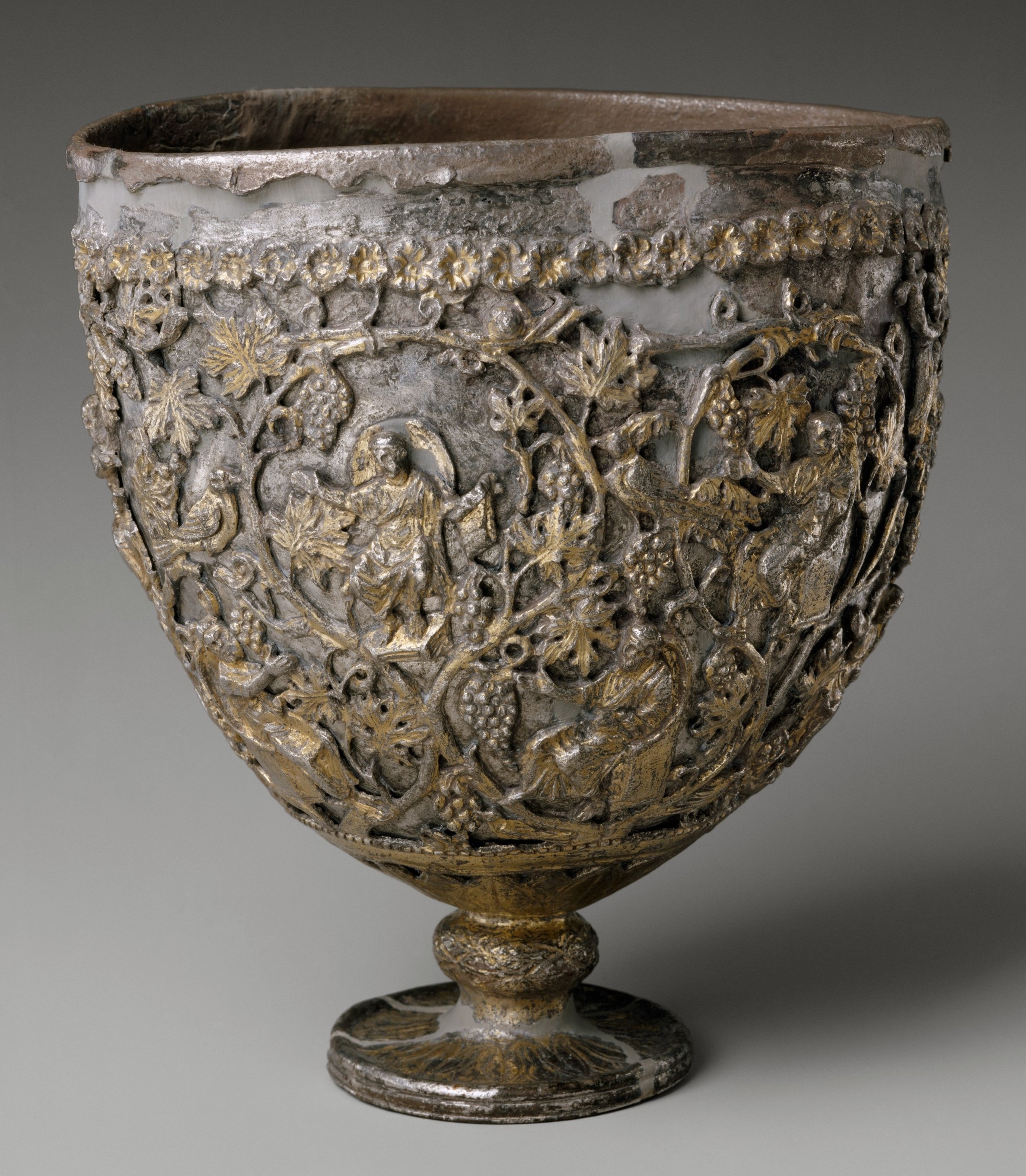
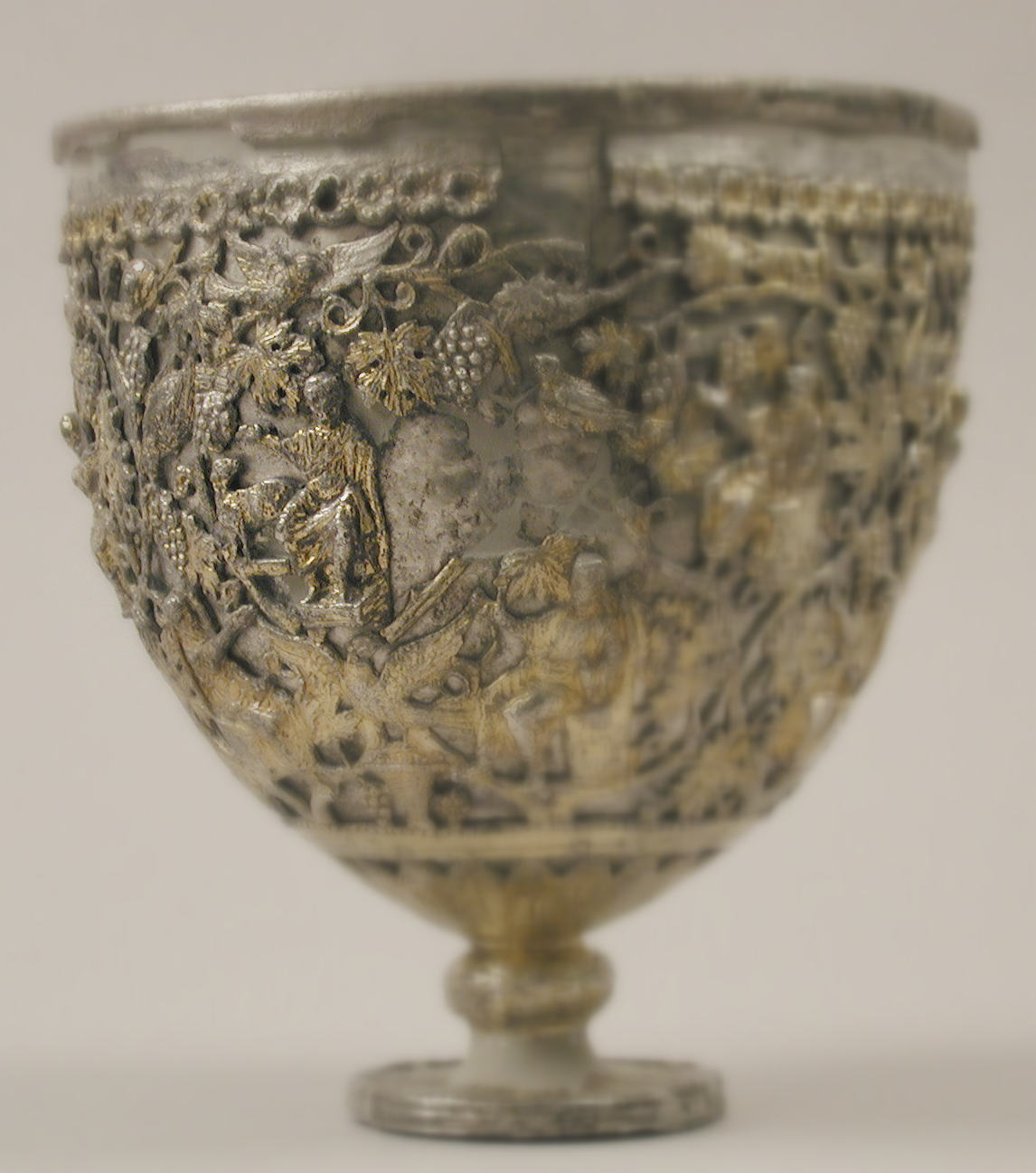
LOOK: The Antioch “Chalice,” 6th century

Antioch Chalice (detail)
The Antioch “Chalice,” Byzantine (Syria), 500–550. Silver, silver-gilt, overall 7 11/16 × 7 1/16 × 6 in. (19.6 × 18 × 15.2 cm). Metropolitan Museum of Art, New York. Photo: Fr. Lawrence Lew, OP.

This Byzantine liturgical object was discovered in 1908 in Antioch on the Orontes (in modern-day Turkey, near the Syrian border) and is thought to be from the first half of the sixth century. Originally it was identified as a chalice, used in the celebration of the Eucharist, but more recent scholarship suggests that it was probably a standing oil lamp that was used in church.

The elaborate silver shell that encloses the plain silver bowl is covered in emblems of the renewal of life—vines, fruit, doves, a butterfly, a rabbit. There are also snails and a grasshopper! If indeed the object is a lamp, its flame would have reinforced Jesus’s self-identification as the light of the world.

Twelve seated human figures circle the bowl, two of which likely represent Christ, as each is surrounded by five figures in attitudes of directed reverence. One Christ figure (see the first photo below) is shown with a scroll draped over his left arm, representing his teaching. The other Christ, on the opposite side, is depicted as the resurrected Lord and giver of life; a lamb stands under his right arm, and beneath him, an eagle with outspread wings perches on a fruit basket.

Antioch Chalice
View 1, what I’ll call the front

Antioch Chalice
View 2, what I’ll call the back. Photo edited by me to focus on the (second) Christ figure and the lamb. Click on image for original.

The subordinate figures, all holding scrolls, may be apostles, or they may be philosophers of the classical age who, like the Hebrew prophets, had foretold the coming of Christ.

LISTEN: Christ lag in Todesbanden (Christ Lay in the Bonds of Death) (BWV 4) by J. S. Bach, 1707 | Words by Martin Luther, 1524 | Performed by Ensemble Orlando Fribourg at the Church of St. Michael’s College, Fribourg, Switzerland, 2016

Bach wrote this Easter cantata—one of his earliest works—at age twenty-two as part of his application for the post of organist at Divi Blasii church in Mühlhausen, Germany. (He got the job!) Its text and melody are taken from the hymn of the same name by Martin Luther, which was itself derived from the eleventh-century plainsong “Victimae paschali laudes.”

The twenty-two-minute cantata is divided into an opening instrumental movement, called a sinfonia, and seven vocal movements corresponding to the stanzas of Luther’s hymn. These are arranged symmetrically—chorus–duet–solo–chorus–solo–duet–chorus—with the focus on the high drama of the central fourth movement, which describes the battle between Life and Death.

Sinfonia

1. Choral

Christ lag in Todesbanden,
für unsre Sünd gegeben,
der ist wieder erstanden
und hat uns bracht das Leben.
Des wir sollen fröhlich sein,
Gott loben und dankbar sein
und singen Halleluja. Halleluja.

2. Duett (SA)
Den Tod niemand zwingen kunnt
bei allen Menschenkindern;
das macht alles unsre Sünd,
kein Unschuld war zu finden.
Davon kam der Tod so bald
und nahm über uns Gewalt,
hielt uns in seim Reich gefangen.
Halleluja.

3. Aria (T)
Jesus Christus, Gottes Sohn,
an unser Statt ist kommen
und hat die Sünde abgetan,
damit dem Tod genommen
all sein Recht und sein Gewalt;
da bleibt nichts denn Tods Gestalt,
den Stachel hat er verloren. Halleluja.

4. Choral
Es war ein wunderlich Krieg,
da Tod und Leben ’rungen;
das Leben, behielt den Sieg,
es hat den Tod verschlungen.
Die Schrift hat verkündet das,
wie ein Tod den andern fraß,
ein Spott aus dem Tod ist worden. Halleluja.

5. Duett (ST)
Hier ist das rechte Osterlamm,
davon wir sollen leben,
das ist an des Kreuzes Stamm
in heißer Lieb gegeben.
Des Blut zeichnet unsere Tür,
das hält der Glaub dem Tode für,
der Würger kann uns nicht rühren. Halleluja.

6. Aria (B)
So feiern wir das hoh Fest
mit Herzensfreud und Wonne,
das uns der Herre scheinen lässt.
Er ist selber die Sonne,
der durch seiner Gnaden Glanz
erleucht unsre Herzen ganz;
der Sünden Nacht ist vergangen. Halleluja.

7. Choral
Wir essen und leben wohl,
zum süßen Brot geladen;
der alte Sau’rteig nicht soll
sein bei dem Wort der Gnaden.
Christus will die Kost uns sein
und speisen die Seel allein;
der Glaub will keins andern leben. Halleluja.
Sinfonia

1. Chorale
Christ Jesus lay in death’s strong bands
for our offenses given;
but now at God’s right hand he stands
and brings us life from heaven.
Therefore let us joyful be
and sing to God right thankfully
loud songs of alleluia! Alleluia!

2. Duet (SA)
No son of man could conquer death,
such ruin sin had wrought us.
No innocence was found on earth,
and therefore death had brought us
into bondage from of old
and ever grew more strong and bold
and held us as its captive. Alleluia!


3. Aria (T)
Christ Jesus, God’s own Son, came down,
his people to deliver;
destroying sin, he took the crown
from death’s pale brow forever.
Stripped of pow’r, no more it reigns;
an empty form alone remains;
its sting is lost forever. Alleluia!

4. Chorale
It was a strange and dreadful strife
when life and death contended.
The victory remained with life,
the reign of death was ended.
Holy Scripture plainly saith
that death is swallowed up by death;
disgraced, it lies defeated. Alleluia!

5. Duet (ST)
Here the true Paschal Lamb we see,
whom God so freely gave us;
he died on the accursed tree—
so strong his love—to save us.
See, his blood now marks our door;
faith points to it; death passes o’er,
and Satan cannot harm us. Alleluia!

6. Aria (B)
So let us keep the festival
to which the Lord invites us;
Christ is himself the joy of all,
the sun that warms and lights us.
Now his grace to us imparts
eternal sunshine to our hearts;
the night of sin is ended. Alleluia!

7. Chorale
Then let us feast this Easter day
on Christ, the bread of heaven;
the Word of grace has purged away
the old and evil leaven.
Christ alone our souls will feed;
he is our meat and drink indeed;
faith lives upon no other! Alleluia!

Trans. Richard Massie, 1854

Easter, Day 5: Christ Is Your Spring

LOOK: Moveable Garden by Sojourn Arts

Moveable Garden (Sojourn Arts)
Moveable Garden, a community art project organized by Sojourn Arts, 2021. Mixed media on panel.

Sojourn Arts is a ministry of Sojourn Midtown in Louisville, Kentucky. As one way for their community to engage the springtime theme of Easter, on Easter Sunday 2021, Tim Robertson led a riso printing project in the church’s art gallery between services, open to all. Participants selected and arranged live flowers on the glass copier of a risograph (a type of digital printing machine that uses a process similar to screen printing to create vibrant, textured prints), printed their designs onto colorful paper, cut them out, and collaboratively collaged them into a floral arrangement on a wood panel—a “moveable garden”! View more photos here.

LISTEN: “Christ Is Your Spring” | Words by Edward A. Washburn, 1863 | Music by Andy Bast, 2024 | Performed by Bellwether Arts, feat. Emily Hanrahan, 2024

Christ has arisen,
And Death is no more!
Lo! the white-robed ones
Sit by the door.
Dawn, golden morning,
Scatter the night.
Haste, you disciples glad,
First with the light!

Break forth in singing,
O the world newborn!
Sing the great Eastertide,
Christ’s holy morn.
Sing him, young sunbeams
Dancing in mirth;
Sing, all you winds of God
Coursing the earth!

Sing him, you laughing flow’rs
Fresh from the sod;
Sing him, wild, leaping streams,
Praising your God!
Break from your winter,
Sad heart, and sing!
Bud with your blossoms fair;
Christ is your spring.

Sing alleluia!

Christ is your spring.

What a beautiful hymn text! Andy Bast found it in Jane Eliza (Coolidge) Chapman’s Easter Hymns compilation, published in Boston in 1876. In the introduction to the hymnal, Chapman’s uncle J. I. T. (James Ivers Trecothick) Coolidge, an Episcopalian minister, delights in how

[Easter’s] sun shines with fuller radiance each year upon the world, whose night of darkness it broke on the Resurrection Morning. The anthems which greet its rising are caught and repeated by increasing millions of grateful hearts of every tongue, kindred, and people, until the wide earth is filled with their sounding praise. How sacred a privilege to have part in this mighty and triumphant symphony, how sad to be out of harmony with its sublime strains!

Written by Rev. Dr. Edward A. Washburn (and given a new tune by Bast), “Christ Is Your Spring” apostrophizes the whole newborn world, enjoining it to praise God. Sunbeams, winds, flowers, streams, the human heart—all are encompassed in God’s project of renewal and invited to sing each in their own way.

Easter, Day 4: Weeping Mary

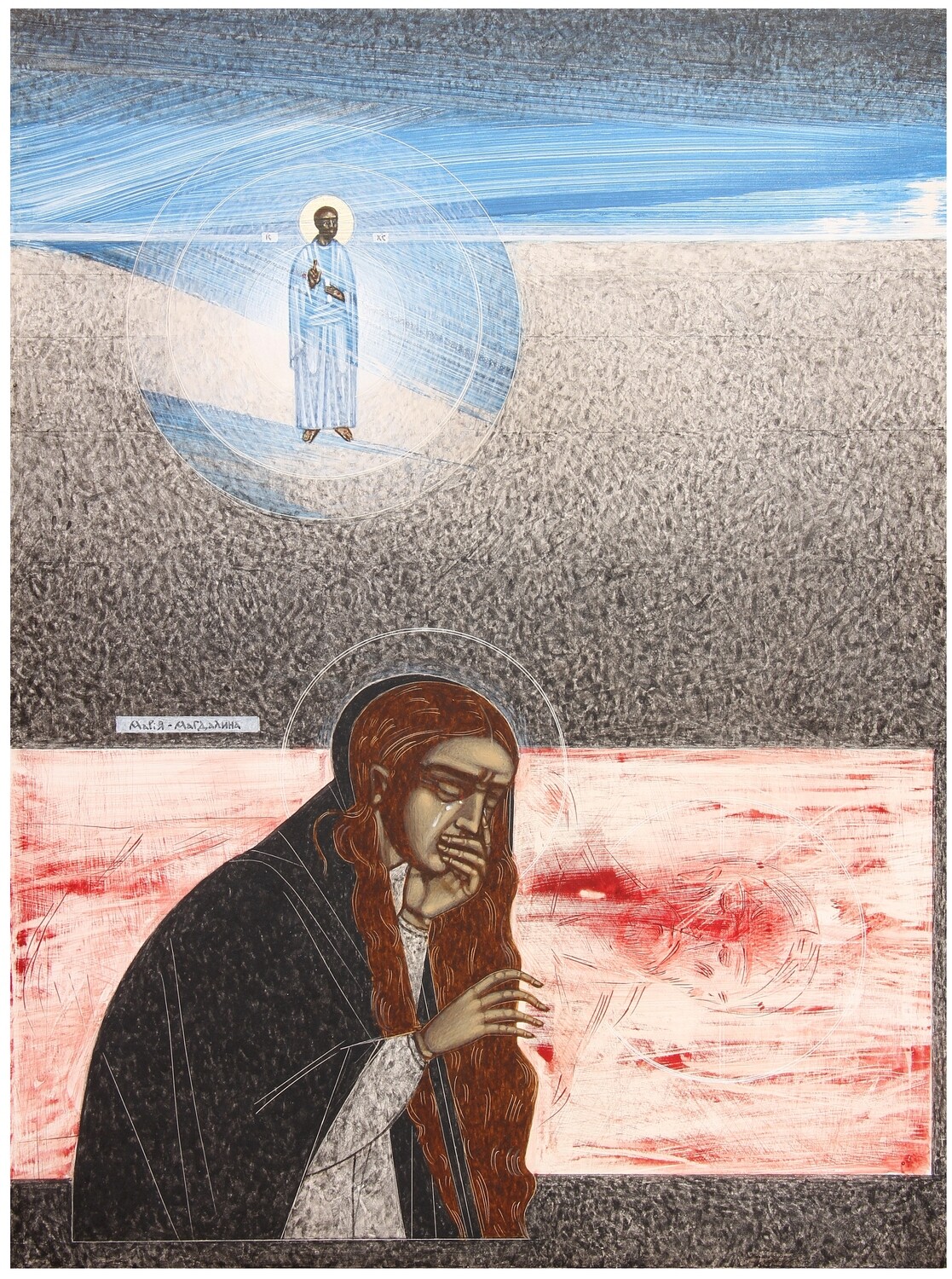
LOOK: Mary Magdalene Stood Crying by Kateryna Kuziv

Kuziv, Kateryna_Mary Magdalene stood crying
Kateryna Kuziv (Ukrainian, 1993–), Mary Magdalene Stood Crying, 2021. Egg tempera and gilding on gessoed wood, 40 × 30 cm.

LISTEN: “Weeping Mary” | Traditional American, 19th century | Arranged by Dan Damon and performed by the Dan Damon Quartet, feat. Sheilani Alix, on Beautiful Darkness, 2022

Is there anybody here like Mary a-weeping?
Call to my Jesus and he’ll draw nigh.
Is there anybody here like Mary a-weeping?
Call to my Jesus and he’ll draw nigh.

Refrain:
Glory, glory
Glory, glory
Glory be to my God on high
Glory, glory
Glory, glory
Glory be to my God on high

Is there anybody here like Peter a-sinking? . . .

Is there anybody here like jailers a-trembling? . . .

This early American spiritual was transmitted orally before first being recorded in The Social Harp (Philadelphia, 1855), a shape-note hymnal compiled by John Gordon McCurry (1821–1886). McCurry was a farmer, tailor, and singing teacher who lived most of his life in Hart County in northeastern Georgia. The Social Harp credits the music for “Weeping Mary” to him and gives it the year 1852, but I think that indicates not composition but notation and harmonization; in other words, McCurry is the arranger.

In the description of their 1973 facsimile reprinting of The Social Harp, the University of Georgia Press writes, “In the time between the [American] Revolution and the Civil War, the singing of folk spirituals was as common among rural whites as among blacks. This was the music of the Methodist camp meeting and the Baptist revival, and white spirituals in fact are known chiefly because homebred composers sometimes wrote them down, gave them harmonic settings, and published them in songbooks.”

I regard “Weeping Mary” as an Easter song, since the primary verse refers to Mary Magdalene standing outside the empty tomb weeping because she doesn’t know what happened to the body of her Lord (John 20). Then a man she supposes to be the gardener engages her in conversation—and turns out to be the one she’s been seeking, only he’s alive!

The jailer in the third verse refers to the Philippian jailer from Acts 16, tasked with guarding the prisoners Paul and Silas, who were falsely charged with disturbing the peace. One night an earthquake strikes, releasing the chains from the walls and breaking open the cell doors. The jailer raises his sword to kill himself to avoid the shame of having let his wards escape. But Paul alerts him that they’re still there, after which the jailer “fell down trembling” and asked the two what he must do to be saved. “Believe in the Lord Jesus,” they reply. After which he and his whole household convert to the new faith.

“Call to my Jesus and he’ll draw nigh,” the song promises.

Another “Weeping Mary” verse not in The Social Harp but that I’ve heard added in some renditions is “Is there anybody here like Thomas a-doubting?”

More subdued than the typical Easter fare, “Weeping Mary” testifies to the nearness of God in our sorrows, fears, doubts, and weaknesses. It embraces those who are anxious, grieving, or struggling, offering a gentle word.

I first learned this song from a recording by the American folk musician Sam Amidon, which I also really like:

In Brattleboro, Vermont, where he grew up in the 1980s and ’90s, he told NPR, shape-note singing was a social tradition, something that happened once a month, with singers moving to different people’s houses, including his own. His parents are the well-known folk musicians Peter and Mary Alice Amidon.

In his rendition he uses the grammatically incorrect but historically faithful verb that appears in original songbook, “Are there anybody . . .”

For a more vigorous jazz arrangement, which includes scat singing and a trumpet solo, see June April’s 2007 album What Am I?. She uses just the first verse.

And here’s a traditional performance in four-part a cappella by the Dordt College Concert Choir, directed by Benjamin Kornelis:

Easter, Day 3: Today Salvation Has Come

LOOK: Easter Morning by Caspar David Friedrich

Friedrich,Caspar David_Easter Morning
Caspar David Friedrich (German, 1774–1840), Easter Morning, ca. 1828–35. Oil on canvas, 43.7 × 34.4 cm. Museo Nacional Thyssen-Bornemisza, Madrid.

I got to see this painting in person when I was in Madrid in 2018, and boy, what a beauty! Caspar David Friedrich was the leading painter of German Romanticism, exploring the spiritual and emotional connections between humanity and nature.

His Easter Morning shows a winding, tree-lined path at early dawn as winter gives way to spring, the leaves just starting to appear on the branches. Three women wrapped in shawls step onto the path, joining others who are making their way to church to worship the risen Lord. Although this is a contemporary scene, the women evoke the three devoted Marys of scripture who got up early one momentous Sunday morning to visit Jesus’s tomb.

LISTEN: All-Night Vigil, op. 37, no. 13: “Dnes spaseniye” by Sergei Rachmaninoff, 1915 | Performed by the Choir of Clare College, Cambridge, dir. Graham Ross, on Haec dies: Music for Easter, 2016

Dnes spaseniye miru byst,
poyem voskresshemu iz groba
i nachalniku zhizni nasheya:
razrushiv bo smertiyu smert,
pobedu dade nam i veliyu milost.

English translation:

Today salvation has come to the world.
Let us sing to him who rose from the dead,
the Author of our life.
Having destroyed death by death,
he has given us the victory and great mercy.

Celebrated as one of the greatest musical achievements of the Russian Orthodox Church, Rachmaninoff’s All-Night Vigil (Всенощное бдение / Vsénoshchnoye bdéniye) is an a cappella choral composition that sets texts from the All-Night Vigil, a liturgical service sung the evening before a major feast, including Pascha, the Feast of the Resurrection of Our Lord. The work premiered in Moscow in March 1915 with the all-male Moscow Synodal Choir and was warmly received but soon after, in 1917, was suppressed, like all church music, by the new Soviet government. For this reason, it didn’t become known in the West until the 1960s.

A troparion inviting meditation on the exalted mystery of the Resurrection, “Today Salvation Has Come” (Днесь спасеніе / Dnes spaseniye) is the thirteenth of the piece’s fifteen movements. It draws on the znamenny style of chant.

Easter, Day 2: Death to Life

LOOK: Golden Dawn by Richard Pousette-Dart

Pousette-Dart, Richard_Golden Dawn
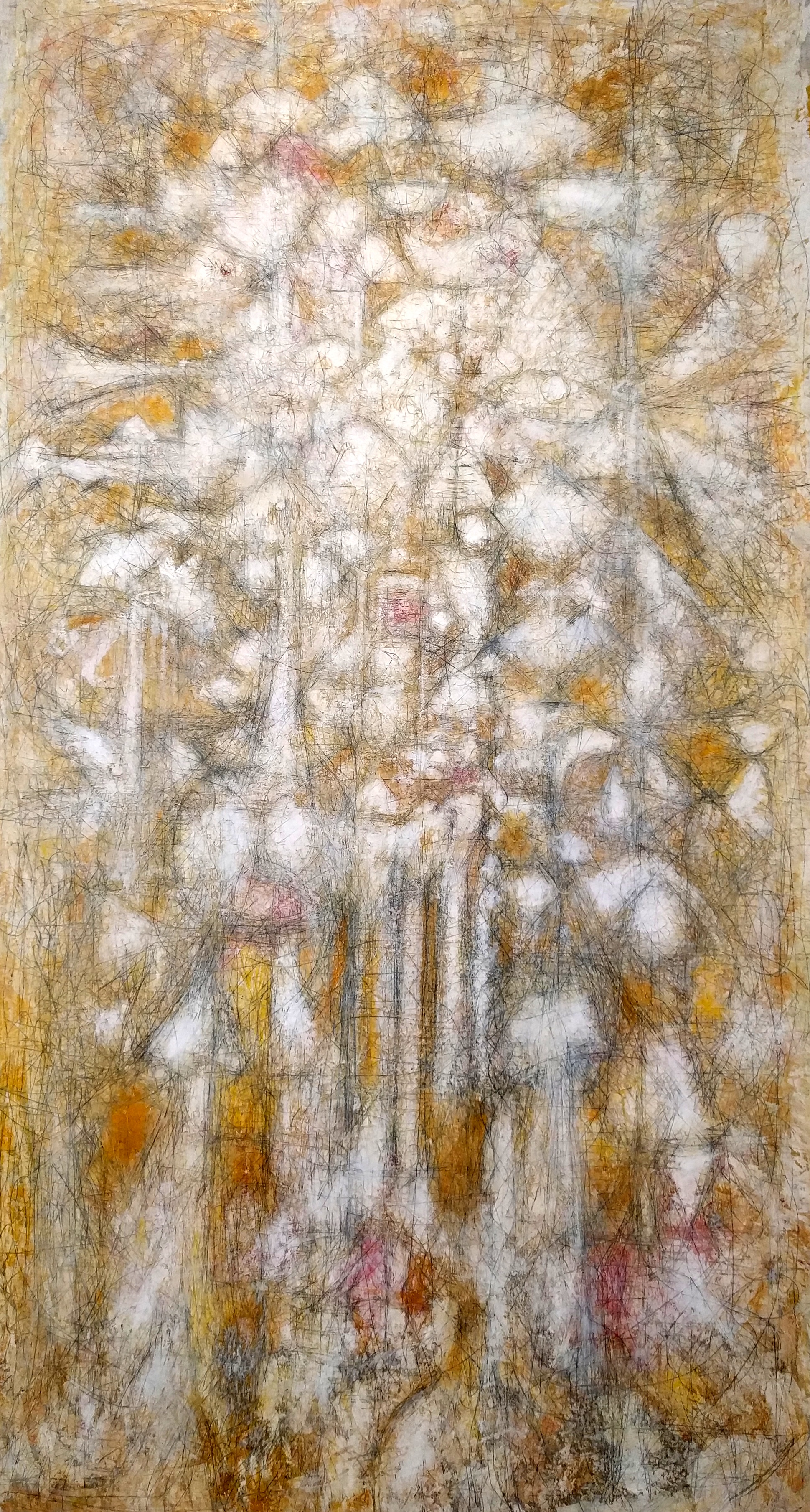
Richard Pousette-Dart (American, 1916–1992), Golden Dawn, 1952. Oil and graphite on linen, 93 1/2 × 51 1/2 in. (237.5 × 130.8 cm). North Carolina Museum of Art, Raleigh. Photo: Victoria Emily Jones. [object record]

This abstract expressionist painting by Richard Pousette-Dart shows an explosion of light, and human bones, as I read it, reassembling—death being translated into life. I’m reminded of Ezekiel’s vision in the valley, of scattered skeletal remains coming back together, growing flesh, standing up, and receiving breath—a foretaste (one, of the descent of God’s Spirit at Pentecost, but also) of the coming resurrection of all the dead, the firstfruits of which was Christ.

LISTEN: The Protecting Veil: “Christ Is Risen!” by John Tavener, 1988 | Performed by the Ulster Orchestra, feat. Maria Kliegel, on John Tavener: The Protecting Veil; In Alium, 1999; re-released on The Essential John Tavener, 2014

This is section 6 of 8 from John Tavener’s The Protecting Veil, a work for cello and strings commissioned by the BBC for its 1989 Promenade season. It’s a Marian work, its title referencing the name of an Eastern Orthodox feast that commemorates the Mother of God’s miraculous appearance over Constantinople in the early tenth century to protect the Christians living there from a foreign invasion.

The “Christ Is Risen!” section is shimmering and exultant, evoking Jesus’s bursting out of the tomb. But about halfway through, the tempo slows and the mood softens, perhaps suggesting, after his triumphant victory over death, a quieter, tearful moment of reuniting with his mom.

The Protecting Veil, Tavener said, “is an attempt to make a lyrical ikon in sound, rather than in wood, and using the music of the cellist to paint rather than a brush.”

The painting featured above is no religious icon, but I see the gospel in it.

Easter, Day 1: Rise Up

This is the first of eight daily art-and-song posts, one for each day of the Easter Octave.

LOOK: Folio 8r (detail) from the Harley Psalter

Resurrection (Harley Psalter)
Detail from the Harley Psalter, Canterbury, first half of 11th century. London, British Library, Harley MS 603, fol. 8r.

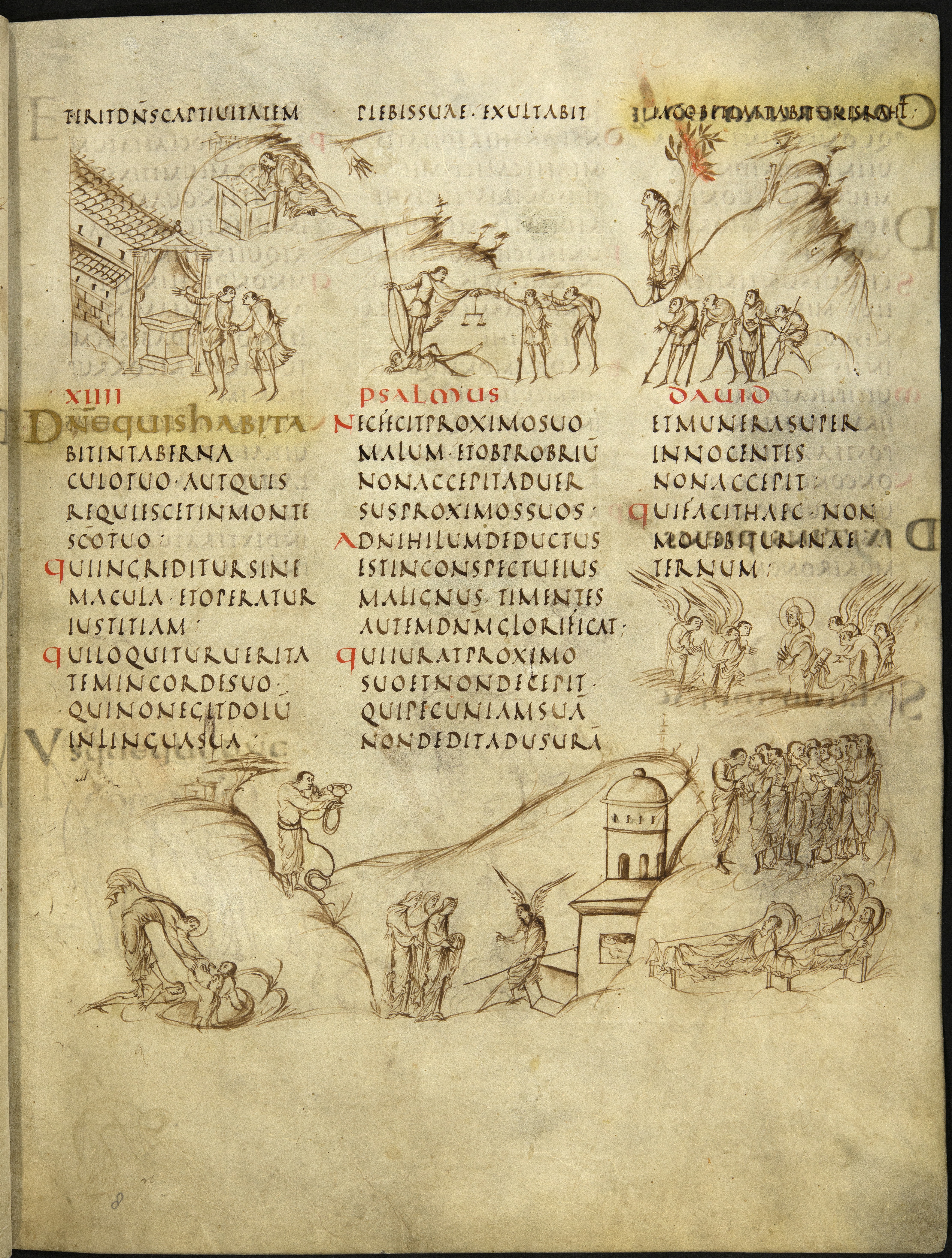
Produced at Christ Church in Canterbury, England, in the eleventh century, the Harley Psalter is celebrated for its lively and delicate multicolored line drawings executed in green, blue, pale sepia, and red inks, which illustrate individual lines from the Psalms, sometimes interpreting them in light of the New Testament. The manuscript is closely based on the ninth-century Utrecht Psalter from France, with a very similar arrangement and many near-identical images.

Folio 8r illustrates Psalm 16 (Psalm 15 in the Vulgate), even though the text of that psalm appears on the following page. I’ll focus on the three drawings at the bottom left (pictured above).

On the far left, the risen Christ pulls Adam and Eve up out of the pit of hell, trampling Hades (death personified as a crumpled man). To the right, three women go to visit Jesus’s tomb early on Easter morning, only to find it empty, save for the abandoned graveclothes—which we can see through an opening in the lower story.

These two vignettes illustrate Psalm 16:10: “For thou wilt not leave my soul in hell; neither wilt thou suffer thine Holy One to see corruption” (KJV). In the New Testament, both Peter (Acts 2:24–28) and Paul (Acts 13:35) apply this verse to Jesus’s resurrection.

The Hebrew word translated into English as “hell” is Sheol, the realm of the dead. In the Apostles’ Creed, the church proclaims that Jesus “was crucified, died, and was buried; he descended into hell [or ‘to the dead,’ as some translations render it]. On the third day he rose again . . .” As have and will most all humans, Jesus went down into the grave—but God did not leave him there. Nor will he leave his holy ones in that shadowy netherworld of deceased souls. Paul writes that Jesus is the first fruits of the harvest of eternal life (1 Cor. 15:20), his resurrection a foretaste and guarantee of the resurrection of all believers. That’s why the church developed the image of the Harrowing of Hell, or Anastasis, showing Christ triumphantly retrieving our ancestors in the faith from the Pit.

Matthew records that at the moment of Jesus’s death, the earth quaked, opening tombs, “and many bodies of the saints who had fallen asleep were raised. After his resurrection they came out of the tombs and entered the holy city and appeared to many” (Matt. 27:52–53). What a strange phenomenon! That’s the harrowing.

The figure who appears in the Harley Psalter between the Harrowing of Hell and the Holy Women at the Tomb is the psalmist himself. He stands on a hillside holding a cup in his right hand and touching his lips with his left, harking to Psalm 16:4–5: “Their [idolaters’] drink offerings of blood I will not pour out or take their names upon my lips. The LORD is my chosen portion and my cup . . .”

Resurrection (Harley Psalter)
BL, Harley MS 603, fol. 8r

To view all 112 drawings from the Harley Psalter in high resolution, visit https://commons.wikimedia.org/wiki/Category:Harley_Psalter_(11th_c.)_-_BL_Harley_603.

If you want to explore the manuscript’s predecessor, the Utrecht Psalter, the Universiteitsbibliotheek Utrecht (its owning institution) provides a full, annotated digital scan, in which every vignette is linked to the psalm verse it illustrates and accompanied by a description. It’s a wonderful resource! Here’s folio 8r, for example.

Resurrection (Utrecht Psalter)
Psalm 15(16) from the Utrecht Psalter, Reims, France (Hautvilliers Abbey), ca. 820-30. Utrecht, Universiteitsbibliotheek, MS 32, fol. 8r.

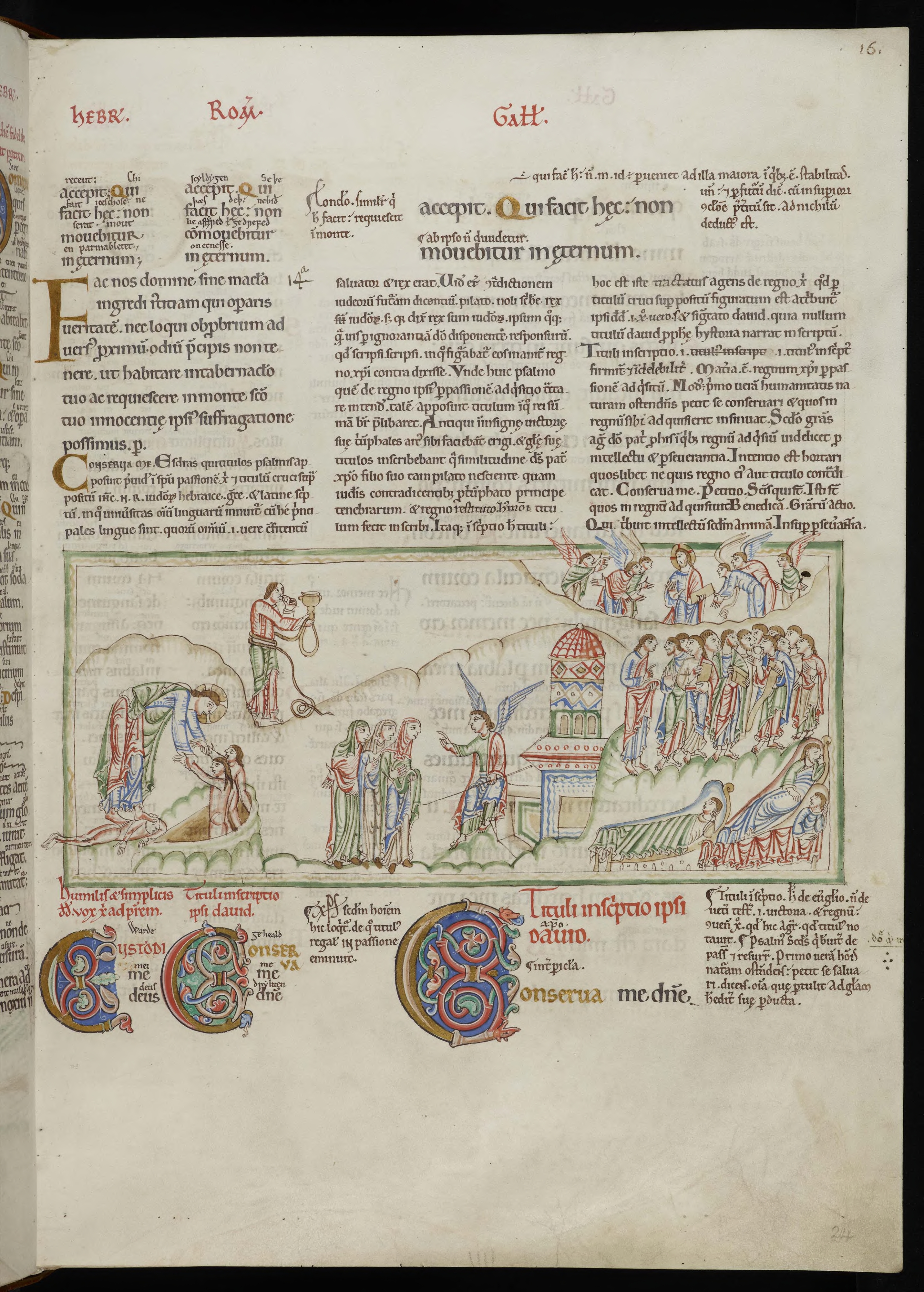
See also the Eadwine Psalter, another copy of the Utrecht Psalter, only slightly later than Harley. Folio 24r corresponds with folio 8r in Utrecht and Harley.

Resurrection (Eadwine Psalter)
Psalm 15(16) from the Eadwine Psalter, Canterbury, ca. 1150. Cambridge, Trinity College, R.17.1, fol. 24r.

LISTEN: “Rise Up (Lauds)” by Dylan McKeeman, on Good Morning, Happy Easter, vol. 3, by the Morning and Night Collective, 2014

Rise up this morning
Jesus is risen!
Rise up this morning and praise
Rise up this morning
Jesus is risen!
Rise up this morning and praise

He is risen indeed
He is risen for me
He is risen this blessed day
He is risen indeed
He has set us all free
He’s risen this blessed day

Dylan McKeeman wrote this song while serving as the director of music and arts at Reynolda EPC in Winston-Salem, North Carolina. He is currently the director of modern worship and production at First Presbyterian Church, also in Winston-Salem.

The subtitle “Lauds” (Latin for “praises”) refers to an early-morning canonical hour designated for prayer, corresponding with dawn.

The song opens with the low, bowed tones of an upright bass, and then a violin, banjo, and guitar enter, all improvising around an F2 chord. Vocalist Jess Silk provides an ethereal hum underneath, which, together with the instruments, evokes a mist lifting. After about the first minute, the song modulates up a whole step to G and a bright banjo tune kicks in along with the summons: “Rise up this morning, Jesus is risen!”

McKeeman is on lead vocals, banjo, and guitar.