LOOK: Adoration of the Lamb from the Escorial Beatus
Adoration of the Lamb, from the Escorial Beatus, Spain, 10th century
This folio is from an illustrated copy of Beatus of Liébana’s (d. ca. 800) hugely influential Commentary on the Apocalypse. The Beatus manuscripts (take a look on Pinterest for some real wacky, Revelation-based imagery) are one of the most significant book genres of the Middle Ages in northern Spain, and the Escorial Beatus (named after its current location) is a preeminent example. It probably originated in the famous scriptorium of San Millán de la Cogolla in La Rioja, Spain. Today it is kept in the Real Biblioteca del Monasterio de El Escorial, part of a royal complex situated at the foot of Mount Abantos in the Sierra de Guadarrama.
LISTEN: “Glory Hallelujah to the Risen Lamb” by Victor C. Johnson, 2009 | Performed by De Angelis Capella, 2019
Glory, glory, glory hallelujah to the risen Lamb! (×4)
Jesus hung on the cruel tree (Glory hallelujah to the risen Lamb!) He gave his life for the likes of me (Glory hallelujah to the risen Lamb!) Women came at the break of day (Glory hallelujah to the risen Lamb!) The angel rolled the stone away (Glory hallelujah to the risen Lamb!)
Glory, glory, glory hallelujah to the risen Lamb! (×4)
Glory, glory hallelujah Glory to the risen Lamb Glory, glory hallelujah Glory to the risen Lamb Glory, glory hallelujah Glory to the risen Lamb Glory, glory hallelujah Glory to the risen Lamb Glory, glory hallelujah Glory to the risen Lamb
Glory, glory, glory hallelujah to the risen Lamb! (×4)
Rob Woodcox, El Espíritu Asciende (Part 3) (The Spirit Rises), 2018
You dragged me
Through the gates of pain
To song,
Love from my heart
Spilling over;

Reason, like Lucifer’s sin,
Burst away and fled.

Now the freer motion
Over the fertile ground
Will reign.
“Release” by Joseph Kariuki is from Poems from East Africa, ed. David Cook and David Rubadiri (Nairobi: East African Educational Publishers, 1971). Used by permission of the publisher.
Joseph E. Kariuki was born in 1931 in Banana Hill, Kenya. After receiving a BA from Makerere College in Uganda and further education at Cambridge University in England, he pursued a career in public administration, working with United Nations organizations in East and North Africa. He also wrote poetry, though less so after his appointment as director-general of the African Training and Research Centre in Administration for Development (CAFRAD) in 1969. His most famous poem is “Ode for Mzee” (1965), written to commemorate Jomo Kenyatta on the occasion of his becoming president of Kenya.
Tanja Butler (American, 1955–), Easter Panels: “The Angel at the Tomb,” “Christ’s Victory Over the Gates of Hell and Death,” “Christ Appearing to Mary in the Garden,” and “The Angel Guarding the Entrance to Paradise,” 2005. Acrylic on canvas, each 8 ft. high. Collection of the artist.
“The tomb is empty!” So declares the angel in the far-left panel of this Easter quadriptych by Tanja Butler, an artist from New England. The angel gestures toward Jesus’s bare and open coffin and his cast-aside graveclothes, telling the women (out of frame) that “he has been raised, as he said” (Matt. 28:6).
The second panel shows Jesus trampling down the gates of hell (the doors laid across each other in an X-shape references traditional iconography of Christ’s descent into Hades). He has defeated death, as indicated by the skull under his feet. A rainbow, symbol of God’s promise, arcs across the scene. Shaped in blessing and communicating doctrinal truths, the fingers on his right hand form the letters IC XC, the first and the last letters of the Greek words IHCOYC XPICTOC, “Jesus Christ.” His five wounds—on wrists, feet, and side—are still present on his resurrected body, but they have been transfigured.
The third panel shows the resurrected Christ appearing to Mary Magdalene in the garden of his burial. With one hand he reaches out to reassure her, but with the other he reminds her that he will be ascending soon, and so not to cling to him (Noli me tangere, as this scene is traditionally named). I believe that the twisting object that seems to proceed from Mary’s mouth and exits the garden gate is a speech scroll, suggesting that she is proclaiming the gospel; “apostle to the apostles,” she is tasked with delivering the news of resurrection to the Eleven. But with its riverine shape, it also reminds me of Jesus’s words to the Samaritan woman at the well: “Those who drink of the water that I will give them will never be thirsty. The water that I will give will become in them a spring of water gushing up to eternal life” (John 4:14).
(Update, 4/20/22: Butler tells me she had in mind the release of the Holy Spirit, breaking through walls and barriers.)
In the far-right scene, the angel who had been guarding paradise with a flaming sword (Gen. 3:24) has put down his sword and now invites us to enter. The sentry has become a porter! He gestures toward the doorway that Christ’s death and resurrection has opened for us. The fall has been undone. We are welcomed home.
“Tanja Butler (b. 1955) was born in Germany and moved to the United States as a young girl. She received her B.A. and M.A. from the University of Albany. Her artistic practice has focused on liturgical art, illustration, and community service projects. She is inspired by Byzantine icons, American and European folk art, Persian manuscripts and textile patterns, African art, Early Christian art, Russian Suprematist paintings, Cubism and Fauvist color. Informed by studies in art history and time working in Italy, she was particularly influenced by the frescoes of Fra Angelico in the Monastery of San Marco in Florence. Her collection of 600 graphic images, Icon: Visual Images for Every Sunday, was published by Augsburg Fortress Publishers. Her work is included in the collections of the Vatican Museum of Contemporary Religious Art; the Billy Graham Center Museum at Wheaton; the Boston Public Library; the DeCordova Museum; and the Armand Hammer Museum of Art, UCLA. In 2014 she retired from her position as an associate professor of art at Gordon College in Wenham, Massachusetts, where she taught painting, drawing, liturgical art, and illustration and frequently integrated service opportunities in her courses.” [source]
Temporary installation at Christ Church, Hamilton/Wenham, Massachusetts, 2005
1. Pourquoi, parmi les morts, chercher les vivants? Jésus est ressuscité! Comme la lumière du soleil levant, Jésus est ressuscité, alléluia, Jésus est ressuscité.
2. Que la terre entière sache la vérité Jésus est ressuscité! Comme la vie nouvelle qu’il nous a donnée, Jésus est ressuscité, alléluia, Jésus est ressuscité.
3. L’ennemi est vaincu, il est terrassé, Jésus est ressuscité! À lui la victoire, nous sommes libérés, Jésus est ressuscité, alléluia, Jésus est ressuscité.
4. Nous voyons sa gloire dans tout l’univers. Jésus est ressuscité! L’image parfaite du Dieu notre Père, Jésus est ressuscité, alléluia, Jésus est ressuscité.
5. Acclamons Jésus, il a vaincu la mort! Jésus est ressuscité! Dansons et chantons, car il est le plus fort, Jésus est ressuscité, alléluia, Jésus est ressuscité.
6. Pourquoi, parmi les morts, chercher les vivants? Jésus est ressuscité! Comme la lumière du soleil levant, Jésus est ressuscité, alléluia, Jésus est ressuscité.
English translation:
1. Why seek the living among the dead? Jesus is risen! Like the light of the rising sun, Jesus is risen, hallelujah, Jesus is risen.
2. Let the whole earth know the truth: Jesus is risen! Like the new life he gave us, Jesus is risen, hallelujah, Jesus is risen.
3. The enemy is defeated, he is struck down, Jesus is risen! To him the victory, we are freed, Jesus is risen, hallelujah, Jesus is risen.
4. We see his glory throughout the universe. Jesus is risen! The perfect image of God our Father, Jesus is risen, hallelujah, Jesus is risen.
5. Let us acclaim Jesus, he conquered death! Jesus is risen! Let’s dance and sing, because he is the strongest, Jesus is risen, hallelujah, Jesus is risen.
6. Why seek the living among the dead? Jesus is risen! Like the light of the rising sun, Jesus is risen, hallelujah, Jesus is risen.
Born and raised in South Africa, singer-songwriter Pat Berning moved to southern France with his wife Linda in 1988, following a call they felt while working for the international ministry Youth for Christ. Though he didn’t know the language at the time, now he sings and records primarily in French, and occasionally in English or Zulu.
His live performance above of his original song “Jésus est ressuscité” is from the Christian arts festival Psalmodia Gagnières—sometime in the early to mid-2000s. The album version uses male and female singers and has call-and-response elements. “Jesus is risen!” the refrain goes. Such a fun and celebratory song.
The hip-hop dancer in the video is Sodapop. He and his wife, Christine Jeanville (a classical and contemporary dancer), founded Machol Danser la Vie in 2005, named after the man in 1 Kings 4:31 whose name means “dancing.” The ministry organizes workshops that promote healing, empowerment, and connection with others and God through dance. And in 2018 they opened the Ecole de Formation sur l’ Identité et la Louange par le Mouvement (Training School on Identity and Worship through Movement).
Easter Sunday is the most joyful day of the Christian year, kicking off a fifty-day season of feasting and celebration centered on the resurrection of Jesus Christ. While we celebrate the resurrection year-round (every Sunday is a “little Easter”), the liturgical calendar gives us this set-apart time to linger with and savor the mystery with particular focus and renewed fervor. Christ’s rising from the grave has far-reaching implications, which the church unpacks, most especially during Eastertide, through its liturgies, scripture readings, sermons—and music.
I compiled a Spotify playlist of songs and other musical pieces for this festal season—a mix of classical, gospel, choral, folk, and indie-pop, with some jazz and bluegrass. These selections span historical periods and geographic locales, ranging from early medieval hymns and liturgical refrains to newer releases, from Senegal, Tanzania, Chile, Tyendinaga Mohawk Territory (in Ontario), Serbia, Hungary, Germany, Ireland, France, the Middle East, and more.
You’ll find plenty of classic texts and tunes, some retunes and new arrangements of the classics and other oldies, and some through-and-through originals. And lots of Alleluias!
Sung in Byzantine-rite churches, the Paschal troparion—“Christ is risen from the dead, trampling down death by death, and on those in the tombs bestowing life”—is represented here by a few different settings in a few different languages, including Georgian (“Krist’e Aghsdga”) and Greek (“Hristos Anesti”). Church of the Apostles does a version in English that works well with a contemporary worship band.
The medieval French melody known as NOEL NOUVELET is often paired with two different Easter hymn texts, both of which I’m very fond of: “Welcome, Happy Morning!” by Venantius Fortunatus, a sixth-century hymnographer in the Merovingian court and later bishop of Poitiers, and the early twentieth-century “Now the Green Blade Riseth” by J. M. C. Crum, which has this wonderfully poetic refrain: “Love is come again like wheat that springeth green.” Claire Holley [previously] recorded a subdued, guitar-picked rendition of the latter, and for the former, here’s Redeemer Knoxville’s [previously] super-fun arrangement, which includes mandolins, trumpets, and a raucous energy!
Christ’s death and resurrection initiated a new exodus, so to speak, so some of the songs, like “Carol of the Exodus” [previously] and “Mary, Don’t You Weep” [previously] use the language of Pharaoh’s armies (i.e., agents of death) being overthrown, and liberation.
Also included on the list is a Swahili praise song whose key phrase, “Yesu ni wangu, wa uzima wamilele,” translates to “Jesus is mine, he is (the God of) everlasting life.” Some English versions of the song translate it as “Jesus is mine, he’s alive and he’s eternal.”
Classical selections include the Sinfonia (instrumental opening) of Bach’s Easter Oratorio; “Dum transisset Sabbatum” (When the Sabbath Was Past), a Renaissance motet setting of Mark 16:1–2 by John Taverner; a movement from a piano sonata by modern Finnish composer Einojuhani Rautavaara inspired by the icon of the holy women at the tomb; and a movement from a violin sonata by Austrian Baroque composer Heinrich Ignaz Franz Biber.
The latter two are among the several allusive instrumental pieces on the list, which also include “Viriditas” on jazz guitar by Charlie Rauh (its title references Hildegard of Bingen’s concept of greening, freshness, new life) and “Phoenix” on oud by Egyptian Australian virtuoso Joseph Tawadros (the phoenix is a mythological bird that dies and rises again, which the medieval church embraced as a symbol of Christ).
Two gems I discovered while searching for Easter music are settings of Gerard Manley Hopkins’s poem “Easter”: one a Celtic-influenced choral setting by Steven C. Warner, the other an alt-rock version by Jon Green (JG Hymns):
A popular Easter song in Spanish-speaking churches throughout the world is “Resucitó” (He Is Risen) by Kiko Argüello:
There are a few songs here written for kids, like “Jesus Is Alive” by Rain for Roots and “Risen Today” by John Burland, but which I find enjoyable myself!
And there are a handful of songs by James Ward [previously], a gospel songwriter and pianist from New City Fellowship in Chattanooga, Tennessee—such as “Morning Sun,” which is included in the Trinity Hymnal:
For a closer, I chose “Love Divine, Victorious,” written by Karl Digerness and arranged by Minna Choi, musicians at City Church San Francisco [previously]. I love its blend of classical and folk-rock styles, with an orchestra interacting with a banjo and drum kit. (The album recording has a full orchestra and a choir; the video below is a pared-down version from last year, with string orchestra and two vocalists.) The song looks back in remembrance and forward in anticipation, quoting the traditional memorial acclamation “Christ has died, Christ is risen, Christ will come again.”
To listen to all 130-plus songs on Spotify, open the Art & Theology Eastertide Playlist link, then click on the More (…) icon and select “Save to Library.” Then the list will be easily accessible to you throughout the season and will reflect any new song additions I make.
Playlist cover art: Edward Burra, Resurrection, ca. 1948–50
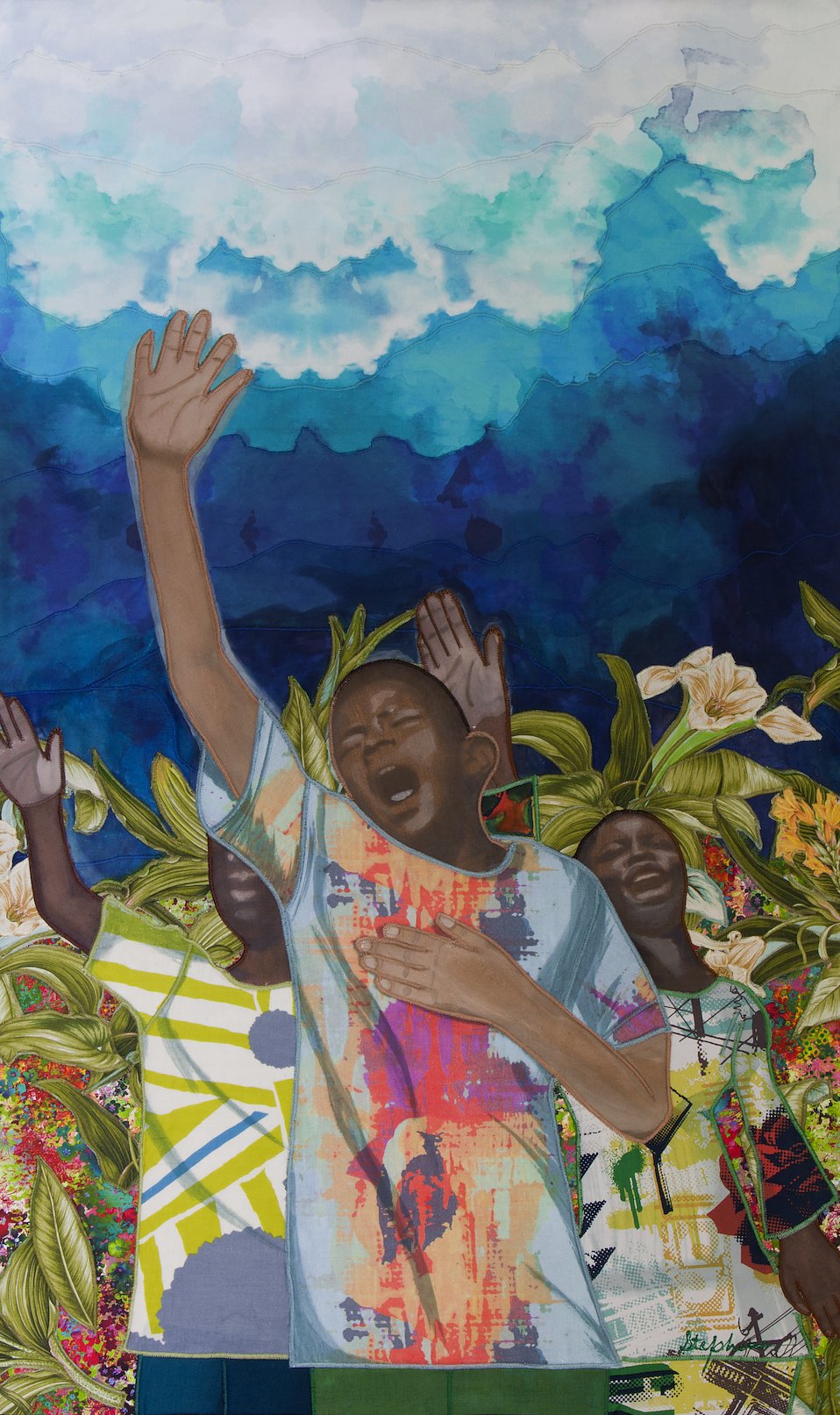
EXHIBITION: Otherwise/Revival, Bridge Projects, Los Angeles, April 9–June 26, 2021: Curated by Jasmine McNeal and Cara Megan Lewis, this group exhibition visualizes the impact of the historic Black church—specifically the Black Pentecostal movement—on contemporary artists. Included are several artists I’ve featured on the blog before—Lava Thomas [here], Kehinde Wiley [here], Clementine Hunter [here], Letitia and Sedrick Huckaby [here]—plus twenty-six others.
Phyllis Stephens (American, 1955–), High and Lifted Up, 2020. Cotton fabric, 57 × 33 in. Private collection. Courtesy of the artist and Richard Beavers Gallery, New York.Kenturah Davis (American, 1984–), Namesake I, 2014. Incense ink on rice paper, applied with rubber stamp letters, 39 × 36 in. Courtesy of the artist and the Petrucci Family Foundation, New Jersey.
I regret that I won’t be able to see the exhibition in person, but there’s a wealth of relevant content available on the gallery’s website, including photos, artist bios and statements, and commentaries. I haven’t fully delved in yet, but some of the artist names are new to me, and I look forward to jumping over to their websites to learn more. There’s also a series of free events that have been scheduled. The premiere of the virtual music performance yes! lord by Ashton T. Crawley and a symposium on the Azusa Street Revival have already passed (both are archived online for on-demand viewing), but here are some upcoming opportunities you can reserve a spot for:
May 1: “Jazz and the Gospel” with Daniel E. Walker, Ashon T. Crawley, Dario Robleto, Norman Teague, Lava Thomas, and Folayemi (Fo) Wilson
ARTICLE: “5 Films About the Beauty of Resurrection” by Brett McCracken: “Resurrection’ tropes are so familiar in certain genres that they can numb us to the jarring beauty and bracing surprise of resurrection. But other films capture the magic and shock of resurrection by situating it within more mundane realities and contexts. Here are five of my favorite examples of this kind—movies that capture resurrection in all of its miraculous, unsettling, hope-giving glory.” One of his selections is Happy as Lazzaro, which I saw last year and enjoyed:
+++
NEW ALBUMS:
>> Hymns I by Lovkn: Steven Lufkin is a singer-songwriter from Phoenix, Arizona, recording under the name Lovkn. His latest EP, a collection of eight acoustic hymn covers, was released April 2. (Also, he’s currently raising funds to record an album of original songs, to be released later this year: kickstarter.com/projects/lovkn/new-album-2021.)
>> Prayers for the Time of Trial by Joel Clarkson: Released April 7, this EP comprises five original SATB choral compositions by Joel Clarkson, which he recorded with his sister Joy Clarkson. My favorite is the first, “Lighten Our Darkness,” a setting of the Book of Common Prayer’s Collect for Aid Against Perils: “Lighten our darkness, we beseech thee, O Lord; and by thy great mercy defend us from all perils and dangers of this night; for the love of thy only Son, our Savior, Jesus Christ. Amen.”
The other four are “Sub Tuum Praesidium” (Beneath Thy Protection), a third-century hymn to the Virgin Mary as Theotokos; “Hail King,” a poem by Joel’s other sister, Sarah Clarkson, that marvels at how rocky cliffs and sea waves and herring gulls sing God’s praises in their own way; “Ubi Caritas,” an ancient hymn centered on the theme of Christian charity; and the simple benediction “May the peace of the Lord be with you now and always.”
ORTHODOX CHANT: Russian Kontakion of the Departed: At Prince Philip’s funeral service at St. George’s Chapel at Windsor Castle on April 17, a choir of four sang, among other pieces, the Russian Kontakion of the Departed, translated into English by William John Birkbeck and arranged by Sir Walter Parratt. “The Russian Kontakion of the Departed is an ancient Kiev chant with its origins in the Russian Orthodox liturgy. This moving chant expresses the sorrow of grief but reminds us of the Christian hope of everlasting life; in the face of sadness, we sing Hallelujahs.” [HT: Global Christian Worship]
Give rest, O Christ, to thy servant with thy saints: where sorrow and pain are no more; neither sighing but life everlasting. Thou only art immortal, the creator and maker of man: and we are mortal formed from the dust of the earth, and unto earth shall we return: for so thou didst ordain, when thou created me saying: Dust thou art und unto dust shalt thou return. All we go down to the dust; and weeping o’er the grave we make our song: Alleluia, alleluia, alleluia.
+++
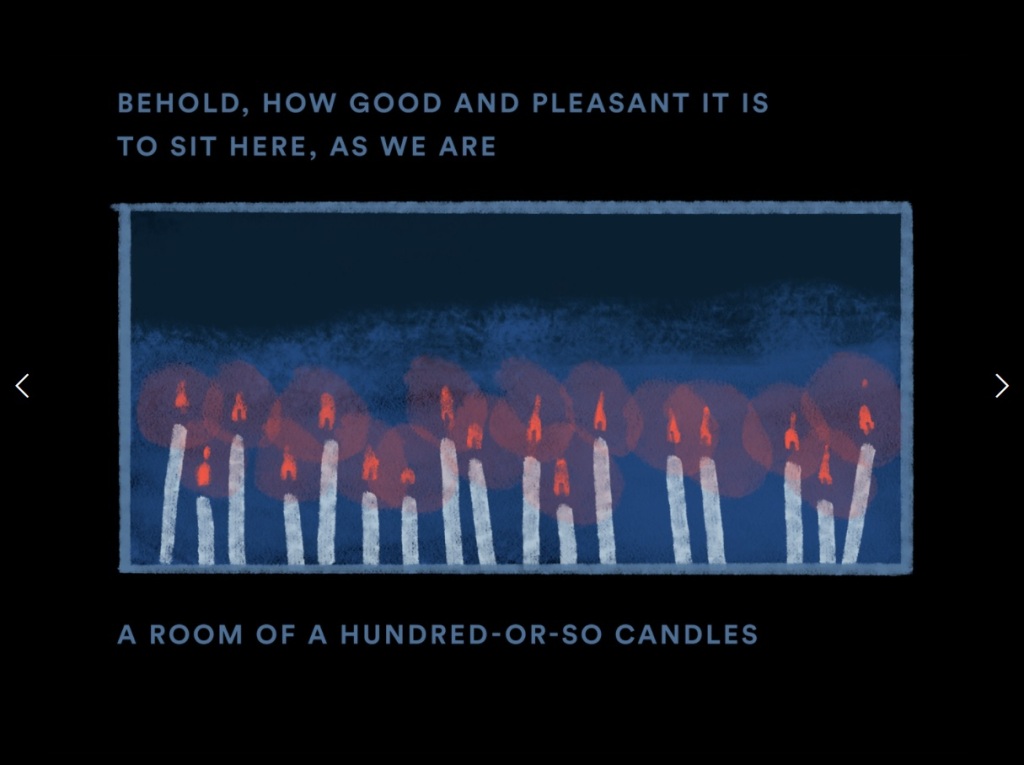
VISUAL LITURGY: “After Ezekiel” by Madeleine Jubilee Saito: Remember those flip books you probably encountered as a kid—the ones with a series of images that gradually change from one page to the next, giving the illusion of animation when viewed in quick succession? Well, this is a digital version of that. In 2019 cartoonist and illustrator Madeleine Jubilee Saito created an image sequence intended to be swiftly clicked through as part of the Easter Vigil at a church in Boston. It was inspired by the story of Ezekiel in the valley of dry bones (Ezek. 37). Very compelling!
As the church continues in this fifty-day season of Eastertide to celebrate the resurrection of Christ, here are some songs I’ve come across for the occasion and really enjoyed. A few are brand-new, while others are new performances.
Good Shepherd New York, a church in Manhattan, has a phenomenal team of in-house musicians and collaborators from coast to coast. They provide music for weekly digital worship services as well as release recordings under the name Good Shepherd Collective. Check out their Easter service from April 4! The songs are listed below.
MEDLEY: “Christ the Lord Is Risen Today” by Charles Wesley / “Celebrate Jesus” by Gary Oliver (1:35)
The GSC has posted “Here Comes the Sun” as a standalone video on Instagram. It features Brennan Smiley on lead vocals and acoustic guitar; Liz Vice on harmonizing vocals; Charles Jones on Hammond organ; John Arndt on piano; Jesse Chandler on flute, clarinet, and saxophone; Joseph M on electric guitar; Tyler Chester on bass guitar; and McKenzie Smith on drums. The art and stop-motion animation are by Boston-based artist Soyoung L Kim.
Last year the Fundación la Caixa in Barcelona launched project #YoCanto Aleluya, soliciting professional and amateur singers alike throughout Spain and Portugal to be part of a “virtual choir,” a phenomenon that has exploded since the pandemic has made live musical concerts a health risk. Participants were asked to submit a video of themselves singing Handel’s famous “Hallelujah” chorus. Igor Cortadellas of Igor Studio then developed a concept for digitally merging all 352 submissions by projecting them on the interior architecture of Barcelona’s Basilica of Santa Maria del Mar (or overlaying them in postproduction?), and he directed a small team to execute this vision. What a feat! The final video was released a few months ago at Christmastime.
“Hallelujah” concludes part 2 of 3 of the oratorio, which covers Christ’s passion and death, resurrection, ascension, and the first spreading of the gospel. The words of the chorus are taken from Revelation 19:6, 11:15, and 19:16. For another blog post featuring an excerpt from Handel’s Messiah, see the Artful Devotion “Worthy Is the Lamb.”
“Keep the Feast (Pascha Nostrum)” by Ryan Flanigan: For this new song, Ryan Flanigan of Liturgical Folk adapted the words of the Pascha Nostrum (“Our Passover”), a traditional Christian hymn for Eastertide that, after the Reformation, was preserved in English in the Book of Common Prayer. It is based on 1 Corinthians 5:7–8, Romans 6:9–11, and 1 Corinthians 15:20–22. Flanigan wrote a fun new melody for it, which he demos here.
+++
“Zinda Yeshua (Jesus Is Alive)” by Blesson Varghese and James Bovas: This Hindi-language Easter song is from Grace Ahmedabad, an Assemblies of God church in the Indian state of Gujarat. James Bovas sings lead, with Priscilla Mozhumannil on supporting vocals. See the YouTube description for a full list of credits. [HT: Global Christian Worship]
+++
“Judah’s Lion” | Words by Fulbert of Chartres, ca. 975–1028, and Rick Barnes, 2016 | Music by Rick Barnes, 2016 | Performed by Covenant Presbyterian Virtual Choir and Orchestra, Birmingham, Alabama, 2021
Now is the shining fabric of our day
Torn open, flung apart,
Rent wide by Love.
Never again
The tight, enclosing sky,
The blue bowl,
Or the star-illumined tent.
We are laid open to infinity,
For Easter Love
Has burst His tomb and ours.
Now nothing shelters us
From God’s desire—
Not flesh, not sky,
Not stars, not even sin.
Now Glory waits
So He can enter in.
Now does the dance begin.
This poem, written in 1981, is used by permission of the Elizabeth B. Rooney Family Trust, www.brighamfarm.com.
Now after the Sabbath, toward the dawn of the first day of the week, Mary Magdalene and the other Mary went to see the tomb. And behold, there was a great earthquake, for an angel of the Lord descended from heaven and came and rolled back the stone and sat on it. His appearance was like lightning, and his clothing white as snow. And for fear of him the guards trembled and became like dead men. But the angel said to the women, “Do not be afraid, for I know that you seek Jesus who was crucified. He is not here, for he has risen, as he said. Come, see the place where he lay. Then go quickly and tell his disciples that he has risen from the dead, and behold, he is going before you to Galilee; there you will see him. See, I have told you.” So they departed quickly from the tomb with fear and great joy, and ran to tell his disciples.
—Matthew 28:1–8
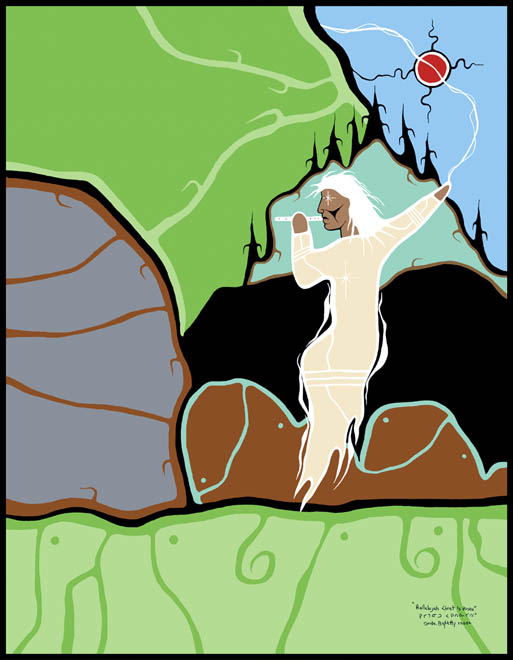
LOOK: Ovide Bighetty (Cree, 1969–2014), Hallelujah, Christ Has Risen, 2002. Acrylic on canvas. From the Kisemanito Pakitinasuwin (The Creator’s Sacrifice) cycle, commissioned by the Indian Metis Christian Fellowship.
Ovide Joseph Bighetty was a Cree (Missinippi-Ethiniwak) self-taught artist originally from Pukatawagan First Nation on the Missinippi River in northwestern Manitoba. He was influenced by the Woodland art style of Norval Morrisseau.
In 2002 the Indian Metis Christian Fellowship (now called the Indigenous Christian Fellowship, or ICF) commissioned Bighetty to create a series of paintings on Christ’s death and resurrection. According to their website, “among North American indigenous peoples, there is the story that, before Europeans arrived on Turtle Island, elders had visions about white people coming from the east with a story from the Creator.” One elder even had a vision of “the Creator’s sacrifice” that corresponds to elements of the biblical passion narratives and Easter story.
Bighetty fulfilled the commission in consultation with Pukatawagan elders, making sure he was properly honoring his people’s heritage.
Hallelujah, Christ Has Risen is the sixteenth painting in a sequence of seventeen. The ICF website offers the following description based on Matthew 28:2–4: “Early on the third day, there was a violent earthquake. A spirit sent by the Creator came down from heaven, rolled the stone away and sat on it. His appearance was like lightning and his clothes white as snow. The warriors were so afraid that they trembled and became like dead men.” It looks to me like the angel is playing a flute with one hand, and with the other he gestures toward the sky, indicating Jesus’s impending ascension.
LISTEN: “Christ the Lord Is Risen Today” | Words by Charles Wesley, 1739 | Music from the Lyra Davidica, 1708 | Arranged and performed by pianist Craig Curry on A Jazz-Inspired Easter, 2012
Christ the Lord is ris’n today, Alleluia! Sons of men and angels say,* Alleluia! Raise your joys and triumphs high, Alleluia! Sing, ye heav’ns, and earth reply, Alleluia!
Love’s redeeming work is done, Alleluia! Fought the fight, the battle won, Alleluia! Death in vain forbids him rise, Alleluia! Christ hath opened paradise, Alleluia!
Lives again our glorious King, Alleluia! Where, O death, is now thy sting? Alleluia! Once he died our souls to save, Alleluia! Where’s thy victory, O grave? Alleluia!
Soar we now where Christ has led, Alleluia! Foll’wing our exalted Head, Alleluia! Made like him, like him we rise, Alleluia! Ours the cross, the grave, the skies, Alleluia!
Hail the Lord of earth and heav’n, Alleluia! Praise to thee by both be giv’n, Alleluia! Thee we greet triumphant now, Alleluia! Hail the Resurrection, thou, Alleluia!
King of glory, soul of bliss, Alleluia! Everlasting life is this, Alleluia! Thee to know, thy pow’r to prove, Alleluia! Thus to sing, and thus to love, Alleluia!
* Alternatively, “Earth and heav’n in chorus say,” as in the United Methodist Hymnal.
This is, for me and many others, the Easter hymn par excellence. (Charles Wesley was a brillianthymn writer.) I never tire of it year after year. It’s glorious.
Happy Easter, friends. Christ is risen!
Be sure to stick around for the next fifty days as I continue to celebrate Easter here at Art & Theology.
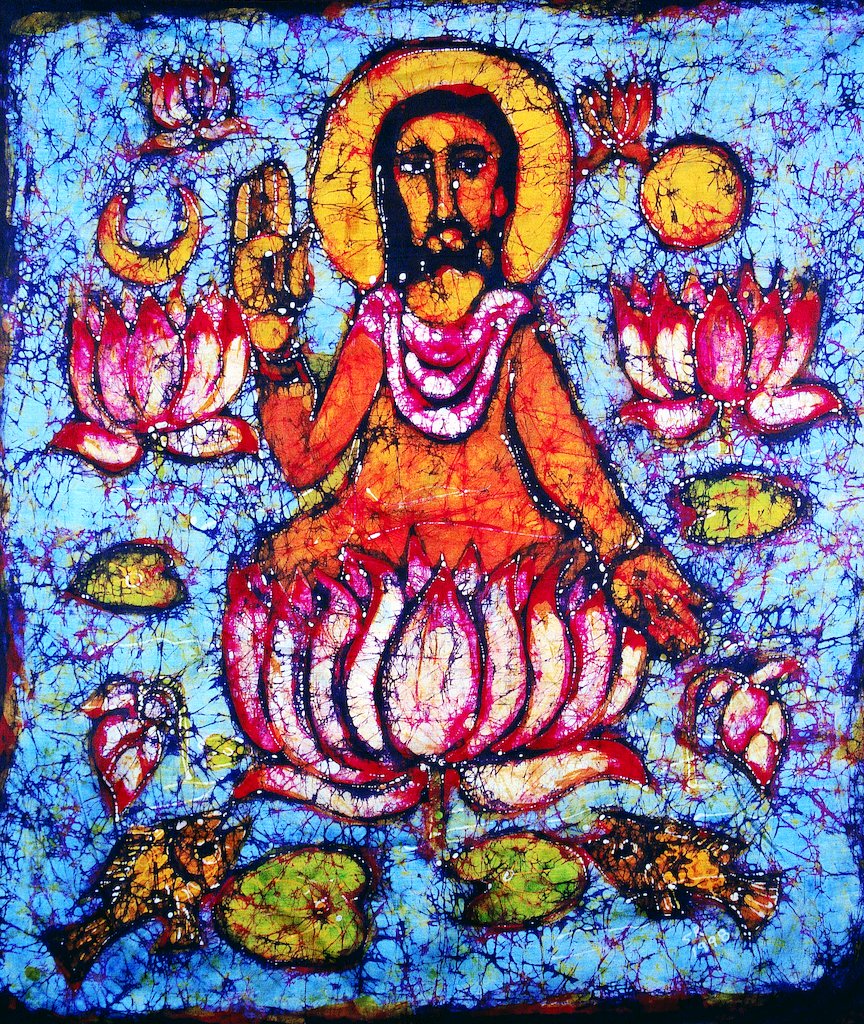
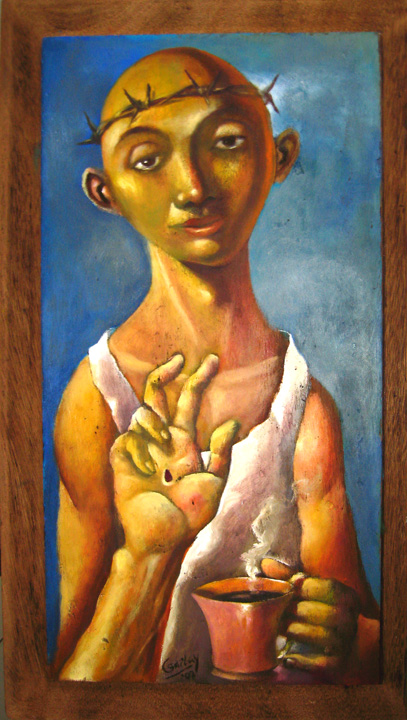
ARTICLE: “Searching for a Jesus Who Looks More Like Me” by Eric V. Copage: I was interviewed the other week for this New York Times piece on multiethnic images of Christ. I comment on paintings by Wisnu Sasongko (Indonesian), Greg Weatherby (Aboriginal Australian), Emmanuel Garibay (Filipino), and Solomon Raj (Indian), and helped select a few of the other images.
Solomon Raj (Indian, 1921–2019), Jesus on the Lotus Flower, 1998. Batik. Photo: Gudrun Löwner.
Emmanuel Garibay (Filipino, 1962–), Untitled, 2007. Oil on wood. Photo via the artist.
Of those Christians who even permit images of Jesus, some hold to a strict literalism and object to images that show him as anything other than a first-century Jew from Israel-Palestine—even though these same literalists would rightly insist that no image is literally Jesus. As I hope is clear from my website, I embrace a wide range of Christological imagery, which I feel reflects the universal presence and revelation of God. (“Christ is all, and in all,” as the apostle Paul wrote in Colossians 3:11; he continues to manifest spiritually, and through his ecclesial body, all over the world.) I’m not so proud to assume that my way of picturing Jesus is the most right or authoritative; I need others to help me see Jesus more fully, more truly. Like C. S. Lewis said, “My own eyes are not enough for me, I will see through those of others.” And historical realism is not the only, or even necessarily the best (depends on context), art style to show who Jesus is.
Even though the historical Jesus never wore a full-face moko (tattoo) like the Maori, as Sofia Minson paints him, nor did he sit on a lotus flower when he taught his disciples, nor did he appear to Peter, James, and John transfigured between two Yoruba deities, these images and others like them tell us something about Jesus. At a broad level, they proclaim the Incarnation—God in flesh, dwelling among us, as us, that is, fully human. The historical Jesus existed in a specific time and place, and had ethnic particularities, but his coming was not just for the Jews but for the Gentiles too, and not just for his day, for but all time. Through symbol and metaphor and materiality, artists make this truth real.
+++
UPDATED BLOG POSTS
Occasionally if I’ve covered an art topic in the past and then come across a new image that fits that topic perfectly, I will add it as an addendum to the original post. I’ve done that with two Eastertide posts.
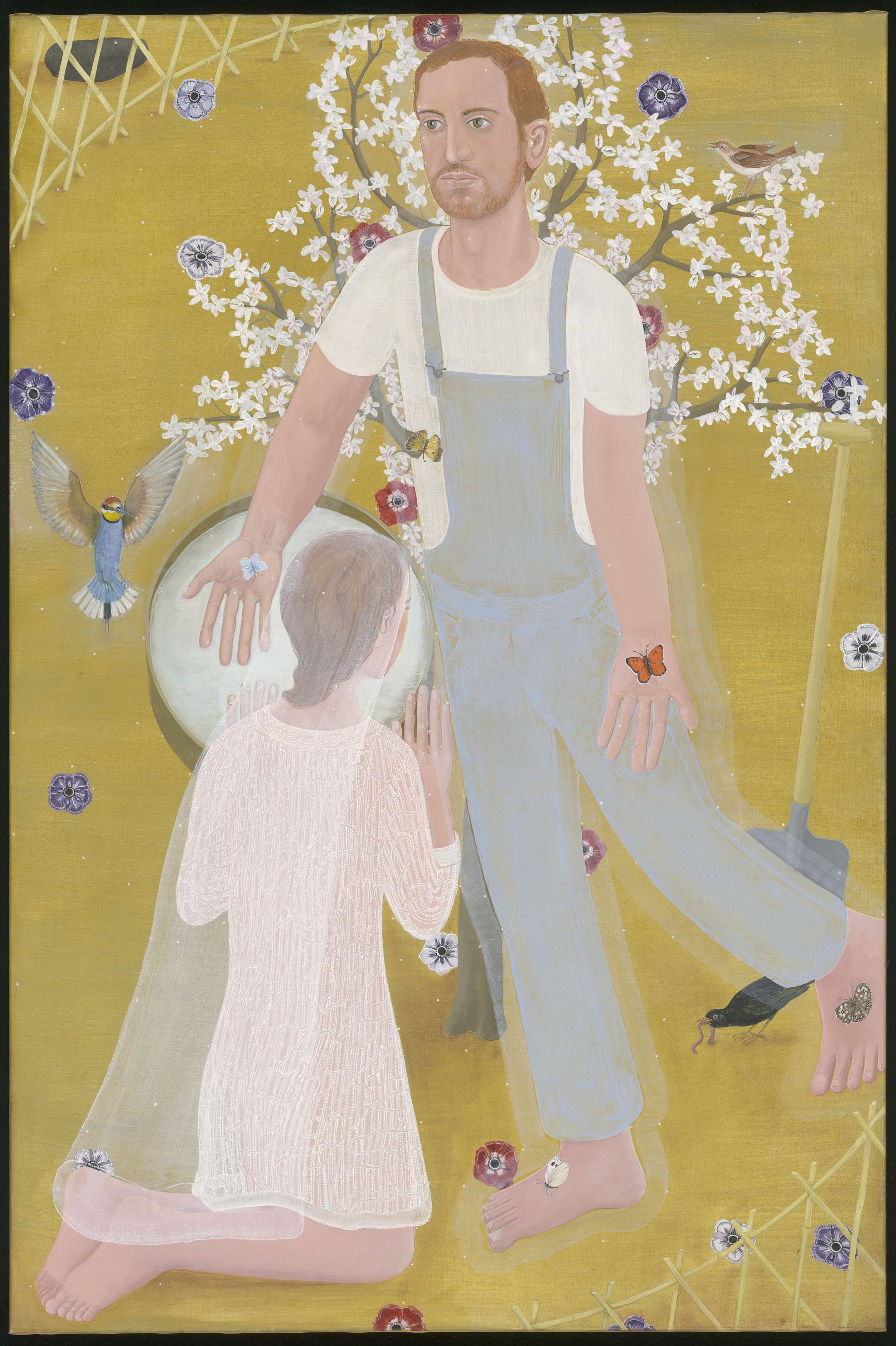
“‘She mistook him for the gardener’”: Humanity was born in a garden and reborn in a garden, as biblical scholars like N. T. Wright are keen to point out, with Easter morning marking the launch of new creation. In art history the resurrected Christ is sometimes amusingly shown carrying gardening tools when he encounters Mary Magdalene outside his tomb—to explain the case of mistaken identity that John records, perhaps, but more likely to establish a metaphor. Two of the paintings I’ve added to this post are by Janpeter Muilwijk, whose New Gardener from 2017 shows the freshly risen Christ in a white T-shirt and overalls, heading with open arms toward Mary, who is dressed like a bride to receive him. (Mary is modeled after the artist’s daughter Mattia, who died.) Butterflies alight on each of Jesus’s five wounds, marking them as sites of transformation, and the flowering branches of a tree crown him with spring glory.
Janpeter Muilwijk (Dutch, 1960–), New Gardener, 2017. Oil on canvas, 150 × 100 cm. Private collection, Netherlands.
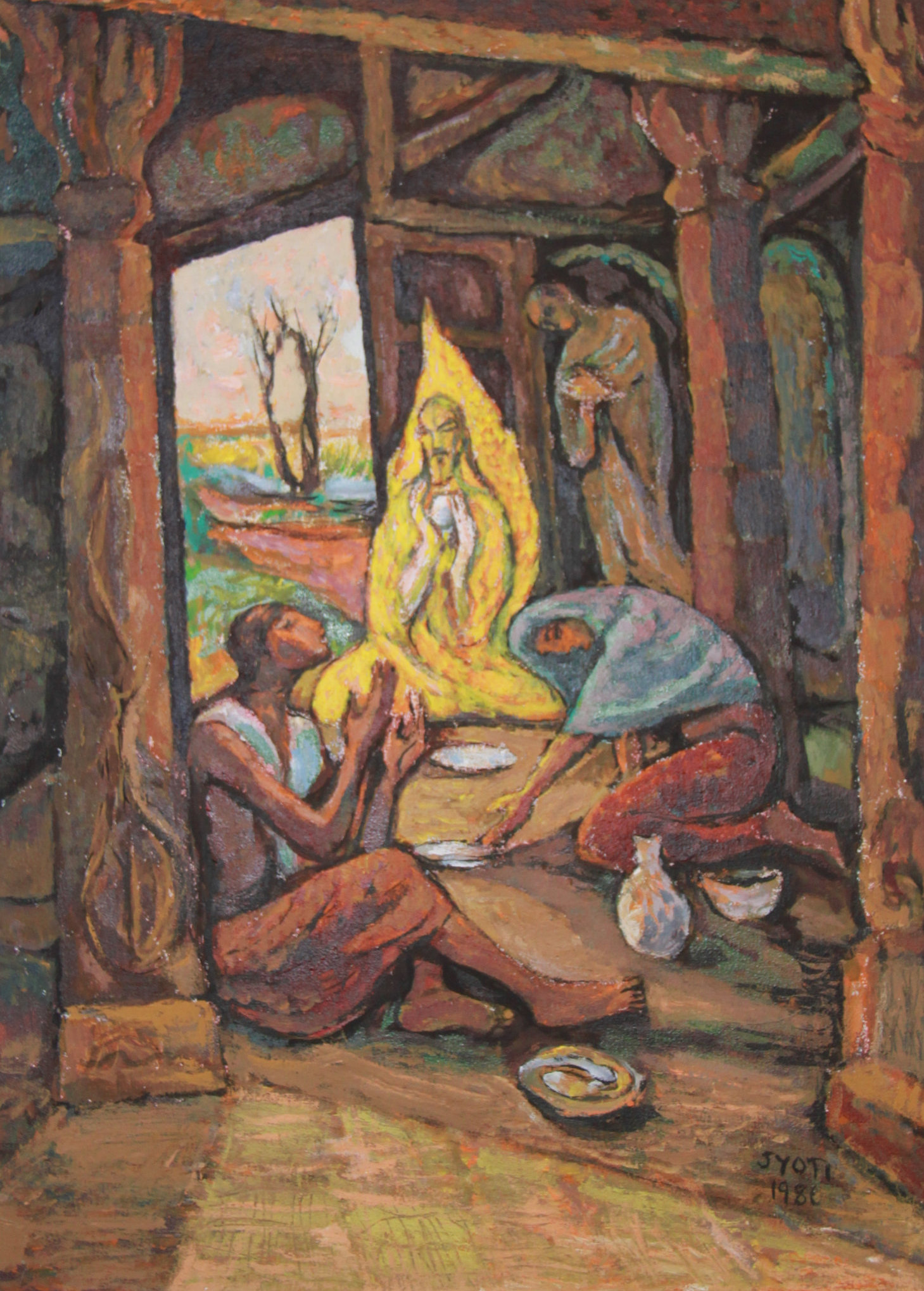
“The Unnamed Emmaus Disciple: Mary, wife of Cleopas?”: Written in 2017, this is one of Art & Theology’s most visited posts. In it I conjecture that the pilgrim who traveled with Cleopas from Jerusalem to Emmaus in the famous Easter story could have been a woman, perhaps Cleopas’s wife. Several artists have conjectured the same, and besides adding to this compilation three Emmaus paintings that the artist Maximino Cerezo Barredo sent me after the initial publication, I’ve also added one by Jyoti Sahi, which shows Jesus sitting with the two disciples—one male, one female—on the floor of a small roadside dwelling, breaking chapati (Indian flatbread) together. He is ablaze with glory, evoking his earlier revelations as I AM in the burning bush before Moses and to Peter, James, and John on Mount Tabor at the Transfiguration.
Jyoti Sahi (Indian, 1944–), The Supper at Emmaus, 1980. Mixed media on canvas. Photo courtesy of the artist.
+++
NEW SONGS
“A Bedtime Song for Anxious Children” by W. David O. Taylor and Paul Zach:David Taylor has written a new children’s song (set to music by Paul Zach), which he sings here with his daughter, Blythe. The lyrics are in the video description on YouTube.
“I’ve heard from so many parents recently that their children are struggling with anxiety, fear, frustration, sadness, anger, and restlessness,” Taylor writes, “and so I thought a little song reassuring them of God’s care at night, when they’re most vulnerable, might help their hearts. Our hope is that the melody might be simple enough for parents and children to be able to sing it when they go to bed.”
“See the Day” by Liz Vice: One of my favorite singers, Liz Vice, released a new single on April 10, called “See the Day.” Cowritten by her, Leslie Jordan, and Jonathan Day, it expresses hope for the coming day of the Lord, when justice will roll down like a mighty river, walls of division will crumble into dust, oppression will cease, and the whole world will be startled awake by love. “Precious Lord, come lead us on” to that reality.
+++
NEW ALBUM: Easter 1 by Mac Meador: Mac Meador, a singer-songwriter from Austin, Texas, released a new EP of six songs for Eastertide this April, a sort of flip side to the Lent 1 EP he released in February. I really enjoyed them both (and the same goes for his Summer of Psalms from 2018). The Easter album strikes just the right note for me right now—of a quiet hope and joy that’s not absent of pain. The songs celebrate Christ the risen king while also expressing longing for the age to come, when the kingdom will be established in full. Lean into that promise!
You can stream and purchase Meador’s music on Bandcamp. (Note: To help musicians affected by COVID-19, Bandcamp is waiving its cut of all sales made on its site on May 1.) You might also want to check out his YouTube channel, where he posts additional songs. For the past four weeks he has been releasing “Quarantine Hymn Sing” lyric videos for his church, Grace + Peace Austin, where he serves as minister of music. (He also sets Bible memory verses to music for kids!)
+++
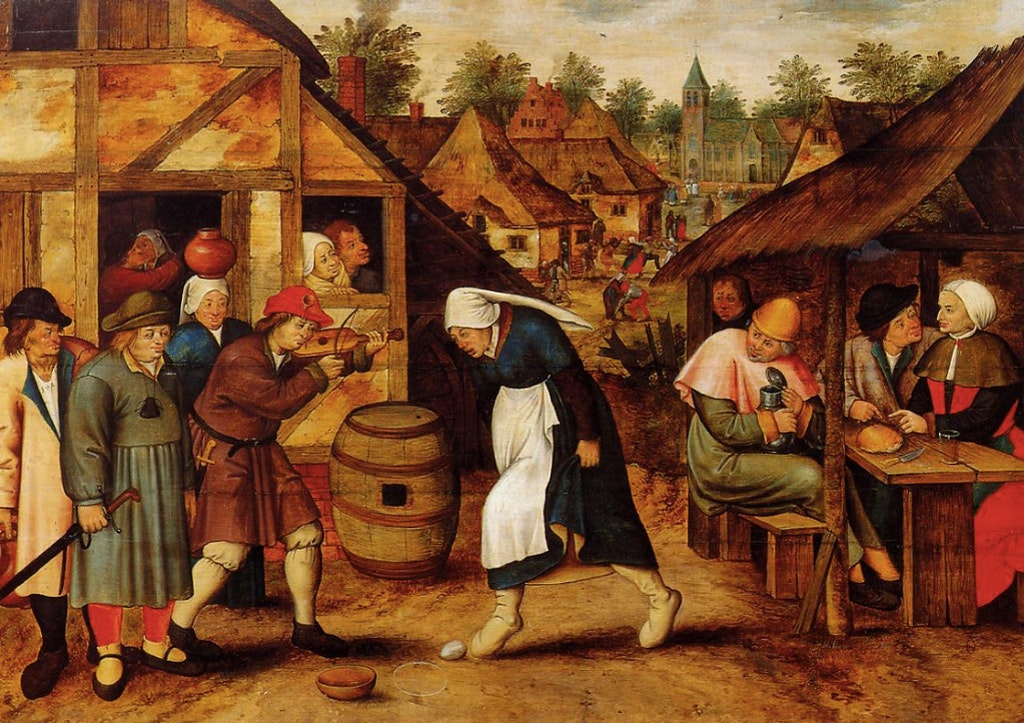
EGG DANCING: “The Egg Dance: From Peasant Village to Political Caricature”: The Public Domain Review has compiled an amusing gallery of historical paintings, drawings, and prints that show the egg dance, a traditional Easter game with several variations, most associated with western European peasantry of the sixteenth and seventeenth centuries.
Pieter Brueghel the Younger (Flemish, 1564/65–1637/38), The Egg Dance, ca. 1620. Oil on panel, 26 1/4 × 41 1/4 in. (66.7 × 104.8 cm).
+++
ART VIDEO:“500 Years of the Herrenberg Altarpiece”: I love seeing all the fun, creative resources being produced by art museums to help educate and engage the public in viewing art. Though I speak not a lick of German, this video from the Staatsgalerie Stuttgart about Jörg (Jerg) Ratgeb’s Herrenberg Altarpiece made me laugh and had me hooked for its full five minutes. (I came across it when I was prepping a Holy Week blog post that features a different painting attributed to the same artist.) Released last October for the five hundredth anniversary of the altarpiece, the video, directed by Valentin Hennig and Oleg Kauz, animates some of the birds from the painted panels and has them narrate as the camera zooms in on details (one of them quite jarring and unseemly!). They then fly through the museum hall and over the town some twenty miles southwest to the church where the piece originally stood.
To add autogenerated subtitles, click the “CC” (closed captioning) button on the bottom of the video player, then select your language using the gear icon.
Painted in 1519, this double-winged altarpiece was commissioned by the Brethren of the Common Life, a Catholic pietist community, for the high altar of the collegiate church of Herrenberg in Swabia. Closed, it shows the apostles about to set out on their mission to spread the word of God. The first open view (interior panels closed, exterior wings folded out) reveals scenes from the passion of Christ, each panel with a primary scene in the foreground and a secondary scene in the background: the Last Supper with the Agony in the Garden, the Flagellation and Crowning with Thorns with the Ecce Homo (presentation to the crowd), the Crucifixion with the Carrying of the Cross and the Entombment, and the Resurrection with the Noli me tangere (appearance to Mary Magdalene). Completely opened (its feast-day configuration), the altarpiece shows scenes from the infancy of Christ, with reference also to the life of the Virgin Mary. It used to have a central Marian statue and predella figures, but these were likely destroyed when the Protestant Reformation came to Württemberg in 1534.
The artist had already died by this time—he was executed (drawn and quartered) for treason in 1526 for his role as one of the leaders of the German Peasants’ Rebellion.
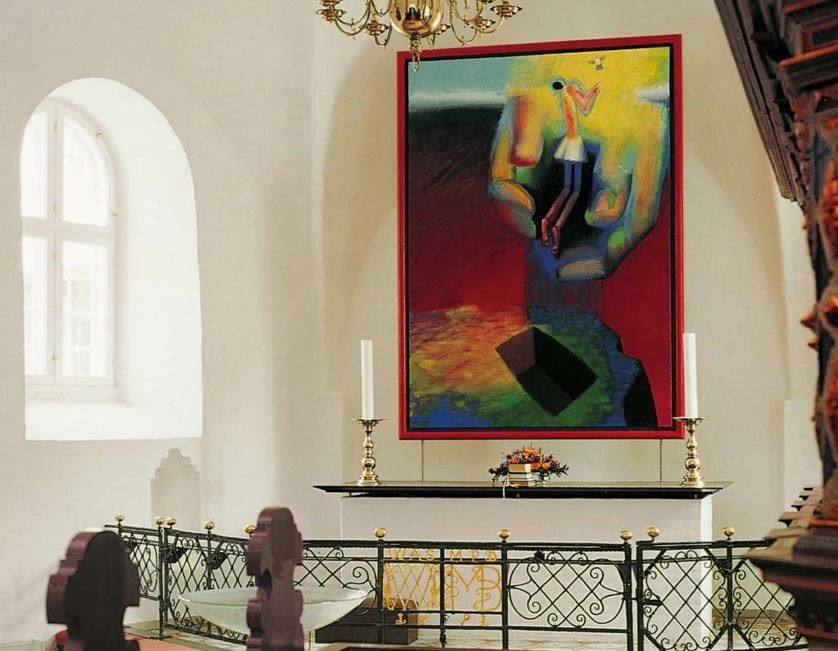
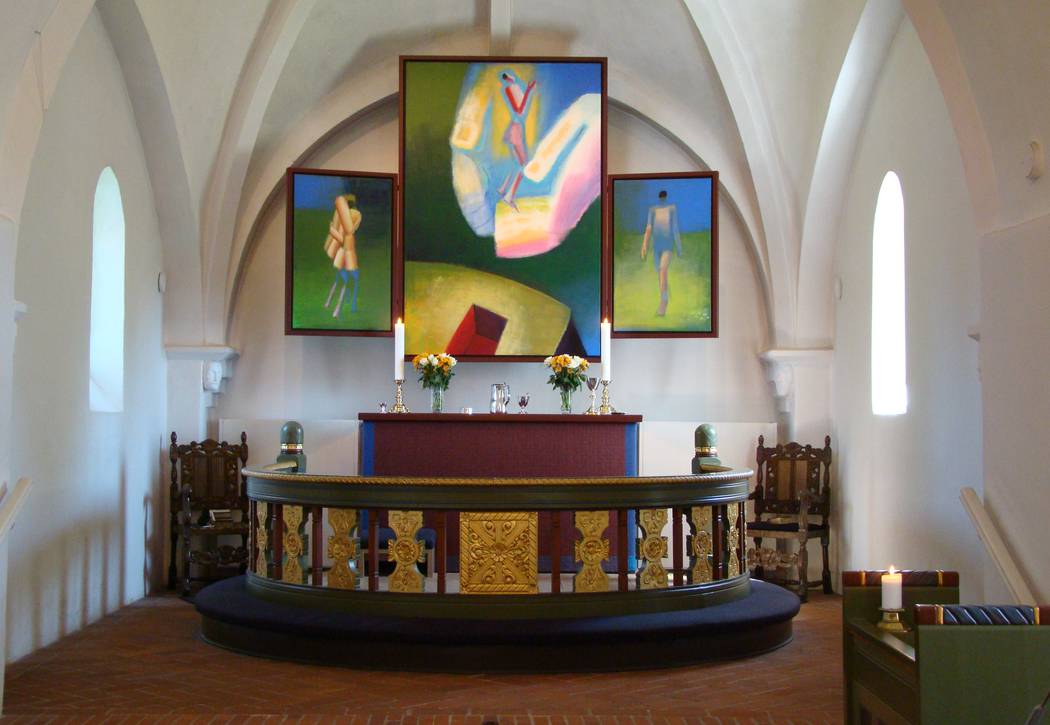
Resurrection by Arne Haugen Sørensen (Danish, 1932–)
Peter, standing with the eleven, lifted up his voice and addressed them:
“. . . Men of Israel, hear these words: Jesus of Nazareth, a man attested to you by God with mighty works and wonders and signs that God did through him in your midst, as you yourselves know—this Jesus, delivered up according to the definite plan and foreknowledge of God, you crucified and killed by the hands of lawless men. God raised him up, loosing the pangs of death, because it was not possible for him to be held by it. For David says concerning him,
“‘I saw the LORD always before me,
for he is at my right hand that I may not be shaken;
therefore my heart was glad, and my tongue rejoiced;
my flesh also will dwell in hope.
For you will not abandon my soul to Hades,
or let your Holy One see corruption.
You have made known to me the paths of life;
you will make me full of gladness with your presence.’
“Brothers, I may say to you with confidence about the patriarch David that he both died and was buried, and his tomb is with us to this day. Being therefore a prophet, and knowing that God had sworn with an oath to him that he would set one of his descendants on his throne, he foresaw and spoke about the resurrection of the Christ, that he was not abandoned to Hades, nor did his flesh see corruption. This Jesus God raised up, and of that we all are witnesses . . .”
The tender hands of God lifting Christ out of the grave is one of Arne Haugen Sørensen’s favorite motifs—he’s painted it dozens of times, often as altarpieces for Danish churches.
Arne Haugen Sørensen (Danish, 1932–), Resurrection, 1996. Acrylic on canvas, 268 × 190 cm. Ringkøbing Church, Ringkøbing, Denmark.
Arne Haugen Sørensen (Danish, 1932–), Resurrection, 1997. Acrylic on canvas, 195 × 130 cm. Skelager Church, Aarhus, Denmark.
Arne Haugen Sørensen (Danish, 1932–), Resurrection (triptych), 2003. Acrylic on canvas. Sankt Ansgar Kirke, Bramming, Denmark.
Arne Haugen Sørensen (Danish, 1932–), Resurrection, 2011, installed 2015. Acrylic on canvas, 162 × 130 cm. Lillerød Kirke, Lillerød, Denmark. Photo: Benny Grey Schuster.
Arne Haugen Sørensen (Danish, 1932–), Crucifixion and Resurrection, 1996, installed 2002, Fonnesbæk Kirke, Ikast, Denmark. Photo: Benny Grey Schuster.
This post belongs to the weekly series Artful Devotion. If you can’t view the music player in your email or RSS reader, try opening the post in your browser.
To view all the Revised Common Lectionary scripture readings for the Second Sunday of Easter, cycle A, click here.

.jpg)








 Art & Theology