
Easter, Day 3: Lord of Light and Life

. . . the sun of righteousness shall rise, with healing in its wings . . .

—Malachi 4:2

The people who walked in darkness
    have seen a great light;
those who lived in a land of deep darkness—
    on them light has shined.

—Isaiah 9:2

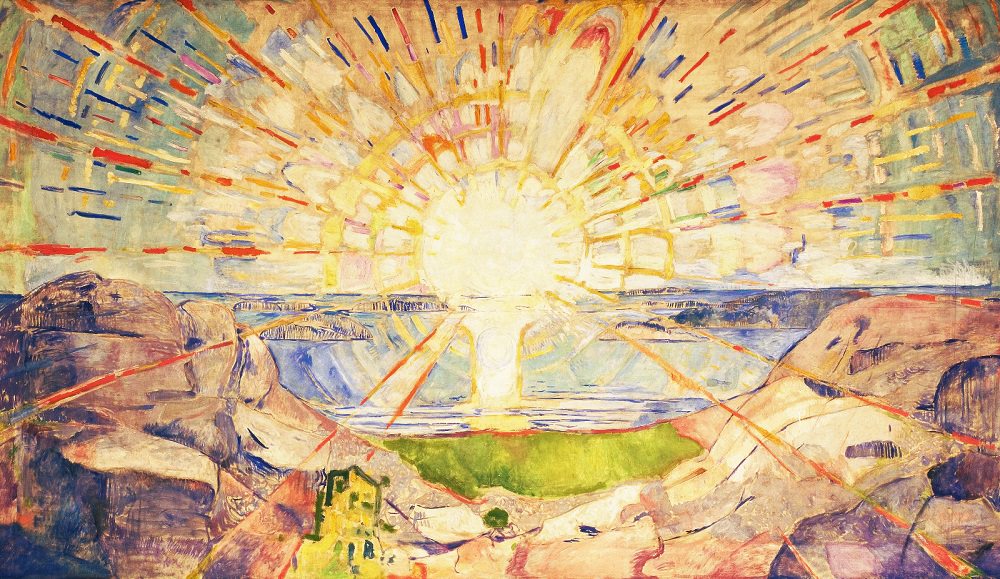
LOOK: The Sun by Edvard Munch
Munch, Edvard_Sun
Edvard Munch (Norwegian, 1863–1944), The Sun, 1911. Oil on canvas, 455 × 780 cm (14.9 × 25.5 ft.). The Aula, University of Oslo, Norway.

Over twenty-five feet across, Edvard Munch’s The Sun is the centerpiece of an eleven-piece cycle of oil paintings on the theme of enlightenment commissioned for, and still located in, the Aula (assembly hall) at the University of Oslo. It shows a blazing sunrise over the coastline of Kragerø in Norway, its multicolored rays extending to adjacent canvases, which portray men and women reaching up toward the light.

Though he didn’t have an explicitly Christological meaning in mind, Munch did see the sun as the source of all life, as he wrote about in his notebooks, and in his work it is often read as a symbol of the eternal.

LISTEN: “Again the Lord” | Words by Anna L. Barbauld, 1772 | Music by Ben Thomas, 2015 | Performed by Ben Thomas on Bring Forth, 2015

Again the Lord of light and life
Awakes the kindling ray
Unseals the eyelids of the morn
And pours increasing day

O what a night was that which wrapped
The sleeping world in gloom
O what a Sun which rose this day
Triumphant from the tomb

This day be grateful homage paid
And loud hosannas sung
Let gladness dwell in every heart
And praise on every tongue

Ten thousand different lips shall join
To hail this welcome morn
Which scatters blessing from its wings
To nations yet unborn

This song is on the Art & Theology Eastertide Playlist.
Bankrupt (Artful Devotion)

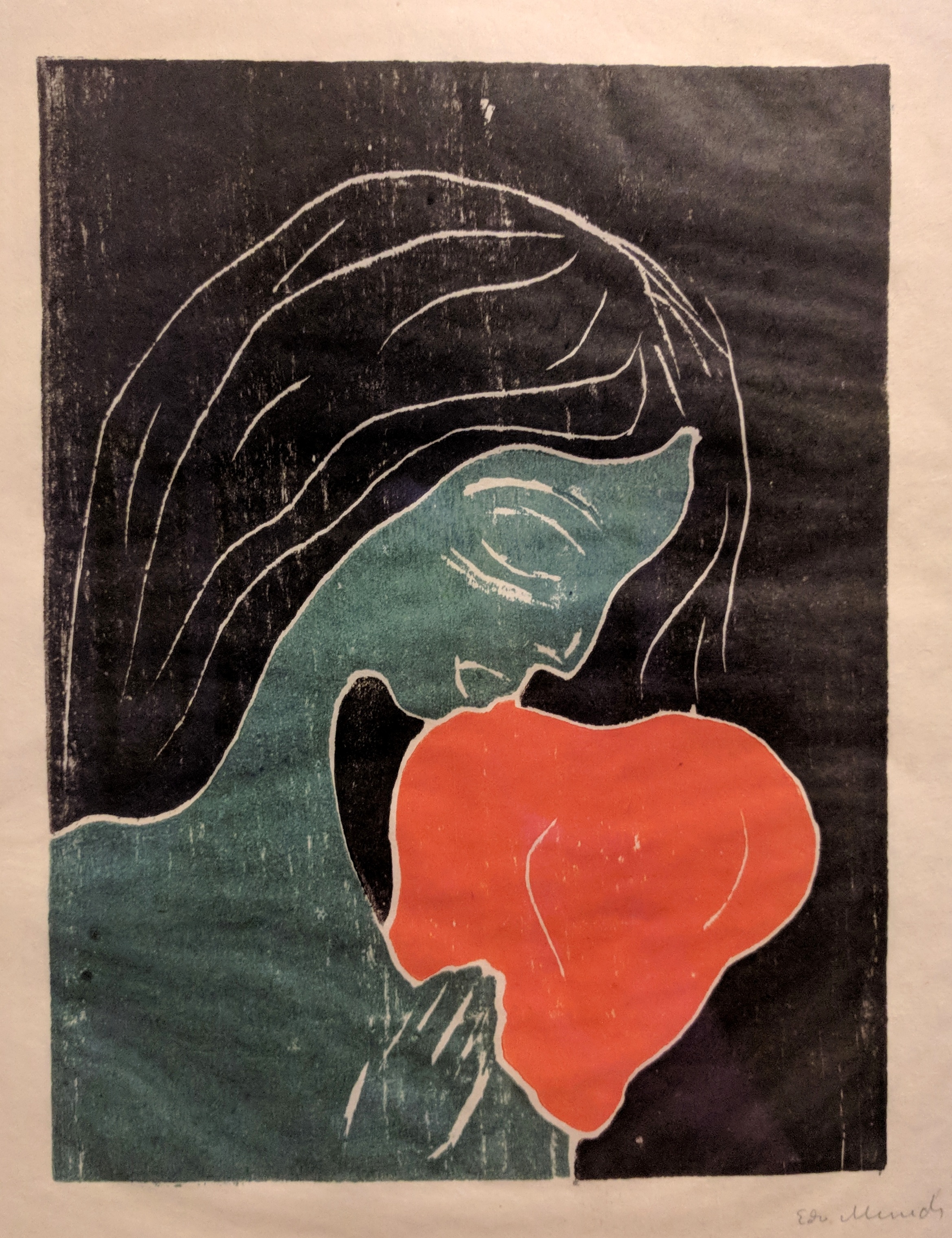
Girl with the Heart by Edvard Munch
Edvard Munch (Norwegian, 1863–1944), Girl with the Heart, 1899. Color woodcut, 40.4 × 33.9 cm (15 7/8 × 13 3/8 in.). National Gallery of Art, Washington, DC. Photo: Victoria Emily Jones.

If I speak in the tongues of men and of angels, but have not love, I am a noisy gong or a clanging cymbal. And if I have prophetic powers, and understand all mysteries and all knowledge, and if I have all faith, so as to remove mountains, but have not love, I am nothing. If I give away all I have, and if I deliver up my body to be burned, but have not love, I gain nothing.

—1 Corinthians 13:1–3

That’s the ESV. Here’s Eugene Peterson’s translation, from The Message:

If I speak with human eloquence and angelic ecstasy but don’t love, I’m nothing but the creaking of a rusty gate. If I speak God’s Word with power, revealing all his mysteries and making everything plain as day, and if I have faith that says to a mountain, “Jump,” and it jumps, but I don’t love, I’m nothing. If I give everything I own to the poor and even go to the stake to be burned as a martyr, but I don’t love, I’ve gotten nowhere. So, no matter what I say, what I believe, and what I do, I’m bankrupt without love.

+++

SONG: “The Gift of Love (Though I May Speak)” | Words: Hal H. Hopson, 1972 | Music: Traditional English folk melody (adapt.) | Performed by Becky Craig (vocals) and John Michniewicz (piano) | CCLI #67327

Though I may speak with bravest fire
And have the gift to all inspire
And have not love, my words are vain
As sounding brass and hopeless gain

Though I may give all I possess
And, striving so, my love profess
But not be giv’n by love within
The profit soon turns strangely thin

Come, Spirit, come, our hearts control
Our spirits long to be made whole
Let inward love guide every deed
By this we worship and are freed


This post belongs to the weekly series Artful Devotion. If you can’t view the music player in your email or RSS reader, try opening the post in your browser.

To view all the Revised Common Lectionary scripture readings for the Fourth Sunday after Epiphany, cycle C, click here.