There are hundreds of creative works I could feature on the topic of Christ’s wounds. Here are just a few of note.
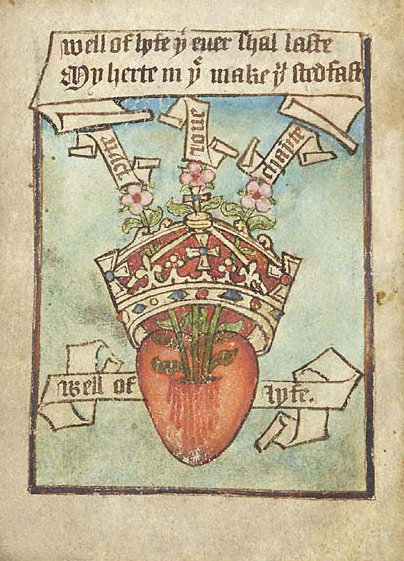
ARTICLE: “‘Your body is full of wounds’: references, social contexts and uses of the wounds of Christ in Late Medieval Europe” by Johanna Pollick, Emily Poore, Sophie Sexon, and Sara Stradal: In this three-part collaborative essay, I was most intrigued, in part because of its newness to me, by the first section, “The flowering wound: Christ’s heart in Princeton University, MS Taylor 17,” in which Dr. Johanna Pollick explores a small English illuminated devotional book, dating from around 1500, that portrays Christ’s wounds as wells. For help in interpreting these images, she turns to medieval literary traditions as well as to the Carthusian Miscellany.
Wounded Heart of Christ as the Well of Lyfe, England, ca. 1500. Princeton University Library, MS Taylor 17, fol. 10v.
Dr. Grace Hamman writes about MS Taylor 17’s extraordinary “well of lyfe” page in Jesus through Medieval Eyes (and for InterVarsity’s The Well), which is what brought me to this essay. The hand-colored image shows flowers—labeled “pyte” (pity), “loue” (love), and “charyte” (charity)—springing forth from the wounded heart of Jesus. The verse prayer at the top reads, “Well of lyfe that ever shall laste / My herte in thee make it stedfast.”
The same theme shows up in another late fifteenth-century English lyric in MS Arundel 286 at the British Library, which appears in modern compilations under the title “The Wounds, as Wells of Life” or “The Wells of Jesus’ Wounds”:
Ihesus woundes so wide
Ben welles of lif to the goode,
Namely the stronde of his syde
That ran ful breme on the rode.
Yif thee list to drinke
To fle fro the fendes of helle,
Bowe thu doun to the brinke
And mekely taste of the welle.
Jesus’s wounds so wide
Are wells of life to the good,
Namely the stream from his side
That ran fiercely on the rood.
If thou list to drink,
To flee from the fiends of hell,
Bow thou down to the brink
And meekly taste of the well.

Trans. Victoria Emily Jones
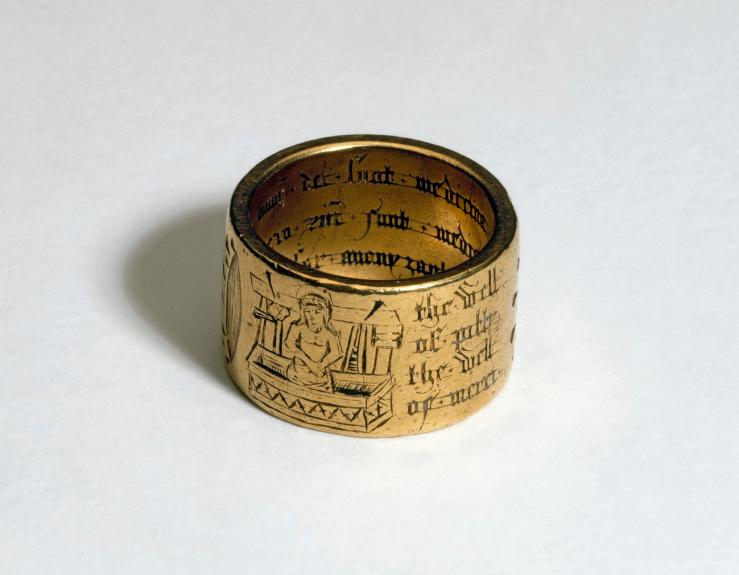
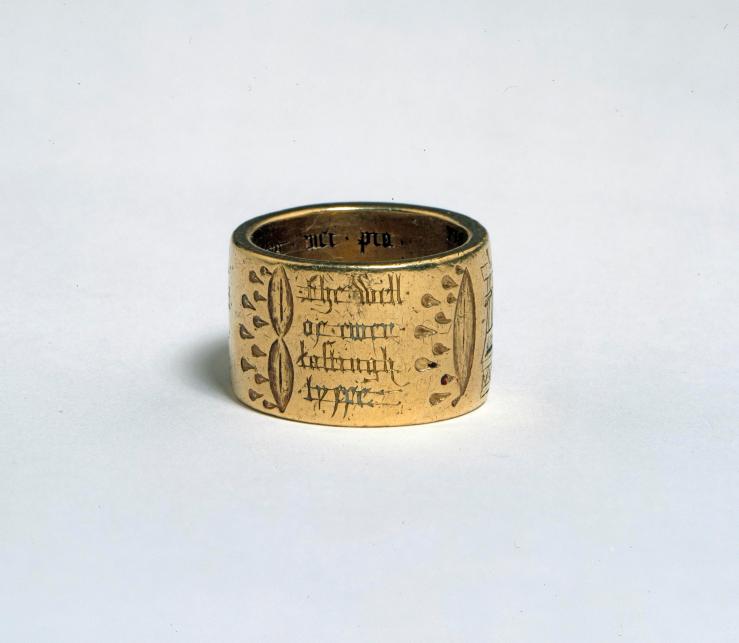
And in a late fifteenth-century gold ring, also from England, engraved with a Man of Sorrows image and hieroglyphs of Christ’s five wounds, labeled “The well of pitty, the well of merci, the well of confort, the well of gracy, the well of everlastingh lyffe”:
SONG: “Deep Were His Wounds” by William Johnson, 1953: This midcentury hymn is composed of three simple stanzas: The first half of each meditates on Jesus’s cruel death on the cross, whereas each second half (“But . . .”) celebrates the healing, freedom, and eternal life that death wrought.
>> Music by Leland B. Sateren, 1958: I like this tune, called MARLEE, but it’s difficult to sing congregationally. Here’s a soloist, Sarah Gulseth, singing it for her church’s 2011 Good Friday service, accompanied on organ by Luther Gulseth:
>> Music by Vito Aiuto, 2008: I was first introduced to “Deep Were His Wounds” through the Welcome Wagon’s debut album, Welcome to the Welcome Wagon, “a ramshackle singalong enterprise of a Presbyterian pastor (the Rev. Vito Aiuto) and his wife (Monique) wrestling out the influences of folk music, religion, popular culture, and church tradition.” Mood-wise, Aiuto’s tune wouldn’t work as well for Good Friday—even given the paradox of that day, it’s too bright, in my opinion, for that somber observance. But it’s great for throughout the year, especially for churches that favor a contemporary/folksy style of music.
+++
CANTATA CYCLE:“Membra Jesu Nostri” (The Limbs of Our Suffering Jesus) by Dieterich Buxtehude: Dieterich Buxtehude (ca. 1637–1707) was a Danish German organist and composer of the mid-Baroque period. For Good Friday 1680, he composed a cycle of seven concerto-aria cantatas. The texts of the aria sections are taken from the medieval Latin hymn “Salve mundi salutare” (Hail, the World’s Salvation) by the Cistercian abbot Arnulf of Leuven (ca. 1200–1250), whereas the concerto section texts are Old Testament quotations. The following video is a 2004 performance from Payerne, Switzerland; see the YouTube video description for further credits. The video includes English subtitles, but you can also read the lyrics (with translation) here.
The cycle begins by paying homage to Christ’s wounded feet (“Ad Pedes” = “To the Feet”), and then progresses upward to his knees, hands, side, breast, heart, and finally, face/head. Traditionally, Christ’s wounds are enumerated as five: a hole in each foot, a hole in each hand, and a hole through his side/heart (from the centurion’s spear). But Arnulf meditates on seven distinct body parts of Christ’s that were injured on Good Friday.
+++
ARTWORKS:
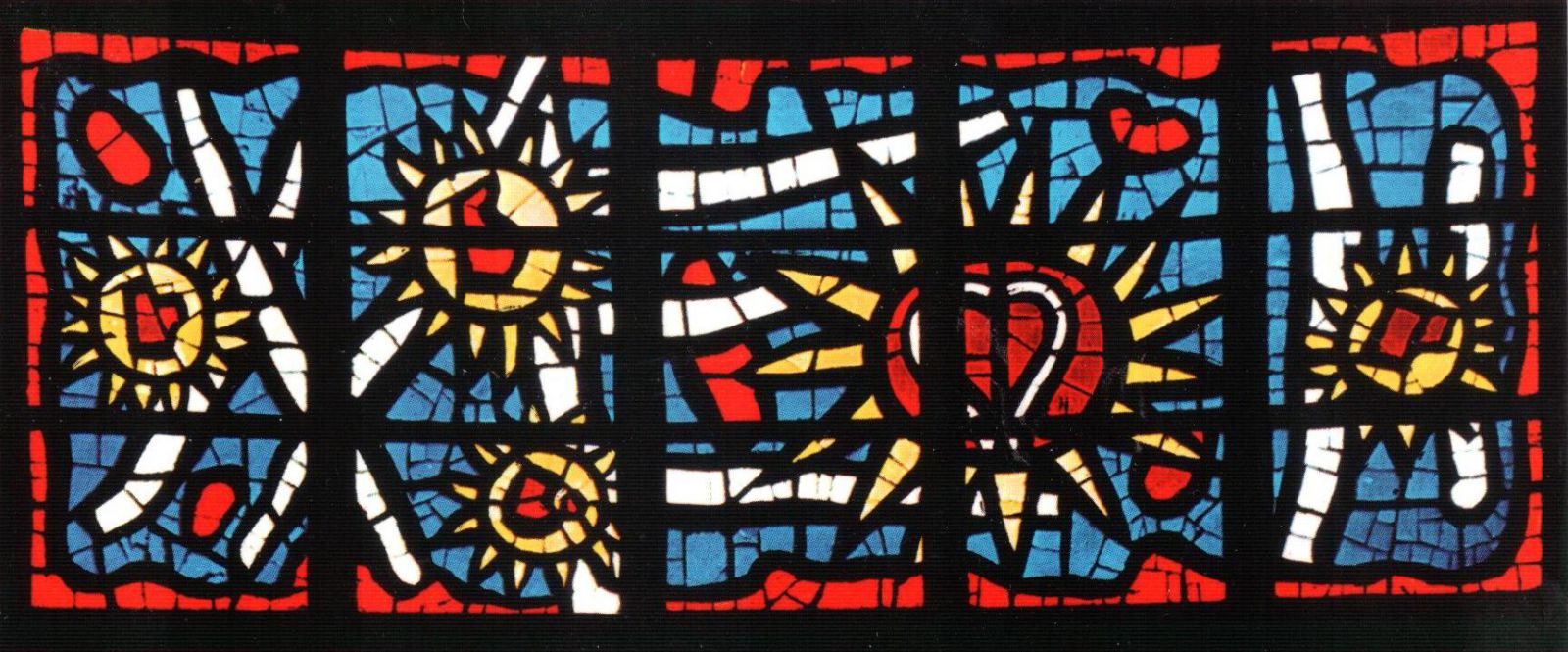
>> The Five Wounds of Christ by Fernand Léger | Commentary by Albert Hengelaar: This visual meditation is about the architecture and interior decoration of the Sacré-Coeur in Audincourt, France, a product of the Art Sacré movement, a Catholic art renaissance spearheaded by the French Dominican Order from 1919 to the 1950s. The centerpiece of the church, sited above the high altar, is a stained glass window depicting the five wounds of Christ shining like suns—one of seventeen windows the artist Fernand Léger designed to encircle the space in a strip.
Fernand Léger (French, 1881–1955), The Five Wounds of Christ, 1950–52. Stained glass window, Église du Sacré-Cœur (Church of the Sacred Heart), Audincourt, France.
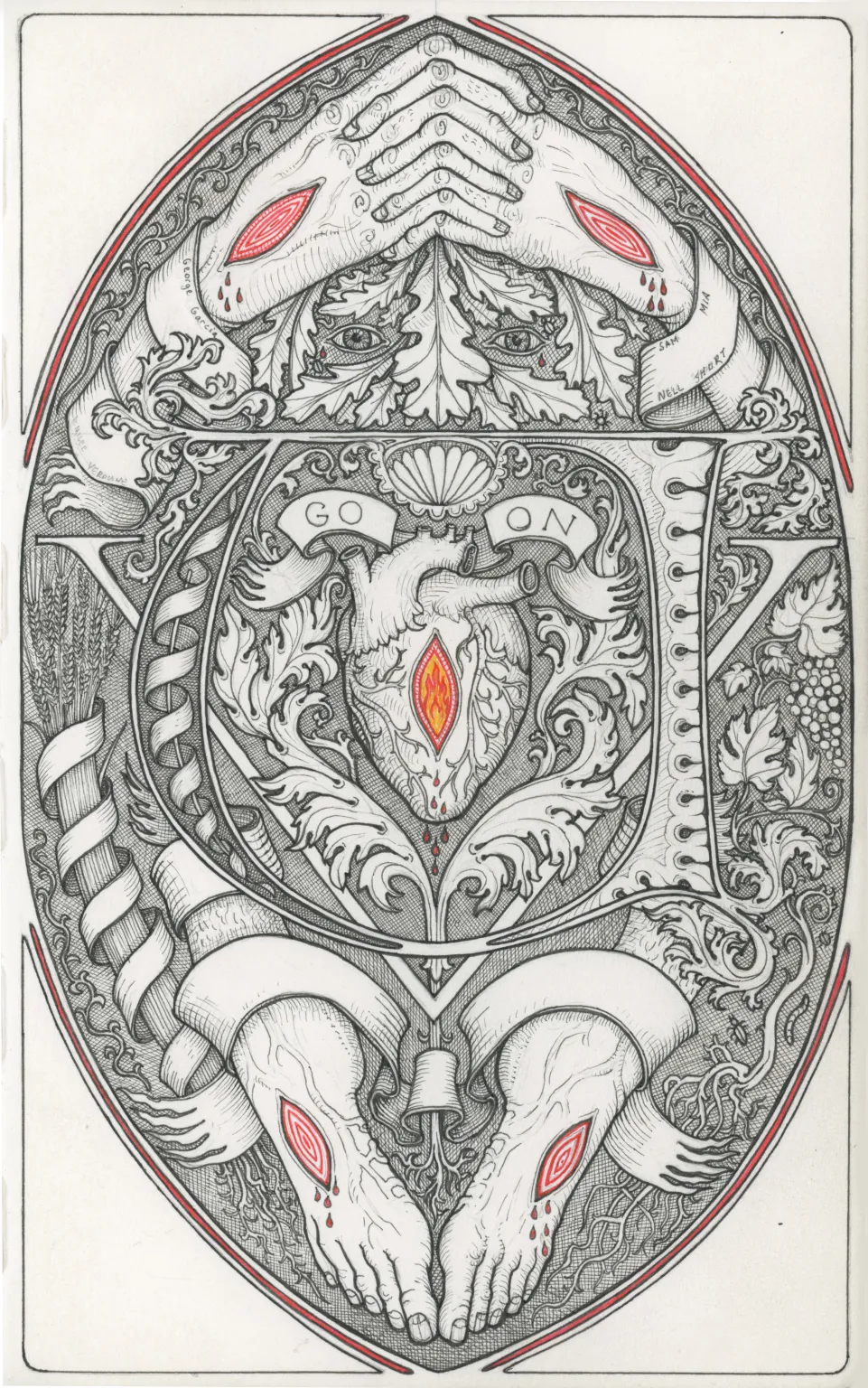
>> The Great Wound, aka Go On, Wounded Healer by Jack Baumgartner | Commentary by Sam Kee: In this Substack post, Sam Kee unpacks a drawing by his friend Jack Baumgartner [previously], which shows that “there is life in His [Christ’s] wounds, and He pours His life into our wounds.” The drawing started with the roman numeral V, which stands for the five wounds of Christ. The circumference is one large wound that encompasses five smaller wounds, eye-like, each one weeping blood. Other symbols that Kee analyzes in the drawing are wheat, grapes, fig leaves, seashell, fire, heart, and womb. “Go on” is a refrain that Baumgartner uses often in his work, a mantra for persevering in the faith, for continuing on the path.
Jack Baumgartner (American, 1976–), The Great Wound, 2024. Drawing from the series The Diary of a Tree Standing on Its Head.
Kee concludes with an original ekphrastic poem.
You can purchase an archival reproduction of The Great Wound from Baumgartner’s online shop. I encourage you to explore his website as well. I admire how his work is somehow both mystical and earthy, rooted.
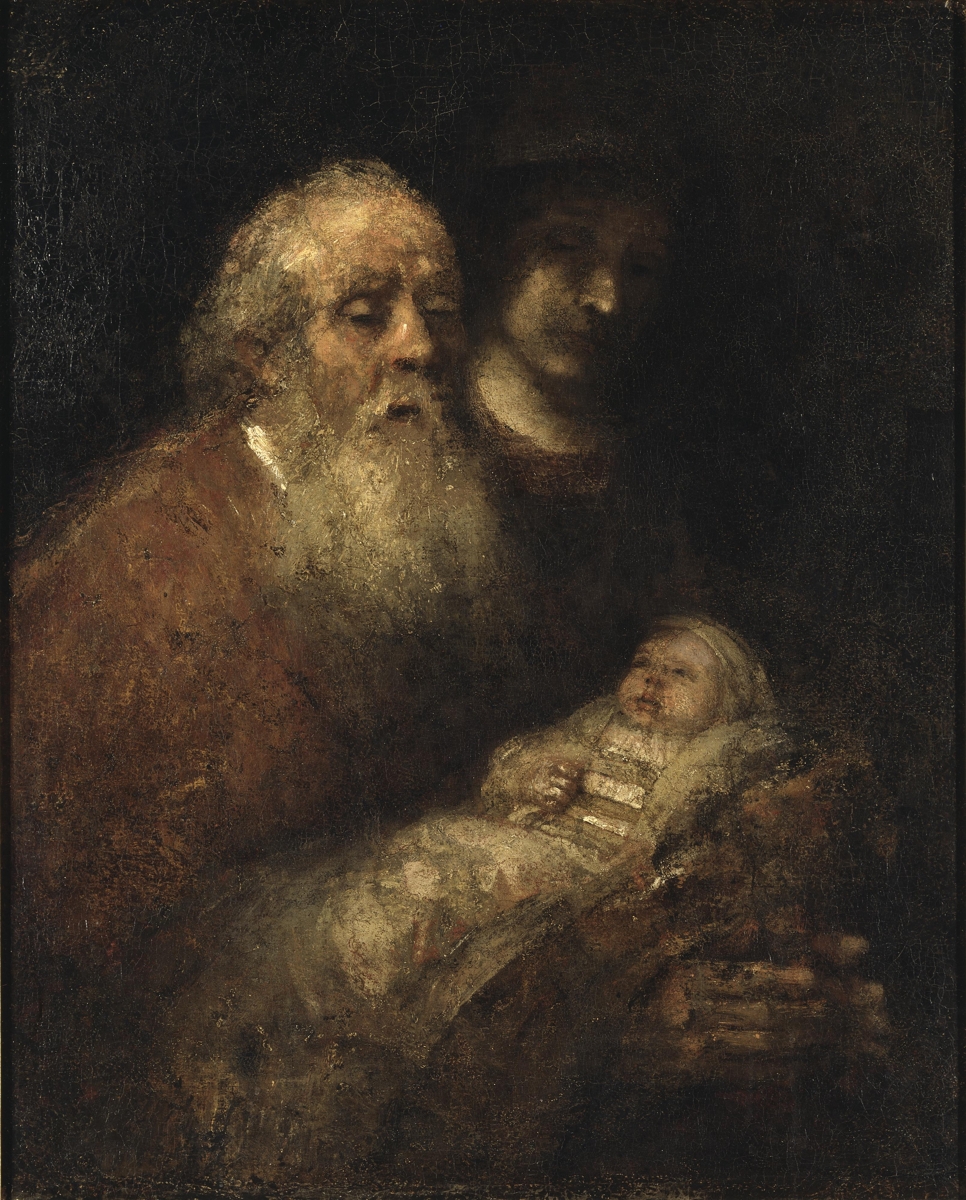
Rembrandt Harmensz. van Rijn (Dutch, 1606–1669), Simeon in the Temple, 1669. Oil on canvas, 98.5 × 79.5 cm. Nationalmuseum Stockholm, Sweden. Photo: Erik Cornelius.
after Simeon in the Temple, Rembrandt, 1669
Fingers stretch as if supplicating hands are interrupted— the answer placed in his waiting arms.
Light glistens on his temple— the mind consoled by consolation’s burden.
Death takes the prophet; takes the artist before his painting is complete; takes the one already bearing sin’s stripes.
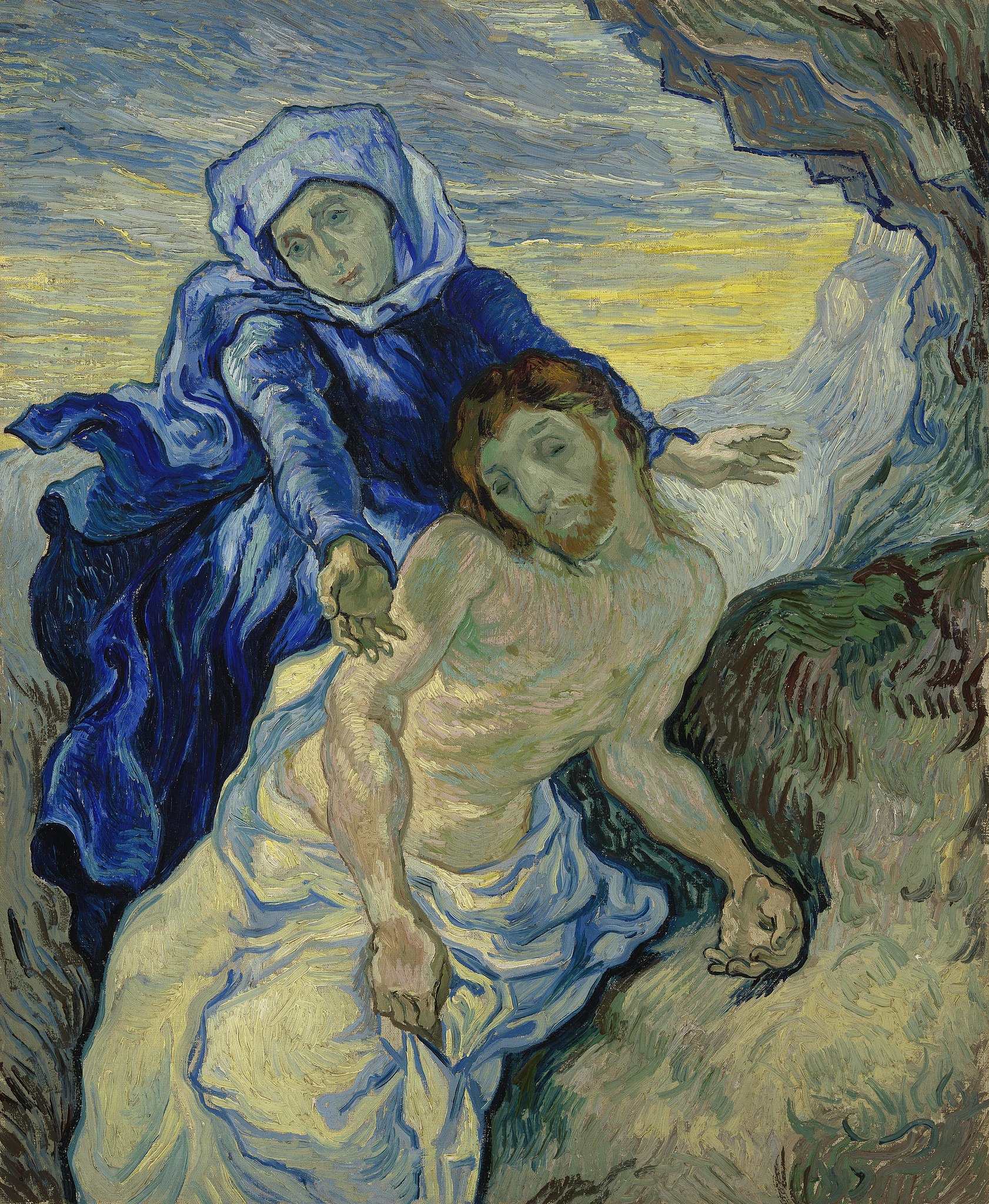
Vincent van Gogh (Dutch, 1853–1890), Pietà (after Delacroix), 1889. Oil on canvas, 73 × 60.5 cm. Van Gogh Museum, Amsterdam.
“Poor fighter, poor sufferer,”
my brother’s words for me.
                                                 Self-pity—
I have to beat it down. But how, exactly?
Never know when the next attack will come.
How to suppress religion?
Down the cloisters of the sick it beckoned—
I abused my God . . . that lithograph of Delacroix’s,
irredeemable sheets I flung in the paint and oil,
his Pietà in ruins.
                               Reconstruct it from memory.
Good technical exercise. Start with the hands,
there were four hands, four arms in the foreground—
mother and son, and the torsions of their bodies
almost impossible, draw them out—
painfully . . . no measurements—
into a great mutual gesture of despair.

Delacroix and I, we both discovered painting
when we no longer had breath or teeth.
Work into his work, strain for health,
the brain clearing, fingers firmer,
brush in the fingers going like a bow,
big bravura work—pure joy! I copy—
no, perform his masterwork of pain.

Genius of iridescent agony, Delacroix,
help me restore your lithograph with color.
I mortify before your model—
how to imitate my Christ? The bronze
of my forelock shadows his, the greatest artist:
stronger than all the others, spurning marble,
clay and paint, he worked in living flesh.

Living and yet immortal, Lord, revive me—
let me inhale the blue of Mary’s cape
billowing hurricanes of hope, clothe me
in your cerements gold with morning—
mother and son, from all your sorrow
all renewal springs, the earth you touch
turns emerald as your hand that burgeons green.
Robert Fagles (1933–2008) (PhD, Yale) was an award-winning American translator, poet, and academic. He is best known for his many translations of ancient Greek and Roman classics, especially the epic poems of Homer. He taught English and comparative literature at Princeton University from 1960 until his retirement in 2002, chairing the department from 1975 onward.
Vincent van Gogh (1853–1890) was raised in the Dutch Reformed Church, the son of a small-town minister—and even worked himself as a lay preacher in the Borinage mining region of southwestern Belgium for two years in his mid-twenties. While there, he gave away all his possessions and lived in poverty like those he served, eating a spare diet, wearing rough garments, and sleeping on the floor. Ironically, his sponsoring evangelical committee deemed such behavior unbecoming of a minister of the gospel, and, due also to his lack of eloquence and theological refinement, they withdrew their support.
This rejection soured Vincent on institutional Christianity. But it didn’t squash his faith. After moving back in with his parents in Nuenen, the Netherlands, he wrote to his brother and close confidante, Theo:
Life [. . .] always turns towards one an infinitely meaningless, discouraging, dispiriting blank side on which there is nothing, any more than on a blank canvas.
But however meaningless and vain, however dead life appears, the man of faith, of energy, of warmth, and who knows something, doesn’t let himself be fobbed off like that. He steps in and does something, and hangs on to that, in short, breaks, ‘violates’ – they say.
Let them talk, those cold theologians. [Letter 464]
Although Vincent left the church and developed conflicted feelings about the Bible, he maintained a reverence for Christ to the end of his days. His time in the Borinage was not for nothing, as it’s there that he discovered, through sketching his parishioners and the surrounding landscapes, his calling to be an artist.
This new vocation was one he ascribed metaphorically to Christ. In a letter to his friend and fellow artist Émile Bernard dated June 26, 1888, Vincent wrote that Jesus’s masterworks are human beings made fully and eternally alive:
Christ – alone – among all the philosophers, magicians, &c. declared eternal life – the endlessness of time, the non-existence of death – to be the principal certainty. The necessity and the raison d’être of serenity and devotion. Lived serenely as an artist greater than all artists–disdaining marble and clay and paint – working in LIVING FLESH. I.e. – this extraordinary artist, hardly conceivable with the obtuse instrument of our nervous and stupefied modern brains, made neither statues nor paintings nor even books . . . he states it loud and clear . . . he made . . . LIVING men, immortals. [Letter 632]
In the same letter, he contended that “the figure of Christ has been painted – as I feel it – only by Delacroix and by Rembrandt…….. And then Millet has painted…. Christ’s doctrine.”
These are the three artists Vincent admired most. He mentions them many times throughout his ample correspondence with family and friends, and he made paintings after all three.
The only painting Vincent ever made of Christ was his Pietà, which he painted in two versions in September 1889, both after the French artist Eugène Delacroix (1798–1863). These are among the many works Vincent painted at a psychiatric hospital in Saint-Rémy-de-Provence in southern France, to which he had voluntarily committed himself after suffering an acute mental breakdown that resulted in his infamous severing of his left ear on December 23, 1888. Theo had rushed to Arles, where Vincent was living in “the Yellow House” at the time, and on December 28 reported on Vincent’s condition in a letter to his wife, Jo van Gogh-Bonger:
I found Vincent in the hospital in Arles. The people around him realized from his agitation that for the past few days he had been showing symptoms of that most dreadful illness, of madness, and an attack of fièvre chaude, when he injured himself with a razor, was the reason he was taken to hospital. Will he remain insane? The doctors think it possible, but daren’t yet say for certain. It should be apparent in a few days’ time when he is rested; then we will see whether he is lucid again. He seemed to be all right for a few minutes when I was with him, but lapsed shortly afterwards into his brooding about philosophy and theology. It was terribly sad being there, because from time to time all his grief would well up inside and he would try to weep, but couldn’t. Poor fighter and poor, poor sufferer. Nothing can be done to relieve his anguish now, but it is deep and hard for him to bear. [Letter 728]
Vincent returned to the Yellow House in January 1889 but over the next few months experienced recurring bouts of mania and depression and was in and out of the hospital. Some of the people of Arles grew increasingly frightened by his erratic behavior, and they essentially ran him out of town. That’s when he made his way twenty miles northeast to the town of Saint-Rémy to check in to Saint-Paul-de-Mausole, a former monastery that then, as now, served as a hospital for the mentally ill.
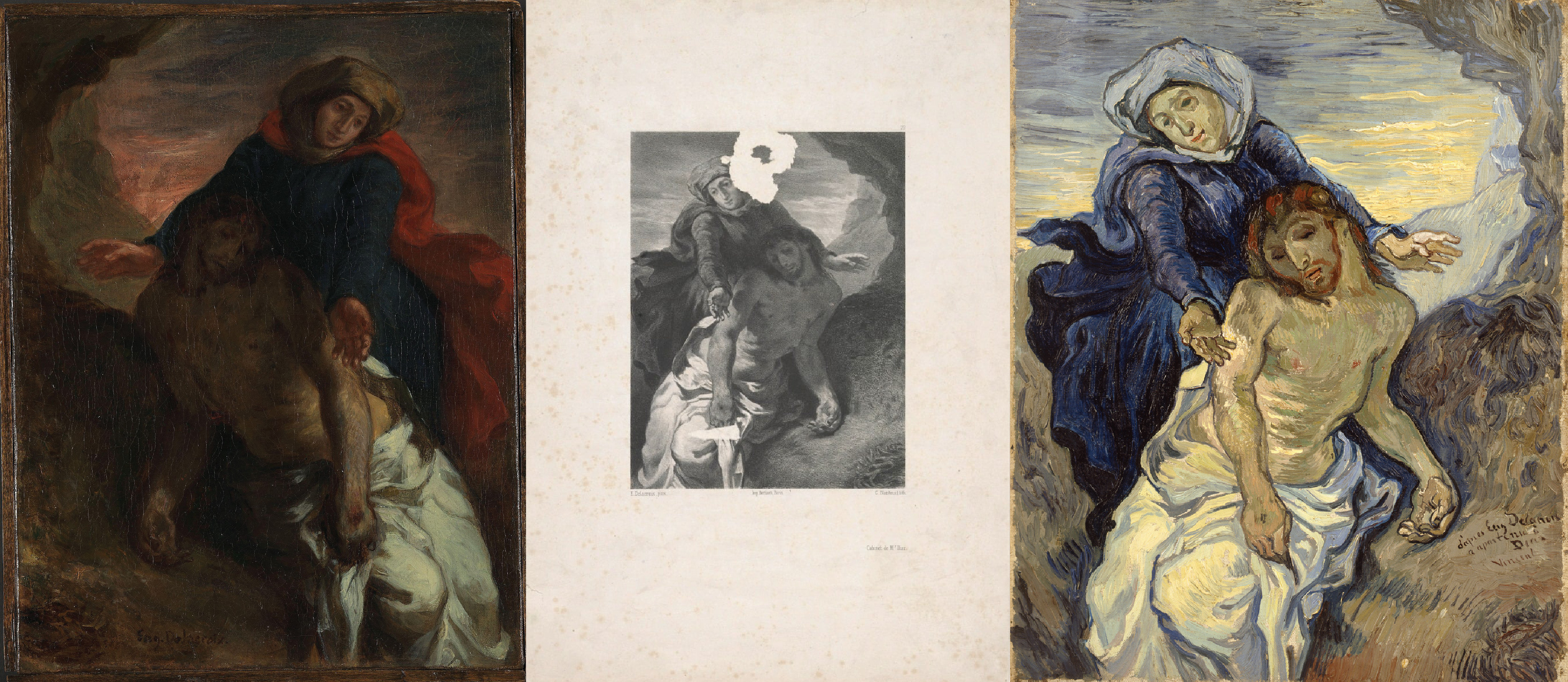
Vincent had two rooms there, one of which he used as a studio, setting up the various print copies he owned of acclaimed paintings. One was a lithograph by Célestin François Nanteuil-Leboeuf after Delacroix’s Pietà, from the portfolio Les artistes anciens et modernes. (Theo had bought and sent him this litho at his request.) Vincent lamented to his brother that he accidentally damaged it with spilled paint—but that impelled him to paint his own copy of Delacroix. On September 10, 1889, he wrote:
Work is going very well, I’m finding things that I’ve sought in vain for years, and feeling that I always think of those words of Delacroix that you know, that he found painting when he had neither breath nor teeth left. Ah well, I myself with the mental illness I have, I think of so many other artists suffering mentally, and I tell myself that this doesn’t prevent one from practising the role of painter as if nothing had gone wrong.
[. . .] In the very suffering, religious thoughts sometimes console me a great deal. Thus this time during my illness a misfortune happened to me – that lithograph of Delacroix, the Pietà, with other sheets had fallen into some oil and paint and got spoiled.
I was sad about it – then in the meantime I occupied myself painting it, and you’ll see it one day, on a no. 5 or 6 canvas I’ve made a copy of it which I think has feeling. [. . .] My fingers [are] so sure that I drew that Delacroix Pietà without taking a single measurement, though there are those four outstretched hands and arms – gestures and bodily postures that aren’t exactly easy or simple. [Letter 801]
LEFT: Eugène Delacroix, Pietà, ca. 1850, oil on canvas, 35.6 × 27 cm, National Museum of Art, Architecture and Design, Oslo. CENTER: Célestin François Nanteuil-Leboeuf, Pietà (after Delacroix), 1853, lithograph, Van Gogh Museum, Amsterdam. RIGHT: Vincent van Gogh, Pietà (after Delacroix), 1889, oil on canvas, 42 × 34 cm, Vatican Museums.
The painted copy he refers to here is the smaller of the two, which he gifted to his sister Willemien and is now in the collection of the Vatican Museums in Vatican City. In another letter, from September 19, he tells Wil “this little copy of course has no value from any point of view,” but “you’ll be able to see in it that Delacroix doesn’t draw the features of a Mater Dolorosa [sorrowing Mother of God] in the manner of Roman statues – and that the pallid aspect, the lost, vague gaze of a person tired of being in anguish and in tears and keeping vigil is present in it.”
The other Pietàthat Vincent painted—which is similar to the first but larger and brighter—he kept for himself, hanging it in his bedroom at Saint-Rémy. He describes the painting to Wil:
The Delacroix is a Pietà, i.e. a dead Christ with the Mater Dolorosa. The exhausted corpse lies bent forward on its left side at the entrance to a cave, its hands outstretched, and the woman stands behind. It’s an evening after the storm, and this desolate, blue-clad figure stands out – its flowing clothes blown about by the wind – against a sky in which violet clouds fringed with gold are floating. In a great gesture of despair she too is stretching out her empty arms, and one can see her hands, a working woman’s good, solid hands. With its flowing clothes this figure is almost as wide in extent as it’s tall. And as the dead man’s face is in shadow, the woman’s pale head stands out brightly against a cloud – an opposition which makes these two heads appear to be a dark flower with a pale flower, arranged expressly to bring them out better. [Letter 804]
Vincent van Gogh (Dutch, 1853–1890), Pietà (after Delacroix), 1889. Oil on canvas, 73 × 60.5 cm. Van Gogh Museum, Amsterdam.
Although Vincent may have at one time seen Delacroix’s Pietàpainting in person, at Saint-Rémy he had only a grayscale image, the lithograph by Nanteuil-Leboeuf, to reference. For his version, he invented his own color scheme—bold blues and yellows.
On September 20, Vincent described to Theo his process of “copying,” or interpreting, the masters:
What I’m seeking in it, and why it seems good to me to copy them, I’m going to try to tell you. We painters are always asked to compose ourselves and to be nothing but composers.
Very well – but in music it isn’t so – and if such a person plays some Beethoven he’ll add his personal interpretation to it – in music, and then above all for singing – a composer’s interpretation is something, and it isn’t a hard and fast rule that only the composer plays his own compositions.
Good – since I’m above all ill at present, I’m trying to do something to console myself, for my own pleasure.
I place the black-and-white by Delacroix or Millet or after them in front of me as a subject. And then I improvise colour on it but, being me, not completely of course, but seeking memories of their paintings – but the memory, the vague consonance of colours that are in the same sentiment, if not right – that’s my own interpretation.
Heaps of people don’t copy. Heaps of others do copy – for me, I set myself to it by chance, and I find that it teaches and above all sometimes consoles.
So then my brush goes between my fingers as if it were a bow on the violin and absolutely for my pleasure. [Letter 805]
Some art historians believe the Christ figure in the painting is a self-portrait—Vincent identifying himself with the suffering Christ, or recognizing Christ’s presence with him in his suffering, and expressing his longing to be cradled in loving arms and for resurrection from the grave of psychosis. In Vincent van Gogh: The Complete Paintings, Ingo F. Walther and Rainer Metzger write,
Nothing could convey more clearly his need to record his own crisis in the features of another than these two copies [of Delacroix’s Pietà]. The face of the crucified Christ in the lap of a grieving Mary quite unambiguously has van Gogh’s own features. In other words, a ginger-haired Christ with a close-trimmed beard was now the perfect symbol of suffering, the (rather crude) encoding of van Gogh’s own Passion. The painter was to attempt this daring stroke once more, in his interpretation of Rembrandt’s The Raising of Lazarus. Here, van Gogh gave his own features to a Biblical figure who, like Christ, passed through Death into new Life. It was as if, in his work as a copyist, van Gogh was pursuing the kind of oblique allegory he disapproved of in Bernard and Gauguin [see Letter 823]. Five weeks of mental darkness demanded artistic expression – and even that incorrigible realist Vincent van Gogh could not be satisfied with landscape immediacy alone. (542)
On May 16, 1890, Vincent left the hospital at Saint-Rémy, bringing his Pietà painting with him. He moved to Auvers-sur-Oise, a suburb of Paris, placing himself under the care of the homeopathic doctor Paul Gachet, who became a friend. Dr. Gachet admired the painting very much and requested his own copy. (As far as we know, Vincent never got around to making one.)
Vincent was incredibly prolific in Auvers, but his mental health continued to decline, and he died a little over two months after relocating there, on July 29, 1890, from a gunshot wound to the lower chest that was likely self-inflicted.
In his poem “Pietà” from an ekphrastic collection based entirely on Vincent’s paintings, Robert Fagles draws on Vincent’s biography and letters in addition to the titular painting to voice the spiritual and emotional yearnings of Vincent’s final year. The last stanza is a prayer that the poetic speaker Vincent addresses to God—for hope, renewal, light:
Living and yet immortal, Lord, revive me— let me inhale the blue of Mary’s cape billowing hurricanes of hope, clothe me in your cerements gold with morning— mother and son, from all your sorrow all renewal springs, the earth you touch turns emerald as your hand that burgeons green.
In Vincent’s Pietà, the dead Christ’s limp hand rests on a grassy boulder or knoll, which Fagles reads as signifying life awakening from death. You can even see the green reflected in Christ’s face and chest, not to mention the golden sun (“after the storm,” as the historical Vincent wrote) glinting on his right arm, abdomen, and shroud, a faint promise of resurrection.
VIDEO MEDITATION: “Yearning and Promise (Advent),” dir. Lauralee Farrer (2017): The first in the seven-part Liturgical Meditations series produced by Fuller Studio (a resource center affiliated with Fuller Theological Seminary), this four-minute video features Advent scripture readings by Fuller alum Paul Mpishi (MDiv, ’17) in his native Swahili, set to beautiful cinematography by Lindsey Sheets, Timothy Kay, and Jordan McMahon.
“Yearning and Promise” explores Advent and the expectant longing for the birth of Christ through cityscapes, wilderness, and water from Chicago and Malibu, with scriptures drawn from Isaiah 40 and Matthew 1. The audio for this video is in Swahili with subtitles in English, Spanish, Mandarin, and Korean—a poetic way to represent the primary tongues of our community. . . .
The liturgical calendar spans the life of Christ in a single year—from anticipation (Advent), to hope (Christmas), to transcendence (Epiphany), to lament (Lent), to redemption (Easter), to the birth of the church (Pentecost), and through long, numbered days (Ordinary Time) back to Advent. The liturgical meditation series to which this video belongs relies on nature to tell the story of God, accompanied by scriptures traditional to each season.
Piero della Francesca (Italian, ca. 1415–1492), Madonna del Parto, after 1457. Detached fresco, 100 × 80 in. (260 × 203 cm). Musei Civici Madonna del Parto, Monterchi, Italy.
>> “Lord, Remind Me” by Jon and Valerie Guerra: From their album It’s Almost Christmas! Jon Guerra writes in the YouTube video description about how most days, hope feels naive; about the narratives in which we misplace our trust; about how Jesus, in his coming, tells a different narrative and brings our hope to fruition.
At Christmastime, Guerra writes,
Christians . . . celebrat[e] the arrival of a “shoot from Jesse’s stump.” It’s a transgressive celebration of fragility and vulnerability. We wanted a fully matured tree—God gave us a shoot coming from a stump. We wanted a strong leader—God gave us a vulnerable baby. We wanted a strength that dominates—God gave us a weakness that submits. We wanted victory—God gave us defeat, destitution, death.
How is this defying of our expectations hopeful? Well, theology at its atomic level says this: God is love. God doesn’t love as a decisive action, as though tomorrow the decision could be reversed. God is, always, love.
That love is not only towards humanity—it becomes humanity. It is not only compassionate towards the broken—it becomes the broken. It is unconditional love that becomes death—and in so doing, defeats it. It defies our expectations only to exceed to them.
So here’s to remembering hope in God’s unconditional love towards the desolate stumpiness of ourselves and the world this season—and to believing that this is not the end of the story. Lord, remind me.
>> “His Name Is Jesus” by Keiko Ying: Released this month on YouTube, this children’s Advent song by Keiko Ying celebrates Jesus as Emmanuel, “God with us.” Here is the lead sheet. The drawings and animation in the music video are by the songwriter’s thirteen-year-old daughter, Clara. [HT: Global Christian Worship]
Out of the living word
Come flower, serpent and bird.

All things that swim or fly
Or go upon the ground,
All shapes that breath can cry
Into the sinews of sound,
That growth can make abound
In the river of the eye
Till speech is three-ply
And the truth triply wound.

Out of the living word
Come flower, serpent and bird.
Howard Nemerov (1920–1991) was a major figure in midcentury American poetry, whose Collected Poems won the Pulitzer Prize, the National Book Award, and the Bollingen Prize. He served as US poet laureate from 1963 to 1964 and again from 1988 to 1990, and he also wrote fiction and essays. “Romantic, realist, comedian, satirist, relentless and indefatigable brooder upon the most ancient mysteries—Nemerov is not to be classified,” Joyce Carol Oates remarked in the New Republic. From an artistic family, Nemerov was the older brother of the photographer Diane Arbus.
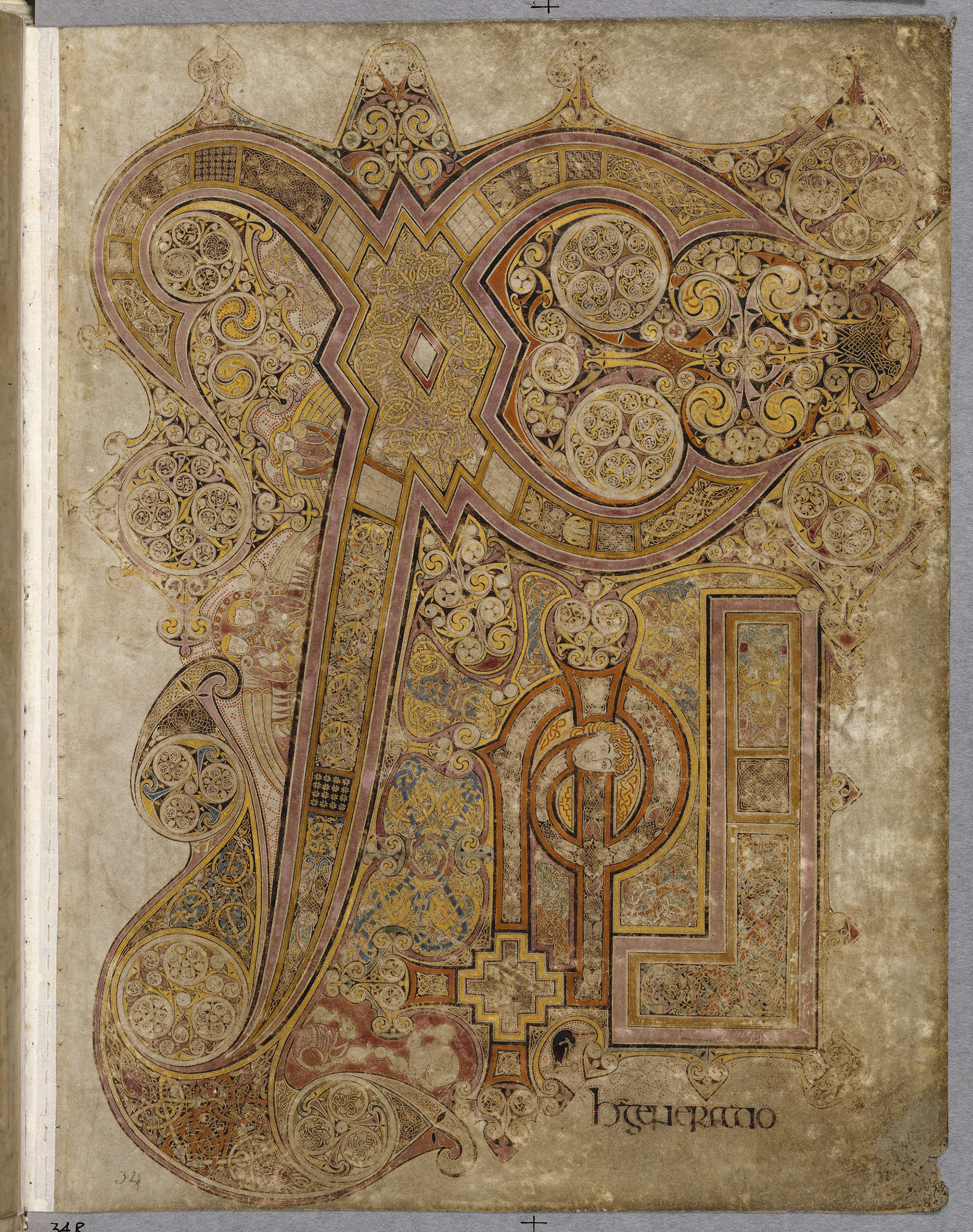
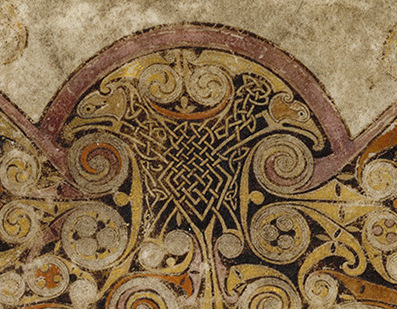
The exuberantly decorated Book of Kells is widely agreed to be the most beautiful book ever made. The crown jewel of Celtic art, it is a manuscript copy of the Four Holy Gospels in Latin, with ten surviving full-page illuminations and many more marginal illuminations and decorated initials throughout the other 670 pages—the work of three artists and four scribes.
Most art historians believe the book was created on the Scottish island of Iona by a group of monks sometime around 800. Viking raids at that time forced the monks to flee to the monastery of Kells in Ireland; they were able to save the book, but it was left unfinished.
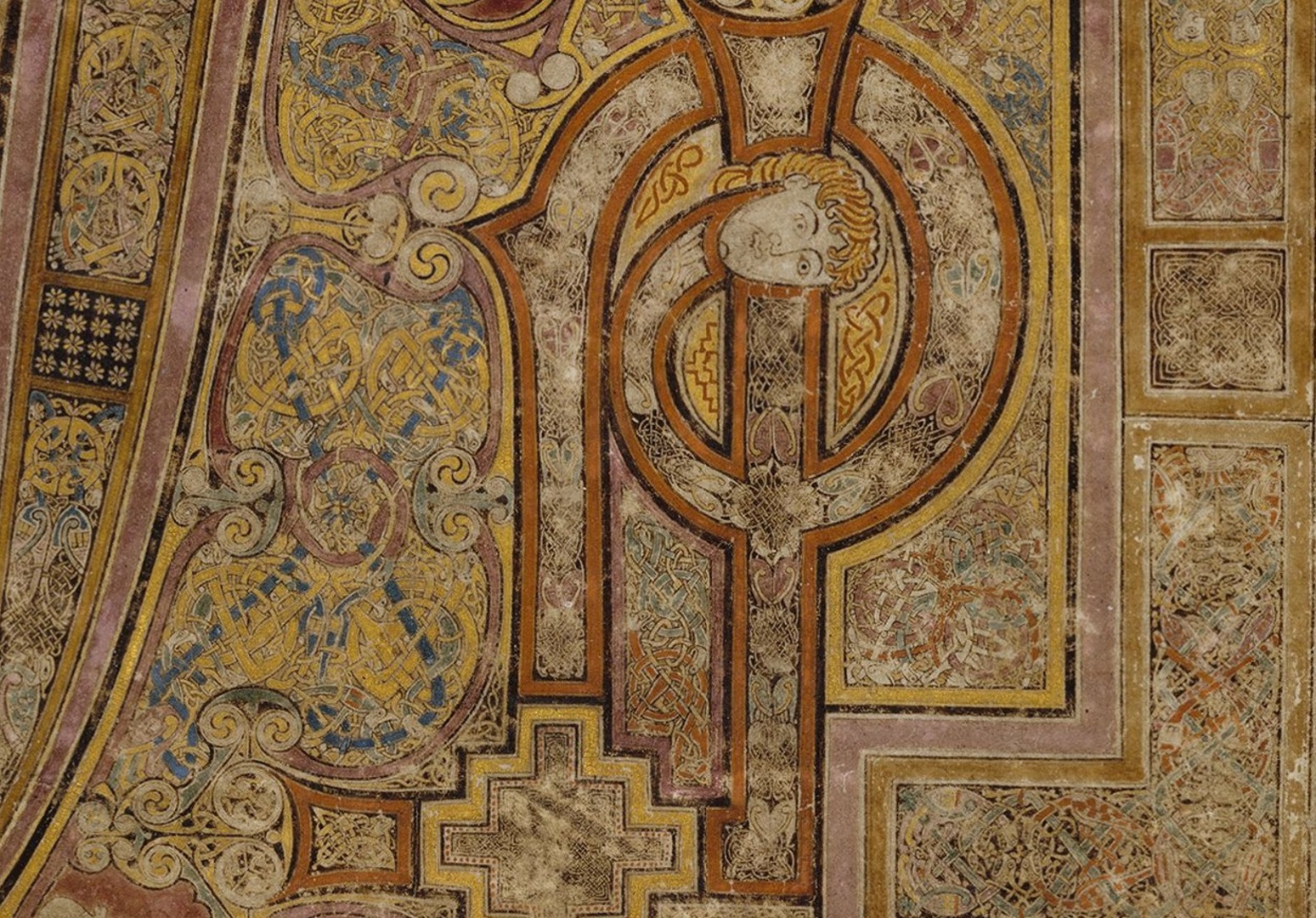
The most famous page from the Book of Kells is folio 34r, often referred to as the Christi autem or Chi-Rho page.
The Chi-Rho page from the Book of Kells, ca. 800. Trinity College Dublin MS 58, fol. 34r.
The page illuminates the “second beginning” of the Gospel of Matthew, following the genealogy and opening the narrative of the life of Christ: Christi autem generatio (“Now the birth of Christ . . .”) (Matt. 1:18). The anonymous artist represents the Holy Name of Jesus with a monogram, enlarged and embellished, consisting of the Greek letters chi (Χ) (pronounced “kai”), rho (ρ), and iota (ι), the first three letters in the word Χριστός, Christos. H generatio (where h is shorthand for autem) is written in Latin in Insular majuscule script at the bottom right of the page.
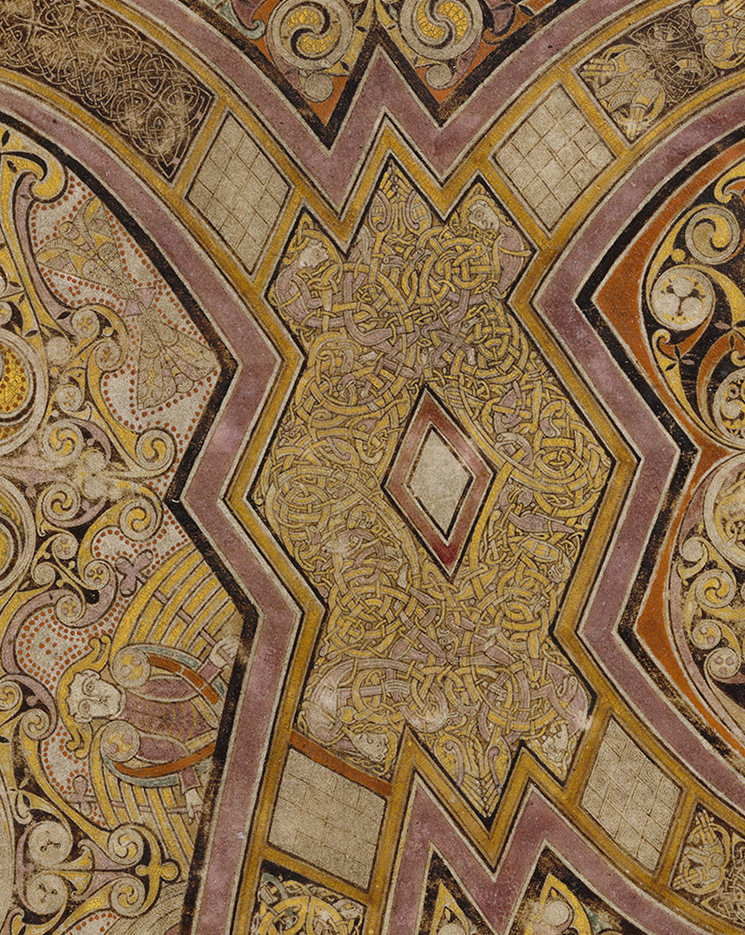
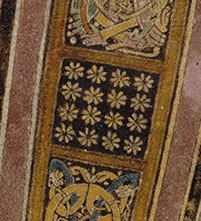
The chi-rho monogram is accorded special dignity in Christian art. Here the chi takes up nearly the whole page, its arms and legs extending to the four corners, exuding a kinetic energy. It reaches, it leaps; it blossoms and enfolds. It is beautified with intricate interlaces, spirals, and lozenges, and it’s teeming with life! Creatures of the land, air, and sea dwell within and around—cats and mice (nibbling on a eucharistic wafer!), birds and moths, an otter and a fish, humans and angels. There are vines and flowers too, and the whirling gears of the cosmos—all of it spilling out of the precious name of Christ.
Peering out from the inner tip of the rho is a red-haired man. Might this represent Jesus? Scholars tend to think so.
This illuminated page combines word (speech) and Word (Logos) with glorious liveliness. “The decoration of the text of Christ’s birth suggests the identification of Christ incarnate with Christ the Creator-Logos,” writes art historian Jennifer O’Reilly. “Christ as the divine Word is here revealed in a word, a single letter, concealed within the design. Similarly, commentators meditating on the name at this point in Matthew’s gospel, described his divinity as lying hidden in his creation, beneath his human flesh at his Incarnation and beneath the literal letter of the scriptural text.”
In his ekphrastic poem “The Book of Kells,” Howard Nemerov subtly draws out this theology—Christ as the Creator of the universe in and by whom all things consist (Col. 1:17). Bearing a rhyme scheme of aa bcbccbbc aa, the poem opens and closes with the same couplet: “Out of the living word / Come flower, serpent and bird.” Again, the word “word” is multivalent, referring to the written word “Christ” that fills the Book of Kells page in the form of a stylized monogram, as well as to Christ the person, the living Word of God, the source of all life. It can also refer to the Bible, which is “living and active” (Heb. 4:12) and which reveals Christ.
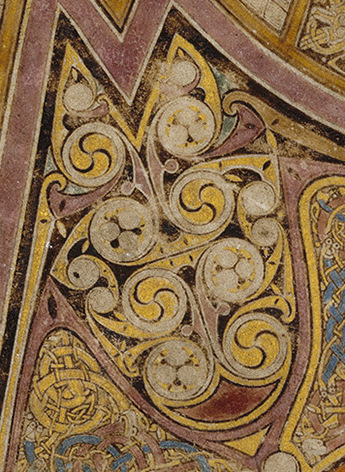
Nemerov alludes to the Chi-Rho page’s knotwork, its geometric shapes, its zoomorphic interlaces, and its triskeles (triple spirals), glorying in the sacred beauty and abundance they signify, which some unnamed early medieval monk laboriously sketched and painted over the course of who knows how long, to honor the story of the birth of Jesus Christ.
The Book of Kells’ Chi-Rho page is a phenomenal work of art. The symbol of Christ is all-encompassing, and all of creation is united in harmony with it.
The 2009 animated fantasy drama The Secret of Kells, made by the Irish studio Cartoon Salon, features a wondrous animation of the Chi-Rho page at the end, bringing to life some of its many details:
Van Engen answers questions from poet Shane McCrae and from the audience, addressing how to read a volume of poetry, how poetry produces an experience, the role of understanding and not understanding when it comes to poems, why Christians in particular should read poetry, hymns as poetry, how Adam’s naming creation in Genesis 2 relates to the task of the poet, his favorite poets, and the qualities of a good poem.
Two especially great questions from attendees were:
How do you imagine poetry nourishing discipleship and/or corporate worship, if used by a church leader?
What, if anything, would you like to see more of from Christian poets writing today?
Regarding the first, he says,
I often think that ministers in particular—and especially the heavier the preaching tradition, the more true this is—need creative literature—poetry, novels, and other things—to enliven what it is they’re doing from the pulpit. Not just to understand human life in all of its flourishing and misery, but to connect to people in different kinds of ways than pure principle and message can do.
He mentions the recurring summer seminar for pastors co-led by Dr. Cornelius “Neal” Plantinga, “Imaginative Reading for Creative Preaching,” to help participants explore the possibilities and homiletical impact of engaging in an ongoing program of reading novels, poetry, short fiction, children’s lit, and nonfiction outside the category of Christianity—not just to mine for sermon illustrations but also to develop a “middle wisdom” (“insights into life that are more profound than commonplaces, but less so than great proverbs”) and to deepen their perception of people.
+++
PODCAST EPISODE: “Opening Your Bible? Turn on Your Imagination” with Russ Ramsey and Sandra McCracken, The Gospel Coalition Podcast, May 8, 2020: This is a recording of a breakout session—“Reading Scripture with an Engaged Imagination”—from the Gospel Coalition’s 2019 National Conference in Indianapolis. Pastor Russ Ramsey (author of Rembrandt Is in the Wind: Learning to Love Art through the Eyes of Faith) and singer-songwriter Sandra McCracken (“We Will Feast in the House of Zion,” “Thy Mercy, My God”) discuss the role the imagination plays in reading scripture and understanding and conveying its truth.
Scripture calls for reading with a fully engaged imagination, Ramsey says, because that’s how literature works and that’s how people work. “How are you supposed to understand Scripture if you’re not trying to empathize or get into a situation and walk around inside of it?” he asks. They discuss wonder, mystery, and paradox—the unresolved dissonance and complexity present in many Bible stories—and the need to take a Bible story on its own terms instead of always trying to extract a moral or “life application” from it.
Though they don’t use the term, they’re basically advocating for Ignatian contemplation, aka the Ignatian method of Bible reading and prayer, in which you put yourself into the story and try to experience it with all your senses. Ramsey demonstrates with the story of Mary and the nard. “In those hours as Jesus is being arrested and tried and flogged and crucified, he smells opulent. And I think we’re supposed to get that, you know. We’re supposed to . . . especially a first-century reader is going to say, ‘He left a lingering scent as he went down the Via Dolorosa, and it was the scent of royalty. And it was the scent of extravagance.’”
Some of the names that come up along the way are Robert Alter, Ellen Davis, Eugene Peterson, and Frederick Buechner.
+++
IMMERSIVE ART EXPERIENCE:Rembrandt’s Christ in the Storm on the Sea of Galilee at Frameless in London: I’ve been seeing these kinds of exhibitions advertised more and more—ones that use animation and projection-mapping technology and dozens of loudspeakers strategically placed around the room to create a wall-to-wall, multisensory experience built around one or more masterpiece paintings. Some people say it’s gimmicky or overstimulating, but though I’ve never been to one, I generally think they look like fun! They’re not meant to be a substitute for seeing the actual artwork in person.
In the case of Rembrandt van Rijn’s Christ in the Storm on the Sea of Galilee, though, that’s not possible, as the painting was stolen from the Isabella Stewart Gardner Museum in Boston in 1990 and has not been recovered. In collaboration with their long-term partner Cinesite, Frameless recently developed an immersive art experience based on the painting—the Dutch master’s only seascape—in which visitors can get a sense of the terror and exasperation Jesus’s disciples must have felt that night they were caught at sea in a torrential wind- and rainstorm while Jesus lay calmly asleep in the boat’s stern (see Matt. 8:23–27; Mark 4:36–41; Luke 8:22–25). Here’s a making-of featurette for that experience, which garnered a nomination for a prestigious Visual Effects Society award earlier this year:
Frameless is permanently housed in the Marble Arch Place in London’s West End cultural district. Christ in the Storm is one of forty-two works of art they riff on across four galleries.
+++
POEMS:
Here are two poems published this month that each explores a different episode from the story of Jacob’s family in the book of Genesis—one of his wife Rachel stealing her father’s household gods as they flee to Canaan, and one of Jacob’s sons avenging the rape of their sister, Dinah. Both are examples of how poems can stimulate renewed engagement with scripture, as these were stories I had forgotten some of the details of, and the poems did not make sense until I revisited the relevant Bible passages. Poems can help us walk around inside the biblical narratives, both familiar and unfamiliar ones, and see things from the perspectives of different characters, especially ones who are not given a voice in scripture, such as a Shechemite woman taken captive by Jacob’s sons.
>>“Rachel, Cunning”by Patricia L. Hamilton, Reformed Journal: Read the poem first, then Genesis 29–31, then my commentary.
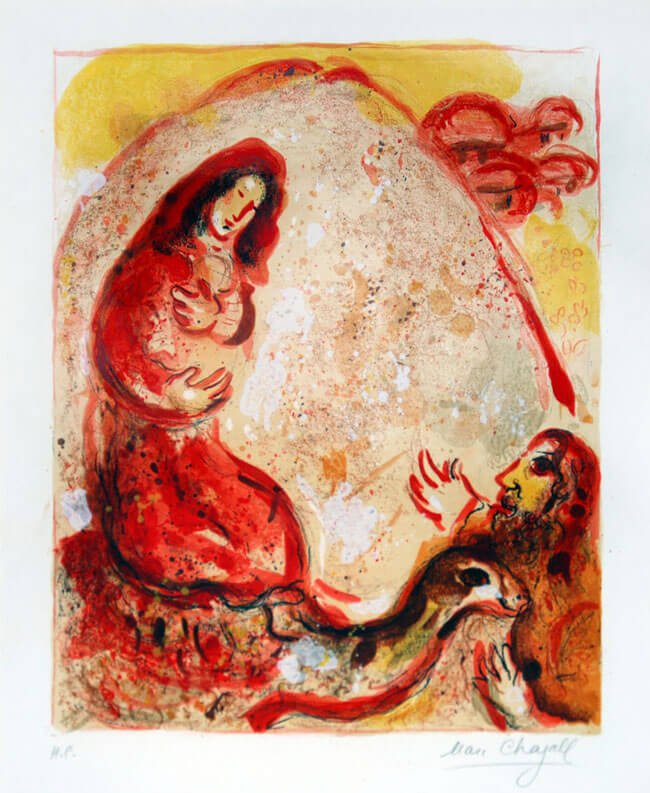
Voiced by Jacob’s second wife, Rachel, in this poem Rachel vents her jealousy over Jacob having first married her sister, Leah, who bore him six sons to her one at this point. This marriage was due to the trickery of her father, Laban, who also tried to cheat Jacob out of fair shepherding wages—so Rachel resents her father. As she prepares to secretly leave Paddan-aram for Canaan with Jacob, Leah, and their children, she steals her father’s teraphim (small images or cult objects used as domestic deities or oracles by ancient Semitic peoples).
In the biblical narrative, Rachel’s motive for stealing the idols is not given. Was she seeking to prevent Laban from consulting them to find out which way she and her family went? Was possession of the gods in some way connected to property inheritance, as some scholars have attested? Was she stealing a blessing from her ancestors? Did she take them for their monetary value? Or leaving her homeland, did she simply wish to take with her a little piece of home, for nostalgia’s sake?
I think the most likely reason is she still believed in these gods’ power—her allegiance to the God of Jacob had not yet been firmly established—and so she stole them for protection. That’s what Hamilton imagines in her poem: that Rachel sees them as “talismans against the spite of brothers,” averting the evil Jacob’s older twin brother, Esau, wished him for his having stolen their father’s blessing that belonged to him. (According to Genesis 27:41–45, before Jacob left for Paddan-aram, Esau had vowed to kill him.)
Marc Chagall (Belarusian French, 1887–1985), Rachel dérobe les idoles de son père (Rachel Hides Her Father’s Household Gods), from The Bible series, 1960. Original color lithograph on Arches wove paper, image size 14 × 10 1/2 in. (35.6 × 26.7 cm).
Caught between two tricksters—her husband and her father—Rachel herself becomes a trickster. When Laban catches up with their traveling party and searches among their possessions for the stolen gods, Rachel, who’s sitting on them, lies and says she cannot get up because she’s menstruating (Gen. 31:34–35). She deceives her deceitful father to keep her deceitful husband and her son Joseph safe from Esau’s rage, as she believes the gods will act in the interests of whoever possesses them. The poem explores the ever-thickening web of deceptions woven in Jacob’s and Rachel’s families and also reminds us that Rachel, remembered now as a great Jewish matriarch, was not raised in the then-still-developing Israelite religion, nor was her turn to Yahweh necessarily immediate upon her marriage to Jacob. I hear in the poem a lament for fraternal and sororal rivalries, and a subtle sad awareness of the vulnerabilities and pressures of women in patriarchal cultures, who are bought and sold in marriage, valued primarily for their childbearing capacities, and typically forced to rely on men for survival, often suffering the consequences of men’s mistakes. (In the poem at least, Rachel’s feeling of insecurity comes from Esau’s threat of vengeance.)
Based on a lithograph by Marc Chagall, this ekphrastic poem is one of twenty-four from the unpublished chapbook Voiced by Patricia Hamilton, all inspired by biblical artworks by Chagall. Hamilton is currently looking for a publisher to take on the collection.
>>“For the Circumcision of a Small City” by Emma De Lisle, Image: The deception continues in Genesis 34; like father, like sons. This poem is based on the episode of the massacre of the men at Shechem by Jacob’s sons Simeon and Levi to avenge the rape of their sister, Dinah. Shechem, meaning “shoulder,” was the name of both the city in Canaan where the rape took place and the Hivite prince’s son who committed the rape. Jacob and his family were sojourning there, having even bought land. After sexually assaulting Dinah, Shechem wanted to make her his wife. Dinah’s brothers were disgusted by this request, but they pretended they would entertain bride-price discussions on the condition that all the males in the city be circumcised. Shechem’s father agreed, and his position as ruler meant the people obeyed. A few days after the mass circumcision, while the men were still sore, Simeon and Levi attacked with swords, killing all the males in the city. Their brothers then joined them in capturing the men’s wives and children and plundering their wealth.
Emma De Lisle’s poem is written from the perspective of a woman of Shechem, taken captive in the slaughter. The women of the city scorned the lengths Shechem was willing to go to for the homely Dinah, barely old enough to have her period. “Jacob’s silence for you” alludes to Genesis 34:5, which says that when he found out about his daughter’s rape, “Jacob held his peace” until his sons returned from the fields. If he felt grief or outrage, it’s not apparent in the scripture text. His initial response was to say and do nothing, and then to defer to his sons, who exact an outsize punishment for the crime that Jacob admits after the fact disappointed him because when word spreads, it will negatively impact the hospitality of other Canaanite cities toward them.
Stanzas 4 and 5 refer to two of Jacob’s previous deceptions: donning goatskins on his hands and neck to impersonate his hairy brother, Esau, before their blind father, so as to steal the blessing of the firstborn (Gen. 27), and altering the breeding pattern of Laban’s flocks to increase the number of spotted sheep and goats (how this is accomplished is vague and has posed difficulties for interpreters) and so enrich himself, as the spotted animals were his agreed-upon wage (Gen. 30:25–43). The implication of this mention is, I think, that men will take what they feel is owed to them, whether by guile or force.
Sometimes women participate in this violence. The poetic speaker wonders whether Dinah will force her or the other captive women to bear children for her (future husband’s) family line, just as her mother, Leah, had used her slave, Zilpah, when her own womb had closed.
“The city bled one way // or another, before your brothers took interest,” the speaker says. Sexual violence was not new to them. The last sentence suggests that Dinah was not the only female victim of the lustful Shechem’s assault—the women of the city paid a price too, seeing their husbands, fathers, brothers, and sons murdered in retaliation and themselves taken prisoner.
+++
ORATORIO: The Book of Romans by Emily Hiemstra (2019): Consisting of musical settings of select passages from the apostle Paul’s letter to the Romans, this piece for SATB soloists, choir, and string orchestra was commissioned by Grace Centre for the Arts, a ministry of Grace Toronto Church, where it premiered October 22, 2019. (Hooray for churches that commission new art!) Read a statement from the composer on the Deus Ex Musica blog. The performers are Meghan Jamieson (soprano), Rebecca Cuddy (alto), Asitha Tennekoon (tenor), Graham Robinson (baritone), Lyssa Pelton (violin), Amy Spurr (violin), Emily Hiemstra (viola), and Lydia Munchinsky (cello).
Here is the video time stamp for each of the eight movements:
0:18: i. Who Has Known the Mind of the Lord? (Rom. 11:33–36)
3:56: ii. His Eternal Power and Divine Nature (Rom. 1:20)
In February I shared a few of the Vespers services offered at this year’s Calvin Symposium on Worship at Calvin University in Grand Rapids, Michigan, which I was privileged to attend. Here are two of the full-fledged services that give you a sense of what the larger corporate gatherings are like. (The theme was Ezekiel.) I love the cross-cultural sharing that goes on, learning new songs alongside others, getting refreshed by prayer and formed by liturgy, sitting under the teaching of wise ministers of God from various backgrounds, and taking Communion with friends new and old.
>> “God’s Glory Departs from Israel,” February 8, 2024 (with bilingual Korean-English music and liturgy): This worship service was led in Korean and English by the Woodlawn Christian Reformed Church Choir, directed by Chan Gyu Jang; the Living Water Church Worship Team, directed by Yohan Lee; and members of the Calvin University and Calvin Theological Seminary Korean communities. Rev. Dr. Anne Zaki from Evangelical Presbyterian Seminary in Cairo, Egypt, preached on Ezekiel 10–11.
This is an example of bilingual worship done really well! (I’ve seen it done poorly: with lack of communication of intention, one-sided involvement in the design or execution, inadequate pronunciation coaching for non-native speakers at the mic, unclear instructions that create confusion as to who is supposed to say or sing what, unintelligibility, etc.) I’m so grateful for all the creativity and thoughtfulness that went into creating this service—with a special shout-out to the bulletin designers and livestream technicians.
The bulletin provides this note on bilingual worship:
Two languages are intertwined together in this bilingual service. At times, words are spoken in one language, and their translation—unspoken—is provided on the righthand column; at times, the leaders demonstrate to the congregation how to sing or speak the words through transliteration; and at other times, the leaders and congregation converse in both languages, providing meaning to each other, so that no word sung or spoken is left unintelligible. We seek understanding and order in the sharing of our gifts.
In our pursuit, however, we practice patience and hospitality. In this service, we are called not only to speak and sing, but also to listen, to take turns. By listening, we create a room—a shelter—for travelers and strangers in this land, since language and music have power to transport one’s soul homeward. By taking turns, we practice the pace and posture of dialogue, even monolingual dialogue.
Beautiful! Here are three songs I’ll call out for special attention:
9:14: “Joo-yeo, Come, O Lord” by Sunlac Noh: This song, which is particularly well suited for Advent, originated in the Anglican Church of Korea and was translated into English last year by Martin Tel (see podcast interview below). The version we sang at the symposium preserves two of the Korean titles for Jesus.
23:36: “우리에게향하신” (Woo-ri-e-ge Hyang-ha-shin) (Never-Ending Is God’s Love) by Jin-ho Kim, based on Psalm 117:2: Sung entirely in Korean, this was used as a refrain during the Assurance of Pardon and the Prayers of the People. A simple, repeated line, either sung or spoken, is a good way to involve non-native speakers of a given language.
1:14:37: “주님다시오실때까지 / Rise, My Soul, Till Jesus Comes Again” by Hyeong-won Koh: The closing song is a charge to continue in the way of Jesus, all the way Home. The vocalists on stage sang the song themselves in its original Korean the first time through, and then we all joined in in English for the second time.
All the song credits are provided in full in the YouTube video description.
I want to especially draw your attention to 23:31, where Floyd premieres an extraordinary new song of hers, “God Breathed.” It opens and closes with a flute, and in between are her powerful jazz vocals, singing an original poetic text based on Ezekiel 37, accompanied by James Weidman on piano. (Update: Here’s a standalone video of the song.)
+++
PODCAST EPISODE: “Fighting Back Against the Storms of Life with Martin Tel,”Psalms for the Spirit: Host Kiran Young Wimberly interviews Martin Tel, director of music at Princeton Theological Seminary and senior editor of Psalms for All Seasons: A Complete Psalter for Worship (2012), about the Psalms—the importance of psalm singing in his Dutch Reformed upbringing; the Psalms as a form of resistance and protest; the Psalms as a means of praying our own prayers and those of others; our need to overhear some psalms as being prayed against us (that is, have you considered that you might be someone else’s oppressor?); and ideas for framing a psalm with a refrain, such as these:
Combine the Charles Albert Tindley gospel song “The Storm Is Passing Over” with Psalm 57 (“In the shadow of your wings I will take refuge, until the destroying storms pass by . . .”). Sing into the storm.
Choose a Gospel passage of someone in deep lament (e.g., the ten lepers in Luke 17:11–19), surround it with Psalm 88, and have the congregation sing “Kum Ba Yah” (Gullah for “Come by Here”) in minor mode as a refrain (“Someone’s crying, Lord . . .”). A choir can hum the spiritual while the reader(s) read the scriptures.
Intersperse the verses of Psalm 14 (“Fools say in their heart, ‘There is no God.’ . . . They have all gone astray . . .”) with the refrain “Prone to wander, Lord, I feel it . . .” to help the congregation members see their own foolishness instead of assuming it’s someone else who’s the fool.
+++
ARTICLE: “The Mysteries of Liturgical Sincerity” by John Witvliet, Worship (reprinted Pray Tell), May 2018: Some Protestants accuse the more liturgically inclined Christians, like me, of not valuing sincerity in worship because we value prewritten prayers and other set forms. But just because something is scripted or done habitually does not make it “rote” or “empty.”
“Among my mostly Protestant students, no theme is more contested, misunderstood, or cherished” than sincerity, writes John D. Witvliet, director of the Calvin Institute of Christian Worship and professor of worship, theology, and congregational and ministry studies at Calvin University and Calvin Theological Seminary. In this article he explores several different definitions of sincerity, which vary widely across cultures, centuries, philosophical frameworks, and Christian traditions, and then offers six “corrective lenses” to common astigmatisms in the free-church Protestant way of viewing the world: outside-in sincerity, vicarious sincerity, trait sincerity, symbiotic sincerity, sincerity as gift, and aspirational sincerity.
This article is SO GOOD. I have been greatly influenced over the years by Dr. Witvliet’s teachings on liturgical formation, and I strongly encourage you all to read this piece.
+++
EKPHRASTIC POEMS:
An ekphrastic poem is a poem written in response to a work of visual art. Here are two examples I like from the past two years:
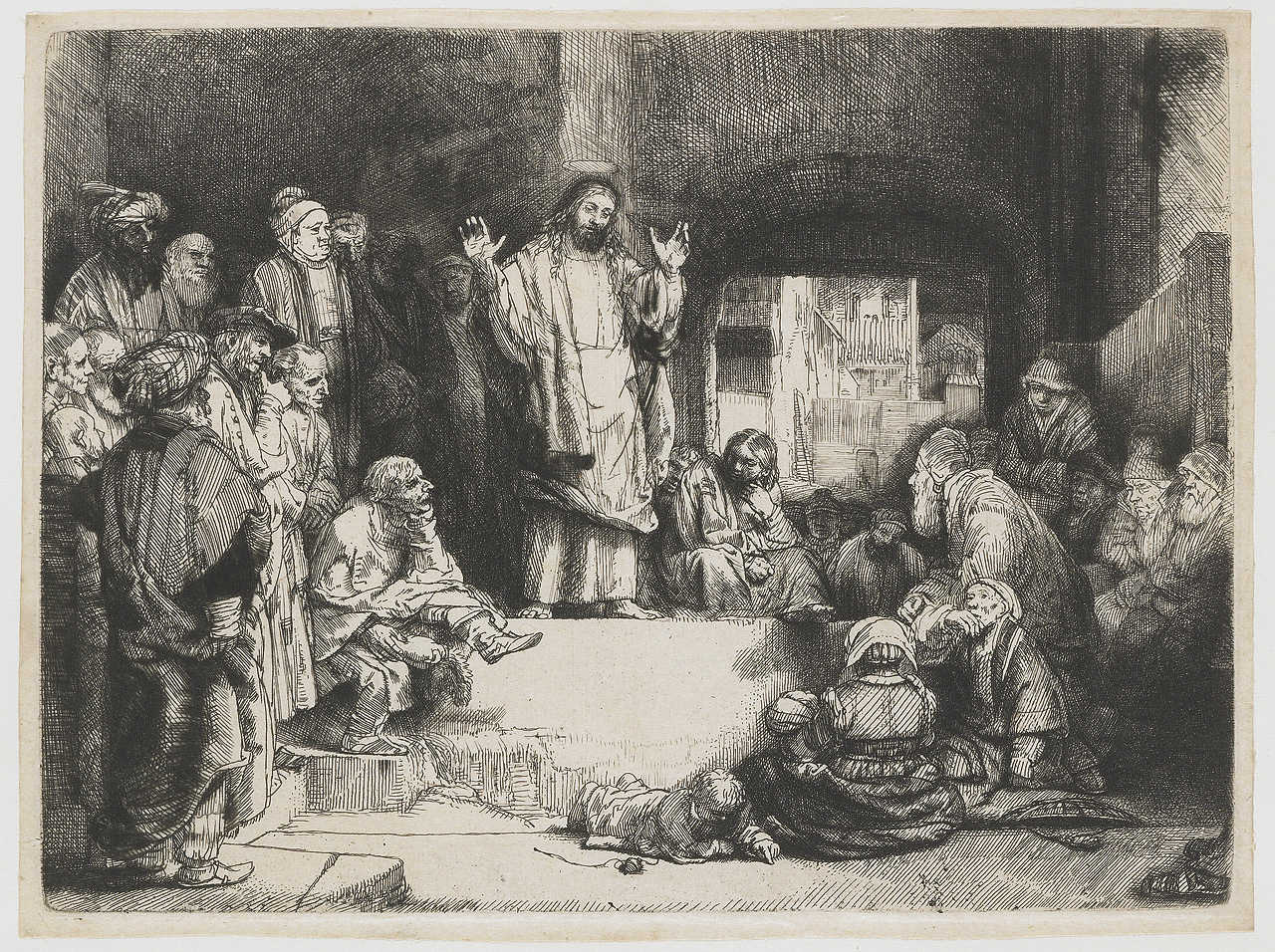
>> “Christ Preaching”by Keene Carter, Image: “I forgive the absent boy,” begins this poem based on a Rembrandt etching, directing our attention to the young child in the foreground who has turned away, disinterested, from Jesus’s sermon, drawing on the ground instead. Jesus gives grace to those in the crowd with averted gazes or who are distracted, simply continuing to preach on on the virtue of empathy—of seeing yourself in others—and on true life.
Rembrandt van Rijn (Dutch, 1606–1669), Christ Preaching (La Petite Tombe), ca. 1652. Etching, engraving, and drypoint on paper, 6 1/4 x 8 5/16 in. (15.9 × 21.1 cm). National Gallery of Art, Washington, DC.
>> “L’Angélus”by Seth Wieck, Grand Little Things:The Angelus is a traditional Christian prayer whose name comes from its opening words in Latin, “Angelus Domini” (The angel of the Lord). For centuries it was prayed by the faithful three times a day—at 6 a.m., noon, and 6 p.m.—the times announced by the ringing of bells from church towers. In the nineteenth century Millet famously painted two peasant farmers at dusk pausing from their labor in the fields to bow their heads and pray the Angelus. Seth Wieck interprets the painting through poetry, homing in on the part of the prayer that says, “Let it be done to me according to thy word,” expressing an attitude of surrender to God’s will. Wieck imagines the hard life of the man and woman shown pulling up potatoes from the earth—the same earth in which, shortly hence, they’ll bury a child, lost to sickness. The poem becomes a meditation on death, harvest, and acceptance.
Jean-Franҫois Millet (French, 1814–1875), The Angelus, 1857–59. Oil on canvas, 55.5 × 66 cm. Musée d’Orsay, Paris.
El Greco (Domenikos Theotocopoulos) (Spanish, 1541–1614), El Espolio (The Disrobing of Christ), 1577–79. Oil on panel, 55.7 × 34.7 cm. National Trust, Upton House, Warwickshire, England. Photo: National Trust Photo Library / John Hammond. [object record]
The carpenter is intent on the pressure of his hand
on the awl, and the trick of pinpointing his strength
through the awl to the wood, which is tough.
He has no effort to spare for despoilings
nor to worry if he’ll be cut in on the dice.
His skill is vital to the scene, and the safety of the state.
Anyone can perform the indignities; it is his hard arms
and craft that hold the eyes of the convict’s women.
There is the problem of getting the holes straight
(in the middle of this shoving crowd)
and deep enough to hold the spikes
after they’ve sunk through those soft feet
and wrists waiting behind him.

The carpenter isn’t aware that one of the hands
is held in a curious beseechment over him—
but what is besought, forgiveness or blessing?—
nor if he saw would he take the time to be puzzled.
Criminals come in all sorts, as anyone knows who makes crosses,
are as mad or sane as those who decide on their killings.
Our one at least has been quiet so far,
though they say he has talked himself into this trouble—
a carpenter’s son who got notions of preaching.
Well here’s a carpenter’s son who’ll have carpenter’s sons,
God willing, and build what’s wanted, temples or tables,
mangers or crosses, and shape them decently,
working alone in that firm and profound abstraction
which blots out the bawling of rag-snatchers.
To construct with hands, knee-weight, braced thigh,
keeps the back turned from death.
But it’s too late now for the other carpenter’s boy
to return to this peace before the nails are hammered.
Earle Birney (1904–1995) is regarded as one of Canada’s finest poets. He is the author of twenty-five poetry collections, including David and Other Poems (1942), Now Is Time (1945), and Near False Creek Mouth (1964). He taught English at the University of British Columbia, where he founded and directed the first Canadian creative writing program. He was also a novelist, essayist, literary critic, and radio playwright.
Sir Henry Raeburn (Scottish, 1756–1823), Reverend Robert Walker Skating on Duddingston Loch, aka The Skating Minister, ca. 1795. Oil on canvas, 76.2 × 63.5 cm. National Galleries of Scotland, Edinburgh. Robert Walker (1755–1808) was senior minister at the Canongate Kirk, a prominent abolitionist, and a member of the Edinburgh Skating Society.
        Portrait in oil, Sir Henry Raeburn, c. 1795

I’d like to think it’s late Saturday afternoon, sky on fire,
sermon finished, and he’s happy to be skating
alone, the village children gathered in for early supper and bed.
Then again, this might be a method of composing
just shy of dancing’s pleasure.

Dressed in black skates with red laces,
black leggings and coat, wide-brimmed black top hat
tipped back from flushed cheeks and pointed nose,
he cuts a fine figure against the green ice,
one leg swept up behind him, arms folded across his chest.

Drawn, it seems, by his steady gaze, does he lean
toward thoughts of the heaven he hopes for,
or the house ahead and his supper?
He’ll stay out there as long as he can.
This poem is from Grip, Give and Sway by Kathleen A. Wakefield (Los Angeles: Silver Birch, 2016).
Kathleen A. Wakefield (born 1954) is the author of two books of poetry: the prize-winning Notations on the Visible World (Anhinga, 2000) and Grip, Give and Sway (Silver Birch, 2016). She was a recipient of the University of Rochester Lillian Fairchild Award and has received grants from the New York State Foundation for the Arts, the Constance Saltonstall Foundation, and Mount Holyoke College. She taught creative writing at the Eastman School of Music and the University of Rochester and has worked as a poet-in-the-schools. She is also a singer, mainly of sacred and classical music.
Käthe Kollwitz (German, 1867–1945), Turm der Mütter (Tower of Mothers), 1937–38. Bronze, 27.9 × 27.4 × 28.8 cm. Art Gallery of Ontario, Toronto. Photo: Craig Boyko / AGO. Kollwitz lost her son in World War I, and much of her work from then on grappled with the horror of that loss or expressed antiwar resistance.
  a sculpture by Käthe Kollwitz

Five Bethlehem women close ranks
to shield sons with hip and hide.
“We will rest in the peace of His hands
before your swords pierce a child.
Spare them or shower us with spears.
Let our blood disarm you, rout you,
haunt you, cowering through nights
that smother your sleep.”
A bosom is no breastplate,
a skirt no fortress wall.
As futile as Babel
the tower falls in,
life upon life.
Death seizes all.
Evelyn Bence (born 1952) is a writer and editor living in Arlington, Virginia. She is the author of Room at My Table; Prayers for Girlfriends and Sisters and Me; Spiritual Moments with the Great Hymns; and the award-winning Mary’s Journal, a novel written in the voice of Jesus’s mother. She has served as religion editor at Doubleday, managing editor for Today’s Christian Woman, and senior editor at Prison Fellowship Ministries. Her personal essays, poems, and devotional reflections have appeared in various publications.



#/media/File:JEAN-FRAN%C3%87OIS_MILLET_-_El_%C3%81ngelus_(Museo_de_Orsay,_1857-1859._%C3%93leo_sobre_lienzo,_55.5_x_66_cm).jpg)


 Art & Theology