
Five new Advent/Christmas albums

Every fall a number of new holiday albums hit the market. Here are five from this year that I’ve been enjoying. I’ve included one or two sample tracks from each.
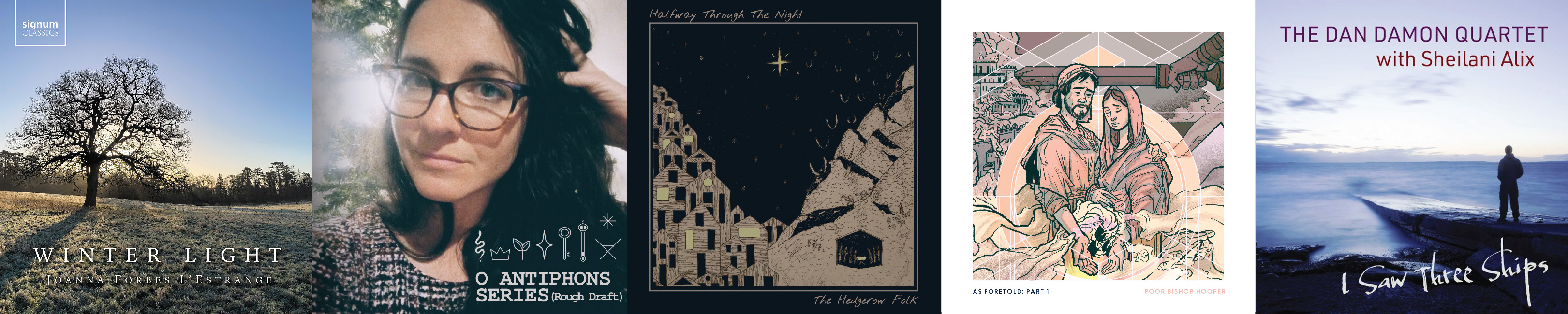
2024 Holiday Albums

Winter Light by Joanna Forbes L’Estrange

A smorgasbord of choral works by the British composer Joanna Forbes L’Estrange, plus a few written or cowritten by her husband, Alexander, and one by her son Harry, all performed by Ben Parry’s London Voices. I learned about this album from Angier Brock, who wrote the anthem text for the title track. One of my favorite pieces is the “Advent ‘O’ Carol,” which I’ll be featuring in a devotional post on December 17. Below is a retune of “In the Bleak Midwinter” (risky, since Holst’s beautiful tune is so iconic, but I love what L’Estrange does with Rossetti’s poem), followed by an original jazzy carol about “The Three Wise Women” of Christmas—Mary, Elizabeth, and Anna.

O Antiphons Series by Elise Massa

Elise Massa is a singer-songwriter and music minister currently living in Durham, England, where she works for United Adoration, a global nonprofit that seeks to empower local artists to create music and art rooted in Christ and meaningful to their particular context, culture, and language. This quiet, understated album consists of seven original songs based on the O Antiphons, refrains sung during evening prayer on the seven last days of Advent preceding Christmas Eve. Here’s the first one, “O Wisdom (O Sapientia)”:

Halfway Through the Night by the Hedgerow Folk

Named after a phrase from a C. S. Lewis poem, The Hedgerow Folk is an Alabama-based acoustic Americana trio: Jon Myles, Amanda Hammett, and Bryant Hains. “Halfway through the night” is a through line that weaves through this their first Christmas album as a declaration of hope. My two favorite tracks: their reharmonized rendition of “Lo, How a Rose E’er Blooming,” and their bluegrass arrangement of “Oh Come, Divine Messiah” (which I knew previously only from an a cappella choir of nuns). Also available on vinyl.

As Foretold: Part 1 by Poor Bishop Hooper

As Foretold is a trilogy of albums that takes its subject matter from the prophetic fulfillment passages in Matthew’s Gospel. Part 1, released this week, covers the first two chapters of the book—Jesus’s birth, his flight to Egypt, Herod’s slaughter of innocents, and Jesus’s return to Nazareth. Three of the tracks deal with Joseph’s three dreams—a rarity in music! In his first dream, an angel appears to tell him that Mary is telling the truth, that the son inside her was indeed conceived by the Holy Spirit. In the second dream, treated in the “Out of Egypt” song below, the angel tells Joseph to take his family and flee Bethlehem to Egypt to escape Herod’s wrath, and in the third, the angel informs him it’s safe to return to their homeland.

Poor Bishop Hooper is offering the album for free download from their website! Parts 2 and 3 will release in early 2025.

I Saw Three Ships by Dan Damon

Daniel Charles Damon is a jazz pianist, hymn writer, and retired Methodist pastor from San Francisco, who also works as associate editor of hymnody at Hope Publishing Company. His latest jazz Christmas album features a combination of classics and originals, including two hymns he wrote both the words and music for (“Like a Child” and “Winter’s Child”); “Hunger Carol” by Shirley Erena Murray (words) and Saya Ojiri (tune), which Damon has freshly arranged; and “Peace Child,” another Murray hymn, for which Damon wrote a tune.

It’s difficult to choose a favorite track, as I love this album through and through! I’ll highlight first the nineties hymn “Peace Child,” a pensive reflection on how Christ comes to us “in the silence of stars, in the violence of wars,” “through the hate and the hurt, through the hunger and dirt.” Second, a lively medieval carol whose Latin refrain, “Id-e-o-o-o, id-e-o-o-o, id-e-o, gloria in excelsis Deo!,” translates to “Therefore, glory to God in the highest!”

The vocalist on the album is the award-winning Sheilani Alix. She is accompanied by Damon on piano, Kurt Ribak on acoustic bass, Carrie Jahde on drums, and Lincoln Adler on tenor saxophone and soprano sax.

If you like this album, be sure to also check out Damon’s 2022 Christmas album, No Obvious Angels.


What 2024 holiday albums have you been enjoying?
Christmas, Day 4: Herod Rages On

When Herod saw that he had been tricked by the magi, he was infuriated, and he sent and killed all the children in and around Bethlehem who were two years old or under, according to the time that he had learned from the magi. Then what had been spoken through the prophet Jeremiah was fulfilled:

A voice was heard in Ramah,
wailing and loud lamentation,
Rachel weeping for her children;
she refused to be consoled, because they are no more.

—Matthew 2:16–18

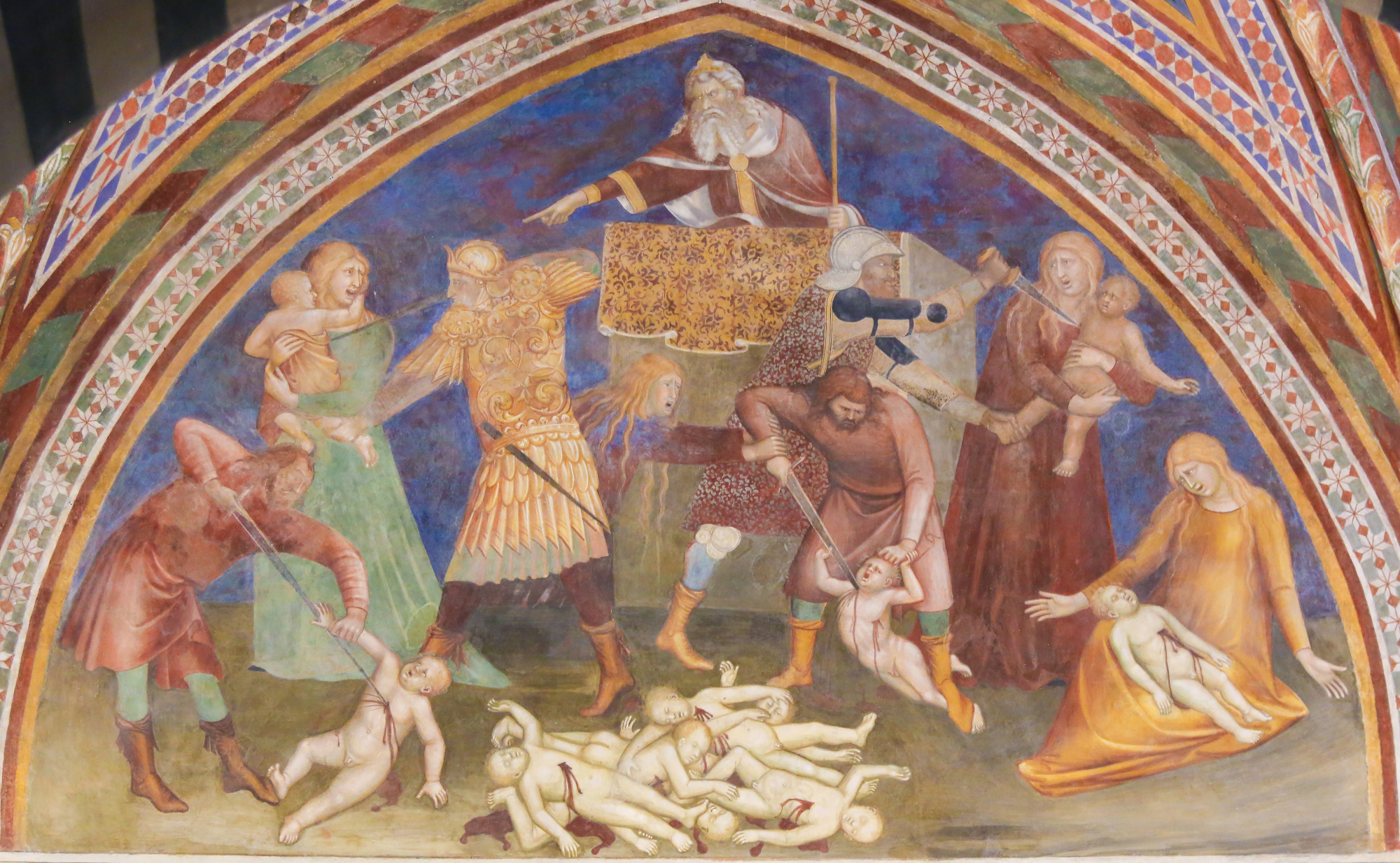
Even though we often omit it from our Christmas pageants and sermons, the Massacre of the Innocents recounted in Matthew 2 is part of the Christmas story. December 28 is set apart yearly to commemorate the babies who lost their lives in this slaughter. View posts on this subject from previous years here and here.

LOOK: Massacre of the Innocents by Lippo Memmi (attrib.)

Memmi, Lippo_Massacre of the Innocents
Attributed to Lippo Memmi (Italian, ca. 1291–1356), Massacre of the Innocents, ca. 1335–45. Fresco, Collegiate Church of San Gimignano, Italy.

In the Collegiate Church of San Gimignano, this scene is part of a narrative cycle on Christ’s infancy in six upper bays, comprising also the Annunciation, the Nativity and Adoration of the Shepherds, the Adoration of the Magi, the Presentation in the Temple, and the Flight to Egypt.

LISTEN: “And Herod Rages On” | Words by Kate Bluett, 2020 | Music by Elise Massa, 2020 | Performed by Elise Massa

The streets ran red in Bethlehem;
our little boys were gone
when soldiers came on Herod’s whim,
but Herod rages on.
No newborn king his light should dim;
he’d be the only dawn,
sent men to tear them limb from limb—
and Herod rages on.

Two thousand years, all filled with births
and stained as red as dawn
by blood that soaks the thirsty earth,
still Herod rages on.
And what is all this bloodshed worth,
our sons and daughters gone,
but barren fields and empty hearths,
while Herod rages on?

Dear infant Christ in Joseph’s arms,
escaped before the dawn,
O come and heal how we’ve been harmed,
for Herod rages on.
The sirens shriek, deep fear alarms;
when will you make them gone?
Or must we wait ’til hate’s disarmed?
For Herod rages on.

The stones that wept in Abel’s gore
cry out with every dawn
’til swords are laid down evermore,
while Herod rages on.
Someday he’ll fall to rise no more;
someday he will be gone.
Our hearts ’til then are bleeding sore,
and Herod rages on.

This song by Kate Bluett and Elise Massa views Herod as representative of any political leader whose policymaking or direct command threatens the lives of innocent children today. Lord, have mercy.


This post is part of a daily Christmas series that goes through January 6. View all the posts here, and the accompanying Spotify playlist here.

Roundup: Psalms and the arts, Ukrainian Easter Choir, and more

BLOG POST: “An open letter to pastors (A non-mom speaks about Mother’s Day)” by Amy Young: There’s disagreement among church leaders on whether Hallmark holidays, such as Mother’s Day, should be recognized during a worship service, and if so, how. Having mothers stand (while women who are not mothers in the conventional sense remain seated) can be very othering and bring up feelings of sadness or shame. It’s also a day when people are thinking about their own mothers, which can evoke a complex range of emotions.

Amy Young believes there is a way to honor mothers in church without alienating others, as well as to acknowledge the breadth of experiences associated with mothering. She has drafted a pastoral address that I find so wise and compassionate. Some women are estranged from their children. Some have experienced miscarriage or abortion. Some have had failed adoptions, or failed IVF treatments. Some placed a child for adoption. Some have been surrogate mothers. Some are foster mothers, or are the primary guardian of a relative’s child. Some are spiritual moms. Some women want to be mothers but have no partner or have had trouble conceiving. Some were abused by their mothers. Some have lost mothers. Some never met their mother. Young puts her arms around all these people who are potentially in the pews on Mother’s Day, making room for the complexity of the day—which does include celebration!

+++

VIDEO: “United with Beauty: The Psalms, the Arts, and the Human Experience” by Mallory Johnson: Mallory Johnson graduated last weekend with a bachelor’s in music and worship (concentration: voice) from Samford University in Birmingham, Alabama. (In the fall she will be starting an MDiv program at Beeson Divinity School.) All the seniors in the Samford School of the Arts are required to complete a capstone project tailored to their individual interests and career goals. As Johnson’s interests center on theology, history, and the arts, she created a twenty-minute video rooted in the Psalms that integrates music, poetry, short excerpts of fiction, visual art, and quotes from van Gogh, Tchaikovsky, Goethe, Luther, and others, resulting in a contemplative multimedia experience.

I resonate so much with Johnson’s approach of bringing together works from different artistic disciplines to interpret one another and to invite the viewer into worship. Her curation is stellar! To cite just one example, the contemporary choral work Stars by Ēriks Ešenvalds plays as we see, among other images, an Aboriginal dot painting of the constellations Orion and Canis and a nighttime landscape by realist painter Józef Chełmoński. Another: John Adams’s double piano composition “Hallelujah Junction” is brought into conversation with Psalm 150 and a painting by Jewish artist Richard Bee of David dancing before the ark.

Józef Chełmoński (Polish, 1849–1914), Starry Night, 1888. Oil on canvas, 22 13/16 × 28 3/4 in. (58 × 73 cm). National Museum in Kraków, Poland.

The video opens with the theme of awe and wonder—expanses of sky and sea and field; the beauty and vastness of God mirrored in the natural world—and then moves to lament—of the prospering of the wicked; of exhaustion, anxiety, and other forms of mental or spiritual anguish and their causes; of personal sin—and finally ends with an assurance of grace and with exultation. Johnson shows how the longings of modern people overlap with those of the biblical psalmists. Here’s her description:

In his famous work titled Confessions, St. Augustine writes this: “Yet to praise you, God, is the desire of every human.” Is this true? What does this look like?

During my time at Samford, I have felt my heart and mind overflow with love for the arts. As a Christian, they have played a devotional role in my life. I find such joy in seeing connections between music, art, and literature that may seem unrelated on the surface. I believe that all humans have a longing for the goodness of God and we find “echoes” of Him everywhere, and most beautifully in artistic expression.

I wanted to show others how I understand the world as a Christian artist. This project is a journey through the Psalms, using art to reinforce the idea that the Psalms capture the full universal human experience. Across time and space, we have all felt the same things and we have all had the same deep longing for “something higher.”

I hope you can allow this project to wash over you. Make time to watch it alone or with someone you love, distraction-free. Turn the lights out, light a candle, watch it on a big screen with the volume up loud. Be cozy under a blanket with a cup of coffee, or grab a journal and write down anything that sticks out to you! It is my earnest desire that you will be moved by the artistic expression of humanity, and that you may realize that God has always been the goodness you most deeply desire.

+++

SONGS:

>> “Broken Healers” by Elise Massa: Singer-songwriter Elise Massa is the assistant director of music and worship arts at Church of the Ascension in Pittsburgh. A meditation on Christ as Wounded Healer, this song from her 2014 album of demos, We Are All Rough Drafts, was inspired by an Eastertide sermon.

Here’s the final stanza (the full lyrics are at the Bandcamp link):

Broken healers are we all
In a living world, decayed
With broken speech we stutter, “Glory”
As broken fingers mend what’s frayed
Holy Spirit, come, anoint us
As you anointed Christ the King
Who wore the crown of the oppressed
Who bears the scars of suffering

>> “Agnus Dei” by Michael W. Smith, performed by the Ukrainian Easter Choir: This is one of the few CCM songs I listened to as a young teen (Third Day’s version from a WOW CD!) that I’m still really fond of. In this video that premiered April 17, an eighty-person choir conducted by Sergiy Yakobchuk was assembled from multiple churches in Ukraine to perform for an Easter service in Lviv organized by the Billy Graham Evangelistic Association. Michael W. Smith’s “Agnus Dei” is one of three songs they sang, in both English and Ukrainian. The name of the soloist is not given. Many of the vocalists in the choir have been displaced from their homes by the current war with Russia. One of them says, “With the war, celebrating the Resurrection means for us now life above death, good above evil.”

+++

PRAYER EXERCISE: “Visio Divina: A 20-Minute Guided Prayer Reflection for the Crisis in Ukraine”: Visio divina, Latin for “divine seeing,” is a spiritual practice of engaging prayerfully with an image, usually an artwork—allowing the visual to invite you into communion with God. On March 17 Vivianne David led a virtual visio divina exercise with Natalya Rusetska’s Crucifixion, hosted by Renovaré. I caught up with the video afterward and found it a very meaningful experience. As the painting is by a Ukrainian artist and represents Christ’s passion, the war in Ukraine is a natural connection point.

I appreciate David’s wise guidance, which includes these reminders:

  • Stay with the image, regardless of whether or not you ​“feel” something happening right away. There is something beautiful about faithfully waiting with that space, having dedicated it to God as a time of prayer.
  • Notice what draws your attention, what invites you into the image—let that become a space for conversation with Christ.
  • Notice what sort of emotions arise as you stay with the image. How does it awaken desire? Let these emotions lead you back to continued dialogue with God.

This kind of quiet, focused looking with an openness to encounter is something I encourage on the blog. Any of David’s three tips above I would also suggest for any art image I post—a corrective to hasty scrolling habits. Stick around for the last four minutes of the video to see dozens and dozens of impressions from participants, which may reveal new aspects of the painting to you.